Tensions between Hungary and Ukraine could lead to a new regional conflict
By Lucas Leiroz | Strategic Culture Foundation | February 12, 2026
Tensions between Hungary and Ukraine have reached a new level of severity, dangerously approaching the possibility of open confrontation. What was once limited to diplomatic disagreements and rhetorical disputes now takes on broader strategic dimensions, with potential for regional destabilization. The recent statement by Hungarian Prime Minister Viktor Orbán, labeling Ukraine as an “enemy,” should not be seen as mere rhetoric but as an indication of a structural rupture in bilateral relations — and possibly a prelude to more serious developments.
The immediate trigger of the crisis lies in Kiev’s insistence, with support from sectors in Brussels, that Budapest end its energy cooperation with Russia. For Hungary, a country highly dependent on external energy supplies, agreements with Moscow are not an ideological choice but a strategic necessity. Any attempt to interfere in this area is perceived by the Hungarian government as a direct violation of its sovereignty and national security.
However, the energy issue is only the surface of a deeper problem. For years, Budapest has denounced discriminatory Ukrainian policies against the Hungarian minority in the Transcarpathian region. Occurrences of forced recruitment, linguistic pressure, and cultural marginalization have fueled growing resentment within Hungary. All of this has contributed to the intensification of bilateral tensions.
It is precisely at this point that the risk of armed conflict begins to gain relevance. Although a direct war between two European countries seems unlikely in the short term, history shows that conflicts often emerge from poorly managed crises involving ethnic minorities and border disputes. Hungary, a member of NATO and the European Union, could not act militarily without triggering serious continental repercussions. Nevertheless, even a mere hardening of its posture — such as reinforcing military presence at the border, conducting strategic exercises, or creating mechanisms to protect the Hungarian diaspora — would already significantly raise regional tensions.
For the Kiev regime, which faces a prolonged conflict with Russia, opening an additional front with a NATO neighbor would be strategically disastrous. However, the logic of total war and permanent mobilization tends to reduce the margin for political concessions. If the Ukrainian government interprets Hungarian criticism as internal sabotage of its war effort, it may respond with even harsher measures — deepening the cycle of hostility.
The European Union thus faces a delicate dilemma. If it chooses to pressure Budapest to align unconditionally with the pro-Ukraine agenda, it risks deepening internal divisions and fueling sovereigntist movements within the bloc. On the other hand, if it recognizes the legitimacy of Hungary’s concerns, it may be accused of weakening political support for Kiev. In either case, European cohesion suffers.
The potential developments go beyond the immediate military dimension. A diplomatic escalation will result in Hungary more and more systematically vetoing European initiatives favorable to Ukraine, blocking financial packages, and paralyzing strategic decisions at the EU level. In a more extreme scenario, internal sanctions against Budapest or even mechanisms to suspend rights within the EU could arise — measures that would further aggravate the political environment.
On the military front, even if direct confrontation remains unlikely, border incidents, refugee crises, or disputes involving consular protection of dual citizens cannot be ruled out. In prolonged conflict contexts, small incidents can quickly escalate out of control.
The central fact is that formal rhetoric of enmity changes the nature of bilateral relations. When one state frames another as a direct threat, institutions begin preparing for scenarios of containment and potential confrontation. Europe, already marked by a large-scale conflict in the East, may be approaching a new focal point of instability.
Hungary has every right to use all necessary means to protect itself from Ukrainian provocations — including military means if diplomatic efforts fail. The only remaining question is whether, in such a scenario, NATO and the EU would side with one of their member states or continue to ignore Ukrainian crimes, as they have done in the current conflict with Russia.
Von der Leyen to have new security unit under her command
By Lucas Leiroz | February 11, 2026
Apparently, the European Commission President fears some kind of political plot or reprisal against her within the bloc. For this reason, she launched plans to create an intelligence agency under her direct command, bypassing European institutions and further monopolizing her power. However, internal pressure within the bloc has forced the Commission President to scale back her ambitions, which is why her project is expected to be reduced to a simple additional security unit – rather than an intelligence cell.
The controversy arises amid an internal dispute between EU factions. Von der Leyen has shown signs of disagreement with EU foreign policy chief Kaja Kallas, as well as other European officials, in recent months. The Commission President is accused of acting in an authoritarian manner and attempting to monopolize the European decision-making process under her command – disrespecting both other commissioners and other institutions of the European bloc.
In response to internal pressure, von der Leyen avoided yielding to the opposition, but attempted to further expand her personal power. She proposed creating an additional intelligence cell within the EU, under her direct command.
Von der Leyen had already announced such plan last November. At the time, her public justification for the project was the supposed “need” to neutralize “Russian hybrid threats.” This justification doesn’t seem to have convinced even the most Russophobic European leaders, which is why the prevailing understanding among officials and analysts is that von der Leyen’s real intention is to shield herself against potential threats from within the bloc itself.
Politico commented on the case, reporting that the Commission president is facing significant internal opposition to her project. Apparently, she has reduced the scope of the plan, succeeding only in creating a special “security unit” instead of a complex new intelligence agency. Even so, the case is viewed negatively by most European officials, who are increasingly furious with von der Leyen’s dictatorial attitudes.
“The EU executive said in November it wanted to set up an internal cell to collect intelligence from across Europe, overseen by the president herself, as part of an effort to protect the bloc from Russian digital attacks and sabotage. But the plan triggered a backlash from European capitals and the EU’s diplomatic service, which has its own center for Europe-wide intel sharing (…) The cell will likely become a security unit and will leave much of the intelligence sharing to the INTCEN center of the European External Action Service (EEAS),” Politico’s article reads.
In fact, von der Leyen appears to have been politically defeated, since her initial plan will have to be shelved and she will need to rely only on a simple security group, instead of an intelligence unit. On the other hand, the mere creation of an additional security scheme under her command can already be seen as a clear sign that she is succeeding in shielding herself against possible internal plots. The wing led by Kallas was not successful in completely neutralizing von der Leyen’s proposal, only in reducing the scope of the project.
Kallas allegedly began to disagree with von der Leyen after the Commission President rejected her request to appoint a personal friend to a high-level position. The details of this disagreement have not yet been clarified, but it is known that she is becoming one of von der Leyen’s main critics, describing her as having a “dictatorial style.”
It is also important to remember that Kallas heads the EU’s Central Intelligence Service (INTCEN). In this sense, the creation of an additional cell would be a way to establish a confrontation between two intelligence agencies within the European bloc. Kallas managed to neutralize this threat, but was not strong enough to prevent von der Leyen from approving a new institutional security scheme under her command.
Obviously, all these discussions are happening behind closed doors. Publicly, von der Leyen claims the objective is to face “Russian threats”, while Kallas justifies her opposition to the plan with budgetary arguments.
“Having been a prime minister of a country, I know that all the member states are struggling with the budget, and asking that we should do something in addition to the things that we have already is not a wise idea,” Kallas said.
However, sources familiar with the matter were consulted by Politico, including four European diplomats who participate in these confidential discussions. Speaking on condition of anonymity, they confirmed assessments suggesting a serious clash between the bloc’s factions. In their personal opinions on the subject, Politico’s sources endorsed the opposition to the creation of a new intelligence cell.
“There is no point in having another cell (…) Even at the level of INTCEN there is not much sharing yet. It is better, but there is no need for the creation of another cell,” a diplomat told Politico.
In fact, all this only confirms that the European bloc is deeply divided and unstable. Not even the main Russophobic and pro-war authorities in the EU are able to reach a consensus on their actions. The inevitable result of this is a serious institutional crisis, the consequences of which could profoundly affect the European decision-making process in the near future.
Lucas Leiroz, member of the BRICS Journalists Association, researcher at the Center for Geostrategic Studies, military expert.
You can follow Lucas on X (formerly Twitter) and Telegram.
Anchorage was the Receipt: Europe is Paying the Price… and Knows it
By Gerry Nolan | Ron Paul Institute | February 10, 2026
Sergey Lavrov didn’t hedge. He didn’t soften. He lit the match and let it burn.
“In Anchorage, we accepted the United States’ proposal.”
And now, he says, Washington is no longer prepared to implement what it itself put on the table — not on Ukraine, not on expanded cooperation, not even on the implied promise that a different phase of US–Russia relations was possible.
That line matters because it shatters the performance. The offer was real enough for headlines — but not real enough to survive contact with the sanctions machine.
And then he let the contradiction sit there in plain sight — because while Washington was talking about cooperation, its navy and enforcement arms were busy doing something else entirely: tracking, boarding, and seizing oil tankers across oceans.
This is no metaphor — it is literal. In the months following Anchorage, US forces pursued and boarded vessels — most recently the Aquila II, across thousands of miles of open water, part of a widening campaign of maritime interdictions tied to sanctions enforcement. Tankers were chased, boarded, seized, or forced to turn back. At least seven were taken outright. Others fled. This is what “expanded cooperation” looked like in practice.
Lavrov didn’t need to raise his voice. The steel already had.
There is zero confusion. It was by design. The apparatus that actually enforces US foreign policy — sanctions, enforcement, energy leverage, financial choke points, and now routine interdiction at sea — does not pivot once engaged.
Even under the illusion of an “America First” presidency, what started as policy under Biden, (sanctions enforcement) now hardens. It builds constituencies, legal inertia, and moral alibis that make reversal look like surrender. Washington can change its language. But the machine keeps moving.
And Europe does more than follow, it leads the public Russophobic hysteria show. Every time.
Europe’s Energy Boomerang
The sanctions regime was never a clean moral stand. It was a war-speed demolition and rebuild of Europe’s energy system, carried out with ideological fervor and no concern for predictable consequences.
Eurostat calls household electricity prices “stable,” which is a neat way of avoiding the obvious: they remain well above pre-2022 levels. The shock didn’t pass. It set. Brussels celebrates “diversification,” but its own numbers quietly confess the damage: Russian gas cut from roughly 45 percent of EU supply in 2021 to about 13 percent by 2025; oil from 27 percent to under 3 percent; coal erased entirely.
That’s anything but adjustment. It’s amputation.
Germany — the supposed industrial spine of Europe — now treats energy prices like a security threat. Manufacturing closed out 2025 in deeper contraction, output slipping again as demand thinned. Berlin’s response has been nakedly revealing: subsidize the very costs its own policy detonated. Industrial electricity price supports were set to begin in early January (2026). Even projected grid-fee reductions are sold not as success, but as relief — relief from some of the highest power costs on the continent, dependent on state life support.
Europe mistook moral theater for strategy — and now pays the energy bill for the applause. This is the sanctions boomerang: punishment abroad, triage at home. While Russia ascends as an economic powerhouse, all on the backs of Eurocrat arrogance.
Dependency was not Ended — It was Merely Reassigned
Lavrov’s broader charge goes beyond Ukraine. He’s describing a system: the grand delusion of global economic dominance enforced through tariffs, sanctions, prohibitions, and control of energy and financial arteries — now enforced not just with spreadsheets, but with illegal maritime interdictions.
Europe’s experience since 2022 makes that system impossible to ignore. What’s sold as diversification increasingly looks like a dependency transfer. Stable, long-term pipeline supply gave way to exposure to a volatile global LNG bidding war — structurally more expensive, strategically weaker, and permanently uncertain. Long-term contracts are now pursued not from strength, but compulsion. A Greek joint venture seeking a 20-year LNG deal for up to 15 bcm per year isn’t sovereignty. It’s necessity, courtesy of Washington’s protection racket, started under the Biden admin but continued by Trump 2.0. But Europe had a choice, it could have chosen survival and sovereignty.
Europe didn’t escape leverage, which was more manageable with cheap and reliable Russian energy. It changed landlords.
And once sanctions start being enforced kinetically — once ships are chased, boarded, seized — the fiction that this is just “economic pressure” collapses. It becomes what it always was: control of supply.
When the Bible of Atlanticism Blinks
Here’s the tell — the kind that only surfaces when denial has finally failed.
Foreign Policy, the house journal of trans-Atlantic orthodoxy — the catechism, the Bible, the place where acceptable thought is laundered into seriousness — recently ran a headline that would have been unprintable not long ago: “Europe Is Getting Ready to Pivot to Putin.”
That matters precisely because of where it appeared.
Foreign Policy does not freelance heresy from the imperial court. It records shifts after they’ve already occurred by the trans-Atlanticist high priests. When it acknowledges a turn in this case, it’s conceding. The article wasn’t sympathetic to Moscow and wasn’t meant to be. It was brutally pragmatic: Europe is discovering that being sidelined by Washington in negotiations that determine Europe’s own future has consequences.
France and Italy — not spoilers, not outliers — are signaling the need for direct engagement with Moscow. Channels once frozen are reopening, carefully, almost grudgingly. Advisers are traveling. Messages are moving. This isn’t ideology evolving. It’s cold arithmetic reasserting itself.
Publicly, the tone remains Russophobic — absolutist, moralized, often shrill. Privately, the conclusion has already landed. European leaders now understand something they can’t scrub away: Russia did not collapse, did not fold, and did not exit history. Quite the opposite in fact.
They don’t have to like that fact. It no longer asks permission.
Russia Hardens — And Reads the Board
Russia’s response to Western pressure was not panic. It was recalibration. Economic diversification. Alternative settlement rails. Deeper Eurasian integration. An energy sector that rerouted flows instead of begging for mercy — even as its ships were hunted across oceans under the banner of “rules.”
Moscow also understands the American calendar. It knows Washington wants a fast off-ramp before the midterms — a way to reduce exposure without saying the quiet part out loud. It also knows the sanctions machine can’t reverse quickly without political bloodshed inside the US system itself.
That asymmetry is decisive.
Russia sees that Trump, whatever his instincts, holds fewer cards than advertised. He cannot simply switch off enforcement — maritime or financial — without confronting the architecture Washington spent years entrenching. Moscow therefore has no incentive to hurry, no reason to concede early, and every reason to sit tight, keep establishing cold battlefield reality on the ground and let the US political calendar amp up the pressure.
This isn’t stubbornness. It’s leverage, earned the hard way.
What a European Pivot Really Means
A real European pivot toward Russia would not be reconciliation or repentance. It would be an acceptance of geopolitical and civilizational reality at a moment when denial has become suicidal. Europe cannot build a durable security order in permanent opposition to Russia without crippling itself economically, industrially, and politically. The post-2022 experiment proved the limit: Europe hollowed out its own productive base much faster than it superficially constrained Russia’s strategic depth.
Energy interdependence, even when restructured, remains central to Europe’s survival as an industrial civilization. That reality cannot be legislated away or drowned in slogans. Pipelines, grids, shipping lanes, and supply chains answer to geography and physics, not values statements. A pivot means admitting that stability comes from managed interdependence, not performative severance — and that Russia, whether welcomed or resented, remains structurally vital in Europe’s continental system.
Most of all, it forces Europe to confront the truth it spent years skirting: the Atlantic order it tied itself to is in late-stage imperial implosion. Policy volatility, sanctions excess, enforcement maximalism, and election-cycle geopolitics aren’t glitches. They’re symptoms. Europe can no longer assume that alignment with Washington guarantees coherence, protection, or prosperity. Adaptation is no longer optional. Europe must re-enter history as a civilizational actor with agency — not as a dependency clinging to an order that can no longer carry its weight.
The Realignment is No Longer Merely Theoretical
The verdict from Anchorage wasn’t a misunderstanding. It was a reveal.
Washington made an offer it could not politically afford to honor, then defaulted back to sanctions, interdictions, and enforcement — the only language its system still speaks fluently. Europe crippled by the cost. Russia absorbed the pressure. Somewhere in between, the old Atlantic script quietly stopped working.
What’s changed now isn’t Europe’s rhetoric, but its private recognition. Even the most Russophobic Eurocrats understand what cannot be unsaid: Russia is not returning to the Western order, and Europe cannot afford endless confrontation.
Europe is not pivoting toward Russia out of goodwill. Russia is not waiting for Europe out of nostalgia. And Washington is no longer the indispensable broker it pretends to be.
The realignment is already happening — not because anyone chose it, but because the old order ran out of force before it ran out of slogans.
Gerry Nolan is a political analyst, writer, and strategist focused on geopolitics, security affairs, and the structural dynamics of global power. He is the founder and editor of The Islander, an independent media platform examining war, diplomacy, economic statecraft, and the accelerating shift toward a multipolar world.
Orbán calls Ukraine an ‘enemy’ of Hungary
By Lucas Leiroz | February 9, 2026
Tensions between Hungary and Ukraine continue to escalate. The constant pressure against Hungarian-Russian energy cooperation and the policies of ethnic cleansing through military recruitment in Ukraine have caused fury in Hungary. Furthermore, the pragmatic and pro-peace stance of Hungarian Prime Minister Viktor Orbán is absolutely antagonistic to the neo-Nazi and warmongering ideology of the Ukrainian regime, making both countries irreconcilable rivals.
In a recent statement, Orbán said that Ukraine is Hungary’s “enemy.” The Hungarian leader’s words were extremely strong and signaled a radical shift in Hungary’s stance, moving from moderate opposition to Ukraine to open enmity – a logical and inevitable consequence of Ukraine’s constant provocations against the Hungarian people.
The trigger for the diplomatic crisis that prompted Orbán’s statement was Ukraine’s insistence on demanding that Hungary end its energy cooperation with Russia. The Kiev regime continues to provoke Hungary through its European partners, encouraging them to pressure Budapest to stop buying Russian oil and gas. For Orbán, these provocations are a red line, which is why Ukraine has ceased to be seen as a simple adversary in the international arena and has become a true enemy of Hungary.
Orbán sees the joint pressure from Ukraine and Europe as a direct threat to Hungarian sovereignty and energy security. Cooperation with Russia is seen by the prime minister as vital for national stability, and any attempt to boycott these ties is an attack on the country’s sovereignty.
Furthermore, Orbán emphasizes how serious it is that Ukraine, not being an EU member, is using Brussels bureaucrats to pressure Hungary, which is a member. This situation reflects the EU’s failure to defend the interests of its members and clearly exposes that Brussels is more interested in protecting Ukrainian interests than European ones.
“The Ukrainians must stop their constant demands in Brussels to disconnect Hungary from cheap Russian energy (…) As long as Ukraine demands that Hungary be cut off from cheap Russian energy, Ukraine is not simply our opponent, Ukraine is our enemy,” he said.
In response to this crisis, the Hungarian leader emphasized that his country will reiterate its opposition to Ukraine’s entry into the EU. Orbán considers it unacceptable for Europe to create any military or economic ties with the Kiev regime. Even though the European Commission continues to approve measures to support Ukraine, creating new military and economic assistance packages, Orbán makes it clear that Hungary will not yield to any kind of blackmail and will oppose any pro-Ukraine project.
Although the energy issue is the trigger for the current crisis, tensions between the two countries have been intensifying for a long time. One of the reasons, in addition to energy, is the Ukrainian persecution of ethnic Hungarians in the Transcarpathian region. The regime has been ethnically targeting its forced recruitment policies aimed at eliminating the Hungarian-speaking population of the region.
Several reports have emerged indicating that Ukrainian recruiters are kidnapping Hungarian citizens and sending them to the front lines without proper military training, resulting in mass deaths. The situation has become increasingly critical, drawing the attention of Hungarian authorities and human rights organizations. Obviously, the Orbán government is concerned about the safety of its citizens on Ukrainian soil, which is certainly one of the factors contributing to the Hungarian leader’s decision to consider Ukraine an “enemy country”.
All of this is extremely serious because it shows that tensions in Europe are rapidly escalating. With Hungary’s decision to treat Ukraine as an enemy, it is possible that in the near future there will be harsher measures on the part of Hungary in the political and diplomatic field to retaliate against Ukrainian provocations. When a country is officially considered an enemy, institutional actions are enabled to neutralize it and prevent the proliferation of threats. Hungary, in this sense, may be close to announcing tough measures against Kiev in the near future.
It remains to be seen how the EU will position itself in this scenario. The bloc will have to choose between respecting the sovereign and legitimate decision of one of its official members or attending to the interests of Ukraine – which is not a member, only a candidate country, among many others. The narrative of unconditional support for Ukraine as a “necessity” to prevent a “Russian invasion” and “defend European values” is no longer supported in local public opinion, making it pointless for the Commission to insist on this discourse.
If Brussels continues to position itself against Hungary, it will become clear to all European public opinion that Ukraine is more valuable to the EU than any member of the bloc.
Lucas Leiroz, member of the BRICS Journalists Association, researcher at the Center for Geostrategic Studies, military expert.
You can follow Lucas on X (formerly Twitter) and Telegram.
Coordinated Media Messaging Is Prepping for Iran War
By Thomas Karat | The Libertarian Institute | February 5, 2026
Between January 27 and January 29, 2026, something carefully orchestrated unfolded across Western capitals. Within this forty-eight hour window, the USS Abraham Lincoln carrier group arrived in the Persian Gulf, President Donald Trump declared “time is running out,” the European Union unanimously designated Iran’s Revolutionary Guard as terrorists, German Chancellor Friedrich Merz announced “Iran’s days are numbered,” and oil surged 5%. This was not a spontaneous crisis but methodical preparation for military action.
Analysis of 235 news headlines from eleven countries1 reveals a coordinated information operation mirroring Iraq and Libya’s preparatory phases. The pattern: synchronized political statements, expanding legal justifications, managed market reactions, and systematic absence of dissenting voices. What emerges is not diplomacy exhausted but deliberately sidelined.
Forty-seven headlines—twenty percent of the dataset spanning back to 2021—appeared within those two days. This clustering is inconsistent with organic news flow. News organizations covering genuine crises do not synchronize attention with such precision across multiple countries unless events themselves were coordinated to generate exactly this response. The headlines did not drive events; events were staged to generate headlines.
Military deployments require weeks of planning. Carrier groups do not sail on presidential whim. The Abraham Lincoln‘s Gulf presence represented logistical preparation that necessarily preceded public rhetoric by considerable time. Yet political messaging was timed to coincide with arrival, creating the impression of responsive crisis management when reality was long-planned positioning. Iranian protests provided convenient moral framing for plans already in motion.
The European Union’s unanimous Revolutionary Guard terror designation demonstrates similar coordination. Achieving consensus among twenty-seven member states typically requires months of negotiation. Yet this designation moved with remarkable speed, arriving at unanimous approval precisely when it would provide maximum legal cover for military action. International legal frameworks precede military operations in the modern interventionist playbook. The terror designation creates legal architecture for strikes against Revolutionary Guard targets anywhere, transforming acts of war into counterterrorism operations under existing agreements.
Chancellor Merz’s “Iran’s days are numbered” represents an unprecedented declaration from a German leader on Middle East military matters. That Merz made this pronouncement within hours of the EU designation and Trump’s escalating rhetoric points to coordinated messaging at the highest levels. When pressed about advocating military action, Merz offered calculated non-denial: “I am describing reality.” The phrasing reveals purpose—presumes outcome while disclaiming responsibility for advocating it.
Meanwhile, according to multiple reports, Israeli military intelligence officials were sharing targeting data with Pentagon planners. This intelligence sharing represents not consultation among allies but active participation in operational planning. Israeli defense analysts have identified approximately three hundred sites linked to the Revolutionary Guard’s command structure and weapons programs. The message conveyed through these leaks is transparent: if American strikes occur, Israel is already integrated into the campaign. The question is not whether Israel will be involved but whether the United States will join an operation in which Israeli interests are clearly paramount.
Yet behind this public coordination lies a revealing contradiction. According to University of Chicago political scientist John Mearsheimer and multiple Israeli sources, Israeli Prime Minister Benjamin Netanyahu privately asked Donald Trump around January 14 not to launch strikes against Iran because Israeli air defenses were insufficiently prepared to handle the inevitable counterattack. After absorbing approximately eight hundred Iranian ballistic missiles throughout 2024 and 2025, along with hundreds more from Hezbollah and Houthi forces, Israel’s Arrow interceptor stockpiles had been severely depleted. The Jerusalem Post confirmed that despite reducing Iran’s pre-war missile arsenal by roughly half, Netanyahu feared the Islamic Republic retained enough firepower to overwhelm Israeli defenses in their current degraded state. The public posture of coordinated operational planning contradicted the private reality of Israeli vulnerability.
This creates an impossible position for the Trump administration. Carrier strike groups cannot maintain forward deployment indefinitely—the logistical burden and operational costs make extended positioning unsustainable without clear objectives. Yet backing down after deploying what Trump himself called a “massive armada” risks appearing weak, undermining American credibility precisely when the administration seeks to project strength. The machinery of escalation, once assembled and publicly announced, develops its own momentum. Political costs of retreat can exceed strategic costs of engagement, even when engagement serves no clear national interest.
The situation grew more complex in late January as Iran responded to American military positioning with its own demonstrations of capability. On January 30 and 31, the Revolutionary Guard conducted live-fire naval exercises in the Strait of Hormuz, prompting sharp warnings from U.S. Central Command about “unsafe and unprofessional behavior” near American forces. Iran’s military spokesman reminded audiences that “numerous U.S. military assets in the Gulf region are within range of our medium-range missiles”—a statement of fact rather than mere bluster given Iranian capabilities demonstrated repeatedly over the previous year.
Regional powers, meanwhile, moved to constrain American options. Saudi Arabia’s Crown Prince Mohammed bin Salman and UAE officials both announced their territories and airspace would not be available for strikes against Iran. Turkey offered to serve as mediator between Washington and Tehran. Egypt engaged in intensive diplomatic consultations with Iranian, Turkish, Omani, and American officials. The architecture of constraint was being constructed even as military assets concentrated. By January 31, both American and Iranian officials were signaling that talks might commence, though with contradictory preconditions: Trump demanding Iran abandon nuclear weapons [no nuclear program, no ballistic missile program, and no support to armed proxy groups] development entirely, Iranian Foreign Minister Abbas Araghchi insisting defense capabilities remain off the table. Trump told reporters Iran was “seriously talking to us,” while Ali Larijani, head of Iran’s Supreme National Security Council, acknowledged that “structural arrangements for negotiations are progressing.”
The question is whether these diplomatic signals represent genuine off-ramps or merely tactical pauses in an escalation that has acquired its own logic. Netanyahu’s private request that Trump delay strikes suggests even the most hawkish regional actor recognizes the costs of actually executing the plans being prepared. Yet the very existence of those plans, the deployment of assets, the public threats, and the coordinated messaging create pressures that constrain diplomatic flexibility. Leaders who threaten military action and then negotiate without delivering on threats risk domestic political consequences. The machinery assembled for coercion can become difficult to dismantle without appearing to capitulate.
The multiplication of justifications over seven days reveals strategic hedging rather than clarifying purpose. Nuclear negotiations, humanitarian intervention for protesters, counterterrorism via the EU designation, and finally explicit regime change language—four distinct rationales in one week. This pattern has precedent. The George W. Bush administration cycled through weapons of mass destruction, democracy promotion, and humanitarian intervention as rationales for Iraq. Paul Wolfowitz later acknowledged that WMDs were selected not because evidence was strongest but because “it was the one reason everyone could agree on”—a marketing decision, not an intelligence assessment.
When governments offer multiple expanding rationales, it indicates the decision to strike preceded the search for justification. A principled case for intervention would stand on a single foundation. The proliferation reveals a predetermined conclusion seeking retrospective legitimization. Each rationale serves a distinct constituency, constructing a coalition no single justification could achieve.
What remains absent from the 235 headlines reveals as much as what appears. Chinese state media produced zero articles captured in Western aggregation despite China’s strategic partnership with Iran and opposition to American intervention. Russian media produced only four headlines—less than 2%—despite Moscow’s regional involvement. Turkish, Saudi, and Arab League perspectives were similarly absent, despite these nations facing direct consequences from regional war. The Iranian perspective itself was reduced to threatening rhetoric with no diplomatic proposals or policy statements beyond deterrence. Western audiences encounter an information environment that presents military action as responding to Iranian aggression rather than initiating it.
This selective amplification follows established patterns. Before Iraq, weapons inspector Scott Ritter’s detailed assessments that Iraq had been disarmed received minimal coverage while administration officials making evidence-free claims dominated news cycles. Millions protesting the war globally in February 2003 generated less coverage than Secretary of State Colin Powell’s fabricated United Nations presentation. The pattern is refined through repetition.
Financial markets, often more honest in their assessments than political rhetoric, sent contradictory signals that warrant attention. Oil prices surged as expected when supply disruption from the Strait of Hormuz closure became possible—20-30% of global oil supply transits this waterway, and Iran possesses the anti-ship missiles and naval mine capability to close it for extended periods. Yet gold, the traditional safe-haven asset that rallies sharply during genuine geopolitical crisis, fell 10% during the same period. Institutional traders with billions of dollars at stake and access to the same intelligence briefings as government officials apparently viewed the escalation as a pressure campaign rather than certain prelude to war. The gold crash suggests sophisticated market participants believe the military posturing serves primarily coercive diplomatic purposes, not inevitable preparation for strikes.
This market divergence creates an interpretive dilemma. Either traders are badly misreading signals—unlikely given the sophistication of institutional risk assessment—or the public escalation deliberately overstates the probability of military action to maximize pressure on Tehran. Yet history demonstrates that pressure campaigns can transform into actual wars when escalation momentum becomes impossible to reverse without political cost. The machinery assembled for coercive purposes can be activated for actual strikes if diplomatic face-saving becomes impossible or if domestic political calculations shift. The invasion of Iraq began as a pressure campaign to force weapons inspections and compliance; it became regime change when backing down appeared politically untenable.
The costs of military action against Iran dwarf previous Middle Eastern interventions yet receive minimal discussion. Iran fields ballistic missiles capable of striking American bases and Israeli cities, anti-ship missiles threatening carrier groups, and proxy forces across Lebanon, Syria, Iraq, and Yemen. Hezbollah alone possesses 150,000 rockets—enough to overwhelm Israeli defenses. This is not Iraq 2003 with degraded capabilities.
The financial burden would exceed the six trillion dollars already spent on Iraq and Afghanistan. Iran’s population is three times Iraq’s, its military more capable, its geographic position more strategic. Regional destabilization would be immediate. Strait of Hormuz closure for two weeks would drive oil above $150 per barrel, triggering global recession. Every Gulf nation would face impossible choices. Humanitarian consequences measured in hundreds of thousands.
The blowback from intervention would generate more terrorism. The CIA’s own assessments confirm military action creates enemies faster than it eliminates them. The Islamic Republic’s proxy network exists precisely to impose costs on adversaries with conventional superiority. Strike Iran, face attacks throughout the region for years. The presumption that Tehran would absorb strikes without major retaliation contradicts both Iranian doctrine and rational assessment of their capabilities.
What is being assembled is not simply military capability but political momentum. The forty-eight hour window represented orchestrated escalation designed to create facts—legal, political, military, psychological—that constrain future options. Each element reinforces others: assets positioned, consensus constructed, frameworks established, markets reacting, attention concentrated. The machinery operates through accumulation of decisions that individually appear reasonable but collectively narrow space for alternatives.
This is how wars begin in the twenty-first century—not through sudden attacks but through gradual construction of inevitability. Diplomatic options are not explored and exhausted; they are marginalized. Intelligence is curated to support predetermined conclusions. Public opinion is manufactured through coordinated messaging and selective information. And when bombs fall, the question asked is not whether war was necessary but only whether it can be prosecuted successfully.
The next seven to fourteen days will reveal whether coordination produces strikes or sustained coercion. Carrier positioning, intelligence preparation timelines, and rhetorical escalation pace suggest decision point approaching. But whether the outcome is strikes or coercion, the pattern revealed in these 235 headlines demonstrates how consent is manufactured—not through lies alone but through timing, framing, omission, and construction of false consensus that makes dissent appear isolated. Understanding these patterns is essential not merely for analyzing this crisis but for recognizing how power operates when information warfare precedes military action.
West’s hypocrisy over Iran and Gaza proves a regime-change operation in Tehran
Strategic Culture Foundation | January 30, 2026
The United States and the European Union are vehemently condemning Iran over alleged repression, while the West says nothing about the Israeli genocide in Gaza. The contradiction, of course, exposes the West’s rank hypocrisy. It also confirms that Iran is the target of a Western regime-change operation.
U.S. President Donald Trump this week repeated his threat to launch a blitzkrieg on Iran, bragging that an armada led by the USS Abraham Lincoln aircraft carrier was in place to strike. “Don’t make me do it,” warned Trump with thug-like menace.
Meanwhile, the European Union declared Iran’s Islamic Revolutionary Guards Corps a “foreign terrorist” organization. Given that the IRGC is a central component of Iran’s national security forces, the EU’s blacklisting is effectively designating the Iranian state as a terrorist entity. The EU’s provocation is paving the way for American aggression and all-out war, which will have devastating consequences, not least of all for Europe.
Washington and Europe are ostensibly basing their hostility towards Tehran on dubious claims that the Iranian authorities have committed systematic atrocities in repressing peaceful protesters in Iran demanding political change.
Trump has urged Iranians to keep protesting and vowed that “help is on the way.”
The European Union’s foreign affairs chief, Kaja Kallas, hailed the blacklisting of the IRGC, saying: “Repression cannot go unanswered… clear atrocities mean there must be a clear response from Europe.”
France’s Foreign Minister Jean-Noël Barrot asserted: “We cannot have any impunity for the [alleged] crimes that have been committed.”
The Dutch top diplomat, David van Weel, added: “I think it’s important that we send the signal that the bloodshed that we’ve seen, the bestiality that has been used against protesters, cannot be tolerated.”
This all sounds noble and chivalrous of Western governments. But it is a contemptuous charade, belying disingenuousness and duplicity.
For more than two years, the Israeli regime has waged a blatant genocide in Gaza. The death toll is estimated at over 71,000, with most of the victims being civilians, women, and children. The real death toll is probably well over 100,000 from bodies buried under rubble from Israeli bombardment that are not accounted for.
Far from expressing any condemnation against the Israeli regime, the United States and the European Union (with minor exceptions) have maintained an odious silence that has afforded political cover for the genocide. The Western states are complicit as a result of their shameful silence. More damning, however, is that the United States and European states, including France, Germany, and Britain, have supplied warplanes, missiles, drones, electronics, and other weaponry to fuel the slaughter.
Trump boasts about his so-called Board of Peace for Gaza and a supposed ceasefire that was claimed to have started in October. Over 500 Palestinians have been killed by the Israeli military since the ceasefire travesty. Thousands of Palestinians are starving or freezing to death in windswept and flooded tents still deprived of humanitarian aid. The genocide continues under the grotesque guise of “peace”.
Trump is an “Israel First” U.S. president more than any of his predecessors, who all consistently gave the Zionist regime a license to kill and occupy. Trump’s complicity is remarkable and suggests his late pedophile friend Jeffrey Epstein furnished Israeli intelligence with lots of blackmail material on the 47th president. So, his silence over genocide is explicable.
What about the Europeans, though? Maybe there is blackmail going on, too, to buy their complicity. Nevertheless, the hypocrisy is astounding.
Why aren’t Kallas, Barrot, and the other EU foreign ministers denouncing impunity and repression by the Israeli regime? They selectively apply their morals and faux humanitarian concerns to Iran.
The two scenarios are, in any case, incomparable. One is genocide, the other is civil unrest, which the evidence shows involves foreign orchestration.
Protests began in Tehran on December 28, sparked by legitimate economic grievances. The country of over 90 million has been strangled for decades by illegal Western economic sanctions. Tellingly, the relatively small demonstrations in Tehran’s bazaars at the end of December were rapidly escalated into full-blown violent attacks in several cities. The disturbances appear to have subsided, and there have been huge counter-demonstrations involving millions of people taking to the streets to denounce the violence of what seems to be almost certainly Western-orchestrated gangs.
The Iranian authorities claim that the total deaths after four weeks of violence are about 3,100. Western media reports and governments have cited much larger figures of 6,000 and up to 17,000 deaths. The Western figures are supplied by U.S. or European-based groups, such as the Iranian Human Rights Activists in Iran (HRAI). These groups are funded by the CIA’s cut-out organization, the National Endowment for Democracy.
Israeli news media have even admitted in reports that the street violence was being directed by foreign agencies. Former CIA chief Mike Pompeo also let it slip that Mossad operatives were behind the disturbances.
The methodical type of violence and damage sustained also indicates a coup attempt. Hundreds of mosques, schools, buses, government buildings, banks, and medical facilities were attacked and destroyed by gun-wielding gangs and arsonists.
Many of the casualties were inflicted on security forces and civilian bystanders in an orgy of violence that indicates a trained cadre of agitators and terrorists. Victims were beheaded and mutilated.
The Western media have conspicuously conflated the deaths and injuries as all attributed to the Iranian security forces, who allegedly used “lethal force to repress peaceful protesters.”
This is the standard operating procedure of Western regime change: to escalate deadly civil strife to destabilize the targeted state. The Western media then reliably row in with a massive propaganda assault to valorize the orchestrated violence and to demonize the authorities.
As Iranian Professor Mohammad Marandi points out, the West’s modus operandi is to demonize foreign countries to justify regime change, and if needs be, to justify all-out military aggression.
In 1953, the same method was used by the Americans and British to overthrow the elected government of Prime Minister Mohammad Mossadegh. Mossadegh’s “crime” was that he nationalized the oil industry, depriving Britain of its leech-like control over Iranian natural wealth, which saw most of the population living in poverty and squalor, as vast Persian oil profits flowed into London. For the coup to succeed, millions of dollars were funneled by the CIA into Iran to whip up street gangs, and the Western media on both sides of the Atlantic dutifully painted Mossadegh as illegitimate. He was overthrown, and the Western puppet, the Shah, was installed, presiding over a brutal CIA and MI6-backed regime for 26 years until the Islamic Revolution kicked him out in 1979. Amazingly, from the point of view of chutzpah consistency, more than seven decades later, the Shah’s son, Reza Pahlavi, living in pampered exile in the U.S., is being advocated by the West to take over if the Islamic Republic collapses. Plus ca change!
The same regime-change formula has been repeated over and over in as many as 100 other countries since the Americans and British launched their post-Second World War debut covert operation in Iran in 1953, as Finian Cunningham’s new book Killing Democracy surveys. Crucially, the Western news media play an absolutely vital role in assisting this systematic criminality, as they are doing currently in Iran, and before that in Venezuela.
Only four weeks ago, Washington’s military aggression against Venezuela and the kidnapping of its president, Nicolás Maduro, by U.S. commandos was preceded by a full-court media campaign of demonization, absurdly labelling him a narcoterrorist.
Trump’s aggression towards Venezuela and now Iran is an outrageous violation of the UN Charter and international law. It marks a return to predatory imperialism. And the servile European states kowtow to this all-out predatory criminality with bogus concern about human rights.
We know their concerns are a complete sham and morally bankrupt because if there were any genuine principles, then they would not be so abject in their silence over the Israeli regime’s genocide in Gaza.
This is why Trump has been so emboldened to treat the Europeans with contempt over Greenland and other issues. If you act like a doormat, then expect to be walked on.
Europeans oppose Brussels’ Russian energy ban, survey finds
By Thomas Brooke | Remix News | January 30, 2026
A proposed European Union ban on Russian oil and gas faces broad public opposition across the bloc and mounting legal resistance from member states, according to new survey data.
Research published by Hungary’s Századvég Foundation indicates that a relative majority of EU citizens oppose a full embargo on Russian energy imports. Across the European Union, 45 percent of respondents said they were against a complete ban, while support failed to reach a majority in most member states. In two-thirds of EU countries surveyed, at least a relative majority rejected the proposal. Only Poland, Lithuania, and Estonia recorded absolute majority support.
Opposition was strongest in Central and Southern Europe. In Slovenia, 68 percent of respondents opposed the embargo, followed by Greece at 65 percent. In Cyprus, Bulgaria, and Hungary, 62 percent of respondents rejected the measure, according to the survey.
Despite this, the European Commission has moved ahead with a regulation under its REPowerEU framework that would prohibit new contracts for Russian fossil fuels and impose a complete phase-out by 2027. The regulation was advanced using qualified majority voting, overcoming government opposition from Hungary and Slovakia.
Critics argue that the Commission’s approach raises serious legal and constitutional questions. While the policy would have the effect of a sanction, opponents say it has been presented as a trade measure, allowing it to bypass the requirement for unanimous approval by all member states.
Energy policy and decisions on national energy mixes fall under member state competence under EU treaties, a point repeatedly emphasized by Hungarian Foreign Minister Péter Szijjártó, who announced on Monday that Budapest would seek to have the regulation annulled.
“Hungary will take legal action before the Court of Justice of the European Union as soon as the decision on REPowerEU is officially published. We will use every legal means to have it annulled,” he said.
“The REPowerEU plan is based on a legal trick, presenting a sanctions measure as a trade policy decision in order to avoid unanimity,” Szijjártó added. “This goes completely against the EU’s own rules. The Treaties are clear: decisions on the energy mix are a national competence.”
The Hungarian government has also warned of significant economic consequences if Russian supplies are cut off. Analysts cited by officials estimate that household utility costs could rise to three-and-a-half times current levels, while fuel prices could exceed 1,000 forints (€2.62) per liter.
Slovakia has announced it will join Hungary’s legal challenge. Slovak Foreign Minister Juraj Blanar said Bratislava could not accept solutions that fail to reflect the “real possibilities and specificities” of individual member states, according to comments cited by TASR.
Slovak Prime Minister Robert Fico went further in his criticism, describing the Commission’s plan as “energy suicide” and predicting that “when the military conflict ends, everyone will be breaking their legs, rushing to go to Russia to do business.”
EU labels Iran’s Revolutionary Guard ‘terrorist organization’
RT | January 29, 2026
EU foreign ministers have agreed to designate Iran’s Islamic Revolutionary Guard Corps (IRGC) as a “terrorist organization,” the bloc’s foreign policy chief, Kaja Kallas, announced on Thursday.
Kallas announced the decision in a post on X, calling the move “decisive.” Earlier on Thursday, the bloc’s foreign ministers also voted to sanction 15 individuals – mostly law enforcement officials – and six entities accused of “human rights violations” in Iran.
“Repression cannot go unanswered,” Kallas stated. “Any regime that kills thousands of its own people is working toward its own demise.”
EU officials have accused the IRGC and the sanctioned individuals of orchestrating a brutal crackdown on anti-government rioters earlier this month. Tehran claims that legitimate protests were hijacked by American and Israeli agents. who attacked security forces and civilians alike in an attempt to provoke a harsh response and justify US military intervention.
Responding to the designation, Iranian Foreign Minister Abbas Araghchi accused the EU of “fanning the flames” of conflict, despite the fact that Europe would be “massively impacted by an all-out war in our region.” He called the move a “PR stunt” and labeled Brussels “an actor in severe decline.”
The EU designation was initially opposed by several nations, including France, Italy, and Spain. They argued that blacklisting the IRGC – an official branch of the Iranian military – would sever critical diplomatic channels with Tehran.
Kallas dismissed these concerns, telling reporters that “the diplomatic channels will remain open even after the listing of the Revolutionary Guards.”
Iran will likely respond in kind. In 2023, after the European Parliament passed a non-binding resolution calling for the IRGC’s blacklisting, Iran’s parliament drafted legislation that would designate the armed forces of all EU member states as terrorist organizations.
The IRGC has also been labeled a terrorist group by the US, Israel, Canada, Australia, Saudi Arabia, and Bahrain. Iran responded to the US designation in 2019 by applying the same label to US Central Command (CENTCOM).
US President Donald Trump has moved what he calls an “armada” of warships to the Persian Gulf. On Wednesday, Trump urged Tehran to “make a deal” on the future of its nuclear program, or face a “far worse” attack than that on its nuclear facilities last summer.
Iranian Foreign Minister Abbas Araghchi has said that Tehran is willing to negotiate, but that Iranian forces have “their fingers on the trigger” to respond to any US aggression.
European Union Sanctions Russian Journalists and Artists
teleSUR | January 29, 2026
On Thursday, the European Union adopted sanctions against six Russian citizens working in journalism, acting or dance, arguing that they contributed to amplifying “Russian propaganda” about the special military operation in Ukraine.
The new restrictive measures for what the EU described as Russia’s “destabilizing activities” were approved at a meeting of EU foreign ministers.
Those sanctioned include Ekaterina Andreeva, a news anchor for Russian state television, and Dmitry Guberniev, a television host and adviser to the director of the Rossiya television channel and to the Russian Federation’s sports minister.
Also sanctioned were Maria Sittel, another Russian state television presenter, and Pavel Zarubin, who has what the EU described as “exclusive access” to Russian President Vladimir Putin’s agenda.
Finally, the list includes Roman Chumakov, a Russian actor and singer, and Sergey Polunin, a Russian ballet star born in Ukraine and former rector of the Sevastopol Academy of Choreography.
Individuals and entities targeted by the restrictive measures are subject to an asset freeze and will be barred from entering or transiting through European Union territory.
Separately, EU foreign ministers on Thursday continued preparations for a 20th package of sanctions against Moscow since the start of the Ukrainian war, with the aim of having it ready in February, when the war will enter its fourth year.
The 20th package — for which the European Commission still must present a proposal — will include additional measures aimed at hitting the Russian economy, including provisions targeting the so-called “Shadow Fleet” that helps Moscow circumvent restrictions on its oil exports, as well as other economic actors.
The debate over the shadow fleet is not limited to which additional vessels should be added to the blacklist, but also to how to address the phenomenon in a much broader way.
In particular, officials are examining how to use national rules and regulations on boarding ships and contacts with the countries under whose flags the vessels are registered.
Davos, Mark Carney’s frankness, and the Euro-American rift
By Raphael Machado | Strategic Culture Foundation | January 29, 2026
One of the defining factors of the era beginning from the second half of the 20th century is the partnership between the USA and Europe – initially only Western Europe, eventually most of the old continent. But “partnership” is perhaps an imprecise term. The ideal term would probably be “occupation,” since, as defined by Lord Ismay, NATO was created to “keep the Americans in, the Soviets out, and the Germans down.”
In the meantime, Europeans grew accustomed to an automatic alignment with the USA, quite similar to that of Ibero-American countries during the same period, with the exception of the brief period when Charles de Gaulle distanced his country from NATO. Otherwise, the Atlantic Alliance gradually absorbed European countries.
The confusion is such that when speaking of “Western civilization,” most people think of Europe and the USA together, not only as expressions of the same civilization but as possessing identical fundamental and strategic interests. The Davos Forum or World Economic Forum can be thought of as the “celebration” of this civilizational alliance, an event bringing together political, economic, and societal leaders from around the world to discuss the priorities to be adopted in the coming years.
Historically, the USA and its representatives have always been prominent at the Davos Forum in all discussions, whether on environmental issues, the supposed need to censor the internet, or the social transformations considered necessary to deal with the 2020 pandemic crisis or future health crises. It was a space for consensus and planning among the North Atlantic elites.
However, Trump’s antagonistic stance towards the countries of the European Union inevitably significantly changed the atmosphere of Davos this time.
The pressures and demands for the cession of Greenland, including the threat of using military force, ultimately became the driving force of interactions among the elites. Naturally, at this moment, EU countries would not be capable of mounting significant military resistance to the USA in Greenland. But the increase in European military presence on the Danish-owned island seems to serve simply as the drawing of a red line.
And despite Mark Rutte rushing to try to find some sort of compromise with Trump on the Greenland issue, the reality is that Trump’s mere threat and pressure against his supposed allies was enough to leave scars. In other words, no matter how timid and cowardly current European leadership may be, to the point of yielding time and again, European distrust and ill-will towards the USA is still likely to increase.
Perhaps it is even necessary to look at other sectors besides the political summit. Among intellectuals, think tanks, journalists, and influencers, it seems easier to find tougher and more critical positions regarding the USA, as well as less willingness to reconcile, than among national political leaders.
“Anti-Americanism,” once a central plank for both nationalist and socialist parties in Europe but fallen into disuse after the Cold War, may end up becoming an important discursive topic again in this era of rising diverse populisms.
To a large extent, the speech by Mark Carney, Prime Minister of Canada, can be seen as a reasonable summary of the current geopolitical moment.
Throughout his speech in Davos, Carney emphasized that for decades, Canada and most Western countries remained aligned with the so-called “rules-based international order,” even considering it partly fictional; still, it was a useful and pleasant fiction. The other Western countries knew that these rules were not applied equally to all countries, and that stronger countries were practically exempt from most of their regulations. Everything in that order depended on who was the “accused” and who was the “accuser.” Different countries, engaged in the same actions, such as suppressing civilian protesters, for example, would receive different treatment depending on who their leaders and governments were: some would receive no more than a symbolic slap on the wrist, others would be bombed and have their heads of state executed in sham courts.
And these Western countries were satisfied as long as the bombed countries were African or Arab or, occasionally, some Slavic country like Serbia. This was because, for a few countries, that order allowed them to collect benefits in the form of capitalist extractivism.
Now, however, the international order has ended. It does not even survive as a farce – according to Carney himself. Faced with a series of crises, many countries began to perceive global integration more as an Achilles’ heel than as an advantage. Goods might have been cheaper, but what good is the theoretical availability of cheaper products when, in times of crisis, they become inaccessible, as during the health crisis. Or when sanctions simply make trade relations unviable for targeted countries.
For Carney, therefore, some countries have decided to transform themselves into fortresses, primarily concerned with ensuring their own energy, food, and military autonomy. And one of the basic consequences of this change is the decline of multilateral organizations. International courts, the WHO, the WTO, the World Bank, and various other bodies are increasingly ignored and disdained by regional powers – in the case of countries outside the “Atlantic axis,” because they consider the influence of the USA and its allies in these bodies too great; in the case of the USA, because, on the contrary, they consider that these bodies do not sufficiently serve US national interests.
This parallel and crosswise dissatisfaction is natural, to the extent that international institutions only ever served the USA and its hegemony insofar as that hegemony was the best tool for gradually constituting a “world government,” that “New World Order” proclaimed by George H. W. Bush.
The consequence of this process of collapse of globalist multilateralism is that international relations have come to be dominated by force. Most medium-power countries are not prepared to deal with this new and sudden reality. Moreover, it is naive to simply condemn the current situation and hope for a return to the “good old days” of a “rules-based” international order where the rules do not apply equally to everyone.
Carney also makes a suggestion for these medium-power countries to deal with the current international situation: strengthen bilateral relations with countries of similar mindset and orientation, building small coalitions of reasonably limited scope, aiming both to eliminate possible economic weaknesses and to enhance security mechanisms.
Naturally, Carney is specifically referring to strengthening Canada-EU relations, but, to some extent, we can also apply this kind of reflection to those counter-hegemonic or non-aligned countries that are not continental powers like Russia, China, and India. The case of Venezuela demonstrated that it is, in fact, necessary to be prepared to deal with US aggressiveness.
Countries like Brazil, despite its size and the importance given to it in international relations, lack nuclear weapons and sufficiently modern military forces to effectively protect itself against a focused and determined military action. Naturally, Brazil should seek to solve these deficiencies (and, indeed, the debate on “Brazilian nuclear weapons” has already begun in political, military, and social circles), but no significant change will be seen in the short term – which is why Brazil actually needs to develop other ways to guarantee its own security that do not depend on simple servility to the USA.
It would be fully in Brazil’s interests to lobby, within BRICS, for increasing the “security” dimension of the coalition. Still, we doubt that the current Brazilian administration has any interest in this, or even that it understands the need for such a radical transformation. In the absence of this initiative, at the very least, Brazil should seek to update its military, intelligence, and radar technology with the help of Russian-Chinese partnerships. But on a regional level, Brazil needs to strengthen its ties with other South American countries and begin, subtly, to try to attract them and remove them from the US orbit.
In short, the mere fact that we are discussing these needs, instead of naively betting that international forums created on Western initiative will be enough to defend us, already proves that we are already in a new and dangerous world.
More Bombs, More Talks Zelensky Rejects Trump’s Plan
Daniel Davis / Deep Dive
Prof Glenn Diesen & Lt Col Daniel Davis
Featured Video
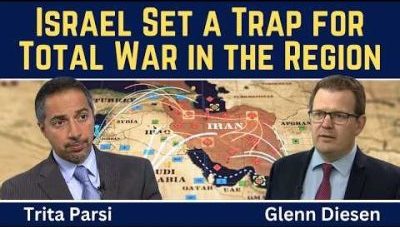
Trita Parsi: Israel Set a Trap for Total War in the Region
or go to
Aletho News Archives – Video-Images
From the Archive
Zionism’s Violent Legacy
By Donald Neff | Washington Report On Middle East Affairs | January 1996
On January 4, 1948, Jewish terrorists drove a truck loaded with explosives into the center of the all Arab city of Jaffa and detonated it, killing 26 and wounding around 100 Palestinian men, women and children.[1] The attack was the work of the Irgun Zvai Leumi – the “National Military Organization,” also known by the Hebrew letters Etzel – the largest Jewish terrorist group in Palestine. The Irgun was headed by Revisionist Zionist Menachem Begin and had been killing and maiming Arabs, Britons and even Jews for the previous ten years in its efforts to establish a Jewish state.
This terror campaign meant that at the core of Revisionist Zionism there existed a philosophical embrace of violence. … continue
Blog Roll
 Aletho News
- Trita Parsi: Israel Set a Trap for Total War in the Region
- Trump’s Iran war is on an Israeli leash
- Saudi oil boss issues global supply warning
- Riyadh Says Its Oil System Is Intact. The Numbers Say Otherwise.
- Trump and Netanyahu Want to “Finish the Job” on Iran
- US ‘one-sided dictation’ not Iran’s beliefs makes rational talks impossible: Baghaei
- Iran’s Next Strike May Not Explode. It Could Shut You Down /Col Doug Macgregor
- Iran: US political targets legitimate if assassinations return
- Iraq shuts key border crossing with Iran under US pressure: Report
- Undersea Internet cables could be targeted in retaliation for attacks on Iran: IRGC deputy chief
- If Americans Knew
- The Israel Lobby’s Changing Fortunes
- AIPAC has become such a political liability that it’s shifting to a more “nimble” approach to buying politicians
- At least 160 Israeli settler attacks in 2 weeks
- Will Gaza’s Ancient Christian Community Disappear Forever?
- Israel’s vision of regional security rests on keeping Arab states weak
- Heidi Levine recounts how Palestinian youths helped save her in settler attack
- DAILY UPDATE: Latest essential news on Palestine, Israel, & region
- Trump’s Intensifying Sabotage of the ICC, for Israel’s Sake
- Israeli military detain US and UK volunteers in West Bank including Democratic NY politician Brad Lander
- Americans at National Conservatism Conference held in Israel this year criticize Israel
- No Tricks Zone
- E-Cars Reduce CO2 Emissions By Only 41% Compared To Internal Combustion Engine Vehicles
- Predictions Made By Renowned Climate Professor Over Past Decades Have Been Proven To Be Poor
- New Study Suggests Large Regions Of The Pacific Ocean Have Been Cooling For The Last 80 Years
- Germany’s Green Energy Debacle: High Energy Costs Force Kahla Porzellan to Close After 182 Years!
- New Study: 50 Years Of The Most Aggressive ‘Net Zero’ Policies Can Only Affect The Global Climate By 0.03°C
- US September “Heat” Was No Record…Many Records Set Decades Ago
- Latest European Green Energy Debacle; Portugal’s Largest Flagship Solar Park Insolvent!
- Green Energy Debacle: German Expert Professor Fritz Vahrenholt Warns Of Severe Economic And Social Consequences
- Two More Paleo Reconstructions Affirm Meters-Higher Sea Levels Across Ireland, Brazil 7000-6000 Years Ago
- New Study: Earth And Venus Surface Warmth Largely Explained By Convection And Lapse Rate, Not CO2 Or Radiation

