Israeli Minister Facebook Rant Blames Brussels Bombing on EU Labeling of Illegal Settlement Goods
21st Century Wire – March 23, 2016
Now here’s another interesting take on the Brussels Attacks.
There are three possible angles you could read this story from:
1. This Israeli minister is essentially saying that because the EU chose to worry about the Palestinian plight, it reaped the scourge of Islamist terror on its capital.
2. This Israeli minister is a few cards short of a full deck.
3. And finally there’s this option: by blaming the EU for accurately labeling its food products that come from from illegal settlements, is this Israeli minister somehow inferring that the Brussels bombing was a retaliation for that EU regulation?
It’s hard to know for sure, but at the very least, the Israeli minister’s off-hand comments are very revealing about the current schizophrenic political mindset in Tel Aviv…
Middle East Monitor – March 22, 2106
The EU’s labeling of goods from illegal Israeli settlements led to the bombing in Belgium, Brussels, today, The New Arab reported an Israeli minister saying.
Minister of Science, Technology and Space, Ofir Akunis, said Europeans lost sight of “terrorism of extremist Islam” by focusing on boycotting Israeli goods instead allowing the attacks to take place.
“Many in Europe have preferred to occupy themselves with the folly of condemning Israel, labeling products, and boycotts. In this time, underneath the nose of the continent’s citizens, thousands of extremist Islamic terror cells have grown,” Akunis wrote on Facebook.
“There were those who repressed and mocked whoever tried to give warning. There were those who underestimated. To our sorrow, the reality has struck the lives of dozens of innocent people.”
EU Urges UN to Join Anti-Russia Sanctions
By Alex GORKA – Strategic Culture Foundation – 23.03.2016
The European Union called on March 18 for more countries to impose sanctions on Russia over Crimea joining the Russian Federation two years ago.
In a statement issued on the anniversary of Crimea’s formal accession to Russia, the EU said it will maintain its sanctions that ban European companies from investing in Russian Black Sea oil and gas exploration.
«The European Union remains committed to fully implementing its non-recognition policy, including through restrictive measures», the European Council, which represents EU governments, said. «The EU calls again on UN member states to consider similar non-recognition measures».
Separately, NATO Secretary-General Jens Stoltenberg urged the EU and United States to maintain their broader economic sanctions against Russia over its support for self-declared republics in the eastern part of Ukraine. «It is important that we continue the economic sanctions», Stoltenberg told an event in Brussels.
The Crimean Peninsula became a part of the Russian Federation on March 18, 2014 after the referendum carried out on March 16 showed 97 percent of voters supported joining Russia.
The Kremlin responded by saying that the issue of Crimea could not be «a matter of negotiations or international contacts». «Our position is known: this is a region of the Russian Federation. Russia has not discussed and will never discuss its regions with anyone», President Vladimir Putin’s spokesman Dmitry Peskov said in a teleconference with reporters.
«In this case we should treat with respect the expression of the will of Crimean residents and the decision which was taken two years ago», he emphasized.
The 28-nation EU imposed its Crimea sanctions in July 2014 and then tightened them in December 2014, banning EU citizens from buying or financing companies in Crimea. The United States, Japan and some other major economies, including Australia and Canada, also imposed sanctions on Russia, whereas many other economically developed nations, like, for instance, China and Brazil, refused to join.
It should be noted that the extension of anti-Russian sanctions is a very much divisive issue inside the European Union.
Hungary and Italy said last week they would not agree to extend the EU’s toughest economic sanctions on Russia, the EU’s major energy supplier, without discussions before the summer.
Germany’s Economy Minister Sigmar Gabriel called on March 17 for the EU to try to create conditions by this summer to lift sanctions.
France’s Minister for the Economy, Industry and Digital Affairs Emmanuel Macron said in January that Paris will look to assist in the lifting of Western backed sanctions on Russia by the summer.
Serbia, a nation in talks on joining the EU, has firmly rejected the idea of joining the sanctions regime.
US Republican Senator John McCain has the reputation of hawk calling for getting tough on Russia. But even he had to admit the fact that the sanctions are becoming increasingly unpopular inside the EU. «I think there is clearly a lot of conversation amongst the Europeans about lifting the sanctions… There are many countries that are looking for the exit sign», the Senator said in February. «I have been hearing it for months, that there is enormous pressure in a lot of countries, particularly Germany, to lift the sanctions», he noted.
At that the prominent US politician believes it is up to Washington if and when the sanctions are eventually lifted, saying that the final decision will «to some degree depend on American leadership». Actually, the US right-wing politician openly stated the EU decision on the sanctions is made under US pressure.
Indeed, the EU is following the US. President Obama announced American sanctions against Russia are to be prolonged for another year on March 2.
The EU obediently chimed in 16 days later.
The attempts of the EU to influence other countries into joining the anti-Russia sanctions regime look especially ridiculous against the organization’s failure to make the tiny nation of San Marino, an enclaved microstate surrounded by Italy, comply with the EU’s demands. The republic is not officially part of the European Union and does not face Russia’s food embargo. According to Rossiyskaya Gazeta, a Russian government daily newspaper of record which publishes the official decrees, statements and documents of state bodies, San Marino and Russia signed an export agreement on March 18 during the International Economic Forum of CIS countries.
San Marino’s Minister of Regional Development and International Economic Cooperation Antonella Mularoni attended the forum. Now this European country will export to Russia a range of products, including Parmesan cheese and premium meat products like local Parma type ham. «There are 24 dairies in the republic, and a lot of enterprises engaged in meat smoking», the executive director of the national wholesalers association Vladimir Lishchuk told Rossiyskaya Gazeta. According to him, imports will take the place of illegal goods bypassing the Russian food embargo. Russia’s food safety watchdog Rosselkhoznadzor said it would monitor food imports from San Marino to prevent re-exports of sanctioned products from neighboring EU countries. Russia introduced the food embargo in August 2014 in response to Western sanctions. The ban applied to meat, poultry and fish, cheese, milk, fruit and vegetables from the United States, the EU, Australia, Canada, Norway, Japan and a number of other countries. According to Russia’s Ministry of Economic Development, the import of banned products has fallen by nearly half to $6 billion in the first six months of 2015. Overall imports from the EU have fallen by 45 percent.
Evidently, the EU’s call for UN members to join the sanctions is an effort doomed to go down the drain. The European Union has no leverage strong enough to make world nations comply.
The organization itself is not in a strong position. Looks like it has seen its best days. Brussels is facing a host of acute problems. Many of them seem to be a tall order, for instance: the flows of migrants, the economic inequality of the Union’s members, debt problem and the conflicting views of the UK and Germany on European integration, to name a few.
Doing away with the divisive issue of anti-Russia sanctions could provide an impetus to making progress in other fields, but Brussels prefers a different approach.
The EU statement shows the Union’s leadership is adamant in its desire to go down the slippery slope risking a revolt among the member-states with tensions running already high inside «the European family».
Turkey’s Erdogan Mentions Possible Brussels Bombing Just Days Before Attack
Sputnik -22.03.2016
Less than a week before the terrorist attacks in Brussels, Turkish President Recep Tayyip Erdogan warned of possible bombings in European cities, including Brussels.
“There is no reason why the bomb that exploded in Ankara could not explode in Brussels, or in any other European city,” Erdogan declared during a ceremony commemorating the 101st anniversary of the Battle of Gallipoli in the coastal town of Canakkale on March 18.
It should be noted that Erdogan’s statement followed the deadly terrorist act of March 13, when a car bomb exploded at a bus stop near Ankara’s central Kizilay Square, leaving 37 dead and over 120 injured. The Turkish head of state blamed Kurdish radicals for the attack and berated European leaders for their refusal to recognize certain Kurdish organizations as terrorist groups.
“The snakes you are sleeping with can bite you at any time,” Erdogan added.
On Tuesday, March 22, the city of Brussels – capital of Belgium and administrative center for both NATO and the EU – was hit by a series of explosions, including two blasts in Brussels Airport in Zaventem, Belgium that left 13 people dead and over 35 injured. An additional 15 people were killed in Tuesday’s explosion at the Maalbeek metro station in central Brussels, local media reported.
‘Turkey and EU make refugees a matter of bargaining – a violation of int’l treaties’
RT | March 19, 2016
The EU countries will receive educated and skilled people, and those who are not skilled and educated, they will remain in Turkey, Yasar Yakis, former Foreign Minister and a former ambassador to the UN Office in Vienna, Egypt, and Saudi Arabia, told RT.
RT: Why do you think that the “one in, one out” Turkish-EU refugee plan isn’t feasible? Who stands to benefit from this plan?
Yasar Yakıs: Both sides are going to benefit, but Turkey was in a position where it couldn’t do anything else but ask the cooperation of the European countries. Theoretically, one may think of a scenario whereby the EU could have closed their doors and not let any refugee come in from Turkey. Turkey, by trying to cooperate with the EU and with the initiative taken by Angela Merkel, at least they decided to share the responsibility of Turkey, open the doors, but of course with certain conditions, and this condition is “one in, one out.” But this doesn’t solve several problems that will entail such a decision. One of them is that the refugees who do not come from Syria, who come from distant countries, Afghanistan and the other countries, why on earth would Turkey accept them if they are already in European Union countries to receive also the refugees coming from the third countries… In my opinion, the deal shouldn’t have covered the refugees originating from countries other than Syria.
Second, since this Syrian crisis we do not see any light at the end of the tunnel; the Syrian crisis will continue for some time. Therefore, if there is nobody readmitted from Greece, the EU will be entitled to refuse any additional refugees coming from Turkey and going to the European Union countries, whereas Turkey will continue to receive refugees from Syria…
Third, the EU will receive refugees on the basis of a selection. That is to say, Syrian refugees having arrived in Turkey will submit their demand to be admitted as a refugee in the EU countries, and the EU countries will look at the qualification of the person. If they agree to receive, they will receive. It means they will receive educated and skilled people, and those who are not skilled and educated, they will remain in Turkey. For these reasons, it will work against Turkey’s interests in the long run.
RT: During the Brussels summit, ministers are also going to debate doubling the deal for the refugee crisis to €6 billion. Turkey was earlier accused of “blackmailing” and “holding the EU to ransom”, for example by UKIP’s Farage, Hungary’s Orban, by demanding money to stop the flood of migrants. How do you view such accusations?
YY: First of all, there are restrictions stemming from the international documents, international treaties, which forbid to make the life of the refugees a question of bargaining. What Turkey and the EU are doing is a violation of the international treaties that all the European countries have signed, and also Turkey has signed. This is one thing.
Secondly, the money that was allocated to Turkey will not be paid to Turkey. Turkey will have to submit to the EU projects. These projects will be financed by the EU – the money will not enter the Turkey’s treasury. There is another difficulty there. And if it is not spent in conformity with the EU relations, then the EU will be entitled to stop the payment.
RT: You said that certain EU member countries may find excuses not to implement the visa-free travel agreement with Turkey. Why do you think so? Why do you think the plan has been stalling so far? Who is being insincere here, Turkey or the EU?
YY: Both sides are sincere, but there are of course always ways for not abiding by the promise. There are two reasons for that. One is the number of the conditions that the EU put in order to start the negotiations. There were 72 conditions that Turkey had to fulfill, and 19 of them were fully fulfilled until recently. And something like 7 of them there was no progress at all. Now we have to see, whether Turkey will be fully compliant with all the 72 conditions.
Secondly, many countries were reluctant and they agreed to the deal only upon the pressure coming from Germany, and they will find other excuses in order not to abide by it. Greek Cypriots may be one of them. There are a lot of EU countries that are not satisfied with Turkey’s human rights records – fundamental rights of freedom. And they say that Turkey should not be given such concessions.
Thirdly, there are countries like France, who say that a refugee deal is one thing, Turkish accession process is another thing. Both of these two things should be assessed, evolve, and should continue to function according to their own rule without interacting between themselves.
RT: Is Turkey ready to accept even more migrants in exchange for visa-free regime with the EU and some €6 billion? Or maybe Europe will see the price tag rising, as Turkey keeps asking for money?
YY: The EU is not monolith, which means that they do not speak with the same language – all of them, 28. They all have different views, which differ slightly form the others. Many countries are looking for excuses, either for not giving money, or for abiding by these international treaties, which bans making the refugee deal a question of bargaining between the sending countries and receiving countries.
Thirdly, for the political reasons, like Greek Cypriots and other countries, as well, they are looking for excuses not to let Turkey’s accession process to the EU to continue. It cannot continue forever. It will be due to the two reasons stemming from Turkey, or stemming from the EU.
RT: Turkey says it’s fighting terrorists in its Kurdish areas, but human rights groups are concerned that civilians are being killed in the crackdown. Do you think civilian causalities can be, are justified by the fight against terror?
YY: For me no civilian causalities are justified. You have to take from the standpoint of a family, who sent their 22-year-old son to the military service, and this young man is fighting there. If you ask this family: “Do you agree that this fight against Kurds should continue, but you may also lose your son?” Most probably in many cases he will say: “No, I want my son! I want that my son’s life should not be given away in exchange of something, which is beyond my family’s concern. Of course, there are also some families in Turkey that say ‘for the security of my country I will sacrifice my son.’ But the majority will say ‘no.’
RT: Has Turkey’s international reputation suffered due to its crackdown on Kurds in Diyarbakir, Cizre etc.? And has Erdogan chosen the right strategy here?
YY: Turkey’s human rights record is going down. Turkey lost a lot of altitude in its international relations. Erdogan’s policy on the crackdown – I have to take it from the beginning. I appreciated it very much President Erdogan’s initiative to solve this Kurdish problem – at that time it was called ‘democratization project’ – so this was a very courageous, bold decision taken by President Erdogan… It is a pity now that this process has collapsed. I wish that Turkey should find one way of resuming the negotiations and continue this process…
Five reasons why the TTIP talks are looking a bit wobbly
By Guy Taylor | TruePublica | February 26, 2016

The twelfth round of negotiations for TTIP, the biggest trade deal of them all, started this week in Brussels. The impacts of TTIP are disturbing and well documented elsewhere on this site, but we are seeing signs of panic setting in on the pro-TTIP side of the fence. They’re right to panic.
1) TTIP is hugely behind schedule. It should have been signed off by now, and well into the ‘legal scrubbing’ stage where the lawyers tie up the legal loose ends and smooth of the rough edges. These negotiations are not open ended. Every delay, every extra month taken up at this stage is a threat to the entire project. We have the US elections looming, two of the frontrunners are against the new generation trade deals like TTIP and the Trans-Pacific Partnership (TPP). There is no secret about the desperation of the Obama machine as they try to get the deal done and signed off before he vacates the White House at the end of the year. Obama is due to visit Germany in April to plead with all concerned to get a move on with the project. It is not impossible for the ratification vote in the European parliament to be held in 2019, after the next elections. That would make ratification in Europe very uncertain indeed.
2) There is a huge crisis over the proposals of corporate courts or ‘ISDS’ as it is often known. As the most contentious part of TTIP, it has attracted huge criticism and upset amongst members of the European parliament and in the public domain as well. In 2014, 150,000 responded to a European consultation on the issue and 97% of those responses were very negative. Since then, the trade commissioner in Brussels has dreamt up the Investor Court System as a proposed alternative. It has been made very clear that ICS is not alternative, more a repackaging of the dangerously flawed ISDS. Earlier this month,the largest association of German Judges completely slammed the ICS idea as undemocratic and undermining the sovereignty of domestic courts. Slowly, our representatives in Brussels are beginning to realise this. We need to keep shouting about this
3) You might have noticed, but there is going to be a referendum on membership of the EU in the UK in June. Everything is up for grabs. If the UK votes to leave the EU, TTIP will probably still apply to us. In the horse-trading and arguments that will rage between now and the day of the vote, there will be concessions and deals struck – maybe, just maybe, TTIP could become a casualty. And in the run up to the referendum, the very idea of Brussels politicians signing off on such a far-reaching corporate power grab is adding a whole lot of fuel to the Brexit fire.
4) Procurement at all levels of government, both sides of the Atlantic is proving to be a sticking point. The EU wants access to state level procurement in the US – that’s a huge market to access. And at country level in the EU there’s an almost equally lucrative market to exploit for US corporations. The trouble is, this isn’t a deal being negotiated at state or nation state level. The US Trade Representative and the DG Trade in Europe are doing their utmost to keep scrutiny and influence at that level to a minimum, but agreeing stuff that is essential to their underlings at local level is part and parcel of TTIP and is inflaming opposition. Local authorities across the EU and in the UK are declaring their opposition to TTIP and CETA. In the States, there’s a similar move afoot. It was recently announced that the EU and USA were going to swap procurement market access offers at the end of this month and then hold a special intercessional meeting to discuss them.
5) And finally, one thing that cannot be ignored, is the growing movement of ordinary people across the EU & the US gaining knowledge and understanding about the deals (despite the best efforts of our governments and media). From the 3.2 million people who signed their opposition in the European Citizens’ Initiative last year, to the trade unions and community organisations saying ‘no’ to the deals, we are building a force that will be hard to resist. We can win this fight if we continue to step up the pressure.
More atglobaljustice.org.uk
Why It’s Dangerous to Conflate Hamas and Daesh
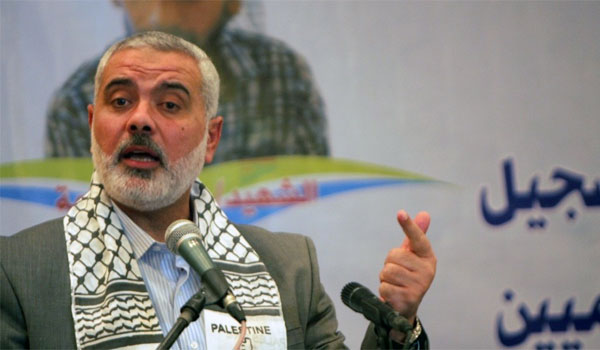
Hamas Prime Minister in Gaza, Ismail Haniyeh
By Belal Shobaki – Al-Shabaka: The Palestinian Policy Network – February 22, 2016
Overview
While Israel’s efforts to link Palestinian resistance to its military occupation to global terrorism are not new, it has expanded its propaganda to address Arab as well as Western audiences. By so doing, it is clearly seeking to exploit the global aversion to movements that have drifted towards extremism and terrorism while claiming to represent Islam. “Hamas is ISIS and ISIS is Hamas,” Israeli Prime Minister Benjamin Netanyahu declared at the United Nations in 2014. Yet better than anyone else, Netanyahu and the Israeli political establishment know that Hamas and Daesh are not related, as do those Arab regimes that also tar all Islamic movements with the same brush to serve their own ends. 1
Not only are Hamas and Daesh unrelated, they are bitter enemies, and Daesh has denounced Hamas as an apostate movement. Al-Shabaka Policy Analyst Belal Shobaki discusses the major ways in which Hamas differs from Daesh including its approach to jurisprudence; the position vis-a-vis the nature of the state; and relations with other religions. He makes the case that it is especially important for the Palestinian national movement to rebut the attempts to conflate Hamas with Daesh and points out the dangers of not doing so.
Serving Short-Term Political Gain
The conflation of Hamas with Daesh ignores reality on the ground. The political environment in Palestine is defined by the occupation, whereas the political environment in the Arab countries where Daesh emerged is defined by authoritarianism and repression as well as sectarian and religious conflicts, an ideal environment for the emergence of a radical ideology motivated by indiscriminate violence.
For Israel, however, the attempt to link the two may pay off regionally and internationally. Many Arabic media outlets have no qualms about referring to this terrorist organization as an “Islamic” State although it is anything but, while many Western media outlets embrace the Israeli conflation of Hamas and Daesh without scrutiny. Arab regimes are uninterested in defending the image of Hamas. Even the Palestinian Liberation Organization (PLO) does not seem concerned with defending Hamas’s international image given the political division between Fatah and Hamas.
Hamas is considered part of the Muslim Brotherhood, which is seen as a threat to authoritarian Arab regimes, particularly in the Arab Mashreq. Thus one way for Arab regimes to fight the Muslim Brotherhood is by claiming it shares common ground or is even synonymous with Daesh, as claimed by the Egyptian regime, and then using this as a justification for excluding the Muslim Brotherhood from participating in political life.
The rapid developments of the past five years in Egypt, the country that provides the only outlet for the Palestinian Gaza Strip, has pushed Hamas into its informal tunnels economy. The official Egyptian stance after Abdel Fattah Sisi’s coup against elected president Mohammad Morsi became tougher against the Gaza Strip, with claims that Hamas was cooperating with Jihadist groups in the Sinai, the same narrative promoted by Israel and its media. However, this narrative is flawed. It is too risky for Hamas to maintain a close relationship with Sinai jihadists, on the one hand, while cracking down on individuals embracing the same ideology in Gaza, on the other. Any links Hamas has established with those groups is limited to securing the needs of the enclave besieged by Israel and Egypt. This interaction is not motivated by a shared ideological identity or shared enmity towards the Egyptian regime. Indeed, Hamas has been eager to keep communication lines open with the Egyptian regime even when accusations conflating Hamas with Sinai’s Salafi Jihadi groups were made in the media. Hamas has also repeatedly said that it is keen on rebuilding the relationship with Egypt in order to ensure the legal flow of goods, services and individuals into Gaza.
It is important to refute this narrative concerning one of the largest Palestinian political movements: Excluding moderate Islamists from political life carries the danger of pushing Palestinian society towards radicalism, in which case both Fatah and Hamas will find themselves fighting takfiri groups. The ensuing discussion will demonstrate the real differences between Hamas and Daesh as well as the very real enmity between them.
Differences in Doctrine
Hamas positions itself as a centrist Islamic movement and an extension of the Muslim Brotherhood, with a rational jurisprudential authority, whereas Daesh adopts a text-based approach that deals with Islamic texts in isolation from their historical context and refuses to interpret them in line with current developments. Hence, for Daesh and other takfiri groups in general, movements like Hamas are secular and un-Islamic, since Hamas is primarily a resistance movement against the Israeli occupation and believes in a moderate Islamic authority. Moreover, Hamas does not take Islamic texts literally; it allows for ijtihad – interpretation and use of discretion. Some scholars have categorized these movements along a horizontal line with the right representing advocates of the text and the left representing advocates of reason. 2 Using this classification, the Muslim Brotherhood can be found a good way down the left of the line, while Daesh is on the far right.
Daesh characterizes Hamas and its discourse as deviant. Hamas for its part has condemned Daesh’s threats and considered these part of a smear campaign that extends beyond Palestine. When threats from Daesh and other takfiri groups materialized into action, Hamas no longer stopped at condemnations. Mahmoud al-Zahar, a prominent Hamas leader, declared “Daesh’s threats can be felt on the ground, and we are handling the situation from a security standpoint. Whoever commits a security offense shall be dealt with in accordance with the law, and whoever wants to debate intellectually shall be debated intellectually; we take this matter seriously”.
Hamas had in fact dealt decisively with a Daesh-like group. In August 2009, Abdul Latif Musa, leader of the “Jund Ansar Allah” (Soldiers of God’s Supporters) armed group, announced the creation of the Islamic Emirate in Gaza at the Ibn Taymiyyah Mosque. The group had previously been accused of destroying cafes and other venues in the Gaza Strip, pushing the Hamas government into a confrontation. Security forces, reinforced by the al-Qassam Brigades (Hamas’ military wing), encircled the Ibn Taymiyyah Mosque and, when Musa’s group refused to surrender, Hamas ended the emirate project in its infancy by killing the members of the group. Hamas was criticized for its use of violence but justified its actions by arguing that the violence that could have been perpetrated by such groups would have been much worse than that used to eradicate extremism in the Gaza Strip.
Daesh’s supporters in Gaza are far fewer than Hamas’s, mainly due to the fact that these groups have not historically contributed to resisting the occupation. Some polls suggest that 24% of Palestinians think positively of jihadist movements, but this percentage is exaggerated. When some Palestinians cheer for the jihadist groups’ hostility towards the US, it is not because they believe in these groups but rather because they see the US, with its infinite support for Israel, as being playing a destructive role.
Different Stances on Statehood
Hamas and Daesh differ in their view of the modern state, in both theory and practice. As noted above, Hamas has always allowed for ijtihad or discretion, evolving its thoughts and opinions. It is thus unfair to assess Hamas’s stance on the civil state and democracy based on the early literature of the mother movement, the Muslim Brotherhood. Hamas maintains that it has embraced new convictions in this regard and has come to fully accept democracy and the concept of the civil state. Indeed, the Muslim Brotherhood itself has evolved. Qatar-based Sheikh Yusuf al-Qaradawi, the jurisprudential authority of the Muslim Brotherhood at large, has stated on multiple occasions, including in his book “The State in Islam”, that the concept of the religious state does not exist in Islam. According to al-Qaradawi, Islam advocates for a civil state founded on respect for the people’s Islam-based opinion, and also founded on the principle of accountability and political pluralism. Although the discussion about the relationship between Islam and democracy predates the Muslim Brotherhood, it gained clarity after the 1950s, when numerous Islamic thinkers, including al-Qaradawi, the Tunisian leader and Ennahda co-founder Rached Ghannouchi and the Algerian philosopher Malek Bennabi, affirmed that Islam and democracy were not in contradiction with each other.
At the opposite end, the movement that Daesh represents rejects democracy in its entirety and considers it an apostate system of governance. Although some jihadist groups do not denounce Islamists who take part in the democratic process as apostates, they do consider their discretion flawed. Daesh views any expression of democracy such as elections as a manifestation of apostasy and any movement or individual taking part in elections as apostates. By contrast, the Muslim Brotherhood participated in elections from its earliest days, when its founder Hassan al-Banna decided to run in the Egyptian parliamentary elections that El-Wafd Party Government sought to hold in 1942. Although al-Banna could not run because the government rejected his candidacy, the Muslim Brotherhood has served in Arab parliaments and sometimes in the executive branch.
When Hamas decided not to participate in 1996 Palestinian Authority elections its position was based on a political and ideological stance towards the Oslo Accords. However, Hamas allowed its members to run in the elections as independents. When the circumstances changed and the 2005 Cairo Agreement became the governing framework for the PA elections instead of the Oslo Accords, Hamas decided to participate. It nominated many members in the movement and some independents to a Change and Reform list to run for the Legislative Council, winning the majority of votes.
By participating in the elections, Hamas has offered evidence that it is willing to function in a modern state and a democratic system. It has called for coalition governments inclusive of leftist and secular parties. Its government as well as its parliamentary list included women and its first government included Muslim and Christian ministers.
Daesh, on the other hand, has turned against all modern institutions in the areas under its control, refusing to recognize borders or national identity. It rules through chaotic and individual decisions. Although Daesh has been eager to use administrative terms derived from the Islamic tradition such as caliphate and shura (consultation), the essence of its governance contradicts the majority of unquestionable texts in the sources of Islamic legislation in many ways. For example, it does not abide by the conditions established in the Quran and sunna (the Prophet Mohammad’s teachings) to declare war or the protection of civilians and treatment of prisoners in wartime. Another example is its imposition of jizya (a tax that was levied on non-Muslim subjects), which is not supposed to be applied to the indigenous inhabitants even if they are non-Muslim. Moreover, it has attacked places of worship and assaulted the faithful in their homes, in clear violation of the Quran and sunna.
Daesh, to some extent, resembles hybrid regimes in the Third World that use modern and democratic vocabulary to describe their political process, even though they remain authoritarian in essence.
Polar Opposites in Treating the Other
The most significant difference between Hamas and Daesh is their position towards followers of other religions. During its formation, Hamas published a charter that used religious vocabulary to describe the conflict. Following severe criticism, Hamas effectively sidelined this Charter and no longer considers it an authoritative reference as some of its leaders have confirmed.
In his interview with The Jewish Daily Forward deputy head of the Hamas politburo Moussa Abu Marzouk confirmed that the Charter was marginal to the movement and not a source for its policies. He added that many members were talking about modifying it because several of Hamas’ present policies contradict it. Hamas’ politburo leaders abroad were not the only ones to disclaim the charter. Gaza-based Hamas leader Ghazi Hamad went even further in an interview with the Saudi Okaz newspaper in which he said the charter was subject to discussion and evaluation in opening up to the world. Sami Abu Zuhri, a young Hamas leader who was the movement’s spokesperson during the Second Intifada, urged in an interview with The Financial Times that focus be shifted away from the 1988 charter, and that Hamas be judged on the statements of its leaders.
Today, Hamas adopts the Quranic verse that reads: “Allah does not forbid you from those who do not fight you because of religion and do not expel you from your homes – from being righteous toward them and acting justly toward them. Indeed, Allah loves those who act justly.” This verse urges kindness and justice when dealing with people of other religions. Unlike Daesh, Hamas has applied this in practice. In addition to appointing Christian ministers to its cabinet, it has celebrated Christmas with Palestinian Christians by sending official delegations to visit during the feast. Meanwhile, Daesh has threatened the lives of those who celebrate Christmas across the world.
Some may argue that these steps are ways in which Hamas tries to beautify its authoritarian rule. However, there is little difference between Hamas’ rule and Fatah’s. The human rights violations committed by Gaza’s government cannot be considered an indication of Hamas’ resemblance to Daesh, but rather an indication of misgovernment. The political leadership of Hamas has spoken out against such practices on occasion, for example as those committed by the Ministry of the Interior under Fathi Hammad.
When some individuals were attacked by extremist groups in Gaza, Hamas and the government acted to ensure their safety and punish the aggressors, as in the case of British journalist Alan Johnston who was freed by Hamas from his radical captors and the killing of Italian solidarity activist Vittorio Arrigoni.
The movement’s position towards the Shiites is similar to that towards Christians. At a time when the Middle East is experiencing a media war between Shiites and Sunnis, Hamas refuses to denounce Shiites as apostates, and has interacted with them politically. When the relationship with Iran became strained during the Syrian crisis, the disagreement was political rather than doctrinal. Daesh, on the other hand, not only thinks of Shiites as apostates, but also all other Sunni groups that hold a different ideology, and believes they must be fought.
Even the two organizations’ treatment of the enemy differs. Hamas identifies the Israeli occupation as the enemy, while Daesh considers everyone else its enemy. Daesh has boasted of its numerous crimes against humanity in its treatment of its abductees and the civilians under its rule, including burning Jordanian pilot Muath al-Kasasbeh alive. It has attempted to legitimize its inhumane conduct by distorting or misinterpreting religious texts. Hamas paid its condolences to al-Kasasbeh’s family and condemned Daesh’s actions. Contrast Daesh’s brutality with Hamas’ treatment of the Israeli soldier Gilad Shalit during his captivity, as even the Jerusalem Post reports.
Moving Forward in Relations with Hamas
Both Hamas and Daesh are on the list of terrorist organizations in many countries, including the member states of the European Union and the United States. However, the listing of Hamas is clearly politically motivated: Unlike Daesh, Hamas has neither targeted nor called for targeting any entity other than the Israeli occupation. Hamas was added to the list of terrorist organizations following the events of September 11, 2001, even though it had nothing to do with this terrorist attack. The political nature of the position against Hamas is underscored by the fact that the General Court of the European Union issued a decision on December 17, 2014, urging the removal of Hamas from the list of terrorist organizations. The Court argued that the order to list Hamas in 2003 was based on media reports rather than solid evidence.
In addition, many European and American dignitaries that are known for their stance against terrorist organizations worldwide have met with Hamas leaders on more than one occasion. Those include European parliamentarians and former US president Jimmy Carter, who met with Ismail Haniyeh in Gaza in 2009 and Khalid Meshaal in Cairo in 2012.
The bottom line is that Israel’s attempt to exploit a chaotic Middle East by implicating Hamas as a terrorist group linked with Daesh is baseless. Hamas is ideologically, intellectually, jurisprudentially and politically different from Daesh. Media outlets that adopt the Israeli narrative hurt their professionalism and credibility.
Palestinian movements must not allow the disagreement with Hamas to justify the accusations that harm the Palestinian cause internationally and create tensions locally. Hamas must also realize that the differences between them and Daesh do not mean that its rule of Gaza is free of abuses and human rights violations, and must therefore revisit its conduct and be more careful in its political discourse. It should move beyond the approach of having one discourse for local consumption and another for global consumption since every word uttered by any Hamas leader is marketed abroad as a message from Hamas to the world.
When the Fatah-led Palestine Liberation Organization (PLO) and Arab regimes, especially in Egypt, do not oppose the efforts to link Hamas with Daesh – or, indeed, occasionally contribute to these efforts – they may “benefit” in the short-term by weakening Hamas as a political opponent. However, this carries the dangers of destabilizing Palestinian society in the medium and long-term. Excluding moderate Islamists could push Palestinian society towards radicalism, in which case both Fatah and Hamas will find themselves fighting takfiri groups.
Notes:
- ISIS: The Islamic State of Iraq and Syria. Daesh is the Arabic acronym for ISIS. Some commentators use ISIL: The Islamic State of Iraq and the Levant. The group itself began to use IS in 2014.
- Samir Suleiman, Islam, Demokratie und Moderene, Herzogenrath: Shaker Media, 2013, P 302. Tariq Ramadan, Muslimesin in Europa, Marburg: Medienreferat, 2001, p15.
Al-Shabaka Policy Member Belal Shobaki is assistant professor in the Department of Political Science at Hebron University, Palestine. He is a member of the American Political Studies Association. He has published on Political Islam and identity and is now working on a book on the Palestinian division. Shobaki is the former Editor-in-Chief of Alwaha Newspaper in Malaysia. He was also a Lecturer in the Department of Political Science at An-Najah National University and the Head of the studies Unit at the Palestinian Centre for Democracy and Studies.
One in Three German Companies Intend to Hire Refugees in 2016-2017
Sputnik — 24.02.2016
At least 34 percent of surveyed German human resources directors intend to hire refugees this year or next year, Spiegel Online news website reported, citing a study conducted by the Ifo research center.
It was noted in the article that the number of people who were ready to hire asylum seekers had increased from about seven percent in the past two years.
Europe has been beset by a massive refugee crisis, with hundreds of thousands of undocumented migrants fleeing their home countries to escape violence and poverty. According to German Interior Ministry estimates, the country registered some 1.1 million refugees in 2015, nearly five times more than the number registered in 2014.
Featured Video

Dan Dicks with James Corbett on Solutions Watch
or go to
Aletho News Archives – Video-Images
From the Archives
Secret document reveals plans for civil war in Lebanon, Israeli false flags, and invasion
By Randi Nord | Geopolitics Alert | April 5, 2019
Beirut – During his visit with US Secretary of State, Mike Pompeo, Lebanese President Michael Aoun reportedly received a US-Israeli document detailing plans for creating a civil war in Lebanon with covert false flag operations and possible Israeli invasion.
Although the source of the document is Israeli and created in partnership with Washington, no one knows who presented it to Aoun. The Lebanese TV station, Al-Jadeed, initially reported the document on Lebanese TV and a video on its website. Geopolitics Alert translated the report for this article. … continue
Blog Roll
 Aletho News
- Sheikh al-Asadi warns of Iraqi government compliance with US demands
- How to MAKE THE CONSPIRATORS PAY for their crimes! Dan Dicks with James Corbett on Solutions Watch
- There’s a drought in academia: A drought in honest research on the subject of drought and other weather extremes
- Department of War Awards $20.7 Billion Contract to Raytheon for Air-to-Air Missiles
- ‘Distance yourselves from Israel’: IRGC urges US population to question govt policies
- America’s Greenland deal has a radioactive backstory
- The RAF Fairford ‘terror plot’: Unpacking escalation in the UK echo-chamber
- EU Council Advances Chat Control 2.0 Scanning Proposal
- Ex-Greek MEP files complaint against Israeli spyware firm over alleged Pegasus surveillance
- Troubling ideas throughout the Torah, Talmud, Mishneh Torah and Tanya
- If Americans Knew
- New Report: “Scholasticide and Genocide in Gaza: Assessment, Testimonies and Legal Analysis”
- Ex-Biden officials are desperate for a Gaza scapegoat
- Israeli “settlers” Invade Al-Aqsa; Pour Boiling Water on 75-Year-Old
- Israel Has Kidnapped Another American Teenager
- US arms sales to Israel worth $21.6 billion in 20 months
- Three Palestinians Killed in Israeli Attacks on Gaza
- Revealed: German “Anti-Semitism Expert” Driving Crackdown on Palestine Solidarity is Former Israeli Spy
- Egypt’s Warning to Israel Before Oct 7
- Israel’s siege signals another cruel winter for 1.8 million Gazans – Daily Update
- Netanyahu Asked UAE Leader to Deny Report on Oct. 7 Warning in Secret Visit, Sources Say
- No Tricks Zone
- An error has occurred; the feed is probably down. Try again later.

