How EU is Pressuring Serbia to Abandon Relationship With Russia
Sputnik | July 17, 2016
European Parliament rapporteur for Serbia David McAllister signaled Thursday that the EU remains committed to enlargement in the Western Balkans. However, Eurocrats regard the Russo-Serbian relationship as a stumbling block in Belgrade’s way to EU accession.
European Parliament rapporteur for Serbia David McAllister warned Belgrade Thursday that Serbia’s intention to maintain close relations with Russia would not be tolerated by Brussels in the long run.
“The European Parliament sent a signal to Serbia through its [January] resolution that a dual approach to Russia could not be tolerated in the long run,” McAllister said at the press conference in Belgrade dubbed “The European Union’s Global Strategy on Foreign and Security Policy and the Western Balkans,” as quoted by Balkan Insight.
McAllister also urged Belgrade to reduce its “dependency” on Russian oil and gas, claiming that Brussels wants to see Serbia abiding by the EU energy market rules.
Ahead of the conference McAllister clarified his position in an interview with Europe Western Balkans media outlet.
“The Serbia-Russia relations have often been debated. Serbia has traditionally strong economic, social and cultural ties with Russia,” he admitted.
However, he claimed that since Russia “unilaterally changes European borders” and tries to “expand its influence” over its neighbors, Belgrade “needs to make strong efforts in aligning its foreign and security policy to that of the EU, including the policy on Russia,” referring to the EU sanctions regime imposed on Moscow.
Much in the same vein Nathalie Tocci, adviser to EU Foreign Policy and Security Chief Federica Mogherini, described Serbia’s prospects for EU membership in her interview with Tanjug.rs:
“In the accession process, a country is expected to meet all accession criteria and align itself with common European rules through negotiations, which implies both foreign policy and security. In that regard, I see the relationship with Russia as the biggest challenge for Serbia — as it gets closer to EU membership, Serbia will be expected to also get closer to the EU in terms of its position regarding Russia, but that is something that cannot happen overnight,” she said as quoted by the media outlet.Nevertheless, the Serbian government does not want to abandon its ties with Moscow, insisting that it intends to maintain fruitful diplomatic relations with both Russia and the West.
“I… wish to underline that in the process of decision-making Serbia had a continued consistent stance that at this very stage of the accession process it could not uphold all EU decisions. In some cases Serbia did not align with the EU positions, respecting its national interest concerning the issue of preserving its territorial integrity and the need to maintain traditionally good relations with other partners as well, first and foremost with Russia and China,” Foreign Minister Ivica Dacic told the press conference on Thursday.
He stressed that Serbia has proven to be a “reliable and true” partner of the EU and bemoaned the fact that despite Belgrade’s strategic foreign policy orientation toward full EU membership, the process “has not had particularly live dynamics so far because in the last two years we opened only two negotiating chapters.”
At the conference Dacic underscored that the time has come to reexamine what was done to Serbia back in 1999, and threw into question Kosovo’s self-proclaimed sovereignty. He recalled that US Assistant Secretary of State told him that the US has been investing in Kosovo’s independence for 20 years.
“Then I think the mistakes must be sought not only in our system,” he stressed, as cited by B92.net.
He emphasized that neither Russia nor China recognize Kosovo’s independence.
Later, commenting on the EU officials’ remarks Dacic told Serbian daily newspaper Novosti, as cited by Balkan Insight: “It could not be expected from Serbia to introduce sanctions on its friends.”
In his interview with Sputnik former Serbian diplomat Zoran Milivojevic noted that Serbia has its own national interests and the right to protect them.
“There are no reasons [for Serbia] to reconsider its relation with other nations, especially with United Nations Security Council permanent members and traditional friends of Serbia, Russia or China,” Milivojevic told Sputnik.
The diplomat stressed that it is inappropriate for Brussels to set such conditions on the very early phases of Serbia-EU negotiations, referring to the fact that Belgrade and the EU are yet to discuss the 31st chapter of EU accession related to Serbia’s foreign policy. Only when the chapter is opened the issue of the Russo-Serbian should be brought into the spotlight, he stressed.
Brexit: A Workers’ Response to Oligarchs, Bankers, Flunkies and Scabs
By James Petras :: 07.14.2016
The European Union is controlled by an oligarchy, which dictates socio-economic and political decisions according to the interests of bankers and multi-national business. The central organs of power, the European Commission (EC), the European Central Bank (ECB) and the International Monetary Fund (IMF) have systematically imposed austerity programs that have degraded working conditions, welfare programs, and wages and salaries.
EU policies demanding the free immigration of non-unionized workers to compete with native workers have undermined wage and workplace protections, union membership and class solidarity. EU financial policies have enhanced the power of finance capital and eroded public ownership of strategic economic sectors.
The European Union has imposed fiscal policies set by non-elected oligarchs over and against the will and interests of the democratic electorate. As a result of EU dictates, Greece, Spain, Portugal and Ireland have suffered double-digit unemployment rates, as well as massive reductions of pensions, health and educational budgets. A huge transfer of wealth and concentration of decision-making has occurred in Europe.
Rule by EU fiat is the epitome of oligarchical rule.
Despite the EU’s reactionary structure and policies, it is supported by Conservatives, Liberals, Social Democrats, Greens and numerous Leftist academics, who back elite interests in exchange for marginal economic rewards.
Arguments for the EU and their Critics
The pro-EU power elite base their arguments on concrete socio-economic interests, thinly disguised by fraudulent ideological claims.
The ideological arguments backing the EU follow several lines of deception.
They claim that ‘countries’ benefit because of large-scale transfers of EU payments. They omit mentioning that the EU elite secures the privatization and denationalization of strategic industries, banks, mass media and other lucrative national assets. They further omit to mention that the EU elite gains control of domestic markets and low wage labor.
The EU argues that it provides ‘free movements’ of capital, technology and labor – omitting the fact that the flows and returns of capital exclusively benefit the powerful imperial centers to the detriment of less advanced countries and that technology is controlled and designed by the dominant elites which also monopolize the profits. Furthermore, the ‘free flow of labor’ prejudices skilled productive sectors in less developed countries while reducing salaries, wages and benefits among skilled workers in the imperial centers.
The EU : A Self-Elected Dictatorship of Empire Builders
‘Integration into the EU’ is not a union of democratic participants; the decision-making structure is tightly controlled by non-elected elites who pursue policies that maximize profits, by relocating enterprises in low tax, low wage, non- unionized regions.
European integration is an integral part of ‘globalization’, which is a euphemism for the unimpeded acquisition of wealth, assets and financial resources by the top 1%, shared, in part, with their supporters among the top 25%.
The EU promotes the concentration of capital through the merger and acquisition of multi-national firms which bankrupt local and national, medium and small scale industries.
Political and Academic Satraps of the EU Elites
The European Union’s oligarchy has organized a small army of highly paid politicians, functionaries, advisers, experts and researchers who support the European Union in a manner not unlike NGO workers in the developing world – answerable only to their ‘foreign’ paymasters.
Numerous Social Democrats draw stipends, travel expenses, lucrative fees and salaries as members of commissions and serve on impotent ‘legislative’ assemblies.
Academics advise, consent —and draw duplicate salaries from membership in the EU bureaucracy. Journalists and academics ‘front’ for the EU oligarchy by playing a leading propaganda role. For example, they have been busy slandering British pro-democracy, anti-EU voters by (1) calling for a new referendum and (2) questioning the right of the working class electorate to vote on issues like the recent EU referendum.
The leading financial press adopts a demagogic pose accusing the pro-democracy voters of being ‘racists’, ‘nativists’, or worse, for ‘opposing Eastern European immigration’.
In fact, the vast majority of workers do not oppose immigrants in general, but especially those who have taken once-unionized jobs at wages far below the going rates for established workers, on terms dictated by employers and with no ties or commitment to the community and society. For decades British workers accepted immigrant labor from Ireland because they joined unions at wage rates negotiated by union leaders, won by long workers struggle and voted with the majority of English workers. Under the EU, Britain was flooded with Eastern European workers who acted as ’scabs’ displacing skilled British workers who were told it was ‘progress’. This acted to destroy the prospects of their own children entering a stable, skilled labor market.
The financial press’s lurid descriptions of the British workers’ anti-EU ‘racism’ against Polish immigrant labor ignores the long history of Warsaw’s virulent hostility to immigrants–namely the refugees from the wars in the Middle East. The Polish government and population exhibit the most furious opposition to sheltering the thousands of Middle East and African war refugees, while claiming that they are not ‘Christians’ or might pose cultural or even terrorist threats against the ethnically pure Polish population.
Some of the British workers’ hostility toward Polish workers has a recognized historical basis. They have not forgotten that Polish strike breakers took the side of ‘Iron Lady’ Thatcher’s militarized assault against unionized UK miners during the great coal strikes and even offered to export coal to aid the Conservative government in breaking the strike. As such, EU-Polish immigrant workers are not likely to integrate into the militant British working class culture.
The Polish regime’s aggressive promotion of the economic sanctions against Russia has further undermined English jobs linked to that large and growing market.
The financial press ignores the fact that Polish immigrants ’scab’ on unionized British workers in the construction industry, undercutting long-established UK plumbers, electrical workers, carpenters and laborers – who have multiple generational ties to their communities and work. The EU elites use the importation of Polish workers to strengthen the reactionary labor policies of the employers
After the fall of Communism, Polish workers backed a succession of right-wing regimes in Warsaw, which privatized and denationalized industries and eroded their welfare system leading to their own impoverishment. Poles, instead of fighting against these neo-liberal regimes at home, headed for England and have been helping the British bosses ever since in their own anti-labor campaigns to reduce wages and decrease worker access to decent, affordable housing, public services, education and medical care.
The Eastern Europeans became the willing recruits of the EU reserve army of labor to raise profits for industrial and finance capital thus further concentrating wealth and power into the hands of the British oligarchs.
To label British workers’ antipathy to these EU policies over the free entry of cheap immigrant labor, as ‘racist’, is a blatant case of blaming workers for opposing naked capitalist profiteering. It is not hard to imagine how the Poles would react if skilled Syrian electricians were taking their jobs!
The pro-EU prostitute press claims that the pro-democracy voters are ‘anti-globalization’ and a threat to England’s living standards and financial stability.
In fact, labor votes in favor of trade but against the relocation of English industry overseas. Labor votes for greater investment in the UK and greater regional diversity of productive, job-creating sectors, as opposed to the concentration of capital and wealth in the parasitic finance, insurance and real estate sectors concentrated in the City of London.
The EU-City of London-financial oligarchy have priced labor out of the housing market by promoting the massive construction of high-end luxury condos for ‘their kind of immigrant’, i.e. the millionaire and billionaire Chinese, Russian, Indian, Eastern European and US plutocrats who flock to London’s famous tax-evasion and money-laundering expertise.
The scribes of the EU-City oligarchy who claim that exit from the EU will lead to a cataclysmic breakdown are blatantly scaremongering. In fact, the stock and bond market, which declined for less than a week, rebounded sharply, as trade, production and demand were scarcely affected by the vote.
The hysteria-peddlers among the financial press resounded . . . in the minds and pockets of the City of London speculators. They rightly feared that their own lucrative financial operations could relocate overseas.
Conclusion
If and when the EU – City end their oligarchical control over the British economy, workers will gain an opportunity to debate and elect freely their own representatives and have a say in their own government. Leaving the EU is just the first step. The next move will be to change the rules for immigrant labor to accord with the standards of wages and conditions set by UK trade union organizations.
The following steps would include subordinating the banks to the needs of industry, investment in public housing for workers and the development of local technology for domestic producers.
The cleavage between productive labor and the EU parasites and their political hangers-on requires a new political leadership with a democratic foreign policy, which precludes overseas wars and imperial alliances.
The break with the EU logically and persuasively argues for a break with NATO and an opening toward free trade with Russia, China and the new dynamic global markets. The end of the EU can help weaken the strategic partnership between the European and City of London oligarchs. No doubt, the latter will not go without a class war of unprecedented ferocity, involving financial lockouts, manufactured fiscal crises, street mobs and parliamentary coups at the top of their agenda.
Only if the democratic electoral majority becomes a cohesive and combative class movement, in and out of Parliament, can they convert the referendum from a temporary electoral win to a stable basis for structural transformation.
Only a democratic majority can implement a fair and equitable immigration policy that strengthens labor and welfare policies and which would be based on the traditional values of British trade unionism and not on some criteria parroted by the ‘house servants’ for the lords of the EU-London ‘Downton Abbey’.
Arms firms profiting from refugee crisis bought ‘access’ to Scottish politicians
RT | July 13, 2016
Arms firms like Airbus, which are cashing in on border security deals to hold back refugees, paid for exclusive access to ministers of the Scottish Parliament (MSPs), a new report claims.
Airbus, the seventh-largest arms producer in the world, makes jets, helicopters and even drones, which are marketed for border security purposes.
The ‘Border Wars’ report by Dutch group Stop Wapenhandel claims that arms firms, including Airbus, “provide the equipment to border guards, the surveillance technology to monitor frontiers, and the IT infrastructure to track population movements.
“Most perverse of all, it shows that some of the beneficiaries of border security contracts are some of the biggest arms sellers to the Middle East and North African region, fueling the conflicts that are the cause of many of the refugees,” the group said.
The report claims that such businesses are cynically “creating the crisis are then profiting from it.”
“Moreover they have been abetted by European states who have granted the licenses to export arms and have then granted them border security contracts to deal with the consequences.”
Airbus allegedly enjoyed privileged access to MSPs as part of its membership of the Scottish Parliament and Business Exchange (SPBE).
The SPBE does not regard itself as a lobbying group and is a registered charity in Scotland, however firms must pay to sign up. Companies involved in the past include security giant Serco and energy firm Shell.
Speaking to the Ferret investigative news website on Wednesday, Mark Akkerman of Stop Wapenhandel said arms firms are determined to influence “national government and politicians in European countries.”
“Even though the lobbying by Airbus in Scotland is probably not focused on military or border security issues, I think the company’s business of fueling conflicts and profiting from the refugee crisis should be reason enough to be very cautious about maintaining any relationship with it.”
Campaign Against Arms Trade (CAAT) spokesman Andrew Smith told the Ferret that Airbus “has sold military equipment to regimes with appalling human rights records. The Eurofighter, which it has worked closely on, has been central to the Saudi-led devastation of Yemen.”
He warned that arms firms enjoy a “totally disproportionate voice in the corridors of power” and that the Scottish Parliament should reject their advances.
Scotland’s Holyrood parliament canceled its own membership of the SPBE in March.
Western leaders support terror groups in Syria, get extremism at home – Assad
RT | July 10, 2016
Terrorist attacks, an unprecedented refugee influx and other problems with which Europe is struggling to cope are the result of wrong decisions made by European leaders, Syria’s president Bashar Assad told a European Parliament delegation.
“The situation in Syria and the whole region naturally affects Europe a lot due to its location and social ties. The problems Europe faces today of terrorism, extremism and waves of refugees are caused by some western leaders’ adoption of policies which do not serve their people,” Assad told the delegation headed by Javier Couso, Vice Chairman of the foreign affairs committee of the European Parliament, who had been visiting Damascus, Syrian state news agency SANA reported.
This is especially true “when those leaders give support and political cover to terrorist groups inside Syria,” the president added.
He stressed the role that the European Parliament should play in fixing the policies of some of European countries which had let terrorism evolve. Economic sanctions imposed against Damascus have impacted the Syrian people, who were forced to leave their homeland, Assad also said.
Couso noted that the delegation is planning to take steps that would help change western countries’ rhetoric and will call for the lifting of sanctions, which he described as “unfair”.
He promised to “inform the Europeans on the real state of affairs in Syria and on how people suffer from terrorism,” the report said.
Syria plunged into chaos in 2011, when public protests escalated into an armed uprising as foreign powers warned the Assad government against cracking down on the protest. As violence expanded, radical groups and criminal gangs hijacked the process, turning Syria into the bloodiest battle zone of the modern world.
Foreign nations opposing Damascus, including Turkey, Saudi Arabia, Jordan, the United States and the United Kingdom, have been providing various Syrian opposition groups with aid, saying that only by supporting armed groups trying to topple the Syrian government can the conflict be stopped.
The US and other western countries aided so-called ‘moderate rebels’ in Syria with weapons and training, saying this would help them defeat both the Syrian army and terrorist organizations, which capitalized on the turmoil in Syria. The effort led to some embarrassing moments, for instance when the initial training program for the moderates produced only a handful of fighters after months of recruiting.
Saudi Arabia and Qatar are among the key providers of Syrian rebel groups with military and financial assistance, including some powerful Islamist groups seeking to turn Syria into a country governed by the Sharia law.
Turkey, which was hit most among Syria’s neighbors by the refugee crisis, hosting almost two million asylum seekers, is among the vocal opponents of Damascus too. Critics accuse Ankara of turning a blind eye on rebel activities in its territory, including recruiting, arms shipments and getting medical assistance.
Jihadists from terrorist groups like Islamic State and Al-Nusra Front are among those benefiting from such policies. IS staged a number of bloody terrorist attacks in Turkey since its rise to power in Iraq and Syria, killing hundreds of people. The organization also claimed responsibility for several high-profile attacks in Europe and the US.
The European delegation arrived in Damascus on Saturday. The group visited refugee center in the Syrian capital and met soldiers undergoing treatment in the Hamish hospital.
Read more:
Jihadists that US kept off terror list attack UN humanitarian convoy in Syria – MoD
Al-Nusra Front in Syria gets daily weapons supplies from Turkey – Russian military
Western officials criticize Damascus in public but secretly deal in private not to upset US – Assad
James Petras: Imperialism Cannot Be Trusted to Abide by Its Agreements

Fars News Agency – July 9, 2016
Dr. James Petras who has been alongside three outstanding leaders of the world – Chile’s late Salvador Allende, Venezuela’s late Hugo Chavez and Greece’s late Andreas Papandreou – as an advisor warns that the United States and other imperialist powers should never be trusted.
The following is a transcript of a recorded interview with professor James Petras by Marwa Osman.
Q: How do you assess the influence of Zionism in setting the agenda for Western governments?
A: I think Zionism has become a very important influence on western, European and US diplomacy, particularly to the Middle East and in particular any questions relating to Israel’s foreign policy. In the US I think it is extremely important. Zionism has set the agenda for the US, it has helped elect officials, it has intimidated critics, it has received enormous funds from the US government and in general we can say that Israel dominates the US policy in the Middle East. The Zionists played a very important role in organizing the invasion of Iraq, they were involved with the war in Afghanistan, they are currently involved in the war inside of Syria, and they have deep positions within the state department and within the Pentagon. In the Pentagon, they have been very prominent in encouraging the US to escalate its wars and destroy the Muslim population in that region. In the treasury department, Israeli Zionists have been influential in imposing sanctions against Iran and I think the agreement was made between Iran and the US despite the pressure from the Zionists and they continue to harass any policy which would implement the Iran-US agreement, that is, what would facilitate trade and investment. So in general, England, France and the United States are very much influenced by Zionist policy regarding the Islamic countries and I think this is a major hindrance to any accommodation and understanding that would lessen the prospect of war and focus attention on the role that Israel plays along with Saudi Arabia as an enemy of the Islamic people and of the population as a whole.
Q: How do you think Zionists have managed to keep such an influence away from the public’s eye and basically away from the media?
A: I think that Zionist influence in the media is enormous. If you look at the major television networks bearing common that Zionists are in the leading positions like CBS, NBS, CNN, New York Times, Washington Post and the Wall Street Journal are very much controlled and influenced by owners and writers tied to Israeli interests. The Financial Times is also no exception to that and that has played a major role in influencing the public opinion and beyond that we have the fact that many Zionists have penetrated the government and they are simply a lobby pressuring the Congress and that plays a role also. Zionists contribute over 60% of the funding of the Democratic Party and about 35 to 40% of Republican Party funding so they influence the government directly and they influence the media and they influence the congress and the electoral process. All of this is accompanied by ferocious attacks on critics of Israel. We have seen many writers and academics who have lost jobs in medical and other professions who have criticized Israel and have been subject to harassment and some have even suffered violent threats against their lives and certainly against their employment.
Q: What are the highlights of your first hand observations during the years you served as an advisor to Andreas Papandreou? Have things changed for the better now?
A: Things are much worse now. When I was in the government back in 1982 till 1985, we implemented a policy much more balanced, criticizing the Israeli aggression against the Palestinians. We saw the Palestinian President at the time, Yasser Arafat, who visited Papandreou and they exchanged similar ideas on the Liberation of Palestine. Papandreou did not pursue his radical commitments that he made in the campaign but he did implement many reforms dealing with women’s rights, with expanding the health programs and the higher education programs. In other words he was an effective social reformer but he did not pursue the maximum agenda which was to withdraw from NATO and from the European Union although he threatened to but it was mainly a bluff. So one can say that in comparison to the current period, Papandreou was certainly much more of a reformer much more effective developing an independent foreign policy than the current governments of Greece. It’s a shame to say that Greece is going backwards rather than at least standing with the independent programs of the past.
Q: Why did the US decide to overthrow the government of President Salvador Allende? Can you depict the depth of US involvement in toppling Chilean government based on your own observations?
A: A number of things that I think are very crucial. One was when the Allende government was democratically elected it proceeded to nationalize the major industries like the copper industry, banks and some of the major industrial plants or turn them into worker represented institutions. So the first objective for Washington, particularly Henry Kissinger, was to undermine the independent economic policy of Chile. The second thing is that Chile served as a democratic alternative in Latin America, an independent foreign policy with good relationships with all of the progressive governments including Cuba and Washington did not want an example in Latin America of a democratically elected socialist government with an independent foreign policy with a critical stance on imperialist wars overseas including the war against China, the US support for the Shah etc. So I think Allende and the socialist government in Chile was overthrown through Washington’s direct involvement with financial aid, with pressures within the Chilean military to eliminate democratically oriented generals and also to pay for certain strikes particularly in the transport industry with the truck owners who were paid very substantial amounts by US CIA officials to paralyze the economy. I was an advisor to the government of Allende at the foreign ministry and I attempted to inform them on the role that Washington was playing in sabotaging the Chilean autonomy in the military. The problem was that the US had a great influence on the military and the military that was allied with the US was not purged and the democratic military officials eventually were ousted and that allowed the coup to move forward.
Q: Comparing the governance model of Allende with Chavez, you believe the reason for Chavez’ success was his structural renewal of the Venezuelan political system while Allende failed to meet its necessity. Do you think this is the reason behind the failure of the uprisings in some Arab countries, while the same fact served as a main factor for the victory of Iran’s 1979 Islamic Revolution?
A: I think both in the case of Imam Khomeini and Chavez, they moved very directly to eliminate the potential of the coup forces in the military. Imam Khomeini got rid of the generals and conspirators of the Shah within the military and therefore eliminated the possibility of intrigues and a military coup. Chavez did the same thing. When he was elected the first thing he did was to evoke a new constitutional assembly and a new constitution was formed and Chavez was very influential in the recruitment and promotion of democratically constitutionally oriented military officials so when Washington promoted the coup against Chavez it was defeated. They only captured a small minority of the military and unlike Allende who believed that the military was a democratic force not taking account of the long term ties to the United States under the previous right wing government. I think that the changes in the military and in the constitution were crucial to the advancement in Iran and Venezuela by making the military and civilian electoral processes work hand in hand. There are many other reasons for the failure of the uprisings in different Arab governments. They failed to mobilize the masses, they relied on simple maneuvers in parliament and elections. They didn’t attempt to organize an independent military that would be nationalistic anti-imperialist. Many of those so called progressive Arab governments were themselves very corrupt and thought they could make deals with the United Sates and I think ultimately fooled themselves and left their countries vulnerable to military coups, US interventions etc. It is hard to believe that if 1 million Arab fighters were recruited in Iraq, they couldn’t have prevented an invasion but Saddam Hussein was too much manipulated by Washington thinking that he could make deals with Washington against Iran and other adversaries with other Persian Gulf countries and he was wrong.
Q: How did you see the mindset of President Papandreou, President Salvador Allende of Chile, and President Hugo Chavez in their fight against US dictatorship?
A: Well I think Papandreou was committed to winning the vote and the only way to win the public vote was by taking public opinion. Greece had suffered a military dictatorship like the Shah of Iran. In the early 60s and late 70s Greece had been under right wing governments which hindered Greece’s independence in its foreign policy. They prejudiced Greece’s living standards and in that sense Papandreou was able to understand the dynamics of civil society and to win an election. Now the problem with Papandreou was that he thought he could work within the capitalist system, he thought he could modify capitalism to make it more responsive, he thought he could work with the European Union and NATO and bring them in a more progressive direction and so while he pursued reforms he misread the natures of the limitations imposed by the structure. So on the one hand he would take positions but would take right turns. So it was a very paradoxical situation; I know I used to visit Papandreou to advise him on policies and he would take notes on paper of what I would suggest as an independent anti-imperialist policy and I thought I was having a major influence but when I left the office his secretary told me that I was followed by the US ambassador, so he was playing both sides by using a lot of my advice and criticism on the one hand to make speeches in parliament and on the other hand make practical decisions aligned with his conferences with the US embassy. Now with Chavez, it was a much different story. Chavez was much more committed, honest and in tune with the people. I was in many meetings with President Chavez, I spoke with him in the Sorbonne in Paris where we shared a platform. He was very much committed to fighting imperialism and he was the only major president in the west that opposed the war on terrorism. He said it shouldn’t be a war on terrorism, it should be a war on poverty and misery that create violent confrontation. For opposing Washington’s policies in the Middle East he became a target. Now I think President Chavez was a brilliant political and social analyst but I think he made mistakes by depending too much on the oil industry and social programs when he should have diversified the economy by focusing on being less dependent on oil and more on developing Venezuela as a diversified economy and one that was capable of being more self-sufficient. Allende was a contradiction in the sense that he was very democratic, very socialist but had weak understanding of the military basis, of popular basis for sustaining the government. He believed that every government would respect democracy and of course he was very naive. Washington never paid any attention. They used democracy as a tool to destroy the government. They exploited the weaknesses of the electoral process, they destroyed the independent military and carried out the coup which led to about 15 years of dictatorship and a reversal in all the major changes in agriculture reform, national ownership of the media and resources etc. So I think one has to have a more comprehensive look. You cannot trust imperialism to abide by its agreements.
Q: Are there any interesting memories during the years as their advisor to recall?
A: A lot of it depends on the issues. I once went swimming with Papandreou and when we were swimming I saw that there were people in scuba suits and I asked him why these people were swimming around and he said these are my bodyguards because we received intelligence information that the Mossad may try to assassinate the President Papandreou while we were swimming. So I found that amusing that the president of a country engaged in a vacation with me and at the time took the concern and right to defend himself even under water. Now with President Chavez, I was very impressed by his capacity to not only to engage in serious discussions but also had a very bright kind of a touch with the people. When we finished a major meeting he met with different admirers and audiences and some of them were from his region of the country and President Chavez engaged in a song contest with some of them. I was amused by the fact that Chavez knew the popular songs that corresponded to the audience that attended him in the informal session. And finally with president Salvador Allende, I remember my first meeting with him and it was in the middle of the Vietnam war and I was part of the anti-war movement and I had just come from the United States and I asked President Allende if he could give a statement and he immediately sat down and taped a rousing speech in defense of the Vietnamese and against US imperialism. I was very respectful because he was at that time playing a leading role in the government and taking the time to engage in international solidarity with the American people’s struggle against the war. And clearly Allende distinguished between the progressive American people and the imperialist government in Washington.
Russia Pushes Back on NATO Expansion
By Natylie Baldwin | Consortium News | July 9, 2016
Can Russian President Vladimir Putin turn the tables on NATO and the European Union in the Balkan states that are not yet members of the Atlanticist project? According to Filip Kovacevic, a political science professor who specializes in Russia and Eastern Europe, Putin has a plan. Some details were provided in an exclusive report in May on the nascent project by Russia to counter NATO expansion into the remaining Balkan countries that have not yet been swept into the Western alliance.
The plan has its origins in the grassroots movement that arose in the aftermath of the first Cold War, which called for non-alignment and cooperation with both East and West. Kovacevic describes the movement as follows:
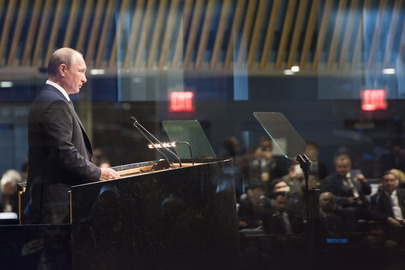
Putin addresses the UN, 09-28-15. (UN Photo)
Their members were generally young people who were enthusiastic, honest and genuinely committed to the public good, but were plagued by the lack of funding and faced with frequent media blackout and open discrimination. Nonetheless, their programs articulated the most promising and humane geopolitical vision for the Balkans. They conceptualized the Balkans as a territorial bridge between the West and the East rather than as the place of persistent confrontation, or the ‘line of fire’ as formulated by the U.S. Secretary of State John Kerry in 2015. They wanted the Balkans to become a force for peace and human dignity in the world. Their vision still remains the best option for the Balkans people.
This desire for non-alignment is understandable as a continuation of the policy of Tito’s Yugoslavia during the Cold War – the nation that several of the modern day Balkan states were a constituent part of. However, according to Kovacevic, these groups were easily overwhelmed, in terms of both financial and propaganda resources, in the 1990s by pro-NATO forces in the West.
In addition to providing resources to build up pro-NATO sentiment in the media and NGO sectors of these countries, financial resources and pressure was used to sway a large number of politicians to favor NATO membership, often in opposition to the general population’s views. Some of the unsavory forms of incentive or pressure include what amounts to blackmail and bribery, Kovacevic told me in an email interview:
This is a long-term process. In the U.S. intelligence community it is called ‘seeding.’ The intelligence scholar Roy Godson defines it as ‘identifying potential agents of influence’ at an early stage and then acting to advance their careers. This is typically done covertly, but there have been the historical examples of overt support. …
In the Balkans, the key role in the process of ‘seeding’ was accomplished by various institutes, conferences, retreats, grants, etc. For instance, I was told by a confidential source who participated in the same U.S.-NATO program, the long-time foreign minister and one-time prime minister of Montenegro, Igor Luksic, was a product of such a process. Luksic was chosen as a very young man to attend various conferences and retreats in Brussels and Washington and, after that, his political career really took off. All the while, he promoted the NATO agenda in Montenegro, even though this went against the will of the majority of the population.
Another example is Ranko Krivokapic who was the speaker of the Montenegrin Parliament for over a decade. He traveled on official business to the U.S. a few times every year and boasted to others that he had a lot of friends in the State Department and other institutions of the U.S. government. There are examples like these in Serbia, Macedonia, Croatia, etc. All over the Balkans.
There is also the fact the European Union has dovetailed its security arrangements to such an extent with NATO that new members are now virtually brought into the NATO structures by default. For example, Mahdi D. Nazemroaya, author of The Globalization of NATO, reports that the E.U.’s Security Strategy was absorbed into NATO during its annual summit in 2006. The emphasis of the summit was on securing energy resources with the goal of ‘co-managing the resources of the EU’s periphery from North Africa to the Caucuses.’ Also implied was the goal of redefining the E.U.’s security borders in synch with both Franco-German and Anglo-American economic and geopolitical interests.
Moreover, British Russia scholar Richard Sakwa, has pointed out that the security integration of the E.U. with NATO was further intensified with the ratification of the Treaty of Lisbon in 2007:
As for the comprehensive character, this is something that has been gaining in intensity in recent years as the foreign and security dimension of the E.U. has effectively merged with the Atlantic security community. The E.U.’s Common Foreign and Security Policy (CFSP) since the Treaty of Lisbon (the “Reform Treaty”) of 13 December 2007, which came into effect in 2009, is now in substance part of an Atlantic system. Acceding countries are now required to align their defense and security policy with that of NATO, resulting in the effective ‘militarization’ of the E.U.
At this point, the forces seeking a non-aligned bridge role for the Balkan states are still very much around, but have suffered marginalization due to lack of resources to take on the powerful and now entrenched pro-NATO political forces. However, with increasing discontent with the weak economic prospects in certain Balkan states, combined with increasing instability in the E.U., it is believed that there is an opening for growth of the movement.
Economic Conditions in the Balkans
The Balkan states comprise Romania, Bulgaria, Albania, Macedonia, Serbia, Kosovo, Montenegro, Bosnia-Herzegovina and Greece.
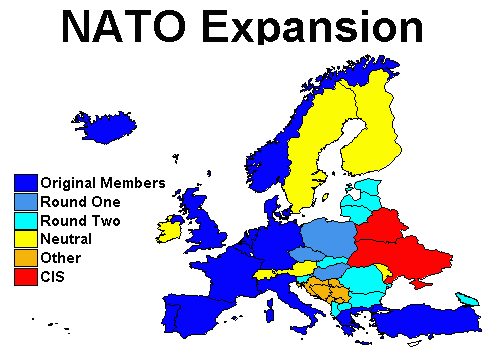
A map showing stages of NATO’s expansion. Dark blue showing original members; lighter blue the “round one” members; aqua the “round two” members; yellow represents neutral states; and brown and red otherwise aligned (including Ukraine, although that has changed since the 2014 U.S.-backed coup).
In 2007, Romania and Bulgaria became E.U. members (three years after joining NATO). Romania’s GDP has barely kept up with its 2008 rate and has a general unemployment rate of 6.4 percent, which sounds reasonable until you look at the youth unemployment rate of 21 percent, which doesn’t bode well.
Bulgaria, on the other hand, is not part of the Eurozone and has not adopted the euro as its currency. Its economic prospects since joining the E.U. have not been impressive either. In the midst of the financial crisis of 2009, its GDP contracted by 5.5 percent, with a current unemployment rate of 7 percent and youth unemployment at 17 percent. Bulgaria is also recognized as one of the union’s most corrupt countries.
Macedonia, Montenegro, Serbia, Kosovo, Bosnia-Herzegovina and Albania are all in the process of E.U. integration, with a supposed approval rate of 80-90 percent among the respective populations of these countries (except for Serbia), despite the virtual rape of Greece and the lackluster performance of Romania and Bulgaria.
It should be noted that all three Balkan nations that are actual E.U. members have higher emigration than immigration rates, another indication that accession to the E.U. doesn’t necessarily translate into a prosperous future for the average person, particularly the young.
There is also the instability highlighted by the British people’s vote to leave the E.U., spurred by disgust with austerity measures imposed by unaccountable bureaucrats in Brussels along with an influx of immigrants – one-third from these poorer E.U. nations – which adversely affect lower-wage natives.
Even if the E.U. had a better track record of effectiveness in terms of improving economic conditions for the masses, it would have a very tall order with some of the prospective Balkan states. Macedonia, for example, has an unemployment rate between 24 and 25 percent as of January 2016, although it has improved from the 2005 high of 37 percent. Despite this improvement, Macedonia still has one of the lowest GDPs in Europe and 72 percent of its citizens claimed they manage their household income only with “difficulty” or “great difficulty” in 2012.
Bosnia-Herzegovina is still feeling the effects of the war of 1992 to 1995 that included major physical destruction of infrastructure and the bottoming out of its GDP. It currently suffers an unemployment rate of 42-43 percent.
Kosovo, a state that owes its existence to a NATO intervention, has 33 percent unemployment, a high crime rate and increasing political violence due to ethnic tensions and a growing ultra-nationalist movement. The Council of Europe compared the government of Kosovo to a mafia state in a 2010 report which revealed trafficking in human organs as well as drugs and weapons throughout Eastern Europe, even implicating the then-prime minister in the operation.
Russia’s Opening
Kovacevic states that the Atlanticist project of E.U. austerity economics and the enabling of Washington’s destabilizing wars via NATO is starting to chip away at its popularity among Balkan populations. He also says Putin is prepared to take advantage of this opening and, since the outbreak of the Ukraine crisis, has turned his attention “to the Balkans with political force and funding not seen since the days of tsar Nicholas II.”
This attention has manifested in the Lovcen Declaration, which was signed on May 6, by members of Russia’s largest political party, United Russia, and the opposition Democratic People’s Party in Montenegro in the village of Njegusi. Kovacevic explains:
One of the most powerful political figures in Montenegro, the metropolitan Amfilohije, the chief bishop of the Serbian Orthodox Church in Montenegro, was present at the signing and gave his blessing. Though in the past Amfilohije has been known to support the authoritarian and pro-NATO prime minister Milo Djukanovic around the election time, he has always publicly opposed NATO membership and has given fiery speeches on its ‘evil nature’ to the point of accusing NATO for continuing Hitler’s anti-Slavic project.
Even more importantly, Amfilohije’s involvement with the Lovcen Declaration reveals one of the fundamental components of Putin’s overall geopolitical plan – the nurturing and intensification of the religious Christian Orthodox connection between the Russians and the Orthodox peoples of the Balkans. This includes not [only] the Serbs, Montenegrins and Macedonians, but also the Greeks and Bulgarians whose states are in NATO and whose religious ‘awakening’ can easily subvert NATO from the inside.
Criticism and minimization of the project have set the tone in Western media, to the extent that it has been covered at all, particularly in relation to utilizing an opposition party for significant influence. But Kovacevic argues that such a dismissive attitude is disingenuous:
[T]he very same method has been used by the U.S. and NATO intelligence services to control the governments of East-Central European states since the collapse of communism. Countless small parties with just a handful of parliamentary deputies were formed with the money coming from the various ‘black budgets’ with the task of entering the governing coalition and then steering the entire government in the direction charted by their foreign founders and mentors.
These parties have had minimal public legitimacy, but have made a great political impact with their ‘blackmail’ potential. As they also don’t cost very much, the CIA, the MI6, and the BND regularly create them for every new election cycle.
Now the Russians (primarily, the SVR and the GRU) are using the same rulebook for their own geopolitical interests. In addition, however, Putin’s grand design for the Balkans embodied in the ANS is also likely to prove durable not only because it builds on the traditional cultural and religious ties linking Russia and the Balkans, but also because it rides on the wave of the enormous present popular dissatisfaction with the neoliberal Atlanticist political and economic status quo.
The fact that this declaration was signed in Montenegro is most relevant due to the fact that the country has been officially invited to join NATO, whose subsequent membership is treated in the West as a fait accompli. However, accession requires consensus approval by all current NATO members – one member could veto the move before completion of the process as happened with Macedonia when Greece vetoed their membership aspirations in 2008 when an invitation was to be offered at the Bucharest Summit – as well as approval by the population of Montenegro.
Joining any alliance treaty is arguably something that affects national sovereignty, which requires a referendum as Kovacevic, who is Montenegrin, explains:
The corrupt government of Milo Djukanovic is trying to avoid a national referendum because it knows that it does not have a majority support for NATO. If given a choice, the people of Montenegro would reject the protocol. The Constitution requires a referendum for all matters that affect national sovereignty, but Djukanovic is arguing falsely that NATO membership leaves Montenegrin sovereignty intact.
Kovacevic predicts that a show-down over NATO membership could create instability in the country: “[I]f he [Djukanovic] tries to push this decision through the Parliament (which he no doubt will), wide-scale strikes and demonstrations may take place all over the country. Whoever is pushing Montenegro in NATO is dangerously destabilizing the country in mid-to-long term.
If that happens, Washington may find for the first time in recent memory that forcing instability on a smaller country may ultimately accrue benefits to another great power, helping to facilitate a shift in geopolitics that it didn’t bargain on. As Nazemroaya comments in his book:
The [NATO] alliance is increasingly being viewed as a geopolitical extension of America, an arm of the Pentagon, and a synonym for an evolving American Empire. … Ultimately, NATO is slated to become an institutionalized military force. … Nevertheless, for every action there is a reaction and NATO’s actions have given rise to opposing trends. The Atlantic Alliance is increasingly coming into contact with the zone of Eurasia that is in the process of emerging with its own ideas and alliance. What this will lead to next is the question of the century.
Natylie Baldwin is co-author of Ukraine: Zbig’s Grand Chessboard & How the West Was Checkmated, available from Tayen Lane Publishing. In October of 2015, she traveled to 6 cities in the Russian Federation and has written several articles based on her conversations and interviews with a cross-section of Russians.
Imagining a Different Europe: Brexit and the Future of NATO
By Gary Leupp | CounterPunch | July 7, 2016
Everyone’s talking about the future of the European Union after the Brexit. Should we not also be wondering about the future of NATO?
The two organizations substantially overlap. Twenty-two countries are members of both; that is, the twenty-two nations are both military allies of the U.S. (which pays two-thirds of the alliance’s cost and controls its politics) and members of an economic union, which—while it of course does not include the U.S., which is 5000 miles away—is of much interest to the world’s only surviving superpower.
Of course the EU and NATO have very different purposes. As we all know, the EU represents an effort to create a common market throughout the continent, allow for free travel and employment between member-states, the formation of common standards, policies etc. We know there have been major downsides for some member countries, involving reduced sovereignty, uncontrolled immigration, indebtedness and austerity programs, etc. But the stated goal, to spread general affluence, and therefore prevent war, has been stated since the EU’s forerunner, the European Coal and Steel Community, was formed in 1951.
Thus, while it’s arguably none of the U.S.’s business, U.S. leaders express opinions on EU composition. (You might think that, as leaders of a competing trading bloc, with the same relationship to the EU that Boeing has to Airbus, they would maintain a politic silence. But both presidents George W. Bush and Barack Obama have urged the EU to admit NATO ally Turkey’s admission. And Obama recently raised a ruckus in the United Kingdom when he urged its electorate to reject Brexit.)
The purpose of NATO is less clear than that of the EU. Formed in 1949 in line with the “Truman Doctrine” pledging that the U.S. would fight communism wherever it threatened the “Free World,” it was supposed to be a defensive alliance between the U.S. and its European client states versus some future (imagined) Soviet aggression against those states.
That aggression needless to say never happened. In retrospect the Cold War appears a long period of stability, with the exception of the horrific wars the U.S. inflicted on Korea and Vietnam while the Soviets stood aside, and the war the Soviets waged in Afghanistan to suppress the rebels opposed to the secular Soviet-backed government (who were then backed by the CIA, because they were so anti-communist, that being the main thing), who went on to became the Taliban and al-Qaeda.
Europe itself was actually remarkably stable during that Cold War, from 1945 to 1989. Since then there’s been horrific violence, especially in southeastern Europe, much of it exacerbated by the U.S. and NATO.
After the collapse of the Soviet Union and the dissolution of the Warsaw Pact (formed in 1955 in belated response to NATO, after NATO decided to include West Germany) in 1991, you might have thought that NATO would dissolve too. But no; it redefined its mission as maintaining “security” in a newly insecure situation. Its purpose is in fact stated in the vaguest terms. Its real function is to preserve U.S. hegemony over post-Soviet Europe, expand to surround Russia and ultimately create the conditions for a Yugoslavia-type fracturing of the Russian state—which for some reason U.S. military leaders keep referring to as the “number one threat” or even “existential threat” to the U.S.!
How the U.S. Uses the EU
The U.S. attempts to use the EU for its own geopolitical ends, particularly for this confrontation with Russia.
For example: from late 2013 to February 2014 the U.S. State Department spent $5 billion in Ukraine in order to (in the words of Under Secretary of State for Eurasia Victoria Nuland, a former Dick Cheney aide, neocon married to neocon Robert Kagan and key Hillary crony) “support the Ukrainian people’s European aspirations”—meaning the hopes of many Ukrainians for their country to join the EU.
But what Nuland, the Pentagon and NATO leaders in Europe really wanted to do was to pull Ukraine into NATO, completing the creeping encirclement of Russia that had begun with NATO’s expansion to include Poland, Czechoslovakia and Hungary in 1999.
NATO now already includes 11 countries formerly part of the Soviet bloc (Warsaw Pact) or Yugoslavia, most added during Bush’s administration but two (Albania and Croatia) admitted since. In all cases, by the way, these states first received admission into NATO, then into the EU.
Bulgaria: joined NATO 2004, EU 2007
Croatia: NATO 2009, EU 2013
Czechoslovakia: NATO 1999, EU 2004
Estonia: NATO April 2, 2004, EU May 1, 2004
Hungary: NATO 1999, EU 2004
Latvia: NATO April 2, 2004, EU May 1, 2004
Lithuania: NATO April 2, 2004, EU May 1, 2004
Poland: NATO 1999, EU 2004
Romania: NATO 2004, EU 2007
Slovakia: NATO, March 29, 2004, EU May 1, 2004
Slovenia: NATO, March 29, 2004, EU May 1, 2004
Notice a pattern? First a country commits itself to an anti-Russian alliance with the U.S., committing 2% of its GDP to military expenses and pledging to go to war against Russia when called upon to do so. Then it gets access to the benefits of EU membership.
Back to Ukraine. Ukraine in early 2014 included the Crimean Peninsula, home to the Russian Black Sea Fleet from the 1780s, a vital naval port for the Russian state that has only a few warm-water ports. (Crimea had been turned over from the Russian Soviet Socialist Republic to the Ukrainian Soviet Socialist Republic by half-Ukrainian Premier Nikita Khrushchev in 1954. After the break-up of the USSR in 1991, Russia retained its traditional military presence on the peninsula by a treaty with the Ukrainian leaders.)
But the U.S. would like to expel the Russians and make Sevastopol a NATO port. (This is not only Vladimir Putin’s nightmare; it would be a nightmare for any Russian leader. Look at a map.)
In 2013 the president of Ukraine, Viktor Yanukovych, democratically elected in an internationally monitored election in 2010, negotiated with the EU for his country’s eventual entry into the union. A substantial portion of the population, especially in the western part of the country, favored this. But when Yanukovych realized that steps towards admission would involve accepting an austerity regime comparable to that inflicted on Greece, he opted out, instead accepting a generous Russian aid offer.
Nuland & Co. depicted this as a pro-Russian leader’s capitulation to Russian pressure; again, their talking point was “Ukrainian people’s European aspirations.” (In fact, Ukrainians were divided on the issue, with fewer than 50% in favor of EU membership.)
Ukraine is ethnically divided between ethnic Ukrainians (who speak a language related to Russian, although the two languages are not mutually intelligible) and ethnic Russians who have always spoken Russian. (Russian has always been a recognized official language in the country.) There has been much intermarriage between the two, but among the ethnic Ukrainians there are many Russophobes including neo-fascists who glorify Stepan Bandera, an anti-Russian Ukrainian leader who worked with the Nazis to round up Jews and fight the Soviets in 1941. (He was declared a “national hero” by Yanukovych’s predecessor Viktor Yushchenko, a pro-U.S. advocate of NATO admission. Yanukovych withdrew this award, but it has been reinstated by the current regime.)
Taking advantage of this Russophobia, the U.S. depicted Yanukovych’s change of mind as a betrayal of “European” dreams. Working with the neo-fascist Svoboda Party, among others, it assisted in the brutal putsch of February 22, 2014, that caused the president to flee for fear of his life. A new, pro-NATO government was immediately installed, with Arseniy Yatsenyev as prime minister.
“Fuck the EU!” …and then Use It!
This is where the story gets interesting, because it reveals what the EU means to the U.S., and what it doesn’t. In an intercepted phone conversation between Nuland and the U.S. ambassador to Ukraine a month before the coup, they discuss who will succeed Yanukovych once he’s toppled. She favors NATO proponent “Yats.” The ambassador mentions the the EU favors a different candidate, whom she thinks is inappropriate. They discuss how Yatsenyev will be legitimated by a UN official sent by Ban Ki-moon.
“So that would be great, I think, to help glue this thing and to have the UN help glue it,” she concludes, “and, you know, Fuck the EU.” (In other words, this is not about any European’s aspirations. It’s about ours.)
So the coup comes off as planned. The obviously prominent role of neo-fascists in the new regime, and the immediate revocation of the existing law protecting language rights frightened and angered the primarily Russian inhabitants of the Donbass region (where Yanukovych had his base of support). They refused to accept its legitimacy. (Their resistance is invariably represented by the U.S. press in the service of the State Department as a Moscow-inspired rebellion or even Russian “invasion.”)
Russia refused to recognize the new government and quickly moved to re-annex its historical territory of Crimea. The Russian-majority population of Crimea overwhelmingly voted in a credible referendum to reunite with Russia. The U.S. media often refers to this as another “invasion” although it was nothing of the sort; there were tens of thousands of Russian troops in place by longstanding agreement, who simply secured government buildings and the borders.
Hillary Clinton, among others, likened this move to Hitler’s annexation of the Sudetenland in 1938. That is to say: something that must not meet with appeasement. And so (people are taught to believe), the practical Russian response to U.S. efforts to complete the expansion of NATO is the problem, not NATO’s relentless advance against Russia itself. Russia under Putin is the worrisome aggressor, not the U.S. leaders who invade a new country like clockwork every few years, boasting that they need to do it because theirs is the “exceptional” nation.
Some in the Obama administration favored a military response to the separatists in the east; they wanted to further arm the new regime and encourage it to assert control over the Donbass if not Crimea. It is clear this was the view of U.S. Gen. Philip Breedlove, the “Supreme Allied Commander” of “NATO Allied Command Operations” in Europe. We know from intercepted emails exchanged between him and Nuland (whom he refers to affectionately as “Toria”) that he was frustrated by the failure of Obama to order the Ukrainian puppets to more forcefully invade the east. (Initial efforts to do this had resulted in mass desertions, or soldiers retreated in the face of unarmed citizens including old women shaming them into abandoning their mission. It was a tremendous embarrassment to the Kiev regime.)
Obama decided not to heed Breedlove. In place of hot warfare he chose economic warfare. Here is where the EU comes in. In July 2014 the union (that Nuland wanted to fuck) dutifully voted to impose economic sanctions on Russia. (Again, 22 of the 28 EU members are also NATO members; the only ones that aren’t are Sweden, Finland, Ireland, Cyprus and Malta.)
The U.S. is of course not an EU member but it had a reliable surrogate within the union: the United Kingdom, which has strongly argued for sanctions, their expansion and extension to the present. (Frank Holmes, managing editor of US Global Investors, calls Britain “the bloc’s strongest supporter of restrictions.” The conservative Washington D.C. website The Daily Caller calls it the U.S.’s “strongest E.U. ally against Russia”).
The UK, which had far less to lose from the sanctions than many other EU nations, was urging its partners to shoot themselves in the foot. It was asking them to punish Russia (and damage themselves). The continental Europeans went along, some grudgingly.
Regrets (and Maybe Rebellion?)
Many have come to regret it. The Czech and Hungarian leaders have long been questioning the sanctions and expressing displeasure. Of course they want, as new members of the EU and NATO, to be team players. But their people are suffering from lost trade and pressuring them to protest. Thus Czech President Milos Zeman has called the sanctions “not merely inefficient; on the contrary, they are counterproductive.” (Only 35% of Czechs according to a 2015 Gallop poll support the sanctions.)
Hungarian Prime Minister Viktor Orban calls the sanctions a “risk in the EU… very deep, of a strategic nature.” (European Council president Donald Tusk, a Pole, calls Orban a “Trojan Horse” for Russia while Orban says Tusk is “on the other side” for opposing an easing of sanctions.)
In May, Hungarian Foreign Minister Peter Szijjarto told Russian Foreign Minister Sergey Lavrov that his government “definitely cannot accept that a decision [by the EU, on extending sanctions] was made behind the scenes, that is, we are against using an automatic procedure.” (In Hungary, only 29% of those polled favor the sanctions.)
The Polish regime has been among the most supportive of the U.S. position; anti-Russian sentiment is deep in that country for various historical reasons, and 70% of those polled support sanctions. But the Polish farmers are suffering from them. One-third of the apples harvested in Poland two years ago went to Russia; now the trade is forbidden.
Meanwhile in Spain farmers burn EU flags over piles of rotting peaches to protest the collapse of their relations with the Russian marketplace. The European Commission keeps having to pay out millions of euros to partly compensate farmers and merchants for their losses due to sanctions.
French MPs in April this year voted for a resolution to lift EU sanctions on Russia. Minister of Economy Emmanuel Macros has vowed to work towards lifting them. Italian cabinet ministers and the lawmakers in Italy’s Upper House of Parliament also want to rethink them. Maybe they’re all Trojan Horses, but if so, that’s good.
The role of Germany in the EU, as the most populous and wealthiest country in Europe, is more important than ever following the Brexit. While it has been, along with France, a strong supporter of the sanctions and their continuation, public support is waning. In May a German pollster found that 36% of Germans want the sanctions scaled down, while 35% want them scrapped entirely.
The sanctions have had disastrous impact on the German economy. Since they were imposed exports have declined by about 20 billion euros. Alstom has lost a huge contract for the construction of the Beijing-Moscow railway line. The business community generally wants the sanctions dropped.
There appears to be a general feeling that the U.S. (which is feeling few effects from the sanctions it itself imposed on Russia) pressed the EU (especially through Britain) to take measures that are not in Europe’s interest. And some surely realize that what this is all really about is the U.S.’s desire to punish Russia for thwarting its effort to bring Ukraine into NATO—through that cynical device of Victoria (“Fuck the EU”) Nuland of supporting Ukraine’s “European aspirations.
As it happens, 67% of Germans oppose bringing Ukraine into NATO, and 45% oppose bringing it into the EU. Most importantly, German support for NATO has been plummeting; it was 73% in 2009 but was 55% last year. And when asked whether Germany, in the event of a Russian attack on an east European border state that is a NATO member, should fight on the side of that state, only 38% say yes according to a Spring 2015 Pew poll.
According to the same poll, that figure is 40% in Italy, 47% in France, and 48% in both Poland and Spain. In other words, over half the people of these countries oppose the very nature of NATO as “mutual defense” alliance.
This raises the real possibility of countries leaving NATO, as well as the EU. Czech president Milos Zeman has called for referendums on his country’s membership in both. German Foreign Minister Frank-Walter Steinmeier has criticized the recent joint maneuvers in Poland, in which 14,000 U.S. troops, 12,000 Polish troops, and 800 from Britain participated as “saber-rattling.”
“Whoever believes,” he warns, “that a symbolic tank parade on the alliance’s eastern border will bring security is mistaken. We are well-advised to not create pretexts to renew an old confrontation.” In other words, the U.S. is steering NATO towards war with Russia, which the Germans know is not a good idea.
Who would have imagined a few years ago that the UK would ever leave the EU? Imagine the Czech Republic leaving this confrontational NATO alliance, joining its prosperous neighbor Austria by opting for neutrality. Imagine the Germans (who have many reasons to be angry towards the U.S., including the fact that the NSA spies on all of them) becoming fed up enough to hold their own referendum and quitting the bloc.
There is something of a precedent. France shocked the U.S. when it pulled out of the NATO Integrated Military Command Structures in 1966, in order to, as President Charles DeGaulle put it “preserve French independence in world affairs.” (It remained committed in theory to the defense of alliance members but only rejoined with conditions in 2009.)
France, which has military bases all over the world and deploys troops routinely in Africa and elsewhere (it cooperated with the U.S. in overthrowing Aristide in Haiti in 2004, as if to apologize for having opposed the U.S. war in Iraq), is very different from Germany with its stiff constitutional limits on the use of its military and generally pacifistic population. Within the EU, it is likely to replace the UK as its most important hawkish member, while Germany is likely to urge reconciliation with Russia.
There are contradictions within both the EU and NATO. They are interwoven, and some look irresolvable. That again is a good thing.
Post-Brexit, Is the EU Flaunting Its Undemocratic Tendencies?
By Joyce Nelson | CounterPunch | July 6, 2016
Stung by Brexit, the EU bureaucrats seem intent on showing just how undemocratic they can be. Here are two examples just in the last seven days.
The Glyphosate License
On June 24, EU member states again refused (for a third time this year) to approve a renewal of the license for the weed-killer glyphosate manufactured by Monsanto and other corporations involved in GMO crop cultivation. That should have meant that the license would expire by the end of June, and Monsanto’s Roundup and other glyphosate weed-killers would have to be withdrawn from Europe by the end of this year.
Instead, on June 29 the European Commission (EC) decided “unilaterally” to extend the glyphosate license for another 18 months. [1]
The decision “drew heavy criticism from the Greens in the European Parliament, who said the decision showed the Commission’s ‘disdain’ for the opposition by the public and EU governments to the controversial toxic herbicide.” [2] Belgian Green Member of the European Parliament Bart Staes said, “As perhaps the first EU decision after the UK referendum, it shows the [EC] executive is failing to learn the clear lesson that the EU needs to finally start listening to its citizens again.” [3]
Many were simply shocked that an unelected body of bureaucrats would cater so blatantly to the corporate sector’s last-minute lobbying.
The EC claims that, because of member nations’ indecision on the matter, its own decision about glyphosate was based on assessments made by the European Food Safety Authority (EFSA), prolonging the authorisation until a new scientific review is concluded before the end of 2017, but Greenpeace has called the EFSA study “a whitewash.” [4]
Lawrence Woodward, co-director of Beyond GM, has called the EC’s unilateral decision “reckless.” [5] It comes at the same time that dozens of individuals and organizations have signed an open “Letter from America,” urging European citizens, politicians and regulators to not adopt a “failing agricultural technology” and sharing examples of glyphosate and GMO repercussions across North America. [6]
CETA Ratification
At virtually the same time that the EC made this controversial decision on glyphosate, it made another that is even more undemocratic.
On June 28, a German news agency reported that European Commission President Jean-Claude Juncker told EU leaders the Commission is planning to push through a controversial free trade agreement between Canada and the EU – known as CETA, the Comprehensive Economic and Trade Agreement – without giving national parliaments any say in it. [7] According to the German press, Juncker argued that allowing national parliaments to vote on the agreement would “paralyze the process” and raise questions about the EU’s “credibility.” Juncker claimed that CETA “would fall within the exclusive competence of the EU executive” and therefore doesn’t need to be ratified by national parliaments within the 28-nation bloc, sources in Brussels told the Germany news agency DPA. [8]
Most EU members, however, view CETA as a “mixed” agreement, meaning “that each country would have to push the deal through their parliaments.” [9]
In late June 2016, the EC’s Juncker was reported as saying that he “personally couldn’t care less” whether lawmakers get to vote on CETA. [10]
Millions of Canadians and Europeans have fought against CETA for the past six years. Like the TPP and TTIP, it is a draconian agreement that would hand multinational corporations immense power to overrule elected local governments on numerous fronts. In Canada, CETA was supposed to be voted on by every Canadian provincial and territorial government before any ratification could take place, but in September 2014 (during the reign of Stephen Harper) the CETA deal was signed without there having been any public consultation whatsoever in Canada. The 2014 announcement was also the first time people in Canada and Europe were allowed to see the official text, which had been kept secret during the years of negotiations.
Unfortunately, Canada’s International Trade Minister Chrystia Freeland is enthused about what the EU is doing. According to The Globe and Mail newspaper (July 3), “The British vote to exit the European Union has refocused
Europe’s attention on the need to send a message to the world that liberalized trade is the path to greater prosperity, Ms. Freeland said.” [11]
She also explained that once the European Parliament approves CETA, “a great deal of the agreement would come into force immediately, more than 90 per cent,” she said, “those portions deemed to be within the European Union’s jurisdiction, those go into force right away.” [12]
Freeland told The Globe and Mail that concerns about CETA’s investor-state dispute settlement (ISDS) mechanism – which allows multinational corporations to sue governments over regulations that harm their future profits – had been addressed by a rewrite of the treaty’s investment chapter. [13] But according to Council of Canadians, those changes “actually make [the provisions] worse. The reforms enshrine extra rights for foreign investors that everyone else – including domestic investors – don’t have. They allow foreign corporations to circumvent a country’s own courts, giving them special status to challenge laws that apply equally to everyone through a [private] court system exclusively for their use.” [14]
Prime Minister Justin Trudeau will be in Europe this week for a NATO summit, and officials “say he will lobby hard for other European leaders not to stand in the way of [CETA’s] ratification.” [15]
The Pushback
Reportedly, the pushback in Europe has been immediate, with Germany and France wanting “their national parliaments to be involved” in CETA ratification. On July 5, Deutsche Welle reported that “Juncker appears to be backtracking,” and would propose at a July 5 EC meeting that CETA would require “both the approval of the European parliament and national legislatures.” [16]
The Globe and Mail reported on July 5 that Juncker’s “new recommendation… could call for applying those EU parts of the treaty while the ratification process [by national legislatures] is under way.” [17] That would mean (as Canada’s Chrystia Freeland had earlier explained) more than 90% of CETA could be approved by the EU as part of its “jurisdiction” and needing no national legislative approvals. Such a process would make a mockery of democratic rights on both sides of the Atlantic.
That appears to be what is happening.
Following the July 5 EC meeting in Strasbourg, France, the CBC reported: “Legal opinions advanced by the commission suggest that most of the agreement – perhaps as much as 95 per cent – falls comfortably with the European Union’s jurisdiction… ‘This is an agreement that Europe needs,’ EU trade commissioner Cecilia Malmstrom said in a statement. ‘The open issue of competence for such trade agreements will be for the European Court of Justice to clarify, in the near future. From a strict legal standpoint, the commission considers this agreement to fall under exclusive EU competence. However, the political situation in the council is clear, and we understand the need for proposing it as a ‘mixed’ agreement, in order to allow for a speedy signature’.” [18]
But as nations gear up to wrangle with the EU (in the European Court of Justice) over what parts of the CETA treaty fall within their jurisdiction, and what parts “fall under exclusive EU competence,” the EC could approve 95% of CETA before elected legislatures even vote.
The Council of Canadians warns on its website (July 5): “One important concern to note, ‘The commission may recommend provisionally applying the EU-parts of the Canada deal while full ratification is pending.’ The French newspaper Le Monde has previously reported that even if CETA is deemed to be a ‘mixed’ agreement, the deal could enter into force ‘provisionally’ even before EU member state parliaments vote on it. It notes, ‘If EU ministers agreed at the signing of the CETA on its provisional application, it could come into effect the following month. Such a decision would have serious implications. Symbolically, first because it would send the message that European governments finally [have] little regard for the views of parliamentarians and thus of European citizens strongly against the agreement’.” [19]
Council of Canadians National Chairperson Maude Barlow stated after the EC meeting in Strasbourg, “Like many Canadians, Europeans are worried about CETA’s attacks on democracy, its weakening of social and safety standards, its contribution to privatization and attacks on public services. After the Brexit vote, policy makers on both sides of the Atlantic would be better counseled to listen to voters, rather than pushing discredited [trade] solutions down people’s throats.” [20]
Global Justice Now director Nick Dearden has called CETA a “toxic deal” and says that the way the EC is acting “reinforces the widely held suspicion that the EU makes big decisions with harmful consequences for ordinary people with very little in the way of democratic process,” he said. “Rather than take a step back and question why there is hostility to the EU, they try to speed up this awful trade deal.” [21]
Union members, environmentalists, social activists and “fair trade” groups say CETA is just as dangerous as the proposed Transatlantic Trade and Investment Partnership (TTIP) deal between the EU and the U.S., which hands massive power to multinationals and is a direct threat to democracy on both sides of the Atlantic. The way the EC is handling CETA is a stark clue to what’s in store for TTIP.
Footnotes:
[1] “European Commission Extends Glyphosate License without Real Restrictions,” Sustainable Pulse, June 29, 2016.
[2] Frederic Simon, “EU muddling on glyphosate fuelled Brexit populism,” EurActiv.com, July 1, 2016.
[3] Quoted in ibid.
[4] Ibid.
[5] Katie Pohlman, “Neil Young: Say No to GMOs on ‘Behalf of All Living Things’,” EcoWatch, July 1, 2016.
[6] Quoted in ibid.
[7] “EU Commission Seeks to Push Through Free Trade Agreement with Canada (CETA) without Parliamentary Approval,” Deutsche Welle, June 28, 2016.
[8] Ibid.
[9] Reuters, “EU Commission to opt for simple approval for Canada deal: EU official,” June 28, 2016.
[10] “EU Commission: CETA should be approved by national parliaments,” Deutsche Welle, July 5, 2016.
[11] Robert Fife, “Despite Brexit vote, key EU powers vow to ratify CETA deal,” The Globe and Mail, July 3, 2016.
[12] Ibid.
[13] Ibid.
[14] Council of Canadians, “CETA changes make investor-state provisions worse,” February 3, 2016.
[15] Fife, op cit.
[16] “EU Commission: CETA should be approved by national parliaments,” Deutsche Welle, July 5, 2016.
[17] “EC set to scrap plans to fast-track CETA deal: report,” The Globe and Mail, July 5, 2016.
[18] “Canada gets clarity on how Europe will ratify trade deal,” CBC, July 5, 2016.
[19] Council of Canadians, “CETA to be considered a ‘mixed’ agreement, now more vulnerable to defeat,” July 5, 2016.
[20] Council of Canadians, “CETA vulnerable to defeat: Council of Canadians,” July 5, 2016.
[21] Lamiat Sabin “Brexit ‘Might Not Stop Awful Ceta’,” Morning Star, July 5, 2016.
Joyce Nelson is an award-winning Canadian freelance writer/researcher working on her sixth book.
New Report Exposes EU’s Security Links to Refugee-Creating Arms Dealers
Sputnik | July 6, 2016
Like peace itself, the military-industrial complex sees internal stability as bad for business. A new report has exposed the activities of military and security companies that are profiting from the ongoing conflicts in the Middle East and North Africa, which have also successfully lobbied the EU to react by buying their security equipment.
The joint report by the European NGO Stop Wapenhandel and the Transnational Institute (TNI), called “Border Wars: The Arms Dealers Profiting from Europe’s Refugee Tragedy,” reveals the most prominent winners of security contracts which were issued in Europe as a result of the migrant crisis, and Europe’s acquiescent response to their lobbying.
“Some of the beneficiaries of border security contracts are some of the biggest arms sellers to the Middle-East and North-African region, fuelling the conflicts that are the cause of many of the refugees. In other words, the companies creating the crisis are then profiting from it.”
The big players in Europe’s border security complex include arms companies Airbus, Finmeccanica and Thales, which are also three of the top four European arms traders and have been particularly prominent winners of EU contracts aimed at strengthening borders.
Other companies to benefit from the EU’s policy response to Middle Eastern conflict are French defense and aerospace company Safran, the Spanish IT and defense systems firm Indra Sistemas, and some Israeli companies like BTec Electronic Security Systems, which promote their expertise based on equipment installed at the Israeli-Palestinian border.
French companies Airbus and Thales, and Italian Finmeccanica, are part of the European Organisation for Security (EOS), which has been most active in lobbying the EU for increased border security. The report notes that many of its proposals, such as its push to set up a cross European border security agency, have eventually ended up as policy.
According to the report, the booming border security market was worth an estimated 15 billion euros ($16.5 billion) in 2015, and is predicted to rise to over 29 billion euros ($32 billion) annually in 2022.
New EU member states have been required to strengthen borders as a condition of membership, creating additional markets for profit.
“The arms business, in particular sales to the Middle-East and North-Africa, where most of the refugees are fleeing from, is also booming. Global arms exports to the Middle-East actually increased by 61 per cent between 2006–10 and 2011–15. Between 2005 and 2014, EU member states granted arms exports licenses to the Middle East and North Africa worth over 82 billion euros ($91 billion).”
On Tuesday, the German newspaper Tagesspiegel newspaper revealed that the arms industry could benefit even further from a new direction in the EU’s African policy.
According to the report, the EU Commission intends to direct some funds from its Instrument contributing to Stability and Peace towards equipping African militaries.
The fund was established in March 2014 and has a 2.3 billion euro ($2.5 billion) budget, to be disbursed between 2014 and 2020.
“Development without security and stability is not possible,” a source in the Commission told the newspaper.
“The Commission is therefore considering increasing its support for security actors,” and “in some very special cases,” this will include security forces.
The proposal to spend African development funds on security forces was criticized by the German Green Party MEP Reinhard Butikofer, who described it as “breaking a taboo.”
Die Linke MEP Sabine Losing called the idea “scandalous,” and criticized the “misuse of aid.”
She said the proposal is one of a series of “steps in the militarization of EU foreign policy.”
Featured Video
John Mearsheimer: Why Russia Gains By Hitting Ukraine Harder
or go to
Aletho News Archives – Video-Images
From the Archives
A Climate Scientist Who Engages Skeptics
By Judith Curry | November 27, 2009
An open letter to graduate students and young scientists in fields related to climate research:
Based upon feedback that I’ve received from graduate students at Georgia Tech, I suspect that you are confused, troubled, or worried by what you have been reading about ClimateGate After spending considerable time reading the hacked emails and other posts in the blogosphere, I wrote an essay that calls for greater transparency in climate data and other methods used in climate research. The essay is posted over at climateaudit.org.
What has been noticeably absent so far in the ClimateGate discussion is a public reaffirmation by climate researchers of our basic research values: the rigors of the scientific method (including reproducibility), research integrity and ethics, open minds, and critical thinking. Under no circumstances should we ever sacrifice any of these values; the CRU emails, however, appear to violate them. … continue
Blog Roll
 Aletho News
- Content control: USAID docs expose Biden admin’s grip on Ukraine coverage
- Ukraine destroying itself: every attack on the Crimean Bridge will come at a price
- NATO capital under protest siege, so NATO escalates war
- A Climate Scientist Who Engages Skeptics
- John Mearsheimer: Why Russia Gains By Hitting Ukraine Harder
- Argentina’s Perito Moreno Glacier Joins Antarctica and Arctic In Defying Doomsday Melt Claims
- ‘Chinagate’ Is Here
- Iran, four other countries condemn US plans to deploy weapons in outer space
- US media brings back the Iraq war playbook and why it won’t work
- Zakharova schools German FM on history basics
- If Americans Knew
- An error has occurred; the feed is probably down. Try again later.
- No Tricks Zone
- Alarmist Climatologists In Shock! 2026 Atlantic Hurricane Season Sees Lowest Count In 101 Years
- New Study: Modern Temps Are Among The Coldest Of The Last 10,000 Years In East Central Europe
- Germany’s Renewable Energies Lead to 1.4 Billion Euro Electric Power Trade Deficit
- Argentina’s Perito Moreno Glacier Joins Antarctica and Arctic In Defying Doomsday Melt Claims
- New Study: Barents Sea Temperatures Were Warmer And Sea Ice Less Extensive In The 1700s Than Today
- German Authorities Start Initiative To Evaluate Public Register For Climate “Disinformation” Spreaders!
- Zonal Asymmetry of Temperature Change in the Antarctic Circumpolar Current
- New Study: The Net Fossil Fuel Contribution To Rising Atmospheric CO2 Has Been Zero For 500 Years
- Germany’s Green Energy Transition Becoming Increasingly Expensive…Another 6 Trillion Euros!
- Sudden Stratospheric Warming, Powerful El Niño Combination May Lead To Extreme Europe Cold, Energy Crisis!

