The West’s Voluntary Blindness on Syria
By Eldar Mamedov | LobeLog | July 2, 2015
Recently Netherlands, Belgium and Luxembourg sent a letter to the UN Security Council demanding that Bashar Assad’s regime in Syria end the use of barrel bombs. The foreign ministry of a European country that still maintains a diplomatic presence in Damascus, one of the few, asked for the opinion of its embassy on the matter. The embassy recommended to sign the letter: barrel bombs are indiscriminate and kill an awful lot of civilians. But the embassy also advised its government to condemn the opposition’s use of improvised mortar bombs (known as “hell cannons”) against the neighborhoods under government control. Diplomats say that the rebels have specifically targeted Christian areas for their perceived support for the Assad regime. Back in Europe, the foreign ministry officials admitted that they “haven’t heard anything” about the “hell cannons.”
This is only one example of how dysfunctional EU policy toward Syria has become, as a European Parliament (EP) delegation that visited Lebanon in mid-June learned. An early EU decision to cut off all ties with the Assad regime has not been vindicated by the developments on the ground. Not only has the regime survived, but radical jihadist elements have increasingly dominated the opposition to Assad. The EU, however, failed to modify its strategy accordingly. As a result, regional actors with often disruptive and sectarian agendas have taken center stage. And individual EU member states have also pursued their own policies, which are not necessarily in the interests of the EU as a whole.
The latest example of the distorting influence of the regional actors is the Syrian opposition’s failure to accept the “freeze plan” in Aleppo and surrounding areas proposed by the UN Special Envoy for Syria Staffan De Mistura as a first step toward a negotiated solution. In the UN assessment, the opposition´s foreign sponsors—mainly Turkey, Saudi Arabia, Qatar, and Jordan—bear primary responsibility for this failure, because they have insisted on removing Assad from power as a pre-condition to any agreements.
Such a position is not new. What is new, however, is that these sponsors do not hide anymore that they work directly with Jabhat al-Nusra, al-Qaeda´s affiliate in Syria. They still pretend, however, that al-Nusra is the face of the “moderate opposition,” even though this assertion stems from a PR operation, widely believed to be Qatari-driven and carried out in Western mainstream media and think-tanks. An interview al-Nusra’s chief Al-Golani gave to the Qatar-based Al Jazeera was part of this PR campaign, but it backfired when Al-Golani made it clear that al-Nusra is al-Qaeda and expressed borderline genocidal views on Alawites.
The Dangers of Supporting Jihad
To make matters more complicated, even those rebel groups that are not part of al-Nusra, espouse deeply troubling views. According to a credible UN source in Damascus, a fighter from an obscure group Jaysh al-Ababil active in Syria´s south, has reported that “Syrian people deserve a democracy like in Saudi Arabia.” He boasted that the group “gets anything it needs” from Jordan and that a major offensive to take Damascus from the south, as well as the north, will be launched “very soon.”
If the US and EU had real strategy to end the war they would, in addition to pressuring Assad, demand that their regional allies curb the flow of weapons and recruits to terrorist groups. But they can’t credibly do that, since they are involved in this effort themselves. According to Conflicts Forum, the southern rebel front is managed from US Centcom’s Forward Command in Jordan, which is run jointly by American, Jordanian, Saudi, Qatari, and British officers. … Full article
The Greek Debt Crisis and Crashing Markets
By MICHAEL HUDSON | CounterPunch | June 29, 2015
Back in January upon coming into office, Syriza probably could not have won a referendum on whether to pay or not to pay. It didn’t have a full parliamentary majority, and had to rely on a nationalist party for Tsipras to become prime minister. (That party balked at cutting back Greek military spending, which was 3% of GDP, and which the troika had helpfully urged to be cut back in order to balance the government’s budget.)
Seeing how unyielding the opposition was, Syriza’s stance was: “We would like to pay. But there’s no money.”
This kept throwing the ball back into the troika’s court. The Institutions were so unyielding that Syriza’s approval rating in the polls rose by 13% by June. Greek voters became increasingly incensed at the Troika’s demand for further pension cuts and privatizations.
Tsipras and Varoufakis were willing to pay the IMF with the IMF’s own funds, in what V. called “extend and pretend.” But their only interest in keeping current on debt was to obtain additional funding that could be used to pay domestic pensions and other basic government budgetary expenditures.
The basic tactic in such tensions between creditors and debtors is clear: once debt repayments exceed new loans, stop paying.
So when The Institutions made it clear that no more credit would be forthcoming without Syriza adopting the old Pasok/New Democracy capitulation to Troika demands, Tsipras and Varoufakis decided it was time to call a referendum eight days hence, on Sunday, July 5.
Late Friday night and into the early Saturday morning hours, Greeks ran to the ATM machines to convert their checking and savings deposits into euro notes, expecting that the end game would involve a likely 30% depreciation of the drachma – and that indeed, the ECB would stop lending to support Greek banks (the only role the ECB wanted to play).
Syriza had no love for the banks. They were the vehicles through which the oligarchs controlled the Greek economy, after all. For a month, they had been discussing how to separate the banks into “good bank” and “bad bank,” either nationalizing them (wiping out stockholders) or creating a Public Option alternative.
Most important, once out of the eurozone, Greece could create its own Treasury to monetize its spending. The Institutions called this “scrip,” but the Greeks could establish it as their national currency. They would escape from euro-austerity – except, of course, to the extent that the ECB waged economic war on Greece by imposing its own capital controls.
By going through the sham negotiations with The Institutions, Syriza gave Greeks enough time to protect what savings and cash they had – by converting these bank deposits into euro notes, automobiles and “hard assets” (even boats).
Businesses borrowed from local banks where they could, and moved their money into eurozone banks or even better, into dollar and sterling assets. Their intention is to pay back the banks in depreciated drachma, pocketing a 30% capital gain.
What commentators miss is that Syriza (at least its left) wants to be transformative. It wants to free Greece from the post-military oligarchy that evades taxes and monopolizes the economy. And it wants to transform Europe, away from ECB austerity to create a real central bank. In the process, it demands a clean slate of past bad debts. It wants to reject the IMF’s austerity philosophy and refusal to take responsibility for its bad 2010-12 bailout.
This larger, transformative picture is at the center of Syriza-left plans.
I’m in Germany now (on my way to Brussels), and have heard from Germans that the Greeks are lazy and don’t pay taxes. There is little recognition that what they call “the Greeks” are really the oligarchs. They have gained control of the old coalition Pasok/New Democracy parties, avoided paying taxes, avoided being prosecuted (New Democracy refused to act on the “Lagarde List” of tax evaders with nearly 50 billion euros in Swiss bank accounts), orchestrated insider dealings to privatize infrastructure at corrupt prices, and used their banks as vehicles for capital flight and insider lending.
This has turned the banks into vehicles for the oligarchy. They are not public institutions serving the economy, but have starved Greek business for credit.
So one casualty apart from the credibility of the eurozone, the ECB and the IMF will be these banks. Syriza is positioning itself to provide a public option – public banks that will promote the economy, and a national Treasury that will spend government money INTO the economy, not drain it to pay the Troika for having bailed out French and other banks back in 2010-1.
The European popular press is as bad as the U.S. press in describing matters. It warns of “hyperinflation” if a central bank monetizes as much as one euro of government spending in the way that the U.S. Fed does, or the bank of England or any other real central bank. The reality is that nearly all hyperinflations stem from a collapse of foreign exchange as a result of having to pay debt service. That was what caused Germany’s hyperinflation in the 1920s, not domestic German spending. It is what caused the Argentinean and other Latin American hyperinflations in the 1980s, and Chile’s hyperinflation earlier.
But once Greece frees itself from the odious debts forced upon it at financial gunpoint in 2010-12, its balance of payments will be roughly in balance (subject to some depreciation of the drachma; 30% is a number I heard bandied about in Athens last week).
To mimic Margaret Thatcher, “There is No Alternative” to withdrawing from the eurozone. The terms dictated for remaining in it was to sell off all of what remained in Greece’s public sector to European and U.S. buyers, at insider prices – but not to Russian buyers, even for the gas pipeline that was to have been sold.
Evidently the eurozone financial strategists thought that Tsipras and Varoufakis would simply surrender, and be promptly voted out of power, thereby crushing their socialist policy agenda. They miscalculated – and are now hoping to create as much anarchy as possible to punish the Greek people. The punishment is for not continuing to support their client oligarchy, which has moved most of its assets out of reach of the government.
But instead of Syriza losing credibility, it is the ECB – which refuses to create money to finance economic recovery, but only to pay the oligarchs’ banks so that they can continue to control the government. This control is now being weakened precisely because their banks are being weakened.
Greece’s Parliament last week released its Debt Truth Commission report explaining why Greece’s debts to the IMF and ECB are odious, and were taken on without a popular referendum approving these loans. Indeed, Mrs. Merkel and Mr. Sarkozy obeyed Mr. Obama and Geithner when the latter insisted at a G8 meeting that the ECB ignore the IMF economists’ analysis that Greece could not pay its debts, and bail out the banks. Geithner and Obama explained that U.S. banks had placed big financial bets that Greece would pay its private bondholders, so the ECB and IMF had to lend the government the funds to pay – but had to overthrow the country’s Prime Minister Papandreou who had urged a referendum on whether Greek people really wanted to commit economic and political suicide.
Financial technocrats were put in place to serve the domestic oligarchy and foreign bondholders. Greece was under financial attack just as deadly as a military attack. Finance is war. That is this week’s lesson.
And for the first time, debtor countries are realizing that they are in a state of war.
This is why markets are crashing on Monday, June 29.
* * *
Eurozone financial strategists made it clear that they wanted to make an example of Syriza as a warning to Spain’s Podemos party, and anti-euro parties in Italy and France. The message was supposed to have been, “Avoid our austerity and we will cause chaos. Look at Greece.”
But the rest of Europe is interpreting the message in just the opposite way: “Remain in the eurozone and we will only create money to strengthen the financial oligarchy, the 1%. We will insist on budget surpluses (or at least, no deficits) so as to starve the economy of money and credit, forcing it to rely on commercial banks at interest.”
Greece has indeed become an example. But it is an example of the horror that the eurozone’s monetarists seek to impose on one economy after another, using debt as a lever to force privatization sell offs at distress prices.
In short, finance has shown itself to be the new mode of warfare. Resisting debt leverage and financial conquest is as legal as is resisting military invasion.
Michael Hudson’s book summarizing his economic theories, “The Bubble and Beyond,” is now available in a new edition with two bonus chapters on Amazon. His latest book is Finance Capitalism and Its Discontents. He is a contributor to Hopeless: Barack Obama and the Politics of Illusion, published by AK Press. He can be reached via his website, mh@michael-hudson.com
Media Coverage of Europe’s Migrant Crisis Ignores Root Cause: NATO
Danielle Ryan | Russia Insider | June 23, 2015
The scale of the migrant crisis Europe is facing today cannot be understated. It is truly unprecedented. What is habitually understated, however — and in fact almost completely ignored by mainstream media — are the real roots of the crisis.
The debate around migration into the EU is happening nearly entirely without reference to the causes of the recent influx of migrants from North Africa and the Middle East. The elephant in the room is NATO and nobody really wants to talk about it.
Hundreds of articles, laden down with numbers and proposals and predictions fail to make any direct link between cause and effect. News anchors sit seemingly baffled, mouths agape, at the apocalyptic-like pictures they are seeing land on their desks, and yet few are willing to draw the appropriate conclusions. But it is such a basic and logical connection that it’s hard to believe it is not being made very loudly and very persistently.
Maybe it’s just that these journalists are so conditioned to framing U.S. and NATO policy in a positive light that the links don’t even really occur to them. Or maybe they’re simply embarrassed and trying to shift focus from their long-recorded support for various military interventions in these countries.
Either way, the result is that the story is framed in such a way that it makes the timing of the crisis sound almost random. We’re witnessing a conversation about how to ‘deal’ with boats full of Libyans making their way across the Mediterranean — as if Libya was a country that had just self-imploded yesterday, and for no discernible reason.
A fierce debate is raging over ‘what to do’ about these migrants — and in a way that’s understandable because that is the more immediate problem — but the debate we really need to be having is about the policies, NATO’s policies, which were the catalyst.
Even if Europe unites in formulating a ‘solution’ to the problem, it will be nothing more than a band-aid fix because it will only deal with symptom. After all, what’s the point in covering your open wound with a band-aid when the guy who cut you is still wielding a knife in the same room? It doesn’t take a genius to work out how that story ends.
Whenever the cause is grudgingly mentioned by the media, it is mentioned briefly and abstractly where the author or anchor might refer to “conflict” or make mention of how violence has “reignited” in these countries in recent years and months.
The editors at the New York Times in particular, are big fans of loading all the blame squarely onto Europe’s shoulders. Here a Times piece argues that the migrant crisis “puts Europe’s policy missteps into focus”. Another piece, from the editorial board, lectures Europe on how to handle the situation.
In April, NATO head Jens Stoltenberg called for a “comprehensive response” to the crisis and promised that NATO would help to stabilize the situation. The alliance’s role in “stabilizing” Afghanistan was part of its broader approach to the refugee crisis in the Mediterranean, he said.
That is rich coming from the head of a ‘security’ and ‘defensive’ alliance which for years has pursued a policy of offensive destabilization in the very regions which people are fleeing from in their hundreds of thousands. But Stoltenberg’s comments and NATO’s actions are easily decoded by the employment of some basic common sense.
The NATO modus operandi is clear. The pattern, repeated over and over, involves the complete destabilization of a region, to be swiftly followed up with another NATO-led ‘solution’ to the problem. When you couple that with the use of spokespeople who are unashamed to feign ignorance and lie blatantly (Jen Psaki, Marie Harf etc.), and a compliant media that will regurgitate the line without question, this is what you get.
The 2011 NATO intervention in Libya was authorized by the United Nations on “humanitarian” grounds and resulted in the deaths of between 50,000 and 100,000 people and the displacement of 2 million. Very humanitarian.
Similarly, after the U.S.-led campaign to destabilize Syria in an effort to topple Bashar al-Assad, facilitating (and even supporting) the rise of ISIS in the region, a staggering 10 million have been displaced (according to Amnesty International) and European countries are left to help pick up the pieces. Germany, for example, has pledged to resettle 30,000 Syrian refugees. Sweden, a non-NATO nation, has taken in similar numbers.
It should be made clear however, that the numbers European countries have taken or pledged to take pale in comparison to the numbers being hosted in other Middle Eastern countries. Lebanon, for example, is hosting 1.1 million Syrian refugees. Jordan is hosting more than 600,000. Iraq hosts nearly a quarter of a million. Turkey hosts 1.6 million.
There is one country that’s getting off scot-free in all of this — at least on the Syrian front. That country is the United States. The U.S. has taken in less than 900 Syrian refugees after four years of war. American officials have cited “national security” in their explanations for not yet taking more, although they have said they would like to see the number increase.

Maybe this has something to do with it?
Debate not allowed
There is a second media crime flying under the radar here and it is this: In European countries where the massive influx of migrants from the Middle East and North Africa have caused serious societal divisions, where migrants have failed to assimilate (for a variety of reasons, including both government policies and often radical religious beliefs), Western media will allow no one to talk about it honestly — and woe betide the person who tries.
Take Sweden, where the disease of political correctness is at an even more advanced stage than it is in the rest of Europe. There, any attempt to debate the coherence of a ‘doors wide open’ immigration policy is branded as “racist”. A further irony in the Swedish context, is that the country is facing a housing crisis and has nowhere to put most of the people they are pledging to resettle. There’s some real forward-thinking, common sense policy for you.
This is a dangerous combination for Europe: An unsustainable influx of migrants, foreign policy which ensures its continuation, a docile media, and an epidemic of political correctness which has infected the entire continent.
Media 101 on the migrant crisis: Talk a lot about migrants, don’t mention why they fled and then call anyone who has a problem with it a “racist” — success! Oh, and you get an added bonus if you can somehow link it all to ‘Russian aggression’, Vladimir Putin and NATO as a ‘defensive’ alliance.
Some European countries are taking a more hardline approach and are getting slammed for it. Hungary, for example, is looking at building a barrier wall along its border with Serbia, similar to barriers along the Greek-Turkish and Bulgarian-Turkish borders. Again, this has sparked accusations of xenophobia and racism from media and political quarters.
But that’s part of the game, isn’t it? If NATO’s war supporters can focus the debate around the idea that anyone who wants to address or critically assess immigration policy is “racist” then we won’t have to talk about why the migrants are here in the first place or why they are facing such dire circumstances at home.
Russia Today’s Oksana Boyko tried recently, to broach this topic with Peter Sutherland, the UN’s special representative on international migration and development, but she got nowhere. She argued that the debate around migration into the EU can’t really be had without addressing the essence and heart of the problem, but found that NATO policy is apparently a topic not up for discussion.
Debating Europe’s migrant crisis without acknowledging the context in which it has been created it useless. It would be like asking Americans to debate police brutality without talking about race. The two are inescapably interlinked and any ‘solutions’ that come from an incomplete debate will ultimately fail.
For now though, it seems Europe will continue to debate this humanitarian crisis in terms of ‘what to do’ without addressing the ‘how to stop’ and we’ll keep running around in a vicious circle.
An easier solution, of course, would be for NATO to put an end to its campaign of destabilization in the Middle East and North Africa, but that would require the acceptance and acknowledgement of some very hard truths.
Black Earth and the Struggle for Ukraine’s Future
By Andrey Panevin | Slavyangrad | June 25, 2015
The Ukrainian crisis can be viewed as being composed of several interconnected factors, from the civil war to rampant corruption, and the wider geopolitical ramifications of American confrontation with Russia. Another—relatively overlooked—factor is the ongoing conflict over Ukraine’s natural resources. Of particular interest to transnational corporations and their puppet local oligarchs is the ‘black earth’ of Ukraine. Black earth or ‘Chernozem’ is found in two major zones on earth, one of which encompasses sections of Moldova, Russia and Ukraine. Black earth is characterized by its very high fertility and, consequently, its capacity for producing a high agricultural output.
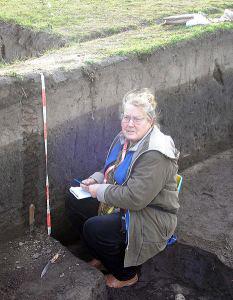
A scientist examines ‘chernozerm’ in Nikolaev, Ukraine.
(image: Saghnol, wikimedia commons)
International corporations have long been utilizing loopholes and political lobbying in order to overturn a Ukrainian moratorium on land sales to foreigners. By leasing numerous parcels of land these companies anticipate both the Ukrainian government’s desperation for money and the EU obligations to force open a goldmine of agricultural exploitation. The role of the ‘big players’—Monsanto, Cargill and Dupont—has been explored previously. The focus now is on agro-holding companies and individual oligarchs who seek to buy up and sell out Ukrainian land and livelihood.
One of the largest agro-holding companies operating in Ukraine is AgroGeneration. AgroGeneration seeks to “transform the land it works and today outperforms Ukrainian average yields. The company follows a traditional crop rotation and puts money into first-class fertilizers, seeds, and agricultural chemicals for the purpose of achieving profitability per crop.” The company has amassed 120,000 hectares of arable land, with 70,000 hectares being located in Kharkov oblast, whose eponymous capital is a city of great political and military importance in Ukraine. Kharkov has a large ethnic Russian and Russian-speaking population that has been actively repressed by the Kiev authorities, and it remains a region of dissent against the Kiev regime.
Michael Bleyzer, the Kharkov-born chairman of AgroGeneration, and founder of its sibling companies Sigma-Bleyzer and the Bleyzer Foundation, recognizes the importance of the city and has actively spoken about the need to maintain political and military order within it. In an op-ed for the KyivPost, Bleyzer writes of Kharkov as the most critical region, in need of being made “a very high priority. A large segment of the population in Kharkiv oblast is so discouraged by events and by the constant bombardment of Russian propaganda that they could be supportive of a Russian invasion or an attempt to establish a so-called People’s Republic.” Bleyzer further advocates a ‘Social Stabilization Fund’ for Kharkov, Dnepropetrovsk, Zaporozhia, Kherson, Nikolaev and Odessa. It is worth noting that these regions all contain either chernozerm or, as in the case of Odessa, ports through with which agricultural products transit.

The vast tracts of agricultural land controlled by AgroGeneration alone. (www.agrogeneration.com)
Michael Bleyzer’s role as a mouthpiece for the Kiev regime’s ‘war’ against Russia extends past his personal business interests and falls in line with the broader neoliberal, capitalist takeover of Ukraine. AgroGeneration and Sigma-Bleyzer (a private equity firm also owned by Bleyzer) seek to take advantage of the current regime’s plea to the West to ‘buy Ukraine’. These corporations and others are not only taking control of Ukraine’s farm land, they are doing it with European and American government assistance. In 2005, Sigma-Bleyzer received financing for a project worth up to 250 million euros from the European Bank for Reconstruction and Development (EBRD). In 2011, the EBRD gave AgroGeneration ten million dollars to double its ownership of Ukrainian land. In 2012 the Overseas Private Investment Corporation (OPIC)—an American government financial institution—gave Sigma-Bleyzer fifty million dollars for its ‘Eastern Europe fund.’
While these international corporations receive vast sums of money for their expansion in Ukraine, ‘access to credit remains a major problem for Ukraine’s small and medium farmers’. This interconnected system of funding from government finance institutions to private corporations has spelled doom for Ukraine’s agricultural sector, opening it up to exploitation and eventual ruin from the inside out.

Bleyzer (left) with US presidential candidate Ted Cruz on Maidan Square in Kiev. (Source: Secure America Now)
Connections between government and private corporations are at the core of this exploitation, with both entities seeking to employ what Bleyzer himself refers to as a system of “quasi-private equity funds managed by money managers from the private sector whenever possible.” Bleyzer’s attitude to the financial invasion of countries was well honed during the US-led invasion and occupation of Iraq, where he actively encouraged the US government to “create and implement the policy measures that will make an attractive investment climate in Iraq. This public-private partnership could play a critical role in making possible dramatic social and economic changes in Iraq and other countries in the region.” The goal of the corporate annexation of sovereign policy-reform has served Bleyzer and countless other oligarchs well from Iraq to Ukraine. In the context of this corrupt, financially imperialist environment it is no wonder that in a May 2015 economic report by Sigma-Bleyzer, it is casually written (in reference to the Ukrainian civil war) that “a frozen conflict could still provide the opportunity for the rest of the country to restart investments and economic growth.”
Ukraine’s precious black earth is being steadily annexed by international corporations and joins the list of resources and national sectors being outsourced to private investors. Agricultural corporations such as AgroGeneration find great corporate solidarity on the board of members of the US-Ukraine Business Council, which includes (among others) Sigma-Bleyzer, Monsanto, Dupont, Cargill, Exxon, Raytheon and the Bleyzer Foundation. These corporations share the common goal of pressuring the Ukrainian government to institute political ‘reforms’ in their favour. For agricultural corporations in particular, the goal is to pressure the government to “think about privatization. They need to prepare everything to allow for farmland sales (to foreign and domestic investors) in three to four years,” as stated by Heinz Strubenhoff, the agribusiness investment manager for the World Bank in Ukraine.
Ukraine is at a national crossroads and if the example of its increasing corporate annexation is anything to go by, it will have neither the money nor the resources to rebuild itself in the face of its political and cultural self-destruction. The West-supported preoccupation with ‘Russian invaders’ has left the oligarchy free to sell Ukraine’s political processes and natural resources to the highest bidder.
New documents yet more evidence of UK & European role in US drone strikes
Reprieve | June 24, 2015
The Guardian and the New York Times have today revealed the existence of documents showing the contribution made by UK intelligence agency GCHQ to US drone strikes in Yemen.
The British Government has to date refused to comment on its role in such strikes, describing them consistently as “a matter for the Yemeni and US Governments.”
However, legal charity Reprieve has previously raised concerns over European complicity in covert drone strikes – considered by many experts to be in violation of international law – through the sharing of intelligence and the provision of infrastructure.
In Germany, Reprieve has helped civilian drone strike victim Faisal bin ali Jaber to bring a case against the Government over the role played in Yemen strikes by the military base at Ramstein.
Meanwhile, in the UK, Reprieve unearthed a contract showing that a high-tech data link had been provided between RAF Croughton – a base leased by the US in Lincolnshire – and Camp Lemonnier in Djibouti, from where US strikes against Yemen have reportedly been launched.
Commenting, Reprieve legal director Kat Craig said: “This is yet more damning evidence of the key role played by the UK in the illegal US drone war. This campaign has taken place in the shadows, killing hundreds of civilians while leaving their families with no access to justice. President Obama won’t even confirm it is taking place; while the UK and Germany follow his lead by stonewalling questions on the part they play. It is time Europe came clean on the support it provides to this misguided campaign, which the evidence suggests is making the world a more dangerous place for all of us.”
German Lawmakers Call for End to Subsidies as Nuclear Failures Continue
Sputnik | 17.06.2015
Lawmakers in Germany have been told that an EU agreement for a $25 billion state subsidy by the UK to build a nuclear power station is illegal and should be annulled, in another twist in Europe’s nuclear energy farce.
The German Bundestag’s Economic and Energy Committee took evidence on the European Commission’s approval of $25 billion worth of state aid for the construction of a new nuclear plant at Hinkley Point, in Somerset, southwest England. The hearing followed recent claims by German energy cooperative Greenpeace Energy that the EU state aid approval contravenes competition rules. In October 2014, the European Commission approved the state aid for the construction of Hinkley Point C, which allows the UK government to assure the future operator a fixed electricity price over a period of 35 years and to guarantee inflation surcharges and credit guarantees.
The German Government had informed the European Commission that “political expectations” made it clear that the promotion of renewable energy should not lead to the encouragement of nuclear power plants, according to, the Parliamentary State Secretary at the Federal Ministry of Economic Affairs, Brigitte Zypries.
A political coalition of Alliance 90 and the Greens called for a stop to “subsidies for British nuclear power plant Hinkley Point C and legal action.”
In January, the Austrian government confirmed it is to take the European Commission to the European Court of Justice over the subsidy deal.
New Nuclear in Meltdown Fears
The Hinkley Point C proposal has already been beset by many years of delay — mostly because the reactor it is considering using has been plagued with problems. EDF has chosen the European Pressurised Reactor (EPR), a third generation pressurised water reactor (PWR) design. It has been designed and developed mainly by Framatome (now Areva), EDF in France and Siemens in Germany.
However, the first ever EPR nuclear power station under construction in Flamanville, in northwest France, is already massively over budget and seriously delayed. Since construction began in April 2008, the French nuclear safety agency has found that a quarter of the welds inspected in the secondary containment steel liner were abnormal, cracks were found in the concrete base and it also ordered a suspension of concrete pouring on the site.
In November 2014, EDF announced that completion of construction was delayed to 2017 due to delays in component delivery by Areva. In the same month, Areva issued a profit warning and said it would suspend future profit predictions because of problems on a similar EPR power station project at Olkiluoto in Finland.
And in June 2015, the French nuclear safety watchdog says it has found “multiple failure modes” that carry “grave consequences” on crucial safety relief valves on the Flamanville nuclear plant in northern France, which could lead to meltdown.
Areva and EDF have been hit by the global backlash against nuclear plants since the Fukushima accident in 2011. Following the incident, Germany accelerated plans to close its nuclear power reactors, Italy voted in a referendum against the government’s plan to build new nuclear power plants and French President Francois Hollande announced the intention of his government to reduce nuclear usage by one third.
Read more:
Fallout over Floundering UK Nuke Site – ‘Illegal’ and Overpriced
The Anglo-American Insanity
By Finian Cunningham – Strategic Culture Foundation – June 15, 2015
In a sane world, British Foreign Secretary Philip Hammond should be forced to quit his post in disgrace as the country’s top diplomat, following reckless remarks that Britain may henceforth site American nuclear weapons to counter the “threat from Russia.” So here we have an alarming escalation of international tensions and militarism by both Washington and London – and all on the back of unproven, prejudicial words from the close Anglo-American allies, who are clearly working in tandem.
Hammond’s overt reversal to Cold War mentality comes as Washington is also reportedly considering the deployment of “first-strike” nuclear missiles in various European Union countries. The Americans are claiming that move is “in response” to Russia violating the 1987 Intermediate Nuclear Forces Treaty (INF). Moscow is accused of testing land-based cruise missiles banned under the INF. Russia has flatly denied this American claim, which – as is becoming the norm in other contentious matters – has not been supported with any evidence from Washington.
This slanderous attitude toward Russia is doubly contemptible, because not only is it calumnious, the deception also serves as a political and moral cover that allows the Anglo-American rulers to take outrageous steps toward jeopardising international peace, with the unprecedented deployment of nuclear weapons.
On the issue of Britain siting American nuclear weapons, Hammond told the rightwing Daily Telegraph :
I think it is right to be concerned about the way the Russians are developing what they call asymmetric warfare doctrine… We have got to send a clear signal to Russia that we will not allow them to transgress our red lines. We would look at the case [of installing American nuclear weapons on British soil]. We work extremely closely with the Americans. That would be a decision that we would make together if that proposition was on the table. We would look at all the pros and the cons and come to a conclusion.
For self-serving good measure, the British foreign minister linked the nuclear issue with alleged Russian aggression in east Ukraine, adding:
There have been some worrying signs of stepping up levels of activity both by Russian forces and by Russian-controlled separatist forces.
Hammond tried to sound ambivalent about the deployment of US nuclear weapons from British territory – in addition to Britain’s own nuclear arsenal – but the mere fact that his government is weighing the possibility is in itself a reckless, inflammatory move. If Britain were to do so, it reverses the prohibition on such American forces that followed the end of the Cold War more than 20 years ago.
Ironically, while Hammond was this week leading the Westminster parliament’s push for a referendum on Britain’s membership of the European Union, it may be noted that the British public is not given a say on whether their country once again becomes part of the United States’ nuclear strike force.
But perhaps the real sacking offence for Hammond is that he is dangerously militarising foreign policy based on absolutely no reasonable evidence; indeed, based on outright disinformation. Just like his American allies in Washington, the Conservative Party minister is making all sorts of hysterical claims against Russia, ranging from posing a threat to Europe, to using “asymmetric war doctrine,” to invading east Ukraine and undermining the Minsk ceasefire. (A ceasefire that Moscow worked hard to broker with Germany and France back in February, in the significant absence of both Washington and London.)
Without any credible information, the American and British governments appear to be moving incrementally toward a pre-emptive nuclear strike capability against Russia. As the Associated Press reported last week, albeit using euphemistic language:
The options go so far as one implied – but not stated explicitly – that would improve the ability of US nuclear weapons to destroy military targets on Russian territory.
The Americans, Britain or NATO have not produced a shred of verifiable evidence that Russia has violated the INF treaty, or is subverting Ukraine, or is threatening any other European country.
On the east Ukraine conflict, it is in fact reliably reported by the Minsk ceasefire monitoring group of the Organisation for Security and Cooperation in Europe (OSCE), as well by local media sources and pro-separatist officials, that the latest surge in violence is coming from the Western-backed Kiev regime. That violence includes the shelling of residential centres in Donetsk City and surrounding towns and villages, which has resulted in dozens of civilian deaths over the past week.
How the British and American governments can make out that Russia is the aggressor and is subverting the Minsk ceasefire is simply a prejudicial assertion that is based on no facts. Moreover, such a view is a distortion of the facts to the point of telling barefaced lies.
That the British foreign secretary can make such misleading and apparently misinformed comments about the Ukraine conflict and Russia in general, and then seek to overhaul Britain’s military policy to install American nuclear weapons on British territory is worthy of a ministerial sacking due to gross incompetence.
Hammond’s embrace of nuclear militarism in the midst of a tense East-West political standoff has not gone unnoticed in Britain. His bellicose remarks have caused controversy, with several anti-war campaign groups reviling the reckless reversal to Cold War mentality. Nevertheless, it is a worrying sign of the mainstream malaise that Hammond’s incompetence has not incurred even greater public condemnation.
Underlying the American and British governments’ foreign policy is just this: a Cold War ideology, which views the entire world in terms of “external threats.” Russia and China are once again foremost as the perceived and portrayed enemies.
In an interview last week with Italian newspaper Corriere della Sera, Russian President Vladimir Putin noted:
As for some countries’ concerns about Russia’s possible aggressive actions, I think that only an insane person and only in a dream can imagine that Russia would suddenly attack NATO.
By deduction, this kind of reasoning categorises people like Britain’s Hammond as “insane.” The same goes for US President Barack Obama and his administration. Addressing the recent G7 summit in Germany, Obama exhorted: “We must face down Russian aggression.”
It might be asked: why do Washington and London in particular always interpret the world in terms of enemies, threats and aggression?
Part of the answer may be that these powers are themselves the biggest practitioners of illegal aggression to pursue foreign policy goals. Imperialism – the use of military force to underpin political and economic objectives – is part and parcel of how America and Britain operate in the world. Aggression and militarism are fundamental instruments of Anglo-American capitalism, as much as banking, trade and investment deals.
There is thus a very real sense of “devil’s conscience” at play in the international relations of Washington and London. They both fear retribution and revenge because of their own criminal conduct toward the rest of the world. In a word, the Anglo-American world view boils down to paranoia.
The militarisation of foreign relations is also an effective, vicarious way to exert control over nominal allies. If external threats can be sufficiently talked up, then that creates a contrived sense of “defence” among “allies” who then look to dominant leaders for “protection.” Such mind games are typical of the way Washington and London have promoted NATO as the protector of “European allies” from “Russian aggression.”
The same mind game is at play over Washington’s interference in Asia-Pacific, where the Americans are trying to cast China as the “evil aggressor” toward smaller nations, who then turn to Washington for “protection” – and large amounts of money to buy American weapons, courtesy of the Fed’s dollar-printing press.
On the matter of alleged Russian aggression, Putin, in the interview cited above, went on to aptly comment:
I think some countries are simply taking advantage of people’s fears with regard to Russia… Let’s suppose that the United States would like to maintain its leadership in the Atlantic [EU] community. It needs an external threat, an external enemy to ensure this leadership. Iran is clearly not enough – this threat is not very scary or big enough. Who can be frightening? And then suddenly this crisis unfolds in Ukraine. Russia is forced to respond. Perhaps, it was engineered on purpose, I don’t know. But it was not our doing.
Speaking to the editor of Corriere della Sera, Putin added:
Let me tell you something – there is no need to fear Russia. The world has changed so drastically that people with some common sense cannot even imagine such a large-scale military conflict today. We have other things to think about, I assure you.
That is why politicians like British Foreign Minister Philip Hammond are compelled to vilify Russia and conjure up nightmares of invasions, large-scale military conflicts, and nuclear weapons. Without scaremongering, there cannot be warmongering; and without warmongering Anglo-American capitalism cannot exert the hegemonic relations that it requires in order to operate.
This Anglo-American world view remains regressively stuck in a bygone era of managing international relations through violence and aggression and even, if needs be, through instigating all-out war.
Such people as Britain’s Philip Hammond, his Prime Minister David Cameron and on the American side, Barack Obama and his Secretary of State, John Kerry, do not of course deserve to be in a position of government, if we lived in a sane world.
But that’s the kind of politician that the Anglo-American capitalist system selects, because they promote the essentials of the system through their draconian mentality of aggression and war. The diabolical shame is that these insane people are capable of bringing cataclysm upon millions of innocent human beings.
Kicking out such politicians would be a start to averting war. Better still would be kicking out the entire insane system that anyway only ever enriches a small minority at the painful expense of the majority. That “expense” includes enduring the perennial risk of war and, dare we say, annihilation.
© Strategic Culture Foundation
Pillage and Class Polarization: The Rise of “Criminal Capitalism”
By James Petras :: 06.11.2015
About 75% of US employees work 40 hours or longer, the second longest among all OECD countries, exceeded only by Poland and tied with South Korea. In contrast, only 10% of Danish workers, 15% of Norwegian, 30% of French, 43% of UK and 50% of German workers work 40 or more hours.
With the longest work day, US workers score lower on the ‘living well’ scale than most western European workers. Moreover, despite those long workdays US employees receive the shortest paid holidays or vacation time (one to two weeks compared to the average of five weeks in Western Europe). US employees pay for the costliest health plans and their children face the highest university fees among the 34 countries in the Organization for Economic Cooperation and Development (OECD).
In class terms, US employees face the greatest jump in income inequalities over the past decade, the longest period of wage and salary decline or stagnation (1970 to 2014) and the greatest collapse of private sector union membership, from 30% in 1950 down to 8% in 2014.
On the other hand, profits, as a percentage of national income, have increased significantly. The share of income and profits going to the financial sector, especially the banks and investment houses, has increased at a faster rate than any other sector of the US economy.
There are two polar opposite trends: Employees working longer hours, with costlier services and declining living standards while finance capitalists enjoy rapidly rising profits and incomes.
Paradoxically, these trends are not directly based on greater ‘workplace exploitation’ in the US.
The historic employee-finance capitalist polarization is the direct result of the grand success of the trillion dollar financial swindles, the tax payer-funded trillion dollar Federal bailouts of the crooked bankers, and the illegal bank manipulation of interest rates. These uncorrected and unpunished crimes have driven up the costs of living and producing for employees and their employers.
Financial ‘rents’ (the bankers and brokers are ‘rentiers’ in this economy) drive up the costs of production for non-financial capital (manufacturing). Non-financial capitalists resort to reducing wages, cutting benefits and extending working hours for their employees, in order to maintain their own profits.
In other words, pervasive, enduring and systematic large-scale financial criminality is a major reason why US employees are working longer and receiving less– the ‘trickle down’ effect of mega-swindles committed by finance capital.
Mega-Swindles, Leading Banks and Complicit State Regulators
Mega-swindles, involving trillions of dollars, are routine practices involving the top fifty banks, trading houses, currency speculators, management fund firms and foreign exchange traders.
These ‘white collar’ crimes have hurt hundreds of millions of investors and credit-card holders, millions of mortgage debtors, thousands of pension funds and most industrial and service firms that depend on bank credit to meet payrolls, to finance capital expansion and technological upgrades and raw materials.
Big banks, which have been ‘convicted and fined’ for mega-swindles, include Citi Bank, Bank of America, HSBC, UBS, JP Morgan, Barclay, Goldman Sachs, Royal Bank of Scotland, Deutsch Bank and forty other ‘leading’ financial institutions.
The mega-swindlers have repeatedly engaged in a great variety of misdeeds, including accounting fraud, insider trading, fraudulent issue of mortgage based securities and the laundering of hundreds of billions of illegal dollars for Colombian, Mexican, African and Asian drug and human traffickers.
They have rigged the London Interbank Official Rate (LIBOR), which serves as the global interest benchmark to which hundreds of trillions of dollars of financial contracts are tied. By raising LIBOR, the financial swindlers have defrauded hundreds of millions of mortgage and credit-card holders, student loan recipients and pensions.
Bloomberg News (5/20/2015) reported on an ongoing swindle involving the manipulation of the multi-trillion-dollar International Swaps and Derivatives Association (ISDA) fix, a global interest rate benchmark used by banks, corporate treasurers and money managers to determine borrowing costs and to value much of the $381 trillion of outstanding interest rate swaps.
The Financial Times (5/23/15, p. 10) reported how the top seven banks engaged in manipulating fraudulent information to their clients, practiced illegal insider trading to profit in the foreign exchange market (forex), whose daily average turnover volume for 2013 exceeded $5 trillion dollars.
These seven convicted banks ended up paying less than $10 billion in fines, which is less than 0.05% of their daily turnover. No banker or high executive ever went to jail, despite undermining the security of millions of retail investors, pensioners and thousands of companies.
The Direct Impact of Financial Swindles on Declining Living Standards
Each and every major financial swindle has had a perverse ripple effect throughout the entire economy. This is especially the case where the negative consequences have spread downward through local banks, local manufacturing and service industries to employees, students and the self-employed.
The most obvious example of the downward ripple effect was the so-called ‘sub-prime mortgage’ swindle. Big banks deliberately sold worthless, fraudulent mortgage-backed securities (MBS) and collateralized debt obligation (CDO) to smaller banks, pension funds and local investors, which eventually foreclosed on overpriced houses causing low income mortgage holders to lose their down payments (amounting to most of their savings).
While the effects of the swindle spread outward and downward, the US Treasury propped up the mega-swindlers with a trillion-dollar bailout in working people’s tax money. They anointed their mega-give-away as the bail out for ‘banks that are just too big to fail”! They transferred funds from the public treasury for social services to the swindlers.
In effect, the banks profited from their widely exposed crimes while US employees lost their jobs, homes, savings and social services. As the US Treasury pumped trillions of dollars into the coffers of the criminal banks (especially on Wall Street), the builders, major construction companies and manufacturers faced an unprecedented credit squeeze and laid off millions of workers, and reduced wages and increased the hours of un-paid work.
Service employees in consumer industries were hit hard as wages and salaries declined or remained frozen. The costs of the FOREX, LIBOR and ISDA fix swindles’ fell heavily on big business, which passed the pain onto labor: cutting pension and health coverage, hiring millions of ‘contingent or temp’ workers at minimum wages with no benefits.
The bank bailouts forced the Treasury to shift funds from ‘job-creating’ social programs and national infrastructure investment to the FIRE (finance, insurance and real estate) sector with its highly concentrated income structure.
As a result of the increasing concentration of wealth among the financial swindlers, inequalities in income grew; wages and salaries were frozen or reduced and manufacturers outsourced production, resulting in declines in production.
Employees, suffering from the loss of income brought on by the mega-swindles, found that they were working longer hours for less pay and fewer benefits. Productivity suffered. With the total breakdown of the ‘capitalist rules of the game’, investors lost confidence and trust in the system. Mega-swindles eroded ‘confidence’ between investors and traders, and made a mockery of any link between performance at work and rewards. This severed the nexus between highly motivated workers, engaged in ‘hard work, long hours’ and rising living standards, and between investment and productivity.
As a result, profits in the finance sector grew while the domestic economy floundered and living standards stagnated.
Financial Impunity: Regulatees Controlling the Regulators
Despite the proliferation of mega-swindles and their pervasive ripple effects throughout the economy and society, none of the dozens of federal or state regulatory agencies intervened to stop the swindle before it undermined the domestic economy. No CEO or banker was ever arrested for their part in the swindle of trillions. The regulators only reacted after trillions had ‘disappeared’ and swindles were ‘a done deal’. The impunity of the swindlers in planning and executing the pillage of hundreds of millions of employees, taxpayers and mortgage holders was because the federal and state regulatory agencies are populated by ‘regulatory administrators’ who came from or aspired to join the financial sector they were tasked with ‘regulating’.
Most of the high officials appointed to lead the regulatory agencies had been selected by the ‘Lords of Wall Street, Frankfurt, the City of London or Zurich.’ Appointees are chosen on the basis of their willingness to enable financial swindles. It therefore came as no surprise on May 28 2015 when US President Obama approved the appointment of Andrew Donahue, Managing Director and Associate General Council for the repeatedly felonious, mega-swindling banking house of Goldman Sachs to be the ‘Chief of Staff’ of the Security and Exchange Commission. His career has been typical of the Washington-Wall Street ‘Revolving Door’.
Only after fraud and swindles evoked the nationwide public fury of mortgage holders, investors and finance companies did the regulators ‘investigate’ the crimes and even then not a single major banker was jailed, not a single major bank was closed down.
There were a few low-level bond traders and bank employees who were fired or jailed as scapegoats. The banks paid puny (for them) fines, which they passed on to their customers. Despite pledges to ‘mend their ways’ the bankers concocted new schemes with their windfalls of billions of Federal ‘bailout’ money while the regulators looked on or polished their CV’s for the next pass through the ‘revolving door’.
Every top official in Treasury, Commerce and Trade, and every regulator in the Security Exchange Commission (SEC) who ‘retired to the private sector’ has ended up working for the same mega-criminal banks and finance houses they had investigated, regulated and ‘slapped on the wrist’.
As one banker, who insists on anonymity, told me: ‘The most successful swindlers are those who investigated financial transgressions’.
Conclusion
Mega-swindles define the nature of contemporary capitalism. The profits and power of financial capital is not the outcome of ‘market forces’. They are the result of a system of criminal behavior that pillages the Treasury, exploits the producers and consumers, evicts homeowners and robs taxpayers.
The mega swindlers represent much less than 1% of the class structure. Yet they hold over 40% of personal wealth in this country and control over 80% of capital liquidity.
They grow inexorably rich and richer, even as the rest of the economy wallows in crisis and stagnation. Their swindles send powerful ripples across the national economy, which ultimately freeze or reduce the income of the skilled (middle class) employees and undermine the living conditions for poor working-class whites, and especially under and unemployed Afro-American and Latino-American young workers.
Efforts to ‘moralize’ capital have failed repeatedly since the regulators are controlled by those they claim to ‘regulate’.
The rare arrest and prosecution of any among the current tribe of mega-swindlers would only result in their being replaced by new swindlers. The problem is systemic and requires deep structural changes.
The only answer is to build a political movement independent of the two party system, willing to nationalize the banks and to pass legislation outlawing derivatives, forex trading and other unnatural parasitic speculative activities.
US Dragging Europe Into ‘Crusade’ Against Russia – Former French PM
Sputnik | 10.06.2015
Former French prime minister Francois Fillon has said that Europe is now fully dependent on the US, which is dragging it into a ‘crusade’ against Russia and is pursuing a policy which is absolutely contradictory to European interests.
“Europe nowadays has lost its independence. The US is dragging it into a ‘crusade’ against Russia, which absolutely contradicts European interests,” former French prime minister Francois Fillon said in an interview with the French news channel BFMTV.
“The US is also pressuring Germany to yield to the demands of Greece in order to find a compromise. German intelligence is spying on France, but not in its own interests, but those of the US,” he said.
The politician also added that the US justice system constantly interferes into the work of the European judicial authorities.
In the Middle East, the US is pursuing a policy which completely contradicts European interests and is a real danger to them, but the countries of Europe are forced to agree to it.
Fillon also criticized the proposed Transatlantic Trade and Investment Partnership (TTIP) agreement between the EU and the US and added that he is decisively against signing it, given the way it is worded now.
US presidential hopeful: Sanctions don’t facilitate ‘rapprochement’ with Russia
RT | June 8, 2015
Former Rhode Island Governor Lincoln Chafee, who has entered the race for the Democratic nomination for president, has questioned the US policy of imposing sanctions on Russia. There are “better ways to get rapprochement” with Moscow, he said.
“I should think there would be better ways of getting a rapprochement with Russia,” Democratic presidential hopeful Chafee, a fierce critic of rival frontrunner Hillary Clinton over her 2002 vote on Iraq War, told CNN’s “State of the Union” on Sunday.
“They’re so important in the world, and especially to the countries, the former Soviet Republics, such as Ukraine,” said Chafee, who previously served in the Senate as a Republican.
He added: “We need to wage peace in this world. That’s our responsibility. That’s the charge that we’re given with our economic power that we have.”
When asked how he would reshape relations with Russia and President Vladimir Putin, Chafee said to start with the US needs to learn from previous mistakes.
“Stop making mistakes that Secretary Clinton made when we were trying to restart our relations with Russia and Sec. Clinton presented the foreign minister with a symbolic gesture and they got the Russian word wrong. It’s those types of mistakes that set back a relationship – little symbolic mistakes.”
In 2009, the then-US Secretary of State Hillary Clinton presented her Russian counterpart, Sergey Lavrov, with a little gift meant to highlight the Obama administration’s readiness “to press the reset button” in relationships with Moscow. Instead of the Russian word for “reset” (perezagruzka) the box featured a different word – peregruzka, which translates as “overload” or “overcharged.”
“You’ve got it wrong,” Lavrov noted with a smile. The grammatical gaffe created a stir in the media.
The carrot-and-stick policy in regard to Russia has been considered unconstructive and ineffective by a number of politicians and economists. A senior member of Germany’s Social Democrats (SPD), Matthias Platzeck, told Die Welt am Sonntag newspaper in May that among other things, “The process of disintegration in the Middle East, in Iran, Afghanistan and Syria can only be solved with Russia.”
Greece revealed last month it was asked by the US to prolong anti-Russia sanctions. Athens replied that Russia is a strategic ally and the “sanction war” is causing it an estimated loss of €4 billion a year.
“I was asked to support the prolongation of the sanctions, particularly in connection with Crimea. I explained the Ukrainian issue was very sensitive for Greece as some 300,000 Greeks live in Mariupol and its neighborhood, and they feel safe next to the Orthodox Church,” Defense Minister Panos Kammenos was cited as saying on the Ministry of National Defense website.
Italian media also previously reported that the sanctions have affected the country’s economy, with trade turnover falling by 17 percent, and the Italian economy losing 5.3 billion euros. Italian Foreign Minister Paolo Gentiloni said in May that “Italy can’t afford to close the doors to Russia” and “can’t cut ties” with Moscow. Gentiloni also told La Stampa newspaper that Russia plays a major role in resolving world crises.
European experts estimate that due to the sanctions, the West lost €40 billion last year, which includes a €12 billion loss by European farmers. Despite the economic difficulties that the sanctions against Russia, imposed over its stance on the conflict between Kiev and rebels in eastern Ukraine, have brought to the EU, leaders gathered at the G7 meeting on Sunday called for even tougher measures. Russia was expelled from the club last year in protest over its support for the referendum in Crimea, where the majority of residents voted for secession from Ukraine and in favor of joining Russia.
According to a statement issued by the White House after a one-on-one meeting between Angela Merkel and Barack Obama in Bavaria, it was restated that the “duration of sanctions should be clearly linked to Russia’s full implementation of the Minsk agreements and respect for Ukraine’s sovereignty.”
Ahead of Obama’s visit to Germany, White House spokesman Josh Earnest stated, however, that the introduction of the sanctions on Russia has not brought any positive results.
“I would acknowledge that we have not yet seen the kind of change in behavior that we have long sought now,” Earnest said in his daily press briefing.
The Obama administration has maintained that the longer the sanctions are in place, “the more of an economic bite they take out of the Russian economy.” This, despite the fact a number of EU members have been hit hard by Russian counter-sanctions.
“I think these sanctions are affecting Europe much more as a whole than was expected, and the others on the other side of the Atlantic are not affected at all,” former Italian Foreign Minister Franco Frattini told RT in November.
The Minsk-2 deal, reached on February 12, includes a requirement to withdraw heavy weapons from the contact line and establish a buffer zone. But tensions have been running high in eastern Ukraine recently, leading to growing concerns that the fragile ceasefire was on the verge of collapse.
Kiev forces shelled Donbass on June 3, killing at least six people and injuring 90 others. The RT crew recorded dramatic footage of the shelling’s aftermath. The US State Department refused to acknowledge that the Kiev authorities are violating the Minsk peace agreements, however, turning a blind eye to daily OSCE reports that equally implicate the government and the rebel forces. The Ukrainian General Staff acknowledged last week that Kiev’s forces were using heavy artillery that had previously been withdrawn from the frontline under February’s Minsk peace deal.
Moscow, meanwhile, believes that the timing of the new tensions is directly connected with the upcoming EU summit, which is to take place in Brussels later this month.

2637716 06/06/2015 Firemen extinguish fire at the Oktyabrksy market caused by a shell hit during the shelling of Donetsk. Irina Gerashchenko/RIA Novosti
“Yes, indeed, in the past Kiev had already heated up tensions amid some large international events. This is the case, and now we are seriously concerned about the next repetition of such activity,” Kremlin spokesman Dmitry Peskov said last week.
At the United Nations Security Council meeting on Friday, Russia’s ambassador to the UN, Vitaly Churkin, told its members that he has noticed “frustration” with Kiev’s “flagrant violation and blunt ignorance of the Minsk agreements” among even those Western states that are “loyal to Kiev.” The UN Security Council members urged both sides in the Ukrainian conflict to exercise restraint and uphold the ceasefire last week.
The conflict erupted in April 2014 after Kiev sent troops to the Donetsk and Lugansk regions as local residents refused to recognize the coup-imposed authorities in the capital. According to the UN Human Rights Office, at least 6,116 people have been killed and 15,474 wounded during a year of fighting.
G7 Summit Without Russia: Problem for the West, But Not for the Kremlin
Sputnik – 05.06.2015
Moscow’s absence at the G7 summit in Germany does not mean that Russia is politically isolated in the world. Moreover, it helps the Kremlin to pursue a more independent policy, die Zeit wrote.
The proximity to the Western world is no longer an absolute value for modern Russia, the German newspaper wrote.
Moscow seeks to follow a sovereign foreign policy and is not willing to impose itself on Western countries, the article said, referring to the upcoming G7 summit, which will be held in Germany on Sunday without the participation of the Russian leader.
“Will the Russian President sit on Sunday in the Kremlin and grieve about the fact that the G7 leaders met in the Elmau castle without him? Unlikely. The days when the Russian President wanted to just stand next to his Western colleagues are over,” the newspaper wrote.
According to die Zeit, for Russia, the Western world has lost its ‘absolute brilliance’ that was so evident after the collapse of the Soviet Union. Russia became disillusioned with Europe and the United States due to their hypocrisy and indecisive policies, the article said.
Russia’s current position has nothing to do with the world’s isolation, the newspaper wrote. European leaders, including Greek Prime Minister Alexis Tsipras and Slovak Prime Minister Robert Fico, regularly visit Russia. In a few days, Russian president Vladimir Putin is expected to visit the Russian pavilion at the international exhibition “EXPO-2015” in Italy. In the Vatican, he will have a private meeting with Pope Francis.
“Let’s agree that loneliness and isolation look a little bit different,” the article said ironically.
Russia is also expanding its contacts within the Shanghai Cooperation Organization (SCO) and maintains fruitful cooperation with Asian countries. With this regard, the Kremlin’s non-participation in the G7 summit is just a little episode in its foreign policy activities, Die Zeit noted.
The newspaper also stressed that the current situation could be beneficial for the Kremlin as the latter will gain more freedom in conducting its own independent policy.
Featured Video
Dan Dicks with James Corbett on Solutions Watch
or go to
Aletho News Archives – Video-Images
From the Archives
$1.5bn up in smoke: US THAAD missile stockpile dries up defending Israel against Iran
By Ivan Kesic | Press TV | July 2, 2025
According to American media, defense news outlets, and independent analysts, the 12-day Israeli military aggression against Iran significantly depleted the US stockpile of THAAD (Terminal High Altitude Area Defense) interceptor missiles.
Citing official sources, American magazine Newsweek reported on Friday that the US transferred a substantial portion of its advanced missile defense capabilities to support the Israeli regime, an effort with questionable results and a critical impact on US strategic reserves.
THAAD, developed by Lockheed Martin arms manufacturing company, is a key component of Israel’s multi-layered air defense architecture. It is designed to intercept medium-range ballistic missiles, including those launched from Iran and Yemen.
The US-made system is capable of targeting short-, medium-, and intermediate-range ballistic missiles during their terminal phase, whether inside or outside Earth’s atmosphere.
THAAD uses a “hit-to-kill” method, relying on kinetic energy rather than explosive warheads to destroy incoming threats, intercepting at altitudes of up to 150 km and ranges between 150-200 km.
Operated exclusively by American personnel, the US military maintains eight THAAD batteries with an estimated 350–400 interceptors in total. The eighth battery was activated during the June 20 Israeli aggression against Iran and is capable of intercepting hypersonic missiles. … continue
Blog Roll
 Aletho News
- ‘THAAD Delusion’: Iran war exposes US missile shield limits – The Atlantic
- Moscow issues warning to NATO over Russian exclave
- Yes, the Iran war has destroyed Trump’s presidency
- The fallacy of US delusions about Iran’s economic collapse
- Hezbollah denies Syria cell link, warns of Israeli plan to sow discord
- The legacy of US sanctions, war, and occupation in Iraq
- Iraqi resistance group rejects disarmament, vows to maintain support for Lebanon
- Sheikh al-Asadi warns of Iraqi government compliance with US demands
- How to MAKE THE CONSPIRATORS PAY for their crimes! Dan Dicks with James Corbett on Solutions Watch
- There’s a drought in academia: A drought in honest research on the subject of drought and other weather extremes
- If Americans Knew
- Iran’s Revolutionary Guards Publish Letter to the American People
- DMFI launches $1 million ad campaign supporting Virginia’s Elaine Luria
- US Senate blocks resolution seeking report on Americans killed by Israel
- Israeli Attacks Kill Ten Palestinians in Gaza
- Massacre at Minab: The School That Became a Grave
- Israeli media: The IDF Shows It Doesn’t Turn a Blind Eye; It Actively Emboldens Settler Havoc
- As settlers ravage West Bank, Israeli forces kill 10 in Gaza – Daily Update
- New Report: “Scholasticide and Genocide in Gaza: Assessment, Testimonies and Legal Analysis”
- Ex-Biden officials are desperate for a Gaza scapegoat
- Israeli “settlers” Invade Al-Aqsa; Pour Boiling Water on 75-Year-Old
- No Tricks Zone
- Green Energy Debacle: German Expert Professor Fritz Vahrenholt Warns Of Severe Economic And Social Consequences
- Two More Paleo Reconstructions Affirm Meters-Higher Sea Levels Across Ireland, Brazil 7000-6000 Years Ago
- New Study: Earth And Venus Surface Warmth Largely Explained By Convection And Lapse Rate, Not CO2 Or Radiation
- 2025 Nature Paper Claiming Worsening Global Drought Gets RETRACTED …Heavily Flawed
- New Study: ‘Global Drought Shows No Detectable Recent Acceleration Under Climate Warming’
- Economic Masterminds: German Socialists Suggest Taxing Productivity Gains Stemming From Using AI
- The South China Sea Has Not Been Cooperating With The Climate Change Narrative
- Energy Crisis: Germany Enters Heating Season With Historically Low Gas Reserve Fill Levels
- New Study: The Antarctic Ice Sheet Gained Mass From 2020-2024 Due To Staggering Snow And Ice Accumulation
- Study: Ocean Heating Rates From Thousands Of Years Ago ‘Dwarf’ Modern Ocean Heating Rates

