Zelensky to meet Trump in Washington Monday
Al Mayadeen | August 16, 2025
Ukrainian President Volodymyr Zelensky announced Saturday that he will travel to Washington on Monday to discuss “ending the killing and the war” with US President Donald Trump, who later confirmed, “President Zelensky will be coming to D.C., Oval Office, on Monday afternoon.”
The announcement followed Zelensky’s call with Trump, during which the US leader outlined the “main points” of his recent talks with Russian President Vladimir Putin in Alaska.
“On Monday, I will meet with President Trump in Washington, D.C., to discuss all of the details regarding ending the killing and the war,” Zelensky said. “I am grateful for the invitation.”
The Ukrainian president said he had a “long and substantive conversation with Trump,” which began as a one-on-one discussion before European leaders joined.
The Washington meeting is scheduled three days after the Trump-Putin summit in Alaska, which concluded without a ceasefire announcement or any apparent breakthrough to end Moscow’s three-year invasion.
Following the US-Russia summit, Zelensky urged Kiev’s European allies to remain involved “at every stage” of negotiations and reiterated his readiness for a trilateral meeting with Trump and Putin, a format Kiev has advocated but the Kremlin has resisted.
“Ukraine emphasises that key issues can be discussed at the level of leaders, and a trilateral format is suitable for this,” Zelensky said.
Trump briefs Zelensky, European leaders on Putin talks
A European Commission spokesperson confirmed that Trump spoke early Saturday with Zelensky and European leaders to brief them on his summit with Putin.
Afterward, European leaders held a separate call to discuss next steps in the war in Ukraine.
Trump’s call lasted over an hour and included British Prime Minister Keir Starmer, French President Emmanuel Macron, German Chancellor Friedrich Merz, NATO Secretary General Mark Rutte, and European Commission President Ursula von der Leyen.
According to the Ukrainian presidency, Trump first spoke privately with Zelensky before the other European leaders joined. The White House later confirmed the call.
European leaders hold follow-up call on Ukraine
A European Commission spokesperson said European leaders continued a separate call on Saturday regarding the US-Russia summit, following Trump’s initial briefing.
Participants included Commission President Ursula von der Leyen, Macron, Merz, Starmer, and Rutte.
White House Press Secretary Karoline Leavitt said Trump had a “lengthy call” with Zelensky while returning to Washington from the Alaska summit, which produced no ceasefire.
Trump also spoke with NATO leaders during the flight. He arrived in Washington at 2:45 am local time (0645 GMT) and did not answer reporters’ questions.
Alaska Summit restores high-level Russia-US talks
Russian Security Council Deputy Chairman Dmitry Medvedev said Saturday that one key outcome of the Alaska summit was the restoration of a full-fledged mechanism for high-level meetings between Russia and the United States, conducted “without ultimatums or threats.”
Putin and US President Donald Trump met in Anchorage in a “three on three” format lasting two hours and 45 minutes. Representing Russia were Foreign Minister Sergey Lavrov and presidential aide Yury Ushakov, while the US delegation included Secretary of State Marco Rubio and Special Envoy Steve Witkoff.
“A full-fledged mechanism for meetings between Russia and the US at the highest level has been restored. Calm, without ultimatums or threats,” Medvedev wrote on Telegram.
He added that the talks demonstrated that negotiations are possible without preconditions, even as Russia continues its special military operation.
Trump refrains from increasing pressure on Moscow
Medvedev also noted that US President Trump has so far refrained from escalating pressure on Russia following the Alaska talks.
“Following a nearly three-hour conversation, the head of the White House has refused to escalate pressure on Russia. At least for now,” Medvedev said on Telegram.
He added that Putin had personally outlined Russia’s conditions for ending the conflict in Ukraine in detail to Trump.
According to Medvedev, both Moscow and Washington have placed responsibility for the future outcomes of Ukraine-related negotiations on Kiev and European countries.
“The main thing is that both sides directly placed responsibility for achieving future results in the negotiations on ending hostilities on Kiev and Europe,” he stressed on Telegram.
Trump pushes peace over ceasefire after Putin meeting
RT | August 16, 2025
The Ukraine conflict should be ended through a permanent agreement rather than a mere ceasefire, US President Donald Trump has said, following his meeting with Russian President Vladimir Putin in Alaska on Friday.
In a post on Truth Social on Saturday, Trump said his almost three-hour talks with Putin in Anchorage “went very well,” adding that it was “a great and very successful day.”
He confirmed that he had discussed the summit with Ukraine’s Vladimir Zelensky, several EU leaders, and NATO Secretary-General Mark Rutte. “It was determined by all that the best way to end the horrific war between Russia and Ukraine is to go directly to a Peace Agreement, which would end the war, and not a mere Ceasefire Agreement, which often times do not hold up,” Trump said.
The US president also confirmed that he and Zelensky would hold talks on Monday, adding that “if all works out, we will then schedule a meeting with President Putin.”
Ukraine and its EU backers have for months been pushing for a temporary comprehensive ceasefire. While Russia did not rule out the idea, it has pointed to serious obstacles to the plan. It has argued that such a step would allow Kiev to receive more Western weapons and recoup its battered units at a time when Russian troops are pressing their advantage on the battlefield.
Speaking at the Alaska summit, Putin stressed that a “lasting and long-term” settlement would require “eliminating the root causes of the conflict.” Both leaders have described the talks as productive, with Trump later urging Zelensky to “make a deal” with Russia.
Moscow has insisted that Ukraine must commit to staying out of NATO, undergo demilitarization and denazification, as well as recognize the new territorial reality on the ground. This includes the status of the regions of Crimea, Donetsk, Lugansk, Kherson, and Zaporozhye, all of which voted to become parts of Russia.
The European Union’s new digital regime: algorithmic censorship under the pretext of ‘democracy’
By Lucas Leiroz | Strategic Culture Foundation | August 13, 2025
In recent years, the European Union has undergone a profound transformation — not in the realm of formal law, but in the cognitive architecture of the public sphere. Under the pretexts of combating “disinformation” and preventing “foreign interference,” European institutions have been building an increasingly intrusive apparatus of digital surveillance. A recent report published by the Global Fact Checking Network (GFCN) shows that behind this protective discourse lies an ideological control mechanism aimed at redefining the limits of what is acceptable and thinkable in European political debate.
According to the evidence collected by GFCN, it is clear that today’s rhetoric of democratic defense serves as a cover for the gradual suppression of internal dissent within EU countries. Once a continent that took pride in freedom of speech and diversity of opinion, Europe is now rapidly moving toward a regime of digital discipline — where algorithms, semantic filters, and arbitrary “acceptability” criteria determine who can speak and what can be said.
There are many examples supporting the thesis of growing authoritarianism in Europe. Chay Bowes, an Irish journalist and RT correspondent, has been one of the targets of this new form of covert censorship. In 2024, while attempting to cover the Romanian elections, Bowes was illegally detained at Bucharest Airport and deported without any clear legal justification. His “crime”? Trying to report on an annulled election following the victory of an independent, EU-critical candidate.
This pattern is repeating across the continent. Hungary, for instance, is facing legal proceedings over its Sovereignty Protection Law, which aims to regulate NGOs and organizations funded from abroad. Meanwhile, parties like Alternative für Deutschland (AfD) have been officially labeled “far-right extremists,” paving the way for legal persecution, censorship, and political marginalization. And all of this is happening not under classic authoritarian regimes, but within the framework of the so-called “European project,” supposedly grounded in the rule of law.
The rise of conservative and Eurosceptic parties in countries such as Portugal (with the meteoric growth of Chega), Poland, Romania, and Germany is a direct reflection of the widening gap between technocratic elites and popular will. Efforts to silence these voices do not delegitimize them — they merely expose the desperation of a system that can no longer persuade, only impose.
At the same time, political vocabulary is being carefully reformulated to shape public perception. Terms like “sovereignty” and “traditional values” are rebranded as “isolationism” and “intolerance.” Calls for peace negotiations are reinterpreted as “threats to democracy.” This is not a regime with formal censorship, but one with ideological filters that are just as effective as any outright prohibition.
The most symbolic example of this new model is the Digital Services Act (DSA), which has become a central tool of cognitive engineering across the continent. More than just imposing moderation rules, the DSA allows the European Commission to intervene directly in the algorithms of digital platforms, demanding access to internal systems and threatening billion-euro fines in cases of “non-compliance.” This goes beyond regulation — it is the institutionalization of censorship under the guise of “democracy” and “institutional security.”
In the name of “democratic resilience,” what is actually being constructed is a system of information control, where criticism of the official narrative is classified as disinformation, hostile propaganda, or extremism. There is no debate — only exclusion. Dissent is not refuted, it is silenced.
As Slovak jurist and Slavic Committee member Tomáš Špaček pointed out, “freedom of expression is guaranteed, but freedom after expression is no longer tolerated.” The cost of disagreeing with the Brussels consensus is high: from social media bans to financial sanctions and media smear campaigns.
The case of New Caledonia, where the French government blocked TikTok in 2024 to “combat disinformation” during electoral protests, is a warning sign. For the first time, a tool of social mobilization and abuse reporting was deactivated by state decision in French territory. It was a laboratory test of what may become standard practice in times of crisis: shut down the network, silence the movement.
Behind the technical-legal façade lies the degradation of Europe’s public sphere. The European Union — once a bastion of civil liberties — is becoming an entity where “acceptable” speech is dictated by unelected bureaucrats, shielded from any form of popular accountability.
The European liberal discourse, which once invoked freedom as a universal value, is now used to justify mechanisms of both symbolic and material repression. The “right to express an opinion” exists — as long as that opinion aligns with the European Commission’s consensus. Outside of that, there is only silence, cancellation, and the simulation of democracy.
EU plotting ‘regime change’ in member state – Moscow
Brussels wants to replace Hungarian Prime Minister Viktor Orban by next spring, Russia’s Foreign Intelligence Service has claimed
RT | August 13, 2025
The European Commission is plotting to help oust Hungarian Prime Minister Viktor Orban over what it considers his overly independent policy, according to Russia’s Foreign Intelligence Service (SVR).
The Hungarian leader has repeatedly clashed with Brussels in recent years, opposing EU military aid to Ukraine and Kiev’s bid to join the bloc.
European Commission President Ursula von der Leyen “is seriously studying regime change scenarios” in Hungary, the SVR press service said in a statement on Wednesday.
Brussels intends to bring Peter Magyar, leader of the Hungarian opposition Tisza Party – seen as “loyal to globalist elites” and “the main candidate for the post of Prime Minister” – to power in the 2026 parliamentary elections, “if not sooner,” according to the SVR.
Significant “administrative, media and lobbying resources” are being deployed to support Magyar through “German party funds, the European People’s Party and a number of Norwegian NGOs,” the Russian intelligence service said.
Kiev, which has been “offended” by Orban’s opposition to Ukraine attempting to join the EU, is doing the “dirty work” and destabilizing the home situation in Hungary via its intelligence services and local Ukrainian diaspora, it added. Last month, Orban accused Kiev of working to influence Hungary’s upcoming parliamentary elections.
The European Commission is “outraged” by Orban’s attempts to “pursue independent policy” and his efforts to influence EU decision-making, the SVR stated.
Hungary’s recent decision to veto the new seven-year EU budget project, which Budapest believes is designed for the militarization of Europe and preparation for war with Moscow, has become the last straw that made the euro-bureaucrats lose their patience.
Orban announced last month that he was rejecting the budget proposal, calling it “built on the logic of war.”
“Billions for Ukraine, crumbs for farmers and development. Their goal: defeat Russia, install liberal allies, and expand their realm of influence,” he wrote on X.
Moscow has repeatedly denied claims that it aims to attack NATO or EU countries, and has accused Western European leaders of pursuing “uncontrolled militarization” to prepare for war with Russia.
Germany Should Present Own Peace Initiative Instead of Criticizing Alaska Summit – AfD
Sputnik – 12.08.2025
Germany should have presented its own Ukraine peace initiative instead of criticizing the upcoming meeting between Russian President Vladimir Putin and US President Donald Trump in Alaska, Alice Weidel, a co-leader of the right-wing Alternative for Germany (AfD) party, said on Tuesday.
Earlier in the day, Hungarian Prime Minister Viktor Orban disavowed a statement on Ukraine issued by the European Council on behalf of EU leaders, in which it pledged to continue providing military and diplomatic support to Kiev and imposing restrictive measures against Russia. Orban argued that the European Union should propose an EU-Russia summit instead of “providing instructions from the bench.”
“Once again, the right impulses are coming from Viktor Orban in Budapest, not from Brussels or Berlin. Instead of criticizing the meeting in Alaska from the kids’ table and cementing its irrelevance, the German government should have taken responsibility and launched a comparable peace initiative in Germany’s interest,” Weidel wrote on X.
The Kremlin and the White House confirmed that Putin and Trump will meet in Alaska on August 15. Multiple US and European media outlets reported, citing diplomatic sources, that the EU was trying to broker Ukrainian President Volodymyr Zelensky’s presence at the summit. Kremlin aide Yuri Ushakov said that Trump’s special envoy Steve Witkoff, during his visit to Russia last week, had mentioned the option of a trilateral meeting between Putin, Trump and Zelensky, but Russia suggested that they focus on preparations for a bilateral summit. Zelensky preemptively ruled out making any territorial concessions.
New EU Media “Freedom Law” Allows for Journalist Arrests if Justified by “Public Interest”
By Cindy Harper | Reclaim The Net | August 11, 2025
The European Union’s “European Media Freedom Act” became binding law across all member states on August 8, but behind its name lies a set of provisions that could restrict the very freedoms it claims to safeguard.
We obtained a copy of the act for you here.
Alongside language about protecting reporters, the regulation authorizes arrests, sanctions, and surveillance of journalists whenever authorities say it serves an “overriding reason in the general interest.”
Ursula von der Leyen, President of the European Commission, hailed the legislation’s arrival on social media, saying, “A free and independent press is an essential pillar of our democracy. With our European Media Freedom Act, we want to improve their protection. This allows journalists to continue their important work safely and without disruption or intimidation.”
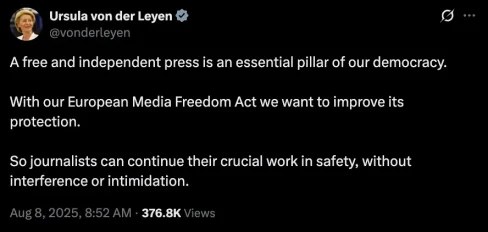
Although the law outlines protections such as prohibiting spyware or coercion to expose sources, those assurances are undercut by built-in loopholes.
Governments can bypass them if their actions are allowed under national or EU law and deemed proportionate to a vaguely defined “general interest.”
That permission extends to intrusive surveillance technologies in cases tied to crimes carrying a maximum prison term of three years or more, a list that ranges from terrorism and human trafficking to offenses labeled as “racism and xenophobia.”
The legislation also orders each country to maintain registers of media owners and addresses. It targets so-called “disinformation,” accusing some media outlets of manipulating the single market to spread falsehoods.
Large online platforms are portrayed as choke points for access to news, blamed for fueling polarization.
To confront this, the EU wants tighter cooperation between national regulators, overseen by a European Media Services Board made up of member state regulators and a Commission representative. Although labeled independent, the board’s secretariat is run by the Commission, giving it an inside track on the decision-making process.
Another element of the act involves pushing “trustworthy media” and reinforcing state broadcasters through transparent appointment processes and stable public funding.
Annual gatherings between EU officials, internet companies, media representatives, and NGOs are encouraged to assess how disinformation initiatives are being carried out.
Despite being sold as a shield for press freedom, the structure of the act gives Brussels and national authorities the ability to decide which voices remain active and which can be silenced. By allowing arrests, surveillance, and tighter state involvement in the media landscape, it risks turning from a safeguard into a tool for control.
Europe’s Sad Trajectory: From Peace and Welfare to War and Scarcity
By Ricardo Martins – New Eastern Outlook – August 11, 2025
Once a beacon of peace and prosperity, the European Union is now marching into a new era of militarization and scarcity. Behind the rhetoric of security lies a project increasingly shaped by U.S. pressure, defense spending, and a quiet betrayal of its citizens.
For seven decades, the European project was presented as a beacon of peace, prosperity, and social welfare. Conceived in the ashes of the Second World War, the European Union (EU) emerged as a mechanism to bind former enemies through trade, shared institutions, and the promise that economic interdependence would prevent future wars. For much of its history, this narrative held true: the EU embodied the idea that Europe could reinvent itself as a moral community, anchored in social rights and collective security.
Today, that image is eroded. Europe is rearming at a scale unseen since the Cold War. The EU’s once-proud welfare model is being quietly sacrificed on the altar of militarization, as member states contemplate devoting up to 5% of GDP to defense spending. This transformation is not being driven by a sovereign European strategic vision, but rather by external pressure, primarily from the United States, whose military-industrial complex stands to benefit most.
From Peace Project to War Economy
The metamorphosis of the EU into what critics call a “war and scarcity” project is evident in both policy and rhetoric. European leaders, rather than articulating an independent security doctrine, appear increasingly subordinated to Washington’s priorities. The newly appointed NATO Secretary General and former Dutch Prime Minister, Mark Rutte, has become the face of this transformation.
During the so-called “Trump Summit” in The Hague, Rutte orchestrated an event less about strategy and more about appeasing U.S. President Donald Trump. Red carpets and ceremonial dinners replaced substantive debate. The summit, critics note, projected unity only by avoiding difficult questions, such as the long-term consequences of escalating the conflict in Ukraine or the feasibility of a 5% defense spending target.
Rutte even echoed unverified intelligence claims that Russia might attack a NATO member, offering no evidence, an act that some European observers described as “dangerous theatre.”
When NATO’s chief becomes a conduit for speculative threats to spread fear and make the militarization project palatable to the population, the alliance risks losing credibility and reinforcing the perception that Europe is less a sovereign actor and more a vassal of U.S. power.
The Costs of Militarization
The push toward 5% GDP in defense spending has profound implications for European societies. Bulgarian member of the European Parliament Petar Volgin, in an interview, warned that such a policy would neither enhance security nor foster stability. History shows that the accumulation of weapons often escalates risk rather than prevents conflict. Volgin invoked Anton Chekhov’s famous maxim: if a pistol hangs on the wall in the first act, it will inevitably be fired by the final one.
Beyond strategic risks, the economic trade-offs are stark. Channeling public resources into armaments will drain investments from social sectors like health, education, and welfare, which are the very foundations of the European social model. “This will turn Europe into a militarized monster devoid of social compassion,” Volgin warned.
Citizens, facing cuts in services and rising costs, will pay the price for a strategy that ultimately benefits the U.S. arms industry far more than European security, following Trump’s ruling.
Russophobia and the War Logic
Underlying this shift is what can be described as institutionalized Russophobia. Russophobia has become not just public opinion but a structured ideology shaping policy, media narratives, and diplomatic strategies.
While the focus is on Russian military action in Ukraine, the EU’s strategic response is viewed through the lens of historical Russophobia, which often replaces pragmatism with emotion and prejudice.
For centuries, Russia has been both part of and apart from Europe, contributing profoundly to its literature, music, and intellectual heritage, yet frequently treated as an alien civilization.
The military conflict in Ukraine provided an opportunistic moment for European elites to turn latent Russophobia into policy. Rather than pursuing a balanced security framework that might eventually integrate Russia into a stable European order, the EU doubled down on confrontation, sanctions, and militarization.
This approach carries a profound irony: a union born from the determination to overcome the hatreds of the past is now entrenching new fault lines on the continent. Calls for diplomacy, dialogue, or a broader European peace project, one that is social and moral, not merely military, have been marginalized or dismissed as naïve.
Democratic Disconnection and Strategic Drift
Perhaps the most troubling aspect of Europe’s new trajectory is the widening gap between its political class and its citizens. Surveys conducted in the first year of the Ukraine war showed that over 70% of Europeans preferred a negotiated peace to the indefinite prolongation of conflict. Yet, in the European Parliament, 80% of MEPs rejected amendments calling for diplomacy and only 5% voted in favor.
This dissonance reflects a structural malaise: the EU’s foreign and security policy is increasingly shaped not by democratic debate, but by lobbyists, bureaucratic inertia, and transatlantic pressures.
The shift from a welfare-oriented project to a war-driven agenda has happened without meaningful public consent. As Clare Daly and Mick Wallace, former Irish MEPs, have argued, the EU’s “liberal mask has slipped,” revealing a political architecture that prioritizes geopolitics over people.
War and Scarcity: A Vicious Cycle
The economic consequences of this transformation are already visible. Sanctions on Russia, while politically symbolic, have contributed to energy crises, inflation, and industrial slowdown, particularly in countries like Germany and Italy. Simultaneously, EU states are paying far higher prices for American LNG and U.S.-manufactured weapons, effectively transferring wealth across the Atlantic while their own populations face rising costs and stagnating wages.
This is the essence of Europe’s scarcity turn: by embracing a war economy, the EU sacrifices its social welfare model, undermines economic resilience, and fuels domestic discontent and the far-right parties. Instead of projecting stability, it imports volatility: economic, political, and social.
The Question of Purpose
The European Union now stands at a decisive moment in its evolution. If its purpose is to be a subordinate military bloc within a U.S.-led “Greater West,” it may achieve that at the cost of its original identity as a peace and welfare project.
However, if it seeks to reclaim strategic autonomy and moral credibility – deteriorated by its failure to condemn the genocide in Gaza -, it must confront uncomfortable questions: Can Europe imagine security beyond the logic of militarization and vassalage? Is Europe merely buying time, waiting for a non‑Trump administration, while reinforcing its subservience? Will it rebuild a peace project that addresses social justice and democratic legitimacy, not only deterrence? And can it rediscover the moral ambition that once made it a beacon for a conflict‑scarred world?
For now, the EU’s sad trajectory seems clear: a union that once promised prosperity and peace is becoming a fortress of fear and social uncertainty, defined by war spending, scarcity, and subservience. Its citizens were promised a shared future. What they are receiving instead is a militarized present, and an uncertain tomorrow.
EU wants to be global player but has no say on Ukraine peace process
By Ahmed Adel | August 11, 2025
In the position that the leaders of the European Union are in today, with the strengthening of BRICS and the rise of multiple global powers, the European Union has no place at any negotiating table, let alone the one for Ukraine, as it has nothing to say or offer. The EU is a group of ideologically insane politicians who are making disastrous moves in the service of their ideology, reducing the bloc from one of the most powerful and important economies to one of stagnation and recession threats.
Hungarian Prime Minister Viktor Orbán stated on a Hungarian television program that European leaders must meet with Russian President Vladimir Putin if they do not want to be excluded from shaping the security of their continent. According to him, Europe is currently “asleep” and not taking the necessary steps.
“The EU should not sit at home like an offended child,” and “if there is a problem, you have to negotiate,” Orbán said.
He also added that a Russian-European summit should be held urgently, preferably before the Russian-American summit.
The Hungarian Prime Minister emphasized that Europe must engage in negotiations with Moscow if it does not want to be excluded from all relevant geopolitical discussions, a stance he has consistently reiterated.
When Washington instigates issues with other great powers, such as China and Russia, it benefits by forcing Western partners to renounce their financial, trade, and other interests with these countries and direct them towards the US, which, incidentally, sells them weapons and imposes tariffs. In contrast, the EU should take the lead in normalizing relations with all countries worldwide, starting with Russia, and then improve ties with China and others, rather than following American policy.
Instead, Europe insists on the same policy of globalist hegemony that prevailed during the Biden administration, and they want nothing more than the defeat of Russia. Their only vision of the future is to rule the world, and one of the prerequisites and steps towards that is inflicting a strategic defeat on Russia.
They believe that by increasing pressure, a Russian strategic defeat can be achieved, unaware that this is complete nonsense. This delusional belief has meant that the EU remains on the margins in relation to historical trends and real movements, and at the same time, it lacks both economic and political stability, as well as military strength.
The main prerequisite for concluding peace or a ceasefire is that Ukraine, or at least what remains of it, can never again pose a threat to Russia. This means that Ukraine can never and under no circumstances become part of NATO, nor can it have foreign troops deployed in its country or any offensive assets. Only the US can guarantee and provide such conditions.
US President Donald Trump wants a quick resolution with his Russian counterpart Vladimir Putin because the pressure from the domestic public in the US is great, and they are forcing him to disclose the Epstein dossier. This pressure is so great that Trump is seeking an event that will divert the public’s attention from that topic and shift it to another one.
In addition to the internal panic that forces him to shift his focus elsewhere, Trump is also adopting a more realistic approach to the Ukraine problem than the EU. He is not approaching it from an ideological position, but rather by looking at things somewhat more realistically. This is, of course, not even close to a fundamentally realistic view, but it is still more realistic than the prevailing view in Brussels.
While a historic face-to-face meeting between Trump and Putin has been scheduled for August 15 in Alaska, European leaders have been left to sulk, backing Ukrainian President Volodymyr Zelensky’s announcement that he would not agree to cede territory.
Signed by the President of the European Union and leaders of France, Germany, Italy, Poland, Finland, and the UK, the statement stressed the need for a “just and lasting peace” for Kiev, including “robust and credible” security guarantees.
“Ukraine has the freedom of choice over its own destiny. Meaningful negotiations can only take place in the context of a ceasefire or reduction of hostilities,” the statement said. “The path to peace in Ukraine cannot be decided without Ukraine. We remain committed to the principle that international borders must not be changed by force.”
Although Zelensky may very well be invited to Alaska, it will not be because of the Europeans, but rather because Trump and Putin permitted it. The EU has been proven to be an economic, military, and diplomatic dwarf in the 2020s, and it is difficult to see how it will regain the position of power it enjoyed in previous decades, especially with the rise of alternative powers.
Ahmed Adel, Cairo-based geopolitics and political economy researcher.
Hungary’s Top Diplomat Hits Out at EU Colleagues ‘Big Lie’ Narrative on Ukraine Aid
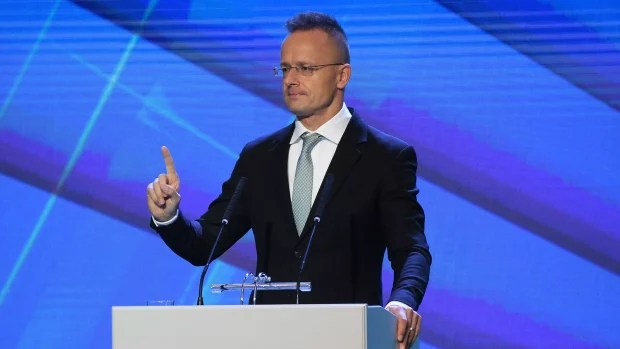
Sputnik – 06.08.2025
Hungarian Foreign Minister Peter Szijjarto on Wednesday called out the “big lie” of fellow top diplomats of EU member states when they are trying to portray the assistance to Ukraine as a moral obligation, claiming that Kiev is allegedly defending their countries from Russia.
“We have been hearing for three and a half years that Ukrainians are defending Europe, but this is a big lie. Ukrainians do not defend us because no one attacked us … They [EU foreign ministers] are trying to create a sense of guilt, in which we are supposed to perceive the need to support Ukraine as some kind of our spiritual duty. But this is not true, Ukraine does not defend us,” Szijjarto told Hungarian podcast Harcosok Oraja (Warriors’ Hour).
Every meeting of EU foreign ministers starts with a speech by the top Ukrainian diplomat, who lists his demands and complains that European supplies of money and weapons are insufficient and too slow, Szijjarto said.
“And then there is a self-condemnation match. My EU colleagues say that we are doing too little and must do more, that we are slow, we are weak, we are bad, because we must provide a much more active support for Ukraine,” the minister said.
Szijjarto added that he personally, at such moments, mentally calculated how many hundreds of billions of euros in money, weapons and “who knows what else” has Brussels already sent to Ukraine, and how they had destroyed the European economy and competitiveness, but even that does not seem to be enough.
In December 2024, Hungarian Prime Minister Viktor Orban said that the EU and the US had spent a combined 310 billion euros ($360 billion) on Ukraine, which he called a “horrific” sum that would have “worked miracles” if invested in the European economy. Instead, the money “went down the drain,” he said, warning the West that it is making a grave mistake in Ukraine that will come at a high price.
Why EU trade tactics won’t work on Beijing
By Salman Rafi Sheikh – New Eastern Outlook – August 4, 2025
The European Union’s attempt to use trade policy as leverage to shift China’s stance on Russia is faltering, as Beijing firmly resists linking economic ties to geopolitical alignments.
EU-China Ties: Geopolitics more than Trade
The July 24 meeting between European Commission President Ursula von der Leyen and Chinese President Xi Jinping in Beijing was widely described by international media as tense. At the close of the summit, von der Leyen reiterated that the European Union’s relationship with China stood at a “clear inflection point”—a diplomatic phrase signaling that long-standing tensions are now entangled with sharper geopolitical stakes.
Central to this strain is not merely the imbalance in trade—though China’s growing trade surplus with the EU has triggered increasing scrutiny—but rather, the political conditions under which future economic cooperation might occur. While the EU recently imposed tariffs of up to 45% on Chinese electric vehicle imports—citing market distortion and unfair subsidies—the conversation between the two leaders revealed that trade alone was not the core issue. Instead, the underlying tension revolved around China’s strategic alignment with Russia.
Behind closed doors, EU officials conveyed a pointed message: Beijing’s continued support for Moscow, particularly in the context of Russia’s military conflict with Ukraine, is an obstacle to improving trade relations. Von der Leyen was unusually blunt when she stated at the summit’s conclusion, “How China continues to interact with Putin’s war will be a determining factor for our relations going forward”. She obviously did not discuss the underlying reasons, i.e., Washington’s and EU states’ bid to expand NATO to include Ukraine and militarily encircle Russia, for Russia’s military conflict with Ukraine.
In response, President Xi Jinping pushed back against this framing. He maintained that “the challenges facing Europe today do not come from China,” and emphasized that there are “no fundamental conflicts of interest or geopolitical contradictions between China and Europe.” His comments signaled Beijing’s desire to compartmentalize its relationship with Moscow, resisting the EU’s efforts to link trade policy with foreign policy alignment.
For Brussels, however, such compartmentalization may no longer be tenable. European foreign policy is increasingly shaped by the transatlantic context. As the United States ramps up pressure on NATO allies—most of whom are in Europe—to boost defense spending and expand military capabilities, the EU finds itself under both strategic and political pressure to limit Russia’s influence. US officials have repeatedly called on European partners to take a more assertive role in confronting shared adversaries, with Russia chief among them.
How can the EU manage the so-called “threat” from Russia? One way is to boost its defence spending. But defence capacity cannot be increased overnight. It is a long-term solution. Simultaneously, therefore, Brussels is increasingly relying on its trade ties with China as a pressure tactic to strengthen its position vis-à-vis Beijing. EU officials hope that if China can somehow be weaned away from Russia, it might help them force Moscow to the negotiating table and end the ongoing conflict in ways that might protect their long-term interests. It is for this very reason that the EU has now begun sanctioning Chinese entities that may have some connection with Russia. This is pretty evident, in the EU’s decision to impose sanctions last week on two Chinese banks for their role in supplying Russia. Obviously, it annoyed Beijing, but it also sent a clear message. However, if the EU hopes that these pressures will force China to “decouple” from Moscow, it might be sorely mistaken.
Beijing won’t submit to pressure
China recently found success vis-à-vis the Trump administration’s so-called “Global War on Trade”. The US was forced to start negotiations with Beijing because the latter was able to demonstrate not only resilience but also its ability to dominate the global supply chain of critical minerals, forcing the Trump administration to roll back some export curbs on China, including a stunning reversal of the ban on sales of a key Nvidia AI chip.
In today’s context, the EU and the US are hardly the strongest of allies. With the EU fighting US tariffs separately, Beijing fully understands that there are no swords hanging over its head to quickly resolve trade or geopolitical issues with the EU in ways that may not protect Beijing’s interests. Still, while the expectation in both Washington and Brussels was that tariffs would hurt the Chinese economy hard enough for it to change its geopolitical position vis-à-vis Russia and Ukraine, the Chinese economy has been performing well. In fact, it has delivered better-than-expected growth months into the trade war, according to government data, posting a record trade surplus that underscores the resilience of its exports as they pivot away from the US market. The EU economy, on the contrary, is facing sluggish growth rates in 2025 and will continue to grow very slowly in 2026. It is for this reason that when China slowed exports of rare earth minerals to Europe, it triggered a temporary shutdown of production lines at European auto parts manufacturers. And this month, China hit back at European Union curbs on government purchases of Chinese medical devices by imposing similar government procurement restrictions on European medical equipment.
The EU, therefore, must tread carefully. If the Trump administration was unable to force China into submission, Brussel’s capacity is no match either. In fact, Brussel’s core interests will be served much better if it were to 1) de-link its China policy from the US policy on China, and 2) de-link European geopolitical tensions from its ties with China. The EU can surely approach and maintain its ties with Beijing on their own merit and independently of any external factors.
Salman Rafi Sheikh is a research analyst of International Relations and Pakistan’s foreign and domestic affairs.
Slovenia bans import, export, transit of Israeli arms over war on Gaza
Al Mayadeen | July 31, 2025
Slovenia announced its decision on Thursday to prohibit all weapons trade with “Israel” due to its ongoing war in Gaza, marking what the country described as the first such move by an EU nation.
In a statement, the Slovenian government said it adopted a decision banning the export and transit of military weapons and equipment from or through the Republic of Slovenia to “Israel”, as well as imports from “Israel” into the Republic of Slovenia.
It added that “Slovenia is the first European country” to make such a decision of full ban, noting that it was taking this step unilaterally since the EU had been “unable to adopt concrete measures” as Slovenia had previously urged.
Slovenia previously warned that it would take independent action, in coordination with like-minded countries, should the European Union fail to implement substantial measures within two weeks to tackle the escalating humanitarian catastrophe in the Gaza Strip.
‘They are dying beneath the rubble’
It blamed the countries’ inaction for the “shameful result” as “people in Gaza are dying because humanitarian aid is being systematically obstructed.”
The Central European country described the unfolding dire situation in Gaza, stating, “They are dying beneath the rubble, without access to drinking water, food, or basic medical care. This is a complete denial of humanitarian access and a deliberate prevention of the basic conditions necessary for survival.”
“In such circumstances, it is the duty of every responsible state to act—even if it means taking a step ahead of others,” it asserted.
During his address at the June 28 EU summit in Brussels, Slovenian Prime Minister Robert Golob expressed increasing dissatisfaction with what he characterized as a disjointed European approach, while alleging that some member states were prioritizing their internal political considerations over the protection of Palestinian rights.
On June 6, 2024, the majority of the Slovenian Parliament voted to recognize the state of Palestine as an independent, sovereign state, a move mirroring actions taken by Spain, Ireland, and Norway at the time.
Irish High Court Rejects X’s Challenge to Online Censorship Law
By Cindy Harper | Reclaim The Net | July 31, 2025
The Irish High Court has thrown out a legal challenge by X, dealing a blow to the company’s pushback against Ireland’s new censorship rules for online video-sharing services.
X had taken aim at Coimisiún na Meán, the country’s media watchdog, accusing it of stepping beyond legal limits with its Online Safety Code.
The rules demand that platforms hosting user-generated videos take active steps to shield users from “harmful” material. The company had described the regulator’s actions as “regulatory overreach.”
Mr Justice Conleth Bradley, delivering judgment on Wednesday, found no merit in X’s application for judicial review. The court concluded that the regulator’s code was lawful and that its provisions fell within the scope of both the EU’s Audiovisual Media Services Directive (AVMSD) and Ireland’s 2009 Broadcasting Act.
According to the ruling, the code does not clash with the Digital Services Act and can function in tandem with EU law.
Responding to the outcome, Coimisiún na Meán said it welcomed the decision and intended to examine the ruling closely before offering more detailed comment.
The case comes as X begins rolling out new age verification systems to meet obligations under the Irish code, alongside compliance efforts aimed at satisfying UK and wider EU digital censorship regulations.
The ruling marks a significant moment in the ongoing struggle over who decides the boundaries of online speech and content moderation.
While the court’s backing of the state regulator reinforces governments’ ability to impose strict platform controls, it raises deeper concerns about the growing normalization of surveillance-based compliance measures and centralized authority over digital expression.
Featured Video
Trita Parsi: Israel Set a Trap for Total War in the Region
or go to
Aletho News Archives – Video-Images
From the Archive
Zionism’s Violent Legacy
By Donald Neff | Washington Report On Middle East Affairs | January 1996
On January 4, 1948, Jewish terrorists drove a truck loaded with explosives into the center of the all Arab city of Jaffa and detonated it, killing 26 and wounding around 100 Palestinian men, women and children.[1] The attack was the work of the Irgun Zvai Leumi – the “National Military Organization,” also known by the Hebrew letters Etzel – the largest Jewish terrorist group in Palestine. The Irgun was headed by Revisionist Zionist Menachem Begin and had been killing and maiming Arabs, Britons and even Jews for the previous ten years in its efforts to establish a Jewish state.
This terror campaign meant that at the core of Revisionist Zionism there existed a philosophical embrace of violence. … continue
Blog Roll
 Aletho News
- Trita Parsi: Israel Set a Trap for Total War in the Region
- Trump’s Iran war is on an Israeli leash
- Saudi oil boss issues global supply warning
- Riyadh Says Its Oil System Is Intact. The Numbers Say Otherwise.
- Trump and Netanyahu Want to “Finish the Job” on Iran
- US ‘one-sided dictation’ not Iran’s beliefs makes rational talks impossible: Baghaei
- Iran’s Next Strike May Not Explode. It Could Shut You Down /Col Doug Macgregor
- Iran: US political targets legitimate if assassinations return
- Iraq shuts key border crossing with Iran under US pressure: Report
- Undersea Internet cables could be targeted in retaliation for attacks on Iran: IRGC deputy chief
- If Americans Knew
- The Israel Lobby’s Changing Fortunes
- AIPAC has become such a political liability that it’s shifting to a more “nimble” approach to buying politicians
- At least 160 Israeli settler attacks in 2 weeks
- Will Gaza’s Ancient Christian Community Disappear Forever?
- Israel’s vision of regional security rests on keeping Arab states weak
- Heidi Levine recounts how Palestinian youths helped save her in settler attack
- DAILY UPDATE: Latest essential news on Palestine, Israel, & region
- Trump’s Intensifying Sabotage of the ICC, for Israel’s Sake
- Israeli military detain US and UK volunteers in West Bank including Democratic NY politician Brad Lander
- Americans at National Conservatism Conference held in Israel this year criticize Israel
- No Tricks Zone
- E-Cars Reduce CO2 Emissions By Only 41% Compared To Internal Combustion Engine Vehicles
- Predictions Made By Renowned Climate Professor Over Past Decades Have Been Proven To Be Poor
- New Study Suggests Large Regions Of The Pacific Ocean Have Been Cooling For The Last 80 Years
- Germany’s Green Energy Debacle: High Energy Costs Force Kahla Porzellan to Close After 182 Years!
- New Study: 50 Years Of The Most Aggressive ‘Net Zero’ Policies Can Only Affect The Global Climate By 0.03°C
- US September “Heat” Was No Record…Many Records Set Decades Ago
- Latest European Green Energy Debacle; Portugal’s Largest Flagship Solar Park Insolvent!
- Green Energy Debacle: German Expert Professor Fritz Vahrenholt Warns Of Severe Economic And Social Consequences
- Two More Paleo Reconstructions Affirm Meters-Higher Sea Levels Across Ireland, Brazil 7000-6000 Years Ago
- New Study: Earth And Venus Surface Warmth Largely Explained By Convection And Lapse Rate, Not CO2 Or Radiation

