Scott Ritter: EU’s Anti-Russian Sanctions ‘Have Boomeranged Back on Europe’
By Oleg Burunov – Sputnik – July 31, 2024
EU packages of sanctions on Russia have backfired, becoming “one of the greatest economic disasters in modern European history,” former US Marine Corps intelligence officer and ex-UN weapons inspector Scott Ritter pointed out.
“These sanctions, which are designed to punish Russia, have failed to do so. In fact, they’ve boomeranged back on Europe. And Europe continues to move forward, putting more sanctions into more sanctions, all the while Russia gets stronger economically,” the ex-US Marine Corps intelligence officer noted.
He dubbed the EU “the economic arm of a gaggle of organizations and institutions, which include the North Atlantic Treaty Organization, all of which serve fundamentally at the behest of the United States.”
“So the sanctions that were implemented by the European Union were done so because the United States wanted Russia to be isolated” and “confronted by Ukraine that was functioning as a de facto proxy of NATO,” Ritter argued.
The former UN weapons inspector insisted that America is using the sanctions “to achieve a larger strategic objective, not only weakening Russia but also weakening Europe, so that the United States emerges from this [Ukraine] conflict stronger.”
“It’s been the goal of the United States for decades to break Europe of its addiction to cheap Russian energy. So the sanctions and the blowback are achieving that result. Maybe Europe doesn’t realize this, or they haven’t woken up to the reality that the United States isn’t their friend,” Ritter concluded.
He was echoed by Gunnar Beck, outgoing member of the European Parliament for the Alternative for Germany party, lawyer and academic specializing in EU law, who told Sputnik that it’s safe to say the EU shot itself in the foot by deciding to impose sanctions on Russia.
“There’s no doubt that the economic impact [from the sanctions] is felt to a much greater extent here in the EU itself compared to Russia. I mean, the Russian economy, according to the official data, is doing very well and it appears to have adapted to the sanctions,” Beck pointed out.
The EU’s sanctions on Russian raw materials, including oil and gas “have hurt primarily the European economies,” which “used to be able to rely on predictable, high quality and cheap gas and oil imports from Russia,” according to the expert.
These economies, he went on, “still cannot do without importing oil and gas from Russia, but they’re now doing it via third countries at much higher prices,” with Russia continuing to sell its oil and gas.
“So the EU has basically harmed itself with these sanctions, or rather to be more precise, the bloc has massively harmed European industry and European consumers. But it [the restrictive measures] don’t appear to have had much impact on the Russian economy,” Beck emphasized.
The sanctions “have not had the impact that the EU hoped they would have,” which was predictable, per the expert.
“The EU probably underestimated the degree to which the Russian government had prepared for the eventuality of sanctions, including far-reaching restrictions on energy imports into the EU, as well as financial transactions. On this occasion, I think the sanctions have proved ineffective and they have failed insofar as Russia is concerned,” Beck summed up.
INTERVIEW: Basil Valentine & Prof. Glenn Diesen – EU Childishly Boycotts Budapest
21Wire | July 26, 2024
TNT Radio guest host Basil Valentine speaks with Professor and political scientist Glenn Diesen, to discuss the EU’s unprecedented efforts to punish Hungary, one of its members, for entertaining diplomatic talks with the Russian Federation. They talk about Western diplomacy and how it is no longer about appeasement but about schooling peers and near-peer enemies on compliance. They touch upon the Prime Minister of Hungary, Viktor Orban’s strong relationship with former U.S. President Trump who if elected, will favour negotiation with the Russians to bring an end to the Russo-Ukrainian conflict to avoid WWIII and a possible nuclear holocaust.
Only ‘Brute Force’ Can Force Draft-Age Ukrainians in Europe to Go Home to Face Near-Certain Death
By Ilya Tsukanov – Sputnik – 26.07.2024
Polish Foreign Minister Radoslaw Sikorski has urged Warsaw’s European allies to create the right conditions to “encourage” Ukrainians who fled their country after 2022 to return home to fight Russia. There’s nothing short of violence that will force these people to comply, says veteran international affairs observer Dr. Gilbert Doctorow.
“We, as European countries, also need to help” Ukraine as the country faces weapons shortages, war fatigue and dwindling troop numbers, Sikorski said in an interview with Polish radio on Thursday.
“There are hundreds of thousands of potential recruits obliged to defend their motherland living in EU countries, and Poland is in the vanguard of helping Ukraine prepare these people for military service,” the foreign minister said. It’s possible to “impose such conditions” on Ukrainian nationals living in Europe that “will encourage them to fulfill their obligation to defend their homeland,” Sikorski stressed.
“The only ‘encouragement’ that could induce military age Ukrainians to return to their country to fight would be brute force,” Dr. Gilbert Doctorow, a veteran Russia and Eastern European politics expert, told Sputnik, when asked to comment on Sikorski’s remarks.
“These potential conscripts are not vacationing in our resorts. They are here precisely because they fled conscription, which means nearly certain death on the battlefield, given the way that day after day the Russians are killing or gravely injuring more than 2,000 Ukrainian troops, including… some of the country’s best trained and equipped military units,” Doctorow emphasized.
Sikorski’s proposal is illustrative of a modern Polish political class “as delusional as their forefathers” in its fanatical hatred of Russia, according to the observer.
Fortunately, other European countries will hopefully “have some residual commitment to due process, not to mention a certain pacifist leaning,” which should prevent them from following “the despicable recommendations of Mr. Sikorski,” Doctorow believes.
Europe’s political institutions in general are staffed by “followers, not leaders,” Doctorow stressed. Accordingly, their main weathervane on what policy to pursue comes from across the Atlantic, not the EU’s Eastern flank.
“They look to Washington and what they see today is the possibility of a Trump victory which will mean that the USA throws Ukraine under the bus, as it is fashionable to say today. With their nose to the wind, they will not expose themselves to ridicule and protest by following the Polish example,” the observer said.
Poland is currently home to about one million of the estimated 4.25 million Ukrainians who fled Ukraine for European Union countries following the escalation of the Donbass crisis into a full-blown Russia-NATO proxy war. Another 5.5 million have gone to Russia.
The present conflict has thrust Ukraine into an acute, unprecedented and perhaps terminal demographic crisis, with the state’s efforts to forcibly mobilize men aged 18-60 (with those age 25 and above eligible to be sent to the front) threatening to wipe out the country’s working and fighting-age male population. The crisis has become so serious in recent months that Kiev has resorted to recruiting women.
Media, even in the West, have increasingly reported on instances of recruiters drafting the mentally and physically handicapped, grabbing draft-age men off the streets and authorities handing out lengthy prison sentences to conscientious objectors. This heavy-handed approach, a general sense of war weariness and the constant scandals surrounding Volodymyr Zelensky and his allies have given rise to a fledgling resistance movement, including a wave of arson attacks across Ukraine targeting recruitment centers and vehicles.
War of Attrition & the Dishonest War Propaganda
Ukrainian FM Tells Beijing Kiev is Ready for Peace Talks, As Russian Troops Advance
By Glenn Diesen | July 26, 2024
In a war of attrition, the army of the adversary is destroyed before seizing territory. Storming well-fortified positions creates high levels of casualties, which undermines the main objective of favourable attrition rates vis-a-vis the adversary.
The narrative-driven media have called the conflict “stagnant” as the frontlines have moved very slowly, and pretended that Ukrainian casualties have been very low. This deception has been deliberate to sell the illusion that Ukraine can win as a requirement for maintaining public support in the West for keeping the war going.
Much like in Afghanistan, the obedient media committed themselves to the narrative. The unreported reality was that the Ukrainian army was being destroyed, while Russia built a powerful army. Now that Ukraine’s army is at breaking point, Russia has begun taking territory with much less resistance.
How can we end the war? There is overwhelming evidence that Russia considers NATO’s incursion into Ukraine to be an existential threat. As NATO refuses to negotiate about restoring Ukraine’s neutrality, which was lost in February 2014, territorial conquest is perceived by Moscow to be the only solution.
Yet, the media shames anyone who recognises this reality by denouncing them as carrying water for Putin as they are “legitimising” or “supporting” Russia’s invasion. Those calling for peace negotiations are smeared as traitors, while the war propagandists can claim to “stand with Ukraine” as their Ukrainian proxies fight and die in a war that cannot be won.
Calls for negotiations are dismissed as it is unacceptable to surrender Ukrainian territory, which would embolden Russia to pursue similar conquests. In reality, this only became a conflict about territory after negotiations about restoring Ukraine’s neutrality were rejected. NATO refused to accept a neutral Ukraine between 1991 and 2014 when approximately only 20% of Ukrainians wanted NATO membership, and they knew it was a red line for Russia. NATO undermined the Minsk agreement for 7 years despite announcing it was the only peaceful path to resolve the conflict. Negotiations with Russia were then rejected in 2021 even as the US and NATO acknowledged Russia would invade if NATO did not end its bid to expand. In the Istanbul peace agreement in April 2022, Russia agreed to withdraw all its troops from Donbas if Ukraine restored its neutrality, although the US and UK sabotaged the agreement. Yet, the political-media elites insist that the territorial dispute is the source rather than the consequence of the NATO-Russia conflict.
The result? Ukraine loses territory and a horrific amount of men every single day. The war is also entering a new stage as casualties increase dramatically when frontlines collapse and an army must pull back. Russia is now breaking through all the frontlines and Ukraine is about to be hit by a powerful Russian fist. Yet, the political-media elites who purportedly “support Ukraine” have criminalised diplomacy and negotiations. Hungary, who holds the rotating presidency of the EU Council, is even punished by the EU for simply engaging in diplomacy with Ukraine, Russia, and China to end the war.
In every war, the call for peace is denounced as support for the adversary while in-group loyalty and patriotism must be expressed as war enthusiasm. After every war, we also acknowledge that the war narrative was full of falsehood and we believe that we have learned an important lesson for the next war.
Von der Leyen’s legacy
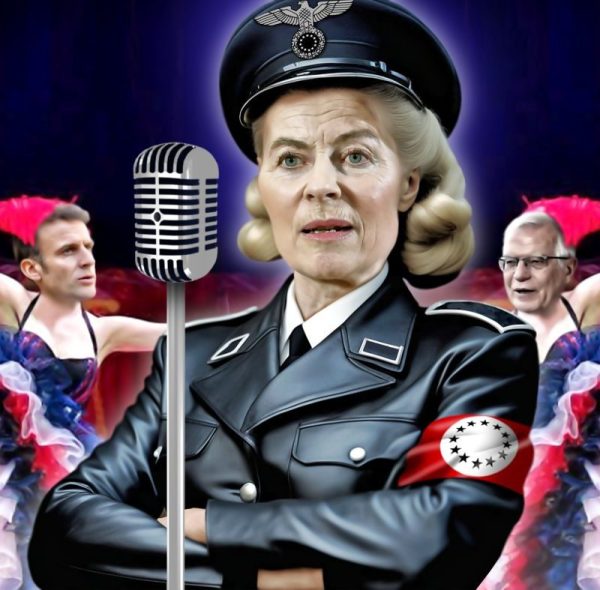
By Hugo Dionísio | Strategic Culture Foundation | July 26, 2024
The mainstream political class of the European Union, and its member states, has predictably ended up prolonging the agony, decadence and subservience of European affairs to U.S. interests. And now, for another five years, we will have to live, again, with Ursula von der Leyen.
Moreover, in the future, we will all remember her speeches on “value chain security”, in which Ursula’s great merit was to further reinforce the world’s dependence on Chinese value chains, demonstrating that, contrary to what she announces with as much anger as hatred, her tariffs, sanctions and conditioning cause us as much pain as they relieve the others. In the EU, in 10 years we will have given up the largest reserve of mineral, food, energy and raw materials in the world and, unless an uprising begins, we will also have given up the largest consumer market on the planet and the one that will grow the most in the coming years. These are von der Leyen’s great merits!
Given this record, you might think that the next five years would see a reversal of course. But no. Ursula von der Leyen will continue to infight against the EU’s own peoples, telling them one thing and doing the opposite, and one of the areas in which we can see, without any reservations whatsoever, that the European Union – this European Union – has given up on its indigenous peoples, is in relation to what is currently one of the main sources of social tension: immigration.
Classifying the current situation of the European labor market as being affected by serious “labor shortages”, the European Commission’s communication, entitled “Strengthening the social dialogue in the European Union: harnessing its full potential to manage just transitions”, is clear about von der Leyen’s intentions in this regard.
Don’t let the apparently rational discourse fool you: “strengthening the social dialogue” should be read as “guaranteeing social peace in the face of measures that will further squeeze wages and living conditions”; “harnessing its full potential” should be read as “increasing the reserve army of labor to contain wage growth”; and “managing fair transitions” should be read as “ensuring that everyone will be forced to adopt the EU’s economic and social model, without reservation”.
As always, by wrapping her draconian intentions in occasional discursive flourishes, Ursula von der Leyen is making Europe poorer, less independent and more dangerous. Much more dangerous. Every time she opens her mouth, it’s best to interpret her words as having a hidden meaning, which is often the opposite of what she actually said.
On the road to increasing the exploitation of Europe’s peoples, the European Commission rightly begins by noting the demographic changes that have taken place in recent decades. Europeans are simply having fewer children. The result is that the native European working population has been shrinking and the forecast is that, today, being around 265 million workers, in 2040 this figure will be around 250 million and in 2050, 240 million. In other words, a reduction of one million per year.
Faced with a problem of this magnitude, the long-term consequences of which will not only be the reduction of native peoples, but also the emergence of vast deserted and unused areas, the perishing of certain cultures and traditions, would require an in-depth study and measures capable of reversing the trend of population decline and falling fertility and birth rates.
So, what is the European Commission proposing to solve what it identifies as serious “labor shortages”? The measures proposed by the European Union are all aimed at promoting an abrupt increase in the stock of available labor. Through what it refers to as “activation policies”, the EU wants – it says – to achieve “zero” unemployment, which is the first contradiction we can identify. So, you want to achieve “zero unemployment” while, at the same time, increasing the stock of available labor?
The truth is that the “activation policies” envisage employing young NEETs (Not in Employment, Education or Training) and assessing the impact of “some retirement pensions”, i.e. assessing the extent to which these pensions are sending people capable of working into retirement, deactivating them instead of keeping them in the job market. This means focusing on the so-called “active ageing” market. Another measure is to identify “pockets” of available labor that may exist among disabled populations, “emancipating” these people, which would be laudable, but not when done for the wrong reasons. As we’ll see later.
Another important measure that is presented is intra-European mobility, transferring the nationally available workforce to the richer countries, leaving the rest without the investment they have made in education and training, aggravating the already unequal European division of labor, continuing to concentrate the activities with the highest added value and the highest wages in the northern countries and making the rest simple reserves of cheap labor, either to supply the richer ones or to install activities with lower added value and lower wages, perpetuating regional asymmetries. And all this, Ursula von der Leyen does, while stating the opposite objectives.
As for what the European Commission calls “promoting working conditions”, it aims to promote early entry into the labor market by promoting internships, apprenticeships and vocational education, diverting many young people, particularly the poorest, away from higher education and into early vocational training. As statistics show, young people in vocational education tend to go on to higher education far less often than those in general education. In this way, an elite is built up and entrusted with top management, keeping the rest in the middle ranks and migrants in low-skilled jobs.
But it is in solving the “labor shortages” on most undervalued activities that the EU is putting all its investment. The European economy still requires large amounts of labor for activities that use it intensively. In this case, the EU’s plans include strengthening migration policies and attracting the necessary workers from outside the EU. And this is how so many people who say they are against what they refer to as a “demographic replacement policy” end up supporting a European Union that wants to make migration policies one of its main strategic goals in attracting workers. In this way, the EU intends to establish what it calls a “European talent pool” and a “Platform for Labor Migration”. The two measures are based on attracting workers from third countries.
Now let’s compare these proposals with the following data:
- The average unemployment rate in the European Union is around 6.5%, so there are still around 17 million workers to be placed, a significant proportion of them young workers (14.5% are unemployed) between the ages of 18 and 25. Although the EU says that it is necessary to improve the qualifications of these people and that the labor gaps are more acute in some sectors than in others, the truth is that there is still a lot to be done at home to achieve “zero unemployment” before looking for a workforce in third countries.
- The potential for robotization, automation and digitalization of the European economy is still very high, especially in the less advanced countries, which in itself would free up huge amounts of available manpower that could be used in other sectors if this potential were to be realized.
- In general, the European Union does not develop policies that protect the birth rate and the right to parenthood, and even less that protect women of childbearing age, who so often have to give up fertility to the detriment of a career.
So, if these tasks have not yet been accomplished, why does the European Commission want to put the elderly, young teenagers, the disabled and invalids to work? Why does it want to attract qualified and less qualified workers from abroad? The reason is clear and has to do with wage restraint. The intention is to do this by increasing the so-called ” reserve army of labor “. More available labor, more demand for work, lower wages. It’s simple. That’s not to say that wages won’t rise, but they will rise at a slower rate than the economy, leading to a loss of purchasing power and to a relative decline in living conditions.
And you don’t have to go very far to understand why the European Union is going down this road. The first answer is as clear as water: cutting off relations with the Russian Federation has made the value of raw materials more expensive, and we need to compensate for this by reducing wages, not least because the strategy is to compete with China on global markets for the same type of products.
And if we need to compensate for this loss of energy and cheap raw materials, why do we compensate with lower wages? For example, in Portugal, the Confederation of Tourism, which brings together entrepreneurs linked to tourism, has proposed a “Labor Simplex” to the government, to make it easier to hire migrant labor from third countries. In other words, European employers are proposing a policy to facilitate migration from third countries. This type of solution is also advocated by Eurobusiness, which brings together European employers.
Migration policies and the flooding of the European Union with migrant labor are policies demanded by European employers, sponsored by the political class of the neoliberal and globalist center and from the interests akin to the transnational economy, and are aimed, in the face of falling unemployment rates and the need to adopt a more rational labor management policy, at ensuring that there is still enough labor available for companies not to be forced to increase wages.
Another of the fallacies that we can identify in Ursula von der Leyen’s speech comes to light when she refers to the need to “de-risk” China because its cheap products are destroying jobs in Europe. These EU proposals show that it’s not about “protecting jobs”, but rather about profit margins and levels of accumulation that put more than 20% of the wealth produced each year in the hands of just 1% of the richest. If it were about protecting “jobs”, the policies would be different. Protectionist? Yes, perhaps. But they would essentially be aimed at protecting jobs and the quality of life of Europeans.
And this is where we catch another fallacy. In this communication, which notes the “geographical changes”, there is not a word about improving the conditions of stability in employment and in life, about access to home ownership, which would allow adults of childbearing age to settle down and start a family; instead, there is a focus on “mobility”, the mobility that forces young people to leave poorer countries for richer ones in search of better salaries, but which, in many situations, is done at the cost of postponing the intention to settle down and start a family.
Promoting a more sustainable and stable lifestyle for young people, combating job insecurity, investing in cheaper housing and support for birth and parenthood, would call into question the economic model of division of labor in the European Union. It would jeopardize the interests of the most powerful countries in attracting the most qualified workers. And that’s not to change, it’s to maintain and even worsen.
The European Union, this European Union, is thus giving up on renewing its native populations, opting for the easiest path, the one that doesn’t call into question the neoliberal, globalist and hegemonic project that it is. In this sense, we could well say that if there is a project against the family and the native peoples of the member states, it is this European project itself. But, above all, it is against all these things, because it is a project against the interests of the peoples themselves, whatever they may be.
When everyone expected that the introduction of new technologies and the consequent increase in productivity – humanity has never produced so much and with such quality in such a short time – would lead to a reduction in normal working hours, since fewer resources are needed to produce the same thing, the European Union is telling us the opposite. It’s telling us that we need more and more human labor. Even if you have to get that labor from third countries. And this is where all those who say they are being “invaded” are silent. And they keep quiet because they know that migrant workers only come because they find work, because the employers attract them in many ways. Those same interests live off the terrible conditions in which these workers arrive and live, because the greater the effort they make to cross the Mediterranean, or to find decent housing, the lower their wages will be and the more degrading the housing conditions they accept.
Those who criticize migrant workers for living in crowded houses, for filling the streets where we circulate, accusing them of taking our jobs, have never, ever seen them accuse those who attract them, who develop the policies and the economic model that legitimizes all this. I have never seen them accuse a European Union that leaves the people, all the people, behind.
A European Union that has not only given up, but is using its own people!
This is the legacy of Ursula von der Leyen and all those who support her!
EU Refuses Support to Hungary, Slovakia on Russian Oil Transit Dispute With Ukraine
Sputnik – 25.07.2024
The European Union has denied its support to Hungary and Slovakia after they sought to force Ukraine to restore Russian oil transit to the bloc, the Financial Times reported citing sources familiar with the matter.
EU Trade Commissioner Valdis Dombrovskis told the FT that Brussels would need more time to gather evidence and assess the legal situation. Eleven of the EU nations attending a meeting of trade officials on Wednesday backed his stance and none took the side of Budapest and Bratislava, diplomats told the FT.
Hungarian Foreign Minister Peter Szijjarto said on Monday that Hungary and Slovakia had asked the European Commission to launch consultations with Ukraine after it stopped the transit of oil through the Druzhba pipeline. Szijjarto also said that Hungary would not approve the allocation of 6.5 billion euros ($7 billion) for arms sent to Ukraine through the European Peace Facility until the issue was resolved.
Ukraine’s trade agreement reportedly contains a clause that provides for the possibility of suspending oil transit. An EU diplomat was quoted as saying by FT that disruption in Russian oil supplies would have a “huge impact” on the central European nation.
Last week, Szijjarto said that Ukraine stopped the transit of Lukoil’s oil. The Slovak Economy Ministry confirmed that the country was no longer receiving oil from the Russian oil giant, which was sanctioned by Ukraine. Slovakia’s Slovnaft refinery imports Russian crude from another supplier, but the country is discussing the current situation with Ukraine.
Poland demands Ukraine resolves WWII massacre before joining EU
RT | July 24, 2024
Ukraine should not be allowed to join the EU until Kiev and Warsaw resolve their differences over a World War II massacre in which Ukrainian Nazi collaborators slaughtered tens of thousands of Poles, Defense Minister Wladyslaw Kosiniak-Kamysz has said.
The issue of the Volyn massacre has long been a flashpoint in Ukrainian-Polish relations, despite Warsaw’s support for Kiev in its conflict with Russia. Between 40,000 and 100,000 Poles are estimated to have been murdered by the Ukrainian Insurgent Army (UPA), which collaborated with the Third Reich, in the Volyn and Galicia Regions in 1943 and 1944.
In 2016, the Polish parliament declared the Volyn massacre a “genocide.” While Ukraine’s Vladimir Zelensky and Polish President Andrzej Duda jointly attended an event to honor the memory of Volyn victims in 2023, Kiev has so far been reluctant to call the massacre a genocide, arguing that such a crime can only be perpetrated by a state, while the atrocities were carried out by partisan units.
In an interview with the Polish broadcaster Polsat on Tuesday, Kosiniak-Kamysz said that while Poland intends to support Ukraine as much as possible, “not everything is perfect in our relations due to unresolved historical issues,” particularly when it comes to the atrocities committed by Ukrainian nationalists against Poles. “There will be no Ukrainian accession to the European Union if the Volyn issue is not resolved,” he stressed.
He reiterated that the fulfillment of Ukraine’s EU aspirations depends on whether it exhumes the bodies of the victims of the Volyn massacre. His remarks echoed a statement made by Polish Foreign Ministry Undersecretary of State Pawel Jablonski, who said in the autumn of 2023 that “without a solution to this issue… Ukraine cannot dream of joining the European Union,” while describing it as a condition for “long-term reconciliation with Ukraine.”
Zelensky promised to lift a moratorium on the exhumation effort in 2019, with searches resuming that same year in Ukraine’s western Lviv region after Poland agreed to restore a memorial to UPA guerrillas on its soil that had previously been destroyed by vandals.
Ukraine applied for EU membership in February 2022 after the escalation of the conflict with Russia and was granted EU candidate status in June of the same year. In June 2024, the EU opened official accession talks with Kiev, although its membership remains a distant possibility, with officials in Brussels demanding that Ukraine do more to combat rampant corruption and carry out a slew of other reforms.
Hungary issues €6.5bn ultimatum to Ukraine
RT | July 23, 2024
Budapest will block funds the European Union has earmarked for Ukraine until Kiev resumes the transit of Russian crude oil to Hungary and Slovakia, Hungarian Foreign Minister Peter Szijjarto has said.
Ukraine stopped the flow of oil through the Druzhba pipeline last week, citing its sanctions against Russian energy giant Lukoil, thus depriving the two EU members of an estimated 30-40% of their needs.
“As long as this issue is not resolved by Ukraine, everyone should forget about the payment of the €6.5 billion of the European Peace Facility compensation for arms transfers,” Szijjarto announced on Tuesday.
“Ukraine’s decision to not allow Lukoil to transit oil supplies through Ukraine poses a fundamental threat to the security of energy supplies to Hungary and Slovakia,” Szijjarto said, describing Kiev’s move as “unacceptable and incomprehensible,” as well as incompatible with its aspirations to join the EU.
Szijjarto also reminded the EU foreign policy chief Josep Borrell that Hungary – along with Slovakia and Poland – came to Ukraine’s aid in early July, sending enough electricity to stabilize Kiev’s energy system. Hungary supplied 42% of Ukraine’s electricity in June, Szijjarto noted.
According to unconfirmed reports from Ukrainian local media, Ukraine stopped receiving electricity from Slovakia and Romania as of midnight on Tuesday.
Kiev has had to resort to imports after Russian air and missile strikes disabled most of its domestic generation capabilities. Moscow has described the strikes as reprisal for Ukrainian attacks on Russian civilian infrastructure.
Poland has already protested Hungary’s move, saying that it would deprive Warsaw of €2 billion it needs to modernize its armed forces. “This is a huge disappointment for me,” Polish Foreign Minister Radoslaw Sikorski has said.
Kiev’s official explanation for embargoing oil deliveries was that Lukoil revenue could be used to support the Russian military. One Ukrainian lawmaker, however, suggested to Politico that the blockade has a secondary purpose, to pressure Hungary into changing its policy on arming Kiev.
Hungarian Prime Minister Viktor Orban has long refused to send Ukraine any weapons, train any Ukrainian troops, or allow the use of Hungarian territory for EU or NATO arms shipments, insisting that Kiev should sue for peace with Moscow as soon as possible.
Member states consult EU over ‘hostile’ Ukrainian move
RT | July 22, 2024
Hungary and Slovakia have requested that the European Commission intervene over Ukraine’s decision last week to block the pipeline transit of Russian crude oil.
While the EU has sanctioned imports of Russian crude to Germany and Poland, Slovakia and Hungary have received exemptions. Last week, however, Ukraine cut off the flow of oil, citing its own sanctions against Russian energy giant Lukoil.
“I spoke with the Ukrainian foreign minister yesterday; he said they allow every oil transfer through, but it’s not true,” Hungarian Foreign Minister Peter Szijjarto said in Brussels on Monday.
Szijjarto described Kiev’s actions as “hostile,” especially since Ukraine imports electricity from Hungary. He added that Budapest and Bratislava have requested consultations with Brussels on the matter. Slovakian Foreign Minister Juraj Blanar has confirmed this.
“The commission has three days to carry out our request, after which we will bring the issue to court,” said Szijjarto. If Kiev refuses to resume oil transit, the EU will be justified in suspending certain clauses of Ukraine’s association agreement, he added.
The EU formally approved the start of membership negotiations with Ukraine last month, as a symbolic message of support to Kiev in its conflict with Moscow.
On Saturday, Slovakian Prime Minister Robert Fico called his Ukrainian counterpart Denis Shmigal to complain about the “senseless” sanctions that may leave Bratislava 40% short of the oil it needs. Moreover, the shortages could force Slovnaft to stop deliveries to Ukraine, which account for 10% of Kiev’s oil consumption.
“Slovakia does not intend to be a hostage to Ukrainian-Russian relations,” Fico said.
Ukraine imposed sanctions on Lukoil on June 24, including the freezing of assets, limiting trade operations, and “partial or complete cessation of resource transit.” The oil stopped flowing on July 17, according to Hungary’s MOL, which also owns Slovnaft.
Officially, Kiev seeks to deprive Moscow of oil revenue that could be used to pay for the Russian military, even though Ukraine itself is getting a cut from transit fees. Ukrainian lawmaker Inna Sovsun has suggested to Politico that the embargo has a secondary purpose: to pressure Hungary.
“We have really tried all the diplomatic solutions, and they never worked,” said Sovsun. “So it seems like we have to find some other approaches in how to talk to them.”
Prime Minister Viktor Orban’s government has vocally opposed the EU policy of sending money and weapons to Ukraine and vowed to block its membership in the bloc as well as NATO.
Scholz orders closure of one of the opposition’s largest media networks after interview with Zakharova
By Ricardo Nuno Costa – New Eastern Outlook – 17.07.2024
On 16 July, Jürgen Elsässer (67) woke up startled at 6 a.m., opened the door of his house while still in his dressing gown, and in front of him were dozens of police officers, some with their faces covered, heavily armed, in a surreal image befitting any authoritarian state. However, it was in Brandenburg, on the outskirts of Berlin, in the Germany of the tragicomic Scholz government, aka the ‘Traffic Light’ coalition.
The police were about to raid his house, while more than 200 federal and Brandenburg state agents were deployed to carry out further searches in eight other houses and offices in the region. Other raids were carried out in the states of Saxony, Hesse and Saxony-Anhalt, ordered by Interior Minister Nancy Faeser (SPD), who had ordered Compact to be closed by decree as an ‘association’, when it was legally a publishing house. She also banned any activity by the audiovisual company that produced Compact’s content, such as its YouTube, Facebook and Instagram accounts.
The minister later explained that Compact ‘incites hatred against Jews, against people with a history of migration and against our parliamentary democracy in an indescribable way’. According to the Ministry, the legal basis is the Law on Associations, according to which organisations that are directed against the free and democratic basic order can also be banned.
‘The ban shows that we are also taking action against intellectual arsonists who are fuelling a climate of hatred and violence against refugees and migrants and who want to bypass our democratic state,’ the minister explained. “Our message is very clear: we will not allow ethnicity to define who belongs in Germany and who does not. Our rule of law protects all those who are harassed because of their faith, their origin, the colour of their skin or even their democratic position.”
As early as 2022, the German intelligence services (BND) considered that Compact, ‘as a multimedia company, conveys anti-democratic positions in society and against human dignity’, and since then, it has been classified as far-right by the Office for the Protection of the Constitution and under suspicion.
Interviewed by journalists during the police search of the house where he lives with his wife and partner in the company, Elsässer said that ‘in 14 years of existence there has not been a single criminal charge against his magazine’, which is why he was surprised by the minister’s announcement. He also said that he was in contact with his lawyer to defend his rights and jokingly imitated Donald Trump with his fist raised saying that he was ‘ready for a fight’.
Mixed reactions in the press
While journalists from the mainstream media are refusing to give this episode its due importance, others have seen the government’s unusual decision as a clear warning sign. Opinions were divided between the established media and the few journalists still struggling to report, and the internet was abuzz with the event. The tag #Compact was the main topic on German Twitter throughout the day, and Germans and foreigners alike made the Scholz government’s persecution of the media viral. Germany is under the scrutiny of international public opinion for the worst reasons.
Elsässer complains that this is ‘the biggest attack on press freedom in Germany since the 1962 Spiegel Magazine scandal’. At that time, it was discovered that the Adenauer government wanted to silence several journalists by illegal means for political reasons. When this was discovered, Defence Minister Franz Josef Strauß and two state secretaries had to resign. However, not even then was a troublesome media outlet banned, as it is now with his case. Elsässer says that only in the GDR and during National Socialism were things like this scene.
The metamorphosis of Elsässer, the current standard-holder of Germany’s ‘new right’
Jürgen Elsässer is a long-time political activist. With a degree in history and a short career as a teacher, he started out in the far-left anti-German movement in the 1970s, wrote books with a strong anti-national slant, worked on the editorial boards of various left-wing publications such as Junge Welt, Neues Deutschland, he collaborated with Der Freitag and the Jüdische Allgemeine and was editor-in-chief of Konkret magazine, until after disagreements with other elements, he founded Compact magazine in 2010, with the idea of bringing together the best of the left and the right in a transversal front (‘Querfront’), based on national sovereignty, the multipolar world and the rejection of the EU and NATO.
In 2017, with the demonstrations against Merkel’s open-door immigration policy, he joined forces with the leader of the AfD in Thuringia, Björn Höcke, considered a quasi-neo-Nazi, and Martin Sellner, leader of Austria’s Identity Movement. Since then, the magazine has become a major reference point for the so-called ‘new right’ and Elsässer has become one of the central figures in the German nationalist spectrum.
His political proposal and trajectory are controversial and very heterodox. He clearly calls for the ‘remigration’ of non-European foreigners, makes claims to Polish territories, likes to provoke his opponents, has aligned himself with openly Islamophobic elements such as Michael Stürzenberger or the PEGIDA movement, has played on the edge, but always within the rules of the game. At least until today.
Elsässer is an experienced figure, with a huge culture and a large archive of articles and books written, where he has changed his mind, or at least his appearance. He says that he hasn’t changed at all, that he remains in the same political position as he was 40 years ago.
He worked for the Die Linke parliamentary group as a member of the BND enquiry committee in the Bundestag. He is an insightful expert on geopolitical issues. In 2012, he was received by then president Mahmoud Ahmedinejad in Tehran, together with a German entourage. About that trip to Iran, he said he enjoyed everything, only missing a good cold beer, like the good German he claims to be. He recently teamed up with Maximilian Krah, the AfD’s European frontrunner, who advocates a Germany that guarantees its status as a pole in the multipolar world that has already been born and is taking its first steps.
A quality magazine
Compact magazine was the centrepiece of the network that included audiovisual channels, the organisation of events, conferences, the publishing and sale of books and Compact TV, with its YouTube channel, which recently reached one million views a day.
Over the years, you could say that the magazine has moved to the right. In 2014, it dedicated a cover to Netanyahu, in which it accused him of perpetrating a ‘Genocide in Gaza’, then shifted its focus to criticising immigration, especially of Islamic origin. Later articles were also read against Hamas. With the pandemic, it took a clear stance against the government, the pharmaceutical industry and the accusation of a biological warfare conspiracy by the great powers of the West.
With Russia’s entry into Ukraine, it advocated dialogue with Moscow and the resumption of Russian energy. It was one of the few media outlets to do an exhaustive report on the Nord Stream attacks, to which it devoted almost an entire issue. In its December 2023 issue, it details how an extremely powerful Zionist sect with global reach, currently in the Israeli government, is planning an eschatological end-of-times war with catastrophic consequences for the whole world.
The absence of the Compact has already been felt since the arrival of the ‘Traffic Light’ government. Heavy pressure on distributors led to the magazine disappearing from petrol stations, supermarkets, newsagents and bookshops. Little by little, it was confined to subscribers. It was one of the few magazines where you could read good geopolitical articles.
The German typhoon
The magazine ban is just one more of the government’s decisions that threaten to divide German society, but it doesn’t seem to bother the establishment, either in the government or in the opposition on the traditional right.
Brandenburg’s Interior Minister Michael Stübgen (CDU) welcomed the federal government’s move. Stübgen accused the magazine of spreading ‘Russian war propaganda and conspiracy theories against the democratic order’. He also said that ‘this platform of enemies of democracy has only one goal, which is the destruction of our liberal society’.
In a comment on social media, historian Hermann Ploppa, identified with the left wing and linked to the famous alternative politics portal Apolut, confesses that ‘the Compact is not to my liking. A lot of it is simply disgusting. But there is no violation of the law. It’s also clear that the Compact ban is the opening fanfare to suppress the inconvenient media. That’s why we shouldn’t stand idly by. WE ARE NEXT.”
Across the party spectrum, only the AfD criticised the magazine ban. The party’s leaders, Tino Chrupalla and Alice Weidel, jointly announced on Tuesday that it was a ‘serious blow to press freedom’. ‘The banning of a media organisation means the denial of discourse and diversity of opinion.’ According to the far-right party, the interior minister is abusing her powers to ‘suppress critical information’.
Sahra Wagenknecht’s BSW had not commented on the Compact ban at the time of writing. Wagenknecht has been on the cover of the magazine on more than one occasion. In its December 2022 issue, she was described as ‘The best chancellor: A candidate for left and right’. The relationship between Elsässer and Wagenknecht goes back to the 90s. In 1996, a still communist Elsässer interviewed his comrade Wagenknecht, long before he became one of the main ideologues of the new ‘Querfront’ between the ‘left of labour and the right of values’, an enterprise for which he has called on Wagenknecht to participate on several occasions in recent times.
The Zakharova interview
If the move against Compact magazine didn’t come without warning, it did coincide with the interview with Russian Foreign Ministry spokeswoman Maria Zakharova, conducted two days earlier by Compact’s Moscow correspondent Hansjörg Müller and broadcast on the magazine’s website and YouTube channel.
With hundreds of thousands of hits on the first day on the website and more than 250,000 on YouTube, Zakharova ridiculed the “traffic light” government in the one-and-a-half hour interview. She sharply criticised the policies of Scholz, Baerbock and the sanctions, which not only destroy relations between Berlin and Moscow, but also harm Germany’s own interests, all at the behest of “third-party interests”.
The Russian spokeswoman also alluded to the problem of immigration in Germany, which she said had geopolitical origins, with Berlin playing a subservient role to “US and British operations in the Middle East and Southern Africa”, which are causing the migratory chaos that is burdening Europe.
She also spoke about Germany’s obligations under the 1999 2+4 Treaty, the murky role of the German authorities in the case of Navalny’s alleged poisoning in 2020, the pandemic, vaccines and the announced abolition of paper money in Europe, the Federal Reserve, the destruction of Nord Stream, and much more. All in all, a fascinating interview, highly recommended, and very uncomfortable for Western liberal elites, especially Germans.
It’s clear that, once again, the German government is acting in accordance with the Washington Consensus, because the magazine in question was clearly in favour of peace between Germany and Russia, was gaining public influence and threatening several pillars on which Germany’s structure has rested since 1945. The fact that this doesn’t please many people is understandable, but it doesn’t make it an illegal outlet. Mrs Faeser’s decision sets a serious precedent, foreshadowing difficult days ahead for free information in Germany and Europe. Having found no illegality, the German government had to use two paragraphs of a law on associations to ban a publishing house because it was inconvenient. It’s all food for thought.
Ricardo Nuno Costa ‒ geopolitical expert, writer, columnist, and editor-in-chief of geopol.pt.
EU Commission Hid Vaccine Contract Details From Public, Court Rules
By John-Michael Dumais | The Defender | July 17, 2024
The European Union‘s (EU) top court today ruled that the European Commission’s decision to heavily redact key portions of COVID-19 vaccine contracts with pharmaceutical companies during the pandemic violated the commission’s transparency obligations.
The European Court of Justice found that the commission failed to provide sufficient public access to COVID-19 vaccine purchase agreements, in a ruling that could deal a blow to Commission President Ursula von der Leyen on the eve of her re-election bid, according to The Associated Press (AP).
The ruling came in response to legal challenges brought by EU lawmakers and private citizens seeking fuller disclosure of the multibillion-euro vaccine deals.
It highlights ongoing concerns about the secrecy surrounding the EU’s vaccine procurement process, a contentious issue since the early days of the pandemic.
“The Commission did not give the public wide enough access to the contracts for the purchase of COVID-19 vaccines,” the court said in its judgment, pointing to several areas where the executive body fell short in being sufficiently transparent.
In response to the ruling, the commission wrote, “The Commission needed to strike a difficult balance between the right of the public, including MEPs [Members of the European Parliament], to information, and the legal requirements emanating from the COVID-19 contracts themselves, which could result in claims for damages at the cost of taxpayers’ money.”
Green MEP Tilly Metz, one of the deputies who submitted the original request, said, “This ruling is significant for the future, as the EU Commission is expected to undertake more joint procurements in areas like health and potentially defence,” Euractiv reported.
“The new European Commission will have to adapt their handling of access to documents requests to be in line with today’s ruling,” Metz said.
However, Dutch attorney Meike Terhorst told The Defender that the court ruling is not the victory it seems. She argued that the EU court has given the commission a “giant loophole” to keep parts of the contracts secret “to protect ‘business interests.’”
“It is not possible to both protect public health and full transparency and at the same time protect the business interests of the supplier,” Terhorst said. “We, the public, will not get the access to the information we need. The cat and mouse play continues.”
The commission, which has two months to appeal the decision, said it would “carefully study the Court’s judgments and their implications” and that it “reserves its legal options.”
Scale and speed of purchases unprecedented
In 2020 and 2021, von der Leyen negotiated purchase agreements for COVID-19 vaccines with several pharmaceutical companies, including Pfizer, Moderna and AstraZeneca, according to the AP.
EU member states mandated the European Commission organize the joint procurement of vaccines and lead negotiations with manufacturers.
The scale and speed of these purchases were unprecedented. According to the court, approximately 2.7 billion euros ($2.95 billion) was quickly mobilized to place firm orders for more than 1 billion doses of vaccines. This joint procurement approach allowed for the rapid acquisition of vaccines for all 27 EU member states.
Initially, von der Leyen received praise for her leadership during the COVID-19 crisis, particularly for her role in securing collective vaccine access for EU citizens. However, the spotlight quickly shifted to concerns about the negotiations’ lack of transparency.
In 2021, several members of the European Parliament requested full details of the agreements. The commission, citing confidentiality reasons, agreed to provide only partial access to certain contracts and documents, which were placed online in redacted versions.
The commission also refused to disclose how much it paid for the billions of doses it secured.
Concerns over secret deals with Pfizer
Pfizer CEO Albert Bourla twice in 2022 refused to testify before the European Parliament’s special committee on COVID-19. Bourla was expected to face tough questions about secretive vaccine deals and negotiations between Pfizer and the European Commission.
Of particular interest were text messages between Bourla and von der Leyen that preceded a multibillion-euro vaccine contract. In January 2023, The New York Times sued the European Commission over its failure to release the messages.
That suit followed a January 2022 inquiry by the EU ombudsman charging the commission with maladministration over its handling of a previous request for the messages.
In June, a Belgian court took up the issue of the secret negotiations between Bourla and von der Leyen, with a former lobbyist for the EU Parliament claiming “destruction of public documents” and alleging von der Leyen violated the commission’s code of conduct.
Commission officials argued the messages didn’t contain any important information and have thus far refused to provide them, according to the AP.
European Public Prosecutor’s Office (EPPO) in 2022 opened an investigation into the acquisition of COVID-19 vaccines in the EU during the pandemic. This investigation stems from a criminal complaint filed by an individual, with the governments of Hungary and Poland later joining the lawsuit, euronews reported. EPPO adjourned the case until December.
Implications for the European Commission and von der Leyen
The court’s ruling comes at a critical time for von der Leyen, just one day before the European Parliament is set to vote on her reappointment as commission president.
Von der Leyen had previously won backing from a majority of EU leaders in June. To secure her position, she now needs to garner support from at least 361 MEPs in the 720-seat European Parliament, WIONews reported.
This ruling presents a dilemma for the Greens, who initiated the legal challenge against the commission’s redactions. In recent days, von der Leyen has been courting the Greens to shore up support for her nomination ahead of the vote.
During a press conference in Strasbourg on Wednesday, Manon Aubry, a French MEP from the Left group, expressed strong concerns about the European Commission’s “lack of transparency.”
On the heels of the EU court ruling, German MEP Christine Anderson today said she would call for the removal of von der Leyen and the continuation of the criminal investigation of her actions.
This article was originally published by The Defender — Children’s Health Defense’s News & Views Website under Creative Commons license CC BY-NC-ND 4.0. Please consider subscribing to The Defender or donating to Children’s Health Defense.
MEPs want Hungary stripped of voting rights
RT | July 16, 2024
Scores of European Parliament members have called on Brussels to punish Hungary after its prime minister, Viktor Orban, allegedly abused the bloc’s rotating presidency by launching his Ukraine “peace mission,” Politico reported on Tuesday.
The outlet published a letter signed by 93 MEPs and addressed to European Commission President Ursula von der Leyen, European Council President Charles Michel, and European Parliament chief Roberta Metsola.
The signatories accused Orban of causing “significant damage by exploiting and abusing the role of the [EU] Council Presidency,” which Hungary assumed earlier this month. The focus of their ire was Orban’s “peace mission” which involved recent visits to Ukraine, Russia, China, and the US.
“Orban deliberately left the impression that he was acting on behalf of the entire European Union,” the letter claimed, despite the leader stressing that he was acting in his capacity as head of the Hungarian government before flying to Moscow earlier this month. MEPs said their assertion was “clearly evidenced” by the fact that senior EU officials had stressed that Orban did not represent the bloc “in any form” during his trips.
The Hungarian leader “is actively pursuing a policy agenda which is contrary to common EU positions,” and “this cannot be allowed to continue,” the MEPs said. They have urged the EU leadership to launch so-called Article 7 proceedings against Hungary.
Widely considered a “nuclear option,” the article allows suspension of voting rights of a member state. The punishment is necessary “since practice has shown that mere verbal condemnations of this situation have no effect,” the letter said.
Hungary has criticized EU policy since hostilities between Ukraine and Russia broke out in February 2022. According to Budapest, Western economic sanctions imposed against Moscow have seriously damaged European economies, while the supply of weapons to Kiev has led to the continuation of hostilities instead of their end. Orban has urged a ceasefire and a negotiated resolution of the crisis, which his critics call a pro-Russian stance.
Orban has detailed his vision of resolving the conflict in a letter to Michel, the European Council president, his office confirmed on Monday. His plan reportedly includes making concessions to Russia in terms of NATO’s expansion in Europe, which Moscow has called one of the key triggers of the confrontation.
Michel has said Brussels should “be smart” about its reaction to Orban’s diplomatic activities, claiming that EU unity could otherwise be seriously damaged.
Featured Video

Racist Seinfeld Dances for Joy as Bibi Unveils His New Map
or go to
Aletho News Archives – Video-Images
TV Drama Review
Japanese drama projects Japan’s wartime atrocities onto Chinese characters

Global Times | October 25, 2026
By portraying Chinese characters as perpetrators of ruthless violence while casting Japanese Self-Defense Forces (SDF) intelligence operatives as defenders, the season 2 of the Japanese drama Vivant has recently drawn criticism from Chinese netizens, who argue that its depiction turns historical reality on its head while ignoring Japan’s wartime atrocities.
The TBS drama series – a spy suspense story in which an alleged unofficial intelligence unit of the SDF operates across the globe — has attracted a passionate fanbase. Its currently airing season 2 opened with a household rating of 18.8 percent, the highest for a TV drama this year, according toa commentary article by Japanese media Toyo Keizai.
What draws attention is the portrayal of the enemies in the series, the article noted. Scenes in which the Chinese organization subjects kidnapped members of the SDF unit to brutal torture are repeated with unrelenting intensity.
It is rare for Japanese TV dramas to explicitly portray a real-life country as the enemy, the article noted.
Japanese Prime Minister Sanae Takaichi also made a reference to the drama, saying that she has been recording Vivant and hopes to binge-watch it over the year-end and New Year holidays, according to Japanese media outlets.
China’s CCTV News report on Sunday revealed that the drama features scenes in which Chinese personnel cut off the fingers of and stab Japanese intelligence operatives in the abdomen. Such acts bear striking similarities to the torture inflicted on Chinese nationals by invading Japanese troops during the World War II.
The drama distorts the truth by attributing these atrocities to modern Chinese characters. Beneath the surface, it subtly glorifies Japan’s cross-border overseas operations, blurs the functional boundaries of the SDF and implicitly promotes an expansionist narrative, per CCTV News. … continue
Blog Roll
 Aletho News
- Netizens condemn Japanese drama for projecting Japan’s wartime atrocities onto Chinese characters
- Racist Seinfeld Dances for Joy as Bibi Unveils His New Map
- A West Bank War for Netanyahu’s Election Campaign, Could It Backfire?
- Yemen denounces European Parliament’s ‘hypocritical’ push to blacklist Ansarullah
- Qalibaf: UAE’s UN bid aims to ‘clear the runway’ for ‘Greater Israel’, whitewash genocide
- Pakistan reopens Iran border after boosting security: Report
- Why are so many Brazilians voting for Flávio Bolsonaro?
- Democrats Put Anti-Russia Agenda Ahead of American Workers
- Elijah Magnier: Yemen’s Strikes Are Shattering Saudi Arabia’s Long-Term Strategy
- Pentagon designates Chinese cultural centers national security threat
- If Americans Knew
- Latest updates from Israeli assault on West Bank
- Tourism Ministry launches free food truck tour in US
- “So Much Worse Than People Realize”: Never-Before-Seen Images Reveal Damage at U.S. Bases as Troops Describe Being Abandoned
- UK Bell Review Confirms Only Anti-Israel Attitudes Are Rising, Not Antisemitism
- DAILY UPDATE: Latest essential news on Palestine, Israel, & region
- DAILY UPDATE: Latest essential news on Palestine, Israel, & region
- Damning report shows the media must confront its failures on Gaza
- BBC senior broadcaster speaks out on Gaza coverage
- Netanyahu vows vast West Bank invasion in response to 20-minute skirmish that left 2 Israeli soldiers and 2 Palestinian fighters dead
- Tied up and tortured: Israel using US-made electroshock weapons on Palestinian detainees
- No Tricks Zone
- Sudden Stratospheric Warming, Powerful El Niño Combination May Lead To Extreme Europe Cold, Energy Crisis!
- Two New Studies Find Thwaites Glacier Melt Cannot Be Driven By Human Activity Or A Warming Ocean
- E-Cars Reduce CO2 Emissions By Only 41% Compared To Internal Combustion Engine Vehicles
- Predictions Made By Renowned Climate Professor Over Past Decades Have Been Proven To Be Poor
- New Study Suggests Large Regions Of The Pacific Ocean Have Been Cooling For The Last 80 Years
- Germany’s Green Energy Debacle: High Energy Costs Force Kahla Porzellan to Close After 182 Years!
- New Study: 50 Years Of The Most Aggressive ‘Net Zero’ Policies Can Only Affect The Global Climate By 0.03°C
- US September “Heat” Was No Record…Many Records Set Decades Ago
- Latest European Green Energy Debacle; Portugal’s Largest Flagship Solar Park Insolvent!
- Green Energy Debacle: German Expert Professor Fritz Vahrenholt Warns Of Severe Economic And Social Consequences

