EU tells citizens to further reduce gas consumption

Greenpeace activists put giant sticker on European Union Commission HQ in Brussels, March 1, 2023 © Thierry Monasse / Getty Images
RT | February 28, 2024
EU residents must maintain the reduced natural gas consumption levels imposed in the wake of sanctions targeting Russia’s energy sector, according to a draft proposal from the European Council published on Tuesday.
The proposal states that usage levels at least 15% below average demand (measured between April 2017 and March 2022) should be maintained on a voluntary basis for another year. This is despite claiming that the reductions undertaken up to now – or an even more severe rate of 18% – had successfully achieved many of the original proposal’s goals.
Despite diversified supply, lower, more stable prices and higher storage reserves “benefiting the competitiveness of the EU economy,” the Council claims cutbacks must continue for another year. The proposal also notes that such a restriction would also push the EU towards Net Zero carbon emissions.
Should EU residents or their leaders become unwilling to cut back on their fossil fuel consumption, the resolution allows the “voluntary” cutbacks to be mandated, eliminating any risk of scuttling the concept entirely with one or two holdout countries.
Brussels recently confirmed that a five-year pipeline gas transit agreement via Ukraine with Russia’s Gazprom would not be renewed when it expires at the end of March.
Despite passing 13 sanctions packages since 2022 in an effort to punish Russia for its military operation, the EU still bought nearly €30 billion in oil, petroleum products and natural gas from the country last year.
At the same time, Germany, traditionally the EU’s strongest economy, is in crisis, with 15% of its companies in distress, consultants Alvarez & Marsal reported earlier this month. Many analysts blame high energy costs and predict the worst is yet to come, with a real estate crisis looming as companies that can no longer afford to pay for their office space are defaulting, among other secondary effects.
‘State-minus’: Biden’s Palestine solution
Three decades after the Oslo Lie, neither the US nor the EU are in any position to dangle the promise of a Palestinian state.
By Stasa Salacanin | The Cradle | February 29, 2024
Is it sadly ironic that the issue of Palestinian statehood – unresolved for over 75 years – has resurfaced only after Israel’s wholesale carpet-bombing of the Gaza Strip, killing over 30,000 civilians, injuring tens of thousands more, and destroying significant swathes of the territory’s infrastructure.
University of California (UCLA) historian James Gelvin states the case plainly:
“There would have been no serious discussion of a two-state solution without [the events of] 7 October. As a matter of fact, putting the Palestine issue back on the front burner of international and West Asian politics was one of the reasons Hamas launched its operation.”
As Gelvin explains it to The Cradle, Hamas has already scored several victories since its Al-Aqsa Flood operation: “The Palestine issue is back on the international agenda, it is negotiating the release of its captives as an equal partner to Israel,” and has demonstrated that it is “more effective in realizing Palestinian goals than its rival, Fatah.”
New ‘Biden Doctrine’
While the unprecedented, brutal Israeli military response has indeed illustrated the urgency for establishing a Palestinian safe haven, it is impossible to ignore that western state backers of the 1993 Oslo Accords – which laid out the essential framework for the establishment of a Palestinian state – have then so assiduously ignored and neglected that responsibility.
Even greater hypocrisy emerges from the fact that these western powers, led by Washington, have now decided to force the discussion of Palestinian statehood in the midst of Gaza’s carnage, with an Israeli prime minister, Benjamin Netanyahu, who is infamously opposed to it.
So, why is this debate possible now? Why was it ignored before 7 October – or even prior to Netanyahu’s return to the prime ministership?
After enormous public and international pressure, US President Joe Biden has, at least rhetorically, reopened the issue of Palestinian statehood. According to the New York Times, the Biden White House’s new doctrine would “involve some form of US recognition of a demilitarized Palestinian state in the West Bank and Gaza Strip in return for strong Palestinian guarantees that their institutions could never threaten Israel.”
In addition, the US president’s plan also envisages Saudi–Israeli normalization and a tough military stance against Iran and its regional allies. However, many analysts have already raised questions about the viability of a plan that does not reflect current ground realities.
While Netanyahu rejects the very notion of a Palestinian state, the ‘Biden doctrine’ and its offering of some limited-sovereignty version of a demilitarized Palestinian state is nothing less than humiliating for Palestinians.
Dr Muhannad Ayyash, Professor of Sociology at Mount Royal University, observes that there is no fundamental change of approach by the US on this issue. In short, the Biden administration refuses to clarify what it means by a ‘Palestinian state.’ Its initiative appears mainly to advance a form of a two-state solution that would be palatable to Israel.
Ayyash points out that the key issues related to Palestinian statehood are left unanswered, including the issue of sovereignty, Jewish settlements, the status of East Jerusalem, a necessary West Bank/East Jerusalem connection with the Gaza Strip, the Palestinian right to return, and so forth.
As Israel has firmly insisted on retaining full security control over the entire territory west of Jordan – meaning, over all the territory likely to come under Palestinian (self-)rule – many experts fear that Israel would have the right to militarily enter those territories at will, without Palestinian consent, with the latter banned from assembling its own military force.
This version of ‘statehood’ is not remotely on par with that of other UN member-states, who are entitled, under the UN Charter, to exercise full sovereignty and defend their territorial integrity. Biden’s ‘solution’ of a Palestinian state with limited sovereignty is nothing more than the legalization of Israel’s perpetual occupation of Palestine.
A Palestinian ‘empty shell’
The revived debate on Palestinian statehood is also intricately connected to a big western public relations dilemma. The Atlanticists’ unconditional support for Israel’s illegal, disproportionate military assault against mostly female and child populations has deeply impacted their image and capacity to maneuver in West Asia and beyond.
This is especially true for Washington’s foreign policy objectives in the region, which are facing major, direct resistance on the ground in Iraq, Syria, and Yemen.
The revival of a two-state solution is, therefore, a “desperate act to salvage some of the credibility or legitimacy of these regimes (both Arab and Western governments),” argues Dr Mohammed Abu-Nimer, Professor and Abdulaziz Said Chair for Peace and Conflict Resolution at the American University in Washington, DC.
For decades, the US has capitulated to Israeli demands on pretty much everything Tel Aviv has ever asked for. In recent years, as Gelvin describes it, the US has mainly focused “on bribing various Arab governments – the UAE, Bahrain, Morocco, Sudan – to normalize relations with Israel” through the “Abraham Accords,” which, in effect, took the Palestine issue off the table.”
Meanwhile, Arab states managed regional expectations by continuing to pay lip service to Palestinian issues while scuttling any opportunities behind the scenes. With few Arab state allies left, Palestinians themselves had no cards left to leverage – until 7 October.
Now, Israel is doing all it can to negate that day’s gains. Says Ayyash:
“Netanyahu wants to dispense with all pretension about the establishment of the Palestinian state and use this moment to establish full Israeli Jewish sovereignty from the river to the sea, whereas the Biden administration prefers a quieter approach that pretends to care about the aspirations of the Palestinian people in order to maintain its close ties with Arab regimes across the region.”
The two-state solution, according to Professor Abu-Nimer, is, therefore, nothing other than a “fig leaf” to resuscitate the west’s crashing image and should not be viewed as a serious US initiative. The proposed plan is “a skeleton or an empty shell which lacks of any serious form of sovereignty.”
Nathan Brown, an American scholar of Middle Eastern law and politics at George Washington University, largely concurs:
“This is not a step toward statehood but only reviving some provisions of the Oslo Accords. Even at a maximum, it would produce what would have been called a ‘protectorate’ in the nineteenth century, not a state.”
A Palestinian state is not on the cards
Although the US and the EU could exercise immense leverage over Israel to revive the Oslo agreement and fast-track its provisions, they are doing nothing of the sort.
Today, there is a unique opportunity for Tel Aviv’s western allies to play this hand, given the utter collapse of Israel’s image worldwide and the mass public demand for the protection of Palestinians.
Instead, the Biden administration thinks that it can resurrect the two-state idea by mediating a grand regional deal – one that will deliver everything Israel wants, by dangling the promise of a rump Palestinian state.
The White House believes that the reward of normalizing relations with Saudi Arabia will offset for the Netanyahu government a reversal on the question of Palestinian statehood and withdrawal from the occupied Palestinian territories.
Gelvin dismisses the plan, saying it simply won’t work on so many levels. For starters, “if Netanyahu commits to a Palestinian state and withdrawal from the occupied territories, his government will collapse and he will go to jail.”
Don’t expect anything spectacular from the European Union either. Although EU High Representative for Foreign Relations Josep Borrell has said that a Palestinian state may need to be imposed from the outside without Israel’s agreement, realistically, the range and reach of European foreign policy is minimal or non-existent. According to Gelvin, “the EU has no more leverage against Israel than Costa Rica.”
Abu-Nimer likely speaks for the majority of regional observers – who have seen this game play out before: these top-down western statehood formulas do not work without genuine engagement with Palestinian political representation – in this case, Hamas and other Palestinian resistance organizations.
Thirty-one years after the Oslo Accords promised a Palestinian state, Israel is ethnically cleansing Gaza and swallowing up the West Bank and East Jerusalem. Almost five months after the start of Operation Al-Aqsa Flood, some of the leverage is back in Palestinian resistance hands, and they are unlikely to trade their gains for an unsovereign rump state which diplomats are privately calling a ‘state-minus.’
EU-Created Fund Interfering in Georgia’s Elections – Parliament Speaker
Sputnik – 28.02.2024
TBILISI – The EU-established European Endowment for Democracy (EED) fund is interfering in the parliamentary elections to come in Georgia by financing various political parties, Georgian parliamentary speaker Shalva Papuashvili said on Wednesday.
“EED does not disclose its own expenses in Georgia. Apparently, the fund directly finances political parties and interferes in the elections. Holding the elections properly is part of the nine points [needed to be taken by Georgia for EU integration] and we cannot deal with this alone. The European Union, its representative office, the European Commission must intervene, because this foundation is an institution created by the EU,” Papuashvili told reporters.
If not stopped, foreign funding will harm the elections, which are scheduled to take place in the country, on October 26, and hinder the choice of the Georgian people, the parliamentary speaker added.
“We are seeing that a significant part of the opposition is being financed directly from abroad and, given the fact that the current year is an election year, this is equivalent to foreign interference in the elections in Georgia. Foreign interference is one of the threats expected in these elections … For the elections to be transparent, it is necessary to prohibit and stop direct or indirect funding of parties in Georgia through European channels,” Papuashvili said.
Established in 2023 by the European Union, EED officially aims to promote democracy in the European Neighborhood, the Western Balkans, and Turkiye.
Here’s How Russia Could Hit Back If West Seizes Assets
By Ilya Tsukanov – Sputnik – 27.02.2024
Some $300 billion in Russian assets were trapped abroad in 2022 after the escalation of the Ukrainian crisis into a full-on NATO-Russia proxy war. Western officials have threatened to seize these funds and transfer them to Ukraine for “reconstruction.” A pair of leading Russian economists tell Sputnik why that’s a very bad idea.
Treasury Secretary Janet Yellen has called on nations of the Western “coalition” against Moscow to “find a way to unlock the value of [Russia’s] immobilized assets to support Ukraine’s continued resistance and long-term reconstruction.”
“I believe there is a strong international law, economic and moral case for moving forward. This would be a decisive response to Russia’s unprecedented threat to global stability,” Yellen said at a meeting of G20 finance ministers and central bank governors in Sao Paulo, Brazil on Tuesday.
Tackling the question of the potential threats to the dollar’s status as the de facto world reserve currency that such an unprecedented move would entail, Yellen said that it it’s “extremely unlikely” that the greenback would be negatively affected. “Realistically there are not alternatives to the dollar, euro and yen,” she assured.
Yellen is the latest senior Western official to propose moving forward with the seizure of Russian assets as Western countries’ own desire to continue fueling the Ukrainian proxy war against Russia falters. Earlier this month, the European Union adopted a law allowing Brussels to bank windfall profits from Russian assets trapped in European banks and use them in Ukraine, a move characterized by Moscow as blatant “theft” which will be met with legal action.
Russian officials and independent economic observers alike have warned of the possible consequences stemming from what Yellen is proposing, with Russian finance minister Anton Siluanov saying Moscow has the means to issue a “symmetrical” response to this form of Western financial aggression.
“We have no fewer frozen [assets than Western countries],” Siluanov said in an interview with Sputnik on Monday. “Any actions taken against our assets would receive a symmetrical response.”
Mechanism for Tit-For-Tat Response Already Exists
“Russia has already taken conservatorship of assets of a number of foreign companies which refused to operate in Russia,” Dr. Andrei Kolganov, a professor of economics at Moscow State University and chief researcher at the Russian Academy of Sciences’ Institute of Economics, told Sputnik, commenting on the folly of the West’s asset seizure plans.
This instrument was already used against foreign investors with an ownership stake in the Baltika Beer Company, as well as the assets of Finnish energy concern Fortum, the professor noted.
“So in principle, the mechanism for the confiscation of foreign assets has already been worked out. Moving from conservatorship to confiscation is, in principle, a fairly simple technical procedure. The amount of assets that are ‘frozen’ on the territory of the Russian Federation, or which may be frozen, is now estimated at approximately $288 billion,” Kolganov explained.
In other words, the professor said, Russia has control over a big chunk of Western assets which, if the US and its allies proceed with confiscation, “will not escape to the West, but will work here in Russia, because we are talking about investment, first and foremost, in the manufacturing sector.”
From there, these assets could become the property of the Russian state, or be transferred to Russian private owners and continue to work as before.
Confiscation of assets of Western companies in Russia would seriously impact their respective bottom lines, meaning they could try to put pressure on governments, both in their home countries and in Russia, to try to avoid having their capital seized.
“We have a lot of foreign companies working in Russia, including those from so-called unfriendly countries. We have more than 50 decently-sized American firms alone working here, and plenty of European companies,” Dr. Georgy Ostapkovich, director of the Center for Market Research at the Institute of Statistical Research and Economics of Knowledge at Russia’s Higher School of Economics, told Sputnik.
Sorry Yellen, Seizing Assets Won’t Crash Russian Economy
Kolganov says that as unpleasant as a seizure of Russia’s assets abroad might be it would not serve to tank the country’s economy, with Moscow able to continue its international payments using its sizable and healthy foreign exchange earnings after reorienting its trade toward developing countries. The money frozen in Western banks constitutes reserves, which “were not actively used for international trade and international payments” anyway, the professor explained.
“For private businesses, the confiscation of assets would create a pretty big hole in their earnings and budgets. Therefore, it would be a rather sensitive measure if Russia had to resort to it in response to the confiscation of its assets,” the economist added.
Dr. Ostapkovich emphasizes that Moscow will have to be strategic and precise in the foreign assets it may choose to seize, to avoid the risk of friendly countries and companies doing business in Russia feeling threatened.
“Every operation” on Russia’s part “must take place with the help of legal services, that is, through the courts,” the veteran economist said. “We are a state based on the rule of law, and cannot just go ahead and close them, because they will naturally go to court. Moreover, they will file in the London court, which judges according to Anglo-Saxon law. This is case law. They will look for a precedent.”
In other words, Ostapkovich stressed, Moscow should expect a tug of war on the international stage regarding the seizure of assets by the West and Russia’s tit-for-tat response.
Pandora’s Box of Damage to the Dollar
In his interview with Sputnik, Russia’s finance minister mentioned the promising transition away from Western currencies in favor of new currencies among the world’s rising economies, especially China.
“The Chinese are reducing their holdings of American securities. This is a consequence of what’s happening [to Russia, ed.] The reliability of the dollar and the euro has been undermined,” Siluanov said.
And while it may be too early to speak about the collapse of the dollar or euro as a result of a decision to seize the assets of a sizable economy like Russia, Kolganov confirmed that it has the potential to seriously undermine Western reserve currencies’ reputation in a big way.
“The yuan’s share in international transactions has doubled over the past two years, but doubled to only about 4.6 percent of the total. This is not a huge amount, but still, an upward trend exists. The share of rubles in international payments has also increased, mainly in the form of payments with our country… Nevertheless, a gradual move away from the dollar will of course take place. Because here we’re talking not only about the confiscation of assets, which will undermine confidence in payments made in reserve currencies. Because any country and any central bank may feel threatened that if the geopolitical situation changes, they could be treated in a similar way.”
The problem is exacerbated by the fact that the United States and Europe are facing a loss of economic confidence at home, with the former facing debt levels that are off the charts, which in the future could cause serious shocks to the entire global dollar system, Kolganov noted.
Recipe for Action
Russia can already move forward with tit-for-tat measures against the Europeans over Brussels’ law allowing the seizure and use of the interest earned on Russian assets frozen in Western banks, Ostapkovich says, noting if the EU moves forward with the seizures, Moscow could similarly start shaving dividends and interest on European companies operating in Russia.
EU’s Russia sanctions ‘massively circumvented’ – study

RT | February 27, 2024
The EU’s sanctions on Russia are being “massively circumvented” via third countries, Euractiv reported on Monday, citing a study by the IESEG School of Management. The bloc has introduced 13 rounds of restrictive measures against Moscow over the Ukraine conflict.
The research found statistical evidence that the sanctions have been hugely dodged for so-called “high priority items,” which are subject to EU export restrictions and include manufacturing equipment and electrical components with potential military applications.
According to the report, EU exports of such items to Türkiye, the UAE, Kazakhstan, and other “Kremlin-friendly” countries skyrocketed by €2.9 billion ($3.2 billion), or over 80%, in the period from October 2022 through September 2023 compared to the previous twelve-month span. The data shows that at the same time EU exports of such goods to Russia decreased by $3.5 billion, or more than 95%.
The decline in EU sales of advanced technology and dual-use items to Moscow was seen as almost entirely compensated for by a sharp increase in exports of the same goods to countries in West and Central Asia, according to Euractiv.
“The surge of these purchases by third countries is too huge to be entirely caused by an increase in local demand, so that it can be suspected that a big part was thereafter exported to Russia,” the IESEG report claimed.
A senior associate at the German Institute for International and Security Affairs, Janis Kluge, told Euractiv that “Russia’s economy is resilient because it is, for the most part, still a market economy.”
The country adjusted to the sanctions through a “decentralized effort” by “thousands of [businesses] managers” to find their ways around the restrictions and “keep things working” – thus proving to be one of the key factors behind Russia’s relative “resilience” to Western sanctions, according to Kluge.
“There were new traders popping up who specialized in importing these goods through third countries. There’s a whole industry that has appeared, which is dedicated to the circumvention of sanctions – because it’s a billion-dollar business,” he stated.
The EU adopted its 13th package of sanctions against Russia last week ahead of the second anniversary of the start of the Ukraine conflict. The measures target 106 individuals and 88 entities and also further restrict trade in technologies and components that could be used by Russia’s defense industry. Components for the development and production of unmanned aerial vehicles have also been added to the blacklist. Some of the sanctioned entities are located in third countries, such as India, China, and Türkiye.
China lashes out at latest Russia sanctions
RT | February 26, 2024
Beijing firmly opposes restrictions placed on its companies as part of the latest sanctions imposed on Moscow by Western countries, the Chinese Commerce Ministry said on Monday.
The US announced a new batch of sanctions against Russia on Friday, ahead of the second anniversary of the Ukraine conflict. The measures include trade curbs which target 63 entities from Russia, and 30 companies from China, Türkiye, the UAE, Kyrgyzstan, India, and South Korea for allegedly supporting Russia’s military operation in Ukraine.
According to the statement published on the Chinese Commerce Ministry’s official website, Washington’s new measures “damage the security and stability of global industrial and supply chains.”
“The US approach is a typical example of unilateral sanctions, ‘long-arm jurisdiction’ and economic coercion, which undermines international economic and trade rules and order. China is firmly opposed to this,” the ministry said, adding that Beijing will take steps to “safeguard the legitimate rights and interests of Chinese enterprises.”
In a separate statement, the ministry commented on the latest sanctions imposed by the EU and UK, warning that they would also have a “negative impact” on global economic and trade ties. Brussels came up with its own Russia-linked sanctions package last week, which included restrictions on four Chinese companies, while the UK sanctioned three Chinese electronics firms.
The sanctions targeting non-Russian entities are designed to prevent companies around the world from aiding Moscow in circumventing Western restrictions adopted in previous packages. Moscow has criticized the sanctions policy as a whole, while noting that they have failed to destabilize the Russian economy, and have instead backfired on the countries that imposed them.
According to the latest official figures, Russia’s GDP expanded by 3.6% in 2023, outpacing both the US and EU. The sanctions have resulted in the country reorienting most of its trade to Asia, while many Western states have lost access to cheap Russian energy, facing soaring inflation and cost-of-living crises as a result.
After All the Media Hype, Wildfires Across Southern Europe Were Completely Normal in 2023
BY CHRIS MORRISON | THE DAILY SCEPTIC | FEBRUARY 25, 2024
Writing in the Daily Telegraph last July, Suzanne Moore reported that the “world is on fire – and we can’t ignore it any longer”. She was noting the usual outbreaks of summer wildfires in southern Europe and suggested a retreat by cautious holiday makers in Rhodes away from one conflagration was “what climate refugees look like”. The Guardian was in similar hysterical mode observing that the lesson from Greece was “the climate crisis is coming for us all”. Such was the level of Thermogeddon interest last summer it is curious that final figures for areas burnt during the year are missing from mainstream media. In the five largest southern European countries for which the EU provides separate data – Portugal, Spain, France, Italy and Greece – 2023 was only the 20th highest in the modern satellite burnt acreage record going back to 1980.
This is perhaps not surprising. Fire ‘weather’ is a potent tool in stoking up general climate anxiety and helps promote the need for a collectivist Net Zero political solution. The Guardian used video footage of tourists moving away from one wildfire last year to claim “survival mode” could easily pass for a “TV climate crisis awareness raising campaign”. An Agence France-Presse report in the Guardian quoted EU spokesman Balazs Ujvari as stating that fires are getting more severe. “If you look at the figures every year in the past years, we are seeing trends which are not necessarily favourable.”
Let us look at some of the figures, starting first with the graph below compiled by the investigative climate writer Paul Homewood.

As noted, the five major countries of southern Europe show many years since 1980 when wildfires consumed more hectares of land. Last year was an average period, easily beaten by 2017 and dwarfed by 1985. In fact the graph above from EU data shows that wildfire acreage over these countries has actually declined over the last 43 years.
Economic damage can be considerable, although the trend on this front shows little overall change over the last two decades across the EU.
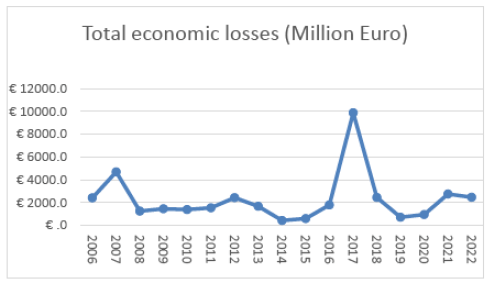
Like many natural events, wildfires cause lives to be lost. Using this tragic loss of life to whip up climate fear is deplorable, not least since many wildfires are deliberately or accidentally started by humans. Greece had a bad wildfire season last year with the BBC reporting that 79 arrests had been made for arson. The BBC accepts that wildfires are common in Greece but “scientists say” there is a link between extreme weather events and climate change. Stefan Doerr of the Centre for Wildlife Research at Swansea University notes that arson “can more easily turn into fast-moving wildfires”. Arsonists, it seems, just love climate change.
Last year, the climate scientist Patrick Brown admitted that he had written a paper published in Nature that focused exclusively on how climate change had affected extreme wildfire behaviour and ignored other key factors. In particular he downplayed the information that 80% of wildfires are lit by humans. He laid out his whistle-blowing claims in an article titled: ‘I Left Out the Full Truth to Get My Climate Change Paper Published’. He knew not to try to quantify key aspects other than climate change because it would dilute the message journals like Nature want to tell, he observed, adding: “To put it bluntly, climate science has become less about understanding the complexities of the world and more about serving as a kind of Cassandra, urgently warning the public about the dangers of climate change.”
Wildfires are an easy propaganda win for climate alarmists. People die, property is destroyed and the published images are spectacular. But fires are a vital part of nature, always have been. They help clear away the debris that accumulates naturally in forests and scrub land and provide a path for regenerative growth. There is little evidence that natural trends are on the increase around the world, and none to suggest that humans play a part in natural ignition by burning hydrocarbons and releasing carbon dioxide into the atmosphere. In its sixth assessment report, the Intergovernmental Panel on Climate Change (IPCC) specifically ruled out human involvement in ‘fire weather’, both in the past and going forward to the turn of this century.
Chris Morrison is the Daily Sceptic’s Environment Editor.
The EU Is Hotel California
An Unelected Body Of Ruling Class Elites, Indistinguishable From Feudal Leaders Of Europe’s Bloodstained Past
By Manorborn | The Truth Barrier | February 20, 2024
Two weeks ago, leaks emerged in The Financial Times revealing how the EU is setting out to destroy Hungary economically for its refusal to fund the war against Russia.
The irony is stunning. Viktor Orban, the president of Hungary, who was once arrested in his youth for protesting the brutality of the USSR toward his little nation, is now objecting to the EU’s strongarmed sabotage of the sovereignty of member states like his and by the EU’s unjustified, unreasonable treatment of the Russian Federation as an enemy instead of a beneficial economic partner.
Orban was forced to back down a few days later. But by backing down, he weakened Hungary vis a vis Ursula van der Leyen and her minions. Orban should have presented the EU’s unacceptable, coercive plan of economic warfare against the Hungarian people and their livelihoods before the UN.
Hungary has many allies around the world – it’s time to go to them for support now that he’s discovered what Greece discovered a decade or so ago – that the EU is Hotel California.
It was that “lovely face” of Western Europe that drew the love starved Easterners once free from the Soviets. Nimium non crede lepidi faciei. (Trust not too much to an enchanting face). – Virgil
Before the inception of the EU, Europe was a region of free, sovereign, more or less democratic nation-states with bright economic futures. After federalization under the EU and concurrent with the neocon capture of the US government, EU member states absent Germany, France, Italy and the Twisted Sisters of Benelux gradually found themselves inured in a 21st Century version of the Warsaw Pact with a grim future of belt tightening, war and downward mobility.
Now we are witnessing just how individual European nations are no longer free in all instances to make decisions that best serve their distinctive populations. Instead they’re tightly bound to EU governance – a commissariat administered by an unelected body of ruling class elites who’re indistinguishable in character and ambitions from the feudal leaders of Europe’s bloodstained past.
But whereas the Warsaw Pact was formed to protect the interests of the USSR, the EU exists to serve the interests of the US hegemon and the competing globalist vision of the WEF who groom and vet future EU leaders.
Fortunately, Orban, along with Fico in Slovakia, Vučić in Serbia and Matteo Salvini in Italy is one of the few European leaders who is not afraid to call out the authoritarian nature and mounting abuses of the EU. Surely he’s noted the EU’s subservience to US plans for escalating wars to target Iran and eventually directly target Russia for its refusal to lie down and allow the West to select its leaders and open up its resources to the kind of pillaging by the West that transpired under Boris Yeltsin.
Orban knows that what the EU is doing to Russia, it could and would do to Hungary. EU membership will not shield it. Western NGOs have been working round the clock to create regime change in Slovakia, Serbia and Hungary. In 2020 the EU ruled that national laws like the law in Hungary requiring NGOs to register as foreign agents are unlawful. That can only signify one thing: Room keys will always be held by the front desk at Hotel California.
Over 90% of French Citizens Support Farmers’ Protests – Poll
Sputnik – 22.02.2024
PARIS – The farmers’ protests that have erupted in France have the support of 91% of the French, and the majority of them believe that President Emmanuel Macron and his government are not handling the crisis well, an Odoxa-Backbone Consulting poll for Le Figaro newspaper showed on Wednesday.
The overwhelming majority of the French, or 91%, support the protests, 85% of citizens hold the government responsible for the crisis, 90% of respondents believe that the European Union is to blame for the crisis, and 92% of those polled blame big retailers.
Moreover, 70% of the French believe that the measures proposed by the government are insufficient, and 77% of respondents said Macron and his cabinet are “reacting poorly” to the crisis.
The French also opposed “punitive ecology” and condemned harsh environmental protection measures that harm farmers.
Ahead of the Paris International Agricultural Show, which opens on Saturday, French farmers continue to stage protest actions, dumping manure, hay and tires on highways and in cities.
Farmers in France have been protesting heavily since January, blocking highways and dumping manure and waste in front of government buildings across the country, with rallies subsiding somewhat in recent weeks. The farmers demand recognition of the importance of their profession and denounce the government’s agricultural policies, which they say make them noncompetitive.
In particular, they oppose the import of cheap agricultural products, restrictions on the use of water for irrigation, and the increase in diesel fuel prices, as well as restrictive measures to protect the environment and the growing financial burden.
French farmers are among those protesting all over Europe. Farmers in Germany, Italy, Belgium, Poland, Romania and the Netherlands are also pushing back against various environmental policies that they see as detrimental to their interests, especially in the face of high inflation and competition from imports.
Scholz and Lackeys Dig Grave for Germany
By Finian Cunningham | Strategic Culture Foundation | February 21, 2024
They say a picture paints a thousand words, and the one showing Chancellor Olaf Scholz with a shovel in hand merrily digging at the earth speaks volumes about the way he is burying Germany’s economy.
Not just Scholz. The entire coalition government in Berlin is betraying the German people, like satraps for a foreign colonial power. That colonial power is the United States which has occupied Germany with its troops and nuclear weapons for eight decades.
How can the German political class be so abjectly servile and treacherous? Simple. They don’t see it like that. They are so brainwashed by Russophobia and Western imperial arrogance, their pathetic actions are “natural”.
Dressed like an undertaker, Scholz was photographed ceremonially laying the foundations for a new armament factory in Lower Saxony belonging to Rheinmetall, the second German military manufacturer.
Accompanying him was Defense Minister Boris Pistorius who last weekend told the Munich Security Conference that Germany’s military spending should double over the next decade.
This is while the German economy is mired in recession and German workers and their families are struggling to make ends meet. The once mighty German economy, the engine for the whole European Union, is now referred to as “the sick man of Europe”. The way things are going under Scholz’s coalition government, the sick man will soon be dead and buried.
It’s astounding to fathom the self-harm being inflicted by Scholz and his administration. Polls show huge popular dissatisfaction. His Social Democrat Party is hemorrhaging votes as the recent Berlin federal election re-run attested.
The German economy is tanking in large part due to spiking energy costs that have resulted from Berlin toeing the United States’ line of cutting off Russian oil and gas supplies.
German farmers like farmers all across Europe are in uproar over crippling energy bills. They are also incensed by the influx of cheap agricultural produce from Ukraine that the Scholz government has permitted the EU to oversee out of pro-war support for the Ukrainian regime.
Scholz and his ministers are turning Germany into a war-time economy. All sectors of the economy are being cut except military production.
At the foundation-laying ceremony for the new Rheinmetall production plant, the event was televised for the German public. Scholz and Pistorius seem to think they are performing heroic service for the good of the nation. Their delusional disconnect with reality and ordinary Germans’ hardships is truly shocking. The insanity is frightening.
Pistorius and German military commanders have been warning the public that the country might be at war against Russia in the next five to eight years. Such unhinged war rhetoric is the height of irresponsibility. It is criminal.
Russian President Vladimir Putin and other Russian leaders have repeatedly stated that they do not want conflict or war with Europe. The Ukraine conflict is a specific problem of a U.S.-led NATO proxy war.
Still, the febrile warmongering that has taken hold of the German political class and the rest of Europe is awesome. Entire national economies are being organized on a war footing.
The notion that Russia is preparing to attack Germany or some other NATO member after it knocks out the NeoNazi regime in Ukraine is wild fantasy to most rational people. But to brainwashed, Russophobic politicians in Berlin (and across the EU generally) such fear-mongering is entertained as reality.
Last week, Scholz hosted the money-grubbing Ukrainian conman president Vladimir Zelensky in Berlin. Zelensky’s regime has lost the NATO proxy war against Russia despite some €200 billion in support and weapons funneled to his corrupt regime over the past two years.
Yet Scholz just signed a bilateral national security pact between Germany and Ukraine. (Britain and France have also signed such pacts.)
As reported on the German pact: “The deal also says that should Ukraine ever be attacked again by Russia, Germany would support the country with swift and sustained security assistance including modern military equipment across all domains.”
What does it mean “should Ukraine ever be attacked again by Russia”? How ridiculous. Russia is at war in Ukraine. The German leaders are foolishly or recklessly signing a warrant for their open entry to war.
How rapidly Berlin has descended into madness. Recall two years ago when Russian forces intervened in Ukraine to quell the NATO proxy war in that country, Berlin was mocked for its caution in only sending “helmets” to aid the Ukraine regime. Two years later, Berlin is sending Leopard tanks, howitzers, and Iris-T missiles. It is now planning to supply long-range Taurus cruise missiles to a regime that has no qualms about bombing Russian civilian centers.
In announcing the latest security pact (war pact) with Ukraine, Scholz bragged that Germany is Europe’s biggest supporter of the Kiev regime.
Berlin has committed to €28 billion in military support for Ukraine, far outstripping the aid from Britain and France. Germany is second only to the United States in the amount of military and financial support it has funneled to Zelensky and his NeoNazi junta.
So much for German prudence and technical efficiency. Berlin is throwing good money down the drain on a war that is being lost badly to Russia with Ukrainian military deaths exceeding 500,000. And yet the wasting of public money keeps on going under Scholz and his loser administration.
The United States covertly sabotaged Germany’s economy by blowing up the Nord Stream gas pipelines from Russia. And Berlin says nothing.
Germany’s industrial base and export-led revenues are decimated by following the U.S. and NATO long-time mission statement of “keeping the Germans down, the Russians out and the Americans in”. And Berlin says nothing.
Scholz and his fellow vassals in government are betraying German national well-being and driving the country to another disastrous war against the Russian people – only 80 years after the last one in which tens of millions were slaughtered.
This betrayal is not just happening in Germany. The entire European Union under the appalling misdirection of former German defense minister Ursula von der Leyen (a scion of a Nazi family) is sacrificing generations of civilians to a dead-end war economy – all driven by Russophobia and total subservience to U.S.-led Western imperialism.
All these pathetic lackeys are digging a grave for Europe – unless citizens rise up against the audacious betrayal by their elites.
Yemen says in talks with EU over Red Sea shipping safety
Press TV – February 21, 2024
Yemeni authorities have held “constructive talks” with the representatives of the European Union (EU) to ensure the safety of shipping in the Red Sea, Deputy Foreign Minister Hossein al-Ezzi says.
The Yemeni minister said on Wednesday that his country had ensured EU authorities during bilateral talks that the Red Sea is safe for international transit.
“We once again reiterate that the Red Sea is absolutely safe. Only passage to ships linked to three parties, namely the US, Israel and Britain, are blocked,” al-Ezzi was quoted as saying by Yemen’s al-Masirah TV channel.
Yemeni forces started carrying out attacks on Israeli-linked ships weeks after the regime launched the bloody hostilities in the besieged Gaza Strip in early October.
The strikes later expanded to target ships linked to the United States and Britain. The two countries have carried out airstrikes and naval attacks on Yemen’s territory in the recent past.
Yemen’s Ansarullah movement says attacks on ships will continue until Israel ends the campaign in Gaza, which has killed more than 29,000 people since early October.
The Yemenis have sought to ensure international shipping companies that their vessels can safely sail in three major regional waterways of the Red Sea, the Bab al-Mandab Strait and the Gulf of Aden if they have no connection to Israel, the US or Britain.
Ezzi said some 283 commercial ships had sailed in the Red Sea with complete safety this week despite claims by Washington that the waterway is not safe for commercial shipping.
“Unfortunately, shipping companies have been deceived by the US propaganda and reduced passage through the Red Sea because of US efforts to militarize the region,” he said.
Google To Start Running “Prebunk” Ads and Quizzing YouTube Viewers To Fight So-Called “Misinformation”
By Didi Rankovic | Reclaim The Net | February 20, 2024
Prebunking – until relatively recently it was just one of the fringe concepts in the relentless “war on misinformation industrial complex.”
A short way to describe it is as a dystopian version of debunking false or incorrect information. But here the idea is to stop users (“help them identify”) unwanted content, before they can even see it.
A short way to describe what’s wrong with the “war on misinformation” is that it all too easily turns into a smokescreen for plain censorship of lawful and factually correct speech.
And now, prebunking is moving from ideations pushed by murky “fact-checking” and similar outfits, to the very top of the mainstream – Google.
The company that in effect controls the search market and some of the largest social platforms in the world (outside China) has announced that its latest anti-misinformation campaign will incorporate prebunking.
No doubt with an eye on the US election later in the year, Google’s attention is now on Europe, specifically the EU ahead of the European Parliament vote in June.
Google is acting in unison with the EU and its Digital Services Act which require tech giants to act on whatever is chosen to be considered “misinformation” and suppress it. Much of this is (at least they say so) driven by “Russia Scare,” and so both Google’s Jigsaw unit and the EU are talking about “democracy at risk.”
As for Google’s version of “prebunking,” it, at least in Europe, comes in the form of animated ads, reports say. They will play not only on YouTube but also other platforms like TikTok, and target Belgium, France, Germany, Italy, and Poland – the EU countries with the largest number of voters.
Jigsaw says prebunking bypasses “polarized debates” and “works equally effectively across the political spectrum.”
User experience may suffer at the expense of this “pre-reeducation.”
“Viewers watching the ads on YouTube will be asked to fill in a short multiple-choice questionnaire, designed to gauge what they have learned about misinformation,” Reuters describes Google’s prebunking technique.
These days, agencies like Reuters describe Jigsaw as an internal Google unit “which operates to tackle threats to societies.”
How noble of Jigsaw, and obliging towards Google of Reuters – but in 2016, reports were still talking about Jigsaw as rather what it really is – a rebrand of Google Ideas.
And, The Guardian explained at the time, this was “the web giant’s controversial diplomatic arm, founded in 2010 and headed by ex-US State Department policy wonk Jared Cohen,” adding – “Jigsaw’s stated mission is to use technology to tackle geopolitics.”
(Geo)politics may these days have been rebranded as “misinformation.”
But otherwise, little has changed.
Featured Video

Racist Seinfeld Dances for Joy as Bibi Unveils His New Map
or go to
Aletho News Archives – Video-Images
TV Drama Review
Japanese drama projects Japan’s wartime atrocities onto Chinese characters

Global Times | October 25, 2026
By portraying Chinese characters as perpetrators of ruthless violence while casting Japanese Self-Defense Forces (SDF) intelligence operatives as defenders, the season 2 of the Japanese drama Vivant has recently drawn criticism from Chinese netizens, who argue that its depiction turns historical reality on its head while ignoring Japan’s wartime atrocities.
The TBS drama series – a spy suspense story in which an alleged unofficial intelligence unit of the SDF operates across the globe — has attracted a passionate fanbase. Its currently airing season 2 opened with a household rating of 18.8 percent, the highest for a TV drama this year, according toa commentary article by Japanese media Toyo Keizai.
What draws attention is the portrayal of the enemies in the series, the article noted. Scenes in which the Chinese organization subjects kidnapped members of the SDF unit to brutal torture are repeated with unrelenting intensity.
It is rare for Japanese TV dramas to explicitly portray a real-life country as the enemy, the article noted.
Japanese Prime Minister Sanae Takaichi also made a reference to the drama, saying that she has been recording Vivant and hopes to binge-watch it over the year-end and New Year holidays, according to Japanese media outlets.
China’s CCTV News report on Sunday revealed that the drama features scenes in which Chinese personnel cut off the fingers of and stab Japanese intelligence operatives in the abdomen. Such acts bear striking similarities to the torture inflicted on Chinese nationals by invading Japanese troops during the World War II.
The drama distorts the truth by attributing these atrocities to modern Chinese characters. Beneath the surface, it subtly glorifies Japan’s cross-border overseas operations, blurs the functional boundaries of the SDF and implicitly promotes an expansionist narrative, per CCTV News. … continue
Blog Roll
 Aletho News
- EU facing trillion-euro debt hole while seeking more cash for Kiev
- How US, Europe, Persian Gulf states exhausted missile stockpiles, splurged billions to defend Israel
- Up in arms… Koreans reject U.S. empire’s plan to make South Korea the next Ukraine
- Iran, Turkey, Pakistan, Saudi Arabia could advance region-led security framework in Tehran: FM spox
- Netizens condemn Japanese drama for projecting Japan’s wartime atrocities onto Chinese characters
- Racist Seinfeld Dances for Joy as Bibi Unveils His New Map
- A West Bank War for Netanyahu’s Election Campaign, Could It Backfire?
- Yemen denounces European Parliament’s ‘hypocritical’ push to blacklist Ansarullah
- Qalibaf: UAE’s UN bid aims to ‘clear the runway’ for ‘Greater Israel’, whitewash genocide
- Pakistan reopens Iran border after boosting security: Report
- If Americans Knew
- An error has occurred; the feed is probably down. Try again later.
- No Tricks Zone
- Sudden Stratospheric Warming, Powerful El Niño Combination May Lead To Extreme Europe Cold, Energy Crisis!
- Two New Studies Find Thwaites Glacier Melt Cannot Be Driven By Human Activity Or A Warming Ocean
- E-Cars Reduce CO2 Emissions By Only 41% Compared To Internal Combustion Engine Vehicles
- Predictions Made By Renowned Climate Professor Over Past Decades Have Been Proven To Be Poor
- New Study Suggests Large Regions Of The Pacific Ocean Have Been Cooling For The Last 80 Years
- Germany’s Green Energy Debacle: High Energy Costs Force Kahla Porzellan to Close After 182 Years!
- New Study: 50 Years Of The Most Aggressive ‘Net Zero’ Policies Can Only Affect The Global Climate By 0.03°C
- US September “Heat” Was No Record…Many Records Set Decades Ago
- Latest European Green Energy Debacle; Portugal’s Largest Flagship Solar Park Insolvent!
- Green Energy Debacle: German Expert Professor Fritz Vahrenholt Warns Of Severe Economic And Social Consequences

