Poland’s new government moves to crack down on ‘hate speech’
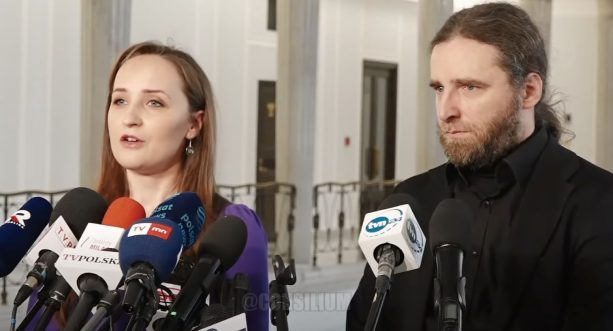
Karina Bosak and Dobromir Sośnierz from the Confederation party
BY GRZEGORZ ADAMCZYK | KRESY.PL | JANUARY 22, 2024
Poland’s new government is moving to limit freedom of speech and actively penalize so-called hate speech, a move that has been associated with stifling dissent and limiting opposition to issues surrounding mass immigration, religion, and LGBT issues in other European countries.
Poland’s Confederation party is now voicing its opposition to new proposals outlined in the left-liberal coalition government’s agreement, which will effectively destroy free speech.
“The ruling coalition, as part of its coalition agreement, has announced that they want to penalize so-called hate speech. The current left-wing Deputy Minister of Justice Krzysztof Śmiszek, from the New Left, has stated that his department is currently working on introducing these regulations, which limit freedom of speech and public debate in Poland. We, as the Confederation, strongly oppose this. The direct consequence of criminalizing certain words will, in fact, be the criminalization of conservative, religious, Christian views,” declared Confederation MP Karina Bosak on Friday.
Bosak added that public debate needs to be free, open, and unencumbered. She pointed out that her party “does not want there to be any sacred cows in Poland, that there are social groups whose ideas cannot be criticized at all in a healthy, free public debate.”
“We will defend Poles against such regulations and proposals that threaten freedom of speech and their values,” declared the Confederation MP.
Dobromir Sośnierz, another party member, highlighted concerns about the subjective nature of defining hate speech.
“What the left understands by so-called hate speech, in practice, will mean speech hated by Minister Śmiszek, not necessarily speech that expresses hatred towards someone, but something that leftists dislike,” he remarked.
Sośnierz also warned that such regulations would, in practice, limit public debate.
“This government is starting not by expanding our freedoms but by limiting them again, which will also lead to clogging up the courts,” he added.
In his view, the ministry’s work is “an act of sabotage, especially in this situation where a massive crisis in the judiciary is looming, as well as perhaps the exclusion of certain judges from ruling. Adding more cases for the judiciary to resolve, which are completely unnecessary, will be counterproductive.”
Deputy Minister Śmiszek announced this week legislative changes to introduce criminal responsibility for what his party considers hate speech against homosexuals.
“The time has come to ban disgusting, homophobic, discriminatory statements in the public sphere,” declared Śmiszek, who is openly homosexual.
Meanwhile, the European Parliament is calling on EU leaders to include incitement to hatred and hate crimes in the catalog of transnational crimes, which include terrorism or human trafficking.
France’s and Germany’s Lack of Independence Forces Them to Continue Bankrolling Ukraine
Sputnik – 20.01.2024
While Western powers’ lavish financial and military contributions to Kiev’s war effort have so far failed to produce any meaningful results, many leaders seem eager to keep bankrolling Ukraine until it runs out of manpower.
The EU may be looking to amend the mechanism used to provide military support to Ukraine by creating a new fund in addition to the European Peace Facility (EPF) that has so far been used by Europe to funnel arms to Kiev.
According to Bloomberg, the new fund may have an annual budget of €5 billion but EU member states are yet to come to a consensus on how this initiative is going to work out.
Commenting on this development, Gabor Stier, senior foreign policy analyst at the conservative Hungarian daily Magyar Nemzet, told Sputnik that whatever shape and form this new fund is going to take, it will ultimately harm European states.
According to him, the EU leadership is essentially trying to come up with a plan to bankroll Ukraine regardless of what Hungary might think about it, with Stier referring to attempts by Hungarian Prime Minister Viktor Orban to come up with a plan to provide aid to Ukraine without harming the EU budget in the process.
Orban’s proposals – that involve dividing the aid to Kiev into smaller tranches and keeping track of exactly how this money would be spent – are very much disliked by Brussels, Stier said. The EU leadership is reportedly concerned that the Hungarian prime minister might veto options he does not like (as decisions to allocate funds under the auspices of EPF require unanimous agreement).
“There will be a new fund but with what money?” Stier inquired. “The first option would be a new fund where money from the EU budget would go into. This does not solve the issue with the Hungarian veto. The second option would involve creating a fund outside the EU budget. The problem with this option is that it would take too long as each (EU) country and its respective parliament would have to vote on it separately. There will be arguments and it will all drag on. While this would go on, Ukraine would already suffer a defeat.”
Thus, Stier suggests, the new fund will likely be filled with money from the EU budget.
“It is already clear that this fund will be designed through discussions within the EU, which is clear in light of the new strikes in Germany or in France. It seems that everyone is either not too keen to trust Ukrainian politicians or have reconsidered their approach to the allocation of funds,” he mused.
Stier also noted that some European states use Orban as “cover” by making it look like he is the lone obstacle on the way to agreeing on the Ukrainian aid issue.
“There are internal frictions, this much is clear. Earlier in Budapest, Slovakian Prime Minister Robert Fico voiced his agreement with Orban on everything related to Ukraine,”
he said. “Austria is also on the same wavelength as Orban. But when it comes to voting in Brussels, no one besides Orban says that they are against (the funding of Ukraine).”
According to Stier, even France and Germany essentially use Orban to “force Ukraine, who is brazenly spending all resources of the Western powers, to slow down somewhat.”
Only Poland, the Baltic states and the Scandinavian states wholeheartedly support Ukraine, he argued, along with the “Benelux and the Netherlands,” though the latter two have some “internal problems.”
He did note, however, that even though Germany, France and Italy may not be thrilled by the prospects of continuously financing Ukraine, they simply cannot stop doing so.
“This is how their dependence on the United States manifests,” Stier explained. “Europe is going to bear the financial burden in the future, that much is obvious.”
The analyst also claimed that this year is going to be “critical” for Ukraine in terms of financing, and that “more justifications are required to amass so much money everywhere” to support Kiev.
Letting Ukraine into NATO is ‘basis for World War Three’ – Slovakia
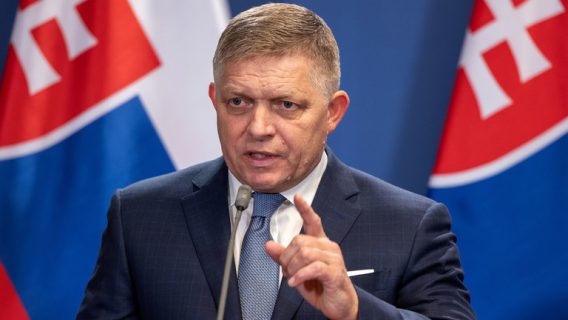
Prime Minister of Slovakia Robert Fico. © Getty Images / Janos Kummer
RT | January 20, 2024
Bratislava will block Kiev’s bid to join the US-led NATO alliance and will stand by a decision to stop supplying weaponry to Ukraine amid its conflict with Russia, Prime Minister of Slovakia Robert Fico has said.
The PM made the remarks on Saturday ahead of his visit to Ukraine to meet his counterpart Denis Shmygal in the western Ukrainian city of Uzhgorod. Fico stressed that his visit serves solely “humanitarian” purposes and promised to openly communicate Bratislava’s stance to Kiev on different issues, including Ukraine’s potential accession to EU or NATO membership.
“I will tell him that there are things on which we have completely different opinions,” Fico told broadcaster RTVS. “I will tell him that we respect them when it comes to joining the EU, but they must fulfill the conditions,” he added, explaining that a situation where “a country that absolutely does not meet any requirements” joins the EU is unacceptable.
He ruled out any possibility of Ukraine joining NATO, insisting such a move would only result in a global catastrophe, apparently caused by a direct collision between NATO and Russia over the issue.
“I will tell him that I will veto and block [a NATO bid by Ukraine] because that is exactly the basis of the third world war and nothing else.”
Fico also promised to reiterate to Shmygal his election campaign pledge to stop providing Kiev with weaponry, stating that the decision remains in force. Still, the weapons restriction applies only to state-sponsored military aid to Ukraine and supplies coming from Slovak military stocks, whereas arms manufacturers are free to sell to the country whatever they like, he noted.
“When Slovak companies don’t make money, American ones will,” Fico noted.
Prior to Fico assuming office following his party’s electoral victory in September, Slovakia had been among Kiev’s top supporters, lavishly supplying it with sophisticated weaponry, including warplanes and anti-aircraft systems. The policy of the previous government has also left the country’s own defense posture badly damaged, new Defense Minister Robert Kalinak claimed earlier this week.
“The former government left us without our own anti-aircraft defenses, without combat aviation, and we don’t even have the promised 700 million for MiGs, which the government also handed over to Ukraine,” Kalinak told the Standard newspaper.
PM Orbán: EU parliament wants to rob citizens of a choice on Ukraine funding

MAGYAR NEMZET | JANUARY 19, 2024
By forcing through a four-year, €50 billion aid package to Ukraine just a few months ahead of European elections, members of the European Parliament want to rob people of the right to choose their future, Prime Minister Viktor Orbán wrote on X.
“Liberal MEPs attacked Hungary once again in the European Parliament yesterday. They want to give money to Ukraine for 4 years, while the European elections are just 5 months away. They essentially want to strip people of their rights to make decisions on their future. What an anti-democratic position! Hungary disagrees. If we want to help Ukraine, let’s do it outside the EU-budget and on a yearly basis! This is the only democratic position just 5 months before the elections,” Orbán wrote.
On Wednesday, two key debates were held in Strasbourg. The first focused on the previous and upcoming EU summits, while the second was entitled: “The situation in Hungary and frozen EU funds.”
After the EU parliament discussed funding to Hungary, the agenda was supposed to focus on the EU summit set for Feb. 1. However, MEPs were so fixated on Hungary, that the country dominated their conversations for nearly the entire session, so much so that even Romanian Socialist MEP Maria Grapini pointed out that the debate was fixated on the vilification of Hungary and the previous session’s discussion on Ukraine.
Hungary proposes plan to end Ukraine conflict
RT | January 17, 2024
Hungarian Foreign Minister Peter Szijjarto has called for a halt to all Western military aid to Ukraine, saying the massive influx of weapons – as well as Kiev’s reluctance to negotiate – has made peace impossible.
Asked what should be done to achieve a ceasefire in Ukraine in an interview with Austrian news site Exxpress, Szijjarto said ending foreign arms shipments to Kiev is a top priority.
“The more weapons that are supplied, the longer the war lasts. And the longer the war lasts, the more people will die,” the minister continued. “It is obvious that what has been done so far has not been successful. Many weapons were delivered, but the war was only prolonged. A lot of money has been paid to Ukraine, but the destruction of Ukraine continues.”
Pressed on the possibility that Russian troops would “march all the way to Kiev” in the event Ukraine is left “defenseless,” the diplomat said this could only be avoided with negotiations and a renewed peace process.
“This should be prevented by ending the war now. As long as that doesn’t happen, the war threatens to intensify further and more people risk dying. The war should have ended yesterday,” he said.
Szijjarto went on to argue for more dialogue between the warring parties and countries willing to mediate talks, saying “the most important requirement is to keep communication channels open.” He noted that he is often “insulted by many European colleagues, and by Brussels” after meetings with his Russian counterpart, but said “there is no hope at all for peace” without negotiations.
Western sanctions have also failed to “bring the Russian economy to its knees” as intended, the foreign minister said, suggesting the more aggressive approach had backfired and could not bring an end to the fighting.
Budapest is among a small number of EU states that have refused to join the sanctions campaign or provide weapons to Ukrainian forces, opting instead to maintain ties with Moscow. Despite pressure from other members in the bloc, Prime Minister Viktor Orban has declined to approve Brussels’ latest aid package to Kiev, holding up the funds since December.
The Hungarian leader has also threatened to veto Ukraine’s accession to the union, arguing that it poses many risks to the bloc and its economy, as well as the fact that Kiev is still “at war.”
The EU impasse comes at a time when Ukraine’s largest Western backer, the United States, has run out of aid money, as a $61.4 billion spending package remains stalled in Congress. Kiev’s foreign minister, Dmitry Kuleba, has acknowledged his country has no “plan B” should the funds run dry, saying there is no alternative to US largesse.
Poland’s Morawiecki: ‘Now, I understand Brexit’
Remix News | January 15, 2024
In a Sunday interview with London’s Daily Express, the former prime minister of Poland, Mateusz Morawiecki, spoke against increasing centralization within the EU and warned that the “dangerous” EU “will implode.”
Morawiecki, of the Law and Justice (PiS) party, has admitted that he now understands why the British voted for Brexit, pointing to the ongoing centralization of the European Union. Morawiecki warned that while the EU has its advantages, these centralizing tendencies could lead to its implosion.
“Well, I probably differ from most Britons who were in favor of leaving the European Union because I believe that the European Union has its values, its advantages. But I think the trend is now very dangerous. And I now better understand why Britain made such a decision,” stated Morawiecki.
Morawiecki remarked that the European Commission’s decision to withhold funds from Poland under the recovery plan was an attempt to influence the outcome of Poland’s parliamentary elections in October.
“As far as various EU policies are concerned, there has definitely been interference in our internal affairs,” the politician emphasized, noting that the increasing transfer of competencies to Brussels is heading in the wrong direction.
“I think this is moving in a bad direction and will ultimately lead to the implosion of the European Union. I definitely believe that the European Union is a very valuable organization from the point of view of the free market area; cooperation within the internal market; and various freedoms, including freedom of movement of capital, people, goods, and services. But the more competencies are acquired and taken over by the European Commission, the less say a sovereign state has,” Morawiecki explained.
He further expressed concern about the latest plans of the European Parliament and the European Commission regarding treaty reforms.
“I believe this is very, very dangerous for the stability of the European Union. Because it primarily deprives sovereign states of their fundamental rights in the areas of security, foreign policy, tax policy, which are the backbone of every sovereign state, as well as in many, many other areas,” warned the former Polish prime minister.
Palestine: EU’s Borrell bats for US
BY M. K. BHADRAKUMAR | INDIAN PUNCHLINE | JANUARY 11, 2024
The diplomatic arena of the Middle East was dominated in the past week by the US Secretary of State Antony Blinken’s regional tour to Türkiye, Jordan, Qatar, the UAE, Saudi Arabia, Israel, the West Bank and Egypt. It was a ‘road show’ to rally the leaders of the Arab countries behind the US but culminated in an acrimonious meeting in the West Bank between Blinken and the Palestine President Mahmoud Abbas marred by “quarrels and arguments,” according to Sky News Arabia.
The region is gripped by angst that Israel may provoke a fateful expansion of the conflict in the Gaza Strip to Lebanon and Iran after the assassination of a number of senior military figures from Hamas and Hezbollah in the recent days, which overlapped Blinken’s presence in the region and underscored Tel Aviv’s disdain toward diplomatic niceties. Two videos from the West Bank showed Israeli troops shooting a 17-year-old boy and repeatedly running over the dead body of a man they had shot last Friday.
The US fears the expansion of the conflict in the Middle East. Yet, Blinken was burdened with the contradiction that the rhetoric of Washington’s continued support for the Israeli operation is so visibly at odds with the words of President Joe Biden last week that he was doing “quiet” work with the Israeli government “to get them to significantly reduce their presence and largely withdraw from the Gaza Strip.”
Blinken claimed that “the (Arab) countries agreed to work together to help the Gaza Strip stabilise, chart a political path for the Palestinians and work towards long-term peace, security and stability in the region.” At the same time, he conceded that to do this, it is necessary to end the conflict in Gaza and identify a concrete path to the creation of a Palestinian state. Blinken flagged that the countries of the region are still interested in normalising relations with Israel, but only on the terms of a settlement of the Palestinian-Israeli conflict. Arguably, these could be incipient signs of a road map emerging.
The killing of senior Hamas and Hezbollah officials indicates that Israel is not making significant progress on the battlefield and the leadership is under compulsion to gather ‘trophies’ and claim ‘victory’. In a hybrid war, such killings will not significantly weaken the resistance movement. An effective leader was appointed overnight to head the IRGC’S Quds Force when the legendary Iranian general Qassem Soleimani was assassinated in 2020.
That said, the probability of a direct conflict between Israel and Hezbollah should not be overestimated, since the latter is well aware that an outbreak of hostilities is precisely what suits Tel Aviv. Iran also sizes up Israel’s calculus to drag the US into the war. According to reports, Iran has supplied cruise missiles to Hezbollah.
Against such a tumultuous backdrop, in a carefully choreographed sideshow, the European Union’s foreign policy chief Josep Borrell also appeared in the region at the same time as Blinken. Borrell’s destinations were Lebanon and Saudi Arabia. The EU announcement said that Borrell’s mission “will be an occasion to discuss all aspects of the situation in and around Gaza, including its impact on the region, especially the situation at the Israeli-Lebanese border, as well as the importance of avoiding regional escalation and of sustaining the flow of humanitarian assistance to civilians.”
While speaking to the media in Beirut, Borrell was highly critical of Israel’s war in Gaza and called for a pause “that could become a permanent one.” He also said, “It is imperative to avoid a regional escalation. It is absolutely necessary to avoid Lebanon being dragged into a regional conflict.” Borrell saw his mission as one to take stock of the situation and “to contribute to a way out of the crisis.”
Borrell met with the Head of Mission and Force Commander of the United Nations Interim Force in Lebanon (UNIFIL) General Aroldo Lazaro, a compatriot from Spain. Indeed, there has been some talk of deploying a peacekeeping force on Israel’s northern border with Lebanon.
Meanwhile, Al Jazeera reported, citing a government source in Beirut, that Borrell also had an unpublicised meeting with a delegation from Hezbollah led by Mohammad Raad, a member of the Lebanese legislature. Conceivably, this might have been a key item on his itinerary in Beirut.
While the US and several European countries, including Germany, the UK, Czech Republic, Austria, among others, regard Hezbollah as a terrorist organisation, the EU restricted itself to merely adding Hezbollah’s so-called “military wing” to its terror list, leaving the door open to interact with the movement’s political leadership if need arises.
That came in the wake of the group’s alleged 2012 suicide bus bombing in Burgas, Bulgaria, which killed five Israeli tourists and a Bulgarian driver. During a debate on the crisis situation in Lebanon last July, the European Parliament, for the first time, adopted a resolution calling for the EU to add the whole of Hezbollah to its list of banned terrorist organisations, but that hasn’t yet been acted upon.
Borrell’s meeting with the Hezbollah delegation would only have been with the knowledge of the Biden administration — it could even be providing a thinkable (and actionable) leitmotif of Borrell’s trip to Lebanon. BBC had reported a week ago on secret contacts between Israel and Hezbollah as well.
At any rate, by a coincidence, Borrell happened to be in Saudi Arabia when Blinken arrived there, and the two of them had a meeting. Later, in a prepared statement to the media after talks in Saudi Arabia with foreign minister Prince Faisal, Borrell also took a nuanced stance apropos Hamas, saying,
“And now we have to stop the killing of civilians in Gaza. We have to stop this great number of casualties. Hamas has to be eradicated. But Hamas is an idea, it represents an idea, and you cannot kill an idea. The only way of killing an idea –- a bad idea — is to propose a better one, to give a horizon to the Palestinian people, to their dignity, to their freedom, to their security, which has to go hand in hand with the security of Israel.”
Clearly, Borrell strove to break the ice by engaging with Hezbollah. Considering that the EU has been the US’ junior partner on major international issues, Borrell’s mission can be considered as substantive aimed at opening a diplomatic track to ease the Israel-Lebanon border tensions.
Equally, Borrell and Prince Faisal rekindled the so-called Peace Day Effort launched in September last year jointly by the EU with Saudi Arabia, the League of Arab States, Egypt and Jordan as an initiative “to reinvigorate the peace process in the Middle East.”
A joint statement issued at that time on the sidelines of the 78th session of the UN General Assembly, in the presence of almost fifty Foreign Ministers from around the world sought “to produce a “Peace Supporting Package” that will maximise peace dividends for the Palestinians and Israelis once they reach a peace agreement, … thus incentivising earnest efforts to reach it.”
As EU foreign policy chief, Borrell navigated international turbulence and divisions within the 28-member bloc to make Europe more united and turn it into a diplomatic heavyweight, but with patchy success. Of course, Ukraine spoiled the party. Palestine could well be Borrell’s last waltz. Borrell’s five-year term in Brussels ends in December.
New Polish Chapter in CIA’s Nord Stream Cover Story Signals Growing US-EU Split
By Ilya Tsukanov – Sputnik – 08.01.2024
European investigators probing the September 2022 attack on the Nord Stream pipeline network have told US business media that Polish officials have refused to cooperate with an international investigation into the incident. But the report is just another attempt to divert attention from Washington’s role in the blasts, a Russian observer says.
Polish officials have dragged their feet in providing any useful info related to the movement of individuals suspected of plotting and carrying out the 2022 attack on the Nord Stream pipeline network and have generally refused to cooperate, the Wall Street Journal reported on Monday, citing unnamed ‘European investigators’ looking into the case.
Some European officials are reportedly considering appealing directly to the office of newly elected Polish Prime Minister Donald Tusk for help in investigating the sabotage attack, with investigators expressing “suspicions” over Warsaw’s “role and motives” amid the lack of cooperation from the previous government.
The new ‘Polish chapter’ in the CIA-inspired cover story diverting attention from evidence of the US’s central role in the Nord Stream attack comes after more than a year of meticulous attempts to pin the blame on Ukrainians – first in the form of a shadowy amateur group of operatives without connections to any governments, and then to claims that the sabotage was coordinated by Ukrainian special operations colonel Roman Chervinsky, who is now conveniently rotting in a Kiev jail.
The narrative, crafted by US and German media after revelations last year by Pulitzer Prize-winning investigative journalist Seymour Hersh that US Navy divers planted explosives on the pipelines under the cover of a NATO drill, claimed that the Ukrainian operatives rented a yacht from a Poland-based, Ukrainian-owned company and proceeded to place explosives on the pipeline infrastructure – situated some 80 and 110 meters underwater in the Baltic Sea.
New Narrative to Distract From Mounting EU-US Tensions
Speaking to Sputnik and asked to comment on why the WSJ piece was published now, Russian political analyst Peter Kolchin explained that it’s designed to reinforce the US narrative about foreign actors’ involvement in the Nord Stream attack, particularly as Europe continues to face the economic consequences resulting from the unprecedented act of sabotage against another NATO country’s infrastructure.
“The United States is currently suffering one diplomatic defeat after another. In the face of problems in the Middle East, in the face of a defeat in Ukraine, it’s very important for Washington to consolidate the entire NATO bloc,” the observer explained. The attack on Nord Stream “is a very difficult topic for the bloc, because factually, the destruction of this infrastructure significantly weakened Europe’s economic capabilities and left it dependent on the US energy sector. Now, Europe is forced to buy American gas and to incur huge costs because of it,” Kolchin noted.
How huge? According to a recent Sputnik review of Eurostat data, EU countries have had to pay some €185 billion ($202 billion US) extra on natural gas over the past 20 months after being cut off – by choice or by force, from cheap Russian pipeline gas. Between early 2022 and late 2023, the bloc spent more on natural gas purchases than it did over the entire eight-year period between 2013 and 2021.
Consisting of four pipelines stretching from Russia to northeastern Germany along the bottom of the Baltic Sea, Nord Stream singlehandedly had the capability to provide Europe with up to 110 billion cubic meters (bcm) of gas per year, equivalent to more than a quarter of the bloc’s 412 bcm consumption in 2021. The September 2022 attack on the infrastructure, combined with Polish and Ukrainian moves to close the taps to Russian gas, have left TurkStream and ship-based LPG the only means for Russian gas to get to EU countries.
The Nord Stream “problem” isn’t going anywhere, Kolchin believes. “Both in Europe and the United States, the mainstream publications and politicians are asking questions about it.” Therefore, “it’s important for Washington to give the public some more or less plausible scenario” regarding the attack.
“Of course, for many months now Washington has been attempting to shift all responsibility onto Ukraine. Here, the appearance of publications in US media adding credibility to a role played by Warsaw is only part of this big campaign. The United States is trying to shift responsibility from itself onto others, in this case Warsaw,” the observer said.
“Poland, which no longer enjoys agency, cannot oppose the will of the United States, and is being forced to accept what Washington is trying to pin on them,” even if in reality, “it has been noted more than once and at the highest levels that the involvement of the United States in the terrorist attack on Nord Stream is obvious,” Kolchin said.
President Putin commented on Washington’s suspected role in the Nord Stream attack at his year-end press conference last month, dismissing European complaints about Russia ‘turning off the taps’ of energy supplies to the region by pointing out that “it wasn’t us that blew up… Nord Stream,” but “most likely the US, or someone at their suggestion.”
Nevertheless, Washington will continue to push its policy line on the Nord Stream incident, regardless of what the evidence, and elementary logic, say, Kolchin believes.
America’s “methodical” approach is particularly important in light of growing splits in the North Atlantic alliance as Washington continues to ride roughshod over Europe’s basic interests, the observer noted.
“Let’s be honest, it’s difficult in principle to speak of any kind of trust within the alliance. And this is largely connected with the Nord Stream events. European countries understand who is responsible, but have very reluctantly been forced to swallow this harsh reality,” the observer summed up.
So You’re a Professor? Here’s What You Can Do to Oppose Genocide
By Steve Salaita | January 7, 2024
College instructors, particularly those in Europe and North America, are generally limited when it comes to meaningful intervention in imperialist horrors afflicting the Global South. Nevertheless, it is usually their governments either orchestrating or abetting the horror. They ought to do something, then, even if it seems pyrrhic or inadequate.
People around the world are now witnessing a particularly gruesome event as the Zionist entity, armed by its U.S. sponsor and enjoying the support of capitalist institutions across the globe, commits one atrocity after the other in the Gaza Strip (along with the West Bank and at times further afield). The atrocities, anyone with a modicum of integrity agrees, add up to genocide. The depth of grief and suffering Palestinians now experience is indescribable, immeasurable.
Do professors and other campus workers have any ability to mitigate the grief and suffering? Not really. But we’re not entirely powerless, either. Higher education is an important sector for information and activism and an industry where participants like to contemplate the role of both exceptional and ordinary people in making a better world. Like anybody else, teachers and researchers can be most effective in their own communities, which are not inoculated from the genocide. Zionist groups have organized hundreds of defamation campaigns against Palestinian students and faculty, often resulting in employment termination and other serious forms of recrimination. These campaigns don’t exist in a vacuum. Targeting Palestinians and anti-Zionists is an extension of the genocide, or at least one of its attendant tactics. And then, of course, many of the campuses are somehow invested in the Zionist entity—financially, politically, or logistically. It does no good to say that “we” aren’t affected by what happens “there.”
The following is a list of suggestions for Western academics, with the understanding that not all professors are equal and each campus is different in terms of its cultural and economic composition. In turn, I have tried to be comprehensive, offering comments that I hope will be useful to everyone from contingent faculty whose employment is precarious to senior scholars with big platforms at elite institutions. (The latter are much more likely to be facilitating the genocide, either obliquely or explicitly, but nevertheless.)
One thing is clear: the world is now experiencing a moral crisis whose enormity will reshape political attitudes and alliances for generations to come. Pretending that life, no matter how sheltered or comfortable, can simply continue as normal is its own kind of moral crisis.
Try one or more of the following if you can:
Defend Palestinian Students: Be it from forces on or off campus, or be it individuals you know or don’t know personally, it is reprehensible that students should suffer doxing and harassment, whether it is orchestrated by skeezy has-beens like Michael Rapaport or hysterical faculty on their own campus. Speak on behalf of your students. It can be done publicly through the usual channels or in private communication with chairs, deans, and other administrators. Or keep it simpler: reach out to the students and offer yourself as a resource.
Defend Palestinian Colleagues: The same idea holds, but with a quick addendum. Being a Palestinian in Western academe can be deeply alienating, in no small part because shitting on Palestinians is a reliable method of upward mobility. I’m sure some of your Palestinian colleagues will appreciate any gesture that might make them feel slightly less alone.
Boycott: Up to this point, academic boycott of Israeli universities has been controversial, even in supposedly progressive quarters of the industry. The facts, however, are clear. Israel has destroyed every institution of higher learning in the Gaza Strip. It has murdered dozens of faculty and administrators, including university presidents, and an untold number of students. There is no academic freedom in Palestine. There is no academe at all in Gaza. Reluctance to boycott is no longer acceptable. It is the baseline of political decency. Anybody who continues to oppose or dissemble about academic boycott should be regarded as untrustworthy on everything else.
Divest: Start or join a local campaign to force your university to divest any holdings from the Zionist entity. Divestment can include study abroad programs in Israel, which inherently discriminate against Palestinian, Arab, and Muslim students. In the past decade, students have successfully passed divestment resolutions at numerous universities, but management simply ignores them. Faculty voices will help these efforts.
Invite People from Gaza: Surely the rank-and-file in academe are tired of the same few dozen big-name professors and celebrity activists saying the same three or four things in the lucrative lecture economy. Decisionmakers on campus invite speakers for prestige, for the brand, or else to network or be in the presence of fame. The habit needs to die and there’s no better time than now. Instead of summoning the usual Endowed Chair of Gobbledygook at Wealthy Private University to deliver radical affectations at a cost of multiple thousands, reach out to scholars and journalists from Gaza (and for God’s sake give them a proper honorarium). They will assuredly be more insightful than warmed-over relics of the pre-millennial theory craze. Likewise: recruit graduate students from Palestine. You can also look into bringing Palestinians as visiting writers/scholars or as researchers/consultants in any effort to document the genocide. Start with people who are currently outside of Gaza; when conditions are better, reach out to those still inside the territory. Gaza is filled with individuals of remarkable talent. You will be better off for having sought it.
Organize or Attend a Demonstration: You don’t need to be a seasoned organizer to raise hell about the abomination that is the Zionist entity.
Direct Action: Why should students always be the ones to shut down administrative offices or gum up the machinery of genocide? Professors can participate, as well. I’m not saying you need to do it. I just want you to bear in mind that nobody, no matter how urbane or well-published, is too good to get fired or sit in jail for a few hours in solidarity with a people whose heroism is known and admired around the world.
Teach Palestine: Hundreds of Palestinian poets, novelists, and essayists write in English or are available in translation. Consider including them on your syllabus. So what if your courses don’t focus on Palestine or the surrounding region? If you’re a modernist, then assign Fadwa Tuqan or Mahmoud Darwish. If you’re in gender studies, look up Fatima Bernawi or Rasmea Odeh. If you teach novels, try Susan Abulhawa, Susan Muaddi Darraj, Sahar Mustafah… on goes the list. If you’re an Americanist, there are numerous options. Same for Latin Americanists. A critical theorist? No problem: there’s Elias Sanbar and Bassel Al-Araj and Ghassan Kanafani. And if you’re, say, a medievalist? That’s no problem, either.
Stop Pandering to Customs of Civility: You don’t need to condemn “Hamas.” You don’t need to “affirm Israel’s right to exist.” You don’t need to bang on about “democratic values.” You don’t need to be “nuanced.” You need to defend the people suffering a genocide. Not a single one of them is asking for anything else. (“Who is my audience?” keep asking yourself. If the answer is anything other than “the dispossessed,” then recalibrate your ethics and try again.)
Shun the Genocidaires: Those rationalizing or cheering on the genocide are personae non grata from here on out. No co-authoring articles with them. No sitting together on conference panels. No buddy-buddy bullshit on the networking circuit. Sure, sometimes circumstance will force you onto the same committee or whatever, but, if the association is voluntary, then decline the opportunity and find colleagues who don’t celebrate mass murder.
Speak: [speak]
Or better still: Listen.
DPR Head Explains Why Russia Only Hits Military Targets in Ukraine
By Svetlana Ekimenko – Sputnik – 07.01.2024
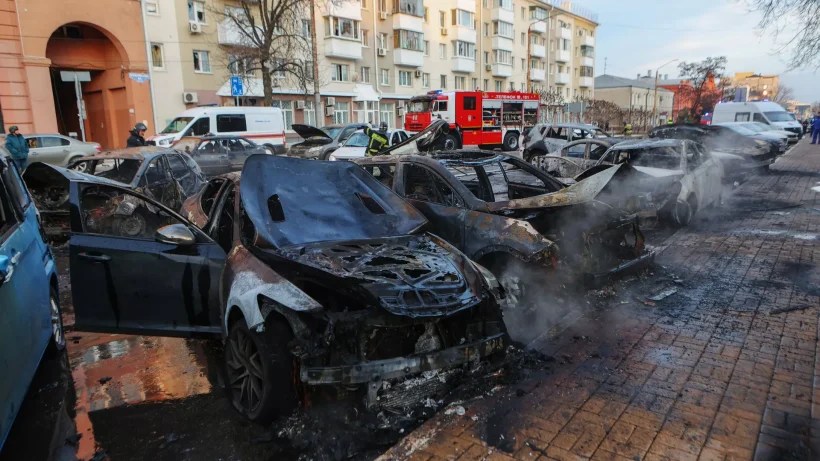
The Ukrainian military has been launching daily attacks on Donetsk throughout the winter holidays. Three hospital patients were wounded during shelling of the city on Orthodox Christmas Eve. Before that, a Ukrainian attack on New Year’s Eve left four dead and 13 more injured.
Russia’s Armed Forces hit only military targets in Ukraine as part of the ongoing special operation, Denis Pushilin, the head of the Donetsk People’s Republic (DPR) told Sputnik.
This is what sets Russia apart from the regime in Kiev that targets civilians in Belgorod and Donetsk during its recent attacks, Pushilin said.
“We, like no one else since 2014, have a certain moral right to act emotionally and deal straight from the shoulder, but that is not who we are. And this is what sets us apart. If we were to employ the methods used by our enemy, how would we then be any better than our enemy, what are we fighting against then?” Pushilin asked rhetorically.
The so-called Euromaidan protests in Ukraine’s capital culminated in the February 2014 coup d’etat that brought radical pro-EU and pro-NATO politicians to power and plunged Ukraine into crisis, leading to the current conflagration.
The DPR head emphasized that Moscow would never stoop to attacks targeting the civilian population – an approach that has become a trademark of the regime led by President Volodymyr Zelensky.
“We would never be able to forgive ourselves if at some point we were able to speed up victory by resorting to carpet bombing and shelling the civilian population,” Pushilin said.
Dwelling on Moscow’s response to the constant shelling of Russian frontline towns by Ukraine’s Armed Forces, the DPR head emphasized: “Gritting our teeth and losing loved ones, we have been dealing with this since 2014, but it has not eroded our humanity. Losing humanity here could have much more serious consequences for our country. This is exactly what our president is talking about – the need to remain human.”
Ukraine De Facto Became NATO’s Testing Ground for Digital Warfare Against Russia – Moscow
Sputnik – 05.01.2024
MOSCOW – Artur Lyukmanov, the director of the Department of International Information Security of the Russian Foreign Ministry shared with Sputnik key insights into the US-backed cyber war against Russia being waged from Ukrainian territory.
Ukraine has de facto become a NATO ground for testing methods of fighting Russia in the digital space, Artur Lyukmanov, the director of the Department of International Information Security of the Russian Foreign Ministry, has told Sputnik.
“Indeed, in the past two years, the domestic information infrastructure has become the target of regular computer attacks. Most of them are carried out from the territory [of Ukraine] or in the interests of [Ukrainian President] Volodymyr Zelensky’s regime,” Lyukmanov said.
He added that “the Kiev authorities, who in the West pose themselves as victims of ‘Russian cyber aggression,’ boast of sabotage against Russia using information and communication technologies.”
In November 2023 alone, the Main Directorate of Intelligence of the Ukrainian Defense Ministry claimed responsibility for several cyberattacks on Russian information resources, Lyukmanov said.
“This country has de facto become a NATO testing ground for the methods of warfare in the digital space,” Lyukmanov said, adding that “the entire information security sector of Ukraine has been handed over to the external management of Western curators.”
Ukrainian “Army” of IT-Scammers Threatens Europe
Russia has repeatedly warned Western countries that Ukraine’s US-backed “IT army” would become a problem for Europeans, and this is what exactly has happened as there are more than 1,000 “call centers” in Ukraine that are engaged in the extortion of money, Artur Lyukmanov, the director of the Department of International Information Security of the Russian Foreign Ministry, has told Sputnik.
“As for the ‘IT army,’ we are talking, in fact, about a bunch of hackers and telephone fraud, who are mainly engaged in trivial theft. According to our data, there are more than 1,000 ‘call centers’ on the territory of Ukraine engaged in the extortion of money. We have repeatedly warned Western countries that the “IT army” created in spite of Russia and supported by the United States would sooner or later become a problem for ordinary Europeans. After all, this is what exactly has happened,” Lyukmanov said.
The Russian official recalled that Hungarian authorities said in November 2023 that most of the funds stolen in Hungary “as a result of crimes using information and communication technologies and telephone fraud end up in Ukraine,” adding that “the geography and scale of criminal activity of these ‘fighters for independence’ is much wider and is not limited to Europe.”
Western Information Security Funds Embezzled
Anglo-Saxon countries send their special services’ cyber units to Ukraine to train their hackers engaged in activities against Russia, and the majority of Western funds provided to Ukraine for information security are being embezzled, Artur Lyukmanov, the director of the Department of International Information Security of the Russian Foreign Ministry, has told Sputnik.
Lyukmanov said Ukraine’s entire information security sector has been handed over to the external management of Western curators.
“Cyber units of special services and armed forces of Anglo-Saxon countries are sent there [to Ukraine] to train and coordinate hackers engaged in activities against Russia. Substantial technical and financial assistance is provided for this, which, of course, is mostly embezzled. We have no doubts that a significant portion of the budget of the US Cyber Command, which has bloated to a record $13.5 billion, will be spent at the Ukraine direction,” Lyukmanov said.
Featured Video

Racist Seinfeld Dances for Joy as Bibi Unveils His New Map
or go to
Aletho News Archives – Video-Images
TV Drama Review
Japanese drama projects Japan’s wartime atrocities onto Chinese characters

Global Times | October 25, 2026
By portraying Chinese characters as perpetrators of ruthless violence while casting Japanese Self-Defense Forces (SDF) intelligence operatives as defenders, the season 2 of the Japanese drama Vivant has recently drawn criticism from Chinese netizens, who argue that its depiction turns historical reality on its head while ignoring Japan’s wartime atrocities.
The TBS drama series – a spy suspense story in which an alleged unofficial intelligence unit of the SDF operates across the globe — has attracted a passionate fanbase. Its currently airing season 2 opened with a household rating of 18.8 percent, the highest for a TV drama this year, according toa commentary article by Japanese media Toyo Keizai.
What draws attention is the portrayal of the enemies in the series, the article noted. Scenes in which the Chinese organization subjects kidnapped members of the SDF unit to brutal torture are repeated with unrelenting intensity.
It is rare for Japanese TV dramas to explicitly portray a real-life country as the enemy, the article noted.
Japanese Prime Minister Sanae Takaichi also made a reference to the drama, saying that she has been recording Vivant and hopes to binge-watch it over the year-end and New Year holidays, according to Japanese media outlets.
China’s CCTV News report on Sunday revealed that the drama features scenes in which Chinese personnel cut off the fingers of and stab Japanese intelligence operatives in the abdomen. Such acts bear striking similarities to the torture inflicted on Chinese nationals by invading Japanese troops during the World War II.
The drama distorts the truth by attributing these atrocities to modern Chinese characters. Beneath the surface, it subtly glorifies Japan’s cross-border overseas operations, blurs the functional boundaries of the SDF and implicitly promotes an expansionist narrative, per CCTV News. … continue
Blog Roll
 Aletho News
- EU facing trillion-euro debt hole while seeking more cash for Kiev
- How US, Europe, Persian Gulf states exhausted missile stockpiles, splurged billions to defend Israel
- Up in arms… Koreans reject U.S. empire’s plan to make South Korea the next Ukraine
- Iran, Turkey, Pakistan, Saudi Arabia could advance region-led security framework in Tehran: FM spox
- Netizens condemn Japanese drama for projecting Japan’s wartime atrocities onto Chinese characters
- Racist Seinfeld Dances for Joy as Bibi Unveils His New Map
- A West Bank War for Netanyahu’s Election Campaign, Could It Backfire?
- Yemen denounces European Parliament’s ‘hypocritical’ push to blacklist Ansarullah
- Qalibaf: UAE’s UN bid aims to ‘clear the runway’ for ‘Greater Israel’, whitewash genocide
- Pakistan reopens Iran border after boosting security: Report
- If Americans Knew
- An error has occurred; the feed is probably down. Try again later.
- No Tricks Zone
- Sudden Stratospheric Warming, Powerful El Niño Combination May Lead To Extreme Europe Cold, Energy Crisis!
- Two New Studies Find Thwaites Glacier Melt Cannot Be Driven By Human Activity Or A Warming Ocean
- E-Cars Reduce CO2 Emissions By Only 41% Compared To Internal Combustion Engine Vehicles
- Predictions Made By Renowned Climate Professor Over Past Decades Have Been Proven To Be Poor
- New Study Suggests Large Regions Of The Pacific Ocean Have Been Cooling For The Last 80 Years
- Germany’s Green Energy Debacle: High Energy Costs Force Kahla Porzellan to Close After 182 Years!
- New Study: 50 Years Of The Most Aggressive ‘Net Zero’ Policies Can Only Affect The Global Climate By 0.03°C
- US September “Heat” Was No Record…Many Records Set Decades Ago
- Latest European Green Energy Debacle; Portugal’s Largest Flagship Solar Park Insolvent!
- Green Energy Debacle: German Expert Professor Fritz Vahrenholt Warns Of Severe Economic And Social Consequences

