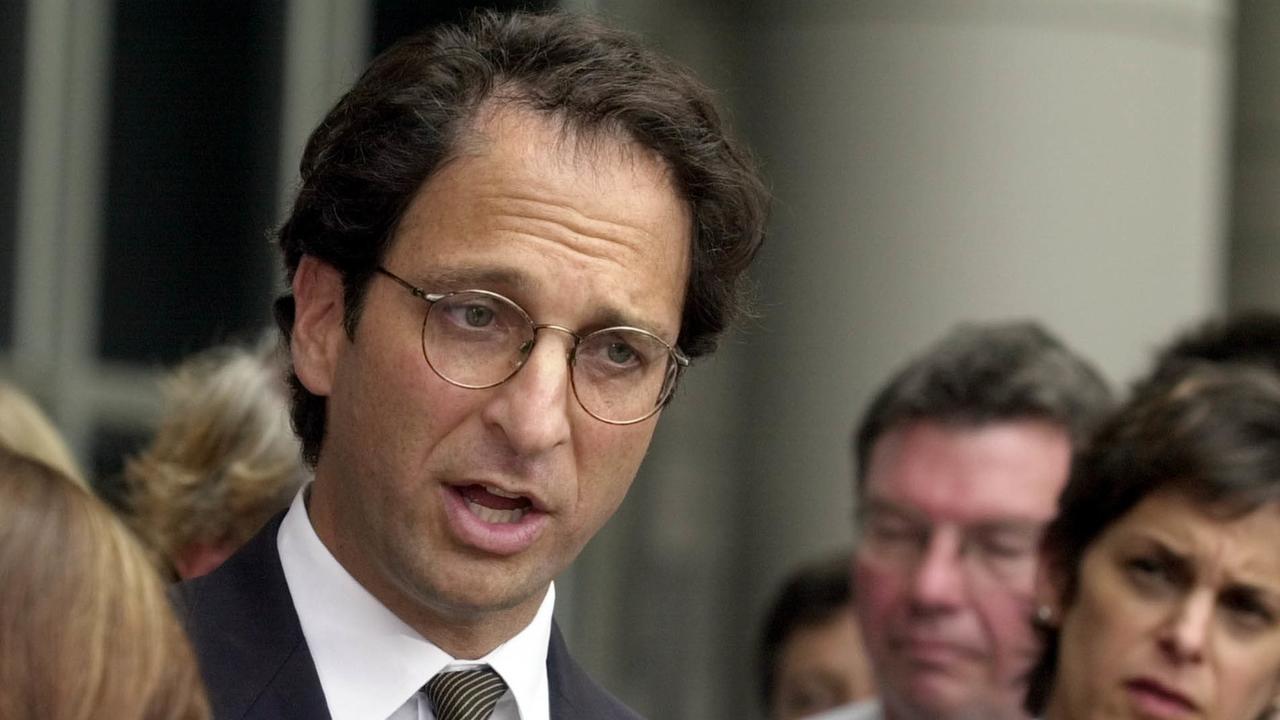
‘Crime does pay’: CNN hires disgraced ex-FBI director Andrew McCabe
RT | August 23, 2019
What does one get for leaking to the media, lying to federal investigators about it, and allegedly participating in a plot to derail an American election? If you answered jail time, too bad. The correct answer is a job at CNN.
That is at least the case for Andrew McCabe, the former acting FBI director and one of the people deeply involved in the ‘Trump-Russia’ investigation before it was taken over by Special Counsel Robert Mueller. CNN announced on Friday it was hiring McCabe as a contributor.
Just a day earlier, however, the network was in full meltdown over former White House press secretary Sarah Sanders getting hired by Fox News, and her predecessor Sean Spicer appearing on Dancing With the Stars – arguing that both were liars who did not deserve gainful employment.
Yet they have no problem with McCabe, who was fired from the FBI in March 2018 – just days before he could claim a $60,000 annual federal pension – because an internal report found that he “made an unauthorized disclosure to the news media and lacked candor – including under oath – on multiple occasions.”
“Lacking candor” is the federal government euphemism for lying.
McCabe going to CNN is “truly a match made in FakeNews heaven,” declared Donald Trump Jr., the president’s son, adding that CNN has long stopped being a news organization. “They’re now a fully integrated anti-Trump propaganda network and they don’t even try hiding it anymore.”
A number of Republican lawmakers, including Senators John Cornyn (Texas), Josh Hawley (Missouri), and Representatives Lee Zeldin (New York) and Mark Meadows (North Carolina) also weighed in on CNN’s employment choice and journalistic standards.
“I guess crime does pay,” added Matt Wolking, a spokesman for the Trump2020 campaign.
Meanwhile, left-wing journalist Aaron Mate offered a reminder that the gullible #Resistance raised over half a million dollars on GoFundMe for McCabe after he was fired.
McCabe joins nine other former national security officials already on CNN’s payroll, including ex-top spy James Clapper. MSNBC has hired five more, including former CIA chief John Brennan. The one thing they all have in common is outspoken opposition to President Trump.
As James Comey’s right hand at the Bureau, McCabe was intimately involved with investigating both Hillary Clinton’s private email server and the so-called ‘Trump-Russia collusion’ that later spawned a special counsel probe – as well as spying on the Trump campaign under questionable pretexts. His name was brought up on several occasions in text messages between agent Peter Strzok and attorney Lisa Page, including the exchange about an “insurance policy” in case Trump got elected.
The president and his supporters have long argued that this was the real scandal about the 2016 election, calling it ‘Spygate,’ and demanding a reckoning. However, no charges have been leveled – yet – against any of the officials involved, including McCabe and his boss Comey.
Yet it is McCabe who is demanding a reckoning in court, arguing that his firing was politically motivated and part of Trump’s “ongoing war on the FBI and the efforts of the Special Counsel” to investigate his ties with Russia. That Robert Mueller delivered his report months ago and found nothing doesn’t seem to faze him in the slightest.
In other words, he’ll fit right in at CNN.
FBI Starts Going After US Citizens Who Attend Iran-linked Conference – Reports
Sputnik – August 11, 2019
The US Federal Bureau of Investigation (FBI) is going after American citizens who have already attended or plan to attend the New Horizon Conference (NHC) held by an Iranian media expert to discuss major global issues.
A Virginia-based ex-Pentagon official said FBI agents were knocking at his door at 6:30 am in May, cited by Medium.com. Michael Maloof had travelled to Mashhad in northeast Iran to attend last year’s NHC and was one of the guests invited to the next conference which is to be held in the Lebanese capital of Beirut in September. The agents, however, warned him of consequences if he decides to attend.
In July, the FBI reportedly sent agents to the Florida home of Scott Rickard, a former translator with the US Air Force and the US National Security Agency (NSA) who once attended New Horizon, also warning him to skip the conference or face arrest.
The bureau also reportedly approached former State Department diplomat J. Michael Springmann, asking him over the phone to attend a meeting and answer a few questions about the conference, but he turned down the request. Vernellia Randall, an African American academic who wrote the book “Dying while Black,” and who attended the conference in Tehran in 2015, was also visited by the FBI.
Hicks said the FBI’s intimidation techniques set a “new low” in America’s approach to its relationship with Tel Aviv, where it has constantly backed the regime despite its many atrocities against the people of Palestine, Lebanon and more recently Syria. Later Hicks told Press TV that the FBI turned up at his door and warned him that New Horizon was being held by what they called “Iranian intelligence” without giving any evidence.
Nader Talebzadeh, the renowned Iranian intellectual and journalist who chairs the New Horizon organization, has filed a petition with the Treasury, appealing the decision.
“The consequence of your highly inaccurate and inflammatory allegations have had the result of seriously damaging our reputation, costing us a major loss of business and longtime friendships,” he wrote in the petition, adding that the NHC is a forum for free thought and expression of these thoughts.
See also:
Israeli elements behind US ban on New Horizon; FBI harassment of guests: Ex-diplomat
An Open Invitation to Tyranny
By Paul Craig Roberts • Unz Review • August 7, 2019
The FBI has published a document that concludes that “conspiracy theories” can motivate believers to commit crimes.
Considering the growing acceptance of pre-emptive arrest, that is, arresting someone before they can commit a crime that they are suspected of planning to commit, challenging official explanations, such as those offered for the assassinations of John F. Kennedy, Robert Kennedy, and Martin Luther King or the official explanation for 9/11, can now result in monitoring by authorities with a view to finding a reason for pre-emptive arrest. Presidents George W. Bush and Obama created the police state precedents of suspension of habeas corpus and assassination of citizens on suspicion alone without due process. If Americans can be preemptively detained indefinitely and preemptively assassinated, Americans can expect to be preemptively imprisoned for crimes that they did not commit.
As Lawrence Stratton and I explained in our book, The Tyranny of Good Intentions, the historic achievement of forging law into a shield of the people is being reversed in our time as law is being reforged into a weapon in the hands of the government.
The FBI document says that conspiracy theories “are usually at odds with official or prevailing explanations of events.” Note the use of “official” and “prevailing.” Official explanations are explanations provided by governments. Prevailing explanations are the explanations that the media repeats. Examples of official and prevailing explanations are: Saddam Hussein’s weapons of mass destruction, Assad’s use of chemical weapons, Iranian nukes, Russian invasion of Ukraine, and the official explanation by the US government for the destruction of Libya. If a person doubts official explanations such as these, that person is a “conspiracy theorist.”
Official and prevailing explanations do not have to be consistent with facts. It is enough that they are official and prevailing. Whether or not they are true is irrelevant. Therefore, a person who stands up for the truth can be labeled a conspiracy theorist, monitored, and perhaps pre-emptively arrested.
Consider 9/11. No forensic investigation of 9/11 was ever officially conducted. Instead the destruction of the buildings was blamed on Osama bin Laden, and scenarios and simulations were created to support the allegation, not to find the truth. Architects, engineers, scientists, pilots, and first responders on site cannot reconcile the official prevailing explanation with the facts. The scientific and testimonial evidence that they have produced is dismissed as “conspiracy theory.” It is those experts who stand on the evidence who are defined as conspiracy theorists, not those who created the story of Osama bin Laden’s 9/11 conspiracy.
Consider Russiagate. Here we have an alleged conspiracy between Trump and Russia that was the official prevailing explanation. Yet, to believe in the Russiagate conspiracy did not make one a conspiracy theorist as this conspiracy was the official prevailing explanation. But to doubt the Russiagate conspiracy did make one a conspiracy theorist.
What the FBI report does, intentionally or unintentionally, is to define a conspiracist as a person who doubts official explanations. In other words, it is a way of preventing any accountability of government. Whatever the government says, no matter how obvious a lie, will have to be accepted as fact or we will be put on a list to be monitored for preemptive arrest.
In effect, the FBI’s document reduces the First Amendment, that is, free speech, to the right to repeat official and prevailing explanations. Any other speech is a conspiratorial belief that can lead to the commission of a crime.
Every American should be greatly concerned that the government in Washington does not see this FBI document as an open invitation to tyranny, repudiate it, and demand its recall.
Did Bill Barr Call His Shot? Unanswered Questions about FBI’s Foreknowledge of the El Paso Shooting
William Barr’s warning that a “major incident” could occur “at any time” and “galvanize public opinion” around the unpopular encryption back-door policy he has been seeking seems to have come true in the weeks since the attorney general made those statements.
By Whitney Webb | MintPress News | August 7, 2019
As a series of recent mass shootings have brought renewed demands for the U.S. government to do something to address the spike in “lone wolf” violence, the Trump administration’s decision to blame internet privacy, controversial websites like 8chan, and social media for the shootings has raised eyebrows from across the political spectrum, particularly in light of claims that Trump’s recent rhetoric about immigrants may have incited some of the shooters.
During a press conference on Monday, Trump blamed the internet for the three most recent mass shooting events:
We must recognize that the internet has provided a dangerous avenue to radicalize disturbed minds and perform demented acts. We must shine light on the dark recesses of the internet and stop mass murders before they start…. The perils of the internet and social media cannot be ignored, and they will not be ignored… We cannot allow ourselves to feel powerless. We can and will stop this evil contagion.”
Yet, not long before the recent spate of mass shootings began, U.S. Attorney General William Barr gave a speech on July 23 in which he spoke of the need for all consumer electronic devices and encrypted software to have a backdoor for the government to bypass encryption, essentially calling for many of the same measures that Trump has proposed following the recent shootings.
Notably, Barr concluded his speech by stating that he anticipated “a major incident may well occur at any time that will galvanize public opinion on these issues.” In other words, just a few days prior to the recent spate of mass shootings, William Barr stated that he anticipated a public safety crisis that “may well occur at any time” and would reduce public resistance to the further erosion of civil liberties that he was advocating for in his speech.
Furthermore, the FBI, which operates under the jurisdiction of the Department of Justice and reports directly to William Barr, has now stated that it was aware of the El Paso shooter’s plan to murder civilians via a post made on 8chan at least two hours before the shooting took place. 8chan — a controversial website that the FBI is known to have used to incite violence as part of its controversial terrorist entrapment strategy — has since been banned in the shooting’s aftermath. In addition, less than two months ago, the FBI obtained a warrant for 8chan’s host — Ch.net — in which the Bureau demanded access to the entire contents of the accounts that were of interest in that specific investigation, suggesting that the FBI had increased access to information of hundreds of 8chan accounts in the lead-up to the recent shootings.
The overlap between Barr’s recent speech and Trump’s proposed solution to the massacres, as well as the FBI’s unusual recent relationship with 8chan, has led some to suggest that the Trump administration is taking advantage of the tragedy at El Paso and of other recent mass shootings to impose unpopular restrictions on civil liberties and increase the mass surveillance of innocent Americans.
An uncanny prediction
On Tuesday, July 23, Attorney General William Barr gave the keynote address at the 2019 International Conference on Cyber Security (ICCS) at Fordham University. The focus of Barr’s speech was the need for consumer electronic products and applications that use encryption to offer a “backdoor” for the government, specifically law enforcement, to obtain access to encrypted communications as a matter of public safety.
Early in his speech, Barr stated:
Service providers, device manufacturers and application developers are developing and deploying encryption that can only be decrypted by the end user or customer, and they are refusing to provide technology that allows for lawful access by law enforcement agencies in appropriate circumstances….
While encryption protects against cyberattacks, deploying it in warrant-proof form jeopardizes public safety more generally. The net effect is to reduce the overall security of society.”
Barr went onto say that “warrant-proof encryption is also seriously impairing our ability to monitor and combat domestic and foreign terrorists.” Barr stated that “smaller terrorist groups and ‘lone wolf’ actors” — such as those involved in the series of mass shootings in California, Texas and Ohio that would occur in the weeks after his speech — “have turned increasingly to encryption.” Barr later notes that he is specifically referencing encryption used by “consumer products and services such as messaging, smart phones, email, and voice and data applications.”
Barr then laid out his vision of what the solution to this challenge posed by “warrant-proof encryption” would look like:
We believe that when technology providers deploy encryption in their products, services, and platforms they need to maintain an appropriate mechanism for lawful access. This means a way for government entities, when they have appropriate legal authority, to access data securely, promptly, and in an intelligible format, whether it is stored on a device or in transmission.
We do not seek to prescribe any particular solution. Our private-sector technology providers have immensely talented engineers who have built the very products and services that we are talking about. They are in the best position to determine what methods of lawful access work best for their technology.”
After laying out his vision, Barr stated that, while he would like to give private companies time to willingly cooperate and comply with his suggested solution to “warrant-proof encryption,” “the time to achieve that [government back-doors into electronic consumer apps and products] may be limited.”
To overcome the resistance by some private companies — who do not want to renege on their right to privacy by giving the government back-door access to their devices — and American consumers, Barr tellingly anticipates that a “major incident” will soon take place that will mold public opinion in favor of his proposed solution.
Barr concluded his speech by stating:
I think it is prudent to anticipate that a major incident may well occur at any time that will galvanize public opinion on these issues.
As this debate has dragged on, and deployment of warrant-proof encryption has accelerated, our ability to protect the public from criminal threats is rapidly deteriorating. The status quo is exceptionally dangerous, unacceptable, and only getting worse.
The rest of the world has woken up to this threat. It is time for the United States to stop debating whether to address it, and start talking about how to address it.” (emphases added)
On Thursday, July 25, the last day of the ICCS conference, FBI Director Christopher Wray also echoed Barr’s call for government back-doors into encrypted software and apps, stating in his speech:
Cybersecurity is a central part of the FBI’s mission. But as the attorney general discussed earlier this week, our request for lawful access cannot be considered in a vacuum. It’s got to be viewed more broadly, taking into account the American public’s interest in the security and safety of our society, and our way of life. That’s important because this is an issue that’s getting worse and worse all the time.
There’s one thing I know for sure: It cannot be a sustainable end state for us to be creating an unfettered space that’s beyond lawful access for terrorists, hackers and child predators to hide. But that’s the path we’re on now, if we don’t come together to solve this problem.”
A new phase of an old campaign
The speeches given by Barr and Wray are the most recent iterations of the Department of Justice’s years-long effort to evade and weaken the encryption used by certain electronic products and applications, particularly encrypted messaging apps. Indeed, the DOJ was particularly active in late 2017 in pushing for back-doors into encrypted software, citing the encrypted devices of past perpetrators of mass shootings as proving the need for federal law enforcement to easily and quickly bypass encryption in criminal investigations.
However, Barr’s and Wray’s speeches mark a new phase of this government campaign targeting encryption, a campaign that has picked up in the past two weeks just as a series of mass shootings in the United States have led to widespread calls for the government to do something to prevent further massacres.
At a Monday press conference, President Donald Trump gave his official response to the most recent shootings in Ohio and Texas, tragedies that he largely blamed on the internet and its “dark recesses” that are inaccessible to the government. “We must recognize that the internet has provided a dangerous avenue to radicalize disturbed minds and perform demented acts,” Trump stated, before adding: “We must shine light on the dark recesses of the internet and stop mass murders before they start.”
“The perils of the internet and social media cannot be ignored and they will not be ignored,” the president emphasized.
One of the main solutions Trump offered to what he alleged caused the recent shootings was to mandate the DOJ “to work in partnership with local, state and federal agencies as well as social media companies to develop tools that can detect mass shooters before they strike.” Some interpreted this statement as suggesting the more widespread implementation of “pre-crime” software, such as Palantir, which was co-founded by billionaire Trump backer Peter Thiel, who is also on Facebook’s board.
Conveniently for William Barr, Facebook announced in May that the company is already developing just the “backdoor” that the attorney general has sought. This new initiative would implement AI-powered surveillance measures onto consumer devices, which would bypass end-to-end encryption on both the recently encrypted Facebook Messenger and the popular encrypted messaging app WhatsApp, acquired by Facebook in 2014. Though the measure was announced in May, it has received media attention only in the last week, following Barr’s speech at the 2019 ICCS.
Following Trump’s proposal for social media and the Barr-led DOJ to work together to monitor encrypted messages, it seems that Facebook will be one of the first major tech companies to offer its ready-made solution to the U.S. government. It is also worth considering the possibility that Barr may use the threat of his Silicon Valley antitrust probe to potentially strong-arm tech companies that would otherwise be unwilling to create a government back-door in their software or products. That probe was announced the same day that Barr spoke about anti-encryption measures at the 2019 ICCS.
In addition, between Barr’s July 23 speech and Trump’s August 5 press conference, there has been a concerted push from not only the DOJ but also the Five Eyes intelligence alliance, of which the U.S. is part, to weaken encryption or give governments access to encrypted applications.
On the heels of the 2019 ICCS, at which Barr and Wray spoke, there was a related cyber security summit in London — called the Five Country Ministerial — where “senior ministers from the U.K., Australia, Canada, New Zealand and the United States … reaffirmed their commitment to work together with industry to tackle a range of security threats.”
According to the U.K. government’s press release on the summit, which took place from July 29 to 30, the ministers in attendance “stressed that law enforcement agencies’ efforts to investigate and prosecute the most serious crimes would be hampered if the industry carries out plans to implement end-to-end encryption, without the necessary safeguards.” William Barr attended that summit, representing the U.S., and echoed his speech given a week prior, stating:
We must ensure that we do not stand by as advances in technology create spaces where criminal activity of the most heinous kind can go undetected and unpunished.”
Notably, Australia last year implemented a law similar to that which Barr is seeking to enact in the United States. It has since been lampooned by expert cryptographers for its ineffectiveness and has caused damage to Australia’s tech industry. According to the Guardian, Microsoft revealed in March that companies and governments it works with say they “are no longer comfortable about storing their data in Australia as a result of the encryption legislation.” Perhaps predictably, what has happened since Australia’s enactment of this controversial encryption legislation is the Australian government’s use of its new “back-doors” to widely surveil its civilians without a warrant.
Barr’s Orwellian bent
Barr’s outsized involvement in this recent push for a government back-door into all encryption apps is notable given his past. For instance, prior to becoming attorney general under Trump, Barr worked at the law firm Kirkland & Ellis, a firm that “represent[s] clients on matters relating to data and network security.” Kirkland & Ellis, in describing its own services, notes:
These matters are increasingly important to national security and international trade concerns such as government surveillance issues, state-sponsored cyber-attacks and espionage, and legal limitations on cross-border data transfers. The Firm represents clients in navigating these legal matters, including with respect to investigating security incidents/breaches and handling resulting litigation or government relations aspects of such incidents.”
Furthermore, Barr’s previous stint as attorney general, during the administration of George H.W. Bush, saw him push for increasing mass surveillance of innocent Americans. According to USA Today, in 1992, while serving as Attorney General under Bush Sr., Barr “launched a vast surveillance program that gathered records of innocent Americans’ international phone calls without first conducting a review of whether it was legal.” The program “ultimately gathered billions of records of nearly all phone calls from the United States to 116 countries, with little oversight from Congress or the courts” and also “provided a blueprint for far broader phone-data surveillance the government launched after the terrorist attacks of Sept. 11, 2001.” The program was partially carried out by the then-head of the DOJ’s Criminal Division, former FBI Director Robert Mueller.
Barr’s history of pushing for reducing privacy for citizens is troubling considering that, earlier in his career, he pushed for increased government secrecy while he was employed by the CIA in the late 1970s. For instance, while working at the CIA’s Office of Legislative Council, Barr attempted to circumvent the moratorium placed on the CIA that prevented it from destroying records and also stonewalled the Church Committee’s investigation into CIA abuses. Thus, Barr’s push for reduced privacy for citizens but increased privacy for the government bodes poorly for those who see government transparency and citizen privacy as important to keeping government overreach in check.
FBI foreknowledge
In the hours before the shooting at a Walmart in El Paso, Texas — and less than two weeks after Barr warned of an imminent “major incident” that would “galvanize public opinion” in favor of ending encryption free from a government back-door — the FBI was made aware of a manifesto published on the controversial website 8chan that is alleged to have been authored by the shooter, Patrick Crusius.
According to NBC News, the FBI was aware of the document prior to the shooting, but was unable to act quickly enough to prevent the attack. There have, however, been conflicting reports about exactly how long the FBI was aware of the alleged manifesto prior to the shooting.
For instance, soon after the shooting, CNN stated that three different sources had told the outlet that the manifesto had been “posted days before the shootings.” However, the FBI later stated less than a half hour before the shooting, while separate law enforcement sources told reporters that it was actually two hours before the shooting.
There is also a discrepancy regarding whether the manifesto was originally posted on 8chan and whether the shooter himself even posted it. Jim Watkins, who owns the 8chan message boards and has alerted federal authorities previously when past shooting manifestos were published at the site, stated:
First of all, the El Paso shooter posted on Instagram, not 8chan… Later, someone uploaded the manifesto. However, that manifesto was not uploaded by the Walmart shooter. I don’t know if he wrote it or not, but it was not uploaded by the murderer; that is clear.”
Facebook, which owns Instagram, said that it had disabled an Instagram account that belonged to Crusius and also noted that that account had been inactive for over a year.
In the past, 8chan administrators had deleted manifestos minutes after they were posted and warned federal authorities that the documents had been published. In the case of the El Paso shooting, Watkins claimed that the site had informed federal authorities as soon as they were aware that the manifesto had been uploaded to its page.
The facts that the FBI knew in advance of the manifesto, that the manifesto may not have been uploaded by the shooter, and that the FBI was quick to link that document to the shooting event soon after it took place have led to speculation about how the FBI was able to make that connection so quickly. For instance, lawyer Robert Barnes stated the following on Twitter:
How did [the] FBI identify the shooter before he began his attack from a post on an anonymous chat board? Usually, this means the shooter tipped them off either directly or indirectly (informant). Misuse of informants (including encouraging violence) is an underexplored problem.”
In addition, journalist Rachel Blevins posed a similar question on social media following the revelations, writing:
It took just hours for the FBI to both identify the suspect in the El Paso shooting and connect him to a manifesto posted on 8chan, which raises the question… was the suspect included in the FBI’s surveillance, and were their agents in contact with him before the shooting?”
This possibility is worth considering, given the well-documented history of the FBI’s policy of manufacturing domestic terror plots within the United States, most of which are ultimately foiled at the last minute by the Bureau. In many of those cases, many alleged terrorists would not have planned or attempted those attacks without goading and support from the FBI, leading critics to accuse the FBI of deliberately using entrapment. For instance, a 2014 study by Human Rights Watch and Columbia Law School’s Human Rights Institute found that “many of these people [in the cases examined in the study] would never have committed a crime if not for law enforcement encouraging, pressuring, and sometimes paying them to commit terrorist acts,” according to the study’s co-author Andrea Prasow.
There are several instances where the FBI sought out mentally handicapped and unstable individuals with no resources of their own, giving them incentives, fake weapons and even driving them to the scene of the planned fake terror attack. Two high-profile domestic terror cases have also had hints of FBI involvement — including the Pulse nightclub shooting, where the shooter’s father was later revealed to be a FBI informant and the FBI had attempted to goad the Pulse shooter into committing a terror attack years prior to the Pulse shooting. In addition, the family of the Boston Marathon bombers claimed that the FBI regularly visited their family home and had cultivated a close relationship with one of the bombers, Tamerlan Tsarnaev, prior to the bombing.
Since late 2016, the FBI’s controversial policy of inducting individuals to commit acts of terror in the United States has expanded after a federal appeals court ruling in December of that year said that federal agents were allowed to target a person’s religious affiliation in order to “probe the attitudes” of an individual who may want to “do something to America” by entrapping them in fake terror act schemes. The ruling also permitted federal agents to create false friendships, referred to in the ruling as the “illusory cultivation of emotional intimacy,” as a means of manipulating individuals to commit acts of terrorism — as well as providing these unstable individuals with money, vehicles, businesses and even vacations to get them to agree to participate in fake attacks.
As a result of this troubling trend, and given the FBI’s foreknowledge of the manifesto and its ease in connecting that document to the shooter, it becomes important to ask whether the FBI had more foreknowledge of the situation than it has publicly let on.
Though history indicates that FBI foreknowledge of the shooter is definitely plausible, 8chan has been a recent focus of the FBI in recent months. For instance, after the alleged manifesto of the shooter responsible for the massacre at the Poway Synagogue earlier this year was published on 8chan, the FBI issued a warrant for hundreds of 8chan user accounts that had commented on the Poway Synagogue shooter’s thread, including both users that supported his statement of intent and those who were appalled by it.
According to the Bureau’s application for a search warrant, the FBI was seeking the “IP address and metadata information about [Poway shooter John] Earnest’s original posting and the postings of all of the individuals who responded to the subject posting and/or commented about it.” The FBI further instructed Ch.net, which hosts 8chan, “to make a digital copy of the entire contents of the accounts subject to seizure.”
It goes without saying that with the information on hundreds of 8chan users, the FBI would have had access to potential future informants and potential targets to be “groomed” by the FBI for a future domestic terrorism entrapment case. This is especially likely given that the FBI’s reasoning for obtaining this large amount of information in the warrant was to identify “individuals who are inspired by the subject posting [i.e., the Poway shooter manifesto].” One 8chan user who was contacted by the FBI after this search warrant and filmed the encounter, was asked by federal agents to help them with information-gathering on other 8chan users.
This possibility is further supported by the fact that the FBI agent who filed the search warrant application, FBI Special Agent Michael Rod, revealed that he had been active on 8chan and (perhaps inadvertently) revealed his user name on 8chan to be user “8f4812.” An archive of the Poway shooter’s 8chan thread, available here, reveals that Rod stated in that 8chan thread that Russia was to blame for the Poway shooting and Rod also claimed that he knew of the Poway shooting 15 minutes before it happened but was unable to warn the authorities because he “was shit posting and got tied up.”
In the wake of the recent shootings in El Paso, Texas and Dayton, Ohio, 8chan was taken offline after internet infrastructure company Cloudflare declined to continue supporting the website.
A tragedy foretold and exploited
William Barr’s warning that a “major incident” could occur “at any time” and “galvanize public opinion” around the unpopular encryption back-door policy he has been seeking seems to have come true in the weeks since the attorney general made those statements. Given Barr’s influence over the FBI, which operates under his jurisdiction, it is important to scrutinize the evidence that the FBI had apparent foreknowledge of at least one of these recent shootings, and consider that the Bureau may have failed to act to prevent the tragedy, allowing Barr’s prediction just weeks earlier to become a self-fulfilling prophecy.
Trump’s proposed solution to the recent spate of mass shootings is focused on giving Barr a mandate to work with social media and tech companies to prevent another mass shooting before it occurs. It seems evident that this solution is set to involve surveilling encrypted communications to ostensibly prevent another shooting while also providing Barr, and the DOJ at large, the back-door into encrypted apps and consumer products that they have long sought but have been unable to sell to either the public or those same tech companies.
Now, a public safety crisis has emerged in the wake of Barr’s recent speech, tipping the scales — as Barr had predicted — so the public would favor further reductions to their civil liberties and right to privacy so that the federal government could provide increased public safety through increased surveillance. Yet, taking this alongside the well-documented fact that the FBI regularly manufactures domestic terror plots, it is worth asking whether some of these recent shootings were allowed to happen and whether public officials like William Barr are manipulating the public’s reaction to these tragedies to advance their own political agendas and further the build-up of state power.
Whitney Webb is a MintPress News journalist based in Chile. She has contributed to several independent media outlets including Global Research, EcoWatch, the Ron Paul Institute and 21st Century Wire, among others. She has made several radio and television appearances and is the 2019 winner of the Serena Shim Award for Uncompromised Integrity in Journalism.
Finally Time for DNC Email Evidence
By Patrick Lawrence | Consortium News | August 5, 2019
Three years after the narrative we call Russiagate was framed and incessantly promoted, it crumbles into rubble as we speak. The mini-empire of allegations, presuppositions, fallacious syllogisms, leaps of logic, imagined connections and mis– and disinformation marshaled to support charges of Russian interference in the 2016 elections is more or less a ruin.
The total collapse of the Russiagate orthodoxy now appears within reach — this for the first time since the Democratic National Committee set the narrative in motion after its email servers were compromised during the Trump–Clinton presidential contest. There is a good chance — though this is not a certainty — that Attorney General William Barr’s just-launched investigation will fully expose the numerous charges of Russian intervention as fabrications. Evidence of these fabrications, long available but ignored in a remarkably prevalent case of willful blindness, continues to grow such that it may be difficult to obscure it much longer.
It is now officially acknowledged that there is no credible evidence that Donald Trump colluded with Russia to defeat Hillary Clinton in the 2016 election. At this point, the demonstrably bogus assertion that Russian intelligence hacked into the DNC’s email system in mid–2016 is the one remaining feature of the Russiagate orthodoxy that is commonly considered rock solid.
The mythology on this question remains deeply embedded, the absence of any supporting evidence notwithstanding. Press and broadcast reports rarely miss an opportunity to cast Russian responsibility for the DNC email intrusion as a foregone conclusion. But this, too, is a tower built on sand. To put Russiagate decisively in the past now comes to demolishing this last, unsound edifice. The rest is already too discredited for anyone but naïve liberals, wishful-thinking “progressives” and the most committed ideologues to take seriously.
This focuses attention on the evidence — considerable and accumulating — that Russian intelligence agencies, officially charged with intrusion into the DNC’s servers, had nothing to do with it. It is now two years since technically qualified intelligence professionals of long experience reported via Consortium News that the theft of Democratic Party email in 2016 was neither a hack nor a Russian intelligence operation. In July 2017 Veteran Intelligence Professionals for Sanity presented persuasive evidence that the DNC’s servers had been compromised by someone with direct access to them.
The email messages subsequently posted by WikiLeaks had been pilfered by an insider of unknown identity: This was the conclusion VIPS drew in VIPS50, the group’s report on the mail incident, on the basis of the evidence it had gathered while working with other independent forensic investigators. The “hack,” in short, was not a hack. It was a leak.
A cacophony of objections erupted after Consortium posted VIPS50. Much — vastly too much — has been made of a group of “dissenters” within the VIPS organization who did not endorse the report. But neither these dissenters nor the many others attempting to discredit VIPS50 have succeeded in doing so. No countervailing evidence from any quarter has been presented. Based on continuing research, VIPS subsequently altered some of its initial conclusions, as noted in this space a year ago. But its principal findings stand.
VIPS50
This puts VIPS50, while still officially excluded from the record, among the most consequential documents to be published since the Russiagate narrative took shape three years ago. If we are to recover from the destructive, divisive nightmare Russiagate has become, VIPS50 will be key to the process. There are indications now that its findings, based on impartially conducted data analysis and forensic science, will soon get the consideration they have deserved from the first. My sources suggest Barr’s office is making use of VIPS report and subsequent findings as it begins its investigation into the genesis of the Russiagate allegations.
Much anticipation preceded the publication in mid–April of the report on Russian interference completed in the office of Special Counsel Robert Mueller. Contrary to prevalent expectations, however, the 448–page document failed to confirm the case for Russiagate and did much to weaken it. Not only did the report conclude that neither President Trump nor anyone in his campaign colluded with Russia as he fought the 2016 election; it also made clear that the special counsel’s office did not undertake a credible investigation of the charge that Russian intelligence hacked the DNC’s mail servers.
Mueller failed to call numerous key witnesses, among them Julian Assange, the WikiLeaks founder and publisher, and Bill Binney, formerly a technical director at the National Security Agency and one of several technical experts in the VIPS group. He also failed to pursue alternative theories in the email-theft case; a duty of any investigator in Mueller’s position. Only the willfully blind can accept these irregularities as legitimate conduct.
Remarkably enough, Mueller’s investigation appears to have conducted no forensic tests of its own to verify allegations of a Russian hacking operation. It relied instead on the patently faulty findings of Crowdstrike, the disreputable cyber-security firm that was working for the DNC by mid–2016. Critically, the special counsel also appears to have neglected to consult the NSA for evidence pertaining to the DNC incident. Had the intrusion been a hack conducted over the internet, by Russians or anyone else, the agency would have a fully detailed digital record of the operation and the means to trace the intervention to its perpetrators. Why, it is perfectly logical to ask, was such a record not cited prominently in the Mueller report?
Mueller’s testimony before two congressional committees on July 24 was a further blow to the Russiagate thesis. The special counsel came over as a detached, out-of-touch figurehead with a very loose grip on his own investigation and poor knowledge of the report bearing his signature. Soon afterward, even Trump’s adversaries in the Democratic camp began to give up the ghost. “In the hours and days after Mr. Mueller gave his opening statement before the House Judiciary Committee,” wrote Samuel Moyn, a Yale law professor, “it became clear how tenaciously many liberals and progressives are clinging to fantasy.” Moyn’s piece appeared in The New York Times. The headline reads, “The Mueller Fantasy Comes Crashing Down.”
Despite the stunningly anticlimactic outcome of the Mueller report and his subsequent appearance on Capitol Hill — which was intended from the first to be a matter of spectacle rather than substance — new allegations of Russian interference continue to arrive on front pages and in news broadcasts. The latest came the day after Mueller’s testimony, when the Senate Intelligence Committee reported that Russia intruded into the election systems of all 50 states during the 2016 campaigns. The report offered no supporting evidence, per usual. It was heavily redacted at the request of the relevant intelligence agencies, again per usual.
Question of Evidence
This brings us to the question of evidence. To go back to the initial allegations of Russian interference three years ago, at no point since have any of these commonly accepted charges been accompanied by hard, legally and logically sound evidence to back them up. This astonishing lacuna, while intently papered over in the media, on Capitol Hill, at the Justice Department, in the intelligence apparatus, and among law-enforcement agencies, has rendered the Russiagate orthodoxy vulnerable from the first. It now emerges that the evidence problem is worse than even the most committed critics of the Russiagate narrative had thought.
This came to light this spring, during the pre-trial discovery phase of the case against Roger Stone, the onetime Trump aide charged with obstructing justice and misleading Congress. When Stone’s attorneys requested Crowdstrike’s final report on the DNC email theft, which they said was relevant to his defense, prosecutors returned with the stunning revelation that Crowdstrike, the DNC’s cyber-security firm, never submitted a final report. “The government does not possess the information the defendant seeks,” the Justice Department responded via a court filing.
The Federal Bureau of Investigation’s failure to take possession of the DNC’s email servers from Crowdstrike after the mid–2016 intrusion, a shocking case of official malfeasance, has long been dismissed as an unimportant detail. We now know that the FBI, the Justice Department and the Mueller investigation relied on nothing more than three Crowdstrike drafts — all of them redacted by Crowdstrike — to build the case for Russia’s culpability in the theft of the DNC’s email.
Not only did the FBI fail to establish a proper chain of evidentiary custody after the incident at the DNC; it is now clear the bureau knows of the email theft only what Crowdstrike chose to tell it. There is no evidence that the FBI asked the NSA for its records of the incident. Nor is there any indication that Crowdstrike has ever given the FBI or prosecutors in the Stone case the data it used to produce its never-completed report. “Crowdstrike appears to have destroyed evidence or is hiding it,” Bill Binney said in a telephone interview.
The corporate media continue to pretend in their press reports and news broadcasts that the official investigation of the DNC email incident was conducted according to the highest standard of legitimacy. Democrats on Capitol Hill, still pursuing their own investigations, never question the validity of the officially constructed case alleging Russia’s responsibility. The revelation of negligence the Stone trial brings to light, which amounts to corruption, could hardly expose this prolonged charade more starkly.
Forensic investigators, meantime, continue to gather evidence supporting the leak-not-hack case made in VIPS50. The gap thus widens between the official story of the DNC mail incident and the case supported by forensic research done by VIPS and other independent investigators working in association with it.
Last February these investigators discovered that email pilfered in 2016 and subsequently conveyed to WikiLeaks had been stored according to a system called File Allocation Table, or FAT. The FAT system time-stamps data according to their last modifications and, because it is less precise than other storage systems, it rounds up time stamps to the next even number. If the FAT system is used to store data, it is a strong indication that the data were stored on a memory key or another such portable device.
In the 35, 816 email messages investigators examined, the FAT system assigned even-numbered time stamps to all of them. Binney, a mathematician by training, puts the chance of this occurring without the use of a portable storage device at 1 in 2 to the 35,816thpower — meaning it is a virtual impossibility.
The FAT numbering pattern detected in the email messages tested does not indicate at what stage or where a portable device was used. It shows only that such a device was used at some point in the handling of the data; a portable device may or may not have been used to execute the initial download. But the presence of the FAT system in the metadata of the emails tested adds another layer of circumstantial evidence supporting the VIPS case that the theft of DNC mail was a leak executed locally via a portable device and not a remote hack conducted through the internet. At the very least, it is an additional line of inquiry the FBI, the intelligence agencies, and the Mueller investigation have left unexamined.
VIPS Dissenters
Among the critics of VIPS50, none has influenced public opinion as much as the dissenters within the group’s membership. The presence of these dissenters has been evident since VIPS50 went through repeated drafts over a period of nearly two weeks. This is a group of honorable, in many cases brave people. But they advanced no coherent objections to the VIPS document prior to its publication, and this remained the case for some time after Consortium News posted it on July 24, 2017. Having begun reporting on VIPS50 shortly after that date, I found — and continue to find — the dissenters’ position heavily inflected with personal animosities and political leanings having no bearing on the validity of the VIPS50 findings.
A number of dissenters signed a contribution to a forum The Nation hosted after the magazine published a piece I wrote on VIPS50 in August 2017. This was the first time the dissenters publicly presented substantive objections to VIPS50, and they focused on the core of the VIPS case. This case continues to rest primarily on the speed at which a mail theft could be executed in mid–2016. The transfer speed, identified by an analysis of metadata found on documents stolen at that time, was considerably faster than the rate possible over the internet at the time of the intrusion, indicating a leak by someone using a portable storage device and with direct access to the DNC’s servers.
The dissenting group took specific issue with these findings. “Data-transfer speeds across networks and the Internet measured in megabits per second (or megabytes per second) can easily achieve rates that greatly exceed the cited reference in the VIPS memo,” the dissidents wrote.
It was at this point the dissenters repeated the failures of the intelligence apparatus and the Mueller investigation: They produced no evidence. There is no indication the dissenters conducted tests to support their assertion on the speed question. The VIPS memo applied scientific method to the DNC mail theft for the first time and was intended as an “evidence to date” document. This marked a transformative advance in how the DNC incident can be understood: The imperative since has been to bring countervailing evidence to the investigative process, which continues. No one —not the dissenters, not the DNC, not the “intelligence community,” not Mueller, not the press — has done so.
The dissenters have been silent since their contribution to The Nation’s forum. Members have declined invitations to work with VIPS50 signatories to develop further the evidence presented in the memo. When I queried a number of dissenters for this commentary, one replied. This person did not address the findings of forensic investigators while reproducing what VIPS50 signatories term the “emotional arguments” that have characterized the dissenters’ response to the memo since the drafting phase two summers ago. These continuing difficulties appear partly to reflect a desire not to be seen defending either Trump or the Russians.
Barr’s Investigation
The NSA, the CIA, the FBI, the Mueller investigation, the press — none has shown the slightest interest in the findings outlined in VIPS50. This can come as no surprise, given the heavy investments all of these entities have made in the Russians-did-it explanation of the DNC email incident. But this omission is nonetheless negligent when one considers the contradicting evidence VIPS and those associated with it continue to amass. A key question now arises: Will the Barr investigation into the genesis of allegations of Russian interference, begun three months ago, transcend this politically inspired ignorance to expose official accounts of the mid–2016 mail theft as fallacies?
The early signs were that Barr’s investigators would at last explode the Russiagate narrative. Trump was unmistakably determined to do so when he urged Barr to “investigate the investigators” last spring. In mid–May Barr appointed John Durham, a federal prosecutor, to direct this effort. Ten days later Trump gave Barr “full and complete authority to declassify information” related to the conduct of the intelligence agencies, the FBI, and the Justice Department.
It was clear very early that Trump was aware of VIPS50 and entertained a lively interest in its findings. In September 2017, two months after Consortiumpublished the memo, he ordered Mike Pompeo, then director of the CIA, to interview Bill Binney, the leading technical expert within the VIPS group. Pompeo did so in October 2017, but by Binney’s account he flinched: Pompeo heard Binney out at the president’s insistence, but he never pursued the forensic findings the former NSA technical director walked him through.
This was an early sign, it is now plain, that even efforts to unearth the truth of the allegations against Russia that emanate from the White House would meet political resistance. Another came last Friday, when Trump was forced to drop John Ratcliffe, a Texas Republican who pledged to support a full investigation of Russiagate, as his nominee to replace Dan Coats as director of national intelligence. While Ratcliffe considered the orthodox Russiagate narrative bogus, Coats was vigorous in his promotion of it.
This makes political will another key question to ask of the Barr investigation: Full exposure of the travesty of Russiagate is almost certainly within Barr’s power to achieve. Will he do so?
Whether Trump will remain consistent in his backing of Barr is another such question. While Trump habitually terms Russiagate “a hoax,” he has also indicated on a number of occasions that his true objective is simply to escape the charge that he colluded with Russians to win the 2016 election. “I never said Russia did not meddle in the election,” Trump tweeted earlier this year. “I said, ‘It may be Russia, or China, or another country or group, or it may be a 400–pound genius sitting in bed and playing with his computer.’ The Russian ‘hoax’ was that the Trump campaign colluded with Russia—it never did!”
A president who slips and slides, an administrative state — the Deep State if you like — thoroughly committed to defending falsified accounts of the mid–2016 intrusions into the DNC’s email servers, a supine press: It is impossible to say when or whether the truth of the events of three years ago will emerge. The evidence is there, sufficient now to conclude the Russigate case. The greatest remaining obstacle is the willful ignorance that incubated the Russiagate narrative and now prolongs it. We reach a point when evidence and more evidence, along with political integrity, are the only effective replies to this cynical, foolish, and costly recalcitrance.
Patrick Lawrence, a correspondent abroad for many years, chiefly for the International Herald Tribune, is a columnist, essayist, author and lecturer. His most recent book is “Time No Longer: Americans After the American Century” (Yale). Follow him on Twitter @thefloutist. His website is Patrick Lawrence.
In the World of Truth and Fact, Russiagate is Dead. In the World of the Political Establishment, it is Still the New 42
By Craig Murray | August 4, 2019
Douglas Adams famously suggested that the answer to life, the universe and everything is 42. In the world of the political elite, the answer is Russiagate. What has caused the electorate to turn on the political elite, to defeat Hillary and to rush to Brexit? Why, the evil Russians, of course, are behind it all.
It was the Russians who hacked the DNC and published Hillary’s emails, thus causing her to lose the election because… the Russians, dammit, who cares what was in the emails? It was the Russians. It is the Russians who are behind Wikileaks, and Julian Assange is a Putin agent (as is that evil Craig Murray). It was the Russians who swayed the 1,300,000,000 dollar Presidential election campaign result with 100,000 dollars worth of Facebook advertising. It was the evil Russians who once did a dodgy trade deal with Aaron Banks then did something improbable with Cambridge Analytica that hypnotised people en masse via Facebook into supporting Brexit.
All of this is known to be true by every Blairite, every Clintonite, by the BBC, by CNN, by the Guardian, the New York Times and the Washington Post. “The Russians did it” is the article of faith for the political elite who cannot understand why the electorate rejected the triangulated “consensus” the elite constructed and sold to us, where the filthy rich get ever richer and the rest of us have falling incomes, low employment rights and scanty welfare benefits. You don’t like that system? You have been hypnotised and misled by evil Russian trolls and hackers.
Except virtually none of this is true. Mueller’s inability to defend in person his deeply flawed report took a certain amount of steam out of the blame Russia campaign. But what should have killed off “Russiagate” forever is the judgement of Judge John G Koetl of the Federal District Court of New York.
In a lawsuit brought by the Democratic National Committee against Russia and against Wikileaks, and against inter alia Donald Trump Jr, Jared Kushner, Paul Manafort and Julian Assange, for the first time the claims of collusion between Trump and Russia were subjected to actual scrutiny in a court of law. And Judge Koetl concluded that, quite simply, the claims made as the basis of Russiagate are insufficient to even warrant a hearing.
The judgement is 81 pages long, but if you want to understand the truth about the entire “Russiagate” spin it is well worth reading it in full. Otherwise let me walk you through it.
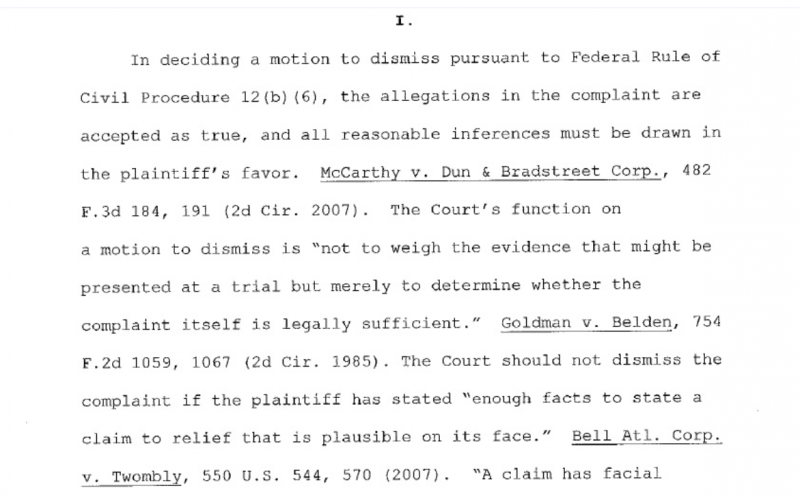
This is the crucial point about Koetl’s judgement. In considering dismissing a case at the outset in response to a motion to dismiss from the defence, the judge is obliged to give the plaintiff every benefit and to take the alleged facts described by the DNC as true. The stage of challenging and testing those facts has not been reached. The question Koetl is answering is this. Accepting for the moment the DNC’s facts as true, on the face of it, even if everything that the Democratic National Committee alleged happened, did indeed happen, is there the basis for a case? And his answer is a comprehensive no. Even the facts alleged to comprise the Russiagate narrative do not mount up to a plausible case.
The consequence of this procedure is of course that in this judgement Koetl is accepting the DNC’s “facts”. The judgement is therefore written entirely on the assumption that the Russians did hack the DNC computers as alleged by the plaintiff (the Democratic National Committee), and that meetings and correspondence took place as the DNC alleged and their content was also what the DNC alleged. It is vital to understand in reading the document that Koetl is not stating that he finds these “facts” to be true. Doubtless had the trial proceeded many of them would have been challenged by the defendants and their evidentiary basis tested in court. It is simply at this stage the only question Koetl is answering is whether, assuming the facts alleged all to be true, there are grounds for trial.
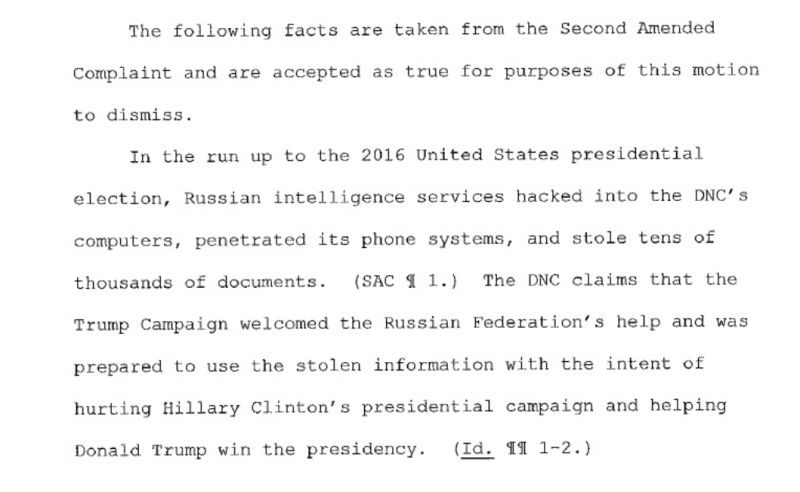
Judge Koetl’s subsequent dismissal of the Russiagate nonsense is a problem for the mainstream media and their favourite narrative. They have largely chosen to pretend it never happened, but when obliged to mention it have attempted to misrepresent this as the judge confirming that the Russians hacked the DNC. It very definitely and specifically is not that; the judge was obliged to rule on the procedural motion to dismiss on the basis of assuming the allegation to be true. Legal distinctions, even very plain ones like this, are perhaps difficult for the average cut and paste mainstream media stenographer to understand. But the widespread failure to report the meaning of Koetl’s judgement fairly is inexcusable.
The key finding is this. Even accepting the DNC’s evidence at face value, the judge ruled that it provides no evidence of collusion between Russia, Wikileaks or any of the named parties to hack the DNC’s computers. It is best expressed here in this dismissal of the charge that a property violation was committed, but in fact the same ruling by the judge that no evidence has been presented of any collusion for an illegal purpose, runs through the dismissal of each and every one of the varied charges put forward by the DNC as grounds for their suit.
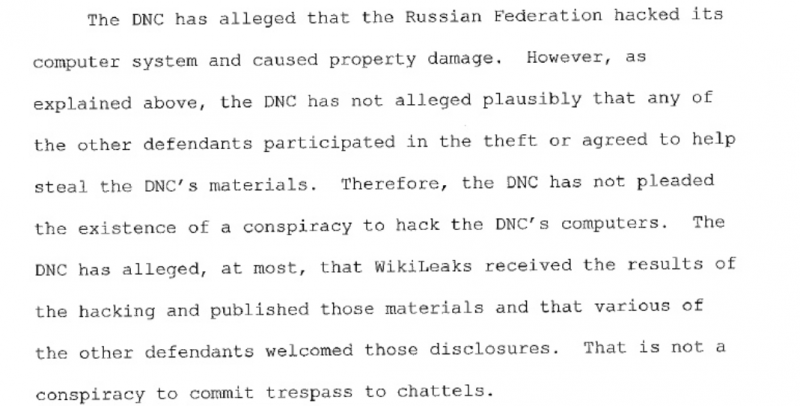
Judge Koetl goes further and asserts that Wikileaks, as a news organisation, had every right to obtain and publish the emails in exercise of a fundamental First Amendment right. The judge also specifically notes that no evidence has been put forward by the DNC that shows any relationship between Russia and Wikileaks. Wikileaks, accepting the DNC’s version of events, merely contacted the website that first leaked some of the emails, in order to ask to publish them.
Judge Koetl also notes firmly that while various contacts are alleged by the DNC between individuals from Trump’s campaign and individuals allegedly linked to the Russian government, no evidence at all has been put forward to show that the content of any of those meetings had anything to do with either Wikileaks or the DNC’s emails.
In short, Koetl dismissed the case entirely because simply no evidence has been produced of the existence of any collusion between Wikileaks, the Trump campaign and Russia. That does not mean that the evidence has been seen and is judged unconvincing. In a situation where the judge is duty bound to give credence to the plaintiff’s evidence and not judge its probability, there simply was no evidence of collusion to which he could give credence. The entire Russia-Wikileaks-Trump fabrication is a total nonsense. But I don’t suppose that fact will kill it off.
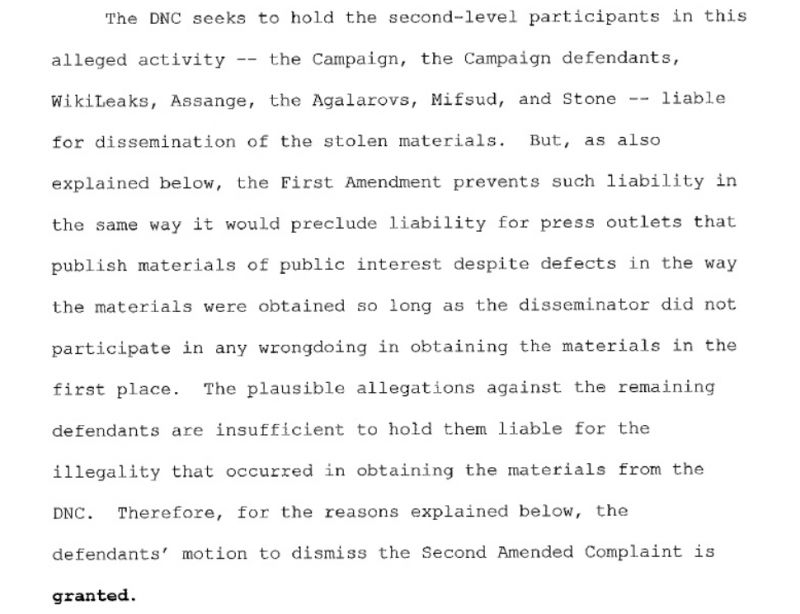
The major implication for the Assange extradition case of the Koetl judgement is his robust and unequivocal statement of the obvious truth that Wikileaks is a news organisation and its right to publish documents, specifically including stolen documents, is protected by the First Amendment when those documents touch on the public interest.
…
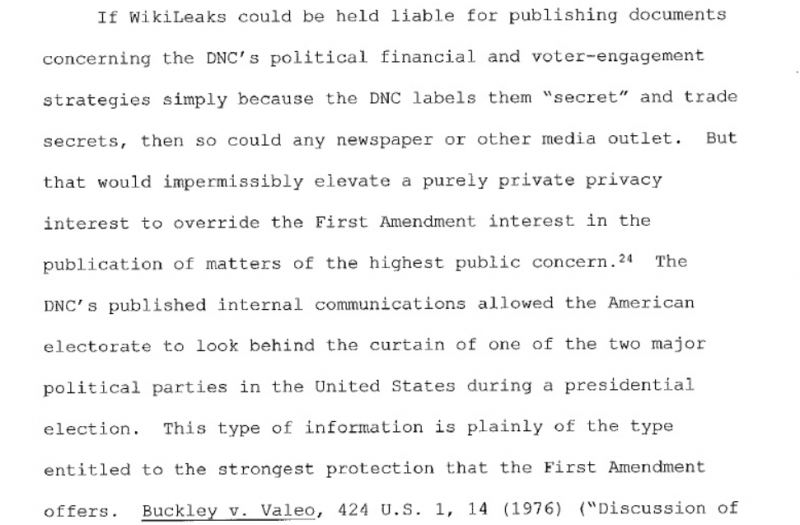
These arguments are certainly helpful to Assange in the extradition case. But it must be noted that the extradition request has been drafted to try to get round the law by alleging that Wikileaks were complicit in the actual theft of documents by Chelsea Manning. Judge Koetl does not address this question as he was presented with no evidence that Wikileaks had contact with the “hackers” prior to their obtaining the documents, so the question did not arise before him. In the extradition request, the attempt is to argue that Assange encouraged and abetted Manning in obtaining the material. This is supposed to be a different argument.
In fact this attempt to undermine the First Amendment has no merit. Cultivation of an insider source is a normal part of journalistic activity, and encouraging an official to leak material in the public interest is an everyday occurrence in such cultivation. In the “Watergate” precedent, for example, the “Deep Throat” source, Mark Felt of the FBI, was cultivated and encouraged over a period by Bernstein. In addition to which, Manning’s access to the documents could not be characterised as “theft”. Leaking of official secrets by an insider is a very different thing to a hack from outside.
And in conclusion, I should state emphatically that while Judge Koetl was obliged to accept for the time being the allegation that the Russians had hacked the DNC as alleged, in fact this never happened. The emails came from a leak not a hack. The Mueller Inquiry’s refusal to take evidence from the actual publisher of the leaks, Julian Assange, in itself discredits his report. Mueller should also have taken crucial evidence from Bill Binney, former Technical Director of the NSA, who has explained in detail why an outside hack was technically impossible based on the forensic evidence provided.
The other key point that proves Mueller’s Inquiry was never a serious search for truth is that at no stage was any independent forensic evidence taken from the DNC’s servers, instead the word of the DNC’s own security consultants was simply accepted as true. Finally no progress has been made – or is intended to be made – on the question of who killed Seth Rich, while the pretend police investigation has “lost” his laptop.
Though why anybody would believe Robert Mueller about anything is completely beyond me.
So there we have it. Russiagate as a theory is as completely exploded as the appalling Guardian front page lie published by Kath Viner and Luke Harding fabricating the “secret meetings” between Paul Manafort and Julian Assange in the Ecuadorean Embassy. But the political class and the mainstream media, both in the service of billionaires, have moved on to a stage where truth is irrelevant, and I do not doubt that Russiagate stories will thus persist. They are so useful for the finances of the armaments and security industries, and in keeping the population in fear and jingoist politicians in power.
DNI Nominee Intent on Getting to Bottom of Russiagate
By Ray McGovern – Consortium News – July 31, 2019
Shortly before President Donald Trump announced he had nominated Rep. John Ratcliffe (R-TX) to replace Dan Coats as director of national intelligence, Ratcliffe made it clear he intends to hit the deck running on the “crimes” behind Russiagate.
“What I do know as a former federal prosecutor is it does appear that there were crimes committed during the Obama administration,” Ratcliffe told Fox News’ Maria Bartiromo. Mincing few words, he claimed the Democrats “accused Donald Trump of a crime and then tried to reverse engineer a process to justify that accusation.”
It’s an extravagant claim. But it is also true, and the proof is in the pudding of which we should have a steady diet in the months to come.
Ratcliffe sounds partisan speaking of “crimes committed” under Obama. But there could well be documentary evidence to back it up. Some is classified. Trump has given Attorney General William Barr instructions to declassify what is necessary. Barr should be able to count on Ratcliffe, if he is confirmed by the Senate as DNI, to ride herd on those in the intelligence community with huge incentives to cover their tracks and those of their former bosses.

Ratcliffe: Justice will be done. (Fox News screenshot)
This may come as something of a shock to new readers of Consortium News because of the incessant drivel from corporate media “talking heads” for a full three years now. They are not likely to give up any time soon.
Ratcliffe on Where We Are Now
Ratcliffe told Bartiromo:
“The only place we can get the answers is from the Justice Department right now. The American people’s faith and trust has been shaken in our Justice Department, and the only way to get that back is for there to be real accountability with a very fair process. Again, I have supreme confidence in Bill Barr’s ability to deliver that and at the end of the day … as long as we know that the process was fair … justice will be done.”
If Ratcliffe means what he says, his remarks indicate that Barr (a former CIA official and relatively new-sheriff-back-in-town in his second stint as AG) should have in Ratcliffe a no-holds-Barred deputy sheriff, if he takes advantage of him. “Bill Barr has earned my trust already … that there will be a fair process, with John Durham and Michael Horowitz, to getting answers … and to provide accountability where it really belongs,” Ratcliffe said.
Barr has ordered John Durham, U.S. Attorney for Connecticut, to investigate how Russiagate got started. And Michael Horowitz, the Department of Justice Inspector General, is said to be almost ready to report on the roles of the DOJ and FBI in promoting the Trump-Putin “collusion” narrative.
Durham, however, twice essentially covered up for CIA misdeeds. The New York Times reported: “In 2008, Attorney General Michael B. Mukasey assigned Mr. Durham to investigate the C.I.A.’s destruction of videotapes in 2005 showing the torture of terrorism suspects. A year later, Attorney General Eric H. Holder Jr. expanded Mr. Durham’s mandate to also examine whether the agency broke any laws in its abuses of detainees in its custody.”
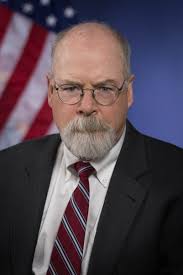
Durham: A good soldier, but with a new commander.
Abundantly clear in those days, however, was the reality that neither Mukasey nor Holder wanted Durham to deliver the goods on CIA people demonstrably involved in well documented death-by-torture of prisoners in Afghanistan and Iraq. Good soldier Durham uttered not a peep when Holder announced that the Department of Justice “declined prosecution because the admissible evidence would not be sufficient to obtain and sustain a conviction beyond a reasonable doubt.”
But Holder added this: “Our inquiry was limited to a determination of whether prosecutable offenses were committed and was not intended to, and does not resolve, broader questions regarding the propriety of the examined conduct.” The Times noted at the time that DOJ’s decision did not amount to “exoneration” of those involved in the prisoners’ treatment and deaths. Does that sound familiar?
Thus, judging from past experience, the question is not so much what Durham will come up with this time around when investigating folks from the same line of (intelligence) work. The more salient question is this: Will Durham’s role be limited by Deep State, gun-shy Trump, or will he be given the latitude to proceed with no-holds-Barred, so to speak.
Horowitz’s investigators, on the other hand, earlier discovered the extremely-damaging-to-the-Russia-gate-yarn text exchanges between senior FBI officials Peter Strzok and Lisa Page, and Horowitz decided to make them public in December 2017. First off the blocks the following day, the late Robert Parry, founder of this website, posted what turned out to be his last substantive article, “The Foundering Russia-gate Scandal.”
Horowitz’s investigators recently interviewed some formerly reluctant witnesses like Christopher Steele, who had been a paid informant of the FBI itself and whom the Clinton campaign later paid to assemble the infamous “dossier” on Trump’s alleged cavorting with prostitutes in Moscow and other scurrilous, since-disproven stories.
With the malleable nonentity Coats as DNI, and with top CIA officials trying to keep former CIA Director John Brennan out of jail (and shield their own derrieres), Barr has — until now — lacked a strong “deputy sheriff” with the requisite prosecutorial skills and courage to investigate the intelligence community to find out where the bodies are buried in Washington.
As soon as Ratcliffe is confirmed, Barr should have what he needs to close that gap and tackle full bore the intelligence part of the Deep State’s role in Russia-gate.
A Parvenu?
But how could Ratcliffe know anything, the corporate media asks, as they paint him as a newcomer, partisan ignoramus and focus on his lack of experience in foreign affairs. Sorry, Rachel Maddow, in case you haven’t noticed, the present focus is on affairs much closer to home. The “parvenu” label will not stick. Serving, as Ratcliffe has, on three key House committees —Intelligence, Judiciary, and Homeland Security — you can learn a whole lot, if you regard your responsibility as oversight, not overlook.
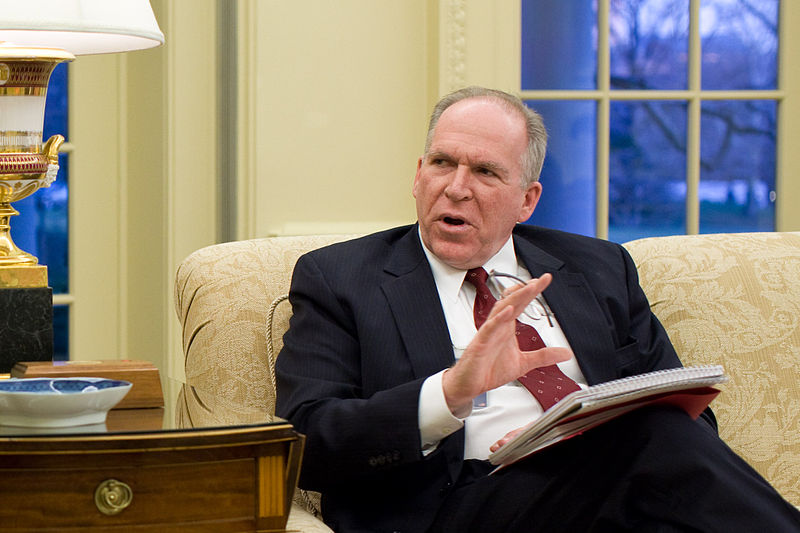
Brennan: Cold on Ratcliffe (White House photo)
Is there documentary evidence? Admittedly, it would seem a stretch to believe that Obama’s top intelligence and law enforcement officials — in “collusion” with the corporate media — would fabricate a Trump-in-Putin’s-pocket story line first to try to prevent Trump from being elected, and then emasculate him as incoming president. But, yes, there should be all manner of documentary evidence indicating that this is precisely what happened.
House Intelligence Committee Ranking Member Devin Nunes (R-CA) claimed in early April 2019, “They [the Democrats] have lied multiple times to the American people. All you have to do is look at their phony memos. They have had the full support of the media, 90 percent of the media in this country. They all have egg on their face.” The way things are now shaping up, we are likely to learn before too long whether the evidence supports Nunes’s accusations.
All the Naiveté That’s Fit to Print
The New York Times reported that many Republican Senators, who must vote on his confirmation, are “cool” to Ratcliffe:
“Democrats said on Monday that they were worried that Mr. Ratcliffe would do little to push back against the Justice Department’s review of the origins of the Russia inquiry, for which Mr. Trump gave Attorney General William P. Barr broad power to declassify relevant documents.”
Democrats don’t watch Fox News, but does the Gray Lady still harbor hope Ratcliffe might “push back” when he says he will push full steam ahead?
None of the leaking, unmasking, surveillance, DNC-hired “opposition research,” or other activities directed against the Trump campaign can be properly understood if one does not bear in mind that it was considered a sure thing that Hillary Clinton would become President, at which point high-risk, illegal activities undertaken to help her win would likely bring gratitude and perhaps a promotion, not an indictment. But Clinton lost.
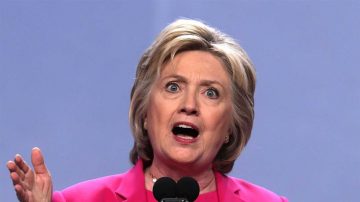
Hillary: She hadda win, but didn’t.
After her loss, Comey himself gave the game away in his book, “A Higher Loyalty” — which amounted to a pre-emptive move motivated by loyalty-to-self and eagerness to secure a Stay-Out-of-Jail card. Comey wrote, “I was making decisions in an environment where Hillary Clinton was sure to be the next president …” [Emphasis added.] This would, of course, confer automatic immunity on key players who may now find themselves criminally referred to the Department of Justice.
Worse still, because they all were convinced a Clinton victory was a sure thing, the plotters did not perform due diligence to hide their tracks. And that largely accounts for the fact that there should be documentary evidence — probably even on not-yet-shredded paper, as well as on computer hard drives.
Given his seats on Intelligence, Judiciary, and Homeland Security, Ratcliffe has seen a lot more of them than most Congress members. In the Sunday interview, he named some of those allegedly engaged in illegalities: former FBI Director James Comey, senior DOJ official Bruce Ohr, and opposition research guru Glenn Simpson. Also mentioned but unnamed were the Obama officials who Ratcliffe said committed a “felony” by leaking highly classified phone transcripts to use against Gen. Michael Flynn, Trump’s short-lived national security adviser.
But Now Running Scared
No one has more to fear from all this than ex-CIA Director Brennan. He eagerly awaited the final report from Mueller, whom Brennan has unctuously praised. Introducing Mueller to an audience at Georgetown University in June 2014, Brennan called him “a remarkable public servant as well as a great friend, a transformative leader, an outstanding partner to CIA, and a source of wise counsel to leaders across the intelligence community.”
In his testimony to the House Judiciary and Intelligence Committees on July 24, Mueller avoided discussing some of the chicanery that bears Brennan’s fingerprints, but he surely failed to “exonerate” him, so to speak. To suggest that the selection of Ratcliffe to become DNI was unwelcome news to Brennan is to state the obvious. Brennan got up early on Monday and at 7:11 AM sent this characteristic tweet — about integrity and subservience, of all things:
Dan Coats served ably & with deep integrity. Ratcliffe showed abject subservience to Trump in Mueller hearings. The women & men in the Intelligence Community deserve a leader like Coats who puts nation first; not a servile Trump loyalist like Ratcliffe. https://t.co/fbYgS3MoOM
— John O. Brennan (@JohnBrennan) July 29, 2019
Sen. Rand Paul (R-KY) has tweeted information from “a high-level source” that it was Brennan who “insisted that the unverified and fake Steele dossier” be given prominent attention in the Russia-gate story.
BREAKING: A high-level source tells me it was Brennan who insisted that the unverified and fake Steele dossier be included in the Intelligence Report… Brennan should be asked to testify under oath in Congress ASAP.
— Senator Rand Paul (@RandPaul) March 27, 2019
Paul has also said he thinks Brennan has been “a partisan” and “abused his office in developing the Trump investigation. I think it was done under false pretenses and done for political reasons.”
Paul has been a strong advocate of investigating the origins of Mueller’s probe, including the dicey question of how witting President Obama was of the Deep State machinations during the last months of his administration. Page did tell Strzok in a Sept. 2, 2016 text that the president “wants to know everything we’re doing.”
So What DID Obama Know?
If anyone knows how much Obama knew, it is one of his closest confidants: Brennan. And it was Obama, of course, who commissioned the misnomered “Intelligence Community Assessment” of Jan. 6, 2017, which Russia-gate aficionados have long regarded as Bible truth. As readers of Consortium News know, candidate Hillary Clinton and her supporters were wrong in saying the ICA was the product of “all 17” U.S. intelligence agencies. The leaders of only three — CIA, FBI, and NSA — signed on to it, plus DNI James Clapper.
Months later, Clapper admitted it was “handpicked analysts” from those three who wrote the report. It is a safe bet that Brennan, Clapper, and perhaps Comey picked the analysts. The ICA is such a shabby piece of work that many — including me — suspect that Brennan took a direct hand in writing it.
Ratcliffe would be well advised to take a priority look into the “Excellent Adventure” of that Intelligence Community Assessment as soon as he is confirmed as Director of National Intelligence, and before Brennan, Clapper, and Comey leave town for parts unknown.
Ray McGovern works with Tell the Word, a publishing arm of the ecumenical Church of the Saviour in inner-city Washington. As a CIA analyst, he served under nine CIA directors and seven presidents, for three of whom he prepared and gave the morning briefing based on The President’s Daily Brief. In retirement, he co-created Veteran Intelligence Professionals for Sanity (VIPS).
Texts Between British, US Intel Officials Reveal UK Link in Whipping Up Russiagate Hysteria – Report
Sputnik – July 31, 2019
UK and US claims about ‘Russian meddling’ in the Brexit referendum and the 2016 US presidential election are nothing new, with recently appointed UK Prime Minister Boris Johnson saying he has “no evidence of Russian interference” in Brexit, and President Trump repeatedly accusing opponents of using Russiagate to try to stage a ‘coup’ against him.
An unnamed ‘informed source’ has told The Guardian that in 2016, now retired FBI deputy director Andrew McCabe and his British counterpart Jeremy Fleming, then serving as deputy director general of the UK’s Government Communications Headquarters (GCHQ), exchanged a series of texts about possible Russian interference in the Brexit vote, and alleged collusion between the Trump presidential campaign and the Kremlin.
Butting In on Brexit
According to the newspaper’s source, McCabe and Fleming were surprised by the results of June 2016 EU referendum, and indicated this sentiment in their back and forth texts, with US officials said to have called the referendum results a “wake-up call” about the success of alleged Russian efforts to meddle in UK politics.
The claims run contrary to statements made by Boris Johnson, who, during his tenure as foreign secretary, said that he saw “no evidence’” of any successful Russian meddling in Britain’s democratic process, or the Brexit referendum. Moscow similarly dismissed the meddling claims, saying those who made them have offered zero substantiated evidence.
Following the referendum, UK lawmakers asked authorities to investigate the scale of alleged Russian meddling, with media reporting on massive troll farm operations on Facebook and Twitter reportedly trying to influence the vote by posting pro-leave messages from fake users. However, last month, Facebook said that there was “absolutely no evidence” that Russia swayed the 2016 vote in any way, reiterating statements the company has been making since 2017. In 2018, Twitter also challenged claims of a Russian troll influence campaign, reporting that just some 49 accounts thought to originate in Russia posted tweets about Brexit ahead of the vote, making up just 0.005 percent of accounts tweeting about the referendum.
Trump Collusion Claims
According to The Guardian’s source, after the Brexit vote, the McCabe-Fleming texts turned to talk of Russian meddling in the US election, with one text from August 2016 referring to a meeting between members of the FBI and MI5 to discuss “our strange situation,” in reference to the alleged collusion situation.
The off-again-on-again messages, most of them cryptic and avoiding reference to any specific details, are “new insights into the start of the FBI’s Russia investigation, and how British intelligence appears to have played a key role in the early stages,” the newspaper suggested.
The FBI opened a secretive counterintelligence operation codenamed ‘Crossfire Hurricane’ into possible links between the Trump campaign and Russia in July 2016, at the same time that the senior FBI and GCHQ officials were supposedly exchanging their texts, with that investigation soon rolling over into the Mueller probe.
Claims about possible Trump-Russia collusion finally collapsed in April 2019, after special counsel Robert Mueller released a 448-page report following a two year investigation, showing that he could find no evidence that anyone from the Trump campaign knowingly colluded with any Russians. As with the Brexit case two years earlier, the ‘evidence of Russian meddling’ presented in the report again boiled down to alleged Russian troll farms; however, these claims by Mueller were themselves debunked for being misattributed, and grossly ineffective, given, for example, that the so-called trolls posted over half of the messages supposedly aimed at influencing the US election in Russian.
The Democrats’ collusion claims took another hit last week during Mueller’s testimony to Congress, and his failure to provide any grounds to revive the Russiagate claims.
McCabe’s Conflict With Trump, UK’s Role in Russiagate
A spokesman for McCabe declined to comment on The Guardian’s piece. The official temporarily served as Trump’s acting director of the FBI for several months in 2017, after James Comey’s dismissal. McCabe was fired in 2018 by then Attorney General Jeff Sessions after being charged with making unauthorised releases of information to the media, and of misleading agents who questioned him about it. McCabe has since proposed that Trump’s cabinet suspend the president from office over his alleged obstruction of justice and work “on behalf of Russia against American interests.” Trump and his allies have blasted such proposals as a call for a “coup” against the elected president.
Since his reported communications with McCabe in 2016, Fleming has been promoted, and now serves as director of the GCHQ.
The UK’s activity in the early stages of the Trump-Russiagate investigation has been put under the spotlight in recent months after it was reported that the so-called Steele dossier, created by former British intelligence officer Christopher Steele, was vetted by MI5 and MI6 ahead of its release. Steele made a variety of bizarre claims about Trump’s suspected ties with Russia, including allegations that Russian intelligence had compromising information on him, forcing him to do their bidding. That report was thoroughly discredited by US media shortly after its release.
After Mueller Debacle, Where Do Democrats Go?
By Pat Buchanan • Unz Review • July 26, 2019
The Democrats who were looking to cast Robert Mueller as the star in a TV special, “The Impeachment of Donald Trump,” can probably tear up the script. They’re gonna be needing a new one.
For six hours Wednesday, as three cable news networks and ABC, CBS and NBC all carried live the hearings of the House Judiciary and Intelligence Committees, the Mueller report was thoroughly trashed.
The special counsel stood by his findings. His investigation was not a “hoax” or “witch hunt,” he said. He admitted that he had found no Trump-Russia conspiracy. He denied he exonerated Trump of obstruction of justice.
All this we knew, and all of it we have heard for months.
What was new, what was dramatic, what was compelling was how the House Republicans arrived with their war paint on and ripped Mueller and his investigation to such shreds that viewers were feeling sorry for the special counsel at the end of his six hours of grilling.
The Republicans exposed him as only vaguely conversant with his own report. They revealed that he had probably not written his own statement challenging the depiction of his findings by Attorney General Bill Barr.
Mueller’s staff of lawyers, Republicans showed, reads like a donors list for Hillary Clinton. The FBI contingent that started the investigation was a cabal so hateful of Trump that some had to be fired.
Republicans raised questions about the origins of the investigation, tracing it back to early 2016 when Maltese intelligence agent Joseph Mifsud leaked to a staffer of the Trump campaign, George Papadopoulos, that Russia had Clinton’s emails. That and subsequent meetings have all the marks of an intel agency set-up.
Repeatedly, Republicans brought up the dossier written by British spy Christopher Steele, who fed Russian-sourced disinformation to Clinton campaign-financed intel firm, Fusion GPS, who passed it on to the FBI, which used it as evidence to justify warrants to spy on Trump’s campaign.
To many in the TV audience, this was fresh and startling stuff.
Yet Mueller’s response to all such allegations was that they were outside his purview and that other agencies were looking into them.
Wednesday’s hearings often proved painful to watch.
Mueller, a 74-year-old decorated Marine veteran of Vietnam and a former director of the FBI, sat mumbling his dissents as one charge after another was fired at him, his associates and his investigation.
For this disaster, the Democrats are alone to blame.
Mueller had wanted to file his report and leave it to the attorney general and Congress to act, or not act, on its contents. His job was done, and he did not want to testify publicly.
Democrats, desperate for impeachment hearings, wanted him to recite for the TV cameras every charge against the president.
What Democrats hoped would be a recital of Trump’s sins, Republicans turned into an adversarial proceeding that ended Mueller’s public career in a humiliating spectacle lasting a full day.
Where do Democrats go from here?
Their goal from the outset has been to persuade the nation that Trump colluded with Putin’s Russia to steal the 2016 election, and that the progressives are the true patriots in seeking to impeach and remove an illegitimate president and prosecute him for acts of treason.
The Republican position is that, for all his flaws and failings, Trump won the 2016 election fairly and squarely. He is our president, and the drive to impeach and remove him is an attempted constitutional coup d’etat by a “deep state” terrified that it cannot win against him in 2020.
The rival narratives are irreconcilable.
The Republican message of Wednesday: Proceed with hearings to impeach and there will be blood on the floor.
Democrats are in a hellish bind.
Should they proceed with hearings on impeachment, they will divide their party, force their presidential candidates to cease talking health care and start talking impeachment, and probably fail.
Impeachment hearings would fire up the Republican base and energize the GOP minority to prepare for combat in a Judiciary Committee where they are already celebrating having eviscerated the prosecution’s star witness.
If Democrats vote impeachment in committee, they will have to take it to the House floor, where their moderates, who won in swing districts, will be forced to vote on it, splitting their own bases in the run-up to the 2020 election.
If Democrats lose the impeachment vote on the House floor, it would be a huge setback. But if they vote impeachment in the House, the trial takes place in a Senate run by Mitch McConnell.
Trump would go into the 2020 battle against a Democratic Party that failed to overthrow the president in a radical coup that it attempted because it was afraid to fight it out with the president in a free and fair election.
Copyright 2019 Creators.com. 
Mueller’s FBI ‘Attack Dog’ Weissmann Begged Ukrainian Oligarch For Dirt On Trump
By Tyler Durden – Zero Hedge – 07/23/2019
As the FBI investigated whether Donald Trump was working with Russia, top bureau attorney Andrew Weissmann secretly approached a Ukrainian Oligarch’s US attorneys seeking dirt on President Trump, according to The Hill‘s John Solomon.
In exchange, the FBI was willing to drop an ongoing case against the Ukrainian – Dmitry Firtash, who was hit with 2014 corruption charges in Chicago alleging that he engaged in corruption and bribery in India linked to a US aerospace deal.
According to a defense memo recounting Weissmann’s contacts, the prosecutor claimed the Mueller team could “resolve the Firtash case” in Chicago and neither the DOJ nor the Chicago U.S. Attorney’s Office “could interfere with or prevent a solution,” including withdrawing all charges. “The complete dropping of the proceedings … was doubtless on the table,” according to the defense memo. –The Hill
Dmitry Firtash at the supreme court in Vienna on June 25
It was a desperate move for the FBI – which was grappling with a lack of evidence against Trump as the Steele dossier was turning out to be an embarrassing dud (“There’s no big there there,” lead FBI agent Pete Strzok texted a few days before Weissmann’s overture, writes Solomon).
At the same time, the DOJ’s evidence against Firtash in the 2014 case was also falling apart.
Two central witnesses were in the process of recanting testimony, and a document the FBI portrayed as bribery evidence inside Firtash’s company was exposed as a hypothetical slide from an American consultant’s PowerPoint presentation, according to court records I reviewed. –The Hill
In short, the DOJ had two high profile cases which were unraveling as Weissmann reached out.
Two weeks before the offer was made, Robert Mueller was appointed special counsel – tasked with continuing and expanding upon the FBI’s substantial investigative efforts (including espionage) against Donald Trump and anyone in his orbit.
Firtash’s legal team thought Weissman was probably overstepping his authority, as the special counsel’s office was still subject to DOJ oversight. They were also taken aback after Weissmann went to extraordinary lengths to enlist the Ukrainian by sharing prosecutorial theories the FBI was forming about Trump and his team.
Prosecutors in plea deals typically ask a defendant for a written proffer of what they can provide in testimony and identify the general topics that might interest them. But Weissmann appeared to go much further in a July 7, 2017, meeting with Firtash’s American lawyers and FBI agents, sharing certain private theories of the nascent special counsel’s investigation into Trump, his former campaign chairman Paul Manafort and Russia, according to defense memos.
For example, Firtash’s legal team wrote that Weissmann told them he believed a company called Bayrock, tied to former FBI informant Felix Sater, had “made substantial investments with Donald Trump’s companies” and that prosecutors were looking for dirt on Trump son-in-law Jared Kushner.
Weissmann told the Firtash team “he believes that Manafort and his people substantially coordinated their activities with Russians in order to win their work in Ukraine,” according to the defense memos. And the Mueller deputy said he “believed” a Ukrainian group tied to Manafort “was merely a front for illegal criminal activities in Ukraine,” and suggested a “Russian secret service authority” may have been involved in influencing the 2016 U.S. election, the defense memos show. –The Hill
Despite being ‘holed up’ in Austria for five years while fighting extradition charges to the US, Firtash turned down Weissmann’s plea overtures. His lawyers told John Solomon that he rejected the deal because he didn’t have credible information or evidence against Trump, Manafort, or anyone else Weissmann laid out in his theories.
In sealed Austrian court filings earlier this month, Firtash’s attorneys compared the DOJ’s 13-year investigation to medieval inquisitions, citing Weissman’s approach as politically motivated – and noting the “possible cessation of separate criminal proceedings against the applicant if he were prepared to exchange sufficiently incriminating statements for wide-ranging comprehensively political subject areas which included the U.S. President himself as well as the Russian President Vladimir Putin.”
Hilariously, the DOJ won a ruling in Austria to secure Firtash’s extradition to Chicago – Austrian officials reversed course after his legal team filed new evidence that included the Weissmann overture, according to the report.
That new court filing asserts that two key witnesses, cited by the DOJ in its extradition request as affirming the bribery allegations against Firtash, since have recanted, claiming the FBI grossly misquoted them and pressured them to sign their statements. One witness claims his 2012 statement to the FBI was “prewritten by the U.S. authorities” and contains “relevant inaccuracies in substance,” including that he never used the terms “bribery or bribe payments” as DOJ claimed, according to the Austrian court filing.
That witness also claimed he only signed the 2012 statement because the FBI “exercised undue pressure on him,” including threats to seize his passport and keep him from returning home to India, the memo alleges. That witness recanted his statements the same summer as Weissmann’s overture to Firtash’s team.
Firtash’s lawyers also offered the Austrian court evidence of alleged prosecutorial wrongdoing. –The Hill
Embarrassingly for the DOJ, a key document they submitted to Austria in support of Firtash’s extradition allegedly from his corporate files and purportedly showing evidence that he sanctioned a bribery scheme in India was actually a slide from a powerpoint presentation created by the McKinsey consulting firm as part of a hypothetical presentation on ethics for the Boeing Corp.
Firtash’s U.S. legal team told me it alerted Weissmann to DOJ’s false portrayal of the McKinsey document in 2017, but he downplayed the concerns and refused to alert the Austrian court. The document was never withdrawn as evidence, even after the New York Times published a story last December questioning its validity. –The Hill
“Submitting a false and misleading document to a foreign sovereign and its courts for an extradition decision is not only unethical but also flouts the comity of trust necessary for that process where judicial systems rely only on documents to make that decision,” Firtash’s US legal team told Solomon. “DOJ’s refusal to rescind the document after being specifically told it is false and misleading is an egregious violation of U.S. and international law.“
Hidden in Plain Sight: The Shocking Origins of the Jeffrey Epstein Case

A composite image shows from left to right, Lewis Rosenstiel, Jeffrey Epstein, and Roy Cohn. Graphic | Emma Fiala
By Whitney Webb | MintPress News | July 18, 2019
Despite his “sweetheart” deal and having seemingly evaded justice, billionaire sex offender Jeffrey Epstein was arrested earlier this month on federal charges for sex trafficking minors. Epstein’s arrest has again brought increased media attention to many of his famous friends, the current president among them.
Many questions have since been asked about how much Epstein’s famous friends knew of his activities and exactly what Epstein was up to. The latter arguably received the most attention after it was reported that Alex Acosta — who arranged Epstein’s “sweetheart” deal in 2008 and who recently resigned as Donald Trump’s Labor Secretary following Epstein’s arrest — claimed that the mysterious billionaire had worked for “intelligence.”
Other investigations have made it increasingly clear that Epstein was running a blackmail operation, as he had bugged the venues — whether at his New York mansion or Caribbean island getaway — with microphones and cameras to record the salacious interactions that transpired between his guests and the underage girls that Epstein exploited. Epstein appeared to have stored much of that blackmail in a safe on his private island.
Claims of Epstein’s links and his involvement in a sophisticated, well-funded sexual blackmail operation have, surprisingly, spurred few media outlets to examine the history of intelligence agencies both in the U.S. and abroad conducting similar sexual blackmail operations, many of which also involved underage prostitutes.
In the U.S. alone, the CIA operated numerous sexual blackmail operations throughout the country, employing prostitutes to target foreign diplomats in what the Washington Post once nicknamed the CIA’s “love traps.” If one goes even farther back into the U.S. historical record it becomes apparent that these tactics and their use against powerful political and influential figures significantly predate the CIA and even its precursor, the Office of Strategic Services (OSS). In fact, they were pioneered years earlier by none other than the American mafia.
In the course of this investigation, MintPress discovered that a handful of figures who were influential in American organized crime during and after Prohibition were directly engaged in sexual blackmail operations that they used for their own, often dark, purposes.
In Part I of this exclusive investigation, MintPress will examine how a mob-linked businessman with deep ties to notorious gangster Meyer Lansky developed close ties with the Federal Bureau of Investigation (FBI) while also running a sexual blackmail operation for decades, which later became a covert part of the anti-communist crusade of the 1950s led by Senator Joseph McCarthy (R-WI), himself known throughout Washington for having a habit of drunkenly groping underage teenaged girls.
Yet, it would be one of McCarthy’s closest aides who would take over the ring in later years, trafficking minors and expanding this sexual blackmail operation at the same time he expanded his own political influence, putting him in close contact with prominent figures including former President Ronald Reagan and a man who would later become president, Donald Trump.
As will be revealed in Part II, after his death, this blackmail operation continued under various successors in different cities and there is strong evidence that Jeffrey Epstein became one of them.
Samuel Bronfman and the Mob
The Prohibition Era in the United States is often used as an example of how banning recreational substances not only increases their popularity but also causes a boom in criminal activity. Indeed, it was Prohibition that greatly increased the strength of the American mafia, as the top crime lords of the day grew rich through the clandestine trade and sale of alcohol in addition to gambling and other activities.
It is through the bootlegging trade of the 1920s and the early 1930s that this story begins, as it brought together key figures whose successors and affiliates would eventually create a series of blackmail and sex trafficking rings that would give rise to the likes of Jeffrey Epstein, the “Lolita Express” and “Orgy Island.”
Samuel Bronfman never planned to become a major producer of liquor but true to his family’s last name, which means “brandy man” in Yiddish, he eventually began distributing alcohol as an extension of his family’s hotel business. During Canada’s Prohibition period, which was briefer than and preceded that of its southern neighbor, the Bronfman family business used loopholes to skirt the law and find technically legal ways to sell alcohol in the hotels and stores the family owned. The family relied on its connections with members of the American mafia to illegally smuggle alcohol from the United States.
Soon after Prohibition ended in Canada, it began in the United States and, by the time the flow of illegal alcohol had turned the other way, the Bronfmans – whose business ventures were then being led by Sam Bronfman and his brothers — were relatively late to an already flourishing bootlegging trade.
“We were late starters in the two most lucrative markets – on the high seas and across the Detroit River. What came out of the border trade in Saskatchewan was insignificant by comparison,” Bronfman once told Canadian journalist Terence Robertson, who was then writing a biography of Bronfman. Nonetheless, “this was when we started to make our real money,” Bronfman recounted. Robertson’s biography on Bronfman was never published, as he died under mysterious circumstances soon after warning his colleagues that he had uncovered unsavory information about the Bronfman family.
Samuel Bronfman pictured in 1937 with his sons Edgar and Charles
Key to Bronfman’s success during American Prohibition were the ties his family had cultivated with organized crime during Canada’s Prohibition, ties that led many prominent members of the mob in the United States to favor Bronfman as a business partner. Bronfman liquor was purchased in massive quantities by many crime lords who still live on in American legend, including Charles “Lucky” Luciano, Moe Dalitz, Abner “Longy” Zwillman and Meyer Lansky.
Most of Bronfman’s mob associates during Prohibition were members of what became known as the National Crime Syndicate, which a 1950s Senate investigative body known as the Kefauver Committee described as a confederation dominated by Italian-American and Jewish-American mobs. During that investigation, some of the biggest names in the American mafia named Bronfman as a central figure in their bootlegging operations. The widow of notorious American mob boss Meyer Lansky even recounted how Bronfman had thrown lavish dinner parties for her husband.
Years later, Samuel Bronfman’s children and grandchildren, their family’s ties to the criminal underworld intact, would later go on to associate closely with Leslie Wexner, allegedly the source of much of Epstein’s mysterious wealth, and other mob-linked “philanthropists,” and some would even manage their own sexual blackmail operations, including the recently busted blackmail-based “sex cult” NXIVM. The later generations of the Bronfman family, particularly Samuel Bronfman’s sons Edgar and Charles, will be discussed in greater detail in Part II of this report.
Lewis Rosenstiel’s dark secret
Crucial to Bronfman’s Prohibition-era bootlegging operations were two middlemen, one of whom was Lewis “Lew” Rosenstiel. Rosenstiel got his start working at his uncle’s distillery in Kentucky before Prohibition. Once the law banning alcohol was in force, Rosenstiel created the Schenley Products Company, which would later become one of the largest liquor companies in North America.
Though he was a high school drop-out and not particularly well-connected socially at the time, Rosenstiel happened to have a “chance” meeting with Winston Churchill in 1922 while on vacation in the French Riviera. According to the New York Times, Churchill “advised him [Rosenstiel] to prepare for the return of liquor sales in the United States.” Rosenstiel somehow managed to secure the funding of the elite and respected Wall Street firm Lehman Brothers to finance his purchase of shuttered distilleries.
Officially, Rosenstiel is said to have built his company and wealth after Prohibition, by following Churchill’s advice to prepare for Repeal. However, he was clearly involved in bootlegging operations and was even indicted for bootlegging in 1929, though he evaded conviction. Like Bronfman, Rosenstiel was close to organized crime, particularly members of the mostly Jewish-American and Italian-American mob alliance known as the National Crime Syndicate.
Subsequent New York state congressional investigations would allege that Rosenstiel “was part of a ‘consortium’ with underworld figures that bought liquor in Canada [from Samuel Bronfman]”, whose other members were “Meyer Lansky, the reputed organized crime leader; Joseph Fusco, an associate of late Chicago gangster Al Capone and Joseph Linsey, a Boston man Mr. Kelly [the congressional investigator testifying] identified as a convicted bootlegger.” Rosenstiel’s relationship with these men, particularly Lansky, would continue long after Prohibition and Samuel Bronfman, for his part, would also maintain his mob ties.
In addition to his friends in the mob, Rosenstiel also cultivated close ties with the FBI, developing a close relationship with longtime FBI Director J. Edgar Hoover and making Hoover’s right-hand man and longtime assistant at the FBI, Louis Nichols, the Vice President of his Schenley empire in 1957.
Despite their similar backgrounds as bootlegger barons turned “respectable” businessmen, Bronfman’s and Rosenstiel’s personalities were drastically different and their relationship was complicated, at best. One example of the dissimilarities between North America’s top liquor barons was how they treated their staff. Bronfman was not necessarily known for being a cruel boss, whereas Rosenstiel was known for his erratic and “monstrous” behavior towards employees as well as his unusual practice of bugging his offices in order to hear what employees said about him when he wasn’t present.
Rosenstiel was connected to both the FBI and to organized crime
Such differences between Bronfman and Rosenstiel were also reflected in their personal lives. While Bronfman married only once and was loyal to his wife, Rosenstiel was married five times and was known for his relatively closeted bisexual antics, a part of his life that was well-known to many of his close associates and employees.
Though for years there were only hints to this other side of the controversial businessman, details emerged years later during a divorce proceeding brought by Rosenstiel’s fourth wife, Susan Kaufman, that would back the claims. Kaufman alleged that Rosenstiel hosted extravagant parties that included “boy prostitutes” that her husband had hired “for the enjoyment” of certain guests, which included important government officials and prominent figures in America’s criminal underworld. Kaufman would later make the same claims under oath during the hearing of the New York’s State Joint Legislative Committee on Crime in the early 1970s.
Not only did Rosenstiel organize these parties, but he also made sure that their venues were bugged with microphones that recorded the antics of his high-profile guests. Those audio recordings, Kaufman alleged, were then kept for the purpose of blackmail. Though Kaufman’s claims are shocking, her testimony was deemed credible and held in high regard by the former chief counsel of the Crime Committee, New York Judge Edward McLaughlin, and committee investigator William Gallinaro and aspects of her testimony were later corroborated by two separate witnesses who were unknown to Kaufman.
These blackmail “parties” offer a window into an operation that would later become more sophisticated and grow dramatically in the 1950s under Rosenstiel’s “field commander” (a nickname given by Rosenstiel to an individual to be named shortly in this report). Many of the people connected to Rosenstiel’s “field commander” during the 70s and 80s have again found their names in the press following the recent arrest of Jeffrey Epstein.
The “Untouchable” Mobster
Bronfman and Rosenstiel became legendary in the North American liquor business, in part due to their fight for supremacy in the industry, which the New York Times described as often erupting “into bitter personal and corporate battles.” Despite their dueling in the corporate world, the one thing that united the two businessmen more than anything else was their close connection to American organized crime, particularly renowned mobster, Meyer Lansky.
Lansky is one of the most notorious gangsters in the history of American organized crime and is notable for being the only famous mobster that rose to notoriety in the 1920s that managed to die an old man and never serve a day in jail.
Lansky’s long life and ability to avoid prison time was largely the result of his close relationships to powerful businessmen like Bronfman and Rosenstiel (among many others), the Federal Bureau of Investigation (FBI) and the U.S. intelligence community as well as his role in establishing several blackmail and extortion rings which helped him keep the law at arm’s length. Indeed, when Lansky was finally charged with a crime in the 1970s, it was the Internal Revenue Service that brought the charges, not the FBI, and he was charged with and acquitted of tax evasion.
Lansky was remarkably close to both Bronfman and Rosenstiel. Bronfman regularly threw “lavish dinner parties” in Lansky’s honor both during and after Prohibition. These parties were remembered fondly by Lansky’s wife, and Lansky, in turn, did favors for Bronfman ranging from exclusive protection of his shipments during Prohibition to getting him tickets to coveted “fight of the century” boxing matches.
Rosenstiel also threw regular dinner parties honoring Lansky. Susan Kaufman, Rosenstiel’s ex-wife, claimed to have taken numerous pictures of her ex-husband and Lansky socializing and partying together, photos that were also seen by Mary Nichols of The Philadelphia Inquirer. In addition, Lansky, per Kaufman’s recollection, was one of the individuals that Rosenstiel sought to protect from legal scrutiny as part of his child prostitution and blackmail ring targeting high-ranking officials, and he was overheard saying that if the government “ever brings pressure against Lansky or any of us, we’ll use this [a specific recording taken at one of the “parties”] as blackmail.”
Lansky was known to address Rosenstiel as “Supreme Commander,” a title that would later be used to refer to Rosenstiel by another individual deeply connected to the mob and sexual blackmail operations, previously referred to in this report as Rosenstiel’s “Field Commander.”
Lansky also had close ties to the CIA and U.S. military intelligence. During World War II, Lansky –along with his associate Benjamin “Bugsy” Siegel — worked with Naval intelligence in what was codenamed “Operation Underworld,” an operation that the government denied for over 40 years.
Journalist and noted chronicler of CIA covert activities, Douglas Valentine, noted in his book The CIA as Organized Crime: How Illegal Operations Corrupt America and the World that the government’s cooperation with the mafia during World War II led to its expansion after the war and set the stage for its future collaboration with U.S. intelligence.
According to Valentine:
Top government officials were also aware that the government’s Faustian pact with the Mafia during World War II had allowed the hoods to insinuate themselves into mainstream America. In return for services rendered during the war, Mafia bosses were protected from prosecution for dozens of unsolved murders. […]
The Mafia was a huge problem in 1951 [when the Kefauver Committee was convened], equivalent to terrorism today. But it was also a protected branch of the CIA, which was co-opting criminal organizations around the world and using them in its secret war against the Soviets and Red Chinese. The Mafia had collaborated with Uncle Sam and had emerged from World War II energized and empowered. They controlled cities across the country.”
Indeed, the CIA forged ties with Lansky not long after its creation at the behest of CIA counterintelligence chief James J. Angleton. The CIA would later turn to the Lansky-linked mob in the early 1960s as part of its consistently fruitless quest to assassinate the Cuban leader, showing that the CIA maintained its contacts with Lansky-controlled elements of the mafia long after the initial meeting with Lansky took place.
The CIA also had close connections to associates of Lansky, such as Edward Moss, who did public relations work for Lansky and was said to be of “interest” to the CIA by the agency’s then-inspector general J.S. Earman. Harry “Happy” Meltzer was also another Lansky associate that was a CIA asset and the CIA asked Meltzer to join an assassination team in December 1960.
In addition to the CIA, Lansky was also connected to a foreign intelligence agency through Tibor Rosenbaum, an arms procurer and high-ranking official in Israel’s Mossad, whose bank – the International Credit Bank of Geneva – laundered much of Lansky’s ill-gotten gains and recycled it into legitimate American businesses.
Lansky outside the High Court of Israel where he sought permission to emigrate in 1972. Photo | AP
Journalist Ed Reid, author of the Virginia Hill biography The Mistress and the Mafia, wrote that Lansky was attempting to entrap powerful people through sexual blackmail as far back as 1939. Reid contends that Lansky sent Ms. Hill to Mexico, where his West Coast connections had established a drug ring that later involved the OSS, the forerunner to the CIA, to seduce numerous “top politicians, army officers, diplomats and police officials.”
Eventually, Lansky was credited with obtaining compromising photos of FBI director J. Edgar Hoover sometime in the 1940s, which showed “Hoover in some kind of gay situation”, according to a former Lansky associate who also said that Lansky had often claimed, “I fixed that sonofabitch.” The photos showed Hoover engaged in sexual activity with his long-time friend, FBI deputy director Clyde Tolson.
At some point, these photos fell into the hands of CIA counterintelligence chief James J. Angleton, who later showed the photos to several other CIA officials, including John Weitz and Gordon Novel. Angleton was in charge of the CIA’s relationship with the FBI and Israel’s Mossad until he left the agency in 1972 and, as was recently mentioned, he was also in contact with Lansky.
Anthony Summers , former BBC journalist and author of Official and Confidential: The Secret Life of J. Edgar Hoover, has argued that it was not Lansky, but William Donovan, the director of the OSS, who obtained the original photos of Hoover and later shared them with Lansky.
Summers also stated that “To [gangster Frank] Costello and Lansky, the ability to corrupt politicians, policemen and judges was fundamental to Mafia operations. The way they found to deal with Hoover, according to several mob sources, involved his homosexuality.” This anecdote shows that Lanksy and the CIA maintained a covert relationship, which included, among other things, the sharing of blackmail material (i.e. “intelligence”).
It is also possible that Hoover was ensnared by the mob during one of Rosenstiel’s blackmail “parties,” at which Hoover sometimes found himself in attendance with prominent figures of the mafia. Hoover was said to have worn women’s clothing at the some of the events and Meyer Lansky’s wife later said that her husband had photos of the former FBI director in drag. Furthermore, Hoover is on record showing an unusual concern in the FBI’s handling of Rosenstiel’s criminal links as early as 1939, the same year that his close associate Lansky was actively orchestrating the sexual blackmail of powerful political figures.
The blackmail acquired on Hoover and the mob’s possession of the evidence has been cited as a major factor in Hoover’s decades-long denial that nationwide networks of organized crime were a serious issue. Hoover asserted that it was a decentralized, local issue and therefore outside of the bureau’s jurisdiction. By the time Hoover finally acknowledged the existence of national organized crime networks in 1963, it was so entrenched in the U.S. establishment that it was untouchable.
Congressional crime consultant Ralph Salerno told Summers in 1993 that Hoover’s willful ignorance of organized crime for most of his career as FBI director “allowed organized crime to grow very strong in economic and political terms, so that it became a much bigger threat to the wellbeing of this country than it would have been if it had been addressed much sooner.”
J. Edgar Hoover: Blackmail Victim?
Most records place the beginning of Hoover’s relationship with Rosenstiel in the 1950s, the same decade when Susan Kaufman reported that Hoover was attending Rosenstiel’s blackmail parties. Rosenstiel’s FBI file, obtained by Anthony Summers, cites the first Rosenstiel meeting as taking place in 1956, though Summers notes that there is evidence that they had met much earlier. After requesting the meeting, Rosenstiel was granted a personal face to face with the director in a matter of hours. The FBI file on Rosenstiel also reveals that the liquor baron heavily lobbied Hoover to aid his business interests.
During that time, the salacious details of Hoover’s sex life were already known to the U.S. intelligence community and to the mob, and Hoover was aware that they knew of his closeted sexuality and penchant for women’s clothing. Yet, Hoover apparently seemed to embrace the very type of sexual blackmail operation that had compromised his private life, given that he was seen at many of Rosenstiel’s “blackmail” parties in the 1950s and 1960s, including at venues such as Rosenstiel’s personal home and later at Manhattan’s Plaza Hotel. Hoover’s penchant for dressing in drag was also described by two witnesses who were not connected to Susan Kaufman.
Hoover with Dorothy Lamour on the set of The Greatest Show on Earth in 1951
Soon after their first “official” meeting, the public relationship between the two men quickly flourished, with Hoover even sending Rosenstiel flowers when he fell ill. Summers reported that, in 1957, Rosenstiel was heard telling Hoover during a meeting, “your wish is my command.” Their relationship remained close and intimate throughout the 1960s and beyond.
Like Rosenstiel, Hoover was well-known for amassing blackmail on friend and foe alike. Hoover’s office contained “secret files” on numerous powerful people in Washington and beyond, files he used to gain favors and protect his status as FBI director for as long as he wished.
Hoover’s own propensity for blackmail suggests that he may have associated with Rosenstiel’s sexual blackmail operation more directly, given he already knew he was compromised and his involvement in the operation would have served as a means of procuring the blackmail he coveted for his own purposes. Indeed, if Hoover was merely being blackmailed and extorted by the Lansky-Rosenstiel connected mob, it is unlikely that he would have been so friendly to Rosenstiel, Lansky and the other mobsters at these gatherings and participated in them with such regularity.
According to journalist and author Burton Hersh, Hoover was also tied to Sherman Kaminsky, who ran a sexual blackmail operation in New York involving young male prostitutes. That operation was busted and investigated in 1966 extortion probe led by Manhattan District Attorney Frank Hogan, though the FBI quickly took over the investigation and photos of Hoover and Kaminsky together soon disappeared from the case file.
Hoover and Rosenstiel’s deep ties would continue to develop over the years, an example of which can be seen in Rosenstiel’s hiring of long-time Hoover aide Louis Nichols as the Vice President of his Schenley liquor empire and Rosenstiel’s donation of over $1 million to the J. Edgar Hoover Foundation, which Nichols also ran at the time.
There is also more than one documented occasion wherein Hoover attempted to use blackmail to protect Rosenstiel and his “field commander,” none other than the infamous Roy Cohn, the other key figure in Rosenstiel’s sexual blackmail operation involving minors.
The Making of a Monster
Decades after his death, Roy Cohn remains a controversial figure in large part because of his close, personal relationship with current U.S. President Donald Trump. Yet reports on Cohn, both in recent and in past years, often miss the mark in their characterization of the man who became closely associated with the Reagan White House, the CIA, the FBI, organized crime and, incidentally, many of the figures who would later surround Jeffrey Epstein.
To understand the true nature of the man, it is essential to examine his rise to power in the early 1950s, when at just 23 years old, he became a key figure in the high-profile trial of Soviet spies Ethel and Julius Rosenberg and later in the House Un-American Activities Committee (HUAC) led by Senator Joseph McCarthy.
Cohn’s dedication to anti-communist activities in the 1950s is allegedly what first endeared him to J. Edgar Hoover who he first met in 1952. During that meeting, as described by Hersh in Bobby and J. Edgar: The Historic Face-Off Between the Kennedys and J. Edgar Hoover That Transformed America, Hoover expressed admiration for Cohn’s aggressive and manipulative tactics and told Cohn to “call me directly” whenever he had information worth sharing. From that point on, Cohn and Hoover “traded favors, effusive compliments, gifts and elaborate private dinners. It quickly became ‘Roy’ and ‘Edgar.’” Hersh also describes Hoover as Cohn’s soon to be “consigliere.”
The date and circumstances around Cohn’s introduction to Rosenstiel is harder to come by. It is possible that the connection was made through Roy Cohn’s father, Albert Cohn, a prominent judge and an influential figure in the New York City Democratic Party apparatus then-run by Edward Flynn. It was later revealed that the Democratic organization dominated by Flynn and based in the Bronx had long-standing connections to organized crime, including associates of Meyer Lansky.
Regardless of how or when it began, the relationship between Cohn and Rosenstiel was close and was often likened to that of a father and son. They were said to frequently salute each other in public and remained close until Rosenstiel was near death, at which point Cohn attempted to trick his then-barely conscious and senile “friend” and client into naming him the executor and trustee of the liquor magnate’s estate, valued at $75 million (more than $334 million in today’s dollars).
LIFE magazine reported in 1969 that Cohn and Rosenstiel had for years referred to one another as “Field Commander” and “Supreme Commander,” respectively. Media references to these nicknames appear in other articles from the period.
Though LIFE and other outlets had interpreted this as merely an anecdote about the nicknames shared in jest between close friends, the fact that notorious crime lord Meyer Lansky also called Rosenstiel “Supreme Commander” and the fact that Cohn and Rosenstiel would later become intimately involved in the same pedophile sex ring, suggests that there may have been more to these “nicknames.” After all, the mob to which Rosenstiel was connected often used military-themed titles like “soldier” and “lieutenant” to differentiate the rank and importance of its members.
Once he had made his connection with Hoover, Cohn’s star began to rise even higher in Washington. Hoover’s recommendation of Cohn would become the deciding factor in his appointment as Sen. McCarthy’s general counsel over Robert Kennedy, a rival and bitter enemy of Cohn’s.
McCarthy covers the mic while having a whispered discussion with Cohn during a 1954 committee hearing. Photo | AP
Though Cohn was ruthless and seemingly untouchable as McCarthy’s counsel and helped the Senator destroy many careers during both the red and lavender scares, his antics in relation to his work on the committee would eventually lead to his downfall after he attempted to blackmail the Army in return for preferential treatment for committee consultant and Cohn’s rumored lover, David Schine.
After he was forced to leave McCarthy’s side due to the scandal, Cohn returned to New York to live with his mother and practice law. A few years later New York Judge David Peck, a long-time associate of former CIA director Alan Dulles, orchestrated Cohn’s hire to the New York law firm, Saxe, Bacon and O’Shea, which would later become Saxe, Bacon and Bolan after Tom Bolan, a friend of Cohn’s, became a partner in the firm. Upon his hire, Cohn brought the firm a slew of mafia-linked clients, including high-ranking members of the Gambino crime family, the Genovese crime family and, of course, Lewis Rosenstiel.
What happened in Suite 233?
The connections Roy Cohn built during the 1950s made him a well-known public figure and translated into great political influence which peaked during the presidency of Ronald Reagan. Yet, as Cohn built his public image, he was also developing a dark private life which would come to be dominated by the same blackmail pedophile racket that appears to have first begun with Lewis Rosenstiel.
One of the “blackmail” parties Susan Kaufman attended with her then-husband Lewis Rosenstiel was hosted by Cohn in 1958 at Manhattan’s Plaza Hotel, suite 233. Kaufman described Cohn’s suite as a “beautiful suite… all done in light blue.” She described being introduced to Hoover, who was in drag, by Cohn, who told her that Hoover’s name was “Mary” in a fit of barely concealed laughter. Kaufman testified that young underage boys were present and Kaufman claimed that Cohn, Hoover and her ex-husband engaged in sexual activity with these minors.
New York attorney John Klotz, tasked with investigating Cohn for a case well after Kaufman’s testimony, also found evidence of the “blue suite” at the Plaza Hotel and its role in a sex extortion ring after combing through local government documents and information gathered by private detectives. Klotz later told journalist and author Burton Hersh what he had learned:
Roy Cohn was providing protection. There were a bunch of pedophiles involved. That’s where Cohn got his power from — blackmail.”
Perhaps the most damning confirmation of Cohn’s activities in Suite 233 comes from statements made by Cohn himself to former NYPD detective and ex-head of the department’s Human-Trafficking and Vice-related Crimes division, James Rothstein. Rothstein later told John Decamp, a former Nebraska state senator who investigated a government-connected child sex ring based in Omaha, among other investigators, that Cohn had admitted to being part of a sexual blackmail operation targeting politicians with child prostitutes during a sit-down interview with the former detective.
Rothstein told John DeCamp the following about Roy Cohn:
Cohn’s job was to run the little boys. Say you had an admiral, a general, a congressman, who did not want to go along with the program. Cohn’s job was to set them up, then they would go along. Cohn told me that himself.”
Rothstein later told Paul David Collins, a former journalist turned researcher, that Cohn had also identified this sexual blackmail operation as being part of the anti-communist crusade of the time.
The fact that Cohn, per Rothstein’s recollection, stated that the child-sex blackmail ring was part of the government-sponsored anticommunist crusade suggests that elements of the government, including Hoover’s FBI, may have been connected at a much broader level than Hoover’s own personal involvement given that the FBI closely coordinated with McCarthy and Cohn for much of the red scare.
It is also worth noting that among Hoover’s many “secret” blackmail files was a sizeable dossier on Senator McCarthy, the contents of which strongly suggested that the Senator himself was interested in underage girls. According to journalist and author David Talbot, Hoover’s file on McCarthy was “filled with disturbing stories about McCarthy’s habit of drunkenly groping young girls’ breasts and buttocks. The stories were so widespread that they became ‘common knowledge’ in the capital, according to one FBI chronicler.”
Talbot, in his book The Devil’s Chessboard, also cites Walter Trohan, Washington Bureau Chief of the Chicago Tribune, as having personally witnessed McCarthy’s habit of molesting young women. “He just couldn’t keep his hands off young girls,” Trohan would later say. “Why the Communist opposition didn’t plant a minor on him and raise the cry of statutory rape, I don’t know.” Perhaps the answer lies in the fact that those “planting” minors on their political foes were McCarthy’s allies and close associates, not his enemies.
The question that necessarily arises from revelations regarding Cohn’s activities in Suite 233 is who else was Cohn “protecting” and servicing with underage prostitutes? One of them could very well have been one of Cohn’s close friends and clients, Cardinal Francis Spellman of the Archdiocese of New York, who was said to have been present at some of these parties Cohn hosted at the Plaza Hotel.
Spellman, one of the most powerful figures in the Catholic Church in North America who was sometimes referred to as “America’s Pope” was accused of not only condoning pedophilia in the Catholic church and ordaining known pedophiles including Cardinal Theodore “Uncle Teddy” McCarrick, but also engaging in it himself to such an extent that many New York area priests widely referred to him as “Mary.” Furthermore, J. Edgar Hoover was said to have a file detailing the Cardinal’s sex life, suggesting Spellman’s involvement in the ring and pedophile protection racket in which Cohn and Hoover were personally involved.
Cardinal Francis ‘Franny’ Spellman. Photo | Museum of the City of New York
People close to Cohn often remarked that he was frequently surrounded by groups of young boys, but seemed to think nothing of it. Similar off-handed comments about Epstein’s penchant for minors were made by those close to him prior to his arrest.
Controversial Republican political operative and “dirty trickster” Roger Stone, who — like Donald Trump — was also a protégé of Cohn, said the following about Cohn’s sex life during an interview with The New Yorker in 2008:
Roy was not gay. He was a man who liked having sex with men. Gays were weak, effeminate. He always seemed to have these young blond boys around. It just wasn’t discussed. He was interested in power and access.” (emphasis added)
Compare this quote from Stone to what Donald Trump, who was also close to Cohn, would later say about Jeffrey Epstein, with whom he was also closely associated:
I’ve known Jeff for 15 years. Terrific guy. He’s a lot of fun to be with. It is even said that he likes beautiful women as much as I do, and many of them are on the younger side. No doubt about it — Jeffrey enjoys his social life.” (emphasis added)
Though it is unknown how long the sex ring at the Plaza Hotel continued, and if it continued after Cohn’s death from AIDS in 1986, it is worth noting that Donald Trump purchased the Plaza Hotel in 1988. It would later be reported and confirmed by then-attendees that Trump “used to host parties in suites at the Plaza Hotel when he owned it, where young women and girls were introduced to older, richer men” and “illegal drugs and young women were passed around and used.”
Andy Lucchesi, a male model who had helped organize some of these Plaza Hotel parties for Trump said the following when asked about the age of the women present: “A lot of girls, 14, look 24. That’s as juicy as I can get. I never asked how old they were; I just partook. I did partake in activities that would be controversial, too.”
The Roy Cohn Machine
Roy Cohn was only at the beginning of his career when he waded his way into the underground sexual blackmail ring apparently led by Lewis Rosenstiel. Indeed, when Cohn first met Hoover, he was only 23 years old. Over the next three decades or so, before his death from AIDS-related complications in 1986 at the age of 56, Cohn built a well-oiled machine, largely through his close friendships with some of the country’s most influential figures.
Among Cohn’s friends were top media personalities like Barbara Walters, former CIA directors, Ronald Reagan and wife Nancy, media moguls Rupert Murdoch and Mort Zuckerman, numerous celebrities, prominent lawyers like Alan Dershowitz, top figures in the Catholic Church and leading Jewish organizations like B’nai B’rith and the World Jewish Congress. Many of the same names that surrounded Cohn until death in the late 1980s would later come to surround Jeffrey Epstein, with their names later appearing in Epstein’s now-infamous “little black book”.
Reagan meets with Rupert Murdoch, U.S. Information Agency Director Charles Wick, and Roy Cohn in the Oval Office in 1983. Photo | Reagan presidential library
While President Trump is clearly connected to both Epstein and Cohn, Cohn’s network also extends to former President Bill Clinton, whose friend and longtime political advisor, Richard “Dirty Dick” Morris, was Cohn’s cousin and close associate. Morris was also close to Clinton’s former communications director, George Stephanopoulos, who is also associated with Jeffrey Epstein.
Yet, these were only Cohn’s connections to respectable members of the establishment. He was also known for his deep connections to the mob and gained prominence largely for his ability to connect key figures in the criminal underworld to respected influential figures acceptable to the public sphere. Ultimately, as New York attorney John Klotz stated, Cohn’s most powerful tool was blackmail, which he used against friend and foe, gangster or public official alike. How much of that blackmail he acquired through his sexual blackmail operation will likely never be known.
As Part II of this exclusive investigation will reveal, Cohn and Epstein, and the sexual blackmail operations they ran share many things in common, including not only many of the same famous friends and patrons, but also connections to intelligence agencies and consortiums of mob-linked businessmen, the modern-day equivalents of Samuel Bronfman and Lewis Rosenstiel who have since rebranded as “philanthropists.”
Part II will also reveal that Cohn’s operation was known to have successors, as revealed by a series of scandals in the early 1990s that have since been swept under the rug. The significant amount of overlap between Epstein’s and Cohn’s covert activities in sexual blackmail and their ties to many of the same powerful individuals and circles of influence strongly suggest that Epstein was one of Cohn’s successors.
As will be shown in the final installment of this report, Epstein is only the latest incarnation of a much older, more extensive and sophisticated operation that offers a frightening window into how deeply tied the U.S. government is to the modern-day equivalents of organized crime, making it a racket truly too big to fail.
Whitney Webb is a MintPress News journalist based in Chile. She has contributed to several independent media outlets including Global Research, EcoWatch, the Ron Paul Institute and 21st Century Wire, among others. She has made several radio and television appearances and is the 2019 winner of the Serena Shim Award for Uncompromised Integrity in Journalism.
Featured Video
Trita Parsi: Israel Set a Trap for Total War in the Region
or go to
Aletho News Archives – Video-Images
From the Archive
Zionism’s Violent Legacy
By Donald Neff | Washington Report On Middle East Affairs | January 1996
On January 4, 1948, Jewish terrorists drove a truck loaded with explosives into the center of the all Arab city of Jaffa and detonated it, killing 26 and wounding around 100 Palestinian men, women and children.[1] The attack was the work of the Irgun Zvai Leumi – the “National Military Organization,” also known by the Hebrew letters Etzel – the largest Jewish terrorist group in Palestine. The Irgun was headed by Revisionist Zionist Menachem Begin and had been killing and maiming Arabs, Britons and even Jews for the previous ten years in its efforts to establish a Jewish state.
This terror campaign meant that at the core of Revisionist Zionism there existed a philosophical embrace of violence. … continue
Blog Roll
 Aletho News
- Trita Parsi: Israel Set a Trap for Total War in the Region
- Trump’s Iran war is on an Israeli leash
- Saudi oil boss issues global supply warning
- Riyadh Says Its Oil System Is Intact. The Numbers Say Otherwise.
- Trump and Netanyahu Want to “Finish the Job” on Iran
- US ‘one-sided dictation’ not Iran’s beliefs makes rational talks impossible: Baghaei
- Iran’s Next Strike May Not Explode. It Could Shut You Down /Col Doug Macgregor
- Iran: US political targets legitimate if assassinations return
- Iraq shuts key border crossing with Iran under US pressure: Report
- Undersea Internet cables could be targeted in retaliation for attacks on Iran: IRGC deputy chief
- If Americans Knew
- The Israel Lobby’s Changing Fortunes
- AIPAC has become such a political liability that it’s shifting to a more “nimble” approach to buying politicians
- At least 160 Israeli settler attacks in 2 weeks
- Will Gaza’s Ancient Christian Community Disappear Forever?
- Israel’s vision of regional security rests on keeping Arab states weak
- Heidi Levine recounts how Palestinian youths helped save her in settler attack
- DAILY UPDATE: Latest essential news on Palestine, Israel, & region
- Trump’s Intensifying Sabotage of the ICC, for Israel’s Sake
- Israeli military detain US and UK volunteers in West Bank including Democratic NY politician Brad Lander
- Americans at National Conservatism Conference held in Israel this year criticize Israel
- No Tricks Zone
- E-Cars Reduce CO2 Emissions By Only 41% Compared To Internal Combustion Engine Vehicles
- Predictions Made By Renowned Climate Professor Over Past Decades Have Been Proven To Be Poor
- New Study Suggests Large Regions Of The Pacific Ocean Have Been Cooling For The Last 80 Years
- Germany’s Green Energy Debacle: High Energy Costs Force Kahla Porzellan to Close After 182 Years!
- New Study: 50 Years Of The Most Aggressive ‘Net Zero’ Policies Can Only Affect The Global Climate By 0.03°C
- US September “Heat” Was No Record…Many Records Set Decades Ago
- Latest European Green Energy Debacle; Portugal’s Largest Flagship Solar Park Insolvent!
- Green Energy Debacle: German Expert Professor Fritz Vahrenholt Warns Of Severe Economic And Social Consequences
- Two More Paleo Reconstructions Affirm Meters-Higher Sea Levels Across Ireland, Brazil 7000-6000 Years Ago
- New Study: Earth And Venus Surface Warmth Largely Explained By Convection And Lapse Rate, Not CO2 Or Radiation