US regulator fast-tracks dementia drug
RT | January 6, 2023
The US Food and Drug Administration (FDA) on Friday fast-tracked the approval of lecanemab, a drug to treat the early stages of Alzheimer’s disease. Made by Japanese drugmaker Eisai and Biogen and marketed as Leqembi, the drug allegedly delays cognitive decline caused by the disease, though trials have shown some alarming side effects.
While a clinical trial of lecanemab’s efficacy in early Alzheimer’s published in November found it slowed cognitive and functional decline better than a placebo, the researchers noted that it was “associated with adverse events” and recommended “longer trials” to “determine the efficacy and safety of lecanemab in early Alzheimer’s disease” – an unusual call for caution in a study co-funded by the drug’s manufacturers.
Around 17% of those who took lecanemab experienced brain bleeding during the trials, while nearly 13% suffered brain swelling or effusions, compared to 9% and 2% in the placebo group respectively, according to the New England Journal of Medicine study. Some 7% of the trial participants stopped taking the drug due to the side effects.
Lecanemab’s high price point – $26,500 for a year’s worth of treatment – has also raised concerns. The Institute for Clinical and Economic Review suggested $20,600 as the price ceiling, arguing a cost-effective rate could be as low as $8,500. The company suggested it could lower the dosing frequency to cut costs.
Biogen is no stranger to controversy over its Alzheimer’s drugs. In 2021, several FDA board members resigned over concerns that Aduhelm, which the company had developed as the first drug designed to target the plaque buildup then believed to be the underlying cause of Alzheimer’s, had not demonstrated sufficient efficacy in treating moderate-to-severe dementia. While not a single member of the advisory panel responsible for reviewing the drug supported its approval, the FDA did so anyway, side effects and $56,000 annual price tag notwithstanding.
A congressional investigation that concluded last week found the approval process “rife with irregularities,” noting the FDA had “inappropriately collaborated” with the company it was supposed to be regulating.
Last year, it emerged that parts of the research that established the current plaque-based disease model of Alzheimer’s were possibly fraudulent, suggesting that the amyloid plaques found in the patients could be a symptom, rather than the cause, of the illness.
How to hide adverse events
FDA compared apples and oranges
Health Advisory & Recovery Team | December 24, 2022
The FDA have finally conceded that the mRNA vaccinations increase the risk of pulmonary embolism. The study that led to this conclusion had a very odd methodology. Using this same methodology other risks were dismissed in an unjustified way. There are two FDA studies which use this same methodology. The first reported on people vaccinated aged 12-64 years and the more recent publication was for those aged 65 years and over. The study on the younger population used insurance databases whereas for the older population it was a medicare database.The studies are repeatedly described as being “rapid” and even “near-real time monitoring” even though nearly two years had passed before they were published.
Imagine you want to see if the risk of a certain condition was higher after vaccination was introduced compared to before. Data from voluntary reporting systems can act as an alarm signal but an accurate measure is better derived from comparing how common the condition is to how common it was in the past.
Ideally, the total number of people diagnosed with the condition for a period after vaccination would be compared to a similar period in a previous year. The MHRA set out to carry out such analysis once a week because of the unprecedented nature and size of the rollout. They have not published any findings.
The FDA chose to only look for 28 days for most conditions. The tally was compared to a 28 day period pre-covid. No justification is given for this short window. For comparison, when the Pandemrix vaccine was rushed out for swine flu in 2009, there was an 8 month lag between vaccination and onset of narcolepsy that was so devastating for the young people affected. (Narcolepsy is a condition where there is sudden paralysis or sleep meaning that a normal life is not possible). It is now known that the spike protein circulates for at least 4 months after vaccination and there has been a post mortem study showing characteristic vaccine induced inflammation of the coronary arteries leading to death 4 months after the last dose. The FDA only looked at the risk for the first 28 days.
Let’s say there was a condition where there were more cases in that 28 day period than in a random 28 day period used as a control. This would be very concerning because of a phenomenon called the “healthy vaccinee effect”. People tend to postpone vaccination when they are unwell such that every condition would be expected to be less common in the period immediately after vaccination. To measure the size of this effect it is important to include conditions in the analysis for which there is no expectation of an association as a control. For example, this group included coeliac disease as a control diagnosis. The FDA did not include a control condition.
The FDA methodology did not make a straightforward comparison. Instead they removed all the people who did have the condition but had not got a complete medical record for 365 days prior to the condition being noted. This might have been more justifiable if they had also removed people from the historical data who had not had an intact record for 365 days, but they did not.
They then removed all the people with the condition after the vaccine who had had a diagnosis of that condition in the 365 days prior to vaccination. They did not do the same for the control group.
If vaccination causes an increased risk of myocardial infarction, pulmonary embolism or other clotting problems then it would not be unreasonable to suspect that people who already had a propensity for those conditions would be at highest risk. Not only was their data removed but no separate analysis was reported for this group.
Having removed these people from the vaccination group the scales tipped such that there was only a slight difference between the control group (including people with bad records and previous history) and the post vaccination group (excluding those people). Even then the risk after vaccination was still higher in most of the groups analysed than in the control group.
The FDA then compared the vaccination group with data on people who had had an influenza vaccination. Again, they do not state that they excluded people who had not got an intact medical record or who had had that condition recently. Finally, they managed to tip the scale enough to claim that the vaccines were safe for myocardial infarctions and clotting issues but not pulmonary embolisms in the over 65 year olds. The rate of transverse myelitis was 4 to 7 times higher in those 12-64 year olds given Janssen (an adenovirus vaccine similar to Astrazeneca) but the FDA still concluded they “identified no safety signals.” … Full article
Opposition to Childhood Vaccine Mandates on the Rise, More Parents Say They Want the Right to Choose
Michael Nevradakis, Ph.D. – The Defender – December 16, 2022
A growing number of parents oppose vaccine mandates as a precondition for public school attendance, and interest among adults in receiving COVID-19 booster shots is waning, according to a national poll by the Kaiser Family Foundation (KFF).
The results of the latest KFF COVID-19 Vaccine Monitor survey, released today, show more than one-third (35%) of parents now believe they should be the ones to decide whether their children receive a slate of childhood vaccines.
The poll encompassed a nationally representative sample of 1,259 adults who were interviewed between Nov. 29 and Dec. 8. According to The New York Times, the KFF is a “nonpartisan health care research organization.”
“It’s unfortunate that it took a wave of injuries and deaths from vaccines that never should have been released into the market — much less mandated — to draw long-overdue attention to the issue of vaccine safety,” said Robert F. Kennedy, Jr., chairman and chief litigation counsel for Children’s Health Defense.
Kennedy told The Defender :
“This latest poll is encouraging for those parents, physicians and scientists who for decades have been calling for an investigation into the relentless promotion by FDA, CDC and Big Pharma of inferior medical products without rigorous safety testing.
“As more parents begin to question the forced, routine administration of vaccines on healthy children, perhaps we will move closer to protecting children and holding vaccine makers and government agencies accountable for the harm these products cause.”
26% of parents today: ‘Risks of childhood vaccines for measles, mumps, and rubella outweigh the benefits’
According to the KFF poll, 65% of parents of children under age 18 “think healthy children should be required to be vaccinated to attend public schools.”
This represents an 11% decline from an October 2019 Pew Research Center poll showing 76% of parents supported public school vaccine mandates.
More than one-third of parents surveyed (35%) “now believe parents should be able to decide not to vaccinate their children, up from 23% in 2019.”
The poll also revealed declines in support for specific vaccines. For instance, 71% of respondents said “healthy children should be required to get vaccinated for MMR in order to attend public schools” compared with 82% who supported the MMR vaccine mandate for healthy children in 2019.
Nearly 3 in 10 parents (28%) said parents should be able to choose whether their children receive the MMR vaccine, compared with 16% in the 2019 poll.
A similar percentage (26%) responded that the “risks of childhood vaccines for measles, mumps, and rubella outweigh the benefits.”
A smaller decline was noted in the percentage of adults (85%) who felt the benefits of childhood MMR vaccination outweigh the risk. This represented a three-percentage-point decline from the 2019 Pew Research Center poll (88%).
These declines were driven by increased vaccine “skepticism” and a growing movement toward parental choice, on the part of Republicans and Republican-leaning independents — 44% of whom responded that parents should have a choice about whether or not their children receive the MMR vaccine, up from 20% in 2019.
Only 11% of Democrats provided the same response.
Moreover, only 56% of Republicans and Republican-leaning independents said “healthy children should be required to be vaccinated to attend public schools,” a decline of 23 percentage points compared to 2019.
A similar divide was apparent among respondents in reference to their COVID-19 vaccination status. While 83% of vaccinated respondents said healthy children should be required to be vaccinated in order to attend public schools, 63% of unvaccinated parents said parents should instead decide.
‘Tepid’ interest in COVID ‘boosters’ and flu vaccine
Interest in the updated COVID-19 booster is “tepid,” according to the KFF poll, which showed only 1 in 5 adults (22%) surveyed said they have received the updated bivalent booster and an additional 16% said they plan to receive it “as soon as possible.”
However, 12% of respondents said they would “wait and see” before deciding whether to get the new booster, 13% said they would get it only if required and 9% said they would “definitely not” get it.
An additional 27% were unvaccinated or only “partially” vaccinated, which means they are not eligible to get the booster.
Interest in the bivalent booster was highest among adults 65 and older (39%) and Democrat voters (38%), though both figures fall significantly short of a majority. Conversely, only 12% of Republicans and 11% of young adults under 30 said they had received a dose of the updated booster.
Also, 36% of “fully vaccinated” adults 65 and older said they don’t think they need the updated booster, while a “similar percentage,” according to KFF, said they did not think the benefit of the updated booster was worth it.
Overall, fewer than half of parents of children under 18 said their child has received the updated booster or is likely to do so.
Combined with children who have not been vaccinated and who are therefore ineligible for the booster, 58% of parents of 12- to 17-year-olds and 70% of parents of 5- to 11-year-olds responded in this manner.
Republicans and Republican-leaning independents, even if vaccinated, expressed skepticism toward the updated booster, with 64% stating they do not think they need it, and 61% saying they did not believe the benefit was worth it.
Even among Democrats, a majority (51%) said they were too busy or hadn’t had the time to get the updated booster, indicating it was not a high priority for them.
Even in the face of a so-called “tripledemic” of COVID-19, flu and RSV (respiratory syncytial virus) this fall and winter, and despite the majority of parents saying they are worried their children will get sick from RSV (56%, and 73% of parents of children under the age of 5), only 34% of parents said their child has gotten a flu shot this season.
Parents’ rights movement growing in prominence
According to The Times, “The shift in positions appears to be less about rejecting the shots than a growing endorsement of the so-called parents’ rights movement.”
Dr. Sean O’Leary, chairman of the American Academy of Pediatrics’ Committee on Infectious Diseases told The Times :
“The talking point that has been circulated is the concept of taking away parents’ rights. And when you frame it that simply, it’s very appealing to a certain segment of the population.”
O’Leary said he worried that the parental rights movement might slow down compliance with state-mandated childhood immunization schedules, telling The Times “We do have a global dip in vaccine coverage. So this is not a time to be considering a rollback of these laws.”
Michael Nevradakis, Ph.D., based in Athens, Greece, is a senior reporter for The Defender and part of the rotation of hosts for CHD.TV’s “Good Morning CHD.”
This article was originally published by The Defender — Children’s Health Defense’s News & Views Website under Creative Commons license CC BY-NC-ND 4.0. Please consider subscribing to The Defender or donating to Children’s Health Defense.
U.S. Lawyers Claim Ivermectin was never prohibited for treating COVID-19. FDA merely recommended not using it.
No legal prohibition authorized or justified hospitals to withhold the drug from dying patients. Let the lawsuits begin.

FDA tweet against using ivermectin. Not a prohibition, merely a recommendation.
By Dr. McCullough & John Leake · Courageous Discourse · November 22, 2022
The Epoch Times recently reported an astonishing statement by a U.S. government lawyer in a federal court in Texas, where the FDA is being sued by Dr. Paul Marik of Virginia, Dr. Mary Bowden of Texas, and Dr. Robert Apter of Arizona. The three plaintiffs claim the FDA illegally prohibited them from prescribing the drug to their patients. At a November 1 hearing, U.S. lawyer Isaac Belfer argued for the defendant:
The cited statements were not directives. They were not mandatory. They were recommendations. They said what parties should do. They said, for example, why you should not take ivermectin to treat COVID-19. They did not say you may not do it, you must not do it. They did not say it’s prohibited or it’s unlawful. They also did not say that doctors may not prescribe ivermectin.”
If Belfer’s assertion is true, it raises a very urgent question: On what legal grounds did hospitals all over the United States refuse to administer ivermectin to severely ill COVID-19 patients, even when patients and their family members begged for the drug to be administered?
If ivermectin was not prohibited by the FDA or any other U.S. medical authority for treating COVID-19, why did Dr. Paul Marik’s hospital prohibit him from administering the drug to his dying patients? Why was Dr. Mary Bowden reported to the Texas Medical Board for disciplinary action when she prescribed it? Why did many pharmacists fear losing their licenses if they filled ivermectin prescriptions for treating COVID-19?
In our book, The Courage to Face COVID-19: Preventing Hospitalization and Death While Battling the Bio-Pharmaceutical Complex, Dr. McCullough and I document numerous instances of hospitals flatly refusing to grant the wishes of dying patients and their family members for ivermectin.
All these patients asked for was to be allowed to try the drug (FDA-approved for River Blindness, Elephantiasis, and Scabies) for COVID-19. The patients and their kin gladly indemnified the hospitals and arranged to have their independent primary care doctors deliver and administer the drug. Nevertheless:
- Hospital administrators absolutely refused to grant this wish.
- Hospital attorneys fought tooth and nail against using ivermectin to treat COVID-19 patients, doing everything in their power to challenge patient lawsuits and appeal court orders to administer the drug.
- Even when hospital doctors acknowledged that the patients were dying, they insisted it was better to let the disease take its natural course rather than allow patients to try ivermectin.
- Even when patients’ families succeeded in getting a court orders to administer the drug, many hospitals still refused, even at the risk of being held in contempt of court.
Several readers have told us that our chapters covering this shameful scandal— Chapters 38: Begging for the Wonder Drug and Chapter 40: Graduating into Eternity—are horrifying beyond belief.
Now we hear U.S. government lawyers arguing in court that the FDA never prohibited using ivermectin to treat COVID-19 patients, but merely recommended not using it. This indicates that hospitals had no legal grounds for denying sick patients a drug that could have helped them. How is withholding medicine from a sick man any different from withholding a life ring from a man who has fallen overboard in high seas?
For families who watched their loved ones slip away after being denied the right to try ivermectin, U.S. attorney Isaac Belfer’s statement may be interpreted as declaring open season for lawsuits against hospital administrators and doctors.
US FDA Willfully Blind on the Safety of COVID-19 Vaccination
How Our Regulatory Agency Got Out of the Way from the Beginning
By Dr. Peter McCullough | Courageous Discourse | November 18, 2022
When the US HHS invoked the Emergency Use Authorization and the Department of Defense offered COVID-19 vaccination to be administered by the US FDA and CDC, it was clear the FDA was going to play no role in stopping the vaccination freight train that was about to steamroll America. A recent paper from Dr. Maryanne Demasi points out that the FDA “checked-out” early in the COVID-19 pandemic:[i] “Regulatory documents show that only nine out of 153 Pfizer trial sites were subject to FDA inspection before licensing the mRNA vaccine. Similarly, only 10 out of 99 Moderna trial sites and five of 73 remdesivir trial sites were inspected. Now, facing a backlog of site inspections, experts have criticized the FDA’s oversight of clinical trials, describing it as “grossly inadequate.” They say the problem, which predated covid-19, is not limited to a lack of inspections but also includes failing to notify the public or scientific journals when violations are identified—effectively keeping scientific misconduct from the medical establishment. The FDA is “endangering public health” by not being candid about violations that are uncovered during clinical trial site inspections, says David Gortler, a pharmacist and pharmacologist who worked as an FDA medical reviewer between 2007 and 2011 and was then appointed as a senior adviser to the FDA commissioner in 2019-21.”
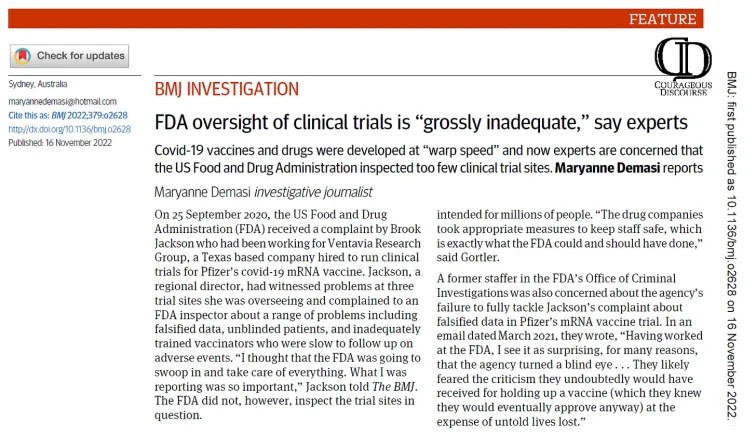
Demasi goes on to point out the FDA suspended inspections and despite having vast resources, does not utilize their discretionary budget to protect Americans from product safety threats. “With a total budget of $6.1bn in 2021, he [Gortler] suggests the agency needs to be leaner and more efficient, with employees interested in improving public health.” “The bottom line is that the FDA has over 18,000 full time employees, more than any other drug regulatory agency by far, so it could have retrained and retooled anybody to tackle the need for increased inspections,” he says. “Half of its budget, about $3bn, is discretionary, which means it could have hired contractors, retirees, or repurpose existing workers. It chose not to. The FDA was just yawning its way through the pandemic. The entire agency is broken.” “The lack of full transparency and data sharing does not allow physicians and other medical scientists to confirm the data independently and make comprehensive risk-benefit assessments,” continues Gortler, who is now a fellow at the Ethics and Public Policy Center thinktank in Washington DC.”
The most egregious example of FDA malfeasance is the intent to withhold release of the Pfizer regulatory dossier on its COVID-19 vaccine for 55 years knowing it contained reports of 1,223 deaths shortly after administration of their vaccine. In a continued set of historic blunders, the FDA approved the COVID-19 bivalent vaccines with no randomized trials powered for clinical outcomes with Omicron, and no information on safety. I believe Drs Demasi and Gortler are correct, the FDA is broken beyond repair, officials and staff involved in malfeasance should be named as targets in federal investigations since so many lives have been impacted by their malfeasance.
[i] Demasi M. FDA oversight of clinical trials is “grossly inadequate,” say experts BMJ 2022; 379 doi: https://doi.org/10.1136/bmj.o2628 (Published 16 November 2022) Cite this as: BMJ 2022;379:o2628
Swissmedic and Vaccinating Doctors Criminally Sued for Authorizing and Administering Covid-19 mRNA Jabs
Do not underestimate the Swiss diligence
By Andreas Oehler | Live To Fight Another Day | November 14, 2022
The detail-oriented Swiss are taking their medical establishment to task in a big way for authorizing and administering the Covid-19 mRNA jabs, in a formal criminal complaint.
“That is what the criminal complaint against Swissmedic is about” (SRF, 2022.11.14):
That’s what it’s all about: On July 14, 2022, a lawyer submitted a 300-page criminal complaint to the responsible cantonal public prosecutor’s office on behalf of six people allegedly injured by mRNA vaccinations. It is directed against three representatives of the Swiss licensing and supervisory authority for medicinal products and medical devices (Swissmedic) and five vaccinating doctors from the Inselspital in Bern. A criminal investigation is to be opened against them. The lawyer has now gone public with a media conference.
These are the plaintiffs: The lawyer for those affected, Philipp Kruse, is a declared opponent of vaccination and Covid measures. He represented people who refused to wear masks or parents who didn’t want their children to take part in pool tests. Doctors who were noticed as corona skeptics also appeared at the media conference.
This is what the indictment says: The defendants are accused of violating basic drug law due diligence by allowing and administering the Covid 19 vaccination. There are a number of other charges listed, including intentional or possibly negligent bodily harm, endangering life, killing and abortion.
These are the alleged damages: According to lawyer Kruse, the damages range from circular hair loss, derailment of the menstrual cycle to polyarthritis, muscle weakness and chronic exhaustion to the death of a 20-year-old person. Some of the six victims listed are still unable to work. The connection to the Covid 19 vaccination was confirmed by experts in five cases. In the case of the deceased, the causal connection must be proven on the basis of pathological examinations. However, these investigations are not yet complete.
What Swissmedic says: Nothing. Swissmedic does not want to comment on the ongoing court proceedings. The Federal Office of Public Health and the Federal Vaccination Commission also do not want to comment.
What may fly under the radar in other countries, in terms of the lack of accountability and responsibility for Covid-19 jabbing injuries, is unlikely to pass muster in Switzerland. The Swiss pride themselves on being OBJECTIVE, diligent, thorough and just. Because of these very high public expectations, it is impossible to sweep under the carpet, gaslight, or outright ignore the laws on the books over there, let’s hope:
It is about these articles of the Medicines Act
Art. 3 Duty of care 1 Anyone who handles medicinal products must take all the necessary measures based on the current state of science and technology to ensure that the health of humans and animals is not endangered.
Chapter 8: Penal Provisions Art. 86233 Crimes and misdemeanors 1 Anyone who willfully: a. manufactures, places on the market, uses, prescribes medicinal products without the necessary authorization or authorization, contrary to the terms and conditions associated with an authorization or authorization or contrary to the due diligence obligations stipulated in Articles 3, 7, 21, 22, 26, 29 and 42, imports, exports or trades abroad; (…).
Link to the Medicines Act .
Also of note here is that Swissmedic is the key conduit of the global vaccination programmes in partnership with Bill&Melinda Gates Foundation and WHO, and also FDA.
Good luck in court!
Pfizer to fast-track more vaccines for pregnant moms, despite mounting evidence rushed COVID shots harmed babies
The Defender | November 9, 2022
On Nov. 1, Pfizer issued a press release about an investigational vaccine for pregnant women the company said will protect babies from respiratory syncytial virus (RSV).
Not coincidentally, RSV is the latest viral bugaboo to hit the headlines, with frantic news accounts of “overwhelmed” hospitals sounding eerily reminiscent of the early coronavirus fear-mongering.
Buoyed by the successful global marketing of its COVID-19 jabs — an estimated 49% of pregnant women worldwide reportedly views the vaccines favorably and almost 1 in 4 pregnant women in the U.S. took them — Pfizer is hoping to hit another home run with the RSV vaccine.
The vaccine maker said it intends to seek U.S. Food and Drug Administration (FDA) approval by the end of the year.
The FDA, meanwhile, has been busy handing out “Breakthrough Therapy” designations to Pfizer as if they were papal dispensations, signaling a regulatory willingness to speed up approval not only for Pfizer’s RSV vaccine but also for a maternal Group B Streptococcus (GBS) vaccine the company is developing.
To this expedient end, the FDA allowed Pfizer to “stop the [RSV] study short,” halting enrollment at about 7,400 participants — though the trial was supposed to involve 10,000 pregnant women.
Researchers devoted to vaccine orthodoxy pay lip service to the need for an extra-high evidentiary bar for pregnancy vaccines — stating that such vaccines should not only prove they reduce illness, with minimal reactogenicity in the woman, the fetus and the neonate, but should also “demonstrate safety or lack of evidence of harm.”
However, those turn out to be empty words.
In fact, the influenza and Tdap (tetanus-diphtheria-acellular pertussis) vaccines that public health agencies have long recommended for pregnant women never underwent any clinical trial safety testing in that population, and the FDA never licensed those vaccines specifically for pregnant women.
Moreover, flu shots and Tdap shots have never even resulted in any statistically significant reduction in the outcomes they are supposed to address.
With the advent of Emergency Use Authorization COVID-19 vaccines, the FDA, Pfizer and other manufacturers barely made any pretense of assessing maternal safety, and likely “colluded together to conceal damaging data” about high rates of fetal death.
Other researchers, however — and even vaccine insiders — began to speak out in 2021.
For example, Canadian researchers writing in late 2021 worried that many of the systemic reactions commonly reported after COVID-19 vaccination might be “sufficient to affect fetal/neonatal development.”
Those authors included vaccinologist Byram Bridle, Ph.D., who earlier in 2021 characterized the COVID-19 vaccines’ disturbing biodistribution and accumulation in vital organs as “a big mistake,” and neurology professor Dr. Steven Pelech, who expressed repeated concerns about myocarditis and the vaccines’ risks to young people.
Now, as horrified pregnant women who took the COVID-19 jabs experience skyrocketing miscarriages, stillbirths and fetal malformations, they are wondering why regulators issued no warnings.
But as Pfizer’s exuberant RSV press release and the FDA’s complacent endorsement of clinical trial shortcuts suggest, vaccine makers and regulators not only intend to ignore or bulldoze even the most outsized safety signals but are clearly positioning themselves to go after pregnant women in an even bigger way.
‘Quibbles’ and questions
The details provided — or omitted — about Pfizer’s RSV clinical trial exemplify manufacturers’ and regulators’ cavalier approach toward pregnant women.
Commenting on Pfizer’s announcement, family physician Dr. Buzz Hollander — who clarified that he is predisposed to celebrate the new RSV vaccine offering — nonetheless noted a number of serious criticisms:
- Pfizer released “just a press release” but no data, making it “impossible to pick [the vaccine’s declared efficacy] apart.”
- Pfizer offered no explanation as to how it defined “severe” disease, its primary endpoint.
- A year into the trial, Pfizer fishily altered an important endpoint, defying a fundamental clinical trial design principle that “involves setting out in advance the endpoints that will be assessed.”
- In Hollander’s words, Pfizer “switched their secondary (critical!) endpoint of RSV hospitalizations to 360 days from 180 days… and then inspired my suspicion by not reporting any hospitalization data, interim or otherwise, in their breathless press release.”
- Researchers have published only one small safety study for the RSV shot, about which Hollander said: “I quibble with studies finding >40% of placebo participants reporting systemic symptoms; when queried enticingly enough, half of us might recall a headache or some fatigue the day after our placebo shot, and that can bury a difference in real adverse reactions compared to the vaccine group.”
- Curtailing study enrollment was unwise, Hollander said, because “bigger is better when it comes to … finding safety signals.”
- Earlier this year, GlaxoSmithKline (GSK) “stopped cold” a three-times-bigger trial of a similar RSV vaccine for pregnant women after detecting a safety signal, yet there has been no discussion as to why Pfizer’s maternal RSV vaccine is “fine” while GSK’s was deemed “untouchable.”
Hollander’s modest conclusion: “We should have all learned by now that even the appearance of cutting corners in the vaccine approval process will carry its own unknown costs.”
Readers reacting to Hollander’s post were less circumspect. One acerbically remarked, “The problem here is Pfizer. They’ve paid billions in fines for shady practices and data manipulation. And that was before the Covid vaccines (for which they’re indemnified).”
Another reader expressed his reservations even more succinctly: “Trust Pfizer numbers? You must be joking.”
Adverse pregnancy outcomes after COVID vaccination — no joke
As Pfizer, with the FDA’s help, tees itself up to “dominat[e] the maternal RSV vaccine market,” OB-GYNs on the front lines of maternal care are stepping forth to sound the alarm about the COVID-19 shots’ infanticidal fallout.
Dr. Kimberly Biss recently tweeted, “Since the vaccine rollout started, we have seen in our practice a decrease in new OB numbers, which would be infertility, by about 50%; we’ve also seen an increase in miscarriage rate by about 50%, and … probably about a 25% increase in abnormal pap smears as well as cervical malignancies.”
Similarly, Dr. James Thorp, in multiple interviews, described an “off-the-charts” rise in sudden fetal death and other adverse outcomes, including fetal malformation and fetal cardiac arrest.
Asked to comment on information recently leaked from a California hospital, Thorp characterized the uptick in fetal deaths — from under 6 per 1,000 in 2020 to more than 29 per 1,000 following the rollout of COVID-19 injections — as being “way way beyond” what the Centers for Disease Control and Prevention ordinarily would consider a safety signal.
Thorp published a preprint in September (along with co-authors who include Children’s Health Defense’s Megan Redshaw) describing “significantly more frequent” pregnancy-related adverse events reported to the Vaccine Adverse Event Reporting System, or VAERS, after COVID-19 shots than in the aftermath of flu shots — which themselves are far from benign.
Cataloging significant increases in “miscarriage, fetal chromosomal abnormalities, fetal malformation, fetal cystic hygroma, fetal cardiac disorders, fetal arrhythmia, fetal cardiac arrest, fetal vascular mal-perfusion, fetal growth abnormalities, fetal abnormal surveillance, fetal placental thrombosis, low amniotic fluid, and fetal death/stillbirth” and also menstrual abnormalities, Thorp and co-authors called for a “worldwide moratorium on the use of COVID-19 vaccines in pregnancy.”
For children who survive, Thorp suggested they may suffer from lifelong “vaccine-induced acquired immune deficiency syndrome.”
In Scotland, meanwhile, the government ordered an investigation into the “spike in newborn baby deaths” in 2021 and 2022, an increase “larger than expected from chance alone.”
Even in a gerrymandered study clearly designed to exonerate the COVID-19 shots during pregnancy — focusing on immediate reactions after a first or second dose and hampered by “limited perinatal outcome assessment” — researchers found that 4.4-7.5% of pregnant women reported obstetrical symptoms.
Careless and worse
As Substack writer Etana Hecht wrote last May, “The topic of pregnant and nursing moms getting vaccinated under encouragement and coercion is painful,” particularly once one becomes aware of “how carelessly the most precious among us are being treated.”
That carelessness is evident as we witness some of the same players involved in the COVID-19 vaccine fiasco now circling back around to help build the case for Pfizer’s RSV vaccine.
That includes figures such as Dr. Robert Frenck, the Pfizer-beholden principal investigator of the Cincinnati Children’s Hospital clinical trial that tested the company’s COVID-19 shot in children. Frenck reported 12-year-old Maddie de Garay’s serious vaccine injuries to the FDA as a mere “stomachache.”
Graphs clearly show that none of the vaccines pushed on pregnant women are safe for babies or moms — but given that from one-fourth to one-half of pregnant women acquiesce to getting them, those who know the truth need to work even harder to get the word out.
This article was originally published by The Defender — Children’s Health Defense’s News & Views Website under Creative Commons license CC BY-NC-ND 4.0. Please consider subscribing to The Defender or donating to Children’s Health Defense.
No balanced coverage of covid vaccines in legacy media, says Peter Doshi
By Maryanne Demasi, PhD | October 16, 2022
Peter Doshi, associate professor at the University of Maryland School of Pharmacy and senior editor at The BMJ, has spoken out about how the mainstream media has ignored important data on covid-19 vaccines.
In a recent interview with German TV, Doshi said, “Our legacy media has not done a good job in providing balanced coverage about the vaccines.”
He said there has been “a lot of nervousness” about how to communicate vaccine harms to people and is concerned that “we’re not getting the information we need to make better choices and to have a more informed understanding of risk and benefit.”
Doshi’s concerns extended to the over-confidence of public health authorities engaged in promoting the covid-19 vaccines.
“It was very unfortunate, that from the beginning, what was presented to us by public health officials was a picture of great certainty… but the reality was that there were extremely important unknowns,” said Doshi who has written and spoken about these unknowns, highlighting that even public health officials were aware of these limitations.
“We entered a situation where essentially the stakes became too high to later present that uncertainty to people.” He added, “I think that’s what set us off on the wrong foot. Public officials should have been a lot more forthright about the gaps in our knowledge.”
Doshi was part of an international group of eminent academic researchers and physicians who went back and re-analysed the safety data from the original randomised clinical trials that underpinned the FDA’s decision to authorise the mRNA vaccines in December 2020.
I reported on the pre-print study, but since then, it has been published in the peer-reviewed journal, Vaccine.
The authors focused on serious adverse events that occurred in the Moderna and Pfizer vaccine trials, events the sponsors classified as “serious” generally because they resulted in hospitalisation.
In short, their analysis showed that mRNA vaccines were associated with 1 additional serious adverse event for every 800 people vaccinated, which Doshi said is “much more common” than what we’ve traditionally observed for other vaccines where the adverse event rate is in the range of 1 to 2 per million vaccinees.
“Just to put that in some perspective, a rate like that in past years has had vaccines taken off the market. In 1976, we saw Guillain Barre Syndrome after influenza vaccines that were then withdrawn.”
The authors of the study also found the trial data showed that the increase in serious adverse events following mRNA vaccination surpassed the reduction in risk of ending up hospitalised with covid-19.
Despite public assurances that covid-19 vaccines would save lives and protect the community by preventing transmission, Doshi knew from the outset that it was never properly tested. In Oct 2020, Doshi published an article in The BMJ:
Hospital admissions and deaths from covid-19 are simply too uncommon in the population being studied for an effective vaccine to demonstrate statistically significant differences in a trial of 30 000 people. The same is true of its ability to save lives or prevent transmission: the trials are not designed to find out [emphasis added]
It was, therefore, unsurprising to Doshi that the vaccines failed to stop the spread.
“One of the big reasons is that it’s an intramuscular vaccine, and this doesn’t produce mucosal immunity. Infections of covid, influenza and other acute respiratory infections, start in the mucosal membranes, a place where these vaccines are not particularly good, historically, at producing immunity antibodies” said Doshi.
Doshi and his colleagues have called on public health authorities and drug manufacturers to release the raw data so that we can better understand who is most at risk of a serious adverse event.
“There’s no reason to think that these risks are going away and if it’s in the low-risk population, that’s very bad news, because low-risk people have much less to potentially gain from covid vaccines, so the side effect profile in such people has to be extremely low,” said Doshi, pointing out that Denmark now recommends against routine covid-19 vaccination for people under 50.
The FDA and the vaccine manufacturers have the raw ‘patient level’ data, but they have not released it and we’re now almost 2 years into the roll out of the product.
“They should immediately be warning people about this safety signal that we found, and they should immediately be replicating our analysis — the data are indicating there’s increased risk at a level that is much higher than has previously been realised,” said Doshi.
Throughout the pandemic, we’ve been told to “trust the science” but Doshi says, “How can one recommend responsibly that these products are based on science if the data are not available? Science is about sharing data. We’re in an era of open science, not secret science.”
Doshi and colleagues have penned an open letter to the CEOs of the vaccine companies asking for the raw data, but as yet, they have not received a reply.
See the full interview on mdr.de
Featured Video

Racist Seinfeld Dances for Joy as Bibi Unveils His New Map
or go to
Aletho News Archives – Video-Images
TV Drama Review
Japanese drama projects Japan’s wartime atrocities onto Chinese characters

Global Times | October 25, 2026
By portraying Chinese characters as perpetrators of ruthless violence while casting Japanese Self-Defense Forces (SDF) intelligence operatives as defenders, the season 2 of the Japanese drama Vivant has recently drawn criticism from Chinese netizens, who argue that its depiction turns historical reality on its head while ignoring Japan’s wartime atrocities.
The TBS drama series – a spy suspense story in which an alleged unofficial intelligence unit of the SDF operates across the globe — has attracted a passionate fanbase. Its currently airing season 2 opened with a household rating of 18.8 percent, the highest for a TV drama this year, according toa commentary article by Japanese media Toyo Keizai.
What draws attention is the portrayal of the enemies in the series, the article noted. Scenes in which the Chinese organization subjects kidnapped members of the SDF unit to brutal torture are repeated with unrelenting intensity.
It is rare for Japanese TV dramas to explicitly portray a real-life country as the enemy, the article noted.
Japanese Prime Minister Sanae Takaichi also made a reference to the drama, saying that she has been recording Vivant and hopes to binge-watch it over the year-end and New Year holidays, according to Japanese media outlets.
China’s CCTV News report on Sunday revealed that the drama features scenes in which Chinese personnel cut off the fingers of and stab Japanese intelligence operatives in the abdomen. Such acts bear striking similarities to the torture inflicted on Chinese nationals by invading Japanese troops during the World War II.
The drama distorts the truth by attributing these atrocities to modern Chinese characters. Beneath the surface, it subtly glorifies Japan’s cross-border overseas operations, blurs the functional boundaries of the SDF and implicitly promotes an expansionist narrative, per CCTV News. … continue
Blog Roll
 Aletho News
- EU facing trillion-euro debt hole while seeking more cash for Kiev
- How US, Europe, Persian Gulf states exhausted missile stockpiles, splurged billions to defend Israel
- Up in arms… Koreans reject U.S. empire’s plan to make South Korea the next Ukraine
- Iran, Turkey, Pakistan, Saudi Arabia could advance region-led security framework in Tehran: FM spox
- Netizens condemn Japanese drama for projecting Japan’s wartime atrocities onto Chinese characters
- Racist Seinfeld Dances for Joy as Bibi Unveils His New Map
- A West Bank War for Netanyahu’s Election Campaign, Could It Backfire?
- Yemen denounces European Parliament’s ‘hypocritical’ push to blacklist Ansarullah
- Qalibaf: UAE’s UN bid aims to ‘clear the runway’ for ‘Greater Israel’, whitewash genocide
- Pakistan reopens Iran border after boosting security: Report
- If Americans Knew
- An error has occurred; the feed is probably down. Try again later.
- No Tricks Zone
- Sudden Stratospheric Warming, Powerful El Niño Combination May Lead To Extreme Europe Cold, Energy Crisis!
- Two New Studies Find Thwaites Glacier Melt Cannot Be Driven By Human Activity Or A Warming Ocean
- E-Cars Reduce CO2 Emissions By Only 41% Compared To Internal Combustion Engine Vehicles
- Predictions Made By Renowned Climate Professor Over Past Decades Have Been Proven To Be Poor
- New Study Suggests Large Regions Of The Pacific Ocean Have Been Cooling For The Last 80 Years
- Germany’s Green Energy Debacle: High Energy Costs Force Kahla Porzellan to Close After 182 Years!
- New Study: 50 Years Of The Most Aggressive ‘Net Zero’ Policies Can Only Affect The Global Climate By 0.03°C
- US September “Heat” Was No Record…Many Records Set Decades Ago
- Latest European Green Energy Debacle; Portugal’s Largest Flagship Solar Park Insolvent!
- Green Energy Debacle: German Expert Professor Fritz Vahrenholt Warns Of Severe Economic And Social Consequences

