Gazans shiver in ruined homes, tents after brutal storm
Al-Akhbar | January 8, 2015
Gazans who survived a brutal summer war are now struggling with the worst storm of the winter, as freezing rain and gale-force winds battered the besieged Gaza Strip on Thursday.
At least ten Palestinians were injured in the Gaza Strip after a winter storm, dubbed “Huda,” hit the embattled coastal enclave, Gaza’s civil defense department said.
More than 96,000 homes were destroyed or damaged during the latest Israeli assault on Gaza, which killed more than 2,300 Palestinians during 50 days in July and August.
Gazans are now living by candlelight and wood fire because of electricity shortages, and rely on sandbags to stop their ruined homes from flooding. Some Gazans have sought shelter in the Sheikh Shaaban cemetery outside Gaza City, living in makeshift hut and tents.
Wael al-Sheikh, 37, lost his home last summer during an Israeli airstrike and now lives with his two sons in a tent pitched among the ruins. But with no access to electricity, it is impossible to fend off the cold.
Fearing that the winds of 80 kilometers per hour would simply blow their makeshift home away, they have sought refuge with relatives.
Imad Mutlaq’s home was also largely destroyed in the war, leaving the wind whistling through the cracks in the walls.
“We have no electricity or heating,” he said, describing the first night of the storm as “difficult.”
Thirty-year-old Mohammed Ziyad, a father of two young sets of twins, is trying to put on a brave face.
During a previous storm, the ground floor of the building where they live flooded, but this time he said the family was well prepared.
“We have stocked up on milk and nappies in case we find ourselves stuck indoors,” he said.
With or without a proper roof over their heads, everyone is facing the same problem: the chronic electricity shortages which has plagued the tiny, impoverished strip that is home to 1.8 million people.
Gaza’s sole power station, which was damaged during the war, is struggling with a severe lack of fuel and is only able to supply the enclave with six hours of power per day.
Raed al-Dahshan, head of Gaza’s civil defense, said his staff were facing “a difficult situation which was compounded by a lack of infrastructure” to help those suffering from the storm.
Gaza is also prone to severe flooding, exacerbated by a chronic lack of fuel that limits how much water can be pumped out of flood-stricken areas. The fuel shortages are a result of the eight-year-old Israeli blockade, which limits the import of other kinds of machinery related to pumping and sewage management that could help Gazans combat the floods. The most recent war has exacerbated the crisis.
In early November, flooding from days of torrential rains forced hundreds of Gaza City residents to flee their homes, as a massive week long storm flooded the city’s streets and homes with water and sewage.
Dispute over reconstruction funds
The Hamas resistance movement on Tuesday accused the Palestinian Authority(PA) of interfering with money earmarked for the reconstruction of the Gaza Strip.
In a statement, Hamas spokesman Sami Abu Zuhri said some ministers of the Palestinian national consensus government “admitted that the money allocated for Gaza reconstruction was being added to the PA budget.”
This confession, he said, “proves that the real reason behind the delay in reconstruction of Gaza is that the PA has been messing with the reconstruction money and exploiting the suffering of Gaza’s people.”
For 51 days this summer, Israel pounded the Gaza Strip – by air, land and sea – with the stated aim of ending rocket fire from the coastal enclave.
More than 2,310 Gazans, 70 percent of them civilians, were killed and 10,626 injured during unrelenting Israeli attacks on the besieged strip.
According to the UN, the Israeli military killed at least 495 Palestinian children in Gaza during “Operation Protective Edge.” The al-Mezan Center for Human Rights puts the number at 518, while the Palestinian Center for Human Rights puts it at 519. All three figures exceed the total number of Israelis, both civilians and soldiers, killed by Palestinians in the last decade.
The Palestinian Ministry of Health reported that 3,106 Palestinian children were injured in the war. The UN estimates that 1,000 children will suffer a permanent disability as a result of their injury.
Moreover, the UN said as many as 1,500 children have been orphaned by Israeli attacks that killed their parents, while 6,000 children will have a parent with a lifelong disability.
In addition, 145 Palestinian families had three or more members killed in a single Israeli attack, for a total of 735 lives lost.
The assault ended with an Egypt-brokered ceasefire agreement that called for reopening Gaza’s border crossings with Israel, which, if implemented, would effectively end the latter’s years-long blockade of the embattled territory.
However, Israel had repeatedly blocked the entry of building material, prompting the UN in September to broker another deal. The reconstruction of Gaza has yet to begin.
The Palestinian Authority has estimated that the rebuilding Gaza will cost $7.8 billion.
UN chief Ban Ki-moon said during a visit to the Gaza Strip in October that the devastation he had seen was “beyond description” and “far worse” than that caused in the previous Israel-Gaza conflict of winter 2008-2009.
According to the UN, over 106,000 of Gaza’s 1.8 million residents have been displaced to UN shelters and host families.
(AFP, Anadolu, Al-Akhbar)
Sexual Violence, Women’s Bodies, and Israeli Settler Colonialism

By Nadera Shalhoub-Kevorkian, Sarah Ihmoud and Suhad Dahir-Nashif | Jadaliyya | November 17, 2014
They not only invaded our home, took over our space, and evicted us—they even arrested me and took me to the Maskubya—the police station. I was put in room number four, alone, for a long time. Then, a big and tall man, a police officer, entered the interrogation room. I was alone, and started shivering from fear as he closed the door, started moving things around in the room and examining me from head to toe. I was terrorized, and my heart was beating so fast. His eyes penetrated my body, as he was opening the drawers looking for something. Then, he left the room and came back five minutes later holding a box. He pulled out a pair of blue plastic gloves, and put one on each of his hands, while looking at me and saying “…Come here…” I must tell you that I was terrorized when they invaded the house and evicted us. I was extremely anxious when they arrested my son. But my fears of ‘you know what’… You know… being abused… being raped by his blue big hands and more…were the most terrifying moments of my life.[1]
These were the words of Sama, a thirty-six-year-old Palestinian woman who lost the intimate familial and physical space of her home, only to experience further terror with the threat of sexual abuse. Sama’s narrative is not uncommon, as colonized women living under severe deprivation and dispossession are subject to daily attacks against their sexuality and bodily rights. Sexual violence is central to the larger structure of colonial power, its racialized machinery of domination, and its logic of elimination. This is readily apparent in the history of settler colonial contexts, where the machinery of violence explicitly targets native women’s sexuality and bodily safety as biologized “internal enemies” since they are the producers of the next generation.
Settler colonialism, as a “structure, not an event” operates through a “logic of elimination” that seeks to erase indigenous presence on a specific territory (settler colonialism’s “irreducible element”). Settler colonialism “destroys in order to replace.” The invasion of indigenous land seeks to permanently erase the indigenous presence on the land, in order to replace it with the new settler society and polity. Scholars have argued that settler colonialism’s logic of elimination may culminate in indigenous genocide. In its European formations, both settler colonialism and genocide have “employed the organizing grammar of race.” Since its inception, the Jewish state has been embedded in a racialized colonial logic. This logic constructs the Palestinian as a dangerous other in opposition to the white/Jewish subject and polis. As numerous authors have noted, this racial configuration is articulated through early Zionist thinkers’ Orientalist ideology that framed the Jewish people as bearers of European civilization in the face of a culturally backward region and people. Such a “modernizing” project or “civilizing” mission relied on a Zionist imaginary of exclusively Jewish labor cultivating an empty, uncultivated land, and “making the desert bloom.” Early Zionist leadership attempted to actualize the foundational Zionist myth of a “land without people for a people without land” through systematic ethnic cleansing of indigenous Palestinians in 1948. The Zionist entity continues to evict native Palestinians today. The massacres in Gaza of July- August 2014, and the repressive “iron fist” policies targeting Palestinian Jerusalemites at the time we write this article, are contemporary modes of settler colonial eviction of the Palestinian native.
The targeting of Palestinian women’s bodies and sexuality, we contend, is structural to the Israeli settler colonial project’s racialized logic of elimination. Rape and other forms of sexual violence against Palestinian women have always been an element of the settler colonial state’s attempts to destroy and eliminate indigenous Palestinians from their land. In addition to rape and other forms of sexual violence, the racialized logic of sexual violence energizes the very imaginary and project of conquering and cultivating Palestinian land, in transforming it into the Jewish polis. Hence, our discussion of sexual violence is embedded not only in the sexualized practices and politics of the Zionist state, but also in the nature of Israeli settler colonial violence itself.
As Palestinian feminists, we assert that the Zionist movement’s imaginary of conquering and settling the Palestinian body is inseparable from the project of conquering and settling Palestinian land, and erasing indigenous presence. Here, we build on native scholar Andrea Smith’s assertion that the logic of colonial sexual violence “establishes the ideology that Native bodies are inherently violable—and by extension, that Native lands are also inherently violable.” It is the logic of settler colonial sexual violence that we center in our analysis of the continuous Nakba that targets our people. We trace the logic of sexual violence, in its historical and present context, as machinery, hidden and apparent, of colonial patriarchy against indigenous communities in Palestine. The logic of sexual violence attempts to fragment Palestinian family and communal life, as it severs the connection to the Palestinian homeland. The Zionist project is inherently based on the destruction of Palestinian native bodies and land, which cannot be separated from the colonial logic of elimination. Sexual violence is not simply a byproduct of colonialism, rather “colonialism is itself structured by the logic of sexual violence.”
Sexual Violence and Palestinian Genocide Since the Nakba
Understanding the intensified attacks on Palestinian women’s bodies in times of heightened attacks by the settler colonial regime requires a feminist analysis. Such an analysis takes the Nakba as its analytical point of departure. Israel was built on the ruins of the Palestinian homeland, on its land, pain, and displacement. It was built on the destruction of our communal social ties, the violation and invasion of our homes and bodies.
Rape and killing of Palestinian women was a central aspect of Israeli troops’ systematic massacres and evictions during the destruction of Palestinian villages in 1948. During the Deir Yassin massacre, for instance:
All the inhabitants were ordered into the village square. Here, they were lined up against a wall and shot. One eyewitness said her sister, who was nine months pregnant, was shot in the back of the neck. Her assailants then cut open her stomach with a butcher’s knife and extracted the unborn baby. When an Arab woman tried to take the baby, she was shot… Women were raped before the eyes of their children before being murdered and dumped down the well.
David Ben Gurion, like other Zionist leaders, openly discussed the rape and sexual torture of Palestinian women in his diary entries during 1948. At the same time that he advocated the killing of Palestinian women and children, constructing them as a threat to the Jewish settler polity, he awarded a prize to every Jewish mother on her tenth child. Ben Gurion ensured that the Jewish Agency, not the state, administered such pronatal incentives in order to guarantee the exclusion of Arabs.[2] The fetishization of fertility has made Palestinians, especially women, targets of nationalist rhetoric that deeply politicizes their reproduction. For Zionists, Palestinian women have always been, and continue to be, as we have seen in the latest attacks on Gaza, targets of the Zionist killing machine.
Feminist scholars have also suggested that the Zionist state mobilizes violence against Palestinian women’s bodies and sexuality to strengthen indigenous patriarchal structures and aid in the eviction of Palestinians from their land. Militarized sexual abuse has been rampant under Israeli occupation. The Israeli state and military forces have exploited the threat of sexual violence against Palestinian women, and patriarchal perceptions of sexuality and “honor” to “recruit Palestinians as collaborators” during periods of uprisings and deter attempts at organized resistance. This practice has been so historically prevalent that it gained its own term in the Arabic language as isqat siyassy, meaning the sexual abuse of Palestinians for political reasons. The state’s security apparatus continues to use Palestinians’ sexual identities and Orientalist conceptions of “Arab culture” to recruit collaborators and fragment Palestinian society. Recent revelations by Israel’s secret military intelligence Unit 8200 have revisited this fact. The literal and figurative “rape” of Palestinian women’s bodies, framed as inherently violable by the Zionist entity, is inherently structured by the same logic of sexual violence that energizes the settler colonial project’s violation and continued confiscation of Palestinian natives’ land.
Unmasking the Logic of Sexual Violence
The silence on the Zionist machinery’s use of sexual violence against Palestinian women[3] and their communities has been further revealed since the inception of the state’s most recent military operations. The logic of sexualized violence that structures the Israeli settler colonial project has become more visible during the last period of military invasion. Slogans such as “Death to Arabs” and “Arabs out” have become more usable and tolerable in the Israeli public sphere, exposing the necropolitical drive against Palestinian natives at the core of the so-called Jewish democracy.
On 1 July, just after discovery of the bodies of three Jewish settler youth who had gone missing in the occupied West Bank, Israeli professor Mordechai Kedar of the Begin-Sadat Center for Strategic Studies remarked on public radio: “the only deterrent for … those who kidnapped the [Israeli] children and killed them, the only way to deter them is their knowledge that either their sister or their mother will be raped if they are caught … this is the culture of the Middle East.” His comments suggested that raping Palestinian women was the only deterrent to Palestinian resistance and “terrorism.”
We as Palestinian feminists were not surprised to hear Kedar advocating rape as an antidote to anti-colonial resistance. Making such comments on public radio, in the open, where it would be heard by a wide Israeli Jewish public, women as well as men, including Israeli Jewish feminists, reflects the settler’s mentality and socialization towards Palestinians. Discussing the rape of Palestinian women as a military strategy by a so-called scholar from one of the prominent universities in Israel reveals the mode in which colonizers portray colonized women. The presentation of a sexualized Orientalist discourse positions Palestinians as culturally “backward,” non-human Others.
Lest the sexualized discourses Kedar mobilized appear an aberration, it is important to note that he was not the only performer in this latest theater of sexualized violence. Israeli soldiers on their way to killing Palestinians in Gaza read slogans of support prepared by their fellow Jewish-Israeli civilians stating: “Go pound their mothers, and come back to your mother.” Israeli Jews gathered on hillsides to watch and cheer as the military dropped bombs on Gaza. One young Jewish woman’s Facebook post summed up the sexualized pleasure they received in spectatorship of our collective lynching: “What an orgasm to see the Israeli Defense Forces bomb buildings in Gaza with children and families at the same time. Boom boom.” Even their Prime Minister Netanyahu received a post, which circulated widely among the Israeli public via social media, showing a veiled woman labeled “Gaza,” naked from the waist down, holding a message: “Bibi, finish inside this time! Signed, citizens in favor of a ground assault.” This is in addition to Knesset member Ayelet Shaked’s public declaration that Palestinian mothers should be killed.
The rape of the land as the rape of women’s bodies has thus come to the fore in Israel’s most recent eliminatory attacks against the Palestinian people. As the massacres of the Palestinian people in Gaza continued, the sexualized nature of Israeli invasion and racial terror against Palestinian natives came to the forefront of nationalist politics and discussion among the public sphere within 1948 Palestine as well. Palestinian women took to the streets with their communities throughout historic Palestine to demonstrate against the continuous massacres in Gaza. Public demonstrations took a sexualized turn, as crowds’ calls for “death to Arabs” quickly turned to chanting “Haneen Zoabi is a whore!” naming a female Palestinian member of the Israeli parliament who stood up for her people’s right to life. Israeli police attacked Palestinian women’s bodies, along with their male counterparts, and dragged them out of protests in Haifa and Nazareth, where they were arrested or beaten by racist crowds. Leading religious and military figures on the state’s payroll issued religious edicts which stated that during times of war it is permissible to bomb Palestinian civilians in order to “exterminate the enemy.” The city council of Or Yehuda, a settlement in Israel’s coastal region, hung a banner supporting Israeli soldiers that suggested the rape of Palestinian women: “Israeli soldiers, the residents of Or Yehuda are with you! Pound their mother and come back home safely to your mother.” [4]
We argue that the logic of sexual violence exhibited during attacks on indigenous Palestinians throughout historic Palestine, both historically and during the Israeli state’s most recent attacks, pervades both the Israeli settler state and settler society. Indeed, the state and settler society are inseparable entities, connected through a visceral psychological and political imaginary that exceeds the commonly framed state/civil society divide. As Lorenzo Veracini notes, settlers “carry their sovereignty with them.” Both the state apparatuses (including public elected officials, academic and military institutions) and settler society (including Israeli publics—situated along the continuum of Zionist ideology) embody the machinery of settler colonial violence. It is no surprise then, that both the official state apparatuses and unofficial settler spheres have exhibited grave attacks on Palestinian women’s sexuality, bodies, and lives in the context of the latest invasions of our people in Gaza, in the daily attacks today in Jerusalem, and throughout historic Palestine.
Israeli officials’ repressive policies and incitement against the Palestinian people work to empower and embolden Israeli settler society to embody the power of the state and viciously attack Palestinians. This is clearly exhibited in the attacks on Palestinian women’s bodies inside Al Aqsa mosque these last weeks in Jerusalem, by both settler publics empowered by the state’s military protection, and members of the state security forces. A recent example of the daily scene of sexual violence is Israeli border police’s violent beating and arrest of Aida, a Palestinian woman from the old city of Jerusalem. When she tried to enter Al-Aqsa mosque, border police attacked and brutally beat Aida. They tore off her hijab and pulled her by her hair, as they continued to beat her through the streets of the old city, and dragged her into the police car. She was then taken to the police station, where she was violently interrogated, further beaten and accused of attacking a police officer. Security forces’ brutalization and violation of Aida’s body, and attempts to mark her as an inherently criminal other, are a form of gendered and sexual violence. The legalization of such forms of violence marks the Israeli legal system itself as deeply embedded in the settler colonial project’s machinery of elimination.
Palestinian women’s brutalization and violation by the settler colonial state also takes on more mundane forms. When Samera was arrested for participating in a demonstration in occupied East Jerusalem, her release by authorities was conditional upon her completing what they termed “community service.” Samera’s “community service” required her to scrub the bathrooms of a facility for Israeli border police and soldiers. As she explained to us:
I could not afford to pay the huge fine, and needed to be released [from prison] to go back to my kids. I had no other choice but to scrub their bathrooms…. Just by being there, in men’s bathrooms, in the Israeli men’s toilets felt like rape. I did it to avoid payment, but I can’t avoid feeling that I allowed them to keep me there, in their bathrooms, in a constant state of terror, fearing being sexually abused, then trashed like we trash toilet paper in toilets.
Samera’s words and analysis further illustrate the gendered and sexualized aspects of the complex machinery of settler colonial violence. Yet as Samera concluded: “Sometimes I feel I was their slave, but some other times I tell myself no, this is resistance, this is sumud, this is power… I did what was needed to come back to my children, without being touched or violated sexually…. yes hard, complex… our situation is complex.” Even in the face of such violent inscription of settler colonial violence, Palestinian women’s daily acts of resistance and survival demonstrate their power and sumud, or steadfastness.
In sum, sexual and gender violence are not merely a tool of patriarchal control, the byproduct of war or intensified conflict. Colonial relationships are themselves gendered and sexualized. We contend that sexual violence, a logic embedded in the Israeli settler colonial project, follows two contradictory principles that operate simultaneously: invasion/violation/occupation and supremacy/purification/demarcation. That is, the Zionist settler colonial project’s invasion, violation, and occupation of indigenous Palestinians’ bodies, lives, and land is intimately intertwined with its demarcation of racialized geographical and physical boundaries between Jewish citizenry and Palestinian natives as well as attempts to “purify” the Jewish national body of the Palestinian body, which is framed as a biopolitical contaminant. It is thus that the logic of sexual violence, embedded in the Zionist regime, energizes historical and continuous attacks on Palestinian bodies and lives.
Thus our struggle for indigenous sovereignty within anti-colonial activism as feminists is necessarily situated in the protection of Palestinian women’s bodily safety and sexuality, family, and communal right to life. It is a struggle against the hypermasculine Zionist military and settler apparatuses that frame Palestinian women as inherently threatening racialized Others whose bodies must be violated and destroyed as the internal enemy and “reproducers of Palestinians.” This logic is inseparable from the settler colonial logic of elimination.
As Palestinian feminists concerned about the safety of women’s bodies and lives, the continuity of our people and our future generations, we call on local and international feminists to join our struggle, challenge the settler colonial culture of impunity and raise their voices against the ongoing Israeli state crimes.
Endnotes
[1] This quote was taken from a group discussion with Palestinian women in Jerusalem, 2014.
[2] In the 1950s Ben Gurion, as the first prime minister of Israel, turned the issue of women’s fertility into national priority, arguing that “increasing the Jewish birthrate is a vital need for the existence of Israel” and that “a Jewish woman who does not bring at least four children into the world is defrauding the Jewish mission.” See Sharoni, S. (1995). Gender and the Israeli-Palestinian Conflict: the Politics of Women’s Resistance. Syracuse University Press. Also see Davis, U. & Lehn, W. (1983). “And the Fund Still Lives: The Role of the Jewish International Fund in the Determination of Israel’s Land Policies”, Journal of Palestine Studies, Vol. 7 (4), p.3, at pp.4-6(1978).
[3] While centering our analysis on Palestinian women, we also note the Zionist state’s use of sexual violence as a tactic to curb the “demographic threat” over some Jewish women’s bodies, including black women (from the Ethiopian community) and women from impoverished backgrounds. While attempting to curb the birth rates of black and/or poor Jewish women, a practice we analyze as connected to the racialized project of curbing Palestinian reproduction and life, Israel has simultaneously sought to increase European Jewish birth through modernized practices such as buying ovum for human reproductive cloning from poor, Eastern European women. Besides, the Israeli state suggested that the law for preventing human reproductive cloning (1999) had expired and many of Israel’s physicians, politicians and social researchers are embracing this practice as yet another strategy for maintaining a Jewish demographic advantage on the land of Palestine.
[4] In addition to the posts and declarations against Palestinian mothers, Jewish girls and women encouraged men serving in the Israeli Occupation Forces by sending them semi-nude or pornographic pictures as an expression of love and support (see http://www.pitria.com/israeli-girls-support-zahal).
BDS National Committee condemns Gaza orphans trip to Israel
MEMO | January 2, 2015
The Palestinian Boycott, Divestment and Sanctions National Committee condemned a planned trip organised for 37 Palestinian orphans, who lost their parents during the recent Israeli aggression on the Gaza Strip, to Israel.
In a statement, the committee said the “suspicious trip” included visits to several Israeli settlements around Gaza and described it as nothing but a failed public relations stunt aimed at covering up Israel’s crimes against the Palestinian people. The trip was cancelled after Hamas stopped the orphans from leaving the Strip.
The visit was organised by Yoel Marshak of the Kibbutz Movement, a versed Zionist organisation which has long been involved in the ethnic cleansing of the Palestinian people and uprooting them from their land, the statement said.
The committee condemned Candle for Peace and Brotherhood, a Palestinian organisation believed to have ties to the right-wing Likud Party.
The statement concluded by calling to stop all normalisation of formal and informal ties with Israel and to support the Palestinian people in the besieged Gaza Strip and the West Bank, including Jerusalem, the Negev and Galilee as well as inside Israel.
86 Israeli Attacks on Islamic and Christian Holy Sites in 2014
IMEMC News & Agencies | January 2, 2015
Al Aqsa Association for Waqf and Heritage has reported that Israelis carried out some 86 assaults and violations of Islamic and Christian Palestinian holy sites in the occupied West Bank and Jerusalem in 2014.
In a report published Wednesday, the association stated that about 30 cases of assault on mosques, 21 cases of assault on graveyards, six cases of attacks on Christian holy sites, and other sporadic attacks, including preventing the call for prayer in Hebron’s Ibrahimi Mosque hundreds of times — amounting to dozens a month — were documented.
To the previous list, the association added the complete destruction of 73 mosques, the partial vandalism of 197 mosques, and damage of one church during this past summer’s war on Gaza.
Al-Aqsa Association recorded five cases of burning mosques or parts of them, including the burning of Ali bin Abi Talib mosque in the village of Deir Estia, in Salfit, spraying of racist slogans on a shrine in Anata town near Jerusalem, Abu Bakr mosqe in Umm al-Fahm, and Abu Bakr mosque in the town of Aqraba, south of Nablus, and the Great Western mosque al-Mughayir village in Ramallah.
Other incidents were recorded such as the attacks on two mosques and Islamic shrines with racist writings and Talmudic words. The report also documented the demolishing of five mosques in Nablus, Jerusalem and Naqab.
Meanwhile, six cases of assault on Christian holy sites were also recorded by the association. In April, “price tag” groups vandalized a monastery in Rafat, to the west of Jerusalem, while an extremist Israeli threatened a priest in Nazareth. Another incident happened in the same month, when price tag groups sprayed racist comments near the Roman church in Jerusalem.
In May, Israeli extremists sprayed offensive comments about Jesus Christ near a church in Beersheba. Meanwhile, other Israelis wrote offensive comments about the prophet Mohammad and Jesus, an incident which coincided with the Holy See’s visit to Palestine.
The report also recorded 18 attacks against mosques in Hebron and Bethlehem, while other attacks which were documented targeted Muslim’s graveyards, such as smashing gravestones, stealing monuments, spraying racist comments, confiscating yards and selling the land to build commercial malls.
According to the report, in 2014, Israeli forces and settler efforts increased to take control over Waqf land to turn it into Jewish shrines; among these attempts were putting up fake gravestones and raiding the sites.
As for the Ibrahimi Mosque, which is targeted on daily basis, the call for prayer was prevented more than 250 times under the pretext that it annoys Israeli settlers. The violations include preventing worshipers from entering the mosque to pray.
In the Gaza Strip, the Ministry of Waqf and Religious Affairs said the Israeli army destroyed 73 mosques completely, 197 partially, and one church partially. It added that six Zakat offices were completely damaged, a waqf school was bombarded and 11 graveyards were destroyed.
PLO: Israel has detained 1266 Palestinian children in 2014
Al-Akhbar | December 30, 2014
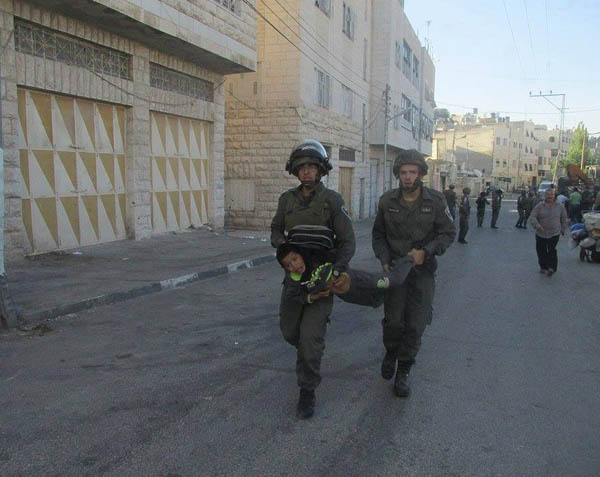
Israeli forces detained over 1,000 Palestinian children in the occupied West Bank and annexed Jerusalem in 2014, the Palestine Liberation Organization (PLO) said Tuesday.
Abdul-Nasser Farawna, head of Authority of Prisoners’ Affairs, a PLO body, said that Israel detained 1,266 Palestinian children, below the age of 15, in the West Bank and Jerusalem in 2014.
“The vast majority of the arrests happened in the second half of the year,” Farawna said in a statement, adding that at least 200 children are still detained in Israeli jails on various charges.
Israeli forces routinely conduct arrest campaigns targeting Palestinians in the occupied West Bank and annexed Jerusalem on claims they are “wanted” by Israeli authorities.
According to the PLO, more than 10,000 Palestinian minors in the occupied West Bank and annexed Jerusalem have been held by the Israeli army for varying periods since 2000.
“The number of Palestinian children arrested by Israeli forces, especially in annexed East Jerusalem, has sharply risen,” Farawna declared, saying that the number of children detainees had increased by 87 percent over the past three years.
“The majority of the detained children were subjected to beatings and torture by Israeli security personnel while in detention,” he asserted.
Farawna’s statements echoed similar comments last month by another PLO official, Issa Qaraqe, who said that around 95 percent of children detainees were subjected to beatings and torture by Israeli security personnel while in detention, while many were forced to make confessions under duress and undergo unfair trials.
Violent practices by Israeli soldiers as well as settlers against Palestinian children is endemic and often abetted by the authorities.
“Israel does not provide any immunity for children and regularly violates international agreements on children’s rights by humiliating and torturing them and denying them fair trials,” Qaraqe explained.
A report by Defense for Children International (DCI) published in May 2014 revealed that Israel jails 20 percent of Palestinian children it detains in solitary confinement.
DCI said that minors held in solitary confinement spent an average of 10 days in isolation. The longest period of confinement documented in a single case was 29 days in 2012, and 28 days in 2013.
A report by The Euro-Mid Observer for Human Rights Israeli forces arrested nearly 3,000 Palestinian children from the beginning of 2010 to mid-2014, the majority of them between the ages of 12 and 15 years old.
The report also documented dozens of video recorded testimonies of children arrested during the first months of 2014, pointing out that 75 percent of the detained children are subjected to physical torture and 25 percent faced military trials.
The most excruciating violations are seen in the psycho-physical torture methods, including the act of forcing children to sit on the investigation chair chained hand and foot and covering their entire heads with foul-smelling bags, in addition to depriving them of sleep.
In 2013, the UN children’s fund (UNICEF) reported that Israel was the only country in the world where children were “systematically tried” in military courts and gave evidence of practices it said were “cruel, inhuman and degrading treatment or punishment.”
The UNICEF report said in a 22-page report that over the past decade, Israeli forces have arrested, interrogated and prosecuted around 7,000 children between 12 and 17, mostly boys, noting the rate was equivalent to “an average of two children each day.”
Palestinian children as young as five years old have also been detained in the past.
In 2013, Israeli forces in the West Bank detained four Palestinian children aged five to nine years.
Palestinian activist Murad Ashtiye told AFP at the time that “Israeli soldiers arrest the children and tie their hands behind their backs using plastic strips.”
Meanwhile in Gaza, a 51-day Israeli aggression last August left at least 505 children dead, 20 percent of the total civilian death toll.
The UN agency for Palestinian refugees UNRWA said 138 of its students were killed during the assault. The organization’s spokesperson Christopher Gunness said an additional 814 UNRWA students were injured and 560 have become orphans due to the Israeli onslaught.
The worst massacre took place in the Abu Hussein School of the Jabaliya refugee camp in the north killing and injuring dozens even after the agency said that it gave the school’s coordinates to the Israelis more than 17 times so they won’t hit it.
(Anadolu, Al-Akhbar)
Palestinians stress their right to respond to Israeli escalation
MEMO | December 26, 2014
All Palestinian factions hold Israel responsible for the latest escalation in Gaza and regard it as a violation of the Egypt-brokered ceasefire agreement. The groups met on Thursday to discuss the latest Israeli aggression against the enclave, which led to the killing of Tayseer Al-Semari, a member of the military wing of Hamas.
Speaking on behalf of all factions, Shaikh Khaled Al-Batsh, a senior official of Islamic Jihad, said that they reject the notion that Palestinian blood is a price to be paid by electioneering Israeli politicians. “We will not stand idle in front of this repeated escalation so that Netanyahu can be re-elected,” he stressed.
Al-Batsh called on Egypt to resume talks with Israel and put pressure on the Israeli government to stop its latest aggression. He also urged the international community to assume its responsibilities and stop Israel’s repeated attacks on the Gaza Strip in particular and the Palestinian people in general. The blockade should be lifted, the crossings opened and reconstruction materials allowed in, he insisted.
The Islamic Jihad official added that the Palestinian unity government must also assume its responsibility for the reconstruction of the Gaza Strip.
Haniyeh says Hamas committed to ceasefire as long as Israel is
Ma’an – December 26, 2014
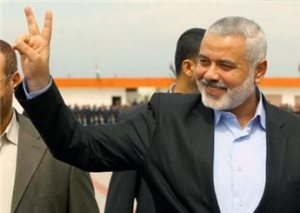 GAZA CITY – Deputy head of the Hamas political bureau Ismail Haniyeh said on Friday that the group is committed to the ceasefire with Israel but called for international attention to ensure Israel abide by its terms.
“We are committed to what was agreed on in Cairo as long as the occupation is,” he said in a statement to the press.
He said that Hamas was contacting Egypt and other outside parties to ensure Israel uphold its side of the bargain, which includes a partial lifting of the seven-year-old siege of Gaza that has not come to pass.
Haniyeh also called on Egypt to permanently open the Rafah crossing, assuring the country’s authorities that “the security and stability of Egypt is our priority.”
Egypt has closed Rafah, the principal connection between Gaza and the outside world due to the Israeli siege, for the majority of the past two months, only opening it for a few days at a time for limited passage.
Egyptian authorities blame Hamas for supporting the Egyptian Muslim Brotherhood and anti-government militants in the Sinai Peninsula, charges Hamas strenuously denies.
US Congress Passes Bill Increasing Weapons in Israel by $200 Million
By Ken Klippenstein and Paul Gottinger | Reader Supported News | December 17, 2014
The US Senate has unanimously passed a bill supplying Israel with military equipment that would enable it to execute an air strike on Iran. The bill, titled the US-Israel Strategic Partnership Act, includes the sale of advanced aerial refueling tankers, which refuel fighter jets in midflight – necessary for Israeli fighter jets to reach targets in Iran. This is particularly noteworthy since the Bush administration had refused to provide Israel with refueling tankers.
The sale of the refueling tankers follows a 2013 arms sale to Israel that included V-22 Ospreys. Kenneth Pollack of the Brookings Institution stated shortly after the sale that Ospreys are “the ideal platform for sending Israeli special forces into Iran.”
The bill, which was also passed in the House earlier this year, expands the US weapons stockpile in Israel by a value of $200 million, to a total of $1.8 billion. Israel used weapons from this stockpile during its most recent military operation against Gaza, “Operation Protective Edge.” Israel also used the stockpile during its 2006 invasion of Lebanon.
The bill has generated concern among experts. Mike Coogan, legislative coordinator at US Campaign to End the Israeli Occupation, told us that the air refueling capabilities, expanded satellite cooperation, and access to US satellite data that the bill would grant Israel “sounds quite dangerous.”
“It sounds like a formula for attacking Iran.”
The bill may also be in violation of the Leahy Law, which prohibits US weapons exports to military units responsible for consistent human rights violations. Israel’s most recent major military offensive, “Protective Edge,” would seem to have violated elementary human rights. […]
Coogan was also critical of the expanded access to weapons stockpiles that the bill would afford Israel. He said, “it’s morally, financially, and legally problematic to continue to give Israel access to the weapons stockpiles, particularly in light of how they used them in their war on Gaza this summer.”
“It looked like, for a time, the Obama admin actually suspended a shipment of weapons to Israel – specifically, hellfire missiles – but then apparently started to resend those. But the thought behind the original suspension was that Israel was using it in violation of international law and US law.”
“I think it was shown by numerous human rights organizations that Israel was using ammunition stored in those forward-deployed stockpiles in clear violation of US and int’l law. So it’s a mystery to us why a country of laws – purportedly – would continue to give Israel access to weapons that it uses in flagrant violations of those laws.” … Full article
Ken Klippenstein can be reached on Twitter @kenklippenstein or via email: ken@readersupportednews.org
Paul Gottinger can be reached on Twitter @paulgottinger or via email: paul.gottinger@gmail.com
Just 2% of pledges paid for rebuilding Gaza
MEMO | December 20, 2014
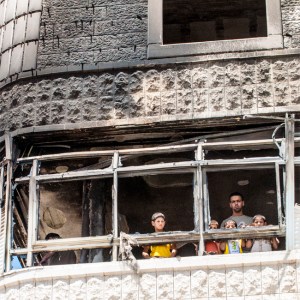 Palestinian and international officials have revealed that only 2 per cent of the pledges made by donor states to rebuild the Gaza Strip have actually been paid. The pledges were made in a donor conference in Egypt two months ago. A total of $5.4 billion was pledged for the reconstruction of the beleaguered territory after it was destroyed during Israel’s latest war against the civilians of Gaza during the summer. Of the major donors, Qatar pledged $1 billion, Saudi Arabia $500 million and the EU $780 million.
It was expected that half of these pledges would have been spent on rebuilding houses and infrastructure in the Gaza Strip and the remainder would boost the Palestinian Authority’s budget. According to UN officials, just $100 million has been handed over from donors.
“We received funds and pledges worth about $100 million for shelters and house renovation,” said Robert Turner, the Director of UNRWA Operations in Gaza. “This money will run out in December in the middle of a harsh winter.” The shortfall, he added, is $620 million.
Palestinian Housing Minister Mofeed Al-Hasayneh said that the Arab states did not pay anything from their pledges for this month. The Europeans, however, have paid “a few millions”.
Featured Video

HE SAVED LIVES. NOW HE FACES PRISON.
or go to
Aletho News Archives – Video-Images
From the Archives
NATO Sanctions and the Coming Global Diesel Fuel Disaster
By F. William Engdahl – New Eastern Outlook – 11.04.2022
Amid the ongoing global inflation crisis, NATO heads of state and mainstream media repeat a mantra that high energy prices are a direct result of Putin’s actions in Ukraine since end of February. The reality is that it is the western sanctions that are responsible. Those sanctions including cutting SWIFT interbank access for key Russian banks and some of the most severe sanctions ever imposed, are hardly having an impact on the military actions in Ukraine. What many overlook is the fact that they are increasingly impacting the economies of the West, especially the EU and USA. A closer look at the state of the global supply of diesel fuel is alarming. But Western sanctions planners at the US Treasury and the EU know fully well what they are doing. And it bodes ill for the world economy.
While most of us rarely think about diesel fuel as anything other than a pollutant, in fact it is essential to the entire world economy in a way few energy sources are. The director general of Fuels Europe, part of the European Petroleum Refiners Association, stated recently, “… there is a clear link between diesel and GDP, because almost everything that goes into and out of a factory goes using diesel.” … continue
Blog Roll
 Aletho News
- Qatar PM calls for Gulf security framework with Iran, says war must be ‘wake-up call’
- China condemns US extortion of Iranian airlines, rejects Washington’s ‘illegal’ sanctions threats
- Italy to move military personnel from Taif base after missile strike
- Finland’s Stubb tells European leaders to calm down
- Defeating Russia on battlefield impossible – Fico
- Finland’s Gender Clinic Reversal
- Massachusetts Wants Mental Health Visits, Why Does Government Use ‘Health’ to Enter Our Homes & Families?
- US lawmaker admits American people footing bill for Trump’s failed aggression against Iran
- Pfizer Gave $500,000 to Groups That Lobbied to End Religious Exemption in Massachusetts
- HE SAVED LIVES. NOW HE FACES PRISON.
- If Americans Knew
- Sanctions are collective punishment: immoral and self-defeating
- Phosphorus Munitions Fired by Israel Burn Groves, Orchards in Southern Lebanon
- Israel Carries Out New Ceasefire Violations Across Gaza
- AI – Emphasis on the ‘I’: Israel Is Funding AI Chatbot Propaganda
- Israel Blocking Hundreds of Wheelchairs for Injured Children From Entering Gaza
- Israel Is Expanding and Upgrading Compounds for Palestinian Militias in Gaza
- The Palestinian-American Residents of This West Bank Town Are Wondering: Where Is Trump?
- Gaza desperately needs tents, wheelchairs, fuel… and everything else (Israel blocks it all) – Daily Update
- Israeli Attacks in Gaza Kill at Least Seven Palestinians Over Three Days, including Woman and Child
- Trump’s militarization of Washington DC as he pursues Israel’s war against Iran
- No Tricks Zone
- 2025 Nature Paper Claiming Worsening Global Drought Gets RETRACTED …Heavily Flawed
- New Study: ‘Global Drought Shows No Detectable Recent Acceleration Under Climate Warming’
- Economic Masterminds: German Socialists Suggest Taxing Productivity Gains Stemming From Using AI
- The South China Sea Has Not Been Cooperating With The Climate Change Narrative
- Energy Crisis: Germany Enters Heating Season With Historically Low Gas Reserve Fill Levels
- New Study: The Antarctic Ice Sheet Gained Mass From 2020-2024 Due To Staggering Snow And Ice Accumulation
- Study: Ocean Heating Rates From Thousands Of Years Ago ‘Dwarf’ Modern Ocean Heating Rates
- Climate Extremists Target, Attack Large-Scale Power Grid Infrastructure In Germany!
- New Study: Antarctic Ice Melt Has Contributed Less Than 1 Centimeter To Sea Level Rise In The Last 30 Years
- Fear Of Debate: Alarmist German Climate Scientist Calls On Mainstream Media To Discredit Skeptic Voices

