Tales of Reagan’s Guatemala Genocide
By Robert Parry | Consortium News | April 16, 2013
The first month of the genocide trial of former Guatemalan dictator Efrain Rios Montt has elicited chilling testimony from Mayan survivors who – as children – watched their families slaughtered by a right-wing military that was supported and supplied by U.S. President Ronald Reagan.
As the New York Times reported on Monday, “In the tortured logic of military planning documents conceived under Mr. Ríos Montt’s 17-month rule during 1982 and 1983, the entire Mayan Ixil population was a military target, children included. Officers wrote that the leftist guerrillas fighting the government had succeeded in indoctrinating the impoverished Ixils and reached ‘100 percent support.’”
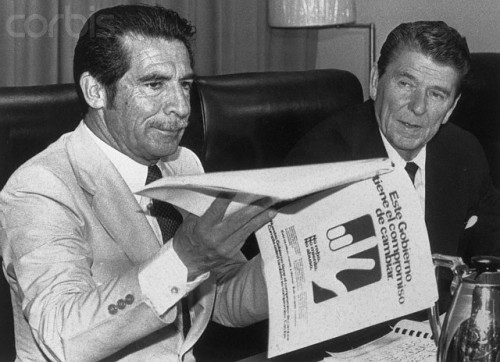
President Ronald Reagan meeting with Guatemalan dictator Efrain Rios Montt.
So, everyone was targeted in these scorched-earth campaigns that eradicated more than 600 Indian villages in the Guatemalan highlands. But this genocide was not simply the result of a twisted anticommunist ideology that dominated the Guatemalan military and political elites. This genocide also was endorsed by the Reagan administration.
A document that I discovered recently in the archives of the Reagan Library in Simi Valley, California, revealed that Reagan and his national security team in 1981 agreed to supply military aid to the brutal right-wing regime in Guatemala to pursue the goal of exterminating not only “Marxist guerrillas” but people associated with their “civilian support mechanisms.”
This supportive attitude toward the Guatemalan regime’s brutality took shape in spring 1981 as President Reagan sought to ease human-rights restrictions on military aid to Guatemala that had been imposed by President Jimmy Carter and the Democratic-controlled Congress in the late 1970s.
As part of that relaxation effort, Reagan’s State Department “advised our Central American embassies that it has been studying ways to restore a closer, cooperative relationship with Guatemala,” according to a White House “Situation Room Checklist” dated April 8, 1981. The document added:
“State believes a number of changes have occurred which could make Guatemalan leaders more receptive to a new U.S. initiative: the Guatemalans view the new administration as more sympathetic to their problems [and] they are less suspect of the U.S. role in El Salvador,” where the Reagan administration was expanding support for another right-wing regime infamous for slaughtering its political opponents, including Catholic clergy.
“State has concluded that any attempt to reestablish a dialogue [with Guatemala] would require some initial, condition-free demonstration of our goodwill. However, this could not include military sales which would provoke serious U.S. public and congressional criticism. State will undertake a series of confidence building measures, free of preconditions, which minimize potential conflict with existing legislation.”
The “checklist” added that the State Department “has also decided that the administration should engage the Guatemalan government at the highest level in a dialogue on our bilateral relations and the initiatives we can take together to improve them. Secretary [of State Alexander] Haig has designated [retired] General Vernon Walters as his personal emissary to initiate this process with President [Fernando Romeo] Lucas [Garcia].
“If Lucas is prepared to give assurances that he will take steps to halt government involvement in the indiscriminate killing of political opponents and to foster a climate conducive to a viable electoral process, the U.S. will be prepared to approve some military sales immediately.”
But the operative word in that paragraph was “indiscriminate.” The Reagan administration expressed no problem with killing civilians if they were considered supporters of the guerrillas who had been fighting against the country’s ruling oligarchs and generals since the 1950s when the CIA organized the overthrow of Guatemala’s reformist President Jacobo Arbenz.
Sympathy for the Generals
The distinction was spelled out in “Talking Points” for Walters to deliver in a face-to-face meeting with General Lucas. As edited inside the White House in April 1981, the “Talking Points” read: “The President and Secretary Haig have designated me [Walters] as [their] personal emissary to discuss bilateral relations on an urgent basis.
“Both the President and the Secretary recognize that your country is engaged in a war with Marxist guerrillas. We are deeply concerned about externally supported Marxist subversion in Guatemala and other countries in the region. As you are aware, we have already taken steps to assist Honduras and El Salvador resist this aggression.
“The Secretary has sent me here to see if we can work out a way to provide material assistance to your government. … We have minimized negative public statements by US officials on the situation in Guatemala. … We have arranged for the Commerce Department to take steps that will permit the sale of $3 million worth of military trucks and Jeeps to the Guatemalan army. …
“With your concurrence, we propose to provide you and any officers you might designate an intelligence briefing on regional developments from our perspective. Our desire, however, is to go substantially beyond the steps I have just outlined. We wish to reestablish our traditional military supply and training relationship as soon as possible.
“As we are both aware, this has not yet been feasible because of our internal political and legal constraints relating to the use by some elements of your security forces of deliberate and indiscriminate killing of persons not involved with the guerrilla forces or their civilian support mechanisms. I am not referring here to the regrettable but inevitable death of innocents through error in combat situations, but to what appears to us a calculated use of terror to immobilize non politicized people or potential opponents. …
“If you could give me your assurance that you will take steps to halt official involvement in the killing of persons not involved with the guerrilla forces or their civilian support mechanism … we would be in a much stronger position to defend successfully with the Congress a decision to begin to resume our military supply relationship with your government.”
In other words, though the “talking points” were framed as an appeal to reduce the “indiscriminate” slaughter of “non politicized people,” they amounted to an acceptance of scorched-earth tactics against people involved with the guerrillas and “their civilian support mechanisms.” The way that played out in Guatemala – as in nearby El Salvador – was the massacring of peasants in regions considered sympathetic to leftist insurgents.
The newly discovered documents – and other records declassified in the late 1990s – make clear that Reagan and his administration were well aware of the butchery underway in Guatemala and elsewhere in Central America.
According to one “secret” cable also from April 1981 — and declassified in the 1990s — the CIA was confirming Guatemalan government massacres even as Reagan was moving to loosen the military aid ban. On April 17, 1981, a CIA cable described an army massacre at Cocob, near Nebaj in the Ixil Indian territory, because the population was believed to support leftist guerrillas.
A CIA source reported that “the social population appeared to fully support the guerrillas” and “the soldiers were forced to fire at anything that moved.” The CIA cable added that “the Guatemalan authorities admitted that ‘many civilians’ were killed in Cocob, many of whom undoubtedly were non-combatants.” [Many of the Guatemalan documents declassified in the 1990s can be found at the National Security Archive’s Web site.]
Dispatching Walters
In May 1981, despite the ongoing atrocities, Reagan dispatched Walters to tell the Guatemalan leaders that the new U.S. administration wanted to lift the human rights embargoes on military equipment that Carter and Congress had imposed.
The “Talking Points” also put the Reagan administration in line with the fiercely anticommunist regimes elsewhere in Latin America, where right-wing “death squads” operated with impunity liquidating not only armed guerrillas but civilians who were judged sympathetic to left-wing causes like demanding greater economic equality and social justice.
Despite his aw shucks style, Reagan found virtually every anticommunist action justified, no matter how brutal. From his eight years in the White House, there is no historical indication that he was morally troubled by the bloodbath and even genocide that occurred in Central America while he was shipping hundreds of millions of dollars in military aid to the implicated forces.
The death toll was staggering — an estimated 70,000 or more political killings in El Salvador, possibly 20,000 slain from the Contra war in Nicaragua, about 200 political “disappearances” in Honduras and some 100,000 people eliminated during a resurgence of political violence in Guatemala. The one consistent element in these slaughters was the overarching Cold War rationalization, emanating in large part from Ronald Reagan’s White House.
Despite their claims to the contrary, the evidence is now overwhelming that Reagan and his advisers knew the extraordinary brutality going on in Guatemala and elsewhere, based on their own internal documents.
According to a State Department cable on Oct. 5, 1981, when Guatemalan leaders met again with Walters, they left no doubt about their plans. The cable said Gen. Lucas “made clear that his government will continue as before — that the repression will continue. He reiterated his belief that the repression is working and that the guerrilla threat will be successfully routed.”
Human rights groups saw the same picture. The Inter-American Human Rights Commission released a report on Oct. 15, 1981, blaming the Guatemalan government for “thousands of illegal executions.” [Washington Post, Oct. 16, 1981]
But the Reagan administration was set on whitewashing the ugly scene. A State Department “white paper,” released in December 1981, blamed the violence on leftist “extremist groups” and their “terrorist methods” prompted and supported by Cuba’s Fidel Castro.
What the documents from the Reagan Library make clear is that the administration was not simply struggling ineffectively to rein in these massacres – as the U.S. press corps typically reported – but was fully on board with the slaughter of people who were part of the guerrillas’ “civilian support mechanisms.”
U.S. intelligence agencies continued to pick up evidence of these government-sponsored massacres. One CIA report in February 1982 described an army sweep through the so-called Ixil Triangle in central El Quiche province.
“The commanding officers of the units involved have been instructed to destroy all towns and villages which are cooperating with the Guerrilla Army of the Poor [the EGP] and eliminate all sources of resistance,” the report said. “Since the operation began, several villages have been burned to the ground, and a large number of guerrillas and collaborators have been killed.”
The CIA report explained the army’s modus operandi: “When an army patrol meets resistance and takes fire from a town or village, it is assumed that the entire town is hostile and it is subsequently destroyed.” When the army encountered an empty village, it was “assumed to have been supporting the EGP, and it is destroyed. There are hundreds, possibly thousands of refugees in the hills with no homes to return to. …
“The army high command is highly pleased with the initial results of the sweep operation, and believes that it will be successful in destroying the major EGP support area and will be able to drive the EGP out of the Ixil Triangle. … The well documented belief by the army that the entire Ixil Indian population is pro-EGP has created a situation in which the army can be expected to give no quarter to combatants and non-combatants alike.”
On Feb. 2, 1982, Richard Childress, one of Reagan’s national security aides, wrote a “secret” memo to his colleagues summing up this reality on the ground:
“As we move ahead on our approach to Latin America, we need to consciously address the unique problems posed by Guatemala. Possessed of some of the worst human rights records in the region, … it presents a policy dilemma for us. The abysmal human rights record makes it, in its present form, unworthy of USG [U.S. government] support. …
“Beset by a continuous insurgency for at least 15 years, the current leadership is completely committed to a ruthless and unyielding program of suppression. Hardly a soldier could be found that has not killed a ‘guerrilla.’”
The Rise of Rios Montt
However, Reagan remained committed to supplying military hardware to Guatemala’s brutal regime. So, the administration welcomed Gen. Efrain Rios Montt’s March 1982 overthrow of the thoroughly bloodstained Gen. Lucas.
An avowed fundamentalist Christian, Rios Montt impressed Official Washington where the Reagan administration immediately revved up its propaganda machinery to hype the new dictator’s “born-again” status as proof of his deep respect for human life. Reagan hailed Rios Montt as “a man of great personal integrity.”
By July 1982, however, Rios Montt had begun a new scorched-earth campaign called his “rifles and beans” policy. The slogan meant that pacified Indians would get “beans,” while all others could expect to be the target of army “rifles.” In October, Rios Montt secretly gave carte blanche to the feared “Archivos” intelligence unit to expand “death squad” operations in the cities. Based at the Presidential Palace, the “Archivos” masterminded many of Guatemala’s most notorious assassinations.
The U.S. embassy was soon hearing more accounts of the army conducting Indian massacres, but ideologically driven U.S. diplomats fed the Reagan administration the propaganda spin that would be best for their careers. On Oct. 22, 1982, embassy staff dismissed the massacre reports as communist-inspired “disinformation campaign,” concluding that “that a concerted disinformation campaign is being waged in the U.S. against the Guatemalan government by groups supporting the communist insurgency in Guatemala.”
Reagan personally joined this P.R. campaign seeking to discredit human rights investigators and others who were reporting accurately about massacres that the administration knew, all too well, were true.
On Dec. 4, 1982, after meeting with Rios Montt, Reagan hailed the general as “totally dedicated to democracy” and added that Rios Montt’s government had been “getting a bum rap” on human rights. Reagan discounted the mounting reports of hundreds of Maya villages being eradicated.
In February 1983, however, a secret CIA cable noted a rise in “suspect right-wing violence” with kidnappings of students and teachers. Bodies of victims were appearing in ditches and gullies. CIA sources traced these political murders to Rios Montt’s order to the “Archivos” in October to “apprehend, hold, interrogate and dispose of suspected guerrillas as they saw fit.”
Despite these grisly facts on the ground, the annual State Department human rights survey praised the supposedly improved human rights situation in Guatemala. “The overall conduct of the armed forces had improved by late in the year” 1982, the report stated.
A different picture — far closer to the secret information held by the U.S. government — was coming from independent human rights investigators. On March 17, 1983, Americas Watch condemned the Guatemalan army for human rights atrocities against the Indian population.
New York attorney Stephen L. Kass said these findings included proof that the government carried out “virtually indiscriminate murder of men, women and children of any farm regarded by the army as possibly supportive of guerrilla insurgents.”
Rural women suspected of guerrilla sympathies were raped before execution, Kass said, adding that children were “thrown into burning homes. They are thrown in the air and speared with bayonets. We heard many, many stories of children being picked up by the ankles and swung against poles so their heads are destroyed.” [AP, March 17, 1983]
Putting on a Happy Face
Publicly, senior Reagan officials continued to put on a happy face. In June 1983, special envoy Richard B. Stone praised “positive changes” in Rios Montt’s government, and Rios Montt pressed the United States for 10 UH-1H helicopters and six naval patrol boats, all the better to hunt guerrillas and their sympathizers.
Since Guatemala lacked the U.S. Foreign Military Sales credits or the cash to buy the helicopters, Reagan’s national security team looked for unconventional ways to arrange the delivery of the equipment that would give the Guatemalan army greater access to mountainous areas where guerrillas and their civilian supporters were hiding.
On Aug. 1, 1983, National Security Council aides Oliver North and Alfonso Sapia-Bosch reported to National Security Advisor William P. Clark that his deputy Robert “Bud” McFarlane was planning to exploit his Israeli channels to secure the helicopters for Guatemala. [For more on McFarlanes’s Israeli channels, see Consortiumnews.com’s “How Neocons Messed Up the Mideast.”]
“With regard to the loan of ten helicopters, it is [our] understanding that Bud will take this up with the Israelis,” wrote North and Sapia-Bosch. “There are expectations that they would be forthcoming. Another possibility is to have an exercise with the Guatemalans. We would then use US mechanics and Guatemalan parts to bring their helicopters up to snuff.”
However, more political changes were afoot in Guatemala. Rios Montt’s vengeful Christian fundamentalism had hurtled so out of control, even by Guatemalan standards, that Gen. Oscar Mejia Victores seized power in another coup on Aug. 8, 1983.
Despite the power shift, Guatemalan security forces continued to murder with impunity, finally going so far that even the U.S. Embassy objected. When three Guatemalans working for the U.S. Agency for International Development were slain in November 1983, U.S. Ambassador Frederic Chapin suspected that “Archivos” hit squads were sending a message to the United States to back off even mild pressure for human rights.
In late November, in a brief show of displeasure, the administration postponed the sale of $2 million in helicopter spare parts. The next month, however, Reagan sent the spare parts anyway. In 1984, Reagan succeeded, too, in pressuring Congress to approve $300,000 in military training for the Guatemalan army.
By mid-1984, Chapin, who had grown bitter about the army’s stubborn brutality, was gone, replaced by a far-right political appointee named Alberto Piedra, who favored increased military assistance to Guatemala. In January 1985, Americas Watch issued a report observing that Reagan’s State Department “is apparently more concerned with improving Guatemala’s image than in improving its human rights.”
It was not until 1999, a decade after Ronald Reagan left office, that the shocking scope of the atrocities in Guatemala was publicly revealed by a truth commission that drew heavily on U.S. government documents that President Bill Clinton had ordered declassified.
On Feb. 25, 1999, the Historical Clarification Commission estimated that the 34-year civil war had claimed the lives of some 200,000 people with the most savage bloodletting occurring in the 1980s. The panel estimated that the army was responsible for 93 percent of the killings and leftist guerrillas for three percent. Four percent were listed as unresolved.
The report documented that in the 1980s, the army committed 626 massacres against Mayan villages. “The massacres that eliminated entire Mayan villages … are neither perfidious allegations nor figments of the imagination, but an authentic chapter in Guatemala’s history,” the commission concluded.
The army “completely exterminated Mayan communities, destroyed their livestock and crops,” the report said. In the northern highlands, the report termed the slaughter “genocide.” [Washington Post, Feb. 26, 1999]
Besides carrying out murder and “disappearances,” the army routinely engaged in torture and rape. “The rape of women, during torture or before being murdered, was a common practice” by the military and paramilitary forces, the report found.
The report added that the “government of the United States, through various agencies including the CIA, provided direct and indirect support for some [of these] state operations.” The report concluded that the U.S. government also gave money and training to a Guatemalan military that committed “acts of genocide” against the Mayans. [NYT, Feb. 26, 1999]
During a visit to Central America, on March 10, 1999, President Clinton apologized for the past U.S. support of right-wing regimes in Guatemala dating back to 1954. “For the United States, it is important that I state clearly that support for military forces and intelligence units which engaged in violence and widespread repression was wrong, and the United States must not repeat that mistake,” Clinton said. [Washington Post, March 11, 1999]
Impunity for Reagan’s Team
However, back in Washington, there was no interest in holding anyone accountable for aiding and abetting genocide. The story of the Guatemalan butchery and the Reagan administration’s complicity quickly disappeared into the great American memory hole.
For human rights crimes in the Balkans and in Africa, the United States has demanded international tribunals to arrest and to try violators and their political patrons for war crimes. In Iraq, President George W. Bush celebrated the trial and execution of Iraqi dictator Saddam Hussein for politically motivated killings.
Even Rios Montt, now 86, after years of evading justice under various amnesties, was finally indicted in Guatemala in 2012 for genocide and crimes against humanity. The first month of his trial has added eyewitness testimony to the atrocities that the Guatemalan military inflicted and that Ronald Reagan assisted and covered up.
On Monday, the New York Times reported on some of this painful testimony, but – as is almost always the case – the Times did not mention the role of Reagan and his administration. However, what the Times did include was chilling, including accounts from witnesses who as children fled to mountain forests to escape the massacres:
“Pedro Chávez Brito told the court that he was only six or seven years old when soldiers killed his mother. He hid in the chicken coop with his older sister, her newborn and his younger brother, but soldiers found them and dragged them out, forcing them back into their house and setting it on fire.
“Mr. Chávez says he was the only one to escape. ‘I got under a tree trunk and I was like an animal,’ Mr. Chávez told the court. ‘After eight days I went to live in the mountains. In the mountain we ate only roots and grass.’”
Lawyers for Rios Montt and his co-defendant, former intelligence chief José Mauricio Rodríguez Sánchez, have maintained that the pair did not order the killings, which they instead blamed on over-zealous field commanders.
However, the Times reported that “prosecution witnesses said the military considered Ixil civilians, including children, as legitimate targets. ‘The army’s objective with the children was to eliminate the seed for future guerrillas,’ Marco Tulio Alvarez, the former director of Guatemala’s Peace Archives, testified last week. ‘They used them to get information and to draw their parents to military centers where they arrested them.’
“In a study of 420 bodies exhumed from the Ixil region and presumed to date from the Ríos Montt period, experts found that almost 36 percent of those who were killed were under 18 years old, including some newborns.
“Jacinto Lupamac Gómez said he was eight when soldiers killed his parents and older siblings and hustled him and his two younger brothers into a helicopter. Like some of the children whose lives were spared, they were adopted by Spanish-speaking families and forgot how to speak Ixil.”
Though some belated justice may still be possible in Guatemala, there is no talk in the United States about seeking any accountability from the Reagan administration officials who arranged military assistance to this modern genocide or who helped conceal the atrocities while they were underway.
There has been no attention given by the mainstream U.S. news media to the new documents revealing how the Reagan administration gave a green light to the slaughter of Guatemalans who were considered part of the “civilian support mechanisms” for the Mayan guerrillas resisting the right-wing repression.
Ronald Reagan, the U.S. official most culpable for aiding and abetting the Guatemalan genocide, remains a hero to much of America with his name attached to Washington’s National Airport and scores of other government facilities. U.S. officials and many Americans apparently don’t want to disrupt their happy memories of the Gipper.
~
Investigative reporter Robert Parry broke many of the Iran-Contra stories for The Associated Press and Newsweek in the 1980s. You can buy his new book, America’s Stolen Narrative, either in print here or as an e-book (from Amazon and barnesandnoble.com).
Related articles
- Genocide trial of former Guatemala dictator Rios Montt opens (alethonews.wordpress.com)
- Guatemala: Ríos Montt Trial Implicates Current President (alethonews.wordpress.com)
- Ríos Montt and the Need for International Accountability for War Crimes in Guatemala (alethonews.wordpress.com)
- How Reagan Promoted Genocide (consortiumnews.com)
- Guatemala genocide trial continues; watch or listen live (boingboing.net)
Pentagon Continues Contracting US Companies in Latin America
By John Lindsay-Poland | FOR | January 31, 2013
The Pentagon signed $444 million in non-fuel contracts for purchases and services in Latin America and the Caribbean during the 2012 fiscal year, an overall decrease of nearly 15% from the previous year. But US military spending in the region is still considerably higher than during the George W. Bush administration, when the equivalent Pentagon spending in Latin America averaged $301 million a year.
Fellowship Of Reconcilliation conducted an analysis of Defense Department contracts listed on usaspending.gov for Fiscal Year 2012, building on the review we did last year.
More than a third of funds for these contracts in the region are being carried out in Cuba, with $158 million for housing upgrades, intelligence analysis, port operations and other services. The United States maintains the Guantanamo naval base in Cuba, site of the 11-year-old detention center that holds 171 prisoners without trial, many of whom have been cleared for release.
An additional $130 million in Pentagon contracts was for fuel purchases, including more than $44 million in Brazil, $35 million in Costa Rica, and $24 million in Honduras. Such fuel purchases supply the Fourth Fleet of the Navy, as well as military aircraft and land vehicles used in exercises, operations, and training.
Colombia remained the country with the largest amount of Pentagon contracts in continental Latin America, with $77 million. A multi-year contract shared by Raytheon and Lockheed for training, equipment and other drug war activities accounted for more than a third of Pentagon contract spending in Colombia. Honduras, which has become a hub for Pentagon operations in Central America, is the site for more than $43 million in non-fuel contracts signed last year.

The US Southern Command (SouthCom), responsible for US military activities in Central and South America and the Caribbean, is assisting the Panamanian border police, known as SENAFRONT, by upgrading a building in the SENAFRONT compound. The force was implicated in killings of indigenous protesters (PDF) in Bocas del Toro in 2011, and fired indiscriminately with live ammunition (PDF) on Afro-Caribbean protesters last October.
Many countries that host US military activities hope to receive economic benefits and jobs as a result. But more than five of every six Pentagon dollars contracted for services and goods in the region went to US-based companies. Only nine percent of the $574.4 million in Pentagon contracts signed in 2012 (including fuel contracts) were with firms in the country where the work was to be carried out. In the Caribbean, there were virtually no local companies that benefited from the $245 million in Defense Department contracts.
A few corporations dominated Pentagon contracts in the region. CSC Applied Technologies, based in Fort Worth, Texas, received more than $53 million in contracts to operate the Navy’s underwater military testing facility in the Bahamas. Lockheed Martin received more than $40 million in contracts, almost entirely for drug war training, equipment and services in Colombia and Mexico.
Pentagon Focus on Guatemala
Although the Pentagon spent less in most Latin American countries in 2012 than the year before, DOD contracts have more than doubled since 2010 in Guatemala, where there is a ban on most State Department-channeled military aid to the army. However, the ban does not apply to Defense Department assistance. The contracts for nearly $14 million in 2012 amount to more than seven times what it was in 2009. In addition, the US military spent another $8.1 million on fuel in Guatemala last year, probably for “Beyond the Horizon” military exercises held there and in Honduras from April to July, and perhaps to support the deployment of 200 Marines to Guatemala in August.
The contracts included new assistance to the Guatemalan special forces, known as Kaibiles, former members of which have been implicated in giving training to the Zetas drug cartel, as well as the worst atrocities during the genocide period of the 1980s. Two contracts, funded by SouthCom and signed in September, were for a “shoot house” and “improvements” at the Kaibiles training base in Poptun, Petén.
SouthCom also funded a contract for construction of a new $3 million counter-drug base in Santa Ana de Berlin, in Quetzaltenango. This year, SouthCom is slated to build a $1.8 million counternarcotics operations center and barracks in Mantanitas, Guatemala, according to an Army Corps of Engineers presentation.
The expenditures included equipment. For the last two years, SouthCom has been providing Boston whaler boats, radios, and tactical vehicles (Jeeps) to Central American militaries. Guatemala is receiving more of the equipment than other countries in the region – 47 Jeeps and 8 Boston whalers, according to a SouthCom document. SouthCom signed a $2.5 million contract in September for Jeeps for Guatemala, and it has purchased more than $2.8 million of Harris military radios for Guatemala since September 2011.
Department of Defense contracts, summaries of which are posted on usaspending.gov, only represent a portion of Pentagon spending. A report to Congress last April (PDF) of Defense Department assistance worldwide showed more than $15 million in military aid to Guatemala in 2010, including $9 million for intelligence analysis, training, boats, trucks, night vision devices, and a “base of operations.” These funds also included more than $6 million of unspecified support for Guatemalan police operations in Cobán, in the Guatemalan highland department of Alta Verapaz. The report didn’t include data after 2010.
On December 7, the Pentagon’s Defense Logistics Agency signed a $1.4 million contract with a Guatemalan firm to manage a 10,000-barrel supply of turbine fuel for the next five years in Puerto Quetzal, on Guatemala’s southern coast. This followed a July 2012 solicitation to deliver 63,000 gallons of jet fuel to another southern Guatemalan site, in Retalhuleu.
FOR compiled data on the “country of performance” for contracts. For Guatemala, we also examined data on additional contracts that reference the country, which included a $2.5 million contract signed in late September with a Chrysler distributor to deliver tactical vehicles – some of the Jeeps slated for the country. The US Army also purchased $7.6 million worth of trousers from a producer in Guatemala in 2012.
“Mini-Bases”
Some legislation for DOD drug war construction of bases and other infrastructure limits projects to $2 million, and the Southern Command continues to employ this authority frequently to construct a variety of facilities all over the Americas. Here are some of the facilities the US military is constructing around Latin America.
| City, Country | Amount of contract | Date signed | Description |
|---|---|---|---|
| Tecun Uman, Guatemala | $550K | Dec. 5, 2011 | Health post refurbishment |
| Champerico, Guatemala | none — part of multi-award contract | Sept 17, 2012 | Counter Narco-terrorism (CNT) Ops Center; pier and fuel |
| Santa Ana de Berlin, Guatemala | $3 million (Army Corps of Engineers says $4.1 million) | Sept 29, 2012 | CNT Barracks, Latrines, refurbish chow hall, motorpool |
| Las Mantanitas, Guatemala | $1.8 million | Not known; see ACE FY13 plan. | CN Operations Center/Barracks |
| Summit, Panama | $1,078,971 | Sept 22, 2012 | Counternarcotics maintenance facility |
| Hunting Caye, Belize | $1,778,420 | August 10, 2012 | Construction of operations barracks/maintenance facility |
| Puerto Castilla, Honduras | $374,882 | March 9, 2012 | Construction of helicopter landing pads and team room improvements |
| Dominican Republic | $1.8 million | Sept 28, 2012 | Construct dormitory building |
| Santo Domingo, Dominican Republic | $414,444 | Jan. 24 and March 8, 2012 | Refurbish peace keeping operations training school buildings |
| Antigua | none — supplemental to existing contract | October 19, 2011 | Emergency response warehouse |
| Tarapoto, Peru | $1,049,265 | September 12, 2012 | Disaster relief warehouse and search and rescue training facility |
| Puno and Huaraz, Peru | $1,037,808 | July 27, 2012 | Emergency Operations Centers |
| Piura and Concepción, Peru | $853,500 | July 27, 2012 | Emergency Operation Center and Disaster Relief Warehouse |
Re-militarization gives rise to new tensions and violence in Guatemala
By Kelsey Alford-Jones | Upside Down World | January 25, 2013
On October 6, the Guatemalan army gunned down six indigenous protesters in Totonicapán and injured at least 30 more. Thousands had gathered to oppose unpopular government reforms, and while the police held their distance, the military advanced and shot into the crowd.
The event was a tragic manifestation of one of the public’s worst fears since President Pérez Molina took office in January 2012: that the Guatemalan armed forces would resort to deadly force in order to repress and silence dissent, an experience all too familiar in the nation´s collective historic memory.
Pérez Molina has made no secret of his intention to deploy the armed forces in ever-greater numbers and ever-expanding roles – the military now overwhelmingly dominates citizen security initiatives. Whether walking down Guatemala City’s central avenue, the “Sexta,” or driving on any major highway, Guatemalans are once again likely to encounter soldiers patrolling with semi-automatic rifles or checking papers at military roadblocks.
The government has opened at least five new military bases and outposts since the beginning of 2012, and has sent soldiers to fight drug cartels, to protect historic sites and nature reserves, and to back up the police during evictions and protests. Soldiers have also been deployed en masse to reduce crime in Guatemala City´s poorest neighborhoods.
Seeing soldiers on the streets may not be new in Guatemala, but under Pérez Molina, it has become symbolic of his administration’s approach to governance; and for the first time in over 15 years, current and former military personnel permeate the leadership of civilian institutions and dictate the administration’s approach to governance.
This swift re-militarization is deeply controversial, and the reasons behind it are much more complex than first meet the eye. In fact, some argue that the motivation for militarization has little to do with providing security for Guatemalan citizens – instead, it is about protecting the status quo, ensuring impunity for the armed forces and defending multinational economic investments. The US government has been eager to offer support to the Guatemalan military, despite the problematic implications.
The Military’s Past Atrocities
In1996, Otto Pérez Molina was a General in the Guatemalan military, and was one of their representatives at the peace negotiations that would put an end to the armed conflict. The Peace Accords, signed by Pérez Molina himself, emphasized the importance of strengthening civilian governance: the number of soldiers would be vastly reduced and a new, civilian, police force would be created. The Accords stipulated that the “National Civilian Police shall be under the direction of the civil authorities.” In contrast, the role of the armed forces was to “[defend] Guatemala’s sovereignty and territorial integrity; they shall have no other functions assigned to them, and their participation in other fields shall be limited to cooperative activities.”
The Accords placed limitations on the military not just to strengthen democracy, but also as a response to the atrocities the military had committed against its own people. In 1999, the UN-sponsored Commission for Historical Clarification (CEH) established that during the 36-year internal armed conflict, 200,000 people were killed, mostly civilians, including an estimated 45,000 who were forcibly disappeared. The Guatemalan state (through its military and paramilitary forces) was responsible for 93% of all human rights violations committed during the conflict, and had committed acts of genocide against the Mayan people.
The Military Creeps Back into Citizen Security Initiatives
Neither the Peace Accords nor the CEH report outlined steps to hold individual soldiers and high-level military officials accountable for the egregious war crimes committed, and many remain in positions of power to this very day. Internal reforms of military institutions were superficial at best, and government officials have been quick to re-engage the military with the justification that it is necessary to provide security to the Guatemalan public.
– In 2000, only four years after the signing of the Peace Accords, a bill was passed legalizing the military’s collaboration with the police to combat common and organized crime, as well as deforestation, kidnapping, and other crimes.
– In 2006 (under the direction of then Presidential Commissioner for Security Pérez Molina), President Berger mobilized reserve troops to maintain internal security, fight crime and distribute humanitarian aid.
– From 2007-2011 President Colom continued to expand the military’s role, reopening military bases and increasing the number of troops, while Congress created a minimum requirement for spending on the Defense Ministry’s budget.
When Pérez Molina assumed the presidency in January 2012, he became the first career military official to hold that office in 25 years. He immediately called on the army to collaborate in “neutralizing illegal armed groups by means of military power.” In September, Pérez Molina inaugurated the Maya Task Force in Zone 18 of Guatemala City, with 1,200 soldiers and 100 police. He initiated a similar operation in Zone 12 in November.
The Re-militarization of Guatemalan Institutions
The dramatic images of thousands of heavily armed soldiers in Guatemala City are shocking and troublesome, yet the re-militarization of Guatemala today isn’t simply about more soldiers on the streets. It also refers to something much less visible –an institutional culture disturbingly similar to the counter-insurgency model that dominated during the internal armed conflict.
Numerous governmental agencies are now run by former military, including the Interior Ministry and offices within the National Civilian Police and intelligence services. According to Guatemalan security analysts, upwards of 40% of security-related positions are held by former military, including many who were directly involved in the counter-insurgency campaigns; some have even been named in cases before Guatemalan courts for their role in crimes against humanity during the conflict.
Many of these policymakers, including Pérez Molina himself, hail from the generation of armed forces that was active during genocide campaigns such as Operation Sofia; a generation that participated in the extermination of entire villages, that used rape as a tool of war, and justified the use of torture and brutality in their campaigns against civilian, mostly indigenous, communities. This is the generation taught to believe that anyone who rejected existing structures of racism, economic dominance by a minority elite, and political exclusion, were “subversives”, “guerrillas,” “terrorists” and “internal enemies.”
The administration’s approach to policy-making, according to human rights groups, reflects this culture of discipline and obedience rather than democratic governance and dialogue. Any social conflict that disrupts the established order is addressed as the military has always dealt with perceived “threats” from its own citizens: intimidation, defamation, repression, and the use of force — sometimes with deadly consequences.
The tragic massacre in Totonicapán momentarily ripped through the curtain of government propaganda to expose the ever-present threat of violence. The international and diplomatic communities reacted strongly, and President Pérez Molina quickly assured the public that his administration would no longer deploy the military at protests and evictions. Only hours later, however, he had reversed his statement and later came out with a new protocol for the military’s collaboration with the police – a protocol that did not, in fact, reduce the military’s role at all.
The Military and the ‘War on Drugs’
The Guatemalan government has attempted to justify the military’s expanded presence due to the country’s high rates of violence linked to organized crime, gangs and common crime. The US has been quick to accept this argument.
“The military must provide security where the police have failed,” is an easy sell in the context of the US war on drugs andis an argument readily repeated by the US State Department. (Meanwhile, the much-needed reform of Guatemala’s police force languishes without the resources or political support to move forward).
The Department of Defense and US Drug Enforcement Agency (DEA) have provided ongoing support and training to the Guatemalan Armed Forces. This collaboration persists despite a decades-long Congressional ban on direct funding to the army due to the atrocities committed by the Guatemalan military against its own people, and the lack of reform within the institution.
Operation Martillo (Hammer) is the newest in a series of US-Guatemala joint operations, although it is also coordinated amongst other countries in Central America and Europe. The operation began in early 2012 and in July, President Pérez Molina signed off on an expansion of the operation. The new agreement permitted US marines and military contractors to be stationed in Guatemala for 120 days and collaborate directly on counter-narcotics missions. It granted US marines the right to be uniformed, to carry weapons, and to enjoy complete diplomatic “privileges, exemptions, and immunity.” Despite regulations requiring approval from the Guatemalan Congress, the document signed by the US and President Pérez Molina attempted to circumvent the process simply by stating: “It is understood that these activities […] do not constitute the passing of a foreign military through Guatemalan territory.”
The operation was not popular among many in civil society. “Drug trafficking in Guatemala shouldn’t be combated by the Guatemalan military, much less by the US military,” commented analyst Sandino Asturias in an interview with GHRC.
Helen Mack, executive director of the Myrna Mack Foundation and former Police Reform Commissioner, commented to the AP at the end of August: “Rural communities in Guatemala are fearful of the military being used to combat drug traffickers because the same techniques are applied that were used in (counterinsurgency) warfare. The historical memory is there and Guatemalans are fearful of that.”
There are other complications in using the military to combat organized crime. The military can’t carry out a criminal investigation, nor can it (legally) detain suspects of a crime. And while the US and Guatemalan armed forces collaborate on high-profile (often unsuccessful) attempts to capture narco-bosses, the Guatemalan Public Prosecutor’s Office has quietly had them arrested, many for extradition to the US. Furthermore, the Guatemalan military has documented ties to drug trafficking organizations and other criminal structures – the very groups they are sent to combat.
What does re-militarization achieve?
Soldiers train for battle, not to police the streets. Not surprisingly, increasing involvement of the military in police work has not only re-traumatized communities and survivors of the armed conflict, but it has also failed to reduce crime and violence in Guatemala. In fact, Sandino Asturias confirms that the homicide rate began to rise dramatically after the military reengaged in matters of internal security in 2000.
The military’s remarkable failure to address security concerns over the last 12 years doesn’t faze policy makers; in fact, the security of Guatemalan citizens doesn’t seem to be the primary concern at all.
Instead, increasing militarization has often functioned as a means to provide protection for the economic interests of transnational corporations.
The administration has constructed new military bases near existing or planned development projects such as mines, cement factories, and hydroelectric power plants. Military forces – in coordination with the police and private security guards – have consistently been mobilized to guarantee that “development” projects aren’t disrupted by local protests. This occurs despite the fact that, in the majority of cases, the government failed to consult local communities about the project and actively ignores threats, attacks, intimidation and other illegal acts committed by persons linked to the international corporations.
Public officials have instead branded those who organize against these unwanted development projects as “terrorists” and “guerrillas,” a strategy similar to the psychological warfare tactics utilized during the conflict. The government’s use of States of Siege in conflict zones has given the military free reign to terrorize indigenous families and detain “suspects.” Dozens of community leaders have been arrested on trumped up charges simply for their rejection of the administration’s development policies, giving rise to a new movement in solidarity with Guatemala’s first generation of political prisoners.
The international diplomatic community has been just as willing as the Pérez Molina administration to overlook commitments laid out in the 1996 Peace Accords – partially implemented at best – in favor of political and economic ties that promote investment, trade and “stability.”
Finally, for an entire generation of military officials and their civilian allies, the re-militarization of public institutions is not just about maintaining control, but about ensuring impunity.
As Guatemalan courts at long last – and against all odds – move forward with indictments against the military high command from the 1980s, accountability and incarceration for war crimes is suddenly a concrete possibility. The threat of judicial action has resulted in a policy of denial of the military’s involvement in war crimes and genocide, even as exhumations and court cases add to voluminous evidence against the military. An ongoing exhumation at a military base in Coban, Alta Verapaz has already unearthed over 500 bodies in mass graves, many bound, blindfolded, and showing evidence of torture.
In response, Pérez Molina has methodically dismantled public institutions that worked to promote human rights, historical clarification and justice, seeking to . During first half of 2012, the administration gutted the Peace Archives Directorate (DAP). The office had opened in 2008 to compile and analyze military (and other) archives in order to establish human rights violations committed during the internal armed conflict. Archive staff published numerous reports on the conflict and acted as expert witnesses in key human rights cases. The closure of the DAP took place as the government was further weakening the Presidential Human Rights Office (COPREDEH) and consolidating it under the Secretary of Peace, Antonio Arenales Forno, a genocide-denier and long-time ally of the military.
The administration has made repeated attempts to limit or dismiss its regional and international human rights obligations that would jeopardize members of the military. At the beginning of 2013, Pérez Molina issued a presidential decree that refused to recognize the jurisdiction of the Inter-American Court on Human Rights in cases prior to 1987, even when they are “continuing crimes” such as forced disappearance and other crimes against humanity. Public outcry by national and international human rights organizations forced Perez Molina to annul the decree. Meanwhile, the Defense Ministry further limited access to information that relates to human rights violations from the early 1980s, which, according to Guatemalan groups, should be part of the public domain.
Emboldened by the administration’s fierce pro-military stance, retired members of the military and other ultraconservative and fanatically nationalistic groups have launched their own campaigns in the press and social media, sending direct,and very public, threats to those who seek justice and defend human rights.
As Guatemala spirals back into a reality frighteningly reminiscent of the 1980s, those who have become the intentional or collateral victims of re-militarization find themselves with little support from state institutions. Nevertheless, indigenous communities, activists and other civil society organizations –despite fear of repression or retaliation –continue to denounce re-militarization in all its forms. They recognize that the way forward for Guatemala is not to be found by returning to the nefarious practices of the past.
Kelsey Alford-Jones is the Director of the Guatemala Human Rights Commission/USA, a non-profit, grassroots, solidarity organization dedicated to promoting human rights in Guatemala and supporting communities and activists who face threats and violence. GHRC documents and denounces abuses, educates the international community, and advocates for policies that foster peace and justice.
Related article
- Does Guatemala Include “Extrajudicial Executions” in its Calculation of National Murder Rates? (alethonews.wordpress.com)
Guatemala’s ‘Little School of the Americas’
By Dawn Paley | Upside Down World | November 19, 2012
COBAN, GUATEMALA—Since February, forensic anthropologists have turned up over 400 skeletons at a military base in Coban, Guatemala, in what has fast become one of the largest discoveries of a clandestine mass grave in the country. During the country’s 36 year long internal armed conflict that led to acts of genocide, the base at Coban was a center of military coordination and intelligence.
But what sets this dig apart is that it is taking place at a military base that remains active today: foreign military and police arrive regularly at the base to train troops from Guatemala, El Salvador, Nicaragua, Honduras, and the Dominican Republic. [1] In 2006, the military zone in Coban was renamed CREOMPAZ, which stands for Regional Training Command for Peacekeeping Operations.
The horrid history of the military base in Coban—and the impunity with which mass killings of men, women and children were carried out—provides a disturbing backdrop for present day “peacekeeping” operations.
Evidence of the ongoing excavation is all over Guatemala’s capital city, in the form of ads gracing billboards and bus stops. On the right hand side of the ad is a stock photo of a woman in a surgical mask, looking at a medical instrument. In Los Angeles, it might be a weight loss ad, in Houston, promotion for a private hospital. Not here. Instead, text across the top reads: “Do you have a family member disappeared between 1940 and 1996?” Then, “with DNA we are identifying them. A spit sample is enough.”
The Forensic Anthropology Foundation of Guatemala (FAFG) put the ad campaign together in attempt to identify the skeletons of the disappeared by matching them with DNA from their living family members. FAFG anthropologists are at work around Guatemala, digging, dusting, recording and finally exhuming human remains.
CREOMPAZ is one of the largest current excavations.
“We have a few more than 400 trenches, where we’ve found I think 60 graves, and we’ve found 426 skeletons, mostly men, like everywhere else, but there’s also women, and what’s particular to CREOMPAZ is that there are also many children,” said José Suasnavar, the executive sub-director of FAFG, during an interview in Guatemala City in October. FAFG is the only group in Guatemala dedicated to identifying the estimated 50,000 disappeared during the country’s internal armed conflict.
Most of the dead found at CREOMPAZ are believed to be people who disappeared from communities around the country. Men and women kidnapped by the army on their way to the shop to buy some food for their children, people who said goodbye to their families one morning and headed off to school or to work, never to be heard from again. Evidence uncovered by forensic anthropologists shows that people disappeared from various regions were later brought to the base at Coban by soldiers for interrogation and torture, followed by extrajudicial execution and secret burial.
“What is radically different about this military base… is that here there is up to 62 people buried in one single grave, representing a single event,” said Sausnavar.
There are few bullet wounds among the dead, according to Sausnavar. Most of the skeletons still show evidence of being bound, and many reveal bones that had been broken, healed and re-broken, indicating that the dead had been tortured and interrogated, some for lengthy periods of time, before they were killed and thrown in the pits.
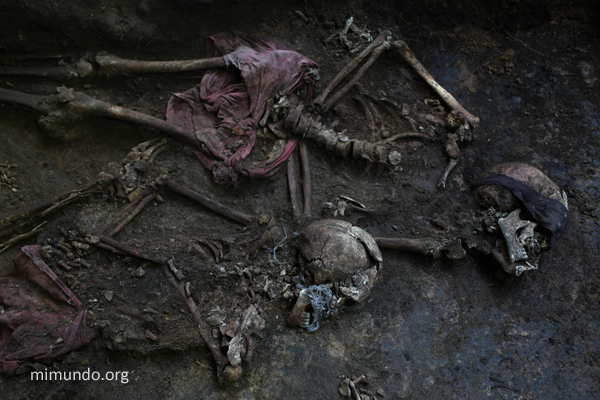
As this image displays, most of the 24 human remains found in Mass Grave 16 were found bound, tied, blindfolded and only wearing underwear.
The dig in Coban is revealing the gruesome reality of the country’s internal armed conflict, where people labeled subversives—political and student activists, Indigenous leaders and community members, and others— were kidnapped and tortured en masse. Children were also murdered before being dumped in clandestine graves at the base. All of this took place within the protective confines of a military controlled area.
Of the 28 former military areas the FAFG has dug since 1996, 24 have turned up bodies. Some of those digs are still works in progress, while more military bases, zones and detachments remain to be investigated. The dig at CREOMPAZ has turned up by far the largest number of corpses of any base.
“When the peace accords were signed, many military bases or detachments were reduced and closed. But the military remained here the whole time,” said Suasnavar of the base at Coban. “They say to us ‘we didn’t know that that happened, it was another time, it was other people, but you found it so there’s no other option than to keep working,’ right, those have been the words that they use with respect to our findings. But the continuity in the structure and function and the territorial control of this location has been strictly military.”
Regardless of the mass graves at the base, military and police training continues there, supported by countries like the US and Canada.
“The facilities have a sort of rank as a military organization of the United Nations, in fact the Guatemalan soldiers and officials that are based there wear the distinctive blue helmets,” said Iduvina Hernández Batres from the Guatemala City based organization Security and Democracy (Sedem). “This is happening, and this unit exists there, regardless of the fact that this property has been documented to have constituted an enormous clandestine cemetery.”
In 2011, the Ottawa-based Pearson Centre carried out a workshop at CREOMPAZ about “police and military cooperation in peace operations.” [2] Canada’s Department of Foreign Affairs and International Trade and the US Southern Command jointly funded the event. Soldiers trained at CREOMPAZ have been deployed as part of UN missions in Haiti and the Democratic Republic of Congo.
For some, like Ka’koj Ba Tiul, a Maya Poqomchi’ anthropologist and professor, CREOMPAZ has received an unwarranted facelift by rebranding the military base as a peacekeeping center.
“It is a school of assassins. The hidden side is the training of teams of military counterintelligence,” said Ba Tiul, who calls CREOMPAZ “the little School of the Americas.”
“There are instructors from Argentina, instructors from Chile, instructors from Colombia, instructors from North America, and instructors from Israel,” said Ba Tiul in an interview at his home just over a dozen kilometers from the base. “It is where they are training all of those who will form part of the modern counterinsurgency model for Guatemala and Central America.”
Dawn Paley is a freelance journalist. See more of her work at her website, dawnpaley.ca. Images by James Rodríguez. See more of his work at mimundo.org.
[1] http://www.canadainternational.gc.ca/guatemala/development-developpement/start.aspx?lang=eng&view=d
Indigenous Guatemalans want justice for 6 dead
Press TV – October 6, 2012
Clashes between Guatemalan security forces and thousands of indigenous people holding a demonstration against rising electricity prices in a poor rural area west of the capital have left six people dead.
On Friday, thousands of people attended the funeral processions of the six peasants who died on Thursday. The mourners shouted “Justice! Justice!”
“We’ve determined that the number of people who died rose to six,” said Ana Julia Solis, a spokesperson for the national human rights prosecutor’s office.
The government said demonstrators were blockading a highway near the town of Totonicapan, about 170 kilometers west of Guatemala City, when unidentified gunmen opened fire, killing six people and injuring 34. However, local activists said soldiers and police killed the protesters.
At a press conference on Friday, Guatemalan President Otto Perez said the military was not involved in the killings, adding that he had information that attackers in a civilian truck opened fire on the demonstrators.
Related articles
- Guatemala demonstrators killed while protesting electricity rates (alethonews.wordpress.com)
Featured Video
Why the U.S. Should Pull Back From the First Island Chain
or go to
Aletho News Archives – Video-Images
From the Archives
Only 19.7% of Americans agree with US State Dept on Israeli settlements
… Most American adults of voting age don’t appear willing to reject the applicability of international law to Israel’s ongoing colonization of occupied territories in East Jerusalem, the West Bank and Golan Heights. … Full article
Blog Roll
 Aletho News
- Albania on fire: who’s behind the riots?
- Egypt’s Civil Democratic Movement rejects involvement in regional war
- Egypt collaborates with Israel to build ‘Green Rafah’ project over erased Palestinian city
- Rising fuel prices and shortages have helped drive ongoing protests and rioting in France
- Tokyo protests demand Takaichi’s resignation over support for ‘Israel’
- Jennifer Kavanagh: Why the U.S. Should Pull Back From the First Island Chain
- Yemen denounces international community’s silence on Saudi aggression, siege
- UAE and Saudi Arabia move toward renewed coordination against Sanaa
- How Iran’s two-week retaliatory strikes exposed cracks in US military architecture in Persian Gulf
- The mother of all propaganda: Why the hype over US MOAB strike against Iran is nothing but theater
- If Americans Knew
- What the UK Is Doing to Pro-Palestine Novelist Sally Rooney Is an Act of Orwellian Villainy
- ‘We will build palaces for Jews in Gaza’: Right-wing activists establish new outpost near border
- ‘You see us burning, you stay silent’: Family’s agony over mother and sons burned to death in Gaza tent
- Israel keeps Palestinian journalist Bushra al-Tawil in isolation for 46 days
- US-Israel integration plan puts US military tech in Israel’s hands
- Israeli Strike Burns Gaza Mother Alive in Front of Toddler, ‘Without Generating Any Headlines’
- ‘The Israel Experience with Mike Huckabee’: The Ambassador’s Family Sells Trips to Israel
- As Gazans carry out mass burial, food insecurity is getting worse – Daily Update
- Israeli rabbi permits occupiers to steal Palestinian olive harvest in West Bank
- Netanyahu’s spin on latest settler attack is laughable – Daily Update
- No Tricks Zone
- Predictions Made By Renowned Climate Proifessor Over Past Decades Have Been Proven To Be Poor
- New Study Suggests Large Regions Of The Pacific Ocean Have Been Cooling For The Last 80 Years
- Germany’s Green Energy Debacle: High Energy Costs Force Kahla Porzellan to Close After 182 Years!
- New Study: 50 Years Of The Most Aggressive ‘Net Zero’ Policies Can Only Affect The Global Climate By 0.03°C
- US September “Heat” Was No Record…Many Records Set Decades Ago
- Latest European Green Energy Debacle; Portugal’s Largest Flagship Solar Park Insolvent!
- Green Energy Debacle: German Expert Professor Fritz Vahrenholt Warns Of Severe Economic And Social Consequences
- Two More Paleo Reconstructions Affirm Meters-Higher Sea Levels Across Ireland, Brazil 7000-6000 Years Ago
- New Study: Earth And Venus Surface Warmth Largely Explained By Convection And Lapse Rate, Not CO2 Or Radiation
- 2025 Nature Paper Claiming Worsening Global Drought Gets RETRACTED …Heavily Flawed

