Guatemalan Court Sentences Ex-Police Chief for Murdering 37
teleSUR | January 19, 2015
A Guatemalan court found Pedro Garcia Arredondo guilty of murder, attempted murder, and crimes against humanity Monday for the massacre of 37 people at the Spanish embassy in Guatemala 35 years ago, EFE reports.
Garcia Arredondo, 69, is responsible for burning the victims of the massacre to death on Jan. 31, 1980, found the court after four months of hearings.
The tribunal outcome confirmed the long-held suspicions in the country that the fire was the result of a “clandestine police operation” and that the participants “prevented the Red Cross, emergency services, and journalists from entering” the building.
The former police chief was still trying to declare his innocence, but Judge Sara Yoc Yoc ruled that he gave the orders to burn down the embassy. According to her ruling, Garcia Arredondo “used the media to confirm the deaths of those inside the embassy.”
The security forces of Guatemala’s military regime at the time attacked the Spanish embassy after rural workers and students occupied it in protest to the dictatorship.
Among the 37 burned to death was Spanish Consul Jaime Ruiz del Arbol Soler and Vicente Menchu and Francisco Tum, the father and cousin, respectively, of 1992 Nobel Prize Winner Rigoberta Menchu. Menchu gave the first testimony against Garcia Arredondo in the case.
Just two people survived the fire, including the Spanish ambassador. The other, Guatemalan farmer Gregorio Yuja, subsequently disappeared and his body was found with evidence of torture three days after the fire in the rectory of the State University of San Carlos of Guatemala. Yuja has since become a symbol of the left-wing student movement.
Garcia Arredondo was first arrested in 2011 over the forced disappearance of a university student, also in 1980. He is three years into a 70 year sentence for that crime.
New frontiers for oil palm
Communities lose out to oil palm plantations
GRAIN | September 22, 2014
Palm oil is not something you would associate with a Mexican kitchen. But go to any supermarket in the country, and you will find countless products containing it. The country’s food system has changed immensely since the North American Free Trade Agreement (NAFTA) came into effect in 1994 and multinational companies moved in to take control of the country’s food supply. The alarming rate of obesity, now higher than that of the US, is one manifestation of Mexico’s changing food landscape, and tied to this is the escalating consumption of palm oil.
Palm oil consumption has increased by over four times since NAFTA was signed, and it now accounts for one quarter of the vegetable oil consumed by the average Mexican, up from 10% in 1996. Other countries in Latin America undergoing similar changes to their food systems have also increased their consumption of palm oil. Venezuelans have doubled their intake, and Brazilians are consuming 5 times what they did in 1996.
This growing consumption is matched by growing production, not in Mexico, but in those countries where oil palm can be most cheaply produced. A third of Latin America’s palm oil exports now go to Mexico.
Colombia, with about 450,000 ha under production, is the biggest palm oil producer in the Americas. Since the late 1990s, Colombia’s palm oil production has taken off for several overlapping reasons, including government incentives and a national biodiesel mandate. Oil palm has also been promoted as a substitute crop for coca as part of the US-backed “Plan Colombia” – a programme aimed at ending the country’s long-standing armed conflict and curbing cocaine production. Paradoxically, palm oil is also proving a useful way for drug cartels, paramilitaries and landlords to launder money and maintain control of the countryside.
The most notorious land grabs for palm oil in Colombia have occurred in the north west Chocó province, where businessmen and paramilitaries have colluded to force Afro-Colombian communities to cede their territories for palm oil plantations and contract farming. After dozens of Afro-Colombian leaders were killed resisting such land grabs, Colombia’s Prosecutor General’s Office brought forward charges against 19 palm oil businessmen for crimes of conspiracy, forced displacement, and the invasion of ecologically important land. Three of these businessmen have so far been convicted.
Disease outbreaks have limited palm oil’s expansion in Chocó Province and most of the expansion has instead happened on the pasture lands of the central and eastern parts of the country, where the oil palm industry claims there is little deforestation and displacement of peasants. But studies show that these pasture lands are in fact typically common areas vital to peasants for the production of their food crops and the grazing of their livestock. The “pasture lands” are often the only lands that peasants have access to, and palm oil companies routinely use force and coercion, including paramilitaries, to take control of these lands from them or to force them into oppressive contract production arrangements. Across Colombia, the expansion of palm oil and the presence of paramilitaries are tightly correlated.
Ecuador, Latin America’s second largest palm oil producer, has also seen a recent expansion in oil palm production. While much of its palm oil is produced on farms of less than 50 ha, new expansion is driven by private companies who have been moving into the territories of Afro-Ecuadorians and other indigenous peoples in the Northern part of the country, leading to severe deforestation and displacement and meeting with stiff local resistance.
Land conflicts over palm oil are also erupting in Central America. In Honduras, peasants in the Aguan Valley have been killed, jailed and terrorized for trying to defend their lands and small palm oil farms from powerful national businessmen who have been grabbing their lands to expand their palm oil plantations with the backing of foreign capital. Ironically, these peasant families first moved into the forests of the Aguan in the 1970s as part of a government land reform programme, and were encouraged to grow palm oil and establish their own cooperatives. The neoliberal policies of the 1990s and a coup d’état in 2009, opened the door for powerful local businessmen like Miguel Facussé, to destroy the peasant cooperatives, violently grab lands for plantations, and reorient the supply chain towards exports for biofuels and multinational food companies. Likewise in Guatemala, where production of palm oil has quadrupled over the past decade, the palm oil sector is now entirely controlled by just eight wealthy families who have been aggressively seizing lands from indigenous communities, such as the Q’eqchi,
Some industry insiders predict that an expansion of oil palm production in Brazil will soon dwarf all other production in the region. Brazil is a net importer, and production has so far been confined to a small area of Pará, in the North. But, unlike in other regional palm oil producing countries where production is dominated by national companies and wealthy landowning families, transnational corporations have recently made significant investments in Brazilian palm oil production, such as the mining company Vale, energy companies Petrobras and Galp, and ADM, one of the world’s largest grain traders and a major shareholder in the world’s largest palm oil processor Wilmar.
Going further
Tanya M. Kerssen, “Grabbing Power: The New Struggles for Land, Food and Democracy in Northern Honduras,” FoodFirst, 1 February 2013
Human Rights Everywhere, “The flow of palm oil Colombia- Belgium/Europe: A study from a human rights perspective,” 2006
Guatemala defies ‘Monsanto Law’ pushed by US as part of trade agreement
RT | September 3, 2014
The highest court in Guatemala has suspended the controversial ‘Monsanto Law,’ a provision of a US-Central American trade agreement, that would insulate transnational seed corporations considered to have “discovered” new plant varieties.
The Constitutional Court suspended on Friday the law – passed in June and due to go into effect on Sept. 26 – after a writ of amparo was filed by the Guatemalan Union, Indigenous and Peasant Movement, which argued the law would harm the nation, LaVoz reported.
The Court’s decision came after several Guatemalan parliamentarians from both the governing Patriotic Party and the opposition party Renewed Democratic Freedom said they would consider repealing the law after outcry from a diverse cross-section of Guatemalans.
The decision also offers interested parties 15 days to present their arguments pertaining to the law in front of the Constitutional Court. Members of both political parties said they would present motions to resist the law.
The ‘Law for the Protection of New Plant Varieties,’ dubbed the ‘Monsanto Law’ by critics for its formidable seed-privatization provisions, is an obligation for all nations that signed the 2005 CAFTA-DR free trade agreement between Costa Rica, El Salvador, Guatemala, Honduras, Nicaragua, the Dominican Republic, and the United States. The agreement requires signatories to adhere to the International Convention for the Protection of New Plant Varieties.
The law offers producers of transgenic seeds, often corporate behemoths like Monsanto, strict property rights in the event of possession or exchange of original or harvested seeds of protected varieties without the breeder’s authorization. A breeder’s right extends to “varieties essentially derived from the protected variety,” thus, a hybrid of a protected and unprotected seed belongs to the protected seed’s producer.
The Rural Studies Collective (Cer-Ixim) warned that the law would monopolize agriculture processes, severely threaten food sovereignty – especially those of indigenous peoples – and would sacrifice national biodiversity “under the control of domestic and foreign companies.”
The National Alliance for Biodiversity Protection said in July that the law is unconstitutional “because it violates the rights of peoples. It will benefit transnational seed companies such as Monsanto, Duwest, Dupont, Syngenta, etc.”
“According to this law, the rights of plant breeders are superior to the rights of peoples to freely use seeds,” the Alliance said in a statement.
“It’s a direct attack on the traditional knowledge, biodiversity, life, culture, rural economy and worldview of Peoples, and food sovereignty,” the Alliance added.
Anyone who violates the law, wittingly or not, could face a prison term of one to four years, and fines of US$130 to $1,300.
It is unclear what options the Guatemalan government has given the obligations under CAFTA-DR. The US would likely put pressure on the nation to pass the law, part of a global effort using trade agreements to push further corporate control over trade sectors like agriculture in the name of modernization. Upon further refusal, the US could drop Guatemala from the trade agreement.
Oligarchs, Demagogues, and Mass Revolts against Democracy
By James Petras | The People’s Voice | December 28, 2013
In ancient Rome, especially during the late Republic, oligarchs resorted to mob violence to block, intimidate, assassinate or drive from power the dominant faction in the Senate. While neither the ruling or opposing factions represented the interests of the plebeians, wage workers, small farmers or slaves, the use of the ‘mob’ against the elected Senate, the principle of representative government and the republican form of government laid the groundwork for the rise of authoritarian “Caesars” (military rulers) and the transformation of the Roman republic into an imperial state.
Demagogues, in the pay of aspiring emperors, aroused the passions of a motley array of disaffected slum dwellers, loafers and petty thieves (ladrones) with promises, pay-offs and positions in a New Order. Professional mob organizers cultivated their ties with the oligarchs ‘above’ and with professional demonstrators ‘below’. They voiced ‘popular grievances’ and articulated demands questioning the legitimacy of the incumbent rulers, while laying the groundwork for the rule by the few. Usually, when the pay-master oligarchs came to power on a wave of demagogue-led mob violence, they quickly suppressed the demonstrations, paid off the demagogues with patronage jobs in the new regime or resorted to a discrete assassination for ‘street leaders’ unwilling to recognize the new order’. The new rulers purged the old Senators into exile, expulsion and dispossession, rigged new elections and proclaimed themselves ‘saviors of the republic’. They proceeded to drive peasants from their land, renounce social obligations and stop food subsidies for poor urban families and funds for public works.
The use of mob violence and “mass revolts” to serve the interests of oligarchical and imperial powers against democratically-elected governments has been a common strategy in recent times.
Throughout the ages, the choreographed “mass revolt” played many roles: (1) it served to destabilize an electoral regime; (2) it provided a platform for its oligarch funders to depose an incumbent regime; (3) it disguised the fact that the oligarchic opposition had lost democratic elections; (4) it provided a political minority with a ‘fig-leaf of legitimacy’ when it was otherwise incapable of acting within a constitutional framework and (5) it allowed for the illegitimate seizure of power in the name of a pseudo ‘majority’, namely the “crowds in the central plaza”.
Some leftist commentators have argued two contradictory positions: On the one hand, some simply reduce the oligarchy’s power grab to an ‘inter-elite struggle’ which has nothing to do with the ‘interests of the working class’, while others maintain the ‘masses’ in the street are protesting against an “elitist regime”. A few even argue that with popular, democratic demands, these revolts are progressive, should be supported as “terrain for class struggle”. In other words, the ‘left’ should join the uprising and contest the oligarchs for leadership within the stage-managed revolts!
What progressives are unwilling to recognize is that the oligarchs orchestrating the mass revolt are authoritarians who completely reject democratic procedures and electoral processes. Their aim is to establish a ‘junta’, which will eliminate all democratic political and social institutions and freedoms and impose harsher, more repressive and regressive policies and institutions than those they replace. Some leftists support the ‘masses in revolt’ simply because of their ‘militancy’, their numbers and street courage, without examining the underlying leaders, their interests and links to the elite beneficiaries of a ‘regime change’.
All the color-coded “mass revolts” in Eastern Europe and the ex-USSR featured popular leaders who exhorted the masses in the name of ‘independence and democracy’ but were pro-NATO, pro-(Western) imperialists and linked to neo-liberal elites. Upon the fall of communism, the new oligarchs privatized and sold off the most lucrative sectors of the economy throwing millions out of work, dismantled the welfare state and handed over their military bases to NATO for the stationing of foreign troops and the placement of missiles aimed at Russia.
The entire ‘anti-Stalinist’ left in the US and Western Europe, with a few notable exceptions, celebrated these oligarch-controlled revolts in Eastern Europe and some even participated as minor accomplices in the post-revolt neo-liberal regimes. One clear reason for the demise of “Western Marxism” arose from its inability to distinguish a genuine popular democratic revolt from a mass uprising funded and stage-managed by rival oligarchs!
One of the clearest recent examples of a manipulated ‘people’s power’ revolution in the streets to replace an elected representative of one sector of the elite with an even more brutal, authoritarian ‘president’ occurred in early 2001 in the Philippines. The more popular and independent (but notoriously corrupt) President Joseph Estrada, who had challenged sectors of the Philippine elite and current US foreign policy (infuriating Washington by embracing Venezuela’s Hugo Chavez), was replaced through street demonstrations of middle-class matrons with soldiers in civvies by Gloria Makapagal-Arroyo. Mrs. Makapagal-Arroyo, who had close links to the US and the Philippine military, unleashed a horrific wave of brutality dubbed the ‘death-squad democracy’. The overthrow of Estrada was actively supported by the left, including sectors of the revolutionary left, who quickly found themselves the target of an unprecedented campaign of assassinations, disappearances, torture and imprisonment by their newly empowered ‘Madame President’.
Past and Present Mass Revolts Against Democracy: Guatemala, Iran, and Chile
The use of mobs and mass uprisings by oligarchs and empire builders has a long and notorious history. Three of the bloodiest cases, which scarred their societies for decades, took place in Guatemala in 1954, Iran in 1953, and Chile in 1973.
Democratically-elected Jacobo Árbenz was the first Guatemalan President to initiate agrarian reform and legalize trade unions, especially among landless farm workers. Árbenz’s reforms included the expropriation of unused, fallow land owned by the United Fruit Company, a giant US agro-business conglomerate. The CIA used its ties to local oligarchs and right-wing generals and colonels to instigate and finance mass-protests against a phony ‘communist-takeover’ of Guatemala under President Arbenz. The military used the manipulated mob violence and the ‘threat’ of Guatemala becoming a “Soviet satellite”, to stage a bloody coup. The coup leaders received air support from the CIA and slaughtered thousands of Arbenz supporters and turned the countryside into ‘killing fields’. For the next 50 years political parties, trade unions and peasant organizations were banned, an estimated 200,000 Guatemalans were murdered and millions were displaced.
In 1952 Mohammed Mossadegh was elected president of Iran on a moderate nationalist platform, after the overthrow of the brutal monarch. Mossadegh announced the nationalization of the petroleum industry. The CIA, with the collaboration of the local oligarchs, monarchists and demagogues organized ‘anti-communist’ street mobs to stage violent demonstrations providing the pretext for a monarchist- military coup. The CIA-control Iranian generals brought Shah Reza Pahlavi back from Switzerland and for the next 26 years Iran was a monarchist-military dictatorship, whose population was terrorized by the Savak, the murderous secret police.
The US oil companies received the richest oil concessions; the Shah joined Israel and the US in an unholy alliance against progressive nationalist dissidents and worked hand-in-hand to undermine independent Arab states. Tens of thousands of Iranians were killed, tortured and driven into exile. In 1979, a mass popular uprising led by Islamic movements, nationalist and socialist parties and trade unions drove out the Shah-Savak dictatorship. The Islamists installed a radical nationalist clerical regime, which retains power to this day despite decades of a US-CIA-funded destabilization campaign which has funded both terrorist groups and dissident liberal movements.
Chile is the best-known case of CIA-financed mob violence leading to a military coup. In 1970, the democratic socialist Dr. Salvador Allende was elected president of Chile. Despite CIA efforts to buy votes to block Congressional approval of the electoral results and its manipulation of violent demonstrations and an assassination campaign to precipitate a military coup, Allende took office.
During Allende’s tenure as president the CIA financed a variety of “direct actions” –from paying the corrupt leaders of a copper workers union to stage strikes and the truck owners associations to refuse to transport goods to the cities, to manipulating right-wing terrorist groups like the Patria y Libertad (Fatherland and Liberty) in their assassination campaigns. The CIA’s destabilization program was specifically designed to provoke economic instability through artificial shortages and rationing, in order to incite middle class discontent. This was made notorious by the street demonstrations of pot-banging housewives. The CIA sought to incite a military coup through economic chaos. Thousands of truck owners were paid not to drive their trucks leading to shortages in the cities, while right-wing terrorists blew up power stations plunging neighborhoods into darkness and shop owners who refused to join the ‘strike’ against Allende were vandalized. On September 11, 1973, to the chants of ‘Jakarta’ (in celebration of a 1964 CIA coup in Indonesia), a junta of US-backed Chilean generals grabbed power from an elected government. Tens of thousands of activists and government supporters were arrested, tortured, forced into exile or killed. The dictatorship denationalized and privatized its mining, banking and manufacturing sectors, following the free market dictates of Milton Friedman-trained economists (the so-call “Chicago Boys”). The dictatorship overturned 40 years of welfare, labor and land-reform legislation which had made Chile the most socially advanced country in Latin America. With the generals in power, Chile became the ‘neo-liberal model’ for Latin America. Mob violence and the so-called “middle class revolt”, led to the consolidation of oligarchic and imperial rule and a 17-year reign of terror under General Augusto Pinochet dictatorship. The whole society was brutalized and with the return of electoral politics, even former ‘leftist’ parties retained the dictatorship’s neo-liberal economic policies, its authoritarian constitution and the military high command. The ‘revolt of the middle class’ in Chile resulted in the greatest concentration of wealth in the hands of the oligarchs in Latin America to this day!
The Contemporary Use and Abuse of “Mass Revolts”: Egypt, Ukraine, Venezuela, Thailand, and Argentina
In recent years “mass revolt” has become the instrument of choice when oligarchs, generals and other empire builders seek ‘regime change’. By enlisting an assortment of nationalist demagogues and imperial-funded NGO ‘leaders’, they set the conditions for the overthrow of democratically elected governments and stage-manage the installment of their own “free market” regimes with dubious “democratic” credentials.
Not all the elected regimes under siege are progressive. Many ‘democracies’, like the Ukraine, are ruled by one set of oligarchs. In the Ukraine, the elite supporting President Viktor Yanukovich, decided that entering into a deep client-state relationship with the European Union was not in their interests, and sought to diversify their international trade partners while maintaining lucrative ties with Russia. Their opponents, who are currently behind the street demonstrations in Kiev, advocate a client relationship with the EU, stationing of NATO troops, and cutting ties with Russia. In Thailand, the democratically-elected Prime Minister, Yingluck Shinawatra, represents a section of the economic elite with ties and support in the rural areas, especially the North-East, as well as deep trade relations with China. The opponents are urban-based, closer to the military-monarchists and favor a straight neo-liberal agenda linked to the US against the rural patronage-populist agenda of Ms. Shinawatra.
Egypt’s democratically-elected Mohamed Morsi government pursued a moderate Islamist policy with some constraints on the military and a loosening of ties with Israel in support of the Palestinians in Gaza. In terms of the IMF, Morsi sought compromise. The Morsi regime was in flux when it was overthrown: not Islamist nor secular, not pro-worker but also not pro-military. Despite all of its different pressure groups and contradictions, the Morsi regime permitted labor strikes, demonstrations, opposition parties, freedom of the press and assembly. All of these democratic freedoms have disappeared after waves of ‘mass street revolts’, choreographed by the military, set the conditions for the generals to take power and establish their brutal dictatorship – jailing and torturing tens of thousands and outlawing all opposition parties.
Mass demonstrations and demagogue-led direct actions also actively target democratically elected progressive governments, like Venezuela and Argentina, in addition to the actions against conservative democracies cited above. Venezuela, under Presidents Hugo Chavez and Vicente Maduro advances an anti-imperialist, pro-socialist program. ‘Mob revolts’ are combined with waves of assassinations, sabotage of public utilities, artificial shortages of essential commodities, vicious media slander and opposition election campaigns funded from the outside. In 2002, Washington teamed up with its collaborator politicians, Miami and Caracas-based oligarchs and local armed gangs, to mount a “protest movement” as the pretext for a planned business-military coup. The generals and members of the elite seized power and deposed and arrested the democratically-elected President Chavez. All avenues of democratic expression and representation were closed and the constitution annulled. In response to the kidnapping of ‘their president’, over a million Venezuelans spontaneously mobilized and marched upon the Presidential palace to demand the restoration of democracy and Hugo Chavez to the presidency. Backed by the large pro-democracy and pro-constitution sectors of the Venezuelan armed forces, the mass protests led to the coup’s defeat and the return of Chavez and democracy. All democratic governments facing manipulated imperial-oligarchic financed mob revolts should study the example of Venezuela’s defeat of the US-oligarch-generals’ coup. The best defense for democracy is found in the organization, mobilization and political education of the electoral majority. It is not enough to participate in free elections; an educated and politicized majority must also know how to defend their democracy in the streets as well as at the ballot box.
The lessons of the 2002 coup-debacle were very slowly absorbed by the Venezuelan oligarchy and their US patrons who continued to destabilize the economy in an attempt to undermine democracy and seize power. Between December 2002 and February 2003, corrupt senior oil executives of the nominally ‘public’ oil company PDVSA (Petróleos de Venezuela) organized a ‘bosses’ lockout stopping production, export and local distribution of oil and refined petroleum products. Corrupt trade union officials, linked to the US National Endowment for Democracy, mobilized oil workers and other employees to support the lock-out, in their attempt to paralyze the economy. The government responded by mobilizing the other half of the oil workers who, together with a significant minority of middle management, engineers and technologists, called on the entire Venezuelan working class to take the oil fields and installations from the ‘bosses’. To counter the acute shortage of gasoline, President Chavez secured supplies from neighboring countries and overseas allies. The lockout was defeated. Several thousand supporters of the executive power grab were fired and replaced by pro-democracy managers and workers.
Having failed to overthrow the democratic government via “mass revolts”, the oligarchs turned toward a plebiscite on Chavez’ rule and later called for a nation-wide electoral boycott, both of which were defeated. These defeats served to strengthen Venezuela’s democratic institutions and decreased the presence of opposition legislators in the Congress. The repeated failures of the elite to grab power led to a new multi-pronged strategy using: (1) US-funded NGO’s to exploit local grievances and mobilize residents around community issues; (2) clandestine thugs to sabotage utilities, especially power, assassinate peasant recipients of land reform titles, as well as prominent officials and activists; (3) mass electoral campaign marches, and (4) economic destabilization via financial speculation, illegal foreign exchange trading, price gouging and hoarding of basic consumer commodities. The purpose of these measures is to incite mass discontent, using their control of the mass media to provoke another ‘mass revolt’ to set the stage for another US-backed ‘power grab’. Violent street protests by middle class students from the elite Central University were organized by oligarch-financed demagogues. ‘Demonstrations’ included sectors of the middle class and urban poor angered by the artificial shortages and power outages. The sources of popular discontent were rapidly and effectively addressed at the top by energetic government measures: business owners engaged in hoarding and price gouging were jailed; prices of essential staples were reduced; hoarded goods were seized from warehouses and distributed to the poor; the import of essential goods was increased and saboteurs were pursued. The Government’s effective intervention resonated with the mass of the working class, the lower-middle class and the rural and urban poor and restored their support. Government supporters took to the streets and lined up at the ballot box to defeat the campaign of destabilization. The government won a resounding electoral mandate allowing it to move decisively against the oligarchs and their backers in Washington.
The Venezuelan experience shows how energetic government counter-measures can restore support and deepen progressive social changes for the majority. This is because forceful progressive government intervention against anti-democratic oligarchs, combined with the organization, political education and mobilization of the majority of voters can decisively defeat these stage-managed mass revolts.
Argentina is an example of a weakened democratic regime trying to straddle the fence between the oligarchs and the workers, between the combined force of the agro-business and mining elites and working and middle class constituencies dependent on social policies. The elected-Kirchner-Fernandez government has faced “mass revolts” in the a series of street demonstrations whipped up by conservative agricultural exporters over taxes; the Buenos Aires upper-middle class angered at ‘crime, disorder and insecurity’, a nationwide strike by police officials over ‘salaries’ who ‘looked the other way’ while gangs of ‘lumpen’ street thugs pillaged and destroyed stores. Taken altogether, these waves of mob action in Argentina appear to be part of a politically-directed destabilization campaign by the authoritarian Right who have instigated or, at least, exploited these events. Apart from calling on the military to restore order and conceding to the ‘salary’ demands of the striking police, the Fernandez government has been unable or unwilling to mobilize the democratic electorate in defense of democracy. The democratic regime remains in power but it is under siege and vulnerable to attack by domestic and imperial opponents.
Conclusion
Mass revolts are two-edged swords: they can be a positive force when they occur against military dictatorships like Pinochet or Mubarak, against authoritarian absolutist monarchies like Saudi Arabia, a colonial-racist state like Israel, and imperial occupations like against the US in Afghanistan. But they have to be directed and controlled by popular local leaders seeking to restore democratic majority rule.
History, from ancient times to the present, teaches us that not all ‘mass revolts’ achieve, or are even motivated by, democratic objectives. Many have served oligarchs seeking to overthrow democratic governments, totalitarian leaders seeking to install fascist and pro-imperial regimes, demagogues and authoritarians seeking to weaken shaky democratic regimes and militarists seeking to start wars for imperial ambitions.
Today, “mass revolts” against democracy have become standard operational procedure for Western European and US rulers who seek to circumvent democratic procedures and install pro-imperial clients. The practice of democracy is denigrated while the mob is extolled in the imperial Western media. This is why armed Islamist terrorists and mercenaries are called “rebels” in Syria and the mobs in the streets of Kiev (Ukraine) attempting to forcibly depose a democratically-elected government are labeled “pro-Western democrats”.
The ideology informing the “mass revolts” varies from “anti-communist” and “anti-authoritarian” in democratic Venezuela, to “pro-democracy” in Libya (even as tribal bands and mercenaries slaughter whole communities), Egypt and the Ukraine.
Imperial strategists have systematized, codified and made operational “mass revolts” in favor of oligarchic rule. International experts, consultants, demagogues and NGO officials have carved out lucrative careers as they travel to ‘hot spots’ and organize ‘mass revolts’ dragging the target countries into deeper ‘colonization’ via European or US-centered ‘integration’. Most local leaders and demagogues accept the double agenda: ‘protest today and submit to new masters tomorrow’. The masses in the street are fooled and then sacrificed. They believe in a ‘New Dawn’ of Western consumerism, higher paid jobs and greater personal freedom … only to be disillusioned when their new rulers fill the jails with opponents and many former protestors, raise prices, cut salaries, privatize state companies, sell off the most lucrative firms to foreigners and double the unemployment rate.
When the oligarchs ‘stage-manage’ mass revolts and takeover the regime, the big losers include the democratic electorate and most of the protestors. Leftists and progressives, in the West or in exile, who had mindlessly supported the ‘mass revolts’ will publish their scholarly essays on ‘the revolution (sic) betrayed” without admitting to their own betrayal of democratic principles.
If and when the Ukraine enters into the European Union, the exuberant street demonstrators will join the millions of jobless workers in Greece, Portugal, and Spain, as well as millions of pensioners brutalized by “austerity programs” imposed by their new rulers, the ‘Troika’ in Brussels. If these former demonstrators take to the streets once more, in disillusionment at their leaders’ “betrayal”, they can enjoy their ‘victory’ under the batons of “NATO and European Union-trained police” while the Western mass media will have moved elsewhere in support of ‘democracy’.
Washington’s Real Aims in Colombia
Mythmaking in the Washington Post
By Nick Alexandov | CounterPunch | December 27, 2013
Last Sunday’s Washington Post carried a front-page article by Dana Priest, in which she revealed “a CIA covert action program that has helped Colombian forces kill at least two dozen rebel leaders.” Thanks to “a multibillion-dollar black budget”—“not a part of the public $9 billion package of mostly U.S. military aid called Plan Colombia”—as well as “substantial eavesdropping help from the National Security Agency,” the initiative has been successful, in Priest’s assessment, decimating the Revolutionary Armed Forces of Colombia (FARC) guerrillas, as the country’s “vibrant economy” and “swanky Bogota social scene” flourish.
The lengthy piece offers a smorgasbord of propagandistic assertions, pertaining both to Washington’s Colombia policies, and to its foreign conduct in general. For a sampling of the latter, consider one of the core assumptions underlying Priest’s report—namely, that our noble leaders despise drugs. The FARC’s “links with the narcotics trade” and “drug trafficking” motivated U.S. officials to destroy their organization, we’re supposed to believe. True, CIA informants in Burma (1950s), Laos (1970s), and Afghanistan (1980s) exploited their Agency ties “to become major drug lords, expanding local opium production and shipping heroin to international markets, the United States included,” Alfred W. McCoy’s research demonstrates. True, a few decades ago the Office of the United States Trade Representative joined “with the Departments of Commerce and State as well as leaders in Congress” for the purpose of “promoting tobacco use abroad,” the New York Times reported in 1988, quoting health official Judith L. Mackay, who described the resulting “tobacco epidemic” devastating the Philippines, Malaysia, and other countries: “smoking-related illnesses, like cancer and heart disease” had surpassed “communicable diseases as the leading cause of death in parts of Asia.” True, the DEA shut down its Honduran office in June 1983, apparently because agent Thomas Zepeda was too scrupulous, amassing evidence implicating top-level military officials in drug smuggling—an inconvenient finding, given Honduras’ crucial role in Washington’s anti-Sandinista assault, underway at the time.
But these events are not part of History, as the subject has been constructed in U.S. schools. It’s common to read, every year or so, an article in one of the major papers lamenting the fact that “American students are less proficient in their nation’s history than in any other subject,” as Sam Dillon wrote in a 2011 piece for the Times. The charge is no doubt true, as far as it goes: Dillon explained that only a “few high school seniors” tested were “able to identify China as the North Korean ally that fought American troops during the Korean War,” for example. But the accusation is usually leveled to highlight schools’ inadequacies, with little examination of the roles these institutions are meant to serve. And the indictments are hardly novel: in 1915, a Times story on New York City’s public schools complained their graduates “can not spell simple words,” were incapable of finding “cities and States” on a map, and so on. That piece explicitly critiqued graduates’ abilities to function as disciplined wage-earners, and so was more honest than the majority of today’s education coverage. The simple fact is “that the public schools are social institutions dedicated not to meeting the self-perceived needs of their students [e.g., by providing an understanding of how the world works] but to preserving social peace and prosperity within the context of private property and the governmental structures that safeguard it,” David Nasaw concludes in his fascinating history of the subject. Private schools, to be sure, are similar in essential respects. And one result of this schooling is that well-educated journalists can repeat myths about U.S. foreign policy, as their well-educated readers nod in blind assent.
The notion that U.S. officials have a coherent counterdrug policy is, again, one of these myths. In addition to the historical examples of U.S. support for drug traffickers cited above, we can note that the slur “narco-guerrilla,” which Washington uses to imply that the FARC is somehow unique for its involvement in the narcotics trade, ought to be at least supplemented by—if not abandoned in favor of—“narco-paramilitary.” Commentators tend to discuss the paramilitaries and the Colombian state separately, presupposing the former are “rogue” entities—another myth—when it would be better to view them, with Human Rights Watch, as the Colombian Army’s unofficial “Sixth Division,” acting in close conformity with governmental aims. Paramilitary leader Carlos Castaño admitted in March 2000 that some 70% of the armed groups’ funding came from drug trafficking, and U.S. intelligence agencies took no issue with his estimate—and “have consistently reported over a number of years that the paramilitaries are far more heavily involved than the FARC in drug cultivation, refinement and transshipment to the U.S.,” International Security specialist Doug Stokes emphasizes.
When these substances enter our country, they become a key pretext for the skyrocketing incarceration rate, which has more people imprisoned for drug offenses today than were incarcerated for all offenses in 1980, criminologist Randall Shelden has pointed out, with rates of arrest and sentencing durations especially severe for blacks. “Every criminal prohibition has that same touch to it, doesn’t it?” legal historian Charles Whitebread once asked. “It is enacted by US,” he stressed, “and it always regulates the conduct of THEM”—“you know, them criminals, them crazy people, them young people, them minority group members,” he added sardonically. Reviewing the history of marijuana prohibition, Whitebread noted that, at the Marihuana Tax Act hearings in 1937, two men spoke regarding the drug’s medical effects. One was Dr. William C. Woodward, Chief Counsel to the American Medical Association, who explained his organization had found “no evidence that marihuana is a dangerous drug.” “Doctor,” a Congressman complained, “if you can’t say something good about what we are trying to do, why don’t you go home?” The second was a Temple University pharmacologist, “who claimed that he had injected the active ingredient in marihuana into the brains of 300 dogs, and two of those dogs had died.” When one Congressman asked him whether he had experimented on dogs because of some similarity they bore to humans, the pharmacologist professed ignorance: “I wouldn’t know, I am not a dog psychologist.”
That was the extent of the medical basis for outlawing marijuana in the U.S., as threadbare as the anti-drug pretexts of Washington’s Colombia policies. Nearly four years after Plan Colombia’s 1999 announcement, for example, the U.S. General Accounting Office reported that “the Departments of State and Defense [had] still not developed estimates of future program costs, defined their future roles in Colombia, identified a proposed end state, or determined how they plan[ned] to achieve it.” But while efforts to reduce coca cultivation and cocaine production were poorly articulated—and failed consistently—other endeavors met with great success. For example, aerial fumigation displaced some 17,000 people from the Putumayo Department, where the FARC had a major presence, in 2001 alone. The fumigation effectively converted the land from a means of subsistence into a profit source: journalist Garry Leech pointed out that, from 2003-2004, there was “a slew of new contracts signed between multinational companies and the Colombian government,” and the events in Putumayo and elsewhere suggest that Colombia’s herbicide-spraying campaign was never really aimed at illicit crops, typically described as the main target. It seems that if the point were to eradicate, say, coca, the solution would be relatively simple: let coca growers harvest something else. But Plan Colombia has consistently devoted only minimal funding for alternative development schemes, indicating the peasants’ sin isn’t growing coca, but living as subsistence farmers. That kind of activity is an inappropriate use of the land in an oil-rich region, where there are profits to be made.
A Guatemalan peasant made a similar point to author-activist Kevin Danaher, when he visited her country in 1984—shortly after School of the Americas alumnus Ríos Montt had completed his genocidal tear through the countryside. The woman, Danaher writes, “told us that soldiers had come to her home one night and hacked her husband to death, right in front of her and her three children;” the man “was a subversive,” in the military’s eyes, “because he was helping other peasants learn how to raise rabbits as a source of food and money.” Danaher struggled to understand the connection between this effort at self-sufficiency, and the brutal end its advocate met. “Look,” the widow explained, “the plantations down along the coast that grow export crops are owned by generals and rich men who control the government. A big part of their profit comes from the fact that we peasants are so poor we are forced to migrate to the plantations each year and work for miserable wages in order to survive.” Were she and other Guatemalan peasants to become self-reliant, they “would never work on the plantations again”—an indication of the severe threat rabbit-raising posed.
This woman’s remarks indicated who Washington’s real enemy was in Guatemala, and throughout the world. The U.S. government was not opposed merely to “Communists,” real or imagined, during the Cold War, and in Colombia its policies have helped ruin—or end—the lives of millions of destitute individuals beyond the FARC’s top officials. Of course, Sunday’s Post article ignores this fact, portraying the struggle as one between the U.S. government and its Colombian allies on one side, and aggressive guerrillas on the other. But we can expect little else from this mythmaker of record.
Land Grabs, the Latest Form of Genocide in Guatemala

By Leonor Hurtado – Americas Program – 12/06/2013
In a historic decision this May, Guatemala’s Supreme Court of Justice sentenced former dictator General Ríos Montt to 80 years in prison for the genocidal massacres of indigenous people in the 1980s. Many Guatemalans hoped that the judicial process against the top criminals of the country’s “dirty war” would finally bring justice—but ten days after the decision, the Constitutional Court reversed the judgment.
While the Guatemalan people protest this violation of the rule of law, the processes of genocide initiated 30 years ago by Ríos Montt’s massacres continue today by other means.
In the last decade, the expansion of oil palm plantations and sugarcane production for ethanol in northern Guatemala has displaced hundreds of Maya-Q´eqchi´ peasant families, increasing poverty, hunger, unemployment and landlessness in the region, according to a new Food First report by Alberto Alfonso-Fradejas, “Sons and Daughters of the Earth: Indigenous Communities and Land Grabs in Guatemala.”
There is a major contradiction here: at the same time that the former General Ríos Montt is convicted for genocide, the Guatemalan government allows the oligarchy, allied with extractive industries, to displace entire populations without concern for the human cost. In many cases, these land grabs result in the murder and imprisonment of rural people who resist the assault.
Genocide against the indigenous peasant population in Guatemala no longer has the face of a military dictatorship supported by the United States. Now it is the corporations, the oligarchy and the World Bank who push peasants off their lands.
In today’s Guatemala, land and resource control is increasingly in the hands of a small oligarchy of powerful families allied with agri-food companies. At the center of this power are fourteen families who control the country’s sugarcane-producing companies (AZAZGUA); five companies controlling the national production of ethanol; eight families that control the production of palm oil (GREPALMA); and members of the Coordinating Committee of Agricultural, Commercial, Industrial, and Financial Associations (CACIF).
Together these powerbrokers are accumulating land and wealth with the support of investment from international institutions such as the World Bank, the Inter-American Development Bank (IDB) and the Central American Bank for Economic Integration (BCIE). The convergence of multiple global crises—finance, energy, food and environment—has directed corporate investment into land-based resources such as agrofuels, minerals, pasture and food. The situation in Guatemala is extremely violent, part of a global trend where agrarian, financial and industrial interests are grabbing control of peasant lands and resources.
Can land grabs be considered genocide? In many ways, land grabbing is a new form of genocide. Ricardo Falla’s study “What Do You Mean There Was No Genocide?” analyzes the definition of genocide and its characteristics. According to Falla, of the five acts that define genocide, two were most prominent in Guatemala: “the massacre of the members of a group,” and “the intentional subjection of a group to living conditions which will lead to their total or partial physical destruction.”
The first genocide was against the Ixil peoples during the reign of Ríos Montt. The second genocide is enacted today through the privation of the Q´eqchi´ peoples’ means of survival through land grabs. Hundreds of families have been displaced. They do not have land on which to produce food or live, and they are denied their cultural and community identity. These conditions undermine their ability to survive, and lead to their displacement, and in many cases death.
The historic genocide trial this May came about through the peoples’ long struggle to defend their rights. The Ríos Montt conviction is a condemnation of impunity. The oligarchy did everything possible to impede the trial while continuing to displace the indigenous peasant population with the support of international investment and a legal system that favors land grabbing to the detriment of the people.
On May 20, the Constitutional Court overturned the conviction, with two of the five judges opposing the decision. Pablo de Greiff, UN Special Rapporteur for the Promotion of Truth, Justice, Reparation and Guarantees of Non-Recurrence stated, “No legal decision is inconsequential, even if it is revoked.” The Inter-American Court of Justice issued a statement criticizing the verdict for violating international obligations assumed by the state and preventing the people from seeking justice. Multiple organizations and authorities have spoken out against the court’s decision, arguing that it overstepped its bounds, violated legal provisions, and endorsed the corrupt mechanisms upon which impunity is built in Guatemala. The decision bolsters evidence that Guatemala’s top court lacks political independence and is tied to the country’s economic and ruling elite.
On May 24, thousands of people demonstrated and delivered a letter with more than a thousand signatures to the Court demanding that the decision be reversed. In Argentina, Chile, Honduras, Mexico, Nicaragua and Peru, thousands more marched in solidarity to the Guatemala embassy demanding justice.
If we fail to judge and condemn the massacres committed thirty years ago, what hope is there for the Mayan Q’eqchi’, Xinka, Mam, Kaqchikel and other indigenous peoples currently being displaced and massacred by extractive corporations with the support of the state and international institutions? The people continue to courageously resist and defend their lives, lands and identities. How shall we express our solidarity?
Leonor Hurtado is a fellow at Food First/Institute for Food and Development Policy. A native of Guatemala, she has spent decades defending human rights and indigenous rights, and supporting indigenous resistance to the expansion of extractive industries.
Photo: Caracol Producciones
Related articles
- Survivors Reluctant to Testify in New Genocide Trial (ipsnews.net)
- Guatemalans protest annulment of dictator’s genocide conviction (workers.org)
- Israel’s Hand in Guatemala’s Genocide (phantomreport.com)
Conviction of former Guatemalan ruler overturned
Press TV – May 21, 2013
Guatemala’s top court has overturned the genocide conviction of the country’s former dictator Efrain Rios Montt, ordering his trial to restart.
The move came on Monday, about ten days after a three-judge panel convicted the 86-year-old of genocide and crimes against humanity, sentencing him to 80 years in prison.
The constitutional court’s secretary Martin Guzman said that the trial needed to go back to where it stood on April 19 in order to resolve several appeal issues.
The sentencing earlier this month was hailed by many Guatemalans, as it was the first time a former Latin American ruler was convicted of such crimes.
According to the panel, Rios Montt failed to prevent the killings of some 1,771 Ixil Mayans during Guatemala’s civil war.
Over 200,000 Guatemalan people were killed in the Guatemalan Civil War of 1960 to 1996, which pitted the right-wing government of Guatemala against various leftist rebel groups, mainly backed by Mayan indigenous people.
Most of the victims of the war were indigenous people.
In September 2011, Judge Carol Patricia Flores accused Rios Montt of genocide but could not prosecute him because he had immunity from prosecution as a congressman.
Related article
- Genocide in Guatemala: The Conviction of Efrain Rios Montt (alethonews.wordpress.com)
Genocide in Guatemala: The Conviction of Efrain Rios Montt
By Binoy Kampmark | Dissident Voice | May 13, 2013
It has been hailed as the first conviction for genocide of a former head of state in his own country, and certainly the first of a former Latin American strongman. Former Guatemalan dictator Efrain Rios Montt was convicted by a Guatemalan court on Friday for his participation in crimes against the Mayans during his rule in 1982 and 1983. His sentences were steep: 50 years for genocide and 30 for crimes against humanity.
As ever with genocide, evidence of an intentioned plan to destroy a race had to be shown. The three-judge panel led by Yassmin Barrios was satisfied that the definition had been made out, finding that there had been a clear and systematic plan to exterminate the Ixil people. Prosecutors allege that up to 1,700 of the Ixil Maya were killed, in addition to torture, rape and the destruction of villages. The acts had occurred as part of a policy of clearing the countryside of Marxist guerrillas and sympathisers.
The heart of the defence by Rios Montt was that, as a political leader, he could not be held accountable for military matters conducted in a rural province some few hours northwest of the Guatemalan capital. “I never authorised it, I never signed, I never proposed, I never ordered that race, ethnicity or religion to be attacked. I never did it!” In this, he was echoing the sentiments of the Japanese General Tomoyuki Yamashita, who was found constructively guilty for having not stopped the massacres that took place in the Philippines.
Yamashita did have a point, and one picked up by the dissenting judges of the U.S. Supreme Court. To hold such a figure to account in circumstances of military emergency, when contact lines were severed, and the army was fighting for its survival, was a tall order. There was little evidence that those troops had acted under his orders. But Rios Montt could hardly claim to have been Yamashita and, according to the judges, “was aware of everything that was happening, and did not stop it, despite having the power to stop it.”
The trial proved a thorough affair, featuring extensive use of forensics, the examination of mass graves and the DNA of skeletons therein. It was grim but important work, and constituted but a small part of what was a civil war of mass murder. Between 1960 and 1996, Guatemala saw conflict that claimed the lives of more than 200,000 people. Prior to that, a U.S.-sponsored overthrow of the democratically elected Jacobo Arbenz Guzman ensured that the country would be doomed to decades of bloody instability.
It is often argued that trials do not provide a means of genuine restorative healing to parties or societies. Rios Montt will not be seen as a criminal by conservatives who feel he performed a sterling job in ensuring that the country did not fall into the clutches of left wing revolutionaries. The Cold War subtext here was that he was, if anything, heroic in holding the fort.
Besides, the current Guatemalan president, Otto Perez Molina, refuses to accept that genocide ever took place. This may not be surprising given that Molina’s name came up in trial testimony, in which a former soldier claimed he had ordered executions while serving in the military of the Rios Montt regime. “When I say that Guatemala has seen no genocide, I repeat it now after this ruling. Today’s ruling is not final… the decision will not be final until the moment they run out of appeals.”
There will also be consternation that the atrocities of the government, rather than those of the rebels, have featured prominently. That the former feature, however, is due to the sheer disproportionate role played by the rulers and paramilitary allies. The 1999 report by the country’s truth and reconciliation commission claimed that the government’s role in the atrocities, along with its allies, was a hefty 93 per cent.
The soiled hands of this incident are many. They did not start or stop with Rios Montt. Will the individuals who also cast money and material the way of such regimes be held to account? A case against the higher-ups, and those complicit beyond the borders of the country may well be in the offing, though that will take time. The edifice of accountability is gradually being built. International law, as ever, takes steps not so much in strides as in awkward stumbles, but when it does reach important junctions, effects are felt. What happens with the appeal will be telling.
Binoy Kampmark can be reached at: bkampmark@gmail.com.
Related article
- Guatemala: Former Dictator Ríos Montt Guilty of Genocide (alethonews.wordpress.com)
Guatemala: Former Dictator Ríos Montt Guilty of Genocide
By Kristie Robinson | The Argentina Independent | May 10, 2013
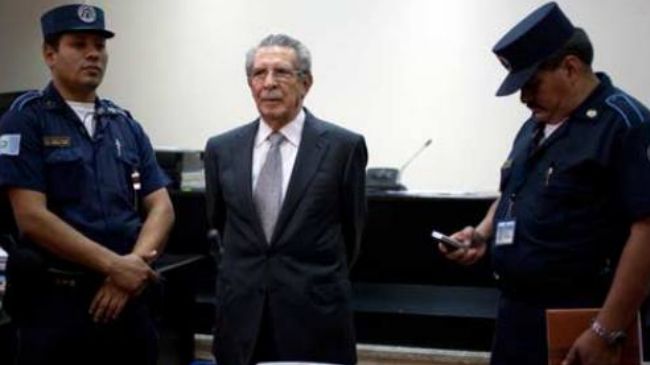 In an historic verdict, former Guatemalan dictator José Efraín Ríos Montt has been found guilty of genocide and sentenced to 50 years in prison for genocide and a further 30 for crimes against humanity. The verdict sets a global precedent, as Ríos Montt was the first former leader to be tried for genocide in a national court.
In reading her verdict, Judge Yassmin Barrios said: “We are completely convinced that in this case, elements demonstrating the intent to commit genocide have been proven … Ríos Montt, the head of state, knew exactly what was happening. He did nothing to stop it.”
Ríos Montt’s co-defendant and former head of military intelligence, José Mauricio Rodriguez Sánchez, was acquitted.
Ríos Montt came to power following a coup in 1982, during Guatemala’s 36-year civil war, in which an estimated 200,000 people, mostly of indigenous descent, were killed or disappeared.
For background on the case, see Avery Kelly’s report from 8th May 2013.
Featured Video
Why the U.S. Should Pull Back From the First Island Chain
or go to
Aletho News Archives – Video-Images
From the Archives
Only 19.7% of Americans agree with US State Dept on Israeli settlements
… Most American adults of voting age don’t appear willing to reject the applicability of international law to Israel’s ongoing colonization of occupied territories in East Jerusalem, the West Bank and Golan Heights. … Full article
Blog Roll
 Aletho News
- Albania on fire: who’s behind the riots?
- Egypt’s Civil Democratic Movement rejects involvement in regional war
- Egypt collaborates with Israel to build ‘Green Rafah’ project over erased Palestinian city
- Rising fuel prices and shortages have helped drive ongoing protests and rioting in France
- Tokyo protests demand Takaichi’s resignation over support for ‘Israel’
- Jennifer Kavanagh: Why the U.S. Should Pull Back From the First Island Chain
- Yemen denounces international community’s silence on Saudi aggression, siege
- UAE and Saudi Arabia move toward renewed coordination against Sanaa
- How Iran’s two-week retaliatory strikes exposed cracks in US military architecture in Persian Gulf
- The mother of all propaganda: Why the hype over US MOAB strike against Iran is nothing but theater
- If Americans Knew
- What the UK Is Doing to Pro-Palestine Novelist Sally Rooney Is an Act of Orwellian Villainy
- ‘We will build palaces for Jews in Gaza’: Right-wing activists establish new outpost near border
- ‘You see us burning, you stay silent’: Family’s agony over mother and sons burned to death in Gaza tent
- Israel keeps Palestinian journalist Bushra al-Tawil in isolation for 46 days
- US-Israel integration plan puts US military tech in Israel’s hands
- Israeli Strike Burns Gaza Mother Alive in Front of Toddler, ‘Without Generating Any Headlines’
- ‘The Israel Experience with Mike Huckabee’: The Ambassador’s Family Sells Trips to Israel
- As Gazans carry out mass burial, food insecurity is getting worse – Daily Update
- Israeli rabbi permits occupiers to steal Palestinian olive harvest in West Bank
- Netanyahu’s spin on latest settler attack is laughable – Daily Update
- No Tricks Zone
- Predictions Made By Renowned Climate Proifessor Over Past Decades Have Been Proven To Be Poor
- New Study Suggests Large Regions Of The Pacific Ocean Have Been Cooling For The Last 80 Years
- Germany’s Green Energy Debacle: High Energy Costs Force Kahla Porzellan to Close After 182 Years!
- New Study: 50 Years Of The Most Aggressive ‘Net Zero’ Policies Can Only Affect The Global Climate By 0.03°C
- US September “Heat” Was No Record…Many Records Set Decades Ago
- Latest European Green Energy Debacle; Portugal’s Largest Flagship Solar Park Insolvent!
- Green Energy Debacle: German Expert Professor Fritz Vahrenholt Warns Of Severe Economic And Social Consequences
- Two More Paleo Reconstructions Affirm Meters-Higher Sea Levels Across Ireland, Brazil 7000-6000 Years Ago
- New Study: Earth And Venus Surface Warmth Largely Explained By Convection And Lapse Rate, Not CO2 Or Radiation
- 2025 Nature Paper Claiming Worsening Global Drought Gets RETRACTED …Heavily Flawed

