Bahrain King Meets Rabbi: Arab-Israeli Diplomatic Ties ‘Matter of Time’

Al-Manar – March 5, 2016
The King of Bahrain has met Israeli Rabbi and ‘recommended’ that the recent blacklisting of Lebanese resistance movement, Hezbollah, as a “terrorist organization” by the Gulf Cooperation Council be taken up by the Arab League as well, Israeli daily, Jerusalem Post reported.
Hamad bin Isa al Khalifa received Rabbi Marc Schneier, and president of the Foundation of Ethnic Understanding based in New York, in the royal palace in Manama in order to discuss “concerns in the Middle East,” JP reported.
The six-member GCC formally blacklisted Hezbollah as a “terrorist organization” on Wednesday.
During Scheier’s meeting with Khalifa, the king noted that there were one or two countries among the GCC who had wanted to distinguish between Hezbollah’s military wing and its political wing, although this was rejected, the Israeli paper said.
According to Schneier, who has met with Khalifa on two other occasions, the king told him “he was advocating for the struggle against Hezbollah to be expanded as widely as possible in the Arab world, stating that the Arab League and its 22 members should take up this mantle and label the group as terrorists.”
“Iran is not only an obstacle but an opportunity for peace between Israel and Arab nations,” Schneier told The Jerusalem Post on Thursday after his meeting on Wednesday with Khalifa.
“Both Israel and the Gulf states share a common enemy, so it’s the makings of a natural alliance, in terms of joining forces against the evil of terrorism, religious extremism and fanaticism,” the Israeli Rabbi said.
“It’s a real opportunity and a silver lining in the dark cloud of terrorism. The Gulf states recognize Israel as an ally against Iran, and its ability to stabilize the region and support moderate Arab countries, so this could be a game changer in the geopolitical climate of the Middle East.”
Schneier added that Khalifa has also said during their meeting that in his opinion “it is just a matter of time before some Arab countries begin opening diplomatic ties” with the Zionist entity.
Israelis Welcome GCC Statement on Hezbollah: Reflects Rapprochement with Saudis
Al-Manar | March 3, 2016
As soon as the Gulf Cooperation Council blacklisted the Lebanese party of Resistance – Hezbollah – on Wednesday, Zionist mass media welcomed the resolution, considering it “critical and serious,” reflecting a great relief among Israelis who have been seeking to fight Hezbollah from the Arab gate.
Former Zionist foreign minister Tzipi Livni hailed the GCC resolution as “an important step, while Zionist daily Maariv stated that “blacklisting Hezbollah is an achievement that serves Israel.”
Moreover, the entity’s mass media correlated the GCC resolution against Hezbollah with “the ongoing coordination between Saudi Arabia, Israel” which has recently emerged to public through exchanging visits between both parties.
“Arab world is approaching closer to Israel’s stances, which has been revealed through the Saudi delegations’ visit to Israel, as well as when Saudi Arabia decided to blacklist Hezbollah as a terrorist organization,” the presenter of Tonight at Six talk show for Zionist Channel 1 said.
“It is very important and dramatic development,” he added.
For his part, Yoval King, an expert of Arab affairs, said that “it is an important resolution,” recalling that it is not the first time that Gulf states blacklist Hezbollah as a terrorist group.
“They had labeled him as ‘militia’, and announced that violence and provocations he is carrying out in Syria, Yemen and Iraq contradicts with the moral and humanitarian values,” King said.
The Saudi-Zionist coordination witnessed a major shift on the Syrian arena in the face of axis of Resistance, as Zionist sources revealed discussions took place between the armed groups operating in Syria on one hand, and Riyadh and Tel Aviv on the other, about the Syrian developments following the ongoing truce.
“Syrian opposition groups, funded by Qatar, Saudi Arabia and Israel are meeting with their sponsors and discussing with them whether they can make gains in the meantime,” Shmerit Maeir, a Zionist analyst of Arab affairs, said during an interview on the Jewish Channel 2.
“Israel needs a key chair on this table whether through the American players or others, because the bases will now determine whether Hezbollah is allowed to do what the ISIL and Al-Nusra Front are banned from doing. If this really is to happen, we will be facing a major catastrophe,” Maeir stressed.
The Zionist position was symmetrical to the Saudi’s, as it doesn’t rule out the possibility of communicating with the armed groups, like Al-Nusra Front and ISIL in order to coordinate for later steps in Syria.
The GCC, which has been committing a genocide in Yemen since March 2015, held a meeting on Monday during which it blacklisted all Hezbollah affiliated institutions.
GCC declares Hezbollah ‘terrorist group’
Press TV – March 2, 2016
The Arab monarchies of the Persian Gulf have declared Lebanon’s Hezbollah movement, which has been fighting terrorist groups in Syria and Israeli occupation, a “terrorist group.”
The six-nation Gulf Cooperation Council officially added Hezbollah and all groups affiliated to its so-called list of “terrorist” organizations on Wednesday.
In a statement, GCC’s Secretary General Abdullatif bin Rashid al-Zayan accused Hezbollah and associated groups of committing “acts of aggression”, recruiting “youth” inside the Persian Gulf littoral states, smuggling “weapons and explosives”, sowing “sedition” and instigating “chaos and violence.”
The bloc, however, did not provide any evidence for its allegations.
The GCC comprises Saudi Arabia, Qatar, the United Arab Emirates, Oman, Bahrain and Kuwait.
The move by the six-member bloc is the latest measure against Hezbollah, which is fighting terrorists in Syria.
In 2000 and 2006, when Israel launched two wars on Lebanon, Hezbollah fighters gave befitting responses to the Tel Aviv regime’s acts of aggression, forcing Israeli military to retreat without achieving any of its objectives.
The GCC have taken a series of measures against Hezbollah since Saudi Arabia last month halted a $4- billion aid pledge to Lebanon’s security forces.
The aid suspension came after Beirut did not follow Riyadh’s lead and refused to endorse joint anti-Iran statements at separate meetings held in Cairo and Jeddah.
On February 26, Saudi Arabia blacklisted four Lebanese firms and three individuals over alleged affiliation to Hezbollah, and imposed sanctions on them. The kingdom also ordered its citizens not to travel to Lebanon, and is poised to expel the Lebanese citizens working on its territory.
On Tuesday, Seyyed Hassan Nasrallah, the secretary general of Hezbollah said Saudi propaganda against Hezbollah has led to a political conflict in Lebanon, and advised the Lebanese youth against playing into the hands of Saudi Arabia, which he said spreads lies about Hezbollah and wrongly accuses the resistance movement of sowing sectarian strife between Shias and Sunnis.
He also denounced the Arab world’s silence in the face of Riyadh’s aggression on Yemen, where over 8,000 people have lost their lives since the Saudi onslaught began in late March last year.
Nasrallah warned that there are some Lebanese groups hoping to see a war in Lebanon just like the one Riyadh has waged against Yemen.
This comes as the Persian Gulf monarchies themselves stand accused of supporting extremists and terrorists in the region.
Lebanon PM urges national unity amid Saudi pressure
Press TV – February 26, 2016
Lebanese Prime Minister Tammam Salam has called for national unity in the face of Saudi pressure after Riyadh suspended a $4 billion in aid to Beirut amid a diplomatic row.
During a Thursday cabinet meeting, Salam highlighted the importance of national unity and urged ministers to “take into consideration the Arab consensus during the difficult and delicate crisis [the country] is passing through,” Information Minister Ramzi Joreige quoted him as saying.
Beirut-Riyadh ties have recently soured after Saudi Arabia suspended a $3-billion package to the Lebanese army and a remainder of $1 billion in aid to its internal security forces earlier this month.
The suspension came after Lebanon refused to endorse joint anti-Iran statements issued last month at separate meetings held in Cairo and Jeddah.
Riyadh also called on Tuesday on all its nationals in Lebanon to leave the country due to deteriorating political relations with Beirut.
Lebanese ministers rejected Saudi calls for apology to the kingdom. Minister of State for Parliamentary Affairs Mohammad Fneish said Beirut had “committed no wrong for which to apologize.”
Industry Minister Hussein Hajj Hassan also voiced surprise over Riyadh’s measures against Beirut. “I don’t understand this great equation: we either apologize or we must bear a collective punishment.”
Economy Minister Alain Hakim, however, urged calm and said the country should not “panic before any measures by [Persian] Gulf states because such fears harm our economy.”
Saudi severed diplomatic relations with Iran on January 3 in the wake of the attacks on two of its diplomatic missions in Iran amid the angry protests over the execution of prominent Shia cleric Sheikh Nimr al-Nimr. This is while Tehran condemned the violence and made dozens of arrests after the incidents.
A number of Riyadh’s allies, including Bahrain, Sudan, Somalia and Djibouti, also followed the kingdom’s lead under pressure and broke off diplomatic ties with Tehran. The Saudis pledged the Somali government USD 50 million in aid on the same day Mogadishu declared it had cut ties with Iran, according to a leaked document.
Lebanon’s resistance movement Hezbollah has slammed Saudi Arabia for suspending aid to the country’s army and said the move exposes the real face of Saudi Arabia and refutes its claims about fighting terrorism.
The Saudis are apparently irked by the victories of the Syrian army, backed by Hezbollah resistance fighters, against the Takfiri militants fighting to topple the Damascus government with the backing of Riyadh.
Meanwhile, some analysts believe the Saudi regime is pressuring Lebanon to regain the influence it lost there in 2011, when the cabinet of former pro-Saudi prime minister, Saad Hariri, collapsed.
They say the kingdom might take further steps against Lebanon such as stopping flights to the country or evicting thousands of Lebanese nationals working in Saudi Arabia.
A number of Lebanese media outlets also speculate that Riyadh is exerting pressure on Beirut to secure the release of a Saudi prince jailed in Beirut for drug smuggling.
Saudi Prince Abdel Mohsen Bin Walid Bin Abdulaziz Al Saud was arrested in Lebanon in late October with two tons of amphetamines at the Rafik Hariri International Airport in Beirut last October.
Saudi Arabia ceases $3 billion military aid to Lebanon
Press TV – February 19, 2016
Saudi Arabia has suspended a $3 billion package to the Lebanese army and the remainder of a $1 billion in aid to its internal security forces.
The decision, announced on Friday, comes following recent victories by the Syrian army, backed by Lebanon’s Hezbollah resistance fighters, against the Takfiri militants fighting to topple the Damascus government.
Riyadh proceeded to “a total evaluation of its relations with the Lebanese republic” in light of positions taken by Hezbollah, an unnamed official told the Saudi Press Agency (SPA).
The Syrian forces, backed by the Hezbollah fighters and Russian warplanes, have recently made major advances against militants.
Syrian government forces have been fighting a foreign-backed militancy since March 2011. Some 470,000 people have been killed and 1.9 million injured, according to the Syrian Center for Policy Research.
The $3 billion package was provided to Lebanon to buy military equipment from France. The Arab country received the first shipment of weapons in April 2015.
Saudi Arabia also halted the remainder of a $1 billion in aid for Lebanese security forces.
The SPA statement said the Saudi official also criticized Beirut for not condemning attacks on the Saudi diplomatic missions in Iran last month.
Saudi Arabia severed diplomatic relations with Iran on January 3 in the wake of the attacks which came amid demonstrations held in front of its embassy in Tehran as well as its consulate in the northeastern city of Mashhad by angry protesters who were censuring the Al Saud family for executing top cleric Sheikh Nimr al-Nimr a day earlier. The cleric was an outspoken critic of Riyadh’s policies. Iranian officials strongly condemned the attacks and arrested over 100 people in connection to the transgression.
A Lebanese military source told AFP that the “Lebanese army command hasn’t been informed” of the Saudi suspension of aid.
Saudi execution aimed at provoking regional bloodbath
By Finian Cunningham | RT | January 4, 2016
The furious reaction across the Middle East to the Saudi execution of a prominent Shiite cleric strongly suggests that the killing is a deliberate provocation by the ruling House of Saud.
That provocation would appear to be aimed at inflaming sectarian tensions and fomenting conflict in various regional countries – already near flashpoint – in order to further Saudi geopolitical interests. Central to those interests is, as always, the bitter rivalry with the region’s Shiite powerhouse, Iran.
Following the announcement at the weekend by the Saudi Interior Ministry that Shiite cleric Sheikh Nimr al-Nimr had been executed, along with 46 other prisoners, there was predictable outrage from across the region, especially among countries where there is a large Shiite following, such as Iran, Iraq, Lebanon and Bahrain. Iran denounced the radical Sunni Saudi rulers as “criminal” and accused them of carrying out an act that is “the depth of imprudence and irresponsibility.”
Iran’s Supreme Leader, Ayatollah Khamenei, compared the House of Saud with Daesh, the extremist terror group (also known as Islamic State, and previously ISIS/ISIL). Of note is the way that the kingdom executes opponents by beheading according to a similar stringent interpretation of Islamic Sharia law known as Wahhabism – shared by both the Saudi regime and the cadres of Daesh.
Former Iraqi Prime Minster Nouri al-Maliki said that the imposition of capital punishment would lead to the downfall of the Saudi rulers, with other Iraqi politicians saying that it would “open the gates of hell” across the volatile and religiously fraught region.
The United States and European Union also responded with alarm at the execution of al-Nimr, both warning of deepening sectarian tensions being exacerbated by the Saudi death penalty.
Sheikh al-Nimr was executed on Saturday, along with 46 other prisoners in what is believed to have been the biggest mass execution in Saudi Arabia for over three decades. The death sentences were carried out in 12 prison locations by decapitation or firing squad, according to reports. Most of those sentenced were alleged members of the Al-Qaeda terror group, who had been accused of carrying out deadly attacks against Western interests in Saudi Arabia between 2003 and 2006.
Nimr al-Nimr was among four Shiite activists who were executed at the weekend. They were convicted on several charges of subversion and terrorism in trials that were dismissed by international rights groups as a travesty of judicial process. Sheikh al-Nimr was arrested in 2012 and accused of inciting violent protests, but supporters point out that the respected cleric always publicly endorsed peaceful protest. One of his best-known statements was: “The power of the word is mightier than the roar of bullets.”
In October, al-Nimr lost a judicial appeal against his death sentence. There then followed several international appeals for clemency. The Iranian government in particular issued several statements calling for the cleric’s life to be spared.
The widely seen miscarriage of justice against al-Nimr and the chilling determination to carry out his execution in spite of appeals for clemency is what makes the case so incendiary.
Lebanese Shiite resistance movement Hezbollah condemned Saudi Arabia’s conduct as “an assassination,” while Iran’s Revolutionary Guards Corps vowed that the Saudi rulers would meet with “harsh vengeance.”
In Yemen, where Saudi Arabia and a coalition of other Sunni Arab states have been carrying out airstrikes for the past nine months, the mainly Shiite Houthi rebels also condemned the execution of al-Nimr and promised retribution for his death. At the weekend, it was reported that 24 Saudi troops were killed in a Houthi rocket attack on the Saudi border province of Jizan. It is not clear if the attack preceded the announced execution of al-Nimr.
The Saudi regime has previously accused Iran and Hezbollah of fueling the Houthi rebellion in Yemen. Tehran has rejected claims of militarily supporting the insurgents. But it would be a fair assumption that Iran and Hezbollah will henceforth step up military intervention in Yemen as a way of striking back at the Saudis.
The same response is envisaged for Iranian and Hezbollah involvement in Syria, where the Saudis have bankrolled and armed various anti-government militia, primarily so-called radical Islamist groups with a shared Wahhabi fundamentalist ideology. These groups include Jaish al Islam (Army of Islam), whose leader Zahran Alloush was killed in a Syrian airstrike near Damascus on December 25. The Saudi regime publicly rebuked the killing of Alloush, saying that it jeopardized the forthcoming UN-sponsored peace talks in Geneva on Syria.
The House of Saud, led by King Salman, is known to be not in favor of the Geneva talks, which Washington and Moscow have both endorsed. The Saudis are dismayed by the seeming compromise made by Washington towards the Russian position, which is that the political future of Syria must be decided by the Syrian people through elections. The erstwhile demand by Washington that Syria’s President Bashar Assad must stand down as a precondition for peace talks has been abandoned – leaving the Saudis, Turkey and the extremist militia groups in Syria as the only parties persisting with the call for Assad to go.
It is perhaps significant that Turkish President Recep Tayyip Erdogan held a “strategic summit” with Saudi King Salman in Riyadh only days before the execution of Nimr al-Nimr.
Russia’s military intervention in Syria, from the end of September, has been a resounding success in terms of stabilizing the Syrian government of Bashar Assad. Even the Obama administration has recently acknowledged the strategic success for Russian President Vladimir Putin in Syria.
That military success can also be attributed to Iran and Hezbollah, as well as to Iraq, which have all contributed to the gains made by the Syrian Arab Army on the ground.
The biggest loser is the axis for covert regime change in Syria, led by Washington, London and Paris, together with their regional allies in Saudi Arabia, Qatar and Turkey. While Washington and the other Western powers have the nous to switch tactics from backing a covert insurgency to belatedly trying a political process for eventual regime change in Syria, it would appear that the Saudis and Turks are still committed to the covert war agenda.
In that way, the Russian-backed military alliance in Syria is a particularly damaging broadside to Saudi Arabia and Turkey.
From the Saudi point of view, one way of trying to salvage their losses in Syria and ongoing setbacks in Yemen would be to blow up the region with an explosion in sectarian conflicts. For many people, of course, such a gambit is insane. But if the House of Saud can provoke a firestorm between Sunnis and Shiites, that would in turn polarize relations between Washington and Moscow, leading to a wider war across the region.
Having lost in their Machiavellian schemes for regime change in Syria, the House of Saud seems to want to inflict a plague of chaos and bloodshed on everyone else’s house.
The execution of renowned Shia cleric Nimr al-Nimr is such a gratuitous barbaric killing, one is left with the conclusion: the unadulterated madness of the slaying betrays an altogether pathological calculation aimed at inciting mayhem in the region.
Saudi Arabia is on such a losing streak over Syria, Yemen, Iraq, Lebanon and elsewhere that its autocratic rulers probably figure that they don’t have much else to lose by going for broke – and thus provoking a regional bloodbath.
Israel military launches artillery into Lebanon
Press TV – January 4, 2016
The Israeli military has fired a number of artillery rounds into Lebanon amid a pledge by the Lebanese resistance movement, Hezbollah, that it will not leave unanswered Israel’s assassination of its high-ranking member Samir Qantar.
On Sunday, Israeli forces shelled the Lebanese border fence for the fourth consecutive day. The Israeli military feared that Hezbollah forces might take advantage of the stormy weather and the poor visibility to launch a strike.
The Israeli shelling comes two weeks after Qantar was killed during the Israeli raid that targeted his home in the southern Syrian city of Jaramana, located 10 kilometers (6.2 miles) southeast of the Syrian capital, Damascus, early on December 20, 2015.
Following Qantar’s death, Hezbollah Secretary General Sayyed Hassan Nasrallah said, “We reserve the right to respond to this assassination at the time and place of our choosing. Those of us in Hezbollah will exercise that right.”
“We have no doubt or question that Israel is the one which assassinated Samir Qantar, its planes fired precise missiles on an apartment (he was in),” Nasrallah noted.
Senior Hezbollah official Hashem Safieddine also said that Tel Aviv will be held accountable for Qantar’s death.
“If the Israelis think by killing Samir Qantar they have closed an account then they are very mistaken because they know and will come to know that they have instead opened several more,” Safieddine added.
Israel launched two wars on Lebanon in 2000 and 2006. About 1,200 Lebanese, most of them civilians, lost their lives during the 33-day war in the summer of 2006.
On both occasions, Hezbollah fighters gave befitting responses to the Tel Aviv regime’s acts of aggression, forcing Israeli military to retreat without achieving any of its objectives.
The Tel Aviv regime has resorted to an intelligence and psychological campaign against Hezbollah to compensate for its fiascos in the two wars on Lebanon.
Israel violates Lebanon’s airspace on an almost daily basis through sending reconnaissance drones, claiming the flights serve surveillance purposes.
‘Saudis seek Muslim division by Nimr execution’
Press TV – January 3, 2016
Press TV has conducted an interview with political analyst Ibrahim Mousavi to talk about the Al Saud regime in Saudi Arabia’s execution of Shia cleric Sheikh Nimr Baqir al-Nimr.
Below is a rough transcription of that interview:
Press TV: Let’s start with one of the main points of [secretary general of Lebanon’s resistance movement Hezbollah] Seyyed Hassan Nasrallah’s speech which basically he is talking about how all Muslims should be diligent and not to basically play the game that the Saudis have initiated, trying to ignite division in the Muslim community and that everyone must remain united.
Mousavi: Indeed this is a very important message at this juncture of history and this sensitive moment when Seyyed Nasrallah talks we hear the voice of reason, we hear the voice of wisdom, we hear the voice of responsibility. Those who are responsible for the Ummah, for the nation, for the people, they should be very aware of what they say, when they say it, and to who they say. The message that should be sent is that this unjust ruling of the Saudi dynasty, those supporters of Takfiri groups, the oppression against the Saudis whether Shia Muslims or non-Shia Muslims—and we know very well that when we talk about the Saudis who are outside the country—you go to Europe, you see how many have applied for political asylum. So we are talking here about a national crisis that is taking place when the Saudi rulers are oppressing their own people.
They are trying at the same time to say that this is a conflict between the Shias and the Sunnis. The execution of Sheikh Nimr Baqir al-Nimr and the execution of every single Yemeni individual regardless of his age, regardless of his belonging on the factional and conventional level, tells you that this is a kind of attack against humanity.
That’s why it is very important to highlight the direction of the message. The message that we should not be misled by what they are trying to do. They are trying to sow the seeds of discord and sedition among the people, among the Arabs, among the Muslims. We should not be in any way under the pressure or under the impact of the Saudi propaganda.
Press TV: And Mr. Mousavi, another point, basically that Seyed Hasan Nasrallah also talked about the desperation of the Saudi regime and that with the spilling of the blood of Sheikh Nimr al-Nimr and other innocent people, it is the beginning of the end of the Saudi regime. Your perspective on that point sir.
Mousavi: This is again, a very clear point and a very evident point. We know very well that when you are strong enough you can handle your problems and go through. When a kingdom, when a dynasty that has tens and hundreds of billions of dollars that they spend in order to annihilate Yemen and the civilization in Yemen and the Yemeni people. When they have all these F-16s that are being supplied to them by the Americans. Why would they go and execute Sheikh Nimr if they are afraid of the voice of one man when they wage wars against their neighbors? When they go and invade Bahrain against the will of the Bahraini people, trying to support the regime of Al Khalifa? When they go and send booby-trapped cars to Iraq? When they interfere in here and there. When they try to topple the authorized and legitimate government in Syria by supporting Takfiri groups?
This all tells you that when they go to these wars and try to execute a man who had always been preaching for change, for political rights, via peaceful means, via political means, this tells you that they are very weak. And yes indeed this is a very important indicative, this is very important and evident reason that proves that they are very weak and they are accumulating more and more mistakes that is going to bring their end in a more hasty way than expected.
Russia refuses to blacklist Hamas as terrorist
“Occupation is in itself a form of terrorism”
Palestine Information Center – December 31, 2015
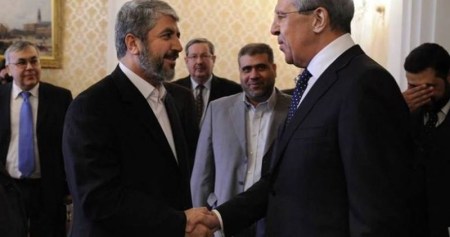
MOSCOW – Russia and the United States agree that Daesh, al-Qaeda and Jabhat al-Nusra are terrorist organizations but differ over blacklisting Hezbollah and Hamas, the Russian Foreign Ministry said.
Speaking to the Interfax news agency on Tuesday night, Russian Deputy Foreign Minister Gennady Gatilov said: “Our opinions coincide as regards to the main terrorist organizations. These are ISIS, al-Qaeda and Jabhat al-Nusra.”
But “we are not even discussing Hezbollah and Hamas with the Americans,” he added.
Moscow has routinely held senior-level contacts with Hamas officials and leaders.
Commenting on the Russian position, political analyst Abdul Sattar Qassem said: “Hamas cannot be compared to Daesh or al-Qaeda. It can only be viewed in terms of its resistance to the Israeli occupation.”
“The Israeli occupation and the USA are the real terrorists. They are fighting all those who stand in their way,” he added.
“Blacklisting Hamas as terrorist is unacceptable for Moscow. There is no evidence to corroborate the fact that Hamas is a terror group,” he said.
“Israel has been misleading the world into believing that Hamas is targeting Israeli civilians, which is not in fact the case,” the analyst stated.
“Hamas is a movement of national liberation that defends its people. It does not seek to wage wars for the sake of wars. It is engaged in a fight against an entity that colonized its motherland,” he explained.
However, “does Russia dare blacklist Israel as a terrorist entity for the crimes it has perpetrated against the Palestinians?” Qassem wondered. “It is not enough that Russia refuses to dub Hamas a terror group. It should dare include Israel on its terror list.”
“There is no colonizing power in the world but Israel. Occupation is in itself a form of terrorism,” the analyst further stated.
Sarah Colborne – A Solidarity Campaigner Or A Traitor
By Gilad Atzmon | December 29, 2015
PSC Director Sarah Colborne went out of her way to kosherize the UK PSC (Palestinian Solidarity Campaign) but now no longer holds her position in what is left of the diluted solidarity institution. The rumour is that Colborne had to go because evidence of her collaboration with the police against leading Palestinian activists was too embarrassing.
Back on 17 October two men were arrested at a pro-Palestinian demonstration in front of the Israeli embassy in London after they refused to take down a Hezbollah flag they had hoisted on a pole.
Abbas Ali and Antonio Maniscalco, both prominent pro-Palestinian activists had been warned by the PSC that only Palestinian national flags would be welcome at the protest. Shortly after, Ali and Maniscalco were arrested by the police, their homes were raided, their PCs, laptops and memory cards were confiscated. They were questioned by counter-terrorism officers for 15 hours before being released with no charges.
Once free, Abbas Ali told 5Pillars “we were initially told to take down the flag by people on the podium and by someone at the demonstration (so) we moved across the road. We also told the police that we were in a public place so we saw no reason to take down the flag – we had as much right to protest as anyone else but the police kept hounding us.”
After the event Sarah Colborne admitted that the organisers of the event had made a clear request before the demonstration that only Palestinian flags should be raised. However, Colborne did not confirm or deny that any of the organisers had alerted the police of Mr Ali and Mr Maniscalco’s actions.
In her interview with 5pillars a few days after the arrest, Colborne produced the standard sound-bite outburst of diarrhea: “we welcome all who stand with us in our opposition to all forms of racism, including anti-Semitism and Islamophobia. Supporters of Palestinian rights encompass all faiths and none. Muslim, Jewish, Christian, Atheist, religious and non-religious people all stand together on this protest… We stand with Palestinians in their struggle for a future free of racism, colonialism and apartheid. There is no place for racism in a progressive movement fighting for justice and human rights.”
No secret that PSC under the rule of the ‘progressive’ Sarah Colborne was mainly concerned with anti-Semitism, racism and other Jewish sensitivities. The question remains whether the PSC can resurrect itself, de-kosherize its act and support Palestine for real. I hope it can but I do not hold my breath.
Letter drafted by IHRC* to the PSC following the 17 October arrest
We the undersigned are deeply concerned about events at last Saturday’s demonstration called by yourselves (17 October 2015).
It is reported that two long-time activists were harassed by other protestors, and ultimately arrested after being told by the police that the organisers and others had complained to them about the flag they were carrying. This came after:
• organisers had called from the stage for all flags other than Palestinian flags to be lowered;
• various persons were sent on behalf of the organisers to ask the activists to remove the flag;
• and some protestors it would seem, emboldened by the organisers’ call, harassed both activists in a manner bordering on violence (one protestor was seen shouting abuse and breaking the flagpole used by one of the men eventually arrested).
The flag in question was the Hizbullah flag. At the time of writing we know that both of the protestors have been bailed pending a decision by the CPS on whether to charge them with supporting a proscribed organisation and encouraging others to support a proscribed organisation. When arrested they were questioned upon arrest by SO15 (the Counter Terrorism Command).
It has also been reported that police were asked by PSC to ask one of the men to remove banners in support of Palestinian prisoners from a previous demonstration.
As you are aware the anti-terrorism laws and regime are not only unjust, they have been used to target Muslims, and demonise some liberation movements, including some associated with the Palestinian struggle. This vicious curtailment of civil liberties, the removal of Muslims from equality before the law and the demonisation of political causes that run counter to UK foreign policy, are all surely things that PSC should at the very least eschew and at most actively oppose.
If these arrests have come as a result of the organisers’ request to the police, it is a matter of great shame for PSC. Those involved in making those calls from the platform and contacting the police should resign their positions forthwith.
As a note, it is worth recognising that the two men arrested have spent every other week over the last three years holding vigils for Palestinan prisoners. The conditions of their bail – of extraordinary disproportionality – prevent them from contacting each other, forbid them from going to demonstrations and require them to sign at a police station three times a week. It is truly disgusting that such committed pro-Palestinian activists and their activities have been stopped in their tracks. Whilst there is no legal case to charge and convict them under anti-terorrism laws, the threat that hangs over them is a form of harassment that has already had the effect of closing down regular pro-Palestinian protests organised by one of these men. As you are doubtless aware one of these men was one of the pioneers of BDS some fifteen years ago, and has suffered many threats and abuse from pro-Israel groups and indviduals.
Both these men should have been supported in their work by the organisers, not targeted. This sorry state of affairs has come through some level of instigtaion by the organisers. At the very least PSC must campaign for these two men. Please advise as to how you will be proceeding.
With deep regret,
• Massoud Shadjareh, Chair of Islamic Human Rights Commission
• Les Levidow, Campaign Against Criminalising Communities
• Francesca Viceconti, visual artist and member of Artisit Against Apartheid (USA)
• Fateh Party UK
• Brighton and Hove PSC
• John Tymon, Football Against Apartheid (Coordinator)
• Badee Dwaik, Human Rights Defenders – Palestine (Coordinator)
*IHRC- Isalmic Human Right Commission
Featured Video
Yemen joins the war – Red Sea could be blocked next – Saudi regime at risk
or go to
Aletho News Archives – Video-Images
From the Archives
A superpower and “the world’s sickest warrior state”
By Paul J. Balles | March 8, 2010
Living through five or six major wars has hardened me to what I thought were the extremes of inhuman cruelty and brutality.
Two things made those extremes almost bearable: the brutality always revealed – at least according to the media coverage – the viciousness of the enemy. It was therefore quite understandable when our “brave men and women” pulverized the enemy.
Films of Japanese torturing captive Americans somehow justified holding Japanese Americans in internment camps during World War II; and only a small percentage of Americans found the bombing of Hiroshima and Nagasaki unreasonably vengeful at best, at worst, depraved.
The media giants in America portrayed the North Koreans as barbaric beasts with their captives, quite unlike their southern counterpoints – our allies during the Korean War. No one ever felt the need to explain how the South Koreans were a civilized breed while the North Koreans were absolute savages, at least according to the official line.
In Vietnam, our warriors justifiably (or so the media made us believe) dropped napalm on the North Vietnamese who had the gall to hide in villages and tunnels to ravage our invaders. At least it was accepted practice until some rogue photojournalist filmed a young girl screaming down a Vietnamese road in flames. … continue
Blog Roll
 Aletho News
- FTC Warns Visa, Mastercard, PayPal, Stripe Over Political Debanking
- Russian tanker approaches Cuba despite US oil blockade
- Marandi: Yemen joins the war – Red Sea could be blocked next – Saudi regime at risk
- Pro-Palestinian French member of European Parliament denied entry to Canada
- Pakistan to Host US-Iran Talks
- How Indonesia’s tilt toward the US left it stranded in the Strait of Hormuz
- US has no choice but to retreat from Iranian borders: Top commander
- Iran Retaliation Strikes Chemical Plant Near Dimona
- AWACS’ Destruction is a Major Loss for US Military – Ex-DoW Analyst
- Israel’s Iran Strategy Uses US Military & Gulf States as Its Pawns
- If Americans Knew
- Israeli police block Catholic cardinal from entering Church of the Holy Sepulchre on Palm Sunday
- Israel is assassinating journalists again, more than any other nation, anywhere, ever – Not a ceasefire Day 170
- Over 300 US service members wounded, majority have brain injuries – Not a ceasefire Day 169
- Researchers at Human Rights Watch Resign Over Blocked Report on Palestinian Refugee Return
- Jewish Groups Are Backing a War Americans Don’t Want
- Eric Fingerhut Thinks He’s the President of the Jews
- Top Jewish Philanthropists, Rabbis Urge Israeli President to Take Action Against ‘Jewish Extremists’
- Don’t Be Fooled. Zionist Leaders Have Always Wanted to Control Southern Lebanon
- Israel’s widespread use of torture is a core element of its genocide against the Palestinian people
- In Israel’s War on Iran, Many Middle East US Bases Rendered “All But Uninhabitable”
- No Tricks Zone
- New Study Finds Warming Saves Lives…Cold Temperatures 12 Times More Deadly Than Excess Heat
- German Science Blog Accuses PIK Climate Institute Of Hallucinating Climate Tipping Points
- Devastating Assessment Of Comirnaty Vaccine By Former Senior Pfizer Europe Toxicologist
- New Study: CO2 Is ‘Effectively Negligible’ As An Explanatory Climate Change Factor Since 2000
- Former Pfizer Toxicologist Dr. Helmut Sterz Tells Bundestag Hearing Pfizer Vaccine Should Have Never Been Approved
- Energy Expert: Germany’s Nuclear Phaseout Was A “500 Billion Euro Mistake”
- New Research: South Australia’s Mid-Holocene Sea Surface Temperatures Were 4°C Warmer Than Today
- Storing Green Energy To Last Germany 10 Days Would Require A 60-Million Tonne Battery
- New Studies: UK Sea Levels Were 4 Meters Higher Than Today During The Mid-Holocene
- Destructive Green New Deal: German Energy And Metal Group Warns Of Drastic Crisis
 Aletho News