Blaming ‘Libs of TikTok’ for a deranged murderer’s actions is shameless politicization
Almost as repugnant as the deadly attacks that are occurring with alarming frequency in the United States is the speed with which certain individuals rush to politicize them. The Club Q massacre in Colorado Springs, which left five dead and 18 injured, was certainly no exception.
The Democrats’ reaction kicked off with predictable calls for gun control. In this particular tragedy, however, the killer, 22-year-old Andersen Lee Aldrich, should never have been allowed to buy a gun in the first place. Moreover, he should have been high on the FBI’s ‘person of interest’ radar.
A year-and-a-half before Aldrich went on his deadly shooting spree, this troubled young man (who, according to court documents, has now started to identify as non-binary and use the pronouns them/they) threatened his family with a homemade bomb, forcing neighbors to evacuate while police talked him into surrendering. Yet, despite this, the district attorney of Colorado, Michael J. Allen, not only refused to press charges, but did not impose Colorado’s red-flag laws, which would have prevented Aldrich from purchasing a firearm. Had the Democratic-run state of Colorado enforced its own laws, five people might still be alive today.
Perhaps sensing the weakness of their anti-gun position, the Democrats rushed to politicize the tragedy by blaming conservative figures for instigating the violence.
Democratic Representative Alexandria Ocasio-Cortez chastised her Republican colleague Representative Lauren Boebert in the wake of the tragedy for “elevating anti LGBT+ hate rhetoric and anti-trans lies,” while MSNBC reporter Brandy Zadrozny took aim at a popular Twitter account for merely pointing out what is becoming increasingly clear to many Americans.
“Online… this Libs of TikTok account, which feeds larger media like Fox News stories, what has happened is the demonization of LGBTQ people, calling them ‘groomers’ and ‘pedophiles,’” remarked Zadrozny. “This type of thing, whether it’s motive or not, what we know is that it’s just another reason why LGBTQ people are scared.”
Yet the goal of voices like Libs of TikTok, which uses actual progressive sources, is not “the demonization of LGBTQ people,” as Zadrozny argues, but rather to shine a spotlight on an issue that many millions of people view as a serious problem. A recent poll showed that 57% of Americans support a ban on teaching young children about sexual orientation and transgender issues in public schools.
Meanwhile, it does not require much digging to see that the sexualization of children is really happening. Consider a recent advertising campaign by the famous fashion house, Balenciaga.
The photo shoot features a very young girl holding a teddy bear that is dressed up in a bondage outfit. Another picture in the series displays a Balenciaga bag on top of a sheaf of documents, one of which appears to reference the 2002 US Supreme Court case “Ashcroft vs Free Speech Coalition,” which struck down some provisions in an anti-child pornography law. The paper wasn’t featured prominently, but it’s hard to imagine it ended up there by accident.
Although the left would like people to ignore it, it stands to reason that these highly suggestive images could inspire acts of violence against children, albeit of a different kind from those witnessed at the Colorado Springs gay club. The only way to address these very real threats to children is to speak openly about them.
Youth today are being exposed to a slew of complex ideas and actions – from questioning their ‘true’ gender, to watching drag queens perform at the local gay club. Having been subjected to such radical concepts at the most impressionable age, an increasing number of young people eventually make the fateful decision to have a sex-change operation.
It is only natural that millions of Americans will want to make their opinions heard on these topics that could have life-long consequences for their children. They should be able to do so without facing accusations of being accomplices to murders carried out by deranged individuals. But as far as the left is concerned, anyone who speaks out against the sexualization of children will be responsible for getting more people killed, just like we saw at Club Q.
Robert Bridge is an American writer and journalist. He is the author of ‘Midnight in the American Empire,’ How Corporations and Their Political Servants are Destroying the American Dream.
November 24, 2022
Posted by aletho |
Civil Liberties, Full Spectrum Dominance, Mainstream Media, Warmongering | Human rights, MSNBC, United States |
Leave a comment
A New Book by Simon Elmer
With the lifting of the thousands of regulations by which our lives were ruled for two long years there has been an understandable desire to believe that the coronavirus ‘crisis’ is over and we will return to something like an albeit new normal.
But as new crises have sprung up to take its place — war in the Ukraine, the so-called ‘cost of living crisis’ and the return of the environmental crisis — it’s increasingly difficult not to look back on ‘lockdown’ as the first campaign in a war that has not been declared by any government but is no less real for that.
The willingness of our governments to use the forces of the state against their own populations on the justification of protecting us from ourselves signals a new level of authoritarianism — and something like the return of fascism — to the governmental, juridical and cultural forms of the formerly neoliberal democracies of the West, and one of the aims of this book is to examine the validity of this thesis.
Its purpose in doing so, however, is not to contribute to an academic debate about the meaning of the term ‘fascism’, but rather to interrogate how and why the general and widespread moral collapse in the West over the past two-and-a-half years has been effected with such rapidity and ease, and to examine to what ends that collapse is being used.
The more deliberate is the immiseration of the populations of Western democracies, the clearer it becomes that the war started by COVID-19 is not between nation states but a civil war waged against our institutions of democratic governance and the division of powers between executive, legislature and judiciary.
Insofar as these institutions and this division are being dismantled and replaced by the rule of international technocracies that, under the cloak of the ‘pandemic’, have assumed increasing power over our lives since March 2020, this war represents a revolution in Western capitalism from the neoliberalism under which we have lived for the past forty years.
Where it is heading with ever greater speed and finality, and which The Road to Fascism sets out to demonstrate, is the new totalitarianism of the Global Biosecurity State.
Simon Elmer is the founder of Architects for Social Housing (ASH), you can follow them on twitter. The Road to Fascism was published by ASH on 28 September, and is available in hardback, paperback and e-book. Click on the link for purchase options, the contents page and preface. Excerpts have been published in The Daily Sceptic and The Exposé; and you can hear Simon discussing his book in an interview on The Delingpod.
November 24, 2022
Posted by aletho |
Book Review, Civil Liberties, Deception | Covid-19, Human rights |
Leave a comment
In 2022, the Flemish government will pay €175 763.87 in membership fees to the World Economic Forum (WEF) and 27 000 Swiss francs (about €27 300) as participation fees to the annual meeting of the WEF in Davos. This is according to Flemish minister-president Jan Jambon’s response to a parliamentary question by Flemish MP Sam van Rooy.
“The Flemish Government thus legitimises and subsidises a global lobbying organisation that clearly pursues a well-defined ideological agenda, namely that of globalism,” van Rooy responded.
German economist Klaus Schwab’s World Economic Forum (WEF) has come under increasing scrutiny in recent years. The WEF claims to be a forum for exchanging ideas and networking, but at the very least the perception has arisen that a lot of government decisions are linked to the ideological goals of the WEF and stem from agreements made within the WEF.
All in all, this international lobbying organisation openly pursues a globalist future agenda involving numerous governments. This agenda seems to have recently crystallised into the so-called The Great Reset, whose goal is “a more secure, equal and stable world” by “acting jointly and rapidly to renew all aspects of our societies and economies, from education to social contracts and working conditions,” according to Klaus Schwab of the WEF.
As citizens in a democratic constitutional state are entitled to transparency on the policies pursued, van Rooy asked Flemish minister-president Jambon questions about the Flemish government’s ties and cooperation with the WEF.
Regular WEF contacts
In his reply, Jambon stated that the Flemish government “has no structural contacts with the WEF outside the participation in the WEF meeting in Davos”, but that there are “regular contacts at the level of the Flemish government”. According to the prime minister, these contacts also aim to follow up on the various activities and projects that take place annually, including outside the Davos meeting.
Until 2020, the Flemish government paid an annual membership fee of €55 000 to the WEF. Since 2022, however, Flanders has been “promoted” to “associate partner” of the WEF, requiring a membership fee of no less than €175 763.87 per year. This contribution has already been paid for 2022 and the same invoice is expected for 2023.
About the “associate partnership”, Jambon stated the following: “The associate partnership offers the advantage that Flanders can participate in more activities throughout the year and, in addition, projects are being worked on within a thematic platform ‘Shaping the Future of Trade and Investment’. Those activities and projects provide additional visibility and an opportunity to learn and contribute policy-wise.” The entanglement of the Flemish government with the WEF is thus increasing.
The prime minister maintained that the WEF would have added value for Flanders because that organisation would allow him to speak at short notice with decision-makers from international companies that are important for Flanders. “The WEF provides the framework that facilitates these talks,” Jambon said, further calling WEF membership “a policy instrument of the Flemish Government” as well “to realise objectives from the Coalition Agreement”. Jambon also announced his intention to further strengthen cooperation with the WEF in the coming period.
WEF’s alleged mission
According to Jambon, the “mission of the World Economic Forum is to improve the state of the world”, but that mission appears to be politically correct and woke, said the party in a statement. The WEF has an ideological agenda of inclusion, diversity, open borders and climate and CO2 hysteria. While Jambon has claimed that “the WEF is not asking us to pursue a specific agenda”, he admitted that his “participation in the Davos meeting may result in policy initiatives”.
It therefore seems very much as if the Flemish government is following the WEF’s globalist objective as much as possible in exchange for access to the WEF network of multinationals, banks, journalists and NGOs.
Van Rooy said that Jambon’s answers were conspicuously vague and this had raised additional questions. He therefore called on the Flemish government to cancel the Flemish paying WEF membership: “Exchanging ideas and attracting investments are of course laudable ambitions in themselves, but this should not be done in the context and under the auspices of the WEF, a lobbying group that pursues a globalist agenda and thus can by no means be considered a neutral forum for this,” van Rooy said.
November 23, 2022
Posted by aletho |
Civil Liberties, Economics | Human rights, WEF |
Leave a comment
No legal prohibition authorized or justified hospitals to withhold the drug from dying patients. Let the lawsuits begin.

FDA tweet against using ivermectin. Not a prohibition, merely a recommendation.
The Epoch Times recently reported an astonishing statement by a U.S. government lawyer in a federal court in Texas, where the FDA is being sued by Dr. Paul Marik of Virginia, Dr. Mary Bowden of Texas, and Dr. Robert Apter of Arizona. The three plaintiffs claim the FDA illegally prohibited them from prescribing the drug to their patients. At a November 1 hearing, U.S. lawyer Isaac Belfer argued for the defendant:
The cited statements were not directives. They were not mandatory. They were recommendations. They said what parties should do. They said, for example, why you should not take ivermectin to treat COVID-19. They did not say you may not do it, you must not do it. They did not say it’s prohibited or it’s unlawful. They also did not say that doctors may not prescribe ivermectin.”
If Belfer’s assertion is true, it raises a very urgent question: On what legal grounds did hospitals all over the United States refuse to administer ivermectin to severely ill COVID-19 patients, even when patients and their family members begged for the drug to be administered?
If ivermectin was not prohibited by the FDA or any other U.S. medical authority for treating COVID-19, why did Dr. Paul Marik’s hospital prohibit him from administering the drug to his dying patients? Why was Dr. Mary Bowden reported to the Texas Medical Board for disciplinary action when she prescribed it? Why did many pharmacists fear losing their licenses if they filled ivermectin prescriptions for treating COVID-19?
In our book, The Courage to Face COVID-19: Preventing Hospitalization and Death While Battling the Bio-Pharmaceutical Complex, Dr. McCullough and I document numerous instances of hospitals flatly refusing to grant the wishes of dying patients and their family members for ivermectin.
All these patients asked for was to be allowed to try the drug (FDA-approved for River Blindness, Elephantiasis, and Scabies) for COVID-19. The patients and their kin gladly indemnified the hospitals and arranged to have their independent primary care doctors deliver and administer the drug. Nevertheless:
- Hospital administrators absolutely refused to grant this wish.
- Hospital attorneys fought tooth and nail against using ivermectin to treat COVID-19 patients, doing everything in their power to challenge patient lawsuits and appeal court orders to administer the drug.
- Even when hospital doctors acknowledged that the patients were dying, they insisted it was better to let the disease take its natural course rather than allow patients to try ivermectin.
- Even when patients’ families succeeded in getting a court orders to administer the drug, many hospitals still refused, even at the risk of being held in contempt of court.
Several readers have told us that our chapters covering this shameful scandal— Chapters 38: Begging for the Wonder Drug and Chapter 40: Graduating into Eternity—are horrifying beyond belief.
Now we hear U.S. government lawyers arguing in court that the FDA never prohibited using ivermectin to treat COVID-19 patients, but merely recommended not using it. This indicates that hospitals had no legal grounds for denying sick patients a drug that could have helped them. How is withholding medicine from a sick man any different from withholding a life ring from a man who has fallen overboard in high seas?
For families who watched their loved ones slip away after being denied the right to try ivermectin, U.S. attorney Isaac Belfer’s statement may be interpreted as declaring open season for lawsuits against hospital administrators and doctors.
November 22, 2022
Posted by aletho |
Civil Liberties | Covid-19, FDA, Human rights, Ivermectin, United States |
Leave a comment
How do we move ahead in a post-pandemic era? And what are the lessons to be learned from our challenging recent history? Catholic psychiatrist and bioethicist Aaron Kheriaty has thought a great deal about these questions and his answers are found in his just-released book The New Abnormal: The Rise of the Biomedical Security State (Regnery Publishing, 2022). The result is a brilliant mix of scientific observations, personal experiences, philosophical reflections, prudent policy prescriptions, and even a few speculative hints about dystopian possibilities of the near future.
Kheriaty, who lost his previous job as clinical psychiatrist and teacher at UC-Irvine in a dispute over mandated vaccines and natural immunity, begins the book in an unexpected time and place: 1947 Nuremberg. He does this to provide historical context for threats to freedom in our time. He briefly surveys the eugenics movement and its appropriation by the Nazi regime. Germany’s medical professionals were well-trained and as good as any in the world, but they lost their way. “Instead of seeing the sick as individuals in need of compassionate medical care, German doctors became willing agents of a sociopolitical program driven by a cold utilitarian ethos,” writes Kheriaty (xvii). After the war the revulsion at the perversion of medicine led to the Nuremberg Code, which emphasized informed consent as a cornerstone of ethical medical treatment.
That code and other ethical agreements remained as part of the medical-bioethical landscape… until 2020. Kheriaty asserts that “[d]uring the covid pandemic, the public health and medical establishment once again abandoned the principle of free and informed consent to advance a supposed greater good” (xxi). Having laid the groundwork for his argument and narrative, he sums up by issuing this frightening declaration: “The unholy alliance of (1) public health, (2) digital technologies of surveillance and control, and (3) the police powers of the state—what I call the Biomedical Security State—has arrived” (xxii). While this probably seems like a heavy meal to digest, the reader can be assured that Kheriaty writes clearly and is grounded in scientific medicine and a solid ethical worldview. His story, while alarming, is neither conspiracy theory nor exercise in despair.
After the Nuremberg prologue, Dr. Kheriaty continues with four long chapters and an epilogue: “Locked Up: The Biomedical Security State”; “Locked Down & Locked Out: A New Societal Paradigm”; “Locked In: The Coming Technocratic Dystopia”; “Reclaiming Freedom: Human Flourishing in a More Rooted Future”; and, “Seattle, 2030.” Sprinkled throughout what could be a gloomy read, we encounter stories of solidarity and resilience. The author makes sure to show us that human interaction cannot — must not — be stymied by government interference in our lives and the functioning of society. “Consider the human goods we sacrificed to preserve bare biological life at all costs: friendships, holidays with family, work, visiting the sick and dying, worshipping God, and burying the dead” (14). But to resist or even question, we must know as much of a situation’s history as possible. Kheriaty lays out the pieces of the puzzle: states of emergency, agency capture of regulators by the regulated, loosening bonds of social cohesion, and the religion of scientism.
Scientism is distinct from science and scientific inquiry, Kheriaty points out. “The characteristic feature of science is warranted uncertainty, which leads to intellectual humility. The characteristic feature of scientism is unwarranted certainty, which leads to intellectual hubris” (54). In other words, scientism upholds so-called science as the only proper form of knowledge and rejects any questioning or skepticism. It is prone to misuse as a political tool and typically accompanies a materialistic worldview. That heavy-handed framework clashes with how science and medicine have long operated through trial and error, experimentation, imaginative solutions, and, most of all, respect for individual humans as made in the image and likeness of God.
Kheriaty’s own story makes for a fascinating sub-plot. As a doctor, ethicist, and teacher he was closely involved with figuring out how to respond to covid and help patients. As the lockdowns unfolded he encountered staggering amounts of fear, worry, and depression. His grasp of bioethics and knowledge of history led him to speak out against new methods of trying to control spread of the covid virus, especially when they superseded societal freedom and individual liberty. “Freedom of movement, of association, of domicile in one’s country of origin, and access to public spaces and public events—these quickly went from basic rights to special privileges conferred by governments as rewards for good behavior” (68). His medical training also led him to critique the development and imposition of a new and mostly untested vaccine. In his own case, he fought against a mandatory vaccination because of a prior covid infection. His argument at the time did not prevent him from being fired. He also touches on the devastating impact of restrictions on work and supply chains.
Indeed, that is one of the constant themes of this book: technology and safety should never eclipse the humanity of our lives. For instance, “[t]here is clearly no such thing as a medication—or a vaccine—that’s always good for everyone in every circumstance all the time” (137). Technology and cultural immersion endanger our sense of ourselves and nudge us to trade autonomy and dignity for convenience. “Today, routine biometric verification for things from mobile phones to lunch lines gets young people used to the idea that their bodies are tools used in transactions” (155). Connected to abuse of genetic and biometric data is the ominous specter of transhumanism, which Kheriaty characterizes as “clearly a religion—a particular type of neo-Gnostic religion” (167). To all these dehumanizing trends the author counsels resistance, but emphatically “nonviolent resistance and civil disobedience” (184).
The book’s final chapter lays out policy proposals for steering clear of dystopia. I found this chapter to be only somewhat persuasive. Kheriaty’s suggestions are certainly prudent and logical; however, they mostly deal with changing the political and medical climate. But bureaucracy and institutional entropy are like the invasive Japanese Knotweed in my back yard, which is to say impossible to eradicate. On other points Kheriaty is spot-on. “The first and most necessary step is to overcome our fear,” he writes (191). And [t]he enemy is not pain or illness. The enemy is fear. The enemy is hatred or indifference toward our fellow human beings” (192). Fear of death was manifest during the pandemic. As Catholics, we are taught to not fear death, but rather to spend our lives preparing for it and to live in a state of grace. During a pandemic or even “normal” times we can bear witness to Christ by living with courage and fighting fear. We can also resist mask mandates that dehumanize us and separate us from others, covering up our God-created uniqueness. Of importance to religious believers, we can engage with our faith authorities to make sure no one is abandoned again because “too many religious leaders and clergy unfortunately showed themselves during the pandemic to be willing chaplains to the new technocracy” (204).
Readers should not skip the epilogue, in which Kheriaty (a native of the Pacific Northwest) posits a dystopian Seattle in 2030. In this uncomfortable scenario, we are asked to consider what life might be like if current trends in pharmaceuticals and their marketing are joined with further developments in social control to create a two-tiered society reminiscent of many well-known alternative futures in literature and movies. Thankfully, Dr. Kheriaty lightens a somber story with some wry humor.
While The New Abnormal is not an explicitly Catholic book, Aaron Kheriaty founds it in Catholic principles of justice, humanity, clear philosophical first principles, subsidiarity, solidarity, and important spiritual goods. He brings in examples from classical and contemporary philosophy, C.S. Lewis, and George Orwell. The prose is clear but some of the concepts can be a little heady at times. This is a valuable piece of work from a man with unique qualifications. His is a prophetic voice calling us to understand and take action while never forgetting the God Who made us.
Greg Cook is a writer living in New York’s North Country with his wife. He graduated from Plattsburgh State College and The Evergreen State College. He is the author of two self-published books of poetry, Against the Alchemists and A Verse Companion to Romano Guardini’s ‘Sacred Signs’.
November 22, 2022
Posted by aletho |
Book Review, Civil Liberties, Timeless or most popular, War Crimes | Covid-19, COVID-19 Vaccine, Human rights, United States |
Leave a comment
Medical ethics is a large field of study. The Covid pandemic certainly brought many medical ethics issues to the forefront and produced rather amazing “ethicist” gems, such as this:

Be aware that “bioethics” has moved on to proposals that might seem crazy to you but are considered seriously and published in Bill Gates-funded publications and scientific journals. Important studies on this subject are conducted under the auspices of the World Economic Forum.
Forcibly giving people collectivism-promoting “Morality Pills” (archive link) is a popular suggestion among bioethicists. It was published in Bill Gates-funded The Conversation and is discussed widely in scientific literature. (The Conversation received 7 million dollars from Bill Gates but pretends to be an independent journalism publication)
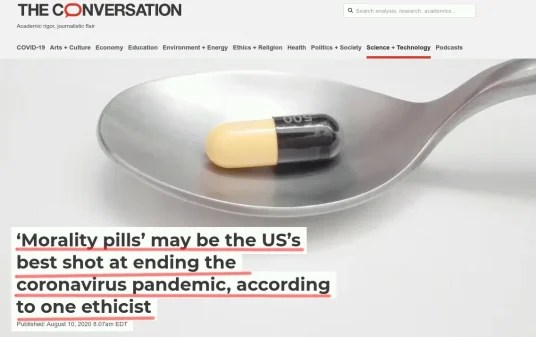
What are these morality pills? You might think that morality, to them, means being a good husband or wife, an honest businessperson, fulfilling promises, and so on. Why not enhance that? What’s the problem?
The problem is that this is NOT how they define morality! To them, morality is a collectivist mindset, lack of critical thinking, and compliance. The article explains that some people lack “moral qualities” and refuse to wear masks or take Covid vaccines, or even deny climate change:
My research in bioethics focuses on questions like how to induce those who are noncooperative to get on board with doing what’s best for the public good. To me, it seems the problem of coronavirus defectors could be solved by moral enhancement: like receiving a vaccine to beef up your immune system, people could take a substance to boost their cooperative, pro-social behavior. Could a psychoactive pill be the solution to the pandemic?
They propose giving people pills to enhance “morality” and explain the climate change angle relevance:
But a strategy like this one could be a way out of this pandemic, a future outbreak or the suffering associated with climate change. That’s why we should be thinking of it now.
The proposed solution to give people morality pills is more than idle thinking. Several candidate psychoactive substances are identified and considered seriously: psilocybin and oxytocin, for example.
The obvious objection to all this morality pill talk is that skeptics would not take them! I would not take such a pill to enhance my collectivist mindset. At the risk of being presumptuous, I would say that you, my dear subscriber, would refuse them also. Right?
The ethicists have a solution: administer collectivist morality pills by force or surreptitiously.
As some have argued, a solution would be to make moral enhancement compulsory or administer it secretly, perhaps via the water supply. These actions require weighing other values. Does the good of covertly dosing the public with a drug that would change people’s behavior outweigh individuals’ autonomy to choose whether to participate? Does the good associated with wearing a mask outweigh an individual’s autonomy to not wear one?
Serious articles discuss how to do it:
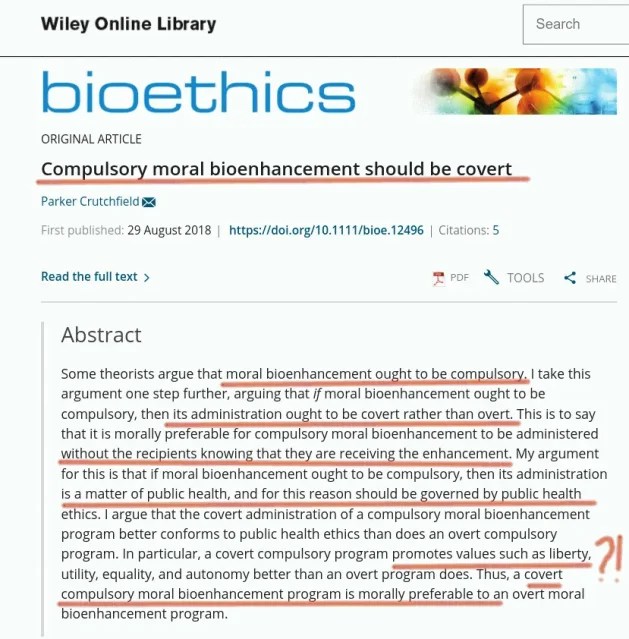
A covert psychoactive substance administration to the masses must not be discussed publicly before its implementation, right? So the ethicists desire to bypass any democratic process or prior public discussion and scrutiny. These ethicists refuse to see an ethical problem with that!
World Economic Forum Sponsored Research into “Collectivist Bioenhancement”
Some of you, my dear readers, might think this is so batshit crazy that it is simply useless musings of fringe philosophers, not worth discussing.
Quite to the contrary, the famous and influential organization called the World Economic Forum sponsors such bioenhancement research.
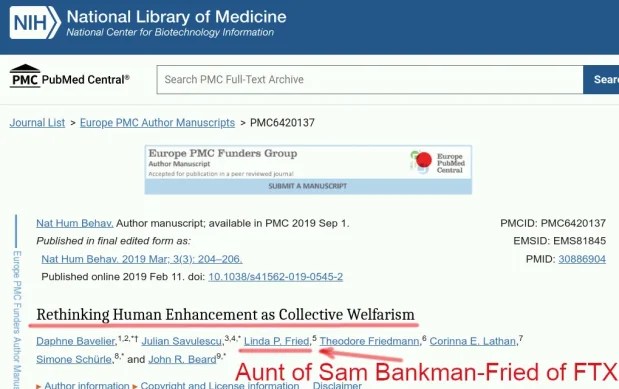
Linda Fried, mentioned above, is the aunt of Sam Bankman-Fried. Sam stole billions of dollars from crypto-investors (in my opinion) and used that money to become the second largest Democratic party donor. So, Linda Fried is not exactly a nobody languishing in obscurity. By the way, a friend of this blog El Gato wrote a great post discussing Sam — check it out.
Linda explains in her article that her goal is “collective welfarism,” and she is part of the group convened by the World Economic Forum:
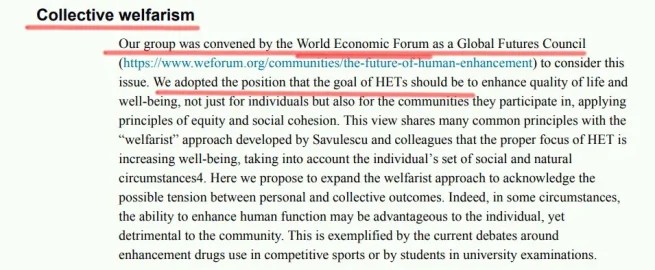
A stronger ethical approach, though, would be to abide by the principle, termed ‘collective easy rescue’, whereby small individual losses are justified in the name of collective well-being. Mass vaccination is a well-documented example of collective easy rescue.
Human “enhancement” to force mass vaccination? Sounds familiar?
Those “medical ethicists,” “world changers,” and “disinformation fighters” are so self-absorbed and self-righteous that they think their way of thinking is the only right way. They consider any deviation from their mindset to be antisocial, divisive, and subversive.
To them, freedom is dangerous. Truth is misinformation. Pursuing personal happiness and liberty instead of welfarism is selfish and immoral and needs to be dealt with through covert bioenhancement pills. Their opponents need to be silenced as “disinformation agents” or influenced via secretly applied substances to enhance compliance and lower critical thinking.
My post, discussing outlandish agenda developed under the auspices of the World Economic Forum, may sound like the perfect conspiracy theory. If someone approached me and told me that the WEF is sponsoring “bioenhancement research,” whose goal is to develop substances to impose “collective welfarism” and achieve compliance with mass vaccination, I would not take that person seriously!
Such is the problem with describing many WEF proposals. Some of their ideas are so crazy that they are difficult to accept as genuine when retold. Official papers, proposals, peer-reviewed studies, and agenda articles describe plans that are extremely strange to the uninitiated — and yet are pursued seriously. Other authors, such as Tessa Lena, also mentioned how difficult it is to describe these tendencies.
I have explained my difficulties with describing crazy but real proposals by world-leading unelected organizations such as the WEF.
I Do Not Spread Conspiracy Theories – I Report on Actual News
Their proposals, when understood properly, are highly disturbing and seem unreal — except that they are very serious.
WEF Uses CODED LANGUAGE to Communicate Unthinkable Plans
The difficulty with their plans is that regular people cannot believe they are real. That happens for a good reason: nobody would expect such insanity to be seriously promulgated by important men and women. Even I have difficulty reconciling the plain text and the simple meaning of their anti-human theories with my idea of what our leaders should act like.
And yet, here we are — the welfarist pills are promulgated under the auspices of the WEF by no one but Linda Fried, the aunt of the second-largest Democrat donor and crypto thief (in my opinion) Sam Bankman-Fried.
In the future, you may need to be careful with your drinking water or the compulsory mystery “health enhancement pill” you must take for an unexplained reason!
Would you take such a welfarism bioenhancement pill?
November 22, 2022
Posted by aletho |
Civil Liberties, Full Spectrum Dominance, Timeless or most popular | Human rights, WEF |
Leave a comment
Canadian Prime Minister Justin Trudeau and Public Safety Minister Marco Mendicino are doing the rounds, insisting on the need to fight online harassment and misinformation.
At the G20 Summit in Bali, Indonesia, Trudeau said that Canada wants to regulate online “harassment and violence.” He added that Canada’s social media platforms have a responsibility to “address online harassment and violence to ensure trust in technology.”
“While always ensuring and defending free speech, we must make it clear that it cannot be OK to bully and attack people online,” Trudeau said.
At the G7 summit in Germany, Public Safety Minister Marco Mendicino told other interior and security ministers there is a need to tackle disinformation. On November 17, he tweeted that “the G7 stands united” when it comes to “addressing the rise of mis and disinformation online.”
On November 19, Mendicino tweeted that Canada will host a G7 summit next year to fight “disinformation.”
“Taking a leading role at the G7, Canada has invited counterpart interior and public safety ministers here for a summit to tackle disinformation, which is one of the most pervasive threats to all our democracies right now,” he tweeted.
He added that a summit in Canada would help “flip the script, and to get ahead of the curve of disinformation.”
“This is where we think that Canada and the G7 can show leadership,” he continued.
According to Mendicino, the “marketplace for disinformation” is bigger than the “marketplace for reliable information,” and Canadians need to be helped to distinguish between the two.
He continued to say that, to fight disinformation, online platforms should ensure they are “adhering to the terms and conditions of their own user agreements.”
During the summit, he suggested the education of high school students on how to identify disinformation, as well as online scams and fraudulent emails and texts.
November 22, 2022
Posted by aletho |
Civil Liberties, Full Spectrum Dominance | Canada, Human rights |
Leave a comment
‘Stay at home’, that constantly repeated edict of the Covid-19 lockdown, was but a trial run for an emerging regime of restricted movement. The direction of travel (or rather, not travel) is indicated by recently proposed zoning schemes in Oxford and Canterbury, the United Nations’ Smart Cities plan for every need fulfilled within a 15-minute journey, and by the G20 Leaders’ Declaration last week.
Ye olde England was never really free – not for the commoners. In the Middle Ages, if a peasant ventured into a village beyond his own community, he would risk a severe beating. Gradually horizons widened, hastened by the advent of the railways. However, it’s a relatively recent phenomenon for citizens to lose their sense of ownership of where they live. Decades of uncontrolled immigration have put paid to strong communities steeped in heritage and homogeneity.
Yet while the English Channel is crossed by about a thousand illegal migrants every day, each receiving housing and services at taxpayers’ expense, the freedom of ordinary Britons is being steadily curtailed. Your ability to travel will depend on your digitally recorded status, as determined by your assets, occupation and – most importantly – your compliance with public health provisions.
In response to the purported Covid-19 pandemic, governments around the world closed their borders, some re-opening them only after mass vaccination. My other half is planning to visit family in New Zealand, a country that isolated itself with strict quarantine for returning Kiwis (a facility that was later confined to the vaccinated). Now she can return freely, and will go as soon as possible, because she knows what’s coming around the corner.
The International Health Regulations (IHR) set by the World Health Assembly (part of the World Health Organisation) are likely to include a global digital health passport when revised in Geneva next year. There is no doubt that this will happen, whatever the opposition from the critically thinking minority of society, because this was one of the pledges made at the G20 Leaders’ conference in Bali.
Hosting the meeting, Indonesian health minister Budi Gunadi Sadikin called for a universal health passport, building on the success of digital Covid-19 certificates. The declaration signed by all 20 leaders stated under point 23:
‘We acknowledge the importance of shared technical standards and verification methods, under the framework of the IHR (2005) to facilitate seamless international travel, interoperability, and recognising digital solutions and non-digital solutions, including proof of vaccination.’
Some critics asked rhetorically why Klaus Schwab of the World Economic Forum and global vaccinator Bill Gates were present. Answer: because they are running the show (or at least, they are its public faces). The Bali Declaration is a manifesto for the Great Reset and global security state. Covid-19, Net Zero, funding war in Ukraine and unlimited migration are prominent themes justifying development of technocratic control of population and resources.
The G20, which first met in 2008 amidst the global economic crisis, is ensconced with the unelected elitist organisation of the World Economic Forum. Earlier this year, in one of its typical hub-and-spoke diagrams, the WEF placed digital identity at the core of all human activity. No identity, no entry – and no existence. According to this document, the introduction of digital Covid certificates was a boon, as ‘these passports by nature serve as a form of digital identity’.
If you refuse vaccination, you will be in effect imprisoned at the World Health Organisation’s pleasure. And this pseudo-immunological discipline will be for whatever diseases that our global masters decide. Whether you’re flying to Thailand or taking the Eurostar to Paris, you may need a jab against monkeypox or a new strain of polio. Furthermore, these vaccines will all be of mRNA spike protein technology. Is a week on the Costa Brava worth the potential risk to health?
As experienced with Covid-19, vaccine passports will not only be for foreign travel. They could become ubiquitous for domestic movement too. Some jurisdictions, including Wales and Scotland, made Covid-19 vaccination a requirement for football matches and other public gatherings. English care workers were dismissed for failing to comply with ‘no jab, no job’. In Europe it was much worse: unvaccinated people were barred from shops. Across the world the media message was shrill: anyone refusing the ‘miracle of science’ should be banished from society.
Vaccination will be a key feature of the data by which your life will be controlled. A fully-fledged digital surveillance system will be linked to a central bank digital currency. This is for your safety and convenience, apparently. As the Bali Declaration asserted, ‘we will advance a more inclusive, human-centric, empowering, and sustainable digital transformation’. We know from Covid-19 that most people will comply with little complaint, unwittingly accepting their enslavement and genetic engineering.
Welcome to the New World Order. You may not like it, but your politicians do.
November 21, 2022
Posted by aletho |
Civil Liberties | COVID-19 Vaccine, Human rights, UK, WEF |
Leave a comment
Former White House Press Secretary Jen Paski’s motion to quash the subpoena to depose her in the lawsuit filed by Missouri and Louisiana was denied. The lawsuit alleges that the Biden administration colluded with social media companies to suppress certain viewpoints on Covid and elections.
When she was the White House Press Secretary, Psaki made statements encouraging social media companies to censor more content. At one time, she said, “We engage with (social media companies) regularly and they certainly understand what our asks are.”
The plaintiffs in the lawsuit want her deposed so that she can say who within the government was engaging with social media companies and what they said.
Psaki filed a motion to quash the subpoena in a federal court in Alexandria, Virginia. She was allowed to file the motion in a different state because that is where she lives. Her lawyers argued that she had little information to give and that most of the information is available through the emails and other documents that were obtained by the plaintiffs. They also argued that the deposition would be a burden to her.
US Magistrate Ivan Davis was not impressed by the arguments, but did not reject her request. Instead he referred the motion back to Louisiana, where the lawsuit was filed, because the judge there is more familiar with the case. Davis also refused to stay his ruling so that the motion could be appealed in a district court in Alexandria.
Davis said that Psaki had failed to demonstrate how being deposed in her home state qualifies as an undue burden. If indeed she has little information to offer, it should not be a burden, the judge argued.
“How much time does it take to prepare a witness for deposition when she doesn’t really have anything to say?” Davis asked.
November 21, 2022
Posted by aletho |
Civil Liberties, Deception | Covid-19, COVID-19 Vaccine, Human rights, United States |
Leave a comment
‘Censorship kills’ is the rally cry for a global medical community under unfathomable pressure from big tech and government to stifle the Covid debate. Fortunately, legislators and the greater public are seeing through the authoritarian behavior and taking action.
The Highwire with Del Bigtree | November 17, 2022
Real Housewives Star and business mogul, Bethenny Frankel, made waves on social media when she went off on how taboo it’s become to even question the possibility of suffering an adverse reaction from Covid-19 vaccines.
November 21, 2022
Posted by aletho |
Civil Liberties, Science and Pseudo-Science, Timeless or most popular, Video | Covid-19, Human rights, United States |
Leave a comment
Covid rates are dropping but you want to cling on to these new emergency powers – what to do? If Covid isn’t around, citizens won’t allow these powers to be extended will they?
Well Colorado have shown us the answer.
Governor Jared Polis signed a new Executive Order on 11 November which amended the emergency Covid rules to include Respiratory Syncytial Virus (RSV), influenza and other respiratory illnesses.
The Order says that “Colorado has seen a sharp increase in pediatric RSV infections and hospitalizations, in addition to patients with influenza and COVID-19, over the last two months”.
It then goes on to list the number of hospitalisations and the intensive care capacity. Therefore “if cases continue to increase, we may continue to see bed shortages across all hospital beds in Colorado as our state experiences a rise in COVID, influenza and RSV hospitalizations simultaneously”.
Due to staffing shortages facing hospitals related to COVID-19, RSV, influenza, and other respiratory illness hospitalizations and an associated decrease in capacity, including pediatric intensive care unit capacity, and to allow clinical staff to focus on patient care by reducing staff time associated with completing utilization reviews, I direct the Colorado Division of Insurance, pursuant to authority in C.R.S. §§ 10-1-108(7) and -109, to promulgate emergency regulations to reduce the administrative burdens associated with discharging, transferring, and caring for patients by temporarily suspending those utilization review requirements necessary to protect insured patients, including any or all prior authorization and preauthorization requirements.
And that is how you create a perpetual state of emergency. Add all types of respiratory viruses that you are on the lookout for because every winter hospitals will be full of people with some type of respiratory virus.
I wonder why they waited until after the elections to sign this Order? Strange. Let’s see how quickly other states amend their emergency orders as well. Maybe they should add in rain for the spring and sun for the summer (climate change) just to make sure the emergency lasts all year.
November 20, 2022
Posted by aletho |
Civil Liberties | Colorado, Human rights, United States |
Leave a comment
Rep. Warren Davidson (R-OH) is urging Congress to pass a bill he introduced last year that would ban the use of vaccine passports for future use.
The bill is aimed at protecting Americans from the federal government’s overreach under the guise of responding to the pandemic.
We obtained a copy of the bill for you here.

The bill, called the Vaccine Passport Prevention Act, would, with a few exceptions, prevent the federal, state, and local governments, as well as private entities, from forcing Americans to provide proof of vaccination to access goods and services, and to continue working.
If passed, the legislation would allow people to sue their employers and governments for requiring proof of vaccination against the coronavirus.
The bill would only allow exemptions for schools, medical facilities, and enlisted service members. However, schools would be required to allow vaccination exemptions for medical, religious, and conscience reasons. Medical reasons would include naturally acquired immunity.
“The point of this bill is simple,” said Davidson during the bill’s introduction. “I’m committed to defending freedom. Freedom surrendered is rarely reclaimed, so now is the time to act. Americans have a right to keep their medical decisions private.
“Neither businesses nor governments should compel access to confidential information as a condition of restoring our way of life. Discrimination that separates healthy people from other healthy people based on vaccine status is unconstitutional. Throughout the pandemic, we’ve seen states deny Americans a republican form of government in the name of public health. Now that the pandemic is over, they are trying to maintain power. Banning vaccine passports has become sadly necessary to thwart these naked power grabs seeking to enable even more control for big government and big business over the lives of individual Americans.”
Related:
How vaccine passports are crushing freedom, privacy, and civil liberties
November 20, 2022
Posted by aletho |
Civil Liberties, Science and Pseudo-Science | COVID-19 Vaccine, Human rights, United States |
Leave a comment