Canadian intelligence reported ‘no concerns’ about Freedom Convoy on day Trudeau invoked Emergencies Act
By Anthony Murdoch – Life Site News – October 17, 2022
OTTAWA – Documents show that the Canadian federal government received regular updates indicating the Freedom Convoy protests in Ottawa were non-violent in nature, despite the Trudeau administration’s claims otherwise.
According to Blacklock’s Reporter, Internal Department of Public Safety reports show that on the same day Prime Minister Justin Trudeau enacted the Emergencies Act (EA) to clear out the protesters, a report stated the protests were peaceful.
“No concerns at this time,” noted a February 14 report from the Canadian Security Intelligence Service.
Trudeau on the same day, however, claimed to reporters that the protests were “illegal and dangerous,” saying they could not be allowed “to continue.”
Multiple daily reports from the Department of Public Safety leading up to Trudeau enacting the EA show that there were no major concerns that the Freedom Convoy protests were violent.
A January 27 report said, “The Freedom Convoy so far has been peaceful and cooperative with police.”
Blacklock’s Reporter listed five such statements asserting there were no issues.
A January 29 report stated there were “No major incidents,” while a report from February 1 said, “no violence took place.”
A February 6 report concluded that disruption to “government activities is so far minor.”
A report from February 10 said that there was a “minimal” amount of people on Parliament Hill, while an update from the next day stated the “situation remains stable and planning is ongoing.”
Canada’s Public Safety Minister Marco Mendicino also claimed the Freedom Convoy might be violent in nature, despite the internal reports stating otherwise.
Government staff even wrote that the “majority of the events have been peaceful,” noting that as most people were working from home, there was very little disruption to “government activities.”
Canada’s Department of Foreign Affairs in a memo said that it had “not observed any significant indicators of foreign state involvement related to the truckers’ convoy.”
Canada’s draconian COVID measures were the catalyst for the Freedom Convoy, which took to the streets of Ottawa to demand an end to all mandates for three weeks in February.
The EA gave the Trudeau government unprecedented powers such as the ability to freeze bank accounts without a court order and deploy police at will.
While Trudeau revoked the EA on February 23, many who supported the Freedom Convoy were targeted by the federal government and had their bank accounts frozen without a court order.
Canada’s Public Order Emergency Commission began public hearings last Thursday into Trudeau’s use of the Emergencies Act.
The hearings are open to the public livestream and will call forth at least 65 witnesses over six weeks.
Video footage showed police using what many said was disproportionate force
Many claims by government officials and mainstream media pundits that the Freedom Convoy would lead to violence never came to light.
After Trudeau had enacted the EA, scuffles only broke out after police directly intervened in the protests.
Video footage of police on horseback trampling an elderly protester went viral, as well as videos showing non-violent protesters being physically assaulted and pepper-sprayed by police.
Also, an independent journalist said she was beaten and intentionally shot at with a tear gas canister.
Just recently, former Ottawa Police Service (OPS) chief Peter Sloly testified that Freedom Convoy protesters were permitted by the cops to park their vehicles outside Canada’s Parliament in the early days of the protest.
OPS interim chief Steve Bell recently acknowledged his department did not request that Trudeau invoke EA to take down the Freedom Convoy.
Even Sloly said he did not request the use of the EA. He resigned as OPS Chief on February 25.
Trudeau had made claims that the Freedom Convoy protesters were funded by foreign entities with ties to terrorist-linked financing. This reasoning was used as justification for Trudeau to use the EA against the Freedom Convoy.
Canada’s state broadcaster the CBC in March had to retract a story that falsely claimed most support for the Freedom Convoy came from foreigners.
Difficult months ahead: Why Israel is afraid of the Lions’ Den
By Ramzy Baroud | MEMO | October 18, 2022
This headline in the Israeli newspaper, the Jerusalem Post, only tells part of the story: “The Lions’ Den, Other Palestinian Groups are Endless Headache for Israel, PA.”
It is true that both the Israeli government and the Palestinian Authority are equally worried about the prospect of a widespread armed revolt in the Occupied West Bank, and that the newly formed Nablus-based brigade, the Lions’ Den, is the epicentre of this youth-led movement.
However, the growing armed resistance in the West Bank is causing more than a mere ‘headache’ for Tel Aviv and Ramallah. If this phenomenon continues to grow, it could threaten the very existence of the PA, while placing Israel before its most difficult choice since the invasion of major Palestinian West Bank cities in 2002.
Though Israeli military commanders continue to undermine the power of the newly formed group, they seem to have no clear idea regarding its roots, influence and future impact.
In a recent interview with the Israeli newspaper Yedioth Ahronoth, Israeli Defence Minister, Benny Gantz, claimed that the Lions’ Den is a “group of 30 members”, who will eventually be reached and eliminated. “We will lay our hands on the terrorists,” he declared.
The Lions’ Den, however, is not an isolated case, but part of a larger phenomenon that includes the Nablus Brigades, the Jenin Brigades and other groups, which are located mostly in the northern West Bank.
The group, along with other armed Palestinian military units, has been active in responding to the killing of Palestinians, including children, elders, and, on October 14, even a Palestinian doctor, Abdullah Abu Al-Teen, who succumbed to his wounds in Jenin. According to the Palestinian Ministry of Health, over 170 Palestinians were killed in the West Bank and Gaza, since the beginning of the year.
The Palestinian response included the killing of two Israeli soldiers, one in Shuafat on 8 October, and the other near Nablus on 11 October.
Following the Shuafat attack, Israel completely sealed the Shuafat refugee camp as a form of collective punishment, similar to recent sieges on Jenin and other Palestinian towns.
Citing Israel’s Hebrew media, the Palestinian Arabic daily, Al Quds, reported that the Israeli military will focus its operations in the coming weeks on targeting the Lions’ Den. Thousands more Israeli occupation soldiers are likely to be deployed in the West Bank for the upcoming battle.
It is difficult to imagine that Israel would mobilise much of its army to fight 30 Palestinian fighters in Nablus. But not only Israel, the PA, too, is terribly concerned.
The Authority has tried but failed to entice the fighters by offering them a surrender ‘deal’, where they give up their arms and join the PA forces. Such deals were offered in the past to fighters belonging to Fatah’s Al Aqsa Martyrs Brigades, with mixed degrees of success.
This time around, the strategy did not work. The group rejected the PA’s overtures, compelling the Fatah-affiliated governor of Nablus, Ibrahim Ramadan, to attack the mothers of the fighters by calling them ‘deviant’ for “sending their sons to commit suicide”. Ramadan’s language, which is similar to language used by Israeli and pro-Israel individuals in their depiction of Palestinian society, highlights the massive schisms between the PA’s political discourse and those of ordinary Palestinians.
Not only is the PA losing its grasp of the narrative, but it is also losing whatever vestiges of control it has left in the West Bank, especially in Nablus and Jenin.
A senior Palestinian official told the Media Line that the Palestinian “street does not trust us any more”, as they “view us as an extension of Israel”. True, but this lack of trust has been in the making for years.
The ‘Unity Intifada‘ of May 2021, however, served as a major turning point in the relationship between the PA and Palestinians. The rise of the Lions’ Den and other Palestinian armed groups are but a few manifestations of the dramatic changes underway in the West Bank.
Indeed, the West Bank is changing. A new generation that has little or no memory of the Second Intifada (2000-2005), had not experienced the Israeli invasion then but grew up under occupation and apartheid, feeding on the memories of the resistance in Jenin, Nablus and Hebron.
Judging by their political discourse, chants and symbols, this generation is fed up with the crippling and often superficial divisions of Palestinians among factions, ideologies and regions. In fact, the newly established brigades, including the Lions’ Den, are believed to be multi-factional groups bringing, for the first time, fighters from Hamas, Fatah and others into a single platform. This explains the popular enthusiasm and lack of suspicion among ordinary Palestinians of the new fighters.
For example, Saed Al-Kuni, a Palestinian fighter who was recently killed by Israeli soldiers in an ambush on the outskirts of Nablus, was a member of the Lions’ Den. Some have claimed that Al-Kuni was a leading member of Fatah’s Brigades, and others say he was a well-known Hamas fighter.
This lack of certainty regarding the political identity of killed fighters is fairly unique to Palestinian society, at least since the establishment of the PA in 1994.
Expectedly, Israel will do what it always does: amassing more occupation troops, attacking, assassinating, crushing protests and laying sieges on rebellious towns and refugee camps. What they fail to understand, at least for now, is that the growing rebellion in the West Bank is not generated by a few fighters in Nablus and a few more in Jenin, but is the outcome of a truly popular sentiment.
In an interview with Yedioth Ahronoth, translated by Al-Quds, an Israeli commander described what he has witnessed in Jenin during a raid:
“When we enter (Jenin), armed fighters and stone throwers wait for us in every corner. Everyone takes part. You look at an old man … and you wonder, will he throw stones? And he does. Once, I saw a person who had nothing to throw (on us). He rushed to his car, grabbed a milk carton and he threw it on us.”
Palestinians are simply fed up with the Israeli occupation and with their collaborating leadership. They are ready to put it all on the line; in fact, in Jenin and Nablus, they already have. The coming weeks and months are critical for the future of the West Bank and, in fact, for all Palestinians.
Americans criticize US Middle Eastern policies
By Viktor Mikhin – New Eastern Outlook – 18.10.2022
The USA never misses an opportunity to present itself as an open and democratic society and a state in which the government authorities respect the will of the majority of the people and tailor their policies accordingly. That may have been the case in the past, but the facts no longer support this view – the President and his team are pushing through policies which favor their own interests and which are quite different from what they promised in their election campaigns.
There is a great deal of evidence to support this claim, but one particularly striking example is a new wide-ranging survey of Americans’ views on Washington’s foreign policy in the Middle East. The survey revealed that the majority of young Americans oppose their country’s policy in relation to Israel and, specifically against its sale of arms to the Israeli regime. The survey also shows that there is a great deal of support in American society for the Iran nuclear deal.
The survey, conducted by the Eurasia Group Foundation (EGF), shows that young Americans are more politically aware than older generations in relation to Israel’s aggressive policies against the Palestinians and its Arab neighbors. Most respondents aged between 18 and 29 were not in favor of continuing to supply arms to Israel. Older Americans (over sixty years old), on the other hand, tend to be in favor of the US providing military support to Israel.
The US supplies Israel with military aid worth some $4 billion a year. As a result, Israel is the biggest recipient of American military support in the world. But this support is being paid for by American taxpayers, many of whom are unaware that their taxes are being used to support the genocide and ethnic cleansing of the native Palestinians. Similarly, more than 80% of Americans support the Biden administration’s policy of negotiating in order to revive the Iran nuclear deal, as they consider that this will help improve the situation in the Middle East. Both in the region and at the international level there is a great deal of debate about how ready ordinary Americans are to criticize their government’s military support for dictatorships and authoritarian regimes enforcing policies of territorial occupation and ethnic segregation. Washington, in a bid to justify its actions, frequently claims that its support is made necessary by so-called security concerns, but many are skeptical of these arguments, dismissing them as cheap populism.
Mark Hannah, senior fellow at the Eurasia Group Foundation, describes the motivation behind the survey, “We began this survey five years ago because we believed lawmakers and foreign policy leaders conducting foreign policy on behalf of the American people would benefit from a window into their opinions and priorities.” He also expressed the hope that the survey results would be used by decision makers responsible for foreign policy in relation to the Middle East would study the survey “to make the activities they pursue more sensitive to – and informed by – the opinions of their constituents, and to bridge the gap between the concerns of policymakers and those of ordinary Americans.”
Unfortunately, the above hope is very naive: officials in Washington and in the Biden administration do not take the interests of ordinary Americans into account when making foreign policy decisions. It would suffice to cite Washington’s involvement supporting neo-Nazi groups in the war in Ukraine, thus threatening the world with nuclear war.
Or one could cite its offer to supply Israel – completely free of charge – with four Boeing military refueling aircraft over the next four years. Boeing signed a contract with the US Defense Department for the supply of four Boeing KC-46 Pegasus aircraft at a cost of $927 million. In effect, this means that the purchase price of $927 million will be paid by the US taxpayer, and Boeing will make a handsome profit from the transaction. According to Israeli media reports and also official government sources, Israel is already planning to use these state-of-the art aircraft to attack Iranian territory. It is obvious that the revival of the so-called Iran nuclear deal is in the interests both of the USA and of ordinary Americans, and that it would have a very positive effect on the highly tense situation in the Middle East.
In a formal statement on the decision to supply Israel with the refueling planes, Benny Gantz, Israel’s Minister of Defense, said, “This is further proof of the alliance and the strategic relations of the Israeli and American defense establishments.” In line with their standard practice, the Minister of Defense and other Israeli officials, along with their counterparts in Washington, all falsely name Iran as the justification for their huge military aid budget. This military aid has support from both parties in Congress, and is approved each year by a majority of lawmakers, even though this support goes against the interests of ordinary Americans.
According to a study by Maryland University, less than 1% of respondents consider Israel to be one of Washington’s two main allies. Many other surveys conducted over a number of years confirm the findings of the Eurasia Group Foundation. Earlier this year a survey by Pew Research also found that Americans under 30 tended to have a negative view of Israel. 61% of respondents in that age group felt sympathy towards the Palestinians. Maryland University also found that only a small proportion were in favor of stronger links with Israel, and that Israel is able to manipulate these links to favor its own interests.
In an interview with Middle East Eye, Dr. Zuri Linetsky, a Research Fellow at the Eurasia Group Foundation, explained that many American respondents who stated that they were against arms sales to Israel explained that they saw Israel’s long-term occupation of Palestinian territory as a violation of human rights. That last survey also found that many Americans are against their government’s continuing arms sales to Saudi Arabia, with 70% of respondents critical of Washington’s policy in relation to Riyadh.
That is despite the fact that rights groups are deeply concerned about the Biden administration’s continuing approvals of new arms sales to countries such as Israel, which have a record of invading other Arab nations. In August President Biden approved a $5 billion sale of rocket technology to Saudi Arabia and the UAE. The survey also shows that respondents are in favor of reining in US military involvement abroad, and, conversely, want to see the US administration make more efforts in the field of diplomacy, especially in relation to US rivals.
One of the key findings of the survey conducted by the Eurasia Group Foundation is that respondents attach a lot of importance to the Iran nuclear deal. It revealed that, irrespective of whether they vote Democrat or Republican, most Americans are in favor of talks with Tehran. Almost 80% of them support Joe Biden’s administration engaging in talks to revive the nuclear deal. To a great extent, support for the talks cuts across party divisions, with more than 70% of Republicans believing that the USA should continue with the talks.
However, approximately 80% of respondents also feel that Congress should more strictly control the President’s powers and authority in military matters, and that such decisions should be made by Congress. The USA has invaded many countries, most notably Afghanistan and Iraq, and its military continues to be involved in combat operations in Syria. Washington is also still illegally “occupying” a number of Arab countries, and has military bases in Kuwait, Qatar, Oman, Saudi Arabia and Bahrain. And the Pentagon does all this without consulting Congress – it prefers to take action and present the legislature with a fait accompli.
When asked about Afghanistan, almost two thirds of respondents consider that the most important lesson to be learned from the Afghan war is that the USA should not be involved in nation-building, or that it should only send troops into harm’s way if its vital national interests are threatened.
As for nuclear weapons, almost 75% of respondents said that they were concerned about this problem. Those respondents who have served or currently serve in the armed forces were less concerned than those with no military experience. “For the vast majority of the 21st century, the United States has been involved in conflicts in far-flung parts of the world. So the question is, is this what the American people want? Does this represent their interests?”, asked Zuri Linetsky, in his interview with Middle East Eye.
In conclusion, the author can confidently state that the survey is a good test to determine the areas in which respondents are dissatisfied with American policies in relation to the Middle East, and what they consider should be their leaders’ priorities, whether concerning international or domestic matters. The survey shows that in relation to many questions, the White House’s policies are inconsistent with the views of the majority of respondents. The survey sample was made up of a highly diverse group of Americans from all parts of the country, with different religions, political affiliations, drawn from every age group and representing all income levels.
What kind of democracy is that?
Submission to Canada’s Public Order Emergency Commission

Fearless Canada | October 16, 2022
As a non-partisan, volunteer activist group, Fearless Canada was present at the beginning and on several other occasions during the Freedom Convoy protest in Ottawa. As such, many of our members witnessed first-hand what the situation looked like on the ground and how it all began. We took extensive video footage of the events during the first weekend from the moment when truckers were being directed toward Parliament by Ottawa police. We have decided to submit our evaluation of the events as well as our strongly held view that the invocation of the Emergency Measures Act (hereafter referred to as “EMA”) by the Trudeau government was not only inappropriate, but also unlawful and unconstitutional.
We must first unequivocally state that, in our view, the Trudeau government’s decision to invoke the EMA in no way met the legal threshold to do so. The usage of the EMA is reserved for exceptional circumstances in which a serious foreign or existential threat imperils the security of the nation. Such security threats would be typically related to war, as the older, subsequently replaced War Measures Act aimed to address. In no conceivable way could the temporary discomfort or inconvenience borne by Ottawa citizens or businesses justify the use of an Act that is meant to aid the government in protecting the nation against threats of an incalculably larger scale. As such, the purpose of the Commission is not to determine whether the invocation of the EMA served the Trudeau government in its objective to deescalate the so-called “occupation” of Ottawa’s downtown core, but rather to assess whether the legal threshold for its invocation was met.
The Early Days in Ottawa
Our group arrived in Ottawa in the early afternoon of January 28, 2022. The first thing we noticed was Ottawa police directing truckers and their rigs onto Wellington Street towards Parliament. The atmosphere was festive and light despite the frigid weather. As more protesters arrived in Ottawa over the course of the weekend, we would quickly observe that the crowds were both peaceful and diverse. Men, women, and children from all different backgrounds and walks of life gathered in the capital with a common goal. They demanded that the Trudeau government lift measures that, in their view, were both unjustified and discriminatory in nature. As a result of those measures, the majority of protesters in Ottawa were themselves directly impacted in profound and often irreversible ways.
In talking with dozens of truckers and protesters, we learned that many had lost their jobs, connections to loved ones, access to essential services, and much more. While speaking with police officers, we learned that many felt they were unlawfully coerced into taking a COVID vaccine in order to keep their jobs. Our impression on the ground was that the majority of police officers were in fact aligned with the goals of the protest. They, too, wanted to see an immediate end to damaging and ineffective policies that divided our nation along medical lines previously acknowledged as a matter of private and personal concern.
Legacy Media and the Trudeau Government’s Portrayal of the Freedom Convoy
While in Ottawa, our group kept an eye on the news coming out of legacy media outlets such as the CBC, CTV News, and Global News. It became impossible not to notice that a concerted narrative had quickly taken shape to misrepresent the situation and characterize protesters as far-right extremists, racists, antisemites, and more. The unjustified slander of protesters directly conflicted with our experience on the ground. What we saw was a festive and peaceful rally, replete with volunteers offering food and shelter from the cold, routinely cleaning streets and sidewalks, and organizing fun activities for the kids. At no time did we spot a single racist or Nazi in the vast crowds, as was incessantly suggested by both the Liberal government and the mainstream media. From what we could tell, these characterizations were fabricated in order to serve a narrative that aimed to discredit the legitimacy and lawfulness of the protest.
As time went on, the media’s portrayal of the situation continued to unhinge itself from reality. The press published stories about imminent violence, a van loaded with illegal firearms, and more. None of these allegations turned out to be true. Yet, the misrepresentation of the situation had already reached the eyes and ears of Canadians from coast to coast, very few of which witnessed the event themselves. But by then, the damage had already been done, just as it seemed to have been intended.
The Invocation of the EMA
At the moment the Trudeau government invoked the EMA, it must be noted that the protest in Ottawa was already in the process of de-escalation. The protest organizers and their lawyers had already brokered a dismantlement deal with the Ottawa mayor and police services. Truckers were already on their way out of the downtown core and the blockades at two Canadian points of entry had already long-since been dismantled. Yet rather than follow an organized de-escalation plan agreed to by all factions, Ottawa police and the Trudeau government instead opted to escalate the situation by using violence and propaganda against Canadian citizens. The impacts of the invocation of the EMA were profound and unwarranted.
Immediately ensuing the invocation of the EMA, police and governmental authorities froze protesters’ bank accounts and deployed violent anti-riot squads all over the downtown core of Ottawa. Several protesters were injured as police again escalated tensions using all manner of crowd dispersal techniques. In the days following the invocation of the EMA, Finance Minister Chrystia Freeland wasted no time in announcing that certain aspects of the EMA would be written into law, granting broad and unconstitutional powers to government without the requisite EMA enacted. It had become clear that the Trudeau government had a predetermined objective in enacting the EMA, one that would grant greater leverage over political dissidents and, more broadly, Canadians that disagreed with its ideology. This in itself represents an egregious misuse of the EMA in order to further a political agenda.
Conclusion
The volunteer activists at Fearless Canada include Canadian scholars, lawyers, professors, small business owners, and artists. We unanimously and unequivocally feel that the Trudeau government’s invocation of the EMA as a response to ongoing protests in Ottawa was both unlawful and unconstitutional. We submit that the government manipulated public opinion by fabricating evidence of unlawful activity in Ottawa and invoked the EMA under false pretenses in order to abet their predetermined agenda. We believe that the evidence overwhelmingly supports our position, and we look forward to seeing all of it brought to light during the Commission’s discovery process.
This statement was authored by the executive of Fearless Canada and endorsed by members.
The statement has been submitted to the Public Order Emergency Commission of Canada, which began public hearings on Thursday, October 13, which will run every weekday until November 25. Live hearings can be viewed here, and True North Centre publishes a recap for each day.
Et Tu, PayPal? The EU’s Role in Defunding Dissent
BY ROBERT KOGON | BROWNSTONE INSTITUTE | OCTOBER 15, 2022
PayPal appears unsure whether it should participate in the current crusade against online “disinformation” or not.
First it closed the PayPal accounts of The Daily Sceptic and the Free Speech Union, and even the personal account of their founder Toby Young, and then, two weeks later, it restored them. Then it announced that it would be docking $2,500 from anyone who uses its services in connection with “promoting misinformation” and then, two days later, it again reversed course and announced that this language was never intended to be included in its new Acceptable Use Policy (AUP).
It was not intended to be included? Well, where did it come from then?
Could the EU’s Code of Practice on Disinformation and its Digital Services Act (DSA), about which I wrote in my last Brownstone article, have something to do with PayPal’s skittish forays into “combatting disinformation?” Well, yes, they could, and you may rest assured that EU officials or representatives have already had a word with PayPal about them.
As discussed in my previous article, the Code requires signatories to censor what is deemed by the European Commission to be disinformation on pain of massive fines. The enforcement mechanism, i.e. the fines, has been established under the DSA.
PayPal is not, for the moment, a signatory of the Code. Furthermore, since it is neither a content platform nor a search engine – the potential channels of “disinformation” targeted in the DSA – it is obviously not in a position to censor per se. But the very first commitment in the “strengthened” Code of Practice unveiled by the European Commission last June is dedicated precisely to demonetization.
Unsurprisingly, given the nature of the business models of the most prominent signatories – Twitter, Meta/Facebook and Google/YouTube – this commitment and the six “measures” it comprises are mostly related to advertising practices.
But the “Guidance” that the Commission issued in May 2021, prior to the Code’s drafting, explicitly calls for “broadening” efforts to defund alleged purveyors of disinformation and contains the following highly pertinent recommendation:
Actions to defund disinformation should be broadened by the participation of players active in the online monetisation value chain, such as online e-payment services, e-commerce platforms and relevant crowd-funding/donation systems. (p. 8; emphasis added)
PayPal, the online e-payment service par excellence, was thus already in the Commission’s sights.
Somewhat illogically, given their own emphasis on advertising and the fact that an advertising-based revenue model and a donation or pay model would ordinarily be regarded as alternatives, the signatories of the “strengthened” Code thus pledged to
… exchange best practices and strengthen cooperation with relevant players, expanding to organisations active in the online monetisation value chain, such as online e-payment services, e-commerce platforms and relevant crowd-funding/donation systems. … (Commitment 3)
But the outreach to PayPal has not only occurred via third parties like the Code signatories.
In late May, shortly after the text of the Digital Services Act had been finalized – but before the European Parliament had even had the opportunity to vote on it! – an 8-member delegation from the parliament was dispatched to California to discuss the DSA and the related Digital Markets Act (DMA) with relevant “digital stakeholders.”
In addition to Code signatories Google and Meta, the “host list,” so to say – since the parliamentarians were to be the guests and they were inviting themselves! – also included PayPal. (See the delegation report here.)
Curiously, Twitter was not included among the companies and organizations to be visited, perhaps because of the turmoil unleashed by Elon Musk’s takeover bid. But, as touched upon in my prior article, Thierry Breton, the EU’s Internal Market Commissioner, had already paid a visit to Musk in Austin, Texas earlier in the month to have a word with him about the DSA.
No less than three of the delegation’s eight members – Alexandra Geese, Marion Walsmann and delegation head Andreas Schwab – were German, whereas Germans only account for around 13% of the total members of the parliament. This stark overrepresentation is telling, since Germany has undoubtedly been the prime mover behind the EU’s censorship drive, having already adopted its own online censorship law in 2017 with the express motivation of “combatting criminal fake news in social networks” (p. 1 of the legislative proposal in German here).
The German legislation, commonly known as “NetzDG” or the Network Enforcement Act, threatens platforms with fines of up to €50 million for hosting content that infringes any of a variety of German laws that restrict speech in ways that would be unthinkable and unconstitutional in the United States. It is also the source of the Twitter notices that many Twitter users will have received informing them that their account had been denounced by “a person from Germany.”
As noted above, PayPal is not presently a signatory of the Code of Practice on Disinformation. On July 14, however, just nine days after the passage of the DSA, the Commission issued a “Call for interest to become a Signatory” of the Code. The call is explicitly addressed to, among others, “e-payment services, e-commerce platforms, crowd-funding/donation systems.” The latter are identified as “providers whose services may be used to monetize disinformation.”
Evidently not satisfied merely with “deplatforming,” the Commission has thus made clear that the next frontier in its combat against “disinformation” is attempting to defund dissenters who, despite their discrimination by or banishment from the major online platforms, have managed to preserve a place in the online discussion thanks to platforms of their own.
PayPal, moreover, will know that the “exclusive” – in effect, dictatorial – powers that the DSA confers on the European Commission include the power to designate the “very large” online platforms that are susceptible to incurring the massive DSA fines of up to 6% of global turnover. PayPal will easily satisfy the “very large” size criterion of having at least 45 million users in the EU, but it is obviously not a content platform.
Nonetheless, this appears not to be so obvious to the European Commission. For the Commission press release on the call for signatories treats it precisely… as a content platform! Thus, the press release refers to “providers of e-payment services, e-commerce platforms, crowd-funding/donation systems, which may be used to spread disinformation.” Huh?
In the meanwhile, on September 1, the EU has opened a specially-dedicated office or “embassy” in San Francisco to conduct what it itself describes as “digital diplomacy” with US tech firms. The “ambassador,” Commission official Gerard de Graaf, is reportedly one of the drafters of the DSA. Perhaps he will be able to explain the intricacies of the DSA to PayPal – or even already has. PayPal headquarters are, after all, just a stone’s throw away in Palo Alto.
In any case, PayPal has been put on notice, and, with it, so too have dissident websites that depend on user support for their survival. Ignore the EU at your peril.
Robert Kogon is a pen name for a widely-published financial journalist, a translator, and researcher working in Europe. He writes at edv1694.substack.com.
PayPal is acting like a feudal overlord
By Josie Appleton | Notes On Freedom | October 13, 2022
In the past, if a government wanted a bank to close or freeze a customer’s account it would have to come banging on the door with a court order. Now, governments have shown that they can close private accounts at the drop of a hat. During the Freedom Convoy protests, the Canadian government drew up a list of individuals – on grounds that were never made clear, although the Justice Minister said that Trump supporters should be ‘worried’ – and banks immediately froze their customers’ accounts, no questions asked.
Indeed, payment companies are taking the lead and freezing their own customers’ accounts, because of vague offences such as perceived ‘misinformation’. PayPal recently closed the accounts of lockdown sceptics, doctors for informed consent, critics of trans ideology, even the Free Speech Union (perhaps for defending trans critical feminists). Other companies such as GoFundMe, MasterCard, Stripe, Etsy, and Patreon have closed the accounts of gender campaigners, right-wing campaigners and critics of vaccine mandates.
PayPal’s recent threat to fine its customers up to $2500 for ‘misinformation’ was a new step. Now they are not only closing accounts but also potentially seizing funds. Although PayPal implausibly claimed that the new ‘acceptable use policy’ was published in error – it was up for several days as a link from its Policy Updates page – the principle of PayPal potentially seizing customers’ funds had already been established. When it closed recent accounts, PayPal stated that it would be holding funds for 180 days to see if any ‘damages’ were due. The idea of holding and perhaps seizing customers’ money was already established in practice.
Similarly, during the truckers’ protests in Canada, GoFundMe decided that it was not going to pass on 9 million Canadian dollars of donations to the Freedom Convoy, since the protests had violated its ‘terms of service’. Instead, it would pass the money to ‘credible and established charities verified by GoFundMe’ (donors could get a refund if they filled in a form). Millions of dollars that had been donated by the public for a particular cause were reappropriated and used for some other cause.
Companies are violating the rules of their own market system. Private property rights are supposed to be sacred, protected with a single-minded obsession that outweighs almost everything else. The sociologist Max Weber said that the operation of the market requires that all authorities work according to ‘calculable rules’ and ‘without regard for persons’ (1). When you put money in an account you need to know that it is safe; when you make a payment you need to know that it will go to its intended beneficiary and not someone else.
Now, governments and companies are randomly freezing people’s accounts and they often won’t even tell you why they have done it. They are lording it over private interests. This has something of the Middle Ages about it, when all lands were nominally held from the king and could be seized at any time if a vassal was not sufficiently loyal; the lands would then be given to a more loyal follower. Now, the bureaucratic-corporate elite nominally holds the wealth of the world; we are graciously allowed to use it, so long as we do not use it for misinformation, in which case it will be taken back and reappropriated to a cause of its choice.
Here is another form of that nefarious principle that your ability to take part in public life is a privilege dependent upon good behaviour. With vaccine passports, you could only take part in society if you had obediently received the correct sequence of vaccines and boosters. If you didn’t get a booster on time, your QR code was deactivated and when you tried to buy a cup of coffee it would not work: ‘This code is no longer valid.’ Now, companies are taking it upon themselves to police the marketplace, so that you can only receive funds and make donations if you express the correct opinions on their flagship issues.
Public life is increasingly becoming subject to an ‘acceptable use policy’. If digital currencies go ahead, the potential for authorities to close accounts, freeze and reclaim funds and refuse purchases will be taken to a new level.
The public backlash against PayPal’s latest account freezes was phenomenal. Thousands of people sent complaints to Paypal and cancelled their PayPal accounts in solidarity, a pressure that led to some of these frozen accounts to be reinstated. The lordly presumption of the new corporate elite is terrifying; we must be prepared to fight it every step of the way.
(1) Max Weber, Economy and Society, Vol 2, Uni California Press, p975
CA DOCTORS FIGHT BACK AGAINST ‘MEDICAL MISINFORMATION’ BILL
The Highwire with Del Bigtree | October 14, 2022
Dr. Jeff Barke, a founding member of America’s Frontline Doctors, joins Del to discuss California’s new law enacted with the passage of AB2098, which effectively makes it illegal for doctors to disagree with politicians.
A Look Back at the Demonization of the Unvaccinated
By Michael P Senger | The New Normal | October 13, 2022
Social media has been in an uproar since a member of European Parliament posted a video of a hearing in which a Pfizer director admitted the company never tested whether its Covid mRNA vaccine prevents transmission prior to its approval for emergency use.
Though the fact that Covid mRNA vaccines do not prevent transmission was, of course, abundantly clear from the data soon after their implementation, this myth was a primary justification for vaccine passes and a primary cause of the unprecedented venom launched at those who refused Covid vaccines throughout 2021 and continuing through today.
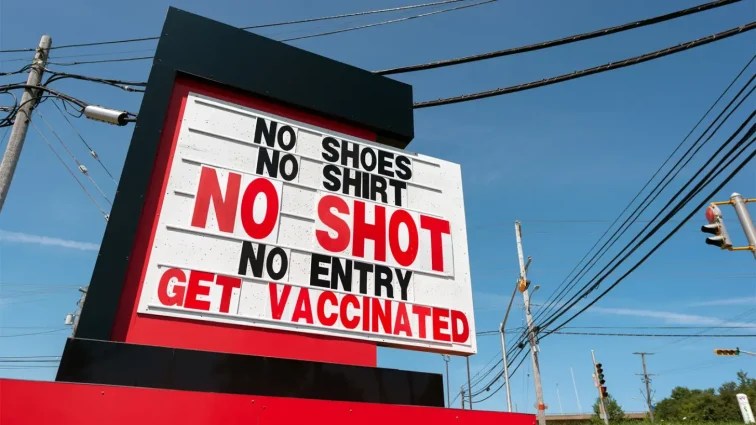
Not only did governments exert this pressure through policy, but in many cases politicians and officials used their office to deliberately stoke the social stigmatization of the unvaccinated. Here’s a look back at some of the unprecedented vitriol that was launched at those who refused Covid vaccines from 2021 and beyond.
Officials in many jurisdictions proposed making the unvaccinated pay more for healthcare.

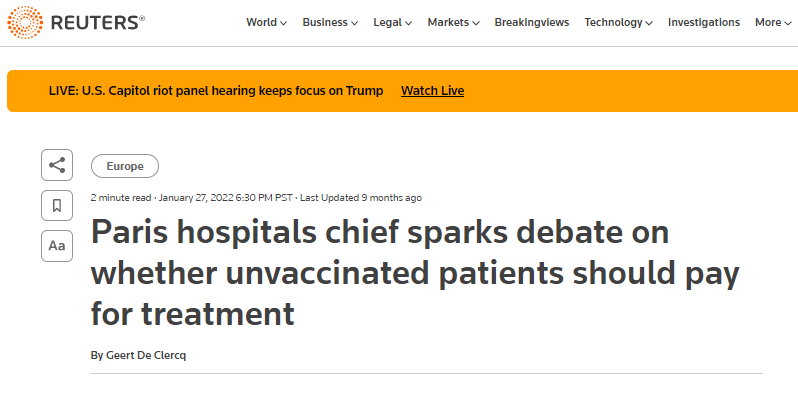
In Victoria, Australia — where lockdowns were longer than in perhaps any other city in the world—one politician proposed cutting the unvaccinated out of the national health system entirely.

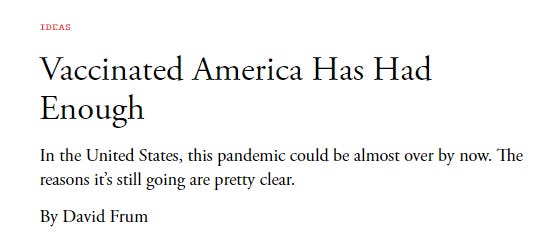
A particularly disturbing idea that began to gain serious traction among the elite commentariat was to have hospitals triage emergency care to serve the unvaccinated last, or even deny healthcare to the unvaccinated entirely—a fairly clear-cut crime against humanity.
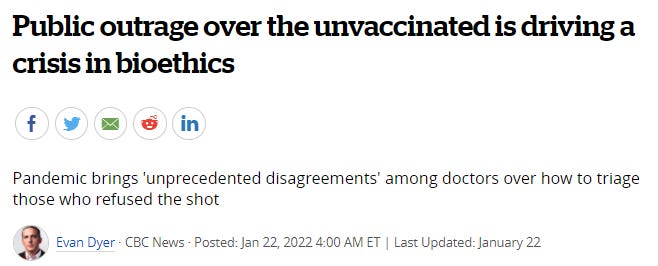
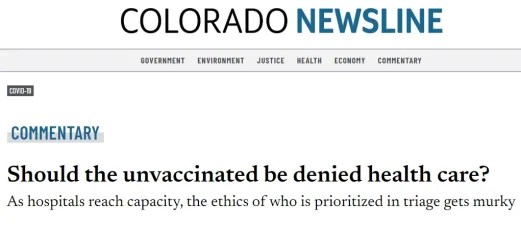
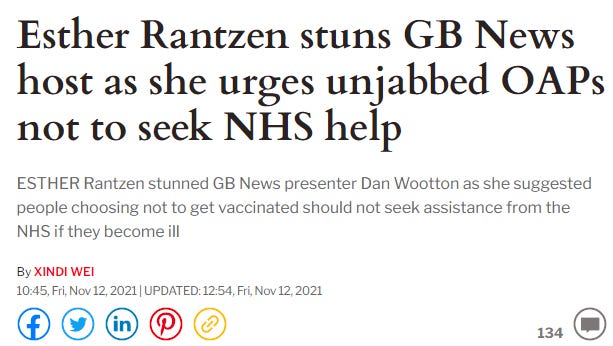
One vocal proponent of the idea of triaging emergency care to disfavor the unvaccinated was David Frum, Senior Editor of the Atlantic, most famous for his outspoken support for the invasion of Iraq. When his infamous tweet on the subject sparked an uproar, Frum doubled down.

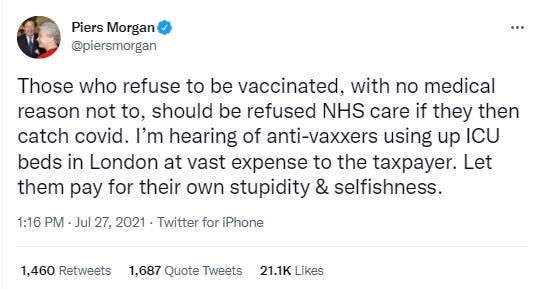
Piers Morgan agreed that the unvaccinated should be denied emergency care.
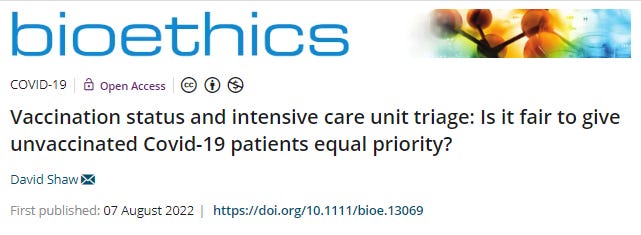
Shockingly, this appalling idea of triaging emergency care based on vaccination status is still being proposed to this day.
The demonization of the unvaccinated was, of course, far from limited to healthcare. Vilifying the unvaccinated became a kind of illiberal fad among the elite commentariat. The US CDC even paid screen writers and comedians to promote Covid vaccines, which in some cases involved paying them to mock the unvaccinated.

In a bout of recidivism to the early 20th century, Austria and Germany introduced the chilling concept of “lockdown for the unvaccinated.”
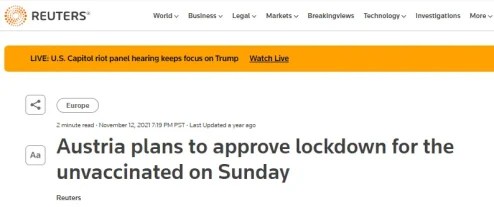
“Lockdown for the unvaccinated” gained traction in the English-speaking world as well.

Most countries, cities, and states across the western world introduced vaccine passes that their own citizens had to show in order to partake in daily life. The World Health Organization published an extensive document on implementing a digital vaccine-pass system, including an international vaccine status registry and instructions on how to later revoke someone’s vaccine pass.
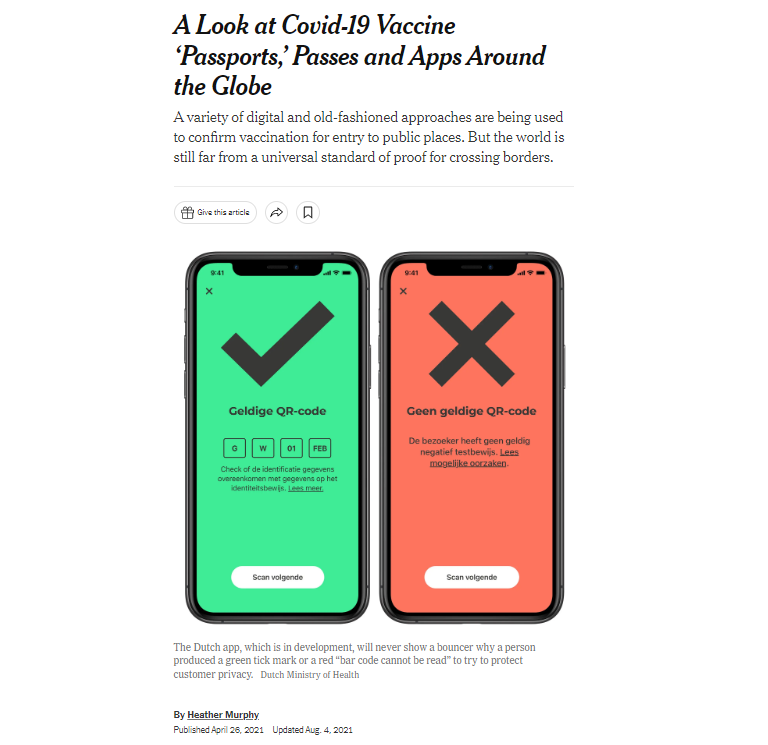
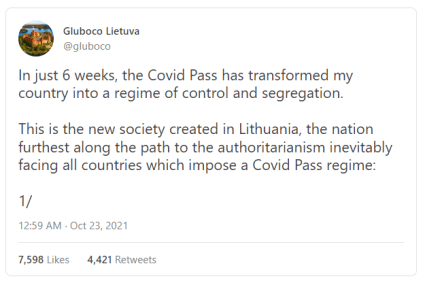
The most dystopian of these vaccine pass systems was in Lithuania, where the unvaccinated were banned from nearly all public spaces and employment outside their homes; the few shops where they could purchase essentials had to post large red signs on their doors indicating that unvaccinated persons could be present.
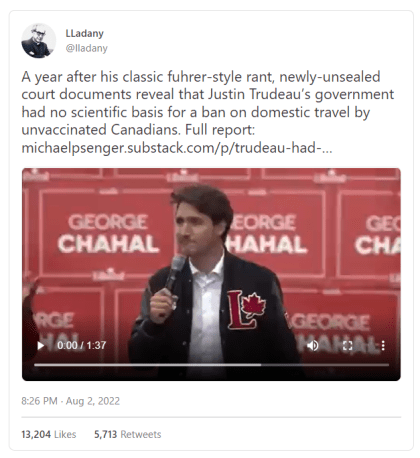
And of course, who could forget Justin Trudeau’s classic fuhrer-style rant about having to share public transportation with the unvaccinated, despite government documents later revealing that he had no science to back any of these claims.
Like so much of the response to Covid, these vaccine passes and the illiberal fad of stigmatizing the unvaccinated were unscientific, unprecedented, ineffective, totalitarian, brutal, and dumb.
It was never remotely realistic for any government to expect every single person to get vaccinated, especially when the vaccine in question involved a novel genetic-based therapy. Thus, these proposals to impose draconian hardships on those who refused Covid vaccines would inevitably involve the state imposing draconian hardships on a sizable portion of the population.
According to Harvard epidemiologist Martin Kulldorff, one of the most credible voices on the subject, Covid vaccines likely yielded benefits for the elderly and vulnerable, but it remains entirely unclear whether Covid vaccines have yielded any benefit at all for healthy adults and especially for children. Coupled with the still-unknown risks associated with mRNA technology and the now well-documented cases of death and serious injury from these vaccines, for governments across the world to have exerted extreme pressure on children and healthy adults to get these vaccines is absolutely sickening.
That some healthy young people were surely coerced into receiving an injection that led to their death or serious injury, when the data showed that the benefits did not outweigh the risks, is an unconscionable tragedy.
Masks For Thee But Not For Me

eugyppius – October 13, 2022
Pictured is the Federal President of Germany, Frank-Walter Steinmeier, violating the Infection Protection Act, which requires masks in all local and long-distance trains. He pleads that he only took his mask off for a few seconds for the purposes of a short video message and some publicity photographs. Alas, the law provides for no such exception, and why should it? The official position of the German government is that unmasked people are a danger to themselves and others, particularly when they are on trains.
Now this is merely the latest in a string of similar incidents, including these barefaced mask mandate-happy Greens at Oktoberfest and German Chancellor Olaf Scholz’s unmasked government flight to Canada. It’s long become clear that nobody—not even the politicians most in favour of mandates—believes that masking is worth the trouble. And when you think about it, that’s depressing indeed, because how can we ever get rid of these rules if they are this discredited, and yet they persist?
Featured Video
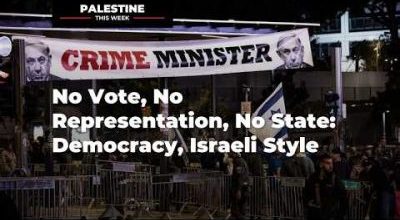
No Vote, No Representation, No State: Democracy, Israeli Style
or go to
Aletho News Archives – Video-Images
From the Archives
Sanctions, War and the Policy of Dual Containment
By SASAN FAYAZMANESH | March 17, 2008
It is now nearly three decades since the Unites States adopted the policy of dual containment of Iran and Iraq. While much has been written about the containment of Iraq, there has been very little in-depth analysis of this policy when it comes to Iran. In a book that is going to be released on March 31, 2008, entitled The United States and Iran: Sanctions, Wars and the Policy of Dual Containment (Routledge), I attempt to address this shortcoming by investigating when and why the US policy of containment of Iran came about, how it evolved, and where it stands today.[1] To the extent that Israel has been involved in US policy making, the study will also include the role that Israel has played in the containment of Iran. Also, since the fate of Iran has been inextricably linked to that of Iraq, occasionally the investigation will overlap with the containment of Iraq.
The policy of dual containment of Iran and Iraq originated during the Carter Administration, but it was not until the Clinton Administration that the expression “dual containment” became popular. … continue
Blog Roll
 Aletho News
- No Vote, No Representation, No State: Democracy, Israeli Style
- Zionist Bought Senate Blocks Information About American Citizens Killed By Israel
- While Gaza dominates the UN, these are the people keeping it alive
- New Report: “Scholasticide and Genocide in Gaza: Assessment, Testimonies and Legal Analysis”
- ‘THAAD Delusion’: Iran war exposes US missile shield limits – The Atlantic
- Moscow issues warning to NATO over Russian exclave
- Yes, the Iran war has destroyed Trump’s presidency
- The fallacy of US delusions about Iran’s economic collapse
- Hezbollah denies Syria cell link, warns of Israeli plan to sow discord
- The legacy of US sanctions, war, and occupation in Iraq
- If Americans Knew
- Mamdani releases plan to combat antisemitism and hate crimes in New York City
- Iran’s Revolutionary Guards Publish Letter to the American People
- DMFI launches $1 million ad campaign supporting Virginia’s Elaine Luria
- US Senate blocks resolution seeking report on Americans killed by Israel
- Israeli Attacks Kill Ten Palestinians in Gaza
- Massacre at Minab: The School That Became a Grave
- Israeli media: The IDF Shows It Doesn’t Turn a Blind Eye; It Actively Emboldens Settler Havoc
- As settlers ravage West Bank, Israeli forces kill 10 in Gaza – Daily Update
- New Report: “Scholasticide and Genocide in Gaza: Assessment, Testimonies and Legal Analysis”
- Ex-Biden officials are desperate for a Gaza scapegoat
- No Tricks Zone
- Green Energy Debacle: German Expert Professor Fritz Vahrenholt Warns Of Severe Economic And Social Consequences
- Two More Paleo Reconstructions Affirm Meters-Higher Sea Levels Across Ireland, Brazil 7000-6000 Years Ago
- New Study: Earth And Venus Surface Warmth Largely Explained By Convection And Lapse Rate, Not CO2 Or Radiation
- 2025 Nature Paper Claiming Worsening Global Drought Gets RETRACTED …Heavily Flawed
- New Study: ‘Global Drought Shows No Detectable Recent Acceleration Under Climate Warming’
- Economic Masterminds: German Socialists Suggest Taxing Productivity Gains Stemming From Using AI
- The South China Sea Has Not Been Cooperating With The Climate Change Narrative
- Energy Crisis: Germany Enters Heating Season With Historically Low Gas Reserve Fill Levels
- New Study: The Antarctic Ice Sheet Gained Mass From 2020-2024 Due To Staggering Snow And Ice Accumulation
- Study: Ocean Heating Rates From Thousands Of Years Ago ‘Dwarf’ Modern Ocean Heating Rates

