Cuomo and the Failure of Covid Absolutism
By James Bovard | AIER | February 24, 2021
New York Governor Andrew Cuomo is falling from grace at epic speed. His administration is now the target of a Justice Department probe for policies that resulted in the death of one out of eight nursing home residents in the state. Regardless of whether the New York legislature impeaches Cuomo, the standard he championed poses a continuing peril.
From the start of the Covid pandemic, the media idolized Cuomo for his “safety through absolute power” mantra. Last March 20, Cuomo imposed a statewide lockdown on 20 million New Yorkers, closing schools and businesses. Cuomo labeled his decree a “pause” and declared: “If everything we do saves just one life, I’ll be happy.” At that point, most counties in New York state had five or fewer people who have tested positive for coronavirus.
Cuomo’s “just one life” standard for lockdowns should have obliterated his credibility. Instead, Cuomo’s maxim was treated as a triumph of idealism and benevolence. Cuomo’s power grab was enabled by media allies that fanned hysteria. As AIER editorial director Jeffrey Tucker recently noted, the New York Times’ Donald G. McNeil Jr. “was the first reporter from a major media venue to stir up virus panic and advocate for extreme lockdown measures… The Times allowed its voice to be used to promote a primal and primitive disease panic, which they surely knew would create a cultural/political frenzy.” Presidential candidate Joe Biden hailed Cuomo last Spring for setting the “gold standard” for leadership on Covid.
After Cuomo swayed the New York legislature to give him “authorization of absolute power,” as the New Yorker declared, he issued scores of decrees, including one compelling nursing homes to admit Covid-infected patients and permitting Covid-infected staffers to keep working at those homes. A New York democratic legislator said that Cuomo was “inclined towards tyranny. But in a crisis that’s what people want.”
A New Yorker profile, entitled “Andrew Cuomo, King of New York,” explained that Cuomo and his aides saw the battle over Covid policy as “between people who believe government can be a force for good and those who think otherwise.” For many liberals and much of the nation’s media, placing people under house arrest, padlocking schools, bankrupting business, and causing two million people to lose their jobs vindicated government as “a force for good.”
MSNBC’s Nicolle Wallace declared that Cuomo is “everything Trump isn’t: honest, direct, brave.” Entertainment Weekly hailed Cuomo as “the hero that America never realized it needed until he was on our television screens every night.” As National Review recently noted, local reporters failed to ask questions on his nursing home edict “for months, as the governor held his much-praised daily press briefings about the pandemic. There were literally hundreds of hours of Cuomo press conferences in the first half of 2020 where not a single question was asked about nursing homes.”
The docile media paved the way to Cuomo winning an Emmy award for his “masterful use of television” during the pandemic. The media’s valorization of Cuomo helped make his self-tribute book, American Crisis: Leadership Lessons from the COVID-19 Pandemic, a bestseller.
Cuomo has always known how to milk the media. When he was Secretary of Housing and Urban Development, he explained to the Washington Post in 1999 how he would fix HUD’s dismal image: “The PR is the most important thing I do … Eighty percent of the battle is communications.” (I christened Cuomo as “the Clinton administration’s most megalomaniacal cabinet secretary in a 2000 American Spectator piece titled, “Andy At It Again: How to Keep Reinventing HUD to Advance Yourself.”) Flash forward to last June, and Cuomo prematurely issued a poster celebrating his and New York state’s victory over Covid. The political art (sold for $14.50 plus shipping and handling) featured a steep mountain symbolizing the rise and fall of Covid cases. The poster was plastered with insipid phrases such as “The sun on the other side, “The power of ‘We,’” “Winds of Fear,” “Follow the Facts,” and “Love Community Support,” and included a jibe against Trump. Though poster sales failed to deter second and third waves of Covid outbreaks, the PR campaign further encouraged the media to focus on Cuomo’s words instead of his deeds.
During the pandemic, “legitimacy” came not from adhering to the U.S. and state Constitutions but from continually invoking “science and data,” as Cuomo did. . Cuomo’s entitlement to absolute power came from modeling concocted by the Institute for Health Metrics and Evaluation (IHME), a Washington State-based institution bankrolled by The Bill and Melinda Gates Foundation. As investigative journalist Jordan Schachtel noted last week in an AIER analysis, IHME forecasts presumed a death rate 30 times higher than the rate that actually occurred. That horrendous miscalculation sufficed for one governor after another to nullify Americans’ freedom with lockdown orders. Absurd statistical extrapolations forecasting future harm made tyranny irrelevant.
Cuomo describes himself as a “great progressive,” perhaps thereby entitling himself to any power he presumes necessary “for the good of the people,” Bill of Rights be damned. November, the U.S. Supreme Court struck down New York state restrictions that limited religious gatherings to ten or fewer people while permitting far more leeway for businesses to operate, declaring that Cuomo’s rules were “far more restrictive than any Covid-related regulations that have previously come before the Court… and far more severe than has been shown to be required to prevent the spread of the virus.” Cuomo’s allies in the liberal establishment reacted with horror to the limit on his sway. An American Civil Liberties Union official fretted to the New York Times that “the freedom to worship… does not include a license to harm others or endanger public health.” Harvard law professor Lawrence Tribe and Cornell professor Michael Dorf babbled that the ruling signaled that the Supreme Court belonged in “the theocratic and misogynist country in Margaret Atwood’s dystopian ‘The Handmaid’s Tale.’”
Cuomo remained revered even though his repressive policies failed to prevent New York from having among the nation’s highest Covid death rates. But a Justice Department probe into his nursing home policies launched last August may be his undoing. New York state reported barely half of the total of more than 12,000 New York nursing home patients who died of Covid. Cuomo’s top aide, Melissa DeRosa, told Democratic legislative leaders that “basically, we froze” when the feds demanded information. “We were in a position where we weren’t sure if what we were going to give to the Department of Justice… was going to be used against us,” DeRosa said according to a leaked transcript.
But Cuomo’s culpability goes beyond hiding corpses. Early in the pandemic, he pushed to include a legislative provision written by the Greater New York Hospital Association to give a waiver of liability to nursing homes and hospitals whose patients died of Covid. A report last month by the New York Attorney General warned, “The immunity laws could be wrongly used to protect any individual or entity from liability, even if those decisions were not made in good faith or motivated by financial incentives.” As the Guardian noted, “Cuomo’s political machine received more than $2 million from the Greater New York Hospital Association (GNYHA), its executives and its lobbying firms.”
But Cuomo’s credibility should have been dethroned long before the latest disclosures. As early as last May, barely two months after the start of the state lockdown, a New York Post columnist groused: “So Gov. Andrew Cuomo killed Grandma and cratered New York’s economy. But he looked good doing it.” Cuomo’s cachet derived almost entirely from media scoring that until recently ignored almost all of the harms he inflicted.
Cuomo and other politicians have used Covid policy lodestars that were akin to crossing the Pacific Ocean with navigators who insisted the earth was flat. Melinda Gates admitted last December: “What did surprise us is we hadn’t really thought through the economic impacts.” The politicians who imposed shutdowns based on data from the Gates’ funded by the Institute for Health Metrics and Evaluation apparently never bothered to estimate the collateral damage from their decrees. Similar myopia spurred crackdowns and restrictions in many states that helped cause the sharpest reduction in Americans’ life expectancy since World War Two.
Unfortunately, there is no indication that either politicians or the media have recognized the authoritarian dangers inherent in governors or presidents claiming a right to boundless power to save “just one life.”
A similar standard is helping justify keeping schools closed in many areas. Teachers’ unions have rallied around the motto: “If one teacher dies, isn’t that too many?” But like Cuomo’s shutdowns, that standard ignores the horrific collateral damage on American children. A Journal of the American Medical Association analysis concluded that shutting down the schools would reduce the current crop of students’ collective years of life by more than five million, based on “lower income, reduced educational attainment, and worse health outcomes.” It remains to be seen how much, if any, the role of the well-being of children plays in school policy in the coming months.
While it is unlikely that the media lapdogs who adore Cuomo and other prominent politicians will admit their follies, the exposure of hard facts may help blunt the next stampede to submission. The Justice Department investigation into nursing home policies that boosted Covid death tolls in New York, New Jersey, Michigan, and Pennsylvania could tarnish some of the nation’s most aggressive Covid lockdowners. Other investigations by the media or private groups could expose far more evidence of misconduct or of gross negligence that boosted Covid death tolls.
In a tour of television talk shows shortly after President Biden was inaugurated, Cuomo recited his latest catchphrase: “Incompetent government kills people.” This intended slapdown of Trump is recoiling badly on the New York governor. If Cuomo is impeached or forced to resign for his Covid fiascos, maybe he could score plenty of media appearances with a new slogan: “Absolute power with impunity kills.”
Tony Blair’s anti-freedom project continues, but ‘War on Terror’ is replaced by ‘War on Covid’
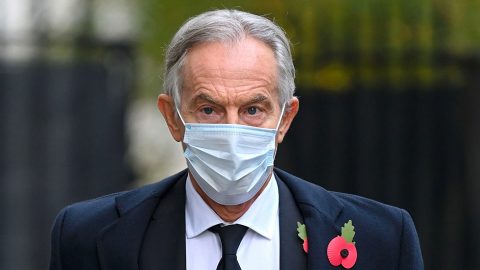
By Neil Clark | RT | February 25, 2021
The ‘War on Terror’ seems to have morphed into a ‘War on Covid’. And guess what? Serial warmonger Tony Blair is a key figure in both, seeking to curtail our civil liberties with the excuse that it’s all for the “greater good.”
The date: Monday November 6, 2006. The place: Downing Street news conference. UK Prime Minister Tony Blair dismisses the civil rights argument against ID cards, which his government is keen to introduce. He says it is an issue of “modernity” and “modern life.”
“We are building a new part of our infrastructure here. And like other such projects the gains to citizens will be much larger and more extensive than anyone could say at the time.”
Sound familiar?
Fast forward fourteen years, and the same Tony Blair is saying much the same thing about Covid vaccine passports. There’s been no more zealous British advocate of vaccine passports than the man the anti-lockdown journalist Peter Hitchens calls ‘The Blair Creature’.
“Prepare for a health passport now,” he said in December. “I know all the objections, but it will happen. It’s the only way the world will function and for lockdowns to no longer be the sole course of action.”
Last week it was reported that ´The Blair Creature’ had been lobbying hard for vaccine passports to be included in Boris Johnson’s so-called ‘road map’ out of lockdown. And they were. The government has announced a review. Michael Gove, a man who once wrote a piece entitled ‘I can’t fight my feelings any more; I love Tony (Blair)’, is heading it.
Tony must be delighted.
Back in 2006, ID cards were promoted as a way of tackling the ‘terrorism’ threat and keeping us all ‘safe’. Vaccine passports are presented today in the same reassuring manner. The War on Terror and the War on Covid have so much in common. They both have five level ‘alert’ systems. ´The Blair Creature’ is the key linking figure.
Both wars (Terror and Covid), have been used as smokescreens to pursue elite, globalist and extremely illiberal agendas. Under the guise of ‘fighting terrorism‘, the US, UK and their allies embarked on a series of regime change wars.
First up was Afghanistan, on the grounds that the Taliban-ruled country had been sheltering Bin Laden. But while you could make a case for linking this to a ’war on terror’ there could be no such excuses for the illegal invasion of Iraq.
Ba’athist Iraq – whose long serving Deputy Prime Minister Tariq Aziz was a practising Christian – was actually a bulwark against extremist groups like Al-Qaeda. The assault on Iraq proved to us that the ‘war on terror’ was a sham. Far from making us safer, the invasion actually greatly boosted global terrorism by spawning ISIS.
In short ‘the war on terror’ made the global terrorism situation much worse, and that’s before we get on to the reduction in civil liberties at home. Air travel has never been the same. Restrictions that were imposed – such as prohibitions on bringing liquids on board flights – and which were billed as ’temporary measures’ are still with us. ‘Anti-terrorism’ legislation has been regularly strengthened while at the same time there’s been covert British action in Libya and Syria on the side of the terrorists, which has led to domestic blowback.
We know for instance that the Manchester Arena suicide bomber Salman Abedi, responsible for the horrific attack in 2017 which killed 22 people, more than half of them children, and his father Ramadan, had links with the anti-Gaddafy Libyan Islamic Fighting Group, allegedly used by the UK authorities as part of their regime change operation. As I noted in a previous op-ed, Abedi Jnr was even rescued from Libya by the Royal Navy.
The ‘War on Terror’ was based on a fundamental deceit. It was a deep state/neocon con trick. Not only was it a war that could never be won, it was never meant to be won. It was meant to be permanent. But in 2020 it was superseded by a new war – the ‘War on Covid’.
Again, we see much the same Manichean rhetoric. George W. Bush famously stated “You’re either with us or against us in the fight against terror.” And so it is today, with ‘virus control’ and not ‘terrorism control’ the focus.
If you oppose oppressive lockdowns, restrictions on free movement, and the introduction of vaccine passports, then you are on the side of the virus. You want to ‘let it rip’. You have ‘blood on your hands’ just like the millions who marched against the Iraq War. Support a more nuanced, proportionate approach with people allowed to make their own risk assessments? No, that’s not allowed. You’re either with the ‘War on Covid’ or against it.
The ‘War on Covid’ gives the Western elites the opportunity to strip away our freedoms and complete the building of the digital ‘infrastructure’ that began under the ‘War on Terror’ and which Blair referred to in 2006.
‘Health passports’ are a key part of that infrastructure, as I noted last summer. The WEF’s ‘Great Reset’ is heavily dependent on their introduction.
Of course, it won’t just be your ‘Covid’ status that’ll be on them; they will be extended into full, digitalised bio-ID cards. Vaccine passports are the gateway to a Chinese-style social credit restricted access control system being rolled out in the West.
Blair, the great authoritarian, hopes to get in 2021 or 2022 what he couldn’t get fifteen years ago. “I think you’re going to the stage where it’s going to be very hard for people to do a lot of normal life unless they can prove their vaccination status… Vaccination in the end is going to be your route to liberty,” he said in a recent interview. And of course he is working hard to make sure we do get to that stage.
Will he succeed? His plan for ID cards fifteen years ago failed because of the strength of opposition. When Labour lost power in 2010, the scheme was ditched. But the Tony Blair Institute (which has received considerable funding for its work from the Bill and Melinda Gates Foundation) boasted on Twitter last May that its ‘teams’ were “embedded in governments around the world, helping them to keep their people safe”.
We know that Blair has been ‘advising’ Health Secretary Matt Hancock and that the secret talks reportedly covered vaccines and mass testing. What is scary today is that the parliamentary opposition – now led by the uber-Blairite Sir Keir Starmer – seems to be even more pro-health passports than the government.
But we shouldn’t give up hope just yet. A petition against Covid-19 vaccine passports has raised almost 200,000 signatures. The campaign against health passports needs the support of the anti-war, anti-imperialist left and hopefully the fact that it’s Tony Blair who is pushing them will cause people to wake up and see the bigger picture. War on Terror, War on Covid. ‘Only connect!’, as the great novelist E.M. Forster might say.
Israel’s killing of Palestinian man at checkpoint was ‘extrajudicial execution’, concludes report

Ahmed Erekat, a 27 year old Palestinian man was killed by Israeli soldiers near a checkpoint in Abu Dis on 23 June 2020
MEMO | February 24, 2021
Further doubts have been raised over Israel’s killing of Ahmad Erekat. The 27-year-old was shot dead in June at an Israeli military checkpoint near the town of Abu Dis, east of Jerusalem. Israeli police claimed that Erekat was a “terrorist” conducting an attack.
But a new report by Forensic Architecture, a British research body based at Goldsmiths, University of London, has challenged the Israeli narrative following a “frame-by-frame” analysis of the security camera footage which clearly showed Erekat’s movement prior to his killing.
The report found that Erekat posed no “immediate threat” to Israeli soldiers; that he was denied medical treatment after he was fatally shot; his body was treated in a “degrading” manner and that following his death his family was subjected to collective punishment.
Details of the report, which includes the reconstruction of the scene using available film, including security footage published by police, cast “significant doubt” over the Israeli narrative. It cited collision experts who concluded that Erekat’s car was not accelerating significantly. “Our analysis also comes across evidence that raises the possibility that Erekat braked before impact with the checkpoint,” the report said.
Collision expert Dr Jeremy J Bauer concluded that “the driver did not rapidly accelerate into the checkpoint. Had the driver truly wanted to maximize the chance that he would surprise the guards and strike them with his vehicle, he could have accelerated to the maximum capacity of the vehicle.”
After the impact, video footage shows Erekat leaving the vehicle unarmed and moving away from the soldiers, raising his hands in the air. He is first shot when standing around four metres away from the nearest soldier. He then continues to move backwards as he falls to the ground. Israeli soldiers fired six shots in the space of two seconds.
Detailed analysis of the footage contradicts the Israeli army’s claim and confirms that Erekat did not pose any immediate threat. It also found that Israeli forces offered no immediate medical aid, even while Erekat was clearly alive. The killing amounted to an extrajudicial execution, it concluded.
Israel said to warn Hamas leader not to run in polls
MEMO | February 23, 2021
Hamas leader Nayef al-Rajoub said Tuesday he was warned by Israeli intelligence agents against running in the Palestinian elections later this year, Anadolu Agency reported.
Speaking to Anadolu Agency, al-Rajoub, 63, said he was searched during an Israeli raid on his home in the town of Dura, west of Hebron.
“An intelligence officer then threatened me not to run in the upcoming polls,” al-Rajoub said, adding that he was only allowed to cast a ballot in the elections.
Al-Rujoub, a brother of prominent Fatah leader Jibril al-Rujoub, received the most votes during the 2006 parliamentary elections won by Hamas.
In the Hamas-led government that emerged from those elections, Al-Rujoub served as minister of religious endowments. He had previously been detained by Israeli forces and served more than eight years in prison.
Earlier Tuesday, Israeli forces arrested 13 Palestinians, including Hamas leader Faze’ Sawafta, in overnight raids in the occupied West Bank.
Hamas, which rules the Gaza Strip, had earlier warned of Israeli plans to stage a mass arrest campaign against the resistance group ahead of Palestinian elections later this year.
Over the past month, several Hamas members were detained in Israeli raids, with the Palestinian group warning that the Israeli arrests aim to disrupt the Palestinian elections and affect its results.
Palestinians are scheduled to vote in legislative elections on May 22, presidential polls on July 31, and National Council polls on Aug. 31.
The last legislative elections, in which Hamas won a majority, were held in 2006.
African governments are crushing opposition using Israeli spyware
By Suraya Dadoo | MEMO | February 24, 2021
As internet penetration and smartphone usage increases across Africa, digital spaces have become increasingly important for organising political uprisings and opposition movements. In response, several of the continent’s regimes have shut down the internet or blocked social media apps. To sidestep the economic costs and global criticism that these online shutdowns incur, governments have turned to digital surveillance technology as a shrewder way to crush all opposition.
In a recently-released report titled “Running in Circles: Uncovering the Clients of Cyberespionage Firm, Circles”, the University of Toronto’s Citizen Lab — which investigates digital espionage against civil society — details how government agencies in Botswana, Equatorial Guinea, Kenya, Morocco, Nigeria, Zambia and Zimbabwe are using the surveillance technology developed by Israeli telecom company Circles to snoop on the personal communications of opposition politicians, human rights activists and journalists. These seven African countries are among 25 around the world using Circles, which is affiliated with the notorious NSO Group whose invasive Pegasus spyware has been used to target human rights defenders and journalists around the world.
How does it work?
Circles technology is sold to nation states only, and intercepts data from 3G networks, allowing the infiltrator to read messages and emails, and listen to phone calls in real time. Using only the telephone number, a Circles platform can identify the location of a phone anywhere in the world within seconds.
Circles exploits flaws in Signalling System No.7 (SS7), the set of protocols that allows networks to exchange calls and text messages between each other. This allows government agencies to track individuals across borders without a warrant, bypassing international conventions.
In 2019, 3G became the leading mobile technology in Sub-Saharan Africa, accounting for over 45 per cent of all connections. With the faster — and possibly more secure — 4G networks being at least five years away from becoming the standard for mobile connectivity on the continent, Circles’ 3G-manipulating technology is ideal for power-hungry African leaders looking to cling to power by spying on critics.
The spying revelations came as African governments — including some named in the Citizen Lab report — are cracking down brutally on protestors and opposition groups.
Nigeria
Recent #EndSARS protests triggered a deadly response from Nigeria’s state security apparatus, with the government able to infiltrate the movement’s organisational structures successfully.
Citizen Lab identified two Circles systems in Nigeria that both began operating in June 2015. One of them was being used by the Nigerian Defence Intelligence Agency (DIA). In 2016, the governors of Delta and Bayelsa states also purchased Circles systems to spy on political opponents and critics. The presence of Circles products in Nigeria goes back more than a decade, when former Rivers state governor, Rotimi Amaechi, became the first Nigerian politician to use the surveillance technology in 2010.
Circles’ government clients in Nigeria have a long history of abusing surveillance technologies to conduct mass surveillance of citizens’ telecommunications. Femi Adeyeye, a Lagos-based political activist who has been detained several times for criticising the Nigerian government, is not surprised that Muhammadu Buhari’s regime is using the invasive spying technology.
Adeyeye cited several cases where Nigerians were swiftly traced, arrested and detained after criticising the government. These include journalists Omoyele Sowore, Abubakar Idris Dadiyata and Stephen Kefas. The Committee to Protect Journalists (CPJ) has also reported numerous cases of the Nigerian authorities abusing phone surveillance by targeting journalists’ phones to reveal and track sources for stories investigating government corruption.
“We are already in the worst stage of dictatorship,” warns Adeyeye. “Freedom of expression, media, and political association have been further weakened by this spying technology.”
He says that Nigerian political analysts now self-censor when commenting on national political issues, after witnessing the government’s infiltration of #EndSARS. “They have seen how people have been traced, their passports seized and bank accounts frozen, and how they have been forced to go into exile.”
Zimbabwe
In Zimbabwe — which has witnessed intense anti-government protests recently — Citizen Lab detected three Circles platforms, with one dating back to 2013. A second platform was activated in March 2018 and is still operating.
As in Nigeria, there has been a government crackdown on anyone exposing corruption. Investigative journalist Hopewell Chin’ono, and Jacob Ngarivhume, the leader of the opposition group Transform Zimbabwe, were detained ahead of anti-government protests last year. Circles technology is facilitating this suppression.
Equatorial Guinea
A Circles surveillance system was also found in Equatorial Guinea, where dictator Tedoro Obiang has ruled for 40 years in a climate of torture, extra-judicial executions, arbitrary arrests and the persecution of political activists and human rights defenders. Obiang has crushed protests violently and ignored demands for electoral reforms and limits on terms of office.
Morocco
Morocco’s Ministry of the Interior has been a Circles client since 2018. Rabat has a history of leveraging digital technology to unlawfully target Moroccan human rights activists.
Eroding democracy in Botswana
It’s not just countries such as these facing protests, or those with a dismal record of human rights abuses, that are spying on their citizens. Even supposed democracies are involved. Botswana is hailed widely as one of Africa’s most stable democracies. Yet, the country’s Directorate of Intelligence and Security Services (DISS) was linked to two Circles surveillance systems dating back to 2015. The targets were journalists investigating corruption by politicians.
According to Moeti Mohwasa, spokesperson for the opposition Umbrella for Democratic Change (UDC), Israeli companies have been selling spyware to the Botswana government for years. Mohwasa says that some of this equipment has been used to eavesdrop on opposition politicians and union leaders in the country.
Enabling authoritarianism in Kenya
Citizen Lab also reported a Circles system in Kenya. While the East African nation is often lauded as a strong democracy, critics accuse the Uhuru Kenyatta administration of being an authoritarian regime.
“In Kenya, freedom of expression and media freedoms are under constant threat,” says Suhayl Omar, a policing, surveillance and militarism researcher from Nairobi. “The Kenyatta regime has waged a war against constitutionalism and any form of opposition in Kenya.”
Omar believes that the Kenyan government relies heavily on surveillance of its citizens to crack down on any form of opposition. “For this, they look to undemocratic and violent states — like Israel — to fund, equip and train their agents and armies for these unconstitutional missions.”
Zambia
Zambia is also a Circles client. In 2019, the Zambian authorities reportedly used a cyber-surveillance unit in the offices of Zambia’s telecommunications regulator to pinpoint the location of a group of bloggers who ran an opposition news site. They were duly arrested, with the authorities in constant contact with the police units on the ground throughout the operation. Given its capabilities, it is likely that a Circles system was used to do this.
Should the Israeli government be held accountable?
African governments will justify spying by claiming that it is a matter of national security. The Israeli government, meanwhile, has distanced itself from these anti-democracy purges. Israeli Minister Zeev Elkin denied any government involvement, telling Israeli radio, “Everyone understands that this is not about the state of Israel.” But it is.
The Israeli government, through its Ministry of Defence, implicitly sanctions such activities by providing tech firms with export licences. In January 2020, Amnesty International filed a lawsuit in Israel calling for the ministry to ban the export of invasive spying software, as it was being used to attack human rights activists by the governments purchasing them. Last July, an Israeli court denied Amnesty’s request.
“The Israeli regime has actively enabled the authoritarianism of Uhuru Kenyatta,” explains Suhayl Omar, commenting on the situation in Kenya. Moeti Mohwasa in Botswana agrees about official Israeli involvement. “In recent years, the Botswana government has increasingly been eroding civil rights, and becoming intolerant of political dissent. Israel is aiding these dangerous trends.”
Friends with benefits
Although developed by private companies, the spying equipment is also a key part of the Israeli government’s diplomatic charm offensive in Africa. By helping African governments cling to power through arming them with the weapons to wage cyber-warfare on their citizens, Tel Aviv is hoping to make more African friends. The aim is to dissolve African solidarity with Palestine, and capture African votes at the UN and so defeat resolutions that are critical of Israel’s brutal military occupation. Israel is also trying to find partners to lobby the African Union to grant the occupation state observer status.
In his book War Against the People, Jeff Halper writes that Israel is exporting its expertise in population control gained through its occupation of Palestine, and leading the “global pacification” industry, assisting state security agencies around the world. The danger, Halper warns, is that gradually we will all become like Palestinians, fearful of being tracked and detained for organising a protest, defending human rights or trying to hold the powerful to account.
As repressive African governments continue looking to Israel to help them shrink the safe space for human rights defenders even further, the danger is that Abuja, Nairobi, Gaborone and other capitals across the continent may end up under digital occupation just like Ramallah, East Jerusalem and Gaza City.
READ ALSO:
Teacher: I Won’t Force Kids To Wear Masks & I Won’t Wear One Either
By Richie Allen | February 24, 2021
The Telegraph newspaper, to its credit, has published an opinion piece by a secondary school teacher who is based in Essex. The teacher believes that forcing kids to wear masks in the classroom is “Dystopian and abhorrent.”
The teacher has been reading “The Handmaid’s Tale with Year 11’s and described a class full of masked children as “like something out of Gilead.” Expressing concern that masks would make it seem to youngsters that schools are not safe when they desperately need some normality the teacher wrote:
They are already being flooded with messages in the media and the outside world which fill them with fear on a daily basis. The government’s whole campaign is built on fear and children have absorbed that. They have also faced a year of disruption to their learning and been kept apart from their friends. What sort of message does it send to them if we then make them wear a mask in the classroom too?
As well as being physically uncomfortable, it’s going to be almost impossible for them to communicate with me as their teacher. It will have a detrimental impact on their confidence, make them even more reluctant to put their hand up in class to ask questions and engage in the lesson. Many of them, especially those who were already struggling, have fallen massively behind during lockdown and will find it difficult or even impossible to catch up.
I’ve also seen very little evidence to suggest that masks are effective anyway. I am cynical about this idea of asymptomatic transmission. Schools aren’t necessarily the cleanest places in the world but children are meant to be exposed to a few germs to build up their immune systems.
The teacher is absolutely right. It’s dystopian and disturbing in the extreme. Of course it will unsettle children but it will also do them serious harm. Wearing masks for eight hours a day may have a seriously detrimental effect on their physical health. Dozens of studies have found that masks make breathing more difficult, especially for children.
The National Institutes of Health (NIH) found that:
… inhaling high levels of carbon dioxide (CO2) may be life-threatening. Hypercapnia (carbon dioxide toxicity) can also cause headache, vertigo, double vision, inability to concentrate, tinnitus (hearing a noise, like a ringing or buzzing, that’s not caused by an outside source), seizures, or suffocation due to displacement of air.
Parents wise up and wise up fast. You must not allow your children be forced to wear a face covering when they return to the classroom.
North Dakota House Votes To Make Mask Mandates Illegal

By Steve Watson | Summit News | February 23, 2021
The House of Representatives in North Dakota has voted to make mandates on wearing face masks illegal.
The bill was sponsored by Rep. Jeff Hoverson who labelled the mask mandate instituted by the State governor last year as “diabolical silliness,” adding that “Our state is not a prison camp.”
The legislation outlines that “A state or local elected official, the state, or a political subdivision of the state may not mandate an individual in this state use a face mask, face shield, or other face covering.”
It also “prohibits making use of a face mask, shield, or covering a condition for entry, education, employment, or services.”
The bill also notes that “If a state or local elected official, the state, or a political subdivision of the state recommends an individual in this state use a face mask, shield, or covering, the official or entity shall provide notice the recommendation is not mandatory.”
Hoverson said that the mask mandates are being enforced by “unelected, wealthy bureaucrats who are robbing our freedoms and perpetuating lies.”
The bill was approved 50-44 and will now advance to the state Senate.
Several states, including Iowa, Montana, and Mississippi have begun lifting mask mandates, despite Joe Biden’s attempts to instigate a nation-wide mask mandate, which he recently said could extend ‘through the next year’.
Dr Anthony Fauci also said Sunday he sees it as entirely possible that everyone will have to keep wearing face coverings throughout the entirety of 2021 and into 2022, prompting backlash.
Signs of life: Are the masses awakening from COVID psychosis?
By Jordan Schachtel | February 23, 2021
Over the course of the past year, a coalition including the corporate media, international “health” institutions, a maniacal mega billionaire, Big Pharma oligarchs, and power drunk governments consumed massive amounts of power left and right, with little to no observed resistance in sight.
With COVID mania in full swing, they moved the goalposts as they pleased. Free of any science, data, or logical reasoning, the ruling class had the terrified masses completely under their thumb. Under the spell of a mass social psychosis, we willingly surrendered our liberties and even happily enforced draconian edicts on our own peers, despite the global trampling of our basic rights.
The ruling class moved seamlessly from “15 days to stop the spread” to “30 days to stop the spread” to “Zero COVID.”
From “everyone needs to wear a mask” to “everyone needs to wear two masks” to “maybe we should wear three masks.”
From “lockdown to preserve healthcare capacity” to “lockdown to slow/stop the spread” to “lockdown until we have a vaccine.”
All of these aforementioned restrictions and guidelines were abided by without resistance. Across the globe, citizens remained firmly trapped in perhaps the most self-destructive mass social psychosis in human history, convinced that a respiratory virus (that causes a disease with a 99.8% recovery rate) was responsible for their economic and societal devastation. The authoritarians did as they wished, without a hint of pushback.
However, it seems we have finally reached one particular narrative that has been met with firm resistance.


Once you’ve gotten any COVID-19 vaccine, you still need to wear a mask, get tested, and watch your distance. Isolate if you have tested positive/have symptoms, and quarantine if you are a close contact or have traveled to another state or country. Visit c19vaccineri.org.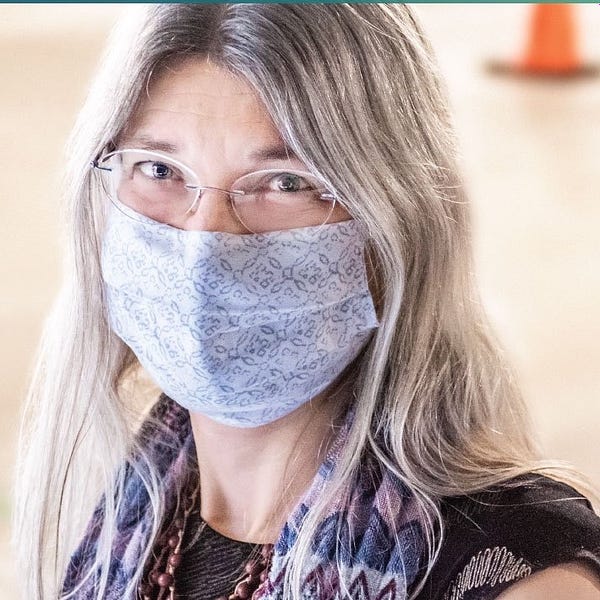


People are rightfully outraged by another ongoing narrative shift attempt led by the likes of Dr. Anthony Fauci, Bill Gates, countless government health bureaucracies, and other leaders of the corona hysteria movement. We’re now being told that the vaccine is not in fact a ticket to normalcy. Instead, we’ve been told that even with the vaccine, people still need to wear a mask, social distance, and act as if fellow human beings are nothing more than mere vectors of disease.


They initially told us lockdowns would solve our COVID problem. They then told us masks would end the pandemic. Soon after, the “experts” went all in on the vaccine narrative. It seems that the new narrative is one of “forever COVID,” or a permanent safety regime that stresses prioritizing avoidance of a virus over anything else in life. Fauci and the gang is now demoting the vaccine’s status as no longer a way out, but just another tool to help you mitigate the threat posed by the “deadly virus.”

WATCH: We spoke with @BillGates about the looming climate crisis and why research he funds suggests we may need a third vaccine dose to fight against new coronavirus variants More tonight on the @CBSEveningNews, watch at 6:30 p.m. ET 
And many finally seem to be pushing back against the ruling class plan for a permanent COVID state.

Excellent column by @karol deploring the rise of “forever pandemic” thinking, in which our lives will continue to be smothered in the name of overhyped public health threats. 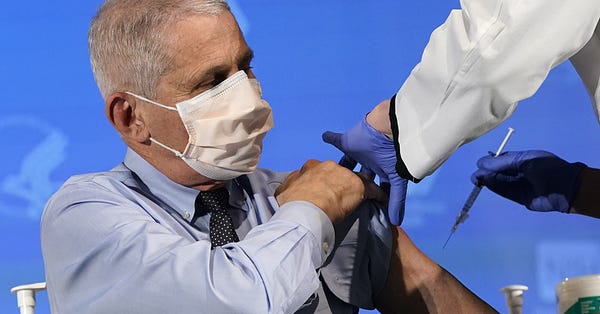


Will the vaccine rug pull attempt awaken the masses to the reality that they’ve been conned for an entire year? That is too soon to tell, but we are finally seeing signs of widespread pushback against the latest demands from the ruling class. Many of us wished this hopeful revival of rational thought had occurred a full year ago, but it’s more important right now to build a coalition around restoring our rights and quashing the power grab, even if that coalition includes the same individuals and groups that were once on the side of the totalitarians.
Florida Wins the Lockdown Science War – Hands Down
Ivor Cummins | February 18, 2021
Self explanatory: Florida is an exemplar of applied scientific thinking.
Please share widely to help the people understand the basics. Also please download the vid right here: https://we.tl/t-8A21PY5MM6 – and upload everywhere.
NOTE: My extensive research and interviewing / video/sound editing and much more does require support – please consider helping if you can with monthly donation to support me directly, or one-off payment: https://www.paypal.com/donate?hosted_…
Alternatively join up with my Patreon: https://www.patreon.com/IvorCummins
Irish “Journalist” Calls For Martial Law To Achieve Zero Covid
By Richie Allen | February 22, 2021
Sunday Times columnist David Quinn Tweeted last night that Martial Law may be needed in Ireland, to achieve zero Covid. Quinn said;
Watching the very large numbers out and about and hearing anecdotal evidence of people starting to meet again in each other’s houses, I see no way short of martial law of us achieving zero-Covid.
Just to be clear, Quinn is suggesting that a military government may need to be imposed in Ireland and the law suspended in order to keep people in their homes. Yes, a journalist is mooting the idea of stationing troops on Ireland’s highways and byways, to force people into their homes and ensure they remain inside.
As of this morning, Ireland’s National Public Health Emergency Team (Nphet) says that Ireland has had a total of 215,000 coronavirus cases and 4,136 deaths. Three weeks ago (Friday January 29th), The Irish Times reported that:
… more than eight out of 10 people who have died as a result of Covid-19 have had an underlying condition, most commonly chronic heart disease…..
The most common underlying condition was chronic heart disease which accounted for 43 per cent of those fatalities or 967 cases in total.
This was followed by chronic neurological disease such as dementia (771), hypertension (520), chronic respiratory disease (450), chronic kidney disease (281), diabetes (389), chronic liver disease (46) and obesity (body-mass index above 40) 47…
Of those who died with an underlying condition, 66 per cent had one, 678 had two and 355 had three or more co-morbidities.
The mortality statistics underline the importance of vaccinating vulnerable cohorts in the population. More than 63 per cent of all deaths (1,720) were in people over 80.
The average age of someone dying with Covid in Ireland is somewhere between 83 and 86, depending on which newspaper you read. And of course we should never forget that dying with doesn’t mean dying of. This is a scam. There is no pandemic. It has been thoroughly debunked, using our collective governments own data.
Rather than eviscerate the Irish government and the medical goons advising it, David Quinn, who claims to be a journalist, would rather call for Martial Law. And the beat goes on.
Featured Video
or go to
Aletho News Archives – Video-Images
From the Archives
A Lesser “Grade” of Human
By Michael Hoffman | Revelation of the Method | January 3, 2024
Will the more than 100 Iranians killed by terrorist bombs today be mourned in the West as victims of terrorism? Certainly not. Allied doctrine has it that the killing of Israeli or American civilians is a crime of cosmic proportions, while shedding the blood of “enemy” women and children is perfectly acceptable; indeed commendable.
The West does not memorialize the hundreds of thousands of civilians bombed by the U.S. in Serbia, Iraq, Afghanistan and every major German city 1943-1945. America’s fire-bombing of the city of Tokyo by General Curtis LeMay in March 1945 was followed by Harry Truman’s atomic incineration of Hiroshima and Nagasaki in August of that year. Truman never had a moment of doubt or regret over the murder of more than a 100,000 Asian children, mothers and non-combatant boys and men. It was business as usual for the “noble” Allies during the “Good War.”
In the West human rights signifies passionate concern only for civilians designated as truly human: Israelis first, then Americans and British, followed by their satraps.
This inhumanity is the legacy of Talmudic ideology, beginning with tractate Sanhedrin 57a from 400 A.D., concerning liability for capital punishment: “If a Jew murders a gentile, he is exempt.”
This teaching of contempt was reiterated in the dogma of Chabad Lubavitch founder Rabbi Shneur Zalman in the 18th century. … continue
Blog Roll
 Aletho News
- NATO’s top generals gather in Kiev
- EU’s continuing expansion – greater threat to Russia
- US Senator Murphy says Pentagon denied him entry to US base in Qatar
- Israel expands “incitement” charge to target Palestinian education and memory
- How Israel seeks to reshape Arab classrooms
- Paris bans pro-Palestinian demonstration planned for Oct. 7 over ‘risks of public disorder’
- In August Hanning Treason Case – All Signs Point To Tel Aviv.
- France cleared dozens of military sales to Israel between May and September: Report
- France projects nuclear power as Macron pushes arsenal expansion
- The fallacy of US delusions about Iran’s economic collapse
- If Americans Knew
- An error has occurred; the feed is probably down. Try again later.
- No Tricks Zone
- US September “Heat” Was No Record…Many Records Set Decades Ago
- Latest European Green Energy Debacle; Portugal’s Largest Flagship Solar Park Insolvent!
- Green Energy Debacle: German Expert Professor Fritz Vahrenholt Warns Of Severe Economic And Social Consequences
- Two More Paleo Reconstructions Affirm Meters-Higher Sea Levels Across Ireland, Brazil 7000-6000 Years Ago
- New Study: Earth And Venus Surface Warmth Largely Explained By Convection And Lapse Rate, Not CO2 Or Radiation
- 2025 Nature Paper Claiming Worsening Global Drought Gets RETRACTED …Heavily Flawed
- New Study: ‘Global Drought Shows No Detectable Recent Acceleration Under Climate Warming’
- Economic Masterminds: German Socialists Suggest Taxing Productivity Gains Stemming From Using AI
- The South China Sea Has Not Been Cooperating With The Climate Change Narrative
- Energy Crisis: Germany Enters Heating Season With Historically Low Gas Reserve Fill Levels

