‘Mass surveillance is exactly what the US does’: Dotcom points out glaring irony of Huawei ban
RT | May 17, 2019
Kim Dotcom has slammed the US for hypocrisy over its Huawei ban given America’s history of “abusing technology” and “turning its entire tech sector into a spy machine.”
The Megaupload founder took to Twitter in the wake of the ban to highlight that the abuse of technology for mass surveillance is “exactly the conduct of the US” and said that “because the US does it, they think China will too.”
Trump declared a “national emergency” for the telecommunications sector on Wednesday, citing risks from “foreign adversaries.”
The US Commerce Department subsequently added Huawei Technologies Co Ltd and 70 affiliates to its so-called Entity List, which bans the Chinese brand from buying parts from US companies without government approval, making it difficult for Huawei to sell some of its products because of its reliance on US parts.
Dotcom pointed out that the US has used tech companies to spy on its own citizens as well as people all around the world. The extent of US surveillance was revealed by National Security Agency (NSA) whistleblower Edward Snowden in 2013 when he exposed the US’ warrantless surveillance, including listening in on phone conversations, its ability to compel tech companies like Google and Facebook to turn over user data, and the XKeyscore tool that can be used to collect nearly everything a user does on the internet.
Snowden also revealed how the US spies on world leaders, attempts to crack encryption and works with the UK to intercept global internet data.
The 2017 Wikileaks ‘Vault 7’ leak of CIA secrets revealed the US agency kept vulnerabilities and security bugs from tech companies so it could continue to access devices. The documents also highlighted the spy agency’s use of hacking tools to remotely hack and control smart phones, and cover their own tracks.
PA New Government Does Not Represent the Palestinian People
By Ramona Wadi | MEMO | April 18, 2019
The new Palestinian Authority government has been welcomed by the UN Special Coordinator for the Middle East Peace Process Nickolay Mladenov, who reiterated the rhetoric reserved for occasions on which the international organisation pledges to work closely with governments in line with their agenda. “At a time of significant financial and political changes to the Palestinian national project,” Mladenov stated, “all must support the government’s efforts and work to overcome internal divisions.”
There is nothing, though, to suggest that the new PA government under recently appointed Prime Minister Mohammad Shtayyeh is working towards reconciliation. Fatah’s insistence that Hamas must relinquish its political control of Gaza has not abated, implying that the PA agenda, as well as that of the UN, has not altered. Last year, there was an increase in the number of international statements, from UN envoys in particular, calling for a return to PA rule in Gaza. The PA, according to them, makes it easier for the UN to carry out its plans.
Mladenov’s statement referenced the previous PA government led by Rami Hamdallah, who had also advanced the call for Hamas to step aside. What followed afterwards is well documented, not least the punitive measures imposed by the PA upon the Palestinian people in Gaza in order to force civilians and politicians alike to surrender. From a PA perspective, ending the Palestinian schism means eliminating and suppressing political alternatives and challengers.
The recent news from Cairo indicates as much, with the Fatah delegation at reconciliation talks placing ultimatums upon Hamas and issuing ambiguous statements regarding the PA’s views on unity and the issue of the weapons in the hands of the armed wing of the Islamic Resistance Movement. In the event of reconciliation, asks Fatah, “What is the need for arms?”
There is thus little divergence from the previous government’s agenda, which is one of the reasons why Mladenov’s rhetoric about the previous and current PA governments overlaps in terms of content. As PA leader Mahmoud Abbas becomes even more irrelevant — due in part to the US efforts to ostracise any form of Palestinian representation and push through its own so-called “deal of the century” — international actors are increasingly taking over and determining the fate of Palestine’s remaining and cruelly fragmented territory.
Having a new PA government that adheres to the same definitions of reconciliation will provide the UN with a further opportunity to alter what remains of Palestine. Despite Mladenov’s praise for Hamdallah’s government keeping in line with the UN Sustainable Development Goals, for example, it is clear that the ongoing colonisation of Palestine, along with the international complicity to ensure that Israel continues to expand its presence, have impeded Palestinians from experiencing any benefits.
A little less “commitment to working with the Palestinian leadership” and more effort towards listening to what the Palestinian people demand and need would go a long way. The UN is not working to “end the occupation”, much less end Israel’s colonisation. The PA has, since its inception, followed suit. A new government that is void of different political strategies, yet has the audacity to speak about Palestinian reconciliation, does not represent the Palestinian people. Mladenov’s comments are another indication of how the new government and the UN intend to work, by persisting in the creation of a diplomatic network that isolates the Palestinian people from the politics determining their fate.
Year of selective blindness: Russian journalist still in Ukrainian jail under bogus treason charges
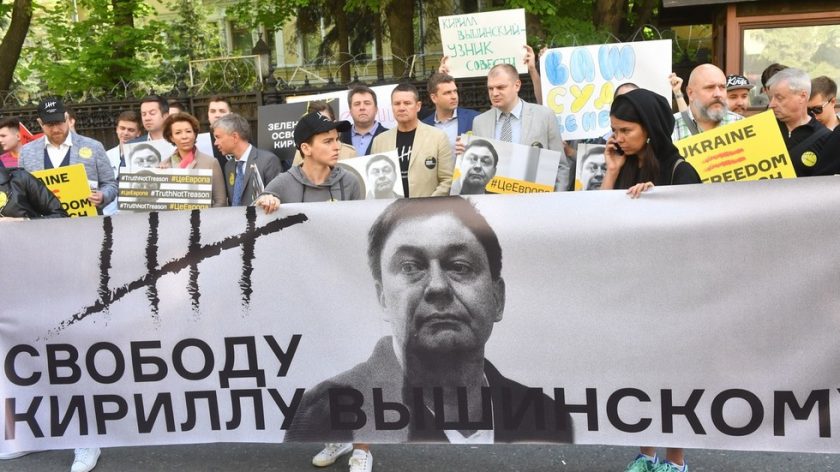
A rally in support of Kirill Vyshynsky in Moscow. ©Sputnik / Aleksey Kudenko
By Alexandre Antonov | RT | May 15, 2019
Exactly a year ago the head of a Russian-Ukrainian news agency was snatched in Kiev and put in jail under a charge of high treason. Western champions of media rights have shown spectacular will to ignore the scandalous case.
Being a journalist in a nation where the government can put you in jail for unfavorable reporting is understandably risky, but at least one can hope to find international support after getting into trouble. Foreign governments and international organizations would cry foul and try to pressure the persecutors.
Well, Kirill Vyshinsky didn’t get this response. On March 15, 2018 he was arrested by agents of the SBU, Ukraine’s powerful national security agency, and charged with treason. His alleged crime was that as head of a Russian-Ukrainian news agency he waged “information warfare” against Ukraine, or at least that’s what the SBU said at the time. The accusation may result in a 15 year jail term.
Vyshinsky has been kept in pre-trial detention since, denied bail or hospital treatment and restricted in visitation rights. The prosecution managed to formulate an 80-page indictment by March, listing 72 stories and opinion pieces published by the news agency since 2014, which the prosecution claims to be manipulative or false.
The journalist insists the accusations are absurd. How can a factually accurate news report about Crimea changing its time zone to that of Moscow or an opinion piece giving a historic overview of referenda held in Ukraine since gaining independence in 1991 be anti-Ukrainian, he argued. The prosecutors said even factually accurate stories can be “anti-Ukrainian in nature.”
Regardless of one’s attitude to what happened between Ukraine and Russia during and after the Maidan mass protests, accurate reporting of facts should not be criminalized. Just imagine what would happen, for example, if in 1999 Russia arrested and put on trial the head of the BBC Russian service, saying the British broadcaster’s coverage of the freshly reignited hostilities in Chechnya was “anti-Russian.” All hell would break loose, and rightfully so.
On Wednesday, there was a protest in front of the Ukrainian embassy in Moscow, calling on Kiev to free Vyshinsky. And a deafening silence from the usual Western defenders of media freedom. Amnesty International, for example, doesn’t mention Vyshinsky’s name on its website at all – not even on the Russian-language and Ukrainian-language versions.
Officials from the Organization for Security Cooperation in Europe and International Federation of Journalists voiced concern about Vyshinsky’s continued incarceration when asked for comments by the Russian media. But the organizations didn’t release any official statements on the occasion of the anniversary. Neither did the Committee to Protect Journalists, although it did report the start of Vyshynsky’s trial in early April.
As for mainstream media in the West, they don’t seem to be particularly interested in their Russian-Ukrainian colleague. Unless, of course, there is a chance to brand him a Russian propagandist who may threaten America’s democracy. A story that the Daily Beast ran in March says Vyshinsky’s wife hired US political consultant Ezra Friedlander to lobby for the journalist’s release in Ukraine, and implied that this may have compromised Friedlander’s other clients, including House Judiciary Committee Chairman Jerry Nadler. In other words, red-baiting at its best.
Apparently, not all reporters are made equal in the eyes of the West. There are those that deserve protection. And there are people like Vyshinsky, or WikiLeaks’ Julian Assange, who are not really reporters – just some guys telling true but unwelcomed facts about the US and its allies. They deserve to rot in jail, right?
Forensic Experts: No Evidence Couple Shot at Police in Houston Botched Drug Raid
By Carlos Miller | Photography is Not a Crime | May 13, 2019
Despite claims by Houston police that they engaged in a fierce gunfight with a couple they raided in January, a team of forensic investigators who spent four days in the house say there is no evidence the couple ever shot at police.
That contradicts the claim by Houston police that four cops were shot as they entered the home in what turned out to be a botched raid based on fabricated information.
The couple were killed and the cops were not wearing body cameras, so police probably did not expect evidence to surface that would contradict their claims.
According to the Houston Chronicle :
A four-day independent forensics review at 7815 Harding Street found a cache of evidence left behind by the city’s crime scene teams after a botched drug raid at the home left dead a couple suspected of selling drugs
Hired by the relatives of Rhogena Nicholas and Dennis Tuttle, the new forensics team found no signs the pair fired shots at police — and plenty of signs that previous investigators overlooked dozens of pieces of potential evidence in what one expert called a “sloppy” investigation.
“It doesn’t appear that they took the basic steps to confirm and collect the physical evidence to know whether police were telling the truth,” said attorney Mike Doyle, who is representing the Nicholas family. “That’s the whole point of forensic scene documentation. That’s the basic check on people just making stuff up.”
And it does not appear as if Houston police are conducting any type of “robust investigation” as Houston Police Chief Art Acevedo promised back in February after previous attempts of spin and deception failed.
It appears that they are doing just what we expected them to do, which is to let this drag out in the hopes people will forget about it.
Already the cop who lied on the search warrant and has a history of lying on search warrants has retired, so he’ll be collecting a pension when he probably should be sitting in prison.
The forensic experts found more inconsistencies:
Though police said they started shooting when the dog lunged as they came through the door, Maloney’s forensics team found that the dog was shot and killed at the edge of the dining room, 15 feet from the front door. Authorities never picked up the shotgun shell when they collected evidence.
And police said that Tuttle started firing at them, but Maloney’s team did not find clear evidence of that.
“The initial bullet trajectories appear to be somewhat contradictory,” said Louisiana-based attorney Chuck Bourque, who is also representing the Nicholas family. “We see no evidence that anybody inside the house was firing toward the door.”
Some of the bullet holes outside the house appeared at least a foot from the door, a fact that Doyle flagged as troubling.
“You can’t see into the house from there,” he said, “you’re firing into the house through a wall.”
The four-day investigation was led by independent forensic expert Mike Maloney, a retired supervisory special agent with the Naval Criminal Investigative Service.
The UN is a mouthpiece for Israeli propaganda, not a threat to the colonial state
By Ramona Wadi | MEMO | May 14, 2019
Only a few days before the Palestinian commemoration of the 1948 Nakba, in which the indigenous people of Palestine were massacred, displaced and ethnically cleansed to pave the way for the European Zionist colonial project, Germany issued a statement declaring its intention to oppose “any unfair treatment” allegedly exhibited at the UN towards Israel. “Germany’s historic responsibility for the Jewish and democratic State of Israel and its security is part of our raison d’être,” the German government declared. “Germany will always work, including in the UN, to ensure that Israel’s right to exist is never called into question.”
Germany deliberately chose to issue its statement on the 70th anniversary of Israel becoming a full UN member state. On this day, despite purportedly championing human rights, the UN abdicated its responsibilities in order to embrace a new colonial power and celebrate its own role in the process of normalising colonialism. The UN has also conveniently and consistently overlooked the fact that Israel’s membership of the organisation was conditional upon it allowing Palestinian refugees to return to their land.
At the UN, Israel faces no threats whatsoever. Its recent bombing of Gaza and official statements from the international community testify to this fact. Yet Germany has jumped on the bandwagon, claiming that Israel is treated unfairly in the international arena and citing its allegiance to the settler-colonial state as a “historic responsibility”. Does Germany also extend the same sentiment and diplomatic commitment to other minorities murdered during the Holocaust?
Israel was a planned political project mooted in the late nineteenth century, as historical documents and research show very clearly. The Holocaust facilitated its implementation but did not create the demand for a “Jewish State”. However, historic responsibility and Israel’s settler-colonial apartheid state are incompatible. Furthermore, such responsibility which Germany has towards all of the minorities murdered in the Nazi era does not cancel out the collective historic responsibility towards Palestinians, from which the entire world has absconded.
Meanwhile, Germany has also attributed its stance to the “firm belief that the UN lies at the heart of the multilateral, rules-based order” for achieving peace and security. It is a fact that the UN has excelled in neither, not least in terms of the impunity with which Israel is allowed to act. The German government, therefore, is merely affirming its commitment to the propagation of ongoing human rights violations which, of course, suits Israel’s interests.
At a time when the least that the international community can do is shift its attention to the Nakba commemoration, Germany is determined to score diplomatic points for Israel which have more to do with the ongoing colonisation of Palestine than Nazi horrors during the Second World War.
“Israeli interests” constitute nothing more than wanting an international commitment against the decolonisation of Palestine. In its statement, Germany is refusing the possibility of questioning Israel’s right to exist, in line with Israel’s purported security and “self-defence” narrative and justification for its violence against Palestinians.
Why not turn the narrative around? Surely, just as Israel demands unconditional support for its existence, Palestinians have a greater claim and legitimacy in asking why the people and their land were ethnically cleansed. If justice truly existed, the UN — and Germany — would not hesitate to call Israel’s creation and existence in such a manner into question. As things stand, however, the UN continues to be a mouthpiece for Israel and its allies, while Palestinians are butchered by the colonial entity that does not hesitate to profit from terms such as “historic responsibility”.
UK admits MI5 in ‘serious’ breach of surveillance safeguards
Press TV – May 14, 2019
Britain’s interior minister Sajid Javid has admitted that the country’s main domestic intelligence agency MI5 has breached safeguards on protection of data obtained from citizens during interception operations.
The Guardian newspaper said in a Tuesday report that Javid had sent a letter to members of the British parliament last week notifying them of “serious” breaches in MI5 operations regarding how private data of millions of citizens, including private messages, digital browsing histories and location information, has been handled by the intelligence agency.
That comes after the Investigatory Powers Commissioner’s Office (IPCO), the official body responsible for overseeing government surveillance practices, sent a team of inspectors to the MI5 to investigate how the secuirty organization had failed to comply with the safeguards regarding how it should use and preserve the data.
The IPCO has said in a report that breaches committed by the MI5 had been “serious and required immediate mitigation”.
Javid has announced that his ministry, the Home Office, had established an independent review to “consider and report back” on the findings of the IPCO report.
The evolving scandal comes as human rights organization Liberty is taking legal action against the government over what it and other rights campaigners allege are excessively intrusive surveillance powers given to the security apparatus.
The new revelations about the MI5 have intensified concerns that the British government is sharing the private data of citizens with foreign intelligence agencies.
“It is possible, from what is known, that millions of innocent people’s data is being shared widely with foreign governments. If the government has its way, we will never know if this is the case,” said Megan Goulding, a lawyer at Liberty.
“If the UK’s surveillance regime is to have a semblance of legitimacy, the public needs to know what happened, and how badly our privacy and the security of our information were put at risk,” Goulding added.
Misled again by the arbiters of anti-semitism
By Jonathon Cook | May 11, 2019
British comedian David Schneider has become one of the more influential public figures on social media seeking to arbitrate what constitutes anti-semitism. Compared to TV show host Rachel Riley, or even Guardian columnist Jonathan Freedland, Schneider is an exemplar of moderation and rationality. But, to be honest, the bar has been set pretty low in recent years.
Schneider has now published a guide in the Independent newspaper on “how to talk about Israel without sliding into antisemitism”. Although there are elements to his guide I can agree with, most of his advice is – to put it charitably – simplistic, misleading or downright unhelpful.
Given how polarised public discourse has grown on the issue of anti-semitism, and the degree to which it has been weaponised by those – Jews and non-Jews alike – opposed to a new kind of insurgency politics in the UK and US demanding the right to speak out unequivocally in support of Palestinian rights, Schneider’s blind spots need highlighting.
He rightly notes that the phrase “legitimate criticism of Israel” has become clichéd. But it is more than just a cliché; it has come to serve as a ringfence, ensuring that “legitimate” criticism relates only to Netanyahu and the Israeli right.
Many of us, however, want to point out that there would still be major problems with Israel even if Netanyahu had been replaced at last month’s election by the rival party of generals led by Benny Gantz or if the Israeli Labour party ever managed to revive itself from terminal decline. We want to talk about why Israel was a very problematic kind of state long before anyone had heard of Netanyahu, during a time when a supposed Israeli left ruled the country.
So here I offer an addendum meant to clarify and counter the arguments made in Schneider’s seven-point guide.
The relevant text of his guide is in bold, with my comments below in ordinary type:
1. Avoid saying “Zionist” or “Zionism” when discussing contemporary Israel/Palestine. The terms are too loaded now, too coarse and broad in their application, and too often used by hardcore antisemites to mean simply Jews.
Benjamin Netanyahu is a Zionist, but so are Israeli lawyers and peace activists fighting to achieve justice for Palestinians. You cannot lump them all together. Fair enough when talking historically, as long as you’re informed and precise, but for the present day, I recommend using specific terms instead, such as “the Israeli government” or “Netanyahu”.
Schneider has lost no time in revealing the nub of the problem with his guide. He is a liberal Zionist, and understandably he feels uncomfortable being lumped in with Netanyahu. But the primary goal of Palestinians and their supporters isn’t to make Schneider or other liberal Zionists feel comfortable with their political views or to comply with their demand that “legitimate” criticism of Israel be restricted to Netanyahu.
Yes, some anti-semites may use “Zionist” as code for “Jew”. But Schneider is demanding his cake and eating it in insisting that the core ideology driving Israeli policy towards the Palestinians for more than seven decades be declared largely unmentionable.
Zionism wasn’t just a historical prelude to Israel’s creation, some anachronism to be deposited in a museum. All the major political parties in Israel still firmly define themselves as Zionist. It is at the core of their political programmes, meaning that they share much common ground. The parties are often divided chiefly about how to achieve their political goals, not what those goals are.
Political disagreements in Israel revolve around two camps: Labour Zionists, who founded Israel, and Revisionist Zionists, now represented chiefly by Netanyahu’s Likud party, that have largely ousted Labour Zionists from power since the late 1970s.
The movement Schneider probably identifies most with are the Labour Zionists (now often described as liberal Zionists) whose founders drove 80 per cent of the native Palestinian population off their lands in 1948 in what would today be called an ethnic cleansing operation.
It didn’t end there, though. The Labour Zionists then created a land and residential segregation system inside the new state of Israel that very much persists to this day. In fact, almost all of Israel’s land is reserved exclusively for Jews, with many hundreds of communities using admissions committees to bar the fifth of the population who are Palestinian citizens. The Palestinian minority have been herded into deprived and overcrowded ghettoes on a tiny fraction of the remaining land. All of this is entirely separate from what happens to Palestinians in the occupied territories.
Inside Israel, the state’s control and allocation of land and resources on an ethnic basis is know as Judaisation, and it has been at the heart of state policy for 71 years.
Labour Zionists also established and maintained a rigid system of segregated state education, separating Jewish and Palestinian children – all of them Israeli citizens – in much the same way as occurred in the Jim Crow South in the US.
Outside Israel, the Labour Zionists founded the first settlements in the occupied West Bank and East Jerusalem, which were built in violation of international law and with intent to destroy any hope of a Palestinian state emerging.
Today the Labour Zionists still advocate policies to keep Israel’s Jewish and Palestinian citizens apart, and support the larger settlements, even at the cost of denying the Palestinians any viable right to self-determination. In any other context, we would call them ethnic nationalists, or racists.
In fact, one could reasonably argue that Judaisation and political Zionism – the kind that probably finds favour with 99 per cent of Israeli Jews – are as good as synonyms. Many of the Israeli Jewish lawyers and human rights activists Schneider refers to who are trying to help Palestinians in the occupied territories are still quite ready to back a political system inside Israel that keeps Palestinian citizens separate from Jewish citizens.
These extreme liberal Zionists – small in number though they are – are plagued by concerns about the rights of Palestinians in the occupied territories, but all too often because they want Israel out of those territories so it can concentrate on privileging Jews inside Israel, even though a fifth of Israel’s population are not Jewish.
Those who do not feel that way are usually described as anti-Zionists – one reason why the term “Zionist” is such a helpful ideological signpost about where Israel Jews and their supporters stand on core issues like equality inside the state of Israel itself.
The other camp, the Likud Zionists, have not opposed this system of segregation, which closely echoes apartheid South Africa. In fact, they have sought to entrench and expand it. Today, the main difference between Labour and Likud Zionists is the latter’s indifference to how such policies are perceived by the international community.
So, in other words, there is no way to understand or critique Israel’s political system, or the nature of its abuses of Palestinians, or the ideology espoused by its supporters abroad, without analysing Zionism and its aims.
Schneider’s formula makes as much sense as demanding back in the 1980s that “legitimate criticism” of South Africa not address the country’s overarching apartheid ideology but be reserved specifically for P W Botha and his government. Following Schneider’s advice would make useful, reasoned criticism of Israel impossible.
2. Do not slide from anger at the actions of the Israeli state into asserting that Israel is controlling everything or paying money to MPs, celebrities or the media to act as they do. To do so simply echoes far-right antisemitism and centuries-old conspiracy theories about Jews, now rebadged to apply to Israel.
And yes, I know about the documentary The Lobby, where a Labour MP was filmed discussing money with an Israeli embassy official. But unless you have other examples of this, I suggest you avoid it.
Few critics of Israel are actually claiming anything of this sort. Schneider has offered a strawman formulation here. But I suspect he wishes to catch in his trawl net far more than these claims.
It is interesting to consider why it is so contentious to claim that Israel wields power through its lobbies to promote its interests in the US and UK when our political elites are so ready to claim that Russia has been supposedly interfering in superhuman ways in the US and UK to pursue its interests.
It is telling that Schneider, like the British media, wishes to hurry past Al-Jazeera’s documentary The Lobby. The undercover film did not just show a Labour MP discussing money with an embassy official – as Schneider would presumably know if he had watched the documentary. It showed much, much more.
Not least, it showed an Israeli government agent, Shai Masot, who was probably working for the strategic affairs ministry at the time, plotting from within the UK to unseat a British government minister who was seen by Israel as a little too sympathetic to the Palestinians. And it showed pro-Israel activists within the Labour party, led by the Jewish Labour Movement, colluding with the Israeli embassy to damage and oust Labour leader Jeremy Corbyn because he too is seen as overly sympathetic to Palestinian rights. That is the necessary context for understanding the endless claims of a supposed “anti-semitism crisis” in the Labour party, much of it advanced by this same Jewish Labour Movement.
The Lobby – both the UK series and the censored, but leaked, US follow-up – were groundbreaking television. They put flesh on the bare bones of what we already knew about the lobby’s activities in interfering in British and American politics. To dismiss its revelations so casually and quickly is to bury one’s head in the sand – because its findings are too unpalatable for those who wish to place Israel at the core of their identity.
3. Don’t conflate Israel and Jews. It may anger you that the likes of Netanyahu try to do this, so don’t make the same mistake yourself. If you see someone talking about Jews, antisemitism or the Holocaust and find yourself leaping straight to Israel-Palestine, think again.
This would make good sense only if we had not just spent the last three years witnessing the term “anti-semitism” being publicly redefined so as to refer chiefly to criticism of Israel. It wasn’t, after all, Israel’s critics that insisted public bodies and political parties, including the British Labour party, adopt the International Holocaust Remembrance Association’s 11 examples of anti-semitism, seven of which refer to Israel.
Here’s a promise. If the accusation of anti-semitism is restricted to examples of hatred, suspicion or fear of Jews, I happily promise to avoid raising the issue of Israel during debates about anti-semitism. But when the term is being weaponised, when its meaning is being altered to defend a state, and one that has been abusing Palestinians for decades without serious censure, then I and others are under a moral responsibility to talk about Israel and remind others that criticism of Israel is not usually anti-semitic.
4. Avoid the terms “Israel lobby” and especially “Jewish lobby” unless you also say “Saudi lobby”, “Russian lobby”, “Hindu lobby” and so on. “Supporters of Israel” is safer language.
As for “Jewish lobby”, they say “two Jews, three opinions”. The idea of us agreeing enough to form a single lobby is as likely as Theresa May fighting the next election as Tory leader.
It is rather surprising that Schneider claims Jews are so disputatious with each other that they could never form a single lobby. Surprising because so many prominent Jews, including Jonathan Freeland of the Guardian, and Schneider himself, I believe, have regularly insisted that Jews are almost entirely of a single mind on at least one issue: that Israel is crucial to their identity as Jews. (This, of course, usually serves as a prelude to warning that any criticism of Israel – apart from the “legitimate” kind they approve of – is evidence of anti-semitism because it undermines Jewish identity.)
Not only is there a very obvious “Israel lobby”, but it is quite unlike the other lobbies Schneider mentions. In the UK, for example, there is no visible public lobby for Saudi Arabia or Russia, and if Hindus are actively and vocally campaigning to prevent criticism of India, or labelling such criticism as anti-Hindu, I must have missed it.
And in one obvious sense, Schneider sabotages his own argument. We have just seen American society waste more than two years hyperventilating about non-existent Russian “collusion” with Donald Trump – a US president supposedly acting as a sort of Trojan horse or Manchurian candidate for the Russia lobby.
Unlike the many conspiracy theories about Russia, the Israel lobby is talked about so much by Israel’s critics because it is so in our faces, and so obviously trying to hijack or manipulate public debate in ways that harm free speech and Palestinian rights.
Right now, more than half of state legislatures in the US have passed legislation to limit their citizens’ fundamental right to free speech – but only in relation to criticism of Israel. Similar legislation is well advanced in Congress too.
This spate of legislation has occurred not because US politicians love Israel more than their own country (which Americans are still free to criticise), but because of the ferocious tactics of an extremely well organised Israel lobby in the US. That lobby is dominated by both rightwing Jewish leadership organisations and rightwing Christian evangelical groups.
None of this is to say that the Israel lobby is supremely powerful, or even unusually powerful, even if it sometimes looks that way. There are lots of other powerful lobbies, from the health and gun lobbies to the arms and financial industries lobbies. And, we could add, the Saudi-oil lobby too.
In fact, one could plausibly argue that many of these lobbies are even more powerful than the Israel lobby because their power is typically wielded far from public view. They are less visible, and therefore their presence less felt by the public. They operate almost entirely in the shadows.
But that is hardly grounds for condemning critics of Israel who are able to identify the Israel lobby’s activities and influence, and its efforts to manipulate public debate, whether it be by misusing the anti-semitism accusation or working actively to violate Americans’ First Amendment rights.
Many of us can see very clearly what the Israel lobby is up to.
It has, for example, also begun actively interfering in British politics. One only needs to see the arch-conservative body the Board of Deputies of British Jews or the Murdoch-owned Times newspaper regularly sticking the knife into Jeremy Corbyn using anti-semitism as their weapon of choice. It is his socialism, not any presumed anti-semitism, that is really driving the agenda of these bodies.
The lobby is seeking to damage our democracies in plain sight, but it is almost impossible to say so without being accused of anti-semitism, as Schneider himself implies here. That’s a wonderful self-rationalising system if you love Israel, but it is simply terrifying if you think the Palestinians should be entitled to rights in their homeland, or that we should at least have the right to discuss whether they are entitled to such rights.
That is why it is so important to keep identifying and exposing the Israel lobby – because, unlike those other lobbies, we don’t need special access to the hidden corridors of power to see it in operation. Even as ordinary citizens we can identify its role and call it out for what it is.
5) Don’t accuse Jews of dual loyalty to Israel and the UK (or whichever country), and certainly not of just being loyal to Israel. It’s another age-old antisemitic standard, as featured in Stalinist show trials and the Dreyfus affair.
And yet, many prominent Jews in the UK and US – as previously mentioned – tell us that Israel is central to their identity, and in the US have been willing to promote a unique violation of First Amendment rights to prevent criticism of Israel.
In fact, some make no secret of their dual loyalty. Here is what I wrote recently in a piece on the lobby:
That pro-Israel lobbyists – as opposed to Jews generally – do have dual loyalty seems a peculiar thing to deny, given that the purpose of groups like AIPAC is to rally support for Israel in Congress.
Casino billionaire Sheldon Adelson, a key backer of Republican candidates for the presidency, has never hidden his passion not only for Israel but specifically for the ultra-nationalist governments of Benjamin Netanyahu.
In fact, he is so committed to Netanyahu’s survival that he spent nearly $200 million propping up an Israeli newspaper over its first seven years – all so he could assist the prime minister of a foreign country.
Similarly, Haim Saban, one of the main donors to Democratic presidential candidates like Hillary Clinton, has made no secret of his commitment to Israel. He has said: “I’m a one-issue guy and my issue is Israel.”
6) Don’t compare Israeli actions to the Nazis unless it’s incredibly specific and historically justified (such as a settler calling for Arabs to be gassed). And even then, use extreme caution.
Finally we can agree.
7) Don’t ask every Jew to condemn Israel in every tweet or comment they make. Would you ask every Muslim to condemn Saudi Arabia? I hope, and presume, not.
Well, fair enough – if anyone beyond a few unhinged people trying to get themselves noticed on social media are actually doing this unbidden.
But it’s a little more complex than Schneider cares to make out. Aren’t Schnneider and other prominent Jewish figures who publicly support Israel or Zionism not creating this problem for themselves by specifically tying their Jewishness to an identification with Israel?
If Jonathan Freedland keeps telling us that to criticise Israel too vehemently is to undermine his Jewish identity – and that this is itself a new form of anti-semitism – he can hardly complain when Israel’s critics hone in on his support for Israel and try to assess what exactly he means by it.
Does his Israel-tied Jewish identity allow him to excuse, rationalise or minimise the murder of unarmed Palestinian demonstrators in Gaza by Israeli snipers? Does he reject Israel’s claim to sovereignty over the Old City of Jerusalem, which violates international law and was based on the ethnic cleansing of many Palestinian residents living there? Does he accept that all of the West Bank must be handed over to the Palestinians as part of a future agreement? Does he accept that Palestinian refugees, ethnically cleansed from their homeland in 1948 and 1967 by Israel, have a right to return? And is he prepared to condemn unequivocally the apartheid system Israel has created inside its recognised borders that separates the rights of Jewish citizens from Palestinian citizens of Israel?
His and Schneider’s answers to those questions and many others not only help us understand what they mean when they speak of “legitimate” criticism of Israel, but what their view of their Jewish identity really entails – for their approach to human rights generally and their approach to Palestinian rights specifically.
France wants more govt regulation of Facebook and Zuckerberg calls it ‘model’ approach
RT | May 10, 2019
The French government is pushing for greater regulation of Facebook and other platforms in order to combat what it calls ‘hate speech’, according to a state-commissioned report published as CEO Mark Zuckerberg visits Paris.
The report, issued by the French Minister for Digital Economy Cedric O, found that social media companies were allowing “abuses” to take place on their platforms, particularly in the area of hateful or bigoted speech, and that the companies had not done enough to address the problems.
“Public intervention to ensure that the major players adopt a more responsible attitude protecting the cohesion of our societies is therefore legitimate,” the report said.
Though the report noted the government would “aim for minimum intervention,” it said that previous attempts at private self-regulation were not sufficient. The regulators added the government should look to strike a balance between “repressive” policies that react to ‘hate speech’ after the fact, and more preventative ones that start with the companies’ policies.
The report said the “lawfulness” of content would be decided in the courts, and specifically requested closer oversight of social media platforms’ algorithms which auto-detect supposedly hateful content.
French President Emmanuel Macron, a major advocate for greater regulation of the web, met with Facebook CEO Mark Zuckerberg on Friday to discuss some of the issues touched on in the report. Zuckerberg has also called for more government controls over the internet.
After the meeting, Zuckerberg hailed the French government’s approach as a model for other countries to follow.
“If more countries can follow the lead of what your government has done here, that will likely end up being a more positive outcome for the world in my view than some of the alternatives,” he told reporters at Facebook’s Paris office.
In January, the French digital economy minister said he was “one hundred percent in agreement” with Zuckerberg’s previous calls for regulation, but complained that Facebook’s growing size and power was creating a “huge democratic problem.”
“Facebook decides that something online is legal or not legal” and “plays the role of justice,” O told AFP last year.
Facebook took steps on its own in 2018 to censor “misleading” content it said contributed to violence, and more recently announced that ‘white nationalist’ content would be wiped from the site. The company also faced claims of censorship this month when it banned controversial figures including Alex Jones, Milo Yiannopoulos and Louis Farrakhan, citing violations of its community standards.
Facebook has seen heavy criticism on a number of other fronts in recent years. Some were outraged when the company struggled to keep videos of the Christchurch massacre off its website, while lawmakers in countries around the world have called for tighter control of the platform over the spread of ‘fake news’
13 Israeli Violations against Journalists in April

By Tareq Astal | IMEMC News & Agencies | May 9, 2019
In its monthly report on Israeli violations against journalists, published today, WAFA said that 11 journalists were injured from rubber-coated metal bullets, live bullets and tear gas canisters, fired by Israeli soldiers, as well as from severe beatings. At the same time, one journalist was detained and another had his press papers seized.
On April 3, the Jerusalem District Court rejected an appeal filed by Mustafa Kharouf, a photographer with Turkish Anadolu news agency, to release him from prison so that he can be with his family in Jerusalem, and kept him incarcerated until May 5, the date he is to be expelled to Jordan. (Kharouf’s attorney got an injunction from the Israeli High Court on May 5, stopping his expulsion until it hears his plea.)
On April 5, Israeli forces shot Amad News Agency correspondent Safinaz al-Louh, with a teargas grenade, in her right foot, and Noor News photographer Mohammad Issa with a gas bomb, in his leg, while covering the March of Return protests, east of the Gaza Strip.
On April 10, Israeli forces raided the home of Ra’ed al-Sharif, in Hebron, holding his family in one room before embarking on a thorough search of the house and tampering with its contents.
On April 12, Israeli forces shot Filistin al-Hadath photographer and correspondent Ahmed al-Zurei, with a rubber-coated bullet, in the abdomen, while he was covering protests east of al-Bureij, in the central Gaza Strip.
On April 19, freelance photographer Abdel Rahim al-Khatib was hit with a rubber-coated bullet, in the left thigh, and Reuters photographer Bassam Massoud with a gas grenade, behind his left ear. A similar bomb injured Watan Radio reporter Mohammad al-Louh and freelance photographers Mahmoud Badr, in the left foot, and Ahmad Washah, in the head, while covering protests east of the Gaza Strip.
In the same day, Xinhua photographer Nidal Shtayeh and WAFA photographer Ayman Noubani were shot with rubber-coated metal bullets, in their thighs, while covering the Israeli army’s crackdown on the weekly protests in Kufr Qaddoum village, east of Qalqilia, in the north of the West Bank.
On April 26, Israeli forces targeted Shihab News Agency photographer Ramadan al-Sharif, with a live bullet that hit him in his right foot, while he covered protests east of Rafah, in southern Gaza.
The daily attacks on journalists in the West Bank are part of an ongoing Israeli policy against their activities and their role in covering the practices and violations committed by these forces, against Palestinian civilians and property.
Trump’s “Deal of the Century” Will Use Sanctions, Military Threats to Force Palestinian Acceptance
By Whitney Webb | MintPress News | May 8, 2019
The Israeli newspaper Israel Hayom, owned by top Trump donor Sheldon Adelson, has published in Hebrew a leaked draft of the Trump administration’s “Deal of the Century” for the Israel-Palestine conflict. The draft was given to the newspaper by an official from Israel’s Foreign Ministry, which is currently headed by Israeli Prime Minister Benjamin Netanyahu. The plan, which has been drafted by President Donald Trump’s son-in-law Jared Kushner and Jason Greenblatt, is expected to be released this June after the conclusion of the Muslim holy month of Ramadan, according to Mondoweiss.
The draft plan published by Israel Hayom, while in keeping with many of the details that have been leaked to the press in past weeks and months, contains several new and troubling claims, including the Trump administration’s plan to force Palestinian leadership to accept the plan through threats of economic strangulation and military force.
For instance, if Palestinian leadership — such as the Palestinian Authority (PA) or Hamas — rejects the Trump administration’s “peace plan,” the United States will respond aggressively by ensuring that “no country in the world transfer money” to Palestine, which would apparently be accomplished through U.S. sanctions. With Palestine’s economy and the livelihood of many Palestinians dependent on foreign aid, such an act would amount to economic strangulation of the over 6 million Palestinians in the West Bank and around 2 million Palestinians in the Gaza Strip.
Furthermore, if the PA accepts the plan but Gaza’s leadership — i.e., Hamas — rejects it, “the U.S. will back Israel to personally harm leaders of Hamas and Islamic Jihad” and the U.S. will hold Hamas fully responsible for any future “round of violence between Israel and Hamas,” regardless of the circumstances that initiate that violence. In other words, the Trump administration is willing to join a future war against the embattled Gaza Strip, described by the United Nations as an open-air prison that is already largely unlivable for its inhabitants and under a full blockade, if Hamas rejects the Trump administration’s plan for the Israel-Palestine conflict.
Thus, the draft plan states that the Trump administration’s tactic of negotiating with the Palestinians involves a combination of threats of economic destruction and military destruction aimed at bullying an already dispossessed people into accepting a plan that clearly favors their occupiers.
Creating a “new” Palestine
In addition to the Trump administration’s apparent game plan to force Palestinian compliance with the so-called “Deal of the Century,” the plan also calls for the creation of a demilitarized state of “New Palestine” that would be incredibly small, as the document calls for the Israeli annexation of the entirety of the Jordan Valley (around 30 percent of the West Bank) and the annexation of all illegal Israeli settlements in the West Bank, which now cover well over half of what international law maintains is Palestinian territory.
This “new” state would be showered in aid from several countries, including the Gulf monarchies, European nations and the United States, allegedly amounting to $30 billion over the next five years. Most of the funding, according to the plan, will come from oil-producing Gulf states like Saudi Arabia. It is unclear whether “New Palestine” would be considered a sovereign state and whether it would be allowed to apply for full membership in the United Nations.
While the plan would allow “New Palestine” access to Jerusalem as a shared, undivided capital with Israel, Palestinians would be responsible for paying the state of Israel for their security because it would be forbidden from having its own army. In other words, Palestinians would be forced to pay the Israel Defense Force (IDF), the military force that has occupied the West Bank for over 50 years, to “protect” them despite the fact the Palestinians are regularly extrajudicially murdered by IDF soldiers. However, the apparent “concession” offered by the Trump administration in this regard would be allowing the “New Palestine” to maintain a police force with “light weaponry.”
In addition, the plan apparently concedes to some past Palestinian demands, such as the release of Palestinian prisoners over a three-year period. However, the draft of the plan published by Israel Hayom does not address Palestinian refugees or the right of return of those refugees in any capacity.
Outsourcing the destruction of Palestine
The fact that this draft of the plan was released to the Netanyahu- and Trump-aligned Israel Hayom by Israel’s Foreign Ministry — itself run by Netanyahu — strongly suggests that Israel’s government was ready to make the details of the plan known to the Israeli public. The draft, which was dismissed by at least one unnamed White House official as “speculative,” reveals an Israeli-centric plan that will likely be rejected by both Israeli right-wing hardliners and a majority of Palestinians.
However, Israel’s leadership is likely to accept the plan only because they know that the Palestinians will reject it, allowing them to blame the failure of the Trump administration-brokered “peace process” on the Palestinians.
Indeed, Dr. Riyad Mansour, the Palestinian ambassador to the United Nations, affirmed on Tuesday that the PA considered the “peace plan” as merely a pretext to a long-planned West Bank land grab by Israel and planned to reject the so-called “Deal of the Century. “If what we read is what is to be expected from this plan, then it seems that the objective of it is not a solution to the conflict, but to give pretext to the Israeli government to annex other portions [of the West Bank],” Mansour recently stated at UN headquarters.
Mansour added:
Some in the [Trump] administration, they think, ‘Yes, what will help peace is break the legs of the Palestinians, break one arm and five teeth, and when they are on the ground they will come crawling to you for anything you offer them.’ Those who think that way don’t know the Palestinians.”
The Palestinian plan to reject the Trump administration’s deal is no secret, with the outgoing French ambassador recently describing the plan as “dead on arrival.” This fact of assured rejection makes all the details of the plan irrelevant, save for the part of the plan that deals with “penalties” for the Palestinians if they reject the plan.
Those penalties should draw the most concern as the “peace plan” is made public, as it harkens coming U.S. military involvement in a future war between Israel and Gaza –regardless of whether that war is initiated by Gazans or Israelis — as well as extreme economic hardship on the West Bank through U.S. sanctions.
Netanyahu has made no secret of the fact that he does not want the two-state solution provided in this U.S. plan, even if the Palestinian “state” is demilitarized and minuscule. However, if the Palestinians reject the plan — as he knows they will — the United States will do the work of further destroying Palestine for him by committing to a future U.S. invasion of Gaza and to the economic strangulation of the West Bank. These “penalties” will allow Israel’s government to blame Palestinians for their own foreign-imposed hardship while giving Netanyahu’s government leeway to fulfill its long-standing goal of “conquering” the Gaza Strip and completely annexing the entirety of the West Bank.
As Mansour noted, the “peace plan” is indeed a pretext, but for far more than a land grab. Instead, it is a pretext for outsourcing the destruction of Palestine to the United States under the cover of a “peace process” that no diplomats — in Israel, Palestine or elsewhere — have at any point taken seriously since the early days of the Trump administration.
Whitney Webb is a MintPress News journalist based in Chile. She has contributed to several independent media outlets including Global Research, EcoWatch, the Ron Paul Institute and 21st Century Wire, among others. She has made several radio and television appearances and is the 2019 winner of the Serena Shim Award for Uncompromised Integrity in Journalism.
Reflection: Key to open door of peace is in the hands of Israel
By Latin Patriarch Emeritus Michel Sabbah – Al-Bushra – 6.5.2019
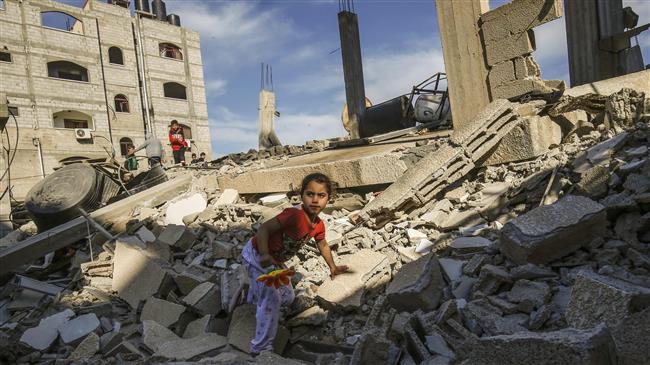
There is a war on Gaza, as it has been once, twice, and more. Gaza and its people are in a state of permanent war. It has been under constant siege for 13 years, which is war imposed upon them every day. Today, the month of Ramadan has started for fasting, prayer, repentance and good deeds. Instead, we see death exploding in and around Gaza. Israel itself complains of the war. Yesterday, Sunday May 5th, the Israeli Defense Minister tweeted and cried out to the world to notice and see Israelis waking up for the second day in a row of rockets coming from Gaza and falling in Israel.
War is painful after two days in Israel. It is as painful and more painful in Gaza after 13 years of siege. War is an absolute evil both for the Israelis and for the Palestinians. Mr. Minister, the key to peace and the end of war is not in the hands of a world that we summon but simply in your hand and in the hands of Israel.
The issue is not only that of Gaza but the issue of all the Palestinian people. The issue is the injustice imposed on the Palestinian people for generations. Israel refuses to see Palestinians as human beings with same rights and equal to all human beings. Israel has tried the methods of war and violence repeatedly to solve the issue. Until today, it has not succeeded and now, on the near horizon, there is talk about a solution wrapped in darkness and non-recognition of Palestinian rights. It will not bring a just solution. It will be another failure.
The solution is simple if Israel wanted to SEE. If it wanted to see that the Palestinian people have the same rights as the Israeli people, all being equal in humanity. It is in Israel’s hands – Israel is the stronger – to realize this equality. Avoiding this equality until now has been useless. Israel itself today suffers from war launched on Gaza.
The solution is simple. Israeli human beings should not remain exposed to war, as is the Palestinian human being. Both are human and equal in humanity. We call upon Israel, the friends of Israel, those interested in the survival of Israel and the security of Israel to simply see that the Palestinian and Israeli peoples are equal in rights and duties and capable of making peace.
We say to the Israeli authorities: It is in your hands to keep us and keep yourselves in constant war and hostility, and in your hands to let us move together to an equal life with dignity, peace and security. Learn from the experience of already 70 years in war. They did not yield security and peace. The cause of the Palestinian people cannot be solved by violence or unjustly imposed solutions, but only by justice and equality. This is the key to war and peace in Israel and Palestine. The key to open the door of peace is in the hands of Israel.
Eileen Fleming, Senior Non-Arab Correspondent for USA’s The Arab Daily News, Author, Reporter: In Nov. 2006, Father Manuel, the parish priest at the Latin Church and school in Gaza, informed the world:
“Gaza cannot sleep! The people are suffering unbelievably. They are hungry, thirsty, have no electricity or clean water. They are suffering constant bombardments and sonic booms from low flying aircraft. They need food: bread and water. Children and babies are hungry… people have no money to buy food. The price of food has doubled and tripled due to the situation. We cannot drink water from the ground here as it is salty and not hygienic. People must buy water to drink. They have no income, no opportunities to get food and water from outside and no opportunities to secure money inside of Gaza. They have no hope.
“Without electricity children are afraid. No light at night. No oil or candles… Thirsty children are crying, afraid and desperate…Many children have been violently thrown from their beds at night from the sonic booms. Many arms and legs have been broken. These planes fly low over Gaza and then reach the speed of sound. This shakes the ground and creates shock waves like an earthquake that causes people to be thrown from their bed. I, myself weigh 120 kilos and was almost thrown from my bed due to the shock wave produced by a low flying jet that made a sonic boom.
“Gaza cannot sleep… the cries of hungry children, the sullen faces of broken men and women who are just sitting in their hungry emptiness with no light, no hope, no love. These actions are War Crimes!
Featured Video
The Search for Truth: Charlie Kirk’s Assassination One Year Later
or go to
Aletho News Archives – Video-Images
From the Archives
The 9/11 “Double-Cross” Conspiracy Theory
BY LAURENT GUYÉNOT • UNZ REVIEW • SEPTEMBER 6, 2022
Is it true that “9/11 was an inside job”? Yes, insofar as Israel is “inside” the U.S. But for the 9/11 truthers who have identified Israel as the main perpetrators, “9/11 was an inside job” is at best a half-truth, and at worst an integral part of the Zionist operation, like a secondary flag sewn as a lining under the false flag of Islamism. Victor Thorn (1963-2017) wrote in his book 9/11 made in Israel: The Plot Against America (2011): “In essence, the ‘9-11 truth movement’ was created prior to Sept. 11, 2001 as a means of suppressing news relating to Israeli complicity. . . . The slogan ‘9-11 was an inside job’ was quite possibly the greatest example of Israeli propaganda ever devised.” In milder terms, it is “controlled opposition”.
A genuine truth movement would have pointed to Israel as the prime suspect from the start. From day one, it was obvious who would benefit. … continue
Blog Roll
 Aletho News
- Hormuz and the Looming Economic Catastrophe
- Dhubab offensive, media blitz and the rapid unraveling of Saudi-backed coalition’s new gambit
- Putin Conveys to Trump Iran’s Vision on Possible Conflict Resolution – Kremlin
- The Search for Truth: Charlie Kirk’s Assassination One Year Later
- ‘Harsh reality’: Iran says France seeks monopoly on power and intimidation, not peace for all
- When Will This White House Madness End?
- Huckabee aide goes to ‘unusual lengths’ to portray ‘Israel’ positively
- Trump Announces Diesel Supply Deal With Putin Following Phone Call
- MEP blasts ‘Euro-Gestapo’ for lecturing Russia on democracy
- Syria May Send Troops to Saudi Arabia Amid War with Ansar Allah
- If Americans Knew
- Israeli forces kill another child in Gaza – Daily Update
- Gaza ceasefire exists in name only, say more than 100 organizations
- Nearly 2 Million in Gaza Need Urgent Shelter Assistance as Winter Looms: IOM Chief Warns
- Suppressing Palestinian resistance: US charity under fire for AI monitoring of Gaza classrooms
- Thousands Are Held in Israeli Torture Camps. This Is What Happens Inside
- Israel puts Gaza’s sick, injured, newborn in peril – Daily Update
- Report claimed Mark Levin used by Israeli government to influence Trump
- Over 2,000 Gazans have died awaiting medical evacuation amid Israel’s continued siege
- How a U.S. Diplomat Suppressed and Altered Reports Critical of Israel
- 5 Palestinians Die from Israeli Strikes in Gaza as Relentless Attacks Continue
- No Tricks Zone
- New Study: 50 Years Of The Most Aggressive ‘Net Zero’ Policies Can Only Affect The Global Climate By 0.03°C
- US September “Heat” Was No Record…Many Records Set Decades Ago
- Latest European Green Energy Debacle; Portugal’s Largest Flagship Solar Park Insolvent!
- Green Energy Debacle: German Expert Professor Fritz Vahrenholt Warns Of Severe Economic And Social Consequences
- Two More Paleo Reconstructions Affirm Meters-Higher Sea Levels Across Ireland, Brazil 7000-6000 Years Ago
- New Study: Earth And Venus Surface Warmth Largely Explained By Convection And Lapse Rate, Not CO2 Or Radiation
- 2025 Nature Paper Claiming Worsening Global Drought Gets RETRACTED …Heavily Flawed
- New Study: ‘Global Drought Shows No Detectable Recent Acceleration Under Climate Warming’
- Economic Masterminds: German Socialists Suggest Taxing Productivity Gains Stemming From Using AI
- The South China Sea Has Not Been Cooperating With The Climate Change Narrative

