In First, Judge Blocks Kansas Law Aimed at Boycotts of Israel
ACLU | January 30, 2018
TOPEKA, Kan. — The American Civil Liberties Union won an early victory today in its federal lawsuit arguing that a Kansas law requiring a public school educator to certify that she won’t boycott Israel violates her First Amendment rights.
A federal judge issued a preliminary injunction blocking enforcement of the law while the case filed in October proceeds. It is the first ruling addressing a recent wave of laws nationwide aiming to punish people who boycott Israel.
The law, which took effect on July 1, requires that any person or company that contracts with the state submit a written certification that they are “not currently engaged in a boycott of Israel.” The ACLU is also currently fighting a case filed in December against a similar law in Arizona.
“The court has rightly recognized the serious First Amendment harms being inflicted by this misguided law, which imposes an unconstitutional ideological litmus test,” said ACLU attorney Brian Hauss, who argued the issue in court. “This ruling should serve as a warning to government officials around the country that the First Amendment prohibits the government from suppressing participation in political boycotts.”
In his opinion, U.S. District Judge Daniel Crabtree wrote, “[T]he Supreme Court has held that the First Amendment protects the right to participate in a boycott like the one punished by the Kansas law.”
Other Supreme Court decisions have established that the government may not require individuals to sign a certification regarding their political expression in order to obtain employment, contracts, or other benefits.
The ACLU represents Esther Koontz, who belongs to the Mennonite Church USA. In accordance with calls for boycott made by members of her congregation and her church, Koontz decided not to buy consumer products made by Israeli companies and international companies operating in Israeli settlements in the occupied Palestinian territories. Koontz participates in this boycott in order to protest the Israeli government’s treatment of Palestinians and to pressure the country to change its policies.
Having served as a public school math teacher for nine years, Koontz now develops her school’s math curriculum and trains teachers on how to implement it. She is also qualified to train teachers statewide as a contractor with the Kansas Department of Education’s Math and Science Partnerships program. When Koontz was asked to certify that she does not participate in a boycott of Israel, she said that she could not sign the form in good conscience. As a result, the state refuses to contract with her, and she is unable to participate as a trainer in the state’s program.
Judge Crabtree wrote in his opinion, “She and others participating in this boycott of Israel seek to amplify their voices to influence change.”
The lawsuit argues that the Kansas law violates the First Amendment for several reasons: it compels speech regarding protected political beliefs, associations, and expression; restricts the political expression and association of government contractors; and discriminates against protected expression based on its content and viewpoint. The lawsuit asks the court to strike down the law and bar the Kansas Department of Education from requiring contractors to certify that they are not participating in boycotts of Israel.
The Kansas law is similar to legislation that has been passed in other states. The ACLU does not take a position on boycotts of foreign countries, but the organization has long supported the right to participate in political boycotts and has voiced opposition to bills that infringe on this important First Amendment right. In the lawsuit challenging the Arizona law, the ACLU represents an attorney and his one-person law office, which contracts with the government to provide legal services to incarcerated individuals.
In July, the ACLU sent a letter to members of Congress opposing a bill that would make it a felony to support certain boycotts of companies doing business in Israel and its settlements in the occupied Palestinian territories. As a result, Senate sponsors of the bill are considering changes.
Today’s ruling is here:
https://www.aclu.org/legal-document/koontz-v-watson-opinion
Also documents filed in the case are here:
https://www.aclu.org/cases/koontz-v-watson-challenge-kansas-law-targeting-boycotts-israel
Reflections on the Chabloz Case
I’ll sing my way to court in high heels and a frock
Give the press a winning smile from inside the dock…
Alison Chabloz song, Find me guiltyBy Nick Kollerstrom PhD | Occidental Review | January 26, 2018
Mr Gideon Falter, 34, who runs the Campaign Against Antisemitism (CAAS) was the chief witness for the Crown Prosecution service’s (CPS) against the British minstrel Alison Chabloz. On January 10th at Marylebone Magistrate’s Court we heard him swear the oath, to tell the truth, the whole truth and nothing but the truth. He then proceeded to give the court various hearsay conjectures, about what effect Ms Chabloz’ songs might be exerting, upon unspecified persons.
He averred for example that they were ‘spreading anti-semitic hatred’ and were ‘inciting to racial hatred.’ The Court was not given evidence for this,[1] nor advised where or in whom these emotions were being generated. Should he not have called witnesses to testify in support of these conjectures, or better still a psychologist to affirm that they were or had been generated?
The Court was advised of one offensive performance by Ms Chabloz, where she sang her songs ‘(((Survivors))) and ‘Nemo’s anti-Semitic Universe’ namely the London Forum in 2016 (September 24th). A problem here could be the signs of mirth and riotous applause in response to the songs: did this really show what Mr Falter had been alleging, or if not, what did?
She was recently introduced as ‘The brilliant comedienne and singer/songwriter Alison Chabloz,’ by Richie Allen, on his popular radio show (18 January).
The point of satire, is that it makes people laugh. Britain has a long tradition of satire from William Hogarth in the 18th century to Private Eye in the present time. Its future is surely at stake in this trial.
In October of 2017 she was arrested and jailed (or, ‘held in custody’) for 48 hours, for posting a video of herself singing a song. This had allegedly broken her ‘bail conditions’. As Ms Chabloz observed, “As far as I am aware, I am the only artist in modern British history to have been jailed for the heinous crime of composing and singing satirical songs which I uploaded to the Internet.”
We live in a society where just about any sacred belief is liable to be satirised for entertainment value, and those being satirised have not generally sought recourse to legal action. When punk-rock bands savagely mocked the Royal family for example, no-one prosecuted them.

Alison Chabloz
The present case was being brought under the Communications Act of 2003. A degree of public support is said to exist for its controversial section 127,[2] by people fed up with online bullying. For example, a racially motivated tweet relating to a footballer was prosecuted under it. But many have objected to its catch-all character,[3] and the DPP has stated in 2102, that its section 127 ‘should not be seen as a carte blanche for prosecuting content which, however upsetting to some, would normally fall within guarantees of freedom of expression in a democratic society,’ and that freedom of expression should include the right to say things that ‘offend, shock or disturb the state or any sector of the population.’
Last year, at least nine people a day were being arrested in the UK on such dubious grounds. Annoying someone or causing distress has never been viewed as a crime — until now. The Communications Act was basically designed for the media.[4] In contrast, songs posted up on the Web are only heard by persons who choose to listen. One exercises that choice by clicking the ‘play’ button. Ms Chabloz has not ‘communicated’ anything in the sense defined by that Act.
Normally, if a Youtube video is found to be disturbing, a complaint is put through to Youtube, rather than the person who has uploaded it. Now Ms Chabloz’ songs have either been deleted or given protective warnings by Youtube, which further complicates the question, of how and to whom she is supposed to be causing offence.
The Defence lawyer Adrian Davies had suggested at an earlier hearing that his client’s songs might be ‘offensive’ but not ‘grossly offensive,’ and that remark was reiterated by the judge in the present hearing. That is surely so: it’s not as if they were snuff movies, or featured depraved or perverted acts, or personally defamed anyone living — except for one person, Irene Zisblatt who claims that she swallowed diamonds while she was at Auschwitz. The court discussed her case, with Mr Davies pointing out that the official Yad Vashem Holocaust centre in Israel had cast doubt upon the veracity of Ms Zisblatt’s story in her book The Fifth Diamond. It features of course ze evil Nazis ripping babies in half, making lampshades out of human skin, etc. Was this not a legitimate target for satire, Mr Davis asked the Court?
Some have commented that British politics would hardly be able to function if a distinction was liable to be made between ‘offensive’ and ‘grossly offensive.’ How is the law supposed to discern such a thing?
Others have wondered if it is really appropriate for the CAAS to be registered as a charity, i.e., a tax-exempt NGO, which goes around suing people. The CPS had not wanted to take this case, but was pressured by the CAAS to do so. That applies both to the pending case of British ‘nationalist’ Jez Turner as well as Ms Chabloz: in both cases the CPS had no inclination to prosecute, but arm-twisting by the CAA made them do it. In fact, the CAA works for a foreign power: its first action upon being founded in 2014 was to intimidate the Trycicle Theatre in Cricklewood so they gave up their BDS policy on Israeli goods. Why should a group specialising in legal intimidation be awarded tax-exempt charity status?
The second witness after Mr Faulter was Stephen Silverman, the CAA’s ‘Director of Investigations and Enforcement.’ Under examination he confirmed that the online character ‘Nemo’ who had been persistently trolling Ms Chabloz, was none other than Stephen Applebaum, the CAAS’s ‘senior volunteer.’ For the last two years she had received some quite intense twitter threats and curses from this character — thus on her website ‘Nemo’ declared: ‘Even if you are acquitted, we will still go after you.’ Earlier, in the first court hearing of this case in December 2016, Mr Silverman admitted that he had been tweeting as ‘Bedlam Jones’ who had likewise been making quite intimidating comments.
So, this is a case that could work a lot better the other way round, with Alison as the innocent injured party and CAA personnel as guilty of harassment and victimisation. Clearly, the CAA needs to be stripped of its charity status. As a general comment, one can either post envenomed tweets against someone or sue them, but it may be inadvisable to try both.
The case is adjourned until March 7th.
[1] As her lawyer A.D advised the Court, the ‘personal emotional reaction’ of Mr Gideon Falter was ‘entirely irrelevant’ to the case
[2] Section 137: A person is guilty of an offence if he— (a)sends by means of a public electronic communications network, message or other matter that is grossly offensive or of an indecent, obscene or menacing character;
[3] Figures obtained by The Times through the Freedom of Information Act reveal that 3,395 people across 29 forces were arrested last year under section 127 of the Communications Act 2003, which makes it illegal to intentionally “cause annoyance, inconvenience or needless anxiety to another”, in 2016′
[4] It aimed ‘to make provision about the regulation of the provision of electronic communications networks and services … to make provision about the regulation of broadcasting and of the provision of television and radio services, etc.
Palestinian youth activists under attack

Haitham Siyaj
Samidoun Palestinian Prisoner Solidarity Network – January 28, 2018
Israeli repression targeting Palestinian youth activists has continued to rise. On Friday, 26 January, occupation forces seize Haitham Siyaj, only a month after he was released from nearly two years’ imprisonment without charge or trial under administrative detention. Siyaj is one of the comrades of Basil al-Araj who was seized by occupation forces shortly after being released from months in Palestinian Authority prison.
There, his administrative detention – imprisonment without charge or trial – was renewed repeatedly. Siyaj was once again seized at a flying checkpoint erected by occupation forces in the Jaba area.

Tareq Mattar
At the same time, Palestinian youth activist Tareq Mattar’s administrative detention was also extended for another six months. Mattar, 28, is a Palestinian youth leader who is active in a variety of projects, initiatives and forums to organize Palestinian youth and promote study and discussion of the Palestinian cause. He was previously jailed for his Palestinian political activities. He has been jailed without charge or trial since August 2017.

Samer Abu Aisha
Meanwhile, Palestinian journalist Samer Abu Aisha, 30, from Jerusalem, was summoned for interrogation by occupation police on 24 January; he was released from Israeli prison six months ago after 20 months in prison. He was seized by occupation forces in January 2016 after they stormed the headquarters of the ICRC in Sheikh Jarrah where he and a fellow Jerusalemite activist, Hijazi Abu Sbeih, were staying in defiance of an order to expel them from their city for six months. He was jailed for 20 months on charges of illegal protest, incitement and “disturbing public security.”
Israel’s endgame in Gaza: Resistance is futile
Israel’s deliberate targeting of Gaza’s health sector and denying those in need of humanitarian care from obtaining it constitute a crime against humanity

By CJ Werleman | Middle East Eye | January 16, 2018
Some describe Gaza as either the world’s largest “concentration camp” or “open air prison”, while others liken it to the modern-day equivalent of the Warsaw ghetto.
Whatever appropriate analogy you apply to the enclave, that traps two million Palestinians on a slender piece of coastal land along the Egyptian-Israeli border, it’s impossible to overstate the level of human misery and suffering that is taking place there today.
A catastrophic situation
When I spoke with Dr Basem Naim, the former Palestinian minister for health and resident of Gaza, I referred him to a UN report that forewarned that Israel’s medieval-like blockade promises to make the territory “uninhabitable” by 2020.
“What do they [UN] mean? It’s uninhabitable here now,” Naim told me. “The situation today is catastrophic.”
Dr Naim explained how Israel’s intentional cutting of Gaza’s power supply, meant to exert pressure on Hamas but, instead, punishing ordinary Palestinians, is having dire affects on the health sector in Gaza.
“The typical Palestinian gets only three to five hours of electricity each day,” he said. “You can’t pump water to apartments that are above ground level. You can’t pump sewage, which is why more than 95 percent of Gaza’s drinking water is undrinkable.”
He explained that hospitals, which depend on 24-hour electricity, are unable to perform life-saving surgeries, and that some, including Al-Shifa hospital in Gaza City, have ceased doing operations altogether.
This is happening while newborn babies and the elderly freeze to death in the winter, and die from heat exhaustion in the summer. This is happening because Israel is allowing only 120 watts of power to be provided to Gaza, knowing that 400 watts are needed to meet the basic minimum survival needs of two million Palestinian people.
“The scarcity of energy and the severe shortage of fuel in Gaza have damaged all aspects of life in the Strip,” said the International Committee of the Red Cross in a statement issued last year.
Closed borders
But the biggest problem facing the imprisoned citizens of Gaza is the “closed borders”, according to Dr Naim. He explained:
“For example, the last time Rafah border crossing was opened, which was one week ago, came after more than 100 days of closure, and out of the 35,000 people waiting to leave Gaza through Rafah, only 2,000 were able to leave, and the others must wait again for another 100 days. When I talk about 35,000 people, I’m talking about urgent humanitarian cases; patients, and people who need to meet their families for urgent situations. It’s nearly impossible for Palestinians in Gaza to get urgent medical care in Israel, Egypt, or Jordan.
“If a Palestinian wants to leave Gaza for urgent medical care or treatment, he or she must wait 70 days to get [an] Israeli reply saying he or she is allowed or not. And after 70 days, and even if the request is approved, he or she must come to Erez crossing for an interrogation, and he or she might be arrested. I know many cases where the families of patients were blackmailed by Israeli security forces, like Shin Bet, under these very circumstances.”
It’s worth noting that it’s not only from Gaza that Palestinians are denied freedom of movement. Earlier this month, Omar Barghouti, who lives in Israel and is one of the founders of the boycott, divest and sanctions (BDS) movement against Israeli occupation, was denied the right to visit his cancer-stricken mother in Jordan.
Israel’s refusal to allow a prominent Palestinian figure, who has a demonstrable lifetime track record of non-violent activism, undercuts Israeli claims that travel bans have little to do with security and everything to do with meting out collective and inhumane punishment to the Palestinian people, writ large.
A new report published by the human rights group Gisha – Legal Centre for Freedom of Movement shows that 2017 was the worst year for the movement of Palestinians in and out of Gaza since Israel’s attack on Gaza in the summer of 2014, reducing the number of exit permits by 51 percent from 2016 to 2017.
The report shows that Israel allowed fewer than 6,000 monthly exits in 2017 compared with the more than 14,000 allowed the previous year.
The authors of the report also identified a list of policies that were carried out by Israeli authorities to prevent or restrict freedom of Palestinian movement through the Erez crossing.
These new restrictive measures were “introduced with little or no justification provided as to their purpose and, it appears, no consideration of the impact they would have on the lives of Gaza’s residents”.
Targeting the health sector
These measures include “significant extension of the processing times of permit applications, leaving thousands of permit applications pending with no response; a new directive prohibiting Palestinians from exiting Gaza with electronic devices, toiletries and food; freezing travel to the American Consulate; mandatory shuttle services to Allenby Bridge Crossing; “security blocks” blocking travel for medical patients, traders, and humanitarian workers; increase in the frequency and severity of “security interviews” at Erez; trader permits cancelled as new approvals declined; travel for Friday prayers in Jerusalem remaining blocked, and; recipients of permits for travel abroad increasingly made to sign a commitment not to return for a year.”
It’s not only inexcusable for Israel to impose any kind of restriction of movement, but to deliberately target Gaza’s health sector by cutting power to the Strip, and then to deny those in need of humanitarian care from obtaining it – constitutes a crime against humanity by any definition.
“The magnitude, the deliberateness, the violations of international humanitarian law, the impact on the health, lives, and survival, and the overall conditions warrant the characterisation of a crime against humanity,” says Richard Falk, a former UN special rapporteur for human rights in the occupied Palestinian territories.
“This is an increasingly precarious condition. A recent study reports that 46 percent of all Palestinian children in Gaza suffer from acute anaemia. There are reports that the sonic booms associated with Israeli overflights have caused widespread deafness, especially among children. Children need thousands of hearing aids.
“Malnutrition is extremely high in a number of different dimensions and affects 75 percent of Palestinians in Gaza. There are widespread mental disorders, especially among young people … Over 50 percent of Palestinian children in Gaza under the age of 12 have been found to have no will to live,” wrote Falk in 2008.
When I referred to Falk’s findings from a decade ago, Dr Naim said things have become “much worse”, pointing to the fact that much of Gaza’s critical infrastructure was destroyed during Israel’s 2014 assault, noting that 20,000 tons of explosive ordinance was dropped on the Strip by Israeli jets and artillery, and that unemployment and poverty have skyrocketed since.
Breaking the Palestinians’ will
Israel’s restriction on Palestinian movement is also preventing Gaza from building a functioning civil society as human rights workers, social workers, health workers, educators, engineers, etc are denied opportunities to expand their knowledge and skills in other countries.
It also runs afoul of Israel’s “obligations to respect the human rights of Palestinians in Gaza and the West Bank, including their right to freedom of movement, which includes, with some limitations, a right to enter and leave one’s country and to choose one’s place of residence within it,” according to Human Rights Watch.
In fact, Palestinians in Gaza may visit their families in the occupied West Bank only if he or she can prove their relative is “dead, dying, or getting married“, which constitutes another violation of not only international law but also the Oslo Accords that stipulate the Palestinian territories – East Jerusalem, Gaza, and the West Bank – constitute one unified territorial entity. Israel has made movement between the territories all but impossible for Palestinians.
Given that nearly a third of Palestinians in Gaza have relatives in either the occupied West Bank, East Jerusalem, or Israel, one can see how needlessly cruel Israel’s brutal policies of occupation truly are.
Of course, Israel tries to justify its near total freeze of Palestinian movement in and out of Gaza with concerns for its security, but this has always been a rhetorical fig leaf for Israel’s sustained effort to break the will of the Palestinian people.
Israel’s intent has always been to strangle Palestinian political, social, and civil life in the hope that those it occupies will come to the realisation that resistance is futile.
– CJ Werleman is the author of Crucifying America (2013), Koran Curious (2011), and he is the host of Foreign Object. Follow him on twitter: @cjwerleman
READ MORE:
Yes, Palestinians under siege are ‘dehumanised’ – by Israel
Remembering Cast Lead: How corporate media continue to justify Israel’s criminal excesses
Ex-FBI Agent: NSA Unlikely to Be Punished for Illegal Data Destruction
Sputnik – January 27, 2018
WASHINGTON – National Security Agency officials are unlikely to face any punishment or censure for defying a court order and destroying data they had broken the law to collect in the first place, former FBI special agent and whistleblower Colleen Rowley told Sputnik.
The NSA was under court order to hold on to information that was linked to warrantless wiretapping during the George W. Bush administration, but instead the agency got rid of data it had been specifically asked to retain, according to US media reports.
“What should be shocking about this news is that it’s about the illegal deletion of the previously illegally collected data on US citizens in the Presidential Surveillance Program,” Rowley said.
There was no accountability for the government’s prior destruction of evidence, including the CIA’s destruction of the “torture tapes,” Rowley noted.
Consequently, “I don’t think there is much chance of any accountability of NSA officials for any of their official negligence or malfeasance that led to these intercepted communications being destroyed and not preserved for purposes of this court proceeding,” she said.
The data was gathered during the administration of President George W. Bush under an illegal program called the “Presidential Surveillance Program,” Rowley recalled.
However, “When the Pulitzer-prize winning news of the illegal program was finally released by New York Times writers, [President] George Bush misled the US public by downplaying it and calling it his ‘Terrorist Surveillance Program,’” she said.
The illegal surveillance of Americans had been secretly “legalized” just as the CIA’s practice of torture as so-called “enhanced interrogation” techniques had been by Bush’s Office of Legal Counsel (OLC) attorney John Yoo and his senior OLC partner Robert Delahunty, Rowley noted.
Yoo and Rowley justified the secret surveillance program “shortly after 9-11 in dozens of secret memos claiming the President had inherent “Commander in Chief” powers to violate the Bill of Rights, a form of martial law,” she said.
The NSA’s interception of communications was illegal in the first place and was in violation of the Foreign Intelligence Surveillance Act (FISA) statute and the entire program was also possibly unconstitutional, Rowley pointed out.
Rowley also said much of the deleted material might have contained details of secret sexual activities that could have proven highly embarrassing to US military and diplomatic personnel who were involved.
“From some of my prior readings, I also suspect that these previously illegally intercepted communications after 9-11 contained a lot of ‘pillow talk’ between American spouses/girlfriends/boyfriends of military members and State Department personnel stationed abroad,” she said.
Had the secret data not been destroyed, it might have exposed the falsehood of many statements and assurances by President George W. Bush that claimed the surveillance program was responsible and limited in scope, Rowley remarked.
“So this content that apparently no longer exists would have proved very embarrassing if it had ever been made public… contradicting George Bush’s descriptions that his program only targeted ‘terrorists,’” she said.
The destroyed NSA data would have angered the important constituency of US military and Foreign Service members as well as other American travelers whose privacy and rights were violated, Rowley noted.
Rowley sent a May 2002 memo to then-FBI Director Robert Mueller that exposed some of the FBI’s pre- September 11, 2001 failures. She was named one of TIME magazine’s “Persons of the Year” in 2002. Mueller is now the Special Counsel investigating President Donald Trump’s alleged collusion with Russia. Both Trump and Russia have denied colluding during the 2016 US presidential campaign.
Virginia Attorney General Attempting to Blacklist Activist & Political Organizations as Domestic Terrorists
The Rutherford Institute | January 26, 2018
RICHMOND, Va. — Warning that attempts by the political establishment to blacklist groups espousing unpopular ideas will endanger and undermine legitimate First Amendment activities across the political spectrum, The Rutherford Institute is calling on the Virginia General Assembly to denounce House Bill No. 1601.
Introduced by Del. Marcia Price and drafted with the help of Attorney General Mark Herring, H.B. 1601 broadly and vaguely defines “domestic terrorism” in such a way as to create a new criminal class of “domestic terrorist organizations” by labeling organizations that are even minimally affiliated with individuals engaged in so-called “acts of terrorism” such as misdemeanor assault, trespass, and damaging property on the land of another. Moreover, once an organization is designated a “domestic terrorist organization,” it becomes a crime to provide that group with a service, whether that be food, lodging, transportation, communication or commerce for any purpose whatsoever.
“If you believe in and exercise your rights under the Constitution (namely, your right to speak freely, worship freely, associate with like-minded individuals who share your political views, criticize the government, demand a warrant before being questioned or searched, or any other activity viewed as potentially anti-government), that could be enough to land you on the federal government’s terrorism watch list. Now, under this proposed Virginia law, just associating with someone labeled a ‘domestic terrorist’ is enough to get an organization blacklisted,” said constitutional attorney John W. Whitehead, president of The Rutherford Institute and author of Battlefield America: The War on the American People. “People have forgotten that in his day, civil rights leader Martin Luther King Jr. was viewed as a domestic terrorist for his acts of civil disobedience. Under this law, which aims to demonize and criminalize organizations based on their social or political associations with individuals whose unpopular beliefs or anti-government sentiments may be construed as ‘terrorist,’ organizations associated with King would be labeled as domestic terrorists and blacklisted. This is about as McCarthyist and un-American as it gets.”
In the wake of a massive protest in Charlottesville, Va., in August 2017 that resulted in violent clashes between alt-right and alt-left activists, with little to no intervention by police, Del. Marcia Price and Attorney General Mark Herring collaborated on legislation, House Bill 1601, that would create a new criminal class of domestic terrorists and blacklist any organizations associated, even minimally, with individuals engaged in so-called domestic terrorist activities.
In a letter to the Courts of Justice Committee, attorneys for The Rutherford Institute warn that H.B. 1601 poses grave dangers to the core constitutional rights of activist and political organizations of all stripes across the entire social and political spectrum. Notably, under H.B. 1601, almost any political organization risks being designated a “domestic terrorist organization”; organizations could be classified as terrorist based merely on minimal associations with individuals engaged in acts of so-called domestic terrorism; mired in secret proceedings, the protocol lacks any assurance of due process; the process for mounting an appeal of a “domestic terrorist” designation is overly burdensome and skewed; and the provisions impermissibly burden the right of political association protected by the First Amendment.
Documents
 The Rutherford Institute’s letter to the Virginia General Assembly
Council of Europe tells PA to stop supporting prisoners’ families
MEMO | January 26, 2018
The Council of Europe has called upon the Palestinian Authority to halt the payments it distributes to the families of Palestinian prisoners and those who have been killed by Israeli forces, the Jerusalem Post has reported. The Israeli narrative swayed the council during its parliamentary session, prompting it to make the demand for the first time as part of a broader call for a resolution on the Israel-Palestine conflict.
“After a persistent effort we succeeded for the first time to include in the final report [resolution] a clear call to stop support for terrorists [sic] and their families,” said Yesh Atid MK Aliza Lavie, who addressed the council in Strasbourg.
The rest of the session addressed the US recognition of Jerusalem as the capital of Israel and reiterated that a two-state solution with East Jerusalem as Palestine’s capital was the only solution to the conflict.
Israel and the US have long berated the PA for providing crucial subsidies to the families of those impacted by the occupation, framing the money as a reward for “terrorists”. In September, the Trump administration announced its backing for a bill that would suspend US aid to the PA until the latter ended payments to prisoners and their families.
“The Trump administration strongly supports the Taylor Force Act, which is a consequence of Palestinian Authority and Palestine Liberation Organisation’s policy of paying terrorists and their families,” the State Department said at the time.
Palestinian officials have said that the payments are support for relatives “who lost their breadwinners to the atrocities of the occupation, the vast majority of whom are unduly arrested or killed by Israel.”
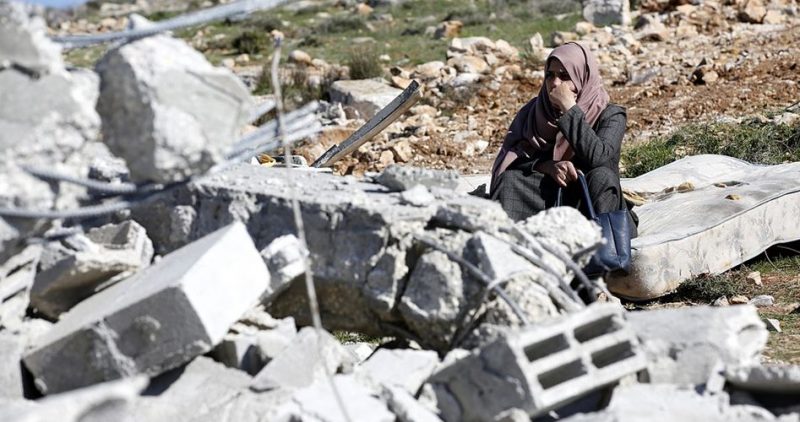
In the aftermath of a resistance attack, the families of the alleged perpetrators often find their homes being demolished, their relatives arrested and their land taken. Amnesty International is one of many human rights groups that have repeatedly condemned such reprisals as a form of “collective punishment”. Consequently, many Palestinians find themselves reliant on the benefits from the PA in order to survive.
A Conspiracy of Silence Assaults Privacy
By Andrew Napolitano • Unz Review • January 25, 2018
During the past three weeks, Congress passed and President Donald Trump signed into law vast new powers for the NSA and the FBI to spy on innocent Americans and selectively to pass on to law enforcement the fruits of that spying.
Those fruits can now lawfully include all fiber-optic data transmitted to or in the United States, such as digital recordings of all landline and mobile telephone calls and copies in real time of all text messages and emails and banking, medical and legal records electronically stored or transmitted.
All this bulk surveillance had come about because the National Security Agency convinced federal judges meeting in secret that they should authorize it. Now Congress and the president have made it the law of the land.
This enactment came about notwithstanding the guarantee of the right to privacy — the right to be left alone — articulated in the Fourth Amendment to the Constitution and elsewhere. Though the surveillance expansion passed the Senate by just one vote, it apparently marks a public policy determination that the Constitution can be ignored or evaded by majority consent whenever it poses an obstacle to the government’s purposes.
The language of the Fourth Amendment is an intentional obstacle to the government in deference to human dignity and personal liberty. It reads: “The right of the people to be secure in their persons, houses, papers, and effects, against unreasonable searches and seizures, shall not be violated, and no Warrants shall issue, but upon probable cause, supported by Oath or affirmation, and particularly describing the place to be searched, and the persons or things to be seized.”
This specific language was expressly written to prevent the bulk suspicionless surveillance that the British government had used against the colonists. British courts in London issued general warrants to British soldiers in America, authorizing them to search wherever they wished and seize whatever they found. These warrants were not based on probable cause, and they did not describe the place to be searched or the people or things to be seized.
The Colonial reaction to the British use of general warrants was to take up arms and fight the American Revolution.
Last week, Congress and the president chose to ignore our history and the human values underlying the right to privacy. Those values recognize that the individual pursuit of happiness is best actualized in an atmosphere free from the government’s prying eyes. Stated differently, the authors and ratifiers of the Fourth Amendment recognized that a person is not fully happy when being watched all the time by the government.
Yet the constitutional values and timeless lessons of history were not only rejected by Congress but also rejected in ignorance, and the ignorance was knowingly facilitated by the members of the House Intelligence Committee.
Here is the back story.
The recent behavior of the leadership of the House Intelligence Committee constitutes incompetence at best and misconduct in office at worst. The leadership sat on knowledge of NSA and FBI surveillance abuses that some committee members have characterized as “career-ending,” “jaw-dropping” and “KGB-like,” while both houses of Congress — ignorant of what their 22 House Intelligence Committee colleagues knew — voted to expand NSA and FBI surveillance authorities.
Stated differently, the 22 members of the committee knowingly kept from their 500 or so congressional colleagues incendiary information that, had it been revealed in a timely manner, would certainly have affected the outcome of the vote — particularly in the Senate, where a switch of just one vote would have prevented passage of this expansion of bulk surveillance authorization.
Why were all members of Congress but the 22 on this committee kept in the dark about NSA and FBI lawlessness? Why didn’t the committee reveal to Congress what it claims is too shocking to discuss publicly before Congress voted on surveillance expansion? Where is the outrage that this information was known to a few in the House and kept from the remainder of Congress while it ignorantly voted to assault the right to privacy?
The new law places too much power in the hands of folks who even the drafters of it have now acknowledged are inherently unworthy of this trust. I argued last week that House Intelligence Committee Chairman Devin Nunes was up to something when he publicly attacked the trustworthiness of the NSA and FBI folks whose secret powers he later inexplicably voted to expand. Now we know what he was talking about.
What can be done about this?
The House Intelligence Committee should publicly reveal the contents of its four-page report that summarizes the NSA and FBI abuses. If that fails, a courageous member of the committee should go to the floor of the House — as Sen. Dianne Feinstein once took the CIA torture report to the floor of the Senate — and reveal not just the four-page report but also the underlying data upon which the report is based. Members of Congress enjoy full immunity for anything said on the House or Senate floor, yet personal courage is often in short supply.
But there is a bigger picture here than House Intelligence Committee members sitting on valuable intelligence and keeping it from their colleagues. The American people are entitled to know how the government in whose hands we have reposed the Constitution for safekeeping has used and abused the powers we have given to it. The American people are also entitled to know who abused power and who knew about it and remained silent.
Does the government work for us, or do we work for the government? In theory, of course, the government works for us. In practice, it treats us as children. Why do we accept this from a government to which we have consented? Democracy dies in darkness. So does personal freedom.
Copyright 2018 Andrew P. Napolitano. Distributed by Creators.com.
WaPo Editor Blames Lack of US Leadership for Famine Caused by US Leadership
By Adam Johnson | FAIR | January 23, 2018
“American leadership” is one of a long list of vague, seemingly benign pseudo-concepts our media throw around to justify increased spending on soft power and military adventurism. It’s a difficult concept to pin down, but it’s almost always presented as something the United States is “failing” to do when it doesn’t “engage” the world with enough war, sanctions or arbitrarily applied human rights scolding.
Lamenting a “lack of American leadership” is, therefore, a time-honored Serious Person cliche for those operating at major US papers, and one Washington Post deputy editorial page editor Jackson Diehl phoned in Sunday with his op-ed “Genocide, Famine and a Democratic Retreat—All After One Year of US Inaction” (1/21/17).
The piece began with a bizarre inversion of reality:
Maybe it’s just a coincidence, but as the United States has retreated from international leadership in the past decade, several toxic global trends have gained momentum. Democracy is steadily retreating, according to Freedom House, whose annual study documents a decline for the 12th consecutive year. Famine is threatening more people than ever: Tens of millions are at risk of starvation in countries such as Yemen, South Sudan and Somalia.
It’s unclear exactly what “international leadership” is supposed to mean here, besides being inversely correlated with Bad Things happening. The piece is a broadside against both former President Obama and Donald Trump for “steadily retreating,” but the most serious Bad Thing he cites as a result of a lack of American leadership, the famine in Yemen, is a direct result of “American leadership.” Obama and Trump have logistically and politically supported the Saudi-led bombing and blockade of Yemen that caused the famine.
But Diehl’s not honestly engaging with the world as it is; his job is to advance the premise that the US has both the right and the moral duty to dictate the affairs of other countries. Diehl did the same cynical reality-inversion last June (FAIR.org, 6/26/17), when he not only ignored the US’s role in creating the Yemen famine, but painted them as the heroes coming to the rescue.
Similarly, Diehl cites “the tragedy of Syria” in Sunday’s piece as a result of a lack of American leadership, without mentioning the American leadership of the CIA—along with American leadership allies Saudi Arabia, Turkey, and Qatar—helped fund, train and arm groups in that conflict, thus fueling the “tragedy.” Also omitted was the ongoing role of “American Leadership” in bombing seven countries, its deadly drone program that has terrorized thousands of civilians in Yemen and Central Asia, its continued use of offshore penal colonies outside the scope of international law and a number of other bad things that result from the active exertion of “American leadership,” rather than its absence.
The rest of the piece is about the Trump administration’s “inaction” over ethnic cleansing of the Rohingya in Burma, but the setup is very telling. Diehl uses this ethnic catastrophe to browbeat the US for not doing enough, but really what he wants, as evidenced by his years of writing (see, e.g., FAIR.org, 5/2/06, 12/23/14, 5/17/16), is more meddling and intervention and bombing in general; the tragedy in Burma simply serves as a moral lubricant for an assertion of the US’s superiority. To national security boosters like Diehl, “American leadership,” like military spending, is always in a state of inadequacy. There’s never enough, we always need more. The possibility that said “leadership” or military spending may be causing the problems—even the ones he himself cites as the most urgent—rather than being their solution is simply not an option.
Messages can be sent to the Washington Post at letters@washpost.com
‘Apartheid State’: UN Slams Israel For Human Rights Violation

Sputnik – 24.01.2018
On Tuesday, the UN Human Rights Council (HRC) held a session aimed at assessing the progress Israel made during its third Universal Periodic Review (UPR), a UN-backed process designed to assess the human rights record of a state and make recommendations for improvement.
In the course of the struggle between the Israelis and Palestinians, the UN has repeatedly accused Israel of not respecting human rights as it continues to build settlements on the West Bank, however, the strongest condemnation comes from South Africa, a country which used to have one of the world’s worst human rights records itself.
During the session a delegate from South Africa, a country where the system of discrimination based on supremacy of white people and suppression of the black population called apartheid originated from, characterized Israel as “the only state in the world that can be called an apartheid state,” since it denies the right of self-determination to the Palestinian people, “in the absence of which no other human right can be exercised or enjoyed.”
Other HRC members also expressed their deep concern over Israel’s violation of the UN resolution which rules that Israeli settlements on the West Bank and in East Jerusalem are illegal, as the country continues to expand the existing settlements as well as building new areas.
Russia, Jordan, the UAE and Iran alongside other countries called on Israel to stop the annexation of Palestinian land and the construction of Israeli settlements there, whereas the Palestinian delegation during the session urged Israel to halt “its 50-year colonial occupation” and “compensate Palestinians for all of the losses incurred due to their presence.”
Israeli ambassador to the UN Aviva Raz Shechter said that Israel would submit to the review process though she pointed out the HRC’s bias and “the unfair treatment of Israel” in the council.
Territory in the West Bank was seized by Israel during the 1967 Six-Day War in the course the long-lasting struggle between Israelis and Palestinians for the territory of what previously was the British Mandate of Palestine. The West Bank is mostly populated by Arabs and the United Nations considers this territory to be illegally occupied by Israel. Some sponsors of a peace process, among whom are Russia and the EU, have repeatedly warned that Israeli settlement activity undermines any chances for a two-state solution, which involves the creation of an independent Palestinian state alongside Israel.
Facebook, Google, Twitter Announce ‘Counterspeech’ Psyop to Keep Public Docile

By Jake Andersen | ANTIMEDIA | January 18, 2018
If you’re a radical or search for “extremist” content online, the biggest social networks and internet companies on Earth will soon be converting you into a docile moderate, or at least, they will try.
Facebook, Google, and Twitter have been screening and filtering extremist content for years, but on Wednesday, the gatekeepers of the internet confirmed to Congress that they are accelerating their efforts and will target users who may be exposed to extremist/terrorist content, redirecting them instead to “positive and moderate” posts.
Representatives for the three companies testified before the Senate Committee on Commerce, Science and Transportation to outline specific ways they are trying to combat extremism online. Facebook, Google, and Twitter aren’t just tinkering with their algorithms to restrict certain kinds of violent content and messaging. They’re also using machine learning and artificial intelligence (AI) to manufacture what they call “counterspeech,” which has a hauntingly Orwellian ring to it. Essentially, their goal is to catch burgeoning extremists, or people being radicalized online, and re-engineer them via targeted propagandistic advertisements.
Monika Bickert, Facebook’s head of global policy management, stated:
“We believe that a key part of combating extremism is preventing recruitment by disrupting the underlying ideologies that drive people to commit acts of violence. That’s why we support a variety of counterspeech efforts.”
Meanwhile, Google’s YouTube has deployed something called the “Redirect Method,” developed by Google’s Jigsaw research group. With this protocol, YouTube taps search history metrics to identify users who may be interested in extremist content and then uses targeted advertising to counter “hateful” content with “positive” content. YouTube has also invested in a program called “Creators for Change,” a group of users that makes videos opposed to hate speech and violence. Additionally, the video platform has tweaked their algorithm to reduce the reach of borderline content.
In his testimony, Juniper Downs, YouTube’s head of public policy, said, “Our advances in machine learning let us now take down nearly 70% of violent extremism content within 8 hours of upload and nearly half of it in 2 hours.”
On the official YouTube blog, the company discussed how they plan to disrupt the “radicalization funnel” and change minds. The four steps include:
- “Expanding the new YouTube product functionality to a wider set of search queries in other languages beyond English.
- Using machine learning to dynamically update the search query terms.
- Working with expert NGOs on developing new video content designed to counter violent extremist messaging at different parts of the radicalization funnel.
- Collaborating with Jigsaw to expand the ‘Redirect Method’ in Europe.”
Starting at the end of last year, the company had already begun altering its algorithm so that 30% of its videos were demonetized. The company had explained that it wanted YouTube to be a safer place for brands to advertise, but the move has angered many content producers who generate income with their video channels.
The effort to use machine learning and AI as part of a social engineering funnel is probably not new, but we’ve never seen it openly wielded on a vast scale by a government-influenced corporate consortium. To say the least, it is unsettling for many. One user commented underneath the post, “So if you have an opinion that’s not there [sic] agenda You are a terrorist. Free speech is dead on YouTube.”
For its part, Twitter’s representative told Congress that since 2015 the company had taken part in over 100 training events focused on how to reduce the impact of extremist content on the platform.
In a post called “Introducing Hard Questions” on its blog, Facebook discussed rethinking the “meaning of free expression.” The post posed a number of hypothetical questions, including:
- How aggressively should social media companies monitor and remove controversial posts and images from their platforms? Who gets to decide what’s controversial, especially in a global community with a multitude of cultural norms?
- Who gets to define what’s false news — and what’s simply controversial political speech?”
The three tech giants have been under intense scrutiny from lawmakers who feel the platforms have been used to sow division online and even recruit homegrown terrorists. While the idea of using an algorithm to fight extremism online is not new, a unified front of Facebook, Google, and Twitter has never collectively produced original online propaganda, the specifics and scope of which remain vague despite the companies’ attempts at transparency.
Only recently, in the 2012 National Defense Authorization Act (NDAA), was the use of propaganda on the American people by the government formally legalized. Then-President Barack Obama continued strengthening government propaganda at the end of his administration with the dystopic Countering Disinformation and Propaganda Act of 2017, which created a kind of Ministry of Truth for the creation of so-called “fact-based narratives.”
It appears that while the government continues to strengthen its potential to conduct psychological operations (psyops), it is also joining forces with internet gatekeepers that can use their algorithms to shape billions of minds online. While one may applaud the ostensible goal of curbing terrorist recruitment, the use of psyops for social engineering and manufacturing consent could extend far beyond the original intent.
Featured Video

Armando Mema: Finland Used as New Frontline Against Russia
or go to
Aletho News Archives – Video-Images
New Documentary
Hospital Horror
Documented in the film,“Bad Medicine”

Blog Roll
 Aletho News
- Poland and Bulgaria put brakes on Ukraine weapons funding
- Russia Reaffirms Its Support for Sovereignty, Territorial Integrity of Lebanon – Russian MFA
- Araghchi: Failure to punish aggressors against Iran endangers all nations
- Iran tells UN Security Council to stop reversing roles of ‘aggressor and victim’
- Disgraced neocons Feith & Libby: stop whining about ‘endless war’
- CENTCOM rejects Israeli claims of preparations for new Iran attacks
- Your Shopping Bag Runs Through Hormuz
- Armando Mema: Finland Used as New Frontline Against Russia
- Gestapo 2.0? Germany grants spy agencies sweeping new powers
- Franco-Palestinian group seeks court ban on Israeli real estate fair in Paris
- If Americans Knew
- An error has occurred; the feed is probably down. Try again later.
- No Tricks Zone
- New Study: Barents Sea Temperatures Were Warmer And Sea Ice Less Extensive In The 1700s Than Today
- German Authorities Start Initiative To Evaluate Public Register For Climate “Disinformation” Spreaders!
- Zonal Asymmetry of Temperature Change in the Antarctic Circumpolar Current
- New Study: The Net Fossil Fuel Contribution To Rising Atmospheric CO2 Has Been Zero For 500 Years
- Germany’s Green Energy Transition Becoming Increasingly Expensive…Another 6 Trillion Euros!
- Sudden Stratospheric Warming, Powerful El Niño Combination May Lead To Extreme Europe Cold, Energy Crisis!
- Two New Studies Find Thwaites Glacier Melt Cannot Be Driven By Human Activity Or A Warming Ocean
- E-Cars Reduce CO2 Emissions By Only 41% Compared To Internal Combustion Engine Vehicles
- Predictions Made By Renowned Climate Professor Over Past Decades Have Been Proven To Be Poor
- New Study Suggests Large Regions Of The Pacific Ocean Have Been Cooling For The Last 80 Years

