Feds Threaten To Arrest Lavabit Founder For Shutting Down His Service
By Mike Masnick | Techdirt | August 16, 2013
The saga of Lavabit founder Ladar Levison is getting even more ridiculous, as he explains that the government has threatened him with criminal charges for his decision to shut down the business, rather than agree to some mysterious court order. The feds are apparently arguing that the act of shutting down the business, itself, was a violation of the order:
… a source familiar with the matter told NBC News that James Trump, a senior litigation counsel in the U.S. attorney’s office in Alexandria, Va., sent an email to Levison’s lawyer last Thursday – the day Lavabit was shuttered — stating that Levison may have “violated the court order,” a statement that was interpreted as a possible threat to charge Levison with contempt of court.
That same article suggests that the decision to shut down Lavabit was over something much bigger than just looking at one individual’s information — since it appears that Lavabit has cooperated in the past on such cases. Instead, the suggestion now is that the government was seeking a tap on all accounts:
Levison stressed that he has complied with “upwards of two dozen court orders” for information in the past that were targeted at “specific users” and that “I never had a problem with that.” But without disclosing details, he suggested that the order he received more recently was markedly different, requiring him to cooperate in broadly based surveillance that would scoop up information about all the users of his service. He likened the demands to a requirement to install a tap on his telephone.
It sounds like the feds were asking for a full on backdoor on the system, not unlike some previous reports of ISPs who have received surprise visits from the NSA.
Honduran Union Leader Faces Death Threats
By Eric Gottwald | Labor is Not a Commodity | August 15, 2013
Long-time Honduran union leader José María Martínez of FESTAGRO is facing serious and repeated death threats for speaking out for banana workers’ rights.
For the past 20 years, Martínez has hosted a daily radio show called “Trade Unionist on Air” where he shares labor rights, human rights, and citizenship information with Honduras’ agricultural workers and answers questions for callers concerned about rights violations. Since September of 2012, Martínez has been working closely with workers at the Tres Hermanas banana plantations, suppliers for Chiquita Bananas, who have been struggling to win a collective bargaining agreement in the face of harsh employer repression. Since May, the struggle of the Tres Hermanas workers has been a frequent topic on Martínez’s radio program.
On June 25, 2013, unidentified callers used an untraceable number to call Martínez, demanding he “stop talking sh*t on the radio or [they] will shut his mouth for him,” and to “prepare your burial clothes because we are going to kill you.” They repeated those threats the following day. The perpetrators also made repeated calls to his wife reiterating the death threats and citing the specific clothing Martinez wore each day as proof they were following him.
On July 5th, those threats escalated as an unmarked vehicle staked out Radio Progreso, home to “Trade Unionist on Air.” The vehicle circled Martínez’s place of work four times at the hour Martínez was getting off air. Martínez was forced to escape through a back exit, escorted by Father Ismael Moreno, the Catholic priest who serves as the director for Radio Progreso.
The local police force has warned Martínez to not leave his home without first notifying them for his own protection. Since the 2009 coup, 31 trade unionists, 52 rural workers, and 28 journalists have been murdered in Honduras.
FESTAGRO has asked for supporters to write to the US and Honduran governments to demand protection for José María Martínez and an investigation into these threats:
-
Honduras Attorney General’s Office: denuncias@mp.hn
- US Department of State, Ben Gedan, Honduras Desk: gedanbn@state.gov
You can also write to Chiquita Bananas (who buys from Tres Hermanas) and Jose Lorenzo Obregon, owner of the Tres Hermanas Plantation, to ask that they speak out against these threats and use their influence to end Tres Hermanas’ ongoing refusal to bargain with SITRAINBA, workers’ legally recognized bargaining representative.
-
Jose Lorenzo Obregon, Owner of the Tres Hermanas Plantation: jolobregon@gmail.com
- Chiquita Banana, Manuel Rodriguez, Vice President for Labor Relations: mrodriguez@Chiquita.com
Eric Gottwald is Senior Policy Analyst at the International Labor Rights Forum.
Related articles
- Guatemala urged to investigate trade unionist murders (theguardian.com)
- TUC protests to Colombia over threats (morningstaronline.co.uk)
- What it means to be a union member in Colombia and Chicago (alethonews.wordpress.com)
- Speak without fear in Honduras (unesco.org)
ISM statement: Hoax video designed to harm the Palestinian popular struggle
International Solidarity Movement | August 15, 2013
A video has been put online on a website claiming to be a human right organization with a woman impersonating an ISM volunteer. In the video a woman who claims to have volunteered with the ISM in Palestine says that she was sexually harassed by a prominent Palestinian activist. The ISM want to make clear that this video is a hoax: the woman is not an ISM volunteer and the Facebook and Twitter pages are not of any human rights organization.
We believe this video is designed to harm the Palestinian popular struggle and the international solidarity movement in Palestine.
It is not the first time a video in which someone claims to be an International activist has been produced in order to attack the popular struggle and the solidarity movement. For example, before the freedom flotilla left for Gaza, a hoax video was released in which an Israeli actor posed as a solidarity activist and was eventually exposed.
When cases of sexual harassment or assault occur, as they do everywhere in the world, ISM and our Palestinian partners take reports very seriously and take action to protect people from sexual harassment and violence.
In solidarity,
International Solidarity Movement
Watched from a waste bin: UK pulls plug on ‘spy’ trash cans
RT | August 12, 2013
The City of London has demanded that an advertising firm cease its ‘spy bin’ program which uses high-tech trash cans to track people walking through the city’s financial district. The bins follow Wi-Fi signals and capture smartphone serial numbers.
Renew installed 200 bomb-proof bins with built-in Wi-Fi and digital screens inside London’s Square Mile during and after the 2012 Olympic Games. The firm initially offered to place advertisements and financial information on its “pods.” But in June, the agency started testing the bins’ wireless potential, subsequently launching a smartphone-tracking campaign.
The company’s ‘ORB’ technology scanned the streets for smartphones, indentifying the manufacturer of every device through unique media access control (MAC) addresses. It also detected the owner’s “proximity, speed and duration” of stay. Renew had hoped the program would attract advertisers and help companies in their marketing campaigns.
“The technology enables clients to accumulate data readings that will aid in compounding statistical analysis on trending demographics in high profile locations (and particularly a client’s own market share within the City relative to peers in the handheld manufacturing example),” the website’s press release said at the start of the ‘Renew ORB’ beta-testing.
The captured data – which encompassed 4,009,676 devices in just one week of testing – was to be sold to advertisers in “raw form.” Shop owners, for example, could find it very useful for analyzing their customers’ visit time and loyalty.
Instead, the program triggered a media storm, building on ‘spy bins’ hype. This was followed by public outrage and an official ban. Questions were raised regarding whether the scheme was completely legal.
Responding to the turbulent reaction, Renew’s ORB technology CEO attempted to downplay the trash bins’ data collection capabilities.
“I’m afraid that in the interest of a good headline and story there has been an emphasis on style over substance that makes our technology trial slightly more interesting than it is,” Kaveh Memari said in a Monday statement published on Renew’s website. He added that “none” of the proposed capabilities “are workable right now.”
Memari also assured that the MAC addresses collected during the pods’ beta-testing were totally “anonymized and aggregated.” He stressed that no personal details could be devised from analyzing such data, comparing the process to the work of a website counter.
Earlier, Renew promised the technology would enable it to “cookie the street.” The comment was in reference to internet cookies – tiny files created by websites to track an individual’s activity.
A City of London spokesman took a different position on the matter, saying, “Irrespective of what’s technically possible, anything that happens like this on the streets needs to be done carefully, with the backing of an informed public.”
According to the spokesman, the issue has been taken to the Information Commissioner’s Office – a UK public body dealing with data protection and freedom of information.
Renew appeared to be ready both for public discussion and for a legal battle, saying that “the law has not yet fully developed and it is our firm intention to discuss any such progressions publicly first and especially collaborate with privacy groups…to make sure we lead the charge on this as we are with the implementation of the technology.”
However, the firm admitted that such technology required “the future levels of protection” and “people being comfortable with interactive technology.”
Meanwhile, Nick Pickles of Big Brother Watch – a civil liberties and privacy pressure group – said that questions need to be asked “about how such a blatant attack on people’s privacy was able to occur.”
Judge: NYPD stop-and-frisk tactic violates rights
Press TV – August 12, 2013
In a blow to New York City mayor’s claims regarding the effectiveness of stop-and-frisk practices by the NYC police, a federal judge ruled that the so-called crime-stopping tactic violates the constitutional rights of minorities.
 U.S. District Judge Shira Scheindlin ruled Monday that by targeting racially targeted groups of citizens, the police had adopted an “indirect racial profiling” policy, that resulted in discriminatory stopping of tens of thousands of blacks and Hispanics, according to Reuters.
The judge ruled that the Mayor Michael Bloomberg’s administration, police commissioner and other city officials had “turned a blind eye” toward the injustice on city’s minorities.
“No one should live in fear of being stopped whenever he leaves his home to go about the activities of daily life,” Scheindlin wrote in her opinion.
The judge wrote in her 105-page decision that police personnel were under pressure to raise the number of stops by Mayor Bloomberg since he took office in 2002 and designated Raymond Kelly to be NYPD Commissioner.
As a result, officers stopped and searched young minority men without any reasons in violation of their constitutional Fourth Amendment rights that protects citizens against unreasonable searches and seizures.
The New York Civil Liberties Union demonstrated in a 2012 report that there had been a sharp increase in number of police stops over the period of Bloomberg’s three terms in office.
The number of searches rose from 160,851 stops in 2003 to 685,724 in 2011, while half of the 2011 searches included physical searches.
Scheindlin ordered the appointment of an independent monitor to oversee compliance with other remedies she ordered, including adopting written policy guideline specifying circumstances where stops are authorized. She also authorized to adopt a trial program requiring the use of body-worn cameras in one precinct in each of the city’s five boroughs; and to set up a community-based remedial process under a court-appointed facilitator.
Related article
- New York’s stop-and-frisk policy is unconstitutional, judge rules (theguardian.com)
“Israeli List Of Detainees To Be Free, Disappointing”
By Saed Bannoura | IMEMC News | August 12, 2013
Fuad Al-Khoffash, head of the Ahrar Center for Detainees Studies and Human Rights, stated that not a single detainee from the Jerusalem and historic Palestine is included in the list of detained to be released by Israel, and that not all old detainees are included.
His statements came after Israel announced the names of 26 Palestinian detainees to be released as part of an American mediated agreement to ensure the resumption of direct peace talks between Tel Aviv and Ramallah.
“This list is very disappointing to the detainees, their families and the Palestinian people”, he said, “Israel was supposed to release old detainees who spent many years in prison”.
He also stated that the Palestinians are happy for the release of any detainee, and added that the release should have been based on real standards, instead of illusions, especially since Israel chose the names of the detainees without any coordination with the Palestinian Authority in the West Bank.
“The worst part of this list is that detainees from Jerusalem from Jerusalem and historic Palestine have been excluded”, Al-Khoffash said, “The list was concentrated on detainees from Gaza”.
He said that there are 57 old detainees from the West Bank and 23 from Gaza, and that Israel was supposed to release 15 detainees from Gaza and 11 from the West Bank.
Al-Khoffash also said that two detainees, members of Hamas, are slated to be release in a month.
“Detainee Samir Hussein Mortaji from Gaza, was kidnapped on October 29 1993, and was sentenced to twenty ears, he served his term and is supposed to be released next month anyways”, he stated, “Detainee Jamal Ambdul-Wahab Natsha was kidnapped on December 12 1992 and was sentenced to 21 years, he served his term, and was scheduled to be released in three months”.
Also on the list are four detainees who were supposed to be released anyways in less than a year, including three, from Gaza, who have been sentenced to 25 years, and one from the West Bank who was sentenced to 21 years and is supposed to be released anyway in six months.
“Nihad Yousef Jondiyya, from Gaza, was kidnapped on July 14 1989, Mohammad Mahmoud Hamdiyya, from Gaza, was taken prisoner on the same day, Mohammad Jaber Nabshat, from Gaza, was kidnapped on September 20 1990”, he said, “Also resident Taher Mahmoud Zyoud, from Jenin, was taken prisoner on February 6 1993, he was sentenced to 21 years, and was supposed to be released in six months”.
He also stated that detainee Ismael Abdul-Hafeeth Mansour, was kidnapped on October 26 1993; he was sentenced to 22 years and was scheduled to be released in two years.
In addition, detainee Atef Izzat Sha’ath, from Gaza, was kidnapped on March 13 1993, and spent 21 years of his 25-year term. Detainee Yousef Sa’id Abdul-‘Aal, from Gaza, was kidnapped on February 22 1994, and spent 20 years of his 22-year term.
Al- Khoffash further said detainee Borhan Sbeih will also be released despite the fact that he is not one of the long serving detainees as he was kidnapped on February 18 2001. He used to work as an officer of the Palestinian Preventative Security Forces.
He added that Israel will be releasing five detainees from Nablus, who were sentenced to life-terms, one from Bethlehem, three from Jenin, one from Ramallah and one from Hebron, and that the rest (15 detainees) are from Gaza, and 17 of the detainees who will be released are serving life terms.
“The reason behind this analysis is that the Palestinians need to clearly understand the nature of this deal, especially since the Palestinian negotiators had no input in it as the names have been chosen by Israel and were kept secret”, Al-Khoffash stated, “We need to understand that the mistakes that have been made in the past, are repeated now in this deal”.
He also said that all old detainees should have been released, including those who still have many years in their terms, and all of the detainees sentenced to life terms without any exceptions.
The release is part of an agreement reached between Israel and the Palestinian Authority, under direct supervision and mediation from U.S. Secretary of State, John Kerry, in an attempt to revive peace talks.
However, Israel was left to choose the names it wants and the criterion it wants to follow.
Related articles
- Report: 1,790 Palestinians Kidnapped, 16 Killed, In First Half of 2013 (alethonews.wordpress.com)
- Ahrar: “One Palestinian Killed, 159 Kidnapped In July” by Jewish terror state (uprootedpalestinians.wordpress.com)
Will it work? German email companies adopt new encryption to foil NSA
RT | August 9, 2013
Communications sent between Germany’s two leading email providers will now be encrypted to provide better security against potential NSA surveillance. Experts say the move will do little to thwart well-equipped snoopers.
The “E-mail made in Germany” project has been set up in the wake of US surveillance revelations made by NSA whistleblower Edward Snowden. National Security Agency documents show that the agency intercepts 500 million phone calls, texts, and emails in Germany each month.
“Germans are deeply unsettled by the latest reports on the potential interception of communication data,” said Rene Obermann, head of Deutsche Telekom, the country’s largest email provider. “Now, they can bank on the fact that their personal data online is as secure as it possibly can be.”
Deutsche Telekom and United Internet, which operate about two-thirds of Germany’s primary email accounts, said that from now on they will use SSL (Secure Sockets Layer) – a modern, industry-standard form of encryption that scrambles signals as they are sent through cables, which is the point at which the NSA often intercepts communication. The companies will also employ exclusively German servers and internal cables when sending messages between each other.
Obermann told the media that no access to users’ email will now be possible without a warrant. However, experts claim the impact of the measure is likely to be mostly psychological and symbolic.
“This initiative helps to tackle the-day-to-day sniffing around on the communication lines but it still doesn’t prevent governments from getting information,” Stefan Frei, a research director at information security company NSS Labs, told Reuters.
As Snowden’s files revealed, the NSA specifically focuses on foreign servers – often with backing from the country that hosts them – when intercepting communication. The agency is also able to crack the SSL code, with and without help from the email operator. However, it is much harder to do so without an operator-issued “key.”
It is notable that Google and other leading companies implicated as willing participants in the PRISM surveillance program also offer SSL encoding with their email service.
“Of course the NSA could still break in if they wanted to, but the mass encryption of emails would make it harder and more expensive for them to do so,” said Sandro Gaycken, a professor of cyber security at Berlin’s Free University.
Bahraini government ‘blocks’ activist from traveling home to Gulf kingdom
RT | August 10, 2013

Maryam al-Khawaja (Image from twitter.com)
A prominent Bahraini activist was prevented from boarding a British Airways flight from Denmark ahead of major protests expected to occur in her home country next Wednesday. She says the Bahraini government denied her from traveling.
“I was blocked at the boarding and told to check with the counter because there was a problem. The lady called the office in London who told her that there was a denied boarding message as a decision from the Bahraini government,” Maryam Al-Khwaja told the International Business Times.
“Like all airlines, we are required to comply with requests from individual government authorities,” a BA spokesperson told the news website.
The activist asked the airline to explain why the ban had been issued, but was not initially given a reason.
“I’ve put in a request and they’re going to get back to me. I told them to move as fast as possible because if I don’t receive a response I’ll be consulting a lawyer on the possibility of going to court,” she said.
Mass protests are scheduled to take place in Bahrain on August 14 – the country’s Independence Day.
King Hamad, whose Gulf kingdom has been rocked by Shiite-led protests since 2011, banned protests in Manama on Wednesday in anticipation of the rallies.
The royal decree modifies the law to “ban organizing protests, rallies, gatherings or sit-ins in Manama, with the exception of sit-ins outside [offices of] international organizations” which have been approved by police.
Al-Khwaja said that Bahrain’s government wants “no witnesses to its current and anticipated future violations,” according to a statement from the Bahrain Center for Human Rights (BHCR).
She later tweeted, “What I want to know is what the regime is so afraid of that they [would] issue a ban preventing me from traveling to Bahrain.”
The activist was due to visit her father and her sister, who are currently imprisoned in Bahrain for their roles in pro-democracy protests.
Al-Khawaja, who holds dual Bahraini-Danish citizenship but has not renewed her Bahraini passport, is acting president of the BHCR.
Her predecessor Nabeel Rajab, the organization’s official president and prominent human rights activist, is currently serving a prison sentence. He was initially arrested for criticizing the prime minister on Twitter in 2012 and was later convicted of disturbing public order, calling for marches without giving prior notification, and participating in illegal gatherings.
Bahrain, which hosts the US Fifth fleet, has made a record 221 entry-denials since February 14, 2011, according to Bahrain Watch. Those barred from entering the country include foreign journalists, NGO members, trade unionists, politicians, aid workers, and activists.
Related articles
Lavabit Encrypted Email Service Shuts Down, Can’t Say Why
By Kurt Opsahl | EFF | August 8, 2013
Today, Lavabit announced that it would shut down its encrypted email service rather than “become complicit in crimes against the American people.” Lavabit did not say what it had been asked to do, only that it was legally prohibited from sharing the events leading to its decision.
Lavabit was an email provider, apparently used by Edward Snowden along with other privacy sensitive users, with an avowed mission to offer an “e-mail service that never sacrifices privacy for profits” and promised to “only release private information if legally compelled by the courts in accordance with the United States Constitution.” It backed up this claim by encrypting all emails on Lavabit servers such that Lavabit did not have the ability to access a user’s email (Lavabit’s white paper), at least without that user’s passphrase, which the email provider did not store.
Given the impressive powers of the government to obtain emails and records from service providers, both with and without legal authority, it is encouraging to see service providers take steps to limit their ability to access user data, as Lavabit had done.
But now it’s gone. Here is Lavabit’s statement in full:
My Fellow Users,
I have been forced to make a difficult decision: to become complicit in crimes against the American people or walk away from nearly ten years of hard work by shutting down Lavabit. After significant soul searching, I have decided to suspend operations. I wish that I could legally share with you the events that led to my decision. I cannot. I feel you deserve to know what’s going on–the first amendment is supposed to guarantee me the freedom to speak out in situations like this. Unfortunately, Congress has passed laws that say otherwise. As things currently stand, I cannot share my experiences over the last six weeks, even though I have twice made the appropriate requests.
What’s going to happen now? We’ve already started preparing the paperwork needed to continue to fight for the Constitution in the Fourth Circuit Court of Appeals. A favorable decision would allow me resurrect Lavabit as an American company.
This experience has taught me one very important lesson: without congressional action or a strong judicial precedent, I would _strongly_ recommend against anyone trusting their private data to a company with physical ties to the United States.
Sincerely,
Ladar Levison
Owner and Operator, Lavabit LLC
Defending the constitution is expensive! Help us by donating to the Lavabit Legal Defense Fund here.
It’s rare to see an email provider choose to go out of business rather than compromise its values. It must have been a hard decision for Ladar Levison, but he remained true to his promise to put privacy before profits. It was also hard on the users, some of whom lost access to email not available elsewhere.
Lavabit’s ominous note and the lack of information about this case is especially concerning for users of large communication service providers like Facebook and Google that may well have been subject to similar pressure, and we hope they will continue to fight for the user in the face of government demands, even if not recognized for years. Already, Lavabit’s note has led to Silent Circle dropping its email service, saying “We see the writing [on] the wall, and we have decided that it is best for us to shut down Silent Mail now. We have not received subpoenas, warrants, security letters, or anything else by any government, and this is why we are acting now.”
Moving forward, we need more transparency so the public can know and understand what led to a ten-year-old business closing its doors and a new start-up abandoning a business opportunity. Hopefully Congress will get concerned, especially when there are American jobs at stake.
Lavabit’s post indicates that there was a gag order, and that there is an ongoing appeal before the Fourth Circuit. We call on the government and the courts to unseal enough of the docket to allow, at a minimum, the public to know the legal authority asserted, both for the gag and the substance, and give Lavabit the breathing room to participate in the vibrant and critical public debates on the extent of email privacy in an age of warrantless bulk surveillance by the NSA.
Bahraini regime arrests over 200 protesters in July
Press TV – August 9, 2013
Bahrain’s main opposition group al-Wefaq says more than 200 people including women and children were detained during the heavy-handed regime crackdown on protests in July.
The Bahraini opposition party recently revealed that at least 19 children and one woman were also among those arrested by the regime forces during the demonstrations last month.
According to al-Wefaq, over 170 people were also wounded due to the excessive force used by the Manama regime forces.
Meanwhile, Manama forces have raided some 650 homes over the past month, while 18 cases of brutal and inhumane tortures have also been reported.
On August 7, Bahraini King Hamad bin Isa Al Khalifa banned protests in the capital, Manama, ahead of the August 14 celebrations of the country’s independence from the United Kingdom.
The opposition is planning to hold a major protest on the same day. The Manama regime has warned that any protests would face the “force of the law.”
Bahrain’s loyalist-dominated parliament has also approved a bill banning all protests in Manama.
The Bahraini uprising began in mid-February 2011.
The Al Khalifa regime promptly launched a brutal crackdown on the peaceful protests and called in Saudi-led Arab forces from neighboring states.
Scores of people have been killed in the crackdown, and the security forces have arrested hundreds, including doctors and nurses.
The protesters say they will continue demonstrations until their demand for the establishment of a democratically elected government is met.
Related article
An Interview With the FARC-EP Peace Delegation
The Colombian Negotiations
By HERNANDO CALVO OSPINA | August 7, 2013
 Havana, Cuba.
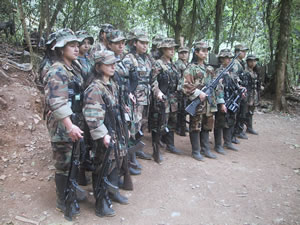
Even in Havana they get up early. “We get up at 4:30 to wake up the roosters so that they can start singing,” grins Ricardo Tellez, better known as “Rodrigo Granda.”I have an appointment at 7am to interview three members of the Secretariat, the highest authority of the FARC. They are at the forefront of the dialogues between the insurgent organization with the delegation of the Colombian government in Havana. In a great hall of a house in “El Laguito” (1), where they live, “Ivan Marquez” and “Pablo Catatumbo” arrive, too. Granda lights a cigarette and drinks his second cup of coffee. Marquez has a big Cuban cigar in his hand, which he`ll start “after breakfast”. Catatumbo is sipping coffee and says to me: “If the three of us are going to say almost the same, why would you interview me?”
It is the first time a journalist has the opportunity to talk to these three guerrilla leaders together.
Hernando Calvo Ospina: Commanders, you have been talking for seven months, negotiating with the government’s commission in this peace process. Are you still optimistic?
Ivan Marquez: The optimism of the FARC is determined by our willpower to find a political solution to this confrontation, which has lasted for almost fifty years. Because they haven´t been able to defeat us militarily, nor have we, we must seek an alternative. In addition, the circumstances, today’s realities, both in Colombia and on the continent, indicate that it is time to find a pacific solution. Wars are not eternal. And that´s why we make any necessary effort to come to an understanding with the government.
HCO: How does it feel to be so close to your enemy?
IM: In spite of sitting at the same table two groups with very different views, almost antagonistic, we have to tolerate and understand each other. At a negotiating table one should respect the other party, and I think that respect should be mutual. There are moments of algid, strong discussions, but soon things turn back to normal because we know that we must come to an understanding.
HCO: Negotiations in war move between two opponents. It seems to me that you put more emotion on it.
IM: You’re right. The government has always had a tendency to seek the subjugation of the guerrillas as a synonym for peace, not peace through structural changes. The oligarchy wants peace for free. We are making great efforts for them to understand that you need to generate an atmosphere for peace, and that it can be achieved through institutional and political transformations. We are sure that the most important thing for Colombia is to ensure real democracy, where the sovereign people can determine strategic policies, where the opinion of the people is taken into account without being stigmatized and murdered.
HCO: Maybe I’m wrong, but I think that at various times President Juan Manuel Santos has wanted to pull back.
Rodrigo Granda: I don´t think he wants to withdraw, but he does seem afraid. It’s as if he were afraid of former President Alvaro Uribe, of the cattle-breeders, of narco-paramilitary power and the obscure sector within the Armed Forces. Santos recoils despite having the support of a significant sector of industrialists, bankers and churches. For example, according to reports we have, Sarmiento Angulo (2), one of the most powerful men in Colombia, supports the dialogue process. Surveys say that 87% of Colombians also want peace. The correlation of forces in favor of peace is indisputable. Uribe aside, nobody speaks about war anymore. But it seems that Santos does not want to face those sectors led by Uribe, he wants to fight us militarily, and assumes intransigent positions that do not allow a correct development of the dialogues. We know that Uribe has prepared 13,000 paramilitaries, known unofficially as the “anti-land restitution army.” Is it that the Armed Forces and Santos don´t know about that? Of course they do! Is that what Santos is afraid of? Or is he taking it as part of a possible move against us?
HCO: Clearly Uribe tries to torpedo the negotiations. Do you think he wants to return to presidency?
RG: And he wants that to protect himself, because he’s afraid of being sent to Miami for drug trafficking, or to the International Criminal Court in The Hague for crimes against humanity. It would be favorable for him if the negotiations failed, so that he can appear before the country as the solution. Although he wasn´t able to resolve the “problem” of the guerrillas during the eight years he was in office. Pablo Catatumbo: Anyway, Santos and Uribe have the same idea about the negotiations: a peace process by submission. They are blind, deaf and quite wrong, but think they’re smart. And that is where we must continue with wisdom to prove that they are wrong, and that like this, the war will continue.
HCO: In statements you´ve made and documents I’ve read, you are asking for reforms in state institutions and the modernization of the State itself, which may be contradictory for a Marxist-Leninist communist guerrilla.
IM: At the table we are not proposing radical changes to the political or economic structures of the state. Over there, we don´t mention socialism or communism. We try to create conditions to reach an understanding with the government. A place where two different views can meet. We know that some leftist organizations, not only in Colombia, say that we became a reformist guerrilla.
We have made minimum proposals, for example the hundred proposals about the agrarian system, which as you´ve already said, are nothing more than a modernization of the Colombian countryside, but fact is that we are still living in feudalism there. Imagine that even this way, the government puts obstacles.
HCO: What has ever signed between the parties?
RG: We have signed some things, but they are not final signatures because nothing is agreed until everything is agreed. There are points on which we haven´t agreed yet, and we let them out to discuss them later on. Otherwise there won´t be any progress.
HCO: Dialogues in Havana, and strong military confrontations in Colombia …
RG: The government doesn’t want a ceasefire, so both parties have to dialogue under fire. We are having heavy confrontations every day, to an average of three per day. We have done large-scale military actions, which they hide to the nation. Now, both parties have decided that what happens in Colombia is not going to affect the Table.
We have made some gestures of peace, as was the unilateral truce for Christmas, although we had to defend ourselves against the attacks of the army. And what has been hidden is also in that same time span multinationals could increase their profits, they did not have our pressure. That’s why one of the major reasons for ending the guerrillas is that the transnationals can steal whatever they want without any problem.
HCO: So far, what has been the main government’s intransigence in negotiations?
IM: Without any doubt, the determination not to touch the property of the big land-owners, most of which has been obtained through violent dispossession. They`re afraid of that. Their representatives, when they talk to us, have said that that could “unleash the demons of paramilitarism.” They are afraid of cattle-breeders and landowners, to touch one third of the 30 million acres they own, although not even the cows occupy them.
But land reform without touching the big property isn’t reform. There must be set limits for land property. The government has not even thought about putting taxes as a punishment for unproductive land tenure. When we proposed taxing these big properties, the government responded that there is no reliable census; that nobody knows where they are or what their extension is. They suggest that first there should be a census, which can take up to 7 or 10 years. What they don’t say is that during this time the landowners can lease or sell the land to multinationals, which is their strategy.
HCO: If the Colombian government decided to negotiate with the FARC, it was because Washington agreed. You know that that is not an exaggeration of mine. What is the current political attitude?
IM: Recently, 62 U.S. congressmen, including two Republicans, led by Jim McGovern, signed a letter of support for the talks. This letter was sent to Secretary of State John Kerry. We welcomed this altruistic gesture. The White House and the State Department have also expressed their support. Of course, there are always different interests because the Colombian conflict produces money. The powerful arms industry doesn´t want to let loose of that business.
HCO: You are determined to stop the armed struggle. What should the government offer you for this to be achieved? And you, what would you become?
RG: President Santos, during the initial interchanges with us, said he wanted to open the floodgates to a real democracy in the country. That struck us because we have never said that the armed struggle is the only way to change the country. We got up in arms, and we still carry them, because violence has closed the doors to political participation. If the possibility of doing politics legally becomes real, without the constant threat of assassination, in equal conditions and with political reforms that could lead the country towards participatory democracy, we are there. Because there could be created a favorable correlation of forces for the revolutionary movement, which routs the necessary radical changes. We accept that challenge.
PC: You need to build a strong mass movement to impose changes, because the establishment doesn’t give away anything for free. That is a task for us, leftists and Democrats. It is important to create a power block of people who want a new Colombia. That is the challenge, and it´s not a small one.
But you see, as we talk about it at the conversation Table, the repression continues all around the country. The government hasn’t changed anything regarding the treatment of social protest: they are stigmatized, associated with the guerrillas to criminalize them and attack them with bullets. And if there is something we have very clear is that we are not willing to repeat the experience of the Patriotic Union, during which nearly 4000 members and leaders (3) were killed.
History, if it’s not manipulated, doesn´t lie: they have been the violent ones. When we remind the governmental team of these facts, they tell us that they are not here to talk about that. Why? What do they feel ashamed or afraid about? Without knowing the history of political violence in Colombia, how are we to know why we got to the current situation and how to resolve it?
IM: There are three items on the agenda to be discussed: guarantees to exercise political activity, political participation and bilateral and definitive ceasefire. The latter discusses the surrender of weapons and under what conditions. But let it be understood: that´s not handing over weapons. We cannot talk about these points until they are discussed in the table, and they will be the last ones on the agenda.
HCO: What will happen with the paramilitaries?
IM: They must definitively be eliminated; if not, there would be no certainty for an insurgent organization to incorporate into legal politics. That’s an insurmountable condition to reach a peace agreement. And it is the government who has to give the order to his generals to stop the state’s counterinsurgency strategy.
HCO: Are you determined to apologize for the suffering you have caused in this war?
PC: We have made mistakes, some serious, indeed. But whatever official propaganda says, aggression to the population has never been a strategy of the FARC. On the contrary, we have defended them against the army and its paramilitaries, mainly on the countryside.
I have no problem in saying to a woman or a family: “I feel sorry about the pain we have caused with the death of your loved one.” But this is much more complex. Are we going to apologize? Very well. Let´s also invite the economic associations that financed the war and paramilitaries; let´s invite all State institutions, because they guarantee repression and impunity; let´s invite the mass media, too, because they reproduced the stigmatization made by security agencies, which have led to the murders and massacres; the rightist political parties should also sit down and assume their great responsibilities; the former presidents of the republic who gave the orders. Not even the Catholic Church can deny its responsibility! And the governments of the United States, Israel, some European countries and others that have supported various criminal governments of Colombia cannot be left outside of this ceremony. All together, we can decide who the terrorists and murderers of the people are.
HCO: You point out, and rightly so, that the government, its armed forces and the mass media are responsible for psychological warfare and propaganda against the insurgency. But I think an important sector of the so-called intelligentsia have savaged the armed struggle they supported before.
PC: Most intellectuals in Colombia, and probably in the world, are suffering from cowardice, accommodations or both things. Almost all were put by the system in the matrix of lies, and are used to “theorize”, create and repeat falsehoods. Many of them spend time writing discourses against media manipulation, but when the system starts a campaign against someone or somebody, they start talking like parrots.
In Colombia, the system told them that the guerrillas are guilty of everything. Although many of them believed, or believe, they are from the left, they repeated in unison that we are responsible for violence, drug trafficking, kidnapping, poverty, rising gasoline and even the high price of the bananas. I assure you that if tomorrow the birds stop singing, these “intellectuals” repeat what the government and their media say: the guerrillas are to be blamed. They have fallen into such poverty regarding research and argumentation, that their analyses and theories don’t endure any discussion, at least with us. They think that if they discuss with us, we´ll kill them afterwards. They are not even capable of realizing that if that was true, in Colombia there would be very few “intellectuals” left right now. Their brain doesn’t have the capacity to see that those who safeguard their intellectual and political independence are those who are said by the government to be friends or accomplices of the subversion.
HCO: I must admit, and I´m about to end, that I’m not very optimistic about these dialogues. I believe that Colombia and Colombians deserve peace with social justice, but I know the Colombian State, I know the United States, who support that State and who ultimately decides. Hopefully the long night, imposed by State terrorism stops and finally dawns. I wish it with all my heart.
PC: Look, political conditions in Latin America have changed. Who could have imagined what happened in Venezuela and Bolivia with the arrival of Chávez and Evo? Who would have thought that other Latin American governments one day would demand respect for their sovereignty from the U.S.? There are unpredictable things, like the end of the Soviet Union for example.
In Colombia there is an accumulation of hunger, exclusion, injustice and repression. The time will come when people simply won´t take it anymore. There is an accumulation of ongoing processes that can make a leap any time. There is a boiling that could explode tomorrow.
Besides, Colombia is not an island. The neighboring countries are pressing the government because they are tired of the conflict that affects them. Venezuela received about 4 million displaced Colombians, Ecuador almost two million. We believe there are 13 to 15 million Colombians in neighboring countries, that is, the third part of the Colombian population. And these countries must provide housing, food and health. For how long? Apart from the budget they spend to protect their borders. Just because the Colombian government insists on not negotiating a conflict they will never win! We have asked the representatives of those nations to demand for peace, so that all our compatriots can return to their country.
We are optimistic. Revolutionaries must be optimistic, even in the worst situations. And we believe that peace will come to Colombia because we deserve it. The other possibility is total war. That´s why I say the moment has come, but that doesn’t mean it´s easy. This peace process is too complex, but we believe it is possible. We insist on striving for peace, so we will not fold our arms.
I do have hope, although I think the authorities and the Colombian oligarchy lack greatness and humility to start solving this conflict.
Hernando Calvo Ospina is a Colombian journalist. He can be reached through his website.
NOTES:
1. “El Laguito” is a residential complex in Havana. Their houses are separated by trees and gardens. In the center is a small lake. Since November 2012, the delegations of the FARC and the Colombian government are located in this peaceful scenery.
2. According to the magazine Forbes (edition 2012). Luis Carlos Sarmiento Angulo listed as the first billionaire in Colombia, and would rank 64 in the world.
3. The Patriotic Union was born in 1985, as a result of the talks between the government of Belisario Betancur and the FARC. According to the Colombian justice, there was a “political genocide” against the Patriotic Union.
Translation: http://en.firatnews.com/news/news/g…
Featured Video

Panama Ransacked in 1989
or go to
Aletho News Archives – Video-Images
From the Archives
Left-leaning despisers of 9/11 Truth movement: Do you really believe in miracles?
David Ray Griffin | Global Research | 06 Jul 2010
An Open Letter to Terry Allen, Noam Chomsky, Alexander Cockburn, David Corn, Chris Hayes, George Monbiot, Matthew Rothschild, and Matt Taibbi.
[1]According to several left-leaning critics of the 9/11 Truth Movement, some of its central claims, especially about the destruction of the World Trade Center, show its members to be scientifically challenged. In the opinion of some of these critics, moreover, claims made by members of this movement are sometimes unscientific in the strongest possible sense, implying an acceptance of magic and miracles. … Full article
Blog Roll
 Aletho News
- British Government Employees Were Fact-Checking the News at the BBC. Nobody Told You.
- Albania on fire: who’s behind the riots?
- Egypt’s Civil Democratic Movement rejects involvement in regional war
- Egypt collaborates with Israel to build ‘Green Rafah’ project over erased Palestinian city
- Rising fuel prices and shortages have helped drive ongoing protests and rioting in France
- Tokyo protests demand Takaichi’s resignation over support for ‘Israel’
- Jennifer Kavanagh: Why the U.S. Should Pull Back From the First Island Chain
- Yemen denounces international community’s silence on Saudi aggression, siege
- UAE and Saudi Arabia move toward renewed coordination against Sanaa
- How Iran’s two-week retaliatory strikes exposed cracks in US military architecture in Persian Gulf
- If Americans Knew
- More on how Bari Weiss is using CBS on behalf of Israel
- What the UK Is Doing to Pro-Palestine Novelist Sally Rooney Is an Act of Orwellian Villainy
- ‘We will build palaces for Jews in Gaza’: Right-wing activists establish new outpost near border
- ‘You see us burning, you stay silent’: Family’s agony over mother and sons burned to death in Gaza tent
- Israel keeps Palestinian journalist Bushra al-Tawil in isolation for 46 days
- US-Israel integration plan puts US military tech in Israel’s hands
- Israeli Strike Burns Gaza Mother Alive in Front of Toddler, ‘Without Generating Any Headlines’
- ‘The Israel Experience with Mike Huckabee’: The Ambassador’s Family Sells Trips to Israel
- As Gazans carry out mass burial, food insecurity is getting worse – Daily Update
- Israeli rabbi permits occupiers to steal Palestinian olive harvest in West Bank
- No Tricks Zone
- Predictions Made By Renowned Climate Proifessor Over Past Decades Have Been Proven To Be Poor
- New Study Suggests Large Regions Of The Pacific Ocean Have Been Cooling For The Last 80 Years
- Germany’s Green Energy Debacle: High Energy Costs Force Kahla Porzellan to Close After 182 Years!
- New Study: 50 Years Of The Most Aggressive ‘Net Zero’ Policies Can Only Affect The Global Climate By 0.03°C
- US September “Heat” Was No Record…Many Records Set Decades Ago
- Latest European Green Energy Debacle; Portugal’s Largest Flagship Solar Park Insolvent!
- Green Energy Debacle: German Expert Professor Fritz Vahrenholt Warns Of Severe Economic And Social Consequences
- Two More Paleo Reconstructions Affirm Meters-Higher Sea Levels Across Ireland, Brazil 7000-6000 Years Ago
- New Study: Earth And Venus Surface Warmth Largely Explained By Convection And Lapse Rate, Not CO2 Or Radiation
- 2025 Nature Paper Claiming Worsening Global Drought Gets RETRACTED …Heavily Flawed

