‘US is Utterly Dishonest’: Why Tehran Won’t Accept Partial Removal of Sanctions by Washington
By Ekaterina Blunova | Sputnik | December 16, 2021
Partial removal of sanctions by the US is not enough to facilitate the revival of the Iranian economy, hurt by the Trump administration’s “maximum pressure” policies, say Iran affairs experts, adding that under the new government Tehran is set to protect the country’s national interests more determinedly.
The United States signalled on 14 December that it is fully prepared to lift those sanctions against Iran that are inconsistent with Washington commitments under the 2015 Joint Comprehensive Plan of Action (JCPOA). That “would allow Iran to receive the economic benefits of the deal,” remarked Linda Thomas-Greenfield, US ambassador to the United Nations, during a UN Security meeting.
For his part, Iran’s Permanent Representative to the United Nations Majid Takht Ravanchi stressed that Washington should lift all sanctions slapped on Tehran and provide guarantees that it would not withdraw from the accords again and it would not abuse the procedures set out in the JCPOA and Resolution 2231.
‘All Anti-Iran Sanctions Have to be Lifted’
“The United States is being utterly dishonest,” says Seyed Mohammad Marandi, a professor at Tehran University, who was part of the Iranian delegation that helped to negotiate the 2015 nuclear deal. “All the sanctions are inconsistent with the 2015 nuclear deal. The maximum pressure campaign was targeting innocent women and children. It was an act of war and the objective was to force Iran to accept changes to the nuclear deal.”
The Trump administration unilaterally withdrew from the JCPOA in May 2018 despite Tehran observing all the provisions of the nuclear accords. Subsequently, the US slapped sanctions on major spheres of the Iranian economy, including the country’s petroleum industry, under the so-called “maximum pressure” campaign.
“Through the maximum pressure campaign, the United States imposed sanctions under all sorts of different names: missile defence, terrorism, Iran’s regional allies, the nuclear programme, human rights and everything except global warming was included, when all of these sanctions had one objective, and that was to force Iran to appease the United States and the Europeans,” Marandi emphasises.
Although the White House changed the rhetoric, in reality, it is trying to cheat Iran and violate its commitments by lifting only those sanctions that were labelled under the nuclear programme, according to the academic.
Moreover, while “the US has a range of sanctions on Iran and President Biden has not removed any since coming to office,” notes Professor Shahram Akbarzadeh from Deakin University in Melbourne, Australia.
Even though the partial removal of sanctions sounds like a positive sign, it will not make a big difference to Iran’s access to the global economy, according to Akbarzadeh. He explains that “many international corporations will continue to be reluctant to invest in Iran because of the extreme uncertainty surrounding the future of talks and the prospects of Iran’s entry into the international market.”
“The Iranian leadership is unlikely to see partial sanctions removal as enough to assuage their concerns,” Akbarzadeh believes. “It insists on an unconditional return to that deal, and Washington has been reluctant to ‘give-in’ to that demand.”
According to the professor, this dynamic may hinder the progress of the Vienna talks over the revival of the JCPOA.
Ebrahim Raisi gives a news conference after voting in the presidential election, at a polling station in the capital Tehran, on June 18, 2021. – Raisi on June 19 declared the winner of a presidential election, a widely anticipated result after many political heavyweights were barred from running. – Sputnik International, 1920, 21.06.2021
‘US is Not in Strong Position in Vienna Talks’
While the US is not present at the table in Vienna, American diplomats are taking part in indirect talks with their Iranian counterparts. Washington does not have an upper hand in the ongoing talks, according to Seyed Mohammad Marandi:
“The Iranians see that the United States has huge problems at home,” he notes. “Political, social and economic problems are causing major issues inside the United States. The United States is increasingly losing ground to a rising China and the re-emerging Russia, and Iran and its allies across the region are growing stronger and American allies are growing weaker.”
In response to Trump’s unilateral withdrawal from the nuclear deal, the Islamic Republic started to gradually loosen the JCPOA restrictions on uranium enrichment starting from July 2019. “The Iranian peaceful nuclear programme is developing and it’s a leverage [in the talks],” according to the professor.
It’s the Americans who need the deal right now and the Iranians know that, Marandi notes, adding that Tehran will see “if the Americans will become reasonable enough to do what is good for themselves.”
At the same time, Washington and its European allies have apparently overlooked the damage their policies inflicted on the Iranian economy and the country’s population, the professor highlights, adding that “the issue of compensation is always on the table.”
The new Iranian government led by President Ebrahim Raisi has adopted a more robust approach in protecting Iranian national interests, according to Marandi. Even though the new Iranian government is critical of the JCPOA deal, it will not tear it apart, unlike the US government, but will observe its commitments. At the same time, Tehran will demand “that what has been signed, the JCPOA, be fully respected by the United States and the Europeans,” the professor underscored.
The Vienna negotiations between Iran and other signatories to the 2015 deal, including the UK, France, Germany, Russia, and China resumed in December after a five-month hiatus caused by the election of a new government in Tehran.
At the beginning of this month, the White House voiced its dissatisfaction with proposals by the new Iranian government. According to European diplomats, Tehran has demanded changes to a set of compromises agreed upon a few months ago with the previous Iranian administration. The E3 group of Britain, France and Germany went so far as to accuse the Iranian leadership of “walking back almost all of the difficult compromises crafted after many months of hard work.”
Iran’s chief negotiator Ali Bagheri Kani tweeted on 14 December that the E3 and Washington “persist in their blame game habit, instead of real diplomacy”: “We proposed our ideas early, and worked constructively and flexibly to narrow gaps; diplomacy is a two-way street. If there’s a real will to remedy the culprit’s wrongdoing, the way for a quick good deal will be paved.”
For his part, Iran’s Permanent Representative to the UN Majid Takht Ravanchi told a UN Security Council meeting on Tuesday that Iran does not impose any preconditions or new conditions in the negotiations to revive the JCPOA and only wishes to see the restoration of the initial terms of the nuclear accord.
“We call for the full, timely, unconditional and verifiable implementation of the JCPOA. No more, no less,” Ravanchi underscored.
Iran says has still not received any initiative from other side in Vienna talks
By Homa Lezgee – Press TV – December 13, 2021
Vienna – Iran’s lead negotiator at the Vienna talks aimed at reviving the Joint Comprehensive Plan of Action, the JCPOA, says his team has not yet received any proposal or initiative from the other side to help resolve the outstanding issues.
In the past days questions have arisen about the drafts being discussed and whether the Iranian team’s amendments and proposals, offered in the form of two written drafts at the beginning of the seventh round, are still on the table.
Iran says it will only go back to full compliance after the full and verifiable removal of US sanctions and while some sources say the Iranian demands are stalling progress, others like Russia’s lead delegate maintain that the atmosphere is positive amid intensive dialogue.
On Sunday, a third Working Group focusing on the sequencing of compliance by all parties was held for the first time during the seventh round of the talks. That was followed by a trilateral meeting between Iran, Russia and China. There’s still no official word on the duration of the current round of negotiations.
US and Iran are getting ever closer to war. Washington has only itself to blame
By Scott Ritter | RT | November 9, 2021
A tense US-Iranian naval standoff appears to be related to the US enforcement of unilateral oil sanctions targeting Iran. Iran’s response suggests that Tehran may not be willing to play this game for much longer.
Amid growing tensions in the region, the United States and Iran carried out tit-for-tat naval exercises in the Persian Gulf designed to send a signal to the other – mess around at your own risk. The US exercises comprising six coastal patrol boats, supported by an expeditionary mobile base platform ship and a guided-missile destroyer, involved live fire exercises using surface-to-surface missiles. Iran followed this display of US military prowess with a demonstration of its own in the form of the annual Zolfaqar military exercise, which included live-fire drills involving anti-ship missiles, drone swarms, and submarine-launched torpedoes.
The dueling drills come nearly two weeks after a confrontation in international waters between the Iranian Revolutionary Guard and the US Navy. While the specific circumstances surrounding this confrontation remain unclear, with both Iran and the US providing competing narratives, one thing is for certain – on October 24, 2021, Iranian and US naval forces faced off in a tense environment, loaded weapons pointed at one another, while Iranian forces boarded and took control of a Vietnamese-flagged oil tanker, which was then sailed into Iranian territorial waters, ending the face-off.
The Iranians claim that the US was engaged in an act of “piracy,” trying to seize a shipment of Iranian oil that was loaded onto the MV Southys, owned by the Hanoi-based OPEC Petroleum Transport Company. Iran was compelled to board the vessel, using helicopter-borne commandos, and then sail the ship and its 26-person crew to the Persian Gulf port city of Bandar Abbas. The US denies the Iranian accusations, instead claiming that US Navy vessels in the region responded to reports of a ship in distress and were simply monitoring the situation.
History suggests that the Iranian version of events is closer to the truth. The US has a reputation for seizing Iranian petroleum shipments on the high seas, part of what it claims to be the lawful enforcement of US sanctions targeting Iran (it should be noted that the sanctions in question are unilateral in nature, and have no enforceable status under international law.) In August 2020, the US seized four Liberian-flagged vessels (the M/T Bella, M/T Bering, M/T Pandi and M/T Luna) carrying approximately 1.116 million barrels of fuel. No military force was used by the US in the seizure of the cargo. Instead, the US worked with the assistance of foreign partners to threaten ship owners, insurers, and captains with sanctions to force them to surrender their cargo to US control. In the case of the four Liberian-flagged tankers, the ships sailed to the US port of Houston, where their cargo was offloaded.
On the same day that the US affected the seizure of the four Liberian-flagged tankers, the Iranian Revolutionary Guard Corps boarded another Liberian-flagged tanker, the M/T Wila, off the coast of the United Arab Emirates, using tactics which mirrored those that had been used against the MV Southys – a special forces team was inserted onto the deck of the tanker using a helicopter, while Iranian patrol boats circled nearby. After five hours, the Iranians departed the ship. The US confirmed that the Iranian seizure of the M/T Wila was related to the US seizure of the four tankers. “They [the Iranians] were looking for their gas,”a US spokesperson noted.
According to Iranian sources, the boarding of the MV Southys was related to the August 2020 seizure of the four tankers carrying Iranian oil. An analysis of the events leading up to the seizure of the MV Southys by Iranian forces suggests that this indeed may be the case. According to an anti-Iranian advocacy group, United Against Nuclear Iran (UANI), satellite imagery from June 2021 shows the MV Southys engaged in what is known as ‘ship-to-ship’ transfer of oil from an Iranian tanker, the Oman Pride. In August 2021 the US Treasury Department named the Oman Pride as an asset of the Iranian Revolutionary Guards Corps Quds Force, which was part of a larger scheme to raise funds for the Quds Force by selling Iranian oil in violation of sanctions. According to UANI, most of this oil ends up being sold to China.
According to the Tankers Trackers website (affiliated with UANI), the MV Southys was supposed to make a delivery of some 700,000 barrels of crude oil to a Chinese port. For some reason, the shipment was rejected, and the MV Southys headed back to the port of Sohar, Oman. The timing of the rejection of the MV Southys’ cargo coincides with a letter sent by UANI to the Vietnam Maritime Administration, which detailed its analysis of satellite photos it claimed showed the MV Southys received a ship-to-ship transfer of oil from the Oman Pride. Given the high-profile composition of the leadership of UANI, which includes many former US government officials and heads of foreign intelligence services, it is likely that this letter was sent in conjunction with outreach by UANI to the US government, which in turn could have put the Vietnamese government on notice that it could be subjected to sanctions for doing business with the Iranian Revolutionary Guard Corps. If this scenario is accurate, the Vietnamese government could have ordered the MV Southys not to offload its cargo, leaving it no choice but to return to the Persian Gulf.
When the MV Southys approached Iranian waters, it was shadowed by a US guided-missile destroyer, the USS Sullivans. Perhaps fearing that the US would seek to take control of the MV Southys and its contents, and uncertain as to the loyalty of the vessel’s captain, the Iranians opted to take control of the tanker and divert it to Bandar Abbas, where its contents could be offloaded. By taking control of the MV Southys in this manner, Iran also avoided the logistical difficulties of attempting a ship-to-ship transfer of oil to an Iranian tanker while under the watchful eyes of the US Navy.
The truth about what transpired with the MV Southys will undoubtedly emerge in the weeks to come. What is certain, however, is that the Iranians have long classified US sanctions against them as violations of international law, and US efforts to seize Iranian oil shipments acts of piracy. The seizure of the MV Southys by Iranian forces, and the aggressive way the US Navy was confronted by Iranian patrol boats, suggests that Iran is determined to forcefully confront any future attempts by the US to enforce its unilateral sanctions. One of the major roadblocks to restarting the Iran nuclear deal, also known as the Joint Comprehensive Plan of Action (JCPOA), is the issue of the US ending its sanctions regime against Iran. If anything, the delay in restarting the JCPOA has shown that there is a military risk attached to the political, and that any continued delay in the negotiations could result in war.
Scott Ritter is a former US Marine Corps intelligence officer and author of ‘SCORPION KING: America’s Suicidal Embrace of Nuclear Weapons from FDR to Trump.’
Drone attack on Iraqi PM ‘must be traced back to foreign think tanks’ – Iran
RT | November 7, 2021
The alleged assassination attempt of Iraqi Prime Minister Mustafa al-Kadhimi was orchestrated by a foreign power seeking to destabilize the country, a senior Iranian security official said.
The apparent attempted assassination of the Iraqi prime minister was “a new sedition that must be traced back to foreign think tanks,” according to Ali Shamkhani, the secretary of the Supreme National Security Council of Iran.
In the past, foreign instigators “have brought nothing but insecurity, discord & instability to oppressed Iraqi people through creation & support of terrorist groups & occupation of this country,” he tweeted.
Al-Kadhimi’s residence in Baghdad’s heavily fortified Green Zone was reportedly targeted by a drone rigged with explosives. The official said he was not hurt in the incident.
The reported attack occurred in the aftermath of protests in the Iraqi capital over the outcome of last month’s parliamentary election, which pro-Iranian Shia parties claim was rigged. Demonstrations were mired by violent clashes with police, which resulted in multiple injuries on both sides and allegedly a handful of deaths among the protesters.
Earlier on Sunday, Mahmoud al-Rubaie, a spokesman for the Shia political coalition al-Sadiqoun Bloc, suggested that the attack on the prime minister’s home was fabricated, saying the US air defenses in the Green Zone would have intercepted any incoming drones. The incident is a plot to distract the public, al-Rubaie said.
Nuclear States Unwilling to Live up to Disarmament Commitments: Iran Envoy
Al-Manar – October 29, 2021
Iran’s permanent Ambassador to the United Nations Majid Takht-Ravanchi slammed the states and regimes who hold nuclear weapons while seek justifications for not abiding by their commitments.
Takht-Ravanchi made the comments after the UN Disarmament and International Security (First Committee) approved the resolution presented by Iran on Thursday, according to IRIB.
“Unfortunately, nuclear weapons holders are unwilling to live up to their nuclear disarmament commitments and only try to justify that the necessary ground is not ready for nuclear disarmament,” the Iranian envoy said, as quoted by Mehr news agency.
He said that their justification cannot be bought and added, “They committed themselves to nuclear disarmament in 1970, and this is not justifiable.”
The Islamic Republic of Iran proposed a resolution the follow-up on the implementation of the agreements reached at the NPT Review Conferences of 1995, 2000 and 2010″, and was adopted with the support of a majority of the members of the UN Disarmament and International Security (First Committee).
In part of the resolution proposed by Iran, the implementation of the decision of the NPT Review Conference in 1995 to establish a nuclear-weapon-free Middle East is emphasized. The decision calls on Israeli regime to join the NPT and accept the International Atomic Energy Agency’s monitoring of its nuclear facilities.
US continues to defy International Court of Justice’s orders in cases filed by Iran
Press TV – October 28, 2021
Iran’s permanent ambassador to the United Nations says the US administration continues to disregard orders issued by the International Court of Justice (ICJ), which have been handed down in cases filed by Iran against US and vice versa.
Majid Takht-Ravanchi made the remarks in an address to the UN General Assembly on Thursday, emphasizing that Iran acknowledges “the vital role of the ICJ in the prevention of hostilities and mitigation of crises through peaceful settlement of disputes as well as in strengthening the rule of law, preserving international order and tackling unilateral measures.”
“Due to adoption of a number of legislative and executive acts in the United States in flagrant violation of international law, the immunity of states and their properties from suit before US courts as well as immunity from jurisdiction and enforcement have been removed against Iran,” he added.
Takht-Ravanchi noted that as a result of the filing of cases in the US courts against Iran as well as its officials and the Central Bank (CBI), “the assets of the CBI have been subjected to execution in order to satisfy a default judgment.”
“The Islamic Republic of Iran believes that such asset blocking and enforcement proceedings against the CBI and certain Iranian companies and banks in the US is in violation of provisions of ‘Treaty of Amity, Economic Relations, and Consular Rights of 1955’ between the two countries,” Iran’s UN envoy said.
Takht-Ravanchi said following the unilateral withdrawal of the US from the 2015 Iran nuclear deal and the unlawful re-imposition of sanctions against Tehran, Iran filed an application instituting proceedings against the US with regard to violations of multiple provisions of the Treaty of Amity.
He said on October 3, 2018, the ICJ issued an order unanimously requiring the US to remove any impediments on the importation of foodstuffs as well as medicines and medical devices to Iran and also ordered Washington to ensure that the licenses and necessary authorizations are granted and that payments and other transfers of funds are not subject to any restriction in so far as they relate to the aforementioned goods and services.
“Regrettably, the United States has not only failed to comply with the Court’s Order but, by imposing new sanctions, especially during the outbreak of the COVID-19 pandemic, has also deliberately defied that Order,” Takht-Ravanchi said.
Iran, he noted, has on several occasions brought the US non-compliance with the Order to the Court’s attention and the answer provided by the US in this regard has always been a repetition of its previous contentions; that humanitarian transactions are exempt from its sanctions.
However, Takht-Ravanchi added, “through tightening the grip of sanctions after the Court’s Order, the US … violated this Order which requires that ‘Both parties shall refrain from any action which might aggravate or extend the dispute before the Court or make it more difficult to resolve’.”
Tehran has on multiple occasions called on the United Nations court to order the immediate lifting of the sanctions, and demanded compensation for damages incurred in their wake.
Sanctions had been lifted under the 2015 nuclear agreement between Iran and world powers- the US, Germany, France, Britain, China and Russia.
Former President Donald Trump unilaterally pulled the US out of the deal with Iran in May 2018 and reimposed draconian sanctions as part of the so-called maximum pressure campaign against the country.
Earlier this year, the ICJ ruled that it can take on Iran’s bid to overturn illegal US sanctions re-imposed by Trump after he pulled Washington out of the nuclear deal.
The United States had tried to argue that Iran could not base claims at the ICJ on the 1955 Treaty of Amity, Economic Relations, and Consular Rights between the two countries. However, a majority of a panel of 16 judges found the treaty could be used as a basis for the ICJ’s jurisdiction.
The new US administration said it is “disappointed” by the ruling, despite President Joe Biden’s criticism of his predecessor for reinstating the bans on the Islamic Republic after leaving the landmark accord.
Israel to Attack Iran? Washington Gives the Green Light to the ‘Military Option’
By Philip Giraldi | Strategic Culture Foundation | October 28, 2021
Some might recall candidate Joe Biden’s pledge to work to rejoin the Joint Comprehensive Plan of Action (JCPOA) which was a multilateral agreement intended to limit Iran’s ability to develop a nuclear weapon. The JCPOA was signed by President Barack Obama in 2015, when Biden was Vice President, and was considered one of the only foreign policy successes of his eight years in office. Other signatories to it were Britain, China, Germany, France, and Russia and it was endorsed by the United Nations. The agreement included unannounced inspections of Iranian nuclear facilities by the IAEA and, by all accounts, it was working and was a non-proliferation success story. In return for its cooperation Iran was to receive its considerable assets frozen in banks in the United States and was also to be relieved of the sanctions that had been placed on it by Washington and other governments.
The JCPOA crashed and burned in 2018 when President Donald Trump ordered U.S. withdrawal from the agreement, claiming that Iran was cheating and would surely move to develop a nuclear weapon as soon as the first phase of the agreement was completed. Trump, whose ignorance on Iran and other international issues was profound, had surrounded himself with a totally Zionist foreign policy team, including members of his own family, and had bought fully into the arguments being made by Israel as well as by Israel Lobby predominantly Jewish groups to include the Foundation for Defense of Democracies (FDD) and the American Israel Public Affairs Committee (AIPAC). Trump’s time in office was spent pandering to Israel in every conceivable way, to include recognizing Jerusalem as the country’s capital, granting Israel the green light for creating and expanding illegal settlements on the West Bank and recognizing the occupied Syrian Golan Heights as part of Israel.
Given Trump’s record, most particularly the senseless and against-American-interests abandonment of JCPOA, it almost seemed a breath of fresh air to hear Biden’s fractured English as he committed his administration to doing what he could to rejoin the other countries who were still trying to make the agreement work. After Biden was actually elected, more or less, he and his Secretary of State Tony Blinken clarified what the U.S. would seek to do to “fix” the agreement by making it stronger in some key areas that had not been part of the original document.
Iran for its part insisted that the agreement did not need any additional caveats and should be a return to the status quo ante, particularly when Blinken and his team made clear that they were thinking of a ban on Iranian ballistic missile development as well as negotiations to end Tehran’s alleged “interference” in the politics of the region. The interference presumably referred to Iranian support of the Palestinians as well as its role in Syria and Yemen, all of which had earned the hostility of American “friends” Israel and Saudi Arabia.
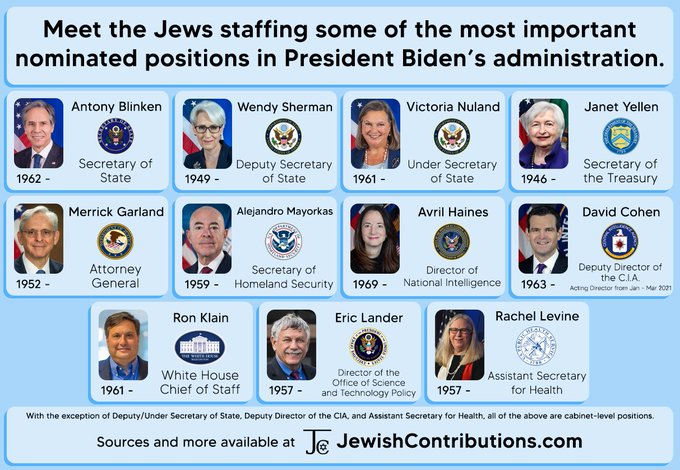 Israel inevitably stirred the pot by sending a stream of senior officials, to include Foreign Minister Yair Lapid, Defense Minister Benny Gantz and Prime Minister Naftali Bennett to discuss “the Iranian threat” with Biden and his top officials. Lapid made clear that Israel “reserves the right to act at any given moment, in any way… We know there are moments when nations must use force to protect the world from evil.” And to be sure, Biden, like Trump, has also made his true sentiments clear by surrounding himself with Zionists. Blinken, Wendy Sherman and Victoria Nuland have filled the three top slots at State Department, all are Jewish and all strong on Israel. Nuland is a leading neocon. And pending is the appointment of Barbara Leaf, who has been nominated Assistant Secretary to head the State Department’s Near East region. She is currently the Ruth and Sid Lapidus Fellow at the Washington Institute for Near East Policy (WINEP), which is an AIPAC spin off and a major component in the Israel Lobby. That means that a member in good standing of the Israel Lobby would serve as the State Department official overseeing American policy in the Middle East.
At the Pentagon one finds a malleable General Mark Milley, always happy to meet his Israeli counterparts, and Secretary of Defense Lloyd Austin, an affirmative action promotion who likewise has become adept at parroting the line “Israel has a right to defend itself.” And need one mention ardent self-declared Zionists at the top level of the Democratic Party, to include Biden himself, Speaker of the House Nancy Pelosi, House Majority Leader Steny Hoyer and, of course, Senate Majority Leader Chuck Schumer?
So rejoining the JCPOA over Israel objections was a non-starter from the beginning and was probably only mooted to make Trump look bad. Indirect talks including both Iran and the U.S. technically have continued in Vienna, though they have been stalled since the end of June. Trita Parsi has recently learned that Iran sought to make a breakthrough for an agreement by seeking a White House commitment to stick with the plan as long as Biden remains in office. Biden and Blinken refused and Blinken has recently confirmed that a new deal is unlikely, saying “time is running out.”
And there have been some other new developments. Israeli officials have been warning for over twenty years that Iran is only one year away from having its own nukes and needs to be stopped, a claim that has begun to sound like a religious mantra repeated over and over, but now they are actually funding the armaments that will be needed to do the job. Israel Defense Force Chief of Staff Aviv Kohavi has repeatedly said the IDF is “accelerating” plans to strike Iran, and Israeli politicians to include former Prime Minister Benjamin Netanyahu have regularly been threatening to do whatever must be done to deal with the threat from the Islamic Republic. Israeli media is reporting that $1.5 billion has been allocated in the current and upcoming budget to buy the American bunker buster bombs that will be needed to destroy the Iranian reactor at Bushehr and its underground research facilities at Natanz.
In the wake of the news about the war funding, there have also been reports that the Israeli Air Force is engaging in what is being described as “intense” drills to simulate attacking Iranian nuclear facilities. After Israel obtains the 5000 pound bunker buster bombs, it will also need to procure bombers to drop the ordnance, and one suspects that the U.S. Congress will somehow come up with the necessary “military aid” to make that happen. Tony Blinken has also made clear that the Administration knows what Israel is planning and approves. He met with Israeli Foreign Minister Yair Lapid on October 13th and said if diplomacy with Iran fails, the U.S. will turn to “other options.” And yes, he followed that up with the venerable line that “Israel has the right to defend itself and we strongly support that proposition.”
Lapid confirmed that one of Blinken’s “options” was military action. “I would like to start by repeating what the Secretary of State just said. Yes, other options are going to be on the table if diplomacy fails. And by saying other options, I think everybody understands here … what is it that we mean.” It must be observed that in their discussion of Iran’s nuclear program, Lapid and Blinnken were endorsing an illegal and unprovoked attack to prevent Iran from acquiring a nuclear weapon that it is apparently not seeking, but which it will surely turn to as a consequence if only to defend itself in the future.
In short, U.S. foreign policy is yet again being held hostage by Israel. The White House position is clearly and absurdly that an Israeli attack on Iran, considered a war crime by most, is an act of self-defense. However it turns out, the U.S. will be seen as endorsing the crime and will inevitably be implicated in it, undoubtedly resulting in yet another foreign policy disaster in the Middle East with nothing but grief for the American people. The simple truth is that Iran has neither threatened nor attacked Israel. Given that, there is nothing defensive about the actions Israel has already taken in sabotaging Iranian facilities and assassinating scientists, and there would be nothing defensive about direct military attacks either with or without U.S. assistance on Iranian soil. If Israel chooses to play the fool it is on them and their leaders. The United States does not have a horse in this race and should butt out, but one doubts if a White House and Congress, firmly controlled by Zionist forces, have either the wisdom or the courage to cut the tie that binds with the Jewish state.
Iran writes to UNSC, warns against any Israeli ‘adventurism’ amid rise in threats
Press TV – October 14, 2021
Iran has written to the United Nations Security Council over a sharp increase in Israeli threats against the country, warning against any “miscalculation” or “military adventurism” on the part of the regime against the Islamic Republic, including its nuclear program.
In a letter submitter to the current president of the Security Council on Wednesday, Iran’s Ambassador to the United Nations Majid Takht-Ravanchi warned that the frequency and severity of the regime’s provocative and adventurous threats had steadily increased over the past months and reached an alarming level.
Such blatant systematic threats against one of the founding members of the United Nations are a gross violation of international law, in particular Article 2 (4) of the United Nations Charter, he added.
As a case in point, the diplomat referred the recent comments by the Israeli military chief, Aviv Kochavi, who said earlier this month that the regime was in constant preparations for an attack on the Iranian nuclear program.
Kochav had said, “The operational plans against Iran’s nuclear program will continue to evolve and improve,” and that “operations to destroy Iranian capabilities will continue, in any arena and at any time.”
The fact that the Tel Aviv regime continues to try to “destroy Iran’s capabilities” proves without any doubt that it had been responsible for terrorist attacks against Iran’s peaceful nuclear program in the past, Takht-Ravanchi said.
Given the ominous history of the Israeli regime’s destabilizing practices in the region and its covert operations against Iran’s nuclear program, it is necessary to counter the regime and stop all its threats and disruptive behavior, the top diplomat added.
Israel prevents realization of nuke-free Middle East: Iran
Meanwhile, Iran’s Representative to the UN General Assembly First Committee Heidar Ali Balouji also said at a Wednesday session on “Nuclear Weapons, Other WMDs, Outer Space, and Conventional Weapons” that the Israeli regime is the main hurdle to a Middle East free of nuclear weapons.
“We reiterate our call on the international community to compel Israel to dismantle its nuclear arsenal, promptly accede to the NPT as a non-nuclear-weapon party without any preconditions and place all of its nuclear facilities under the IAEA’s full-scope safeguards,” he said.
He described the Islamic Republic as one of the countries “with the highest record in accession to the international instruments banning” weapons of mass destruction (WMDs).
“Achieving global nuclear disarmament remains one of the most long-lasting goals of the United Nations. Today, international security is under threat by the existence of almost 14,000 nuclear weapons with well-funded, long-term plans to not only modernize but also strengthen the arsenals of NWSs (nuclear weapons states) and so nuclear arms race,” he said.
He said the United States’ withdrawal from the Intermediate-Range Nuclear Forces Treaty and its unwillingness to return to the Joint Comprehensive Plan of Action — the 2015 nuclear agreement signed between Iran and major world powers — have inflicted immense damage on international disarmament measures.
The diplomat said chemical weapons remain a grave concern, with the United States as the only possessor, urging Washington to meet a 2012 deadline for the destruction of its stockpile of such weapons.
Balouji said the ratification of a legally binding protocol would be the most effective way to strengthen the Biological Weapons Convention, urging the United States to withdraw its objection to the adoption of such a measure.
Similarly, a legally binding instrument is required to prevent an arms race in outer space, he said, saying the United States already has a space force with a $17 billion budget, which will increase by 13 percent, he noted.
Iran believes that the arms race in space should be stopped through a binding legal document, he emphasized.
The Iranian diplomat defended countries’ right to possess conventional weapons, warning that massive and irresponsible production and transfer of such weapons in the Middle East pose a threat to the entire region.
“Israel is the largest recipients of US arms aids in the region. Using these weapons, it is committing different crimes and causing destabilization and insecurity that must be stopped,” he said.
Taliban, Iran conclude bilateral economic deals
MEMO | October 6, 2021
Afghanistan and Iran yesterday concluded “important” bilateral economic and trade agreements, a spokesman for the Taliban said.
Zabihullah Mujahid, who is also acting deputy minister of information and culture in the interim Afghan government, said in a statement that a meeting was held between Afghan and Iranian officials “with the aim of strengthening economic ties and providing necessary facilities for trade issues between the two countries”.
According to the statement, the two sides have decided to increase working hours to facilitate the flow of goods at the Islam Qala-e-Dogharoon border, reviewing existing tariffs on goods and services, as well as launching discussions on fuel supplies.
Last year, Iran’s exports to Afghanistan amounted to about $4 billion while Afghan exports to Iran ranged between $40-$50 million only.
The statement added that a Taliban delegation will visit Tehran to meet officials from the Iranian Oil Ministry.
The two sides also agreed that Iran would build roads in eight Afghan provinces in order to improve trade and transportation within the next month.
Lift Iran sanctions if you seek end to global energy crisis: Minister
Press TV – October 4, 2021
Iranian Oil Minister Javad Owji says removing sanctions from Iran’s hydrocarbon sector would be key to resolving a global energy crisis that has affected supplies in many Western countries.
Owji said on Monday that people in the United States and some European countries have been paying the price for the unwise policies of their leaders who have banned crude exports from Iran as one of the leading energy suppliers of the world.
The minister made the remarks while speaking after a meeting of OPEC+ alliance of oil exporting nations.
He was referring to fuel, natural gas and electricity problems reported on both sides of the Atlantic amid rising prices and increasing demand caused by the global recovery from the coroanvirus pandemic.
“My recommendation to the decision-makers in these countries is that they should take a lesson from the current circumstances and lift sanctions from Iran so that people in all regions can benefit from cheap and accessible energy,” said Owji.
Iran has seen its oil exports slashed to levels much lower than those reported in mid-2018 when a former US administration pulled out of an international agreement on Iran’s nuclear program and imposed sanctions on the country.
A new US government has been pressing for a revival of the 2015 nuclear deal that would lift sanctions from Iran’s energy exports.
Beside its huge crude production capacities, Iran is also a leading supplier of natural gas with a current production of over 1 million cubic meters per day.
Owji said Iran has repeatedly declared that it would be able to swiftly increase its crude production to help alleviate the global shortage of fuel.
He said the current shortages could have larger implications on the livelihoods of people in the West in future if policymakers do not properly tackle supply issues.
Featured Video

Trita Parsi: Middle East Unraveling — Are We on the Path to World War?
or go to
Aletho News Archives – Video-Images
New Book
Trans agenda is ‘normalization of sadism’ – US author

RT | September 23, 2026
The US Democratic Party has embraced a transgender agenda that amounts to “the normalization of sadism,” author A.J. Rice has said, warning that radical trans policies would return if the party is allowed to regain power.
Speaking to RT’s America First host Scotty Nell Hughes about his new book, ‘The Curse of the Bearded Lady: How the Trans Mafia Whacked American Sanity’, Rice argued that activists have gained significant influence in schools, medicine, and corporate America while people who questioned the agenda have faced pressure to stay silent.
The author described the “trans mafia” as the sprawling network of people and institutions that have helped the movement gain influence. He singled out parts of academia, wealthy backers, and corporations, and stated that providers of transition-related treatment also have a financial incentive to keep young people in their care indefinitely.
Rice argued that the consequences of these policies ultimately fall on children who are being drawn toward gender-affirming medical treatments and on girls who are expected to share locker rooms or compete in sports with biological males.
He noted that while voters rejected the Democrats’ approach to gender in 2024, the party, which has been “captured by madness,” has since only doubled down and is seeking what is effectively “the normalization of sadism.” … Full report
Blog Roll
 Aletho News
- German chemicals giant reveals details of downsizing
- Refaat Al-Areer Was The Canary In The Coal Mine In Israel’s War On The Truth
- Israeli election committee bars candidate from Knesset race over Gaza war opposition
- French-Lebanese man files war crimes complaint over Israeli attacks
- Mahan Air Flight Lands in China Despite US Threat against Iranian Airlines
- US eyes $10bn fund to rebuild war-battered Gulf infrastructure
- Trump meets Rodríguez near Maduro’s prison as Venezuela’s oil flows to US
- Trita Parsi: Middle East Unraveling — Are We on the Path to World War?
- Iran FM meets with US envoy on UN meeting’s sidelines at American side’s insistence: Report
- Qatar PM calls for Gulf security framework with Iran, says war must be ‘wake-up call’
- If Americans Knew
- Caught on Tape: AIPAC CEO Boasted of Controlling Trump’s National Security Officials
- Why Hamas Attacked Israel in October 2023 – Israeli professor Ilan Papé
- They see them, then kill them: Israeli quadcopters track, deliberately target civilians in Gaza
- Winter could turn Gaza’s treacherous, war-damaged buildings into deathtraps
- Majority of Democratic Voters Want to Prosecute Both Biden and Trump Administration Officials Over Gaza
- As Gaza languishes, world leaders gather at the UN – Daily Update
- Sanctions are collective punishment: immoral and self-defeating
- Phosphorus Munitions Fired by Israel Burn Groves, Orchards in Southern Lebanon
- Israel Carries Out New Ceasefire Violations Across Gaza
- AI – Emphasis on the ‘I’: Israel Is Funding AI Chatbot Propaganda
- No Tricks Zone
- New Study: Earth And Venus Surface Warmth Largely Explained By Convection And Lapse Rate, Not CO2 Or Radiation
- 2025 Nature Paper Claiming Worsening Global Drought Gets RETRACTED …Heavily Flawed
- New Study: ‘Global Drought Shows No Detectable Recent Acceleration Under Climate Warming’
- Economic Masterminds: German Socialists Suggest Taxing Productivity Gains Stemming From Using AI
- The South China Sea Has Not Been Cooperating With The Climate Change Narrative
- Energy Crisis: Germany Enters Heating Season With Historically Low Gas Reserve Fill Levels
- New Study: The Antarctic Ice Sheet Gained Mass From 2020-2024 Due To Staggering Snow And Ice Accumulation
- Study: Ocean Heating Rates From Thousands Of Years Ago ‘Dwarf’ Modern Ocean Heating Rates
- Climate Extremists Target, Attack Large-Scale Power Grid Infrastructure In Germany!
- New Study: Antarctic Ice Melt Has Contributed Less Than 1 Centimeter To Sea Level Rise In The Last 30 Years

