Terrorists organizing murder from their safe havens in US, EU: Iran’s Zarif

Press TV – August 2, 2020
Iran has lashed out at Western countries for financing and harboring terrorists, saying the safe havens provided for these groups in the US and Europe have given them a platform for organizing the murder of innocent civilians.
“The west must cease financing and harboring terrorists,” Iranian Foreign Minister Mohammad Javad Zarif tweeted on Saturday night.
“From their safe havens in US and Europe, they promote hatred, agitate and organize murder and mayhem, and shamelessly claim responsibility for the murder of innocent Iranian civilians,” he added.
“Smokescreens can’t obscure this hypocrisy.”
His tweet came a few hours after the Iranian Intelligence Ministry said it has arrested the ringleader of an anti-Iran terrorist group based in the United States.
Iranian security forces have managed to arrest the head of the terrorist group, Jamshid Sharmahd, who directed “armed operations and acts of sabotage” in Iran from the US, the ministry said in a statement on Saturday.
Following a complicated operation, the ringleader of the group, named Tondar (Thunder), was arrested and he is “now in the powerful hands” of Iranian security forces, it added.
The ministry said it has dealt a heavy blow to the Tondar group that planned and carried out a deadly terrorist attack on Seyyed al-Shohada mosque in the southern city of Shiraz, Fars Province, in 2008, which killed 14 people and wounded 215 others.
It noted that the terrorist group had also planned to carry out other large-scale operations, like blowing up several places, including Sivand Dam in Shiraz, Mausoleum of the late founder of the Islamic Republic Imam Khomeini in southern Tehran, and Tehran International Book Fair, which were all foiled.
Iran’s Foreign Ministry Spokesman Abbas Mousavi said on Saturday that the US regime must be held accountable for “supporting this terrorist grouplet (Tondar) and other [terrorist] outfits as well as criminals that lead sabotage, armed and terrorist operations from within the United States against the Iranian people” and shed the blood of Iranians.
“The US regime considers itself to be standing by the Iranian people while it harbors and supports in different ways the known terrorists and those have claimed responsibility for several terrorist operations inside Iran and who have the blood of innocent Iranian people and citizens on their hands,” he added.
Iran’s Intelligence Minister Mahmoud Alavi also told the state TV that “people like Sharmahd make a mistake to rely on the US and the Zionist regime as these two support them as long as they serve their interests.”
“Although Interpol was tasked with arresting him, no action was taken against him, which shows the West’s empty slogan of fighting terrorism,” he pointed out.
US switches to obstruction of air transit in the Middle East
By Lucas Leiroz | July 29, 2020
Last Thursday, July 23, two American fighters carried out hostile maneuvers against an Iranian civil aircraft at an extremely short distance on the stretch between Beirut and Tehran, in Syrian airspace. Several people were injured. Much more than a mere “mistake”, the American attitude reveals a real military strategy.
The pilot of the Iranian aircraft – flight 1152 of the company Mahan Air – said that, while traveling through Syrian airspace, he had to perform sudden maneuvers to avoid collision with the fighters that approached violently, consequently injuring several passengers. The Iranian pilot claims to have then contacted the American pilots to warn them and ask to keep a safe distance. However, the fighter pilots only reported that they were American military personnel and ignored him, continuing with the maneuvers. The travelers reported that the American fighter was “literally glued” to the Iranian aircraft and the maneuver was so abrupt that they were “thrown” from their seats.
The case generated strong national indignation in Iran, acquiring great repercussion throughout the country. Iranian Foreign Ministry spokesman Seyed Abbas Mousavi said the United States would be responsible for any incident with the plane. In addition, he said that Iran’s ambassador to the United Nations, Majid Takht-Ravanchi, informed the UN’s secretary general, Antonio Guterres, about what had happened. In the same vein, spokesman for the Guardians of the Iranian Constitution, Abbas Ali Kadkhodaei, classified the American action as terrorist and announced that the Iranian government will take appropriate action.
Bill Urban, a spokesman for the US Central Command, commented on the case, saying that American fighters only performed a standard visual inspection from a “safe distance”, which does not seem to match the incident data. The purpose of the inspection, according to Urban, is to ensure the safety of Americans in the coalition forces in the Al Tanf garrison, an American military base near Syria’s borders with Iraq and Jordan, whose aim, according to the Americans, is to train local anti-ISIS fighters – however, some national security experts argue that the base is aimed at spying on Iran and curbing Iranian influence on the region.
In fact, American aircraft, especially the F-15E Strike Eagles (the same one involved in the incident), based in Jordan, routinely patrol the area for the strategic purpose of keeping away or fighting enemy foreign aircraft and require all planes, even commercials, to identify themselves as they pass. What happened with the Iranian aircraft, however, does not correspond to a simple “visual inspection”, since at no time did American fighters contact the civil aircraft to request identification, on the contrary, the communication came from the Iranian aircraft itself, precisely because it was under violent interception.
Iran therefore dismissed the United States’ explanation and classified it as unjustified and unconvincing. “The harassment of a passenger plane on the territory of a third country is a clear violation of aviation security and freedom of civilian aircraft,” said Laya Joneydi, vice president of the Iranian government for legal affairs, according to Iranian media.
At no time did the US government apologize or formally lament the victims who were injured in the incident, showing that American forces in the Middle East must continue carrying out hostile maneuvers without any restrictions. We can relate this increase in aerial violence to the American naval military decay. Recently, maritime tensions between Americans and Iranians have been rising in the Persian Gulf, with an increased Iranian presence in the region through military incursions against American vessels.
Violence through the air can be understood as a strategic choice in view of the impossibility of facing Iran by sea or by land. However, it is not strategic for American interests to face Iranian forces head-on for aerial combat – instead, they invest in piracy tactics in conflict areas. The choice of the location for the maneuvers seems meticulously planned: an area where Washington will always claim “jurisdiction” because of its right to protect the military base. This will probably not be the only incident and soon new episodes will be reported.
Iran has acted correctly in submitting the case to the UN and international law must be applied promptly to punish the American attitude. The fact that American fighters did not contact the Iranian plane previously constitutes a serious violation of international aviation standards and international humanitarian law itself, since it has put the lives of innocent civilians at risk. As long as the UN response is not announced, it is up to Iran to strengthen a defense system against American air piracy, in order to avoid new incidents.
Lucas Leiroz is a research fellow in international at the Federal University of Rio de Janeiro.
Ebb and flow of Iran’s influence in Iraq
By M. K. BHADRAKUMAR | Indian Punchline | July 27, 2020
Getting caught between a rock and a hard place is an unenviable situation for a politician. A tragic case in modern times was that of Hafizullah Amin, the Cold War era Afghan communist politician who tried to reduce his country’s dependence on the former Soviet Union. The predicament of the present Iraqi Prime Minister Mustafa al-Kadhimi has some similarities. Kadhimi’s political dexterity lies in his ability to find his limits and his prudence from going too far.
Kadhimi has strong affiliations with the US and British intelligence dating back to his years in exile, which continued to be nurtured during his 4-year stint as spy chief in Baghdad, which ended in May when the pro-US Iraqi president Barham Salih, a Kurdish politician, nominated him as prime minister.
Kadhimi continues to receive political, security, intelligence, and logistical support from Washington. Kadhimi also enjoys personal rapport with the Saudi Crown Prince Mohammed bin Salman.
The strong American backing did help Kadhimi to secure the job of prime minister in May, but essentially, he emerged as a compromise candidate of warring Iraqi political blocs who settled for him as interim arrangement until parliamentary elections take place in coming months.
Through last year, Washington shrewdly fuelled chaotic street protests in Iraq by exploiting the people’s disenchantment with the corruption and venalities of the established political blocs and widespread social and economic discontent. This put the Shi’ite political blocs and Tehran on the back foot and in turn created conditions for Kadhimi’s transition as prime minister.
The big question is how Kadhimi figured as chief of Iraqi intelligence when the US assassinated the head of Iran’s Quds Force Qassem Soleimani and the deputy chief of Tehran-backed deputy chief of Popular Mobilisation Committee at Baghdad airport on 3rd January in drone attacks ordered by President Trump.
Beyond doubt, the US had prior tip-off about Soleimani’s arrival in Baghdad. The Iraqi militia factions have accused Kadhimi of complicity and claim to have compelling evidence. At any rate, the US expects Kadhimi to crack the whip on the Iran-backed militia forces in Iraq. Equally, Washington encourages Kadhimi to reduce Iraq’s economic dependency on Iran and instead seek help and investments from the GCC countries.
Kadhimi is moving in this direction. On June 26, Kadhimi ordered a raid on the headquarters of one of the prominent Iran-backed militia factions south of Baghdad — Kata’ib Hezbollah, whom US officials have accused of firing rockets at bases hosting US troops. Thereby, he displayed his intention to be ‘tough’ on the Iran-backed militia groups.
On July 19, an Iraqi ministerial delegation arrived in Riyadh headed by Finance Minister Ali Allawi and comprising the ministers of oil, planning, electricity, agriculture, and culture, amongst others. Saudi Arabia has expressed willingness to help Kadhimi’s government.
The bottom line is that the US hopes to consolidate a long-term military presence in Iraq and counts on Kadhimi to overcome the resistance to the American occupation from the Iraqi political blocs, popular opinion and, of course the Iran-backed militia groups. But the paradox here is that Washington bets on Kadhimi who lacks a political base to perform as a ‘strongman’.
Why did Tehran acquiesce to Kadhimi’s elevation as Iraq’s prime minister? The US analysts’ narrative is that Iran’s influence in Iraq is on the wane in the recent months after the murder of Soleimani who used to handle Tehran’s security dossier in Iraq. The Iraqi parliament’s confirmation of Kadhimi’s appointment has been touted as a sign of Tehran’s loss of clout in Baghdad.
However, this narrative reflects a self-serving American mindset — ‘You are either with us, or against us’. Whereas, Iran’s regional strategies in Iraq are not one-dimensional. True, Kadhimi couldn’t possibly have been an ideal Iranian candidate for Iraqi prime ministership. Tehran apparently had no intimate history with him. Possibly, Tehran also knew about Kadhimi’s well-established connections with the American and British intelligence.
But having said that, the fact of the matter is that Tehran never really worked to install a proxy in power in Baghdad in all these years since the overthrow of Saddam Hussein. Iran’s focus is on Iraq’s stability and security, as evident from the alacrity with which it rushed to act as a provider of security when the Islamic State of Iraq and Syria (ISIS) launched its stunning offensive on Mosul and Tikrit in June 2014. Iran worked in tandem with the US in its anti-ISIS campaign.
The point is, Tehran views Iraq through the prism of its own national security. Tehran had the means to block Kadhimi’s appointment on the floor of the parliament but it chose not to. For, Kadhimi kept lines of communication open to Tehran too, and Iran drew appropriate conclusions from the American experience in Iraq that creating a puppet in Baghdad is an exercise in futility and can only be counterproductive.
Tehran preferred to cast its net wide in the Iraqi society and create organic relationships — not only among the Shia majority but also among Sunnis and Kurds — which explains the spread of its influence, ensuring that no security threats emanate from Iraqi soil as in the Saddam era.
Second, make no mistake, Iraq all along served as a buffer for Iran — a turf where the Americans would get a better understanding of Tehran’s motivations and potentials to be a factor of regional stability.
Third, Tehran sees interesting potentials in Kadhimi being a ‘balancer’ in Iran-Saudi relations.
Indeed, below the radar, the regional security situation is radically transforming. Iran’s Foreign Minister Javad Zarif visited Moscow last week during which he “delivered an important message (from President Rouhani) to President Putin,” and held “extensive talks” with Russian Foreign Minister Sergei Lavrov on bilateral cooperation as well as regional and global coordination.
Two days later, Putin discussed Iran’s nuclear program in a phone conversation with President Trump. The influential Tehran Times newspaper since estimated in a lengthy resume that “Putin hasn’t said how he intends to save the Iran nuclear deal. But his nascent efforts highlight a possible revival of diplomatic initiatives between Iran and the U.S., ahead of the expiration of the UN arms embargo on Iran in October.”
Against this backdrop, Kadhimi’s visit to Iran last week, his first as prime minister, marks a defining moment. Kadhimi’s refrain while in Tehran has been that “Iraq would not allow any threat to Iran coming from its territory.” Iran’s Supreme Leader Ali Khamenei was rather explicit when he told Kadhimi that the Popular Mobilisation Units (which Iran supports) are a “great blessing for Iraq, and they should be safeguarded.”
Khamenei’s lengthy discourse against the US’ regional policies all but signalled to Kadhimi that Tehran’s support for his government is predicated on the belief that he will not act as a surrogate of Washington. To be sure, Kadhimi has come under pressure to reshape Iraq’s strategic partnership with the US.
Kadhimi has two choices — seek a complete withdrawal of US troops from Iraq (or at least significant drawdown), or alternatively, expect the wrath of the Iraqi political system. The choice that Kadhimi makes will determine his own political future. The recent killing of an expert of the Iraqi security establishment suggests that the tide that brought him to power is turning.
Iran to legally pursue US ‘act of terrorism’ against its Beirut-bound flight
Press TV – July 24, 2020
Iran has condemned the harassment of its Beirut-bound passenger plane by two US fighter jets over the Syrian airspace, vowing to lodge a complaint over the “unlawful” act at the International Civil Aviation Organization (ICAO).
In a statement on Friday, the Civil Aviation Organization of Iran said it will seriously pursue the US fighter jets’ harassment of Mahan Air flight 1151 over the Syrian airspace on Thursday.
The Iranian organization urged the ICAO to immediately address the move, which is “a clear violation of the international law and the aviation standards and regulations.”
Iranian Vice-President for Legal Affairs Laya Joneidi also said on Friday that the harassment of a passenger plane in a third country is a blatant violation of aviation security, a breach of the freedom of the air for civil flights, and contradicts the Article 3 and Article 44 of the Chicago Convention as well as the 1971 Montreal Convention.
Joneidi said the US government is responsible for the fighter jets’ dangerous maneuvering, and Iran can legally pursue the issue at the ICAO Council and the International Court of Justice.
Iran’s Minister of Roads and Urban Development Mohammad Eslami described the US air piracy as an “act of terrorism”, urging the international community to condemn the “poisonous” move.
“Our passenger plane was moving at the international commercial flight route and corridor, and the American fighter jets’ threatening move was unlawful and inhumane,” he added.
He also called on the governments of Lebanon and Syria to file a complaint against Washington at the International Civil Aviation Organization.
“The ICAO is also expected to issue a statement against this inhumane move by the US,” the Iranian minister said.
On Thursday night, US warplanes operating illegally in Syria conducted some aggressive and “dangerous” maneuvering close to the Mahan Air flight in an act of air piracy.
Mahan Air’s Flight 1152 had taken off from Tehran and was en route to the Lebanese capital when the incident happened over Syria’s hugely-strategic al-Tanf region.
In response, the US Central Command said a single F-15 had made a “visual inspection” of the Iranian airliner “in accordance with international standards… to ensure the safety of coalition personnel” at the military base in al-Tanf.
The command added that the US F-15 was on a “routine air mission” in Syria and conducted “a standard visual inspection of a Mahan Air passenger airliner at a safe distance of approximately 1,000 meters”.
“Once the F-15 pilot identified the aircraft as a Mahan Air passenger plane, the F-15 safely opened distance from the aircraft.”
Forgoing any permission from Damascus, the US has been operating in the Arab country since 2014 under the pretext of fighting the Daesh terrorist group. The US, however, continues its occupation even as Syria defeated the Takfiri terrorists in late 2017.
Iraq to begin construction work on railway link to Iran: Iraqi official
Press TV – July 23, 2020
A senior Iraqi official says that work for a key rail link connecting the country to the neighboring Iran will begin in the very near future.
“The railway between Iran and Iraq through the Shalamcheh link will get going soon,” said Qasim al-Araji, a national security adviser to the Iraqi government, in a tweet posted on Thursday.
The announcement comes just days after a high-ranking Iraqi delegation travelled to Iran to discuss key issues with officials in Tehran.
The announcement by Araji, a former interior minister of Iraq, could be a sign that Iran and Iraq have reached fresh arrangements on how they can finish a project that that has stalled on the Iraqi side of the border for almost eight years.
Iran’s Mostazafan Foundation (MFJ), a semi-governmental charity with years of experience in construction activities, is responsible for funding and execution of the entire project in Iran and Iraq.
Iran has finished its side of the railway, a 17-koilometer link between the cities of Khoramshahr and Shalamcheh. However, MFJ plans for continuing the project into Iraq hit a snag in 2014 when the Arab country became involved in an extensive war on terror.
The $150-million project, which spans 47 kilometers through the two territories to reach the Iraqi city of Basra, has also faced issues like mine clearance inside Iraq.
Once finished, the railway could have major economic and geopolitical implications for Iraq.
It will serve as a major link on Iraq’s transit access through Iran to landlocked countries as of Central Asia and further to India and East Asia.
China also views the link as a major component of its new Silk Road scheme which runs through various territories to reach gateways of Europe, including through Iran, Iraq and Syria to the Mediterranean.
Iran, Russia to devise long-term strategic cooperation agreement: FM Zarif
Press TV – July 22, 2020
Iranian Foreign Minister Mohammad Javad Zarif says Tehran and Moscow have agreed to devise and conclude a long-term strategic cooperation agreement.
Speaking to reporters on the sidelines of a cabinet meeting on Wednesday, Zarif said the agreement was made during his Tuesday visit to Moscow, where he met with his Russian counterpart, Sergei Lavrov, and talked with President Vladimir Putin on the phone for one hour due to the coronavirus pandemic.
Describing his talks with Russian officials as fruitful, Zarif said he held intensive negotiations with the authorities in Moscow for four and a half hours that resulted in the agreement.
He pointed to a 10-year agreement initially inked between Tehran and Moscow two decades ago, which has been extended twice for five years each time and is due to expire in eight months.
“If no one has any objection, the agreement will be extended automatically for another five years, but we decided it would be better to devise a long-term comprehensive strategic treaty and update it,” he added, noting the agreement will be sent to Iran’s Parliament for approval.
Zarif traveled to Moscow to hold talks with senior Russian officials on issues of bilateral and regional significance and to convey President Hassan Rouhani’s “important” message to Putin.
Iranian Deputy Foreign Minister Abbas Araqchi also accompanied Zarif in his third visit to Russia in the past six months.
US concerned about emergence of new powers like Iran
Elsewhere in his remarks, the top Iranian diplomat commented on a recent article by US Special Representative for Iran Brian Hook, in which the American official expressed skepticism at a recent strategic partnership announced by Iran and China.
In a joint opinion article published in the Wall Street Journal on Monday, Hook and the US Undersecretary of State for Economic Growth, Energy, and the Environment Keith J. Krach took aim at a 25-year strategic partnership recently announced between China and Iran.
They noted in the article other parts of the partnership between Iran and China that they claimed could cause their alliance more harm than good and praised companies and countries that have sought to cut business ties with Iran and China.
In response to the article, Zarif described Hook as the “architect of the maximum pressure” campaign against Iran.
He has definitely never been benevolent towards the Iranian people or he would not have imposed economic terrorism against them under conditions that the people are grappling with the novel coronavirus pandemic, the minister said.
“The 25-year cooperation agreement between Iran and China is completely transparent. Nothing has been finalized yet, but we are very close to an agreement,” Zarif said.
He dismissed rumors about the agreement and noted that the US is making hue and cry as it is concerned about the emergence of new powers like Iran, China and India.
Due to COVID-19, face-to-face negotiations have not yet taken place, so no document is currently valid, Zarif said, but stressed that so far, all the steps taken have been transparently announced.
“There are no hidden points in the Iran-China cooperation document,” he concluded.
Zarif said earlier the agreement is at the “negotiation” stage, noting that the Foreign Ministry has obtained the required permission from the government to engage in the relevant talks.
Speaking to ICANA News Agency, the Iranian Parliament’s news outlet, last Thursday, he dismissed rumors and anti-Iran reports that the 25-year agreement with Beijing entails cession of some parts of the Iranian territory to Chinese contractors.
“These allegations are not true. There is not even a particle of truth to these allegations, which have been put forth,” he added.
Iran to launch special trade office in China: Businessman
Press TV – July 21, 2020
Iran is to set up a special office in China to streamline trade activities with the East Asian country.
A senior businessman says major Iranian companies are teaming up to create a trade office in China amid growing economic relations between the two countries.
Gholamhossein Jamili, a board member at Iran Chamber of Commerce, Industries, Mines and Agriculture (ICCIMA), said on Tuesday that the trade office in China would play a major role in protecting Iranian businesses and firms working in the East Asian country against growing restrictions caused by US sanctions.
“We are working to launch this office before the end of the current Christian calendar year,” Jamili was quoted as saying by the official IRNA news agency.
The announcement comes amid reports of booming economic relations between Iran and China as the two countries move to finalize a 25-year comprehensive partnership agreement that would massively boost bilateral cooperation in areas like energy, infrastructure, tourism and trade.
China was the top buyer of Iranian oil before the United States introduced its unilateral sanctions on Iran two years ago. However, Beijing is still a top economic partner for Iran and the balance of trade between the two countries hit $20 billion in the year ending March, according to Iranian government data.
Other senior Iranian figures involved in trade with China said that the planned trade office would seek to resolve problems facing Iranian businesses and companies in China.
Majid Hariri, who chairs the Iran-China Joint Chamber of Commerce, said that the office in Beijing would serve as Iran’s economic embassy in the East Asian country.
The official IRNA news agency said the ICCIMA plans similar offices in India, Turkey, United Arab Emirates and Iraq, adding that two such offices are being set up in Russia’s Astrakhan and Syria’s Damascus.
Top Iranian Diplomat Discusses US Troop Pullout With Iraq’s PMF Chief
Sputnik – 19.07.2020
The Iranian foreign minister and the leader of Iraq’s Shiite-dominated Popular Mobilisation Forces (PMF) discussed the US troop pullout on Sunday.
Mohammad Javad Zarif is currently on a visit to Iraq, where has already held talks with the top leadership.
“Zarif and [Falih] Al-Fayyad, the head of Hashd al-Shaabi [PMF], discussed the legitimate decision of the government, people and parliament of Iraq on the need for American troops to withdraw from this country as well as other issues of mutual interest”, the Iranian Foreign Ministry said.
The sides also touched upon the circumstances of the US drone killing of top Iranian commander Qasem Soleimani and deputy PMF head Abu Mahdi Muhandis.
Zarif’s visit to Baghdad coincided with a rocket attack on the Iraqi capital’s green zone, which houses heavily fortified government facilities and foreign diplomatic missions. A source in the Iraqi security services said that at least two rockets fell near the US embassy inside this zone.
The Iraqi parliament voted to expel all foreign troops from the country in January, shortly after a US precision strike killed Soleimani and Muhandis near Baghdad.
The United States held the two as well as Fayyad accountable for a 31 December attack against its embassy in Iraq, when protesters tried to storm the diplomatic mission’s gates following the funeral of the Kataib Hezbollah militiamen who were killed by the prior American drone strikes.
Iran Voices Readiness to Help Ease Tensions between Azerbaijan, Armenia
Al-Manar | July 16, 2020
Iran’s Foreign Ministry expressed the Islamic Republic’s readiness to mediate between Azerbaijan and Armenia in the wake of deadly border clashes between the two countries.
“As soon as clashes erupted between Armenia and Azerbaijan, Iran’s diplomatic apparatus got active to mediate and soothe this tension as the region cannot afford another conflict,” ministry spokesman Abbas Mousavi told reporters in the northwestern city of Ardabil on Thursday.
He further called on both sides to show restraint, voicing Iran’s readiness to help bring an end to tensions between the two former Soviet republics, Tasnim news agency reported.
The clashes broke out on the volatile Armenia-Azerbaijan border on Sunday and have continued over the past days.
At least 16 people, including four Armenian troops, 11 Azeri servicemen and one Azeri civilian, have been killed in the latest outbreak of hostilities between the two neighbors.
China-Iran deal is a major blow to U.S. aspirations in Central Asia
By Paul Antonopoulos | July 16, 2020
“Two ancient Asian cultures, two partners in the sectors of trade, economy, politics, culture and security with a similar outlook and many mutual bilateral and multilateral interests will consider one another strategic partners” – these were the opening words of an 18-page document that confirmed a multi-billion dollar deal between China and Iran that blatantly defies U.S. imposed sanctions against the Islamic Republic.
According to The New York Times, the agreement that Iran and China drafted is an economic and security partnership that would allow China to invest in Iran’s banking, telecommunications, ports, railways and dozens of other projects, “undercutting the Trump administration’s efforts to isolate the Iranian government because of its nuclear and military ambitions.”
In Tehran’s view, China and Iran are long-standing strategic partners who are now reinforcing their strategies on the international stage to oppose U.S. unilateralism. Both countries had already agreed on a strategic partnership in 2016, but this latest agreement allows Iran’s economy to have a semblance of normalcy with this flurry of desperately needed investments.
The New York Times claims that the military ties include “joint training and exercises, joint research and weapons development and intelligence sharing” to fight “the lopsided battle with terrorism, drug and human trafficking and cross-border crimes.”
Effectively, the agreement between the two countries “represents a major blow to the Trump administration’s aggressive policy toward Iran.” The agreement is expected to guarantee the supply of Iranian oil to China for the next 25 years, which undoubtedly benefits both parties as the U.S. intends to completely block Iranian crude exports to starve the country of foreign money.
The deal is a major win for China’s Belt and Road Initiative as Iran’s major new investments in transportation, rail, ports, energy, industry, commerce and services will improve China’s network in the region. Iran serves as a meeting point between South Asia, Central Asia, the Caucasus and the Middle East, making it one of the most important countries for the Belt and Road Initiative. The agreement secures the supply of oil and gas to China with an overland route that gives another option away from Southeast Asian waterways, especially at a time when hostilities between China and the U.S. in the South China Sea are increasing.
The deal will see $400 billion worth of Chinese investments into Iran’s infrastructure, including upgrades in the oil industry and the construction of a 900-kilometer railway between Tehran and Mashhad, the second city of Iran and a center of pilgrimage near the borders with Afghanistan and Turkmenistan. Not only will this railway line connect two of Iran’s most important cities, but as its on the doorstep of Central Asia, it will give both China and Iran greater access into Eurasia.
Zbigniew Brzezinski argued in his book The Grand Chessboard that Central Asia was the center of global power and that it was imperative that no power, indirectly referring to Russia and China, should arise that could challenge U.S. dominance in the region. If something like this happened, the global power of the U.S. would erode. Halford John Mackinder argued in his 1904 article, The Geographical Pivot of History, that whoever ruled the “Heartland,” ruled the world. He defined the Heartland as the great Eurasian expanse of Siberia and Central Asia.
Iran is certainly a major gateway into Central Asia, and China’s enormous investment into the Islamic Republic shows that it is making a strong push to control the region. In accordance to Brzezinski’s and Mackinder’s theories, by China being the major influencer in Central Asia, it is making a strong push to control the entire region and/or world. Although Russia is another major power with vast influence in Central Asia, their relationship with China in the region can be considered cooperative at best or friendly rivals at worst. However, both are making strong efforts to limit U.S. influence in the region.
Russia simply cannot economically challenge China in the region, but due to the long history of the Russian Empire and Soviet Union controlling the region, it still has large influence for historical reasons that also includes a significant Russian minority and Russian being the second language of Central Asia. Although Russia deals with Iran, it does not have the capabilities of investing hundreds of billions into the country, meaning that the Islamic Republic will certainly come under much stronger Chinese influence, and there is not much the U.S. can do to stop it.
“The United States will continue to impose costs on Chinese companies that aid Iran, the world’s largest state sponsor of terrorism,” a State Department spokeswoman wrote in response to questions about the draft agreement. “By allowing or encouraging Chinese companies to conduct sanctionable activities with the Iranian regime, the Chinese government is undermining its own stated goal of promoting stability and peace.”
It appears the U.S. will penalize Chinese companies dealing with Iran, but China would have anticipated this. How Beijing plans to deal with such penalizations that can unravel a worsening of already tense relations with the U.S. remains to be seen, but China certainly would have prepared for such a scenario. Despite some harsh words from the State Department, it is highly unlikely that Washington can respond to this immense deal that will give the beleaguered Iranian economy and currency a major lifeline. The deal will also encourage other states wary of U.S. sanctions to begin dealing with Iran again knowing that they can have Chinese support and backing.
Paul Antonopoulos is an independent geopolitical analyst.
Iran oil revenue dips but future holds bright promises
Press TV – July 15, 2020
The Organization of Petroleum Exporting Countries (OPEC) says Iran’s revenue from total crude oil exports and oil products in 2019 was just over $19 billion, less than a third of the previous year.
According to the organization’s annual report, Iran’s income from selling oil and oil products amounted to 60.5 billion in 2018, while it was $110 billion in 2011.
Iran’s average daily crude oil exports last year were 651,000 barrels per day, of which about 60,000 barrels went to Turkey and the rest to Asia, it said. In 2018, the figure was 1.85, and in 2017 more than 2.1 million barrels per day.
Iran’s oil industry is at the forefront of an economic war with the United States which has pledged to bring Tehran’s crude exports down to zero. The Islamic Republic exported around one million bpd until May 2019, when the United States tightened its sanctions, banning all oil exports from Iran.
The Iranian economy has been carrying on at a relatively steady clip after a period of turmoil when the Trump administration unleashed its most ferocious economic attack on the country in November 2018 with a pledge to sink its oil exports to zero.
According to OPEC, Iran also exported about 285,000 bpd of oil products including diesel and fuel oil last year.
Barring oil products, revenues from Iran’s crude oil exports last year were less than $9 billion, government officials have said.
The OPEC report said Iran’s total oil and non-oil exports reached $69 billion last year, down about a third from 2018.
Early this year, Industry Minister Hossein Modares Khiabani, then a deputy, told an exports quality summit in Tehran that Iran had exported $32 billion of non-oil goods in the 10 months up to January, shoring up its economy amid the unprecedented US sanctions.
“This is like a miracle in the current economic situation of the country,” he said. “Non-oil exports have almost replaced oil exports, and the country is governed by the revenues of the non-oil sector,” he added.
The Trump administration is tweaking the contours of its sanctions regime to put more aspects of the Iranian economy under strain.
In recent months, the US Treasury Department has announced new sanctions against Iran’s air and maritime transport industries, construction, manufacturing, textiles, mining, aluminum, copper, iron and steel industries to hit much of Iran’s economy as well as Chinese companies that have conducted business with Iran.
Iran-China partnership
China has long been Iran’s largest trading partner and the Islamic Republic is one of its major suppliers of oil. US officials have reportedly been working behind the scenes to pressure China into halting all its oil and condensate imports from Iran.
But recent reports of an imminent finalization of a roadmap for strategic partnership have put the kibosh on those reports.
On Sunday, The New York Times said the sweeping economic and security partnership would clear the way for billions of dollars of Chinese investments in energy and other sectors, undercutting the Trump administration’s efforts to isolate the Islamic Republic.
The paper said it had obtained details of an 18-page proposed agreement that would vastly expand Chinese presence in banking, telecommunications, ports, railways and dozens of other projects. In exchange, China would receive a regular supply of Iranian oil over the next 25 years, it said.
The partnership — first proposed by China’s leader Xi Jinping, during a visit to Iran in 2016 — was approved by President Hassan Rouhani’s cabinet in June, Foreign Minister Mohammad Javad Zarif said last week.
The deal “represents a major blow to the Trump administration’s aggressive policy toward Iran since abandoning the nuclear deal reached in 2015 by President Obama and the leaders of six other nations after two years of grueling negotiations,” The Times said.
Renewed American sanctions, including the threat to cut off access to the international banking system for any company that does business in Iran, have prompted Tehran to turn to China, which has the technology and appetite for oil that Iran needs.
China gets about 75 percent of its oil from abroad and is the world’s largest importer, at more than 10 million barrels a day last year.
The Chinese investments in Iran would reportedly total $400 billion over 25 years. China will invest $280 billion developing Iran’s oil, gas and petrochemicals sectors. There will be another $120 billion investment in upgrading Iran’s transport and manufacturing infrastructure.
Such an infusion would certainly help to revive Iran’s economy and create more jobs, according to Shireen Hunter, an affiliate fellow at the Georgetown University Center for Muslim-Christian Understanding.
“A major reason for Iran’s shift towards China and other Asian countries, known locally as the ‘pivot to the East’, has been the failure of Iran’s repeated efforts, beginning with the administration of Ayatollah Hashemi Rafsanjani, to expand economic relations with the West as a prelude to better political ties,” she wrote on the Middle East Eye news website.
Hunter cited the latest of Iran’s offers after the signing of the nuclear deal in 2015, including for buying Boeing and Airbus aircraft and welcoming American and European companies such as Total into the country – to which the West responded negatively.
“If the Iran-China agreement is implemented, it would revive Iran’s economy and stabilize its politics. Such an economic and political recovery would improve Iran’s regional position and perhaps incentivize adversaries to reduce tensions with Tehran, instead of blindly following US policies. Arab states could rush to make their own special deals with China,” she wrote.
“By pursuing an entirely hostile policy towards Iran, the US has limited its strategic choices in Southwest Asia and thus been manipulated by some of its local partners, such as Saudi Arabia and the UAE. China’s more pronounced interest in Iran should alert the US to review its past approach towards Tehran,” she added.
Iran slams ‘flurry of disinformation’ about potential China deal
Press TV – July 11, 2020
A senior Iranian foreign ministry official has slammed a “disinformation” campaign that seeks to stoke fears about the impacts of a potential agreement between Iran and China.
In remarks published on Saturday, Reza Zabib, a foreign minister aide for South Asia, dismissed “the hypothetical figures” reported in the media about Iran-China Comprehensive Strategic Partnership, saying nothing has yet been finalized about the deal.
“The objective of those who spread this disinformation is to destroy the (bilateral) relations, to prevent the signing of the deal and to pile accusations on the (Iranian) government and system,” said Zabib in an interview with Persian daily Shargh.
The seasoned Iranian diplomat also said that scaremongering about the deal is an attempt by certain political elements inside Iran to extract information about the deal and to force the Iranian government to disclose more information about the ongoing talks with China.
He said that Iran and China are now in agreement about at least 75 percent of the terms of a draft deal that was proposed by Iran during a visit to Beijing last year by Iranian Foreign Minister Mohammad Javad Zarif.
Zabib said that the Iran-China Comprehensive Strategic Partnership will allow the two countries to expand ties in three main fields of politics, military and economy.
He said that the economic part of the agreement would cover a wide range of areas, including energy, technology and infrastructure.
Zabib’s comments come against the backdrop of criticism suggesting that Iran has offered major discounts on its future sales of oil to China in return for Beijing’s long-term and sizable investment in the country.
Iranian authorities have dismissed the claims while also insisting that the potential deal with China would not be an attempt to offset the failure of a 2015 nuclear agreement involving major Western powers.
Zabib said China has always been a major economic partner for Iran, even at the times of normal relations between Tehran and some Western countries.
Featured Video
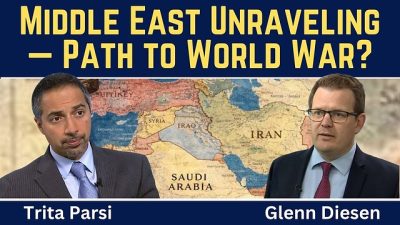
Trita Parsi: Middle East Unraveling — Are We on the Path to World War?
or go to
Aletho News Archives – Video-Images
New Book
Trans agenda is ‘normalization of sadism’ – US author

RT | September 23, 2026
The US Democratic Party has embraced a transgender agenda that amounts to “the normalization of sadism,” author A.J. Rice has said, warning that radical trans policies would return if the party is allowed to regain power.
Speaking to RT’s America First host Scotty Nell Hughes about his new book, ‘The Curse of the Bearded Lady: How the Trans Mafia Whacked American Sanity’, Rice argued that activists have gained significant influence in schools, medicine, and corporate America while people who questioned the agenda have faced pressure to stay silent.
The author described the “trans mafia” as the sprawling network of people and institutions that have helped the movement gain influence. He singled out parts of academia, wealthy backers, and corporations, and stated that providers of transition-related treatment also have a financial incentive to keep young people in their care indefinitely.
Rice argued that the consequences of these policies ultimately fall on children who are being drawn toward gender-affirming medical treatments and on girls who are expected to share locker rooms or compete in sports with biological males.
He noted that while voters rejected the Democrats’ approach to gender in 2024, the party, which has been “captured by madness,” has since only doubled down and is seeking what is effectively “the normalization of sadism.” … Full report
Blog Roll
 Aletho News
- ‘We don’t seek permission to defend our country’: Snippets from President Pezeshkian’s UNGA address
- NATO chief wants Europeans to fight American wars [for Israel]
- German chemicals giant reveals details of downsizing
- Refaat Al-Areer Was The Canary In The Coal Mine In Israel’s War On The Truth
- Israeli election committee bars candidate from Knesset race over Gaza war opposition
- French-Lebanese man files war crimes complaint over Israeli attacks
- Mahan Air Flight Lands in China Despite US Threat against Iranian Airlines
- US eyes $10bn fund to rebuild war-battered Gulf infrastructure
- Trump meets Rodríguez near Maduro’s prison as Venezuela’s oil flows to US
- Trita Parsi: Middle East Unraveling — Are We on the Path to World War?
- If Americans Knew
- An error has occurred; the feed is probably down. Try again later.
- No Tricks Zone
- New Study: Earth And Venus Surface Warmth Largely Explained By Convection And Lapse Rate, Not CO2 Or Radiation
- 2025 Nature Paper Claiming Worsening Global Drought Gets RETRACTED …Heavily Flawed
- New Study: ‘Global Drought Shows No Detectable Recent Acceleration Under Climate Warming’
- Economic Masterminds: German Socialists Suggest Taxing Productivity Gains Stemming From Using AI
- The South China Sea Has Not Been Cooperating With The Climate Change Narrative
- Energy Crisis: Germany Enters Heating Season With Historically Low Gas Reserve Fill Levels
- New Study: The Antarctic Ice Sheet Gained Mass From 2020-2024 Due To Staggering Snow And Ice Accumulation
- Study: Ocean Heating Rates From Thousands Of Years Ago ‘Dwarf’ Modern Ocean Heating Rates
- Climate Extremists Target, Attack Large-Scale Power Grid Infrastructure In Germany!
- New Study: Antarctic Ice Melt Has Contributed Less Than 1 Centimeter To Sea Level Rise In The Last 30 Years

