Saudis finance Western media to demonize opponents: Expert
Press TV – October 4, 2018
The head of the UK-based Islamic Human Rights Commission says that Saudi Arabia’s increasing efforts to buy shares or directly finance TV and radio channels in Britain is in line with the kingdom’s efforts to demonize any entity which is opposed to its crimes and human rights violations.
“Saudis are organizing themselves and indeed opening and financing TV stations, radio station to broadcast in Farsi as a means of trying to influence their position within the Iranian community,” Massoud Shadjareh said in an interview with the Press TV on Thursday.
He said Riyadh has also tried to demonize groups like Lebanon’s Hezbollah and Egypt’s Muslim Brotherhood as they oppose the kingdom and its policies.
Shadjareh said Saudi Arabia’s investment in Farsi stations in Britain and elsewhere is only the tip of the iceberg and there has been further investment in other outlets as well.
“Saudis for a very long time have been involved in buying shares and influencing main TV stations like CNN, Sky and others,” he said.
The policy has been meant to both silence the media regarding Saudi Arabia’s war crimes and inhumane activities and also to publicize the kingdom’s demonization of Iran and others who it sees as an obstacle to its policies.
Shadjareh said Saudi Arabia is in fact emulating Israel and other suppressive regimes in bribing the media or launching propaganda stations. “And this tactic is the sort of very similar to the tactics that Zionists are using.”
The expert said the media should try to get more information about the increasing Saudi clout on the field, saying that would expose the crimes committed by the kingdom both inside the country and in other parts of the world.
“I think this use of the media, both social media and mainstream media, it is very dangerous and we need to be aware of it and we need to make sure that we expose their (Saudis’) crimes everywhere,” he added.
Trump Administration Follows Corporate Media Playbook for War With Iran
By John C. O’Day | FAIR | October 4, 2018
Three years ago, as Americans debated the Joint Comprehensive Plan of Action (JCPOA) agreement with the Islamic Republic of Iran—popularly known as “the Iran deal”—I highlighted a troubling media trend on FAIR.org (8/20/15): “For nearly all commentators, regardless of their position, war is the only alternative to that position.”
In the months since US President Donald Trump tore up the JCPOA agreement, his administration has been trying to make good on corporate media’s collective prediction. Last week, John Bolton (BBC, 9/26/18), Trump’s national security advisor and chief warmonger, told Iran’s leaders and the world that there would be “hell to pay” if they dare to “cross us.”
That Bolton’s bellicose statements do not send shockwaves of pure horror across a debt-strapped and war-weary United States is thanks in large part to incessant priming for war, facilitated by corporate media across the entire political spectrum, with a particular focus on Iran.
Back in 2015, while current “resistance” stalwarts like the Washington Post (4/2/15) and Politico (8/11/15) warned us that war with Iran was the most likely alternative to the JCPOA, conservative standard-bearers such as Fox News (7/14/15) and the Washington Times (8/10/15) foretold that war with Iran was the agreement’s most likely outcome. Three years hence, this dynamic has not changed.
To experience the full menu of US media’s single-mindedness about Iran, one need only buy a subscription to the New York Times. After Trump withdrew from the JCPOA, the Times’ editorial board (5/8/18) wrote that his move would “lay conditions for a possible wider war in the Middle East.” Susan Rice (New York Times, 5/8/18), President Barack Obama’s national security advisor, agreed: “We could face the choice of going to war or acquiescing to a nuclear-armed Iran,” she warned. Cartoonist Patrick Chappatte (New York Times, 5/10/18) was characteristically more direct, penning an image of Trump alongside Bolton, holding a fictitious new agreement featuring the singular, ultimate word: “WAR.”
On the other hand, calling Trump’s turn against JCPOA a “courageous decision,” Times columnist Bret Stephens (5/8/18) explained that the move was meant to force the Iranian government to make a choice: Either accede to US demands or “pursue their nuclear ambitions at the cost of economic ruin and possible war.” (Hardly courageous, when we all know there is no chance that Trump or Stephens would enlist should war materialize.)
Trump’s latest antics at the United Nations have spurred a wave of similar reaction across corporate media. Describing his threat to “totally destroy North Korea” at the UN General Assembly last year as “pointed and sharp,” Fox News anchor Eric Shawn (9/23/18) asked Bill Richardson, an Obama ally and President Bill Clinton’s ambassador to the UN, whether Trump would take the same approach toward Iran. “That aggressive policy we have with Iran is going to continue,” Richardson reassured the audience, “and I don’t think Iran is helping themselves.” In other words, if the United States starts a war with Iran, it’s totally Iran’s fault.
Politico (9/23/18), meanwhile, reported that Trump “is risking a potential war with Iran unless he engages the Islamist-led country using diplomacy.” In other words, if the United States starts a war with Iran, it’s totally Trump’s fault. Rice (New York Times, 9/26/18) reiterated her view that Trump’s rhetoric “presages the prospect of war in the Persian Gulf.” Whoever would be the responsible party is up for debate, but that war is in our future is apparently all but certain.
Politico’s article cited a statement signed by such esteemed US experts on war-making as Madeleine Albright, who presided over Clinton’s inhuman sanctions against Iraq in the ’90s, and Ryan Crocker, former ambassador for presidents George W. Bush and Obama to some of America’s favorite killing fields: Iraq, Afghanistan, Pakistan and Syria. James Clapper, Obama’s National Intelligence Director, who also signed the letter, played an important role in trumping up WMD evidence against Saddam Hussein before the United States invaded Iraq in 2003. When it comes to US aggression, they’re the experts.
Vanity Fair (9/26/18) interviewed John Glaser of the Cato Institute, who called Trump’s strategy “pathetic,” and also warned that it forebodes war. In an effort to “one-up Obama,” Glaser explained, Trump’s plan is “to apply extreme economic pressure and explicit threats of war in order to get Iran to capitulate.” Sound familiar? As Glaser implies, this was exactly Obama’s strategy, only then it wasn’t seen as “pathetic,” but rather reasonable, and the sole means for preventing the war that every US pundit and politician saw around the corner (The Hill, 8/9/15).
When everyone decides that war is the only other possibility, it starts to look like an inevitability. But even when they aren’t overtly stoking war fever against Iran, corporate media prime the militaristic pump in more subtle yet equally disturbing ways.

Netanyahu speaks for the Iranian people on CNN (9/29/18)
First among these is the near-complete erasure of Iranian voices from US airwaves (FAIR.org, 7/24/15). Rather than ask Iranians directly, national outlets like CNN (9/29/18) prefer to invite the prime minister of Israel, serial Iran alarmist and regional pariah Benjamin Netanyahu, to speak for them. During a jovial discussion this weekend over whether regime change and/or economic collapse is Iran’s most likely fate, Netanyahu explained to the audience that, either way, “The ones who will be happiest if that happens are the people of Iran.” No people of Iran were on hand to confirm or deny this assessment.
Bloomberg (9/30/18) similarly wanted to know, “What’s not to like about Trump’s Iran oil sanctions?” Julian Lee gleefully reported that “they are crippling exports from the Islamic Republic, at minimal cost to the US.” One might think the toll sanctions take on innocent Iranians would be something not to like, but Bloomberg merely worried that, notwithstanding the windfall for US refineries, “oil at $100 a barrel would be bad news for drivers everywhere—including those in the US.” [$500,000,000 increase in gas costs, daily, just for Americans]
Another prized tactic is to whitewash Saudi Arabia, Iran’s chief geopolitical rival, whose genocidal destruction of Yemen is made possible by the United States, about which corporate media remain overwhelmingly silent (FAIR.org, 7/23/18). Iran’s involvement in Yemen, which both Trump and the New York Times (9/12/18) describe as “malign behavior,” is a principal justification for US support of Saudi Arabia, including the US-supplied bombs that recently ended the brief lives of over 40 Yemeni schoolchildren. Lockheed Martin’s stock is up 34 percent from Trump’s inauguration day.
Corporate media go beyond a simple coverup of Saudi crimes to evangelize their leadership as the liberal antidote to Iran’s “theocracy.” Who can forget Thomas Friedman’s revolting puff piece for the Saudi crown prince Mohammad bin Salman? Extensively quoting Salman (New York Times, 11/23/17), who refers to Iranian Ayatollah Ali Khamenei as “the new Hitler of the Middle East,” Friedman nevertheless remains pessimistic about whether “MBS and his team” can see their stand against Iran through, as “dysfunction and rivalries within the Sunni Arab world generally have prevented forming a unified front.” Oh well, every team needs cheerleaders, and Friedman isn’t just a fair-weather fan.
While Friedman (New York Times, 5/15/18) believes that Trump has drawn “some needed attention to Iran’s bad behavior,” for him pivotal questions remain unanswered, such as “who is going to take over in Tehran if the current Islamic regime collapses?” One immediate fix he proposed was to censure Iran’s metaphorical “occupation” of Syria, Iraq and Lebanon. Isn’t this ironic coming from an unapologetic propagandist for Washington’s decades-long, non-metaphorical occupation of the two countries to the east and west of Iran? (FAIR.org, 12/9/15)
In a surprising break from corporate media convention, USA Today (9/26/18) published a column on US/Iran relations written by an actual Iranian. Reflecting on the CIA-orchestrated coup against Iran’s elected government in 1953, Azadeh Shahshahani, who was born four days after the 1979 revolution there, wrote:
I often wonder what would have happened if that coup had not worked, if [Prime Minister] Mosaddeq had been allowed to govern, if democracy had been allowed to flourish.
“It is time for the US government to stop intervening in Iran and let the Iranian people determine their own destiny,” she beseeched readers.
Shahshahani’s call is supported by some who have rejected corporate media’s war propaganda and have gone to extreme lengths to have their perspectives heard. Anti-war activist and Code Pink founder Medea Benjamin was recently forcibly removed after she upstaged Brian Hook, leader of Trump’s Iran Action Group, on live TV, calling his press conference “the most ridiculous thing I have ever seen” (Real News, 9/21/18). Benjamin implored the audience: “Let’s talk about Saudi Arabia. Is that who our allies are?”
“How dare you bring up the issue of Yemen,” admonished Benjamin as she was dragged from the room. “It’s the Saudi bombing that is killing most people in Yemen. So let’s get real. No more war! Peace with Iran!” Code Pink is currently petitioning the New York Times and Washington Post to stop propagandizing war.
Sadly, no matter whom you ask in corporate media, be they spokespeople for “Trump’s America” or “the resistance,” peace remains an elusive choice in the US political imagination. And while the public was focused last week on Supreme Court nominee Brett Kavanaugh’s perjurious testimony, the Senate finalized a $674 billion “defense” budget. Every single Democrat in the chamber voted in favor of the bill, explicitly naming Iran as persona non grata in the United States’ world-leading arms supply network, which has seen a 25 percent increase in exports since Obama took office in 2009.
The US government’s imperial ambitions are perhaps its only truly bipartisan project—what the New York Times euphemistically refers to as “globalism.” Nowhere was this on fuller display than at the funeral for Republican Sen. John McCain (FAIR.org, 9/11/18), where politicians of all stripes were tripping over themselves to produce the best accolades for a man who infamously sang “bomb bomb bomb, bomb bomb Iran” to the tune of a Beach Boys song.
McCain’s bloodlust was nothing new. Nearly a hundred years ago, after the West’s imperial competition culminated in the most destructive war the world had ever seen, the brilliant American sociologist and anti-colonial author WEB Du Bois wrote, “This is not Europe gone mad; this is not aberration nor insanity; this is Europe.”
Iranian leaders have repeatedly said they do not want war with the US (AP, 9/27/18), but US corporate media, despite frequently characterizing Trump as a “mad king” (FAIR.org, 6/13/18), continue to play an instrumental role in rationalizing a future war with Iran. Should such an intentional catastrophe come to pass, we can hardly say that this would be America gone mad; war is not aberration, it is always presented as the next sane choice. This is America.
Victory for Iran: Highest UN court orders US to suspend sanctions
Press TV – October 3, 2018
In a victory for Tehran against Washington, the International Court of Justice (ICJ) has ordered the United States to halt the unilateral sanctions it recently re-imposed on “humanitarian” supplies to Iran.
The Hague-based court, which is the principal judicial organ of the United Nations, announced its ruling on Wednesday regarding the July lawsuit brought by Tehran against Washington’s decision to re-impose unilateral sanctions following the US exit from the the 2015 nuclear deal.
Iran’s lawsuit argued that the sanctions violate the terms of the 1955 Treaty of Amity between Iran and the US. It also called on the court to order Washington to immediately suspend the measures.
On Wednesday, the UN’s top tribunal – known as the World Court — unanimously ruled that the US must ensure that the re-imposed sanctions do not impact humanitarian aid or civil aviation safety.
According to the verdict, which was read out by Judge Abdulqawi Ahmed Yusuf, Washington “shall remove by means of its choosing any impediments arising from the measures announced on May 8 to the free exportation to Iran of medicines and medical devices, food and agricultural commodities” as well as airplane parts.
The court further said that sanctions on goods “required for humanitarian needs… may have a serious detrimental impact on the health and lives of individuals on the territory of Iran.”
US sanctions on aircraft spare parts also had the “potential to endanger civil aviation safety in Iran and the lives of its users,” it added.
The decisions of the ICJ – which rules on disputes between UN member states – are legally binding and cannot be appealed.
In a post on his Twitter account on July 16, Iran’s Foreign Minister Mohammad Javad Zarif said the complaint challenged the US “unlawful re-imposition of unilateral sanctions.”
“Iran is committed to the rule of law in the face of US contempt for diplomacy & legal obligations. It’s imperative to counter its habit of violating int’l law,” he tweeted.
In May, Trump pulled his country out of the 2015 nuclear agreement, called the Joint Comprehensive Plan of Action (JCPOA), despite objections from the other signatories to the accord.
In August, he re-imposed the first round of sanctions on Iran. The second phase of US bans will come into effect next month.
Defeat for ‘sanctions-addicted’ US
Meanwhile, Tehran has welcomed the ruling by the 15-member panel of justices, saying it once again indicted Iran’s “righteous” position against the hostile US policies.
In a tweet on Wednesday, Foreign Minister Mohammed Javad Zarif described the verdict as yet another defeat for the “sanctions-addicted” US government.
Iran’s Foreign Ministry also issued a statement, saying the decision “proved once again that the Islamic Republic of Iran is right, and that US sanctions against people and citizens of our country are illegitimate and cruel.”
It also showed that “the US government is growing more isolated day by day due to its wrong and extremist policies and as a result of its own excessive demands from other countries,” the statement added.
Tehran further called on Washington to abandon its unpleasant addiction to imposing cruel and illegal sanctions against other people and act as a responsible member of the international community.
IAEA dismisses Israel’s call to inspect Iran facility
Press TV – October 2, 2018
The International Atomic Energy Agency (IAEA) has declined to “take at face value” a recent Israeli claim that Iran has a secret atomic warehouse.
“The Agency uses all safeguards relevant information available to it but it does not take any information at face value,” IAEA Director General Yukiya Amano said in a statement released on Tuesday.
Although Amano did not make an explicit reference to Israeli Prime Minister Benjamin Netanyahu’s claim against Iran, it is his first public pronouncement since the premier’s speech.
“It should be noted that under the existing verification framework, the Agency sends inspectors to sites and locations only when needed,” he added.
During his speech on Thursday at the 73rd annual session of the UN General Assembly in New York, Netanyahu once again took the stage to bring out fresh theatrics against Iran, repeating his threadbare allegation that the country is working to develop nuclear weapons at a “secret” site and urged the IAEA to inspect it.
“In May, we exposed the site of Iran’s secret atomic archive. Today, I’m revealing the site of a second facility; Iran’s secret atomic warehouse,” claimed the Israeli PM, who added, “Iran has not abandoned its goal to develop nuclear weapons.”
Amano further emphasized that the IAEA’s work related to nuclear verification “must always be impartial, factual, and professional,” saying, “In order to maintain credibility, the Agency’s independence in relation to the implementation of verification activities is of paramount importance.”
The IAEA chief added that the agency is conducting verification and monitoring of Iran’s nuclear-related commitments under the 2015 nuclear agreement, officially known as the Joint Comprehensive Plan of Action (JCPOA), Iran signed with major world powers.
“These activities will continue to be carried out within the parameters of the relevant decisions and resolutions of the IAEA Board of Governors and the UN Security Council as appropriate,” he pointed out.
Pointing to his reports to the IAEA Board of Governors, Amano noted that the agency would continue its evaluations regarding the absence of “undeclared nuclear material and activities for Iran.”
“The Agency continues to evaluate Iran’s declarations under the Additional Protocol, and has conducted complementary accesses under the Additional Protocol to all the sites and locations in Iran which it needed to visit,” the head of the UN nuclear agency said.
In his introductory statement to the Board of Governors in Vienna on September 10, Amano said Iran is living up to all its commitments under the 2015 nuclear deal.
He added that the IAEA would continue to verify the non-diversion of nuclear material declared by Iran under its Safeguards Agreement.
Later in his opening address to the IAEA’s 62nd General Conference in Vienna on September 17, the IAEA director general reaffirmed that Iran is in compliance with the nuclear agreement.
Germany approves extradition of Iran diplomat over bomb ‘plot’ – court
RT | October 1, 2018
Germany has approved the extradition of an Iranian diplomat over a suspected bomb plot, according to a statement by a local court. The 46-year-old man, arrested on German soil in July, will be handed over to Belgium.
The diplomat, identified as Vienna-based Assadollah Assadi, is suspected of plotting an attack on an Iranian opposition group near Paris, according to AP. He was detained in July near the German city of Aschaffenburg on a European arrest warrant.
Now, a superior regional court in a Bavarian town of Bamberg said in a statement that it had approved the extradition of Assadi to Belgium. The man “cannot cite diplomatic immunity” to oppose the extradition because he was detained outside of his host state, Austria.
Also, Assadi was not traveling “between his host country and the state that dispatched him,” the court has said.
Back in July, Assadi had allegedly contracted an Antwerp-based couple and gave them a device containing 500 grams of TATP, a homemade explosive produced from easily available components.
The couple in question, identified by the media as a 38-year-old man, Amir S., and a 33-year-old woman, Nasimeh N., were stopped in Belgium and authorities reported finding the explosives in their car. The pair were then charged with attempted terrorist murder and preparation of a terrorist act.
Soon after the news on Assadi broke, Iranian Foreign Minister Javad Zarif denounced the allegations as a foiled terrorist plot, calling them “a sinister false-flag ploy.” He said the timing of Assadi’s arrest was particularly notable.
“How convenient: Just as we embark on a presidential visit to Europe, an alleged Iranian operation and its ‘plotters’ arrested,” Zarif tweeted. He stated that Tehran “unequivocally condemns all violence and terror anywhere.”
US creating basis for regional conflagration in Middle East: James Petras
Press TV – September 29, 2018
The United States is creating the basis for the regional conflagration in the Middle East by fortifying its circle around Iran, American writer and academic James Petras says.
The US State Department has endorsed the proposed sale of more than 800 tactical missiles to Bahrain amid the Al Khalifah regime’s heavy-handed crackdown on pro-democracy campaigners and political dissidents in the tiny Persian Gulf country.
The approval includes Guided Multiple Launch Rocket System (GMLRS) Unitary Rocket Pods and Army Tactical Missiles System (ATACMS) Unitary missiles for an estimated cost of $300 million, the Arabic-language al-Khaleej al-Jadeed news website reported on Saturday.
“Well, it’s part of the US setting up the aggressive policy; mainly it is directed against the government in Iran. And it’s largely responsible for encouraging this aggression with the addition of its support of Israel and Saudi Arabia,” Professor Petras said.
“It’s creating the basis for the regional conflagration. I don’t think anyone is aware of any danger to the small (Persian) Gulf state. They’re mainly there to serve the US, and to enrich the oligarchies that run those countries,” he added.
“They have no defensive function. They have no positive role to play. And they are forever condemned for their repression of their dissident populations,” the analyst said.
“So I think this is an act by the Trump administration to fortify its circle around Iran. It’s likely to force Iran to increase its defenses and its alliances in the region,” he added.
“I don’t think it has any positive function for the US to continue meddling the Middle East and causing new wars, new terrorists, and new instability in the region,” the academic concluded.
The Debate – Israel Anti-Iran Stunt
PressTV | September 28, 2018
The Israeli Prime Minister has addressed the UN General Assembly. Anything unique about his address: the props were there, but there were more of them, and the target of the props: Iran, Iran, Iran. Was he successful in his pitch, that Iran had a Secret Iranian Nuclear Facility? We will look at his statements on Iran, how he said Iran “took this radioactive material and spread it around Tehran like Nutella, when it is Israel that possesses Nuclear weapons and yet it won’t allow for any inspections.
Watch Live: http://www.presstv.com/live.html
YouTube: https://www.youtube.com/user/videosptv/
Twitter: http://twitter.com/PressTV
US Intel Officials Publicly Contradict Netanyahu’s UN Speech On ‘New’ Iran Atomic Facility
By Tyler Durden | ZeroHedge | September 28, 2018
Netanyahu’s Thursday UN General Assembly speech predictably included the familiar props and visuals condemning Iran over what the Israeli prime minister says is a continuing nuclear program it is hiding from the world’s view.
Like pretty much all prior Netanyahu speeches focusing on Iran, he held up a physical “evidence” to illustrate his points as he spoke — this time it was a “proof” that Iran has yet another secret warehouse holding nuclear-related material in the form of an aerial photograph of the Iranian capital marked with a red arrow pointing to a large building.
Though this was perhaps a step up from the cartoon bomb performance at the UNGA in 2012, the act is now a fixture and entirely predictable after many others spanning years, barely eliciting much media excitement compared to six years ago.
But unlike the last number of similar speeches, US intelligence officials have told Reuters that the claims are not true.
“I am disclosing for the first time that Iran has another secret facility in Tehran, a secret atomic warehouse for storing massive amounts of equipment and materiel from Iran’s secret nuclear program,” Netanyahu said as if breathlessly leading a breaking news press conference.
He said the site had previously held some 15 kilograms (33 pounds) of radioactive material that has since been moved in a curiously specific claim that would now seem very hard if not impossible to prove — given that… well it’s all been moved according to the claims. He called on the UN atomic agency to initiate immediate inspection with Geiger counters.
“Since we raided the atomic archive, they’ve been busy cleaning out the atomic warehouse. Just last month they removed 15 kilograms of radioactive material. You know what they did with it?” he said. “They took it out and they spread it around Tehran in an effort to hide the evidence.”
And on Twitter the Israeli prime minister began making a public appeal in parallel to his speech, asking people to “Google it” and offering the coordinates “35.5022 51.2997. It’s Iran’s secret nuclear warehouse in Tehran. Look for it and share it asking people to.”
Iranian officials were quick to seize upon his once again attempting to persuade through ample use of props and visuals, with Foreign Minister Javad Zarif mocking, “No arts & craft show will ever obfuscate that Israel is only regime in our region with a *secret* and *undeclared* nuclear weapons program – including an *actual atomic arsenal*. Time for Israel to fess up and open its illegal nuclear weapons program to international inspectors.”
And elsewhere foreign ministry spokesman Bahram Qassemi said, “The world will only laugh loudly at this type of false, meaningless and unnecessary speech and false shows,” according to Fars news.
Considering this usual run of events anytime Netanyahu addresses the UN, the only surprise came later in the day, when Reuters cited US intelligence officials who immediately contradicted the content of his speech.
Reuters called the claims of the freshly revealed purported atomic facility “nothing new” to the Americans, according to an unnamed intelligence source:
A US official, speaking on condition of anonymity, said the United States is aware of the facility Netanyahu announced and described it as a ‘warehouse’ used to store ‘records and archives’ from Iran’s [civilian] nuclear program.
And further citing a second intelligence official, the report continued:
A second US intelligence official called Netanyahu’s comments ‘somewhat misleading. First, we have known about this facility for some time, and it’s full of file cabinets and paper, not aluminum tubes for centrifuges, and second, so far as anyone knows, there is nothing in it that would allow Iran to break out of the JCPOA any faster than it otherwise could.’
A separate Israeli media report also noted the contradiction between Netanyahu’s speech and US intelligence: “The claims gainsay the remarks made by Netanyahu, who said that the site, which sits a short distance from Shourabad, contained some 15 kg (33 pounds) of radioactive material that has since been moved.”
Thus it appears the media — including Israeli media — aren’t so lockstep in uncritically repeating Netanyahu’s talking points anymore.
Also on Thursday the Israeli Defense Forces (IDF) made more claims connected with the UN speech, tweeting satellite images via its official account that claim Iran is establishing at least three missile factories inside Lebanon in partnership with Hezbollah, specifically in dense civilian neighborhoods of Beirut.
Israel has lately vowed to continue attacking Iranian forces stationed in Syria, and Thursday’s media information and propaganda blitz portend it is prepping for more rounds of strikes.
With Russia threatening response and now set to deliver the S-300 air defense system to Syria, it could be that Israel sets its sights on these purported Hezbollah “missile factories” on Lebanese soil.
Israel in no position to level nuclear accusation at Iran: Zarif
Press TV – September 28, 2018
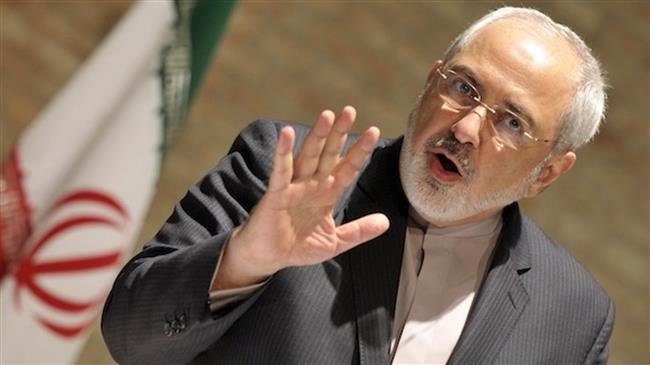
Iranian Foreign Minister Mohammad Javad Zarif has lashed out at Israeli Prime Minister Benjamin Netanyahu for his baseless claims against Iran at his UN speech, saying Tel Aviv is in no position to level such accusations against Tehran.
“Netanyahu must explain how Israel, as the only possessor of nuclear weapons in the Middle East region, can put itself in a position to level such brazen accusations against a country whose [nuclear] program has been repeatedly declared peaceful by the International Atomic Energy Agency (IAEA),” Zarif told IRNA on Thursday.
The senior Iranian diplomat’s comments came after the Israeli prime minister once again took the stage at the UN on Thursday to put on another spectacle about Iran’s nuclear program, repeating his threadbare allegation that the country is working to develop nuclear weapons at “secret” sites.
Zarif said Netanyahu’s move is only aimed at deflecting attention from the fact that the Israeli regime is “the biggest threat to the Middle East” given that he stands by a nuclear weapons facility and threatens other states with atomic annihilation, Zarif noted.
“The Tel Aviv regime will never manage to achieve anything by playing such games,” the Iranian foreign minister added.
“We have seen in recent days the extent of the US’ isolation at the UN General Assembly and the Security Council as a result of the policies Netanyahu has imposed on Washington. Now imagine how isolated the Israelis themselves are when they have managed to haul the US into such isolation,” Zarif stated.
Meanwhile, Iranian Foreign Ministry Spokesman Bahram Qassemi strongly dismissed Netanyahu’s UN show as “ridiculous” and a fabricated scenario aimed at making up for the failed US and Israeli smear campaign against Iran at the UN General Assembly.
“The occupying regime [of Israel] must know that in the new era, the world will only laugh out loud at such false, inconsiderate and empty remarks and fake shows,” Qassemi told journalists on Thursday.
He referred to the IAEA as the only body responsible for dealing with nuclear issues, saying that 12 reports issued by the UN atomic watchdog and verified by the global community and all relevant parties have so far confirmed Iran’s commitment to its obligations under the 2015 nuclear deal, officially known as Joint Comprehensive Plan of Action (JCPOA).
Volvo stops truck assembly in Iran due to US sanctions
RT | September 24, 2018
Swedish truckmaker Volvo has stopped assembling trucks in Iran because of Washington’s sanctions, spokesman for the company, Fredrik Ivarsson, told Reuters.
According to him, the group could no longer get paid for parts it shipped and had therefore decided not to operate in Iran.
“With all these sanctions and everything that the United States put (in place)… the bank system doesn’t work in Iran. We can’t get paid… So for now we don’t have any business (in Iran),” Ivarsson said.
Volvo was working with Saipa Diesel (part of Iran’s second-largest automaker Saipa) which was assembling the Swedish firm’s heavy-duty trucks from kits shipped to Iran. The company had plans to become Iran’s main export hub for the Gulf region and North Africa markets.
An unnamed commercial department manager at Saipa Diesel told the media that more than 3,500 Volvo trucks had been assembled in the year to May. However, none had been assembled in this financial year, he said. The original deal was for at least 5,000 trucks.
The manager confirmed that sanctions had prompted Volvo Trucks to terminate their partnership agreement.
“They have decided that due to the sanction on Iran, from (May) they couldn’t cooperate with us. We had some renovation planned in Iran for a new plant but they refused to work with us,” he said.
Volvo has joined a list of European companies such as Total, Adidas and Daimler, who have been forced to reconsider their investments in Iran. The firms said they will scale back or abandon all operations in Iran due to Washington’s sanctions.
Swedish truckmaker Scania, which is owned by Volkswagen (VW), said it had canceled all orders that it could not deliver by mid-August due to sanctions. French carmaker PSA Group began to suspend its joint venture activities in Iran in June.
Germany’s Daimler said it was closely monitoring any further developments, while Volkswagen rejected reports that it had decided against doing business in Iran. VW said its position had not changed.
Iran summons European envoys over terrorist attacks in Ahvaz
Press TV – September 22, 2018
Iranian authorities have summoned ambassadors of the Netherlands and Denmark as well as chargé d’affaires of the British embassy in Tehran after terrorists with alleged links to the European countries carried out attacks during a military parade in the southwestern city of Ahvaz on Saturday.
Iran’s Foreign Ministry Spokesman Bahram Qassemi said that the department for European affairs of the ministry summoned the three diplomats separately at the evening time on Saturday to declare Tehran’s strong protest to the role their countries might have played to support elements who carried out the terror attacks in Ahvaz earlier in the day that led to the killing of some 25 people.
The al-Ahvaziya terror group, whose recruits are believed to be scattered in several European countries, including in the Netherlands and in Denmark, claimed responsibility for the attack in Ahvaz.
The terror outfit, which is backed by Saudi Arabia, has a record of carrying out sabotage acts in Iran’s Khuzestan province, which encompasses Ahvaz and some other Arab-dominated towns.
Qassemi said Iran expected the two European countries to extradite the “criminal perpetrators” of the terrorist act in Ahvaz.
“It was reiterated to the ambassadors of the Netherlands and Denmark that the Islamic Republic of Iran had earlier warned about the residence of these individuals in these countries and has called for their arrest and prosecution,” said Qassemi in a statement, adding that the ambassadors of the two countries declared that their governments were ready to share any information with regards to the terrorists and their records.
The official said that Iranian authorities had also passed their strong note of protest to the chargé d’affaires of the British embassy in Tehran about an interview aired by a Britain-based TV channel after the attack in Ahvaz in which the spokesman of the al-Ahvaziya had condoned the terrorist act.
Qassemi said the British diplomat condemned the attack and said that he would accordingly relay Iran’s message of protest to the authorities in London.
Three of the terrorists were shot dead at the scene while a fourth was arrested and later succumbed to his wounds, armed forces spokesman Brigadier General Abolfazl Shekarchi said.
Iran declared Monday to be a day of national mourning in which a funeral ceremony will be held for the victims of the attack in Ahvaz.
All but one of the 25 people killed in the attack have been identified. Some 60 people were wounded in the attack, most of them civilians. Authorities said the death toll could rise as some injured were in critical condition.
Western media mostly silent on Ahvaz terrorist attack
Press TV – September 22, 2018
The mainstream Western media have been mostly silent about the deadly US-sponsored terrorist attack in the Iranian city of Ahvaz, according to US scholar and political analyst Kevin Barrett.
“Innocent people being killed by terrorists is front page news in the West; but, in the case of terrorism against Iran, suddenly, everything changes and the media tends to ignore and downplay it,” Barrett told Press TV in an interview on Saturday.
Barrett sees the attack as another terrorist operation launched by the United States and its regional allies.
“There have been close to 20,000 people killed in these kinds of terrorist attacks by extremist groups in Iran over the years to almost the complete silence of the western media and that is because it is the western governments led by the United States and its Israeli master who are in fact organizing, funding, arming, equipping, and unleashing these terrorists against Iran and they have been ever since the Islamic Revolution of 1979,” Barrett said.
Barrett noted that US President Donald Trump and top officials in his administration like Secretary of State Mike Pompeo and National Security adviser John Bolton were behind such state-sponsored terrorist attacks on innocent people.
“Today, we have in power in the United States the Trump administration whose two main Iran advisers — Bolton and Pompeo –are fanatical anti-Iran haters,” Barrett said.
Barrett said the pair had received huge bribes from the Iranian terrorist opposition group Mojahedin-e Khalq Organization (MKO), known to most other countries by another acronym, MEK.
“These guys bribes are usually called ‘speaking fees’, and Bolton and Pompeo and others will go in front of these terrorist organized events – propaganda exercises – for huge sums of money, to basically paper over MEK’s terrorist past,” Barrett said.
In return, Barrett assumed, the pair helps the terrorists receive funds to launch anti-Iran operations. “We can assume that the pair is helping their friends by upping the level of US support for them,” he said.
Barrett said direct support of terrorists groups like the MEK and state-sponsored terrorism was doing the US no good.
Barrett concluded that US-sponsored terrorist attacks were going to be counterproductive in the long run because “terrorism doesn’t work … Iranian people are not going to stand it. People like Bolton and Pompeo may have failed to learn that lesson and they will be learning it in the future. “
Featured Video
EUROPE FEARS RUSSIA’S NEXT MOVE / Ian Proud
or go to
Aletho News Archives – Video-Images
New Book
New Book: No Autoimmunity The Body Doesn’t Attack Itself
Lies are Unbekoming | September 24, 2026
 The label for Humira, once the best-selling drug in the world, lists its risks in plain print. One of them, in the label’s own words, is new “autoimmune” disease.
A drug prescribed for a condition labelled autoimmune carries a warning that it can cause a condition labelled autoimmune. That contradiction sits in every box, on a folded paper almost nobody reads.
My new book starts there.
No Autoimmunity: The Body Doesn’t Attack Itself
For seventy years, “your body is attacking itself, and we don’t know why” has ended the conversation for people diagnosed with multiple sclerosis, lupus, rheumatoid arthritis, Hashimoto’s, Type 1 diabetes, Crohn’s and psoriasis. More than eighty conditions now carry the autoimmune label. The diagnosis comes with a prescription for life. It almost never comes with a question about cause.
This book asks the question and answers it from the framework’s own records: its drug labels, its journals, its regulatory filings, and its own experiments. … continue
Blog Roll
 Aletho News
- Israeli settlers terrorize West Bank Palestinians with state-provided drones: Report
- They see them, then kill them: Israeli quadcopters track, deliberately target civilians in Gaza
- Debunked: Trump’s egregious UNGA claims on war against Iran crumble under scrutiny
- Europe was part of the infrastructure of US aggression against Iran: Deputy FM
- New evidence on the Bucha Massacre
- Italy and France debunk reports CIA issued ‘Russian drone threat’ warning
- How Russia is Rewiring the Global South
- Britain’s elites want you ready to die for a war they keep imagining
- Inside Ukraine’s propaganda operation targeting Americans
- Hackers From US, France, Singapore Tried to Disrupt Russian Elections – Internet Provider
- If Americans Knew
- Trump betrayed voters with his campaign lies and prioritized a foreign country once he took office
- Netanyahu calls Israel’s war in Gaza ‘opposite of genocide’ in UN speech to near-empty hall
- Settler Kidnappings: Torture, Sexual Abuse and Terrorisation of Palestinian Abductees as Israel Deepens Annexation of West Bank
- Gaza winter nears as 162,000 tents become unusable, raising fears of humanitarian crisis
- Netanyahu says, “It’s the opposite of genocide”; UN says Gaza economy is world’s ‘most severe crisis on record’ – Daily Update
- Israel’s US-Backed Assault on Gaza Has Created the ‘World’s Most Severe Economic Crisis on Record’: UN
- ‘Protecting U.S. Citizens’… From Israel
- ‘This is where I live now, the back of a truck’: a day in the life of a grandmother in Gaza
- In UN Speech, Iran’s President Displays Pictures of Children Killed by US, Brings Attention to Israel’s Nuclear Arsenal
- Israel displaces hundreds of Palestinians amid wave of demolitions in West Bank
- No Tricks Zone
- New Study: Earth And Venus Surface Warmth Largely Explained By Convection And Lapse Rate, Not CO2 Or Radiation
- 2025 Nature Paper Claiming Worsening Global Drought Gets RETRACTED …Heavily Flawed
- New Study: ‘Global Drought Shows No Detectable Recent Acceleration Under Climate Warming’
- Economic Masterminds: German Socialists Suggest Taxing Productivity Gains Stemming From Using AI
- The South China Sea Has Not Been Cooperating With The Climate Change Narrative
- Energy Crisis: Germany Enters Heating Season With Historically Low Gas Reserve Fill Levels
- New Study: The Antarctic Ice Sheet Gained Mass From 2020-2024 Due To Staggering Snow And Ice Accumulation
- Study: Ocean Heating Rates From Thousands Of Years Ago ‘Dwarf’ Modern Ocean Heating Rates
- Climate Extremists Target, Attack Large-Scale Power Grid Infrastructure In Germany!
- New Study: Antarctic Ice Melt Has Contributed Less Than 1 Centimeter To Sea Level Rise In The Last 30 Years

