Baghdad grapples with ‘curse’ of US sanctions on Iran
By Omar al-Jaffal | Asia Times | August 17, 2018
Iraqi Prime Minister Haider al-Abadi has raised the level of uncertainty over how Iraq will handle long-expected US sanctions on Iran.
In the span of less than a week, Abadi went from pledging to abide by the sanctions the day after they were imposed, to backtracking on his statement.
“I said yes, we will abide … but abide when it comes to dollar transactions,” Abadi told reporters Monday. The confusion for Iraqi citizens and political parties is even greater for the Central Bank of Iraq.
“Dealing in dollars with Iran has been banned for a very long time,” the bank’s director general of financial operations, Mahmoud Dagher, told the media. “Neither the bank nor the banking system deals with Iran in dollars when it comes to foreign trade.”
Iran is not only a neighbor to Iraq, with a land border of more than 1,000 kilometers. It dominates the Iraqi market and political scene.
Prime Minister Abadi’s vocal opposition to the US sanctions stems from this hegemony, especially as he is seeking a second term in office. His coalition placed third in the May parliamentary elections and he will need Tehran’s support moving forward.
Politically, Iran has influence on a large number of Shiite parties in the government and parliament. Some of these parties have announced they will mount a “break the siege” campaign to counter the US sanctions on Iran.
Militarily, Tehran supports and trains dozens of militias in Iraq, and these groups sharply criticized Abadi over his initial acquiescence to the sanctions. The United States also holds major influence in the military and economic spheres.
As in the past, Abadi is walking a tightrope between Tehran and Washington, both of which have their share of clout in green lighting the next prime minister.
Iranian dairy, Iranian cars
Where there is political and military influence in Iraq, there is economic reverberation.
Hamid Hosseini, the secretary-general of the Iran-Iraq Chamber of Commerce, said in December that “Iraq, for Iran, equals the markets of three continents: Europe, America and Africa.”
Iranian goods account for about 17% of the Iraqi market, making it the second largest destination for exports after Turkey in this respect. Iranian exports to Iraq have risen exponentially over the past decade.
Before US sanctions were reimposed, Iran said it was seeking to control a quarter of the Iraqi market and increase the volume of trade from $13 billion in 2017 to $20 billion in the coming years.
In the markets of central and southern Iraq, one can clearly observe how Iranian goods dominate shop shelves and how dairy products occupy a large place in the refrigerators.
On the streets, the Iranian-made SAIPA and Samand cars are too many to count. The cheap, poor-quality vehicles have not only entered Iraq by highway — they are assembled at factories in the heart of the country.
Iraq’s power plants are heavily reliant on diesel and gas to operate, and in this regard, Tehran has an agreement to export diesel and about 25 million cubic meters of gas per day to Iraqi power plants.
Even so, Iraq continues to suffer from major power shortages, which this summer prompted major waves of protests as temperature hovered around 50 degrees Celsius. The Iraqi government since 2005 has been compelled to conclude successive deals with Iran to ease the shortfall, importing 1,500 to 2,500 megawatts of electricity per year.
For Iraq, Iranian religious tourism is a major source of income.
Each year, about three million Iranian pilgrims flock to the shrines of the descendants of the the Prophet Mohammad in the provinces of central and southern Iraq.
Baghdad charges a $40 visa fee per tourist, but Abadi’s government quickly announced it would reduce that amount for pilgrims as sanctions on Tehran came into effect.
Iranian goods are often the source of ridicule in Iraq for their lack of quality. But they are hugely popular in the central and southern provinces of the country, as a much more affordable option than goods made in Turkey. Not to mention the foodstuffs Iraqis depend on for their daily diet.
For much of the population, those low prices make a major difference in the household budget, especially with the rise of unemployment and poverty following the price of oil – the key export on which Baghdad relies to conduct about 97% of its economic activities.
Iran’s trade surplus with the Iraqi private sector is more than $7 billion.
Against this backdrop, the Iraqi government appears at a loss, with scant plans in place to deal with the first package of US sanctions against Iran, which is light compared to the second round coming in November.
Dr. Mohammed Saleh, an economic adviser to the prime minister, says Iraq faces a dilemma in the coming period.
“Given the closed border with Syria and the dangerous situation [on the border] with Jordan, for Iraq only Turkey remains” to compensate for the shortage in Iranian goods when the second tranche of US sanctions comes into force. “But also [Turkey] is in a vague position as a result of the US sanctions,” he added, with a note of desperation.
“Iraq will have to comply with the US sanctions on Iran and it will have to compensate for the loss of Iranian goods by producing some of them,” Saleh told Asia Times, adding that this goes especially for the gas sector.
“We will also have to revive the manufacturing of oil products by reactivating refineries suspended from work. The same goes for agriculture, if Iraq can persuade the Turkish side to up Iraq’s water quotas.”
Asked whether Iraq had immediate plans to implement what he had referred to, he said: “Unfortunately, so far there are no actual plans on the ground,” stressing that Iraq was still reeling from the war against ISIS and the failure to form a government after the latest elections.
Made in Iraq?
Falah al-Rubaie, professor of economics at the Faculty of Management and Economics at Mustansiriya University in Baghdad, said the sanctions should be seen as an opportunity for Iraq. An opportunity to reconsider its economic policy in the fields of industry and agriculture, and to start competing with Iranian goods through local production.
“Iraq has the space to activate such a policy,” Rubaie told Asia Times. “But such a decision requires political will and belief in achieving development.”
He said Iraq’s economic predicament was not for a lack of strategies. “There have been more than 16 strategies developed by successive governments related to industry, agriculture, trade and others sectors, in addition to the existence of four development plans since 2003.
“All these plans sit on the shelf because of the confusion of political decision-makers and many of them are linked to Iran politically, which facilitates the import of their products at the expense of Iraqi development plans.
“The absence of development and the return to oil revenue is what Iraqi politicians have been doing since 2003 in order to secure their personal benefits at the expense of the country’s interest,” Rubaie added.
Up till now, Iraq has not faced major issues with Tehran or Washington over the latest US sanctions.
“Trade between the two countries (Iraq and Iran) is proceeding normally,” said Nasir Behrouz, Iran’s trade adviser in Baghdad. “The import and export process with Iraq continues at all ports.
“Iran is determined to expand its presence in the Iraqi market to suit the interests of the two countries,” Behrouz was quoted as saying by the official IRNA news agency.
The US, for its part, has not flagged any sanctions violations by Iraq to date, despite alarmist reports in the local press.
The US embassy in Baghdad issued a statement of clarification after State Department spokesperson Heather Nauret warned Tuesday that Washington would “continue to hold countries accountable for any violations.”
The embassy said Nauret’s statement had been misinterpreted and stated categorically that there was “no breach of sanctions” by Iraq in dealing with Iran.
The economic adviser to PM Abadi described the sanctions against Iran as “the curse” and said that the second round was an impending disaster that Iran must redress.
He did not say whether Iraq would be able to tackle this curse and find a substitute for Iranian imports.
Is This The Most Important Geopolitical Deal Of 2018?
By Olgu Okumus | Oilprice.com | August 13, 2018
The two-decade-long dispute on the statute of the Caspian Sea, the world largest water reserve, came to an end last Sunday when five littoral states (Russia, Iran, Turkmenistan, Kazakhstan and Azerbaijan) agreed to give it a special legal status – it is now neither a sea, nor a lake. Before the final agreement became public, the BBC wrote that all littoral states will have the freedom of access beyond their territorial waters, but natural resources will be divided up. Russia, for its part, has guaranteed a military presence in the entire basin and won’t accept any NATO forces in the Caspian.
Russian energy companies can explore the Caspian’s 50 billion barrels of oil and its 8.4 trillion cubic meters of natural gas reserves, Turkmenistan can finally start considering linking its gas to the Turkish-Azeri joint project TANAP through a trans-Caspian pipeline, while Iran has gained increased energy supplies for its largest cities in the north of the country (Tehran, Tabriz, and Mashhad) – however, Iran has also put itself under the shadow of Russian ships. This controversy makes one wonder to what degree U.S. sanctions made Iran vulnerable enough to accept what it has always avoided – and how much these U.S. sanctions actually served NATO’s interests.
If the seabed, rich in oil and gas, is divided this means more wealth and energy for the region. From 1970 until the dissolution of the Soviet Union (USSR) in 1991, the Caspian Sea was divided into subsectors for Azerbaijan, Russia, Kazakhstan and Turkmenistan – all constituent republics of the USSR. The division was implemented on the basis of the internationally-accepted median line.
After the dissolution of the Soviet Union, the new order required new regulations. The question was over whether the Caspian was a sea or a lake? If it was treated as a sea, then it would have to be covered by international maritime law, namely the United Nations Law of the Sea. But if it is defined as a lake, then it could be divided equally between all five countries. The so-called “lake or sea” dispute revolved over the sovereignty of states, but also touched on some key global issues – exploiting oil and gas reserves in the Caspian Basin, freedom of access, the right to build beyond territorial waters, access to fishing and (last but not least) managing maritime pollution.
The IEA concluded in World Energy Outlook (WEO) 2017 that offshore energy has a promising future. More than a quarter of today’s oil and gas supply is produced offshore, and integrated offshore thinking will extend this beyond traditional sources onwards to renewables and more. Caspian offshore hydrocarbon reserves are around 50 billion barrels of oil equivalent (equivalent to one third of Iraq’s total oil reserves) and 8.4 trillion cubic meters of gas (almost equivalent to the U.S.’ entire proven gas reserves). As if these quantities were not themselves enough to rebalance Eurasian energy demand equations, the agreement will also allow Turkmenistan to build the Trans-Caspian pipeline, connecting Turkmenistan’s resources to the Azeri-Turkish joint project TANAP, and onwards to Europe – this could easily become a counter-balance factor to the growing LNG business in Europe.
Even though we still don’t have firm and total details on the agreement, Iran seems to have gained much less than its neighbors, as it has shortest border on the Caspian. From an energy perspective, Iran would be a natural market for the Caspian basin’s oil and gas, as Iran’s major cities (Tehran, Tabriz, and Mashhad) are closer to the Caspian than they are to Iran’s major oil and gas fields. Purchasing energy from the Caspian would also allow Iran to export more of its own oil and gas, making the country a transit route from the Caspian basin to world markets. For instance, for Turkmenistan (who would like to sell gas to Pakistan) Iran provides a convenient geography. Iran could earn fees for swap arrangements or for providing a transit route and justify its trade with Turkey and Turkmenistan as the swap deal is allowed under the Iran-Libya Sanctions Act (ILSA, or the D’Amato Act).
If the surface water will be in common usage, all littoral states will have access beyond their territorial waters. In practical terms, this represents an increasingly engaged Russian presence in the Basin. It also reduces any room for a NATO presence, as it seems to be understood that only the five littoral states will have a right to military presence in the Caspian. Considering the fact that Russia has already used its warships in the Caspian to launch missile attacks on targets within Syria, this increased Russian presence could potentially turn into a security threat for Iran.
Many questions can now be asked on what Tehran might have received in the swap but one piece of evidence for what might have pushed Iran into agreement in its vulnerable position in the face of increased U.S. sanctions. Given that the result of those sanctions seems to be Iran agreeing to a Caspian deal that allows Russia to place warships on its borders, remove NATO from the Caspian basin equation, and increase non-Western based energy supplies (themselves either directly or indirectly within Russia’s sphere of geopolitical influence) it makes one wonder whose interests those sanctions actually served?
Caspian Sea Convention Bans Military Presence of Non-Littoral States in Region
RT | August 12, 2018
Vladimir Putin attended the Caspian Sea summit in Kazakhstan which he said has “milestone” significance. There five littoral powers finally made a breakthrough on trade, security and environment following 20 years of talks.
This year’s meeting has been “an extraordinary, milestone event,” Russian President Vladimir Putin told his counterparts in Kazakhstan’s port city of Aktau, where the summit took place. Leaders of the Caspian Five came there to seal a convention on the legal status of the sea washing shores of Azerbaijan, Iran, Kazakhstan, Russia and Turkmenistan.
“It is crucial that the convention governs … maritime shipping and fishing, sets out military cooperation among [Caspian] nations and enshrines our states’ exclusive rights and responsibilities over the sea’s future,” Putin said. He added the landmark accord also limits military presence in the Caspian Sea to the five littoral countries.
From now on, no country from outside the region will be allowed to deploy troops or establish military bases on the Caspian shores. The five states themselves will also decide on how to deal with issues currently affecting the Caspian Sea region, such drugs and terrorism.
“Hotspots, including Middle East and Afghanistan, aren’t far away from the Caspian Sea,” the President stated. “Therefore, the very interests of our peoples require our close cooperation.”
The summit may give boost to digitalization of commerce, mutual trade and logistics, Putin suggested. “Transportation is one of key factors of sustainable growth and cooperation of our countries,” he argued. Additionally, the five states will establish the Caspian Economic Forum “to develop ties between our countries’ businesses,” Putin told.
The Caspian Sea is home to some 48 billion barrels of oil and 292 trillion cubic feet of natural gas in proven offshore reserves. A range of important pipelines are going through the Caspian Sea, connecting Central Asia and Caucasus with the Mediterranean.
Foreign Power in American Democracy? Guess Which One?

By Frank Scott | Legalienate | August 7, 2018
Americans schooled by films, comics, sitcoms and other forms of capital media might well believe Russia invaded the USA during our 18th century revolution and that’s why we’ve been enemies ever since. Actually, the USA and its future European lap dogs, along with Japan, invaded Russia in 1918 under various pretenses covering the need to destroy an uprising that had the gall to replace a holy family of royal wealth with some stupid ideals about ending poverty and promoting actual rule by a democratic majority.
That bloody foreign intrusion into a civil war which further wrecked an economy already near total destruction as a result of the First World War, saw Russia lose more lives than any other country involved and was a preview of more recent history; the present assault on its borders by NATO, all following in the same imperial footsteps to the current moment of reducing innocent Americans into a near frenzied psycho-neurotic mob over alleged horrors committed to our cherished democracy by evil Russians.
That religiously worshipped fictional system has never in history existed nor produced one American president actually elected by a majority of the electorate. In fact, the image of a supposedly “brutal authoritarian thug” Putin, a description widely accepted by duped twits under merciless American mind management, received a much larger share of the Russian electorate’s voting support than either the despicable or deplorable lesser evil candidates in the last billionaire’s campaign we have been taught to call “our” democracy. This produced the frenzy of established power’s brain assault committed on a public with minds so reduced to pulp it may be too late for some to survive even with decent emergency treatment. Which they might only get in a foreign country given the private profit crazed madness in our alleged “health care” market. In fact, if paying a private insurance company before being able to acquire the services of a doctor or nurse is “health care”, then paying a pimp in order to acquire the services of a sex worker is “love care”. But away with logic and back to the supposed identity of a foreign force wreaking havoc with our cherished national perversion passing for democracy.
While hate crazed elders of the bureaucratic un-intelligence class formerly seen as enemies of the people take on the role of heroic fighters for the masses, the president elected by millions in the usual minority vote for bogus chief executive is treated as a treasonous, racist, homophobic, sexist, child molesting, bank robbing, unsafe driver and any other charge possible by almost all establishment voices. He certainly is a rich, arrogant, egomaniacal super twit, but his crude dim-witted honesty over-qualifies him for the job of CEO of a rich, arrogant, egomaniacal nation programmed to think itself god’s gift to humanity and what more regular presidential puppets of wealth have called the “essential” nation. And truthfully, what other giant of morality and intellect could spend trillions on war, billions on pets, and leave hundreds of thousands of its people living in the street? Such is the marketing fiction forcing insanity into the minds of near helpless consumers of commodified crap in diets leading to digestive and psychological disorders bordering on terminal social malfunction. These are usually diagnosed as personal problems needing therapy and drug cures, which bring massive private profits to a dwindling minority and massive public loss to an expanding majority.
Meanwhile, Trump’s alleged treasonous love affair with Putin occupies consciousness controllers and their near helpless consumers while Trump’s burying his economic face in Netanyahu’s political crotch attracts attention only from those long trying to wake the nation to its government falling under the control of a foreign power, Israel, where all manner of atrocities both moral and financial are excused under the banner of protecting the only democracy in the middle east. This lie is greater than the one sold here about our own minority rule cartel but helps perversely rationalize the need to slaughter, pillage, and destroy much of the Islamic world in pursuit of racial supremacy to be enjoyed by those who shout loudest that racial supremacy must be fought. Except when they practice it.
While the breast-fed-into-adulthood brigades swallow tales of Russian meddling in our billionaire financed minority perversion of democracy, Israel’s continued role in getting the USA to murder hundreds of thousands in the middle east increasingly moves to extend the fanatic bloodletting to Iran. Always in Israeli sights because it is totally disrespectful of European rule, given both its fundamental Islamic stance against much of modernity but mostly western values seen as immoral – because they frequently are – and its long history dating from ancient times of being both a global and more recently local power not given to taking guff from anyone. It has always been critical of the most blatant western invasion of the 20th century in the establishment of a euro-colony in Palestine and the total disregard for the people who’ve lived there since biblical times. How dare they disrespect the only other “essential” nation, along with the U.S.A. Are they crazy or what?
The perennially facing extermination mindset of the Israelis has dominated American politics since before that nation’s origins, officially in 1948 but pending since long before the days of Nazi Zionist partnership to make Palestine the home for Jews seeking a separate and superior homeland. The later bloody Nazi assault, murders and ethnic cleansing inflicted on lower economic class European Jews who could not afford to buy their way out, as their one percent did, has become the most well known, publicized and often fictionalized assault on humanity ever recorded in global consciousness. This even after the facts of western murders of countless millions in colonializing much of the world, and especially here in the USA where entire nations of indigenous people were wiped out or ethnically cleansed and where American Jews, descended from immigrants, far outnumber American Indians, the horror of the European Jewish experience takes precedence over what was done to native Americans. And Trump, like every single president before him, has not only embraced every fictional foundation story to cover injustice, but unlike previous hypocrites who did it only for the money provided by the Israeli lobby, he probably believes it and thus may be even more dangerous.
So as the saber rattling toward Iran increases, with the most extreme racists in the USA and Israel licking their chops over the thought of wiping out more Middle Eastern people, the mind boggling idiocy of alleged Russian involvement in organized crime in America – the electoral system – approaches sending millions to a mental health crisis center, none of them able to afford the drugs needed to possibly calm their over stressed minds. And the leaders in this rush to further crisis for capital are not the usual right wing loonies who used to find commies under their beds, but what passes for sophisticated neo-liberals who unashamedly assume the role of the most demented force in American politics and one that can almost make the insect brain in the white house seem thoughtful by comparison.
The idea that a nation which suffered more than any other with 25 million deaths in the two capitalist “world” wars, which saw its country invaded, bombed and reduced to starvation and cannibalism by this bloody experience, is a threat to America which by comparison lost less than half a million people – some .02% of the Russian total – is one that can only be placed into consciousness by creating a vast pool of unconsciousness. Americans with knowledge of material reality would not accept the dreadful drivel being poured into their heads, which is why rulers are pouring it on faster, and with more fury. If it truly is darkest just before the dawn, we are hopefully experiencing what will become the most shining burst of light imaginable. Hopefully non-nuclear.
Tehran Reveals Terms of Its Withdrawal From Syria
Sputnik – 04.08.2018
Iran might decrease its military presence in Syria and even leave altogether after the situation in the war-torn country normalizes and the fight against terrorism there brings significant results, Iranian Foreign Ministry spokesman Bahram Qassemi said.
“As soon as we see that Syria is close to certain stability, and the fight against terrorism is close to its end, and significant results have been reached, of course, we might decrease the presence of our advisors in Syria or even withdraw from the country,” Qassemi said in an interview with the Iranian Pupils Association News Agency (PANA) as quoted by the Iranian Foreign Ministry’s website on Saturday.
Tehran would maintain its presence in Syria as long as Damascus wants it to, Qassemi pointed out. The diplomat noted that fighting terrorism was one of the Iranian forces’ tasks in Syria, apart from granting support to the war-torn country’s government.
In July, Iranian Supreme Leader’s Top Adviser for International Affairs Ali Akbar Velayati said Tehran would be present in Syria and Iraq at the request of these countries’ legitimate governments and would not leave despite the threats voiced by the United States.
Israel has also repeatedly expressed security concerns over the Iranian presence next to its borders in Syria. Velayati has noted that the Iranian presence in Syria was coordinated with Moscow and Damascus and did not have to be agreed upon with Israel.
Iran, alongside Russia and Turkey, is a guarantor state of the Syrian truce. Syrian President Bashar Assad has said that only Iranian officers, not troops, were operating in his country.
Trump’s Art of the Deal and Iran sanctions
By M K Bhadrakumar | Indian Punchline | August 4, 2018
An amicable formula seems to be emerging between the Trump administration on the one hand and China and India on the other hand as regards the impending US sanctions on Iran’s oil exports. Below-the-radar consultations are going on between Washington and Beijing and New Delhi.
The Trump administration initially threatened collateral damage to countries such as China and India unless they fell in line with the US diktat to stop all oil imports from Iran to zero by November 4. Oil is at the core of Trump’s containment strategy against Iran, since oil exports are a major source for income for Tehran and the American game plan is all about hurting the Iranian economy until its leadership capitulates and begs him for a meeting.
It’s a hackneyed notion to bully Tehran to make it bend. It never worked in these 40 years – not even under Barack Obama who enjoyed vast political capital in the international community. But the good thing about Trump is that behind the fire and fury, he’s a realist. (By the way, Iranians know it, too, as this utterly fascinating tongue-in-cheek commentary yesterday implies.)
So, after some rounds of diplomacy in world capitals (to test the waters, basically) – Beijing, New Delhi, Ankara, in particular, which are big-time buyers of Iranian oil – Washington began signaling that sanctions can also provide for ‘waivers’ – that is, Trump administration will selectively exercise the great privilege of deciding not to punish countries that may still want to buy Iranian oil after the November 4 cutoff date.
Quite obviously, from the feedback received from American diplomats, Washington senses great reluctance to pay heed to the US demarche. In particular, China and India (which account for over half of Iranian oil exports) are heavily dependent on Iranian oil – and, for good reason too. At least in the case of India, Iran offers oil at a discounted price on deferred payment basis with substantial reduction in freight and insurance costs.
Now, the US cannot possibly sanction the oil industry in China or India because Big Oil is also hoping to do business with them. (For shale oil, Asian market is the preferred destination.) Some analysts predict that Russia, which like America is also an energy superpower, will be a net gainer. Russia can cash in on the needs of China and India for oil; Russia can buy Iranian oil and sell it through swap deals and so on (and make some money in the bargain); or, Russia may even move into the Iranian oil industry in a big way and make investments there. At any rate, it is foolhardy for the US to imagine that it can control the world energy market in terms of price elasticity of supply.
In view of the above factors, the Trump administration is finessing an understanding with China and India whereby the US sanctions policy against Iran does not become an acrimonious issue. The interests to be reconciled are: a) China and India have legitimate interests in sourcing Iranian oil and it is unrealistic and counterproductive to coerce them; and, b) the US too has an abiding interest not to sanction the oil companies of China and India, which are prospective buyers of US oil.
The Bloomberg report, here, says that China has point blank refused to cut Iranian oil imports but may agree to keep imports at the existing level as of November 4. Interestingly, the report cites US officials heaving a sigh of relief: “That would ease concerns that China would work to undermine U.S. efforts to isolate the Islamic Republic by purchasing excess oil.” Plainly put, Washington is relieved that Beijing will not take advantage of the US sanctions against Iran.
On the other hand, the Reuters report on India, here, assesses that Indian imports of Iranian crude oil are dramatically increasing in recent months. A 30% increase is reported in July with crude imports from Iran touching record level of 768,000 barrels per day. (This is a whopping 85% jump over the corresponding period in July 2017, which was 415,000 bpd)!
Of course, if the US can allow China to keep its import of Iranian oil at the existing level as of November 4, it cannot deny a similar formula to India. And, therefore, doesn’t it make eminent sense that India keeps ramping up its oil imports from Iran to the maximum level possible by November 4?
Evidently, this is Trump’s Art of the Deal at work. By the way, for Iran too, this would provide some ‘sanctions relief’. Which in turn may even ‘incentivize’ Tehran to talk to Trump. If there is anything like a workable “win-win” in politics, this is it, this is it.
AngloZionist Attack Options Against Iran
The Saker • Unz Review • August 3, 2018
In the past few days, the Internet has been flooded with a frankly silly rumor about the US soliciting Australia’s assistance in preparing an attack on Iran. Needless to say, that report does not explain what capabilities Australia would possess which the US would lack, but never-mind that. Still, the report was picked up in too many places (see here, here and here ) to be ignored. In one of these reports, Eric Margolis has described what such a US attack could look like. It is worth quoting him in full:
Outline of a possible AngloZionist attack on Iran
The US and Israel will surely avoid a massive, costly land campaign again Iran, a vast, mountainous nation that was willing to suffer a million battle casualties in its eight-year war with Iraq that started in 1980. This gruesome war was instigated by the US, Britain, Kuwait and Saudi Arabia to overthrow Iran’s new popular Islamic government.
The Pentagon has planned a high-intensity air war against Iran that Israel and the Saudis might very well join. The plan calls for over 2,300 air strikes against Iranian strategic targets: airfields and naval bases, arms and petroleum, oil and lubricant depots, telecommunication nodes, radar, factories, military headquarters, ports, waterworks, airports, missile bases and units of the Revolutionary Guards.
Iran’s air defenses range from feeble to non-existent. Decades of US-led military and commercial embargos against Iran have left it as decrepit and enfeebled as was Iraq when the US invaded in 2003. The gun barrels of Iran’s 70’s vintage tanks are warped and can’t shoot straight, its old British and Soviet AA missiles are mostly unusable, and its ancient MiG and Chinese fighters ready for the museum, notably its antique US-built F-14 Tomcats, Chinese copies of obsolete MiG-21’s, and a handful of barely working F-4 Phantoms of Vietnam War vintage.
Air combat command is no better. Everything electronic that Iran has will be fried or blown up in the first hours of a US attack. Iran’s little navy will be sunk in the opening attacks. Its oil industry may be destroyed or partially preserved depending on US post-war plans for Iran.
The only way Tehran can riposte is by staging isolated commando attacks on US installations in the Mideast of no decisive value, and, of course, blocking the narrow Strait of Hormuz that carries two-thirds of Mideast oil exports. The US Navy, based nearby in Bahrain, has been practicing for decades to combat this threat.
There is a lot of interesting material in this description and I think that it is worth looking into it segment by segment.
First, I can only agree with Margolis that neither the US nor Israel want a ground war against Iran: the country is too big, the Iranians too well prepared and the size of the force needed for such a campaign way beyond what the Empire can currently muster.
Second, Margolis is absolutely correct when he says that Iran does not have the means to stop a determined AngloZionist (missiles and aircraft) attack. Iran does have some modern air-defense capabilities, and the attackers will sustain a number of losses, but at this point, the size disparity is so huge that the AngloZionists will achieve air superiority fairly soon and that will give them an opportunity to bomb whatever they want to bomb (more about that later).
Assessing Iranian air defenses is not just a matter of counting missiles and launchers, however, and there is much more to this. According to one Russian source Iran has 4 long range anti-aircraft missile S-300PMU-2 systems (with 48Н6Е2 Mach 6,6 interceptor missiles), 29 military anti-aircraft self-propelled missile complexes Tor-M1, some fairly advanced anti-aircraft missile complexes like the Bavar-373, a passive electronically scanned array radar (whose illumination and guidance system almost certainly includes modern Chinese electronics) and an impressive number of radar systems early warning radar of the Russian, Chinese and Iranian manufacture. This category includes systems like the high-potential long-range radar detection and target designation Najm-802 radar (has 5120 receiving and transmitting modules, operates in the decimeter S-range and is designed to detect ballistic targets and small elements of high-precision weapons), the Russian meter radar “Nebo-SVU” advanced early warning and control system with a fixed-array radar, as well as a meter range early warning radar of the type “Ghadir” . Most importantly, these radars are all integrated into the network-centric missile defense system of Iran. For example, the “Ghadir” radar is able to detect not only the tactical fighters of the USAF, the KSA and Israel, but also ballistic missiles immediately after launch (at a distance of about 1100 km). As a result, the presence of Iranian radio engineering units of multi-band radar detection facilities in the Western direction (the Persian Gulf) will allow the Iranians to prepare a flexible echeloned air defense to defend against high-intensity missile strikes. And yet, no matter how much the Iranians have improved their air defenses, the sheer number of of missiles (including the new advanced AGM-158 JASSM (Joint Air-to-Surface Standoff Missile) low observable standoff air-launched cruise missile delivered by B-1B bombers) means that the Iranian defenses will inevitably be overwhelmed by any massive attack.
I therefore also agree with Margolis that the Iranian oil industry cannot be protected from a determined US/Israeli attack. In fact, the entire Iranian infrastructure is vulnerable to attack.
Margolis’ final paragraph, however, makes it sound like Iran does not have credible retaliatory options and that I very much disagree with.
Example one: Iranian capabilities in the Strait of Hormuz
For one thing, the issue of the Strait of Hormuz is much more complicated than just “the US Navy has practiced for years to combat this threat“. The reality is that Iran has a very wide range of options to make shipping through this strait practically impossible. These options range from underwater mines, to fast craft attacks, to anti-shipping missiles, to coastal artillery strikes, etc.
Therein also lies a big danger: the Israelis and or the US could very easily organize a false flag attack on any ship in the Strait of Hormuz, then accuse Iran, there would be the usual “highly likely” buzzword from all the AngloZionst intelligence agencies and, voilà, the Empire would have a pretext to attack Iran.
In fact, the mere fact of issuing a threat to shipping through this narrow body of water might well deter insurances from providing coverage to any ships and that might stop the shipping all by itself. Should that not be enough, Iran can always lay even a limited amount of mines, and that will be enough (please keep in mind that while the USN could try to engage in mineclearing operations, to do so right off the coast of Iran would expose USN minesweepers to an extreme danger of attack).
Margolis does mention this issue when he writes:
While Iran may be able to interdict some oil exports from the Arab states and cause maritime insurance rates to skyrocket, it’s unlikely to be able to block the bulk of oil exports unless it attacks the main oil terminals in Saudi Arabia and the Gulf with ground troops. During the Iran-Iraq war, neither side was able to fully interdict the other’s oil exports.
However, I believe that grossly under-estimates the Iranian capabilities in this context. Let’s take one example, the Iranian submarine force.
The Iranian submarine force is a highly specialized one. According to the 2018 Edition of the IISS’s Military Balance, the Iranians currently have 21 submarines deployed:
- 3 Taregh-class diesel-electric submarine (Russian Kilo-class Project-877EKM)
- 1 Fateh-class coastal submarine
- 16 Ghadir-class midget submarines
- 1 Nahand-class midget submarine
When most people hear “diesel-electric,” they think of old diesel trucks, and are not impressed, especially when these are contrasted with putatively “advanced” nuclear attack submarines. This is, however, a very mistaken opinion because submarines can only to be assessed in the environment they are designed to operate in. Naval geography is typically roughly divided into three types: blue water (open ocean), green water (continental shelves) and brown water (coastal regions). Nuclear attack submarines are only superior in the blue water environment where autonomy, speed, diving depth, weapon storage capacity, advanced sonars, etc. are crucial. In comparison, while diesel-electric submarines are slower, need to resurface to recharge their batteries and are typically smaller and with fewer weapons onboard, they are also much better suited for green water operations. In shallow brown water, midget submarines reign, if only because nuclear attack submarines were never designed to operate in such an environment. Now take a quick look at the kind of environment the Strait of Hormuz constitutes:

Notice the interesting combination of very shallow and shallow depth typical of brown water and then the green water type of environment when going further into the Gulf of Oman and the Arabian Sea. With this in mind, let’s see what kind of submarine force Iran has acquired/developed:
For brown water operations (Persian Gulf and Strait of Hormuz) Iran has a relatively large and capable fleet of midget submarines. For green water operations (the Gulf of Oman and the Arabian Sea), Iran has three formidable Taregh/Kilo-class submarines (which are even capable of limited blue water operations, though with much less autonomy, speed, armament or sonar than a nuclear attack submarine). Just like “diesel-electric”, the term “midget” submarine makes it sound that we are talking about a toy or, at best, some primitive third world hack which, at best, could be used to smuggle drugs. In reality, however, the Iranian “midgets” can carry the same heavyweight torpedoes (533 mm) as the Kilos, only in smaller quantities. This also means that they can carry the same missiles and mines. In fact, I would argue that Iranian Ghadir-class “midget” submarines represent a much more formidable threat in the Persian Gulf than even the most advanced nuclear attack submarines could.
The US has stopped producing diesel-electric submarines many years ago because it believed that being a hegemonic power with a typical (aircraft carrier-centric) blue water navy it had no need for green or brown water capabilities. Other countries (such as Russia, Germany, Sweden and others) actively pursued a diesel-electric submarine program (including so-called “air-independent propulsion” – AIP – ones) because they correctly understood that these submarines are much cheaper while being also much better suited for coastal defensive operations. Ditching diesel-electric submarines was yet another major mistake by US force planners; see this article on this topic. The new Littoral Combat Ship (LCS) and the Zumwalt-class guided missile destroyer were supposed to partially palliate to this lack of green and brown capabilities, but both turned out to be a disaster

Ghadir-class submarine
The Russian Kilo-class submarines are some of the most silent yet heavily armed submarines ever built, and they could potentially represent a major threat to any US naval operations against Iran. However, we can be pretty sure that the USN tracks them 24/7 and that the Kilos would become a prime target (whether in port or at sea) at the very beginning of any AngloZionist attack. But would the USN also be capable of keeping track of the much smaller (and numerous) Iranian midget submarines? Your guess is as good as mine, but I personally very much doubt that, if only because these relatively small subs are very easy to hide. Just take a look at this photo of a Ghadir-class submarine and imagine how easy it would be to hide them or, alternatively, create decoy looking just like the real thing. Yet this midget submarine could sink any vessel in the Persian Gulf with a single torpedo.
While the US definitely has a lot of very capable reconnaissance and intelligence capabilities available to try to locate and then destroy these threats, we also know that the Iranians have had decades to prepare for this scenario and that they are truly masters at what is called maskirovka in Russian military terminology: a combination of camouflage, concealment, deception, and misdirection. In fact, the Iranians are the ones who trained Hezbollah in Lebanon in this art and we all know what happened to the Israelis when they confidently waltzed into southern Lebanon only to find out that for all their reconnaissance/intelligence capabilities they were unable to deal with even a relatively primitive (technologically speaking) Hezbollah missile capability. For all the patriotic flag-waving, the truth is that if the Iranians decide to block the Strait of Hormuz the only option left for the US will be to land a force on the Iranian shore and engage in a limited but still extremely dangerous offensive land-attack operation. At this point, whether this counter-attack is successful or not will be irrelevant, as there will be so much combat activity in this narrow bottleneck that nobody will even consider to bring ships through it.
I also believe that Margolis is wrong when he writes that all Iran could do would be to stage “isolated commando attacks on US installations in the Mideast of no decisive value“. One very real Iranian option would be to strike US targets (of which there are plenty in the Middle-East) with various missiles. Furthermore, Iran can also launch missiles at US allies (Israel or the KSA) and interests (Saudi oil fields).
Example two: Iranian missile capabilities
I would not trust everything the CSIS writes (they are a very biased source, to put it mildly), but on this page, they posted a pretty good summary of the current Iranian missile capability:

On the same page, CSIS also offers a more detailed list of current and developed Iranian missiles:
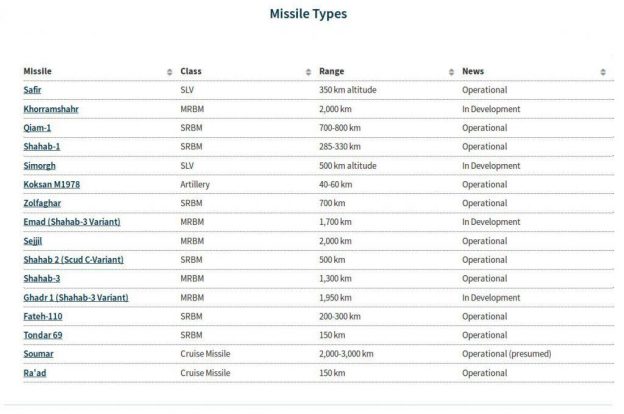
(You can also check on this Wikipedia page to compare with the CSIS info on Iranian missiles)
The big question is not whether Iran has capable missiles, but how many exactly are deployed. Nobody really knows this because the Iranians are deliberately being very vague, and for obvious and very good reasons. However, judging by the example of Hezbollah, we can be pretty sure that the Iranians also have these missiles in large enough numbers to represent a very credible deterrent capability. I would even argue that such a missile force not only represents a capable deterrent capability, but also a very useful war-fighting one. Can you imagine what would happen if US bases (especially airbases and naval facilities) in the region came under periodic Iranian missile attacks? Judging by the Israeli experience during the First Gulf War or, for that matter, the recent Saudi experience with the Houthi missiles, we can be pretty sure that the US Patriots will be useless to defend against Iranian missiles.
Oh sure, just like the US did during the First Gulf War, and the Israelis did in 2006, the AngloZionists will start a massive hunt for Iranian missile sites, but judging by all the recent wars, these hunts will not be successful enough and the Iranians will be able to sustain missile strikes for quite a long time. Just imagine what one missile strike, say, every 2-3 days on a US base in the region would do to operations or morale!
Reality check: the US is vulnerable throughout the entire Middle-East
Above I only listed two specific capabilities (subs and missiles), but the same type of analysis could be made with Iranian small speedboat swarms, electronic warfare capabilities or even cyber-warfare. But the most formidable asset the Iranians have is a very sophisticated and educated population which has had decades to prepare for an attack by the “Great Satan” and which have clearly developed an array of asymmetrical options to defend themselves and their country against the (probably inevitable) AngloZionist attack.
You have probably seen at least one map showing US military installations in the Middle-East (if not, see here, here or here). Truth be told, the fact that Iran is surrounded by US forces and bases presents a major threat to Iran. But the opposite is also true. All these US military facilities are targets, often very vulnerable ones. Furthermore, Iran can also use proxies/allies in the region to attack any of these targets. I highly recommend that you download this factsheet and read it while thinking of the potential of each listed facility to become the target of an Iranian attack.
The usual answer which I often hear to these arguments is that if the Iranians actually dared to use missiles or strike at the US bases in the region, the retaliation by the US would be absolutely terrible. However, according to Eric Margolis, the initial and main goal of a US-Israeli attack on Iran would be to “totally destroy Iran’s infrastructure, communications and transport (including oil) crippling this important nation of 80 million and taking it back to the pre-revolutionary era“. Now let me ask you this simple question: if Margolis is correct – and I personally believe that he is – then how would that outcome be different from the “absolutely terrible” retaliation supposedly planned by the US in case of Iranian counterattack? Put differently – if the Iranians realize that the AngloZionists want to lay waste to their country (say, like what the Israelis did to Lebanon in 2006), what further possible escalation would further deter them from counter-attacking with the means available to them?
To answer this question we need to look again at the real nature of the “Iranian problem” for the AngloZionists.
Real AngloZionist objectives for an attack on Iran
First and foremost, there is absolutely no evidence whatsoever that Iran has any kind of military nuclear program. The fact that the Israelis have for years been screaming about this urbi et orbi does not make it true. I would also add that common sense strongly suggests that the Iranians would have absolutely no logical reason to develop any kind of nuclear weapons. I don’t have the time and space to argue this point again (I have done so many times in the past), so I will simply refer to the US National Intelligence Estimate’s conclusion that Iran had “halted its nuclear weapons program” and leave it at that.
I don’t believe that the Iranians ever had a nuclear weapons program either, but that is irrelevant: even if they once had one, that would put them on par with many other countries which took some initial steps in the development of such a capability and then gave it up. The only point is that it is the official US position that there is no current military nuclear program in Iran.
The real problem of Iran is very simple. Iran is the only country in the world which is:
- Islamic and leads the struggle against the Saudi/Daesh/ISIS/al-Qaeda/etc. ideology of takfirism and the terrorism they promote
- Openly anti-Zionist and anti-Imperialist and combines conservative religious values with progressive social policies
- Successful politically, economically and militarily and thereby threatens the monopoly of power of Israel in the region
Any one of those features by itself would already constitute a grievous case of crimethink from the point of view of the Empire and would fully deserve a reaction of absolute hatred, fear and a grim determination to eliminate the government and people which dare to support it. No wonder that by combining all three Iran is so hated by the AngloZionists.
This entire canard about some Iranian nuclear program is just a pretext for a hate campaign and a possible attack on Iran. But in reality, the goals of the AngloZionists is not to disarm Iran, but exactly as Margolis says: to bomb this “disobedient” country and people “back to the pre-revolutionary era”.
Here is the key thing: the Iranians perfectly understand that. The obvious conclusion is this: if the purpose of an AngloZionist attack will be to bomb Iran back into the pre-revolutionary era, then why would the Iranians hold back and not offer the maximal resistance possible?
Because of the threat of a US nuclear retaliation?
US nuclear attack options – not much of an option in reality
Here again, we need to look at the context, not just assume that the use of nuclear weapons is some kind of magical panacea which immediately forces the enemy to give up the fight and to unconditionally surrender. This is far from being the truth.
First, nuclear weapons are only effective when used against a lucrative target. Just murdering civilians like what the US did in Japan does absolutely no good if your goal is to defeat your opponent’s armed forces. If anything, nuking your opponents “value” targets might only increase his determination to fight to the end. I have no doubt that, just as during the first Gulf War, the US has already made a typical list of targets it would want to strike in Iran: a mix of key government buildings and installations and a number of military units and facilities. However, in most cases, those could also be destroyed by conventional (non-nuclear) weapons. Furthermore, since the Iranians have had decades to prepare for this scenario (the US has always had Iran in its sights since the 1979 Revolution), you can be quite sure that all the peacetime facilities have been duplicated for wartime situations. Thus while many high-visibility targets will be destroyed, their wartime counterparts will immediately take over. One might think that nukes could be used to destroy deeply buried targets, and this is partially true, but some targets are buried too deep to be destroyed (even by a nuclear blast) while others are duplicated several times (say, for 1 peacetime military headquarters there would be 4, 5 or even 6 concealed and deeply buried ones). To go after each one of them would require using even more nukes and that begs the question of the political costs of such a campaign of nuclear strikes.
In political terms, the day the US uses a nuclear weapon against any enemy it will have committed political suicide from which the Hegemony will never recover. While a majority of Americans might consider that “might makes right” and “screw the UN”, for the rest of the world the first use of nuclear weapons (as opposed to a retaliatory counter-strike) is an unthinkable abomination and crime, especially for an illegal act of aggression (there is no way the UNSC will authorize a US attack on Iran). Even if the White House declares that it “had to” use nukes to “protect the world” against the “nuclear armed Ayatollah”, the vast majority of the planet will react with total outrage (especially after the Iraqi WMD canard!). Furthermore, any US nuclear strike will instantly turn the Iranians from villains into victims. Why would the US decide to pay such an exorbitant political price just to use nuclear weapons on targets which would not yield any substantial advantage for the US? Under normal circumstances, I would think that this kind of unprovoked use of nuclear weapons would be quite unthinkable and illogical. However, in the current political context in the US, there is one possibility which really frightens me.
Trump as the “disposable President” for the Neocons?
The Neocons hate Trump, but they also own him. The best example of this kind of “ownership” is the US decision to move its embassy to Jerusalem which was an incredibly stupid act, but one which the Israel Lobby demanded. The same goes for the US reneging on the Joint Comprehensive Plan of Action or, for that matter, the current stream of threats against Iran. It appears that the Neocons have a basic strategy which goes like this: “we hate Trump and everything he represents, but we also control him; let’s use him to do all the crazy stuff no sane US President would ever do, and then let’s use the fallout of these crazy decisions and blame it all on Trump; this way we get all that we want and we get to destroy Trump in the process only to replace him with one of “our guys” when the time is right“. Again, the real goal of an attack on Iran would be to bomb Iran back into a pre-revolutionary era and to punish the Iranian people for supporting the “wrong” regime thus daring to defy the AngloZionist Empire. The Neocons could use Trump as a “disposable President” who could be blamed for the ensuing chaos and political disaster while accomplishing one of the most important political objectives of Israel: laying waste to Iran. For the Neocons, this is a win-win situation: if things go well (however unlikely that is), they can take all the credit and still control Trump like a puppet, and if things don’t go well, Iran is in ruins, Trump is blamed for a stupid and crazy war, and the Clinton gang will be poised to come back to power.
The biggest loser in such a scenario would, of course, be the people of Iran. But the US military will not fare well either. For one thing, a plan to just “lay waste” to Iran has no viable exit strategy, especially not a short-term one, while the US military has no stomach for long conflicts (Afghanistan and Iraq are bad enough). Furthermore, once the US destroys most of what can be destroyed the initiative will be in the Iranians’ hands and time will be on their side. In 2006 the Israelis had to fold after 33 days only, how much time will the US need before having to declare victory and leave? If the war spreads to, say, Saudi Arabia, Iraq, and Syria, then will the US even have the option to just leave? What about the Israelis – what options will they have once missiles start hitting them (not only Iranian missiles but probably also Hezbollah missiles from Lebanon!)?
Former Mossad head Meir Dagan was fully correct when he stated that a military attack on Iran was “the stupidest thing I have ever heard”. Alas, the Neocons have never been too bright, and stupid stuff is what they mostly do. All we can hope for is that somebody in the US will find a way to stop them and avert another immoral, bloody, useless and potentially very dangerous war.
VIPS to Trump: Intel on Iran Could be CATASTROPHIC
As drums beat again for war — this time on Iran—-the VIPS’ warning is again being disregarded as it was before the Iraq debacle and this time VIPS fear the consequences will be all-caps CATASTROPHIC.
August 1, 2018
MEMORANDUM FOR: The President
FROM: Veteran Intelligence Professionals for Sanity (VIPS)
SUBJECT: Intelligence on Iran Fails the Smell Test
Mr. President:
As the George W. Bush administration revved up to attack Iraq 15 years ago, we could see no compelling reason for war. We decided, though, to give President Bush the benefit of the doubt on the chance he had been sandbagged by Vice President Dick Cheney and others. We chose to allow for the possibility that he actually believed the “intelligence” that Colin Powell presented to the UN as providing “irrefutable and undeniable” proof of WMD in Iraq and a “sinister nexus” between Saddam Hussein and al Qaeda.
To us in VIPS it was clear, however, that the “intelligence” Powell adduced was bogus. Thus, that same afternoon (Feb. 5, 2003) we prepared and sent to President Bush a Memorandum like this one, urging him to seek counsel beyond the “circle of those advisers clearly bent on a war for which we see no compelling reason and from which we believe the unintended consequences are likely to be catastrophic.”
We take no satisfaction at having been correct — though disregarded — in predicting the political and humanitarian disaster in Iraq. Most Americans have been told the intelligence was “mistaken.” It was not; it was out-and-out fraud, in which, sadly, some of our former colleagues took part.
Five years after Powell’s speech, the Chair of the Senate Intelligence Committee minced few words in announcing the main bipartisan finding of a five-year investigation. He said: “In making the case for war, the Administration repeatedly presented intelligence as fact when in reality it was unsubstantiated, contradicted, or even non-existent. As a result, the American people were led to believe that the threat from Iraq was much greater than actually existed.”
Iran Now in Gunsight
As drums beat again for a military attack — this time on Iran, we Veteran Intelligence Professionals for Sanity and other experienced, objective analysts are, by all appearances, being disregarded again. And, this time, we fear the consequences will be all-caps CATASTROPHIC — in comparison with the catastrophe of Iraq.
In memoranda to you over the past year and a half we have pointed out that (1) Iran’s current support for international terrorism is far short of what it was decades ago; and (2) that you are being played by Prime Minister Benjamin Netanyahu’s claims about Iran’ they are based on intelligence exposed as fraudulent several years ago. Tellingly, Netanyahu waited for your new national security adviser to be in place for three weeks before performing his April 30 slide show alleging that Iran has a covert nuclear weapons program. On the chance that our analysis of Netanyahu’s show-and-tell failed to reach you, please know that the Israeli prime minister was recycling information from proven forgeries, which we reported in a Memorandum to you early last spring.
If our Memorandum of May 7 fell through some cracks in the West Wing, here are its main findings:
The evidence displayed by Israeli Prime Minister Benjamin Netanyahu on April 30 in what he called his “Iranian atomic archive” showed blatant signs of fabrication. That evidence is linked to documents presented by the Bush Administration more than a decade earlier as “proof” of a covert Iran nuclear weapons program. Those documents were clearly fabricated, as well.
In our May 7, 2018 Memorandum we also asserted: “We can prove that the actual documents originally came not from Iran but from Israel. Moreover, the documents were never authenticated by the CIA or the International Atomic Energy Agency (IAEA).”
Iran: Almost Targeted in 2008
There was a close brush with war with Iran a decade ago. Bush and Cheney, in close consultation with Israel, were planning to attack Iran in 2008, their last year in office. Fortunately, an honest National Intelligence Estimate of November 2007 concluded that Iran had stopped working on a nuclear weapon in 2003, and that key judgment was made public. Abruptly, that NIE stuck an iron rod into the wheels of the juggernaut then speeding downhill to war.
The key judgment that Iran had stopped work on a nuclear weapon was the result of the painstakingly deliberative process that was customarily used, back in the day, to produce an NIE. After that process — which took a full year — the Nov. 2007 NIE was approved unanimously by all U.S. intelligence agencies.
(In other words, it was decidedly NOT a rump “assessment” like the one cobbled together in a couple of weeks by “handpicked” analysts from three selected, agenda-laden agencies regarding Russian meddling. We refer, of course, to the evidence-impoverished and deceptively labeled “Intelligence Community Assessment” that the directors of the FBI, CIA, and NSA gave you on January 6, 2017. The Defense Intelligence Agency and the State Department intelligence bureau were among the other 13 agencies excluded from that “Intelligence Community Assessment.”)
As for the Bush/Cheney plans for attacking Iran in 2008, President George W. Bush, in his autobiography, Decision Points, recorded his chagrin at what he called the NIE’s “eye-popping” intelligence finding debunking the conventional wisdom that Iran was on the verge of getting a nuclear weapon. Bush added plaintively, “How could I possibly explain using the military to destroy the nuclear facilities of a country the intelligence community said had no active nuclear weapons program?”
Mr. President, we do not know whether a fresh National Intelligence Estimate has been produced on Iran and nuclear weapons — or, if one has been produced, whether it is as honest as the NIE of Nov. 2007, which helped prevent the launch of another unnecessary war the following year. We stand on our record. In sum, if you believe that there is credible evidence that Iran has an active secret nuclear weapons program, we believe you have been misled. And if you base decisions on misleading “intelligence” on Iran, the inevitable result will be a great deal worse than the Bush/Cheney debacle in Iraq.
For the Steering Group
Veteran Intelligence Professionals for Sanity
William Binney, former NSA Technical Director for World Geopolitical & Military Analysis; Co-founder of NSA’s Signals Intelligence Automation Research Center (ret.)
Sen. Richard H. Black, 13th District of Virginia; Colonel US Army (ret.); former Chief, Criminal Law Division, Office of the Judge Advocate General, Pentagon (associate VIPS)
Kathleen Christison, Senior Analyst on Middle East, CIA (ret.)
Bogdan Dzakovic, former Team Leader of Federal Air Marshals and Red Team, FAA Security (ret.) (associate VIPS)
Philip Giraldi, CIA, Operations Officer (ret.)
Larry C. Johnson, former CIA and State Department Counter-terrorism officer
Michael S. Kearns, Captain, Wing Commander, RAAF (ret.); Intelligence Officer & ex-Master SERE Instructor
Linda Lewis, WMD preparedness policy analyst, USDA (ret.) (associate VIPS)
Edward Loomis, NSA Cryptologic Computer Scientist (ret.)
David MacMichael, Capt., USMC (ret.); former Senior Estimates Officer, National Intelligence Council
Ray McGovern, former US Army Infantry/Intelligence Officer & CIA analyst; CIA Presidential briefer (ret.)
Elizabeth Murray, former Deputy National Intelligence Officer for the Near East, National Intelligence Council & CIA political analyst (ret.)
Todd E. Pierce, MAJ, US Army Judge Advocate (ret.)
Gareth Porter, author/journalist (associate VIPS)
Coleen Rowley, FBI Special Agent and former Minneapolis Division Legal Counsel (ret.)
Robert Wing, former Foreign Service Officer (associate VIPS)
Ann Wright, Colonel, US Army (ret.); Foreign Service Officer (resigned in opposition to the war on Iraq)
Netanyahu Got it Wrong Again: No Nuclear Arms in Iran and No Yazdi Cake in Alaadin!
By Heba Morad | American Herald Tribune | July 31, 2018
In the latest English-language video, Israeli Prime Minister Benjamin Netanyahu asks the world to help Iran’s imaginary character Fatemeh in her struggle with the claimed hardships in her country, Iran.
Israeli media outlets circulated a video that Netanyahu had released on Sunday night; an English-language video on social media calling on the world to allegedly help Iranians improve their lives, claiming that the government is oppressing the people. In the video, Netanyahu addresses the camera and tells the story of an imaginary 15-year-old girl called Fatemeh.
Fatemeh, Netanyahu claims, has different hardships to deal with. Netanyahu tries to describe in detail his imaginary friend in Tehran, and concludes by saying that although Fatemeh is fictitious, this is the true story of “millions of Iranians”.
However, when he arrives to a point where he says that “She stops at her favorite bakery in the Aladdin mall to eat cake yazdi but there’s a nation-wide strike,” he makes a big mistake, and makes a fool out of himself.
It seems that Netanyahu’s Mossad and Hasbara teams have failed once again in providing him with the required information to carry out his psychological warfare against Iran; a country that has chosen to have an independent identity and beliefs. They failed to tell him that the Alaadin Mall does not have ANY CONFECTIONARY shop, and that it is a mall, or what they call in Iran “a passage” that sells mobile phones.
Netanyahu failed to know a small detail that can be easily figured out; the Alaadin passage is the most famous of phone malls in Iran, how can the Prime Minister miss out on that point? And if this is the case with Alaadin, this triggers questions on the precision and accuracy of the information related to other stories cooked up by the Israelis on Iran, more precisely Iran’s nuclear deal. Is it that all information Israel and the US have been providing on Iran’s nuclear activity is only as accurate as those on Fatemeh’s cake-craving?
Israel and the US have been claiming that Iran has been seeking a nuclear weapon for years, imposed sanctions on the country, threatened to attack Iran multiple times at the time they are the two regimes that own the largest number of nuclear warheads. Iran has never attacked any other country or state actor. Even Iran’s support to the Assad government in Syria was upon an official invitation from the Syrian government to help curb the Daesh or ISIS terrorists that have committed heinous crimes of inhumanity against the innocent Syrian people. Now if we want to dive into the details we will need an elaborate explanation on bloopers or confessions that were made live on air through different media outlets by US and Israeli generals and officials, like that of General Flynn who acknowledged that the US has been supporting terrorist groups in Syria.
Iran had over and again assured that it seeks no nuclear arms and that all its activity was for peaceful purposes. Leader of the Islamic Revolution Ayatollah Seyed Ali Khamenei has also issued a religious verdict stating that it is forbidden in Islam to seek nuclear weapons, which was acknowledged by the Obama government at a certain point. So, today after Netanyahu’s silly mistake some Iranian activists through social media platforms reassured that young and old know that Alaadin passage sells nothing but mobile phones and accessories. Are they also accused of lying just like the Iranian government has been accused of being untruthful about its nuclear program?
One cannot but say the truth. Yes, Iran does have some issues, just like any other country across the globe. But the Iranian government is, also like other governments trying to carry out reforms and resolve issues. There is no Utopia on this planet, is there one? The US and the Israeli apartheid regime have been putting their utmost efforts to hammer the government and put pressure on Iran and its people. Nevertheless, they should have tried a bit harder maybe or been more careful about the source of their information. At the end of the day, Iran does not seek nuclear weapons just like there is no confectionary shop in the mobile phones passage!
An Iran War Would Destroy the United States
By Philip Giraldi | American Herald Tribune | July 30, 2018
The establishment of a military force to go abroad and overthrow governments does not appear anywhere in the Constitution of the United States, nor does calling for destruction of countries that do not themselves threaten America appear anywhere in Article 2, which describes the responsibilities of the President. Indeed, both Presidents George Washington and John Quincy Adams warned against the danger represented by foreign entanglements, with Adams specifically addressing what we now call democracy promotion, warning that the United States “should not go abroad to slay dragons.”
Since the end of the Second World War, the United States has proven to be particularly prone to attacking other countries that have only limited capability to strike back. North Korea was the exception that proved the rule when the Chinese intervened to support its ally in 1950 to drive back and nearly destroy advancing U.S. forces. Otherwise, it has been a succession of Granada, Panama, Afghanistan, Iraq, Somalia, Serbia, and Libya, none of which had the capability to hit back against the United States and the American people.
Iran just might prove to be a harder nut to crack. There has been a considerable escalation in tension between Washington and Tehran since the White House withdrew from the Joint Comprehensive Plan of Action (JCPOA) in May. The JCPOA was intended to monitor Iran’s nuclear program to ensure that it would not be producing a nuclear weapon. Since that time, the U.S. and Israel have been threatening the Iranians and accusing them of both having a secret nuclear program and engaging in widespread regional aggression. In the latest incident, President Donald Trump tweeted in response to comments made on July 21st by Iranian President Hassan Rouhani, who had told a meeting of Iranian diplomats that war between America and Iran would be a misfortune for everyone, saying “Mr. Trump, don’t play with the lion’s tail, this would only lead to regret. America should know that peace with Iran is the mother of all peace, and war with Iran is the mother of all wars.”
Trump responded in anger all in capital letters, “NEVER, EVER THREATEN THE UNITED STATES AGAIN OR YOU WILL SUFFER CONSEQUENCES THE LIKES OF WHICH FEW THROUGHOUT HISTORY HAVE EVER SUFFERED BEFORE. WE ARE NO LONGER A COUNTRY THAT WILL STAND FOR YOUR DEMENTED WORDS OF VIOLENCE & DEATH. BE CAUTIOUS!”
Interventionist U.S. national security adviser John Bolton added fuel to the fire with a statement on the following day that “President Trump told me that if Iran does anything at all to the negative, they will pay a price like few countries have ever paid before.”
President Trump’s warning that he would annihilate Iran missed the point that Rouhani was offering peace and urging that both sides work to avoid war. The Administration has already announced that it will reinstate existing sanctions on Iran and will likely add some new ones as well. After November 4th, Washington will sanction any country that buys oil from Iran, markedly increasing the misery level for the Iranian people and putting pressure on its government.
Iran, while recognizing the overwhelming imbalance in the forces available to the two sides, has not taken the threats from Washington and Tel Aviv lightly. Its Quds Revolutionary Guards Special Forces chief Major Generral Qassem Soleimani has now warned Trump that “We are near you, where you can’t even imagine … Come. We are ready … If you begin the war, we will end the war. You know that this war will destroy all that you possess.”
Iran’s Guards commanders have in the past threatened to target and destroy U.S. military bases across the Middle East, and also target Israel, within minutes of being attacked. Military targets would be defended by both Israeli and U.S. counter-missile batteries but civilian targets would be vulnerable, particularly if Hezbollah, with an estimated 100,000 rockets of various types, joins in the fighting from Lebanon.
Washington argues that its pressure on Iran is intended to force its government to end its nuclear program as well as its support for militant groups in the Middle East, where Iran, so the claim goes, is engaged in proxy wars in both Yemen and Syria. The arguments are, however, largely fabrications as Iran has no nuclear weapons program and its engagement in Syria is by invitation of the legitimate government in Damascus while aid to Yemen’s Houthi’s is very limited. And there is no Iranian threat to the United States or to legitimate American interests.
Given the size of Iran, its large population, and clear intention to resist any U.S. attack, military action against the country, which many in Washington now see as inevitable, would be by missiles and bombs from the air and sea. But it would not be a cakewalk. In the past year, Iran has deployed the effective Russian made SA-20c SAM mobile air defense units as well as the S-300 VM missile system, which together have a range of more than 100 miles that could cover the entire Persian Gulf. Radar has also been upgraded. They are the centerpieces of an air defense system that could prove formidable against attacking U.S. aircraft and incoming missiles while ballistic missiles in large numbers in the Iranian arsenal could cause major damage to U.S. bases, Israel, the Gulf States and Saudi Arabia.
All of which means that Americans will die in a war with Iran, possibly in substantial numbers, and the threat by Iran to close the strategic Strait of Hormuz is no fantasy. It has threatened to do so if its own oil exports are blocked after November 4th, even if there is no war. And if there were war, even if subjected to sustained attack, Iran would be able to threaten ships trying to use the Strait with its numerous batteries of anti-ship missiles hidden along the country’s rough and mountainous coastline, to include the Russian made SS-N-22 Sunburn, which is the fastest and most effective ship killing missile in anyone’s arsenal. Fired in volleys, it would be able to overwhelm the defenses of U.S. warships, to include aircraft carriers, if they get too close. With the Strait closed in either scenario, oil prices would go up dramatically, damaging the economies of all the major industrialized nations, including the United States. A major war would also add trillions to the national debt.
Iran also has other resources to strike back, including cadres ready and able to carry out terror attacks in the United States and Western Europe. American tourists in Europe will be particularly vulnerable. The reality is that the United States has no motive to go to war with Iran based on its own national interests but seems to be prepared to do so anyway under pressure from Israel and Saudi Arabia. If it does do so, Iran will certainly lose, but the damage to the United States at every level might possibly be very high.
Has US-Iran conversation begun already?
By M K Bhadrakumar | Indian Punchline | July 29, 2018
About 4 months ago, when Iran’s Foreign Minister Javad Zarif travelled to Muscat to meet his Omani counterpart Yusuf bin Alawi bin Abdullah, I had written that something important might be brewing, since Oman was after all the intermediary that Barack Obama thoughtfully handpicked for opening a line to Tehran.
Oman handled the job with such rare aplomb that a couple of years later, later when US-Iran direct negotiations became public knowledge, the Saudis got furious with Muscat for keeping them in the dark. Oman is actually a very sophisticated practitioner of diplomacy, unlike the pompous petrodollar Gulf states that are so full of themselves, and has an independent foreign policy, although a close ally of the US.)
At any rate, news has just appeared that Alawi has paid a visit to the US where amongst others he met US Defence Secretary James Mattis. To my mind, all this probably began when Mattis visited Oman in March (in the backdrop of President Trump’s impending announcement on the US walkout from the 2015 Iran nuclear deal.)
Thus, while the back-and-forth flow of rhetoric between Washington and Tehran in the recent weeks might have conveyed a sense of imminent confrontation, the reality could be very different. Indeed, when it comes to US-Iran tango, rhetoric can be deceptive – like cats in heat making strange growl.
It couldn’t have been coincidental that over the weekend, following the talks with the visiting Omani minister, Mattis made two very significant remarks regarding Iran during a Pentagon briefing for the media. In the first remark, Mattis said that beyond the stated agenda of curbing Iran’s “threatening behavior” in the Middle East, Washington is not seeking regime change in Tehran. He was specific: “We need them to change their behavior on a number of threats that they can pose with their military, with their secret services, with their surrogates and with their proxies.”
In the second remark, Mattis took on frontally any talk of the US preparing for a military strike against Iran. Pegging his remark on an Australian news report, Mattis said, “I have no idea where the Australian news people got that information. I’m confident that it’s not something that’s being considered right now, and I think it’s a complete, frankly, it’s fiction.”
Taken together, what Mattis said significantly waters down Trump’s recent threatening tweet where he challenged Iranian President Hassan Rouhani by name. Trump tweeted:
- To Iranian President Rouhani: NEVER, EVER THREATEN THE UNITED STATES AGAIN OR YOU WILL SUFFER CONSEQUENCES THE LIKES OF WHICH FEW THROUGHOUT HISTORY HAVE EVER SUFFERED BEFORE. WE ARE NO LONGER A COUNTRY THAT WILL STAND FOR YOUR DEMENTED WORDS OF VIOLENCE & DEATH. BE CAUTIOUS!
But then, arguably, Rouhani’s earlier remark itself was misunderstood. Rouhani had said, “America should know that peace with Iran is the mother of all peace and war with Iran is the mother of all wars.” To my mind, Rouhani probably made an overture to Washington to the effect that making nice is still viable and a ‘win-win’ proposition.
Of course, Trump himself made amends the very next day, adjusting his rhetoric and suggesting that Washington is ready to go back to the negotiating table with Tehran for a new nuclear deal. Trump told a convention in Kansas City, “I withdrew the United States from the horrible one-sided Iran nuclear deal, and Iran is not the same country anymore. We’re ready to make a deal.”
Much will depend now on whether Allawi carried back from Washington some ‘talking points’ for transmission to Tehran.
Featured Video

EUROPE FEARS RUSSIA’S NEXT MOVE / Ian Proud
or go to
Aletho News Archives – Video-Images
New Book
New Book: No Autoimmunity The Body Doesn’t Attack Itself
Lies are Unbekoming | September 24, 2026
 The label for Humira, once the best-selling drug in the world, lists its risks in plain print. One of them, in the label’s own words, is new “autoimmune” disease.
A drug prescribed for a condition labelled autoimmune carries a warning that it can cause a condition labelled autoimmune. That contradiction sits in every box, on a folded paper almost nobody reads.
My new book starts there.
No Autoimmunity: The Body Doesn’t Attack Itself
For seventy years, “your body is attacking itself, and we don’t know why” has ended the conversation for people diagnosed with multiple sclerosis, lupus, rheumatoid arthritis, Hashimoto’s, Type 1 diabetes, Crohn’s and psoriasis. More than eighty conditions now carry the autoimmune label. The diagnosis comes with a prescription for life. It almost never comes with a question about cause.
This book asks the question and answers it from the framework’s own records: its drug labels, its journals, its regulatory filings, and its own experiments. … continue
Blog Roll
 Aletho News
- Merz regime wants ‘secret police’ – opposition
- Israeli settlers terrorize West Bank Palestinians with state-provided drones: Report
- They see them, then kill them: Israeli quadcopters track, deliberately target civilians in Gaza
- Debunked: Trump’s egregious UNGA claims on war against Iran crumble under scrutiny
- Europe was part of the infrastructure of US aggression against Iran: Deputy FM
- New evidence on the Bucha Massacre
- Italy and France debunk reports CIA issued ‘Russian drone threat’ warning
- How Russia is Rewiring the Global South
- Britain’s elites want you ready to die for a war they keep imagining
- Inside Ukraine’s propaganda operation targeting Americans
- If Americans Knew
- Trump betrayed voters with his campaign lies and prioritized a foreign country once he took office
- Netanyahu calls Israel’s war in Gaza ‘opposite of genocide’ in UN speech to near-empty hall
- Settler Kidnappings: Torture, Sexual Abuse and Terrorisation of Palestinian Abductees as Israel Deepens Annexation of West Bank
- Gaza winter nears as 162,000 tents become unusable, raising fears of humanitarian crisis
- Netanyahu says, “It’s the opposite of genocide”; UN says Gaza economy is world’s ‘most severe crisis on record’ – Daily Update
- Israel’s US-Backed Assault on Gaza Has Created the ‘World’s Most Severe Economic Crisis on Record’: UN
- ‘Protecting U.S. Citizens’… From Israel
- ‘This is where I live now, the back of a truck’: a day in the life of a grandmother in Gaza
- In UN Speech, Iran’s President Displays Pictures of Children Killed by US, Brings Attention to Israel’s Nuclear Arsenal
- Israel displaces hundreds of Palestinians amid wave of demolitions in West Bank
- No Tricks Zone
- New Study: Earth And Venus Surface Warmth Largely Explained By Convection And Lapse Rate, Not CO2 Or Radiation
- 2025 Nature Paper Claiming Worsening Global Drought Gets RETRACTED …Heavily Flawed
- New Study: ‘Global Drought Shows No Detectable Recent Acceleration Under Climate Warming’
- Economic Masterminds: German Socialists Suggest Taxing Productivity Gains Stemming From Using AI
- The South China Sea Has Not Been Cooperating With The Climate Change Narrative
- Energy Crisis: Germany Enters Heating Season With Historically Low Gas Reserve Fill Levels
- New Study: The Antarctic Ice Sheet Gained Mass From 2020-2024 Due To Staggering Snow And Ice Accumulation
- Study: Ocean Heating Rates From Thousands Of Years Ago ‘Dwarf’ Modern Ocean Heating Rates
- Climate Extremists Target, Attack Large-Scale Power Grid Infrastructure In Germany!
- New Study: Antarctic Ice Melt Has Contributed Less Than 1 Centimeter To Sea Level Rise In The Last 30 Years

