Pompeo Rocks the Middle East: Lessons from a Former CIA Officer for the Secretary of State

By Philip Giraldi | American Herald Tribune | May 7, 2018
Former Central Intelligence Agency Director Mike Pompeo has recently completed his first trip to the Middle East as U.S. Secretary of State. Perhaps not surprisingly as President Donald Trump appears prepared to decertify the Joint Comprehensive Plan of Action (JCPOA) limiting Iran’s nuclear program creating a possible casus belli, much of what Pompeo said was focused on what was alleged to be the growing regional threat posed by Iran both in conventional terms and due to its claimed desire to develop a nuclear weapon.
The Secretary of State met with heads of state or government as well as foreign ministers in Saudi Arabia, Israel and Jordan during his trip. He did not meet with the Palestinians, who have cut off contact with the Trump Administration because they have “nothing to discuss” with it in the wake of the decision to recognize Jerusalem as Israel’s capital.
During his first stop in Riyadh, Pompeo told a beaming Foreign Minister Adel Jubeir that Iran has been supporting the “murderous” Bashar al-Assad government in Damascus while also arming Houthi rebels in Yemen. He noted that “Iran destabilizes the entire region. It is indeed the greatest sponsor of terrorism in the world…”
In Israel, Pompeo stood side by side with a smiling Prime Minister Benjamin Netanyahu and said “We remain deeply concerned about Iran’s dangerous escalation of threats to Israel and the region, and Iran’s ambition to dominate the Middle East remains. The United States is with Israel in this fight. And we strongly support Israel’s sovereign right to defend itself.”
At the last stop in Jordan, Pompeo returned to the “defend itself” theme, saying regarding Gaza that “We do believe the Israelis have a right to defend themselves and we are fully supportive of that.”
One hopes that discussions between Pompeo and his foreign interlocutors were more substantive than his somewhat laconic published comments. But given the comments themselves, it is depressing to consider that he was until recently Director of the CIA and was considered an intellectually brilliant congressman who graduated first in his class at West Point. One would hope to find him better informed.
Very little that surfaced in the admittedly whirlwind tour of the Middle East is fact-based. Starting with depicting Iran as a regional and even global threat, one can challenge the view that its moves in Yemen and Syria constitute any fundamental change in the balance of power in the region. Iranian support of Syria actually restores the balance by returning to the status quo ante where Syria had a united and stable government before the United States and others decided to intervene.
Israeli claims repeated by Washington that Iran is somehow building a “land bridge” to link it to the Mediterranean Sea are wildly overstated as they imply that somehow Iraq, Syria, and Lebanon are willing to cede their sovereignty to an ally, an unlikely prospect to put it mildly. Likewise, the claim that Iran is seeking to “dominate the region” rings hollow as it does not have the wherewithal to do so either financially or militarily and many of its government’s actions are largely defensive in nature. The reality is that Israel and Saudi Arabia are the ones seeking regional dominance and are threatened because a locally powerful Iran is in their way.
Support by Tehran for Yemen’s Houthis is more fantasized than real with little actual evidence that Iran has been able to provide anything substantial in the way of arms. The Saudi massacre of 10,000 mostly Yemeni civilians and displacement of 3 million more being carried out from the air has been universally condemned with the sole exceptions of the U.S. and Israel, which seem to share with Riyadh a unique interpretation of developments in that long-suffering land. The U.S. has supplied the Saudis with weapons and intelligence to make their bombing attacks more effective, i.e. lethal.
Pompeo did not exactly endorse the ludicrous Israeli claim made by Benjamin Netanyahu last week that Iran has a secret weapons of mass destruction program currently in place, but he did come down against the JCPOA, echoing Trump in calling it a terrible agreement that will guarantee an Iranian nuclear weapon. The reality is quite different, with the pact basically eliminating a possible Iranian nuke for the foreseeable future through degradation of the country’s nuclear research, reduction of its existing nuclear stocks and repeated intrusive inspections. Israel meanwhile has a secret nuclear arsenal and is a non-signatory of the Nuclear Non-Proliferation Treaty without any demur from the White House.
The Israeli-Pompeo construct assumes that Iran is singularly untrustworthy, an odd assertion coming from either Washington, Riyadh or Tel Aviv. It also basically rejects any kind of agreement with the Mullahs and is a path to war. It is interesting to note that the Pentagon together with all of America’s closest allies believe that the JCPOA should stay in place.
And then there is the claim that Iran is the world’s greatest sponsor of terrorism. In reality that honor belongs to the United States and Israel with Iran often being the victim, most notably with the assassination of its scientists and technicians by Mossad agents. Israel has also been targeting and bombing Iranians in Syria, as has the United States, even though neither is at war with Iran and the Iranian militias in the country are cooperating with the Syrians and Russians to fight terrorist groups including ISIS as well as those affiliated with al-Qaeda. The U.S. is actually empowering terrorists in Syria and along the Iraqi border while killing hundreds of thousands in its never-ending war on terror. Israel meanwhile has agreements with several extremist groups so they will not attack its occupied Golan Heights and also seeks to continue to destabilize the Syrians.
Pompeo also endorsed Israel’s “fight” against the Gazan demonstrators and pledged that America would stand beside its best friend. As of this point, Israel has used trained army snipers to kill forty-three unarmed protesting Palestinians. Another 5,000 have been injured, mostly by gunfire. No “threatened” Israelis have suffered so much as a broken fingernail and the border fence is both intact and has never been breached. Israel is committing what is very clearly a war crime and the United States Secretary of State is endorsing the slaughter of a defenseless people who are imprisoned in the world’s largest open-air concentration camp.
Donald Trump entered into office with great expectations, but if Mike Pompeo is truly outlining American foreign policy, then I and many other citizens don’t get it and we most definitely don’t want it.
*(Mike Pompeo meets with Israeli Minister Benjamin Netanyahu in Tel Aviv, April 2018. Image credit: U.S. Embassy Tel Aviv/ flickr)
The Warmakers
The Saker • Unz Review • May 5, 2018
Between the US strikes on Syria in April and the recent developments on the Korean Peninsula, we are in somewhat of a lull in the Empire’s search for a new war to start. The always helpful Israelis, in the person of the ineffable Bibi Netanyahu, are now beating the drums for, well, if not a war, then at least some kind of false flag or pretext to make the US strike at Iran. And then there is the always bleeding Donbass (which I won’t address in today’s analysis). So let’s see where we stand and try to guesstimate where we might be heading. To be honest, trying to guess what ignorant warmongering psychopaths might do next is by definition a futile exercise, but since there are some not negligible signs that there are at least a few rational people still left in the US White House and/or Pentagon (as shown by the mostly “pretend strikes” on Syria last month), we can assume (hope) that some residual degree of sanity is still present. At the very least Americans in uniform have to ask themselves a very basic and yet fundamental question:
Do I want to die for Israel? Do I want to lose my job for Israel? How about my pension? Maybe just my stock options? Is it worth risking a major regional war for such a “wonderful” state?
A lot depends on whether the US military leaders (and people!) will have the courage to ask themselves this question and, if they do, what their reply will be.
But, first, let’s begin with the good news:
The DPRK and ROK are in direct talks with each other.
This is indeed a truly great development for at least two reasons. First, of course, the main and objective one: anything which lowers the risks of war on the Korean Peninsula is good. But there is a second reason which we should not discount: Trump can now take all the credit for this and claim that his (empty) threats are what brought the North Koreans to the negotiating table. I say – let him. In fact, I hope that they organize a parade for Trump somewhere in the US, with confetti and millions of flags. Like for an astronaut. Let him feel triumphant, vindicated and very, very manly. MAGA, you know?!
Yeah, that will be sickening to the thinking (not to mention counter-factual), but if a little bit of intellectual nausea is the price to pay for peace, I say let’s do it. If Trump, Bolton, Haley and the rest of them can feel that they “kicked ass” and that their “invincible military” is what brought “Rocket Man” to “give up his nukes” (he never said any such thing, but never mind that) then I sincerely wish them a joyful and highly ego-pleasing celebration. Anything to stop them from looking for another war to start, at least for a now.
Now the bad news.
The Israelis are at it again
Amazing, isn’t it? The Israelis have been whining about “imminent” Iranian nukes for years [decades], and they are still at it. Not only that, but these guys have the nerve to say “Iran lied”. Seriously, even by the already unique Israeli standards, that is chutzpah elevated to a truly stratospheric level. If it were just Bibi Netanyahu, then this would be comical. But the problem is that Israel has now fully subjugated all the branches of the US government to its agents (the Neocons) and that they now run everything: from the two branches of the Uniparty to Congress, to the media and, now that Trump has abjectly caved in to all their demands, they also run the White House. They apparently also run the CIA, but there still might be some resistance to their lunacy in the Pentagon. The US is now quite literally run by a Zionist Occupation Government, no doubt about it whatsoever.
So what are these guys really up to? Listen to the one man who knows them best, and whose every single word you can take to the bank, Hezbollah General Secretary Nasrallah (ever wondered why Hezbollah, which has not committed anything even remotely looking like a terrorist attack since the 1980s is called the “A-Team of terrorists”? Just saying…):
The first event is the Israeli blatant and manifest aggression against the T-4 base or airport on the outskirts of Homs, that targeted Iranian forces from the Guardians of the Islamic Revolution of Iran who were present there, hitting them with a large number of missiles, causing 7 martyrs among its officers and soldiers and wounding others. This was a new, significant and important event. Maybe some people do not pay attention to its importance and magnitude. In this operation, Israel has deliberately killed (Iranian soldiers). This is an unprecedented event. In the past, Israel has struck us [Hezbollah] for example in Quneitra, and it turned out that coincidentally Guardians [of the Islamic Revolution] officers were with us. Israel declared hastily that they did not know it, and thought that all (targeted soldiers) were Hezbollah’s. This is an event that has no precedent since 7 years, it is unprecedented since 7 years, that Israel openly targets the Guardians of the Islamic Revolution in Syria, killing deliberately, in an operation that caused a number of martyrs and wounded (…) I want to tell the Israelis that they must know – I wrote that statement accurately and I read it to them – they must know that they have committed a historic mistake. This is not a simple blunder. They committed an act of great stupidity, and by this aggression, they entered in a direct confrontation with Iran, the Islamic Republic of Iran. And Iran, O Zionists, is not a small country, it is not a weak country, and it is not a cowardly country. And you know it very well. As a comment on this incident, I stress that it constitutes a turning point in the situation of the region. What follows will be very different from what preceded it. This is an incident that cannot be considered lightly, contrary to what happens with many incidents here. It is a turning point, a historic turning point. And when the Israelis committed this stupid act, they had some assessment (of the situation), but I tell them that their evaluation is false. And even in the future, since you have opened a new path in the confrontation, (you should ensure) not to be wrong in your evaluations. In this new path you opened and initiated, don’t be wrong in your assessment, when you are face to face, and directly (in conflict) with the Islamic Republic of Iran.
I can only agree with this evaluation. As does The Jerusalem Post, NBC News, and many others. Regardless of how crazy this notion might sound to rational people (see below), there are all the signs that the Israelis are now demanding that the US start a war against Iran, either by choice or more likely, to “stand by our Israeli allies and friends” after they attack Iran first.
Israel is truly a unique and amazing country: not only does it openly and brazenly completely ignore international law, not only is it the last overtly racist country on the planet, not only has it been perpetuating a slow-motion genocide against the Palestinians for decades, it also constantly uses its considerable propaganda resources to advocate for war. And in order to achieve these goals, it does not mind allying itself with a regime almost as despicable and evil as the Zionist one – I am talking about the Wahabi nutcases in the KSA. And all that under the high patronage of the United States. Some “Axis of Kindness” indeed!
What is their plan? Actually, it is fairly straightforward.
The Israeli plan “A” (failed)
Initially, the plan was to overthrow all the secular (Baathist) regimes in power and replace them by religious nutcases. That would not only weaken the countries infected by that spiritual rot, it would set them backwards for many decades, some of them would break up into smaller entities, Arabs and Muslims would kill each other in large numbers while the Israelis would proudly claim that they are a “western country” and the “only democracy in the Middle-East”. Even better, when the Daesh/ISIS/al-Qaeda/etc types commit atrocities on an industrial scale (and always on camera, professionally filmed, by the way), the slow-motion genocide of Palestinians would really be completely forgotten. If anything, Israel would declare itself threatened by “Islamic extremism” and, well, extend a couple of “security zones” beyond its borders (legal or otherwise), and do regular bombing runs “because Arabs only understand force” (which would get the Israelis a standing ovation from the “Christian” Zionist rednecks in the US who love the killing of any Aye-rabs and other “sand niggers”). At the end of all this, the Zionist wet dream: unleashing the Daesh forces against Hezbollah (which they fear and hate since the humiliating defeat the IDF suffered in 2006).
Now I will readily agree that this is a stupid plan. But contrary to the propaganda-induced myth, the Israelis are really not very bright. Pushy, arrogant, nasty, driven – yes. But smart? Not really. How could they not realize that overthrowing Saddam Hussein would result in Iran becoming the main player in Iraq? This is a testimony of how the Israelis always go for “quick-fix” short-term “solutions”, probably blinded by their arrogance and sense of racial superiority. Or how about their invasion of Lebanon in 2006? What in the world did they think they would achieve there? And now these folks are taking on not Hezbollah, but Iran. Hassan Nasrallah is absolutely correct, that is a truly stupid decision. But, of course, the Israelis now have a “plan B”:
The Israeli plan “B”
Step one, use your propaganda machine and infiltrated agents to re-start the myth about an Iranian military nuclear program. And never mind that the so-called “Joint Comprehensive Plan of Action” was agreed upon by all five of the UNSC Permanent Members, and Germany (P5+1) and even the European Union! And never mind that this plan places restrictions on Iran which no other country has ever had to face, especially considering that since 1970 Iran has been a member in good standing with the Nuclear Non-Proliferation Treaty (NPT) while Israel, of course, is not. But the Zionists and their Neocon groupies are, of course, quite exceptional people, so they are constrained by neither facts nor logic. If Trump says that the JCPOA is a terrible deal, then this is so. Hey, we are living in the “post-Skripal” and “post-Douma” era – if some Anglo (or Jewish) leaders say “highly likely” then it behooves everybody to show instant “solidarity” lest they are accused of “anti-Semitism” or “fringe conspiracy theories” (you know the drill). So step one is the re-ignition ex nihilo of the Iranian military nuclear program canard.
Step two is to declare that Israel is “existentially threatened” and therefore has the right to “defend itself”. But there is a problem here: the IDF simply does not have the military means to defeat the Iranians. They can strike them, hit a couple of targets, yes, but then when the Iranians (and Hezbollah) unleash a rain of missiles on Israel (and probably the KSA) the Israelis will not have the means to respond. They know that, but they also know that the Iranian counter-attack will give them the perfect pretext to scream “oy vey!! oy, gevalt!!” and let the dumb Americans fight the Iranians.
You might object that the US does not have a mutual defense treaty with Israel. You are wrong. It does, it is called AIPAC. Besides, last year the US established a permanent US military base in Israel, making it a “tripwire”: just claim that “the Ayatollahs” tried to attack the US base with “chemical weapons” and, bingo, you now have a pretext to use all your military forces in retaliation, including, by the way, your tactical nuclear forces to “disarm” the “genocidal Iranians who want to wipe Israel off the map” or some variation of this nonsense.
You might wonder what the point of all that would be if Iran does, as I say, not have any military nuclear program?
My answer would be simple: do you really think the Syrians have been using chemical weapons?!
Of course not!
All this nonsense about Saddam’s WMD, the Iranian nuclear program, the Syrian chemical weapons or, for that matter, Gaddafi’s “Viagra armed raping soldiers”, and before that the “Racak massacre” in Kosovo or the various “Markale market” atrocities in Sarajevo for that matter: these were just pretexts for aggression, nothing more.
In Iran’s case, what the Israelis fear is not that they will be “wiped off the map” (that is a mistranslation of words originally spoken by Ayatollah Khomenei) by Iranian nukes; what really freaks them out is to have a large, successful Muslim regional power like Iran openly daring to denounce Israel as an illegitimate, racist state. The Iranians are also openly denouncing the US imperialism and they are even denouncing the Wahabi dictatorship of the House of Saud. That is Iran’s real “sin”: to dare defy openly the AngloZionist Empire and be so successful at it!
So what the Israelis really want to do is:
- inflict a maximum amount of economic damage upon Iran
- punish the Iranian population for daring to support the “wrong” leaders
- overthrow the Islamic Republic (do to it what they did to Serbia)
- make an example to dissuade any other country who dares to follow in Iran’s footsteps
- prove the omnipotence of the AngloZionist Empire’s
To reach this objective, there is no need to invade Iran: a sustained cruise missile and bombing campaign will do the job (again, like in Serbia). Finally, we just have to assume that the Zionists are evil, arrogant and crazy enough to use nuclear weapons on some Iranian facilities (which they will, of course, designate as “secret military nuclear research” installations).
The Israelis hope that by making the US hit Iran really hard, they will weaken the country enough to also weaken Hezbollah and the other allies of Iran in the region sufficiently and break the so-called “Shia crescent”.
In their own way, the Israelis are not wrong when they say that Iran is an existential threat to Israel. They are just lying about the nature of this threat and why it is dangerous for them.
Consider this:
If the Islamic Republic is allowed to develop and prosper and if the Islamic Republic refuses to be terrified by Israel’s undisputed ability to massacre civilians and destroy public infrastructure, then the Islamic Republic will become an attractive alternative to the kind of repugnant Islam embodied by the House of Saud which, in turn, is the prime sponsor of all the collaborator regimes in the Middle-East from the Hariri types in Lebanon to the Palestinian Authority itself. The Israelis like their Arabs fat and corrupt to the bone, not principled and courageous. That is why Iran must, absolutely must, be hit: because Iran by its very existence threatens the linchpin upon which the survival of the Zionist entity depends: the total corruption of the Arab and Muslim leaders worldwide.
Risks with Israel’s plan “B”
Think of 2006. The Israelis had total air supremacy over Lebanon – the skies were simply uncontested. The Israelis also controlled the seas (at least until Hezbollah almost sank their Sa’ar 5-class corvette). The Israelis pounded Lebanon with everything they had, from bombs to artillery strikes, to missiles. They also engaged their very best forces, including their putatively ‘”invincible” “Golani Brigade”. And that for 33 days. And they achieved exactly *nothing*. They could not even control the town of Bint Jbeil right across the Israeli border. And now comes the best part: Hezbollah kept its most capable forces north of the Litany river so the small Hezbollah force (no more than 1,000 men) was composed of local militias supported by a much smaller number of professional cadre. That’s a 30:1 advantage in manpower for the Israelis. But the “invincible Tsahal” got it’s collective butt kicked like few have ever been kicked in history. This is why, in the Arab world, this war is since known as the “Divine Victory”.
As for Hezbollah, it continued to rain down rockets on Israel and destroy indestructible Merkava tanks right up to the last day.
There are various reports discussing the reasons for the abject failure of the IDF (see here or here), but the simple reality is this: to win a war you need capable boots on the ground, especially against an adversary who has learned how to operate without air-cover or superior firepower. Should Israel manipulate the US into attacking Iran, the exact same thing will happen: CENTCOM will establish air superiority and have an overwhelming firepower advantage over the Iranians, but other than destroying a lot of infrastructure and murdering scores of civilians, this will achieve absolutely nothing. Furthermore, Ayatollah Ali Khamenei is no Milosevic, he will not simply surrender in the hope that Uncle Sam will allow him to stay in power. The Iranians will fight, and fight, and continue to fight for weeks, and months and then possibly years. And, unlike the “Axis of Kindness” forces, the Iranians do have credible and capable “boots on the ground”, and not only in Iran, but also in Syria and Iraq and Afghanistan. And they have the missiles to reach a very large number of US military facilities across the region. And they can also not only shut down the Strait of Hormuz (which the USN would eventually be able to re-open, but only at a cost of a huge military operation on the Iranian coast), they can also strike at Saudi Arabia proper and, of course, at Israel. In fact, the Iranians have both the manpower and know-how to declare “open season” on any and all US forces in the Middle-East, and there are plenty of them, mostly very poorly defended (that imperial sense of impunity “they would not dare”).
The Iran-Iraq war lasted for eight years (1980-1988). It cost the Iranians hundreds of thousands of lives (if not more). The Iraqis had the full support of the US, the Soviet Union, France and pretty much everybody else. As for the Iranian military, it had just suffered from a traumatic revolution. The official history (meaning Wikipedia) calls the outcome a “stalemate”. Considering the odds and the circumstances, I call it a magnificent Iranian victory and a total defeat for those who wanted to overthrow the Islamic Republic (something which decades of harsh sanctions also failed to achieve, by the way).
Is there any reason at all to believe that this time around, when Iran has had almost 40 years to prepare for a full-scale AngloZionist attack the Iranians will fight less fiercely or less competently? We could also look at the actual record of the US armed forces (see Paul Craig Roberts’ superb summary here) and ask: do you think that the US, lead by the likes of Trump, Bolton or Nikki Haley will have the staying power to fight the Iranians to exhaustion (since a land invasion of Iran is out of the question)? Or this: what will happen to the world economy if the entire Middle-East blows up into a major regional war?
Now comes the scary part: both the Israelis and the Neocons always, always, double-down. The notion of cutting their losses and stopping what is a self-evidently mistaken policy is simply beyond them. Their arrogance simply cannot survive even the appearance of having made a mistake (remember how both Dubya and Olmert declared that they had won against Hezbollah in 2006?). As soon as Trump and Netanyahu realize that they did something really fantastically stupid and as soon as they run out of their usual options (missile and airstrikes first, then terrorizing the civilian population) they will have a stark and simple choice: admit defeat or use nukes.
Which one do you think they will choose?
Exactly.
Going nuclear?
Here is the paradox: in purely military terms, using nukes on Iran will serve no pragmatic purpose. Nuclear weapons can be used in one of two ways: against military assets (“counterforce”) or against civilians (“countervalue”). The point is that by the time the Neocons and their Israeli patrons come to the point of considering using tactical nuclear forces against the Iranians, there won’t be a good target to hit. Iranian forces will be dispersed and mostly in contact with allied (or even US forces) and nuking an Iranian battalion or even a division won’t fundamentally alter the military equation. As for nuking Iranian cities just out of savagery, this will only serve one purpose: to truly get Israel wiped off the map of the Middle-East. I would not put it past the Neocons and their Israeli bosses to try to use a tactical nuclear weapon to destroy some Iranian civilian nuclear facility or some underground bunker with the very mistaken hope that such a show of force and determination will force the Iranians to submit to the AngloZionist Empire. In reality, this will only infuriate the Iranians and strengthen their resolve.
As for the currently “macronesque” Europeans, they will, of course, first show “solidarity” on the basis of “highly likely”, especially Poland, the Ukies and the Baltic statelets, but if nuclear weapons start going off in the Middle-East, then the European public opinion will explode, especially in Mediterranean countries, and this might just trigger yet another major crisis. Israel wouldn’t give a damn (or, as always, blame it all on some totally mysterious resurgence of anti-Semitism), but the US most definitely does not want the Anglo grip on the continent compromised by such events.
Maybe a Korean scenario?
Is there a chance that all the huffing and puffing will result in some kind of peaceful resolution as what seems to be in the works in Korea? Alas, probably not.
A few months ago it sure looked like the US might do something irreparably stupid in Korea (see here and here) but then something most unexpected happened: the South Koreans, fully realizing the insanity of Trump’s reckless threats, took the situation in their own hands and began making overtures to the North. Plus all the rest of the regional neighbors emphatically and clearly told Trump & Co. that the consequences of a US attack on the DPRK would be apocalyptic for the entire region. Alas, there are two fundamental differences between the Korean Peninsula and the Middle-East:
- On the Korean Peninsula, the local US ally (the ROK) does not want war. In the Middle-East it is the local US ally (Israel) which pushes the hardest for a war.
- In Far-East Asia all the regional neighbors were and are categorically opposed to war. In the Middle-East most regional neighbors are sold out to the Saudis who also want the US to attack Iran.
So while the risks and consequences of a conflagration are similar between the two regions, the local geopolitical dynamics are completely different?
What about Russia in all this?
Russia will never *choose* to go to war with the US. But Russia also understands that Iran’s security and safety is absolutely crucial to her own security, especially along her southern borders. Right now there is a fragile equilibrium of sorts between the (also very powerful) Zionist lobby in Russia and the national/patriotic elements. In truth, the recent Israeli attacks in Syria have given more power to the anti-Zionist elements in Russia, hence all the talk about (finally!) delivering the S-300s to Syria. Well, we will see if/when that happens. My best guesstimate is that it might already have happened and that this is simply kept quiet to restrain both the Americans and the Israelis who have no way of knowing what equipment the Russians have already delivered, where it is located or, for that matter, who (Russians or Syrians) actually operate it. This kind of ambiguity is useful to placate the pro-Zionist forces in Russia and to complicate AngloZionist planning. But maybe this is my wishful thinking, and maybe the Russians have not delivered the S-300s yet or, if they have, maybe these are the (not very useful) S-300P early models (as opposed to the S-300PMU-2 which would present a huge risk to the Israelis).
The relationship between Russia and Israel is a very complex one (see here and here), but if Iran is attacked I fully expect the Russians, especially the military, to back Iran and provide military assistance short of overtly engaging US/Israeli/NATO/CENTCOM forces. If the Russians are directly attacked in Syria (and in the context of a wider war, they very well might be), then Russia will counter-attack regardless of who the attacker is, the US or Israel or anybody else: the Zionist lobby in Russia does not have the power to impose a “Liberty-like event” on the Russian public opinion).
Conclusion: Accursed are the warmakers, for they shall be called the children of Satan
The Israelis can eat falafel, create “Israeli kufiyeh” and fancy themselves as “orientals”, but the reality is that the creation of the state of Israel is a curse on the entire Middle-East to which has only brought untold suffering, brutality, corruption and wars, wars and more wars. And they are still at it – doing all they can to trigger a large regional war in which many tens or even hundreds of innocent people will die. The people of the US have now allowed a dangerous cabal of psychopathic Neocons to fully take control of their country and now those, who Papa Bush used to call the “crazies in the basement” have their finger on the nuclear button. So now it all boils down to the questions I opened this article with:
Dear US Americans – do you want to die for Israel? Do you want to lose your job for Israel? How about your pension? Maybe just your stock options? Because make no mistake, the US Empire will not survive a full-scale war against Iran. Why? Because all Iran needs to do to “win” is not to lose, i.e. to survive. Even bombed out and scorched by conventional or nuclear strikes, if Iran comes out of this war still as an Islamic Republic (and that is not something bombs or missiles will change) then Iran will have won. In contrast, for the Empire, the failure to bring Iran to its knees will mean the end of its status as the world Hegemon defeated not by a nuclear superpower, but by a regional conventional power. After that, it will just be a matter of time before the inevitable domino effect breaks up the entire Empire (check out Richard Greer’s excellent book “Twilight’s Last Gleaming” for a very plausible account on how that could happen)
Okay, unlike Russia, Iran cannot nuke the US or, for that matter, even reach it with conventional weapons (I don’t even think that the Iranians will successfully attack a US carrier as some pro-Iranian analysts say). But the political and economic consequences of a full-scale war in the Middle-East will be felt throughout the United States: right now the only thing “backing” the US dollar, so to speak, are USN aircraft carriers and their ability to blow to smithereens any country daring to disobey Uncle Sam. The fact that these carriers are (and, truly, have been for a long while) useless against the USSR and Russia is bad enough, but if it becomes known urbi et orbi that they are also useless against a conventional regional power like Iran, then that’s it, show over. The dollar will turn into monopoly money in a very short span of time.
Wars often have “Nietzschean consequences”: countries which wars don’t destroy often come out even stronger than before they were attacked, even if it is at a horrendous price. Both the Israelis and the Neocons are too dialectically illiterate to realize that by their actions they are just creating increasingly more powerful enemies. The old Anglo guard which ran the US since its foundation was probably wiser, possibly because it was better educated and more aware of the painful lessons learned by the British (and other) Empire(s).
Frankly, I hope that the ruling 1%ers running the US today (well, they are really much less than 1%, but never mind that) will care about their wealth and money more than they care about appeasing the Neocons and that the bad old Anglo imperialists who built this country will have enough greed in themselves to tell the Neocons and their Israeli patrons to get lost. But with the Neocons controlling both wings of the Uniparty and the media, I am not very hopeful.
Still, there is a chance that, like in Korea, somebody somewhere will say or do the right thing, and that awed by the potential magnitude of what they are about to trigger, enough people in the US military will follow the example of Admiral William Fallon and CENTCOM commander at the time who told the President “an attack on Iran will not happen on my watch”. I believe for his principled courage, the words of Christ “Blessed are the peacemakers: for they shall be called the children of God” (Matt 5:9) can be applied to Admiral Fallon and I hope that his example will inspire others.
Only IAEA can assess any claim on Iranian nuclear program: Mogherini
Press TV – May 1, 2018
The EU foreign policy chief says what the Israeli premier tried to present as documents on Iran’s “secret” nuclear work fails to question Tehran’s compliance with the 2015 nuclear deal, and that any such claims should solely be assessed by the UN nuclear watchdog.
“What I have seen from the first reports is that Prime Minister Netanyahu has not put into question Iran’s compliance with the JCPOA (Joint Comprehensive Plan of Action) commitments, meaning post-2015 nuclear commitments,” Federica Mogherini said Monday.
The remarks came hours after Netanyahu unveiled what he claimed to be “conclusive proof of the secret” Iranian nuclear program during a televised address from Israel’s ministry for military affairs.
Standing in front of a big screen and using large visual aids, the prime minister claimed that “Iran is brazenly lying” about its nuclear activities, presenting 55,000 pages of documents and 55,000 files on CDs as alleged evidence.
Netanyahu’s new anti-Iran show comes just ahead of a May 12 deadline for US President Donald Trump to decide whether Washington would keep its side of the multilateral deal with Iran. Trump has given the European parties to the JCPOA until that date to fix the so-called “flaws” in the accord or face a US exit.
The Israeli leader’s fresh claims contradict numerous reports by the International Atomic Energy Agency (IAEA) verifying Iran’s full commitment to its side of the bargain.
Mogherini further said the JCPOA “is not based on assumptions of good faith or trust – it is based on concrete commitments, verification mechanisms and a very strict monitoring of facts, done by the IAEA. The IAEA has published 10 reports, certifying that Iran has fully complied with its commitments.”
“And in any case, if any party and if any country has information of non-compliance, of any kind, it can and should address and channel this information to the proper, legitimate, recognized mechanisms, the IAEA and the Joint Commission [of the JCPOA] for the monitoring of the nuclear deal that I chair and that I convened just a couple of months ago. We have mechanisms in place to address eventual concerns,” she said.
“IAEA is the only impartial international organisation in charge of monitoring Iran’s nuclear commitments. If any country has information of non-compliance of any kind should address this information to the proper legitimate and recognised mechanism”
The top EU diplomat further reiterated that she had not seen from “Netanyahu arguments for the moment on non-compliance, meaning violation by Iran of its nuclear commitments under the deal.”
France says Netanyahu claims strengthen Iran deal
France’s Foreign Ministry said that the Israeli data underscored the need to ensure that the Iran nuclear deal and UN inspections remained.
“This information should be studied and evaluated in detail,” Foreign Ministry spokeswoman Agnes von der Muhll said in a statement.
“The new information presented by Israel could also confirm the need for longer-term assurances on the Iranian program, as the president has proposed,” the statement added.
The statement further said “it is essential that the IAEA can continue to verify Iran’s respect for JCPOA and the peaceful nature of its nuclear program.”
All sides must abide by JCPOA: Putin
Russian President Vladimir Putin spoke with the Israeli premier on the phone, reaffirming Moscow’s support for the Iran deal.
“Vladimir Putin reiterated Russia’s position that the JCPOA, which has a paramount importance in terms of international stability and security, must be strictly observed by all its signatories,” the Kremlin press service quoted the Russian president as saying.
UK, Germany defend Iran deal
A British government spokesman also defended the Iran nuclear pact, saying the IAEA inspection regime “is one of the most extensive and robust in the history of international nuclear accords.”
“It remains a vitally important way of independently verifying that Iran is adhering to the deal and that Iran’s nuclear program is exclusively peaceful,” he said in a statement.
Furthermore, a German government spokesman said Berlin will analyze the Israeli documents on Iran’s nuclear program, but independent inspections must be maintained.
He emphasized that “the nuclear accord was signed in 2015, including the implementation of an unprecedented, thorough and robust surveillance system by the International Atomic Energy Agency.”
Israeli data ‘mostly recycled material’
Meanwhile, a former deputy director for sanctions at the US State Department said he had not seen anything in Netanyahu’s presentation that would change the accord, BBC reported.
“I think, frankly, this was a political statement meant to try to influence President Trump’s decision on whether to pull out of the deal,” John Hughes said, noting, “I think it’s mostly recycled material.”
Illegal foreign presence in Syria serves to revive terrorism front: Iranian official
Press TV – April 25, 2018
Iran’s top security official says the illegitimate military presence of certain countries in Syria is meant to put the Takfiri terrorists, who have suffered defeat in the region, back on their feet.
Secretary of Iran’s Supreme National Security Council Ali Shamkhani made the remarks on Tuesday during a meeting with his Russian counterpart, Nikolay Patrushev, in Sochi, where he is to attend a security conference of senior officials from more than 100 countries.
“Through their illegitimate military presence in Syria, some countries have only further complicated the circumstances on the ground there, and are practically taking steps towards the reinforcement of the defeated front of Takfiri terrorism,” he said.
The two officials discussed a wide range of issues, including bilateral anti-terror cooperation, insecurity in Afghanistan, and the threat facing the region from the relocation of terrorists to the Central Asian country following their defeat in Syria and Iraq.
Shamkhani also spoke in condemnation of an April 9 Israeli strike against the T-4 airbase in central Syria, which killed more than a dozen people, including seven Iranian military advisors.
He said the attack on the people, who are in Syria for anti-terrorism military advisory assistance at the request of the legal government, “exposed the identity of the real supporters of terrorists.”
The official also condemned a recent coordinated attack by the US, the UK, and France against Syria, saying the strikes showed the West is seeking out excuses to damage the standing mechanisms for finding a political solution to the crisis in the Arab country.
The Russian official, for his part, said the conference in Sochi is meant to explore ways to replace militarism and violence with dialog and understanding.
Some countries, he added, resent successful Iran-Russia cooperation, and have launched “full-scale and suspicious” efforts at hurting their ties.
Patrushev said the US is continuously trying to deliver economic and political blows to Iran and Russia to restrict their joint efforts to restore stability to the region, adding, however, that Washington will fail to achieve its goal.
Iran and Russia have been both assisting Syria in its counter-terrorism offensive and mediating, together with Turkey, a diplomatic process to help restore calm to the Arab country.
On the contrary, the United States and its allies have been launching attacks on Syria since 2014, claiming they seek to root out Daesh without getting the Syrian government’s approval or a UN mandate.
The US and its allies have defied the Damascus government’s call to leave Syrian soil despite the collapse of the Takfiri terror group late last year.
In recent months, Russia has on various occasions reported that the US military is allowing Daesh members to leave its former strongholds in the Middle East to Afghanistan, where the terrorists have carried out bloody acts of violence.
Iran has also censured the US for supporting Daesh, with Leader of the Islamic Revolution Ayatollah Seyyed Ali Khamenei saying in January that Washington has been transferring Daesh to Afghanistan to rationalize its military presence in the region.
Russia backs Iran deal
Elsewhere in his remarks, the Russian official condemned Washington for failing to stay committed to its obligations under the 2015 nuclear deal.
The Russian Federation decisively backs the preservation and implementation of the deal and believes that Iran should be able to enjoy the benefits of the accord, officially called the Joint Comprehensive Plan of Action (JCPOA).
Washington Has Violated Iran Deal ‘Ever Since the Agreement Was Signed’
Sputnik – 25.04.2018
European leaders are clamoring for US President Donald Trump not to rip up the historic 2015 Iran nuclear deal. Whether or not Trump kills the deal, the US hasn’t been living up to its end of the bargain since the agreement was signed, according to Mohammad Marandi, a professor at Iran’s University of Tehran.
French President Emmanuel Macron is in Washington to convince Trump to go against the suggestions of new neoconservative National Security Adviser John Bolton and keep the 2015 Iran nuclear deal intact.
While anything is possible between now and May 12 — when Trump must renew the the Joint Comprehensive Plan of Action (JCPOA) — Bolton’s role in the White House has led to increasing conviction among political observers that Trump will pull the US out of the history agreement struck by his predecessor.
“The Iranians have, for a very long time, been sensing that the deal is coming to an end. Ever since the agreement was signed, the United States has been violating it,” Marandi told Sputnik Radio’s Loud & Clear on Tuesday.
“Under [former] President Barack Obama, they passed the nuclear restriction laws. They also passed — again, despite promises to do otherwise — the Iran Sanctions Act. The Treasury Department has constantly added people and institutions to the sanctions list. But also, more importantly, the United States behind the scenes was putting pressure on banks, financial institutions, insurance companies and shipping companies not to work with Iran. That was in direct violation of the agreement, specifically between Articles 26 and 29,” Marandi, a professor of English Literature and Orientalism at the University of Tehran, said.
Earlier in the day, Trump actually hinted that he may have reached an “understanding” with Macron on the Iran deal. “We could have at least an agreement, among ourselves, fairly quickly… I think our meeting, our one-on-one, went very, very well,” Trump said following the meeting in the Oval Office, shortly before the joint news conference.
And during their joint news conference, Macron introduced the idea of building on top of the Iran nuclear arms deal to accomplish mutual goals instead of tearing up the JCPOA.
“We’re going to have a short little meeting and it turned out to be a long meeting, and it could have gone on for another two hours,” Trump said following extended talks with the French president. “We’ve come a long way — just the two of us — as understanding.”
“We talked about Iran. We talked about Syria… I think we really had some substantive talks on Iran, maybe more than anything else. We’re looking forward to doing something, but it has to be done, and it has to be done strongly,” the New York native said Tuesday.
With eye on Pompeo, Zarif reaches New York
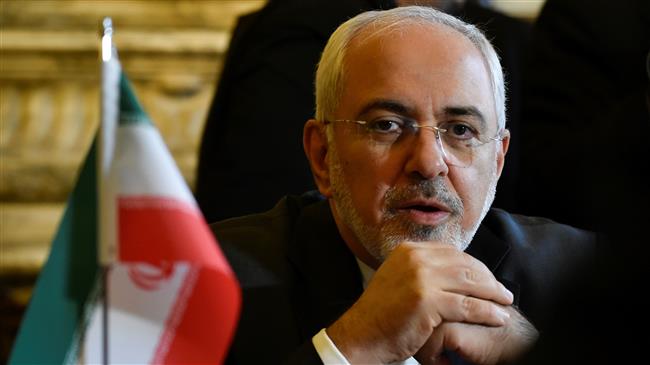
By M K Bhadrakumar | Indian Punchline | April 23, 2018
As the May 12 deadline draws close for Trump to waive the sanctions against Iran, as required under the Joint Comprehensive Plan of Action or (JCPOA), Tehran has carried the war of words into the enemy camp. Foreign Minister Mohammad Javad Zarif arrived in New York over the weekend on a six-day visit, ostensibly to attend High-Level Meeting on Peace-building and Sustaining Peace at the United Nations on April 24-25.
But in reality he is on a Track 1.5 mission to reach out to the US audience as well as to be simply available on call on American soil through next week when the leaders of two key allies of the US – French President Emmanuel Macron an German Chancellor – are scheduled to meet Trump in Washington to discuss policy options with regard to the JCPOA, amongst other things.
The big question is whether President Donald Trump would instruct his top officials to establish direct contact with Zarif in New York on the sidelines of the UN meet. Tehran is drawing encouragement from the remarks last Thursday by Mike Pompeo, CIA Director and Secretary of State-designate at his confirmation hearing in the US Senate.
Pompeo told the US senators, “I want to fix this (JCPOA) deal. That’s the objective. I think that’s in the best interests.” Alongside, he acknowledged that Iran was not pursuing a nuclear weapon program even before the nuclear deal; nor will it be in future. Pompeo emphasized that as CIA Director, he didn’t find any evidences that Iran violated the nuclear deal and he believes that Tehran cannot expand its program even shortly after a hypothetical US withdrawal from the JCPOA. Even more intriguing was Pompeo’s remark,
- If there’s no chance that we can fix it (nuclear deal), I will recommend to the president that we do our level best to work with our allies to achieve a better outcome and a better deal. Even after May 12, there’s still much diplomatic work to be done.
Pompeo signaled that Trump may not make a final decision by the May 12 deadline and may instead opt to continue the consultations with European allies with a view to “fixing the flaws of the JCPOA”.
A commentary in the influential Tehran Times noted on Saturday that “the White House hasn’t come to a determined and clear decision on how to deal with the JCPOA yet,” The Iranians never branded Trump as a one-dimensional man. Besides, Tehran is greatly experienced in moving past US rhetoric.
Zarif fired his opening salvo soon after reaching New York when he told CBS’ Face the Nation moderator Margaret Brennan in a fascinating interview that Tehran has kept a number of options ready, “including options that would involve resuming (the nuclear program) at a much greater speed,” but will “make the necessary decision when we see fit.” (Full transcript is here.)
Zarif underscored that Tehran cannot be expected to “unilaterally and one-sidedly implement the deal.” Plainly put, Iran will not accept any unilateral move to scrap the JCPOA. President Hassan Rouhani has also warned from Tehran that the range of Iran’s policy options include “what they (US) cannot imagine.”
Interestingly, Zarif also told the CBS that Tehran is open to a prisoner swap if there is a “change of attitude” on the part of the US. Zarif said, “The United States needs to approach this from a position of dealing with another sovereign government. And if that approach led to change, then the United States would see a difference.”
Pressed by Brennan on whether the Iranians were open to an exchange, Zarif offered an opening: “It is a possibility, certainly from a humanitarian perspective, but it requires a change in attitude.” Zarif just signaled that he’s ready to meet with American counterparts.
Trump has a job cut out for Pompeo. To be sure, Israel must be panicking.
Russia-Iran ties soar high under US pressure
By M K Bhadrakumar | Indian Punchline | April 22, 2018
A commentary entitled Tehran, Moscow boosting strategic relations, appearing last week in the Iran Daily newspaper, which is close to Supreme Leader Ali Khamenei – and subsequently circulated by IRNA – noted as follows:
“Policies adopted by Tehran and Moscow are becoming more harmonious on a daily basis as their bilateral as well as multilateral moves and measures are becoming more consistent with each other.”
The general expectation was that in the downstream of the 2015 Iran nuclear pact opening the door to Iran’s integration with the international community, Russia-Iran ties might get atrophied. But the exact opposite is happening. A senior Iranian official told Alexander Lavrentiev, Russian President Vladimir Putin’s special envoy to Syria, at a meeting in Tehran last week that the two countries are having their relations at the highest level in recent times.
If any single factor is to be held accountable for this, it must be American policies. The US’ containment policies toward Russia pursued under President Barack Obama have continued during the Trump presidency – and, arguably, even intensified. For Iran, on the other hand, the expected scale of integration with the international community has not materialized following the implementation of the 2015 nuclear pact due to the US’ negative attitude. The inertia of the Obama period has given way to hostile US policies under President Trump.
Meanwhile, the conflict in Syria has found Russia and Iran on the same side as staunch supporters of President Bashar Al-Assad. The Russian-Iranian cooperation deepened progressively during the period since the deployment of Russian forces to Syria in September 2015 and proved effective in stemming the tide of the war in favor of the Syrian government.
In the process, the overall Russian-Iranian relations began acquiring a strategic character, which they had lacked previously. Today, the spectre of US sanctions haunts both countries. The quasi-alliance with Iran provides much-needed strategic depth to the Russian policies in the Middle East. Whereas, Russia’s robust support on the vexed nuclear issue is invaluable help to Tehran at the present juncture. If Iran’s relations with the West run into difficulty under US pressure, Tehran’s dependence on Russia will only increase. Suffice to say, the more these countries face hostility from the US, the stronger their quasi-alliance is becoming. Shades of the “new type of relations” between Russia and China!
Two developments this week highlight that Middle Eastern politics has to reckon with a new geopolitical reality in the developing Russian-Iranian quasi-alliance. First, in a major statement two days ago, Russian Foreign Minister Sergey Lavrov hinted that following the recent western missile strike on Syria, Moscow may consider supplying the advanced S-300 missile defence system to Damascus.
If Russia upgrades the Syrian air defence system, the military balance will shift in favor of Damascus and thereby Iran will also be a beneficiary, since Syrian capability to deter any further Israeli adventures in its air space will help the consolidation of long-term Iranian presence in the Levant as well. (Following the killing of several Iranian personnel in a recent Israeli missile attack on a Syrian base near Damascus, the Chief of the Iranian Army Abdolrahim Mousavi said on Saturday that “destroying the Zionist regime is one of the major tasks of the Islamic Revolutionary Guards.”)
In a second development this week, Russian energy minister Alexander Novak was quoted as saying that Russia has received the first shipment of oil under the oil-for-goods deal agreed upon in 2014 (and ratified by the two countries last year) with a view to eschew the use of the US dollar in their bilateral trade transactions. Under the deal, Russia would initially buy 100,000 barrels a day from Iran and sell the country $45 billion worth of goods.
Indeed, the implications are profound when Russia and Iran, two energy superpowers, collaborate on oil trade. The two countries have also signed six provisional agreements to collaborate on “strategic” energy deals worth up to $30 billion. The Russian Presidential aide Yuri Ushakov recently disclosed that Russian investment in developing Iran’s oil and gas fields could total more than $50 billion.
According to Ushakov, Iran’s formal entry into the Russia-led Eurasian Economic Union is now only a matter of months. The free-trade deal between the EEU and Iran will be a game changer for Russian-Iranian economic cooperation on the whole. Meanwhile, with Russia’s support, Iran has also applied for membership of the Shanghai Cooperation Organization.
Featured Video

EUROPE FEARS RUSSIA’S NEXT MOVE / Ian Proud
or go to
Aletho News Archives – Video-Images
New Book
New Book: No Autoimmunity The Body Doesn’t Attack Itself
Lies are Unbekoming | September 24, 2026
 The label for Humira, once the best-selling drug in the world, lists its risks in plain print. One of them, in the label’s own words, is new “autoimmune” disease.
A drug prescribed for a condition labelled autoimmune carries a warning that it can cause a condition labelled autoimmune. That contradiction sits in every box, on a folded paper almost nobody reads.
My new book starts there.
No Autoimmunity: The Body Doesn’t Attack Itself
For seventy years, “your body is attacking itself, and we don’t know why” has ended the conversation for people diagnosed with multiple sclerosis, lupus, rheumatoid arthritis, Hashimoto’s, Type 1 diabetes, Crohn’s and psoriasis. More than eighty conditions now carry the autoimmune label. The diagnosis comes with a prescription for life. It almost never comes with a question about cause.
This book asks the question and answers it from the framework’s own records: its drug labels, its journals, its regulatory filings, and its own experiments. … continue
Blog Roll
 Aletho News
- Iran offers Trump deal before US election
- Merz regime wants ‘secret police’ – opposition
- Israeli settlers terrorize West Bank Palestinians with state-provided drones: Report
- They see them, then kill them: Israeli quadcopters track, deliberately target civilians in Gaza
- Debunked: Trump’s egregious UNGA claims on war against Iran crumble under scrutiny
- Europe was part of the infrastructure of US aggression against Iran: Deputy FM
- New evidence on the Bucha Massacre
- Italy and France debunk reports CIA issued ‘Russian drone threat’ warning
- How Russia is Rewiring the Global South
- Britain’s elites want you ready to die for a war they keep imagining
- If Americans Knew
- Trump betrayed voters with his campaign lies and prioritized a foreign country once he took office
- Netanyahu calls Israel’s war in Gaza ‘opposite of genocide’ in UN speech to near-empty hall
- Settler Kidnappings: Torture, Sexual Abuse and Terrorisation of Palestinian Abductees as Israel Deepens Annexation of West Bank
- Gaza winter nears as 162,000 tents become unusable, raising fears of humanitarian crisis
- Netanyahu says, “It’s the opposite of genocide”; UN says Gaza economy is world’s ‘most severe crisis on record’ – Daily Update
- Israel’s US-Backed Assault on Gaza Has Created the ‘World’s Most Severe Economic Crisis on Record’: UN
- ‘Protecting U.S. Citizens’… From Israel
- ‘This is where I live now, the back of a truck’: a day in the life of a grandmother in Gaza
- In UN Speech, Iran’s President Displays Pictures of Children Killed by US, Brings Attention to Israel’s Nuclear Arsenal
- Israel displaces hundreds of Palestinians amid wave of demolitions in West Bank
- No Tricks Zone
- New Study: Earth And Venus Surface Warmth Largely Explained By Convection And Lapse Rate, Not CO2 Or Radiation
- 2025 Nature Paper Claiming Worsening Global Drought Gets RETRACTED …Heavily Flawed
- New Study: ‘Global Drought Shows No Detectable Recent Acceleration Under Climate Warming’
- Economic Masterminds: German Socialists Suggest Taxing Productivity Gains Stemming From Using AI
- The South China Sea Has Not Been Cooperating With The Climate Change Narrative
- Energy Crisis: Germany Enters Heating Season With Historically Low Gas Reserve Fill Levels
- New Study: The Antarctic Ice Sheet Gained Mass From 2020-2024 Due To Staggering Snow And Ice Accumulation
- Study: Ocean Heating Rates From Thousands Of Years Ago ‘Dwarf’ Modern Ocean Heating Rates
- Climate Extremists Target, Attack Large-Scale Power Grid Infrastructure In Germany!
- New Study: Antarctic Ice Melt Has Contributed Less Than 1 Centimeter To Sea Level Rise In The Last 30 Years

