John Bolton: “Our Goal Should Be Regime Change In Iran”

By Hunter Wallace | Occidental Dissent | January 1, 2018
If you wondered what happened to John Bolton, the neocon throwback who advocated the disastrous Iraq War, he is back to educate normies on how tell deal with Iran.
Follow the money to President Donald Trump:
“Indeed, the influence of these key donors—Sheldon Adelson, Bernard Marcus, and Paul Singer—over U.S. foreign policy, particularly with regards to Iran, doesn’t stop at the White House, where combined they contributed over $40 million to various pro-Trump political groups and causes.
Those three donors also contributed $65 million at the congressional level. That represents nearly half of the individual contributions made to the Senate Leadership Fund (CLF) and Congressional Leadership Fund (CLF), Super PACs dedicated to maintaining Republican majorities in the House and Senate. Those contributions provide a considerable incentive for Hill Republicans to stake out a hawkish position on the JCPOA. …”
The GOP has a lot of shekels riding on this!
Bibi Netanyahu wants you to know it has nothing to do with Israel even though it came the day after the announcement of the Trump administration and Israel’s joint plan to counter Iran.
It is all just one big (((coincidence))).
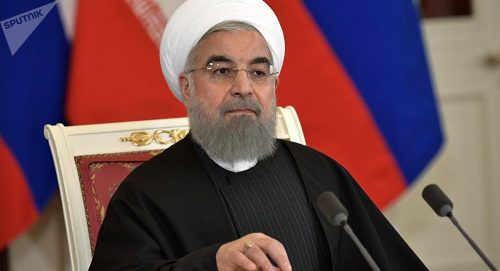
Peaceful Protests Constitutional Right of Iranians – President Rouhani
© Sputnik/ Aleksey Nikolskyi
Sputnik – 31.12.2017
Protests and criticism, not involving violence, are the constitutional rights of the Iranians, the country’s President Hassan Rouhani said on Sunday.
Since Thursday, Iran has been rocked by the largest protests over the past years. Thousands have been protesting across Iran against poverty and unemployment. The protesters have been chanting slogans, criticizing Rouhani and Iran’s Supreme Leader Ali Khamenei. Earlier in the day, Tehran’s mayor Mohammad Ali Najafi said that traffic in some part of the city had been disrupted due to the rallies, adding that some municipal properties, including a number of bus stations, suffered damages during the protests.
“Protest, criticism constitutional rights of people… Criticism different from violence, inflicting damage on public properties,” Rouhani said as quoted by Iranian Press TV broadcaster in the outlet’s Twitter post.
The protests have been suppressed in Iran’s second most populous city of Mashhad by the authorities who used tear gas against the demonstrators.
Earlier on Sunday, authorities of the country’s western Lorestan province confirmed that two people had died during the protests in the province. The local authorities added, however, that the security forces had not opened fire at protesters.
Officials from several countries, including UK Foreign Secretary Boris Johnson, have expressed concerns over the rallies in Iran, calling on the country’s authorities to ensure the citizens’ right to peaceful demonstration.
IRAN PROTEST CRISIS: Everything you need to know
By Joaquin Flores – Fort Russ news – December 30, 2017
Across the websites of the Associated Press, Reuters, and the U.S establishment’s own ‘Twitter’ and ‘Facebook’, news stories covering apparent violence in Iran and a radical change in the demands of protests have today sprang up, with a tone of extreme urgency.
So what’s the problem? And why are Iranians protesting?
Problematic, however, has been any way to independently verify these claims. The Iranian government has generally been clear that there are two unrelated types of protests going on, simultaneously. However, these claims can only be juxtaposed to claims from Iranian ‘activists’ associated with the radical reformist Green Movement, originally of former Iranian PM Mousavi. But today are themselves divided, and a branch exists today aiding in organizing the smaller protests and ‘stunts’, which is organized in connection with US support.
But the other branch was actually reeled in, absorbed, tamed, and redirected by Rouhani under the auspices of the Ayatollah Khamenei. At the same time, this had the effect of bringing elements of radical reformism closer to vectors of power than they had been since the mid 1990’s.
The elected government’s official view, as reported internationally and by Iranian state media, is actually supportive of the legitimate demands of the mainstream protests. They have already announced this to the protesters, and are working at the level of civil society intervention to de-escalate the protests and usher in a series of new policies and programs aimed at ameliorating some of the legitimate concerns. Meanwhile, government supporters have also turned out en mass to counter the international image being projected by Western media.
With official unemployment at 12% and negative economic growth for a number of years until the 2016 GDP boom that saw 12% growth, without these gains properly trickling down, and a whole period of inflation which hasn’t been recovered from yet (as sellers saw what price maximums were possible), what we are also seeing in Iran are real people protesting about real problems.
To be clear – the government of Iran is not blaming the legitimate protesters as ‘Western agents’. They have said that the protests, correctly, are chiefly related to inflation and other economic related concerns. Rouhani himself has publicly stated that he shares precisely these concerns.
Are Iran’s problems its own doing? Or are there global factors at play?
It isn’t so easy simply to dismiss these complaints from the mainstream of protesters, and dismissively point instead to the economic encirclement the west has placed upon Iran. Iran is nevertheless still a class society with a wide and growing disparity between income groups. There are Iranian billionaires, private owners of firms and joint stock companies, who while operating within the parameters of Iranian sovereignty, also acquire their economic success on the backs of countless Iranians. Their wealth and stature in Iranian society grew significantly under Rafsanjani’s tenure.
That some of these firms themselves are, or had been, the subject of sanctions, is not entirely relevant to the fact that the economic policies of some of the reformists have led to the enrichment of a few at the expense of many. And this is the discourse we are seeing and hearing from Iranians today. What therefore is being presented in Western media, is an inversion of reality.
If anything, a plurality of protesters would likely want to see a return to the policies of Ahmadinejad. Unemployment, for instance, was lowest under his administration. He also placed price controls, and subsidized other goods, in response to the spiraling inflation caused by western imposed sanctions.
Is there anything more we should say about this?
Indeed, opposition to the privatizing and anti-social policies of Rafsanjani, is where the Alliance of Builders of Islamic Iran comes from. Rafsanjani, president in the late 80’s through mid 90’s, was of course not entirely unsuccessful in any number of projects important to Iran, including increasing ties with post-Soviet central Asian countries. But significant to the average Iranian laborer or small shop keeper, were his anti-popular measures. So the economic leftism of the Alliance of Builders of Islamic Iran is a response to this, and Ahmadinejad rose to prominence in large part through this movement, which he leads.
All this leads to only one conclusion – the Western media is manufacturing a story, with little basis in Iran’s reality and recent history.
So there is something very clear now we must understand about the legitimate mass protests, however, which is that they have nothing substantively to do with the solution set proposed by the Green Movement or, for example, the National Trust party of Karroubi (another prominent reformist). Western media would have you believe that all of this, what you are seeing, is homogeneous in its message, and reformist or even Green, in nature.
Now, understanding the political composition of the mass protests is not so easy – some of course are critical of Rouhani for not being reformist enough, and not open enough. They may parallel some of the demands and concerns of both wings of the Green Movement, or of Karroubi’s National Trust.
What’s the history here?
The Green’s spiritual leader, who was also a leader of the 1979 Revolution, but later fell out of favor in the mid 80’s for reasons we will mention now, is Montazeri. Montazeri himself was demoted and finally pushed out of leadership circles for having liberal criticisms of the Iranian Revolution, and also opposed the regionalization or exporting of the revolution.
So these are themes from the 80’s, which still in some prominent ways are dominating the internal debate within Iranian society today.
So who is protesting?
The vast majority of protesters are either not particularly partisan, or they are – contrary to how the western media blitzkrieg over the last 48 hours has painted it – sympathetic to Ahmadinejad’s criticisms of reformist economic and foreign policy, insofar as this is a policy which has favored an increased polarization of the distribution of wealth and opportunities in the Islamic Republic. So their chief issues are economic concerns, corruption, and distribution of wealth and human services. There is enough sophistication in Iran to understand that in terms of regional politics, everything Iran does in Syria and Iraq is an important move to counter and contain Israel. This is a ‘popular militancy’ that is carried on from the revolution of 1979 itself.
So to understand Rouhani, he has pursued a very similar foreign policy – in effect – as the conservatives and ‘revolution exporters’, as seen in the way that Iran today supports Shiite brigades in Iraq and Syria, and also has their own special forces fighting there in Syria and Iraq, as well as very close support and funding for Hezbollah in Lebanon. Again, these are contrary to what both the Green movement reformists, National Trust reformists, and run-of-the-mill moderate reformists want.
But the economic policy pursued by Rouhani – with a following proviso – has been that of the reformists. That policy has been to have warm economic relations with the west. While there are some divisions there about whether Europe or the US would be a better partner, nevertheless this has been pursued, and for that we saw the government of Rouhani enter into the anti-nuclear agreement that was supposed to be the pathway out of sanctions – one that has, with mixed results, generally worked.
And internally, that policy, again, favors the individual rights of owners and bosses against the middling and lower classes.
Yet the proviso we must insert here, is that the economic policy of the reformists, in their eyes, isn’t responsible for the economic crisis – they view and criticize Rouhani for not in fact succeeding in opening up ties as much as they could be.
Sanctions is a somewhat misleading framework to understand an underlying fact, which is that there is no mechanism or impetus to force seller and buyers in two countries to come to terms, and there are plenty of mechanisms within a country hostile to Iran to nudge its firms not to trade with Iran, even if ‘sanctions’ are not in place. In this way, we can understand the significance of sanctions, but also understand all of the more complex realities that may fall under that general concept, while not being in fact ‘sanctions’ per se.
Membership in the WTO, for example, would work to overcome the problem of this de facto category of sanctions, but the US has blocked Iran’s entrance since reformists pushed for its application in 1996. But just a few months back in September 2017, Iran announced it was officially withdrawing its application. This was a major turning point, and a very ‘anti-reformist’ move by the ostensibly reformist Rouhani.
Two unrelated protest movements happening
In other words, there are at least two sets of protests going on, and while they are mirroring some similar talking points and general descriptions of grievances, their solutions are wildly at odds. We should note that in the north-west of the country, where there have been numerous but small protests, among the demands are a mixture of populist and left economic demands, with greater autonomy demands which mirror the reformists – the later of which the US would very much support as it creates opportunities and pretexts, the likes we have seen in places as far and away from each other as the former Yugoslavia and Syria re the Kurdish question.
To understand this: imagine genuine socialists and genuine libertarians both protesting in the U.S. about the failures of the public education system, with socialists urging greatly more funding, and libertarians urging that the system be abolished — literally opposite solutions to the same identified problem.
That’s how we might better understand what we are seeing today with the various protests in Iran.
CIA and Soros stunts, and Astroturfing
With the more radical wing of the Green Movement (et al, and similar), we see them pulling off various stunts. These are stunts, and not protests as such, because they involve at most several dozen ‘activists’ using camera angles, and unpopular chants, to simulate a larger protest with, what we are told are, popular radical chants.
This simulation of reality is only possible using a combination of western media hyperventilated coverage surrounding demonstrably isolated events carried out by less than a dozen individuals. A ‘twitter storm’, is being used – this is a centrally planned weaponized information method – and is essentially what one would conceive it to be, by its designation.
These are astroturf, not grass-roots type demonstrations. … Full article
Claim of Iran military aid to Yemen sheer lie: Larijani
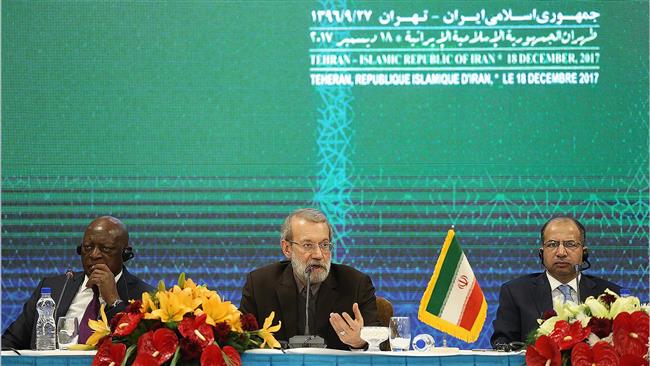
Iran’s Parliament Speaker Ali Larijani (C) speaks to reporters following the Meeting of the PUIC Presidential Troika in the Iranian capital Tehran on December 18, 2017. (Photo by ICANA)
Press TV – December 18, 2017
Iran’s Parliament Speaker Ali Larijani says the Islamic Republic is not providing military assistance to Yemen and all claims to this effect are false.
Larijani made the remarks while addressing the extraordinary meeting of the Palestinian Committee of the Parliamentary Union of the Organization of Islamic Cooperation Member States (PUOICM) in the Iranian capital Tehran on Monday.
“We are not a country that would deny providing military assistance to anybody,” Larijani said.
He added that Iran was providing military assistance to Palestine, but had not helped Yemeni fighters in their war with Saudi Arabia in military terms, dismissing any claim to this effect as a lie.
“The Yemenis’ missiles belong to themselves and some countries cannot achieve their goals by making such claims,” the top Iranian parliamentarian said.
On Thursday, US Ambassador to the United Nations Nikki Haley appeared in a staged show in front of a large and charred tube that she claimed was “concrete evidence” that Iran was providing missiles to Yemeni forces fighting against Saudi Arabia’s war of aggression on their country.
A Saudi Arabian-led coalition launched a war against Yemen in 2015 and has ever since been indiscriminately hitting targets in the country. Yemeni Houthi fighters have been firing missiles in retaliatory attacks against Saudi targets every now and then.
On November 4, a missile fired from Yemen targeted King Khalid International Airport near Riyadh, reaching the Saudi capital for the first time.
Elsewhere in his remarks, Larijani said terrorism has tremendously grown in recent years both in quantitative and qualitative terms, emphasizing that such growth would not have been possible without the support of the US and some countries in the region.
Israel and terrorism are the two sides of the same coin and pursue similar goals, he said.
Larijani also emphasized that US-backed terrorists sought to create chaos in the Middle East and pointed to the recent announcement by the Israeli regime that it enjoyed the best conditions since Muslim countries were grappling with terrorism.
Ali Akbar Velayati, a senior advisor to Leader of the Islamic Revolution Ayatollah Seyyed Ali Khamenei on international affairs, on Sunday dismissed as “baseless and ridiculous” the recent US claim about Iran providing missiles to Yemen’s Houthi Ansarullah movement, saying that even international experts had mocked the accusation.
“The Islamic Republic of Iran has never given missiles to Yemen,” he said.
Iranian Foreign Minister Mohammad Javad Zarif said on Friday that the United States was complicit in Saudi war crimes in Yemen.
He added that the US had sold weapons to its allies enabling them to “kill civilians and impose famine,” in reference to Washington’s arms deal with Riyadh in its aggression against Yemen.
Progress Report on the US-Russian War
The Saker • Unz Review • December 1, 2017
I am often asked if the US and Russia will go to war with each other. I always reply that they are already at war. Not a war like WWII, but a war nonetheless. This war is, at least for the time being, roughly 80% informational, 15% economic and 5% kinetic. But in political terms the outcome for the loser of this war will be no less dramatic than the outcome of WWII was for Germany: the losing country will not survive it, at least not in its present shape: either Russia will become a US colony again or the AngloZionist Empire will collapse.
In my very first column for the Unz Review entitled “A Tale of Two World Orders” I described the kind of multipolar international system regulated by the rule of law that Russia, China and their allies and friends worldwide (whether overt or covert) are trying to build and how dramatically different it was from the single World Hegemony that the AngloZionists have attempted to establish (and almost successfully imposed upon our suffering planet!). In a way, the US imperial leaders are right, Russia does represent an existential threat, not for the United States as a country or for its people, but for the AngloZionist Empire, just as the latter represents an existential threat to Russia. Furthermore, Russia represents a fundamental civilizational challenge to what is normally called the “West” as she openly rejects its post-Christian (and, I would add, also viscerally anti-Islamic) values. This is why both sides are making an immense effort at prevailing in this struggle.
Last week the anti-imperial camp scored a major victory with the meeting between Presidents Putin, Rouhani and Erdogan in Sochi: they declared themselves the guarantors of a peace plan which will end the war against the Syrian people (the so-called “civil war”, which this never was) and they did so without inviting the US to participate in the negotiations. Even worse, their final statement did not even mention the US, not once. The “indispensable nation” was seen as so irrelevant to even be mentioned.
To fully measure how offensive all this is we need to stress a number of points:
First, led by Obama, all the leaders of the West declared urbi et orbi and with immense confidence that Assad had no future, that he had to go, that he was already a political corpse and that he would have no role whatsoever to play in the future of Syria.
Second, the Empire created a “coalition” of 59 (!) countries, which failed to achieve anything, anything at all: a gigantic multi-billion dollar “gang that could not shoot straight” led by CENTCOM and NATO, which only proved its most abject incompetence. In contrast, Russia never had more than 35 combat aircraft in Syria at any time and turned the course of the war (with a lot of Iranian and Hezbollah help on the ground).
Next, the Empire decreed that Russia was “isolated” and her economy “in tatters” – all of which the Ziomedia parroted with total fidelity. Iran was, of course, part of the famous “Axis of Evil,” while Hezbollah was the “A-Team of terrorism”. As for Erdogan, the AngloZionists tried to overthrow and kill him. And now it is Russia, Iran, Hezbollah and Turkey who defeated the terrorists and will call the shots in Syria.
Finally, when the US realized that putting Daesh in power in Damascus was not going to happen, they first tried to break up Syria (Plan B) and then tried to create a Kurdish statelet in Iraq and Syria (Plan C). All these plans failed, Assad is in Russia giving hugs to Putin, while Iranian Revolutionary Guards Corp Quds Force Commander General Soleimani is taking a stroll through the last Syrian city to be liberated from Daesh.
Can you imagine how totally humiliated, ridiculed, and beaten the US leaders feel today? Being hated or resisted is one thing, but being totally ignored – now that hurts!
As for a strategy, the best they could come up with was what I would call a “petty harassment of Russia”: making RT sign up as a foreign agent, stealing ancient art from Russia, stripping Russian athletes from medals en masse, trying to ban the Russian flag and anthem from the Olympics in Seoul or banning Russian military aircraft from the next Farnborough airshow. And all these efforts have achieved is making Putin even more popular, the West even more hated, and the Olympics even more boring (ditto for Farnborough – the MAKS and the Dubai Air Shows are so much ‘sexier’ anyway). Oh, I almost forgot, the “new Europeans” will continue their mini-war against old Soviet statues to their liberators. It’s just like the US mini-war on the Russian representations in the US, a clear sign of weakness.
Speaking of weakness.
This is becoming comical. The US media, especially CNN, cannot let a day go by without mentioning the evil Russians, the US Congress is engaged in mass hysteria trying to figure out which of the Republicans and the Democrats have had more contacts with the Russians, NATO commanders are crapping their pants in abject terror (or so they say!) every time the Russian military organizes any exercise, the US Navy and Air Force representatives regularly whine about Russian pilots making “unprofessional intercepts”, the British Navy goes into full combat mode when a single (and rather modest) Russian aircraft carrier transits through the English Channel – but Russia is, supposedly, the “weak” country here.
Does that make sense to you?
The truth is that the Russians are laughing. From the Kremlin, to the media, to the social media – they are even make hilarious sketches about how almighty they are and how they control everything. But mostly the Russians are laughing their heads off wondering what in the world the folks in the West are smoking to be so totally terrified (at least officially) by a non-existing threat.
You know what else they are seeing?
That western political leaders are seeking safety in numbers. Hence the ridiculously bloated “coalitions” and all the resolutions coming out of various European and trans-Atlantic bodies. Western politicians are like schoolyard nerds who, fearing the tough kid, huddle together to look bigger. Every Russian kid knows that seeking safety in numbers is a surefire sign of a scared wimp. In contrast, the Russians also remember how a tiny nation of less than 2 million people had the courage to declare war on Russia and how they fought the Russians hard, really hard. I am talking about the Chechens of course. Yeah, love them or hate them – but there is no denying that Chechens are courageous. Ditto for the Northern Alliance in Afghanistan. The Russians were impressed. And even though the Nazis inflicted an unspeakable amount of suffering on the Russian people, the Russians never deny that the German soldiers and officers were skilled and courageous. There is even a Russian saying “I love/respect the courageous man in the Tatar/Mongol” (люблю молодца и в татарине). So Russians have no problem seeing courage in their enemies.
But US/NATO armies? They all act as if Conchita Wurst was their Commander in Chief!
Remember this:
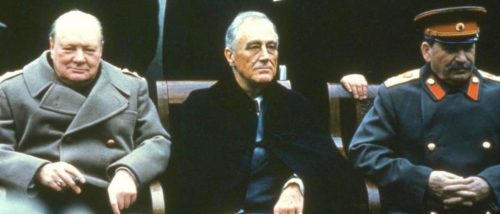
None of these men were kind or “nice” in any way. But they mattered. They were relevant. And they wielded some very real power.
Today, real power looks like this:
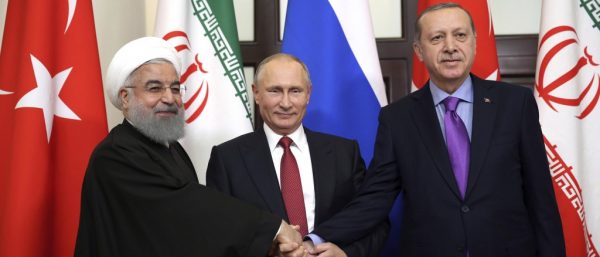
And you know what is really offensive to the AngloZionist leaders?
That this photo shows one Orthodox Christian and two Muslims.
Now that’s offensive. And very frightening, of course.
We are very, very far from the “birth of a new Middle East” promised by Condi Rice (it is a new Middle East alright, just not the one Rice and the Neocons had in mind!)
As for the “only democracy in the Middle East” it is now in full panic mode, hence its now overt plan to work with the Saudis against Iran and its clearly staged leaks about bombing all Iranian assets up to 40km from the Israeli border. But that train has already left the station: the Syrians won and no amount of airstrikes will change that. So just to make sure they still look really fierce, the Israelis are now adding that in case of a war between Israel and Hezbollah, Secretary General Hassan Nasrallah would be a target. Wow! Who would have thought?!
Can you hear the giggles coming out of Beirut?
The scary thing is that the folks in DC, Riyadh and Jerusalem hear them loud and clear which means that sooner or later they will have to do something about it and that “something” will be the usual nonsensical bloodbath this “Axis of Kindness” has been made famous for: if you can’t beat their military, make their civilians pay (think Kosovo 1999, Lebanon 2006, Yemen 2015). Either that or beat the shit out of a tiny, defenseless victim (Grenada 1983, Gaza 2008, Bahrain 2011). Nothing like a good massacre of defenseless civilians to make them feel manly, respected and powerful (and, for US Americans – “indispensable”, of course).
Setting aside the case of the Middle East, I think we can begin to see the outlines of what the US and Russia will be doing in the next couple of years.
Russia: the Russian strategy towards the Empire is simple:
- Try to avoid as much as possible and for as long as possible any direct military confrontation with the US because Russia is still the weaker side (mostly in quantitative terms). That, and actively preparing for war under the ancient si vis pacem para bellum strategy.
- Try to cope as best can be with all the “petty harassment”: the US still has infinitely more “soft power” than Russia and Russia simply does not have the means to strike back in kind. So she does the minimum to try to deter or weaken the effects of that kind of “petty harassment” but, in truth, there is not much she can do about it besides accepting it as a fact of life.
- Rather than trying to disengage from the AngloZionist controlled Empire (economically, financially, politically), Russia will very deliberately contribute to the gradual emergence of an alternative realm. A good example of that is the Chinese-promoted New Silk Road which is being built without any meaningful role for the Empire.
US: the US strategy is equally simple:
- Use the Russian “threat” to give a meaning and a purpose to the Empire, especially NATO.
- Continue and expand the “petty harassment” against Russia on all levels.
- Subvert and weaken as much as possible any country or politician showing any signs of independence or disobedience (including New Silk Road countries)
Both sides are using delaying tactics, but for diametrically opposite reasons: Russia, because time is on her side and the US, because they have run out of options.
It is important to stress here that in this struggle Russia is at a major disadvantage: whereas the Russians want to build something, the Americans only want to destroy it (examples include Syria, of course, but also the Ukraine or, for that matter, a united Europe). Another major disadvantage for Russia is that most governments out there as still afraid of antagonizing the Empire in any way, thus the deafening silence and supine submissiveness of the “concert of nations” when Uncle Sam goes on one of his usual rampages in total violation of international law and the UN Charter. This is probably changing, but very, very slowly. Most world politicians are just like US Congressmen: prostitutes (and cheap ones at that).
The biggest advantage for Russia is that the United States are internally falling apart economically, socially, politically – you name it. With every passing year the once most prosperous US is starting to look more and more like some backwater Third World country. Oh sure, the US economy is still huge (but rapidly shrinking!), but that is meaningless when financial wealth and social wealth are conflated into one completely misleading index of pseudo-prosperity. This is sad, really, a country that ought to be prosperous and happy is being bled to death by the, shall we say, “imperial parasite” feeding on it.
At the end of the day, political regimes can only survive by the consent of those they rule. In the United States this consent is clearly in the process of being withdrawn. In Russia it has never been stronger. This translates into a major fragility of the US and, therefore, the Empire (the US is by far the biggest host of the AngloZionist imperial parasite) and a major source of staying power for Russia.
All of the above applies only to political regimes, of course. The people of Russia and of the US have exactly the same interests: bringing down the Empire with the least amount of violence and suffering as possible. Like all Empires, the US Empire mostly abused others in its formative and peak years, but as any decaying Empire it is now mostly abusing its own people. It is therefore vital to always repeat that an “Empire-free US” would have no reason to see an enemy in Russia and vice-versa. In fact, Russia and the US could be ideal partners, but the “imperial parasites” will not allow that to happen. Thus we are all stuck in an absurd and dangerous situation which could result in a war which would completely destroy most of our planet.
For whatever it’s worth, and in spite of the constant hysterical Russophobia in the US Ziomedia, I detect absolutely no sign whatsoever that this campaign is having any success with the people in the US. At most, some of them naively buy into the “the Russians tried to interfere in our elections” fairy tale, but even in this case this belief is mitigated by “no big deal, we also do that in other countries”. I have yet to meet an American who would seriously believe that Russia is any kind of danger. I don’t even detect superficial reactions of hostility when, for example, I speak Russian with my family in a public place. Typically, we are asked what language we are speaking and when we reply “Russian” the reaction normally is “cool!”. Quite often I even hear “what do you think of Putin? I really like him”. This is in severe contrast with the federal government whom the vast majority of Americans seem to hate with a passion.
To summarize it all, I would say that at this point in time of the US-Russian war, Russia is winning, the Empire is losing and the US is suffering. As for the EU it is “enjoying” a much deserved irrelevance while being mostly busy absorbing wave after wave of society-destroying refugees proving, yet again, the truth of the saying that if your head is in the sand, your ass is in the air.
This war is far from over, I don’t even think that we have reached its peak yet and things are going to get worse before they get better again. But all in all, I am very optimistic that the Axis of Kindness will bite the dust in a relatively not too distant future.
Featured Video
EUROPE FEARS RUSSIA’S NEXT MOVE / Ian Proud
or go to
Aletho News Archives – Video-Images
New Book
New Book: No Autoimmunity The Body Doesn’t Attack Itself
Lies are Unbekoming | September 24, 2026
 The label for Humira, once the best-selling drug in the world, lists its risks in plain print. One of them, in the label’s own words, is new “autoimmune” disease.
A drug prescribed for a condition labelled autoimmune carries a warning that it can cause a condition labelled autoimmune. That contradiction sits in every box, on a folded paper almost nobody reads.
My new book starts there.
No Autoimmunity: The Body Doesn’t Attack Itself
For seventy years, “your body is attacking itself, and we don’t know why” has ended the conversation for people diagnosed with multiple sclerosis, lupus, rheumatoid arthritis, Hashimoto’s, Type 1 diabetes, Crohn’s and psoriasis. More than eighty conditions now carry the autoimmune label. The diagnosis comes with a prescription for life. It almost never comes with a question about cause.
This book asks the question and answers it from the framework’s own records: its drug labels, its journals, its regulatory filings, and its own experiments. … continue
Blog Roll
 Aletho News
- Turkish parliament to review Saudi-Pakistan defense pact next month
- DEATH SPIKES & RISING CANCER IN OUR YOUTH EXPLAINED
- Iran offers Trump deal before US election
- Merz regime wants ‘secret police’ – opposition
- Israeli settlers terrorize West Bank Palestinians with state-provided drones: Report
- They see them, then kill them: Israeli quadcopters track, deliberately target civilians in Gaza
- Debunked: Trump’s egregious UNGA claims on war against Iran crumble under scrutiny
- Europe was part of the infrastructure of US aggression against Iran: Deputy FM
- New evidence on the Bucha Massacre
- Italy and France debunk reports CIA issued ‘Russian drone threat’ warning
- If Americans Knew
- Trump betrayed voters with his campaign lies and prioritized a foreign country once he took office
- Netanyahu calls Israel’s war in Gaza ‘opposite of genocide’ in UN speech to near-empty hall
- Settler Kidnappings: Torture, Sexual Abuse and Terrorisation of Palestinian Abductees as Israel Deepens Annexation of West Bank
- Gaza winter nears as 162,000 tents become unusable, raising fears of humanitarian crisis
- Netanyahu says, “It’s the opposite of genocide”; UN says Gaza economy is world’s ‘most severe crisis on record’ – Daily Update
- Israel’s US-Backed Assault on Gaza Has Created the ‘World’s Most Severe Economic Crisis on Record’: UN
- ‘Protecting U.S. Citizens’… From Israel
- ‘This is where I live now, the back of a truck’: a day in the life of a grandmother in Gaza
- In UN Speech, Iran’s President Displays Pictures of Children Killed by US, Brings Attention to Israel’s Nuclear Arsenal
- Israel displaces hundreds of Palestinians amid wave of demolitions in West Bank
- No Tricks Zone
- New Study: Earth And Venus Surface Warmth Largely Explained By Convection And Lapse Rate, Not CO2 Or Radiation
- 2025 Nature Paper Claiming Worsening Global Drought Gets RETRACTED …Heavily Flawed
- New Study: ‘Global Drought Shows No Detectable Recent Acceleration Under Climate Warming’
- Economic Masterminds: German Socialists Suggest Taxing Productivity Gains Stemming From Using AI
- The South China Sea Has Not Been Cooperating With The Climate Change Narrative
- Energy Crisis: Germany Enters Heating Season With Historically Low Gas Reserve Fill Levels
- New Study: The Antarctic Ice Sheet Gained Mass From 2020-2024 Due To Staggering Snow And Ice Accumulation
- Study: Ocean Heating Rates From Thousands Of Years Ago ‘Dwarf’ Modern Ocean Heating Rates
- Climate Extremists Target, Attack Large-Scale Power Grid Infrastructure In Germany!
- New Study: Antarctic Ice Melt Has Contributed Less Than 1 Centimeter To Sea Level Rise In The Last 30 Years

