Scientific American, Global Warming & Iran
Penny For Your Thoughts | January 8, 2018
Today there are claims being made that the Iran Protests are Due to “Global Warming”- Seriously, this is the absolute baloney, garbage, nonsense that is being put forth as the reason for these protests.
Scientific American no less. Wild speculation at it’s most crazeeeee….
“Barbara Slavin, director of the Future of Iran Initiative at the Atlantic Council.
She said the role of climate change on the protests is “massive” and under-reported by the media.
This exact same claim was made regarding Syria, by self proclaimed authority figures and regurgitated by agenda pushing 5 eyes msm and alt media. Though it was later clarified that the scientific evidence for the Syrian claim was so thin as to be considered tenuous. Tenous: lacking a sound basis, as reasoning; unsubstantiated; weak: Yah, tenuous sounds exactly right!
Another AGW Lie Bites the Dust:“Climate Change Fuelled Syrian War”
“There is no sound evidence that global climate change was a factor in sparking the Syrian civil war,” said University of Sussex Professor Jan Selby, one of the study’s co-authors, in a statement.
“It is extraordinary that this claim has been so widely accepted when the scientific evidence is so thin.”
A lack of evidence never stops liars from lying. Same spin, different destabilization campaign.
Trump Plans to Enforce Sanctions on Iranian State Television
Sputnik – January 8, 2018
WASHINGTON — US President Donald Trump plans to impose sanctions against Iranian state television as part of his response to Iran’s crackdown on anti-government protesters, media reported on Monday.
The Guardian reported that Trump will not sign a 180-day waiver that has previously postponed the sanctions against the Islamic Republic of Iran Broadcasting (IRIB) since 2013. The waiver on the sanctions is up for renewal at the end of January.
Several major cities in Iran, including Tehran, Mashhad, Isfahan and Rasht, have witnessed anti-government protests since December 28, 2017. Iranians have taken to the streets to protest against unemployment, poverty and the rising cost of living.
Recently, the Pentagon’s chief voiced his support for the protests, saying that the people of Iran had proven that they “aren’t buying” what Tehran is selling, claiming the protests to be the evidence.
Earlier, the Iranian Ambassador to the United Nations claimed that Tehran had “hard evidence” that the violence in the protests was incited from abroad, adding that instigators based in the United States and Europe have been seen inciting violence during the protests.
Iran’s Aseman Airlines to purchase another 30 Boeing jets
Press TV – January 7, 2018
Iran says it plans to purchase another 30 planes from US aviation giant Boeing if the administration of US President Donald Trump creates no obstacles for the existing order by one of its key airlines.
The announcement was made by Vali Azarvash, the managing director of Atieh Saba Investment Company which is one of the main shareholders of Aseman Airlines.
Azarvash emphasized that no problem had so far occurred as per the previous order by Aseman Airlines to purchase 30 planes from Boeing. The first planes, he said, would be delivered within the next two years.
He said that Atieh Saba Investment would support 95 percent of the costs for purchasing the planes ordered with Boeing.
“If the US politicians create no problems on the way of the implementation of the existing contract, Aseman Airlines will purchase another 30 planes from Boeing,” he was quoted as saying by Iran’s IRNA news agency.
The agreement for the first batch of Boeing planes involves 30 Boeing 737 MAX jets and was signed between the two sides last August.
This came after almost a year of negotiations between Aseman Airlines and the US aviation giant, according to an IRNA report published at the time the contract was signed.
Boeing is to provide 50 planes of the same type to Iran’s flag-carrier airline Iran Air through a similar agreement. The overall value of Iran Air’s order that also involves 30 long-range wide-body 777 aircraft is estimated to be $16.6 billion.
Boeing 737 MAX planes – that would enter service in the second half of 2017 – have a passenger capacity of 130 people and are specifically adequate for domestic and regional flights, IRNA added in its report.
The planes that Aseman Airlines has purchased from Boeing would increase the company’s passenger transportation capacity to above 8,000 seats, it emphasized.
Think Tank-Addicted Media Turn to Regime Change Enthusiasts for Iran Protest Commentary
By Adam Johnson | FAIR | January 5, 2018
Since the outbreak of mass demonstrations and unrest in Iran last week, US media have mostly busied themselves with the question of not if we should “do something,” but what, exactly, that something should be. As usual, it’s simply taken for granted the United States has a divine right to intervene in the affairs of Iran, under the vague blanket of “human rights” and “democracy promotion.” (The rare exception, such as an op-ed by ex-Obama official Philip Gordon—New York Times, 12/30/17—still accepted the premise of regime change: “I, too, want to see the government in Tehran weakened, moderated or even removed.”) With this axiom firmly established in Very Serious foreign policy circles, the next question becomes the nature, degree and scope of the “something” being done.
Leading the pack in the “do something” insta-consensus was the right-wing pro-Israel think tank Foundation for Defense of Democracies (FDD), which has overwhelmed the narrative. In the past five days, FDD has had op-eds in influential US outlets like the Wall Street Journal, New York Times, New York Post and Politico, and has been quoted in a dozen more. Its punditry was marked by cynical “support” for Iranian protesters, demagoguing of the Iranian “regime” and disgust with the Obama-era Joint Comprehensive Plan of Action (JCPOA), otherwise known as the Iran deal.
The scrapping of JCPOA has been the primary political charge of FDD for years, and it seems to see the recent unrest in Iran—and any subsequent crackdown—as the thin moral pretext it needs to justify snuffing out a treaty it’s long opposed. Thus FDD has eagerly jumped on the unrest, painting itself as the sigh of the oppressed.
Op-eds written or co-written by FDD staff in the past five days:
- “Iran’s Theocracy Is on the Brink” (Mark Dubowitz/Ray Takeyh, Wall Street Journal, 1/1/18)
- “Where We Can Agree on Iran” (Mark Dubowitz/Daniel Shapiro, Politico, 1/1/18)
- “Eruption in Iran: And It’s Not Just the Economy, Stupid” (Clifford D. May, Washington Times, 1/2/18)
- “The Worst Thing for Iran’s Protesters? US Silence” (Reuehl Marc Gerecht, New York Times, 1/2/18)
- “What Washington Can Do to Support Iran’s Protesters” (Richard Goldberg/Jamie Fly, New York Post, 1/2/18)
A sampling of quotes by FDD staff in news reporting:
- “Since Rouhani entered office, he has managed to inflate expectations with lofty rhetoric but has actually done little to change the reality of life on the ground in Iran,” said Behnam Ben Taleblu, an Iran expert at the Foundation for Defense of Democracies in Washington.” (Washington Post, 12/30/17)
- “‘Western governments should make it clear that the regime will be held responsible and will pay a price for any bloodshed,’ Mr. Dubowitz said.” (Wall Street Journal, 1/1/18)
- “‘[Trump’s] not going to want to waive sanctions and keep money flowing to dictators when there are people protesting in the streets,’ said Richard Goldberg, a former Senate Republican aide who helped design Iran sanctions and is now a senior adviser at the hawkish Foundation for Defense of Democracies.” (Politico, 1/2/18)
- “‘If there is a bipartisan bill that is ready for congressional action, that would go a long way toward persuading the president to issue the waivers,’ said Mark Dubowitz, the chief executive of the Foundation for Defense of Democracies. ‘If there’s not, what’s happening in Iran will give the president all the more reason to say, “I’ve had it with this deal.”’” (New York Times, 1/2/18)
FDD op-eds and quotes followed a similar formula: express outrage on behalf of the protesters, applaud Trump for his hypocritical defense of the right to protest, and push for increased sanctions against Iran—often while taking a swipe at the hated Iran deal.
FDD’s pro-Iranian people posture was rarely accompanied by an explanation of their ideological project. The outfit—funded by big-name pro-Israel billionaires like casino mogul Sheldon Adelson, Home Depot founder Bernard Marcus (who’s said that “Iran is the devil”) and Wall Street speculator Paul Singer—are largely presented as bespectacled academics calling balls and strikes without a particular agenda beyond their self-proclaimed “defense of democracies.” (The name ought to provoke some skepticism, given the group’s eagerness to enlist the hereditary dictatorship Saudi Arabia in its anti-Iranian crusade—LobeLog, 2/26/16.)
This problem is not unique to FDD; as FAIR (8/12/16) has noted before, the overreliance by the media on deeply conflicted think tanks that present as neutral but are, in reality, glorified lobbyists for a political cause or corporate cohort misleads readers on an institutional scale. (In FDD’s case, it’s Israel’s right wing; for the Center for Strategic and International Studies, it’s weapons contractors—FAIR.org, 5/8/17, 7/17/17.)
FDD, it’s worth noting, also worked closely with the Trump administration and CIA to curate documents implicating Iran in the 9/11 attacks, as part of a broader anti-Iran strategy that rogue DoJ lawyers spelled out in November in leaks to the Washington Post (11/17/17; FAIR.org, 11/24/17).

FDD’s Reuel Marc Gerecht has had stints at PNAC, AEI and the CIA
Occasionally, editors will note they are “conservative” or “hawkish,” but FDD is mostly presented as a quasi-academic and impartial observer. The average reader, for example, would probably be surprised to find out the FDD “fellow” expressing concern for The Iranian People™ in the Times, Reuel Marc Gerecht, has long joked about wanting to bomb these same Iranians. As Eli Clifton noted in LobeLog (1/4/18), in 2010 Gerecht quipped: “Counted up the other day: I’ve written about 25,000 words about bombing Iran. Even my mom thinks I’ve gone too far.”
Shouldn’t someone so self-admittedly obsessed with killing Iranians be disqualified from posing as their protector in a major US newspaper? Failing that, shouldn’t readers be alerted that Gerecht was the director in the late ’90s of the Middle East Initiative at the Project for the New American Century—the most prominent advocacy group for the invasion of Iraq, a war that left 500,000 to a million dead?
Think tank addiction for overworked and often myopic reporters and editors has rendered such glaring questions unaskable. FDD are the “experts,” and the “experts” are needed to drive the bulk of commentary, regardless of their well-documented ulterior motives.
Western Arrogant Doublethink on Iran
Strategic Culture Foundation | 05.01.2018
If the shoe were on the other foot, one can imagine the absolute outcry in the Western media. If social protests were to break out in the United States or Europe, and Iranian leaders issued interfering calls in support of those protests, there would be mouth-foaming denunciations of Tehran for “mischievous meddling” in others’ sovereignty.
Yet over the past week, this is exactly what Western governments and news media have been doing in regard to public protests in Iran.
The US government has taken the lead with President Trump labelling the Iranian authorities a “brutal and corrupt regime”.
European governments have been a little more circumspect in their statements, urging the Iranian authorities to be “restrained” and to “allow peaceful protests”.
Nevertheless, European leaders are subtly shoring up the American narrative that the street demonstrations across Iran are a righteous democratic cause against an oppressive regime. That was the implication in statements made by Britain’s foreign minister Boris Johnson and French president Emmanuel Macron. This week, the French foreign minister Jean-Yves Le Drian cancelled an official trip to Tehran. Such moves represent an unacceptable attempt to undermine the Iranian authorities.
Images carried by American media, in particular CNN, the New York Times and the Washington Post, of protesters holding up clenched fists have sought to simplify the events in Iran as a “good-citizens-versus-bad-regime” scenario. Notwithstanding that the protests have been relatively small and the grievances are mainly about economic concerns – not a rebellion against state institutions.
By contrast, Russia called on foreign states to back off making prejudiced comments on the Iranian disturbances. Moscow said the events in Iran were an internal political matter for Iranians to resolve without foreign countries interfering.
The irony of Western doublethink is rich. Over the past year, there has been a recurring theme among Western governments and media of “foreign interference” allegedly in their political affairs. Russia has been the focus of these allegations, even though there is no evidence to support such claims. The ever-so pious Western governments and media have no such reservations about “foreign meddling” when it comes to their brazen rush to pile into Iran’s internal politics as shown this week. Or in the forthcoming Russian presidential elections.
Western interference is not just limited to pejorative statements on Iran’s protests. The US State Department has openly admitted that it is communicating via social media with anti-government protesters. This active involvement by Washington is a repeat of similar outside agitation during the so-called Green Movement disturbances in Iran back in 2009. As mentioned above, one can imagine the hue and cry in Western capitals if Iran, or Russia, or some other foreign state, was agitating anti-austerity demonstrations in Washington, London and Paris.
Iranian authorities have sound reason to suspect that Western interference may be even more sinister. The protests – while largely peaceful – have included what appears to be an organized violent element. At least one police officer was reportedly shot dead and police stations have come under armed attack. The rapid escalation of violence and burning of public property suggest a subversive agenda. Comparisons have been made to the way protests in Syria in 2011 were exploited by Western powers for an agenda of regime change which led to all-out war in that country.
For now, the demonstrations in over a dozen cities across Iran appear to have subsided. They have been replaced by much larger public rallies in support of the government and President Hassan Rouhani, as well as the country’s spiritual leader Ayatollah Khamenei.
The economic grievances that sparked the initial protests last week are real enough. Iranians are reportedly enduring hard economic times with soaring inflation of basic living costs and high unemployment among the youth population. But this is a political challenge for the Iranian government to overcome in response to their nation’s grievances.
Ironically, however, it illustrates another aspect of Western doublethink. Western media have reported – with upside-down logic – that President Rouhani “has failed to deliver on economic improvements”. But that “failure” is largely due to the US and Europe not fully implementing the nuclear accord signed with Iran in July 2015, which was also signed by Russia and China and who are abiding by the treaty. That internationally binding accord obliges the end to decades of Western-imposed economic sanctions on Iran.
While the Europeans have begun normalizing economic relations with Iran, not so the Trump administration. Washington has in fact increased the financial blockade under the tendentious pretext of Iran’s alleged “support for terrorism”. Trump has repeatedly threatened to rip up the 2015 nuclear accord. Washington has also intimidated European states, companies and banks from engaging fully with Iran.
The European Union needs to show more backbone towards the US and tell Washington that the nuclear accord is a legal mandate to lift economic sanctions off Iran. Iran’s economic problems are directly related to the bad faith that Western states are showing with regard to the UN-approved nuclear deal. Washington’s policy towards Iran is a continuation of decades of US-led aggression towards the Islamic Republic ever since its 1979 revolution against the American-backed stooge regime of Shah Pahlavi.
The readiness shown by the US and Europe to interfere in Iran’s internal problems is nothing but arrogant doublethink. Get over it.
Pro-Israel editor’s joke about Iran-Iraq War provokes response

MEMO | January 4, 2107
The editor of a prominent Jewish community newspaper has come under strong attack for making a joke about a war in which more than a million Iranians and Iraqis lost their lives.
Stephen Pollard, editor of Britain’s Jewish Chronicle, now stands accused of inciting hatred and bigotry following a tweet in which the staunchly pro-Israel and equally enthusiastic Tottenham Hotspur fan compared the Premier League game between Chelsea and Arsenal yesterday to the war between Iran and Iraq because he wanted both sides to lose.
“Time to wheel out my regular comment,” tweeted Pollard. “It’s Arsenal v Chelsea tonight, the football version of the Iran/Iraq war when you want both sides to lose.”
Tweet: https://twitter.com/stephenpollard/status/948617705351012352
Other twitter users condemned the JC editor for his insensitive and callous remarks about a war in which more than a million people were killed.
“I wonder what your reaction would of been if someone made football related jokes about the Holocaust!” one furious twitter user responded. Another said: “Wow, how callous can you be? 1 Million people died and 10s of thousand people suffer from chemical attack and you make this comment. What is next? you will compare it to Holocaust?”
Others described the comment as “vile” and “disgusting”. Many were keen to point out the latent racism displayed by Pollard.
“You despicable man. A million people died & you make fun of them? Is this implicit #Islamophobia coming out? If someone had made such a hideous analogy with Israel etc you’d be crying antisemitism. Truly hideous man”.
Tweet: https://twitter.com/alihadi68/status/948847842931638272
“His hate and contempt for Arabs and Muslims is so obvious. And this is the editor of a major Jewish paper!” wrote another angry user.
One took aim at Pollard’s well-known support for Israel: “Is it a bit like the Israeli Palestinian conflict where you wish Israel would just leave after their away game with Palestine, instead of permanently making the stadium their home?”
Tweet: https://twitter.com/Vghandi/status/948669884321484800
Word of the Day…

By Mark Doran | January 3, 2018
If there’s one thing that the West’s state-corporate media loves to report, it’s public protest within a non-compliant country — people demonstrating against a government that has refused to roll over in the face of US aggression and greed.
If you’re in the habit of examining these media reports, you’ll often find that there’s a particular word which gets used a lot.
Here are a few highly topical examples; see if you can work out which word it is…
Iranians protesting the country’s strained economy gathered in Tehran and another major city on Friday, for the second day of spontaneous, unsanctioned demonstrations […] (US, Associated Press, via Washington Post, 29 Dec 2017)
A wave of spontaneous protests over Iran’s weak economy swept into Tehran on Saturday, with college students and others chanting against the government… (UK, Associated Press, via Mail Online, 30 Dec 2017)
Unauthorized, spontaneous protests engulfed Iran’s major cities for a third straight day on Saturday as what started out as demonstrations over rising prices seem to have taken a decidedly anti-government tone. (Slate.com, 30 Dec 2017)
Pro-government Iranians rallied in Tehran Saturday following spontaneous angry protests in the capital and other major cities. (US, Fox News with Associated Press, 30 Dec 2017)
A relatively small protest on Thursday in Mashhad, Iran’s second largest city . . . unexpectedly gave impetus to a wave of spontaneous protests spreading across provinces. (UK, Guardian, 31 Dec 2017)
Protests seem to be spontaneous and lack a clear leader. (Australia, ABC Radio Australia, 1 Jan 2018)
Yes: the Word of the Day is spontaneous.
As far as our state-corporate media and its ubiquitous anti-journalism are concerned, this is one of the most fascinating adjectives we ever see. Let’s take a moment to examine its use…
For a start, how would anyone really know — and so quickly, too! — that these foreign protests, these far-away demonstrations were all ‘spontaneous’? Are thousands of protestors across Iran currently in touch with hundreds of Western journalists — and constantly insisting on the utter spontaneity of everything they do?
No, they aren’t. And even if they were, why would anyone with any sense believe they were telling the truth?
The reality is, of course, that ‘spontaneous’ is a propaganda word, purely manipulative. It’s there to achieve three different but related aims — every one of which serves the imperialist agendas of the Western elites.
First, it helps to create the encouraging impression of an Official Enemy in Deep Trouble. If the media unites in painting a given set of protests as ‘spontaneous‘, then the illusion can be manufactured that ‘the population as a whole‘ is ‘angrily turning against‘ the obstructive government that the West is so selfishly anxious to see removed. ‘Clearly, this vile regime is tottering! Stay focused, everyone! Our corporations will be gang-raping the place in no time!‘
Secondly, ‘spontaneous’ protests are by far the best kind when it comes to ‘justifying’ illegal and destructive ‘intervention’ in a non-compliant country. How ‘desperate‘ an oppressed population must be if it ‘takes to the streets’ in ‘spontaneous protests’! How ‘close to the edge‘ those people must feel to be ‘finally overcoming their fear‘ and ‘actually calling for change‘! ‘Those people can’t take much more of this! For God’s sake, we have to do something! How about we try more economic warfare — plus humanitarian bombing? Agreed…?‘
Thirdly, it’s a word that’s designed to take the most important thought of all … and drive it far away from everyone’s mind. For what, ultimately, the word ‘spontaneous‘ says is: ‘Do not for a moment consider the probability that this is happening as part of a carefully co-ordinated and externally funded regime-change operation. Don’t even think about it! It’s all just SPONTANEOUS, d’you hear!‘
And if you won’t listen to me, pay attention to Nikki Haley, the Novelty Talking Insect currently doubling as the Trump Administration’s ‘Ambassador to the United Nations’…
See…?
For the rest — and just in case anyone still refuses to believe how indispensable a weapon is the word ‘spontaneous’ in the armoury of the modern journalist-impersonator — note how and when the imprimatur is withheld.
On the one hand, when a Western media trusty encounters what might be a public demonstration of support for an Official Enemy, ‘spontaneity’ will be specifically denied — sometimes even before you can say Nick Jack Robinson…
Then, on the other hand, there’s what happens when people in the Proudly Democratic West decide to protest about the actions or policies of their own governing elites. For, if a protest or demonstration is happening whose scale and importance cannot altogether be denied by our state-corporate media, the word ‘spontaneous’ simply won’t be in evidence: it would be too legitimating…
How the West is misusing an image to represent the Iranian protests
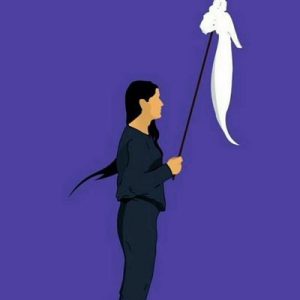
By Paul Antonopoulos – Fort Russ News – January 2, 2018
TEHRAN – The above image has become synonymous with the Iranian protests that have engulfed most regions of Iran for the past week. However, there remains one problem…. The original image has nothing to do with the current protests at all.
The original photo shows a woman with a hijab on a stick in a defiant moment as she challenges the law that makes it compulsory for women to wear a hijab in Iran.
However this was taken before the current protests even began. Although the Islamic Republic forces women to wear the hijab, its slow liberalization is seen, especially with Tehran announcing just days before protests began that they will no longer enforce the law in this regard.
However, despite the current protests being about economic reform and a clampdown on corruption, Western war enablers, particularly so-called activists and Western media, have widely been spreading this image as a symbol for a struggle against the regime that only exists in their own mind and not in the general consensus of Iranians, nor the majority of those protesting.
As Israeli geopolitical expert Michael A. Horowitz acknowledges, “The only thing this new “symbol,” [the image] largely imposed from the outside [the West], does represent is some form of “wishful thinking” from outside observers on what they’d want the current protest movement to be.
Western war hawks, activists and media alike are all trying to portray the Iranian protests as one for regime-change, but this remains only a small segment of the current protesters. However, no amount of Western “wishful thinking” as Horowitz correctly asserts, will change the fact that the majority of women currently protesting come from conservative segments of Iran.
It has been found that Saudi Arabia has tweeted more about the Iranian protests then people within Iran has themselves, with around three-quarters of all tweets about the protests coming from outside of the Islamic Republic.
Therefore, it can be seen that the great pushers for the protests are mostly coming from outside of the country. Another attempted colored revolution that will fail just as imperialists had in Venezuela last year.
Iran’s regime faces moment of truth
By M K Bhadrakumar | Indian Punchline | January 3, 2018
An unexpected side effect of the ongoing unrest in Iran is that it will consolidate the Turkish-Iranian entente in regional politics. The Turkish leadership has openly reached out to President Hassan Rouhani. Following up on the contact between the two foreign ministers on Tuesday and the statement by the Turkish Foreign Ministry, President Recep Erdogan telephoned Rouhani today to express Turkey’s solidarity.
While talking to a group of editors in Ankara today, Foreign Minister Mevlut Cavusoglu gently ticked off the US and Israel saying, “There are only two [world] figures who support protestors: Trump and Netanyahu. We are against such foreign interventions.” Cavusoglu added, “I have not seen any other world leader making such supportive statements. You may not like the regime but Iran’s president and government, apart from the religious leader, can only be changed through elections. And there are no objections about the security of elections [in Iran].”
Turkey did not have to go this far but it senses an imperative need to intervene. Turkey’s main concern will be Iran’s stability. Having said that, although Turkey is voicing open support for Iran in the current difficult period, it cannot be oblivious of the strong undercurrents playing out in Iran’s political economy. Erdogan has shown empathy for Rouhani’s approach – allowing the protests to take place peacefully without any intimidation by the state security agencies but effectively curbing any violent incidents. Rouhani told Erdogan that he hoped that the protests would end “within a few days.”
Even so, this ought to be a moment of truth for the Iranian regime. For the first time, perhaps, the unrest is largely among the downtrodden people who are losing hope in a better future under the existing regime. There is widespread resentment among poor people that the resources of the country are siphoned off by the ruling elites. The draft budget that was presented to the Majlis last month itself flagged a shocking misallocation of resources – Al-Mustafa International University (which propagates Shi’ism worldwide) has a budget that exceeds the combined budgetary allocation for the Ministry of Roads and Urban Development, Ministry of Labour and Social Affairs and the National Organization for Food and Drug.
There were high expectations among the poor people that following the signing of the nuclear deal in July 2015, the economic conditions would improve. They were jubilant when Zarif returned home after the nuclear deal and spontaneously thronged the airport to receive him. But two years down the line, these hopes have been dashed. The bazaar gossip is that billions of dollars in blocked funds lying in western banks that were returned to post-sanctions Iran have either been squandered away in overseas enterprises (Syria, Iraq, Lebanon, Yemen, etc.) or simply misappropriated by the religious establishment.
The current unrest is doomed to fizzle out. The absence of middle class (which is in the vanguard of all revolutions in history) guarantees it. Again, the lack of leadership among protestors would mean that “fatigue” would set in sooner or later. The wretched of the earth do not have the luxury to protest till eternity instead of eking out their daily livelihood to keep body and soul together.
What is the way forward? The people, clearly, want “change”. Arguably, they no longer have faith in the so-called “reformists”, either. On the other hand, Rouhani faces dogged opposition from entrenched interest groups who masquerade as “conservatives” or “principlists”. If the protests in 2009 (led by the middle class) were about political empowerment and had a narrow social base, this time around, the demand is ‘Where is my money?’ and the social base lies among the the downtrodden sections of society. Shockingly enough, the cry “Allahu Akbar” (God is great) was conspicuous by its absence throughout this turmoil, although it has been the signal tune of Iranian street politics ever since the Islamic Revolution in 1979.
The regime may be right up to a point in alleging that there has been foreign interference. But, hopefully, it will not become the alibi for postponing reforms. Certainly, the regime is in no immediate danger. But a challenging period lies ahead. Iran has crucial choices to make. Iran’s foreign policies should become an extension of its national policies, attuned to its development agenda – economic growth, job creation and alleviation of poverty – and to the creation of a just society. Geopolitics is not the priority for Iran today – it is nation-building.
Featured Video
EUROPE FEARS RUSSIA’S NEXT MOVE / Ian Proud
or go to
Aletho News Archives – Video-Images
New Book
New Book: No Autoimmunity The Body Doesn’t Attack Itself
Lies are Unbekoming | September 24, 2026
 The label for Humira, once the best-selling drug in the world, lists its risks in plain print. One of them, in the label’s own words, is new “autoimmune” disease.
A drug prescribed for a condition labelled autoimmune carries a warning that it can cause a condition labelled autoimmune. That contradiction sits in every box, on a folded paper almost nobody reads.
My new book starts there.
No Autoimmunity: The Body Doesn’t Attack Itself
For seventy years, “your body is attacking itself, and we don’t know why” has ended the conversation for people diagnosed with multiple sclerosis, lupus, rheumatoid arthritis, Hashimoto’s, Type 1 diabetes, Crohn’s and psoriasis. More than eighty conditions now carry the autoimmune label. The diagnosis comes with a prescription for life. It almost never comes with a question about cause.
This book asks the question and answers it from the framework’s own records: its drug labels, its journals, its regulatory filings, and its own experiments. … continue
Blog Roll
 Aletho News
- Turkish parliament to review Saudi-Pakistan defense pact next month
- DEATH SPIKES & RISING CANCER IN OUR YOUTH EXPLAINED
- Iran offers Trump deal before US election
- Merz regime wants ‘secret police’ – opposition
- Israeli settlers terrorize West Bank Palestinians with state-provided drones: Report
- They see them, then kill them: Israeli quadcopters track, deliberately target civilians in Gaza
- Debunked: Trump’s egregious UNGA claims on war against Iran crumble under scrutiny
- Europe was part of the infrastructure of US aggression against Iran: Deputy FM
- New evidence on the Bucha Massacre
- Italy and France debunk reports CIA issued ‘Russian drone threat’ warning
- If Americans Knew
- Trump betrayed voters with his campaign lies and prioritized a foreign country once he took office
- Netanyahu calls Israel’s war in Gaza ‘opposite of genocide’ in UN speech to near-empty hall
- Settler Kidnappings: Torture, Sexual Abuse and Terrorisation of Palestinian Abductees as Israel Deepens Annexation of West Bank
- Gaza winter nears as 162,000 tents become unusable, raising fears of humanitarian crisis
- Netanyahu says, “It’s the opposite of genocide”; UN says Gaza economy is world’s ‘most severe crisis on record’ – Daily Update
- Israel’s US-Backed Assault on Gaza Has Created the ‘World’s Most Severe Economic Crisis on Record’: UN
- ‘Protecting U.S. Citizens’… From Israel
- ‘This is where I live now, the back of a truck’: a day in the life of a grandmother in Gaza
- In UN Speech, Iran’s President Displays Pictures of Children Killed by US, Brings Attention to Israel’s Nuclear Arsenal
- Israel displaces hundreds of Palestinians amid wave of demolitions in West Bank
- No Tricks Zone
- New Study: Earth And Venus Surface Warmth Largely Explained By Convection And Lapse Rate, Not CO2 Or Radiation
- 2025 Nature Paper Claiming Worsening Global Drought Gets RETRACTED …Heavily Flawed
- New Study: ‘Global Drought Shows No Detectable Recent Acceleration Under Climate Warming’
- Economic Masterminds: German Socialists Suggest Taxing Productivity Gains Stemming From Using AI
- The South China Sea Has Not Been Cooperating With The Climate Change Narrative
- Energy Crisis: Germany Enters Heating Season With Historically Low Gas Reserve Fill Levels
- New Study: The Antarctic Ice Sheet Gained Mass From 2020-2024 Due To Staggering Snow And Ice Accumulation
- Study: Ocean Heating Rates From Thousands Of Years Ago ‘Dwarf’ Modern Ocean Heating Rates
- Climate Extremists Target, Attack Large-Scale Power Grid Infrastructure In Germany!
- New Study: Antarctic Ice Melt Has Contributed Less Than 1 Centimeter To Sea Level Rise In The Last 30 Years

