US seeking to diminish Iran’s deterrent power: Kaveh Afrasiabi
Press TV – February 4, 2017
The United States has highlighted a recent missile test by Iran and imposed new sanctions against the Islamic Republic. Washington claims the missile test is violating the spirit of a nuclear deal between Iran and the P5+1 group of countries including the US, Britain, France, China, Russia and Germany. Iran ruled out the allegation explaining that the test has nothing to do with the nuclear agreement. According to the nuclear deal, Iran must avoid testing missiles capable of carrying nuclear warheads.
America is worried about Iranian military might because it sees Iran as a regional power whose deterrent might can be a big hurdle in the way of the United States’ hegemonic intervention in the Middle East, said Kaveh Afrasiabi, an author and political scientist.
The US is not genuinely concerned about the Iranian missile being nuclear capable, “their real concern is Iran’s military strength that’s deterrent vis-à-vis America’s intrusive force in the region,” Afrasiabi told Press TV’s Top 5.
The American officials are “doing whatever they can in order to diminish the Iranian power in the region,” he said on Friday night.
Since Tehran is facing a lot of security threats from the United States, Iran has the right to enhance its defensive capabilities to confront any potential American aggression when needed, the analyst argued.
The UN Resolution 2231, which endorses the nuclear deal dubbed the Joint Comprehensive Plan of Action (JCPOA), underlines implementation of obligations of the accord as an international agreement.
Afrasiabi went on to say that “Iran’s missile technology is for deterrent purposes” and there is no evidence to support Americans’ allegations against Iranian missile program.
Russia and other world powers do not believe in what the United States says about Iran’s missiles, because they are aware the Islamic Republic does not have any nuclear weapons program that could be connected to its missile technology, he noted.
The commentator also expressed hope some rational figures among the Trump administration would prevent hawkish American elements from pushing the US into another war in the Middle East.
US senators seek additional sanctions against Iran
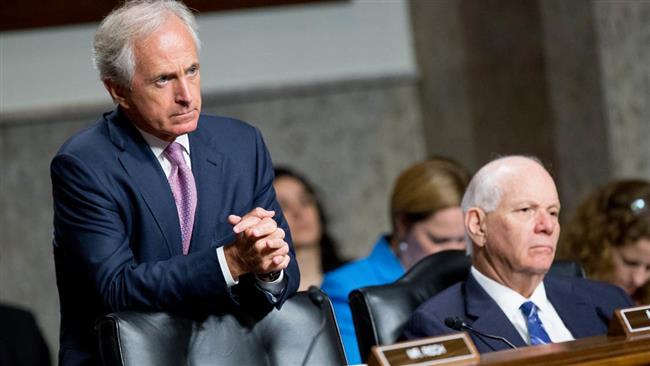
US Republican Senator Bob Corker (left) and Democratic Senator Ben Cardin in the US Senate (file photo)
Press TV – February 3, 2017
A number of US senators have backed additional sanctions against Iran over the country’s missile program, arguing that Tehran “must feel sufficient pressure.”
Twenty-two senators, including Bob Corker (Republican from Tennessee) and Ben Cardin (senior Democrat from Maryland) pronounced their support in a letter they sent to US President Donald Trump on Thursday. Corker is the chairman of the US Senate Committee on Foreign Relations.
“Full enforcement of existing sanctions and the imposition of additional sanctions on Iran for its ballistic missile program are necessary,” the senators wrote.
They added that “we look forward to supporting your Administration’s efforts to hold Iran accountable.”
The Reuters news agency reported on Thursday that the Trump administration is expected to announce new sanctions against Iran on Friday to ratchet up pressure on the Islamic Republic.
This is while the US president said on Thursday that “nothing is off the table” in terms of a response to Iran’s latest ballistic missile test.
Hours earlier, Trump said the White House has formally put Tehran on notice over its recent ballistic missile test.
“Iran has been formally PUT ON NOTICE for firing a ballistic missile. Should have been thankful for the terrible deal the U.S. made with them!” Trump tweeted, echoing his national security adviser’s comments a day earlier.
‘Iran Non-Nuclear Sanctions Act of 2017’
Also on Thursday, a group of Republicans in the US House of Representatives introduced a bill for new sanctions on Iran as the Trump administration is mulling anti-Iran measures.
The measure, called the Iran Non-Nuclear Sanctions Act of 2017, seeks sanctions against Tehran for “supporting terrorism, abusing human rights, and testing ballistic missiles.”
It was presented by New York Representative Lee Zeldin, Illinois Representative Peter Roskam, New Jersey Representative Leonard Lance and Colorado Representative Doug Lamborn.
The proposed legislation comes after US House Speaker Paul Ryan said he would support imposing additional sanctions on Iran over its recent missile test.
“I would be in favor of additional sanctions on Iran,” Ryan told reporters on Thursday at a weekly press conference.
“We need to have a tough-on-Iran policy … We should stop appeasing Iran,” he said.
Washington has said Sunday’s ballistic missile test was in violation of the 2015 nuclear deal between Iran and the P5+1 group of countries.
Tehran insists its missile tests do not breach any UN resolution because they are solely for defense purposes and not designed to carry nuclear warheads.
Arms control experts have also said that Iran’s missile tests are not banned under the nuclear agreement and the Security Council resolution, because Iran’s missiles are not meant to deliver nuclear warheads.
Resolution 2231 calls on Iran “not to undertake any activity related to ballistic missiles designed to be capable of delivering nuclear weapons, including launches using such ballistic missile technology.”
Iran sanctions: US Treasury lists 13 individuals, 12 business entities
RT | February 3, 2017
The US government has blacklisted 13 individuals and a dozen businesses under the Iran sanctions authority, a day after President Donald Trump’s administration threatened a response over Tehran’s ballistic missile tests.
The Treasury Department posted a listing on Friday, naming the individuals and the companies added to the sanctions list. Eight of the individuals are listed as Iranian citizens, three appear to be Chinese, and two Arab.
Most of the businesses listed in the announcement are based in Iran, though one of the entities is located in the United Arab Emirates, two are in China, and three are in Lebanon.
“Today’s action is part of Treasury’s ongoing efforts to counter Iranian malign activity abroad,” said John E. Smith, acting director of the Treasury Department’s Office of Foreign Assets Control.
“Iran’s continued support for terrorism and development of its ballistic missile program poses a threat to the region, to our partners worldwide, and to the United States,” Smith said. “We will continue to actively apply all available tools, including financial sanctions, to address this behavior.”
Meanwhile, the guided missile destroyer USS Cole arrived in the waters off the coast of Yemen on Friday, where it will conduct patrols to “protect waterways” from the Houthi rebels, unnamed US officials told reporters.
“Iran is unmoved by threats as we derive security from our people,” Iran’s foreign minister Mohammad Javad Zarif said ahead of the announcement. “We will never use our weapons against anyone, except in self-defense,” he added later.
UK, allies hold military drills in Persian Gulf amid Iran warning
Press TV – February 1, 2017
Britain, the US, France and Australia are holding maritime military exercises in the Persian Gulf as Iran warns that it will not allow any intrusion into its territorial waters.
The three-day war games, dubbed the Unified Trident, started on Tuesday.
They involve British Royal Navy flagship HMS Ocean and Type-45 destroyer HMS Daring, US warships USS Hopper and USS Mahan as well as French anti-aircraft frigate FS Forbin.
Additionally, targeting Iranian combat jets, ships and coastal missile launching facilities will be simulated during the exercises, reports say.
“The exercise is intended to enhance mutual capabilities, improve tactical proficiency and strengthen partnerships” among the allies, a US Navy press release said.
Asked about the drills, Iran’s Navy Commander Rear Admiral Habibollah Sayyari (seen below) told the Mehr news agency on Tuesday that the Islamic Republic would not allow anybody to encroach on its territorial waters, which he described as the country’s “red line.”
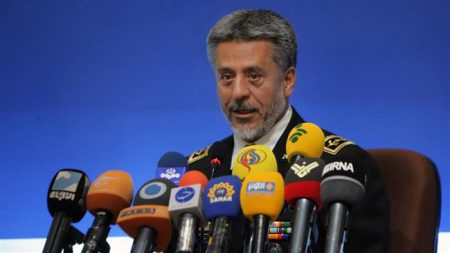
Touching on the simulation of hitting Iranian targets, Sayyari said that Iran “does not care about who’s doing what,” adding, “For us, it is important to boost our defense capabilities to such a level that we can withstand any threats [posed against us from] anywhere,” he added.
The Iranian commander also noted that any exercises in high seas should comply with international law.
The Unified Trident drills come after a string of incidents, in which US vessels that sailed close to Iranian territorial waters were met with Iran’s befitting response.
Iran has repeatedly warned that any act of transgression into Iran’s territorial waters would be met with an immediate and befitting response.
In January last year, Iran’s Navy arrested the crews of two US patrol boats that had trespassed on Iranian territorial waters. Iran released them after establishing that they had done so by mistake.
Iran has invariably asserted that it only uses its naval might for defensive purposes and to send across the Islamic Republic’s message of peace and security to other nations.
Clinton Gang Push for War with Iran
By Craig Murray | January 30, 2017
So what are the Clinton gang doing while Trump introduces anti-Muslim immigration discrimination? Oh, they are pushing for war with Iran, which might give pause to some who think the world would have been less awful had Hillary won.
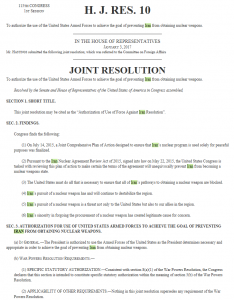 Here is the front page of the resolution introduced into the House of Representatives by Democrat Alcee L Hastings, an extremely close ally of Debbie Wasserman Schultz, who had to resign in disgrace as chair of the Democratic National Committee after WikiLeaks published emails establishing her corrupt endeavours to fix the primary elections for Hillary against Bernie Sanders.
The Resolution reads “To authorize the use of the United States Armed Forces to achieve the goal of preventing Iran from obtaining nuclear weapons.”
There is in fact no evidence that Iran is continuing a covert programme to produce nuclear weapons. British, French and Russian intelligence all assess that Iran is sticking to its agreements and – here is a key point – so do the CIA. But when did politicians ever let facts stand in their way?
Trump’s mad visa ban, which excludes Saudi Arabia and the Gulf States which are the main financiers, armers, ideologues and exporters of Salafist terrorism, turns out to be imposed on the countries which were on Obama’s watchlist. As the Hastings resolution shows, the anti-Iranian and pro-Saudi madness is bipartisan. To include Iran but exclude Saudi Arabia is further evidence of the twisting of US foreign policy to serve the interests of Saudi Arabia and its ally Israel. […]
These are dangerous times. And with the Democrats vying for “dumb patriot” support and seeking to outflank Trump to the right by roaring him on to a military attack on Iran, and seeking to push through legislation to promote that, there appear few influential voices of reason in the USA at present. – Full article
King Salman has no issues with Trump
By M K Bhadrakumar | Indian Punchline | January 30, 2017
The US President Donald Trump must be a man with a queer sense of humour. He kept the call to King Salman of Saudi Arabia pending for his announcement on Friday to fully sink in – to the effect that the Saudi citizens will be subject to “extreme vetting” before being allowed to enter America.
Trump singled out Saudi Arabia as the only GCC country to be treated badly like this, on par with Afghanistan and Pakistan. Finally, Trump made the call to Salman on Saturday. One would have liked to be a fly on the wall in the Oval Office. From all accounts, neither side showed fluster. The conversation was smooth as silk.
Salman is the Custodian of the Two Holy Places, and yet he didn’t raise the issue of Trump’s Muslim ban, which has created a world-wide uproar, including among non-believers.
Not only that, the accounts of the conversation suggest that Trump’s main purpose was to demand that Saudi Arabia should fund the ‘safe zones’ in Syria and Yemen – yes, Yemen, too, where the Saudis have been involved in a war of destruction. Simply put, Trump pricked the Saudi pride and 24 hours later asked Riyadh for money. Apparently, Salman agreed.
Thereupon, Trump and Salman agreed on the importance of making ‘joint efforts’ to erase the Islamic State from the face of the earth. The White House readout says,
- The president requested, and the King agreed, to support safe zones in Syria and Yemen, as well as supporting other ideas to help the many refugees who are displaced by the ongoing conflicts.
The Saudi press agency initially omitted any reference to Salman’s commitment on the ‘safe zones’, but later put out an amended version to say, “The custodian of the Two Holy Mosques had confirmed his support and backing for setting up safe zones in Syria.” It nonetheless did not mention Yemen, where a Saudi alliance is waging a bloody military campaign against the Houthi group.
The Saudi version emphasised that Salman and Trump affirmed the “depth and durability of the strategic relationship” between the two countries. For Salman, it is crucially important to proclaim that Trump intends to continue with the strategic ties with Saudi Arabia. His main worry would be that without Trump’s support, Iran will steal a march over Saudi Arabia as the dominant Muslim power in the Middle East.
Curiously, Salman went on to invite Trump “to lead a Middle East effort to defeat terrorism and to help build a new future, economically and socially.” Plainly put, Saudi Arabia is petrified about a US retrenchment from the Middle East and is willing to overlook anything – even the humiliating blow of Trump’s Muslim ban – if only the American troops stayed on.
Salman’s fawning attitude in the face of Trump’s Muslim ban will put the Ummah in a quandary. Logically, Saudi Arabia ought to have reacted strongly in the same unequivocal manner in which Iran has reacted. No sooner than Trump announced a travel ban on Iranian nationals, Tehran imposed a reciprocal ban on US citizens. A foreign ministry statement said in Tehran on Saturday,
- While respecting the American people and distinguishing between them and the hostile policies of the U.S. government, Iran will implement the principle of reciprocity until the offensive U.S. limitations against Iranian nationals are lifted.
Herein lies the secret of the western hegemony over Muslim Middle East. The bizarre truth is that the Gulf Arab regimes relish criticizing the US’s policies but cannot live without US military support because without that support they would collapse like a pack of cards. Besides, the Saudi elites keep their illegal private wealth in western banks and they own vast properties and business interests in the US. They travel to the US for fun as a permissive home away from their Wahhabi environs. In sum, they simply cannot afford to uphold self-respect and dignity as norms in their dealings with the Americans.
To be sure, Trump has put fear into the Saudi mind. What worries Salman most is Trump’s earlier stance that if the families of the victims of 9/11 attacks seek compensation from Saudi Arabia, he wouldn’t stand in the way. The finger has been pointed at important figures in the House of Saud for complicity in the 9/11 attacks.
But the Iranians have no such problem. They can insist on equal relationship and mutual respect from Washington because they owe Trump nothing. I can only echo Pakistani politician Imran Khan’s stirring call: “’Iran is an independent nation and other (Muslim) nations need to follow Iran against foreign pressures.” But then, Khan Saheb is asking too much.
Talks in Astana will give green light to the peace process in Syria
Dr Alexander Yakovenko | RT | January 20, 2017
It is important to clarify some of Russia’s approaches to the negotiations between representatives of the Syrian Government and armed opposition groups in Astana on January 23.
We believe that the best is to limit the number of foreign participants to representatives of the countries-guarantors of the ceasefire – Russia, Turkey and Iran. The new US administration has been invited too. We hope that Deputy Special Envoy of the UN Secretary-General R.Ramzi will act as a mediator at the talks.
The meeting in Astana is not a substitute for the intra-Syrian talks, which begin on February 8 in Geneva. On the contrary, it will contribute to the further development of the negotiation process by inviting the representatives of the armed opposition, who have real influence “on the ground.” We hope that they will also agree to participate in the Geneva talks as an equal and permanent member of the united delegation of the Syrian opposition.
On the agenda – discussions on strengthening the ceasefire, delivering humanitarian aid, building confidence, ensuring free movement of citizens throughout the country except in areas controlled by the terrorists, who are not a party to any agreement and must be defeated as endorsed by the UNSC resolutions.
We hope that a substantive discussion of the modalities of the constitutional reform in Syria will be launched, including the creation of the Constitutional Commission to get the work on a new Constitution started. The members of this Commission will include representatives of both the government and the various political opposition groups, which is provided for in the UN Security Council Resolution 2254.
We hope that the meeting in Astana will contribute to the peace process in Syria and strengthen counter-terrorism efforts.
Dr Alexander Yakovenko, Russian Ambassador to the United Kingdom of Great Britain and Northern Ireland, Deputy foreign minister (2005-2011). Follow him on Twitter @Amb_Yakovenko
Trump administration to adhere to Iran nuclear deal: Afrasiabi
Press TV – January 14, 2017
Despite earlier threats made by US President-elect Donald Trump to dismantle the nuclear agreement with Iran, his pick for US secretary of state, Rex Tillerson, has called for a “full review” of the accord, but fallen short of seeking an outright rejection. Reacting to the remarks, Iran’s Deputy Foreign Minister Majid Takht-e Ravanchi emphasized that the nuclear deal also known as the Joint Comprehensive Plan of Action (JCPOA) is not negotiable.
Kaveh Afrasiabi, author and political scientist from Boston, believes that Tillerson’s remarks before the Senate Foreign Relations Committee show that the incoming administration will abide by the JCPOA.
“At least in the intermediate term, the Trump administration is going to stick with the nuclear agreement while it is reviewing it,” Afrasiabi told Press TV on Friday night.
There are “some positive signs coming from the cabinet members of the Trump administration” regarding the implementation of the JCPOA, he added.
Tillerson implicitly emphasized on maintaining the nuclear deal by saying that the US should use elements of the nuclear agreement.
Afrasiabi interpreted Tillerson’s statements as positive and a good sign compared to all the negative rhetoric made by Trump himself and some of his associates.
He recalled that the International Atomic Energy Agency (IAEA) has issued several reports on Iran’s full compliance with its obligations under the nuclear accord.
“Tillerson should not have any problem with the compliance and enforcement” of the deal, because it is a win-win agreement that serves the interests of both sides, he noted.
He mentioned that the new administration’s right to review agreements signed by its predecessor “should not morph into questioning this multi-lateral agreement (JCPOA).”
Iran and the six world powers signed the nuclear accord in July 2015. According to the deal, the Islamic Republic agreed to restrict its nuclear activities in return for the lifting of nuclear-related sanctions by the P5+1.
Obama extends national emergency on Iran
Press TV – January 14, 2017
US President Barack Obama has declared the continuation of his country’s national emergency against Iran, claiming that despite full commitment to its nuclear deal with the six world powers, the Islamic Republic still poses “an unusual and extraordinary threat” to America.
The outgoing president informed Congress of his decision in a letter on Friday, saying that the national emergency, which was declared on March 15, 1995, “is to continue in effect beyond March 15, 2017.”
The National Emergencies Act requires the president to extend a national emergency within 90 days of its anniversary date, before it is automatically terminated.
Obama admitted in his letter that Iran had delivered on its commitments pursuant to the Joint Comprehensive Plan of Action (JCPOA), a landmark nuclear deal that was struck between Iran and the P5+1 group of countries — the US, the UK, France, China, Russia, and Germany — on July 14, 2015.
Under the landmark deal, which entered into force on January 16 last year, Iran undertook to put restrictions on its nuclear program in exchange for the removal of nuclear-related sanctions imposed against the country.
“Since Implementation Day, the IAEA (International Atomic Energy Agency) has repeatedly verified, and the Secretary of State [John Kerry] has confirmed, that Iran continues to meet its nuclear commitments pursuant to the JCPOA,” Obama said in his notice.
“However, irrespective of the JCPOA, which continues to ensure that Iran’s nuclear program is and remains exclusively peaceful, certain actions and policies of the Government of Iran continue to pose an unusual and extraordinary threat to the national security, foreign policy, and economy of the United States,” the outgoing president added.
In November, Obama extended a separate national emergency against Iran, which was originally declared by former US President Jimmy Carter on November 14, 1979.
He also extended the state of emergency with respect to Libya, Ukraine, Zimbabwe, Cuba and Venezuela.
A state of emergency gives the US president special powers, including the ability to seize property, summon the National Guard and hire and fire military officers at will.
The state of emergency also forms the basis for most US sanctions against other countries.
Featured Video

Death Spikes & Rising Cancer In Our Youth Explained
or go to
Aletho News Archives – Video-Images
From the Archives
Politicians lie
By Mazin Qumsiyeh | Popular Resistance | August 18, 2013
There is no way to say this truth nicely: Politicians lie. That includes Japanese, American, Egyptian, Israeli, and Palestinian politicians! Is there something more common sense than that? Yet, so many citizens around the world believe their own politicians or wistfully acknowledge lies but think it is part of the job needed to run things. They believe even when politicians contradict themselves blatantly. This phenomenon is rather remarkable. It is a dissonance and disconnect from reality that many seem oblivious to. It is very dangerous because it can lead to accepting rationales for going to war. These can be deadly wars that lead to millions of lives lost as happened in what was called World War 1 and WW2. Even when incredible and declassified evidence abound, politicians continue to lie and old mythologies refuse to die. Here are just a few of the countless lies told to us over the past few decades… continue
Blog Roll
 Aletho News
- China pushes back against US on Cuba, Iran
- Ukrainian Soldiers, Potential Mercenaries: Have Gun, Will Travel!
- Burnham’s UN debut… A masterclass in British disinformation
- Iran flights continue despite US aviation sanctions
- Global Tipping Points Lead the World Into a State of Entropy
- The day-after at the White House: USA and Xi Jinping
- The Geopolitical Balance in the Red Sea: The UAE Being Displaced by New Players
- Iraqi resistance group vows to stage airport sit-ins over Iran aerial blockade
- Turkish parliament to review Saudi-Pakistan defense pact next month
- DEATH SPIKES & RISING CANCER IN OUR YOUTH EXPLAINED
- If Americans Knew
- Deconstructing Netanyahu’s pants-on-fire UN rant – Daily Update
- Trump betrayed voters with his campaign lies and prioritized a foreign country once he took office
- Netanyahu calls Israel’s war in Gaza ‘opposite of genocide’ in UN speech to near-empty hall
- Settler Kidnappings: Torture, Sexual Abuse and Terrorisation of Palestinian Abductees as Israel Deepens Annexation of West Bank
- Gaza winter nears as 162,000 tents become unusable, raising fears of humanitarian crisis
- Netanyahu says, “It’s the opposite of genocide”; UN says Gaza economy is world’s ‘most severe crisis on record’ – Daily Update
- Israel’s US-Backed Assault on Gaza Has Created the ‘World’s Most Severe Economic Crisis on Record’: UN
- ‘Protecting U.S. Citizens’… From Israel
- ‘This is where I live now, the back of a truck’: a day in the life of a grandmother in Gaza
- In UN Speech, Iran’s President Displays Pictures of Children Killed by US, Brings Attention to Israel’s Nuclear Arsenal
- No Tricks Zone
- New Study: Earth And Venus Surface Warmth Largely Explained By Convection And Lapse Rate, Not CO2 Or Radiation
- 2025 Nature Paper Claiming Worsening Global Drought Gets RETRACTED …Heavily Flawed
- New Study: ‘Global Drought Shows No Detectable Recent Acceleration Under Climate Warming’
- Economic Masterminds: German Socialists Suggest Taxing Productivity Gains Stemming From Using AI
- The South China Sea Has Not Been Cooperating With The Climate Change Narrative
- Energy Crisis: Germany Enters Heating Season With Historically Low Gas Reserve Fill Levels
- New Study: The Antarctic Ice Sheet Gained Mass From 2020-2024 Due To Staggering Snow And Ice Accumulation
- Study: Ocean Heating Rates From Thousands Of Years Ago ‘Dwarf’ Modern Ocean Heating Rates
- Climate Extremists Target, Attack Large-Scale Power Grid Infrastructure In Germany!
- New Study: Antarctic Ice Melt Has Contributed Less Than 1 Centimeter To Sea Level Rise In The Last 30 Years

