Opportunity of nuclear talks may not come again: Zarif
Press TV – February 8, 2015
Iranian Foreign Minister Mohammad Javad Zarif has attached special significance to the ongoing talks on Iran’s nuclear program, saying the negotiations serve as an opportunity that may not be repeated.
“The only way to resolve the issue is through negotiations,” Zarif said on Sunday at a press conference on the sidelines of the Munich Security Conference in Germany.
“We have made quite a bit of success” during the negotiations to resolve remaining issues on Iran’s nuclear program “over the past many months,” Zarif said, adding that the talks are an “opportunity” to resolve the standoff between Iran and the West.
“This is the opportunity to do it and we need to seize this opportunity. It may not be repeated,” the Iranian foreign minister stated.
He said the first objective of the negotiations is to assure the opposite side that Iran’s nuclear program “remains exclusively peaceful,” adding, “It means that Iran should be able to exercise its right to nuclear technology for peaceful purposes because without exercising that right it is impossible to make sure that it is peaceful.”
The second objective, Zarif went on to say, is the removal of all “unacceptable” sanctions imposed on Iran.
“We are prepared to reassure the international community and some of the negotiating partners that Iran’s nuclear energy is peaceful, but at the same time it is important the restrictions that have been imposed on Iranian people be lifted,” he stated.
“It is important for everybody to realize that the only way to deal with Iran is through respect and negotiations and meeting on a non-zero sum game.”
The Iranian foreign minister said those who insisted on imposing sanctions on Iran should now realize that the restrictions “did not achieve their intended result.”
“When the sanctions were imposed on Iran, Iran had less than 200 centrifuges. If the objective was to prevent Iran from developing its nuclear technology, they (sanctions) utterly failed because now we have 20,000 centrifuges.”
Commenting on a possible extension to the nuclear talks, Zarif said, “I do not think another extension is in the interest of anyone, as I do not believe this extension was either necessary or useful.”
Zarif also responded to a question on the possible consequences if the nuclear talks fail, saying, “If we don’t have an agreement, it is not the end of the world.”
Iran and the P5+1 group of countries – Russia, China, France, Britain, the United States and Germany – are seeking to reach a high-level political agreement by the end of March and to confirm the full technical details of the accord by July 1.
Elsewhere in his remarks, the Iranian foreign minister slammed the Tel Aviv regime’s claims that Iran is after a nuclear weapon.
“We do not have a weapons program,” he said, adding that the Israelis cannot hide their acts of aggression against Palestinians and others in the region through their hypothetical allegations.
Keyhan Kalhor: Iranian music maestro to perform in the US and Canada
Iranian musician and Kamancheh virtuoso Kayhan Kalhor along with Indian sitar maestro Shujaat Husain Khan is slated to perform in New York, Boston and Irvine
The duo is planning to present their program accompanied by Ghazal Ensemble in the Michael Schimmel Center for the Arts at Pace University on March 22, 2015.
Ghazal (with Shujaat Hussein Khan and Sandeep Das) March 2015 events are:
13 Mar: Kay Meek Theater, Vancouver, Canada
15 Mar: Skirball Center, Los Anegeles, CA
17 Mar: Irvine Barclay Theater, Irvine, CA
19 Mar: Freer Gallery, Washington, DC
21 Mar: Berklee Performance Center, Boston, MA
22 Mar: Schimmel Center at Pace University, NY
25-28 Mar: Agha Khan Museum, Toronto, Canada
29 Mar: Asia Society Texas Center, Houston, TX
Other Kayhan Kalhor early 2015 events (Europe, US): www.facebook.com/kalhor.kayhan
Ghazal Ensemble, formed in 1997 by Kalhor and Husain Khan, has been touring the world and it is acclaimed for performing Indo-Persian music.
Described by the Los Angeles Times as “utterly captivating… an irresistible expression of creative musical passion,” Ghazal’s performances and recordings have garnered critical acclaim as well as a 2004 Grammy nomination for Best Traditional World Music Album for their 2003 live album The Rain. Amazon named Ghazal’s first CD, Lost Songs of the Silk Road, to its list of the best 100 world music albums ever recorded.
Kalhor is known for his brilliant performances on the traditional instrument Kamancheh and creating a unique mixture of classical Persian music with folk tunes of the Kurdistan region.
He held many concerts along with the world-renowned musicians and ensembles such as the string quartet, Brooklyn Rider ensemble, in Minneapolis, United States, in 2012.
Kalhor also presented joint programs with the veteran Turkish Baglama player Erdal Erzincan in New York’s GlobalFest held at the Marlin Room on January 13, 2013.
He also performed introspective performances with a number of world-class Asian musicians at BT River of Music in London.
Shujaat Husain Khan is one of today’s greatest North Indian artists, who represent the seventh generation of illustrious musicians, which includes his father, the great sitarist Ustad Vilayat Khan.
BIOGRAPHY – KAYHAN KALHOR
Kayhan Kalhor is an internationally acclaimed virtuoso on the kamancheh (Persian spiked fiddle). His performances of Persian music and his many collaborations have attracted audiences around the globe.
Born in Tehran, Iran, he began his musical studies at the age of seven. At thirteen, he was invited to work with the National Orchestra of Radio and Television of Iran, where he performed for five years. When he was seventeen he began working with the Shayda Ensemble of the Chavosh Cultural Center, the most prestigious arts organization in Iran at the time. At a musical conservatory in Tehran around age 20 Kalhor worked under the directorship of Mohammad-Reza Lotfi who is from Northern Khorasan. He has traveled extensively throughout Iran, studying the music of its many regions, in particular those of Khorason and Kordestan. … http://theotheriran.com/2015/02/03/keyhan-kalhor-iranian-music-maestro-and-former-grammy-awards-nominee-to-perform-in-the-us-and-canada/
Iran slams UN Security Council indifference to Israel’s airstrike on Golan
Press TV – February 7, 2015
Iran has criticized the United Nations Security Council for failing to take action against the Israeli regime over its recent deadly airstrike on the occupied Golan Heights in Syria, Press TV reports.
“The Security Council remains indifferent in making any position on condemning the aggressor while it was a clear violation of international law,” Iran’s Ambassador to the UN Gholam Hossein Dehqani told Press TV.
“Once again the Security Council allowed that regime to get away with the crime it committed and failed to condemn the aggression which was done by Israel,” he added.
The Iranian envoy said the Israeli regime’s impunity does not serve peace and security in the world and would lead to the deaths of more innocent people.
Dehqani’s comments come in the wake of an Israeli airstrike in Syria on January 18 that claimed the lives of six Hezbollah members, including 25-year-old Jihad Mughniyeh, the son of slain top Hezbollah commander Imad Mughniyeh, and a general of Iran’s Islamic Revolution Guards Corps (IRGC).
Media reports that Israel carried out the terror attack in the strategic southwestern city of Quneitra in Golan Heights with the help of Takfiri terrorists, particularly the al-Nusra Front.
Israel has carried out numerous airstrikes in Syria over the past couple of years. The Syrian army has repeatedly seized huge quantities of Israeli-made weapons and advanced military equipment from the foreign-backed militants inside Syria.
However, the UN has so far failed to take any action over the attacks, which have been condemned by Damascus as violation of its sovereignty.
The Golan Heights have been under the Israeli occupation since the 1960s. The Tel Aviv regime captured the Syrian territory during the Six-Day War of 1967 and annexed the region in 1981.
Al-Qaeda, Saudi Arabia and Israel
By Robert Parry | Consortium News | February 4, 2015
The disclosure that convicted al-Qaeda operative Zacarias Moussaoui has identified leading members of the Saudi government as financers of the terrorist network potentially reshapes how Americans will perceive events in the Middle East and creates a risk for Israel’s Likud government which has forged an unlikely alliance with some of these same Saudis.
According to a story in the New York Times on Wednesday, Moussaoui said in a prison deposition that he was directed in 1998 or 1999 by Qaeda leaders in Afghanistan to create a digital database of the group’s donors and that the list included Prince Turki al-Faisal, then Saudi intelligence chief; Prince Bandar bin Sultan, longtime Saudi ambassador to the United States; Prince al-Waleed bin Talal, a prominent billionaire investor; and many leading clerics.
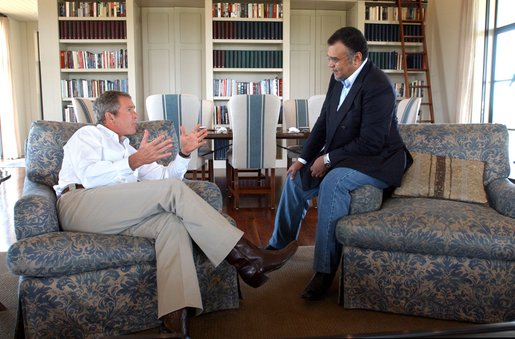
Prince Bandar bin Sultan, then Saudi ambassador to the United States, meeting with President George W. Bush in Crawford, Texas. (White House photo)
“Sheikh Osama wanted to keep a record who give money,” Moussaoui said in imperfect English — “who is to be listened to or who contributed to the jihad.”
Although Moussaoui’s credibility came under immediate attack from the Saudi kingdom, his assertions mesh with accounts from members of the U.S. Congress who have seen a secret portion of the 9/11 report that addresses alleged Saudi support for al-Qaeda.
Further complicating the predicament for Saudi Arabia is that, more recently, Saudi and other Persian Gulf oil sheikdoms have been identified as backers of Sunni militants fighting in Syria to overthrow the largely secular regime of President Bashar al-Assad. The major rebel force benefiting from this support is al-Nusra Front, al-Qaeda’s affiliate in Syria.
In other words, the Saudis appear to have continued a covert relationship with al-Qaeda-connected jihadists to the present day.
The Israeli Exposure
And, like the Saudis, the Israelis have sided with the Sunni militants in Syria because the Israelis share the Saudi view that Iran and the so-called “Shiite crescent” – reaching from Tehran and Baghdad to Damascus and Beirut – is the greatest threat to their interests in the Middle East.
That shared concern has pushed Israel and Saudi Arabia into a de facto alliance, though the collaboration between Jerusalem and Riyadh has been mostly kept out of the public eye. Still, it has occasionally peeked out from under the covers as the two governments deploy their complementary assets – Saudi oil and money and Israeli political and media clout – in areas where they have mutual interests.
In recent years, these historic enemies have cooperated in their joint disdain for the Muslim Brotherhood government in Egypt (which was overthrown in 2013), in seeking the ouster of the Assad regime in Syria, and in pressing for a more hostile U.S. posture toward Iran.
Israel and Saudi Arabia also have collaborated in efforts to put the squeeze on Russia’s President Vladimir Putin, who is deemed a key supporter of both Iran and Syria. The Saudis have used their power over oil production to drive down prices and hurt Russia’s economy, while U.S. neoconservatives – who share Israel’s geopolitical world view – were at the forefront of the coup that ousted Ukraine’s pro-Russian President Viktor Yanukovych in 2014.
The behind-the-scenes Israeli-Saudi alliance has put the two governments – uncomfortably at times – on the side of Sunni jihadists battling Shiite influence in Syria, Lebanon and even Iraq. On Jan. 18, 2015, for instance, Israel attacked Lebanese-Iranian advisers assisting Assad’s government in Syria, killing several members of Hezbollah and an Iranian general. These military advisors were engaged in operations against al-Qaeda’s Nusra Front.
Meanwhile, Israel has refrained from attacking Nusra Front militants who have seized Syrian territory near the Israeli-occupied Golan Heights. One source familiar with U.S. intelligence information on Syria told me that Israel has a “non-aggression pact” with these Nusra forces.
An Odd Alliance
Israel’s odd-couple alliances with Sunni interests have evolved over the past several years, as Israel and Saudi Arabia emerged as strange bedfellows in the geopolitical struggle against Shiite-ruled Iran and its allies in Iraq, Syria and southern Lebanon. In Syria, for instance, senior Israelis have made clear they would prefer Sunni extremists to prevail in the civil war rather than Assad, who is an Alawite, a branch of Shiite Islam.
In September 2013, Israel’s Ambassador to the United States Michael Oren, then a close adviser to Israeli Prime Minister Benjamin Netanyahu, told the Jerusalem Post that Israel favored the Sunni extremists over Assad.
“The greatest danger to Israel is by the strategic arc that extends from Tehran, to Damascus to Beirut. And we saw the Assad regime as the keystone in that arc,” Oren told the Jerusalem Post in an interview. “We always wanted Bashar Assad to go, we always preferred the bad guys who weren’t backed by Iran to the bad guys who were backed by Iran.” He said this was the case even if the “bad guys” were affiliated with al-Qaeda.
And, in June 2014, speaking as a former ambassador at an Aspen Institute conference, Oren expanded on his position, saying Israel would even prefer a victory by the brutal Islamic State over continuation of the Iranian-backed Assad in Syria. “From Israel’s perspective, if there’s got to be an evil that’s got to prevail, let the Sunni evil prevail,” Oren said.
Skepticism and Doubt
In August 2013, when I first reported on the growing relationship between Israel and Saudi Arabia in an article entitled “The Saudi-Israeli Superpower,” the story was met with much skepticism. But, increasingly, this secret alliance has gone public.
On Oct. 1, 2013, Israeli Prime Minister Netanyahu hinted at it in his United Nations General Assembly speech, which was largely devoted to excoriating Iran over its nuclear program and threatening a unilateral Israeli military strike.
Amid the bellicosity, Netanyahu dropped in a largely missed clue about the evolving power relationships in the Middle East, saying: “The dangers of a nuclear-armed Iran and the emergence of other threats in our region have led many of our Arab neighbors to recognize, finally recognize, that Israel is not their enemy. And this affords us the opportunity to overcome the historic animosities and build new relationships, new friendships, new hopes.”
The next day, Israel’s Channel 2 TV news reported that senior Israeli security officials had met with a high-level Gulf state counterpart in Jerusalem, believed to be Prince Bandar, the former Saudi ambassador to the United States who was then head of Saudi intelligence.
The reality of this unlikely alliance has now even reached the mainstream U.S. media. For instance, Time magazine correspondent Joe Klein described the new coziness in an article in the Jan. 19, 2015 issue.
He wrote: “On May 26, 2014, an unprecedented public conversation took place in Brussels. Two former high-ranking spymasters of Israel and Saudi Arabia – Amos Yadlin and Prince Turki al-Faisal – sat together for more than an hour, talking regional politics in a conversation moderated by the Washington Post’s David Ignatius.
“They disagreed on some things, like the exact nature of an Israel-Palestine peace settlement, and agreed on others: the severity of the Iranian nuclear threat, the need to support the new military government in Egypt, the demand for concerted international action in Syria. The most striking statement came from Prince Turki. He said the Arabs had ‘crossed the Rubicon’ and ‘don’t want to fight Israel anymore.’”
Though Klein detected only the bright side of this détente, there was a dark side as well, as referenced in Moussaoui’s deposition, which identified Prince Turki as one of al-Qaeda’s backers. Perhaps even more unsettling was his listing of Prince Bandar, who had long presented himself as a U.S. friend, so close to the Bush Family that he was nicknamed “Bandar Bush.”
Moussaoui claimed that he discussed a plan to shoot down Air Force One with a Stinger missile with a staff member at the Saudi Embassy in Washington, at a time when Bandar was the ambassador to the United States.
According to the New York Times article by Scott Shane, Moussaoui said he was assigned to “find a location where it may be suitable to launch a Stinger attack and then, after, be able to escape,” but that he was arrested on Aug. 16, 2001, before he could carry out the reconnaissance mission.
The thought of anyone in the Saudi embassy, then under the control of “Bandar Bush,” scheming with al-Qaeda to shoot down George W. Bush’s Air Force One is shocking, if true. The notion would have been considered unthinkable even after the 9/11 attacks, which involved 15 Saudis among the 19 hijackers.
After those terror attacks which killed nearly 3,000 Americans, Bandar went to the White House and persuaded Bush to arrange for the rapid extraction of bin Laden’s family members and other Saudis in the United States. Bush agreed to help get those Saudi nationals out on the first flights allowed back into the air.
Bandar’s intervention undercut the FBI’s chance to learn more about the ties between Osama bin Laden and the 9/11 perpetrators by giving FBI agents only time for cursory interviews with the departing Saudis.
Bandar himself was close to the bin Laden family and acknowledged having met Osama bin Laden in the context of bin Laden thanking Bandar for his help financing the jihad project in Afghanistan during the 1980s. “I was not impressed, to be honest with you,” Bandar told CNN’s Larry King about bin Laden. “I thought he was simple and very quiet guy.”
The Saudi government claimed to have broken ties with bin Laden in the early 1990s when he began targeting the United States because President George H.W. Bush had stationed U.S. troops in Saudi Arabia, but – if Moussaoui is telling the truth – al-Qaeda would have still counted Bandar among its supporters in the late 1990s.
Bandar and Putin
Bandar’s possible links to Sunni terrorism also emerged in 2013 during a confrontation between Bandar and Putin over what Putin viewed as Bandar’s crude threat to unleash Chechen terrorists against the Sochi Winter Olympics if Putin did not reduce his support for the Syrian government.
According to a leaked diplomatic account of a July 31, 2013 meeting in Moscow, Bandar informed Putin that Saudi Arabia had strong influence over Chechen extremists who had carried out numerous terrorist attacks against Russian targets and who had since deployed to join the fight against the Assad regime in Syria.
As Bandar called for a Russian shift toward the Saudi position on Syria, he reportedly offered guarantees of protection from Chechen terror attacks on the Olympics. “I can give you a guarantee to protect the Winter Olympics in the city of Sochi on the Black Sea next year,” Bandar reportedly said. “The Chechen groups that threaten the security of the games are controlled by us.”
Putin responded, “We know that you have supported the Chechen terrorist groups for a decade. And that support, which you have frankly talked about just now, is completely incompatible with the common objectives of fighting global terrorism.”
Bandar’s Mafia-like threat toward the Sochi games – a version of “nice Olympics you got here, it’d be a shame if something terrible happened to it” – failed to intimidate Putin, who continued to support Assad.
Less than a month later, an incident in Syria almost forced President Barack Obama’s hand in launching U.S. air strikes against Assad’s military, which would have possibly opened the path for the Nusra Front or the Islamic State to capture Damascus and take control of Syria. On Aug. 21, 2013, a mysterious sarin attack outside Damascus killed hundreds and, in the U.S. media, the incident was immediately blamed on the Assad regime.
American neocons and their allied “liberal interventionists” demanded that Obama launch retaliatory air strikes even though some U.S. intelligence analysts doubted that Assad’s forces were responsible and suspected that the attack was carried out by extremist rebels trying to pull the U.S. military into the civil war on their side.
Yet, pushed by the neocons and liberal war hawks, Obama nearly ordered a bombing campaign designed to “degrade” the Syrian military but called it off at the last minute. He then accepted Putin’s help in reaching a diplomatic solution in which Assad agreed to surrender his entire chemical weapons arsenal, while still denying any role in the sarin attack.
Later, the Assad-did-it case crumbled amid new evidence that Sunni extremists, supported by Saudi Arabia and Turkey, were the more likely perpetrators of the attack, a scenario that became increasingly persuasive as Americans learned more about the cruelty and ruthlessness of many Sunni jihadists fighting in Syria. [See Consortiumnews.com’s “The Mistaken Guns of Last August.”]
Targeting Putin
Putin’s cooperation with Obama to head off a U.S. military strike in Syria made the Russian president more of a target for the American neocons who thought they finally had reached the cusp of their long-desired “regime change” in Syria only to be blocked by Putin. By late September 2013, a leading neocon, National Endowment for Democracy President Carl Gershman, announced the goal of challenging Putin and recognizing his sore point in Ukraine.
Taking to the Washington Post’s op-ed page on Sept. 26, 2013, Gershman called Ukraine “the biggest prize” and an important step toward ultimately ousting Putin. Gershman wrote, “Ukraine’s choice to join Europe will accelerate the demise of the ideology of Russian imperialism that Putin represents. … Russians, too, face a choice, and Putin may find himself on the losing end not just in the near abroad but within Russia itself.” [See Consortiumnews.com’s “Neocons’ Ukraine-Syria-Iran Gambit.“]
However, in early 2014, Putin was obsessed with Bandar’s implicit threat of terrorism striking the Sochi Olympics, thus distracting him from the “regime change” – being pushed by NED and neocon Assistant Secretary of State for European Affairs Victoria Nuland – next door in Ukraine.
On Feb. 22, 2014, putschists, spearheaded by well-organized neo-Nazi militias, drove elected President Viktor Yanukovych and his government from power. Putin was caught off-guard and, in the resulting political chaos, agreed to requests from Crimean officials and voters to accept Crimea back into Russia, thus exploding his cooperative relationship with Obama.
With Putin the new pariah in Official Washington, the neocon hand also was strengthened in the Middle East where renewed pressure could be put on the “Shiite crescent” in Syria and Iran. However, in summer 2014, the Islamic State, which had splintered off from al-Qaeda and its Nusra Front, went on a rampage, invading Iraq where captured soldiers were beheaded. The Islamic State then engaged in gruesome videotaped decapitations of Western hostages inside Syria.
The Islamic State’s brutality and the threat it posed to the U.S.-backed, Shiite-dominated government of Iraq changed the political calculus. Obama felt compelled to launch airstrikes against Islamic State targets in both Iraq and Syria. American neocons tried to convince Obama to expand the Syrian strikes to hit Assad’s forces, too, but Obama realized such a plan would only benefit the Islamic State and al-Qaeda’s Nusra Front.
In effect, the neocons were showing their hand – much as Israeli Ambassador Oren had done – favoring the Sunni extremists allied with al-Qaeda over Assad’s secular regime because it was allied with Iran. Now, with Moussaoui’s deposition identifying senior Saudi officials as patrons of al-Qaeda, another veil seems to have dropped.
Complicating matters further, Moussaoui also claimed that he passed letters between Osama bin Laden and then Crown Prince Salman, who recently became king upon the death of his brother King Abdullah.
But Moussaoui’s disclosure perhaps cast the most unflattering light on Bandar, the erstwhile confidant of the Bush Family who — if Moussaoui is right — may have been playing a sinister double game.
Also facing potentially embarrassing questions is Israeli Prime Minister Netanyahu, especially if he goes through with his planned speech before a joint session of Congress next month, attacking Obama for being soft on Iran.
And, America’s neocons might have some explaining to do about why they have carried water not just for the Israelis but for Israel’s de facto allies in Saudi Arabia.
~
Investigative reporter Robert Parry broke many of the Iran-Contra stories for The Associated Press and Newsweek in the 1980s. You can buy his latest book, America’s Stolen Narrative, either in print here or as an e-book (from Amazon and barnesandnoble.com).
Saying “No” to Netanyahu
Israel’s demands are not good for Americans
By Philip Giraldi • Unz Report • February 3, 2015
Israeli Prime Minister Benjamin Netanyahu will be visiting Washington during the first week in March. His annual visit coincides with the American Israel Public Affairs Committee (AIPAC) summit in Washington, at which he is expected to speak. He will also be addressing a joint session of Congress on March 3 rd as a guest of the new Republican majority. Per Speaker of the House John Boehner, Netanyahu will be providing additional insights regarding the threats posed by Iran and by Islamic terrorism, which the president had “papered over” in his State of the Union address. Boehner has in mind promotion of policies that would be contrary to those embraced by the White House, most particularly President Barack Obama’s intention to continue negotiations to come to an understanding over Iran’s nuclear program. That would mean Congress’s imposing new and intentionally deal breaking sanctions on Iran just to show it we are serious and a possible demand that any agreement with Tehran be subject to legislative approval.
Netanyahu has frequently warned that Iran’s construction of a nuclear arsenal is just around the corner. He has been making that claim regularly since 1996 and apparently is not particularly bothered that his warning has proven to be inaccurate since the Mullahs have yet to develop the long anticipated weapon of mass destruction. He will no doubt again express his view that there is a secret Iranian weapons program that imminently threatens both Israel and the United States. It is not clear if he will produce a cartoon showing a ticking bomb as he famously did at the United Nations in 2012.
Concerning the terrorist threat, Netanyahu will undoubtedly play the Charlie Hebdo card, insisting that it is the duty of the West united with Israel to oppose Islamic barbarism. It will be convenient dodge as it allows him to avoid answering for what Israel is doing to the Palestinians and it conveniently conflates all believers in a specific religion with political violence. No matter what Netanyahu says he will undoubtedly be cheered both when he speaks to Congress and also by the 1,500 attendees at AIPAC, which will include many Congressmen, journalists, and even Supreme Court justices. He will be treated like visiting royalty even though his message is essentially one of hate.
It is my understanding that a number of groups are organizing to protest both AIPAC and the Netanyahu visit. I hope they will be highly visible and noisy as hell, possibly forcing some of the summit attendees to think about just what they are supporting. I also urge the demonstrators to focus on Netanyahu’s actual message because everything that he has come to Washington to sell is essentially false.
Starting with Iran, the entire narrative of Iran as a nuclear threat is bogus, largely invented in Israel and the United States and in part based on manufactured evidence. I am not suggesting for a moment that Iran is a friend to the American people, but its malignancy has been much overstated by the Israel Lobby and its friends. It does not threaten the United States in any way and it hardly impacts on the security of countries like Israel and Saudi Arabia, both of which should be worrying about their viability based on their own behavior rather than due to an exaggerated Iranian menace. The reality is that the United States government has twice in 2007 and 2011 confirmed that Iran has no nuclear weapons program. Even Israel’s Mossad agrees and both governments admit that Tehran has not made the essentially political decision to proceed with such a program.
Not only has Iran neither developed nor tested a nuclear device, she has never enriched her uranium stocks to anything approaching weapons-grade. Her Fordow “secret” plant and other nuclear sites now have IAEA inspectors in place, the heavy-water reactor at Arak is not operational and many centrifuges are not operating. Most Iranians and many Americans understand that a negotiated settlement over the program as an alternative to a major regional war is highly desirable.
Netanyahu’s second point will be that the world is threatened by Islamic terrorism, requiring democratic nations to stand by Israel. But standing by Israel and adopting the Israeli standards for dealing with terrorism are precisely the problem. The only places in the world where Islamists have the remotest ability to take power are in those countries where the United States adhered to the Israeli model and intervened militarily, leaving chaos in its wake. Today that would include Iraq, Libya, Somalia, Afghanistan and Syria. Highly publicized terrorist attacks in Europe and in the United States have killed relatively few people and produced a predictably panicked response but do not threaten either a national security crisis or the stability of any government. In the U.S. since 9/11 there have been 69 deaths, either terrorist or criminal, that can plausibly be linked to Muslims or Islamic sensibilities, less than five a year. During the same time period 200,000 Americans have been murdered, making terrorism by local Muslims pretty much a statistical anomaly. For what it’s worth, the policies being pursued overseas by Washington during the same time period directly or indirectly contributed to the killing of as many as half a million Muslims while turning at least three million more into refugees, which inevitably fuels terrorism.
A third point that Netanyahu will not be making as he is a beneficiary of it is the astonishing power of the Israel Lobby in the United States. As John Mearsheimer and Stephen Walt demonstrated in their book, the Lobby is in reality a loose aggregation that is bound together to promote what are perceived to be Israeli interests. It includes think tanks, PACS and other lobbying groups, journalists and media outlets, Christian evangelicals, leading figures in academia and it is all backed up by deep pocket donors who both fund political candidates and provide the fuel to keep everything moving. Pat Buchanan once described Congress as “Israeli occupied territory,” but to be sure he was being too kind and Tom Friedman’s observation that it is bought and paid for by the Lobby might actually be closer to the mark. In an actual occupation there would characteristically be at least some resistance but in the United States Congress there is virtually none now that Ron Paul is retired. If any daring congressmen stay home sick when Netanyahu speaks it will be a surprise and the only real question regarding the impending joint session address is how many standing ovations the Israeli leader will receive. Will it exceed the 29 he recorded last time around?
So there are three good reasons for saying “no” to Benjamin Netanyahu, or, even better, telling him to go away and stay away. First, he is striving mightily to involve the United States in a war with Iran for which there is no compelling national interest and which will cost Americans heavily in both lives and treasure. Second, he has poisoned Washington’s relationship with the Muslim world through the largely successful selling of his message that all believers in Islam are essentially terrorists. And third, he and his associates in the Israel Lobby are a cancer in our political system, using money and even coercion to bring about a “special relationship” that is hardly a relationship at all but is instead a mechanism to impel U.S. subordination to Israeli interests.
It is shameful that Netanyahu will be in Washington at all on a mission to tell the U.S. Congress what to do, but one can always hope that both he and Speaker Boehner have finally gone too far. Will this be a wake-up call for the American public, aware at last that it is being led by the nose by a foreign country aided by its own venal and corrupted quislings? One can always hope, and it might just be that Netanyahu will finally pay a price for his hubris with his own voters next month and be turned out of office. Wouldn’t it be nice to be able to say that we have seen the last of Benjamin Netanyahu?
Iran to pursue Golan raid through ‘diplomatic channels’
Press TV – January 28, 2015
Iran has condemned as “state terrorism” Israel’s recent airstrike that killed a top Iranian commander in Syria’s Golan Heights, saying the Islamic Republic will pursue the matter through diplomatic channels.
Speaking at her weekly press conference on Wednesday, Foreign Ministry Spokeswoman Marzieh Afkham dismissed as an instance of state terrorism the Israeli raid that killed six Hezbollah members as well as Iranian commander Brigadier General Mohammad Ali Allahdadi.
“We will pursue the matter through diplomatic means and political channels,” Afkham said.
The Iranian official said that the world is witnessing a wave of state terrorism, calling on countries to recognize the real threat facing the globe and work toward restoring security.
On January 17, an Israeli military helicopter fired two missiles into Amal Farms in the strategic southwestern Syrian city of Quneitra, close to the line separating the Syrian part of the Golan Heights from the Israeli-occupied sector.
The air assault killed six Hezbollah members and the Iranian commander. Following the attack, Israel claimed that it was unaware of the presence of an Iranian commander in the area where the attack happened.
Nuclear Talks
Regarding the ongoing nuclear talks between Iran and the P5+1 group, Afkham said the Islamic Republic seeks to reach an agreement with the six countries “as soon as possible, but not at any price.”
She said that Iran is using every possible opportunity to contribute to the negotiations.
Iran has presented certain “initiatives and proposals” to the other side to lead the talks out of stalemate, Afkham said.
She described the talks as “complicated, tough and sensitive” and said gaps have been narrowed to a little extent and that the two sides are now discussing details and technical issues.
Afkham reiterated that a nuclear deal is possible if more good faith and political will is demonstrated to work out details.
Iran and the P5+1 countries – the US, France, Britain, China, Russia and Germany – are in talks to secure a final comprehensive deal over Tehran’s nuclear work.
Since an interim deal was agreed in Geneva in November 2013, the negotiating sides have missed two deadlines to ink a final agreement.
Tehran and the six countries now seek to reach a high-level political agreement by March 1 and to confirm the full technical details of the accord by July 1.
Chutzpah Squared, Bibi and Boehner
By Jim Lobe | LobeLog | January 22, 2015
As Mitchell Plitnick pointed out on Wednesday, House Speaker John Boehner has invited Israeli Prime Minister Benjamin Netanyahu to speak to a joint session of Congress on February 11, although now it appears that Bibi would like to put off the occasion until March 3, when AIPAC will be holding its annual policy conference and unleashing its 12,000-plus attendees on Capitol Hill. The lobby group presumably aims to persuade its members of Congress to do everything they can to sabotage a possible nuclear deal between the P5+1 and Iran—as well as bolster Bibi’s chances of retaining the premiership in the March 17 elections in Israel. Much has happened that is relevant to the visit in the last 24 hours, and a brief round-up, which unfortunately is all that I have time for today, seems in order.
The invitation was clearly arranged without any notification of or coordination with the White House, which, as Mitchell reported, noted that its handling appeared to be “a departure from protocol.” It also appears now that Boehner didn’t even consult Minority Leader Nancy Pelosi who, in addition to complaining about the negative impact Netanyahu’s appearance might have on the negotiations, explained on Thursday that the common practice is for the two leaders from each party to agree before issuing an invitation to a foreign leader:
…[I]t’s out of the ordinary that the Speaker would decide that he would be inviting people to a Joint Session without any bipartisan consultation. And of course, we always—our friendship with Israel is a very strong one. Prime Minister Netanyahu has spoken to the Joint Session two times already. And there are concerns about the fact that this—as I understand it from this morning—that this presentation will take place within two weeks of the election in Israel. I don’t think that’s appropriate for any country—that the head of state would come here within two weeks of his own election in his own country.
Meanwhile, the White House announced that Obama won’t meet Netanyahu for the same reason: “As a matter of long-standing practice and principle, we do not see heads of state or candidates in close proximity to their elections, so as to avoid the appearance of influencing a democratic election in a foreign country,” National Security Council spokeswoman Bernadette Meehan told reporters in an emailed statement. Kerry won’t meet with Bibi either, according to the State Department.
Meanwhile, Obama’s position that Congress should give diplomacy a chance by not enacting new sanctions legislation got a key endorsement from the presumed front-runner in the 2016 Democratic presidential race, Hillary Clinton. Speaking at a conference in Winnipeg, Manitoba, she said:
If we’re the reason—through our Congress—that in effect gives Iran and others the excuse not to continue the negotiations, that would be, in my view, a very serious strategic error… Why do we want to be the catalyst for the collapse of negotiations until we really know whether there’s something we can get out of them that will make the world safer [and] avoid an arms race in the Middle East?… [R]ight now, the status quo that we’re in is in my view in our interests and therefore I don’t want to do anything that disrupts the status quo until we have a better idea as to whether there’s something we can get out of it.
Clinton’s position, of course, should be quite helpful in keeping wavering Democrats in line. And, in the wake of Obama’s veto threat and Boehner’s invitation to Bibi, it seems that even some of the Democratic co-sponsors of the original Kirk-Menendez bill are moving in the White House’s direction. “I’m considering very seriously the very cogent points that he’s made in favor of delaying any congressional action,” Sen. Richard Blumenthal told Politico. “I’m talking to colleagues on both sides of the aisle. And I think they are thinking, and rethinking, their positions in light of the points that the president and his team are making to us.”
The fact that he would mention that some Republicans may also be “rethinking” their positions, while not provable yet, is significant, particularly in light of today’s Washington Post op-ed, “Give Diplomacy a Chance,” by the foreign ministers of France, Britain, and Germany and the high representative of the European Union (EU) for foreign affairs and security policy, Federica Mogherini, with whom Kerry met on Wednesday. The four of them could not have been clearer:
Maintaining pressure on Iran through our existing sanctions is essential. But introducing new hurdles at this critical stage of the negotiations, including through additional nuclear-related sanctions legislation on Iran, would jeopardize our efforts at a critical juncture. While many Iranians know how much they stand to gain by overcoming isolation and engaging with the world, there are also those in Tehran who oppose any nuclear deal. We should not give them new arguments. New sanctions at this moment might also fracture the international coalition that has made sanctions so effective so far. Rather than strengthening our negotiating position, new sanctions legislation at this point would set us back.
It’s worth remembering that the writers of that statement include the foreign ministers of Washington’s three closest European and NATO allies—the countries (at least Britain and France) that Americans normally think of when a politician, including the Republican variety, talks about building closer ties with “our traditional allies.” Asked to choose between Israel and Washington’s western allies that, unlike Israel, have suffered real casualties alongside U.S. servicemen and women in Iraq and Afghanistan, some Republicans may not find it to so easy to follow AIPAC’s lead, despite rich campaign rewards dangled by the billionaire donors in the Republican Jewish Coalition (RJC), notably its chairman, Sheldon Adelson. So, when Boehner told Politico Thursday, “Let’s send a clear message to the White House — and the world — about our commitment to Israel and our allies,” he failed to clarify which “allies” he was referring to.
Of course, Europe is also Israel’s biggest trading partner by far, and European leaders and parliaments have been expressing increasing frustration over the past year with Netanyahu’s positions on Israel-Palestine as well as the general rightward drift of Israeli politics. In his last foreign venture, Netanyahu made himself thoroughly obnoxious in France. By being seen as actively trying to sabotage an agreement with Iran that, if it is indeed concluded, will gain the strong backing of the president of the United States and the leaders of Washington’s closest European allies, Netanyahu will isolate Israel even more from its western supporters.
That may be part of the reason why Israel’s national-security professionals have apparently been willing to go “rogue,” as Josh Rogin and Eli Lake called it in their big story Wednesday on Bloomberg about dissent in the Israeli intelligence community regarding the potentially disastrous impact of new sanctions legislation on the Iran negotiations. The intelligence community did this before when Netanyahu and Ehud Barak were repeatedly threatening to attack Iran earlier this decade.
Although Mossad’s director issued an extremely unusual statement on Thursday denying any opposition to new sanctions, the phrasing indicated a certain lack of conviction.
Meanwhile, it will be very interesting to find out who initiated the idea that Netanyahu should be invited to address Congress at such a critical moment and to do so without any consultation with the State Department, the White House, or the minority leader in Congress. It’s hard to believe that either Boehner or McConnell would have the temperament or imagination to act on their own. One wonders whether Israeli Ambassador Ron Dermer or someone at the RJC or Bill Kristol thought it was a great idea. Or maybe it was Bibi himself. Certainly the Emergency Committee for Israel welcomes the visit and plans to hold a reception for Bibi when he gets to Washington. Still, it’s hard to figure out how Israel’s relations with the United States or Europe are going to be improved by this.
AN ADDITIONAL THOUGHT: I think mainstream Jewish organizations that place a high stock in maintaining their bipartisan identity — including the Conference of Presidents of Major Jewish Organizations, the Anti-Defamation League, and even AIPAC — are going to have a difficult time dealing with this situation due to the fact that Boehner has acted in such a transparently partisan manner. It’s important to remember that both Kristol’s ECI and Adelson’s favorite Zionist group, the Zionist Organization of America, implicitly attacked AIPAC last February for essentially throwing in the towel on the Kirk-Menendez sanctions bill precisely because the powerful lobby group had run into a solid wall of Democratic opposition and didn’t want to risk its bipartisan image. As Kristol said at the time, “[I]t would be terrible if history’s judgment on the pro-Israel community was that it made a fetish of bipartisanship — and got a nuclear Iran.” If Democrats line up strongly against Boehner’s and Bibi’s little coup, that same community is going to have to make some hard decisions.
~
Congress Seeks Netanyahu’s Direction
By Robert Parry | Consortium News | January 22, 2015
Showing who some in Congress believe is the real master of U.S. foreign policy, House Speaker John Boehner has invited Israel’s Prime Minister Benjamin Netanyahu to address a joint session and offer a rebuttal to President Barack Obama’s comments on world affairs in his State of the Union speech.
Boehner made clear that Netanyahu’s third speech to a joint session of the U.S. Congress – scheduled for Feb. 11 – was meant to counter Obama’s assessments. “There is a serious threat in the world, and the President last night kind of papered over it,” Boehner said on Wednesday. “And the fact is that there needs to be a more serious conversation in America about how serious the threat is from radical Islamic jihadists and the threat posed by Iran.”
The scheduling of Netanyahu’s speech caught the White House off-guard, since the Israeli prime minister had apparently not bothered to clear his trip with the administration. The Boehner-Netanyahu arrangement demonstrates a mutual contempt for this President’s authority to conduct American foreign policy as prescribed by the U.S. Constitution.
In the past when Netanyahu has spoken to Congress, Republicans and Democrats have competed to show their devotion by quickly and frequently leaping to their feet to applaud almost every word out of the Israeli prime minister’s mouth. By addressing a joint session for a third time, Netanyahu would become only the second foreign leader to do so, joining British Prime Minister Winston Churchill who never used the platform to demean the policies of a sitting U.S. president.
Besides this extraordinary recognition of another country’s leader as the true definer of U.S. foreign policy, Boehner’s move reflects an ignorance of what is actually occurring on the ground in the Middle East. Boehner doesn’t seem to realize that Netanyahu has developed what amounts to a de facto alliance with extremist Sunni forces in the region.
Not only is Israel now collaborating behind the scenes with Saudi Arabia’s Wahhabist leadership but Israel has begun taking sides militarily in support of the Nusra Front, al-Qaeda’s affiliate in the Syrian civil war. A source familiar with U.S. intelligence information on Syria said Israel has a “non-aggression pact” with Nusra forces that control territory adjacent to the Israeli-occupied Golan Heights.
The quiet cooperation between Israel and al-Qaeda’s affiliate was further underscored on Sunday when Israeli helicopters attacked and killed advisers to the Syrian military from Lebanon’s Hezbollah and Iran. In other words, Israel has dispatched its forces into Syria to kill military personnel helping to fight al-Nusra. Iran later confirmed that one of its generals had died in the Israeli strike.
Israel’s tangled alliances with Sunni forces have been taking shape over the past several years, as Israel and Saudi Arabia emerged as strange bedfellows in the geopolitical struggle against Shiite-ruled Iran and its allies in Iraq, Syria and southern Lebanon. Both Saudi and Israeli leaders have talked with growing alarm about this “Shiite crescent” stretching from Iran through Iraq and Syria to the Hezbollah strongholds in Lebanon.
Favoring Sunni Extremists
Senior Israelis have made clear they would prefer Sunni extremists to prevail in the Syrian civil war rather than President Bashar al-Assad, who is an Alawite, a branch of Shiite Islam. Assad’s relatively secular government is seen as the protector of Shiites, Christians and other minorities who fear the vengeful brutality of the Sunni jihadists who now dominate the anti-Assad rebels.
In one of the most explicit expressions of Israel’s views, its Ambassador to the United States Michael Oren, a close adviser to Netanyahu, told the Jerusalem Post in September 2013 that Israel favored the Sunni extremists over Assad.
“The greatest danger to Israel is by the strategic arc that extends from Tehran, to Damascus to Beirut. And we saw the Assad regime as the keystone in that arc,” Oren told the Jerusalem Post in an interview. “We always wanted Bashar Assad to go, we always preferred the bad guys who weren’t backed by Iran to the bad guys who were backed by Iran.” He said this was the case even if the “bad guys” were affiliated with al-Qaeda.
Saudi Arabia shares Israeli’s strategic view that “the Shiite crescent” must be broken and has thus developed a rapport with Netanyahu’s government in a kind of “enemy of my enemy is my friend” relationship. But some rank-and-file Jewish supporters of Israel have voiced concerns about Israel’s new-found alliance with the Saudi monarchy, especially given its adherence to ultraconservative Wahhabi Islam and its embrace of a fanatical hatred of Shiite Islam, a sectarian conflict between Sunnis and Shiites that dates back 1,400 years.
Though President Obama has repeatedly declared his support for Israel, he has developed a contrary view from Netanyahu’s regarding what is the gravest danger in the Middle East. Obama considers the radical Sunni jihadists, associated with al-Qaeda and the Islamic State, to be the biggest threat to Western interests and U.S. national security.
That has put him in a different de facto alliance – with Iran and the Syrian government – since they represent the strongest bulwarks against Sunni jihadists who have targeted Americans and other Westerners for death.
What Boehner doesn’t seem to understand is that Israel and Saudi Arabia have placed themselves on the side of the Sunni jihadists who now represent the frontline fight against the “Shiite crescent.” If Netanyahu succeeds in enlisting the United States in violently forcing Syrian “regime change,” the U.S. government likely would be facilitating the growth in power of the Sunni extremists, not containing them.
But the influential American neoconservatives want to synch U.S. foreign policy with Israel’s and thus have pressed for a U.S. bombing campaign against Assad’s forces (even if that would open the gates of Damascus to the Nusra Front or the Islamic State). The neocons also want an escalation of tensions with Iran by sabotaging an agreement to ensure that its nuclear program is not used for military purposes.
The neocons have long wanted to bomb-bomb-bomb Iran as part of their “regime change” strategy for the Middle East. That is why Obama’s openness to a permanent agreement for tight constraints on Iran’s nuclear program is seen as a threat by Netanyahu, the neocons and their congressional allies – because it would derail hopes for militarily attacking Iran.
In his State of the Union address on Tuesday, Obama made clear that he perceives the brutal Islamic State, which he calls “ISIL” for the Islamic State of Iraq and the Levant, as the principal current threat to Western interests in the Middle East and the clearest terror threat to the United States and Europe. Obama proposed “a smarter kind of American leadership” that would cooperate with allies in “stopping ISIL’s advance” without “getting dragged into another ground war in the Middle East.”
Working with Putin
Thus, Obama, who might be called a “closet realist,” is coming to the realization that the best hope for blocking the advances of Sunni jihadi terror and minimizing U.S. military involvement is through cooperation with Iran and its regional allies. That also puts Obama on the same side with Russian President Vladimir Putin who has faced Sunni terrorism in Chechnya and is supporting both Iran’s leaders and Syria’s Assad in their resistance to the Islamic State and al-Qaeda’s Nusra Front.
Obama’s “realist” alliance, in turn, presents a direct threat to Netanyahu’s insistence that Iran represents an “existential threat” to Israel and that the “Shiite crescent” must be destroyed. There is also fear among Israeli right-wingers that an effective Obama-Putin collaboration could ultimately force Israel into accepting a Palestinian state.
So, Netanyahu and the U.S. neocons believe they must do whatever is necessary to shatter this tandem of Obama, Putin and Iran. That is one reason why the neocons were at the forefront of fomenting “regime change” against Ukraine’s elected pro-Russian President Viktor Yanukovych last year. By splintering Ukraine on Russia’s border, the neocons drove a wedge between Obama and Putin. [See Consortiumnews.com’s “Neocons’ Ukraine-Syria-Iran Gambit.”]
Even the slow-witted mainstream U.S. media has begun to pick up on the story of the emerging Israeli-Saudi alliance. In the Jan. 19 issue of Time magazine, correspondent Joe Klein noted the new coziness between top Israeli and Saudi officials.
He wrote: “On May 26, 2014, an unprecedented public conversation took place in Brussels. Two former high-ranking spymasters of Israel and Saudi Arabia – Amos Yadlin and Prince Turki al-Faisal – sat together for more than an hour, talking regional politics in a conversation moderated by the Washington Post’s David Ignatius.
“They disagreed on some things, like the exact nature of an Israel-Palestine peace settlement, and agreed on others: the severity of the Iranian nuclear threat, the need to support the new military government in Egypt, the demand for concerted international action in Syria. The most striking statement came from Prince Turki. He said the Arabs had ‘crossed the Rubicon’ and ‘don’t want to fight Israel anymore.’”
Not only did Prince Turki offer an olive branch to Israel, he indicated agreement on what the two countries consider their most pressing strategic interests: Iran’s nuclear program and Syria’s civil war. In other words, in noting this extraordinary meeting, Klein had stumbled upon the odd-couple alliance between Israel and Saudi Arabia – though he didn’t fully understand what he was seeing.
On Tuesday, the New York Times reported that Obama had shifted his position on Syria as the West made a “quiet retreat from its demand” that Assad “step down immediately.” The article by Anne Barnard and Somini Sengupta noted that the Obama administration still wanted Assad to exit eventually “but facing military stalemate, well-armed jihadists and the world’s worst humanitarian crisis, the United States is going along with international diplomatic efforts that could lead to more gradual change in Syria.”
At the center of that diplomatic initiative was Russia, again reflecting Obama’s recognition of the need to cooperate with Putin on resolving some of these complex problems (although Obama did include in his speech some tough-guy rhetoric against Russia over Ukraine, taking some pleasure in how Russia’s economy is now “in tatters”).
But the underlying reality is that the United States and Assad’s regime have become de facto allies, fighting on the same side in the Syrian civil war, much as Israel had, in effect, sided with al-Qaeda’s Nusra Front by killing Hezbollah and Iranian advisers to the Syrian military.
The Times article noted that the shift in Obama’s position on Syrian peace talks “comes along with other American actions that Mr. Assad’s supporters and opponents take as proof Washington now believes that if Mr. Assad is ousted, there will be nothing to check the spreading chaos and extremism.
“American planes now bomb the Islamic State group’s militants in Syria, sharing skies with Syrian jets. American officials assure Mr. Assad, through Iraqi intermediaries, that Syria’s military is not their target. The United States still trains and equips Syrian insurgents, but now mainly to fight the Islamic State, not the government.”
Yet, as Obama adjusts U.S. foreign policy to take into account the complex realities in the Middle East, he now faces another front in this conflict – from the U.S. Congress, which has long been held in thrall by the Israel lobby.
Not only has Speaker Boehner appealed to Netanyahu to deliver what amounts to a challenge to President Obama’s foreign policy but congressional neocons are even accusing Obama’s team of becoming Iranian stooges. Sen. Robert Menendez of New Jersey, a Democratic neocon, said, “The more I hear from the administration and its quotes, the more it sounds like talking points that come straight out of Tehran.”
If indeed Netanyahu does end up addressing a joint session of the U.S. Congress, its members would face a stark choice of either embracing Israel’s foreign policy as America’s or backing the decisions made by the elected President of the United States.
~
Investigative reporter Robert Parry broke many of the Iran-Contra stories for The Associated Press and Newsweek in the 1980s. You can buy his latest book, America’s Stolen Narrative, either in print here or as an e-book (from Amazon and barnesandnoble.com).
Applauding Israel’s Transgressions
By AHMAD BARQAWI | CounterPunch | January 21, 2015
So after “headlining” that anti-terrorism joke of a parade last week and basking in the Parisian sun of selective humanitarianism and international solidarity with freedom of speech; the first order of (shoddy) business for Israeli Prime Minister Benyamin Netanyahu was lambasting the International Criminal Court, for merely entertaining the (anti-Semitic?) notion of investigating “possible” Israeli war crimes in Gaza (how dare they?), going as far as threatening to lobby member-states and allies to cut off funding for the tribunal and practically pull a repeat of the UNESCO farce when the Obama Administration, at the behest and for the benefit of its darling Israel, froze funding for the cultural organization, after granting the Palestinians full membership into the agency, plunging the UN body into the worst financial dire strait in its history.
It is more than likely that Netanyahu will get his way this time too.
The second order of business, however, was sending a military helicopter gunship over to Syrian territory and bombing a convoy belonging to the Lebanese Resistance Movement Hezbollah, killing six operatives including the son of assassinated leader Imad Mughnyyieh and field commander Mohammad Issa in addition to one Iranian General, in the Syrian village of Quneitra close to the border area with Lebanon in the Golan heights.
Business as usual for humanitarian extraordinaire Bibi and Co.
Of course this was no terrorist attack, at least not according to the mainstream media; so you won’t be seeing #jesuishizbollah anywhere on social media and no solidarity marches in real life, just another daily recount of internationally tolerable Israeli shenanigans in the region.
Evidently, unless it involves scraggy young men with weird, unpronounceable Middle Eastern names, wearing Keffiyehs, wielding shabby Kalashnikovs and storming the streets of a western city then it’s not terrorism, and in the case of the latest Israel airstrike in the Syrian Golan heights; it was just a military operation, clean and surgical, according to the BBC at least; not forgetting of course to tail the news with the little tidbit that this is not the first time Israel has conducted air strikes inside Syria, to “prevent the transfer of stockpiles of weapons from Syria to Hezbollah”. So, all should be fine and dandy then.
You see it’s completely acceptable for the BBC to venture justifications on behalf of the Israeli army for its various terrorist operations and transgressions in the region, we’ve seen it before in Palestine, Syria and Lebanon; covering Israeli crimes in the complacent mainstream media usually comes with peppered excuses and rationalizations that supposedly give some sort of subtle credence to any act of aggression committed by the Zionist entity, wrapping it with the usual, tattered caveat of “self-defense”; the AP’s report on the latest attack, for instance, highlighted the fact that Hezbollah had recently boasted of its “ability to hit any part of the Jewish state” with rockets, in reference to Hezbollah leader Hassan Nasrallah’s recent interview. Imagine the outrage!
Whereas if one so much as dared to attempt a mildly rational and lucid reading of the Charlie Hebdo massacre; he’d be immediately castigated at best and lumped into the same category as the Kouachi brothers as an Al Qaida sympathizer at worst; that’s the freedom of speech they were marching for in Paris I guess.
Speaking of Al Qaida; do you know who were rubbing their hands with ecstatic glee over the Israeli airstrike against Hezbollah? None other than Al Qaida’s very own Al Nusra Front (or the moderate Syrian opposition force worthy of caches of weapons and funding, according to the west) and other rag-tag, ideologically like-minded militant groups whose evident ironclad alliance with Israel has transcended the widely reported medical assistance and treatment of the injured in Israeli hospitals into providing direct military backing and air cover when needed especially in areas where the Syrian opposition’s tenuous grab is slipping in favor of the Syrian Army along with Hezbollah forces. Areas such as Al Quneitra.
In a sense this latest Israeli attack against a Hezbollah target in Syria serves as a perfect cliff note for the uninitiated to disentangle this seemingly complicated cobweb of alliances in the Syrian war. On the one side you have the Syrian Government of Bashar Al Assad backed by Hezbollah and Iran, while on the other you have a who’s who of the region’s nastiest terrorists; from the mismatched posses of Islamic extremists fighting under the Islamic Army moniker, to ISIS and Al Nusra Front, backed by the deep-pocketed Gulf monarchies along with Erdogan’s Turkey and the U.S., with Netanyahu’s Israel added to the mix for good measure. Talk about a true rogues gallery.
A cursory glance over GCC media and social networks is more than enough to note a certain air of unabashed exuberance over the Israeli airstrike; Syrian “revolutionaries” along with their GCC sponsors could not contain their jubilation as soon as news of the bombing broke; gloating over the assassination and mocking Hezbollah’s rhetoric of vowing vengeance for its slain operatives “at the time and place of its choosing”.
The rotten logic of the “lesser of two evils”, in reference to the Zionist regime, has become such a stable in the armory of the anti-Hezbollah/anti-Iran crowd in the Arab World, invoked every time the Israeli terrorist army commits a new atrocity to soften the impact of its crimes and desensitize the public to Israel’s parasitic existence on Arab lands. And this time was no different; with many reveling in the claim that Hezbollah “had it coming” for backing the government of Bashar Al Assad.
In an article confessedly titled “How Did We End up Applauding for Israel”, published in the Saudi-financed, crude Arabic daily Al-Sharq Al-Awsat, which by the way, itself exhibited an unmistakable celebratory tone while covering the latest Israel strike especially over the slain Iranian General, Saudi writer Abdel Rahman al-Rashed actually “laments” the fact that there are growing cheerleading voices in the Arab world for Israel and that (some) Arabs have become increasingly more vocal in their support for the Zionist entity just out of sheer “spite” for Hezbollah and Iran, especially on social media websites and even among supporters of Islamic Jihadi groups.
Nonetheless, al-Rashed places the brunt of the blame on… yes you guessed it… Hezbollah, Israel’s arch enemy, for ostensibly transforming poor, gullible Arabs en masse into hordes of hardcore Israel-enthusiasts, through its alleged role in the assassination of former Lebanese Prime Minister Rafiq Al Hariri (according to a sham international tribunal anyway), and the Lebanese party’s military involvement in the Syrian civil war. Talk about connecting all the wrong dots.
Never mind that the Lebanese movement has been the subject of an unrelenting smear campaign steeped in vile sectarianism, all manner of character assassination and outright fabrications targeting its leaders, and discrediting its military achievements against Israel ever since 2005, courtesy of Saudi Arabia along with the rest of the GCC club (aka Al Rashed’s sole meal tickets) and their labyrinthine network of media outlets including Al Sharq Al Awsat newspaper where anti-Shiite sentiments run amok and distinct pro-Israel bias reigns supreme.
Never mind the fact that the Arab public has been bombarded with a nonstop barrage of demonization and vilification sprees directed not only at Hezbollah, but also at any movement, party or political group which just so happens to adopt an anti-Israel stance and/or rhetoric, including the Palestinian movements of Hamas and the Islamic Jihad, only with the sole endgame of reshuffling the public’s priorities to accommodate the West’s political agenda in our region where Israel gets to sit snugly and comfortably in our midst all the while Iran is being touted and over-hyped as the biggest threat to the stability of the Arab world.
It’s true; we do applaud for Israel. Its transgressions and air strikes on Arab soil no longer provoke a sense of outrage or even the merest of condemnations, but we only have the GCC to thank for that.
Iranian Defense Minister: Iran to Arm West Bank Against Israel
Al-Akhbar | January 21, 2015
Iranian Defense Minister General Hossein Dehqan on Wednesday declared that Tehran will arm Palestinians in the West Bank against the Zionist state, according to the Iranian Fars news agency.
Naqdi stressed, during a memorial service marking the death of six Hezbollah members and an Iranian General killed by Israeli Occupation forces in Syria, that “arming the West Bank is a principal policy of the Islamic Republic and we will use every means and capacity” to fulfill this policy.
Dehqan warned that “the Zionists will receive a crushing response” and added “today the resistance front, as representative of all Muslims, is acting against the Zionists and the Takfiri stream and we will support it in every aspect with all our capacities,” reported Fars news agency.
On Wednesday, at a funeral procession for General Mohammed Ali Allahdadi, killed by Israel in Golan Heights, a Revolutionary Guards commander Major General Ali Jafari said “the path of martyr Allahdadi is unstoppable and will be continued until the liberation of the Holy Quds (Jerusalem) and obliteration of the Zionist regime.”
Jafari also took aim at Israel on Tuesday, saying, “The Zionists should await destructive thunderbolts.”
“They have in the past seen our wrath,” he announced, adding the Revolutionary Guards “will continue its support for Muslim fighters and combatants in the region.”
Mohsen Rezaie, secretary of Iran’s Expediency Council, on his part said that Hezbollah would eventually retaliate against “this recent atrocity,” but that the group was “prudent and has a long term plan and will not be infuriated.”
General Mohammed Ali Allahdadi died alongside six fighters from Lebanon’s Hezbollah resistance movement in the attack Sunday near Quneitra on the Syrian-controlled side of the Golan Heights.
An Israeli security source told AFP one of its helicopters carried out the strike, but a United Nations’ observer force in the Golan raised the possibility that drones may have been used.
The incident came days after Hezbollah chief Hassan Nasrallah threatened to retaliate against Israel for its repeated strikes on targets in Syria, and boasted the movement was stronger than ever.
(AFP, Al-Akhbar)
Russia and Iran sign defense deal, ‘may resolve’ S300 missile delivery issue
RT | January 20, 2015
Moscow and Tehran have signed military cooperation deal that implies wider collaboration in personnel training and counter-terrorism activities. It may also resolve the situation concerning the delivery of Russian S300 missiles, Iranian media reported.
Russia’s Defense Minister Sergey Shoigu and his Iranian counterpart Brigadier General Hossein Dehghan, signed the document during a visit by Russia’s top brass to Iran’s capital on Tuesday.
Under the new agreement, the broadened cooperation will include military personnel training exchanges, increased counter-terrorism cooperation and enhanced capabilities for both countries’ Navies to use each other’s ports more frequently.
According to the Iranian news agency FARS, the two sides have also resolved problems concerning the delivery of Russia’s S300 missile defense systems to Iran. However, Moscow is yet to make an official comment regarding the defense system.
The $800 million contract to deliver S300 air defense missile systems to Iran was cancelled in 2010 by then Russian President Dmitry Medvedev, to fall in line with UN sanctions imposed on Iran due to its disputed nuclear program. In turn, Tehran has filed a currently pending $4 billion lawsuit against Russia to Geneva’s arbitration court.
“The two countries have decided to settle the S300 issue,” Iran’s Defense Ministry said, as cited by the Interfax news agency. No further details have been provided.
The possible renewal of talks concerning missile sales has been confirmed by a former head of the Defense Ministry department of international cooperation, according to the RIA Novosti news agency.
“A step has been taken in the direction of economic and military technologies cooperation, at least such defensive systems as the S300 and S400 we would probably be delivering,” Colonel General Leonid Ivashov, who is also the president of the International Center for Geopolitical Analysis, said, which was reported by RIA. Sanctions from the West have brought the two countries’ positions on defense cooperation closer, Ivashov added.
The new agreement is aimed at creating a “long-term and multifaceted” military relationship with Iran, Russia’s Defense Minister Shoigu said, stressing that “a theoretical basis for cooperation in the military field has been created.”
The Iranian side believe, “durable impacts on regional peace and security” can be provided by the deal, FARS reported. “As two neighbors, Iran and Russia have common viewpoints towards political, regional and global issues,” Dehghan said, as cited by AP.
For Iran, the deal to boost military cooperation could also mean support in opposing American ambitions in the Middle East, with the two countries to “jointly contribute to the strengthening of international security and regional stability.”
“Iran and Russia are able to confront the expansionist intervention and greed of the United States through cooperation, synergy and activating strategic potential capacities,” Iran’s Defense Minister said, which was reported by AP.
Moscow has maintained close ties with Tehran for years, particularly in the field of nuclear power. The first Iranian nuclear power plant in Bushehr became operational, with control of the station having been handed over to Iranian specialists in September 2013. Last autumn, a deal to build more reactors in Iran was signed.
Featured Video

AIDS Inc. by Gary Null (2007)
or go to
Aletho News Archives – Video-Images
From the Archives
Clash of Civilization, Iran Part II
By Jamal Kanj – Intifada-Palestine.com – January 14, 2011
Israel’s survival kit is: perpetuate conflict, insecurity to rationalize collective hate and finally playing victim.
Devoid of conflict, Israel implodes internally; without hate, Zionism loses its justification; and playing eternal victim to continue blackmailing the West. Absence of this holy trinity, Israel ceases to exist.
From its inception, the house of Zion has mastered exploiting adversarial powers to advance Israel’s cause. For instance, their influence over the Democratic Party in the US began with President Truman’s bid for 2nd term election in 1948.
Responding to strong opposition from Secretary of State General George Marshall and Department experts urging against recognition of Israel, President Truman replied: “I’m sorry gentlemen but I have to answer to hundreds of thousands [Jewish voters] who are anxious for the success of Zionism. I do not have hundreds of thousands of [voting] Arabs among my constituents”
Zionists influence over liberal American politics was matched with the doctrinal school of Conservative theoreticians aligning the Republican Party’s platform with Israel’s objectives. The Neoconservative Zionists, coined Zioncons, invented the “Clash of Civilization” concept to fight Israel’s wars. … continue
Blog Roll
 Aletho News
- 12 Things Your Psychiatrist Was Trained Not to Tell You
- From Unipolar Universalism to Multipolar Civilizational Distinctiveness
- RSF military group defects, joins Sudanese army: State media
- Ireland goalkeeper refuses to play ‘Israel’ as squad weighs boycott
- China pushes back against US on Cuba, Iran
- Ukrainian Soldiers, Potential Mercenaries: Have Gun, Will Travel!
- Burnham’s UN debut… A masterclass in British disinformation
- Iran flights continue despite US aviation sanctions
- Global Tipping Points Lead the World Into a State of Entropy
- The day-after at the White House: USA and Xi Jinping
- If Americans Knew
- Israel forces Gazans to live in constant peril – Daily Update
- Deconstructing Netanyahu’s pants-on-fire UN rant – Daily Update
- Trump betrayed voters with his campaign lies and prioritized a foreign country once he took office
- Netanyahu calls Israel’s war in Gaza ‘opposite of genocide’ in UN speech to near-empty hall
- Settler Kidnappings: Torture, Sexual Abuse and Terrorisation of Palestinian Abductees as Israel Deepens Annexation of West Bank
- Gaza winter nears as 162,000 tents become unusable, raising fears of humanitarian crisis
- Netanyahu says, “It’s the opposite of genocide”; UN says Gaza economy is world’s ‘most severe crisis on record’ – Daily Update
- Israel’s US-Backed Assault on Gaza Has Created the ‘World’s Most Severe Economic Crisis on Record’: UN
- ‘Protecting U.S. Citizens’… From Israel
- ‘This is where I live now, the back of a truck’: a day in the life of a grandmother in Gaza
- No Tricks Zone
- New Study: Earth And Venus Surface Warmth Largely Explained By Convection And Lapse Rate, Not CO2 Or Radiation
- 2025 Nature Paper Claiming Worsening Global Drought Gets RETRACTED …Heavily Flawed
- New Study: ‘Global Drought Shows No Detectable Recent Acceleration Under Climate Warming’
- Economic Masterminds: German Socialists Suggest Taxing Productivity Gains Stemming From Using AI
- The South China Sea Has Not Been Cooperating With The Climate Change Narrative
- Energy Crisis: Germany Enters Heating Season With Historically Low Gas Reserve Fill Levels
- New Study: The Antarctic Ice Sheet Gained Mass From 2020-2024 Due To Staggering Snow And Ice Accumulation
- Study: Ocean Heating Rates From Thousands Of Years Ago ‘Dwarf’ Modern Ocean Heating Rates
- Climate Extremists Target, Attack Large-Scale Power Grid Infrastructure In Germany!
- New Study: Antarctic Ice Melt Has Contributed Less Than 1 Centimeter To Sea Level Rise In The Last 30 Years

