Iran’s IRGC confirms killing of its general in Syria’s Golan
Press TV – January 19, 2015
Iran’s Islamic Revolution Guards Corps (IRGC) confirms the killing of one of its generals in an Israeli airstrike on the occupied Golan Heights in Syria that also killed six members of the Lebanese resistance movement, Hezbollah.
“A number of fighters and forces of the Islamic Resistance along with Brigadier General Mohammad Ali Allahdadi were visiting the region of Quneitra and were attacked by a military helicopter of the Zionist regime,” the IRGC said in a statement on its website on Monday.
“This brave general and some members of Hezbollah were martyred as a result of this crime,” it added.
It said Allahdadi had traveled to Syria to provide consultation and help the Syrian government and nation counter the Takfiri and Salafi terrorists in the war-stricken country.
He gave “decisive” consultation about ways to stop and thwart the Israeli regime’s plots and crimes, it added.
The statement emphasized that the killing of the IRGC general and Hezbollah fighters would strengthen the movement’s determination to fight the Israeli regime.
“The Zionist regime’s criminal move to violate Syria’s airspace once again showed that the terrorist plot of the ISIL and Takfiri groups has been hatched in line with policies of the arrogant and Zionist system and in coordination with leaders of the White House and the occupying regime of al-Quds against the Muslim community,” the IRGC said.
They are not committed to any international regulations and human and moral principles to achieve their evil goals, it pointed out.
Jihad Mughniyeh funeral procession
Lebanon’s Hezbollah on Monday held a funeral procession for Jihad Mughniyeh in southern Beirut. Massive crowds took part in the event.
Jihad was among six Hezbollah fighters killed in Israel’s missile strike on Syria’s Golan Heights. He was the son of Hezbollah’s slain military commander, Imad Mughniyeh, who was assassinated in an Israeli-orchestrated bombing back in 2008.
Painful response
A source close to the Lebanon’s Hezbollah says the movement’s response to Israel’s deadly attack on members of the resistance would be “painful.”
“The attack against six Hezbollah members will have a painful and unexpected response, but it can be assumed that it will be controlled to prevent an all-out war,” the sources told the Lebanese As-Safir Arabic political daily on Monday.
A serious mistake
The Syrian information minister has slammed as a “serious mistake” the recent Israeli airstrike on the southwestern strategic Syrian city of Quneitra.
“Israel has made a serious mistake when it attacked on Syrian soil today,” Omran al-Zoubi said in an interview with Lebanese al-Manar TV on Sunday.
Al-Zoubi said the airstrikes proved the Tel Aviv regime was cooperating with terrorist groups, including the al-Qaeda-linked al-Nusra Front.
The Syrian minister said that Israel needs the terrorist groups to act as a “buffer zone” that separates it from the Syrian army and people.
Whoever fights the Syrian people and army is putting himself in the service of the Zionist project against Syria, Palestine and the Arab nation, he added.
Iran’s condemnation
Iran’s Foreign Ministry has strongly condemned the killing of six fighters of Lebanese resistance movement Hezbollah by Israel, Press TV reports.
“We condemn all actions of the Zionist regime as well as all acts of terror,” Iranian Foreign Minister Mohammad Javad Zarif told Press TV early on Monday, lashing out at Israel for committing acts of terrorism.
Zarif further censured the acts of terrorism against the people of Lebanon and the resistance movement, saying that “this has been a practice followed for a very long time,” the top Iranian diplomat noted. “The policy of state terrorism is a known policy of the Zionist regime,” he added.
Hezbollah statement
Lebanese resistance movement Hezbollah confirmed the death of six fighters in the new Israeli airstrike on the southwestern strategic Syrian city of Quneitra.
In a statement issued on Sunday, Hezbollah said 25-year-old Jihad Mughniyeh, the son of slain Hezbollah top commander Imad Mughniyeh, and five other fighters lost their lives in the fresh Israeli aerial assault against Syria.
Hezbollah identified the other victims as Mohammad Issa,42, Abbas Ibrahim Hijazi, 35, Mohammad Ali Hasan Abu al-Hasan, 29, Ghazi Ali Dawi, 26, and Ali Hasan Ibrahim, 21.
The martyrs were reportedly on a field reconnaissance mission in Quneitra when an Israeli military helicopter targeted their vehicle.
Fresh Israeli aggression
On Sunday, an Israeli military helicopter fired two missiles into Amal Farms in the strategic southwestern city of Quneitra, close to line separating the Syrian part of the Golan Heights from the Israeli-occupied sector.
The Israeli military has so far declined comment on the attack.
Press TV reported that the Israeli military has gone on high alert for the fear of a possible Hezbollah response to the regime’s new act of aggression.
Analysts believe the new Israeli assault is yet another attempt by Tel Aviv to change the balance of war in favor of the Takfiri militants fighting against Syria.
The new Israeli aerial raid comes as Syrian soldiers, backed by Hezbollah resistance fighters, have made numerous gains against the militants operating in Quneitra.
The Tel Aviv regime has carried out several airstrikes in Syria since the start of the nearly four-year-old foreign-sponsored militancy there.
Damascus says Tel Aviv and its Western allies are aiding the extremist terror groups operating inside Syria since March 2011.
The Syrian army has repeatedly seized large quantities of Israeli-made weapons and advanced military equipment from the foreign-backed militants inside the Arab state.
Berri reaction
Lebanese Parliament Speaker Nabih Berri has hit out at the Tel Aviv regime for disrupting stability in Lebanon.
“Every time we take steps forward in terms of achieving stability … Israel tries to create chaos,” local Lebanese media quoted Berri as saying on Monday.
“Israelis don’t want Lebanon to relax,” he said.
Lebanon’s al-Manar TV said later in the day that Tel Aviv is “playing with fire that puts the security of the whole Middle East on edge.
Iran FM rejects Der Spiegel claims as ‘ridiculous’
Press TV – January 11, 2015
Iranian Foreign Minister Mohammad Javad Zarif has rejected as “ridiculous” a report by the website of Germany’s Der Spiegel weekly claiming that Tehran is helping Syria build nuclear weapons.
Speaking at a Sunday news conference with visiting Cypriot Foreign Minister Ioannis Kasoulides in Tehran, Zarif said such claims are part of a scaremongering campaign targeting the Islamic Republic’s peaceful nuclear work, paving the way for adopting wrong policies vis-à-vis Syria.
In an article published on Friday, Der Spiegel claimed that the government of Syrian President Bashar al-Assad is making efforts to build nuclear bombs, adding that Damascus may be getting assistance from the Islamic Republic to produce nuclear arms.
The top Iranian diplomat further described the claims as “ridiculous” and said such reports are aimed at inciting fears and promoting Iranophobia in the international community.
Iran has repeatedly voiced opposition to the possession of nuclear weapons either on its soil or anywhere else in the world, said Zarif, adding that Tehran favors the removal of all nuclear arms as they are to the detriment of everyone.
“Based on the fatwa by Leader [of the Islamic Revolution Ayatollah Seyyed Ali Khamenei], we have never been and will never be after nuclear weapons,” added the Iranian foreign minister.
The United States, Israel and some of their allies have repeatedly accused Iran of pursuing non-civilian objectives in its nuclear energy program.
Iran strongly rejects the allegations that it is seeking to develop nuclear weapons. Tehran says it needs the nuclear program for peaceful purposes, including generating electricity and producing radio-isotopes for medical purposes.
The Fantasy of an Iran-US Partnership
By Seyed Mohammad Marandi | Tehran Times | January 6, 2015
Western pundits who blithely assert that the Islamic Republic of Iran can or will cooperate with the United States in Iraq against ISIL ignore a basic problem; how can the US be a serious partner in fighting a terrorist movement that Washington may have played a critical role in creating?
When US Vice-President Joe Biden told an American university audience in October that Turkey, the UAE and Saudi Arabia are responsible for arming al-Nusra, ISIL, and other al-Qaeda-rooted extremists in Syria and that there is no “moderate middle” in the country, there was (as most non-Americans expected) little coverage of this stunning admission in the US mainstream media.
Indeed, what little coverage there was focused on Biden’s subsequent apologies to Turkish, Emirati, and Saudi leaders for having made such comments in the first place.
Predictably, there was no follow-up reporting in The New York Times reminding Americans that the US is itself complicit in funding and arming extremists in Syria.
CIA producing weapons
In early 2013, the newspaper reported what many in the region already knew; that since the beginning of 2012, the CIA had been deeply involved in procuring weapons for anti-Assad forces, airlifting arms to Jordanian and Turkish airports, and “vetting” rebel commanders – all to help US allies “support the lethal side of the civil war”. Other reports pointed out that these shipments were actually paid for by US allies, at the bidding of the Obama administration.
But, after the Biden revelation, the so-called “newspaper of record” made no reference to how the US, in violation of international law, helped to facilitate the Syrian civil war – and, in the process, to enable the rise of ISIL.
Western-backed extremism is neither a new nor regionally-bound concept. Whether it is the “Contra” rebels in Nicaragua or al-Qaeda-like groups in Afghanistan, the objective has always been to achieve strategic objectives through the infliction of mass suffering – for, in the “free and civilised world” of the US and its allies, the utopian end too often justifies the Mephistophelean means.
More recently, an important footnote to the Libyan civil war was the involvement of Abdul Hakim Belhaj, previously the leader of the Libyan Islamic Fighting Group as well as an al-Qaeda member.
He was one of many Libyan militants influenced by a takfiri (apostate) ideology; the groups with which he was affiliated were designated as terrorist organisations by the US State Department.
Nevertheless, he, along with other like-minded militants, became central components in the efforts of western and Arab-backed anti-Gaddafi forces to capture Tripoli, the Libyan capital.
Western willingness to cooperate with al-Qaeda (or “former” al-Qaeda) militants in Libya was a major turning point. Even the subsequent death of the US ambassador to Libya did not change US policy in this regard. Belhaj became the representative of Libya’s interim president after Gaddafi’s overthrow (before the complete ruin of the country).
More importantly, the willingness of the US and European and “Middle Eastern” allies to embrace al-Qaeda-like militants took US and western foreign policy in the region back to what it had been before the September 11, 2001 attacks – a policy of cooperation with violent extremists to undermine regional actors the West considers problematic.
Monster they created
This policy quickly expanded from Libya to Syria and the repercussions are being felt today in countries like Pakistan, Nigeria, Australia, and China.
After Gaddafi’s overthrow, Turkey – a NATO member – allegedly helped Belhaj to meet with leaders of the so-called “Free Syrian Army” in Istanbul and along the Syrian-Turkish border. In the meetings the former al-Qaeda leader discussed supporting the FSA with money, weapons, and fighters, at a time when the CIA was a major conduit for the transfer of weapons from Libya to Syria.
While Belhaj was just one of many al-Qaeda affiliates involved in violent anti-government campaigns in both Libya and Syria, his openly acknowledged role underscores how the supposedly “moderate” FSA was, from early on in the Syrian civil war, as Iran repeatedly warned, deeply associated with and infiltrated by extremists.
US arms sales hit record levels
Over time, the problem grew so large with ISIL’s rise that it became impossible to hide the monster that the US and its allies had created. And so, Washington launched yet another chapter in its never-ending post-9/11 “war on terror”.
Notwithstanding Washington’s professed determination to degrade and, ultimately, to destroy ISIL, Iran remains profoundly skeptical of US intentions.
Even after dramatic gains by ISIL in Iraq and the formation of a US-led coalition of the guilty to fight it, this coalition has, on average, carried out just nine airstrikes per day in both Iraq and Syria.
In comparison, western reports indicate that, in the same period, the Syrian air force alone has at times carried out up to 200 strikes in 36 hours. Even as these largely inconsequential US-led airstrikes are carried out in Iraq and Syria, some regional players continue to provide extensive logistical support to ISIL; along Syria’s borders with Jordan and the Israeli regime, the Nusra Front continues to collaborate with other extremist militias backed by foreign (including western) powers.
In light of these realities, Iranians – who have been indispensable in preventing the fall of Damascus, Baghdad, Aleppo, and Erbil – simply do not buy the argument that a repentant US is now waging a real war against ISIL, the Nusra Front, and other extremist organisations in Iraq and Syria.
Rather, Iranians see the evidence as pointing to a complex (yet foolish) policy undertaken by Washington and its allies for the purpose of “containing” the Islamic Republic.
What, then, would be the justification – under such circumstances and as Iranian allies are successfully pushing back extremists in Iraq and Syria – for the Islamic Republic to cooperate with the US in Iraq?
No matter how much some may try to tempt it, Iran will not play Faust to America’s Mephistopheles.
Seyed Mohammad Marandi is professor of North American Studies and dean of the Faculty of World Studies at the University of Tehran. He can be reached at mmarandi@ut.ac.ir.
US Senate will vote on Iran sanctions bill in January
Press TV – December 28, 2014
Hawkish Republican Senator Lindsey Graham has announced that the US Senate will vote on Iran sanctions legislation next month despite ongoing nuclear negotiations.
“In January of next year, there will be a vote on the Kirk-Menendez bill, bipartisan sanction legislation,” he said in a press conference with Israeli Prime Minister Benjamin Netanyahu on Saturday.
He was referring to sanctions legislation drafted by Senate Foreign Relations Chairman Bob Menendez and Sen. Mark Kirk.
 The bill that would impose more sanctions against Iran came one month after Tehran and six world powers reached an interim nuclear agreement in Geneva in November 2013.
Several important lobby groups, including the American Israel Public Affairs Committee (AIPAC), are working hard to build support for the measure.
The White House has said President Barack Obama will veto the bill if it is passed.
“We continue to believe that adding on sanctions while negotiations are ongoing would be counterproductive,” White House spokesman Josh Earnest said last month.
The Obama administration is under pressure to put additional sanctions against Iran following the extension of nuclear talks between Tehran and the P5+1 countries — the US, Britain, France, Russia, China and Germany.
Last month, Iran and the six world powers agreed to extend the negotiations.
They also agreed that the interim deal they had signed in Geneva last November remain in place during the remainder of the negotiations until July 1, 2015.
The EU shifting its strategy on Syria, Iraq and fighting ISIS
By Sami Kleib | Al-Akhbar | December 27, 2014
After the United States abandoned the idea of Syrian President Bashar al-Assad stepping down and enhanced security coordination with the Syrian army against the Islamic State in Iraq and Syria (ISIS), it appears the Europeans began some time ago a series of meetings to change their policy on Syria. According to information obtained by Al-Akhbar, some senior European officials did not hesitate to say at the last Council of European Union Foreign Ministers meeting that “this policy was wrong.” It is necessary, therefore, to change it and let the United Nations envoy Staffan de Mistura’s initiative lead the way. Does that mean we will soon see favorable signs towards the Syrian regime and further disregard for the external opposition?
Geneva – A European official told Al-Akhbar about the proceedings of an important meeting between United Nations (UN) envoy Staffan de Mistura and European Union (EU) foreign affairs ministers on December 11, confirming that there is a change in the European position towards Syria. He said the meeting was closed like all meetings during which Europeans discuss sensitive matters. De Mistura began to explain the situation in Syria and the regional and international framework surrounding his plan that is supposed to be implemented in three months “otherwise it loses its ability to be implemented.”
This, in short, is what de Mistura said and the Europeans’ position towards it.
- The plan to freeze the fighting in Aleppo is the only one currently available. There is no hope for another plan. Therefore, the EU should support it practically and not just verbally. It is the only plan capable of freezing the fighting, securing people’s needs and returning the displaced people who are burdening neighboring areas and states. It will also allow for the eventual process of reconstruction.
- Syrian President Bashar al-Assad, who showed readiness to ensure the success of the international plan in Aleppo, convinced Russian President Vladimir Putin of the plan and played a major role in convincing his Iranian allies as well. This was necessary because Moscow was reluctant, thinking that no US-Atlantic effort can be trusted and the plan might lead to dire consequences for Russia and its allies.
- Although the Americans expressed reservations and doubt about the plan at the beginning, they have become more flexible, tying their approval with that of some of their regional allies, meaning of course Saudi Arabia primarily. In any case, I am going to Riyadh to convince Saudi officials of the plan’s feasibility. If we obtain preliminary approval from them, I will subsequently continue my efforts in Damascus so we can start as soon as possible because time is running out.
Here, we should remember that Brahimi had told the Europeans once what he said on more than one occasion and in more than one place, namely, that his resignation will “relieve two people, Assad and Saudi Foreign Affairs Minister Saud al-Faisal” because his personal relationship with both men was quite bad. He was probably speaking about “Saud al-Faisal’s personal hatred towards Assad being a hindrance to finding a solution.” It is also known that the Syrian president, from his very first meeting with Brahimi, questioned his intentions especially when the Algerian UN envoy suggested that Assad should step down and intended to meet Syrian Vice President Farouk al-Sharaa before Assad prevented him from doing so, arguing that this is improper on an official visit. Brahimi at the time had to make do with a phone call. After a while, Sharaa was removed from power.
- Turkey remains a real problem for the Europeans. Some officials say it is impossible to predict what Ankara could do next. Others believe that Turkey is pretty much the only country still facilitating the passage of foreign fighters to Syria, it has not made up its mind about fighting the Islamic State in Iraq and Syria (ISIS) and is trying to blackmail the international community with its position. Here, the Europeans make two suggestions. Either put pressure on Turkey, including perhaps issuing a warning – which some believe is pointless because it might make the Turkish president Recep Tayyip Erdogan’s position more intransigent and push him further into Russia and Iran’s arms – or try to cajole and get closer to Turkey, prompting it to commit to the international decision to fight ISIS and stop the flow of foreign fighters. Either way, the Turkish position remains worrisome for Europe.
- Iran has become a central player in both the Syrian and Iraqi crises. It is necessary to deal with this reality regardless of the reservations that some might have. There is nothing to prevent engaging with Iran in a serious dialogue about Syria, even before signing a nuclear agreement. This is useful because it could lead to political concessions from the Syrian regime and it could strengthen the presence of European companies in Iran. Perhaps this has become a European need despite French reservations, which are understandable, given French-Saudi relations and France’s concern not to upset Israel.
- It is impossible to think of serious solution or temporary solutions in Syria without Saudi Arabia, which has extensive relations with a number of Anti-Assad parties. It is important to reassure Riyadh that the European efforts do not intend to buoy up the regime. De Mistura said that Saudi Arabia implicitly welcomes his initiative. The Spanish foreign affairs minister was clearer, saying that Riyadh accepts the plan and it is in France’s interest to tone down its critique otherwise it will appear more extremist than Saudi Arabia, which is not an understandable position. The Spanish minister went as far as suggesting that an international conference for Syria be held in his country given that the idea might be accepted by everybody.
- Russia remains the main obstacle to any solution that does not satisfy the Kremlin and the Syrian regime. Since its relationship with the US and Europe is currently strained because of Ukraine, it is necessary to look for ways to separate any discussion with Russia about Syria from the position regarding Ukraine. Some European officials intend to strengthen the dialogue with Moscow because “it is unacceptable to return to the logic of the cold war.” Perhaps the High Representative of the EU for Foreign Affairs and Security Policy Federica Mogherini will visit Moscow soon. Besides, Russia is active and serious about finding a political solution. The Europeans keeping their distance from Moscow might mean distancing the US and Russia.
The Europeans with and against Assad
First, everyone agrees to de Mistura’s plan, but they want to support it because it is the only plan currently available while awaiting the results of Russian efforts to bring the opposition and the Syrian regime delegation together in Russia. However, France, which currently enjoys strong trade relations with Saudi Arabia and Britain, is ahead of other Europeans in its contacts with Iran and insists that the plan should not support the Syrian army against the moderate opposition in Aleppo. In other words, the issue should not be portrayed as standing with the army against ISIS because in Aleppo and its surroundings there are fighters affiliated with the moderate opposition and they should be taken into consideration and supported “so we won’t appear as though we are drawing a parallel between the regime and the opposition and that we view both sides equally.”
The French foreign affairs minister was the most intransigent even though some within the current French administration point out the need to take a new position towards Syria, especially after the terrorist attacks that took place on French soil. Laurent Fabius said, “We don’t want what happened to Homs to happen in Aleppo,” where suspending the fighting benefited the regime only and was not balanced. The fighters left after they turned in their weapons to the state and were transported in government buses to the areas they come from.
A European official with ties to the Syrian opposition said “the departure of the fighters then was a farce for them. Imagine that the Grand Mufti, Ahmad Badreddin Hassoun, who is a regime loyalist showed up in the buses transporting the fighters joking with them and asking them isn’t it better to marry while they are young instead of getting killed on battlefronts? They were given cell phones to talk with their families and undermine their morale. In the end, the media image and the reality on the ground were in the interest of the regime.”
The French minister was insistent that “the regime should not benefit from this plan in terms of relieving it at the Aleppo front so it can focus on other fronts in other areas.” That is what Fabius was saying when the EU received information about the possibility of the Syrian and Iraqi armies engaging in a wide joint military operation in Deir Ezzor.
Second, the European relationship with Assad is possible, but it becomes evident during the discussions of the foreign affairs ministers and commissioners of the EU that they are at a loss on how to deal with Syria. For example, a European official in Geneva says that a number of his European colleagues have begun to talk about the failure of the policy adopted so far and about the “uncalculated mistake” of suggesting early on that Assad step down.
Some Europeans argue that their assessment of the situation was erroneous while others believe that trusting the US from the beginning was a mistake because Washington, as usual, places its interests ahead of all its alliances, often putting the Europeans in an awkward position. Still others argue that underestimating the capabilities of the Syrian army and its allies was their biggest mistake.
As such, EU officials are currently discussing how to “modify” the political position that has been adopted for more than three years in Syria. One sign of this change is abandoning the mantra of “Assad stepping down” and finding more realistic statements that have been repeated now and then, such as “Assad is not a final solution to the crisis” or “Assad will not stay at the end of the political solution” or “it is only natural that a political solution will eventually lead to transferring powers from the presidency and not all powers” according to Geneva I. Another sign of a change in position is abandoning the phrase “proceeding with a transitional process now” and replacing it with one accepted by all, namely, “calling for the start of a transitional process.”
It appears that Mogherini succeeded, to some extent, in promoting the point of view that “we agree on the end result but political realism and the developments of the situation require us to adjust our course and use new phrases.” In other words, even if everyone in Europe wanted Assad to step down, political realism suggests that this is not possible at this point and encouraging a political solution might eventually lead to this end, meaning this is no longer a European priority.
The security council in Aleppo?
In light of these discussions about modifying the European position towards the Syrian regime, the most important question in the EU is how to ensure the success of the Aleppo plan and how to implement it without portraying Assad as the winner, especially given that the Syrian army advanced in a noticeable way in Aleppo recently?
The dominant trend is to find a monitoring mechanism by the UN Security Council. However, the Europeans realize that this is impossible due to the dual Sino-Russian veto that is always ready to protect Syria. Therefore, unlike the French and British positions which insist on an international force from the UNSC, the EU is more inclined towards finding a diplomatic formula that talks about “a monitoring mechanism linked to the UNSC.”
All of this will be released soon in what is now called “the EU strategy on Syria, Iraq and fighting ISIS.”
Despair with the Syrian opposition, particularly, the National Coalition for Syrian Revolution and Opposition Forces, which for a long time monopolized, with international support, the representation of the opposition has infiltrated EU states after the US. The Europeans too are now more inclined towards expanding the scope of the opposition to include forces that were previously not accepted and undermine the Muslim Brotherhood.
It is remarkable for instance that when the head of the Coalition, Hadi al-Bahra, visited the EU in Brussels few days ago, representatives from the Coalition were calling the Europeans to say that Bahra no longer represents them. A European official says jokingly: “Everytime we begin to talk with an official from the Coalition, we discover that this Coalition held new elections and changed the official. So we start all over again. And every time we meet with a Coalition official, he repeats the same question, how are you going to prevent the regime from benefiting from the plan you are proposing? But we have noticed for some time now that some parties within the Coalition have come to accept the idea of negotiating with the regime and reaching a political agreement with it even if their ultimate goal is for Assad to step down. This is the case with Moaz al-Khatib and his team for instance. The problem of the Coalition is that it does not know the meaning of political realism and continues in its fragmentation as it is tossed around by conflicting foreign alliances.”
In light of all the above, is the EU starting to change its position towards Assad? Perhaps all its members still support the departure of the Syrian president. But political realism requires a change in behavior and approach and not insisting on Assad’s departure as a priority. This will become more evident in the future as terrorist attacks inside Europe have increased. The only solution left is to cooperate with Syrian security forces, the Syrian army and Iran in the context of fighting terrorism.
As for de Mistur’as plan in Aleppo, it is currently in a feverish race between a military solution and security arrangements that cannot be undertaken without the regime’s approval and that might be to its advantage.
Once again, history repeats the same old maxim, “international interests are more important than principles and people’s tragedies.”
Bad Reporting and Nuclear Alarmism Return to The Guardian
By Nima Shirazi | Wide Asleep in America | December 22, 2014

Tehran Bureau/Digarban/The Guardian article from December 17, 2014
Last week, the Iran-focused blog, Tehran Bureau, housed online by The Guardian, posted an alarming headline: “Senior cleric: Iran has knowledge to build a nuclear bomb.” The accompanying article, co-authored by Tehran Bureau‘s new partner Digarban, was posted below a guaranteed-to-scare image simultaneously containing three beardy clerics, two Supreme Leaders, and an angry looking partridge in a pear tree.
The report announced:
An official site belonging to the Islamic Revolutionary Guard Corps (IRGC) has quoted a senior conservative cleric as saying that Iran has attained the knowledge to build a nuclear bomb but doesn’t want to use it.
The IRGC site of Kurdistan province today quoted Ayatollah Ahmad Khatami, a leading cleric who often leads Friday prayers in Tehran, as telling a group of IRGC commanders in Iran’s Kurdistan province that Iran had the expertise to enrich uranium not just to the 5% and 20% levels required for civilian uses but to higher levels required for a bomb. “[We] can enrich uranium at 5% or 20%, as well as 40% to 50%, and even 90%,” he was quoted as saying. But he said the Islamic republic believed that the building of a bomb is religiously forbidden.
Furthermore, Tehran Bureau boasts, “Khatami’s speech was widely covered by the Iranian press, but the remarks about Iran’s nuclear bomb-making capabilities were not reported.”
What an exclusive! What breaking news!
Except not really.
Before addressing the details of the disingenuous reportage, a larger point looms. Tehran Bureau‘s headline and lede claiming that, according to a senior cleric, Iran now has “the knowledge to build a nuclear bomb” are not only irresponsible and misleading, they are genuinely incorrect.
The reporting wholly conflates uranium enrichment with nuclear bomb-making; this is absurd. Obtaining enriched uranium at weapons-grade levels (90% or more) is but one component of manufacturing a nuclear weapon, but one that pales in relative comparison to mastering the detonation process, requisite missile technology, and making a bomb deliverable. It’s like standing next to a pile of steel, plastic and glass, and claiming an ability to make a Ferrari.
Iran has the technical ability to enrich uranium up to roughly 19.75%; it began enriching to this level in February 2010, under strict IAEA monitoring. By early 2013, Iran had already begun voluntarily converting its stockpile of 19.75% LEU to reactor fuel, a process rendering such material incapable of weaponization. Conversion of all remaining 19.75% stocks was agreed to under the multilateral interim nuclear deal struck between Iran and six world powers in November 2013. Earlier this year, the IAEA confirmed that Iran had completed the conversion process, leaving no 19.75% LEU in the country.
As is often pointed out, the technical capacity to enrich uranium to nearly 20%, “accomplishes much of the technical leap towards 90% – or weapons-grade – uranium.”
Last year, Rob Wile explained in Business Insider:
Uranium enrichment has a kind of momentum curve, where it takes much more effort to go from 0% enriched to 20% enriched than it does 20% enriched to 90% enriched. Here’s the chart: The vertical axis represents “effort” as measured in things called Separate Work Units, which is basically the given quantity of uranium measured in kilograms needed to reach a given level of enrichment. The horizontal axis is enrichment percentage.
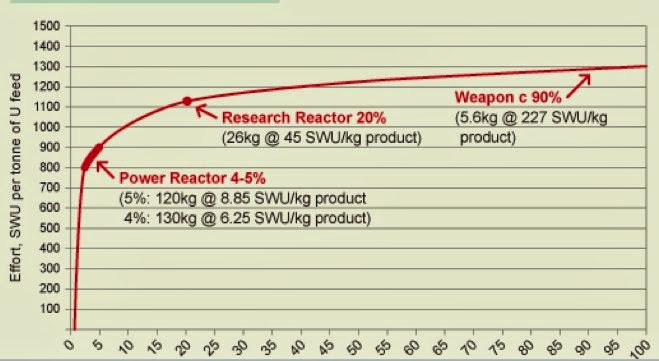
By virtue of having functional uranium enrichment facilities and technical expertise to spin centrifuges, Iran – like any other nation with that technology – can create weapons-grade material if it decided to. But this doesn’t mean it can already “build a nuclear bomb.”
Moreover, Tehran Bureau‘s paraphrased quote from Khatami is itself misleading. The source of the quote can be found here, although Tehran Bureau does not provide a link over to it, a highly unprofessional reporting practice.
Mohammad Ali Shabani, a doctoral researcher at the University of London’s School of Oriental and African Studies (SOAS), notes that the focus of Khatami’s speech before the IRGC gathering was not the nuclear issue, but rather Iran’s Kurdistan province and Syria. While Khatami is by no means an expert on nuclear technology, when he did touch briefly on the subject, this is what he said, according to Shabani’s translation:
[But] even if we could build a bomb, we would not do such a thing as our Guardian Jurist [Ayatollah Khamenei] deems use [of such weapons] impermissible (haraam). The West’s concerns are not about a bomb, but Iran’s capabilities; just as our nuclear scientists enriched uranium from 5% to 20%, undoubtedly they can [do so] to 40%, 50% and finally 90%, which is needed in order to build a bomb, and they [Iran’s scientists] posses this knowledge. Our role model is our Dear Prophet, who even forbade the poisoning of an enemy city, and this is our evidence [basis] for not building a bomb.
This is a political statement, not a technical declaration. Nowhere does Khatami state that Iran can build a nuclear weapon. Tehran Bureau‘s reporting also omits the fact that such statements about such scientific capabilities and the nation’s official, absolute prohibition on nuclear weapons are nothing new for Iranian officials.
For instance, in February 2010, then-Iranian president Mahmoud Ahmadinejad announced that “right now in Natanz, we have the capacity to enrich uranium at high levels.” He added, “We have the capability to enrich uranium more than 20 percent or 80 percent but we don’t enrich (to this level) because we don’t need it.”
A couple years later, in April 2012, The Guardian itself reported on a nearly identical statement made by Gholamreza Mesbahi Moghadam, a minister of the Iranian parliament. The framing in both that piece and the latest report are very similar:
Iran has the technological capability to produce nuclear weapons but will never do so, a prominent politician in the Islamic republic has said.
The statement by Gholamreza Mesbahi Moghadam is the first time an Iranian politician has publicly stated that the country has the knowledge and skills to produce a nuclear weapon.
Moghadam, whose views do not represent the government’s policy, said Iran could easily create the highly enriched uranium that is used to build atomic bombs, but it was not Tehran’s policy to go down that route.
Moghadam told the parliament’s news website, icana.ir: “Iran has the scientific and technological capability to produce [a] nuclear weapon, but will never choose this path.”
The 2012 Guardian report sparked false conclusions and predictable reactions from Israeli officials, who eagerly exploited the non-news for political posturing. The following year, a number of different reports published by The Guardian contained bad analysis, dubious allegations and sloppy journalism.
Unfortunately, The Guardian, now in partnership with Tehran Bureau, is at it again.
Iran Nuclear Talks à la Israeli-Palestinian Negotiations
By ISMAEL HOSSEIN-ZADEH | CounterPunch | December 16, 2014
Soon after the Iran nuclear talks were recently extended for another seven months (beyond the November 22, 2014 deadline), President Rouhani spoke with the Iranian people in a televised address in which he sought to portray the inconclusive negotiations as a diplomatic victory for Iran, as an indication that his team of negotiators “stood their ground” in the face of excessive demands by the US and its allies.
In reality, however, the extension meant the failure of the Iranian negotiators to achieve anything of substance (in terms of sanctions relief) in exchange for the significant unilateral concessions they had made a year earlier. To put it differently, it meant that the US and its allies refused to honor what they had promised Iran in return for its suspension and/or downgrading of its nuclear technology.
A year earlier, that is, in the first round of negotiations on 24 November 2013, Iran had agreed to the following significant concessions: limit its enrichment of uranium from the level of 20 percent to below 5 percent purity, render unusable its existing stockpile of 20 percent fuel for further enrichment, not activate its heavy-water reactor in Arak, not use its more advanced IR-M2 centrifuges for enrichment, and consent to extensive IAEA inspections of its nuclear industry/facilities.
This obviously means that Iranian negotiators had agreed to more than freezing Iran’s nuclear technology; more importantly, they had reversed and rolled back significant scientific achievements and technological breakthroughs of recent years.
In return, the US and its allies had agreed that following the “confidence building” implementation of these commitments by Iran, economic sanctions against that country would be lifted.
A year later, and despite the fact that IAEA has consistently confirmed Iran’s compliance with these commitments, major sanctions continue unabated. At a press conference on November 22, 2014, US Secretary of State John Kerry boasted that undiminished sanctions have forced Iran to either reverse or freeze much of its nuclear program. “Today,” Kerry stated, “Iran has no 20 percent enriched uranium. Zero. None. They have diluted and converted every ounce that they have… Today, IAEA inspectors have daily access to Iran’s enrichment activities and a far deeper understanding of Iran’s program.”
Instead of honoring what they had promised during the initial negotiations of year ago, the US and its allies now argue that Iran needs to make more concessions, and that therefore more time is needed for further negotiations—hence the seven-month extension of negotiations, to July 1, 2015.
And what are the new demands that are made of Iran? The new requirements, which the Iranian negotiators have now additionally agreed to, include the following:
* Expanded snap Inspections of Iran’s Centrifuge Production Facilities: under the seven-month extended negotiations, the IAEA will double its unannounced, snap inspections of Iran’s centrifuge production facilities.
* Conversion of more 20% Uranium Oxide to Reactor Fuel: Iran will convert 35 additional kg of its remaining 75 kg of 20% enriched uranium powder from oxide form into reactor fuel for the Tehran Research Reactor, thereby helping prevent the reversibility of a key concession Iran has made.
* Further Limitations on Research and Development (R&D) of Advanced Centrifuges and Enrichment Technology. The most important of these new limits are:
* Iran cannot pursue semi-industrial-scale operation of the IR-2M, a necessary prerequisite toward mass production of the model.
* Iran cannot feed IR-5 model centrifuges with uranium gas.
* Iran cannot pursue gas testing of the IR-6 centrifuge on a cascade level.
* Iran cannot install the IR-8 centrifuge at the Natanz Pilot Plant, preventing it from being tested with uranium gas.
* Iran is prohibited from using other/new forms of enrichment, including laser enrichment [source].
And what would Iran gain in return for these significant additional/new concessions? Not much. Under the extended interim agreement, as in the two previous interim agreements, dating back to November 2013, Iran will be permitted to repatriate only $700 million per month of its nearly $100 billion assets that are frozen overseas under the sanctions regime.
This explains why many critics have pointed out that Iranian negotiators have, once again, made significant one-sided concessions without much reciprocity in the way of sanctions relief. It also explains why President Rouhani’s (and his negotiating team’s) portrayal of the extension of negotiation as a diplomatic victory for Iran is far from warranted—it is, indeed, tantamount to self-deception, or more precisely, deception of the Iranian people.
Off-the-record briefings in Washington indicate that the US is projecting a long period of 15 to 20 years of protracted negotiations before restrictions on Iran’s civilian nuclear program are fully lifted. In light of the fact that the US and its allies have already achieved their goal of downgrading and freezing Iran’s nuclear program, while retaining crippling sanctions on that country, their policy of prolonging negotiations—as a tactic to avoid honoring what they have promised Iran—is understandable. As Keith Jones, a keen observer of the Iran nuclear talks, points out:
“Washington is determined to continue to subject Iran to crippling economic sanctions, with relief doled out incrementally and over a period of years. Moreover, during a lengthy initial period, the Western powers want only piecemeal suspension of the sanctions, not their repeal, so that they can be quickly reinstituted should they determine that Tehran has failed to fulfill its commitments” [source].
This means that President Rouhani’s (and Foreign Minister Javad Zarif’s) wishful thinking that a combination of generous concessions and a diplomatic charm offensive would suffice to have the US lift the economic sanctions against Iran has, effectively, placed his negotiators on a slippery slope, with no end to ever newer demands and additional conditions required of them by the US and its allies.
The perils of prolonged negotiations—increasingly resembling the Israeli-Palestinian negotiations—go beyond downgrading and/or freezing Iran’s nuclear technology. Equally devastating are the crippling effects of the continued sanctions on the Iranian economy/society.
Detrimental effects of sanctions on the Iranian economy have been further exacerbated by the Rouhani administration’s misguided policy of having tied the fate of Iran’s economy to the outcome of nuclear negotiations—effectively, making the future of the economy hostage to the unreliable and unpredictable consequences of the nuclear talks. This policy stems from the administration’s neoliberal economic outlook that seeks solutions to economic stagnation, poverty and under-development in unreserved integration into world capitalist system. The policy tends to hurt Iran in two major ways.
First, by tying the chances of economic recovery in Iran to the removal of the sanctions, that is, to the “successful” conclusion of the nuclear talks, the policy has undermined Iran’s bargaining position in the negotiations. Indeed, it can reasonably be argued that President Rouhani condemned Iran to a losing nuclear negotiation long before he was elected. He did so during his presidential campaign by pinning his chances for election on economic recovery through a nuclear deal. This was a huge mistake, as it automatically weakened Iran’s bargaining position and, by the same token, strengthened that of the United States and its allies. By exaggerating the culpability of his predecessor in the escalation of economic sanctions against Iran, he committed two blunders: (a) downplaying the culpability of the US and its allies, and (b) placing the onus of reaching a nuclear deal largely on Iran.
Second, the policy of linking the chances of an economic recovery to the outcome of nuclear negotiations and/or the lifting of sanctions has created an ominous atmosphere of business/market uncertainty among the Iranian investors and entrepreneurs. Uncertainty is perhaps the worst enemy of a market economy, which explains why long-term, productive investment is drying up in Iran, or why economic stagnation has deteriorated since President Rouhani took office in early 2013.
Iran could minimize the baleful effects of sanctions by trying to delink its economic policies from nuclear negotiations and the threat of further sanctions. This would be possible if the Rouhani administration’s economic outlook somehow tilted away from outward-looking to inward-looking strategies of economic development; that is, the development of a “resistance economy,” as Iran’s Supreme leader, Ayatollah Khamenei has put it. This requires an economic strategy that would view the sanctions as an opportunity to mobilize national resources and chart an industialization course toward import-substitution and economic self-reliance—something akin to a war economy, since Iran has effectively been subjected to a brutal economic war by the United States and its allies.
Such a path of development would be similar to the eight years (1980-88) of war with Iraq, when at the instigation and support of regional and global powers Saddam Hussein launched a surprise military attack against Iran. Not only did the Western powers and their allies in the region support the Iraqi dictator militarily but they also subjected Iran to severe economic sanctions. With its back against the wall, so to speak, Iran embarked on a revolutionary path of a war economy that successfully provided both for the war mobilization to defend its territorial integrity and for respectable living conditions of its population.
By taking control of the commanding heights of the national economy, and effectively utilizing the revolutionary energy and dedication of their people, Iranian policy makers further succeeded in bringing about significant economic developments. These included: extensive electrification of the countryside, expansion of transportation networks, construction of tens of thousands of schools and medical clinics all across the country, provision of foodstuffs and other basic needs for the indigent at affordable prices, and more.
Alas, despite its record of success, this option seems to be altogether alien to President Rouhani and his team of economic advisors who, following the neoliberal/neoclassical school of economic thought, maintain that the solution to Iran’s economic problems lies in an unrestrained integration into world capitalism, in a wholesale (and often fraudulent) privatization of the economy, and in an IMF-style of economic austerity.
Ismael Hossein-zadeh is Professor Emeritus of Economics (Drake University). He is the author of Beyond Mainstream Explanations of the Financial Crisis (Routledge 2014), The Political Economy of U.S. Militarism (Palgrave–Macmillan 2007), and the Soviet Non-capitalist Development: The Case of Nasser’s Egypt (Praeger Publishers 1989).
Official denies having confirmed Iranian anti-ISIS strikes in Iraq
Al-Akhbar | December 9, 2014
A senior Iranian official on Tuesday denied remarks attributed to him in a British newspaper saying Tehran had carried out airstrikes against the Islamic State of Iraq and Syria (ISIS) group in Iraq.
The Guardian last week quoted deputy foreign minister Ebrahim Rahimpour as saying that Iran had conducted strikes against ISIS for “the defense of the interests of our friends in Iraq.”
His remarks appeared to contradict the official position of Iran, which has not confirmed it carried out the attacks as reported by the Pentagon.
Rahimpour on Tuesday however said he was misquoted, and that his remarks had been made in response to a question on possible airstrikes.
He said he was referring to “the general way in which Iraq is allied to Iran and that we are ready to provide military assistance if the Iraqi government asks for it.”
“My comments were misinterpreted,” Rahimpour told AFP on the sidelines of an international conference in Tehran.
Iran has consistently denied having troops in Iraq, and was not invited to join a US-led military coalition against ISIS, which has carved out a vast region of control in the country and in neighboring Syria.
Iraqi Prime Minister Haider al-Abadi has said he had no knowledge of Iranian airstrikes against ISIS in his country.
(AFP, Al-Akhbar)
Israeli official: Strategic cooperation with Riyadh is growing

Director of Institute for Policy and Strategy, and Chair of Atlantic Forum of Israel Prof. Uzi Arad
MEMO | December 8, 2014
Strategic and security cooperation between Saudi Arabia and Israel is growing at an unprecedented rate, Israel’s former National Security Adviser Uzi Arad said.
During his participation at the Energy 2015 Conference, Arad said that Israel takes advantage of Saudi Arabia’s role as a counterweight in the face of Iran which makes it play a central and effective role in Israel’s strategic plans.
Arad warned of the consequences of betting on the survival of an allied regime in Egypt, pointing out that Egypt is going through a very sensitive stage and things could turn upside down at any moment.
With regards to Jordan, Arad said: “About Jordan, we cross our fingers. No one knows what will happen there in five years. One must hope that things there will be stable. Who says the wave sweeping Iraq and Syria will not arrive to Jordan?”
Arad said the Palestinian Authority currently represents a partner for Israel in the face of many challenges.
Israel will not tolerate Iran turning into a state with nuclear capabilities, he stressed, pointing out that if the world and regional powers accept this, Israel will turn to the military option. He said: “For a long time now, there have been plans in Mossad about a situation in which another country around us has nuclear weapons. Such discussions begun in the 80s. Responses were prepared in advance. If you see a new submarine enter the port of Haifa, it does not take a genius to figure out what it signifies.”
Commenting on the relationship with Turkey, Arad said the most important research centre in Israel said the reality and the future of these relations do not bode well.
Israel is facing growing international isolation which, he warned, will affect the Israeli military and the country’s economic interests.
Arad noted that Israel benefits from the EU funded research projects, pointing out that they have strengthened the position of Israel as a great technological power.
He warned that the upcoming early elections in Israel will only contribute to the decline in Israel’s status.
Israel claims prevented ‘bad deal’ on Iran nuclear issue

Press TV – December 8, 2014
Irked by the ongoing nuclear negotiations between Iran and six world powers, Israeli Prime Minister Benjamin Netanyahu claims Tel Aviv has prevented what he calls a “bad deal” on Tehran’s civilian nuclear work.
In a recorded speech for a Washington think-tank released on Sunday, Netanyahu said the Israeli regime’s “voice” and “concerns” had played a key role in stopping a “bad deal” on Iran’s nuclear energy program before the November 24 deadline.
The Israeli premier further said the new extension of the nuclear negotiations must be used by the Tel Aviv regime and its allies to pile more pressure on the Islamic Republic over its nuclear energy program.
After they signed a landmark interim agreement last year, Iran and the six powers – Russia, China, Britain, France, the US and Germany — are now working to reach a final accord aimed at putting an end to the longstanding dispute over Tehran’s nuclear issue.
Last month, the two sides failed to meet the November 24 deadline to sign a permanent nuclear deal and agreed to extend their discussions until June 2015 so that they could resolve their differences and clinch a permanent accord.
Angered by the historic interim deal between Iran and its negotiating partners, the Israeli regime has been lobbying over the past months to thwart a final accord.
Tel Aviv has accused Iran of pursuing non-civilian objectives in its nuclear activities. However, Tehran has categorically denied the allegation, vowing that it will not back down an iota from its peaceful nuclear rights and will not buckle under any pressure.
Iran disputes veracity of US claims it launched air raids against ISIS in Iraq
Al-Akhbar | December 3, 2014
Iran has not launched any airstrikes against Islamic State of Iraq and Syria (ISIS) targets in neighboring Iraq, a senior Iranian official told Reuters on Wednesday, contradicting an earlier statement by the US.
“Iran has never been involved in any airstrikes against the Daesh (ISIS) targets in Iraq. Any cooperation in such strikes with America is also out of question for Iran,” the senior official said on condition of anonymity.
The US Pentagon had previously affirmed on Tuesday that Iranian fighter jets had bombed ISIS fighters in eastern Iraq in recent days, but that the strikes were not coordinated with US forces.
“We have indications that they did indeed fly airstrikes with F-4 Phantoms in the past several days,” Pentagon spokesman Rear Admiral John Kirby told AFP.
His comments came after Al-Jazeera recently ran footage of what appeared to be an F-4 fighter, similar to those used by the Iranian air force, attacking targets in the eastern province of Diyala.
At a press conference earlier, Kirby said it was up to the Iraqi government to oversee and coordinate military flights by different countries and not US commanders.
“We are flying missions over Iraq. We coordinate with the Iraqi government as we conduct those. It’s up to the Iraqi government to deconflict that air space,” Kirby told reporters.
“Nothing has changed about our policy of not coordinating military activity with the Iranians.”
Iranian forces have reportedly been active on the ground in Iraq assisting militias and Baghdad government units. Iran also has provided Sukhoi Su-25 aircraft to Iraq amid speculation that the planes are flown by Iranian pilots.
Iran has close ties to the government in Baghdad, which has struggled to counter ISIS.
US fighters, bombers and surveillance aircraft fly daily missions over Iraq along with other coalition warplanes from European governments as well as Australia and Canada.
The US-led air war against ISIS began on August 8 in Iraq and was extended into Syria in September. However, it has so far failed to stave off ISIS advances.
(AFP, Al-Akhbar)
Featured Video

AIDS Inc. by Gary Null (2007)
or go to
Aletho News Archives – Video-Images
From the Archives
Clash of Civilization, Iran Part II
By Jamal Kanj – Intifada-Palestine.com – January 14, 2011
Israel’s survival kit is: perpetuate conflict, insecurity to rationalize collective hate and finally playing victim.
Devoid of conflict, Israel implodes internally; without hate, Zionism loses its justification; and playing eternal victim to continue blackmailing the West. Absence of this holy trinity, Israel ceases to exist.
From its inception, the house of Zion has mastered exploiting adversarial powers to advance Israel’s cause. For instance, their influence over the Democratic Party in the US began with President Truman’s bid for 2nd term election in 1948.
Responding to strong opposition from Secretary of State General George Marshall and Department experts urging against recognition of Israel, President Truman replied: “I’m sorry gentlemen but I have to answer to hundreds of thousands [Jewish voters] who are anxious for the success of Zionism. I do not have hundreds of thousands of [voting] Arabs among my constituents”
Zionists influence over liberal American politics was matched with the doctrinal school of Conservative theoreticians aligning the Republican Party’s platform with Israel’s objectives. The Neoconservative Zionists, coined Zioncons, invented the “Clash of Civilization” concept to fight Israel’s wars. … continue
Blog Roll
 Aletho News
- 12 Things Your Psychiatrist Was Trained Not to Tell You
- From Unipolar Universalism to Multipolar Civilizational Distinctiveness
- RSF military group defects, joins Sudanese army: State media
- Ireland goalkeeper refuses to play ‘Israel’ as squad weighs boycott
- China pushes back against US on Cuba, Iran
- Ukrainian Soldiers, Potential Mercenaries: Have Gun, Will Travel!
- Burnham’s UN debut… A masterclass in British disinformation
- Iran flights continue despite US aviation sanctions
- Global Tipping Points Lead the World Into a State of Entropy
- The day-after at the White House: USA and Xi Jinping
- If Americans Knew
- Israel forces Gazans to live in constant peril – Daily Update
- Deconstructing Netanyahu’s pants-on-fire UN rant – Daily Update
- Trump betrayed voters with his campaign lies and prioritized a foreign country once he took office
- Netanyahu calls Israel’s war in Gaza ‘opposite of genocide’ in UN speech to near-empty hall
- Settler Kidnappings: Torture, Sexual Abuse and Terrorisation of Palestinian Abductees as Israel Deepens Annexation of West Bank
- Gaza winter nears as 162,000 tents become unusable, raising fears of humanitarian crisis
- Netanyahu says, “It’s the opposite of genocide”; UN says Gaza economy is world’s ‘most severe crisis on record’ – Daily Update
- Israel’s US-Backed Assault on Gaza Has Created the ‘World’s Most Severe Economic Crisis on Record’: UN
- ‘Protecting U.S. Citizens’… From Israel
- ‘This is where I live now, the back of a truck’: a day in the life of a grandmother in Gaza
- No Tricks Zone
- New Study: Earth And Venus Surface Warmth Largely Explained By Convection And Lapse Rate, Not CO2 Or Radiation
- 2025 Nature Paper Claiming Worsening Global Drought Gets RETRACTED …Heavily Flawed
- New Study: ‘Global Drought Shows No Detectable Recent Acceleration Under Climate Warming’
- Economic Masterminds: German Socialists Suggest Taxing Productivity Gains Stemming From Using AI
- The South China Sea Has Not Been Cooperating With The Climate Change Narrative
- Energy Crisis: Germany Enters Heating Season With Historically Low Gas Reserve Fill Levels
- New Study: The Antarctic Ice Sheet Gained Mass From 2020-2024 Due To Staggering Snow And Ice Accumulation
- Study: Ocean Heating Rates From Thousands Of Years Ago ‘Dwarf’ Modern Ocean Heating Rates
- Climate Extremists Target, Attack Large-Scale Power Grid Infrastructure In Germany!
- New Study: Antarctic Ice Melt Has Contributed Less Than 1 Centimeter To Sea Level Rise In The Last 30 Years

