Mystery Surrounds U.S. Justice Department Move to Wrap Anti-Iran Group in Shroud of Secrecy
By Noel Brinkerhoff and Steve Straehley | AllGov | July 30, 2014
The U.S. Department of Justice has drawn attention to itself for helping an organization opposed to Iran maintain secrecy of its records, which are caught up in a defamation lawsuit filed against the group.
United Against Nuclear Iran (UANI) was founded six years ago and is operated by and gets advice from a who’s who list of American and foreign politicos, including former U.S. Senator Joseph Lieberman; Frances Townsend, the former homeland security adviser to President George W. Bush; Dennis Ross, a former Middle East adviser to both Republican and Democratic presidents; plus former intelligence chiefs from Israel, Germany and Britain.
Victor Restis, a Greek shipping magnate accused by UANI of violating sanctions by doing business with Iran, filed a defamation suit against the group. Restis’ lawyers have sought to compel UANI to release information about its donors and other details.
But the Justice Department stepped in and asked a federal judge to block the request, claiming the records contain sensitive information that the government considers important. Federal attorneys insisted “that certain information” would jeopardize law enforcement investigations, expose investigative techniques or identify confidential sources if released, according to The New York Times.
U.S. District Judge Edgardo Ramos in New York City granted the government’s request, while also describing the U.S. government’s involvement as “very curious.” The Justice Department has until July 31 to claim law enforcement privilege and keep the information from being disclosed permanently. In the meantime, each side has hurled charges and countercharges at the other.
“I am particularly concerned,” Ramos said in April, “that the defendants are able to utilize certain information in its public statements, and then not have to answer to their actions on the basis of a privilege.”
The claim of privilege puts the Justice Department in a conundrum. Federal intelligence agencies are not supposed to work with outside agencies to influence U.S. public opinion. But if UANI hasn’t been working with the government, what information could it have that would be so sensitive? We might find out on Thursday.
Iran ready to build makeshift hospital in Gaza
Press TV – July 29, 2014
The Iranian Red Crescent Society (IRCS) says it is ready to set up a fully equipped makeshift hospital in the Gaza Strip amid deadly Israeli attacks on the impoverished coastal enclave.
Seyyed Reza Raeis Karami, the IRCS under-secretary general for health, treatment and rehabilitation, said the humanitarian body is ready to dispatch a medical team to Gaza and build a field hospital there to treat those wounded in Israeli attacks.
The hospital could be built up in a six-month period, while a group of 23 Iranian surgeons will also operate in the medical center to treat the injured Gazans, according to the IRCS official.
Karami added that the IRCS will be prepared to send necessary equipment and human resources to set up the hospital after gaining permission and making assessments of the situation in the Palestinian land.
The first consignment of relief aid provided by the IRCS for Gazans has been flown into the Egyptian capital of Cairo and is waiting to be cleared for transfer into the coastal enclave via the Rafah border crossing.
On July 21, Iran’s Health Minister Seyyed Hassan Qazizadeh Hashemi said the country’s hospitals were fully prepared to admit the injured Palestinians, saying the Islamic Republic is ready to supply the wounded with necessary medicine.
Latest reports say Israeli aerial and ground assaults have killed more than 1,100 Gazans and injured over 6,500 others since July 8.
Hospitals in Gaza are in desperate need of medicine and equipment. Over the past days, Israeli warplanes and tanks have pounded several hospitals across the besieged region.
Earlier this month, the Israeli military targeted the hospitals in Deir al-Balah and Beit Hanoun, killing a number of Palestinian civilians and wounding several others.
The Consistency of Official Iranian Commentary, Part III: On Khamenei’s Referendum Rhetoric, Reuters is Wrong
By Nima Shirazi | Wide Asleep in America | July 27, 2014
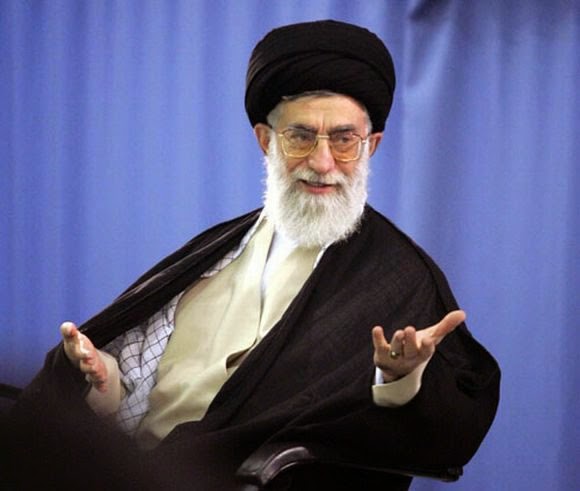 Last week, Iranian leader Ayatollah Ali Khamenei addressed a meeting of Iranian university students and, in his first public comments on the ongoing assault on Gaza, spoke of his belief in the necessity of continued Palestinian resistance to Israel aggression, oppression, and occupation.
“Don’t the Palestinians have the right to defend their lives and security?” he asked rhetorically, and condemned Western nations like the United States and Great Britain for openly supporting Israel’s assault and justifying “crimes that no ordinary person would.”
In the right-wing Daily Caller, notorious neocon darling Reza Kahlili noted that Khamenei reiterated the call by his predecessor, Ayatollah Rouhollah Khomeini, that “Israel must be destroyed,” adding that “until that time with the help of God for this cruel and murderous regime to be destroyed, strong confrontation with steadfast armed resistance is the only solution against this destructive regime.”
Yet the Caller omitted a crucial aspect of Khamenei’s speech – deliberately replaced by an ellipsis linking the the paraphrased Khomeini quote with Khamenei’s endorsement of Palestinian armed struggle – in which the Iranian leader stated that the ideal solution to the current impasse was a democratic vote.
The missing piece, however, was reported by other outlets. “There are logical and practical means to this end, which is for people who live and belong there to pick the government of their choice through a referendum. That would be the end of a usurping fake regime,” Khamenei said, according to a translation by Reuters. Until that time, he continued, “while waiting for an end to this cold-blooded murderous regime, mighty armed resistance is the only way to deal with it.”
Only through a vote by the indigenous population, Khamenei said, will “the usurper and forged regime” of Israel “be practically annihilated.”
Kahlili’s report predictably expunged all mention of a referendum, focusing instead on Iranian military capabilities and nuclear negotiations. More troubling, perhaps, is that “The Young Turks,” a liberal (some might even say, progressive) news and commentary outlet led by host Cenk Uygur, promoted the Daily Caller line in their own round table discussion of the matter. After hearing a portion of the Kahlili article read aloud verbatim, co-host Ana Kasparian described Khamenei’s comments as “extremely violent” and “crazy,” while John Iadarola called such statements “depressing.”
Reuters also quoted Khamenei as saying, “Israel’s annihilation is the only real cure, but that doesn’t mean destroying Jews in this region,” a statement also ignored by the Daily Caller. With this comment, Reuters editorialized, “Khamenei made clear for the first time that he was talking about the dismantling of the state of Israel, not the death of Jews.”
While such clarification is important, the characterization of that distinction as being a new addition to Khamenei’s rhetoric is curious. In fact, this is a distinction made often by Iranian officials when discussing this very topic – and Iran’s official position toward Israel/Palestine. Cursory research into past statements quickly reveals the consistency of such statements and proves the Reuters claim to be, not only sloppy, but ludicrous.
A similar presumption was made last year in the wake of then-newly-inaugurated Iranian President Hassan Rouhani’s insistence that, “when it comes to the settlement and resolution of regional issues,” including the colonization and occupation of Palestine, “we believe that the only path is through the ballot box, through democracy.” International news media declared this to be a breakthrough moment, despite the clear fact that Rouhani’s immediate predecessor, the much-maligned Mahmoud Ahmadinejad, had made identical statements throughout his eight-year tenure as president.
“We are opposed to the idea that the people who live there should be thrown into the sea or be burnt,” Ahmadinejad said in comments reported by the New York Times in September 2008. “We believe that all the people who live there, the Jews, Muslims and Christians, should take part in a free referendum and choose their government.”
More to the point, however, Khamenei himself has remained remarkably consistent on this issue, and Iran’s official prescription, for over two decades. In an extensive analysis of Khamenei’s speeches since 1990, published in the Boston Review in November 2013, well-known Iranian dissident Akbar Ganji – no fan of the Iran’s theocratic leadership – revealed the truth: Khamenei has long called for a new, inclusive Palestinian government to supersede the current Zionist one, thereby dismantling what is currently known as “Israel” politically, not violently.
For instance, Ganji notes, on April 17, 1991, Khamenei discussed “his solution for the Palestinian problem and said, ‘The Islamic Republic’s solution is to disband the usurping Zionist regime, forming a government of the Palestinians, and [guaranteeing] peaceful co-existence of Jews, Christians, and Muslims in all of Palestine.'” Four months later, on August 19, 1991, Ganji adds, Khamenei stated, “Solving the Palestinian problem entails destroying and eliminating the illegitimate government there, so that the true owners [of the land] can form a new government; Muslims, Christians, and Jews can live side by side… Our view regarding the Palestine issue is clear. We believe the solution is destroying the Israeli regime.”
Nearly a decade later, Khamenei’s position had not shifted. In a speech to the Basij militia on October 21, 2000, Ganji tells us that Khamenei again laid out his vision for the indigenous people of Palestine to choose their own political path forward. “The solution is for the millions of the Palestinians to return to Palestine, the several millions that live away from home to return to Palestine. The indigenous people of Palestine—Jews, Christians, and Muslims—should hold a referendum to decide what kind of a regime they want. The vast majority are Muslims. There are also Jews and Christians that belong there, as their parents also lived there. They can decide the political system that they favor,” he opined.
In March 2002, Khamenei again stated, “Holding a referendum in Palestine among the Palestinians, and all those that became refugees—if, of course, they want to return to Palestine—is a rational solution.” In June 2002, he repeated, “The only solution for the Palestine problem is that the true Palestinians, not the usurping and occupying immigrants, those who live in Palestine and those who became refugees, decide the type of government that they want. If asking for the vote of the people of a nation is a solution for those who claim to be democracy advocates, [then] Palestine is also a nation and must decide [its fate].”
The Palestinian problem has only one solution, and that is what we proposed several years ago. Hold a referendum among the indigenous Palestinians, those who live there, or are in refugee camps, or live elsewhere, regardless of whether they are Muslim, Christian, or Jew, and ask them to decide the government that they want. Regardless of whether that government is run by the Muslims, Jews, or Christians, as long as it is the result of people’s direct votes, is acceptable, and will solve the problem. Without it [the referendum] the problem will never be solved.
That Reuters would now claim Khamenei’s recent comments about Gaza mark a stark break from the past is absurd. In his Friday prayer sermon on June 20, 2008, Khamenei declared, “No, we have no problems with Jews. We have no problems with Christians, and with adherents of other religions in the world. The usurper is just the Zionist regime. This is the position of our state, and that of our revolution and our people.”
Similarly, on September 30, 2011, Khamenei spoke at a conference in support of the Palestinian struggle for freedom, justice, and self-determination, and said, “We neither advocate a classic war between Israel and the Islamic countries, nor throwing the Jewish people into the sea, and neither do we accept mediation by the United Nations or any other international organization. We propose a referendum among the Palestinian people. Similar to any other nation, the Palestinians also have the right to decide their fate and pick the type of government they want.”
Addressing the opening assembly of the Non-Aligned Movement on August 30, 2012 in Tehran, Khamenei once again reiterated Iran’s “just and entirely democratic solution” to the conflict:
All the Palestinians – both the current citizens of Palestine and those who have been forced to immigrate to other countries but have preserved their Palestinian identity, including Muslims, Christians and Jews – should take part in a carefully supervised and confidence-building referendum and chose the political system of their country, and all the Palestinians who have suffered from years of exile should return to their country and take part in this referendum and then help draft a Constitution and hold elections. Peace will then be established.
Regardless of whether Khamenei’s proposals are realistic, idealistic, inevitable or impossible, is irrelevant. That he has consistently called for a referendum to alter the exclusivist and discriminatory political system that controls Palestinian lives and has routinely made distinctions between the Zionist government in Israel specifically and Jewish people in general, is indisputable.
Reuters should get their facts straight.
Has America learned anything from negotiating with Iran?
By Flynt Leverett, Hillary Mann Leverett, and Seyed Mohammad Marandi | Press TV | July 18, 2014
While negotiators from Iran, the United States and the rest of the P5+1 will not meet their July 20 target for a comprehensive nuclear agreement, it is clear they won’t walk away from the table in a huff. So, as the parties prepare to continue the process, what has America learned from negotiating with Iran, and what does it still need to learn to close a final deal?
One thing Washington has learned is that the Islamic Republic is deeply committed to protecting Iran’s independence. Thirty-five years ago, Iran’s current political order was born of a revolution promising Iranians to end subordination of their country’s foreign policy to the dictates of outside powers—especially the United States. Since then, the Islamic Republic has worked hard to keep that promise—for example, by defending Iran against a U.S.-backed, eight-year war of aggression by Saddam Hussein’s Iraq and fending off a steady stream of U.S. and Israeli covert attacks, economic warfare and threats of overt military action.
On nuclear matters, the Islamic Republic’s commitment to protecting Iranian independence focuses on the proposition that Iran has a sovereign right, recognized in the 1968 Nuclear Nonproliferation Treaty (NPT), to enrich uranium indigenously under International Atomic Energy Agency (IAEA) safeguards. The Islamic Republic terminated the purely weapons-related aspects of the U.S.-supplied nuclear program it inherited from the last shah, going so far as to reconfigure the Tehran Research Reactor—which, when transferred by the United States in the 1960s, only ran on fuel enriched to weapons-grade levels (over 90 percent)—to use fuel enriched to just below 20 percent.
But the Islamic Republic has also been determined to develop a range of civil nuclear capabilities, including indigenous enrichment for peaceful purposes. It won’t surrender Iran’s right to do so—even in the face of massive U.S. and Western pressure and sanctions. Beyond sovereignty and practical needs, Iranian policy makers judge that appeasing Washington on the issue will simply lead to more aggressive U.S. demands and pressure on other disputes.
America may have begun to recognize that respecting Iranian independence is key to diplomatic progress. For over a decade, Washington has insisted—contrary to how the vast majority of states read the NPT and to America’s own publicly stated view during the Treaty’s early years—that Iran has no right to enrich. Even today, while Secretary of State John Kerry acknowledges Iran’s right to a “peaceful nuclear program,” the United States refuses to acknowledge that this includes a right to safeguarded enrichment.
However, when Washington has moved, in practical ways, to accept safeguarded Iranian enrichment, Tehran has responded positively. In the Joint Plan of Action agreed last November, America and its British and French partners dropped their longstanding demands that Iran cease all enrichment-related activities before substantial diplomatic progress would be possible. Furthermore, the United States and the rest of the P5+1 agreed that a final deal would encompass an Iranian enrichment program. In return, Tehran made multiple commitments to diminish what America and its Western partners portray as the proliferation risks of Iran’s nuclear activities. These confidence-building measures—which, the IAEA reports, Iran has scrupulously implemented—include stopping enrichment at the near-20 percent level needed for TRR fuel, converting part of its near-20 percent stockpile to oxide form and diluting fissile-isotope purity in the rest, freezing its centrifuge infrastructure and accepting IAEA monitoring well beyond NPT requirements.
While U.S. officials have started to grasp the importance of respecting Iran’s independence, they have yet to draw this insight’s full implications—the main reason a final deal isn’t at hand.
America and its Western partners continue demanding that Iran dismantle most of its safeguarded centrifuge infrastructure—a demand with no basis in the NPT or any other legal instrument and which contributes nothing to Western powers’ purported nonproliferation goals. Iranian Foreign Minister Javad Zarif has made clear that, in a final deal, Iran could agree to cap temporarily the scope and level of its enrichment activities and to operate its centrifuges in ways rendering alleged scenarios of rapid “breakout” implausible (e.g., no stockpiling of low-enriched uranium).
Unfortunately, Western demands for dismantlement appear grounded in a determination that Tehran must “surrender” in a final deal—to forego sustainable indigenous enrichment capabilities and instead rely on foreign fuel suppliers (especially Russia). If Western powers insist that Iran compromise its sovereign rights, there will be no final deal, no matter how long talks are extended.
The United States also still needs to learn—however incomprehensible this may seem to some—that the Islamic Republic is, in fact, a legitimate order for the overwhelming majority of Iranians living inside their country.
Besides restoring Iranian independence, the revolution that produced the Islamic Republic promised Iranians to replace externally imposed autocracy with an indigenously created system, grounded in participatory Islamist governance. For thirty-five years, this is what the Islamic Republic has offered Iranians the chance to build. With all its flaws, the Islamic Republic has delivered for its people in important ways, including impressive (and progressive) developmental outcomes in poverty alleviation, educational access, health-care delivery, scientific and technological advancement, and improving the status of women—despite decades of war, threats of war, and intensifying sanctions.
Still, many American elites persist in depicting the Islamic Republic as a system so despised by its own people as to be chronically in danger of overthrow—a fantasy that has driven Western enthusiasm and not-so-tacit support for regime change in Iran. Beyond its falsity, this misapprehension of reality continues to warp the Western approach to nuclear diplomacy with Tehran. Beyond dictating the “acceptable” scope of Iran’s indigenous capabilities, Western powers want the limits on Iran’s nuclear activities in a final deal to apply for well over a decade. Conversations with Western officials indicate that this demand—also with no basis in the NPT or any other legal instrument—is motivated by assessments that the Islamic Republic will not last for more than ten years. By insisting on a more-than-ten-year term, Western powers are calculating that, when a final deal expires, Iran will have a political order less committed to strategic independence.
This is both foolhardy and reckless. The Islamic Republic is not about to disappear—and no truly legitimate Iranian government will compromise what the vast majority of Iranians see as their nation’s sovereign rights.
When the United States fully understands that, the nuclear issue will almost resolve itself.
Zarif and Kerry Signal Momentum on Nuclear Pact
By Gareth Porter | IPS | July 17, 2014
WASHINGTON — As the negotiations on the Iranian nuclear programme approach the July 20 deadline, both U.S. Secretary of State John Kerry and Iranian Foreign Minister Mohammad Javad Zarif have signaled through their carefully worded statements that they are now moving toward agreement on the two most crucial issues in the talks: the level of Iranian enrichment capability to be allowed and the duration of the agreement.
Their statements after two days of meetings Sunday and Monday suggest that both Kerry and Zarif now see a basis for an agreement that would freeze Iran’s enrichment capacity at somewhere around its present level of 10,000 operational centrifuges for a period of years.
They also indicated that the two sides have not yet agreed on how many years the agreement would last, but that the bargaining on that question has already begun.
The tone and content of Kerry’s statements in particular contrasts sharply with remarks by a senior U.S. official shortly before Kerry’s arrival in Vienna on July 12, which accused Iran of failing to move from “unworkable and inadequate positions that would not in fact assure us that their programme is exclusively peaceful.”
Zarif’s comments to New York Times correspondent David E. Sanger suggested movement toward an accord on the two key issues of the level of enrichment capacity and the duration of the agreement.
“I can try to work out an agreement where we would maintain our current levels,” Zarif was quoted as saying.
The Wall Street Journal reported Tuesday that a diplomat involved in the talks had said Iran had proposed freezing the number of centrifuges at 9, 400 – roughly the same number that have actually been operating.
Iran has another 9,000 centrifuges that were installed but never hooked up or operated, suggesting that Iran intended to trade them off for concessions from the P5+1 in eventual negotiations even before Hassan Rouhani became president last year.
The Times story reported that Zarif also “signaled that he had some room to negotiate on how long the freeze would last because Iran has an agreement with Russia to provide fuel for its Bushehr nuclear plant for the next seven years.”
“We want to produce only what we need,” Zarif said. “Since our reactor doesn’t need fuel for another seven years we don’t have to kill ourselves for it. We have time.”
Zarif’s latitude for negotiating on the expiration date may be wider than has been assumed because Iran is pursuing a possible deal with Russia on cooperation in fuel fabrication, according to a document on Iran’s nuclear energy needs recently released by the government.
Such an agreement could eliminate the need to begin replacing Russian fuel immediately after the expiration of the present contract.
In his press conference Tuesday, Kerry refused to address the question of specific numbers of centrifuges discussed with Zariff. Nevertheless, he said, “We have made it crystal clear that the 19,000 that are currently part of their programme is too many.”
By referring to the 19,000 figure rather than to the 10,000 operative centrifuges, Kerry was leaving the door open to a deal that would cut half of Iran’s total centrifuge capacity.
As recently as June, Obama administration officials were leaking to the press a demand that Iran would have to accept a cut in the number of centrifuges to between 2,000 and 4,000.
The rationale for that demand was that Iran’s existing level of centrifuges would allow it the capability to achieve a “breakout” to sufficient weapons-grade uranium to build a single nuclear weapon in only two to three months, and that Washington was insisting on lengthening that “breakout timeline” to six to 12 months.
But the administration is well aware that another way to achieve that objective is to reduce Iran’s low enriched uranium stockpile to close to zero.
Zarif explained to the Times correspondent the Iranian proposal, which was part of the negotiating draft, to guarantee that no breakout capability would exist even with the current level of Iranian enrichment.
Sanger reported that Zarif had “combined his proposal of a freeze with an offer to take the nuclear fuel produced by its 9,000 or so working centrifuges and convert it to an oxide form, a way station to being made into nuclear fuel rods.”
Zarif reportedly said Iran would “guarantee, during the agreement, not to build the facility needed to convert the oxide back into a gas, the step that would have to precede any effort to enrich it to 90 percent purity, which is what is generally considered bomb-grade.”
The foreign minister claimed that his proposal would lengthen the “breakout timeline” to more than a year, according to Sanger. As described by Zarif to IPS in early June, the plan is designed to assure that no low enriched uranium would be available for weapons-grade enrichment for the duration of the agreement.
Sanger reported that American officials are “doubtful” that it would accomplish that objective but offered no explanation and did not quote any official. That suggests that Sanger was relying on what U.S. officials had said about the “breakout” issue before the Kerry-Zarif negotiations.
Kerry did not address the issue of duration of the agreement in his press conference remarks. But a U.S. official was quoted in a July 12 Reuters story as declining to give a specific number but as saying that the United States wanted it to be “in the double digits”.
In earlier briefings for the news media, U.S. officials had indicated that the United States wanted the agreement to last 20 years.
Before the Kerry-Zarif meetings, the senior U.S official briefing journalists July 12 had criticised Ali Khamenei’s July 7 speech referring to Iran’s need for the equivalent of 190,000 first generation centrifuges. The official had said that the number would be “far beyond their current programme” and that the U.S. had said the existing capacity needed to be cut instead.
That suggested that Iran was insisting on getting approval for that increased capacity in the agreement.
In his news conference, however, Kerry clearly suggested that Khamenei’s citation of the 190,000 figure is not a deal-breaker. “[I]t reflects a long-term perception of what they currently have in their minds with respect to nuclear plants to provide power,” Kerry said. “[I]t was framed what way, I believe, in the speech,” he added.
Kerry was implying that Khamenei’s vision of industrial scale enrichment would not fall within the time frame of the agreement, presumably on the basis of his talks with Zarif.
That answer suggests that Kerry is now considering an Iranian proposal on the duration of the agreement that would put off the beginning of Iran’s buildup to industrial level enrichment to a point close to or within the “double digit” period of years demanded by the United States.
Once the difference between the proposed duration of the two sides has been reduced to a very few years, both sides may well conclude that the difference is not important enough to sacrifice the advantages of reaching agreement.
The Obama administration is still assessing whether to request an extension of the talks beyond Sunday’s deadline, but it may not take long to wrap up an agreement once the decision to reach compromise on the two key issues is made.
When Sanger of the Times asked Zarif whether agreement could be reached by the July 20 deadline, the foreign minister replied, “We can do that by this evening.”
Iran sanctions cost US economy $175bn: NIAC
Press TV – July 17, 2014
The US sanctions against Iran have cost Washington as much as USD 175 billion dollars in losses for not doing business with the Islamic Republic, a Washington-based think-tank has found.
“The United States is by far the biggest loser of all sanctions enforcing nations. From 1995 [when the US imposed trade embargo on Iran] to 2012, the US sacrificed between USD 134.7 and USD 175.3 billion in potential export revenue to Iran,” the National Iranian American Council (NIAC) concluded in a report.
During the same period, the report said, the United States lost 51,000 to 280,000 jobs a year due to the sanctions slapped on Iran.
“Texas and California are likely the biggest losers in terms of lost employment, due to their size as well as the attractiveness of their industries to Iran’s economy,” it said.
The US sanctions also cost the European economies billions of dollars in losses through the 2010-2012 period.
“In Europe, Germany was hit the hardest, losing between USD 23.1 and USD 73.0 billion between 2010 and 2012, with Italy and France following at USD 13.6-USD 42.8 billion and USD 10.9-USD 34.2 billion respectively,” it said.
The think-tank recommended that the US government consider lifting sanctions against Iran as nuclear negotiations are under way between Iran and the five permanent members of the UN Security Council – the Unites States, Britain, France, Russia and China – plus Germany.
“Decision-makers must… ask themselves if the cost of sanctions to the US economy is worth shouldering if other options do exist,” it said.
At the beginning of 2012, the United States and the European Union imposed sanctions on Iran’s oil and financial sectors with the goal of preventing other countries from purchasing Iranian oil and conducting transactions with the Central Bank of Iran.
New Cases by the EU General Court Striking Down Iran Sanctions Listings
By Dan Joyner | Arms Control law | July 7, 2014
I just wanted to draw attention to several cases recently decided by the EU General Court in which EU sanctions against designated individuals and businesses allegedly connected to Iran’s nuclear program have been annulled. These are just the latest in a growing line of cases in both the EU General Court and the European Court of Justice reaching similar decisions regarding EU sanctions targeting Iran’s nuclear program, which are essentially attempts to implement UN Security Council sanctions against Iran. I’ve written about this issue before on a couple of occasions. The EU Sanctions Blog has a great run down of the three recent cases here, here and here. I’m particularly pleased to note that the Sharif University of Technology was represented in its case by my friend Matthew Happold. See the text of the court’s judgment in this case here. Congratulations to Matt and to the University.
In terms of the legal merits of these cases, they really are just a continuation of the same bases on which earlier cases in this line have been decided. Basically the EU courts are requiring the EU and state governments to provide evidence on which the sanctions are based, and the governments involved are refusing to do so. Thus, as a basic matter of due process, the court has decided that the sanctions cannot stand on a lack of proffered evidence. A very sound holding in my view.
Hopefully, of course, the current round of P5+1 negotiations with Iran will produce a comprehensive agreement before the July 20 deadline, and this will lead to these EU sanctions being repealed, as part of a normalization of relations between Iran and the West. I think it is reasonable to expect that both the UN Security Council and the EU will be willing and able to withdraw the sanctions they have imposed against Iran over the past ten years, pursuant to such a comprehensive diplomatic agreement (as long as the US administration chooses to at least not veto such a decision by the UNSC). I have just about zero confidence, however, that the US government will be able to implement meaningful sanctions relief promised under such a comprehensive agreement. As I’ve said before, I think the biggest impediment to implementing a comprehensive agreement between Iran and the West over Iran’s nuclear program is the US Congress.
US warship downed Iran airliner, killed 290, July 3rd 1988

Iranians honor the victims of the 1988 US missile cruiser’s attack on an Iranian passenger plane
Press TV – July 3, 2014
On July 3, 1988, 290 people were killed in a US missile cruiser’s attack on an Iranian passenger plane.
Carrying 274 passengers and 16 crew members, the Airbus A-300 (IR655) had just taken off from the southern Iranian coastal city of Bandar Abbas and was climbing inside an internationally recognized route to Dubai when it was targeted by two Standard missiles fired from USS Vincennes on July 3, 1988.
Following the incident, US officials claimed their warship mistook the jetliner for an attacking Iranian F-14 fighter plane. The allegation was made as highly sophisticated radar systems and electronic battle gear had been mounted on the warship.
The Iranian airliner was equipped with an identification transponder to give off a specific response signal when interrogated by a radar signal from a potential adversary.
Due to delay in takeoff, the Vincennes started issuing warnings on the Military Air Distress frequency, having mistaken the Iranian civilian airplane for a military aircraft.
Vincennes’ attempts to contact Flight 655 failed because they had been sent on wrong frequencies.
Although no data recorder reported any identification, friend or foe (IFF) signal, the staff aboard the Vincennes continued misreporting the signal.
The decision to shoot down the Iranian plane was reportedly taken deliberately on the basis of personal advice passed from junior officers, regardless of a stream of contrary evidence from the electronics aboard.
The US government has so far refused to admit to its crime in the tragic incident and instead keeps falsely blaming Iran for the incident.
Washington later paid some 95 million dollars in compensation for the Iranian victims and the aircraft.
The money, however, failed to placate the anti-US sentiments in Iran, where people expected the USS Vincennes’ captain, William Rogers, to be held responsible for his criminal act.
Instead, Rogers was awarded the prestigious medal of Legion of Merit for his so-called outstanding service.
Kerry threatens Iran with ‘tightened sanctions’
Press TV – July 1, 2014
US Secretary of State John Kerry has threatened Iran with tightened sanctions and deepened isolation as he says time is running out for a “comprehensive” nuclear agreement with Iran.
In an opinion piece published by The Washington Post on Monday, Kerry said failure to reach a comprehensive agreement over Iran’s nuclear energy program could not be blamed on the “excessive demands on our part” but on Iran because Tehran has to “back up its words with concrete and verifiable actions.”
Iran has always emphasized that its nuclear energy program is geared to civilian purposes only. The International Atomic Energy Agency has conducted numerous inspections of Iran’s nuclear facilities but has never found any evidence showing that Iran’s civilian nuclear energy program has been diverted to nuclear weapons production.
However, Kerry urges Iran to choose between “phased relief” from unilateral sanctions and sanctions that “will tighten.”
“Now Iran must choose,” writes Kerry in his op-ed, threatening that “international sanctions will tighten and Iran’s isolation will deepen” if Iranians choose to stand by “the positions they have articulated”.
What Iran has always insisted on is that as a committed signatory to the nuclear Non-Proliferation Treaty (NPT) and a member of the IAEA, it will never give up the right to use nuclear technology for peaceful purposes.
Iran and the five permanent members of the UN Security Council plus Germany reached an interim deal on November 24, 2013, in the Swiss city of Geneva. The six-month deal, which took effect on January 20 and will end on July 20, can be extended.
However, Kerry says Iran “must show a genuine willingness” to address the US and its allies’ “concerns” or “the United States and our partners will not consent to an extension.”
Kerry’s remarks came after Israel sent a high-ranking delegation to the United States to discuss a final deal between Iran and the P5+1.
The Israeli team headed by Israel’s Minister of Strategic Affairs Yuval Steinitz traveled to Washington on Sunday to meet with US Under-Secretary of State for Political Affairs Wendy Sherman, who is the country’s representative in the nuclear talks.
The Israeli lobby in the US has been working hard to sabotage Iran’s nuclear deal with the world powers.
U.S. Demand for Deep Centrifuge Cut Is a Diplomatic Ploy
By Gareth Porter | Inter Press Service | July 1, 2014
WASHINGTON — With only a few weeks remaining before the July 20 deadline, the Barack Obama administration issued a warning to Iran that it must accept deep cuts in the number of its centrifuges in order to demonstrate that its nuclear programme is only for peaceful purposes.
U.S. officials have argued that such cuts are necessary to increase the “breakout” time – the time it would take Iran to enrich enough uranium to weapons grade level to build a single bomb – from what is said to be two to three months at present to as long as a year or even more.
Given the past record of political interference in fuel agreements, Washington knows it faces a tough sell trying to get Iran to accept the U.S. insistence on reliance on foreign suppliers.
Tehran has made it clear that it will not accept such a demand. Dismantling the vast majority of the centrifuges that Iran had installed is a highly symbolic issue, and the political cost of acceptance would be extremely high.
But a closer examination of the issues under negotiation suggests that the ostensible pressure on Iran is part of a strategy aimed at extracting concessions from Iran on the issue of its longer-term enrichment capability.
The Obama administration has been aware from the beginning of the talks that the “breakout” period could be lengthened to nearly a year without requiring the removal of most of the 10,000 centrifuges that have been used over the past two and a half years.
U.S. officials were well aware that reducing the amount of low enriched uranium and oxide powder now stockpiled by Iran to close to zero and avoiding any future accumulation would have the same effect – and that Iran was willing to accept such restrictions.
David Albright of the Institute for Science and International Security and Olli Heinonen, the former International Atomic Energy Agency (IAEA) deputy director general for Safeguards, warned in a June 3 article against a deal that would allow Iran to have more than 4,000 centrifuges in return for reducing its stocks of UF6 and oxide powder (UO2).
But they acknowledged that, if the Iranian LEU stockpile were reduced from the present level of 8,475 kg to 1,000 kilogrammes, the breakout time for 10,000 IR-1 centrifuges would be six months. And if the stockpile were reduced to zero, the breakout time would increase to close to a year, according to one of the graphs accompanying the article.
Experts from the Department of Energy as well as from the intelligence community certainly briefed policymakers on the fact that lengthening the breakout timeline to between six and 12 months could be achieved through reducing either centrifuges or the stockpile of low enriched uranium (LEU), according to Steve Fetter, who was assistant director at large for the White House Office of Science and Technology from 2009-12.
Eliminating the existing LEU stockpile and avoiding any further accumulation is the intent of an Iranian proposal formally handed over to EU Foreign Policy Chief Catherine Ashton by Iranian Foreign Minister Mohammad Javad Zarif in Istanbul last month. Under that proposal, which Zarif revealed in an interview with IPS in Tehran June 3, Iran would convert all UF6 to Uranium oxide powder (U02) and then convert the U02 to fuel plates for Bushehr.
Iran has expressed the desire to fabricate fuel plates for Bushehr itself, but has not yet mastered the technology. The proposal would therefore involve shipping either UF6 enriched to 3.5 percent or the U02 to Russia for conversion into fuel plates until the expiration of the contract with Russia for fuel fabrication for Bushehr expires in 2021.
In the interim agreement, Iran committed to begin converting UF6 enriched to 3.5 percent to oxide powder as soon as its line for such conversion became operational. The Enriched U02 Powder Plant began operating in May, but the time required to reduce the existing stockpile to zero will depend on the capacity of the plant, which has not been announced.
Zarif told IPS he had unveiled the basic idea underlying the Iranian proposal in his PowerPoint presentation to European officials in Geneva in mid-October.
When Secretary of State John Kerry declared in April that he would demand a major increase in the existing “breakout” period to somewhere between to six and 12 months, therefore, he had good reason to believe that Washington could achieve that objective without cutting Iran’s centrifuges to a few thousand.
An agreement to freeze the existing level of 10,000 operating centrifuges while reducing the LEU stockpile to zero could place the 9,000 centrifuges that have never been operated in storage under IAEA seal. Those used centrifuges include 1,000 advanced IR-2 centrifuges that are estimated to be three to five times more efficient than the IR-1 model.
Iran’s policy of introducing thousands of centrifuges into the Natanz and Fordow enrichment facilities that were never used was aimed at accumulating negotiating chips for eventual negotiations on its nuclear programme.
In late August 2012, a senior U.S. official told the New York Times that Iran was being “very strategic” by “creating tremendous [enrichment] capacity,” but “not using it.” In doing so, the official said, Iran was acquiring “leverage” – obviously referring to future negotiations.
During the round of negotiations in Vienna in June, however, the draft tabled by the P5+1 apparently called for cuts going well beyond what U.S. officials knew would be acceptable to Iran. U.S. officials told the New York Times that the objective was now to lengthen the “breakout period” to more than a year – thus going beyond what Kerry had suggested in April.
The draft may have included an even more extreme demand from the French government. French Foreign Minister Laurent Fabius declared in mid-June that the West wants to cut the number of centrifuges to “several hundred”.
After the June round of negotiations, Zarif denounced the draft as containing “excessive demands” which Iran would not accept.
But those demands appear to be a negotiating ploy in which the U.S. would give up the demand for deep short-term reductions centrifuges in the coming years in return for Iranian concessions on the level of enrichment capability to be allowed in the later stage of the agreement.
The November 2013 Joint Plan of Action provided that the future enrichment programme would depend on Iran’s “practical needs”. Iran interprets that term to include the need to be self-reliant in providing reactor fuel for Bushehr, whereas the Obama administration argues that Iran can and should rely on Russia or other foreign suppliers.
Given the past record of political interference in fuel agreements Iran had negotiated with French and German firms in the 1980s and with Russia in 2005, however, Washington knows it faces a tough sell trying to get Iran to accept the U.S. insistence on reliance on foreign suppliers.
The “practical need” criterion suggests that Iran would have to provide concrete evidence of its need and ability to provide the fuel rods for the Bushehr reactor when the current contract with Russia expires in 2021.
Postponing the negotiations over that issue until a date much closer to 2021 would offer a period of a few years to negotiate an agreement on a regional fuel consortium for the Middle East that would be acceptable to both sides, as has been proposed by a group of Princeton University scientists and scholars.
Perhaps even more important, such a postponement would allow for increasing trust through the successful implementation of the agreement covering the next few years.
Explaining the Princeton group’s plan at a briefing in Washington, D.C. last week, nuclear scientist Frank N. von Hippel, who was assistant director for national security in the White House Office of Science and Technology in the Bill Clinton administration, said, “We would have five years to cool down this impasse.”
Featured Video

AIDS Inc. by Gary Null (2007)
or go to
Aletho News Archives – Video-Images
From the Archives
Clash of Civilization, Iran Part II
By Jamal Kanj – Intifada-Palestine.com – January 14, 2011
Israel’s survival kit is: perpetuate conflict, insecurity to rationalize collective hate and finally playing victim.
Devoid of conflict, Israel implodes internally; without hate, Zionism loses its justification; and playing eternal victim to continue blackmailing the West. Absence of this holy trinity, Israel ceases to exist.
From its inception, the house of Zion has mastered exploiting adversarial powers to advance Israel’s cause. For instance, their influence over the Democratic Party in the US began with President Truman’s bid for 2nd term election in 1948.
Responding to strong opposition from Secretary of State General George Marshall and Department experts urging against recognition of Israel, President Truman replied: “I’m sorry gentlemen but I have to answer to hundreds of thousands [Jewish voters] who are anxious for the success of Zionism. I do not have hundreds of thousands of [voting] Arabs among my constituents”
Zionists influence over liberal American politics was matched with the doctrinal school of Conservative theoreticians aligning the Republican Party’s platform with Israel’s objectives. The Neoconservative Zionists, coined Zioncons, invented the “Clash of Civilization” concept to fight Israel’s wars. … continue
Blog Roll
 Aletho News
- 12 Things Your Psychiatrist Was Trained Not to Tell You
- From Unipolar Universalism to Multipolar Civilizational Distinctiveness
- RSF military group defects, joins Sudanese army: State media
- Ireland goalkeeper refuses to play ‘Israel’ as squad weighs boycott
- China pushes back against US on Cuba, Iran
- Ukrainian Soldiers, Potential Mercenaries: Have Gun, Will Travel!
- Burnham’s UN debut… A masterclass in British disinformation
- Iran flights continue despite US aviation sanctions
- Global Tipping Points Lead the World Into a State of Entropy
- The day-after at the White House: USA and Xi Jinping
- If Americans Knew
- Israel forces Gazans to live in constant peril – Daily Update
- Deconstructing Netanyahu’s pants-on-fire UN rant – Daily Update
- Trump betrayed voters with his campaign lies and prioritized a foreign country once he took office
- Netanyahu calls Israel’s war in Gaza ‘opposite of genocide’ in UN speech to near-empty hall
- Settler Kidnappings: Torture, Sexual Abuse and Terrorisation of Palestinian Abductees as Israel Deepens Annexation of West Bank
- Gaza winter nears as 162,000 tents become unusable, raising fears of humanitarian crisis
- Netanyahu says, “It’s the opposite of genocide”; UN says Gaza economy is world’s ‘most severe crisis on record’ – Daily Update
- Israel’s US-Backed Assault on Gaza Has Created the ‘World’s Most Severe Economic Crisis on Record’: UN
- ‘Protecting U.S. Citizens’… From Israel
- ‘This is where I live now, the back of a truck’: a day in the life of a grandmother in Gaza
- No Tricks Zone
- New Study: Earth And Venus Surface Warmth Largely Explained By Convection And Lapse Rate, Not CO2 Or Radiation
- 2025 Nature Paper Claiming Worsening Global Drought Gets RETRACTED …Heavily Flawed
- New Study: ‘Global Drought Shows No Detectable Recent Acceleration Under Climate Warming’
- Economic Masterminds: German Socialists Suggest Taxing Productivity Gains Stemming From Using AI
- The South China Sea Has Not Been Cooperating With The Climate Change Narrative
- Energy Crisis: Germany Enters Heating Season With Historically Low Gas Reserve Fill Levels
- New Study: The Antarctic Ice Sheet Gained Mass From 2020-2024 Due To Staggering Snow And Ice Accumulation
- Study: Ocean Heating Rates From Thousands Of Years Ago ‘Dwarf’ Modern Ocean Heating Rates
- Climate Extremists Target, Attack Large-Scale Power Grid Infrastructure In Germany!
- New Study: Antarctic Ice Melt Has Contributed Less Than 1 Centimeter To Sea Level Rise In The Last 30 Years

