Iran, China & Russia v. Trump /Glenn Diesen & Lt Col Daniel Davis
Daniel Davis / Deep Dive – April 15, 2026
Press TV – April 17, 2026
Following 40 days of unrelenting US-Israeli aggression, mounting evidence reveals that the US Department of War is deliberately concealing catastrophic, billion-dollar military losses inflicted by highly effective Iranian retaliatory strikes, the Daily Mail reports.
In the latest episode of the Daily Mail’s Photo Evidence, the British paper “scrutinizes new satellite images that reveal how America’s Department of War may not be telling the full truth about the scale of its losses during the Iran war,” it said.
Since the launch of the joint US-Israeli terrorist bombing campaign against Iran, the Islamic Republic has retaliated by targeting American military assets across the Persian Gulf with waves of missile and drone strikes.
As the Mail explains, “Iran’s war strategy has been anything but conventional. Rather than targeting fighter jets or bombers, the IRGC has systematically attempted to blind and cripple America’s command and control layer, launching attacks against radar and air defense systems”.
“It is these costly losses in strategic equipment that the Department of War is not being fully transparent about,” the paper wrote.
Its report “is borne out by looking at the latest EU Sentinel satellite images and cross referencing these with open source flight tracking data, ground photography and pictures issued by Iran’s state media,” the Mail added.
The US Department of War has asked Planet Labs, the world’s largest commercial satellite imagery provider, to withhold all images of the war region, including the bases of ally nations, indefinitely and the company has submissively complied.
According to the Mail, the Prince Sultan Air Base in Saudi Arabia provides an example of this lack of transparency. The Prince Sultan is one of the main bases from which America is fighting its war with Iran. The base is where the US keeps its logistics and support planes.
“On March 27th, we know Iran managed to effectively destroy an AWACS aircraft during an attack on the base. Looking at before and after satellite images, you can see the black roto dome of the aircraft is completely gone and there’s a black scorch mark on the tarmac,” the paper said.
Beyond the loss of the AWACS, evidence shows “how as many as seven KC-135 refueling tankers may have been destroyed or damaged in the March 27 strike,” it added.
Images of the air base’s main apron, released by Iran’s media, which claim three KC-135 tankers were destroyed and four more damaged in the strike, tally with independent EU satellite imagery, the Mail further said.
“In the EU image, you can clearly see a scorch mark on the ground which tallies with where the tankers were in the Iranian image,” it said.
“Looking at one airbase on just one day of the Iran war, it appears probable that the US lost over a billion dollars worth of equipment. The UK’s entire defense budget for 2026 was £62.2 billion,” the paper added.
“America is not being entirely honest with the damage being caused by the war,” said Daily Mail reporter Catherine Barnwell who scrutinized new satellite images.
“It has stopped US satellite companies from publishing imagery which shows us the damage that other sources and photographers on the ground are revealing.
“Officials have given off the record briefings confirming that Prince Sultan Air Base was hit on March 27, but have said nothing about the destruction of the aircraft,” she added.
The loss of just one AWACS plane costs the American taxpayer $724 million.
Furthermore, Iranian state media released images showing that strikes on the base devastated America’s aerial refueling capabilities, effectively destroying or damaging multiple KC-135 Stratotankers. Replacing a single KC-135 with a modern equivalent costs up to $240 million.
According to reports, the US lost at least 39 military aircraft by mid-April, with another 10 damaged. Experts estimate the US suffered at least $1.4 billion worth of combat losses in just the first six days of the fighting.
Iranian air defenses systematically dismantled the myth of US air superiority. Among the most humiliating defeats was the downing of a prized MQ-4C Triton drone in the Persian Gulf. Valued between $200 million and $250 million, it stands as the costliest single US air asset lost.
American stealth technology also proved vulnerable to Iran’s layered defenses. The F-35 Lightning II, marketed as highly survivable and costing $100 million per unit, suffered its first-ever combat loss when it was struck by Iranian ground fire.
Official Iranian tallies confirm the downing of two F-35s, alongside four F-15s (three in Kuwait and one in Tehran), two F-16s (one in central regions and one in the south), and one F-18 in the south. Furthermore, Iranian short-range air defenses successfully shot down over 160 US and Israeli drones during the war.
The US drone fleet suffered massive numerical attrition. By early April, Iranian surface-to-air missiles destroyed 24 MQ-9 Reaper drones—many around Shiraz and Kish Island—resulting in an estimated $720 million loss.
The severe operational pressure on US forces was further highlighted during a disastrous mission in Isfahan. US Special Forces were forced to destroy two of their own MC-130J Commando-II aircraft—costing $120 million each—after failing to take off. They also destroyed four AH-6 Little Bird helicopters, valued at $7.5 million per unit, to prevent them from falling into Iranian hands.
Obtained images reveal the destruction and severe damage inflicted upon strategic US equipment at regional bases, including advanced fighter jets, high-priced drones, and critical logistical facilities.
Satellite imagery from airbases in Jordan, Kuwait, and the UAE exposes the destruction of 3 F-35 stealth fighters, as well as significant damage to B-21 bombers and the American drone fleet.
Further satellite photos from the Port of Fujairah and southern bases show massive infernos consuming huge fuel depots intended to support prolonged US operations. The value of the destroyed fuel alone is estimated at over $800 million.
Looking at just one air base on a single day, it is probable that the US lost over a billion dollars in equipment, exposing a massive gap between the Pentagon’s official narrative and the devastating reality of Iran’s defensive capabilities.
Iran opens the Strait of Hormuz during 10-day ceasefire
By Kurt Nimmo | Another Day in the Empire | April 17, 2026
The Prime Minister of Lebanon, Nawaf Salam, thanked President Trump for a ten-day ceasefire announced on Truth Social that took effect at 5PM on Thursday, April 16. Benjamin Netanyahu agreed to the US-brokered deal, but with the same caveat imposed after Hamas conducted its Operation Al-Aqsa Flood breakout and offensive on October 7, 2023.
Israel reserves the right, the US State Department said, to carry out strikes in Lebanon “at any time” under Article 3 of the agreement. Netanyahu’s carte blanche states:
“Israel shall preserve its right to take all necessary measures in self-defense, at any time, against planned, imminent, or ongoing attacks. This shall not be impeded by the cessation of hostilities. Besides this, it will not carry out any offensive military operations against Lebanese targets, including civilian, military, and other state targets, in the territory of Lebanon by land, air, and sea.”
A similar double standard permitted Israel to violate the Gaza ceasefire agreement at least 2,400 times from October 10, 2025 to April 14, 2026, killing more than 700 Palestinians in the process.
“Israel has made a mockery of the supposed ceasefire agreements in both Lebanon and Palestine,” writes Maryam Jameela for The Canary. “They’re able to keep killing people, and to keep restricting the necessary conditions for life because international governments continue to allow them to.”
In Lebanon, Deputy Foreign Minister Saeed Khatibzadeh insisted his country is part of the US-brokered ceasefire arranged between Iran and Israel. Ibrahim al-Moussawi, a Hezbollah lawmaker, said the group would respect the deal if Israel did not target Hezbollah.
Trump said Hezbollah is party to the ceasefire and added that the government of Joseph Aoun will work to disarm the resistance group. “They’re going to be having a ceasefire and that will include Hezbollah,” the president told reporters. He added that he hopes “Hezbollah will behave.”
The paramilitary group, formed in the early 1980s during the Lebanese Civil War in response to an Israeli invasion and occupation of south Lebanon, insists it will not disarm. “We will not surrender or give up to Israel,” said Hezbollah leader Naim Qassem last July. “Israel will not take our weapons away from us.” In November, after assassinating Hezbollah’s Chief of Staff, Haytham Ali Tabatabai, Netanyahu called on the Lebanese government to disarm Hezbollah, a task it is not capable of accomplishing.
Israeli Media: Ceasefire is a “Double Submission”
In Israel, response to the ten-day ceasefire was met with anger and hostility by officials, journalists, and analysts. According to Israeli Channel 14, Netanyahu’s cabinet members reacted angrily at learning of the deal through social media. Israeli media framed the ceasefire as a betrayal and sellout to Hezbollah.
Marwa Osman, a journalist and television show host in Beirut, summarized the reactions on her X account.
Tamir Morag of Channel 14: “The way President Trump announced the ceasefire was embarrassing for Israel. It was clear that Israel’s interest was to continue fighting against Hezbollah.”
The nationalist opposition leader of Yisrael Beiteinu (“Israel is Our Home”), Avigdor Lieberman, complained, “The ceasefire in Lebanon is a betrayal of the residents of the north. The war must not end without a decisive outcome and the elimination of Hezbollah; this October 7 government has learned nothing.”
Ariel Kahane, a senior Israeli journalist and diplomatic correspondent for Israel Hayom daily, declared, “Donald Trump’s move reflects a double submission to Iran: Trump is aligning with Iran’s linking of the war in its territory to Lebanon. He is leaving one of Iran’s arms alive, active, and dangerous.”
Benny Ben Muvchar, head of the Mevoot Hermon Regional Council in northern Israel: “Hezbollah is still strong and waiting for us… the [Arab dominant] Galilee is being emptied of its residents, and we are being led by Trump’s whims.”
Israel’s i24 News characterized the ceasefire as a gift to Iran. “A more alarming development is that Iran itself informed the Americans that it wants to see a ceasefire in Lebanon, in order to advance negotiations between Tehran and Washington. What is happening amounts to a gift to Tehran at the expense of the northern settlements,” while Channel 13 complained the “ceasefire in Lebanon was imposed on Israel.”
“Residents of the north feel once again that they have been betrayed,” Channel 13 also reported. “We felt it during the ‘Iron Swords’ war [response to al-Asqa Flood], and we feel it again today. The fact that the U.S. President announced the ceasefire only highlights the distance between the Israeli Prime Minister and the people in the north and their reality.”
Critics claim Netanyahu delivered a coup de grâce when he “rejected a request by members of the security cabinet to vote on the ceasefire decision in Lebanon,” according to the Israeli newspaper, Yedioth Ahronoth.
On April 15, before the ceasefire in Lebanon, Netanyahu asserted that Israel was not obligated to adhere to Trump’s ceasefire agreement with Iran. Consequently, the Israeli military continued its attacks on Lebanon, despite the original agreement explicitly including Lebanon in the ceasefire.
Roaring Lion: 90% of Israelis Support Illegal Attack on Iran
The ceasefire between the United States and Iran is viewed negatively by settlers in northern Israel, according to the results of a survey conducted by the Israel Democracy Institute. In regard to Israel’s Operation Roaring Lion, concurrent with Trump’s Operation Epic Fury, the survey showed that “more than 90% gave the IDF a positive performance rating,” although the poll did not investigate Israeli responses to the concerns of international law experts, human rights organizations, and UN officials.
Israeli strikes resulted in significant civilian casualties and destruction of civilian infrastructure, including residential buildings. On February 28, 2026, a joint US-Israel attack struck a primary school in Minab, southern Iran, killing over 170 people, most of whom were children. Israeli strikes on Iranian oil depots on March 7, 2026, were also flagged for potentially causing long-term health and environmental damage to civilians.
In response to the attacks on Iran, over 100 international law experts signed a letter condemning them as violations of the UN Charter and potentially war crimes. Additionally, UN experts condemned the aggression against Iran and Lebanon, warning of the catastrophic impact on civilians and urging an immediate ceasefire.
Conversely, Iran’s retaliation, including the use of cluster munitions, has been condemned by Amnesty International. Civilian deaths in Ramat Gan, Tel Aviv, Yehud, and Bat Yam have come under investigation. A missile that struck Beit Shemesh that killed nine civilians is being investigated as a war crime.
Strait of Hormuz Open to Commercial Traffic
Following the ceasefire agreement, Israel Defense Minister Katz said the ongoing campaign against Hezbollah is far from over. According to Katz, the IDF has achieved several significant victories. However, certain areas in southern Lebanon have not yet been fully cleared. Weapons and combatants may still be present in these zones, and their removal is deemed crucial, he said.
According to the Lebanese army, there had been “a number of violations of the agreement, with several Israeli attacks recorded, in addition to intermittent shelling targeting a number of villages.” French President Emmanuel Macron expressed concern that the ceasefire has been compromised by ongoing military operations, as reported by AFP.
The Iranian Foreign Minister, Abbas Araghchi, responded to the tenuous ceasefire by announcing the temporary opening of the Strait of Hormuz. “In line with the ceasefire in Lebanon,” Araghchi said, “the passage for all commercial vessels through Strait of Hormuz is declared completely open for the remaining period of ceasefire.”
The price of Brent oil fell below $84 on the announcement and West Texas Intermediate futures, the US benchmark, dropped by 10% on the news of Araghchi’s announcement. Additionally, the Dow rose 640 points, around 1.2%, the S&P 500 gained 0.7%, and the Nasdaq rose 1%. “The stock market is good,” Trump declared, “the oil prices are coming down, and it’s looking very good that we are going to make a deal with Iran.”
However, considering Israel’s history of ceasefire violations, and the response by Hezbollah and Iran, it is entirely possible hostilities will resume and the strait will once again be closed to tanker and carrier traffic, thus dashing hope the war is now winding down and there is a peace deal on the horizon. As noted above, Israel has indicated it will continue military operations at its discretion.
RT | April 17, 2026
Passage for all commercial vessels through the Strait of Hormuz is now completely open, Iranian Foreign Minister Seyed Abbas Araghchi declared on Friday. He added that the waterway will remain open for the remainder of the ceasefire in Lebanon.
Araghchi’s announcement came shortly after a 10-day truce came into force between the Israel Defense Forces (IDF) and the Hezbollah militant group in Lebanon, which has been one of the major obstacles to a peace deal between Iran and the US.
Writing on X, the Iranian minister stated that “in line with the ceasefire in Lebanon, the passage for all commercial vessels through Strait of Hormuz is declared completely open for the remaining period of ceasefire.”
He noted however, that the vessels would be allowed to move along the “coordinated route as already announced by Ports and Maritime Organisation of the Islamic Rep. of Iran,” suggesting that the strait will remain under Tehran’s control.
US President Donald Trump has responded to Araghchi’s announcement on his Truth Social account, appearing to thank Tehran for fully reopening the “strait of Iran.”
The Strait of Hormuz has been shut down ever since the US and Israel launched an unprovoked attack on Iran in late February. The closure has driven up energy prices and rattled the global economy, disrupting one of the world’s most important trade arteries, which handles around 20% of global crude exports.
In the minutes following Araghchi’s announcement, oil prices plummeted by more than 10%, with Crude oil dropping to just over $83 per barrel and Brent coming in at around $88.
Glenn Diesen | April 16, 2026
Seyed Mohammad Marandi explains the Iranian perspective on why the negotiations with the US failed, what to expect from the US naval blockade, and the likely war that will continue. Marandi is a professor at Tehran University and a former advisor to Iran’s Nuclear Negotiation Team.
Follow Prof. Glenn Diesen:
Support the research by Prof. Glenn Diesen:
Daniel Davis / Deep Dive – April 15, 2026
By Joseph Solis-Mullen | The Libertarian Institute | April 16, 2026
For decades Washington has advertised its air and naval supremacy as the indispensable guarantor of global order. Recent events have shown this to be little but increasingly expensive theater. The 2026 Iran War has paused not with Iranian capitulation but in a cascade of humiliations that have permanently altered the strategic landscape. Washington’s vaunted power-projection capabilities proved unable to shield even its own forward bases, depleted critical munitions stockpiles, and ultimately ceded effective control of the Strait of Hormuz to Tehran. These lessons will not be lost on Beijing or Taipei. If the United States cannot impose its will on Iran, or previously the Houthis, it cannot credibly claim it could defend Taiwan against the far more formidable People’s Liberation Army.
Begin with the facts on the ground. Iranian retaliation rendered at least a dozen U.S. facilities across the Gulf effectively unusable. Satellite imagery revealed craters where hardened aircraft shelters once stood at Al-Udeid in Qatar, Prince Sultan in Saudi Arabia, and installations in the UAE, Bahrain, and Kuwait. Damage estimates reached easily into the hundreds of millions in the first two weeks alone. U.S. casualties climbed into the hundreds wounded, with over a dozen killed. Meanwhile, the Houthis, far from being neutralized by years of prior American and British airstrikes, continued to threaten Red Sea shipping and tie down U.S. naval assets. The net result was unmistakable: Washington lost operational basing, prestige, and the aura of invulnerability, all while expending interceptors at a rate its defense industrial base cannot sustain.
The munitions problem is particularly acute. Analysts estimate that roughly a quarter of America’s upper-tier interceptor inventory, THAAD, Patriot, and SM-3 interceptors, were expended in a matter of weeks. Replenishment will take years: the production capacity simply does not exist at the necessary scale. China, by contrast, fields a missile arsenal that is both larger and cheaper to sustain. The PLA can produce ballistic and cruise missiles at a fraction of the cost of U.S. interceptors and in volumes that would overwhelm American magazines within days in a Taiwan contingency. The cost-exchange ratio is brutally asymmetric: a single American SM-3 or PAC-3 arrayed against swarms of cheaper rockets and drones.
This disparity matters all the more because the geography that doomed U.S. basing in the Gulf applies with even greater force in the Western Pacific. China’s anti-access/area-denial (A2/AD) architecture—particularly its DF-21D and DF-26 “carrier killer” missiles, land-based hypersonics, integrated air defense networks, and a growing submarine fleet—turns the waters within the first island chain into a kill zone for surface vessels. U.S. naval planners have long acknowledged, if only in private, that carrier strike groups cannot operate within the Strait or its immediate approaches without incurring unacceptable risk. The 2026 Middle East experience merely confirms what those worst-case assessments have long suggested: when an adversary can launch salvos measured in the hundreds from mobile, hardened, or subterranean positions, forward-deployed U.S. forces become targets rather than instruments of deterrence.
The industrial base mismatch compounds the problem. China’s shipyards, missile factories, and drone assembly lines increasingly resemble a wartime footing. The United States, by contrast, struggles to produce even basic artillery shells at scale, let alone the sophisticated guided munitions required for sustained high-intensity conflict. Pentagon wargames have repeatedly shown that in a Taiwan scenario, the United States would exhaust its long-range anti-ship and land-attack missiles within two to three weeks: The Middle East has now provided a real-world demonstration that even these projections may be optimistic.
It is therefore hardly surprising that Taiwanese political actors are adjusting their posture. In the immediate aftermath of the Hormuz debacle, elements of the island’s opposition undertook a high-profile “peace mission” to Beijing. Invoking the legacy of Sun Yat-sen and calling for renewed cross-strait dialogue, they signaled a growing recognition that unconditional reliance on American military intervention is no longer a viable long-term strategy. While Taipei’s current leadership continues to reject Beijing’s claims, the political winds are shifting.
None of this is particularly surprising. For years, even the Pentagon’s internal assessments have warned that China’s growing quantitative and qualitative advantages in the Western Pacific are eroding the foundations of traditional U.S. power projection—in November Hegseth said it openly. What the Iran War provided was not new information, but political clarity. The same voices who dismissed Houthi drones and Iranian missiles as manageable nuisances are now confronted with the reality that a peer competitor could achieve similar effects on a vastly larger scale—and at far lower cost.
The fiscal implications are no less sobering. When the full spectrum of defense-related expenditures is accounted for, U.S. military spending already approaches $1.5 trillion annually. Every interceptor expended over the Gulf represents resources diverted from capabilities that, in any case, may not survive in a Taiwan scenario. The American taxpayer is thus underwriting a deterrent that no longer deters and a forward presence that has become a forward liability.
The lesson for the high priests of Washington’s global primacy is straightforward: the United States cannot function as the world’s policeman because the world has outgrown the role. From the libertarian perspective, the lesson is likewise straightforward: Empire is not only expensive; it is fragile and ultimately self-defeating. The 2026 Middle East campaign was not an aberration but the logical culmination of decades of strategic overreach. Washington’s inability to impose its will on Iran, a nation of ninety million with an economy smaller than that of Massachusetts, reveals the limits of air and naval power against determined, decentralized resistance. To imagine that this same model could be scaled successfully against a peer nuclear power with the world’s largest navy by hull count and an economy oriented toward protracted conflict is not strategy. It is hubris.
The appropriate response is not to double down on commitments that cannot be honored. It is to recognize that the security of Taiwan, like that of the Gulf, ultimately rests with the states most directly involved. Diplomacy and economic engagement offer more realistic paths than continued reliance on a Seventh Fleet that can no longer reliably reach, or survive in, the theater of operations.
The sooner Washington internalizes the lessons of its latest strategic own goal, the less likely it is to stumble into the next, and far more costly, one.
Candace Owens – April 10, 2026
My response to Trump’s latest unhinged rant on Truth Social name dropping me.
Press TV – April 15, 2026
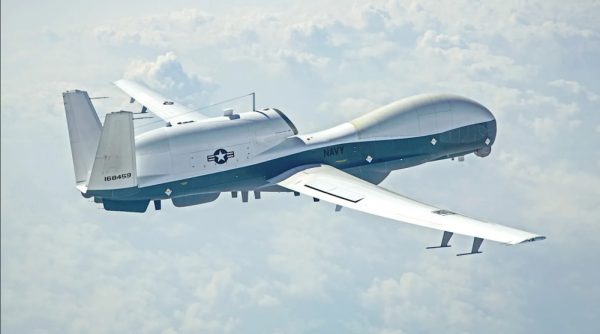
The US Navy has confirmed that an MQ-4C Triton unmanned surveillance aircraft crashed in the Persian Gulf region on April 9, with the incident now described as a mishap, although little was revealed regarding the circumstance under which it was lost.
After the aircraft had vanished unexpectedly from online flight tracking sites while flying over the Persian Gulf, multiple sources reported that it had been shot down by Iranian air defenses.
The MQ-4C is a significantly rarer and higher value aircraft than the F-15E strike fighter, MQ-9 drone, and other aircraft that have been shot down by Iranian forces, with only the US Air Force E-3 Sentry AWACS destroyed on the ground in Saudi Arabia being more valuable.
Where the E-3 is an ageing aircraft that was scheduled for retirement within the next 15 years, the MQ-4C is a cutting edge platform that is still being produced for the Navy.
Each MQ-4C is estimated to have a value of $235-250 million, with its extreme cost meaning only 20 have been brought into service.
The destruction of one of the aircraft by Iranian air defenses would not be wholly unprecedented, with the closely related RQ-4A Global Hawk developed for the US Air Force having been shot down by the Islamic Revolution Guards Corps on June 20, 2019.
Iran’s ambassador to the United Nations Majid Takht Ravanchi reported at the time that the aircraft “conducted an overflight through the Strait of Hormuz to Chabahar port in a full stealth mode as it had turned off its identification equipment and engaged in a clear spying operation.. When the [US] aircraft was returning towards the western parts of the region near the Strait of Hormuz, despite repeated radio warnings, it entered into the Iranian airspace.”
Iranian forces have more recently from late February shot down an estimated 17 MQ-9 drones, and multiple drones of other types such as the Israeli Heron.
The Triton is a derivative of the MQ-4 Global Hawk, and is specialized in maritime surveillance. The aircraft have ranges of over 13,000 kilometers, which are necessary for persistent wide-area surveillance, and have reinforced airframes for harsh ocean weather allowing them to stay on station over oceans in all conditions.
Each integrates the AN/ZPY-3 Multi-Function Active Sensor radar, which was designed for 360° maritime surveillance and can track ships over vast areas. They also integrate electro-optical / infrared sensors, as well as electronic support measures for signals detection.
Real-time data links via satellite communications allow them to serve as nodes in wider surveillance networks, sharing data with naval, air and ground assets. The aircraft are particularly heavily relied on in the Pacific theatre, although their survivability has repeatedly been questioned.
Before its sudden disappearance from flight tracking systems, the Iranian-downed MQ-4C Triton reportedly exhibited a dramatic loss of altitude, plunging from its typical cruising height of around 50,000 feet to below 10,000 feet.
At the time, the drone appeared to be returning to its base at Naval Air Station Sigonella in Italy after completing a surveillance mission in the Persian Gulf and the Strait of Hormuz, the US Navy said.
At the time of its descent, the drone’s transponder was broadcasting a distress signal, commonly known as “squawking.” Initially, it transmitted the code 7400, indicating a loss of communication with ground controllers, and later switched to the emergency code 7700.
While the latter is a general declaration of an in-flight emergency, it does not divulge the specifics of the situation.
In 2019, Iran successfully shot down a Navy RQ-4 Broad Area Maritime Surveillance-Demonstrator (BAMS-D) drone over the Sea of Oman and showcased the remains of the uncrewed aircraft.
Another MQ-4C was detected conducting a routine mission over the Persian Gulf on Wednesday.
Last week, defense publication TWZ noted that Tritons are likely to be crucial for monitoring the Persian Gulf and the Strait of Hormuz, especially during the fragile ceasefire between the United States and Iran.
Press TV – April 15, 2026
Iran’s Minister of Science, Research, and Technology Hossein Simaei has confirmed that over 60 university students and 10 professors have been martyred in the recent US-Israeli aggression.
During a visit to the Aerospace Research Institute of Iran (IARI) on Wednesday, Simaei expressed hope that the academic community would continue the work of those lost in the attacks.
“The students and professors martyred during the illegal aggression have been identified,” Simaei said. “We hope that other members of Iran’s academia continue the work of the martyred students and professors.”
Simaei described the strikes as part of a broader campaign of “scientific crimes” by the US and the Israeli regime. He said the IARI, a facility focused on non-military research in fields such as biology, agriculture, and surveying, was specifically targeted twice despite its peaceful academic objectives.
“This is another of the scientific crimes committed by the sinister US-Israeli alliance. This is a place where researchers in civilian fields like biology, agriculture, and surveying worked, and unfortunately, it has fallen victim to the barbaric attacks of the enemy,” Simaei stated.
Simaei reflected on the loss of Dr. Saeed Shamghadri, an associate professor at Iran University of Science and Technology, who was martyred in the attack alongside his two children.
He described this loss as particularly tragic, underlining the personal cost of the aggression beyond the destruction of academic institutions.
In his remarks, Simaei provided details about the broader damage to Iran’s educational and scientific infrastructure.
More than 20 state universities, as well as several research institutes, have been directly targeted by the attacks, resulting in both significant physical destruction and the loss of critical human resources.
Meanwhile, Dr. Bijan Ranjbar, the president of the Islamic Azad University, confirmed that 110 students from his institution have been martyred, and 21 university branches of his institution have sustained damage.
In addition, four faculty members and two employees, as well as two students from the SAMA schools, were martyred.
On April 6, Sharif University of Technology, one of Iran’s most prestigious engineering universities known as the MIT of Iran, was struck. The High-Performance Computing (HPC) Center, which supports over 3,000 researchers in fields such as artificial intelligence (AI) and computer science, was severely damaged.
The attack, which Simaei described as part of a broader strategy to cripple Iran’s scientific and technological progress, was not limited to the HPC center. Several laboratories and educational buildings were also hit, alongside a nearby mosque and other academic facilities.
The Sharif University attack followed a pattern of similar assaults on prominent Iranian institutions, including the Laser and Plasma Research Institute at Shahid Beheshti University, the Pasteur Institute, and a satellite development laboratory at Science and Technology University.
The attacks, according to Iranian officials, were deliberate efforts to target strategic research and technological infrastructure.
“The world is governed by international, legal, and ethical order, but we are facing an enemy that adheres to none of these principles,” Simaei said.
The minister highlighted that Iran is meticulously documenting all damage inflicted on its academic and research institutions, preparing to take legal action in international courts.
“We are documenting all the damages based on internationally accepted standards,” Simaei noted.
“Because claiming damages and filing legal suits have their own specific standards, we are conducting precise evaluations according to these criteria. The extent of the damages will be announced in the future.”
Simaei also commented on the plight of Iranian students who have been expelled from universities in the US amid the war.
“Given that the United States, contrary to legal and ethical principles, has expelled some Iranian students who were legally studying there, we announce that all these expelled students and professors can continue their studies at equivalent universities in Iran,” he said.
“We welcome them with open arms, and there is no need for them to be concerned.”
The president’s threat to annihilate Iranian civilization took America to a dark place
By Harrison Berger | The American Conservative | April 10, 2026
On Tuesday morning, President Donald Trump took to Truth Social to declare that “a civilization will die tonight.” By 8 p.m., the U.S. announced a two-week ceasefire with Iran had begun. Whether the ceasefire holds (or even takes hold) is already in question—Iran and the U.S. appear to be offering contradictory accounts of what the 10-point plan they allegedly agreed to actually says. The best hope that it might stick comes from Israel, where TV presenters who spent Monday salivating over a clock counting down the minutes and hours until Trump’s planned genocide of Iranians were left confused and outraged when the president backed down shortly before the deadline.
But whether or not Trump ultimately goes as far as the Israelis would like him to, Americans must now reckon with the destruction already carried out in our name, the civilization-destroying actions Trump has threatened, and the barbarians we have become in the process.
As Tucker Carlson, the most prominent critic of the war with Iran, pointed out in his viral monologue Monday, there was very little that was American or Western about Trump’s threat to destroy an entire civilization. That is not to say the U.S. government hasn’t committed serious crimes before, including wars of aggression. As a study published in The Lancet, a scientific journal, found, U.S. and European sanctions have killed 38 million people since 1971. But those shameful actions were at least concealed behind a pretext, not declared outright as the objective itself. Though it may seem like a distinction without a difference, Carlson convincingly argues it matters significantly. By abandoning even the aspiration of higher laws, we have embraced the “law of the jungle,” which is “a brutal and unforgiving law” that will not stop at Iran’s borders. “We know from history that the things you do will be done unto you,” Carlson said. “Once you set a standard, you will have to live by that standard.”
Indeed, Trump’s threat to destroy Iranian civilization was not an expression of American values but the purest expression, and logical endpoint, of an ideology the United States has attached itself to under both Joe Biden and now Trump: Zionism and the Greater Israel project, first through U.S. support for Israel’s genocide in Gaza and ethnic cleansing of the West Bank, and most recently through the joint war of aggression against Iran.
And while the American taxpayers forced to fund those wars are told they are fought on our behalf to save “civilization,” it is now impossible to think of any force in recent history more destructive and threatening to civilization than the Greater Israel project—which wages an ISIS-style campaign to destroy every artifact, center of knowledge, and source of beauty in the region, and does so with American weapons, American servicemembers, and American money.
The record of what has already been destroyed provides evidence that the U.S. and Israel wish to do exactly to Iran what ISIS and its various backers did to Syria. According to Iran’s minister of cultural heritage, U.S. and Israeli strikes have damaged more than 131 historical sites across the country including museums, palaces, and UNESCO-listed landmarks, with the heaviest losses in Tehran. Among the centuries-old structures destroyed by U.S.–Israeli bombs is Iran’s Golestan Palace, a UNESCO World Heritage site; the Chehel Sotoun pavilion in Isfahan, a 17th-century monument from the Safavid period; the Sheikh Lotfollah Mosque, one of the architectural jewels of the Islamic world; and the Fin Garden in Kashan, one of Iran’s oldest surviving gardens which dates to the late 16th century. Dozens of universities and research centers have been struck, including the Iran University of Science and Technology, Isfahan University of Technology, and Sharif University of Technology, “Iran’s MIT,” whose computer science center was reduced to rubble. A Tehran synagogue was also struck on Passover.
Our descent into barbarism has long been in the making, and the fingerprints all over that transformation are recognizably Israeli. One of the earliest signs of our transition came when the “War Department” began posting drone strike footage, often as memes, on social media. Where the government once prosecuted WikiLeaks and scrambled to conceal its war footage out of embarrassment, Defense Secretary Pete Hegseth’s Pentagon now shamelessly publishes such imagery on its own initiative, a direct import from Israel, which pioneered the model of broadcasting its own war crimes during the assault on Gaza. More recently, Israel-firsters like Laura Loomer and Mark Levin were the loudest voices pushing Trump toward escalation and cheering him on as he threatened civilizational annihilation. Loomer, whom Trump reportedly solicits for advice, called on him to channel Curtis LeMay, the general whose fanatical bloodlust inspired Dr. Strangelove and who came within a hair of igniting nuclear war. Levin, for his part, arguably insinuated on his Fox News television show that dropping a nuclear bomb on Iran would be justified.
Whether or not the ceasefire holds, Americans will have to reckon with what has already been done in our name, and with the fact that the Israel-firsters who cheered every escalation have not been removed from their positions of influence. They remain right in the president’s ear, defining not just his second term but the international symbol of destruction and barbarism we are in the process of becoming.
Israel’s erroneous belief that it can destroy Iran should not be supported by the US, the Russian foreign minister has said
RT | April 15, 2026
There is no quick fix to the crisis surrounding Iran, Russian Foreign Minister Sergey Lavrov has said. The US must recognize its underlying causes, including Israel’s goal of destroying the country, he added.
Speaking to reporters during a visit to China on Wednesday, Lavrov described the situation as “a crisis knot that will be extremely difficult to untangle.” He explained that “some parties are trying to cut it now – I don’t believe that would produce a [favorable] result.”
According to Lavrov, the current crisis stems directly from the US-Israeli attack on Iran in late February. The resulting disruption to global markets and the Iranian damage to Arab states hosting US military facilities were foreseeable consequences, he stressed.
“Israel appears totally convinced that Iran must be destroyed. I cannot understand how such a belief is possible,” Lavrov said, adding that remarks by US President Donald Trump about wiping out Iran’s civilization had sparked strong international backlash.
In addition to backing Israeli ideological motives, Washington is also pursuing dominance over global energy markets, as confirmed by Trump’s own messaging, Lavrov stated.
US and Israel hurting the Middle East
Commenting on recent US-Iran peace talks in Pakistan, Lavrov expressed hope that Washington would be “realistic, take the region’s interests into account and suspend its unprovoked aggression.”
He expressed solidarity with Gulf nations damaged in the conflict, but stressed that “those who started the war also have intentions not to allow normalization between the Arabs and Iran.”
Lavrov pointed to China’s quiet role in facilitating the 2023 agreement between Saudi Arabia and Tehran, which restored diplomatic ties after seven years and led to the reopening of embassies between the regional rivals.
Iran’s nuclear rights must be respected
Lavrov dismissed claims by the US and Israel that Iran is pursuing nuclear weapons, citing reports from international inspectors that found no evidence of such activities.
Concerns over Iran’s nuclear program were addressed under the 2019 multilateral agreement known as the JCPOA, Lavrov said, adding that “the United States destroying this initiative as Israel always wanted is a sad fact of modern history.”
He also criticized the European Union for acceding to Trump’s withdrawal from the agreement and playing “the most malicious role” in pushing snapback UN sanctions targeting Iran.
Russia, he said, remains ready to assist in finding a solution, provided that Iran’s right to develop a peaceful nuclear program is upheld.
Dialogue Works | April 13, 2026
Substack: https://substack.com/@dialogueworks?u…
X (Twitter): https://x.com/Dialogue_NRA
Patreon: https://patreon.com/Dialogueworks?utm…
Support Me:
Al Mayadeen | April 14, 2026
Italy has decided to suspend the automatic renewal of its defence cooperation agreement with “Israel”, Prime Minister Giorgia Meloni said on Tuesday, citing the ongoing wars in the Middle East.
Meloni’s right-wing government, which has been among “Israel’s” closest allies in Europe, has in recent weeks grown increasingly critical of Israeli military actions during the wars, particularly strikes affecting Lebanon. Italian troops deployed there under a United Nations mandate have also been impacted.
Speaking in Verona, northern Italy, Meloni said the government had opted to suspend the agreement’s renewal “in light of the current situation,” according to Italian news agencies. A Defense Ministry source added that the move would end military training cooperation between Italy and “Israel”.
The decision was taken on Monday during a meeting involving Foreign Minister Antonio Tajani, Defense Minister Guido Crosetto, and Deputy Prime Minister Matteo Salvini, the source said.
The agreement at hand
The defense cooperation framework between Italy and “Israel” is based on a Memorandum of Understanding (MoU) signed on June 16, 2003, establishing formal collaboration in the military and defense sectors.
The agreement entered into force after ratification by the Italian parliament on April 13 2016, providing a legal basis for structured bilateral defence cooperation between the two.
The June 16, 2003, defense cooperation agreement between Italy and “Israel” outlines collaboration across military training, joint exercises, and defense industry partnerships, including research and development projects.
It allows exchanges of military personnel, sharing of technical expertise, and coordinated programs between the two sides’ armed forces and the Italian Defense Ministry and the Israeli War Ministry. The framework also supports procurement cooperation, enabling each side to acquire military systems and services from the other.
Examples of its implementation include Italy’s purchase of Israeli unmanned aerial vehicles such as the IAI Heron and IAI Eitan, while “Israel” acquired Italian training aircraft like the Alenia Aermacchi M-346 Master.
The agreement further enabled joint pilot training programs, reciprocal use of military facilities, and industrial offsets involving Italian defense firms participating in Israeli-linked projects under agreed confidentiality and regulatory provisions.
The agreement includes a clause for automatic renewal every five years unless one party formally notifies termination before the end of a cycle. One such renewal was scheduled for June 8, 2025, under this mechanism.
Additional provisions have been reported to include confidentiality requirements, limiting public disclosure of joint military activities conducted under the framework of the agreement.
or go to
Aletho News Archives – Video-Images
By Jamal Kanj – Intifada-Palestine.com – January 14, 2011
Israel’s survival kit is: perpetuate conflict, insecurity to rationalize collective hate and finally playing victim.
Devoid of conflict, Israel implodes internally; without hate, Zionism loses its justification; and playing eternal victim to continue blackmailing the West. Absence of this holy trinity, Israel ceases to exist. … continue
 Aletho News If Americans Knew No Tricks Zone
 Aletho News