IRNA denies 2nd round of negotiations: reports
Al Mayadeen | April 19, 2026
Iran has not yet made a decision on whether it will engage in a new round of negotiations with the United States, local media reported on Sunday. IRNA news agency said that “there is no clear prospect of fruitful negotiations.”
IRNA denied reports that a second round of negotiations had been held in Islamabad, stating that they were “incorrect.” The state news agency reported that Washington’s “maximalism and excessive and unrealistic demands,” along with “frequent changes of positions, constant contradictions, and the continuation of the so-called naval blockade.”
The agency added that under these conditions, “there is no clear prospect of fruitful negotiations.”
It also indicated that the reports being circulated by the United States are nothing more than “media games, part of a pattern of exchanging accusations and exerting pressure on Iran.”
On another note, citing unnamed sources, the Fars and Tasnim news agencies reported that Tehran has not finalized its position on participating in the proposed talks. They also described the current climate as “not very positive,” with Fars quoting a source as saying that lifting a US blockade on Iranian ports would be a prerequisite for any negotiations.
Iran withholds second-round US talks until blockade lifted
Iran has not yet decided whether to send a delegation for negotiations with the United States, Tasnim News Agency reported on Sunday, as tensions remain high following Washington’s continued breach of the ceasefire.
According to the report, Tehran has made clear that talks with the United States will not take place as long as the maritime blockade remains in force, effectively linking any diplomatic engagement to the removal of coercive measures.
Communication between the two sides is ongoing through a Pakistani intermediary, suggesting that backchannel contacts remain active despite the absence of formal negotiations.
Talks collapse
The current deadlock follows an earlier round of talks held in Islamabad in mid-April, which lasted several hours but ended without agreement.
The US delegation was led by Vice President JD Vance, while Iran was represented by a senior delegation headed by Parliament Speaker Mohammad Bagher Ghalibaf and Foreign Minister Abbas Araghchi.
Tehran rejected “maximalist” US demands, arguing that Washington sought sweeping concessions, particularly on nuclear and regional issues, without offering credible guarantees or meaningful sanctions relief in return.
Ceasefire contradiction
The breakdown was further compounded by Washington’s decision to impose a naval blockade on April 12, even as negotiations were ongoing.
Iran had initially moved to reopen the waterway under a ceasefire understanding before reversing course in response to continued US interference with maritime traffic.
Washington maintained its blockade, announced on April 12, even as it publicly framed the Strait as “reopened,” a contradiction that has fueled tensions.
Iran has argued that engaging in talks under such conditions would amount to negotiating under pressure, insisting that meaningful dialogue requires the lifting of restrictions on its shipping and ports.
Israel attacks three nations for alleged backing of Iran
RT | April 19, 2026
Israel’s ambassador to the United Nations has lashed out at his French, Chinese, and Pakistani counterparts, accusing their countries of effectively backing Iran by allegedly striking deals to secure safe passage through the Strait of Hormuz.
The rebuke appears to stem from media reports which recently indicated that commercial vessels from all three countries were able to transit the Strait of Hormuz during the blockade, in some cases with Iranian authorization, despite broader restrictions on shipping imposed by Tehran.
“I asked the French ambassador: How much money did you pay Iran to move ships safely through the Strait of Hormuz?” Danny Danon said in a post on X shortly after speaking at the UN General Assembly session on the Strait of Hormuz blockade.
“Surprisingly, he had no answer,” he wrote, adding: “The ambassadors of China and Pakistan also had no answer.”
Navigation through the Strait of Hormuz, a key route handling around 20% of global oil and liquefied natural gas flows, has been disrupted since Tehran effectively blocked the waterway in response to the US-Israeli bombing campaign that began on February 28.
On Friday, Iran opened the Strait to all commercial vessels, framing the move as part of ceasefire arrangements linked to the Israel–Lebanon truce, but closed it again the following day. The decision came as US President Donald Trump said the US blockade on Iranian ports and shipping would remain in force until a peace deal is reached. Washington imposed the restrictions after bilateral talks in Pakistan collapsed last weekend.
In March, Iran said that vessels of India, China, Russia, Iraq, Pakistan, and Sri Lanka would be allowed to pass through the crucial waterway. Beijing is ranked as the biggest buyer of Iranian oil and most of its supplies pass through the chokepoint. At the same time, Malaysian authorities thanked Tehran for allowing the passage of the country’s ships.
In April, the Financial Times reported, citing the tracking data, that a container ship owned by a French shipping company had sailed through the Strait of Hormuz along with several other ships.
At the UN, France previously voted in favor of resolutions condemning Iran’s blockade of the strait, China either vetoed the measures or voted against critical wording, while Pakistan abstained.
Netanyahu’s ‘total victory’ to total flop
By Robert Inlakesh | Al Mayadeen | April 19, 2026
Promising annihilation, dominance, and total victory, the Israeli leadership has found itself in a predicament no closer to victory on any front. Tactical victories sold as strategic ones have been exposed; instead of meticulously planned operations, Tel Aviv engages in aggression without any discernible long-term strategy to achieve its stated aims.
Since October 7, 2023, the Israeli regime of old is no more. Instead of implementing methodical planning, public deception, and fighting the long game, its thinking has been replaced by a ruthlessly violent vengeance scheme that seeks to try and achieve in months what it was previously aiming for over decades.
The beginning of the war on Iran was not February 28, 2026; instead, it was October 7, 2023. This was the moment when everything changed in the strategic thinking of the Israeli leadership. For them, the illusion of absolute control and superiority was crushed under the boots of a few thousand Palestinian fighters, who single-handedly dealt the most severe blow to the Zionist regime in its history.
As an event, the collapse of the Israeli southern command at the hands of a guerrilla force possessing homemade light weapons, Operation Al-Aqsa Flood, represented the moment of a great shift. It wasn’t long before the decision was made to launch a genocide against the people of Gaza.
Inflicting the genocide was the whole strategy, not dealing a military defeat to Hamas or any other Palestinian organizations. Israeli PM Benjamin Netanyahu foolishly believed that the genocide would restore the Zionist entity’s prized “deterrence capacity”, while the side effects of the genocide would mean the de facto defeat of the Resistance, destroying Palestinian will to resist that could lead to a mass ethnic cleansing event that would end up inflicting a predicament on Hamas that replicates the PLO’s defeat in 1982.
When it became clear that this strategy was not working inside Gaza itself, the Israeli military continued without any clear goals and launched operation after operation in desperate attempts to achieve their desired outcomes. The majority of the tasks performed inside Gaza by the invading ground forces were simply round-the-clock demolition work; so much that they even recruited private businesses and settler employees to aid in these efforts.
Ultimately, they ran into a major problem; after two years, they had still failed and presented a plan to try to implement a West Bank-style occupation over Gaza City, a task that experts predicted could take them a decade. This is why they accepted a ceasefire, one in which the war was simply frozen and meant they were able to engage in a prisoner exchange.
In Lebanon, they were also put into a difficult predicament. The stance of former Hezbollah leader Sayyed Hassan Nasrallah had been that Lebanon would remain a support front for Gaza until the very end. “Hamas will win,” stated Nasrallah in a 2023 speech, after which he asserted that “no matter where the region is taken,” Hezbollah will stand with Gaza.
The daily operations by Hezbollah were a thorn in its side, which is why the Israelis began planning to escalate in an unprecedented way. Through their terrorist indiscriminate pager attacks, followed by the assassination of Sayyed Hassan Nasrallah and most of Hezbollah’s senior leadership, the Israelis believed they had dealt a death blow to Hezbollah.
Selling this lie to the public, the Israeli leadership claimed a major victory and alleged to have taken out around 80% of Hezbollah’s weapons arsenal.
In March, when Hezbollah began responding to the some 15,400 ceasefire violations committed by the Zionists, suddenly the Israeli public was jolted back by the power and coordination with which Hezbollah managed to attack, especially as these operations were carried out alongside Iran’s missile and drone strikes.
Eventually, failing to score victories in key towns like Bint Jbeil and Khiam, the Israelis begrudgingly accepted a temporary ceasefire, one that they immediately violated.
If it were true that the Israelis were close to, or even believed that a victory over Hezbollah was possible, they would not take any ceasefire agreement of any description. Instead, they were forced to go back to the drawing board.
Similarly, they launched the 12-day war on Iran and came out empty-handed. They also used their US allies to launch an air assault on Yemen and failed to achieve any of their goals. Then came the February 28 attack on Iran, where the largest blows were landed during the first 24 hours, yet even with the US on their side, their aspirations for regime change quickly faded into a distant memory.
When Yemen’s Ansar Allah joined the war in support of Iran and Hezbollah, the Israelis didn’t even launch strikes on Yemen, likely due to it being a useless endeavour.
So as it stands, the Lebanon front is again open, the Iran front was fought to a standstill with no goals achieved, Yemen is open whenever there is aggression on their allies, and Gaza is a temporarily frozen arena that they still have no plan for. Even in Syria, the constant aggression is like playing with fire.
Meanwhile, the delusional Zionist leadership is still chasing its aspirations of a “Greater Israel”, threatening even Turkey with retaliation for simply criticizing them. What this behaviour and all of their decision-making since October 7 point to is an irrational inability to close any conflict, lacking any coherent plans to win.
Therefore, the Israelis will use any and all ceasefire agreements in order to go back to the drawing board, in order to conjure up new plans for further aggression. Whether it’s a Lebanon, Gaza, or Iran ceasefire, they are not about to give up on attacking everyone mercilessly.
This means that despite all of its efforts and attacks over the past two and a half years, the predicament they find themselves in has not changed. A ceasefire kicks the can down the road, simply delaying the inevitable resumption of war. Either the Israelis are totally defeated in battle, or they will continue to attack again and again. This will go around in circles until they are eventually defeated.
Iran defends limits on Strait of Hormuz passage
The Islamic Republic once again shut the strategic waterway due to what it described as US “piracy”
© Ruptly
RT | April 18, 2026
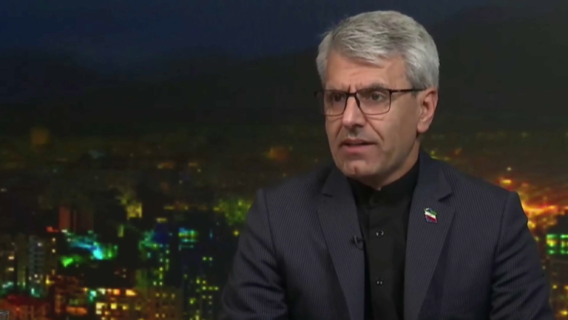
Iran said the renewed restrictions on maritime traffic through the Strait of Hormuz are justified under international law and necessary to counter hostile actions, Foreign Ministry spokesman Esmail Baqaei has said in an interview with RT.
Iranian military officials said on Saturday that Tehran had reasserted “strict control” over the strategic route, which carries about 20% of global oil, citing the continued US blockade of its ports, just a day after declaring it open. The Revolutionary Guard Navy Command later said the strait would remain under Iranian military control as long as US restrictions stay in place.
“There was no safe and secure passage in this waterway,” Baqaei told RT on Saturday, adding that as a coastal state Iran has the right under international law to take measures against what it sees as hostile actions.
“We cannot allow enemy vessels, especially military ones or those linked to countries involved in aggression, to pass through the strait normally, as they pose a direct threat,” the spokesman stated.
The US-Israeli bombing campaign prompted Iran to restrict passage through the strait for “enemy ships,” triggering a breakdown in supply chains and sending global crude oil prices soaring.
Oil prices eased during the first round of US-Iran talks in Islamabad last weekend on hopes of the Strait reopening. After the negotiations collapsed, US President Donald Trump ordered a naval blockade on Iranian ports and shipping, prompting tankers to turn back and pushing prices back toward $100 a barrel.
On Friday, Iranian authorities said the waterway was fully open to commercial vessels for the remainder of the ten-day Israel–Lebanon ceasefire, lowering crude oil prices on de-escalation hopes. Tehran later reversed the decision after Trump said the US blockade of Iranian ports would remain in full force until a peace deal is reached.
The disruption in the Strait of Hormuz has triggered broad global economic ripple effects, with Europe facing higher fuel and energy costs due to reduced oil flows. The International Energy Agency has warned of rising market volatility and possible jet fuel shortages within six weeks if disruptions continue. Humanitarian organizations have also flagged growing risks to global food security as fertilizer and agricultural supply chains are affected.
‘We warned you’: Hormuz Strait back to pervious state amid US blockade
Al Mayadeen | April 18, 2026
Iran’s military announced that the Strait of Hormuz has returned to its previous operational status, placing it under “strict management and control” by the country’s armed forces, following repeated violations of prior understandings by the United States.
In a statement, the spokesperson of the Khatam al-Anbiya Central Headquarters said Iran had earlier agreed, in good faith and within the framework of negotiations, to allow the managed passage of a limited number of oil tankers and commercial vessels through the strategic waterway.
However, the spokesperson stated, the United States had failed to uphold its commitments, amid Washington’s continued acts of “piracy and maritime robbery” under the guise of a naval blockade.
The statement added that, in response, Iran has reinstated full control measures over the strait, emphasizing that the passage of vessels will remain tightly regulated unless the US fully lifts restrictions on Iranian shipping routes, both inbound and outbound.
“As long as the United States does not completely lift the restrictions on the passage of vessels from Iran to destination and from destination to Iran, the situation in the Strait of Hormuz will be strictly controlled and remain as before,” the spokesperson said.
IRGC-N affirms change in Hormuz regime
Meanwhile, Iran’s Islamic Revolution Guard Corps Navy (IRGC-N) reaffirmed the change in the regime of the Strait of Hormuz, stressing that any breach of promise by the United States will receive a fitting response.
“As long as the passage of vessels from and to Iran is threatened, the status of the Strait of Hormuz will remain unchanged,” the IRGC-N said, according to the Iranian TV, IRIB.
Iranian official outlines ‘new maritime regime’
Separately, Ebrahim Azizi, head of the National Security Commission of the Iranian parliament, outlined a new framework governing maritime transit in the strait.
“It is time to submit to the new maritime regime of the Strait of Hormuz; this regime is determined by the Islamic Republic of Iran, not by virtual posts,” Azizi wrote in a post on X.
“In this regime, only commercial ships, and only with permission from the Armed Forces General Staff, particularly the Navy, are allowed to pass through designated routes after paying the rightful dues of the Iranian nation.”
He added that any US interference with Iranian vessels could prompt further escalation in restrictions.
“If the Americans want to create the slightest interference for Iranian ships, this decision can easily be changed!” Azizi said.
In a follow-up post, he added, “We warned you, but you didn’t pay attention! Now enjoy the return of the Strait of Hormuz situation to its previous state.”
Iran rejects uranium transfer, warns of response to naval blockade
Al Mayadeen | April 18, 2026
Iran’s Foreign Ministry spokesperson Esmaeil Baghaei flatly rejected on Friday any proposal to transfer the country’s enriched uranium abroad, declaring that Iran’s uranium reserves are as sacred as its own soil.
Responding to remarks made by US President Donald Trump, who told Reuters that Washington would work with Tehran to retrieve and transfer its enriched uranium, and claimed Iran had agreed to halt enrichment, Baghaei called such assertions part of a coordinated media campaign designed to pressure negotiators and tilt the direction of ongoing talks.
“Claims about a permanent suspension of uranium enrichment are aimed at influencing the course of negotiations,” Baghaei said, adding that any final agreement must fully safeguard Iran’s interests and rights.
Iran has consistently maintained that its uranium enrichment program serves civilian purposes, including agriculture and medicine, and that it operates no military nuclear program.
Compensation, sanctions relief are core demands
Baghaei stressed that compensation for the losses and damages inflicted on Iran is not a peripheral issue but a fundamental pillar of any potential deal.
He also placed the lifting of sanctions at the top of Tehran’s list of priorities, emphasizing that ending the war and halting hostilities across all fronts must be treated as a single, inseparable package, not piecemeal concessions to be negotiated separately.
He described diplomacy as “a continuation of military efforts on the ground,” signaling that Tehran’s negotiating posture is shaped by the same resolve it has brought to the battlefield.
Naval blockade crosses a red line
On the security front, Baghaei warned that a naval blockade would be met with a firm Iranian response, calling any such measure a direct violation of the ceasefire. “Iran cannot be blockaded,” he said, adding that Tehran would take all necessary measures in response.
He also invoked international maritime law, asserting that coastal states bordering strategic straits hold both the right and the responsibility, in wartime conditions, to take appropriate measures against states they consider hostile, in reference to the Strait of Hormuz.
No direct talks with Trump
Baghaei also denied Trump’s claims that US officials had held direct talks with Iranian counterparts, calling those assertions false.
He noted that while earlier rounds of negotiations had focused primarily on the nuclear file, the most recent discussions have shifted to center on ending the war entirely.
On the progress of talks, he said the Islamabad meeting had helped map out areas of understanding and define red lines, adding that “there is no ambiguity regarding the negotiation files.”
He cautioned, however, that developments over the coming days would ultimately determine the outcome.
Tehran’s previous uranium offer
Iran’s Deputy Parliament Speaker Ali Nikzad revealed on Monday that Tehran had at one point signaled a willingness to demonstrate goodwill, but on its own terms.
Nikzad said Iran had proposed diluting 450 kilograms of enriched uranium, not handing it over, and that earlier negotiations had explored the possibility of establishing a trilateral consortium involving Iran, the United States, and Saudi Arabia to carry out that dilution. He clarified that the other parties ultimately pulled back from that framework.
Nikzad also claimed that the US military operation targeting Isfahan had been aimed at seizing Iran’s uranium stockpiles, but that it failed.
US Middle East Policy: The Growing Propensity for Genocide
Arab Center Washington DC | April 10, 2026
Professor John Mearsheimer discusses the #IranWar, the #Gaza genocide, and the US policy toward the Middle East.
His remarks were the keynote address for Arab Center’s Eleventh Annual Conference.
John J. Mearsheimer is an American political scientist and international relations scholar who serves as the R. Wendell Harrison Distinguished Service Professor of Political Science at the University of Chicago and is the author of How States Think: The Rationality of Foreign Policy, The Tragedy of Great Power Politics, The Great Delusion: Liberal Dreams and International Realities, and The Israel Lobby and U.S. Foreign Policy, among other works.
Daniel Davis: Iran Reopens the Strait of Hormuz
Glenn Diesen | April 17, 2026
Lt. Col. Daniel Davis is a 4x combat veteran, the recipient of the Ridenhour Prize for Truth-Telling, and is the host of the Daniel Davis Deep Dive YouTube channel. Lt. Col. Davis discusses Iran’s announcement that it is reopening the Strait of Hormuz, yet the US decides to maintain the blockade on Iranian ports. While diplomatic developments are positive, the statements from the US and Iran do not correspond with each other.
Daniel Davis Deep Dive: https://www.youtube.com/@DanielDavisDeepDive/videos
Follow Prof. Glenn Diesen:
- Substack: https://glenndiesen.substack.com/
- X/Twitter: https://x.com/Glenn_Diesen
- Patreon: https://www.patreon.com/glenndiesen
Support the research by Prof. Glenn Diesen:
- PayPal: https://www.paypal.com/paypalme/glenndiesen
- Buy me a Coffee: buymeacoffee.com/gdieseng
- Go Fund Me: https://gofund.me/09ea012f
The collapse is real – Lebanon ceasefire marks a historic strategic defeat
By Ramzy Baroud | MEMO | April 17, 2026
A ceasefire in Lebanon was announced on Thursday by US President Donald Trump, but its reality tells a very different story. The ceasefire was not the product of American diplomacy, nor Israeli strategic calculation. It was imposed—largely as a result of sustained Iranian pressure.
Washington, Tel Aviv, and their allies—including some within Lebanon itself—will continue to deny this reality. Acknowledging Iran’s role would mean admitting that a historic precedent has been set: for the first time, forces opposing the United States and Israel have succeeded in imposing conditions on both.
This is not a minor development. It is a strategic rupture. But it is not the only fundamental shift now underway: Israel’s very approach to war and diplomacy is itself changing.
After failing to secure victory through overwhelming violence, Israel is increasingly relying on coercive diplomacy to impose political outcomes.
Over the past two to three decades, this Israeli strategy has become unmistakably clear: achieving through diplomacy what it has failed to impose on the battlefield.
‘Diplomacy’ as War
Israeli ‘diplomacy’ does not conform to the conventional meaning of the term. It is not negotiation between equals, nor a genuine pursuit of peace. Rather, it is diplomacy fused with violence: assassinations, sieges, blockades, political coercion, and the systematic manipulation of internal divisions within opposing societies. It is diplomacy as an extension of war by other means.
Likewise, Israel’s conception of the ‘battlefield’ is fundamentally different. The deliberate targeting of civilians and civilian infrastructure is not incidental, nor merely ‘collateral damage’; it is central to the strategy itself.
Nowhere is this clearer than in Gaza. Following the ongoing genocide, vast swathes of Gaza have been reduced to rubble, with estimates indicating that around 90 percent of the whole of Gaza has been destroyed. According to the Gaza Ministry of Health, women and children consistently account for roughly 70 percent of all of Gaza’s casualties.
This is not collateral damage. It is the deliberate destruction of a civilian population, an act of genocide that is designed to force mass displacement and remake the political and demographic reality in Israel’s favor.
The same logic extends beyond Gaza. It shapes Israel’s wars in Lebanon against Hezbollah and its broader confrontation with Iran.
The United States, Israel’s principal ally, has historically operated within a similar paradigm. From Vietnam to Iraq, civilian populations, infrastructure, and even the environment itself have borne the brunt of American warfare.
A Faltering Model
It is often argued that Israel turned to ‘diplomacy’ following its forced withdrawal from southern Lebanon in 2000 under resistance pressure. While this moment was pivotal, it was not the beginning.
Earlier precedents exist. The First Intifada (1987–1993) demonstrated that a sustained popular uprising could not be crushed through brute force alone. Despite Israel’s extensive repression, the revolt endured.
It was in this context that the Oslo Accords emerged—not as a genuine peace process, but as a strategic lifeline. Through Oslo, Israel achieved politically what it could not impose militarily: the pacification of the uprising, the institutionalization of Palestinian political fragmentation, and the transformation of the Palestinian Authority into a mechanism for internal control.
Meanwhile, settlement expansion accelerated, and Israel reaped the global legitimacy of appearing as a ‘peace-seeking’ state.
Yet the last two decades have exposed the limits of this model.
From Lebanon in 2006 to repeated wars on Gaza (2008–09, 2012, 2014, 2021, and the ongoing genocide since 2023), Israel has failed to secure decisive strategic victories. Its ongoing confrontations with Hezbollah and Iran further underscore this failure
Not only has Israel been unable to achieve its stated military objectives, but it has also failed to translate overwhelming firepower—even genocide—into lasting political gains.
Some interpret this as a shift toward perpetual war under Prime Minister Benjamin Netanyahu. But this reading is incomplete.
Perpetual War?
Netanyahu understands that these wars cannot be sustained indefinitely. Yet ending them without victory would carry even greater consequences: the collapse of Israel’s deterrence doctrine and, potentially, the unraveling of its broader project of regional dominance.
This dilemma strikes at the heart of Zionist ideology, particularly Ze’ev Jabotinsky’s concept of the ‘Iron Wall’—the belief that overwhelming, unrelenting force would eventually compel indigenous resistance to surrender.
Today, that premise is being tested—and found wanting.
Netanyahu has repeatedly framed current wars as existential, comparable in significance to 1948—the war that resulted in the ethnic cleansing of Palestinians during the Nakba and the establishment of Israel.
Indeed, the parallels are unmistakable: mass displacement, civilian terror, systematic destruction, and unwavering Western backing—once from Britain, now from the United States.
But there is a critical difference: The 1948 war led to the creation of Israel; the current wars are about its survival as an exclusivist settler colonial project.
And herein lies the paradox: the longer these wars continue, the more they expose Israel’s inability to secure decisive outcomes. Yet ending them without victory risks a historic defeat—not only for Netanyahu, but for the ideological foundations of the Israeli state itself.
Israeli society appears to recognize the stakes. Polls throughout 2024 and 2025 have shown overwhelming support among Israeli Jews for continued military campaigns in Gaza and confrontations with Iran and Lebanon.
Public discourse frames this support in terms of ‘security’ and ‘deterrence’. But the underlying reality is deeper: a collective recognition that the long-standing project of military supremacy is faltering.
Having failed to subdue Gaza despite the genocide, Israel is now attempting to achieve through diplomatic maneuvering what it could not secure through war. Proposals for international oversight, stabilization forces, and externally imposed governance structures are all variations of this approach
But these efforts are unlikely to succeed.
Gaza is no longer isolated. The regional dimension of the conflict has expanded, linking Lebanon, Iran, and other actors into a broader, interconnected front.
Balance is Shifting
In Lebanon, Israel has been repeatedly forced toward ceasefire arrangements not out of choice, but because it failed to defeat Hezbollah or break the will of the Lebanese people.
This dynamic extends to Iran. Following the joint aggression on Iran starting February 28, both the United States and Israel were compelled to accept de-escalation frameworks after failing to achieve rapid or decisive outcomes.
The expectation that Iran could be quickly destabilized—replicating the models of Iraq or Libya—proved illusory. Instead, the confrontation revealed the limits of military escalation and forced a return to negotiations.
This is the essence of Israel’s current predicament.
Diplomacy, in this model, is not an alternative to war—it is a pause within it. A temporary tool used to regroup before the next phase of confrontation.
But in Israel’s case, this aggressive ‘diplomacy’ is increasingly becoming the only available tool, precisely because its military strategy has failed to deliver victory.
Lebanon was meant to be the exception—a theater where Israel could isolate and defeat Hezbollah. Instead, it became further evidence of strategic failure.
Efforts to separate the fronts—Gaza, Lebanon, Yemen, Iran—have collapsed. Iran has explicitly linked its diplomatic engagement to developments on other fronts, forcing Israel into a broader strategic entanglement it cannot control.
This marks a profound shift.
The foundational pillars of Israeli strategy—overwhelming force, fragmentation of adversaries, narrative control, and political engineering—are no longer functioning as they once did
Yet Netanyahu continues to project victory, declaring success at regular intervals, invoking deterrence, and framing ongoing wars as strategic achievements.
But these narratives ring hollow.
The reality, increasingly evident to observers across the region and beyond, is that the balance is finally shifting.
For the first time in decades, the trajectory of history is no longer bending in Israel’s favor.
Trump keeps Hormuz blockade despite Iran reopening passage
Al Mayadeen | April 17, 2026
US President Donald Trump announced that Washington will maintain its naval blockade targeting Iran, even after Tehran declared the Strait of Hormuz open to commercial shipping.
“THE STRAIT OF HORMUZ IS COMPLETELY OPEN AND READY FOR BUSINESS AND FULL PASSAGE, BUT THE NAVAL BLOCKADE WILL REMAIN IN FULL FORCE AND EFFECT AS IT PERTAINS TO IRAN, ONLY, UNTIL SUCH TIME AS OUR TRANSACTION WITH IRAN IS 100% COMPLETE,” Trump said in a post on Truth Social on Friday.
He added that an agreement may be imminent, claiming that most negotiation points between Washington and Tehran have already been settled.
Iran reopens strategic waterway amid ceasefire
Iran’s move to reopen the Strait of Hormuz came in the context of broader regional de-escalation. Foreign Minister Abbas Araghchi announced that all commercial vessels would be permitted to pass through the vital waterway.
“In line with the ceasefire in Lebanon, the passage for all commercial vessels through Strait of Hormuz is declared completely open for the remaining period of ceasefire, on the coordinated route as already announced by Ports and Maritime Organisation of the Islamic Rep. of Iran,” Araghchi stated on April 17 via X.
The announcement ties maritime security in the Gulf to developments in Lebanon, where a temporary ceasefire has reduced immediate regional tensions.
Tankers continue transit despite US measures
Despite Washington’s insistence on maintaining its blockade, maritime activity suggests that Iranian oil shipments have not been halted.
Reports indicate that Iranian vessels have continued to navigate the Strait of Hormuz, reaching international waters and proceeding toward their destinations.
According to AFP, citing maritime tracking firm Kpler, three sanctioned Iranian oil tankers successfully exited the Gulf through the strait in recent days.
The vessels, The Deep Sea, Sonia I, and Diona, carried a combined five million barrels of crude oil after departing from Kharg Island. Their movement underscores the continued flow of Iranian oil toward Asian markets despite US efforts to restrict exports.
This development highlights the limitations of enforcement mechanisms, particularly as vessels employ tracking avoidance tactics and indirect shipping routes.
Strategic tensions between de-escalation and pressure
The parallel developments, Tehran reopening the strait and Washington maintaining its blockade, reflect a broader contradiction in the current phase of regional dynamics.
Iran’s decision signals a willingness to facilitate global trade flows and align maritime policy with ceasefire conditions. In contrast, the US approach continues to prioritize economic pressure, even amid signs of diplomatic progress.
The continued movement of Iranian tankers suggests that enforcement gaps remain, raising questions about the practical effectiveness of the blockade.
‘New order’ in Strait of Hormuz: IRGC Navy mandates authorization for all vessels
Press TV – April 17, 2026
The Islamic Revolution Guards Corps (IRGC) Navy says a “new order” is now in place over the strategic Strait of Hormuz, outlining strict new regulations for all maritime traffic.
In a statement released on Friday, the IRGC Navy commander announced that all commercial vessels will only be permitted to transit through routes designated by Iran.
The announcement also reaffirmed that military vessel transit through the strategic chokepoint firmly under Iranian control remains strictly prohibited.
According to the IRGC Navy, all transits, commercial or otherwise, will only be allowed with the explicit authorization of the IRGC’s naval forces.
The statement further stated that these transits are being conducted in accordance with the agreement established under the ongoing Iran-US ceasefire and following the implementation of the ceasefire in Lebanon late on Thursday.
The new measures signal Iran’s firm grip over the waterway, through which approximately one-fifth of the world’s oil passes, after the 40-day war of aggression against the Islamic Republic of Iran by the American-Israeli coalition.
Earlier on Friday, following the implementation of a ceasefire in Lebanon, Iran’s Foreign Minister Abbas Araghchi announced the reopening of the strategic Strait of Hormuz to commercial vessels.
“In line with the ceasefire in Lebanon, the passage for all commercial vessels through Strait of Hormuz is declared completely open for the remaining period of ceasefire, on the coordinated route as already announced by Ports and Maritime Organisation of the Islamic Rep. of Iran,” Araghchi wrote on his X handle.
It was followed by foreign ministry spokesperson Esmaeil Baghaei’s remarks, explaining that the foreign minister’s tweet was within the framework of the April 8 ceasefire agreement.
The passage of ships through the Strait of Hormuz, he stressed, will take place along the route designated by Iran and in coordination with Iran’s competent authorities.
The Strait of Hormuz, a strategic waterway nestled between the Persian Gulf and the Gulf of Oman, is a strategically vital waterway that forms the pulse of the global energy economy and, simultaneously, a potent asset for the Islamic Republic to fundamentally reshape the balance of power in the Persian Gulf and around the world.
According to experts, Iran is uniquely positioned to exert absolute control over the northern and most critical part of the strait, with its coastline stretching more than 1,600 kilometers along the Persian Gulf and the Sea of Oman.
The strategic waterway has been in the news since February 28, when the US-Israeli alliance launched an unprovoked aggression against the Islamic Republic, prompting strong retaliation from Iranian armed forces, including the closure of the critical chokepoint to US and allied vessels.
Iran’s Navy Commander Rear Admiral Shahram Irani, in a TV interview, also dismissed US President Donald Trump’s rhetoric of naval blockade, saying no one listens to him.
Trump, he said, has imposed a “naval blockade” on his friends, not on the Islamic Republic of Iran, calling it “banditry and piracy.”
“To this day, we have not allowed US and Israeli aircraft carrier strike groups and marines to enter the Sea of Oman,” Rear Admiral Irani stated.
Persian Gulf oil production can take two years to recover from war: IEA chief
The Cradle | April 17, 2026
It could take up to two years for oil production in West Asia to return to levels from before the start of the US-Israel war on Iran in late February, Fatih Birol, executive director of the International Energy Agency (IEA), told Bloomberg on 17 April.
“There is a general belief that the minute we see the strait open … we come back to the level of production before – which is, in my view, misleading,” Birol stated.
West Asia oil production was disrupted by the US-Israeli bombing campaign, which targeted Iranian oil and energy infrastructure.
Iran retaliated by targeting Gulf oil and gas infrastructure. It also threatened to target ships linked to the “enemy” in the Strait of Hormuz, effectively closing the waterway through which most Gulf oil is exported.
“The recovery will be gradual as damage from the conflict has affected oil fields, refineries, and pipelines across the Persian Gulf,” Birol said.
The IEA chief emphasized that the effective closure of Hormuz has caused world markets to lose hundreds of millions of barrels of crude and refined fuels.
The full resumption of liquefied natural gas (LNG) production could take even longer, with some terminals taking more than two years to repair after suffering damage in attacks, Birol added.
If a resolution to the conflict is not reached soon, energy-importing emerging economies, especially in Asia and Africa, will be hardest hit, Birol warned.
He added that early signs of demand destruction are already visible, including rationing and reduced activity, which could further reduce oil demand moving forward.
Meanwhile, US oil and gas exports have soared since the beginning of the war. Reuters reported on 15 April that the US has nearly become a net crude exporter for the first time since World War II as Asian and European buyers scramble to replace oil supplies lost due to the Iran war.
The difference between US oil imports and exports narrowed to 66,000 barrels per day (bpd) last week, the lowest on record, according to US government data. At the same time, exports reached 5.2 million bpd, the highest in seven months.
Reuters noted, however, that the US is rapidly approaching its maximum export capacity.
Iran has also increased its oil exports amid the conflict, boosting daily loadings and exports to around 2 million barrels over the past three months.
China has stepped up its purchases of Iranian crude by more than 300,000 bpd to a total of 1.6 million bpd.
Since the war began, India has resumed oil purchases from Iran, receiving at least 2 million barrels this month. New Delhi had halted its purchases of Iranian crude in 2019.
Iranian crude has recently been sold to some Chinese buyers at prices even higher than the Brent benchmark, which marks a reversal from before the war, when Iran was forced to sell oil to China at a discount due to US sanctions.
Featured Video
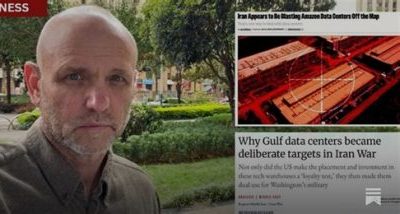
Iran spent $1 million to wipe out $30 billion in data center plans, and take down Amazon in the ME
or go to
Aletho News Archives – Video-Images
From the Archives
Clash of Civilization, Iran Part II
By Jamal Kanj – Intifada-Palestine.com – January 14, 2011
Israel’s survival kit is: perpetuate conflict, insecurity to rationalize collective hate and finally playing victim.
Devoid of conflict, Israel implodes internally; without hate, Zionism loses its justification; and playing eternal victim to continue blackmailing the West. Absence of this holy trinity, Israel ceases to exist. … continue
Blog Roll
 Aletho News
- China Rejects Outside Pressure on Trade Ties After New US Russia Sanctions Bill
- Houthis Keep Advancing as the Red Sea Crisis Deepens
- Iran spent $1 million to wipe out $30 billion in data center plans, and take down Amazon in the ME
- Zionist billionaire pressure to silence Macklemore sparks exodus from Ed Sheeran tour
- House Votes to End Iran War for Third Time
- North Korea Slams US Plan for ‘AUKUS 2.0’ with South Korea and Japan
- Prolonging US-Iran Conflict Not Meeting Interests of Int’l Community – China’s Wang Yi
- EU bans former Zelensky aide from parliament
- NATO-backed Kosovo separatist ‘responsible for war crimes’
- US destroying international space law
- If Americans Knew
- Palestinian-American Journalist Naqaa Hamed Detained by Israeli Forces After Settlers Targeted Her
- U.S. Makes, Israel Takes: The Real Story of U.S.-Israeli Military Cooperation
- Night raids rise in Palestine
- Tucker Carlson interviews Norman Finkelstein about Gaza
- Groups urge Americans to support Van Hollen legislation on Israel’s killing of Americans & Palestinians
- Trump administration plans to send 40,000 tons of bombs to Israel: report
- Sanctions Target Iran’s Government, But Kill Hospitalized 23-Year-Old Woman
- An alternative view on the book “Israel’s Lobby: America in the Grip of a Foreign Power”
- Ed Sheeran’s band Beoga, other opening acts quit tour after Macklemore was dropped over his pro-Palestinian comments
- The assassination attempt on President Trump in Butler and the various Israeli connections to it
- No Tricks Zone
- New Study: ‘Global Drought Shows No Detectable Recent Acceleration Under Climate Warming’
- Economic Masterminds: German Socialists Suggest Taxing Productivity Gains Stemming From Using AI
- The South China Sea Has Not Been Cooperating With The Climate Change Narrative
- Energy Crisis: Germany Enters Heating Season With Historically Low Gas Reserve Fill Levels
- New Study: The Antarctic Ice Sheet Gained Mass From 2020-2024 Due To Staggering Snow And Ice Accumulation
- Study: Ocean Heating Rates From Thousands Of Years Ago ‘Dwarf’ Modern Ocean Heating Rates
- Climate Extremists Target, Attack Large-Scale Power Grid Infrastructure In Germany!
- New Study: Antarctic Ice Melt Has Contributed Less Than 1 Centimeter To Sea Level Rise In The Last 30 Years
- Fear Of Debate: Alarmist German Climate Scientist Calls On Mainstream Media To Discredit Skeptic Voices
- End-Of-August Arctic Sea Ice Extent Hasn’t Fallen In 20 Years, Official Data Show!
 Aletho News