Trump takes sabbatical on Russia ties
By M K Bhadrakumar | Indian Punchline | April 2, 2017
The NATO Foreign ministers meeting in Brussels on Friday assumed special significance since it happened to be the first appearance by US Secretary of State Rex Tillerson on the alliance’s ‘diplomatic podium’. The alliance, in fact, refixed the date of the ministerial to suit Tillerson’s scheduling convenience. And he, for sure, did not disappoint his audience.
Tillerson’s interventions on Friday were the first structured statements of the Donald Trump administration on two important vectors of the US foreign policies – NATO’s raison d’etre as a military alliance and, secondly, Ukraine – which together inevitably reflect on the overall approach that can be expected from Washington in relations with Russia – at least in the near term. Tillerson is slated to visit Moscow on April 12.
Tillerson unequivocally stressed the Trump administration’s commitment to NATO. He described the alliance as the “bedrock of transatlantic security”. Thereupon, he went on to identify ISIS and Russia as the two “common threats” that the alliance faces. He said NATO as an alliance is “fundamental to countering both non-violent, but at times violent, Russian agitation and Russian aggression.” Tillerson called on NATO to “remain vigilant in strengthening NATO’s eastern defences… from Baltic to the Black Sea.”
No doubt, it was exceptionally strong language for the US’ top diplomat to use. Tillerson cited against this backdrop this weekend deployment to Poland of the US’ “enhanced, forward presence battalion”. He hinted that the Trump administration envisages a lead role for NATO in fighting the ISIS and, importantly, in the stabilization of Iraq.
This effectively rules out any significant level of military cooperation between the US and Russia in the fight against ISIS. (Notably, though, Tillerson made no mention of Syria.) Indeed, it remains to be seen how an enhanced NATO presence in Iraq will be perceived in Tehran.
Tillerson also addressed a meeting of the NATO-Ukraine Commission in Brussels on Friday and his remarks there have been the most detailed statement so far on the Trump administration’s policies towards the Ukraine crisis. Tillerson literally tore into Russia. The following excerpts bring out the flavour of this unequivocal condemnation of Russian policies in Syria through the past 3-year period:
- Three years ago, Russia’s aggression against Ukraine shook the very foundations of security and stability in Europe. Today, Russia’s ongoing hostility and occupation is compromising our shared vision of a Europe that is whole, free, and at peace. American and NATO support for Ukraine remains steadfast. As we have repeated at every Ministerial and Summit since Russia launched its campaign of aggression against Ukraine, NATO Allies stand firm in our support of Ukraine’s sovereignty and territorial integrity. We do not, and will not, accept Russian efforts to change the borders of territory of Ukraine… NATO solidarity is crucial to finding a political solution to this conflict.
Tillerson made it clear that the US squarely holds Russia accountable for the implementation of the Minsk agreements. He warned Moscow:
- The United States sanctions will remain until Moscow reverses the actions that triggered our sanctions. We note with alarm the escalating violence along the line of contact and the repeated targeting of civilian infrastructure by Russia-led separatist forces, which poses an elevated risk of humanitarian disaster. We call on Russia to exercise its influence over the separatists to put a stop to the violence, end the campaign of attacks and intimidation against OSCE monitors, and facilitate the access they need to do their job. The OSCE must be able to fulfill its mandate which included monitoring throughout the conflict zone and to the international border. And Russia must understand there is no basis to move forward on the political aspects of the Minsk agreements until there is visible, verifiable, and irreversible improvement in the security situation.
Simply put, Tillerson has put Russia on notice that the Trump administration policies will be hard as nails when it comes to the Ukraine situation. (Meanwhile, there are growing demands that the US should supply lethal weapons to Ukraine.)
On Crimea, Tillerson was pretty much blunt: “Crimea-related sanctions must remain in place until Russia returns control of the peninsula to Ukraine.”
Most important, Tillerson just stopped short of saying that the US is supportive of Ukraine’s induction as a NATO member country. He urged Kiev to bring the Ukrainian armed forces to continue to reform and modernise so as to come up to the NATO standards by 2020. In a subtle reference to what lies ahead, Tillerson recalled Trump’s assertion that “every country has the right to chart its own future.” To be sure,Ukraine is looming ahead as the inflection point in Russia’s relations with the US.
The overall tenor of Tillerson’s remarks suggests that not only is the Trump administration unable or unwilling to do anything to improve relations with Russia in immediate terms, it might simply continue with the Barack Obama administration’s Russia policies for as long as the civil war conditions prevail in Washington between him on the one hand and the Russophobes in the Congress and the American foreign and security policy community on the other. Read the triumphalist opinion piece by Time magazine – These Five Facts Explain Why Trump’s Russia Reset May Be Over.
Why Trump’s Syria ‘Surge’ Will Fail
By Ron Paul | March 13, 2017
Last week President Trump significantly escalated the US military presence in Syria, sending some 400 Marines to the ISIS-controlled Raqqa, and several dozen Army Rangers to the contested area around Manbij. According to press reports he will also station some 2,500 more US troops in Kuwait to be used as he wishes in Iraq and Syria.
Not only is it illegal under international law to send troops into another country without permission, it is also against US law for President Trump to take the country to war without a declaration. But not only is Trump’s first big war illegal: it is doomed to failure because it makes no sense.
President Trump says the purpose of the escalation is to defeat ISIS in Raqqa, its headquarters in Syria. However the Syrian Army with its allies Russia and Iran are already close to defeating ISIS in Syria. Why must the US military be sent in when the Syrian army is already winning? Does Trump wish to occupy eastern Syria and put a Washington-backed rebel government in charge? Has anyone told President Trump what that would to cost in dollars and lives – including American lives? How would this US-backed rebel government respond to the approach of a Syrian army backed up by the Russian military?
Is Trump planning on handing eastern Syria over to the Kurds, who have been doing much of the fighting in the area? How does he think NATO-ally Turkey would take a de facto Kurdistan carved out of Syria with its eyes on Kurdish-inhabited southern Turkey?
And besides, by what rights would Washington carve up Syria or any other country?
Or is Trump going to give up on the US policy of “regime change” and hand conquered eastern Syria back to Assad? If that is the case, why waste American lives and money if the Syrians and their allies are already doing the job? Candidate Trump even said he was perfectly happy with Russia and Syria getting rid of ISIS. If US policy is shifting toward accepting an Assad victory, it could be achieved by ending arms supplies to the rebels and getting out of the way.
It does not appear that President Trump or his advisors have thought through what happens next if the US military takes possession of Raqqa, Syria. What is the endgame? Maybe the neocons told him it would be a “cakewalk” as they promised before the 2003 Iraq invasion.
Part of the problem is that President Trump’s advisors believe the myth that the US “surge” in Iraq and Afghanistan was a great success and repeating it would bring the victory that eluded Obama with his reliance of drones and proxy military forces. A big show of US military force on the ground – like the 100,000 sent to Afghanistan by Obama in 2009 – is what is needed in Syria, these experts argue. Rarely is it asked that if the surge worked so well why are Afghanistan and Iraq still a disaster?
President Trump’s escalation in Syria is doomed to failure. He is being drawn into a quagmire by the neocons that will destroy scores of lives, cost us a fortune, and may well ruin his presidency. He must de-escalate immediately before it is too late.
Copyright © 2017 by RonPaul Institute.
Drastic Changes in the Middle East Happen Unbelievably Fast
By Peter KORZUN | Strategic Culture Foundation | 04.03.2017
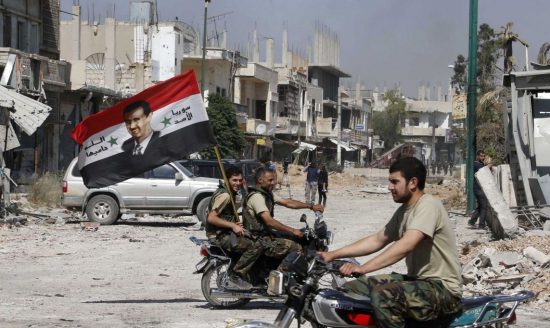
The situation in the Middle East is changing at an incredible speed. The things unbelievable yesterday, become reality today. Each of the events becomes part of a bigger picture, with the region gradually moving away from abyss to become a better place.
On March 1, Iraqi forces were reported to have taken control of the last major road out of western Mosul, preventing Islamic State (IS) militants from fleeing the city. The route leads to Tal Afar, another IS stronghold that is 40 km further west. They have since driven militants from the international airport, a military base, a power station and a number of residential areas. IS fighters began to flee. Total control over the city by Iraqi forces seems to be a matter of a few days, maybe hours.
Being almost defeated in Iraq, the IS has nowhere else to go but Syria – the country where they have just suffered a defeat, with Palmyra retaken by Syria’s government forces. Russia’s support has been crucial in the Syrian army’s push. Raqqa, the last remaining stronghold of the IS, will be the place of the final battle the extremist group is doomed to lose as many influential actors want it to be wiped away from the earth.
Turkey has announced its intent to launch an offensive to retake Raqqa but only after taking control of Manbij, the town held by the Kurds-dominated Syria Democratic Forces (SDF). The parties were in for a fight to benefit the IS and other terror groups. The US was at a loss as to how to prevent a clash between the NATO ally and the Kurds – the force it relies on in the fight against the IS. That’s when Moscow stepped in to avoid the worst, using its unique position as a mediator. It managed to do what nobody thought was possible. The military council in Manbij said on March 2 it will hand over areas west of the flashpoint town to Syrian government troops, after an agreement brokered by Russia.
Now the town is in Arab hands and Turkey has no reason to attack it. Syria and Turkey are not at war.
The United States had promised Turkey that Kurdish forces would withdraw from Manbij to the east of the Euphrates, but it never happened. Now Russia did what America had failed to do.
As a result of Russia’s effective mediation, Turkey can double down on its plans to advance to Raqqa, while Syria’s government has greatly strengthened its position. Turkey’s President Erdogan has just said he is ready to fight the IS together with Russia. He is coming to Moscow on March 9. It means no clash between Turkey and Syria will take place.
Many things are changing for the Syrian government and it has been going on for some time. It’s not a coincidence that voices get louder, calling for inviting Syrian President Assad to the March 29 Arab Summit in Amman – five years after Syria was expelled from the 22-member organization. Russia, Jordan and Egypt are applying efforts to reconcile the Arab community with the Syrian government. Last month, Egypt’s parliamentary committee for Arab affairs called for the return of Syria to the Arab League. This would signify the reconciliation between Saudi Arabia which backed the Syrian rebels – something unthinkable some time ago.
In 2015, then US President Obama predicted Russia would get stuck in Syria’s quagmire. He appears to have been wrong. Thanks to Russia’s involvement, one can see the light at the end of the tunnel to make the quagmire a thing of the past.
Moscow can facilitate the process of Iran joining with Arab states in the effort to reach agreement on Syria, bringing it to some mutual understanding with Saudi Arabia. Not much has been reported about some recent events of special significance. Iranian President Hassan Rouhani visited Kuwait and Oman on February 15. Saudi Arabian Foreign Minister Adel Al-Jubeir made a trip to Iraq on February 25, to be received by Iraqi Prime Minister Haider Al-Abadi. The trend is visible – Shia and Sunni are on speaking terms again and they are discussing something very important. It would have sounded incredible a short time ago but these are the facts.
All these events and emerging trends are taking place against the background of the ongoing UN-brokered Geneva talks on peaceful settlement in Syria. Here too we have an unexpected turn of events – the Syrian opposition seeks to meet with Russian officials!
According to Paul Vallely, a retired US Army Major General and senior military analyst for Fox News, Russia-US consultations on Syria are to start in two months after the presidents hold a summit. He said Russia is to play a key part in any scenario.
The recent days have literally shaken the Middle East. So many unexpected things happen to push things forward. Right in front of our eyes the impossible becomes possible.
As said before, Moscow is in a unique position to act as an intermediary and it plays its role aptly to achieve tangible results. If the current trend continues in the same direction, leading to the desired outcome, Russia’s effort will go down in history as an extraordinary achievement of military success combined with effective diplomacy.
At US behest Turkey reboots Syrian war
By M K Bhadrakumar | Indian Punchline | February 23, 2017
Turkey has decided to pick up a quarrel with Iran. It all began with President Recep Erdogan’s sudden outburst on February 14 in the first leg of a regional tour of Gulf States – Bahrain, Saudi Arabia and Qatar — when he said, “Some people want both Iraq and Syria to be divided. There are some that are working hard to divide Iraq. There is a sectarian struggle, a Persian nationalism at work there. This Persian nationalism is trying to divide the country. We need to block this effort.”
Tehran hit back by accusing Turkey of supporting terrorist organizations “to destabilize neighbouring countries.” And there has been much back and forth in mutual recriminations since then. The spat makes a mockery of the “trilateral alliance” between Russia, Turkey and Iran that Moscow has been promoting at the recent Astana talks on Syria. The Russian Foreign Ministry had announced as recently as February 16 that Russia, Turkey and Iran have formed a tripartite operational group to stabilize the ceasefire in Syria. The most puzzling aspect is that this is happening just when the Syrian peace talks began in Geneva today under UN auspices.
But then, there is always a method in Erdogan’s madness. Succinctly put, Erdogan’s outburst reflects an overall frustration that Iran has greatly outstripped its traditional rival Turkey in expanding its influence in both Iraq and Syria. The Iranian militia played a big role in taking Aleppo city and vanquishing the rebel groups supported by Turkey.
Turkey had fancied that it would play a similar lead role in wresting control of Mosul from the hands of the ISIS. But to its great consternation and anger, Iran has wrested that role too. The latest reports show that Iraqi forces have stormed Mosul airport. Iraq (and Iran) opposed any role for Turkey in the liberation of Mosul.
Conceivably, with an eye on the new US administration’s reported plan to create an anti-Iran alliance in the region, Turkey is repositioning itself. There are several developments pointing in this direction. The US and Turkey have been holding a series of top-level meetings through the past fortnight since President Donald Trump made his first phone call with Turkish President Recep Erdogan on February 7. The American visitors to Ankara since then included CIA Director Mike Pompeo, Chairman of the Joint Chiefs of Staff General Joseph Dunford and US the senator who heads the Armed Services Committee John McCain.
Meanwhile, Erdogan has undertaken a tour of the GCC states, which aimed at harmonising the Turkish stance on Syria with that of Saudi Arabia and Qatar. (During Erdogan’s tour, Turkey and Saudi Arabia signed a defence agreement.) Ankara has noted that in the past fortnight there have been important visitors from the US to the Gulf region –CIA chief Pompeo, Senator John McCain and Defence Secretary James Mattis. Pompeo conferred on Saudi Crown Prince Mohammed bin Nayef bin Abdulaziz the CIA’s George Tenet Medal for his exceptional contributions in the fight against terrorism. It doesn’t take much ingenuity to figure out that the US is promoting a Saudi-Israeli alliance against Iran.
Equally, Ankara and Washington are edging toward a mutually satisfactory resolution of a discord that had set them apart in the recent past – the fate of Islamist preacher Fetullah Gulen who lives in exile in Pennsylvania. The Trump administration may act to curb Gulen’s activities, while Erdogan may no longer press for his outright extradition to Turkey.
However, one other contentious issue still remains unresolved – US military support for Syrian Kurds. This is a non-negotiable issue for Turkey, which considers the Syrian Kurdish militia to be an affiliate of the separatist Kurdish group PKK. Turkey and the US are actively discussing at the moment the modalities of a Turkish military operation aimed at liberating Raqqa, the ‘capital’ of the Islamic State. The Turkish Prime Minister Binaldi Yildirim discussed the Raqqa operation with the US Vice-President Mike Pence in the weekend at the Munich Security Conference. It will be a major military operation with tanks, armoured vehicles and artillery. Turkey seeks US Special Forces’ participation, which will also serve the purpose of deterring Russian intervention, apart from weakening the Syrian Kurds’ drive to create an entity in northern Syria.
Without doubt, the capture of Raqqa will be much more than a symbolic event. Raqqa determines how much of Syria will be under the control of the Syrian regime. Clearly, Erdogan hopes to project Turkish power right into Damascus and have a big say in Syria’s future. Yildirim sounded upbeat after meeting Pence. See a report in the pro-government Turkish daily Yeni Safak – PM Yildirim: Turkey, US turning over a new leaf.
Suffice to say, Erdogan seems confident that the Trump administration is viewing Ankara once again as a “strategic partner and a NATO ally” (as Trump indeed told him). Just another 5 days remain in the timeline given by the Trump administration to the Pentagon to prepare a comprehensive plan to defeat the Islamic State in Syria and Iraq. But Turkey is already acting as if it had a preview of the Pentagon plan.
A lengthy dispatch from Damascus by Xinhua underscores that Turkey’s journey back to its American ally also coincides with the “re-emergence of the Gulf states as the backers of the rebels” and with a growing probability of US putting boots on the ground in Syria — all in all a “remilitarization” of the Syrian conflict. Read the insightful report titled Spotlight: Gloomy outlook shadows Syrian talks in Geneva.
Trump’s ISIS Plan: Another US Invasion?
By Ron Paul | February 20, 2017
Just over a week into the Trump Administration, the President issued an Executive Order giving Defense Secretary James Mattis 30 days to come up with a plan to defeat ISIS. According to the Order, the plan should make recommendations on military actions, diplomatic actions, partners, strategies, and how to pay for the operation.
As we approach the president’s deadline it looks like the military is going to present Trump with a plan to do a whole lot more of what we’ve been doing and somehow expect different results. Proving the old saying that when all you have is a hammer everything looks like a nail, we are hearing increasing reports that the military will recommend sending thousands of US troops into Syria and Iraq.
This would be a significant escalation in both countries, as currently there are about 5,000 US troops still fighting our 13-year war in Iraq, and some 500 special forces soldiers operating in Syria.
The current Syria ceasefire, brokered without US involvement at the end of 2016, is producing positive results and the opposing groups are talking with each other under Russian and Iranian sponsorship. Does anyone think sending thousands of US troops into a situation that is already being resolved without us is a good idea?
In language reminiscent of his plans to build a wall on the Mexican border, the president told a political rally in Florida over the weekend that he was going to set up “safe zones” in Syria and would make the Gulf States pay for them. There are several problems with this plan.
First, any “safe zone” set up inside Syria, especially if protected by US troops, would amount to a massive US invasion of the country unless the Assad government approves them. Does President Trump want to begin his presidency with an illegal invasion of a sovereign country?
Second, there is the little problem of the Russians, who are partners with the Assad government in its efforts to rid the country of ISIS and al-Qaeda. ISIS is already losing territory on a daily basis. Is President Trump willing to risk a military escalation with Russia to protect armed regime-change forces in Syria?
Third, the Gulf States are the major backers of al-Qaeda and ISIS in Syria – as the president’s own recently-resigned National Security Advisor, Michael Flynn, revealed in a 2015 interview. Unless these safe zones are being set up to keep al-Qaeda and ISIS safe, it doesn’t make any sense to involve the Gulf States.
Many will say we should not be surprised at these latest moves. As a candidate, Trump vowed to defeat ISIS once and for all. However, does anyone really believe that continuing the same strategy we have followed for the past 16 years will produce different results this time? If what you are hammering is not a nail, will hammering it harder get it nailed in?
Washington cannot handle the truth: solving the ISIS problem must involve a whole lot less US activity in the Middle East, not a whole lot more. Until that is understood, we will continue to waste trillions of dollars and untold lives in a losing endeavor.
Amnesty International Stokes Syrian War
By Rick Sterling | Consortium News | February 11, 2017
Amnesty International (AI) has done some good investigations and reports over the years, which has won the group widespread support. However, less well recognized, Amnesty International has also carried out faulty investigations with bloody and disastrous consequences.
One prominent example is in Iraq, where AI “corroborated” the false story that Iraqi soldiers were stealing incubators from Kuwait, leaving babies to die on the cold floor. The deception was planned and carried out in Washington to influence the U.S. public and Congress.
A more recent example is from 2011 where false accusations were being made about Libya and Muammar Gaddafi as Western and Gulf powers sought to overthrow his government. AI leaders joined the campaign claiming that Gaddafi was using “mercenaries” to threaten and kill peacefully protesting civilians. The propaganda was successful in muting criticism of what became an invasion and “regime change.”
Going far beyond a United Nations Security Council resolution to “protect civilians,” NATO launched sustained air attacks and toppled the Libyan government leading to chaos, violence and a flood of refugees. AI later refuted the “mercenary” accusations but the damage was done.
Now, on Feb. 7, Amnesty International released a new report titled “Human Slaughterhouse: Mass Hangings and Extermination at Saydnaya Prison,” which accuses the Syrian government of executing thousands of political prisoners, a set of accusations that has received uncritical treatment in the mainstream news media.
Like the Iraq/Kuwait incubator story and the Libyan “mercenary” story, the “Human Slaughterhouse” report is coming at a critical time. It accuses and convicts the Syrian government of horrible atrocities against civilians – and AI explicitly calls for the international community to take “action.” But the AI report is deeply biased and amounts to a kangaroo-court conviction of the Syrian government.
AI’s Standards Ignored
The Amnesty International report violates the organization’s own research standards. As documented by Professor Tim Hayward here, the Secretary General of Amnesty International, Salil Shetty, claims that Amnesty does its research “in a very systematic, primary, way where we collect evidence with our own staff on the ground. And every aspect of our data collection is based on corroboration and cross-checking from all parties, even if there are, you know, many parties in any situation because of all of the issues we deal with are quite contested. So it’s very important to get different points of view and constantly cross check and verify the facts.”
But the Amnesty report fails on all counts: it relies on third parties, it did not gather its information from different points of view, and it did not cross-check with all parties. The report’s conclusions are not based on primary sources, material evidence or AI’s own staff; the findings are solely based on the claims of anonymous individuals, mostly in southern Turkey from where the war on Syria is coordinated.
Amnesty gathered witnesses and testimonies from only one side of the conflict: the Western- and Gulf-supported opposition. For example, AI consulted with the Syrian Network for Human Rights, which is known to seek NATO intervention in Syria. AI “liased” with the Commission for International Justice and Accountability, an organization funded by the West to press criminal charges against the Syrian leadership. These are obviously not neutral, independent or nonpartisan organizations.
If AI were doing what its Secretary General claims the organization always does, AI would have consulted with organizations within or outside Syria to hear different accounts of life at Saydnaya Prison. Since the AI report has been released, the AngryArab has published the account of a Syrian dissident, Nizar Nayyouf, who was imprisoned at Saydnaya. He contradicts many statements in the Amnesty International report, the type of cross-checking that AI failed to do for this important study.
Amnesty’s accusation that executions were “extrajudicial” is exaggerated or false. By Amnesty’s own description, each prisoner appeared briefly before a judge and each execution was authorized by a high government leader. We do not know if the judge looked at documentation or other information regarding each prisoner. One could argue that the process as described was superficial, but it’s clear that even if AI’s allegations are true, there was some kind of judicial process.
Amnesty’s suggestion that all Saydnaya prisoners are convicted is false. Amnesty quotes one witness who says about the court: “The judge will ask the name of the detainee and whether he committed the crime. Whether the answer is yes or no, he will be convicted.” But this assertion is contradicted by a former Saydnaya prisoner who is now a refugee in Sweden. In this news report, the former prisoner says the judge “asked him how many soldiers he had killed. When he said none, the judge spared him.” This is evidence that there is a judicial process of some sort and there are acquittals.
The Amnesty report includes satellite photographs with captions which are meaningless or erroneous. For example, as pointed out by Syrian dissident Nizar Nayyouf, the photo on page 30 showing a Martyrs Cemetery is “silly beyond silly.” The photo and caption show that the cemetery doubled in size. However, this does not prove hangings of prisoners who would never be buried in a “martyrs cemetery” reserved for Syrian army soldiers. On the contrary, it confirms the fact which Amnesty International otherwise ignores: Syrian soldiers have died in large numbers.
The Amnesty report falsely claims — based on data provided by one of the groups seeking NATO intervention — “The victims are overwhelmingly ordinary civilians who are thought to oppose the government.” While it’s surely true that innocent civilians are sometimes wrongly arrested, as happens in all countries, the suggestion that Saydnaya prison is filled with 95 percent “ordinary civilians” is preposterous. Amnesty International can only make this claim without facing ridicule because AI and other Western organizations have effectively “disappeared” the reality of Syria.
Missing Facts
Other essential facts, which are completely missing from the Amnesty report, include:
–Western powers and Gulf monarchies have spent billions of dollars annually since 2011 to recruit, fund, train, arm and support with sophisticated propaganda a violent campaign to overthrow the Syrian government;
–As part of this operation, tens of thousands of foreign fanatics have invaded Syria and tens of thousands of Syrians have been radicalized and paid by Wahhabi monarchies in the Gulf to overthrow the government;
–More than 100,000 Syrian Army and National Defense soldiers have been killed defending their country. Most of this is public information yet ignored by Amnesty International and other mainstream media in the West. This “regime change” operation has been accompanied by a massive distortion and cover-up of reality.
–Without providing evidence, Amnesty International accuses the highest Sunni religious leader in Syria, Grand Mufti Ahmad Badreddin Hassoun, of authorizing the execution of “ordinary civilians.” While the Grand Mufti is a personal victim of the war’s violence – his son was murdered by terrorists near Aleppo – he has consistently called for reconciliation. Following the assassination of his son, Grand Mufti Hassoun gave an eloquent speech expressing forgiveness for the murderers and calling for an end to the violence.
What does it say about Amnesty International that it makes specific personal accusations, against people who have personally suffered, yet provides no evidence of guilt?
In the report, Amnesty uses sensational and emotional accusations in place of factual evidence. The title of the report is “Human Slaughterhouse.” And what goes with a “slaughterhouse”? A “meat fridge.” So, the report uses the expression “meat fridge” seven separate times, presumably in an attempt to strengthen the central metaphor of a slaughterhouse.
Even the report’s opening quotation is hyperbolic: “Saydnaya is the end of life – the end of humanity.” The report is in sharp contrast with fact-based objective research and investigation; it appears designed to manipulate emotions and thus create new public support in the West for another escalation of the war.
Yet, Amnesty International’s accusations that the Syrian government is carrying out a policy of “extermination” are contradicted by the fact that the vast majority of Syrians prefer to live in government-controlled areas. When the “rebels” were finally driven out of East Aleppo in December 2016, 90 percent of civilians rushed into areas under government control.
In recent days, civilians from Latakia province who had been imprisoned by terrorists for the past three years have been liberated in a prisoner exchange. [This video shows Syrian President Bashar al-Assad and his wife meeting with some of the civilians.]
A Video
The Amnesty report is accompanied by a three-minute propaganda cartoon that reinforces the narrative that Syrian civilians who protest peacefully are imprisoned and executed. Echoing the theme of the report, the animation is titled “Saydnaya Prison: Human Slaughterhouse.” Amnesty International appears to be in denial that there are tens of thousands of violent extremists in Syria, setting off car bombs, launching mortars and otherwise attacking civilian areas every day.
Given the national crisis – with so many violent jihadists to confront – it makes little sense that Syrian security or prison authorities would waste resources on non-violent civilians although that does not mean that the Syrian government has clean hands either. Mistakes and abuses surely happen in this war like all wars.
But the AI report is more like the propaganda that has surrounded the Syrian conflict from the beginning, lacking in balance and reminiscent of the “perception management” used to justify the U.S. invasion of Iraq in 2003 and the West’s assault on Libya in 2011. AI’s hyperbole is also contradicted by the fact that Syria has many opposition parties that compete for seats in the National Assembly and campaign openly for public support from both the right and left of the Baath Party.
AI’s claim that Syrian authorities brutally repress peaceful protests further ignores the Syrian reconciliation process. For the past several years, armed opposition militants have been encouraged to lay down their weapons and peacefully rejoin society, a program largely unreported in Western media because it contradicts the “black hat” narrative of the Syrian government. [A recent example is reported here.]
The Amnesty report cites the “Caesar” photographs as supporting evidence for its “slaughterhouse” accusations but ignores the fact that nearly half those photographs show the opposite of what was claimed. The widely publicized “Caesar photographs” was a Qatari-funded hoax designed to sabotage the 2014 Geneva negotiations as documented here.
While the Amnesty report makes many accusations against the Syrian government, AI ignores the violation of Syrian sovereignty being committed by Western and Gulf countries. It is a curious fact that big NGOs such as Amnesty International focus on violations of “human rights law” and “humanitarian law” but ignore the crime of aggression, also called the crime against peace.
According to the Nuremberg Tribunal, aggression is “the supreme international crime, differing only from other war crimes in that it contains within itself the accumulated evil of the whole.” Former Nicaraguan Foreign Minister and former President of the U.N. General Assembly, Father Miguel D’Escoto, is someone who should know. He says, “What the U.S. government is doing in Syria is tantamount to a war of aggression, which, according to the Nuremberg Tribunal, is the worst possible crime a State can commit against another State.” Amnesty International ignores this reality.
Background and Context
The co-author of this Amnesty International report is Nicolette Waldman (Boehland), who was uncritically interviewed on DemocracyNow! on Feb. 9. The background and previous work of Waldman shows the inter-connections between influential Washington “think tanks” and the billionaires’ foundations that fund “non-governmental organizations” – NGOs – that claim to be independent but are clearly not.
Waldman previously worked for the “Center for Civilians in Conflict,” which is directed by leaders from George Soros’s Open Society, the Soros-funded Human Rights Watch, Blackrock Solutions and the Center for a New American Security (CNAS).
CNAS may be the most significant indication of political orientation since it is led by Michele Flournoy, who was expected to become Secretary of Defense if Hillary Clinton had won the election. CNAS has been a leading force behind neoconservative and liberal-interventionist plans to escalate the war in Syria. While past work or associations do not always define new or future work, in this case the sensational and dubious accusations seem to align with those political goals. [Soros’s Open Society has also provided funds to Amnesty International.]
So what to make of Amnesty International’s new report? The once widely respected human rights organization has, in the recent past, let itself be used as a propaganda tool to justify Western aggression against Iraq and Libya, which seems to be the role that AI is playing now in Syria.
The Amnesty International report is a mix of hearsay accusations and sensationalism that tracks with the Western propaganda themes that have surrounded the Syrian war from the start. Because of Amnesty’s undeserved reputation for independence and accuracy, the report has been picked up and broadcast widely. Liberal and supposedly progressive media outlets have joined in dutifully echoing the questionable accusations.
Little or no skepticism is applied when the target is the Syrian government, which has faced years of foreign-sponsored aggression. If this report justifies another escalation of the conflict, as Amnesty International seems to want, the group will again be serving as a rationalizer for Western aggression against Syria, just like it did in Iraq and Libya.
Rick Sterling is an investigative journalist based in the San Francisco Bay Area. He can be reached at rsterling1@gmail.com
Featured Video
REDFIELD REWRITES THE RECORD
or go to
Aletho News Archives – Video-Images
From the Archives
Fake 9/11 Activism on 9/11. “Saudi Arabia was Behind the Attacks”
By Prof Michel Chossudovsky | Global Research | September 10, 2017
There is an element of confusion which has served to divide the 9/11 Truth movement. Saudi Arabia is said to have supported the alleged 9/11 highjackers.
What are the implications of “the Saudi did it” narrative?
It is very convenient to say that Saudi Arabia was behind the 9/11 terrorists. Why, because it upholds the official narrative of the 9/11 Commission Report and it whitewashes the US Deep State including its military and intelligence apparatus.
The official narrative –which has been amply refuted– states that 19 Al Qaeda hijackers brought down the WTC towers, i.e Muslims were behind the attack on America, –i.e. it was not an “inside job” or a false flag.
And now what is happening is that Saudi Arabia is blamed for having supported the al Qaeda hijackers.
And if Saudi Arabia is held responsible, pari passu the official narrative holds, namely the hijackers did it with the support of the House of Saud. … continue
Blog Roll
Recent Comments
loongtip on Trump tells India to stop purc… eddieb on The Old Testament and the Geno… papasha408 on Trump’s war posturing against… Coronistan on This is How We Should Have Res… Coronistan on NO MANDATES, NO PROFITS: MODER… Lutz Barz on Russia Vows to Protect Its Oil… loongtip on Russia Vows to Protect Its Oil… loongtip on Hamas never agreed to lay down… eddieb on Conspiracy Denial eddieb on WEF Calls for ‘Cultural Revolu… loongtip on Trump wanted to play peacemake… Coronistan on EU member to sue bloc over ‘su…


 Aletho News
- Saudi media takes an anti-‘Israel’ turn: WSJ
- Fantasies of Fragmenting Iran Only Serve Israeli Interests
- Mike Pompeo admits Washington ‘directly helped’ rioters in Iran
- Iranian FM reveals ‘fruitful’ indirect talks with US in push for de-escalation
- British journalism hits rock bottom with latest shocking revelations
- American Zionists are using Trump’s Republican Party to create a multicultural supremacist elite
- German calls for nukes are ‘madness’ – veteran politician
- REDFIELD REWRITES THE RECORD
- From Iraq war crimes to Gaza’s ‘board of peace’: Why Tony Blair belongs in The Hague
- Epstein email reveals plan to pursue frozen Libyan assets with help from former MI6, Mossad figures
- If Americans Knew
- One side emerged from a tunnel; the other side killed 31. Both must “exercise restraint” – Not a ceasefire Day 115
- Israel killed at least 32 Gazans on Saturday – Not a ceasefire Day 114
- Is Israel opening the Rafah border to depopulate Gaza? – Not a ceasefire Day 113
- NBA Star Stephen Curry’s Ties To Israeli Military Intelligence
- ‘Apocalyptic wasteland’: Biden admin. blocked warning on deteriorating Gaza situation after Oct. 7
- Why Israeli counterterrorism tactics are showing up in Minnesota
- Israel Went to Extremes to Return Ran Gvili’s Body. Why Doesn’t It Accord Dead Palestinians the Same Respect?
- Across the West, speaking for Palestine is now a crime
- A West Bank Bus Trip Through ‘the Best Documented Ethnic Cleansing in History’
- Mike Huckabee’s distorted theology does not speak for Christians worldwide
- No Tricks Zone
- One Reason Only For Germany’s Heating Gas Crisis: Its Hardcore-Dumbass Energy Policy
- 130 Years Later: The CO2 Greenhouse Effect Is Still Only An Imaginary-World Thought Experiment
- New Study Affirms Rising CO2’s Greening Impact Across India – A Region With No Net Warming In 75 Years
- Germany’s Natural Gas Crisis Escalates … One Storage Site Near Empty …Government Silent
- Polar Colding…Antarctica Saw Its Coldest October In 44 Years!
- New Study: Sea Levels Rose 20 Times The Modern Rate During The Roman Warm Period
- As German Gas Storage Dips Dangerously Low…Shortage Hardly Avoidable
- New Study: Brazil’s Relative Sea Level Was 2+ Meters Higher And SSTs 3-4°C Warmer 6000 Years Ago
- Philosopher Schopenhauer: Climate Science Certainty Stems From Stupidity, Ignorance
- New Study: Species Extinction Rates Declining Since 1980 – ‘Climate Change Is Not An Important Threat’
 Aletho News