In this episode of Truth in Media, Ben Swann explores the origin of ISIS that has already been long forgotten by American media. Swann takes on the central issue of whether or not ISIS was created by “inaction” by the United States government or by “direct” action.
A senior Iranian lawmaker has slammed recent remarks by a top US military commander on Iraq’s disintegration, saying Washington seeks to break down the entire Middle East.
“The US has created Daesh based on a calculated scheme in order to realize the Greater Middle East plan and disintegrate the region. That’s why the Americans are bringing up the issue of Iraq’s disintegration,” Alaeddin Boroujerdi, the chairman of the National Security and Foreign Policy Committee of the Iranian Parliament (Majlis), said on Sunday.
The Iranian lawmaker’s remarks came after US Army Chief of Staff General Raymond Odierno, who once served as the top US commander in Iraq, said on August 12 that partitioning Iraq “is something that could happen” and “might be the only solution.”
The remarks came as a controversial US Congress bill, the draft of which was released in April, proposes the division of Iraq into three states and allows the Kurdish forces and the Sunni tribesmen to be armed directly without Baghdad’s approval.
The bill stipulates that 25 to 60 percent of the USD 715-million aid money allegedly allocated to Iraq in its war against Daesh will be directly supplied to Sunni and Kurdish forces.
Iraqi Prime Minister Haider al-Abadi strongly condemned the comments by the top US military commander as “irresponsible,” saying they reflected “ignorance of the Iraqi reality.”
Iraqi politicians, including members of the parliament, as well as religious leaders have also voiced their opposition to the bill.
Syria no-fly zone
Elsewhere in his remarks, Boroujerdi said that Turkey’s pushing for a no-fly zone over Syria is a “strategic mistake” for Ankara.
He said that the move is a violation of international law as well as sovereignty and territorial integrity of the Arab country.
“Turkey is expected to adopt a policy that will contribute to regional stability and security, not [one that will] lead to instability in the region,” he added.
Turkey has been pushing for a no-fly zone over northern Syria, claiming that such a buffer zone could protect Ankara from Syrian airstrikes against foreign-backed militants.
Turkish Prime Minister Ahmet Davutoglu said in an interview last week that he would work with the US to establish what he called a “safe area,” claiming that the buffer zone would protect civilians.
The US has not given the official go-ahead for the plan yet.
The Middle East has been in a state of chaos for years now, with each passing year bringing a new wave of instability, carnage and human suffering to the people of the region. From Afghanistan to Iraq, Libya to Syria, Western foreign policy has directly caused or exacerbated much of the chaos we see in the region today and has contributed to a growing trend of instability.
A pertinent question of our time however is whether this instability and destabilization is a result of inept strategy by Western nations, or a calculated strategy by the West to intentionally create chaos, balkanize nations and increase sectarian tensions in the region?
The “New Thirty Years War”
Certain individuals within the US establishment have been drawing the comparison between the Middle East today and the Thirty Years War in Europe in the 17th century, with Prof. Larry Goodson of the US Army War College being one of the latest individuals to make the comparison. Even though the parallels between Europe and the Middle East are by no means exact, it has become somewhat of a talking point within Western geostrategic circles.
The Thirty Years War is a complex historical period, pertaining to numerous wars and conflicts fought by an array of power blocs for a variety of reasons. According to the Encyclopædia Britannica: “Although the struggles that created it erupted some years earlier, the war is conventionally held to have begun in 1618, when the future Holy Roman emperor Ferdinand II, in his role as king of Bohemia, attempted to impose Roman Catholic absolutism on his domains, and the Protestant nobles of both Bohemia and Austria rose up in rebellion.”
The war quickly spread to embroil the majority of Europe’s major powers who either believed there was an opportunity to conquer neighbouring powers or were drawn into the conflict by a force invading their lands, and is regarded by historians as one of the most destructive periods in European history. Villages, towns and cities were raped and pillaged by mercenaries who were fighting for different power blocs, devastating the European continent.
The Thirty Years War was brought to an end when a series of treaties was signed in 1648 known as the Peace of Westphalia, establishing a new political order in Europe in the form of co-existing sovereign states (although some historians dispute the significance of Westphalian sovereignty). James Bissett, the former Canadian Ambassador to Yugoslavia, Bulgaria and Albania, described the Westphalian system in a 2007speech as laying “down the basic tenets of sovereignty—the principle of territorial integrity and of non-interference in the affairs of national states… The Westphalian order has frequently been violated, but age has not diminished the principles themselves.”
In July of 2014, the former director of policy planning for the US Department of State and the President of the Council on Foreign Relations (CFR), Richard Hass, compared the Middle East of today to 17th century Europe, in his article “The New Thirty Years War”. Hass proclaims that the Middle East will likely be as turbulent in the future unless a “new local order emerges”:
“For now and for the foreseeable future – until a new local order emerges or exhaustion sets in – the Middle East will be less a problem to be solved than a condition to be managed.”
As I reported a year ago, this “new local order” may be in the form of a Middle Eastern Union.
Fragmenting the Middle East
Ubiquitous evidence indicates that there is an agenda by at least some strategists within the US to destroy the nation state and balkanize the region into feuding rump states, micro-states and mini-states, which will be so weak and busy fighting each other that they will be unable to unify against foreign colonial powers – most notably Western multinational corporations. After a prolonged period of destruction and chaos in the region, the people of the Middle East may be so weary of the horrors of war that they will accept a Western imposed order as a means of ending the fighting, even though the very same Western forces have been responsible for creating much of the intolerable chaos.
The strategy of balkanization can be traced back to at least the early 1990’s, when British-American historian Bernard Lewis wrote an article published in the 1992 issue of the CFR’s publication, ‘Foreign Affairs’, titled: Rethinking the Middle East. He envisages the potential of the region disintegrating “into a chaos of squabbling, feuding, fighting sects, tribes, regions and parties.” Even though Lewis writes in his article that this is only one “possibility” of many other possibilities, it is starkly similar to the situation that we see in countries such as Iraq and Libya today:
“Another possibility, which could even be precipitated by fundamentalism, is what has of late become fashionable to call “Lebanonization.” Most of the states of the Middle East—Egypt is an obvious exception—are of recent and artificial construction and are vulnerable to such a process. If the central power is sufficiently weakened, there is no real civil society to hold the polity together, no real sense of common national identity or overriding allegiance to the nation state.”
Lewis continues:
“The state then disintegrates—as happened in Lebanon—into a chaos of squabbling, feuding, fighting sects, tribes, regions and parties. If things go badly and central governments falter and collapse, the same could happen, not only in the countries of the existing Middle East, but also in the newly independent Soviet republics, where the artificial frontiers drawn by the former imperial masters left each republic with a mosaic of minorities and claims of one sort or another on or by its neighbours.”
Speaking at the Ford School in 2013, former US secretary of state and CFR member, Henry Kissinger, reveals his desire to see Syria balkanized into “more or less autonomous regions”, in addition to comparing the region to the “Thirty Years War” in Europe:
“There are three possible outcomes. An Assad victory. A Sunni victory. Or an outcome in which the various nationalities agree to co-exist together but in more or less autonomous regions, so that they can’t oppress each other. That’s the outcome I would prefer to see. But that’s not the popular view…. I also think Assad ought to go, but I don’t think it’s the key. The key is; it’s like Europe after the Thirty Years War, when the various Christian groups had been killing each other until they finally decided that they had to live together but in separate units.” (from 27.35 into the interview).
Creating a “Salafist Principality” in Syria
In May of this year, Judicial Watch released a series of formerly classified documents from the US Department of Defense and Department of State after the watchdog group filed a Freedom of Information Act (FOIA) lawsuit against the two government agencies. One important document contained in the release was a 2012 Defense Intelligence Agency (DIA) report which reveals that the powers supporting the Syrian opposition – “Western countries, the Gulf states and Turkey” – wanted to create a “Salafist principality in Eastern Syria in order to isolate the Syrian regime”:
“Opposition forces are trying to control the Eastern areas (Hasaka and Der Zor), adjacent to the Western Iraqi provinces (Mosul and Anbar), in addition to neighbouring Turkish borders. Western countries, the Gulf states and Turkey are supporting these efforts… If the situation unravels there is the possibility of establishing a declared or undeclared Salafist principality in Eastern Syria (Hasaka and Der Zor), and this is exactly what the supporting powers to the opposition want, in order to isolate the Syrian regime, which is considered the strategic depth of the Shia expansion (Iraq and Iran).” (p.5)
The document adds:
“ISI [the Islamic State of Iraq] could also declare an Islamic State through its union with other terrorist organisations in Iraq and Syria.” (p.5)
Balkanizing Iraq
Fragmenting Iraq into three separate regions has been the goal of many within the US establishment since the 2003 invasion of the country, although NATO member Turkey has vocally opposed the creation of a Kurdish state in the North. In 2006, a potential map of a future Middle East was released by Lieutenant-Colonel Ralph Peters which depicted Iraq divided into three regions: a Sunni Iraq to the West, an Arab Shia State in the East and a Free Kurdistan in the North.
Even though the map does not reflect official Pentagon doctrine, it gives a glimpse into the minds of some of the top military strategists and corroborates with many other Western voices on the strategy for Iraq. As geopolitical analyst Eric Draitser noted in a recent article for New Eastern Outlook, the President Emeritus of the CFR, Leslie Gelb, argued in a 2003 article for the NY Times that the most feasible outcome in Iraq would be a “three-state solution: Kurds in the north, Sunnis in the center and Shiites in the south.”
Syria is shown as still being a unified country in the above map, although this may be because the Syrian proxy war did not begin until years later. Israel could also come to occupy more territory in the coming decades.
Different Country, Same Strategy
The same pattern of balkanization and chaos that we see in Iraq and Syria is also true in Libya. Following the NATO’s 2011 war in the North African nation, the country descended into an abyss of chaos and has essentially been split into three parts, with Cyrenaica comprising the East of the country, and the West split into Tripolitania in the Northwest and Fezzan in the Southwest. Libya is now a failed state which is devoid of central government and is stricken by tribal warfare, where rival militias who were once fighting alongside each other are now battling against one another.
The Iranian nuclear deal could mark a new beginning for Western geopolitical strategy in the Middle East, where they would work with regional powers to promote stability and refrain from military intervention (or intervention through proxies). Let’s hope this is true, and the West will halt the plethora of destabilization programs it has engaged in for years.
But the most probable scenario will be a continuation of the balkanization strategy that we have all come to expect; until a “new local order emerges” – an order that will be designed by, and for, Western interests of course.
Prologue: In the village of Duma, an 18 month old Palestinian baby died following the fire-bombing of his family’s home by Israeli settlers. The father of the child died of burns a week later and the surviving mother and young sibling are barely alive – covered with burns from racist Jewish arson.
The United Nations Special Committee to investigate Israel’s practices toward Palestinians in Israeli occupied territory have revealed that the ‘root cause’ of the escalating violence is the ‘continuous policy of Jewish settlement expansion (financed and defended by the Netanyahu regime) and the climate of impunity relating to the activities of the settlers (financed and defended by the Presidents of the 52 Major American Jewish Organizations). (UN News Centre, Aug. 10, 2015).
Introduction
The recent US-Iran nuclear agreement, entitled Joint Comprehensive Plan of Action or JCPOA, has implications far beyond the ending of nearly 40 years of regional confrontation.
Several fundamental issues concerning the nature of US policymaking, the power of a foreign regime (Israel) in deciding questions of war and peace and the role organized power configurations with overseas loyalties play in making and breaking executive and legislative authorities.
To investigate these fundamental issues it is important to discuss the historical context leading up to the rise of this paradoxical situation: Where a ‘global power’ is subject to the dictates of a second-rate state through the strategic penetration and influence by domestic organizations composed of ‘nominal citizens’ of the subject state with ‘divided (to put it politely) loyalties’.
The Centrality of Israel’s Unchallenged Regional Supremacy
The motor force of Israeli foreign and domestic policy is their drive for unchallenged regional supremacy: Military dominance through wars, territorial occupation, brutal armed interventions, extra territorial political assassinations of opponents and favorable one-sided treaties. To ensure its unquestioned dominance Israel has developed the only nuclear weapons arsenal and largest missile launch capacity in the region and has openly declared its willingness to use nuclear weapons against regional rivals.
Israel’s repeated mantra that it faces an ‘existential threat’ from its Arab neighbors and subjugated Palestinians has no factual basis. On the contrary, history has taught the world that Israel, directly and indirectly, has engaged a series of aggressive wars devastating its Arab and Muslim neighbors. Israel has bombed and/or invaded Lebanon, Egypt, Jordan, Syria, Palestine and Sudan. Israel has assassinated scientists in Iran and Palestinian political leaders as well as intellectuals, writers and poets in the Gulf, Jordan and Europe. Even family members have not been spared Israeli terror.
Israel can brutalize its neighbors with total impunity because of its vast military superiority, but its real power is found in its overseas proxies, the Tel Aviv-dominated Zionist power configurations, especially in North America and Europe. The most important proxy organizations and individuals operate in the United States. Thanks to them Israel has received over $150 billion dollars in economic and military grants and loans from US taxpayers in the past half-century. Each year Israel rakes in billions in tribute, billions in tax-free donations from billionaire Israel loyalists with dual US citizenship, who extract their wealth from American workers, investors and gamblers, and hundreds of billions via unrestricted investments, privileged market access and technology transfers.
The economic and military transfers to Israel result from the cumulative build-up of political power among powerful US Zionists. No one disputes today that what is dubbed as the ‘pro-Israel lobby’ is the most powerful configuration inside Washington DC today. Focusing primarily on the ‘Israel lobby’ overlooks the powerful role that influential, Zionist political officials have played in deciding issues prioritized by the Israeli leadership.
Israeli power over the making and implementing of US Middle East policy has led to the US invasions of Iraq, Syria and Libya; the current economic boycott and blockade of Iran; the breakup of Sudan; and the bombing of Somalia.
Israeli power in the US operates through various political instruments in different institutional settings. The pro-Israel mass media moguls at the Washington Post, Wall Street Journal, the New York Times and all the TV networks unconditionally defend Israel’s bombing, dispossession and repression of Palestinians while demonizing any Arab or Muslim states which has opposed its brutality – frequently calling for the US to impose sanctions and/or to launch armed attacks against Israel’s critics.
The US military campaign known as the ‘Global War on Terror’, a series of brutal invasions and ‘regime changes’, launched after the attacks of September 11, 2001 was formulated and promoted by fanatical Israeli proxies in strategic positions within the Bush government, especially Paul Wolfowitz, Douglas Feith, ‘Scooter’ Libby, Elliott Abrams and Richard Perle. The boycott of Iran was designed and implemented by US Treasury officials Levey and Cohen. The drumbeat for war in Iraq and the phony ‘intelligence’ about ‘weapons of mass destruction’ was propagated by New York Times scribe Judith Miller, designed by Wolfowitz and Feith, backed by the 52 President of Major American Jewish Organizations and ultimately paid for with the lives of over five thousand Americans and well over a million Iraqi civilians. The destruction and breakup of Iraq, a long-time supporter of Palestinian national rights, was accomplished without the loss of a single Israeli life – despite the enormous benefit the Jewish state has enjoyed from the war! The extraordinary success of this highest Israeli military priority was due entirely to the machinations of Israel’s highly placed US proxies.
Yet the cost of the war has been very high for the American people (and unimaginably high for Iraqis): Over a quarter million physical and mental casualties among US troops; two trillion dollars and counting in military expenditures crippling the US economy and a vast and growing army of Islamist and nationalist rebels opposing US interests throughout the region.
The Israeli power configuration within the US led the US into a war, which enhanced Israel’s dominance of the Middle East region and accelerated its annexation of Palestinian land. But Israeli ambition for total regional power is not complete. It still faces a formidable opponent to its conquest of the Middle East: Iran remains a staunch supporter of the people and national sovereignty of Palestine, Syria and Lebanon.
The regime of Prime Minister Benyamin Netanyahu, backed by the entire Israeli political opposition and the majority of the Jewish electorate, has been aggressively pushing for a US confrontation with Iran – through economic and eventually military warfare.
There have been scores of public and private meetings in the US and elsewhere, where Netanyahu’s regime “informed” (or rather dictated to) the entire Zionist power configuration to launch an economic and military attack against Iran with the open aim of ‘regime change’ and the ultimate aim of breaking up and destroying the Islamic republic – similar to the destruction of Iraq, Libya and now Syria.
Israel’s Proxies and the Obama – Iran Nuclear Accord
All the major US spy agencies, including the CIA, long concluded that Iran did not have a nuclear weapons program. Its nuclear program has been proven to be limited to legal, internationally sanctioned peaceful civilian use. When the US intelligence establishment went ‘off-script’ and cleared Iran of a nuclear weapons program, Israel responded by brazenly assassinating five Iranian scientists and engineers, leaking faked evidence of a nuclear weapon program and directing its US proxies to push the US toward greater economic sanctions. They escalated their media campaign demonizing Iran, pushing for an economic and military blockade of Iran using the US naval forces in the Persian Gulf and its military bases in adjoining countries. Israeli officials want yet another US war for Israel along the lines of the Iraq invasion.
With the recent change in the Iranian government leadership via democratic elections there have been serious expressions of greater flexibility with regard to inspections of its nuclear programs and facilities. At the same time Washington has been confronted with multiple escalating insurgent wars in Yemen, Syria, Iraq, Libya, and Afghanistan. This provides the context for President Obama’s ‘pivot’ toward negotiations and diplomacy to secure an agreement with Iran and away from military confrontation.
This has infuriated the Netanyahu regime. Its government leaders and agents met with the Presidents of the 52 Major American Jewish Organizations, leading Zionist Washington insiders like (Dennis Ross), super-rich Zionist billionaires and multiple delegations of notables and told them to launch an all-out campaign to sabotage the Iran-US- England- France-Russia-China, and Germany (‘P5+1’) nuclear agreement.
The entire Zionist political apparatus immediately organized a multi-prong, multi-million dollar campaign blitz to undermine the US President. The American (sic) Israel Political Action Committee (AIPAC) mobilized hundreds of its full-time functionaries, invading the US Congress with offers of all expense-paid junkets to Israel, political threats, campaign ‘donation’ enticements and outright blackmail.
Influential US Zionist Congress people joined the onslaught with their ‘leader’ the ‘Senator from Tel Aviv’ Charles Schumer, accompanied by his fellow Zionist one-hundred percenters, Congress people like Steve Israel, Ted Deutsch, Eliot Engel and Nita Lowery. They have openly chosen to follow the dictates of the Israeli Prime Minister against their fellow Democrat US President Obama. Schumer, who frequently boasts that his name derives from ‘shomer Yisrael’ (Israel’s Guardian), flaunts his ‘role in Washington’ to serve Israel’s interest. The unannounced (or undenounced) ‘elephant in the room’ is their primary loyalty to Israel over the US. The Democratic Congressional Zionists have joined hands with the Republican war mongers – both in tow to militarist, Zionist billionaires and media moguls. The 52 organizations brazenly announced a $40 million budget to fund an Israeli front group “Citizens for a Nuclear Free Iran” to undermine President Obama’s (and the other members of the P5+1) push for diplomacy.
Netanyahu’s ‘megaphones’ in the US mass media spread his message in their daily reports and editorial pages. The Zionist power configuration ran roughshod over dissident Jewish voters and Congress people who dared to support Obama’s Iran agreement – an agreement which has majority support of the war-weary US public and strong support from US scientists and Nobel Prize recipients.
President Obama has finally counter-attacked this campaign to undermine the agreement, calling attention to the fact that “the same people who led us into the Iraq war are pushing us into war with Iran”. The President discreetly omitted identifying the Israeli links of the “same people”.
Obama understands that the alternative to the peace accord opposed by Israel and the Zionist-led US Congress members will be a devastating regional war, costing trillions of dollars in losses to the US economy, thousands of US lives and hundreds of thousands of wounded soldiers – not to speak of millions of Iranian casualties – and an environmental holocaust! While the Zionist power configuration saturates the airwaves with its unending lies and fear mongering, each and every major city and community Jewish Confederation have sent their activists to plant stories and twist arms to sabotage the agreement.
While many US intellectuals, liberals, progressives and leftists support the US-Iran agreement (see the Scientists’ Letter to Obama on Iran Nuclear Deal, Aug. 8, 2015 with 29 top scholars and Nobel laureates support diplomacy), few would dare to identify and attack Israel’s US proxies as they promote Tel Aviv’s agenda pushing the US to war with Iran. A brief glance through the sectarian left press, for example, The Socialist Register, New Politics, New Left Review, finds no discussion of the powerful, well-financed, highly organized, elite-driven Israeli proxies and their role in determining US wars in the Middle East, and more specifically the war agenda toward Iran.
Conclusion
The success or failure of the US-Iran nuclear agreement will have momentous, world-historic consequences that go far beyond the Middle East. Obama is absolutely right to pose the question as one between a diplomatic accord or a large scale, long-term devastating war. But war is what Israel, its leaders, its majority and its opposition parties are demanding and what its US proxies are pursuing.
The basic question for all Americans is whether we will act as an independent, sovereign country pursuing peace through diplomacy, as we currently see unfolding with Iran and Cuba, or a submissive military instrument, directed by Israel’s proxies hell-bent on destroying America for Israel.
A year has passed since the establishment of a rather peculiar state—the Islamic Caliphate. And today, a year later, its “founding fathers,” allies, enemies, objectives and tasks (which will define its further development) can be identified with precision.
Hardly anybody doubts today that the notorious al-Qaeda is responsible for the creation, nurturing and funding with dollars (supplied by the U.S. and their allies from the Persian Gulf region, headed by Saudi Arabia) of a terrorist organization the Islamic State. Al-Qaeda had already been suspected of being an “American mercenary.” That is why it is believed that al-Qaeda was behind the formation of a terrorist organization the Islamic State of Levant in Syria, whose objective was to oppose country’s President Bashar Assad, who, unlike Abd Rabbuh Mansur Hadi of Yemen, had been legitimately elected and had never abandoned his country. The members of this organization were those same militants, who had undergone combat training conducted by American military advisors in the territory of Turkey and Jordan and had been supplied with the most advanced weapons. From time to time, in order to acquit themselves, Washington officials would admit that yes, indeed, there were instances when American weapons did not reach the intended people and fell into the wrong hands. However, it is an irrefutable fact that militants of the Islamic State of Levant were much better armed with American weapons as compared to the fighters of the so-called Free Syrian Army (an organization, which is now almost completely forgotten).
Despite their high-tech armament, militants and terrorists failed to achieve considerable success, and this is why militants of the Sunni Islamic State of Iraq had to be relocated to the Syrian territory. It should be noted that the CIA spawned this organization during the U.S. occupation of Iraq with the objective of curbing the intentions of Tehran to gain full control over Iraq. Soon this organization, whose core consisted of the former officers of Saddam Hussein’s army and members of the Arab Socialist Ba’ath Party, became an influential force, capable of “showing teeth” to its overseas patrons to display their unwillingness to always dance to their tune. There was something about those former members of the Arab Socialist Ba’ath Party (who, perhaps, still maintain their memberships): they were aware of their worth and were very skillful negotiators. After the militants of the Islamic State of Iraq seeped to the territory of Syria, they joined forces with the Islamic State of the Levant. Thus, a new organization was formed — the Islamic State of Iraq and the Levant (ISIS), which is led by none other than the Head of the Islamic State of IraqIbrahim Awwad Ibrahim Ali al-Badri al-Samarrai, alsoknown as Abu Baqr al-Baghdadi.
Since the leader of ISIS is a very intriguing and nontrivial character, whose charisma affects all activities of this organization, it would be proper to share a few interesting facts about this individual. According to the official data of the United States Department of Defense, from February to December of 2004 Abu Baqr al-Baghdadi was detained and held as a suspect in Camp Bucca, the largest detention camp in Iraq. But according to the memoirs of the commander of the Camp, US Army Colonel Kenneth King, who remembers this person very well, he is “99 % sure” that the Iraqi prisoner left the Camp not in 2004, but only right before its closing, i.e., at the end of the summer of 2009. The Colonel remembers Abu Baqr al-Baghdadi because when leaving the Camp, he said to his guards, “See you in New York,” because he knew that the guards were from New York and served in the 306th Military Police Battalion.
An unidentified friend of Abu Baqr al-Baghdadi, who was also detained at the Camp, told Iraqi newspaper Al-Fourat about their life in the American Camp Bucca. Only two people were detained in one cell, which was more like a room of a campsite; their daily ration was the same as the ration of a US Army sergeant; they would regularly receive carefully selected fresh press; a TV in the cell was always on; cells were equipped with a powerful AC unit. They would spend a part of their day talking with American advisors, who tried to convert the detainees to their faith. Often pro-American Iraqi university professors would come to teach the prisoners international relations, politics, history and geography. In other words, those prisoners of the Camp, selected for the close cooperation with Americans, not only had to participate in an extensive “counterinsurgency program” from early morning to late evening, but were also trained by American advisors “for future collaborative business.” Perhaps this is why Abu Baqr al-Baghdadi was released only on the 5th year of his imprisonment, or rather “training.”
Truth be told, American advisors, who lack the knowledge of Arab morals and customs, used to make and still make many mistakes. One of the Arab sayings is that, “a Bedouin cannot be enslaved, he can only be killed.” And Abu Baqr al-Baghdadi, not a Bedouin, but an Arab (though a descendant of Bedouins) and a faithful follower of Islam, who after his liberation had at his disposal a powerful organization and plenty of money, started playing by his own rules.
It is peculiar that the interests of this Iraqi and of the Washington rulers still coincide, at least to some extent. It is also noteworthy that the borders of the proclaimed state (Caliphate) perfectly fit the borders of the “Sunni State,” outlined in the map elaborated by Lieutenant Colonel Ralph Peters (at the order of the Pentagon), which was assigned the name the New Middle East. Militants did not immediately head for Baghdad, which is supposed to be the capital of the Caliphate, but took Mosul first, from which the Sunni army of Iraq quietly withdrew leaving behind most of its inventory. Newspaper Al-Mashriq reported that on the day right before the seizure of Mosul, 50 million dollars had been delivered to the city’s Central Bank from Baghdad. Was it a coincidence? Later newspapers wrote that militants acquired a total of 200 million dollars in the Mosul operation.
Simultaneously, by having engaged in battles against Kurds and having threatened Iraqi Kurdistan, militants did an invaluable favor to Washington. First of all, Kurds were then faced with a rather tangible threat, were forced to begin mobilization and had to throw their Peshmerga forces into the battle. Secondly, in the absence of any considerable assistance on the part of the rulers of Baghdad, who were themselves hanging by a thread, dependence of Erbil on the U.S. had increased even more. It is not surprising then that the US Secretary of Defense Ashton Carter promptly arrived in Kurdistan and held talks with the senior Kurdish leadership, not even having informed the central government of that. The day before, Ashton Carter defined the ground forces of the army of Kurdistan as “powerful and successful” and confirmed his eagerness to meet Barzani who, being the leader of the guerrilla movement, had been opposing the regime of Saddam Hussein for decades. It is no surprise either that the Pentagon intended to deploy American military units, including its elite special forces, in the territory of the autonomous Kurdish region. The Western mass media reported that military machinery, weapons and equipment would be delivered to Kurdistan to arm Kurdish groups countering jihadists of the Islamic State. All these actions were never coordinated with the Iraqi central government, which, as the facts suggest, was no longer viewed by Washington as a real power. By the way, neither such country as Iraq is at present in the Lt. Col. R. Peters’ map, nor its name is mentioned anywhere.
At the same time, unceasing clashes in the northern Iraq forced Turkish government to issue a permission to the US Air Force to use the Incirlik Air Base located in the eastern part of the country to launch air operations against the Islamic State in the territory of Syria. “We have endorsed the agreement pertaining to the Incirlik Air Base. The Base can start operating at any time. First of all, it will be used to target the IS’s facilities in Syria,” the agency quotes the Spokesperson of the Ministry of Foreign Affairs Tanju Bilgiç. And recently, the implementation of the agreement on the construction of the Turkey Stream pipeline, signed with Russia, has been considerably slowed down. Based on the opinion of a knowledgeable expert in the field of energy Efgan Nifti, statements made by the Russian party, in which the beginning and end dates of the construction of the gas pipeline were announced, were premature since not all contentious issues had been resolved. The expert stressed that the parties have to find common ground and ensure their interests are harmonized. Apparently, the slowing down of the pipeline construction process was also “accidental.”
So far it looks like the IS is acting in line with the Washington’s interests, and Islamist militants carry out tasks orchestrated by their oversees patrons. But that, as they say, can go on only until the IS matures. The Caliphate was proclaimed in the entire territory of the Arab world and, apparently, Abu Baqr al-Baghdadi is ploughing around in an attempt to find the most vulnerable “link in the chain.” Abu Baqr al-Baghdadi had realized a long time ago that he could not stake on Jordan, as Washington would not give it up. Therefore, he does not seem to show any particular interest in it, though, he would not mind stirring up “an Islamic wave” (and it would not be hard to accomplish) in this small neighboring state. But a solemn pledge to free both holy cities—Mecca and Medina—from the notorious House of Saud has already been made. And, having put all pieces of this crazy jigsaw together, we get a bizarre picture: Saudi Arabia, which played the first fiddle and had made major monetary contributions to support the creation of terrorist organizations (including IS) in Syria to fight President Bashar Assad now faces the risk of falling victim of its own brainchild!
However, these actions of the IS fit perfectly into the map of the New Middle East, in accordance with which, a number of new states controlled by the United States is supposed to emerge in the territory of Saudi Arabia. Besides, when the time of the “one” Saudi Arabia is long gone would there be anybody to recall that almost a trillion dollars, deposited into accounts of American banks, earlier belonged to Saudi citizens? The U.S. would only gain from such a development since, having deployed its military bases in the territory of 140 states worldwide and having put together a huge military budget, the world’s gendarme would be fully insured against claims made by any country. Thus, since the only good enemy is a dead enemy, total destruction of this state would solve all the problems. Such thinking pattern was vividly illustrated in the situation with Iraq.
There we have it: a new American “assistant” with a proven track record of the obedient fulfillment of all uncle Sam’s orders has emerged in the Middle East. And apparently (for the above reasons), militants of the IS and the IS itself will not be at risk of destruction in the near future, as long as they continue launching strikes against victims picked by Washington. And all these speculations and vague hints that the U.S. are presumably countering the IS just do not withstand any criticism because criticism is supported by numerous crying facts.
Words have consequences, and when they come from official sources, they can be even more dangerous, the president was told. The community worked hard to keep it from getting personal and didn’t make it specific to him. The president complained about the lobbying, and said some of the same people who brought you Iraq are opposing the Iran deal. He was told those characterizations are not accurate. Jewish lobbyists didn’t support the Iraq war.
Another participant who also asked to remain anonymous told me that some people expressed discomfort with “how the debate is being framed—framed as, ‘if you are a critic of the deal, you’re for war.’ The implication is that if it looks like the Jewish community is responsible for Congress voting down the deal, it will look like the Jewish community is leading us off to another war in the Middle East.”
A senior official at a Washington, D.C.-based Jewish organization involved in the Iran fight told me: “The President told concerned Jewish Americans that he would turn down the constant refrain of anti-Semitic insinuations from the White House. Then he went out and gave a speech implying that Jews are dragging American boys and girls into war.”
It’s unfortunate that the president of the United States seems to really believe that Israel and the American Jewish community was responsible for taking America to war in Iraq.
But of course saying that the same people who promoted the Iraq war are now lobbying in opposition to the Iran deal is simply and obviously true, and certainly Obama was not so bold as to actually say that Jews promoted the Iraq war. Obama’s statement is analogous to someone saying that the same people who control Hollywood movie and TV production also run the New York Times and much of the rest of the mass media: The worry is that people will connect the dots not with labels like “White liberals,” but rather with Jews who have attitudes related to their identity as Jews and entirely typical of the mainstream Jewish community but not at all typical of most Whites.
Unfortunately for AIPAC et al., as everyone who is not living under a rock knows, the perception that indeed Jews were a necessary condition for the Iraq war is a common belief so that quite a few people will connect the dots in a way that Jews don’t like. And in fact, Israel (with Netanyahu as spokesperson), Jewish neoconswith high positions in the Bush administration, and yes, AIPAC (see, e.g., comments of Rep. Barney Frankand Matt Yglesias: “AIPAC and Iraq”) were critical in successfully promoting the war in Iraq (even though surveys reported that most American Jews opposed the war).
Disowning any Jewish involvement in the Iraq war has a long history. When the U.S. invaded Iraq in 2003,
the main Jewish activist organizations [were] quick to condemn those who have noted the Jewish commitments of the neoconservative activists in the Bush administration or seen the hand of the Jewish community in pushing for war against Iraq and other Arab countries. For example, the ADL’s Abraham Foxman singled out Pat Buchanan, Joe Sobran, Rep. James Moran, Chris Matthews of MSNBC, James O. Goldsborough (a columnist for the San Diego Union-Tribune), columnist Robert Novak, and writer Ian Buruma as subscribers to “a canard that America’s going to war has little to do with disarming Saddam, but everything to do with Jews, the ‘Jewish lobby’ and the hawkish Jewish members of the Bush Administration who, according to this chorus, will favor any war that benefits Israel.”
Similarly, when Senator Ernest F. Hollings (D-SC) made a speech in the U.S. Senate and wrote a newspaper op-ed piece which claimed the war in Iraq was motivated by “President Bush’s policy to secure Israel” and advanced by a handful of Jewish officials and opinion leaders, Abe Foxman of the ADL stated, “when the debate veers into anti-Jewish stereotyping, it is tantamount to scapegoating and an appeal to ethnic hatred …. This is reminiscent of age-old, anti-Semitic canards about a Jewish conspiracy to control and manipulate government.” (Neoconservatism as a Jewish Movement,” pp. 15–16)
One has the feeling that Jews unhappy with Obama’s statement are doing their best to suggest that Iraq and Iran are completely different, that Jews had nothing to do with the Iraq war, and that the opposition of Israel and pretty much the entire activist Jewish community to the Iran deal is not at all about desiring a war with Iran.
Only the last of these is a possibility that reasonable people could differ on. However, it is quite clear that Israel and its fifth column insisted on terms that Iran would not and could not accept, therefore assuring that a negotiated deal could not happen (seehere). In the absence of such a deal, war is indeed the only option. What the Lobby wants is nothing less than a U.S. war with Iran made possible by insisting on a deal that Iran cannot accept and then portraying Iran as intent on building weapons that are a danger to the entire world. In reality, this war would mainly be about punishing Iran and lessening its ability to oppose Israeli interests in the region rather than anything to do with an Iranian nuclear weapon.
Senator Chuck Schumer, who call himself the “guardian of Israel,” made the same point: it’s not really about the nuclear issue, but rather about Iran as a power in the region. David Bromwich, writing in HyffPo:
[Schumer] admits that the heart of the nuclear deal works against the development of nuclear weapons quite effectively. “When it comes to the nuclear aspects of the agreement within ten years, we might be slightly better off with it. However, when it comes to the nuclear aspects after ten years and the non-nuclear aspects, we would be better off without it.” There, for all his elaborate show of scruple, he gives the game away. The “nuclear aspects” are the substance of the agreement. That is why they call it the nuclear deal. But no, for Netanyahu and Schumer what offends is the prospect of Iran’s re-entry into the global community as a trading partner and a non-nuclear regional power of some resourcefulness. This emergence can only curb Israel’s wish to dominate for another half century as it has done for the past half century. That, and not anything resembling an “existential threat,” is the real transition at issue.
In the same way, the WMD ruse rationalizing the war with Iraq was promoted by Jewish neocon operatives in US intelligence organizations, neocon writers and talking heads with access to the elite media, and AIPAC influence on Congress and the White House — with the ADL ready to pounce on anyone who noticed that Jewish identities and commitments were in any way relevant. The WMD ruse was a cover for the desire to fragment and weaken Iraq and cause instability in the region—long a goal of Israeli foreign policy throughout the region. The Iraq war strategy has been spectacularly successful in serving Israeli interests while creating a disaster for the United States.
Fool me once, shame on you; fool me twice, shame on me.
The Tablet naturally rushes to the conclusion that Obama is stoking the flames of a completely irrational anti-Semitism:
Obama’s political tactics [point to] Nixon’s Southern strategy, which played on the racist fears of white southerners. If the purpose of the Obama Administration’s Jew-baiting is to silence potential critics of the JCPOA, it may also stoke a deeply ugly hatred that is no less dangerous to American society than racism.
Obama the Jew baiter. Not that it needs repeating here at TOO, but the Tablet article is yet another indication that Jews are simply incapable of acknowledging that the legitimate interests of Jews and non-Jews can differ or that it is possible to make a rational critique of Jewish power and the behavior that Jewish power enables.
The former director of the US Defense Intelligence Agency (DIA) has said that the rise of the ISIL terrorist group in Syria was a “willful decision” made by Washington.
An internal DIA study released recently shows Washington knew that the actions of “the West, (Persian) Gulf countries and Turkey” in Syria may create a Takfiri group like the ISIL.
Michael Flynn, the former head of the DIA, has described the study as important and confirmed its findings.
In an interview with Al Jazeera TV, he said he had studied a DIA memo in 2012 predicting the West’s backing of ISIL in Syria, adding it was very clear intelligence.
When the interviewer asked whether the administration turned a blind eye to his analysis, Flynn said, “I don’t know that they turned a blind eye, I think it was a decision. I think it was a willful decision.”
Asked if it was a willful decision to support an insurgency, he responded, “It was a willful decision to do what they’re doing.”
He also said he had even argued against sponsoring foreign militants in Syria, noting the reason behind the rise of the ISIL was the US and its allies sponsoring terrorists in Syria to pressure Damascus.
Observers say that the US and its allies helped create and train the terrorist organizations to wreak havoc in Muslim countries.
The ISIL militants have seized large swathes of land in Syria and Iraq. They have been carrying out heinous crimes against all communities in both neighboring Arab states.
Elsewhere in his remarks, Flynn admitted that Washington was well aware of the chaos Iraq would face following its withdrawal in 2011.
US warplanes have been conducting airstrikes against ISIL in Iraq since early August 2014. Some Western states have also participated in some of the strikes in Iraq.
Since late September 2014, the US and some of its Arab allies have been carrying out airstrikes against ISIL inside Syria without any authorization from Damascus or a UN mandate.
Turkey’s pro-Kurdish Peoples’ Democratic Party (HDP) has dismissed Ankara’s claims that its attacks targeted positions of the Kurdistan Workers’ Party (PKK) in northern Iraq, saying unarmed civilians have fallen victim to the raids.
The HDP, in a statement released on Friday, said Turkish fighter jets pounded Zergele village in the remote and far-flung Qandil Mountain of the semi-autonomous Kurdistan region of Iraq earlier this month, arguing that the area is populated by civilians contrary to the Turkish government’s allegations that the warplanes hit a PKK training base there.
“Those who lost their lives due to the bombing were civilians and unarmed people. The responsibility of the airstrike that resulted in the massacre of civilians rests with Ankara,” the statement noted.
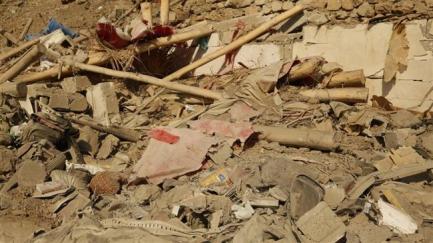
On August 1, at least nine civilians lost their lives and 15 others sustained injuries, when Turkish military aircraft struck Zergele village.
“Two people initially lost their lives in the airstrikes. Turkish jets later bombed the villagers that had gone to the scene, leaving seven more people dead. Turkey is targeting Kurds. All the people living here, and all those killed in the strikes, were civilians and villagers,” Suleyman Nebi Boki, a Zergele resident, said.
Another villager, Feqi Muhammed, said, “There were six houses in this area, and all of them have been destroyed. The people targeted are innocent civilians. The Turkish government is targeting Kurdish villagers in place of PKK fighters.”
Meanwhile, Turkish military has denied allegations that the country’s jets bombarded civilians in Zergele.
On August 6, Selahattin Demirtas, the HDP’s co-chair, called on the international community to censure Ankara’s new “unjust war” on Kurds, accusing the government of President Recep Tayyip Erdogan of using the so-called anti-ISIL fight as a cover to pursue its main goal of targeting the PKK and undermining the HDP.
Turkey recently launched airstrikes against purported ISIL targets in Syria as well as PKK positions in Iraq, after a deadly bomb attack attributed to ISIL Takfiris left 32 people dead in the southeastern Turkish town of Suruc, across the border from the northern Syrian town of Kobani.
A shaky ceasefire that had stood since 2013 was declared as null by PKK following the Turkish airstrikes against the group, narrowing chances of the two sides reaching a deal in the near future.
The PKK had been fighting for an autonomous Kurdish region inside Turkey since the 1980s. The conflict has left tens of thousands of people dead.
In light of the fact that Israel is in possession of at least 200 (surreptitiously-built) nuclear warheads, and considering the reality that, according to both US and Israeli intelligence sources, Iran neither possesses nor pursues nuclear weapons, the relentless hysterical campaign by Israel and its lobby against the Iran nuclear deal can safely be characterized as the mother of all ironies—a clear case of chutzpah.
As I pointed out in a recent essay on the nuclear agreement, the deal effectively establishes US control (through IAEA) over the entire production chain of Iran’s nuclear and related industries. Or, as President Obama put it (on the day of the conclusion of the agreement), “Inspectors will have access to Iran’s entire nuclear supply chain—its uranium mines and mills, its conversion facility and its centrifuge manufacturing and storage facilities. . . . Some of these transparency measures will be in place for 25 years. Because of this deal inspectors will also be able to access any suspicious location.”
Even a cursory reading of the text of the agreement shows that, if ratified by the US congress, the deal would essentially freeze Iran’s nuclear program at a negligible, ineffectual level of value—at only 3.67% uranium enrichment. Israel and its lobby must certainly be aware of this, of the fact that Iran poses no “existential threat to Israel,” as frequently claimed by Benjamin Netanyahu and his co-thinkers.
So, the question is: why all the screaming and breast beating?
There is a widespread perception that because the nuclear agreement was reached despite the lobby’s vehement opposition, it must therefore signify a win for Iran, or a loss for Israel and its allies. This is a sheer misjudgment of what the deal represents: it signifies a win not for Iran but for Israel and its allies. And here is why: under the deal Iran is obligated to (a) downgrade its uranium enrichment capabilities from 20% of purity to 3.67%, (b) freeze this minimal level of 3.67% enrichment for 15 years, (c) reduce its current capacity of 19000 centrifuges to 6104 (a reduction of 68%), (d) reduce its stockpile of low grade enriched uranium from the current level of 7500 kg to 300kg (a reduction of 96%), and (e) accept strict limits on its research and development activities. While some restrictions on research and development are promised to be relaxed after 10 years, others will remain for up to 25 years.
In addition, Iran would have to accept an extensive monitoring and inspection regime not only of declared nuclear sites but also of military and other non-declared sites where the monitors may presume or imagine incidences of “suspicious” activity. The elaborate system of monitoring and inspection was succinctly described by President Obama on the day of the conclusion of the agreement in Vienna (July 14, 2015): “Put simply, the organization responsible for the inspections, the IAEA, will have access where necessary, when necessary. That arrangement is permanent.”
These are obviously major concessions that not only render Iran’s hard-won (but peaceful) nuclear technology ineffectual, but also weaken its defense capabilities and undermine its national sovereignty.
So, the lobby’s frantic objection to the nuclear agreement cannot be because the deal represents a win for Iran, or a loss for Israel. Quite to the contrary the agreement signifies a historic success for Israel as it tends to remove, or drastically undermine, a major challenge to its expansionist schemes in the Middle East—the challenge of independent, revolutionary Iran that consistently opposed such colonial schemes of expansion and occupation.
Thus, the reasons for the lobby’s panicky, or more likely feigned, protestations must be sought elsewhere. Two major reasons can be identified for the lobby’s vehement opposition to the nuclear deal.
The first is to keep pressure on negotiators in pursuit further concessions from Iran. Indeed, the lobby has been very successful in quest of this objective. A look back at the process of negotiations indicates that, under pressure, Iran’s negotiators have continuously made additional concessions over the course of the 20-month long negotiations. For example, when negotiations began in Geneva in November 2013, discussion of Iran’s defense industries or inspection of its military sites were considered off the limits of negotiations. Whereas in the final agreement, reached 20 months later in Vienna, Iran’s negotiators have regrettably agreed to such highly intrusive, once-taboo measures of national sovereignty.
The lobby is of course aware of the fact that the 159-page long nuclear deal is fraught with ambiguities and loopholes, which leaves plenty of room for haggling and maneuvering over the many contestable aspects of the deal during its 25-year long implementation period. This means that, even if ratified by the US congress, the deal does not mean the end of negotiations but their continuation for a long time to come.
The shrill, obstructionist voices of the lobby’s operatives are, therefore, designed to continue the pressure on Iran during the long period of implementation in order to extract additional concessions beyond the agreement.
The second reason for the lobby’s relentless campaign to sabotage the nuclear agreement is that, while the agreement obviously represents a fantastic victory for Israel, it nonetheless falls short of what the lobby projected and fought for, that is, devastating regime change by military means, similar to what was done to Iraq and Libya.
This is no conspiracy theory or idle speculation. There is well-documented, undeniable evidence that the lobby, as a major pillar of the neoconservative forces in the US and elsewhere, set out as early as the late 1980s and early as 1990s to “deconstruct” and reshape the Middle East in the image of radical Zionist champions of building “greater Israel” in the region, extending from Jordan River to Mediterranean coasts.
Indeed, radical Zionists’ plans to balkanize and re-mold the Middle East are as old as the state of Israel itself. Those plans were actually among the essential designs of Israel’s founding fathers to build a Jewish state in Palestine. David Ben Gurien, one of the Key founders of the state of Israel, for example, stated unabashedly that land grabbing, expulsion of non-Jewish natives from their land/homes and territorial expansion is best achieved through launching wars of choice and creating social chaos, which he called “revolutionary” times or circumstances. “What is inconceivable in normal times is possible in revolutionary times; and if at this time the opportunity is missed and what is possible in such great hours is not carried out—a whole world is lost” [1].
While the plans to foment war and create social convulsion in pursuit of “greater Israel” thus began with the very creation of the state of Israel, systematic implementation of such plans, and the concomitant agenda of changing “unfriendly” regimes in the region, began in earnest in the early 1990s—that is, in the immediate aftermath of the collapse of the Soviet Union.
As long as the Soviet Union existed as a balancing superpower vis-à-vis the United States, US policy makers in the Middle East were somewhat constrained in their accommodations of territorial ambitions of hardline Zionism. That restraint was largely due to the fact that at the time the regimes that ruled Iraq, Syria and Libya were allies of the Soviet Union. That alliance, and indeed the broader counter-balancing power of Soviet bloc countries, served as a leash on the expansionist designs of Israel and the US accommodations of those designs. The demise of the Soviet Union removed that countervailing force.
The demise of the Soviet Union also served as a boon for Israel for yet another reason: it created an opportunity for a closer alliance between Israel and the militaristic faction of the US ruling elites—elites whose interests are vested largely in the military-industrial-security-intelligence complex, that is, in military capital, or war dividends.
Since the rationale for the large and growing military apparatus during the Cold War years was the “threat of communism,” US citizens celebrated the collapse of the Berlin Wall as the end of militarism and the dawn of “peace dividends.”
But while the majority of the US citizens celebrated the prospects of what appeared to be imminent “peace dividends,” the powerful interests vested in the expansion of military-industrial-security-intelligence spending felt threatened. Not surprisingly, these influential forces moved swiftly to safeguard their interests in the face of the “threat of peace.”
To stifle the voices that demanded peace dividends, beneficiaries of war and militarism began to methodically redefine the post-Cold War “sources of threat” in the broader framework of the new multi-polar world, which purportedly goes way beyond the traditional “Soviet threat” of the bipolar world of the Cold War era. Instead of the “communist threat” of the Soviet era, the “menace” of “rogue states,” of radical Islam and of “global terrorism” would have to do as new enemies.
Just as the beneficiaries of war dividends view international peace and stability inimical to their interests, so too the militant Zionist proponents of “greater Israel” perceive peace between Israel and its Palestinian/Arab neighbors perilous to their goal of gaining control over the “promised land.” The reason for this fear of peace is that, according to a number of the United Nations’ resolutions, peace would mean Israel’s return to its pre-1967 borders. But because proponents of “greater Israel” are unwilling to withdraw from the occupied territories, they are therefore afraid of peace—hence, their continued attempts at sabotaging peace efforts and/or negotiations.
Because the interests of the beneficiaries of war dividends and those of radical Zionism tend to converge over fomenting war and political convulsion in the Middle East, an ominously potent alliance has been forged between them—ominous, because the mighty US war machine is now supplemented by the almost unrivaled public relations capabilities of the hardline pro-Israel lobby in the United States.
The alliance between these two militaristic forces is largely unofficial and de facto; it is subtly forged through an elaborate network of powerful neoconservative think tanks such as The American Enterprise Institute, Project for the New American Century, America Israel Public Affairs Committee, Middle East Media Research Institute, Washington Institute for Near East Policy, Middle East Forum, National Institute for Public Policy, Jewish Institute for National Security Affairs, and Center for Security Policy.
In the immediate aftermath of the Cold War, these militaristic think tanks and their hawkish neoconservative operatives published a number of policy papers that clearly and forcefully advocated plans for border change, demographic change and regime change in the Middle East. Although the plan to change “unfriendly” regimes and balkanize the region was to begin with the removal of Saddam Hussein’s regime, as the “weakest link,” the ultimate goal was (and still is) regime change in Iran.
For example, in 1996 an influential Israeli think tank, the Institute for Advanced Strategic and Political Studies, sponsored and published a policy document, titled “A Clean Break: A New Strategy for Securing the Realm,” which argued that the government of Prime Minister Benjamin Netanyahu should “make a clean break” with the Oslo peace process and reassert Israel’s claim to the West Bank and Gaza. It presented a plan whereby Israel would “shape its strategic environment,” beginning with the removal of Saddam Hussein and the installation of a Hashemite monarchy in Baghdad, to serve as a first step toward eliminating the anti-Israeli governments of Syria and Iran.
The influential Jewish Institute for the National Security Affairs (JINSA) also occasionally issued statements and policy papers that strongly advocated “regime changes” in the Middle East. One of its hardline advisors Michael Ladeen, who also unofficially advised the George W. Bush administration on Middle Eastern issues, openly talked about the coming era of “total war,” indicating that the United States should expand its policy of “regime change” in Iraq to other countries in the region such as Iran and Syria. “In its fervent support for the hardline, pro-settlement, anti-Palestinian Likud-style policies in Israel, JINSA has essentially recommended that ‘regime change’ in Iraq should be just the beginning of a cascade of toppling dominoes in the Middle East [2].
It follows from this brief sketch of the lobby’s long-standing plans of regime change in Iran that, as mentioned earlier, its opposition to the nuclear deal is not because the deal does not represent a win for Israel, or a loss for Iran, but because Iran’s loss is not as big as the lobby would have liked it to be, that is, a devastating regime change through bombing and military aggression, as was done in Iraq or Libya.
What the lobby seems to overlook, or more likely, is unwilling to acknowledge or accept, is that regime change in Iran is currently taking place from within, and the nuclear deal is playing a major role in that change. The lobby also seems to overlook or deny the fact that the Obama administration opted for regime change from within—first through the so-called “green revolution” and now through nuclear deal—because various US-Israeli led attempts at regime change from without failed. Indeed, such futile attempts at regime change prompted Iran to methodically build robust defense capabilities and geopolitical alliances, thereby establishing a military and geopolitical counterweight to US-Israeli plans in the region.
Furthermore, The Obama administration’s plan of “peaceful” regime change seems to be more like an experimental or tactical change of approach to Iran than a genuine commitment to peace, as it does not rule out the military option in the future. If Iran carries out all its 25-year long obligations under the deal, regime change from within would be complete and military option unnecessary—in essence, it would be a gradual, systematic retrogression to the days of the Shah. But if at any time in the long course of the implementation of the deal Iran resists or fails to carry out some of the highly draconian of those obligations, the US and its allies would again resort to military muscle, and more confidently too because success chances of military operations at that time would be much higher, since Iran would have by then greatly downgraded its military/defense capabilities.
References
[1] Quoted in Norman Finkelstein, Image and Reality of the Israel-Palestine Conflict, Introduction to German edition (10 July 2002).
[2] William D. Hartung, How Much Are You Making on the War, Daddy? New York: Nation Books
Tony Blair should stand trial for war crimes if the Chilcot Inquiry rules the former prime minister broke international law by invading Iraq in 2003, Labour leadership candidate Jeremy Corbyn has said.
The surprise frontrunner in the contest said he was convinced the war was “illegal.”
Speaking on BBC Newsnight, the MP for Islington North said Blair should stand trial “if he has committed a war crime, yes. Everybody who has committed a war crime should be.”
He added the former Labour prime minister, who orchestrated the invasion with then-US President George W. Bush, should “confess” to any plans he made with the former president. The publication of the Chilcot inquiry would force Blair’s hand, he said.
Corbyn, who staunchly opposed the invasion and is a leading member of the Stop the War coalition said, “It was an illegal war. I am confident about that. Indeed Kofi Annan [UN secretary general at the time of the war] confirmed it was an illegal war and therefore [Tony Blair] has to explain to that. Is he going to be tried for it? I don’t know. Could he be tried for it? Possibly.
“The Chilcot report is going to come out sometime,” he said.
“I hope it comes out soon. I think there are some decisions Tony Blair has got to confess or tell us what actually happened. What happened in Crawford, Texas, in 2002 in his private meetings with George [W.] Bush.”
“Why has the Chilcot report still not come out? Because apparently there is still debate about the release of information on one side or the other of the Atlantic. At that point Tony Blair and the others that have made the decisions are then going to have to deal with the consequences of it,” he added.
Corbyn further asserted his opposition to British airstrikes against Islamic State (IS, formerly ISIS/ISIL) militants in Syria and Iraq.
“I would want to isolate ISIS. I don’t think going on a bombing campaign in Syria is going to bring about their defeat. I think it would make them stronger. I am not a supporter of military intervention. I am a supporter of isolating ISIS and bringing about a coalition of the region against them.”
His comments come as Prime Minister David Cameron calls on Sir John Chilcot to name the date his report will be published. The inquiry began in 2009 and concluded its evidence gathering phase in 2011. Its long delay has led to fears of an establishment whitewash.
Cameron is expected to tell the chairman he wants to see “a timetable” of publication, and that he is keen to see the results as soon as possible.
“I cannot make it go faster because it’s a public inquiry and it’s independent, but I do want a timetable and I think we deserve one pretty soon,” Cameron will tell Chilcot.
The bombing campaign against the Islamic State in Iraq and Syria has killed at least 459 civilians, including 100 children, in 52 air strikes, according to a new report by Airwars, a project by a group of independent journalists.
Commenting on the supposed precision of air strikes against Isis, the Airwars project leader Chris Woods has told the Guardian that this “hasn’t been borne out by facts on the ground”.
This is one of the first reports examining the number of civilian casualties which have resulted from the savage bombing campaign against Isis militants. The lack of official interest in and support for investigating these casualties means that their number may actually be far higher. The violence on the ground also greatly impedes the verification of casualties.
It took years before the full scale of mass murder in the Second Iraq War came to light. A recent study by Physicians for Social Responsibility, Physicians for Global Survival and International Physicians for the Prevention of Nuclear War has established that around a million people have died as a result of that war.
Chris Woods from Airwars has stated that bombing Isis fighters in their strongholds means that the focus is on bombing cities. 40% of civilian casualty reports came from the city of Mosul in Iraq. “You can’t have an air war of this intensity without civilians getting killed or injured,” said Woods.
Western intervention in Iraq and Syria is adding fuel on the fire of a savage war. As the experience of more than a decade of terroristic “war on terror” shows us, Western intervention contributes to a vicious cycle of brutalising violence. It increases suffering and is a major cause of bitterness against the West.
This underscores the need to oppose resolutely the proposed full-scale UK military intervention in Syria, which will lead to more of the same: more misery, more hatred, more death and more destruction. Humanity can be more creative than that.
Over 400 civilians have been killed in in the first year of US-led anti-ISIS airstrikes, including 58 non-combatants who were being held in an Islamic State prison for offenses such as buying cigarettes, a major study claims.
The study was carried out by the Air Wars transparency group and written by former BBC Panorama and Newsnight journalist Chris Woods.
The study cites 57 incidents where there is publicly available evidence of civilian deaths by coalition military action.
“Despite claims by the US-led coalition that its airstrikes in Iraq and Syria are ‘the most precise and disciplined in the history of aerial warfare,’ there are clear indications from the field that many hundreds of non-combatants have been killed,” Woods writes in the report’s key findings.
According to Air Wars, the largest single death toll was that of 58 non-combatants on December 28, 2014, in Al Bab, Syria, when an airstrike hit an Islamic State headquarters which doubled as a prison.
Among the dead at Al Bab are believed to be four women and a number of teenagers, with some of those killed thought to have been imprisoned for buying cigarettes.
In another incident in February 2015, Ibrahim al-Mussul, a farmer in his sixties, and his two daughters were allegedly killed in an airstrike near the town of Shadadi, Syria, close to an oilfield targeted by the coalition.
“Their bodies were shredded. We found Ibrahim’s hand next to the house, and we were still collecting bits of flesh and body parts into the early hours of the following morning,” an eyewitness said.
Writing on the challenges of collating casualty numbers, Air War’s Syria researcher Kinda Haddad explained in one section of the report: “Civilians are dying in unacceptable numbers as a result of military action by so many different actors in both Syria and Iraq.
“It’s not just the coalition, but also government troops; a large number of different opposition forces; Shia’a and Kurdish militias; and of course Islamic State or Daesh.”
The study also notes that the UK Ministry of Defence, in particular, amends and changes its reporting of incidents, making it difficult to assess what is happening on the ground.
“The Ministry of Defence has on occasion significantly amended or even removed earlier copy, making the process of accurately tracking some reports difficult,” the study found. “The UK also does not report on airstrikes in Syria carried out by British air crews embedded with allied forces.”
“The coalition has often spoken of the power of Daesh propaganda as a weapon, and how it must be countered. Yet at the same time, the coalition’s near-total denial of having caused civilian casualties continues to damage its own credibility,” the report claims.
Air Wars said the proper reporting and investigation of civilian deaths by coalition action should be undertaken and that such an initiative would make strategic sense.
“Conducting prompt and effective investigations into all credible claims of civilian casualties – and publishing those findings – would go some way towards countering such militant propaganda, while addressing the very real concerns of Iraqi and Syrian civilians on the ground,” they said.
The drug-induced nipple secretions of trans women are as good as mothers’ breast milk for babies, the University of Sussex Hospitals NHS Trust claimed in a letter to campaigners made public in a report by British think tank the Policy Exchange on Sunday.
The healthcare trust’s medical director, Rachel James, argued that the off-label prescription drug cocktail men transitioning to female take in order to produce milk was “similar to the natural hormones which encourage lactation to develop when the baby is newly born.”
“The evidence which is available demonstrates that the milk is comparable to that produced following the birth of a baby,” James wrote in the letter, sent to Children of Transitioners last August.
Biological men who wish to lactate must first take hormones to grow milk glands and then take high doses of either domperidone or metoclopramide to stimulate milk production. Neither drug is approved for this use, though they are occasionally prescribed off-label to biological women who have trouble lactating.
However, domperidone’s own manufacturer, Janssen, warns patients the drug “may cause unwanted side effects affecting the heart in a breastfed baby” and “should be used during breastfeeding only if your physician considers this clearly necessary.” … continue
This site is provided as a research and reference tool. Although we make every reasonable effort to ensure that the information and data provided at this site are useful, accurate, and current, we cannot guarantee that the information and data provided here will be error-free. By using this site, you assume all responsibility for and risk arising from your use of and reliance upon the contents of this site.
This site and the information available through it do not, and are not intended to constitute legal advice. Should you require legal advice, you should consult your own attorney.
Nothing within this site or linked to by this site constitutes investment advice or medical advice.
Materials accessible from or added to this site by third parties, such as comments posted, are strictly the responsibility of the third party who added such materials or made them accessible and we neither endorse nor undertake to control, monitor, edit or assume responsibility for any such third-party material.
The posting of stories, commentaries, reports, documents and links (embedded or otherwise) on this site does not in any way, shape or form, implied or otherwise, necessarily express or suggest endorsement or support of any of such posted material or parts therein.
The word “alleged” is deemed to occur before the word “fraud.” Since the rule of law still applies. To peasants, at least.
Fair Use
This site contains copyrighted material the use of which has not always been specifically authorized by the copyright owner. We are making such material available in our efforts to advance understanding of environmental, political, human rights, economic, democracy, scientific, and social justice issues, etc. We believe this constitutes a ‘fair use’ of any such copyrighted material as provided for in section 107 of the US Copyright Law. In accordance with Title 17 U.S.C. Section 107, the material on this site is distributed without profit to those who have expressed a prior interest in receiving the included information for research and educational purposes. For more info go to: http://www.law.cornell.edu/uscode/17/107.shtml. If you wish to use copyrighted material from this site for purposes of your own that go beyond ‘fair use’, you must obtain permission from the copyright owner.
DMCA Contact
This is information for anyone that wishes to challenge our “fair use” of copyrighted material.
If you are a legal copyright holder or a designated agent for such and you believe that content residing on or accessible through our website infringes a copyright and falls outside the boundaries of “Fair Use”, please send a notice of infringement by contacting atheonews@gmail.com.
We will respond and take necessary action immediately.
If notice is given of an alleged copyright violation we will act expeditiously to remove or disable access to the material(s) in question.
All 3rd party material posted on this website is copyright the respective owners / authors. Aletho News makes no claim of copyright on such material.



 Aletho News
 Aletho News