Revealed: The CIA report used as pretext for Iraq invasion
RT | March 20, 2015
The document summarizing the CIA’s purported knowledge of Iraqi chemical, biological and nuclear weapons programs, produced in October 2002 and hidden from the public ever since, has finally been made public.
The CIA had previously released a heavily redacted version of the controversial National Intelligence Estimate (NIE) in 2004. Last year, transparency advocate John Greenwald made another FOIA request and received a declassified version of the document, which Vice News published this Thursday.
RAND Corporation, a government-connected think tank, also had access to the NIE. In a report published in December 2014, RAND analysts noted that the original CIA assessment contained many qualifiers about virtually everything, but as the document went up the chain of command, “the conclusions were treated increasingly definitely.”
Thus, even though the CIA offered guesses based on rumors from Iraqi exiles and unverifiable sources, Bush administration officials claimed with absolute certainty that Iraq was producing chemical and biological agents, and acquiring components for nuclear weapons.
Likewise, the Bush administration asserted a connection between Al-Qaeda and the government in Baghdad even though the CIA report noted that its information was based on “sources of varying reliability,” and that even if the relationship had existed, there was no indication Iraqi leader Saddam Hussein knew about it.
“As with much of the information on the overall relationship, details on training and support are second-hand,” the document, quoted by Vice News, said. “The presence of [Al-Qaeda]… militants in Iraq poses many questions. We do not know to what extent Baghdad may be actively complicit in this use of its territory for safehaven and transit.”
The NIE reveals much of the intelligence concerning allegations that Iraq gave Al-Qaeda instructions on using chemical and biological weapons came from interrogations of alleged terrorists, often under torture.
Last year’s Senate investigation into the CIA torture program revealed that the dubious charges all came from a single source, which the NIE names as Ibn al-Shaykh al-Libi (“The Libyan”). Al-Libi commanded the Khaldan training camp in Afghanistan, shut down by the Taliban before 9/11 because he refused to subordinate to Osama bin Laden. Who exactly tortured the information out of him remains redacted, but the Senate report noted that Al-Libi recanted his testimony after being turned over to the CIA in February 2003, saying he only told his torturers what they wanted to hear.
Paul Pillar, the former CIA analyst in charge of coordinating the assessment on Iraq and now a visiting professor at Georgetown University, told Vice News that the claims of alleged Iraqi biological weapons – such as the anthrax-laced envelopes sent to Senators Tom Daschle and Patrick Leahy a week after 9/11 – were based on such sources as Ahmad Chalabi, of the US-backed Iraqi National Congress.
“There was an insufficient critical skepticism about some of the source material,” Pillar said. “I think there should have been agnosticism expressed in the main judgments. It would have been a better paper if it were more carefully drafted in that sort of direction.”
Tunisia museum attack: Who’s behind it, what are their goals?
RT | March 19, 2015
Groups like IS, which could be behind the Bardo Museum shootings, have a long history of collaborating with the West and may have attacked tourists just to maintain their anti-Western façade, says independent political analyst Dan Glazebrook.
RT: Do you think that the Western tourists were targeted on purpose?
Dan Glazebrook: Yeah, I think so. The thing is with ISIS and these groups – they have a long history of collaborating with the West. It’s fundamental to their appeal that they kind of try to present themselves as anti-Western. If you look over the last several years, they’ve been singing from the same song-sheet – whether it’s on Libya, the fight against Gaddafi; Syria, the fight against Assad. We’ve had revelations about fighters’ passage to Syria to go and fight against Assad being facilitated by MI5, by British intelligence. This all came out in the hearings in Mozambique last year. So these guys are on the same page, they are helping to fulfill the West strategic aims of destabilization in the area. … The thousands and thousands people they’ve killed, the vast majority of them have been other Muslims and non-white people. From time to time they have to kill some Europeans and some Westerners in order to maintain this façade of somehow being opposed to the West, whilst they continue to carry out and facilitate the West’s strategic aims.
RT: A large number of Islamic State fighters reportedly come from Tunisia. Why is that?
DG: It was estimated at one point that the actual majority of foreign fighters in Syria were of Tunisian origin, over 3,000… They’ve also fought in Libya; they’ve fought in terrorist campaigns in Algeria. There are many different reasons; part of it is a kind of extremist backlash against the extremist secularism of the previous President [Zine El Abidine] Ben Ali and his predecessor [Habib Bourguiba]. But I think a lot of it is just simply to do with the economics and finances. There is very high unemployment in Tunisia. It is rumored that you can get up to $27,000 a year for going to fight for ISIS… Billions of dollars were put into these sectarian militias to build up these groups by Saudi Arabia and the USA as a bulwark against the resistance axis of Syria, Iran, and Hezbollah. These billions of dollars are still slushing around.
‘Attack might be publicizing Ansar al-Sharia’s merger with ISIS’
Brian Levin, director of the Center for the Study of Hate and Extremism, also commented on the Tunis museum attack.
RT: No one has claimed responsibility for the attack yet. Who in your view is most likely to be behind it?
Brian Levin: The most likely would probably be Ansar al-Sharia which is a radical Salafist terrorist group which started in Tunisia shortly after the Tunisian revolution in January, 2011. It was formed three months later by a fellow named Abu Ayadh. That is the most likely suspect, although, ISIS affiliates are present in neighboring Libya as well.
RT: Do you think the attackers were pursuing any particular goal with this terrible assault?
BL: Yes, I would think that if it is Ansar al-Sharia or if Ansar al-Sharia is using this to publicize some kind of merger with ISIS – this would be the time and the place to do it. Tunisia, as I said, in an area where ISIS has been exporting its brand of radicalism. That is one thing – Tunisia is Western friendly and it has got a strong economy.
RT: Earlier, a warning for tourists had been issued calling on them not to visit certain areas. Is this kind of attack in Tunisia a rare event and just how dangerous is the country for travelers?
BL: There have been advisories put out about travel to Tunisia. Its biggest industries are in fact tourism and minerals. It is a democratic society and it is Western friendly. Its economy is strong [but] it relies on these exports and tourism. And an attack like this could really hurt the economy in a place where there is fragility with respect to the economic situation. Remember again, Tunisia was the success story of the Arab Spring. This is the time and the place where groups like ISIS and Ansar al-Sharia are trying to make radicalism an imprint there and in the neighboring countries as well.
RT: The EU foreign policy chief Federica Mogherini has said that IS was behind the attack. Do you believe that that is likely?
BL: It could be in a sense to the extent that these actors had the same goal… Ansar Al-Sharia is allying itself with the al-Qaeda affiliates in North Africa. The fact of the matter is it very well could be ISIS. ISIS does have an imprint in North Africa. One of the things that ISIS had wanted to do even when it was just AQI [al-Qaeda in Iraq] back in 2004, they wanted to export their terrorism to places like Jordan, and now has an imprint in places like Libya which neighbors Tunisia.
Read more 17 tourists, 2 locals slain in Tunis museum attack
UK-Iraq abuse inquiry refuses to consider CIA torture report
Reprieve | March 19, 2015
The body tasked with investigating British abuses in Iraq has said it will not request as evidence the US Senate’s report on CIA torture, in the case of two Pakistani men tortured and rendered by the UK and the US.
Yunus Rahmatullah and Amanatullah Ali were captured and tortured by British operatives in Iraq in 2004, before being rendered to the US-run Bagram prison in Afghanistan. They were held incommunicado for a further decade before their release to Pakistan in 2014.
The Iraq Historic Allegations Team (IHAT), which is investigating the men’s allegations, has refused a request from human rights organization Reprieve that it obtain a full copy of the US Senate’s report on CIA torture. Mr Rahmatullah and Mr Ali were rendered on a CIA flight, and it is believed that the full report would contain evidence of the two men’s physical condition after UK troops handed them over to US forces, as well as the timing of their rendition; information that could corroborate the men’s claims.
IHAT has claimed that its decision not to request a copy of the CIA report is a private ‘operational’ matter. Reprieve, which is assisting the two men, has initiated a challenge to that decision, amid concerns that the body is failing properly to investigate the men’s ordeal.
The controversial executive summary of the CIA torture report, published late last year, revealed wide-ranging torture and rendition activities by the US and its allies in the initial years of the ‘War on Terror’.
Kat Craig, legal director at Reprieve, which is assisting the two men, said: “Yunus Rahmatullah and Amanatullah Ali suffered a horrific, 10-year ordeal of torture and detention at the hands of the UK and US. These men deserve answers and justice – and the CIA torture report is a crucial piece of evidence in that effort. IHAT’s refusal to request a copy of that report is therefore inexplicable. Who should the victims of torture and rendition look to for accountability, if they are let down like this at every turn?”
Breaking the Resistance with Terrorism and Proxy Wars
By Eric Draitser | New Eastern Outlook | March 17, 2015
With the situation in the Middle East seemingly spinning out of control, many political observers are left wondering what it all means. The war in Syria has been at the forefront of the news since 2011, and rightly so, as Syria has become the epicenter of a larger regional conflict, particularly with the ascendance of ISIS in the last year.
Undoubtedly, the mainstream acceptance of the ISIS threat has changed the strategic calculus vis-à-vis Syria, as the US prepares to launch yet another open-ended war, ostensibly to defeat it. And, while many in the West are willing to buy the ISIS narrative and pretext for war, they do so with little understanding or recognition of the larger geopolitical contours of this conflict. Essentially, almost everyone ignores the fact that ISIS and Syria-Iraq is only one theater of conflict in the broader regional war being waged by the US-NATO-GCC-Israel axis. Also of vital importance is an understanding of the proxy war against Iran (and all Shia in the region), being fomented by the very same terror and finance networks that have spread the ISIS disease in Syria.
In attempting to unravel the complex web of relations between the terror groups operating throughout the region, important commonalities begin to emerge. Not only are many of these groups directly or tangentially related to each other, their shadowy connections to western intelligence bring into stark relief an intricate mosaic of terror that is part of a broader strategy of sectarianism designed to destroy the “Axis of Resistance” which unites Iran, Syria, and Hezbollah. In so doing, these terror groups and their patrons hope to internationalize the war in Syria, and its destructive consequences.
Terrorism as a Weapon in Syria and Iraq
In order to understand how these seemingly disparate groups fit into the regional destabilization, one must first recognize how they are connected both in terms of ideology and shared relationships. On the one hand you have the well known terror outfits operating in the Syria-Iraq theater of this conflict. These would include the ubiquitous ISIS, along with its Al Qaeda-affiliated ally Jabhat Al-Nusra.
However, often left out of the western narrative is the fact that the so called “moderate rebels,” such as the Al Farouq Brigade and other similar groups affiliated with the “Free Syrian Army,” are also linked through various associations with a number of jihadi organizations in Syria and beyond. These alleged “moderates” have been documented as having committed a number of egregious war crimes including mutilation of their victims, and cross-border indiscriminate shelling. And these are the same “moderates” that the Obama Administration spent the last three years touting as allies, as groups worthy of US weapons, to say nothing of the recent revelations of cooperation with US air power. But of course US cooperation with these extremist elements is only the tip of the iceberg.
A recent UN report further corroborated the allegations that Israeli military and/or Mossad is cooperating with, and likely helping to organize, the Jabhat al-Nusra organization in and around the Golan Heights. Such claims of course dovetail with the reports from Israeli media that militant extremists fighting the Syrian government have been treated in Israeli medical facilities. Naturally, these clandestine activities carried out by Israel should be combined with the overt attacks on Syria carried out by Tel Aviv, including recent airstrikes, which despite the inaction of the UN and international community, undeniably constitute a war crime.
Beyond the US and Israel however, other key regional actors have taken part in the destabilization and war on Syria. Turkey has provided safe haven for terrorists streaming into Syria to wage war against the legally recognized government of President Assad. In cooperation with the CIA and other agencies, Turkey has worked diligently to foment civil war in Syria in hopes of toppling the Assad government, thereby allowing Ankara to elevate itself to a regional hegemon, or so the thinking of Erdogan and Davutoglu goes. Likewise, Jordan has provided training facilities for terrorists under the guidance and tutelage of “instructors” from the US, UK, and France.
But why rehash all these well-documented aspects of the destabilization and war on Syria? Simple. In order to fully grasp the regional dimension and global implications of this conflict, one must place the Syria war in its broader geopolitical context, and understand it as one part of a broader war on the “Axis of Resistance.” For, while Hezbollah and certain Iranian elements have been involved in the fighting and logistical support in Syria, another insidious threat has emerged – a renewed terror war against Iran in its Sistan and Baluchestan province in the east.
Rekindling the Proxy War against Iran
As the world’s attention has been understandably fixed upon the horrors of Syria, Iraq, and Libya, a new theater in the regional conflict has come to the forefront – Iran; specifically, Iran’s eastern Sistan and Baluchestan province, long a hotbed of separatism and anti-Shia terror, where a variety of terror groups have operated with the covert, and often overt, backing of western and Israeli intelligence agencies.
Just in the last year, there have been numerous attacks on Iranian military and non-military targets in the Sistan and Baluchestan region, attacks carried out by a variety of groups. Perhaps the most well known instance occurred in March 2014 when five Iranian border guards were kidnapped – one was later executed – by Jaish al-Adl which, according to the Terrorism Research and Analysis Consortium is:
an extremist Salafi group that has since its foundation claimed responsibility for a series of operations against Iran’s domestic security forces and Revolutionary Guards operating in Sistan and Balochistan province, including the detonation of mines [link added] against Revolutionary Guards vehicles and convoys, kidnapping of Iranian border guards and attacks against military bases… Jaish al-Adl is also opposed to the Iranian Government’s active support of the Syrian President Bashar al-Assad, which they regard as an attack on Sunni muslims… Jaish ul-Adl executes cross border operations between the border of Iran and Pakistan and is based in the Baluchistan province in Pakistan.
It is important to note the centrality of Iran’s support for Syria and the Syrian Arab Army (and of course Hezbollah) in the ideological framework of a group like Jaish al-Adl. Essentially, this terror group sees their war against the Iranian government as an adjunct of the war against Assad and Syria – a new front in a larger war. Of course, the sectarian aspect should not be diminished as this group, like its many terrorist cousins, makes no distinction between political and religious/sectarian divisions. A war on Iran is a war on Shia, and both are just, both are legitimate.
Similarly, the last 18 months have seen the establishment of yet another terror group known as Ansar al-Furqan – a fusion of the Balochi Harakat Ansar and Pashto Hizb al-Furqan, both of which had been operating along Iran’s eastern border with Pakistan. According to the Terrorism Research and Analysis Consortium:
They characterize themselves as Mujahideen aginst [sic] the Shia government in Iran and are linked to Katibat al Asad Al ‘Ilamiya; Al-Farooq activists; al Nursra Front (JN), Nosrat Deen Allah, Jaysh Muhammad, Jaysh al ‘Adal; and though it was denied for some time, appears to have at least personal relationships with Jundallah… The stated mission of Ansar al Furqan is “to topple the Iranian regime…”
Like its terrorist cousin Jaish al-Adl, Ansar al-Furqan has claimed responsibility for a number of attacks against the Iranian Government, including a May 2014 IED attack on a freight train belonging to government forces. While such attacks may not make a major splash in terms of international attention, they undoubtedly send a message heard loud and clear in Tehran: these terrorists and their sponsors will stop at nothing to destroy the Islamic Republic of Iran.
Two inescapable facts immediately come to the fore when examining these groups. On the one hand, they are Sunni extremists whose ultimate goal is the destruction of the Iranian state and all vestiges of Shia dominance, political, military or otherwise. On the other hand, these groups see their war against Iran as part and parcel of the terror wars on Syria and Iraq.
And then of course there’s Jundallah, the notorious terror organization lead for decades by the Rigi family. Anyone with even cursory knowledge of the group is undoubtedly aware of its long-standing ties to both US and Israeli intelligence. As Foreign Policy magazine reported in 2012, Israeli Mossad and US CIA operatives essentially competed with one another for control of the Jundallah network for years. This information of course directly links these agencies with the covert war against Iran going back years, to say nothing of the now well-known role of Israeli intelligence in everything from assassinations of Iranian scientists to the use of cyberweapons such as Stuxnet and Flame. These and other attacks by Israel and the US against Iranian interests constitute a major part of the dirty war against Iran – a war in which terror groups figure prominently.
It should be noted that a number of other terror outfits have been used through the decades in the ongoing “low-intensity” war against Iran, including the infamous Mujahideen-e-Khalq, a terrorist group hailed as heroes by the US neocon establishment. Thanks to Wikileaks, it is also now documented fact that Israel has long since attempted to use Kurdish groups such as PJAK (Iraqi Kurdish terror group) to wage continued terror war against Iran for the purposes of destabilization of the government. Additionally, there was a decades-long campaign of Arab separatism in Iran’s western Khuzestan region spearheaded by British intelligence. As Dr. Kaveh Farrokh and Mahan Abedin wrote in 2005, “there is a mass of evidence that connects the British secret state to Arab separatism in Iran.”
These and other groups, too numerous to name here, represent a part of the voluminous history of subversion against Iran. But why now? What is the ultimate strategy behind these seemingly disparate geopolitical machinations?
Encircling the Resistance in Order to Break It
To see the obvious strategic gambit by the US-NATO-GCC-Israel axis, one need only look at a map of the major conflicts mentioned above. Syria has been infiltrated by countless terrorist groups that have waged a brutal war against the Syrian government and people. They have used Turkey in the North, Jordan in the South, and to a lesser degree Lebanon and, indirectly, Israel in the West. Working in tandem with the ISIS forces originating in Iraq, Syria has been squeezed from all sides in hopes that military defeat and/or the internal collapse of the Syrian government would be enough to destroy the country.
Naturally, this strategy has necessarily drawn Hezbollah into the war as it is allied with Syria and, for more practical reasons, cannot allow a defeated and broken Syria to come to fruition as Hezbollah would then be cut off from their allies in Iran. And so, Hezbollah and Syria have been forced to fight on no less than two fronts, fighting for the survival of the Resistance in the Levant.
Simultaneously, the regional power Iran has made itself into a central player in the war in Syria, recognizing correctly that the war could prove disastrous to its own security and regional ambitions. However, Tehran cannot simply put all its energy into supporting and defending Syria and Hezbollah as it faces its own terror threat in the East. The groups seeking to topple the Iranian government may not be able to compete militarily with the Iranian Revolutionary Guards, but they can certainly create enough destabilization through terrorism to make it more difficult for Tehran to effectively aid in the fight in Syria.
The US-NATO-GCC-Israel alliance has not needed to put its own boots on the ground to achieve its strategic objectives. Instead, it is relying on irregular warfare, proxy terror wars, and small-scale destabilizations to achieve by stealth what it cannot achieve with military might alone.
But it remains paramount for all those interested in peace to make these connections, to understand the broad outlines of this vast covert war taking place. To see a war in Syria in isolation is to misunderstand its very nature. To see ISIS alone as the problem is to completely misread the essence of the conflict. This is a battle for regional hegemony, and in order to attain it, the Empire is employing every tool in the imperial toolkit, with terrorism being one of the most effective.
Have Pillaged Iraqi Artifacts Ended Up in a Museum in Israel?

By Richard Edmondson | Fig Trees and Vineyards | March 12, 2015
With ISIS carrying out rampages through archaeologically sensitive areas of Iraq, a pertinent question to ask now is what group’s cultural heritage in the Middle East is being preserved, and whose is being destroyed.
Over the past couple of weeks shocking reports have surfaced concerning mass destruction of Iraq’s cultural heritage at two locations–the museum in Mosul and the ancient Assyrian city of Nimrud, located in northern Iraq. Both incidents were perpetrated by the so-called Islamic State. The one at the Mosul museum was recorded on video.
But destruction with sledge hammers, bonfires, and heavy equipment isn’t the only threat to priceless objects thousands of years old. Artifacts are also being illegally excavated and pilfered on a massive scale. An enormous black market in stolen antiquities in fact has arisen in the last four years since the outbreak of the conflict in Syria, and the general rule of thumb seems to be if it’s small enough to be carted off, take it and sell it on the black market; if it’s too large to move, then smash it to pieces. This is what we’ve seen repeatedly in Syria and Iraq since ISIS took over large swaths of both countries.
By the way, the trade in looted antiquities seems to be quite lucrative, with some of these items fetching in the hundreds of thousands of dollars, while the total black market trade has been estimated at roughly $7 billion per year.
This is not just Iraq’s cultural heritage that is at stake, of course; it’s all of humanity’s. If we think of human history collectively as a lepidopteron, drifting lazily from the flower of the Neolithic past, into the age of proto-writing, and finally early recorded history, then Syria, Iraq and the Fertile Crescent stand out perhaps unique among regions of the earth. This is where human civilization got started, and the looting and destruction of these antiquities is a loss to all of us.
Interestingly, an exhibition entitled “By the Rivers of Babylon” has now opened at a museum in Israel, and among its exhibits are a large number of ancient Babylonian cuneiform tablets–110 of them altogether. These tablets belong to a London-based Israeli collector by the name of David Sofer, but a controversy has sprung up, since there seems to be some question about the provenance, or origin, of the artifacts.
The tablets are said to be some 2,500 years old and reportedly shed light on the biblical Israelites during their exile in Babylon (in what is, of course, today Iraq). Sofer claims he purchased the tablets in the 1990s from a person who supposedly obtained them through public auction some 20 years previous. However, he reportedly has refused to name the person he bought them from.
The rise of ISIS has made it extremely perilous for archaeologists to continue to work in Iraq and Syria, and most expeditions have in fact come to a halt. But in Israel these days things are a bit different.
Unhindered by ISIS marauders, the Israeli Antiquities Authority has undertaken archaeological excavations in numerous areas of the country, including one begun last year in the occupied West Bank, where the objective is to recover artifacts dating back to the King David era. Finds of this nature would, by some views at any rate, help validate Israel’s “3000-year-old land claim,” as it’s been called, and thus you won’t be surprised to learn that this isn’t the only such archaeological dig going on–not by a long shot.
In fact, you can go to the website of the Israeli Antiquities Authority, where no less than 19 separate excavations are listed as currently active for the year 2015.
So what to make of it all? That’s a good question. All I can really say is that it seems enormous efforts are being expended to recover and safeguard Jewish cultural heritage–this, ironically, as everyone else’s cultural heritage in the Middle East is being looted and destroyed.
At any rate, here is an article recently published about the museum exhibition in Israel featuring the artifacts in Sofer’s possession.
Museum Embroiled in Looting Row
New Historian
A new exhibition in Jerusalem is causing heated debate.
The exhibition, ‘By The Rivers of Babylon’, at the Bible Lands Museum, displays some spectacular examples of ancient Babylonian tablets. On show for the first time, the 2,500-year-old clay tablets written in cuneiform present artefacts from an important time in the Middle East.
Experts note that the collection of 110 clay tablets provides the earliest written evidence of the Biblical exile of the Judeans in the area of modern-day Iraq. As such, the Babylonian tablets provide fresh insight into a formative period of early Judaism.
Filip Vukosavovic, a curator for the exhibition, says the tablets complete a 2,500-year puzzle. Many Judeans returned to Jerusalem after the Babylonians allowed them to in 539 BCE, but some remained in the area to build a Jewish community that lasted for two millennia.
“The descendants of those Jews only returned to Israel in the 1950s,” Vukosavovic said. As a result, the tablets provide a unique insight into a little known period of Jewish history.
Controversy has surrounded the exhibition however, as the tablets are the product of a modern, shadowy process. The recently chaotic climate in Iraq and Syria has led to the rampant theft of the area’s archaeological heritage. Widespread looting has led to the international antiquities markets being stocked with cuneiform tablets.
Many museums have promised not to exhibit artefacts that may have been looted, as part of an effort to discourage the illicit trade in antiquities. Cuneiform inscriptions, however, are a notable exception to this. Since 2004, cuneiform artefacts with no record of where or how they were unearthed have been allowed to be transported, in order to be examined by scholars. This is done on the condition that Iraqi authorities give their consent, and that the tablets are eventually returned to Iraq.
Some argue that these precious objects, some of which are the earliest examples of writing in the world, could be forever lost if they are not looked after by conservators.
“We are not interested in anything that is illegally acquired or sneaked out,” said Amanda Weiss, director of the Bible Lands Museum Jerusalem. “But it is the role of a museum to protect these pieces,” she added. “It’s what we are here for.”
It has been claimed that the Islamic State extremist group and other militants are part-funding their campaigns through the illegal trafficking of historic artefacts. Trafficking and looting have, however, been going on for a long time. Archaeologists were first alerted to the problem during the first Gulf War, when Western antiquities markets were flooded with cuneiform artefacts.
London-based collector David Sofer, who owns the cuneiform collection currently exhibited in the Bible Lands Museum, has denied his artefacts were trafficked. He said he had bought the tablets legally in the United States in the 1990s; and the tablets had previously been obtained from public auctions in the 1970s.
The exhibition at the Bible Lands Museum allows the public to see some remarkable artefacts and to learn more about an important part of Jewish history. What must not be overlooked, however, is the damage which can be caused by illicitly-obtained artefacts.
***
A little bit more on the Bible Lands Museum and Sofer’s collection of cuneiform tablets can be found here. The article focuses especially on a symposium entitled “Jerusalem in Babylonia” held at the museum in early February, asserting that the tablets provide “new insights into the social and economic life of the Judeans… in their own community of Al Yahudu (Jewtown) and their interrelationships with and assimilation to their West Semitic and Babylonian neighbors.”
Another article on the museum display is here and includes the following (emphasis added):
Sofer said a few tablets from the collection were displayed in a New York museum and a Los Angeles museum in 2013, and their import and export in the U.S. was properly reported to U.S. authorities. He would not name the two museums, or the person who sold them to him.
“These things would be lost, and wouldn’t be recognized for what they are” if he hadn’t bought them, Sofer said.
As common as cuneiform tablets are, few have been as celebrated as those on display in Jerusalem.
More on David Sofer (or someone from Israel going by the same name, at any rate) can be found here in an L.A. Times article from 1991. It seems he and a fellow Israeli, Nahum Vaskevitch, were implicated in insider trading in 1987. While the Sofer named in the article appears to have reached a settlement in his own case, Vaskevitch went on to be named in a 45-count indictment accusing him of conspiracy and violation of US insider trading laws from 1984-87.
A New York Times article on Sofer from 1987 includes a quote describing him as “a financial wizard, a genius manipulator with brilliant ideas in everything financial,” and reports that he made his fortune through the Jordan Exploration and Investment Company. The company engaged in oil development in the Sinai in the 1970s, yet the same article goes on to also mention investments in real estate in Israel, “including interests in such choice property as the Dizengoff Center shopping mall in Tel Aviv and the Ben Yehuda arcade in Jerusalem, as well as in hotels and other interests.”
Two additional articles, both from 2008–one here in YNet and the another here in Haaretz–describe a controversy which arose over a Sofer-owned property, a highly prized piece of Jerusalem real estate known as the Villa Salameh. The rightful owners of this property were a Palestinian Christian, Constantine Salameh, and his family, who completed construction on the villa in 1935.
But in 1948 the family left Israel and the property was seized by the new Israeli state under the so-called Absentee Property Law. The government of Belgium also entered the picture, leasing the property for its consulate in Jerusalem. But instead of paying rent to the Israelis, the Belgians made a decision apparently based upon conscience and sent their rent payments directly to the Salameh family, who by this time were living in Egypt.
However, in 1983 Sofer (or, again, someone by that name) acquired the property for a faction of its worth and sued the Belgian government for full payment of rent. The case was decided in an Israeli court. Fortunately the Salameh family had some political clout and was able to negotiate a settlement awarding them $700,000 as compensation for their lost property–a small fraction of its total value.
“The man (Salameh) sought to appeal his status as an absentee and a discussion began about his case,” said former Israeli Justice Minister Moshe Nissim. “We reached the conclusion that instead of being in a situation in which all the property would be registered in his name, it would be worth the state’s while to purchase Salameh’s vast property – which already then was worth millions of dollars – for a pittance.”
Quite an interesting story, to be sure, but what does it have to do with the theft of archaeological artifacts going on today? Maybe nothing. Maybe a lot.
There has of course been abundant evidence of Israeli support for terrorist rebels in Syria (see here, here, here, here, here, here, and here, for instance) and it has been noted that neither ISIS nor Al-Nusra have launched attacks against Israel, even though the latter, in particular, seems to be active in the Golan Heights very close to Israel’s border.
And not only do Israel and Al-Nusra not attack each other, but Israel has even transported wounded terrorists across the border for medical treatment in Israel.

Most people seem to be of the opinion that the Jewish state’s motivation in all this is its desire for regime change in Syria, but are there perhaps a few lesser-discussed fringe benefits as well?
Back in May of 2003, after the fall of Baghdad and the looting of Iraq’s national museum, a large trove of Jewish communal documents, Torah fragments as well as public records dating back several centuries, were discovered in a flooded basement and taken to the United States for restoration and safeguarding. Iraqis were given assurances that the collection would be returned to them at a later date.
Eventually the summer of 2014 was set as the target date for when the restored documents would be handed back over, but this got sidetracked in late 2013 when a campaign was launched to have the entire collection remain in the US… or possibly transferred to Israel.
It is, after all, Jewish heritage, so the argument went, and since there aren’t many Jews left in Iraq today, why on earth should the collection go back there?
Initially the position of US officials was that America would honor its commitment and return the collection to Iraq. But then in the summer of 2014, ISIS took over large parts of the country, including the city of Mosul, and in September it was announced that highlights of the archive, rather than going back to Iraq, would be taken on a tour of US cities.
The plot thickened further in January of 2015 when it was reported that one of the artifacts, a 200-year-old Torah scroll, had not actually been taken to the US at all, but rather instead had been deposited at the Israeli Embassy in Jordan–and from there it made its way into Israel.

Reportedly the scroll is now housed in a synagogue attached to the Israeli Foreign Ministry, and a ceremonial “Torah inauguration” is said to have been held on January 22.
By all accounts the text of the scroll had been copied onto a deer skin parchment using concentrated pomegranate juice as ink. Supposedly the use of deer skin was unusual, as most of the Torah scrolls at the time in question were comprised of cow parchment.
In any event, the disposition of the scroll, and its ending up in Israel, have prompted accusations of collaboration on the theft of Iraqi heritage by the US and Israel.
Meanwhile, the rest of the Iraqi Jewish archive purportedly remains in “safe hands” in the US.
Alas, the same cannot be said of Iraq’s, or humanity’s, “non-Jewish” heritage, as it were, the destruction of which continues at an alarming pace. The attacks upon the Mosul Museum and the ancient city of Nimrud, as well as the earlier ransacking and burning of documents at the Mosul library–these and other incidents like them exact a dreadful toll. They are, in essence, “taking us back to the dark ages,” as an Iraqi official recently described it.
And it doesn’t seem to be letting up.
Just within the past several days news has surfaced of destruction at two more sites, Khorsabad, located 12 miles northeast of Mosul, and Hatra, also in the general vicinity of Mosul though 68 miles to the southwest. Iraq’s Ministry of Tourism and Antiquities has confirmed reports of ISIS attacks at both sites, though the extent of the damage is unclear at this time.
Deliberate destruction of cultural heritage by belligerent parties in war is of course not unprecedented. But clearly it is now being carried by ISIS to levels heretofore unseen.
“They are killing the diversity of this region,” says Hélène Sader, an archaeologist at the American University of Beirut. “This is ethnic cleansing. You throw the people out, erase their history, and you can claim they were never there.”
Protection of cultural property is covered under several international treaties, including the 1954 Hague Convention, though many critics are now saying that the laws are not tough enough and need to be strengthened considerably.
With growing public outrage at the destruction now occurring in Iraq, chances are probably good we will see some toughening of international law on the matter. But the question is whether or not individual nations can muster the political will to adopt rigid enforcement of any new measures should they pass–and part of the problem in that regard seems to be complicity on the part of certain museums and auction houses, if not in the black market trade itself, at least insofar as knowingly accepting unprovenanced artifacts.
As long as someone is making a profit or benefiting in some way, and as long as the geopolitical interests of certain powerful nations are served by continuing the conflict in the Middle East, the looting and destruction are not likely to let up anytime soon.
Iraqi govt coalition party calls for probe into killing of 22 soldiers, blames US-led airstrikes
RT | March 13, 2015
Iraqi authorities are being urged to investigate the killing of 22 Iraqi soldiers in the western province of Anbar in what they claim was a US-led airstrike. The government coalition party, which urges the probe, says the findings should be made public.
The soldiers were killed on Wednesday when an airplane bombed the HQ of an army company near Ramadi, a city in central Iraq, about 110 kilometers west of Baghdad, an Iraqi military officer and a police source said, as cited by Reuters.
“The aviation of international coalition repeatedly carried out air strikes on the positions of the national militia forces and the armed forces, who are leading a fierce war against terrorists of ISIL [also formerly known ISIS, currently the Islamic State (IS)],” said a statement from Al-Moaten bloc, a member party in the government coalition.
No one has yet admitted responsibility for the deaths. Iraqi forces have blamed the killing of 22 soldiers on the US-led coalition. A military source told Reuters that a missile was launched from a foreign aircraft. However, coalition spokesman Lieutenant Colonel Thomas Gilleran said that the alliance fired the only strike in the province and it didn’t result in any “friendly casualties.”
US military officials also told Reuters on condition of anonymity that Iraqi security force planes were operating in targeted area and that US are discussing with Iraqi the reports of a friendly fire incident among Iraqi forces.
The head of the Anbar provincial council, Sabah Karhout, has suggested that the blast was caused by explosives planted in an underground tunnel beneath the military headquarters.
According to one of US officials, the strike was 33 kilometers from the site where Iraqi soldiers were killed.
In the meantime, Iraqi officials deny that their country forces were responsible for that friendly fire. “We don’t have any Iraqi war planes carrying out combat duties in Anbar,” an Iraqi military source said.
Kevork Almassian, an academic and political analyst focusing on the Middle East, told RT that he“ doesn’t buy the reports” that the attack in Anbar province was not carried out by the coalition or was carried out by mistake against the Iraqi forces.
“The equation for me is very clear in Iraq: the strong ISIS and other strong terrorist organizations have a price.”
American forces are working covertly to slow down the advances of the Iraqi forces in Tikrit and elsewhere against ISIS, Almassian said.
“If the Iraqi forces succeeded in crushing and eliminate these terrorist elements from that area, the Iraqi government will empower its position and the Iranians will empower their position in the Middle East,” he told RT.
Since the US-led offensive against the Islamic State began several months ago, Secretary of State John Kerry said that nearly 2,000 airstrikes have helped ground forces retake 700 square kilometers (270 square miles) of territory, kill 50 percent of IS commanders and choking off some of the group’s oil revenue.
According to US officials, approximately 6,000 Islamic State members in Iraq and Syria have died since the strikes began.
Human Rights Watch FAIL: Uses Photo of American Bombing Destruction To Condemn Assad
Activist Post | March 9, 2015
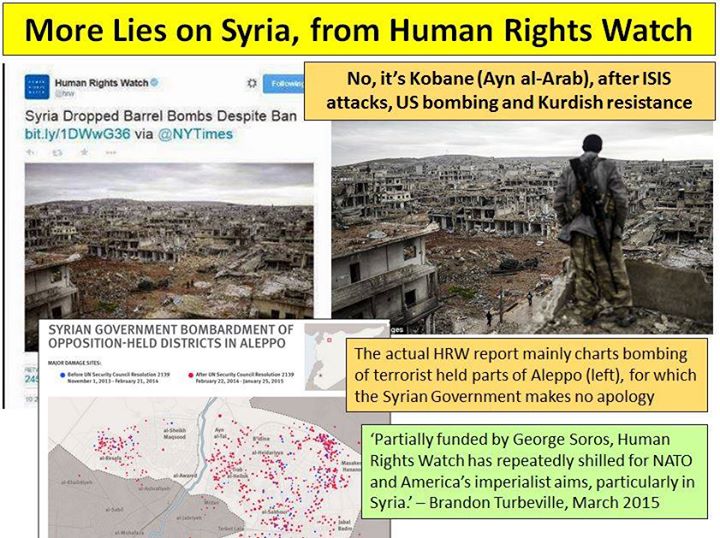
Putting its hypocritical and biased nature on full display once again, the alleged human rights organization, Human Rights Watch, was recently caught in an attempt to fabricate “evidence” of Assad’s use of barrel bombs in civilian areas for the purposes of further demonizing the secular Syrian government.
On February 25, HRW posted a photo of a devastated civilian area in Syria with the tagline “Syria dropped barrel bombs despite ban.” The “ban” HRW is referring to is the ban on bombing civilian areas that applies to both sides in Aleppo after the United Nations stepped in to save the Western-backed terrorists from annihilation. Assad’s forces had surrounded the city and had cut off a major supply route for the death squads from Turkey thus making the ultimate elimination of the jihadist forces a virtual inevitability.
As Somini Sengupta wrote for the New York Times on February 24,
Human Rights Watch said Tuesday that the Syrian government had dropped so-called barrel bombs on hundreds of sites in rebel-held towns and cities in the past year, flouting a United Nations Security Council measure.
In a report released Tuesday, the group said it relied on satellite images, photos, videos and witness statements to conclude that the Syrian government had bombarded at least 450 sites in and around the southern town of Daraa and at least 1,000 sites in Aleppo in the north.
The report focused on the period since Feb. 22, 2014, when the Security Council specifically condemned the use of barrel bombs, which are large containers filled with explosives and projectiles that can indiscriminately hurt civilians and are prohibited under international law.
There was only one problem with HRW’s tweet – the photograph the organization provided was not Aleppo.
In fact, the damage that had been wrought upon the civilian area in the photograph was not committed by the Syrian military but by the United States.
The photo was actually a picture of Kobane (Ayn al-Arab), the city which has been the site of heavy US aerial bombardment over the last several months as the US engages in its program of death squad herding and geographical reformation of sovereign Syrian and Iraqi territory.
But, while HRW was content to use the destruction of the city as a reason to condemn the Assad government and continue to promote the cause for US military action in Syria, the “human rights organization” was apparently much less interested in the exact same destruction wrought by US forces.
In other words, if Assad’s forces bomb a civilian area into the stone age, it is an atrocity, a war crime, and justification for international military involvement. If the United States bombs a civilian area into the stone age, it’s no biggie.
Partially funded by George Soros, Human Rights Watch has repeatedly shilled for NATO and America’s imperialist aims, particularly in Syria.
For instance, when Western media propaganda had reached a crescendo regarding the outright lie that Assad had used chemical weapons against his own people, HRW stood right beside Barack Obama and John Kerry in their effort to prove Assad’s guilt. HRW even went so far as to repeat the lie that the UN report suggested that Assad was the offending party, driving the final nail into the coffin of any credibility HRW may have had.
When a last-minute chemical weapons deal was secured by Russia in an effort to avoid yet another US/NATO invasion of Syria, HRW did not rejoice for the opportunity of peaceful destruction of chemical weapons and a chance to avoid war, it attacked the deal by claiming that it “failed to ensure justice.” Of course, the deal did fail to ensure justice. There were no provisions demanding punishment of the death squads who actually used the weapons or the US/NATO apparatus that initiated and controlled the jihadist invasion to begin with.
Regardless, when Mother Agnes Mariam of the Cross released her report that refuted what the US/NATO was asserting in regards to chemical weapons in Syria, HRW embarked upon a campaign of attack against her and her work.
Even as far back as 2009, however, HRW was showing its true colors when it apparently signed off on and supported renditions – the process of kidnapping individuals off the street without any due process and “rendering” them to jails and prisons in other countries where they are often tortured – in secret talks with the Obama administration.
If HRW ever had any credibility in terms of the question of actual human rights, then all of that credibility has assuredly been lost. HRW is nothing more than a pro-US, pro-NATO NGO that acts as a smokescreen for the continuation of the violation of human rights across the world – that is, unless those violations are committed by America’s enemies.
Washington and ISIS: The Evidence

By Tim Anderson | teleSUR | March 8, 2015
Reports that US and British aircraft carrying arms to the Islamic State group – better known as ISIS – have been shot down by Iraqi forces have been met with shock and denial in western countries. Few in the Middle East doubt that Washington is playing a ‘double game’ with its proxy armies in Syria, but some key myths remain important amongst the significantly more ignorant Western audiences.
A central myth is that Washington now arms ‘moderate Syrian rebels’, to both overthrow the Syrian Government and supposedly defeat the ‘extremist rebels’. This claim became more important in 2014, when the rationale of US aggression against Syria shifted from ‘humanitarian intervention’ to a renewal of Bush’s ‘war on terror’.
A distinct controversy is whether the al-Qaida-styled groups (especially Jabhat al-Nusra and ISIS) have been generated as a sort of organic reaction to the repeated US interventions, or whether they are actually paid agents of Washington.
Certainly, prominent ISIS leaders were held in US prisons. ISIS leader, Ibrahim al-Badri (aka Abu Bakr al-Baghdadi) is said to have been held for between one and two years at Camp Bucca in Iraq. In 2006, as al-Baghdadi and others were released, the Bush administration announced its plan for a ‘New Middle East’, a plan which would employ sectarian violence as part of a process of ‘creative destruction’ in the region.
According to Seymour Hersh’s 2007 article, ‘The Redirection’, the US would make use of ‘moderate Sunni states’, not least the Saudis, to ‘contain’ the Shia gains in Iraq brought about by the 2003 US invasion. These ‘moderate Sunni’ forces would carry out clandestine operations to weaken Iran and Hezbollah, key enemies of Israel. This brought the Saudis and Israel closer, as both fear Iran.
While there have been claims that the ISIS ‘caliph’ al-Baghdadi is a CIA or Mossad trained agent, these have not yet been well backed up. There are certainly grounds for suspicion, but independent evidence is important, in the context of a supposed US ‘war’ against ISIS. So what is the broader evidence on Washington’s covert links with ISIS?
Not least are the admissions by senior US officials that key allies support the extremist group. In September 2014 General Martin Dempsey, head of the US military, told a Congressional hearing ‘I know major Arab allies who fund [ISIS]’. Senator Lindsey Graham, of Armed Services Committee, responded with a justification, ‘They fund them because the Free Syrian Army couldn’t fight [Syrian President] Assad, they were trying to beat Assad’.
The next month, US Vice President Joe Biden went a step further, explaining that Turkey, Qatar, the UAE and Saudi Arabia ‘were so determined to take down Assad … they poured hundreds of millions of dollars and tens, thousands of tons of weapons into anyone who would fight against Assad … [including] al-Nusra and al- Qaida and extremist elements of jihadis coming from other parts of the world … [and then] this outfit called ISIL’. Biden’s admissions sought to exempt the US from this operation, as though Washington were innocent of sustained operations carried out by its key allies. That is simply not credible.
Washington’s relationship with the Saudis, as a divisive sectarian force in the region, in particular against Arab nationalism, goes back to the 1950s, when Winston Churchill introduced the Saudi King to President Eisenhower. At that time Washington wanted to set up the Saudi King as a rival to President Nasser of Egypt. More recently, British General Jonathan Shaw has acknowledged the contribution of Saudi Arabia’s extremist ideology: ‘This is a time bomb that, under the guise of education. Wahhabi Salafism is igniting under the world really. And it is funded by Saudi and Qatari money’, Shaw said.
Other evidence undermines western attempts to maintain a distinction between the ‘moderate rebels’, now openly armed and trained by the US, and the extremist groups Jabhat al-Nusra and ISIS. While there has indeed been some rivalry (emphasised by the London-based, Muslim Brotherhood-aligned, Syrian Observatory of Human Rights), the absence of real ideological difference is best shown by the cooperation and mergers of groups.
As ISIS came from Iraq in 2013, its Syrian bases have generally remained in the far eastern part of Syria. However Jabhat al-Nusra (the official al-Qaida branch in Syria, from which ISIS split) has collaborated with Syrian Islamist groups in western Syria for several years. The genocidal slogan of the Syrian Islamists, ‘Christians to Beirut and Alawis to the Grave’, reported many times in 2011 from the Farouk Brigade, sat well with the al-Qaida groups. Farouk (once the largest ‘Free Syrian Army’ group) indeed killed and ethnically cleansed many Christians and Alawis.
Long term cooperation between these ‘moderate rebels’ and the foreign-led Jabhat al-Nusra has been seen around Daraa in the south, in Homs-Idlib, along the Turkish border and in and around Aleppo. The words Jabhat al-Nusra actually mean ‘support front’, that is, support for the Syrian Islamists. Back in December 2012, as Jabhat al-Nusra was banned in various countries, 29 of these groups reciprocated the solidarity in their declaration: ‘We are all Jabhat al-Nusra’.
After the collapse of the ‘Free Syrian Army’ groups, cooperation between al-Nusra and the newer US and Saudi backed groups (Dawud, the Islamic Front, the Syrian Revolutionary Front and Harakat Hazm) helped draw attention to Israel’s support for al-Nusra, around the occupied Golan Heights. Since 2013 there have been many reports of ‘rebel’ fighters, including those from al-Nusra, being treated in Israeli hospitals. Prime Minister Netanyahu even publicised his visit to wounded ‘rebels’ in early 2014. That led to a public ‘thank you’ from a Turkey-based ‘rebel’ leader, Mohammed Badie (February 2014).
The UN peacekeeping force based in the occupied Golan has reported its observations of Israel’s Defence Forces ‘interacting with’ al-Nusra fighters at the border. At the same time, Israeli arms have been found with the extremist groups, in both Syria and Iraq. In November 2014 members of the Druze minority in the Golan protested against Israel’s hospital support for al-Nusra and ISIS fighters. This in turn led to questions by the Israeli media, as to whether ‘Israel does, in fact, hospitalize members of al-Nusra and Daesh [ISIS]’. A military spokesman’s reply was hardly a denial: ‘In the past two years the Israel Defence Forces have been engaged in humanitarian, life-saving aid to wounded Syrians, irrespective of their identity.’
The artificial distinction between ‘rebel’ and ‘extremist’ groups is mocked by multiple reports of large scale defections and transfer of weapons. In July 2014 one thousand armed men in the Dawud Brigade defected to ISIS in Raqqa. In November defections to Jabhat al-Nusra from the Syrian Revolutionary Front were reported. In December, Adib Al-Shishakli, representative at the Gulf Cooperation Council of the exile ‘ Syrian National Coalition’, said ‘opposition fighters’ were ‘increasingly joining’ ISIS ‘for financial reasons’. In that same month, ‘rebels’ in the Israel-backed Golan area were reported as defecting to ISIS, which had by this time began to establish a presence in Syria’s far south. Then, in early 2015, three thousand ‘moderate rebels’ from the US-backed ‘Harakat Hazzm’ collapsed into Jabhat al-Nusra, taking a large stock of US arms including anti-tank weapons with them.
ISIS already had US weapons by other means, in both Iraq and Syria, as reported in July, September and October 2014. At that time a ‘non aggression pact’ was reported in the southern area of Hajar al-Aswad between ‘moderate rebels’ and ISIS, as both recognised a common enemy in Syria: ‘the Nussayri regime’, a sectarian way of referring to supposedly apostate Muslims. Some reported ISIS had bought weapons from the ‘rebels’.
In December 2014, there were western media reports of the US covert supply of heavy weapons to ‘Syrian rebels’ from Libya, and of Jabhat al-Nusra getting anti-tank weapons which had been supplied to Harakat Hazm. Video posted by al-Nusra showed these weapons being used to take over the Syrian military bases, Wadi Deif and Hamidiyeh, in Idlib province.
With ‘major Arab allies’ backing ISIS and substantial collaboration between US-armed ‘moderate rebels’ and ISIS, it is not such a logical stretch to suppose that the US and ‘coalition’ flights to ISIS areas (supposedly to ‘degrade’ the extremists) might have become covert supply lines. That is precisely what senior Iraqi sources began saying, in late 2014 and early 2015.
For example, as reported by both Iraqi and Iranian media, Iraqi MP Majid al-Ghraoui said in January that ‘an American aircraft dropped a load of weapons and equipment to the ISIS group militants at the area of al-Dour in the province of Salahuddin’. Photos were published of ISIS retrieving the weapons. The US admitted the seizure but said this was a ‘mistake’. In February Iraqi MP Hakem al-Zameli said the Iraqi army had shot down two British planes which were carrying weapons to ISIS in al-Anbar province. Again, photos were published of the wrecked planes. ‘We have discovered weapons made in the US, European countries and Israel from the areas liberated from ISIL’s control in Al-Baqdadi region’, al-Zameli said.
The Al-Ahad news website quoted Head of Al-Anbar Provincial Council Khalaf Tarmouz saying that a US plane supplied the ISIL terrorist organization with arms and ammunition in Salahuddin province. Also in February an Iraqi militia called Al-Hashad Al-Shabi said they had shot down a US Army helicopter carrying weapons for the ISIL in the western parts of Al-Baqdadi region in Al-Anbar province. Again, photos were published. After that, Iraqi counter-terrorism forces were reported as having arrested ‘four foreigners who were employed as military advisers to the ISIL fighters’, three of whom were American and Israeli. So far the western media has avoided these stories altogether; they are very damaging to the broader western narrative.
In Libya, a key US collaborator in the overthrow of the Gaddafi government has announced himself the newly declared head of the ‘Islamic State’ in North Africa. Abdel Hakim Belhaj was held in US prisons for several years, then ‘rendered’ to Gaddafi’s Libya, where he was wanted for terrorist acts. As former head of the al-Qaida-linked Libyan Islamic Fighting Group, then the Tripoli-based ‘Libyan Dawn’ group, Belhaj has been defended by Washington and praised by US Congressmen John McCain and Lindsey Graham.
Some image softening of the al-Qaida groups is underway. Jabhat al-Nusra is reported to be considering cutting ties to al-Qaida, to help sponsor Qatar boost their funding. Washington’s Foreign Affairs magazine even published a survey claiming that ISIS fighters were ‘surprisingly supportive of democracy’. After all the well published massacres that lacks credibility.
The Syrian Army is gradually reclaiming Aleppo, despite the hostile supply lines from Turkey, and southern Syria, in face of support for the sectarian groups from Jordan and Israel. The border with Lebanon is largely under Syrian Army and Hezbollah control. In the east, the Syrian Army and its local allies control most of Hasaka and Deir e-Zour, with a final campaign against Raqqa yet to come. The NATO-GCC attempt to overthrow the Syrian Government has failed.
Yet violent destabilization persists. Evidence of the covert relationship between Washington and ISIS is substantial and helps explain what Syria’s Deputy Foreign Minister Fayssal Mikdad calls Washington’s ‘cosmetic war’ on ISIS. The extremist group is a foothold Washington keeps in the region, weakening both Syria and Iraq. Their ‘war’ on ISIS is ineffective. Studies by Jane’s Terrorism and Insurgent database show that ISIS attacks and killings in Iraq increased strongly after US air attacks began. The main on the ground fighting has been carried out by the Syrian Army and, more recently, the Iraqi armed forces with Iranian backing.
All this has been reported perversely in the western media. The same channels that celebrate the ISIS killing of Syrian soldiers also claim the Syrian Army is ‘not fighting ISIS’. This alleged ‘unwillingness’ was part of the justification for US bombing inside Syria. While it is certainly the case that Syrian priorities have remained in the heavily populated west, local media reports make it clear that, since at least the beginning of 2014, the Syrian Arab Army has been the major force engaged with ISIS in Hasaka, Raqqa and Deir eZour. A March 2015 Reuters report does concede that the Syrian Army recently killed two ISIS commanders (including Deeb Hedjian al-Otaibi) along with 24 fighters, at Hamadi Omar.
Closer cooperation between Iran, Iraq, Syria and Lebanon’s Hezbollah is anathema to Israel, the Saudis and Washington, yet it is happening. This is not a sectarian divide but rather based on some clear mutual interests, not least putting an end to sectarian (takfiri) terrorism.
It was only logical that, in the Iraqi military’s recent offensive on ISIS-held Tikrit, the Iranian military emerged as Iraq’s main partner. Washington has been sidelined, causing consternation in the US media. General Qasem Suleimani, head of Iran’s Quds Force is a leading player in the Tikrit operation. A decade after Washington’s ‘creative destruction’ plans, designed to reduce Iranian influence in Iraq, an article in Foreign Policy magazine complains that Iran’s influence is ‘at its highest point in almost four centuries’.
Select references
Mahdi Darius Nazemroaya (2006) Plans for Redrawing the Middle East: The Project for a ‘New Middle East’
Seymour Hersh (2007) The Redirection
http://www.newyorker.com/magazine/2007/03/05/the-redirection
Al Akhbar (2011) Syria: What Kind of Revolution?
http://english.al-akhbar.com/node/540
The New Yorker (2013) Syrian Opposition Groups Stop Pretending
http://www.newyorker.com/news/news-desk/syrian-opposition-groups-stop-pretending
RT (2014) Anyone but US! Biden blames allies for ISIS rise
Iraqi News (2015) American aircraft dropped weapons to ISIS, says MP
Washington Post (2015) Syrian rebel group that got U.S. aid dissolves
David Kenner (2015) For God and Country, and Iran, Foreign Policy
Reuters (2015) Syrian air strike kills two Islamic State commanders
http://www.reuters.com/article/2015/03/07/us-mideast-crisis-syria-islamicstate-idUSKBN0M30F720150307
A Perspective on the Rise of ISIS
By Ruben Rosenberg Colorni | NEWS JUNKIE POST | March 10, 2015
One of the most popular pieces of “information” that is being circulated on the internet and newspapers in my own country of birth, Italy, is an announcement of the imminent arrival of ISIS fighters on our shores. According to United States intelligence agencies, which are not exactly impartial or neutral sources, throngs of Islamic terrorists are about to be shipped to our boot-shaped Mediterranean country from Libya. Panic. Fear. Insecurity. These are the words that are being thrown around like stale bread to the birds. Few column inches in the Italian national press, and elsewhere for that matter, have been devoted to any analysis of the validity of the threats or their inherent origins. Alas, this is a well-known technique: capitalize on those points that suit the needs of international interests and national politicians, and omit the information that really matters. It’s a dirty trick that causes entire populations to be plagued by short-term memory loss.
Sponsoring proxy armies
ISIS was founded in 1999 by a shadowy figure, Abu Musab al-Zarqawi. He has been reported killed and resurrected numerous times, as has been its successor. Let us not dwell on the first 12 years of ISIS, when it was a spinoff of al-Qaeda in Iraq. Instead, let us fast forward to 2011, when the NATO powers, led by France and the UK, engaged in an aerial offensive against Libya to topple Gaddafi and replace him with a pro-West government. This approach has been standard geopolitical operating procedure for the US and its Western-European allies for decades in places such as Nicaragua, Bolivia, Ecuador, Mexico, Brazil, Vietnam, Iran, Yemen, Afghanistan, Chile and many more, where despotic regimes have been installed after Western-engineered coups. Often, the major powers do not get directly involved or send their own troops to die on foreign lands, because this would have severe repercussions on the standing of politicians in the public opinion. The praxis is to sponsor, fund and arm ruthless bands of “rebels” to fight against an established government. These groups are first funded to serve geopolitical interests, and when they are unwilling to do so any longer, they become an excuse to invade. Once in power, in fact, these groups tend to believe that they can stand on their own two feet without the support of their previous benefactors and often turn against them. Power beckons, and history indeed repeats itself. This is precisely the case with ISIS.
Libya: using the pretext of the Arab Spring
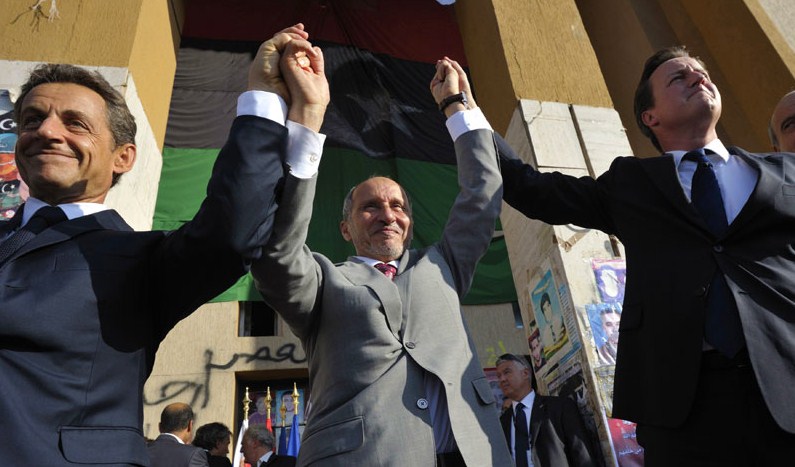
The meteoric rise of ISIS to power is not a coincidence or byproduct of innocent geopolitical mistakes. ISIS was initially created, for the sake of foreign-policy interests, to remove uncooperative governments like those in Libya, and then Syria which arguably became the pivotal point for the rise of ISIS. Until 2011 Libya was largely secular, sovereign, and fairly prosperous; now this country lies in ruins and is portrayed as having been invaded by a horde of foreign “Islamists”. The reality, however, is that France, Italy, the UK, and the US sponsored a small group of discontents to fight Gaddafi in 2011. They called themselves the Shabab, and they later constituted the “Libyan Transitional Council” which is now in government. The Libyan rebels were portrayed to the Western public as being “freedom fighters” who sought greater government accountability and increased liberties. In reality, it almost immediately became apparent that Islamic extremists had taken the leadership of the movement; the western powers were certainly aware of this.
Numerous reports warned that many of the fighters were affiliated with Al-Qaeda, another organization originally made powerful by the US to fight against the Soviet Union in Afghanistan. From the start, the global left had denounced these pseudo-revolutionaries as being violent as well as extreme in their religious zeal: in short, bad news for everybody. Nobody heeded their calls. The demonization of Gaddafi continued in the mainstream Western media, and the glorification and support for the rebels grew to the point when NATO’s governments felt secure that their public would support bombing Libya. So they did. Let us also remember that the Libyan army was sufficiently well trained and disciplined to have almost neutralized the opposition, and it would have done so if NATO had not intervened. In short, if Gaddafi’s government existed today, ISIS might not.
It was not made widely public that many of Libya’s rebels were not Libyans but Iraqis from Al-Qaeda in Iraq. This organization cleverly re-branded itself to confuse the public, and it became ISIS. Abdel Hakim-Belhadj was the commander of the Libyan Islamic Fighting Group that helped NATO to depose Gaddafi. It is almost unknown that Hakim-Belhadj was in fact an al-Qaeda lieutenant, turned double agent after being in the care of the CIA, and released back into operation. “The US was fully aware of and facilitating the delivery of weapons to the Al Qaeda-dominated rebel militias throughout the 2011 rebellion”, as stated by The Citizen’s Commission on Benghazi’s interim report. Far from the US being able to claim ignorance, this program was run and administered by Hillary Clinton, then the Secretary of State.
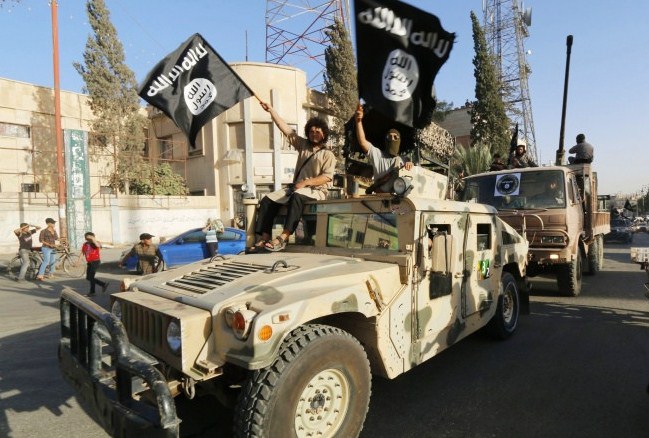
With NATO’s air support, the Libyan rebels captured Gaddafi (he was murdered by the rebels in a horror show that the mainstream media did not hesitate to broadcast). With Gaddafi gone, Hakim-Belhadj was rewarded by NATO and Washington with the title of Governor of Tripoli. With this position, he ensured the recruitment of Jihadists into Libya and the smuggling of hundreds of them to Syria through Turkey. This would create the backbone of what would eventually, and ironically, be named the “Free Syrian Army”. There is no equivocation on the fact that the very same members of the Libyan Islamic Fighting Group were flying the Al-Qaeda and ISIS flags following the murder of Gaddafi. This happened “before and during the time they were shipped on to fight in Syria against Bashar al Assad’s government forces – on behalf of those very same NATO-allied agencies” as reported by the 21st Century Wire.
Syria: toppling Assad
One year later, the Free Syrian Army arguably brought us to the brink of World War III by using chemical weapons against Syrian civilians, and they attempted to frame Assad for it. They are the same fighters who were using weapons shipped by Saudi Arabia and Qatar, with logistic support from the CIA operating in Jordan, and they were also funded by the Saudis, Qataris and Americans. All of this, despite their benefactors’ knowledge that the weapons were falling in the hands of the Jihadists rather than the secular opposition. With help from the CIA, these governments and that of Turkey sharply increased their support for the Syrian rebels throughout 2013, expanding exponentially an airlift of arms and equipment for the uprising against Assad.
With the Jihadization of Damascus having failed, ISIS was born, led by the infamous al-Baghdadi, who was being sponsored just a few months before by the US to fight against Assad. This was achieved through missions coordinated by the likes of John McCain, who to this day maintains that he “knows these people very well” and they “are not terrorists”. The cognitive dissonance does not register in the minds of the majority of the western public. It is not understood that the people who are being paid by the US and NATO in Syria to get rid of Assad are the same people that we must supposedly fight in Libya. Politicians lie, the media parrots, and the populace believes. The infamous “Caliph” al-Baghdadi is now the new bogeyman, the new Bin Laden, the new scapegoat upon which the neocons of the world can capitalize. With Jeb Bush poised to be the leading US Republican candidate for the presidency, the parallels with his brother George W. Bush and his crusade against Al-Qaeda to justify the invasions of Afghanistan and Iraq are simply too sinister to ignore. It hardly matters whether one believes that ISIS is under direct control of the US or not. The point is that ISIS has achieved its primary role: that of creating an atmosphere of fear that can be exploited and manipulated to justify military and political interventions abroad.
We have to wonder about the goal of ISIS in bombing in Libya. If ISIS really wants to attack Rome, it can easily do so with home-grown members rather than risk the laborious task of smuggling fighters from Libya. Could it be to influence the US elections in favor of a neoconservative? Or to pretend to be fighting ISIS while bombing the pro-Gaddafi militias that have re-taken most of the southern regions of Libya? Whatever the reason, it appears that the support from the US to the supposed enemies of the US is allegedly not waning. The Pentagon is set to send 1,000 troops to aid the Syrian rebels, and in June 2014 Obama requested $500 million from the US Congress to train and arm the group that potentially includes ISIS combatants. This comes amidst claims from an alleged Islamic State commander in Pakistan that the US is directly funding ISIS fighters on the ground there, and from the Iraqi parliament that their army has downed two British military planes that were carrying weapons and explosives to be allegedly air-dropped on ISIS-controlled areas. Saudi Arabia, Qatar, Turkey, and the NATO powers are not the only ones who have at least indirectly supported ISIS; Israel too has also thrown its lot with these unsavory characters. For 18 months the Israeli “Defense” Forces provided medical and technical help to opposition groups fighting inside Syria, as observed by the UN peacekeeping missions in the Golan Heights.
If a hand strikes you, do you blame the hand that hit you or the mind that commanded it? The situation with ISIS is similar, and so the real question to be asked is the following: Who is the greatest enemy to our security here, ISIS or the US? For those willing to see, the truth is in plain sight.
ISIS 101
What’s really terrifying about this threat
By John Chuckman | Aletho News | March 1, 2015
ISIS certainly is not what a great many people think that it is, if you judge what they think by what our corporate press proclaims incessantly.
Judging by what ISIS actually does and whom its acts benefit, its clandestine associates, and the testimony of some witnesses, ISIS is a complex intelligence operation. Its complexity reflects at least in part the fact that it serves the interests of several countries and that it has more than one objective. Its complexity reflects also the large effort to reinforce a false image with disinformation and staged events such as a video of a beheading which could not have been a beheading unless they’ve discovered a bloodless method until now unknown to science.
The subject of ISIS is not without brief glimmers of humor. The image of bands of men, swathed in Arabic robes and bumping their way around the desert in Japanese pick-up trucks with Kalashnikovs raised in the air for every picture has elements of Monty Python. The idea of modern, trained and well-armed military units turning and running from them resembles a war scene in a Laurel and Hardy comedy such as the one with Hardy stuck upside down in a WWI tank turret kicking his legs the whole time Laurel drives towards the German positions managing accidentally to round-up a whole trench-full of prisoners with some wire fencing that becomes snagged on the tank.
Despite the tiresome stupidities we see and hear about it, ISIS unquestionably does kill people and destroy things, that being its purpose, and there is no humor in that.
ISIS appears to have served several tasks so far. First, it frightened Iraq’s Prime Minister, Nouri al-Maliki, out of office in Iraq, a man America and Israel grew very much to dislike owing simply to his good relations with Iran, one of the unintended consequences of America’s invasion of Iraq being expanded Iranian influence in the region. No doubt al-Maliki was terrified not so much by ISIS approaching in their pick-up trucks as he was by his own military’s tendency, as if on cue, to turn and run from ISIS, often leaving weapons behind. The message was clear: you won’t be protected.
Second, America’s highly selective “air war” against ISIS somehow manages to attack infrastructure targets inside Syria with the feeble excuse that they are facilities helping ISIS. We’ve seen what American bombing can do when it’s undertaken seriously, and somehow I have a hard time imaging the men in Japanese pick-ups lasting long when faced with what hit the Taleban in Afghanistan or Gadhafi’s forces in Libya. The air strikes are partly a show for the world – after all, how can America be seen not to be fighting such extremely well-advertised, super-violent terrorists, guys putting out videos regularly from a studio trailer they must haul around with one of their pick-up trucks? The air strikes’ main purpose appears to be a way of hurting Assad and assisting those fighting Syria’s army without coming into conflict with Russia, as they would with a large, direct campaign. They likely also punish elements of ISIS which have exceeded their brief and serve as a reminder to the rest of what could happen to them if they stray too far from their subsidized purpose once the war comes to an end.
Three, in some of the ground fighting in Iraq where we’ve read of Iraqi units fighting ISIS, the units are often Kurdish, and sometimes the press uses expressions like “Iraqi and Kurdish troops.” But the Kurdish region is still part of Iraq legally, although it has been given a good deal of autonomy by the central government. The Kurdish region of Iraq is the country’s prime oil-producing area, and in the estimation of many observers, an area both the United States and Israel would very much like to see severed from Iraq in the way Kosovo was severed from Serbia after America’s devastating air war there. This would not only permanently assure Iraq’s weakness, it would create a rather grateful and more willing oil supplier.
Where does ISIS get its technical equipment and the know-how to produce videos and run Internet sites? These are not qualities commonly found among fanatical fundamentalists anywhere; indeed most true radical fundamentalists tend to eschew technology. A supply of advice, technical assistance, and equipment comes from somewhere. Where does ISIS get the money for food, gasoline, clothes, ammunition, and Japanese pick-up trucks? And I wonder, did one of those wild-looking jihadi types just show up one day at an Iraqi car dealership and order a fleet of Japanese pick-ups? Were they delivered out on the desert or did a gang of jihadists march in, waving their Kalashnikovs, to drive them away?
The effort to destroy the Syrian government, whether by means of ISIS or anyone else, is warmly and generously supported by Saudi Arabia and its buddy Qatar – another oil-rich, absolute monarchy where political parties are banned – both these countries’ primary interest being the defence of their immensely privileged situations against creeping threats of all progressive developments such as equal human rights or democracy or indeed against revolt led by external forces. The payments we now know the Saudi royal family long made to Osama bin Laden before 9/11 were simply bribes to keep him and his anti-establishment work out of the country. They really didn’t care a lot about what the money bought elsewhere, but since 9/11 and its many Saudi connections – 15 of the perpetrators plus the past financing plus the many members of the royal family and bin Laden family secretly flown out by American officials at the time – the Saudi authorities were genuinely fearful of how America might respond and have become far more responsive to what America wants in the Middle East and now apply their money to such projects. What America wants in the Middle East is, invariably, what Israel wants, so there is now extensive, secret cooperation where once there was complete official hostility.
We have reports from plane-spotters in the region of daily flights of mysterious planes from Israel to Qatar. We have several eye-witness reports and photographs of supply bundles dropped from unknown planes into ISIS territory. Maybe ISIS has its own air force now? We know Turkey has served both as an entry point for countless terrorists into Syria and as a place of retreat and refuge when fighting with the Syrian army becomes too hot for them, the volumes of such activity having been too great to keep secret. We have reports of Turkish supply flights. A Jordanian official recently told a reporter that ISIS members were trained in 2012 by American instructors working at a secret base in Jordan.
If ISIS is what our corporate news pretends that it is – a fanatical Muslim extremist group that sprang suddenly from the desert sands much like Jack’s bean stalk – one blindingly obvious question is, why does it not attack Israel or Israeli interest? Isn’t that what one would expect from such a cast of characters? But it has not done so, undoubtedly because Israel is an important covert benefactor and supplier.
We might equally ask why ISIS has not attacked Saudi Arabia or its interests, for although the Saudi royal family officially professes a strict and conservative form of Islam, Wahhabism, in fact many of them are very worldly people who spend a good deal of time and money at the world’s great pleasure palaces. Perhaps even more damning for a genuine fanatical fundamentalist, the Saudis now often secretly cooperate and make plans with Israel where mutual interests exist.
No, there is something highly suspicious about Islamic fundamentalist terrorists who avoid such interests while managing to brutally kill poor Syrian soldiers just doing their jobs along with the odd foreign journalist or aid worker who may just have seen something they shouldn’t have seen. Of course, we have Edward Snowden himself having described ISIS as an operation intended to protect Israel. Despite the fact that some news sources have said the interview in which this was revealed never took place, my instincts tell me it likely did. Snowden has never refuted it, and the news sources saying it did not are highly suspect on such a subject.
The way ISIS serves Israeli and American interests is by providing a focus point for extremists, attracting them from various parts of the world so that they can be recorded and kept track of. Also the tracks back to the various countries from which they come provide security services with leads to places where there might be some festering problems. In the meantime, ISIS serves the interest of helping to bring down President Assad, a goal dear to the hearts of Israelis. Please remember that black operations, even the ones about which we know, show little consideration for lives or property. Just think of Israel’s attack on an American spy ship in the Mediterranean during the Six Day War, its pilots knowingly shooting up and bombing for two hours the well-marked ship of its ally and benefactor, no explanation worth hearing ever having been offered.
Just read conservative mainline sources (pretty much a redundant pair of adjectives) about the harm Snowden has done: claims of everything from his revelations about American intelligence having served to help ISIS avoid detection (!) to his revelations having set up the United States for another 9/11! You might think intelligent people would be ashamed of making such asinine public statements, but, no, there are almost no limits to trying to discredit those revealing murderous, dark operations.
We’ve had many reports of officials in various countries, including Canada as I write, concerned about the odd individual or small group running off to join ISIS. Now why should that be a concern? A few flaky people going abroad just removes them from your country, something I should have thought was a complete gain from a security point of view. Even if they were ever to return in future, you would know exactly who they are. Where is the basis for serious concern? But the psychological advantages of noise and hype to scare people about obscure dangers and “lone wolves” and “home-grown terrorists” outweigh completely good sense and intelligence.
Finally, there are numerous reports that Abu Bakr al-Baghdadi (a nom de guerre, not his real name), the leader of ISIS, is a Western intelligence asset. What little we can learn about him makes that entirely plausible. The Supreme Leader of Iran, Ali Khamenei, has said that the man is a Mossad agent, a claim supported supposedly by documents revealed by Edward Snowden. Abu Bakr al-Baghdadi is by all accounts a secretive man who speaks directly with few people, and even his birth place, given as Samarra, Iraq, is not sure. Records of his past, as those from his period of American captivity (always a great opportunity to “turn” someone to serving two interests), are not available. He was once reported killed but is still alive. He is said to have received intensive training from Mossad and the CIA, and some sources give his real name as Simon Elliot (or, Elliot Shimon), but few details can ever be certain in such dark operations.
The truly terrifying aspect of ISIS and other forces fighting with it in Syria is that the United States and Israel have approved and supported such wanton destruction in so beautiful and formerly-peaceful a place as Syria. Millions of lives destroyed and countless historic places damaged as though they were all nothing more than a few pieces moved on a geopolitical chessboard. I think it fair to describe that as the work of psychopaths.
The Destabilization Doctrine: ISIS, Proxies and Patsies
By Brandon Martinez | Non-Aligned Media | February 22, 2015
“Islam and the West at War,” reads a recent New York Times headline.
It would certainly seem that way if one were to take at face value the putrid assertions of Western governments that are not particularly known for their honesty or integrity. But astute observers of history and geopolitics can spot a deception when they see one, and the latest theatrical performances being marketed to the masses as real, organic occurrences remind one of a Monty Python sketch.
In the past week we have witnessed a number of expedient events that were designed to legitimize the West’s imperialist foreign policies in the minds of the masses. On Feb. 15 the Islamic State (also known as ISIS) released another highly choreographed and visually striking video allegedly depicting the beheading of 21 Egyptian Coptic Christians. Shortly following the video’s release, the Egyptian dictator Abdel Fattah el-Sissi launched air strikes against ISIS targets in Libya where the execution video was allegedly filmed, although experts are now saying that the production was faked.
ISIS’s continued provocations in the form of carefully crafted, emotionally impactful execution videos (real or faked), such as the recent immolation of a caged Jordanian pilot, cannot possibly be the work of rational actors seeking a military victory in any capacity. The videos only ever work to ISIS’s disadvantage, solidifying the resolve of their current ‘coalition’ opponents as well as creating new enemies upon every release.
Sixty-two countries and groups are presently fighting in the dubious ‘coalition’ against ISIS, most of which have modern militaries with advanced air and ground forces. Why in the world does ISIS continue to entice more countries to join the already over-crowded alliance against them? Why a group that purports to want to establish a ‘state’ which will ostensibly govern millions of people is deliberately seeking more and more enemies and a constant state of war with them beggars belief.
Does ISIS think it can do battle with the whole planet and achieve victory, culminating in world domination? How do people who harbor such ridiculous delusions have the wherewithal and resources at their disposal to organize and recruit thousands of fighters from around the world to an utterly ludicrous cause doomed to sheer failure? How can this be anything but a contrived prank of an operation?
The only logical conclusion that many analysts have come to is that ISIS does not represent a grassroots, organic movement, but rather operates entirely as a cat’s paw of Western foreign policy in the Middle East and North Africa, which is concurrently under the domination of Israel. ISIS’s actions expressly benefit Muslims least of all and Israel/the West most of all, the extent of which increases with every new atrocity and outrage ISIS inflicts upon innocents in Iraq and Syria that gets endless play in Western media. In fact, the Western media’s obsession with ISIS is in and of itself an effective form of PR for the group. Western media outlets are consciously performing an unqualified service for ISIS’s recruiting efforts by affording the terrorist group ‘premium level branding’ that will attract criminally-inclined degenerates, Wahhabist religious zealots and disaffected, suicidal lowlifes from around the world to join a cause predestined to abject failure.
This senile ‘ISIS vs. The World’ spectacle is little more than a melodramatic screenplay engineered in a boardroom by professional propagandists and marketing aficionados. It resembles a classic ‘problem, reaction, solution’ dialectic of deceit. Who in their right mind believes the rancid mythology surrounding this orchestrated ‘good vs. evil’ Hollywood blockbuster?
Proxy Warriors: Cannon Fodder for the Empire
The West is not sincerely at odds with ISIS nor is it seeking to “degrade and destroy” the group, as US President Barrack Obama claims. One piece of information that undermines this good cop/bad cop puppet show is the West’s clandestine support of ISIS beginning with the artificial uprising in Libya. In 2011, the West openly sought to depose Libyan strongman Muammar Gaddafi, and did so by backing ISIS and al-Qaeda-affiliated rebel groups to do it. The maniac rebels who sodomized and then murdered Gaddafi in the street like a dog were hailed as ‘freedom fighters’ by the repellant thugs in Washington, Paris and London, and were fully aided and abetted with NATO air strikes against Gaddafi’s forces. The rebel victory in Libya was only made possible through Western military intervention. “We came, we saw, he died,” said Obama’s former Secretary of State Hilary Clinton in reference to the assassination of Gaddafi by Washington’s foot soldiers, cackling like a witch at the demise of the Libyan potentate.
In a Nov. 19, 2014, article for Global Research, analyst Tony Cartalucci noted that the “so-called ‘rebels’ NATO had backed [in Libya] were revealed to be terrorists led by Al Qaeda factions including the Libyan Islamic Fighting Group (LIFG) and Al-Qaeda in the Islamic Maghreb (AQIM).” During the manufactured ‘uprising’ Gaddafi routinely declared in public speeches that al-Qaeda was leading the way. “Gaddafi blames uprising on al-Qaeda,” read one Al Jazeera headline from February 2011. A March 2011 Guardian report spoke of how “hundreds of convicted members of the Libyan Islamic Fighting Group (LIFG), an al-Qaida affiliate, have been freed and pardoned” under a “reform and repent” program headed by Gaddafi’s son Saif al-Islam. The same article acknowledged that the LIFG, which was established in Afghanistan in the 1990s, “has assassinated dozens of Libyan soldiers and policemen” since its founding and that Britain’s MI6 had previously supported the group. That group formed the backbone of the anti-Gaddafi insurgency, and received all manner of support from the West and allied Gulf sheikhdoms.
In the aforesaid Global Research article, Cartalucci outlines how the synthetic insurrection in Libya was spearheaded by al-Qaeda franchises that were later subsumed into ISIS. A February 2015 CNN report entitled “ISIS finds support in Libya” revealed that since the fall of Gaddafi, ISIS has established a large and menacing presence throughout the North African country. “The black flag of ISIS flies over government buildings,” according to CNN’s reportage. “Police cars carry the group’s insignia. The local football stadium is used for public executions.” It adds that, “Fighters loyal to the Islamic State in Iraq and Syria are now in complete control of the city of Derna, population of about 100,000, not far from the Egyptian border and just about 200 miles from the southern shores of the European Union.”
NATO effectively carpet-bombed Libya into rubble, paving a path of blood for ISIS and al-Qaeda death squads to seize power and institute their medieval ideology. That’s the reward for falling afoul of ‘the West’ and whatever drives it. Cartalucci further proved in another report entitled “Libyan Terrorists Are Invading Syria” that as soon as Gaddafi’s regime collapsed and rebel gangs emerged triumphant, thousands of battle-hardened and fanatical jihadist fighters took their Western training and weapons over to Syria to fight Bashar al-Assad in accordance with Washington’s ‘bait and switch’ scheme. Apparently, these hired mercenaries behave a lot like wild dogs chasing a piece of raw meat.
An absolutely identical scenario unfolded in Syria where Washington and its regional puppets led by Saudi Arabia, Qatar and Turkey have been subsidizing the Islamist guerrillas from the outset. “Do you know of any major Arab ally of the US that embraces ISIL?” US Senator Lindsey Graham facetiously asked General Martin Dempsey at a Senate Armed Services Committee in 2014. To Graham’s surprise, Dempsey responded: “I know major Arab allies who fund them.” US Vice President Joe Biden himself confirmed this in an October 2014 speech wherein he told students at Harvard University that America’s Gulf allies – the Saudis and Qataris especially – were backing ISIS and Jahbat al-Nusra (an al-Qaeda affiliate) with substantive sums of arms and funds. A former US General, Thomas McInerney, told Fox News that the US government helped “build ISIS” by “backing some of the wrong people” and by facilitating weapons to al-Qaeda-linked Libyan rebels which ended up in the hands of ISIS militants in Syria. Retired US General and former NATO Supreme Allied Commander, Wesley Clark, repeated this view in a February 2015 interview with CNN, saying that “ISIS got started through funding from our friends and allies [in the Gulf]” who sought to use religious fanatics to assail the Shia alliance of Syria, Iran and Hezbollah. “It’s like a Frankenstein,” he concluded.
A June 17, 2014, World Net Daily report highlights how Americans trained Syrian rebels who later joined ISIS in a secret base located in Jordan. Jordanian officials told WND’s Aaron Klein that “dozens of future ISIS members were trained [in a US run training facility in Jordan] at the time as part of covert aid to the insurgents targeting the regime of Syrian President Bashar al-Assad in Syria.” Reports in Der Spiegel, the Guardian, Reuters and other mainstream outlets all confirmed that the US, Britain, France and their regional allies were training militants in secret bases in Jordan and Turkey as part of the West’s proxy war against the Assad regime.
The West has attempted to cover-up its support of ISIS and al-Qaeda elements by running a ‘two degrees of separation’ gambit. Washington claims to only provide support to ‘moderate, vetted’ rebel groupings, namely the Free Syrian Army (FSA), but this amounts to a calculated ruse to confound the credulous masses. FSA is the nom de gerre of a loose collection of rebel bandits who don’t operate under a central command framework or authority, rather acting independently or under the umbrella of other factions. Aron Lund, an expert on Syrian rebel groups, discerned in a March 2013 article titled “The Free Syrian Army Doesn’t Exist” that from the very beginning the FSA has been nothing more than a fictional branding operation.
During the initial stages of the insurgency, any militant faction in Syria looking for Western military aid called itself FSA and then took the weapons they received from the West straight to ISIS and Jahbat al-Nusra. The FSA functions as a conduit between Western governments and the Takfiri terrorists fighting Assad as well as an arms distribution network for them. In the aforesaid article, Lund explains that the FSA’s General Staff was set up in Turkey in 2012 “as a flag to rally the Western/Gulf-backed factions around, and probably also a funding channel and an arms distribution network, rather than as an actual command hierarchy.” Thousands of militants fighting under the FSA rubric have since joined or pledged allegiance to ISIS and al-Nusra.
Western governments know this and are apparently totally comfortable with it, revealing their bare complicity and collaboration with the Takfiri insurgents hell-bent on beheading their way to power in Syria and Iraq.
The Counterfeit Campaign
This inevitably creates confusion for people not studied in imperial geopolitics, especially after the West and its Gulf allies ‘declared war’ on ISIS in late 2014. The counterfeit campaign cannot be seen as anything other than a convenient, disingenuous volte-face maneuver designed to whitewash all of the aforementioned facts about the West’s dirty hands behind ISIS. Average plebs who receive all of their information from TV news channels won’t know about the West’s clandestine activities that effectively spawned ISIS and facilitated its rise to prominence in Iraq, Syria and Libya, so they will naturally take the West’s phony confrontation with ISIS at face value.
The West’s crusade to “degrade and destroy” ISIS is a preposterous hoax. In fact, evidence suggests that the West continues to covertly support ISIS with airdrops of weapons and supplies, whilst concurrently ‘bombing’ them in sketchy and deliberately ineffective air strikes.
Iran’s President Hassan Rohani called the US-led anti-ISIS coalition ‘a joke’ considering how many of its participants significantly helped bolster the terrorist group since its inception. In a January 2015 report, Iran’s Fars News Agency quotes a number of Iranian generals and Iraqi MPs who believe that the US is continuing to surreptitiously support ISIS with airdrops of weapons caches and other supplies. General Mohammad Reza Naqdi, a commander of Iran’s Basij (volunteer) Force, said that the US embassy in Baghdad is the “command center” for ISIS in the country. “The US directly supports the ISIL in Iraq and the US planes drop the needed aids and weapons for ISIL,” General Naqdi told a group of Basij forces in Tehran. Fars News cited Majid al-Gharawia, an Iraqi Parliamentary Security and Defense Commission MP, who said that the US are supplying ISIS with weapons and ammunition in a number of Iraqi jurisdictions.
An Iraqi security commission spoke of unidentified aircraft making drops to ISIS militants in Tikrit. Another senior Iraqi lawmaker, Nahlah al-Hababi, echoed these claims about US planes and other unidentified aircraft making deliveries to ISIS. She opined that, “The international coalition is not serious about air strikes on ISIL terrorists and is even seeking to take out the popular Basij (voluntary) forces from the battlefield against the Takfiris so that the problem with ISIL remains unsolved in the near future.” General Massoud Jazayeri, the Deputy Chief of Staff of Iran’s Armed Forces, called the US-led coalition against ISIS a farce. “The US and the so-called anti-ISIL coalition claim that they have launched a campaign against this terrorist and criminal group – while supplying them with weapons, food and medicine in Jalawla region (a town in Diyala Governorate, Iraq). This explicitly displays the falsity of the coalition’s and the US’ claims,” the general said.
The US military claims these air deliveries are mistakenly ending up in ISIS’s possession and that they were intended for Kurdish fighters, but such a ridiculous assertion rings hollow among the true opponents of ISIS – Iran, Syria, Hezbollah and Shiite volunteers in Iraq. Meanwhile, the laughable nature of Washington’s anti-ISIS gambit is underscored by the fact that its initial air strikes against ISIS’s stronghold in Raqqa, Syria, in September 2014 did little more than destroy a bunch of empty buildings. CNN let slip that ISIS fighters had evacuated their command centers in the city 15 to 20 days before US air strikes commenced, indicating that they were probably tipped off. A Syrian opposition activist told ARA News that “the targeted places [in Raqqa], especially refineries, were set on fire, pointing out that IS militants evacuated their strongholds in the last two days to avoid the U.S.-led strikes.”
The Hidden Hand of Zionism
The sham rebellion in Syria was devised and executed by outsiders to serve a nefarious anti-Syrian agenda. All of this seems very confusing if one doesn’t take into consideration the destructive proclivities of the state of Israel in the region.
Israel has essentially used the United States as a cat’s paw in the Middle East, manipulating America’s Leviathan military to smash up her enemies. The formidable Israeli lobby inside the US and its neoconservative lackeys who are a dominant force in the war-making apparatus of the US Military Industrial Complex is a key factor driving the Washington foreign policy establishment’s intransigent approach to the Middle East. When it comes to Middle East policy, the Israelis always get their way. “America is a thing you can move very easily… in the right direction,” Israeli PM Benjamin Netanyahu once bragged. “Don’t worry about American pressure on Israel. We control America,” the former Israeli PM Ariel Sharon boasted.
The destruction of Iraq, Syria, Iran, Lebanon, Libya, Egypt and other Middle Eastern and North African states is a long-standing Zionist policy plan dating back to the 1950s. In 1982 a stunning Israeli strategy paper was published which outlined with remarkable candor a vast conspiracy to weaken, subjugate and ultimately destroy all of Israel’s military rivals. The document was called “A Strategy for Israel in the 1980s,” authored by Oded Yinon, a prominent thinker in Israeli Likud circles. In the vein of the Ottoman millet system, Yinon envisioned the dissolution of Israel’s neighbors and a new Middle East made up of fractured and fragmented Arab/Muslim countries divided into multiple polities along ethnic and religious lines. In Yinon’s mind, the less unified the Arabs and Muslims are the better for Israel’s designs. Better yet, have the Arabs and Muslims fight each other over land and partition themselves into obscurity. Yinon suggests a way to accomplish this, primarily by instigating civil strife in the Arab/Muslim countries which will eventually lead to their dismemberment.
In the document, Yinon specifically recommended:
Lebanon’s total dissolution into five provinces serves as a precedent for the entire Arab world including Egypt, Syria, Iraq and the Arabian peninsula and is already following that track. The dissolution of Syria and Iraq later on into ethnically or religiously unique areas such as in Lebanon, is Israel’s primary target on the Eastern front in the long run, while the dissolution of the military power of those states serves as the primary short term target. Syria will fall apart, in accordance with its ethnic and religious structure, into several states such as in present day Lebanon, so that there will be a Shi’ite Alawi state along its coast, a Sunni state in the Aleppo area, another Sunni state in Damascus hostile to its northern neighbor, and the Druzes who will set up a state, maybe even in our Golan, and certainly in the Hauran and in northern Jordan. This state of affairs will be the guarantee for peace and security in the area in the long run, and that aim is already within our reach today.
He later singled out Iraq as Israel’s most formidable enemy at the time, and outlined its downfall in these terms:
Iraq, rich in oil on the one hand and internally torn on the other, is guaranteed as a candidate for Israel’s targets. Its dissolution is even more important for us than that of Syria. Iraq is stronger than Syria. In the short run it is Iraqi power which constitutes the greatest threat to Israel. An Iraqi-Iranian war will tear Iraq apart and cause its downfall at home even before it is able to organize a struggle on a wide front against us. Every kind of inter-Arab confrontation will assist us in the short run and will shorten the way to the more important aim of breaking up Iraq into denominations as in Syria and in Lebanon. In Iraq, a division into provinces along ethnic/religious lines as in Syria during Ottoman times is possible. So, three (or more) states will exist around the three major cities: Basra, Baghdad and Mosul, and Shi’ite areas in the south will separate from the Sunni and Kurdish north. It is possible that the present Iranian-Iraqi confrontation will deepen this polarization.
Yinon’s vision seems to be unfolding rapidly in Iraq which is today on the verge of partition with the Sunni extremists of ISIS seizing vast swaths of territory for their ‘caliphate’ and the Northern Kurds still battling for independence from Baghdad which is ruled by a Shia clique headed by Haider al-Abadi and Nour al-Maliki. Syria too looks to be falling victim to Yinon’s venomous whims as ISIS has wrested control of large chunks of Syrian territory and presently enforces its brutal sectarianism on the Eastern population of the country.
The themes and ideas in Yinon’s Machiavellian manifesto are still held dear today by the Likudnik rulers in Israel and their neocon patrons in the West. Pro-Israel neocons basically replicated Yinon’s proposals in a 1996 strategy paper intended as advice for Benjamin Netanyahu, although in less direct language. Their report titled “A Clean Break: A New Strategy for Securing the Realm” spoke of “removing Saddam Hussein from power in Iraq” as an “important Israeli strategic objective” that serves as a means of weakening Syria. The Clean Break authors advised that Israel should militarily engage Hezbollah, Syria and Iran along its Northern border. They go on to suggest air strikes on Syrian targets in Lebanon as well as inside Syria-proper. They also stipulate that, “Syrian territory is not immune to attacks emanating from Lebanon by Israeli proxy forces.”
These neocon recommendations seem to be playing out today like a perfectly gauged game of chess. The Syria crisis has unveiled Israel’s plans for destabilizing the region to their benefit. At many points since the unrest in Syria began in 2011, Israel has conducted air strikes on Syrian military sites, just as the Clean Break criminals encouraged. In a January 2015 interview with Foreign Affairs magazine, Syria’s President Bashar al-Assad made note of Israel’s incessant attacks against Syrian army installations during the conflict: “[Tel Aviv is] supporting the rebels in Syria. It’s very clear. Because whenever we make advances in some place, they make an attack in order to undermine the army.” Assad further described Israel as “al-Qaeda’s air force.”
Israel’s support of the Takfiri militants inside Syria goes beyond periodic air strikes in their favor. According to a 2014 UN report, Israel has been providing sanctuary and hospital care to thousands of anti-Assad terrorists, including those of ISIS and al-Nusra, and then dispatching them back into the fight. A Russia Today report on the issue headlined “UN details Israel helping Syrian rebels at Golan Heights” noted: “Israeli security forces have kept steady contacts with the Syrian rebels over the past 18 months, mainly treating wounded fighters but possibly supplying them with arms, UN observers at the Israeli-Syrian border reported.”
Israel’s gains in this situation are manifold. Tel Aviv has been using the fog of war to weaken its primary adversary in Damascus and consequently draw its other foes – Iran and Hezbollah – into the quandary, thereby diminishing their collective resolve to fight Israel itself. The Zionist regime not only views the Takfiris of ISIS and al-Nusra as a “lesser enemy,” but also as proxy mercenaries against Damascus, a strategy explicated in the neocons’ Clean Break document. In fact, Tel Aviv doesn’t view the Takfiris as much of a threat at all; a point that was validated by ISIS itself which declared that it is “not interested” in fighting Israel. “ISIS: Fighting ‘Infidels’ Takes Precedence Over Fighting Israel,” reads an August 2014 headline in Arutz Sheva, an Israeli news outlet.
The former Israeli ambassador to the US, Michael Oren, substantiated all of this in a September 2013 interview with the Jerusalem Post. “’Bad guys’ backed by Iran are worse for Israel than ‘bad guys’ who are not supported by the Islamic Republic,” he told the Post, adding that the “greatest danger” to Israel is “the strategic arc that extends from Tehran, to Damascus to Beirut. And we saw the Assad regime as the keystone in that arc. That is a position we had well before the outbreak of hostilities in Syria. With the outbreak of hostilities we continued to want Assad to go.” Oren further remarked with glee about the total capitulation of the Gulf sheikhdoms – Saudi Arabia, Qatar and the United Arab Emirates – to Israel’s itinerary vis-à-vis Syria, Iran and the Palestinian issue, observing that “in the last 64 years there has probably never been a greater confluence of interest between us and several Gulf States. With these Gulf States we have agreements on Syria, on Egypt, on the Palestinian issue. We certainly have agreements on Iran. This is one of those opportunities presented by the Arab Spring.”
Roland Dumas, France’s former foreign minister, confirmed Israeli intrigue behind Syria’s internal woes. In a June 15, 2013, article for Global Research, journalist Gearóid Ó Colmáin quotes Dumas who told a French TV channel that the turmoil in Syria, which has cost the lives of more than 100,000 Syrians, was planned several years in advance. Dumas claimed that he met with British officials two years before the violence erupted in Damascus in 2011 and at the meeting they confessed to him “that they were organizing an invasion of rebels into Syria.” When asked for his support in the endeavor, Dumas declined, saying, “I’m French, that doesn’t interest me.’’ Dumas further pinpointed the architects of the madness as Israeli Zionists, suggesting that the Syria destabilization operation “goes way back. It was prepared, preconceived and planned [by the Israeli regime].” Dumas noted that Syria’s anti-Israel stance sealed its fate in this respect and also revealed that a former Israeli prime minister once told him “we’ll try to get on with our neighbours but those who don’t agree with us will be destroyed.”
“Israel planned this war of annihilation years ago in accordance with the Yinon Plan, which advocates balkanization of all states that pose a threat to Israel,” writes Gearóid Ó Colmáin in the aforesaid piece. “The Zionist entity is using Britain and France to goad the reluctant Obama administration into sending more American troops to their death in Syria on behalf of Tel Aviv.”
Ó Colmáin argues that the West “are doing [Israel’s] bidding by attempting to drag [the United States] into another ruinous war so that Israel can get control of the Middle East’s energy reserves, eventually replacing the United States as the ruling state in the world. It has also been necessary for Tel Aviv to remain silent so as not to expose their role in the ‘revolutions’, given the fact that the Jihadist fanatics don’t realize they are fighting for Israel.”
ISIS: A Repository of Patsies for the False Flaggers
At long last, this brings us to the ‘second phase’ of the ISIS psyop: scaring Westerners into submission.
It’s no coincidence that the notorious belligerence of ISIS in its quest for a ‘caliphate’ aligns perfectly with the neocon agenda which aims to inculcate in the minds of the masses the myth of a ‘clash of civilizations’ between the West and Islam. In its official magazine, Dabiq, ISIS ideologues advanced a parallel attitude with the neocon desire for a civilizational conflict. Is that merely happenstance? Or has ISIS been manufactured by the neocons to serve as the ultimate boogeyman and straw man caricature of ‘Islamic radicalism’?
The godfather of neoconservatism, Leo Strauss, espoused a dogma of deception, stipulating that in order to corral society behind the wishes of an elite vanguard an ‘external enemy’ must be fashioned. This ‘enemy’ could be real, but enemies usually exist in the eye of the beholder and in the minds of those seeking opposition. Strauss made it clear that if this societal ‘enemy’ did not exist or was not formidable enough to generate an adequate amount of fear required to paralyze and manipulate the masses, then one should be invented or inflated and then advertised to the populace as a real, pressing danger.
For the neocons, this phantom nemesis forms the crux of their strategy of subjugation. Without it, the public would never consent to their lunatic foreign policies, nor would anyone feel threatened enough to willingly relinquish their freedoms in the name of security. This is what ISIS is all about.
As demonstrated earlier, ISIS was cultivated by our own governments to destabilize and ultimately overthrow various regimes in the Middle East and North Africa that fell astray of the Globalist-Zionist program. The Western media has purposely marketed the ISIS ‘brand’ across the globe, making it a household name. The Zionist globalists built up ISIS to do their bidding abroad, but despite media sensationalism the group is not nearly strong enough to pose any serious threat to Western countries. So while ISIS represents no legitimate military threat to the West, its global reputation for brutality and obscene violence is seen as a fantastic propaganda tool to frighten Western populations into consenting to the extirpation of their freedoms at home.
The Zionist globalists have put that carefully crafted ISIS image to work, fabricating a series of perfectly timed ‘terror events’ inside Western countries which have been used to curtail freedoms under the guise of ‘keeping us safe from the terrorists.’ What the gullible commoners don’t realize is that these ‘terrorists’ are controlled by our own governments and are being wielded against us to vindicate the construction of an Orwellian police state.
The string of ‘lone-wolf’ attacks that hit Ottawa, Sydney, Paris and now Copenhagen over the past five months since the West first ‘declared war’ on ISIS are all part of an organized neocon strategy of tension. The intelligence agencies of the West and Israel stand behind them all. In every case, the ‘terrorists’ had long histories of mental illness and/or frequent run-ins with the law; the standard rap-sheet of a patsy whose innumerable weaknesses are exploited by government agents to produce a type-cast ‘fall guy’ to play the part of the ‘wily gunman’ who ‘hates our freedoms.’ ISIS therefore in effect provides the false flag con artists who control our governments with an inexhaustible wellspring of patsies for their operations.
As the researcher Joshua Blakeney pointed out, “Some peasant in Yemen may be angry [enough at the West to want to harm it] but he [could] never [physically carry out] such an attack without it being made possible by the false-flag planners.” A ‘let it happen’ or a ‘made it happen’ scenario amounts to the same thing – without the connivance of the government in question there is no ‘attack’ to even discuss. Since ISIS is a ‘global’ phenomenon, according to our controlled media, authorities don’t even have to prove that these deranged individuals are even members of the group. All they have to say is that they were ‘inspired’ by the group’s message which can be accessed online, and that’s enough to indict them in the court of public opinion. Even if all that were true, it still wouldn’t eliminate potential state involvement, which usually comes in the form of equipping the dupe with the necessary armaments to execute the plot and preventing well-meaning police and intelligence people from intervening to stop it. These are the kinds of queries the West’s big media patently refuses to pursue, knowing full well that the state is almost always complicit with, and keen to exploit, whatever tragedy befalls their population.
All of the latest traumatic terror events in Western capitals have been instantly branded by lying, cynical politicians as attacks on ‘free speech’ and the ‘values of Western civilization,’ a familiar trope first trotted out by George W. Bush and his neocon puppet masters after the false flag attacks of 9/11.
However, what many are starting to realize is that whatever threat some mind controlled junkie might pose to our lives, our own governments are a markedly more dangerous menace to our liberties, well being and way of life. They prove this point every single day with a manifold of new freedom-busting laws that they pass using the comical excuse of protecting us from their own Frankenstein.
That’s the simple truth of the matter that the neocon false flaggers seek to suppress at all costs as they desperately hold up the façade of their artificial power which will inevitably collapse under its own weight.
Brandon Martinez is an independent writer and journalist from Canada who specializes in foreign policy issues, international affairs and 20th and 21st century history. He is the co-founder of Non-Aligned Media and the author of the 2014 books Grand Deceptions and Hidden History. Readers can contact him at martinezperspective[at]hotmail.com or visit his blog at http://martinezperspective.com
Copyright 2015 Brandon Martinez
Featured Video

ARE PATIENTS BEING PROPERLY INFORMED ABOUT OZEMPIC?
or go to
Aletho News Archives – Video-Images
From the Archives
Trans ‘milk’ as good as the real thing – NHS
RT | February 18, 2024
The drug-induced nipple secretions of trans women are as good as mothers’ breast milk for babies, the University of Sussex Hospitals NHS Trust claimed in a letter to campaigners made public in a report by British think tank the Policy Exchange on Sunday.
The healthcare trust’s medical director, Rachel James, argued that the off-label prescription drug cocktail men transitioning to female take in order to produce milk was “similar to the natural hormones which encourage lactation to develop when the baby is newly born.”
“The evidence which is available demonstrates that the milk is comparable to that produced following the birth of a baby,” James wrote in the letter, sent to Children of Transitioners last August.
Biological men who wish to lactate must first take hormones to grow milk glands and then take high doses of either domperidone or metoclopramide to stimulate milk production. Neither drug is approved for this use, though they are occasionally prescribed off-label to biological women who have trouble lactating.
However, domperidone’s own manufacturer, Janssen, warns patients the drug “may cause unwanted side effects affecting the heart in a breastfed baby” and “should be used during breastfeeding only if your physician considers this clearly necessary.” … continue
Blog Roll
 Aletho News
- 2025 Nature Paper Claiming Worsening Global Drought Gets RETRACTED …Heavily Flawed
- Your Milk Is Not the Problem
- The Truth About the Trump Shootings with Ken Silva
- ARE PATIENTS BEING PROPERLY INFORMED ABOUT OZEMPIC?
- US lawmaker blocks $2.8 billion weapons sale to Israel: Report
- Yemeni army claims responsibility for strikes on sensitive sites in Saudi capital, Aramco facilities in Yanbu
- Iran Judiciary issues indictments against 159 US, Israeli officials for assassination of Leader, commanders
- Turkiye revokes Iranian bank license under US sanctions campaign
- US-Denmark Agreement on Greenland Is ‘PR Stunt’ Ahead of Midterms
- Araghchi: Military intervention cannot create security; coercion cannot bring peace
- If Americans Knew
- Salah Sarsour’s Legal Team Says DHS Has Not Met Its Burden to Prove He Is Deportable
- An analysis of tax forms by The Intercept show Kraft’s charity and LLC have donated to Friends of the IDF and AIPAC’s super PAC.
- Israeli attacks kill four Palestinians in Gaza – Daily Update
- Inside Gaza’s death trap of collapsing, bombed-out buildings
- The everyday items Israel bans from Gaza every day
- Inside the siege, the ruined buildings of Gaza – Daily Update
- Debunking The Claim That Macklemore Has A “History Of Antisemitism”
- CPJ demands release of arrested Palestinian-US journalist near Bethlehem
- Robert Kraft: The Billionaire Friend of Netanyahu Pulling The Strings Behind the Macklemore/Ed Sheeran Blow Up
- Columbia Administered Fund Gives Big Money to Pro-Israel Groups
- No Tricks Zone
- 2025 Nature Paper Claiming Worsening Global Drought Gets RETRACTED …Heavily Flawed
- New Study: ‘Global Drought Shows No Detectable Recent Acceleration Under Climate Warming’
- Economic Masterminds: German Socialists Suggest Taxing Productivity Gains Stemming From Using AI
- The South China Sea Has Not Been Cooperating With The Climate Change Narrative
- Energy Crisis: Germany Enters Heating Season With Historically Low Gas Reserve Fill Levels
- New Study: The Antarctic Ice Sheet Gained Mass From 2020-2024 Due To Staggering Snow And Ice Accumulation
- Study: Ocean Heating Rates From Thousands Of Years Ago ‘Dwarf’ Modern Ocean Heating Rates
- Climate Extremists Target, Attack Large-Scale Power Grid Infrastructure In Germany!
- New Study: Antarctic Ice Melt Has Contributed Less Than 1 Centimeter To Sea Level Rise In The Last 30 Years
- Fear Of Debate: Alarmist German Climate Scientist Calls On Mainstream Media To Discredit Skeptic Voices
 Aletho News