How Many More Wars?
By Ron Paul | February 16, 2015
Last week President Obama sent Congress legislation to authorize him to use force against ISIS “and associated persons and forces” anywhere in the world for the next three years. This is a blank check for the president to start as many new wars as he wishes, and it appears Congress will go along with this dangerous and costly scheme.
Already the military budget for next year is equal to all but the very peak spending levels during the Vietnam war and the Reagan military build-up, according to the Project on Defense Alternatives. Does anyone want to guess how much will be added to military spending as a result of this new war authorization?
The US has already spent nearly two billion dollars fighting ISIS since this summer, and there hasn’t been much to show for it. A new worldwide war on ISIS will likely just serve as a recruiting tool for jihadists. We learned last week that our bombing has led to 20,000 new foreign fighters signing up to join ISIS. How many more will decide to join each time a new US bomb falls on a village or a wedding party?
The media makes a big deal about the so-called limitations on the president’s ability to use combat troops in this legislation, but in reality there is nothing that would add specific limits. The prohibition on troops for “enduring” or “offensive” ground combat operations is vague enough to be meaningless. Who gets to determine what “enduring” means? And how difficult is it to claim that any ground operation is “defensive” by saying it is meant to “defend” the US? Even the three year limit is just propaganda: who believes a renewal would not be all but automatic if the president comes back to Congress with the US embroiled in numerous new wars?
If this new request is not bad enough, the president has announced that he would be sending 600 troops into Ukraine next month, supposedly to help train that country’s military. Just as the Europeans seem to have been able to negotiate a ceasefire between the opposing sides in that civil war, President Obama plans to pour gasoline on the fire by sending in the US military. The ceasefire agreement signed last week includes a demand that all foreign military forces leave Ukraine. I think that is a good idea and will go a long way to reduce the tensions. But why does Obama think that restriction does not apply to us?
Last week also saw the Senate confirm Ashton Carter as the new Secretary of Defense by an overwhelming majority. Carter comes to the Pentagon straight from the military industrial complex, and he has already announced his support for sending lethal weapons to Ukraine. Sen. John McCain’s strong praise for Carter is not a good sign that the new secretary will advise caution before undertaking new US interventions.
As we continue to teeter on the verge of economic catastrophe, Washington’s interventionists in both parties show no signs of slowing. The additional tens of billions or more that these new wars will cost will not only further undermine our economy, but will actually make us less safe. Can anyone point to a single success that the interventionists have had over the last 25 years?
As I have said, this militarism will end one way or the other. Either enough Americans will wake up and demand an end to Washington’s foreign adventurism, or we will go broke and be unable to spend another fiat dollar on maintaining the global US empire.
Russia the world’s last line of defence against Isramerica’s murderous grand design
By Greg Felton | February 8, 2015
The world is heading for war. The Isramerican empire is funneling tons of heavy weaponry into Ukraine to provoke Russia into launching a defensive attack, and then that response will be used to justify starting a major war. It is a waste of time trying to find any intelligent discussion in the mainstream corporate media of why the U.S. wants to provoke war with Russia. Its job is to cover up and falsify, not report. For example, take the following well-known acts of violence.
Despite what the media told us at the time, we know that the collapse of World Trade Centre had nothing to do with Muslim anger, and the Boston Marathon bombing had nothing to do with Chechen terrorism. These three events, among others, were executed with such clumsiness that they should have immediately been exposed as frauds, but they worked because their simplistic cause-and-effect narrative, black-and-white morality and shock value stampeded the public into doing what was expected: embrace official anti-Muslim bloodlust, self-identify with the officially approved victims, and, most importantly, accept the need to sacrifice liberty for security, as in this official declaration.
If we look at the Charlie Hebdo shooting synoptically with the Boston Marathon bombing and the World Trade Centre/Pentagon attack, Isramerica’s handiwork in Ukraine becomes frighteningly obvious. These seemingly discrete false-flag attacks fit together to reveal a coherent pattern of deliberate, Isramerican subversion that is now being played out in Ukraine.
Debunking the cover story
The Charlie Hebdo shooting had nothing to do with anti-Westernism or press freedom. It was executed with such clumsiness that no sentient being could possibly buy the cover story that our organs of orthodoxy shamelessly regurgitated.
First of all, the identification of the two black balaclava-wearing shooters is not credible—an identity card of one of them fortuitously found in a car. If the shooters took pains to conceal their identity so completely, such carelessness is implausible. More likely, the card was planted to implicate the shooters, brothers Saïd and Chérif Kouachi, just like the pristine passport identifying one of the “hijackers” that just happened to found among the rubble of the World Trade Centre. To date, no positive ID of the Charlie Hebdo shooters has been made.
Second, the idea that Muslims committed murder over defamatory cartoons of the Prophet Muhammad is unsupported. We have only video of two unidentified people claiming, in Arabic, to be avenging the Prophet, but we have no proof that these men are Muslims. They could just as easily be Musllim impersonators. Besides, if Muslims felt that strongly about the cartoons, they should have gone after the staff of the Danish newspaper Jyllands Posten. In 2006, the newspaper’s cultural editor Flemming Rose commissioned defamatory cartoons, but perhaps no avenging attack took place because Rose is a zionist Jew with close ties to Daniel Pipes.
Third, we have a smoking gun, literally, that proves the Charlie Hebdo attack was staged. The video below shows one of the masked “Muslim” shooters killing a Paris police officer who is lying on the sidewalk. As this footage and commentary show, the killing is a badly staged hoax.
Finally, we come to the issue of press freedom, the shibboleth used to inflame democratic passions about journalism, especially the freedom to satirize. As if on cue, the “je suis Charlie” crusade erupted and had people all over the world commiserating with their fallen fourth-estate brethren and bemoaning an assault on one of the sacred institutions of a free Western society. But this sentiment is unjustifiable. First, the cartoons in question fail to meet the definition of satire:
“Satire is a technique employed by writers to expose and criticize foolishness and corruption of an individual or a society by using humour, irony, exaggeration or ridicule. It intends to improve humanity by criticizing its follies and foibles. A writer in a satire uses fictional characters, which stand for real people.” (http://literarydevices.net/satire/)
Gratuitous, defamatory renderings of the Prophet Muhammad serve no useful purpose, cannot improve humanity and contain no irony or humour. Therefore we have no business treating them as legitimate forms of journalistic expression. Second, France arrested dozens of people on charges of “defending terrorism” because they verbally satrized the shooting. Those arrested include a 14-year-old girl as well as three school workers who allegedly refused to observe a moment of silence.
I am tempted to say that the staff at Charlie Hebdo brought the attack upon themselves through their ignorance and arrogance, but that would feed the propaganda, as was the case with the WTC/Pentagon attack, that Muslims were to blame for a mass murder.
To see the machinations behind the attack, let us gag the “je suis Charlie” reflex, tune out the lamentations about press freedom and reject the nonsensical Muslim revenge causality. For it to make sense we need to approach it from the point of view of who benefited—cui bono? as the Romans used to say. Going from effect to cause negates the sense-dulling effect of official anti-Muslim propaganda and shows the attack to be not an act of direct violence against French civilians but an act of indirect intimidation against the French government.
Disobeying the empire
In the week and a half leading up to the Jan. 7, 2015, Charlie Hebdo attack, the government of François Hollande committed two acts of disobedience against the Isramerican empire.
The first occurred on Dec. 29, 2014, in the UN Security Council when France chose to stand with the civilized word in support of Palestinian statehood. There was no reason to oppose the motion. It was rational, logical, fair and just. But for Israel a successful vote would have been disastrous because Israel requires unfettered power to terrorize and murder the region’s native Palestinian population and steal their land to set up illegal Jewish colonies. A vote to acknowledge Palestine as a state would have been a lethal challenge to Israel’s raison d’être. In November 2014, Israeli strongman Benjamin Netanyahu went so far as to threaten France with grave consequences should it vote for Palestinian statehood.
The second came a week later when Hollande announced France would end economic sanctions against Russia, sanctions that the empire demanded because of events in Ukraine. France was in the forefront of the European anti-sanctions movement, and therefore posed a real threat to Israel’s plans to destabilize Middle Eastern regimes.
The grand design that animates Israel’s lethal Middle East policy was defined as far back as 1982 by Oden Yinon, a journalist formerly attached to Israel’s foreign ministry. In an article entitled A Strategy for Israel in the Nineteen Eighties, he gave a candid depiction of Israel’s imperial objectives, which we still see unfolding today. The article reads, in part:
The dissolution of Syria and Iraq later on into ethnically or religiously unique areas such as in Lebanon, is Israel’s primary target on the Eastern front in the long run, while the dissolution of the military power of those states serves as the primary short term target. Syria will fall apart, in accordance with its ethnic and religious structure, into several states such as in present day Lebanon, so that there will be a Shi’ite Alawi state along its coast, a Sunni state in the Aleppo area, another Sunni state in Damascus hostile to its northern neighbor, and the Druzes who will set up a state, maybe even in our Golan, and certainly in the Hauran and in northern Jordan. This state of affairs will be the guarantee for peace and security in the area in the long run, and that aim is already within our reach today.…
In the short run, it is Iraqi power which constitutes the greatest threat to Israel. An Iraqi-Iranian war will tear Iraq apart and cause its downfall at home even before it is able to organize a struggle on a wide front against us. Every kind of inter-Arab confrontation will assist us in the short run and will shorten the way to the more important aim of breaking up Iraq into denominations as in Syria and in Lebanon.
While the Cold War was on, Israel could do nothing overtly subversive, but after the dissolution of the Soviet Union on Dec. 26, 1991, the Yinon Plan became doable. That fact became clear immediately after the WTC/Pentagon attack. On CBS’s Meet the Press host Tim Russert, showed an embarrassed Secretary of Defence Donald Rumsfeld his own notes from 2:40 p.m. on Sept. 11, 2001, which proved he wanted to frame Saddam Hussein for the attack:
best info fast. Judge whether good enough hit S.H. [Saddam Hussein] at same time. Not only UBL [Usama Bin Laden]…. Go massive. Sweep it all up. Things related and not.
The need to frame Hussein was corroborated by George W. Bush’s top counterterrorism advisor Richard Clarke:
The president dragged me into a room with a couple of other people, shut the door, and said, “I want you to find whether Iraq did this.” Now he never said, “Make it up,” but the entire conversation left me in absolutely no doubt that George Bush wanted me to come back with a report that said Iraq did this…“Iraq! Saddam! Find out if there’s a connection.” And in a very intimidating way. I mean that we should come back with that answer.
Iraq has been largely destroyed based on a fabricated premise. The next victim to fall would be Libya; now it’s Syria’s turn. As the next sections show, The Yinon Plan is the backdrop against which the Charlie Hebdo shooting must be understood.
Russia, Syria and the Yinon Plan
Overall, Israel’s main target in the Yinon Plan is Iran because it could soon have its own nuclear power capability, thus breaking Israel’s regional nuclear monopoly and weakening its ability to use it to blackmail European governments into acquiescing in the genocide of Palestine. Sabre-rattling, disinformation and sanctions have so far failed to intimidate Iran, and when taken together with its geographical location has meant that more attention is being paid to Iran’s ally, Syria.
In spring 2011, Isramerica’s assault on Syria become overt with the formation of the Free Syrian Army, ostensibly an indigenous rebel force against the authoritarian Assad regime. In reality, it’s not Syrian and it’s not indigenous. It’s a foreign insurgency designed to foment unrest and overthrow Assad in favour of a leader more to Isramerica’s liking. The leader of the FSA is Media al-Harati, a Dublin-based Libyan who had been head of the Tripoli Army Brigade after the overthrow of Moammar Qaddafi. Adding to its illegitimacy are its organizers. The attendees at a Syrian opposition conference on July 6, 2011, in Saint-Germain, France, included:
- Bernard-Henri Lévy, zionist philosopher;
- Bernard Kouchner, former French foreign minister and a major proponent of war on Iraq;
- Frederick Ansel, member of the youth wing of Israel’s Likud Party; and
- Alex Goldfarb, former Knesset member and advisor to former Israeli Defense Minister Ehud Barak.
Significantly, nobody felt the need to challenge Goldfarb’s credentials as a member of the Syrian opposition or as a spokesman for the group “Democratic Change in Syria,” probably because the meeting was chaired by Zionists.
The key event that was supposed to stampede the world into abetting the overthrow of Assad was a deadly sarin gas “attack” in a Damascus suburb on Aug. 21, 2013. Instantly and without evidence, the Syrian Army was blamed and Obama was expected to authorize invasion because he had said that use of chemical weapons was “a red line” that Assad could not cross without repercussions.
The Israeli imperial influence here is obvious: Netanyahu used that exact cliché in a Sept. 27, 2012, speech to the UN when he said Iran would cross a “red line” if its nuclear enrichment of Uranium reached 20 per cent. Moreover, a pre-emptive assault on Syria by sea-based U.S. Tomahawk missiles had been on the drawing board, leaving open the question of whether the sarin gas attack was really designed to justify a foregone conclusion. It was not be the first time a mass murder was used to rationalize an aggression: The USA PATRIOT Act, written and robotically passed in response to the Sept. 11, 2001, attack was in fact drafted the previous month by Philip Zelikow. Soon after the attack
Just as Muslims had nothing to do with bringing down the World Trade Center or ventilating the Pentagon, Syria had nothing to do with the attack. The sarin belonged to the Isramerican insurgents and was supplied by Saudi Arabia. Even after the case against Assad blew up in the U.S.’s face, Obama was still trapped by his inflammatory rhetoric, and the Yinon Plan seemed poised to claim another victim after Iraq and Libya. Then, Putin came up with a face-saving diplomatic solution for Obama that ruined everything. He offered to support a UN Security Council resolution that would have Syria surrender its chemical weapons to UN inspectors in exchange for a promise from Obama not to bomb.
Putin’s Sept. 11, 2013, opinion piece in the New York Times was a plea for statesmanship over sadism, and as such amounted to a frontal assault on the Yinon Plan.
From the outset, Russia has advocated peaceful dialogue enabling Syrians to develop a compromise plan for their own future. We are not protecting the Syrian government, but international law. We need to use the United Nations Security Council and believe that preserving law and order in today’s complex and turbulent world is one of the few ways to keep international relations from sliding into chaos… It is alarming that military intervention in internal conflicts in foreign countries has become commonplace for the United States. Is it in America’s long-term interest? I doubt it. Millions around the world increasingly see America not as a model of democracy but as relying solely on brute force, cobbling coalitions together under the slogan “you’re either with us or against us.”… We must stop using the language of force and return to the path of civilized diplomatic and political settlement.… If we can avoid force against Syria, this will improve the atmosphere in international affairs and strengthen mutual trust. It will be our shared success and open the door to cooperation on other critical issues. [my emphasis]
If the Yinon Plan were to succeed, Russian moderation and power would have to be weakened considerably.
Ukraine’s fascist coup
What didn’t work for Isramerica in Syria finally did work in Ukraine. A year ago this month, the legitimate government of Viktor Yanukovitch was overthrown in a coup that brought to power the pro-Western, pro-NATO, neo-fascist régime of Arkadiy Yatsenyuk. U.S. Assistant Secretary of State Victoria Nuland even boasted that the U.S. spent $5 billion to subvert the Yanukovich government and its eastward-looking pro-Western politics, even though former White House resident George W. Bush promised to Putin that the U.S. would not interfere in Ukraine. Nuland is married to Robert Kagan, who comes from a leading Jewish Isramerican family.
The coup was pure stagecraft. After it happened and Yankuovich was forced to flee for his life, the empire and its media mouthpieces reinvented the coup as a “democratic, Ukrainian revolution” and proceded to regurgitate a spate of anti-Putiin/anti-Russian propaganda. One extreme case was a clumsily fabricated story in the New York Times about Russian special forces invading eastern Ukraine to start an uprising. Just two days later on April 20, 2014, the Times issued a half-assed retraction because the sheer ineptitude of the story had made it indefensible.
It turns out the Russian troops didn’t invade; they were already in Ukraine under an international treaty, and Russia’s UN ambassador Vitaly Churkin said the treaty allowed for up to 25,000 Russian troops. Moreover, Putin only mobilized Russian forces to defend Russia’s security and to protect Russian-speaking Ukrainians in the Crimea who wanted to flee the fascist coup. Russia did not take any aggressive action.
One of the few informed writers on the coup in Ukraine, investigative journalist Robert Parry, ties it to the larger issue of implementing the Yinon Plan:
Since their current strategic necessity is to scuttle the fragile negotiations over Syria and Iran, which otherwise might negate the possibility of U.S. military strikes against those two countries, the Putin-Obama collaboration had to go. By spurring on the violent overthrow of Ukraine’s elected president, the neocons helped touch off a cascade of events – now including Crimea’s secession from Ukraine and its annexation by Russia – that have raised tensions and provoked Western retaliation against Russia. The crisis also has made the continued Obama-Putin teamwork on Syria and Iran extremely difficult, if not impossible.
On Dec. 11, 2014, the Israel-occupied U.S. Congress passed Russian Sanction Bill H.R. 5859, without it having been read or debated. Just over three weeks later. French President François Hollande repudiated the sanctions. Two days latter, 12 members of Charlie Hebdo were murdered.
The Common Russian Denominator
The execution of the Charlie Hebdo attack is reminiscent of the April 15, 2013, Boston Marathon bombing: Two brothers were accused of a shock mass killing; their motives were contrived and illogical; both were Muslims; police set out to execute them afterwards; and Isramerica was the only beneficiary. Dzhokhar Tsarnayev, one of the Boston marathon bombers, somehow managed to survive. Although he was severely wounded, he is expected to be fit for his show trial this April.
One significant difference in the two attacks, though, is the ethnicity of the brothers. Saïd and Chérif Kouachi were French citizens of Algerian heritage; Dzhokhar and Tamerlan Tsarnaev are Chechens. Setting up Franco-Algerians as patsies for a false-flag attack does not seem out of character for Isramerica, but setting up Chechens is another matter.
The U.S. had been up to its eyes in anti-Russian subversive activity since 1991 when the Dzhokar Dudaev government in Chechnya declared independence from the Russian federation. From 1994 to 1996 Russia and Chechnya were at war and then again from 1999 to 2009, but fighting in the North Caucasus persists. Seeing an opportunity to undermine Putin’s rule, the U.S. and the U.K. began funneling money and support to various secessionist ethnic groups in the region.
For example, the Jamestown Foundation, a CIA front founded in 1984 by former CIA Chief William Casey, is affiliated with the Caucasus Fund of Georgia, which puts on seminars and conferences to foment anti-Putin activism. Between January and July 2012, Georgian intelligence reported that Dzhokhar Tsarnaev was in the capital Tblisi attending some of these seminars, a fact that got little to no attention in the stage-managed post-bombing propaganda.
Given the importance of the Chechen independence movement, it made no obvious sense to set Chechens up to look like terrorists, especially the Tsarnaev brothers. Moreover, these brothers had had a relationship with the FBI going back at least two years. Given that not one but two parts of the U.S. security apparatus knew who the brothers were and that they posed no threat, the idea that they set off the bombs is implausible.
The only way the Boston Marathon bombing makes a lick of sense is as a political gambit—a false flag attack that was an indirect message to Putin to convince him to roll over on Assad: “We made Chechens look like terrorists, so now you stop blocking our attempts to attack Syria.”
In the hierarchy of the Yinon Plan, Chechnya doesn’t register, so sacrificing a peripheral activity to get at Syria seemed like sacrifice worth making even though it didn’t work.
Note that the sarin gas attack in Damascus, occurred just four months after the Boston Marathon bombing, which raises the question of whether it would have been necessary if Putin had done as Isramerica wanted.
At any rate, we only “know” the Tsarnaev brothers committed the bombing because we were told they did, just as we were told the Kouachi brothers shot up Charlie Hebdo.
In fact, the backpacks that contained the bombs belonged to the mercenary security/ murder-for-hire outfit Craft International. As I wrote in May 2013, no agency admitted to hiring Craft and of course no mainstream news agency would touch this angle. At the time, though, New Hampshire State Senator Sheila Tremblay said that a black ops team was behind the bombing, but she was later pressured into issuing a political apology, the standard punishment meted out to anyone who has the poor judgment to expose imperial deceptions.

Are these the real bombers? Click here for enlargement and commentary.
Executing the Yinon Plan drives everything Isramerica does in the Middle East, and it is the only motive that can explain the Boston Marathon bombing, sarin gas attack, the coup in Ukraine, and Charlie Hebdo shooting. To get at Iran, Isramerica focused its attention on Syria. To get at Syria it first has to isolate and weaken Russia.
We are headed to something approaching another major European war if Isramerica and its puppet regimes can effectively poison the world against Russia.
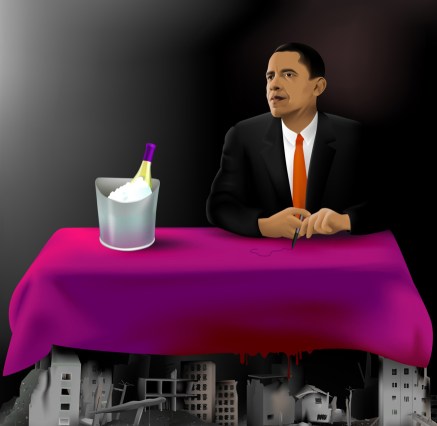
Obama the War President
By Dave Lindorff | This Can’t Be Happening! | February 6, 2015
The Nobel Peace Laureate President Barack Obama, the guy who once campaigned claiming one US war — the one against Iraq — was a “bad” one, and the other — against Afghanistan — was a “good” one, turns out to be a man who, once anointed commander-in-chief, can’t seem to find a war he doesn’t consider to be a “good” idea.
Obama turned out, on taking office, to have a hard time saying good-bye to the occupation of Iraq, only leaving when he was forced out by an Iraqi government that refused to continue giving US forces legal immunity for killing Iraqi civilians. In Afghanistan, he decided to copy the same “surge” — a massive increase in targeted assassinations and violence — that he had once condemned in Iraq. Then he stepped up drone-launched rocket attacks and bombings in seven other countries.
More recently he has begun an air war against Syria (okay, he says it’s against the so-called Islamic State, but the whole world, with the exception of a lot of ill-informed US citizens, knows it’s ultimately against the Syrian government), and now his Secretary of Defense (sic) Ashton Carter and his Secretary of State John Kerry are pushing for sending heavy arms and, inevitably, US “advisors” to Ukraine to escalate US involvement in the civil war there. What makes that latest war particularly dangerous is that all the while, Peace Laureate Obama makes it clear that the “enemy” is Russian President Vladimir Putin and the Russian military.
Never mind that it is the US that originally orchestrated and encouraged the fascist coup that overthrew the elected government of Ukraine, setting in motion a huge pogrom against ethnic Russians in the east of that country and provoking the current armed conflict, and never mind that Russian concern about the Ukraine stems from a decades long history of the US pushing NATO ever closer to Russia’s western border, with Ukraine kind of the last straw.
Anyone looking objectively at the warmaking and war-promotion of this administration would have to conclude that President Obama is one of the most bellicose Chief Executives in the history of the United States.
If you don’t believe me, just look at the US military budget President Obama has proposed for FY2016. At $585.3 billion, it would if approved by Congress represent an increase in spending of $24.9 billion, or about 4%, over the 2015 budget, and that is despite a decline in what, since the Bush/Cheney years, has euphemistically been called Overseas Contingency Operations spending, or spending on actual wars. The proposed OCO budget for 2016 in this “peace” president’s budget is “just” $50.9 billion, down about $13.3 billion from 2015 thanks to what the president, in one whopper offered during his State of the Union address, called the “end of combat” in Afghanistan (that war is actually continuing, with some 12,000 US troops expected to remain stationed in that country indefinitely).
The thing about OCO funding is that it is really not predictive of anything. It could soar way beyond that $50.9-billion level, for example, in a flash if the US follows through and escalates the war in Ukraine — especially if Russian troops are drawn directly into that conflict and the US responds by upping its own involvement.
In fact, the OCO part of the budget has been used by the Pentagon and the administration over the last few years to get around the constraints of an ongoing Congressional “sequestration” requirement that cuts so-called discretionary spending, both military and non-military. Congress, ever mindful and solicitous of the country’s imperial ambitions, provided an exemption for ongoing military conflicts, and the Pentagon has since been deceptively slipping all kinds of other spending under the OCO heading now ever since the loophole was created.
But the Obama administration’s warmongering stance, in terms of the budget, isn’t told just by looking at the official Pentagon budget. There is much more spending that is really all about war. Not included in that $585.3 billion figure is $70.2 billion in discretionary spending for Veterans Affairs (that’s in addition to $90 billion in mandated spending). This is money to pay for the damages of the nation’s warmaking — the injured or ailing veterans who served or are now serving in the nation’s armed forces. Then there’s the intelligence agencies’ budgets — the CIA, the NSA, the FBI, the DIA, the DEA, the ATF and Homeland Security, etc. — most of which is really part of part of the war machine, thanks to the so-called “War on Terror,” which has re-defined the US itself as part of a global war zone. While much of that intelligence budget is concealed from the public on the spurious grounds of “national security,” it is known to exceed $100 billion a year. Add to that the $24-billion share of the Department of Energy budget that is weapons and war related, and you have a real military budget for 2016 of $707 billion. That’s out of a $1.2 trillion total discretionary spending budget (the rest of the $4 trillion proposed 2016 budget is called mandatory because it is debt repayment or spending on mandated things like Social Security and Medicare, which are funded by dedicated payroll taxes, not income taxes and other federal taxes, and which are promised to recipients like retirees and the sick.
What this means is that when you look closely, some 59% of the entire discretionary budget of the federal government – things that are funded each year by money that Congress has to appropriate — is being spent on the military. Given that the total amount of taxes collected by the federal government (income, corporate profits, exist, inheritance, etc.) also comes in at about $1.2 trillion, we’re saying that taxpayers this coming year will be pouring not just $707 billion, but 59 cents of every tax dollar in to war, planning for war, or paying for war. But it’s actually worse than that because actually the US government operates at a deficit, and doesn’t ever finance its wars on a pay-as-you-go basis. Instead, it borrows the money and then pays interest on that debt. Every year that interest comes to about $240 billion, and roughly half that is for borrowing to pay for past wars and past and current military spending. So add $120 billion to the $707 total and it become $827 billion.
In other words, it’s really 68.9% of every tax dollar you pay this April 15 that’s going to pay for America’s wars and its obsession with militarism.
No wonder our schools and universities, our parks, our roads, our once-vaunted global scientific leadership, our environment, our health and safety, our family budgets and even our life expectancy, have been going to hell! The only thing that’s really getting funded in this country is war.
By the way, the reason you may not have realized how much you are paying for war out of your taxes is that the government, and the corporate media, carefully avoid letting you know. They do this by sleight of hand. You see, they never really break out just the “discretionary” budget, or point out the parts of the budget that are outside the Pentagon but that are still really military-related, like spending on nuclear weapons and weapons development, nuclear research and cleanup, decommissioning of nuclear processing plants, and of course veterans affairs and benefits. They also do it by lumping the huge outlays for Social Security benefits and Medicare into the overall spending budget, though actually those benefits are funded not by income taxes but by a Trust fund of some $1.7 trillion that was created over the years by specially-dedicated payroll taxes separately paid by workers and their employers over the working life of each person. Adding those items into the national budget, while leaving out things like spending on veterans, nukes and war debt, appears to reduce military spending to a much less troubling 6.8% of the budget.
But it’s a fraud.
If we want to revitalize the US, the only way to do it is to end militarism and war, and to generously fund human needs.
To do that, we need a real peace president and a peace congress, not the Nobel Laureate warmonger we have now in the White House, and the bi-partisan war chorus we have in the Congress.
US plans to establish military base in Kurdistan
MEMO | February 10, 2015
The United States is planning to establish a military base in the Iraqi Kurdistan town of Erbil, the regional capital. The intention is to provide logistical support to military aircraft deployed against ISIS positions, it has been report by Anadolu.
A spokesperson for the Peshmerga Ministry, which looks after military affairs for the autonomous Kurdish government, said on Monday that military officials and aircraft will be based in Erbil as soon as construction work is finished. “The aircraft will carry out surveillance,” said Helgurt Hikmet, “but those on bombing missions will not take off from the new base.” He did not disclose how many aircraft will be based in Erbil, but said that all 60 member states of the coalition fighting ISIS could make use of the new facilities.
The US-led coalition has launched numerous airstrikes against ISIS targets in both Iraq and Syria in recent months.
Hikmet added that military advisors from eight countries are helping to train Peshmerga personnel.
Court presses US govt to act on withheld photos of post-9/11 detainee abuse
RT | February 5, 2015
A federal court insists it wants the Department of Defense to supplement the 2,100 pictures showing US military abuse of detainees in Iraq and Afghanistan with an individual reason for not making each of them public.
Judge Alvin Hellerstein gave a week to the government on Wednesday either to submit a written estimate of how long it might take to comply with the August 2014 ruling and list individual exemptions for the disclosure of the photographs, or to appeal the court’s decision.
“I have a feeling where we are at this point – to make up a phrase – at a line in the sand,” Hellerstein said, as cited by the Guardian.
The photographs in question depict abuse at US detention facilities in Iraq and Afghanistan following 9/11 attacks. They are believed to be more disturbing than the notorious images of torture and humiliation of detainees at Abu Ghraib prison.
The legal battle for making the classified cache of 2,100 abuse photos public has been led by the American Civil Liberties Union (ACLU) since 2004. The watchdog initiated the case after it was denied the release of photos under the Freedom of Information Act (FOIA).
Hellerstein ruled in 2005 that the government had to make the pictures public. The ruling was supported by the Second Circuit Court of Appeals in 2008.
However, a bill passed by the US Congress in 2009 made it possible for the Department of Defense to conceal images it deemed dangerous for Americans. That same year, President Obama denied the release of the photographs on the grounds they would “further inflame anti-American opinion and … put our troops in greater danger.”
The bulk concealment of abuse pictures is something judge Hellerstein believes wrong. That’s why he ruled in August 2014 that individual reasons should be given for the non-disclosure of each of the photos.
The government has not complied, providing instead a general assessment of the photos, done by associate deputy general counsel Megan M. Weis. She sorted the photos into three categories based on the extent of injury suffered by the detainee, if a US service member was depicted and the location of the photograph. Weis then took samples from each of the categories and showed them to a group of senior military officials, who recommended that CIA Director Leon Panetta keep the images secret.
“I could give you more time to satisfy my ruling…but I am not changing my view,” Hellerstein told the government on Wednesday, as cited by Newsweek.
“Some are harmless” he said of the pictures, while describing others as “highly prejudicial.”
Hellerstein also offered looking through the images with the government, as a way of complying with the court ruling.
In December, the intelligence committee of the US Senate released report detailing the CIA’s use of torture on prisoners in the wake of the September 11, 2001 terrorist attacks.
Sleep deprivation and the simulated-drowning practice known as waterboarding were listed among the so-called enhanced interrogation techniques used by the CIA.
The report released to the public consists of only a 524-page summary out of the full 6,000-page document. It has most of the details blacked out, such as the names of those involved.
The UN and major human rights groups have urged prosecution of those responsible US officials, listed in the Senate’s report. The Justice Department however said it would not pursue charges.
READ MORE:
The Great Israeli Theft of Iraqi Jewish Heritage

Extreme right-wing Israeli Foreign Minister Avigdor Lieberman (C) holding the Torah stolen from Iraq on January 22, 2015
By Alaa al-Lami | Al-Akhbar | February 3, 2015
Recently, Israel stole one of the symbols of Iraqi Jewish heritage, a rare ancient copy of the Torah. The incident went smoothly and quietly, with blatant collusion between Israel, the United States, the Kurdish Regional Government in Iraq, and the Jordanian authorities, amid suspicious silence from the Iraqi federal authorities and the Iraqi cultural scene, save for a few objections.
The Torah manuscript in question, known as the Iraqi Old Testament Scroll, was written using concentrated pomegranate juice on deer-skin parchments. The manuscript was seized by US forces, among other Iraqi antiquities, which survived the systematic destruction by the illegal Anglo-American invasion and occupation.At the time, it was said that many Iraqi archaeological treasures and large amounts of documents from the Iraqi state’s secret archives were transferred to Israel, ostensibly for restoration and preservation. In truth, however, this was the deliberate looting of Iraqi heritage.
At a ceremony held at the Ministry of Foreign Affairs, Israeli authorities publicly displayed that major Iraqi artifact, thus admitting that they had pirated part of Iraq’s heritage. The Israeli Foreign Minister explicitly admitted that the manuscript had been obtained from Kurdistan via Baghdad and Amman, and that it is now being used in daily prayer in the Foreign Ministry synagogue.
According to The Times of Israel, “After it was repaired and prepared for ritual use by a Jerusalem-based scribe, the scroll was placed in a case from Aleppo, Syria and brought over to the ministry.” Avigdor Lieberman, the extremist foreign minister of Israel, did not let the occasion go without repeating old Zionist cliches, saying that “the scroll’s journey from Kurdistan to Baghdad to Amman to Jerusalem was reminiscent of the destiny of the Jewish nation.”
Some like Iraqi writer Akil al-Azraki, one of the rare voices who commented on the affair, believe that the Israeli announcement exposed the lies of the Iraqi government. The Iraqi government had claimed the manuscript was sent along with other Iraqi artifacts to the United States for restoration.
Azraqi, citing information revealed by The Times of Israel, said, “The claim about the Torah scroll having been sent to the United States for restoration is a lie. The scroll was revealed not to have travelled to the United States, but to the Israeli embassy in Amman from that time until 2011. After the attack by Egyptian protesters on the Israeli embassy in Cairo, the manuscript was sent to Israel.”
After the Israelis celebrated their successful piracy, official Iraqi authorities were oddly silent. There was no immediate response to the reports, even in the Iraqi media and cultural scene, save for a few voices.
Recall here that the Minister of Tourism and Antiquities in Iraq Adel Shershab had said on January 19, 2015, “The Jewish archive should have been returned to Iraq since 2005, after it was removed on the grounds of restoring it,” stressing that this was part of Iraqi heritage and that his government would continue efforts to retrieve it.
However, the minister did not say anything in response to the Israeli theft. In turn, the Iraqi Ministry of Culture fell completely silent following the incident, although it had announced on May 13, 2010, that an agreement was conducted between Iraq and the United States, whereby the Iraqi Jewish archive and millions of documents that the US army removed from Baghdad following the US-led invasion in 2003 would be returned to Iraq. These include the archive of the dissolved Baath Party and many Iraqi historical artifacts.
A few days after the report on the Israeli theft, the media published remarks by a member of the Culture Committee in the Iraqi parliament calling on the Iraqi Foreign Ministry to issue a complaint to Washington over the matter.
The news agency that first published the remarks, which is owned by Fakhri Karim, a businessman and senior adviser to former Iraqi President Jalal Talabani, tried to promote another account of what happened.
The news agency said the way the manuscript reached Israel was a “mystery,” describing what happened as “the loss of parts of the manuscript,” even though the Israeli foreign ministry had said in its ceremony that the scroll had come from Baghdad via Kurdistan, Jordan, and then Tel Aviv. Fakhri Karim, however, is known for his pro-Israel attitudes. Karim visited the headquarters of the pro-Israel lobby AIPAC in Washington, as reported by renowned Iraqi poet Saadi Youssef, in a story Al-Akhbar reported in August 2013 (in Arabic).
On the day Al-Mada reported the story, one of its most famous staff writers, Sarmad al-Tai, wrote a strongly-worded criticism of those who protested the theft of the Iraqi Torah scroll, accusing them of folly. He suggested that the Jews who were expelled by the Iraqis from their country in various ways had only retrieved their Torah.
Tai’s article is often quoted by the Israeli media, though some Iraqi Jews who live in Israel and beyond dispute such analysis. Refer, for example, to what Sasson Somekh wrote in his books, and novels by Jewish Iraqi writer Samir Naqqash, who wrote all his novels in Arabic and refused to write anything in Hebrew, considering himself an Iraqi until the last day of his cruel life in Israel. The article received strong responses, though they were few in number, on social media.
The article’s absurd and sinister logic is meant to exonerate the occupation and its allies in the Iraqi federal government, the KRG, and Israel, for the crime of stealing important Iraqi artifacts, produced in Iraq hundreds of years before the creation of the Zionist entity.
Extrapolated further, the same skewed skewed logic can be used to justify an artificial entity, built on injustice, aggression, and warmongering, which has killed, maimed, and displaced people by the millions amid global silence.
The official Iraqi position was not stated publicly until days after the incident. The Iraqi minister of tourism released a statement calling on Washington to return the manuscript to Iraq, and said what happened was unlawful confiscation of a part of Iraqi heritage.
However, the minister repeated previous claims purporting the manuscript had been in Washington. These claims were invalidated by remarks made by Israeli Labor MP Mordechai Ben-Porat, who has Iraqi Jewish ancestry. Ben-Porat said that it was Iraqi government officials who gifted Israel a number of precious historical manuscripts.
Ben-Porat’s account cannot be completely dismissed. It is indeed possible that insiders colluded with this theft and piracy. Recall that Lieberman said that the manuscript was moved from Baghdad to Kurdistan, Jordan, then Tel Aviv.
The theft of Iraqi antiquities is not unprecedented. Many Western powers, led by France, Britain, Germany, and the United States, have its looted artifacts in the last century and before.
Dr Mahmoud al-Saied al-Doghim, Research Associate, Centre of Islamic Studies at the University of London, wrote a paper titled, “One Hundred and Ten Years of US Theft of Iraqi Heritage.” The paper says that entire wings of the Louvre Museum, the Berlin Museum, and the British Museum would have to close down entirely, if they returned all the artifacts stolen from Iraq (and elsewhere).
Doghim estimates the number of stolen artifacts at more than one million. A single US university, the University of Pennsylvania, as he wrote, “Acquired more than 50,000 palettes and other artifacts shedding light on the history of Mesopotamia, and discrediting many of the biblical claims promoted by the Zionists.”
The American occupation forces hit the mother-lode following the invasion of 2003. The US forces seized a large part of the contents of Iraq’s 33 museums.
In effect, the astounding rich history of Iraq and its wealth of ancient historical artifacts is not the subject of dispute. However, it might be very surprising when one examines the numbers.
According to a statement made in March 2003 by former head of Iraqi antiquities Jaber Khalil Ibrahim, archaeologists believe that there are 500,000 archaeological sites in Iraq that remain undiscovered and unstudied, along with ten thousand registered and discovered sites. The sites include at least 25,000 highly important ones.
Only 15 percent of the sites in Iraq have been excavated, most of them located between the Euphrates and the Tigris. This area is considered the cradle of humanity, and from six thousand years ago, it was home to civilizations like the Sumerians, Akkadians, Assyrians, Babylonians, all the way to the Abbasids.
The US occupation of Iraq was a disaster for the country’s material heritage.
Illegal Occupation, the Elephant In The Room
The Origin of Modern Terror and Crumbling Western Values
By John Chuckman | Aletho News | January 26, 2015
Do you ever solve problems by ignoring them? Most of us would say that is not possible, yet that is precisely what western governments do in their efforts to counteract what is called “Islamic terror.” Yes, there are vast and costly efforts to suppress the symptoms of what western governments regard as a modern plague, including killing many people presumed to be infected with it, fomenting rebellion and destruction in places presumed to be prone to it, secretly returning to barbaric practices such as torture, things we thought had been left behind centuries ago, to fight it, and violating rights of their own citizens we thought were as firmly established as the need for food and shelter. Governments ignore, in all these destructive efforts, what in private they know very well is the origin of the problem.
Have Islamic radicals always existed? Yes, we have records through the history of British and French empire-building of strange and fearsome groups. It appears every large religion has a spectrum of believers, always including at one end of the spectrum extreme fundamentalists. They are not a new phenomenon anywhere, so why has one group of them, in the sands of the Middle East, become part of our everyday awareness?
It is also nothing new that young men become hot-blooded and disturbed over what they regard as attacks upon their kind. Western society’s record of crusades, religious wars, colonial wars, and revolts, all total likely having no equal in the histories of the world’s peoples, offers countless examples of young men being angered by this or that circumstance and joining up or running off to fight.
George Bush told us today’s terrorists hate our freedom and democratic values, but like virtually every utterance of George Bush, that one was fatuous, explaining nothing. Nevertheless, his is the explanation pounded into public consciousness because governments and the corporate press never stop repeating versions of it, the Charlie Hebdo affair and its theatrical posturing over free speech being only the latest. Theatrical? Yes, when we know perfectly well that most of those who marched at the front of the parade in Paris are anything but friends of free speech.
All backward peoples are uncomfortable with certain western values, that being the nature of backwardness, and backwardness is a defining characteristic of all fundamentalist religious groups – Hasidic or ultra-Orthodox Jews, Mennonites, Roman Catholic Cardinals, cloistered nuns, Sikhs, and many others – who typically choose modes of dress, rules to obey, and even foods to eat having little or no relationship with the contemporary world and science. Of course, that is their right so long as they are peaceful and law-abiding.
Any fundamentalist group, pushed by more powerful people from outside their community, is entirely capable of, and even prone to, violence, and all human beings are capable of violence when faced with abuse and injustice. Centuries of religious wars and terrors in Europe about such matters as how the Mass is celebrated prove the proposition and should be held as a warning, but they are forgotten by most, if they were ever known. The tendency towards violence continues today amongst many fundamentalist faiths. In so relatively small and seemingly homogeneous a society as Israel, there are regular attacks from ultra-Orthodox Jews against the country’s worldly citizens or against fair-minded rules about such pedestrian matters as women riding buses or walking on a street. The attacks become quite violent – punching, spitting, burning down homes, and killing sometimes – and all go against what we call western values, but because the scale is fairly small, and our press also has a constant protective bias concerning all things Israeli, these events rarely make our mainline news. They must be found on the Internet.
It took Western Europe literally centuries to leave behind such recurrent and violent themes as witches and the need to burn them alive, the Evil Eye, casting out demons, execution for differences of belief, and countless other stupidities which characterized whole societies and destroyed lives. And if you want to go still further back, go to the Old Testament, a collection of ancient writing packed with violence, superstition, prejudice, and just plain ignorance, which Christians and others even today regard as containing important truths for contemporary life. Human progress, at least in some matters, takes a very long time indeed.
Our world has more backward people than most of us can imagine. The news does not feature their extremes and savageries because it serves no political purpose. In Africa, for example, we find practices and beliefs utterly repellent to modern minds: the practice of senior village men raping young girls as an accepted right, the genital mutilation of 3 million girls annually (an African, not an Islamic, practice), the hunting down and butchering such “strange” people as albinos, their parts to be eaten as medicine, and many others. In India, a country well on its way to becoming modern yet one with a huge backward population, we have practices such as marrying off mere girls to old men rich enough to pay dowries to poor parents. At one stroke this enriches the parents and relieves them of the burden of a child, a female child too, always viewed less favorably. The practice generates a large population of widows when the old husbands of girls married at, say, twelve die. These women are then condemned to entire lives as widows, never allowed to remarry, required to dress and eat in certain ways, and basically shunned to live in squalid equivalents of old folks homes, living entirely meaningless lives. India also has the practice of “bride burning” where new brides who are deemed unacceptable for various reasons become the prey of the groom’s family, literally being burned alive. There are many other barbarities in that society too, including “honor killing” and young women who are made inmates in certain temples to serve as glorified prostitutes.
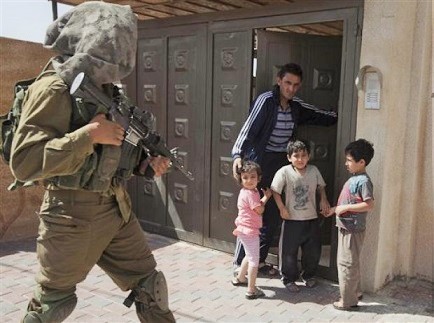
Our press assiduously avoids much of the world’s horrors as it focuses on “Islamic extremism,” and politics are the only explanation for the bias. The press theme of Islamic terror and indeed real incidents of terror grow from a reality always taken for granted, never debated, and certainly never criticised: the elephant in the room, as it were, is Israel’s illegal and agonizingly long occupation of the Palestinians.
It may be not be important to our press and governments that Israel holds millions as prisoners, crippling the lives of generation after generation, or that Israel periodically strikes out in every direction – Gaza, Lebanon, Syria, the West Bank – causing the deaths of many thousands, or that Israel is seen to bulldoze people’s homes and sacred monuments with complete impunity, but it very much matters to many millions of Muslims in the world, and some of them, fundamentalist men, strike out against it just as young men everywhere have sometimes struck out against keenly-felt hurts and injustice.
In western countries, under the hard influence of America, a country in turn under the hard influence of the world’s best organized and financed lobby, the Israel Lobby, we have come to regard Israel’s behavior as normal, but it is, of course, not normal, not in any detail. What is normal about holding several million people prisoner for half a century? What is normal about bulldozing homes and literally stealing the land upon which they stood? What is normal about declaring an honestly elected government as criminal and treating its people as though they were criminals? What is normal about limiting people’s opportunity to earn a living or to import some of the needs of life? What is normal about killing nearly a thousand children, as Israel has done just in Gaza, since 2008?
Pretending that Israel’s behavior is not the major cause of what screams from our headlines and news broadcasts has reached absurd levels. America has only vastly compounded the problem of Israel’s organized abuse of a people: it and its silent partners have destroyed Iraq, destroyed Libya, are working hard to destroy Syria, have seen to it that Egypt’s tens of millions again live under absolute government, ignore countless inequities and barbarities in secretly-helpful countries like Saudi Arabia, and carry out extra-judicial killings through much of the region. All of it is carried out on Israel’s behalf and with Israel’s cooperation. Can any reasonable person not see that this vast factory of death also manufactures countless grievances and vendettas? The stupidity is on a colossal scale, rooted in the notion that you can kill your way out of the terrible consequences of terrible policies.
In America, paid political shills (Newt Gingrich was one) have campaigned about there being no such thing as a Palestinian. Others (Dick Armey was one) have said that millions of Palestinians should be removed, all their land left conveniently to Israel. That last is an odd thing to say, isn’t it, considering there are supposed to be no such thing as Palestinians? And just what country would take millions of “non-existent” Palestinians? Obviously no politician with even pretence of integrity would say such things, and how can intelligent and successful people like America’s Jews take satisfaction in hearing politicians reciting such embarrassing scripts? But this is a good measure of the way intelligence and sound thinking are scorned in American politics. How can you achieve anything worth achieving without intelligence and sound thinking? You cannot, but that doesn’t stop American Presidents and Secretaries of State from carrying on the world’s longest-running dumb show, something called the “peace process.” The sombre, moose-like figure of John Kerry is photographed playacting at statesmanship while American-supplied arms just keep killing thousands of innocent people.
Hollywood uses ‘American Sniper’ to destroy history & create myth
By John Wight | RT | January 23, 2015
The moral depravity into which the US is sinking is shown by American Sniper glorifying the exploits of a racist killer receiving six Oscar nominations, whereas ‘Selma’ depicting Martin Luther King’s struggle against racism has been largely ignored.
American Sniper is directed by Clint Eastwood, and tells the story of Chris Kyle, a US Navy Seal who served four tours of duty in Iraq as a sniper credited with 160 confirmed “kills”, and earning him the dubious honor of being lauded the most lethal sniper in US military history.
Played by Bradley Cooper, in the movie Kyle is an all-American hero, a Texas cowboy who joins the military out of a sense of patriotism and a yearning for purpose and direction in his life. Throughout the ‘uber-tough’ selection process, Kyle is a bastion of stoicism and determination, willing to bear any amount of pain and hardship for the honor of being able to serve his country as a Navy Seal – America’s equivalent of the Samurai.
The personal struggle he endures as a result of what he experiences and does in Iraq is not motivated by any regrets over the people he kills, including women and children, but on his failure to kill more and thereby save the lives of American soldiers as they go about the business of tearing the country apart, city by city, block by block, and house by house.
If American Sniper wins one Oscar, never mind the six it’s been nominated for, when this annual extravaganza of movie pomp and ceremony unfolds in Hollywood on February 22, it will not only represent an endorsement of US exceptionalism, but worse it will be an insult to the Iraqi people. In the movie they are depicted as a dehumanized mass of savages – occupying the same role as the Indians in John Wayne Western movies of old – responsible for their own suffering and the devastation of their country, which the white man is in the process of civilizing.
Anything resembling balance and perspective is sacrificed in American Sniper to the more pressing needs of US propaganda, which holds that the guys who served in Iraq were the very best of America, men who went through hell in order to protect the freedoms and way of life of their fellow countrymen at home. It is the cult of the soldier writ large, men who in the words of Kyle (Bradley Cooper) in the movie “just want to get the bad guys.”
The ”bad guys” are, as mentioned, the Iraqis. In fact if you had just arrived in the movie theatre from another planet, you would be left in no doubt from the movie’s opening scene that Iraq had invaded and occupied America rather than the other way round.
Unsurprisingly, the real Chris Kyle was not as depicted by Clint Eastwood and played by Bradley Cooper. In his autobiography, upon which the movie is supposedly based, Kyle writes, “I hate the damn savages. I couldn’t give a flying f**k about the Iraqis.”
It is clear that the movie’s director, Clint Eastwood, when faced with the choice between depicting the truth and the myth, decided to go with the myth.
But it should come as no surprise, given that the peddling of such myths is the very currency of Hollywood. Over many decades the US movie industry has proved itself one of the most potent weapons in the armory of US imperialism, helping to project a myth of an America, defined by lofty attributes of courage, freedom, and democracy.
As the myth has it, these values, and with them America itself, are continually under threat from the forces of evil and darkness that lurk outwith and often times within. The mountain of lies told in service to this myth has only been exceeded by the mountain of dead bodies on the basis of it – victims of the carnage and mayhem unleashed around the world by Washington.
Chris Kyle was not the warrior or hero portrayed in American Sniper. He was in fact a racist killer for whom the only good Iraqi was a dead Iraqi. He killed men, women, and children, just as his comrades did during the course of a brutal and barbaric war of aggression waged by the richest country in the world against one of the poorest.
They say that patriotism is the last refuge of the scoundrel. In the hands of a movie director with millions of dollars and the backing of a movie studio at its disposal, it is far more dangerous than that. It is a potent weapon deployed against its victims, denying them their right to even be considered victims, exalting in the process, when it comes to Hollywood, those who murder and massacre in the name of America.
With this in mind, it is perhaps fitting that Chris Kyle was shot and killed by a former Marine at a shooting range in Texas in 2013. “Man was born into barbarism,” Martin Luther King said, “when killing his fellow man was a normal condition of existence.”
Keeping the Chilcot Inquiry Under Wraps
By JONATHAN WOODROW MARTIN | CounterPunch | January 22, 2015
24-hours after a report claiming the UK government is the most transparent in the world, the 6-year wait for The Chilcot Inquiry into the Iraq War to be published was extended until after the general election in May this year.
I was present for one of the eyewitness-sessions of the enquiry when former Prime Minister Tony appeared, back in 2010. Whilst he blathered on about the threat of a nuclear-armed Iran (which still hasn’t happened, even after decades of neo-con doom-mongering) I wondered how difficult it was to completely wrap yourself in an ideology to protect your being from the glaring mis-truths you have to speak and actions you carry out. It obviously takes a high degree of a certain kind-of-intelligence to do this, no-one doubts that Blair was and is an intelligent man, in this way. However, that intelligence was completely consumed by the Iraq invasion and subsequent set of disasters that have beset that country and region since. He looked like a haunted man that day, let alone today.
It wasn’t JUST Blair though. He was the prime minister at the time and he certainly set the tone and action for the UK joining the US politically and militarily on this mis-adventure. I do doubt that the ever-cautious Gordon Brown (at that time Chancellor of the Exchequer) would have been so hasty to join the lunatics in the Pentagon and Oval Office if he had been prime minister at the time. However, it was Parliament which made the final decision to join the invasion, overwhelmingly, 412-149. (This final vote took place one-day before the invasion began).
Were the Members of Parliament, who voted for the invasion, blinded by the intelligence (or lack of) coming from the UK and US security forces? Were they too busy being whipped in to frenzy by the media (Murdoch) and party whips? Was there a sense of left-over imperial pride in re-entering the scene of previous British conquests in the early 20th century in the then named Mesopotamia? I don’t know. It must have been a tricky time for many, and many still carry the scars of their terrible decision-making today, most notably Tony Blair. It is easy to conclude that it was the faulty (made-up) intelligence that fooled these members of parliament, but even if the intelligence had been 100% correct, that Saddam Hussein had a large WMD programme and was potentially looking to build nuclear weapons, were those reasons, based on old assumptions and half-truths that had been known for decades, reason-enough to commit your armed forces to a hasty assault on a sovereign nation? If so, we in the UK should prepare for invasion as our government pushes ahead in replacing our nuclear “deterrent”.
You will have heard and read a lot about how what is happening in Iraq and the wider-region has nothing to do with the US-UK led invasion. Or will you? Most reports I have seen on the likes of BBC television news offer very little context on how Islamic State (IS) came to exist and how, most importantly, they are accepted or at least tolerated as an alternative by Sunni populations in Syria and Iraq in comparison to their sectarian governments who are seen as waging war on them. In the aftermath of the invasion, the American and British systematically destroyed the Iraqi state as existed under Saddam Hussein’s Baathist and Sunni-led dictatorship and turned the country completely over the previously persecuted Shia majority of the country, without any real thought or concern for the consequences this would have on the citizens of Iraq. If the invasion was illegal under international law (which to this laymen, it clearly was) these actions were tantamount to the prolonged torture of an entire country and its people (not to mention Abu Ghraib).
When The Chilcot Inquiry is eventually published, clearly at a time which best suites those under the microscope and wider establishment and not the British public, who were, it should be remembered, overwhelmingly against the invasion, what will we discover that we do not already know? The invasion was an utter disaster for the people of Iraq, yet not one of the decision-makers has ever felt any justice for this. History books, enquiries and public anger are not enough. Where is the International Criminal Court (ICC) when you need it?
Jonathan Woodrow Martin can be reached at jwoodrowm@gmail.com
Featured Video

ARE PATIENTS BEING PROPERLY INFORMED ABOUT OZEMPIC?
or go to
Aletho News Archives – Video-Images
From the Archives
Trans ‘milk’ as good as the real thing – NHS
RT | February 18, 2024
The drug-induced nipple secretions of trans women are as good as mothers’ breast milk for babies, the University of Sussex Hospitals NHS Trust claimed in a letter to campaigners made public in a report by British think tank the Policy Exchange on Sunday.
The healthcare trust’s medical director, Rachel James, argued that the off-label prescription drug cocktail men transitioning to female take in order to produce milk was “similar to the natural hormones which encourage lactation to develop when the baby is newly born.”
“The evidence which is available demonstrates that the milk is comparable to that produced following the birth of a baby,” James wrote in the letter, sent to Children of Transitioners last August.
Biological men who wish to lactate must first take hormones to grow milk glands and then take high doses of either domperidone or metoclopramide to stimulate milk production. Neither drug is approved for this use, though they are occasionally prescribed off-label to biological women who have trouble lactating.
However, domperidone’s own manufacturer, Janssen, warns patients the drug “may cause unwanted side effects affecting the heart in a breastfed baby” and “should be used during breastfeeding only if your physician considers this clearly necessary.” … continue
Blog Roll
 Aletho News
- 2025 Nature Paper Claiming Worsening Global Drought Gets RETRACTED …Heavily Flawed
- Your Milk Is Not the Problem
- The Truth About the Trump Shootings with Ken Silva
- ARE PATIENTS BEING PROPERLY INFORMED ABOUT OZEMPIC?
- US lawmaker blocks $2.8 billion weapons sale to Israel: Report
- Yemeni army claims responsibility for strikes on sensitive sites in Saudi capital, Aramco facilities in Yanbu
- Iran Judiciary issues indictments against 159 US, Israeli officials for assassination of Leader, commanders
- Turkiye revokes Iranian bank license under US sanctions campaign
- US-Denmark Agreement on Greenland Is ‘PR Stunt’ Ahead of Midterms
- Araghchi: Military intervention cannot create security; coercion cannot bring peace
- If Americans Knew
- Salah Sarsour’s Legal Team Says DHS Has Not Met Its Burden to Prove He Is Deportable
- An analysis of tax forms by The Intercept show Kraft’s charity and LLC have donated to Friends of the IDF and AIPAC’s super PAC.
- Israeli attacks kill four Palestinians in Gaza – Daily Update
- Inside Gaza’s death trap of collapsing, bombed-out buildings
- The everyday items Israel bans from Gaza every day
- Inside the siege, the ruined buildings of Gaza – Daily Update
- Debunking The Claim That Macklemore Has A “History Of Antisemitism”
- CPJ demands release of arrested Palestinian-US journalist near Bethlehem
- Robert Kraft: The Billionaire Friend of Netanyahu Pulling The Strings Behind the Macklemore/Ed Sheeran Blow Up
- Columbia Administered Fund Gives Big Money to Pro-Israel Groups
- No Tricks Zone
- 2025 Nature Paper Claiming Worsening Global Drought Gets RETRACTED …Heavily Flawed
- New Study: ‘Global Drought Shows No Detectable Recent Acceleration Under Climate Warming’
- Economic Masterminds: German Socialists Suggest Taxing Productivity Gains Stemming From Using AI
- The South China Sea Has Not Been Cooperating With The Climate Change Narrative
- Energy Crisis: Germany Enters Heating Season With Historically Low Gas Reserve Fill Levels
- New Study: The Antarctic Ice Sheet Gained Mass From 2020-2024 Due To Staggering Snow And Ice Accumulation
- Study: Ocean Heating Rates From Thousands Of Years Ago ‘Dwarf’ Modern Ocean Heating Rates
- Climate Extremists Target, Attack Large-Scale Power Grid Infrastructure In Germany!
- New Study: Antarctic Ice Melt Has Contributed Less Than 1 Centimeter To Sea Level Rise In The Last 30 Years
- Fear Of Debate: Alarmist German Climate Scientist Calls On Mainstream Media To Discredit Skeptic Voices
 Aletho News