Scottish First Minister leads united call for Iraq war report disclosure
RT | January 19, 2015
Scottish National Party (SNP) leader Nicola Sturgeon has called for a united political movement to demand the immediate publication of the Chilcot Inquiry report into the legality of the 2003 Iraq invasion.
Sturgeon has written to other Scottish party leaders, urging them to unite in favor of immediate publication.
The Chilcot Inquiry, which was set up in 2009 and is expected to cost the taxpayer over £10 million, has come under fire in recent months due to delays in its publication.
The disclosure of secret documents, and disagreements over whether private communications between former leaders Tony Blair and George W. Bush should be made public, has disrupted the progress of the inquiry.
There are now fears that unless the report is published immediately, its release could affect the results of the general election in May.
The leader of the Scottish Labour Party, Jim Murphy, and the Scottish Liberal Democrat leader, Willie Rennie, have also said they support the earliest possible release of the document.
The House of Commons will debate the release of the findings on January 29.
Last month there was speculation that Tony Blair may face prosecution for war crimes as a result of the report’s findings. Blair said he “resented” claims he was responsible for the delays.
The debate surrounding the release of classified material had presented a large obstacle to the publication of the report, but it was decided in June last year that the “gist” of conversations between Blair and Bush could be published.
Sturgeon said it would be impossible to have a national election without the report’s findings being presented.
“Surely we can’t go through a general election without people having the answers to the questions on the Iraq war that they still don’t have,” she told the BBC.
“That has to happen before some of these MPs that voted for the Iraq war are back up for election.”
Murphy responded to Sturgeon’s call for action, saying it was essential for future governments to learn from the results.
“The Chilcot Inquiry is a crucially important piece of work that must be conducted thoroughly and forensically,” he said. “The inquiry was initiated by Labour in July 2009, because it is vital to identify the lessons that can be learned from the conflict.”
“There is rightly real public interest in the findings of such an important inquiry and I think it is right that there is the earliest possible publication of the report.”
Rennie also expressed his eagerness for the report to be published, saying he agreed with the SNP’s Sturgeon.
“We agree with Nicola Sturgeon. It is important that the lessons learnt from the Chilcot report are learnt whilst there are people involved in Parliament who are in a position to answer for their actions.”
A spokeswoman for the Iraq Inquiry said: “We will not be commenting further on the process or the progress of the report.”
READ MORE:
Cameron has final word on release date of Iraq war report – Downing Street
Baghdad 1950. Paris 2015?
False Flag Attacks by Zionists Against Fellow Jews…

Left: Zionist agent in Iraq, Naeim Giladi, circa 1947; right: Iraqi Jews arrive in Israel 1951
By Richard Edmondson | Fig Trees and Vineyards | January 14, 2015
It is said that there is nothing new under the sun.
Jewish leaders talking up the threat of “anti-Semitism” in order to induce Jews to immigrate to Israel is of course not new. Such talk emanating in the immediate aftermath of what appear to have been false flag attacks by Zionists against fellow Jews–this also is not new.
“To all the Jews of France, all the Jews of Europe, I would like to say that Israel is not just the place in whose direction you pray, the state of Israel is your home,” Israeli Prime Minister Benjamin Netanyahu said over the weekend in the wake of the attacks in Paris.
Netanyahu is certainly up on his Jewish history, but for those of the rest of us who may not be quite as well-versed, here is a little primer.
In the years 1950-51, the city of Baghdad was hit by a series of explosions targeting Iraqi Jews. The attacks caused property damage, injuries, and deaths, creating panic in the Jewish population. At the time the bombings were blamed upon Arab nationalists, raising fears of anti-Semitism and giving rise to a desire by Jews to immigrate to Israel–which of course, at precisely that same time, was in the process of displacing Palestinians and attempting to expand its Jewish population.
What follows is a timeline of events in Baghdad excerpted from a book written and published in the 1990s by an Iraqi Jew named Naeim Giladi. I’ll say a little bit more below about who Giladi was, but for right now just consider the timeline as he presents it:
Six months later-the exact date was March 19, 1950-a bomb went off at the American Cultural Center and Library in Baghdad, causing property damage and injuring a number of people. The center was a favorite meeting place for young Jews.
The first bomb thrown directly at Jews occurred on April 8, 1950, at 9:15 p.m. A car with three young passengers hurled the grenade at Baghdad’s El-Dar El-Bida Café, where Jews were celebrating Passover. Four people were seriously injured. That night leaflets were distributed calling on Jews to leave Iraq immediately.
The next day, many Jews, most of them poor with nothing to lose, jammed emigration offices to renounce their citizenship and to apply for permission to leave for Israel. So many applied, in fact, that the police had to open registration offices in Jewish schools and synagogues.
On May 10, at 3 a.m., a grenade was tossed in the direction of the display window of the Jewish-owned Beit-Lawi Automobile Company, destroying part of the building. No casualties were reported.
On June 3, 1950, another grenade was tossed from a speeding car in the El-Batawin area of Baghdad where most rich Jews and middle class Iraqis lived. No one was hurt, but following the explosion Zionist activists sent telegrams to Israel requesting that the quota for immigration from Iraq be increased.
On June 5, at 2:30 a.m., a bomb exploded next to the Jewish owned Stanley Shashua building on El-Rashid street, resulting in property damage but no casualties.
On January 14, 1951, at 7 p.m., a grenade was thrown at a group of Jews outside the Masouda Shem-Tov Synagogue. The explosive struck a high-voltage cable, electrocuting three Jews, one a young boy, Itzhak Elmacher, and wounding over 30 others. Following the attack, the exodus of Jews jumped to between 600-700 per day.
Zionist propagandists still maintain that the bombs in Iraq were set off by anti-Jewish Iraqis who wanted Jews out of their country. The terrible truth is that the grenades that killed and maimed Iraqi Jews and damaged their property were thrown by Zionist Jews.
The paragraphs above come from Giladi’s book, Ben Gurion’s Scandals: How the Haganah and the Mossad Eliminated Jews, originally published in 1992. An except from the book can be found here, and includes details about the Baghdad bombings as well as a number of other interesting items, including Giladi’s own immigration to Palestine and what he witnessed there. You’ll note, in the timeline, his reference to leaflets being distributed on the same day of the April 8 bombing. That leaflet read in part, “Call to the Jews: To all the tribe of Zion living in Babylon.” It goes on to encourage an exodus out of Iraq:
“For the second time in the history of the diaspora, we have an opportunity to leave. We encourage you to hurry and leave. Today the Jews are in a new era of the history of the diaspora.”
Giladi was born in Iraq in 1929 and became a committed Zionist in his late teens. Later in life he disavowed Zionism, renounced his Israeli citizenship, and moved to the US. His change of heart began when, as a young Jewish immigrant, shortly after arriving in Israel, he encountered “institutionalized racism,” against both Palestinians as well as Arabic or Mizrahi Jews.
The principal interest Israel had in Jews from Islamic countries was as a supply of cheap labor, especially for the farm work that was beneath the urbanized Eastern European Jews. Ben Gurion needed the “Oriental” Jews to farm the thousands of acres of land left by Palestinians who were driven out by Israeli forces in 1948.
At the time in question, the early 1950s, Israel was ethnically cleansing the Ashkelon area and forcing Palestinians who lived there into the Gaza Strip. Farms were indeed taken over, and so, yes, there was a need for cheap labor, and Jews from Iraq provided a good source. And to make sure that the new arrivals were wholly dependent upon their earnings as laborers, Israel saw to it that they were forced, for the most part, to leave their property and possessions behind in Iraq. According to Giladi:
…the pro-British, pro-Zionist puppet el-Said [Nouri el-Said, the Iraqi prime minister–ed.]saw to it that all of their possessions were frozen, including their cash assets. (There were ways of getting Iraqi dinars out, but when the immigrants went to exchange them in Israel they found that the Israeli government kept 50 percent of the value.) Even those Iraqi Jews who had not registered to emigrate, but who happened to be abroad, faced loss of their nationality if they didn’t return within a specified time. An ancient, cultured, prosperous community had been uprooted and its people transplanted to a land dominated by East European Jews, whose culture was not only foreign but entirely hateful to them.
Giladi passed away in 2010, but his conclusions–that the Baghdad bombings were perpetrated by Zionist Jews–are shared by a number of modern historians and writers, including Uri Avnery, who wrote that, “After the disclosure of the Lavon Affair… the Baghdad affair became more plausible.” But perhaps most interesting was the assessment given by career CIA officer Wilbur Crane Eveland:
In attempts to portray the Iraqis as anti-American and to terrorize the Jews, the Zionists planted bombs in the U.S. Information Service library and in synagogues. Soon leaflets began to appear urging Jews to flee to Israel. . . .
Although the Iraqi police later provided our embassy with evidence to show that the synagogue and library bombings, as well as the anti-Jewish and anti-American leaflet campaigns, had been the work of an underground Zionist organization, most of the world believed reports that Arab terrorism had motivated the flight of the Iraqi Jews whom the Zionists had “rescued” really just in order to increase Israel’s Jewish population.
The above is quoted by Giladi and is derived from Eveland’s memoir, Ropes of Sand: America’s Failure in the Middle East, published in 1980.
An Iraqi court went on to find 20 people, all members of the Iraqi Zionist underground, guilty of carrying out the bombings. Two were sentenced to death, and the rest received lengthy prison terms. But by this time the Jewish population of Iraq had been greatly reduced. Giladi says that 125,000 Iraqi Jews ended up immigrating to Palestine, leaving just 6,000 remaining. It also resulted in a split in Giladi’s own family; while Giladi himself made the journey, his parents, he says, were not fooled by the false flag events and remained behind in Iraq.
***
While a good many analysts have concluded that the recent attacks in Paris were a false flag operation, carried out most likely by Israel, others have expressed dubiousness on the matter. Certainly Israeli false flag operations are well documented, but a line would surely be drawn at targeting Jews in such attacks–this seems to be the reasoning. The events in Baghdad 65 years ago, however, would apparently refute this notion. If something is “good for the Jews” collectively, as a whole, then it can apparently be justified even should it be brought about at the expense of individual Jews–that at least seems to be the thinking on the matter by some Jews or Jewish leaders at any rate. Maybe, though, this should come as no surprise, and here I’m reminded of the words of Caiaphas, the chief priest at the time of Jesus: “You do not realize that it is better for you that one man die for the people than that the whole nation perish.”
I highly recommend Giladi’s book excerpt in its entirety, if you have the time, for it makes for fascinating reading. You can also click here to see a video featuring an interview with the author that was conducted in 1994.
Meanwhile Israeli officials continue urging French Jews to make “aliyah” to Israel.
“Due to the impossible security situation [for French Jews], Israel has a responsibility to allocate all necessary resources to facilitate the aliyah and absorption of Jews from France,” said Knesset member Yoni Chetboun.
Other Israeli officials have also spoken out.
“Your place, Jews of France, is with us,” said Rabbi Eli Ben-Dahan, Religious Affairs minister, speaking at a Jewish Home party rally.
“We are all shocked at the recent wave of anti-Semitic attacks in France,” said Knesset member Motti Yogev. “To all our Jewish brothers in France we call: Come and make Aliyah to Israel! Here is your home – our home.”
Another Israeli politician, Yair Lapid, seemed to be going out of his way to push the alarm buttons.
“I don’t want to speak in terms of Holocaust, but…” he said, “European Jewry must understand that there is just one place for Jews, and that is the State of Israel.”
All of this is obviously having an effect. The leader of a Paris synagogue is predicting that between 14,000 and 15,000 French Jews will immigrate to Israel in 2015, and indeed hundreds are reported to have flocked to an “aliyah fair” held on Sunday.

French Jews attend an “aliyah fair” held in Paris on Sunday, Jan. 11, just two days after an attack on a kosher market. A series of such fairs are scheduled as part of an Israeli policy called “France First.”
Is not the holding of an “aliyah fair” just two days after an attack on a kosher market pretty much the equivalent or on a par with the aforementioned leaflets printed by the Zionist underground in Baghdad 65 years ago?
Is there anything new under the sun?
By the way, additional aliyah fairs are scheduled this week for Marseilles and Lyon, with more to come in February and March. The organizing of such events is said to be part of a new Israeli policy–overseen by the Ministry of Immigration Absorption–called “France First.” The implications of such a policy are somewhat alarming. If France is “first,” who’s next? Will attacks similar to the ones last week begin to occur in other countries with large Jewish populations?
No word on whether Netanyahu dropped by the fair in Paris on Sunday, although he was in the city participating in the giant anti-terrorism march–this of course despite the fact that he had been specifically requested by the French government not to come. One person who did pop into the fair, however, was Natan Sharansky, chairman of the Jewish Agency, who had accompanied the prime minister to Paris from Israel.
In his remarks, Sharansky assured the potential immigrants that “the Jewish Agency embraces the French Jewish community at this difficult time and is extending its full support by helping provide for the physical security of Jewish communities across France, increasing our assistance to any individual who wishes to immigrate to Israel, and working to ease immigrants’ integration into the Israeli workforce and Israeli society.”
Translation: don’t worry. The United States will pay for it.
The calls for Jewish immigration today are, of course, motivated by different needs from those of 65 years ago. Recently the Palestinian Central Bureau of Statistics released figures showing that the number of Palestinians throughout historical Palestine will exceed the Jewish population by the end of the year 2020. The figures have been challenged by Israeli academics, who insist the Palestinian statistics are flawed, although certainly the “demographic threat” has been an ongoing Zionist concern.
But prompting an upswing in Jewish immigration probably would not have been the only, and maybe not even the prime, consideration in carrying out the Paris attacks–that is assuming the attacks were a false flag. Other writers have suggested a number of other motivations including payback for France’s support for Palestinian statehood at the UN. (One wonders: was Israel’s “France First” policy adopted before or after the UN vote?)
What is clear, of course, is that terrorist organizations and terrorist armies are being supported by some of the most powerful nations on earth, and that these forces are being used to advance certain geopolitical objectives. The likelihood that such elements will be mobilized in some way in future false flag attacks in Western cities has to be considered high.
Dude, Where’s My Peace Dividend?
By Robert Ted Hinds | CounterPunch | January 14, 2015
In the 1970s and 1980s, Americans were conditioned with the idea that the extraordinary growth in military expenditure for the U.S. to “win the arms race” with the USSR would somehow lead to a “peace dividend.” That’s what the elected officials of the United States and its NATO allies called it. Eventually the Soviet Union did collapse under the weight of its own economic dysfunction and hyper-militaristic bureaucracy. When the Berlin Wall came down on November 9, 1989, compelled by massive nonviolent noncooperation with the dictatorial regime, it seemed that the leaders of the world might finally declare the peace dividend we had all been expecting. Mankind as a whole seemed to have hope that the specter of nuclear war had vanished and that a constitutional democracy could operate as a benevolent superpower.
It wasn’t long before President Bush Sr. replaced the old war with a new one. The New York Times disclosed official transcripts of a conversation between US Ambassador to Iraq, April Glaspie, and Saddam Hussein where she said, “We have no opinion on the Arab-Arab conflicts like your border disagreement with Kuwait. James Baker (Secretary of State) has directed our official spokesmen to emphasize this instruction.”
Soon after, Saddam Hussein invaded Kuwait and America’s action toward war was swift. King Hussein of Jordan, one of America’s strongest allies in the region (and whose wife was American), told the New York Times that the day of the invasion, Bush gave him 48 hours to negotiate a withdrawal of Iraqi forces from Kuwait.
The Jordanian king secured a promise from Saddam to withdraw all of his forces within a week to avert war. King Hussein could not understand why the deal was undermined by the Bush Administration. The US and its Allies proceeded to annihilate the Iraqi army it had supported for 10 years during the Iran-Iraq War which ended in 1988. George Bush had been able to maintain diplomatic relations with Saddam when Saddam was waging war against Iran, but not when he was offering to withdraw from Kuwait. Thus began the Gulf War in 1991 and a process of political destabilization in the Middle East that has been a pretense for ongoing military intervention to this day.
Harvard public policy professor Linda Bilmes published a study in 2013 estimating that the true cost of the current wars in Iraq and Afghanistan will run between $4 trillion and $6 trillion, including ongoing healthcare for veterans and interest on the war debt. A similar study by Brown University put the price tag at $4 trillion, but both of these studies preceded the rise of ISIS and do not account for rising tensions with Iran and Syria, or Russia in the Ukraine.
Where’s the peace dividend we were promised throughout the Cold War, that payback for defeating the evil superpower that prevented America from spreading peace and democracy by way of its “benevolent hegemony?” Where’s our $4 trillion? The war hawks and politicians in Washington D.C. will tell you it is being reinvested to defeat terror and secure American interests abroad; that the elusive dividend payment is just another war or two away. In an October 2014 interview with USA Today to promote his book Worthy Fights, President Obama’s former Secretary of Defense and CIA Director, Leon Panetta, stated that “we can expect kind of a 30-year war” that would need to include Nigeria, Yemen, Libya and other threats. Those who profit from the military-industrial complex will continue to recognize a return on their investments. The American people will only realize a peace dividend when their government begins to practice peace instead of war as a means to foreign policy.
Robert Ted Hinds is an activist, journalist, and professional analyst. He holds a Master of Business Administration from Washington State University and Bachelor of Science degrees in Psychology and Finance from the University of Oregon.
Charlie Hebdo Massacre: Another Staged Event to Incite War and Destroy Freedom?
By Brandon Martinez | Non-Aligned Media | January 11, 2015
The “Islamists” strike again – at least that’s what those who stand behind the latest outrage in Paris want us to believe.
On Wednesday, two masked gunmen wielding AK-47s stormed the headquarters of Charlie Hebdo, a satirical newspaper based in Paris, France, assassinating the entire leadership of the paper. Twelve people were killed in the ensuing rampage, mostly Charlie Hebdo employees and a few policemen. Days later, four more random civilians were gunned down at a kosher supermarket by two other militants allegedly connected to the shooters in Paris.
Sporadically shouting “Allah Akbar” throughout the duration of their onslaught, the two attackers were caught on video making a spectacle of themselves as they paraded down the Paris street guns blazing. It is typically unusual for terrorists to immediately make it known who they are and what they stand for before concluding their dirty work, an anomaly the mainstream media refuses to emphasize for obvious reasons.
Other anomalies are cause for skepticism. How did the terrorists get ahold of military-grade weaponry undetected? Journalist Gearoid O Colmain told Russia Today that the two deceased suspects, French-born Said and Cherif Kouachi, had received military training from militants in Syria and had also traveled to Yemen to meet with al-Qaeda leaders there. And yet the pair was able to return to France without interference from authorities. Other reports indicate that the brothers were known and being monitored by French intelligence, but were still able to obtain the necessary armaments to conduct Wednesday’s attack without a hiccup.
In a Jan. 8 article, Sputnik News reported: “Said and Cherif Kouachi, two brothers in their 30s who are suspected of committing the [Charlie Hebdo] terror attack, have been known to France’s General Directorate for Internal Security and the prefecture of Police of Paris, Le Point news magazine said Thursday.” The Sputnik article further revealed that in 2008 Cherif Kouachi had been arrested and sentenced to a prison term of three years for attempting to recruit others to fight for al-Qaeda in Iraq.
Others contend some aspects of the Paris shooting were completely staged like a scene from a Hollywood action movie. Ali Şahin, a Turkish MEP and member of the ruling AKP party, echoed this view, citing the mysterious absence of street traffic where the shooting took place, and the odd lack of blood or recoil when a Paris cop was shot point blank by one of the gunmen.
In an op-ed for Press TV, analyst Kevin Barrett calls into question the dubious story that authorities found IDs left behind in the terrorists’ get-away car, which led police to quickly identify the suspects. Barrett contends that such a ‘mistake’ would not be made by sophisticated terrorists, but rather bears the markings of a false flag deception aimed at implicating Muslims.
“Al-Qaeda in Yemen” is officially being blamed for the Charlie Hebdo massacre, an unusual detour from ISIS or ‘Islamic State’ (IS) as it is now called, which has been the go-to bogeyman for neoconservative talking heads on the mass media for months.
According to a Fox News report, “Cherif Kouachi told a French TV station before Friday’s raid at an industrial park that he was sent by Al Qaeda in Yemen and had been financed by the cleric Anwar al-Awlaki.” The same report goes on to admit that al-Awlaki was “killed by a U.S. airstrike in Yemen in 2011,” but failed to explain how a dead man was able to finance and direct an attack four years after his death.
Many questions about the Paris attack remain and will likely go unanswered by the subservient sell-outs who populate mainstream media outlets.
Western Foreign Policy and Muslim Discontent
Even if we were to presuppose that a group of Muslims carried out a terrorist attack like the one we saw in Paris, one question journalists and reporters should be asking is ‘why would Muslims be angry enough to want to harm France and its citizens?’ To evade this essential line of inquiry, the prevailing script contends that it was Charlie Hebdo’s anti-Islamic cartoons, which depict Islam’s prophet Mohammed in a derogatory manner, that motivated the attack, and nothing else — a convenient narrative for France’s political class whose militaristic foreign policy warrants scrutiny.
Following the lead of Washington and Tel Aviv, France has as of late pursued staunchly anti-Muslim foreign policies, yet it befuddles journalists to ask why Muslims are upset with the present pro-American, pro-Israeli puppet regime in Paris?
It cannot be overlooked that America and France led the NATO onslaught against Libya in 2011, bombarding civilians and infrastructure in the name of “liberating” the predominately Muslim North African country from a ‘dictator.’ Thanks to the US, Britain, France, Canada and other rogue states, Libya – once a boon of progress in an otherwise bleak part of the world – is now a failed state plagued by terrorism and civil war. The stability and prosperity that Libyans once enjoyed under Gaddafi is nothing but a distant memory as the country is teetering on collapse whilst NATO-backed Takfiri gangs and warlords wrestle for control of Tripoli.
Many have also forgotten that the French invaded Mali, a Muslim-majority country in West Africa, in January of 2013 to put down the rise of armed groups opposed to France’s puppet regime in Bamako. Add to that France’s unyielding support of Israel and its terroristic policies against the Palestinians.
In the case of real Muslim violence directed at France and other NATO member states, it would be wise to broach the underlying causes of Muslim discontent, rather than objectifying it with stale neocon propaganda memes about ’72 virgins in heaven’ and other inanities.
Could it be that the Muslim world has suffered a litany of Western military invasions over the past few decades, causing the deaths and displacement of a few million Muslims, which may lie behind the deep-seated consternation and disdain emanating from that part of the world? Or do they simply ‘hate us for our freedoms,’ as neocon warmongers and Zionists assure us?
An average intellect could easily deduce the above puzzle, but those are queries that few in the degenerated ‘mainstream’ dare to raise with any serious vigor.
Islamic Extremism: A Manufactured Enemy?
So now we’ve seen attacks in Ottawa, Sydney and Paris within a relatively short period of time. Is it reasonable to believe that this recent string of ‘lone-wolf jihadist’ attacks across the West have been organic occurrences, cooked up in the deranged minds of mad-men? Or is there something more sinister at work?
Many analysts are questioning the dubious timing and nature of all of these incidents, which come at just the right moment to lend credence to the US-led coalition against ISIS. It is nothing short of miraculous that just as various Western countries gear up for military strikes against ISIS in Iraq and Syria, ‘terror incidents’ hit their respective homelands right on cue to give the politicians their belated ‘casus belli’ for joining the campaign to be rid of ISIS.
In any case, the West’s crusade against ISIS is as counterfeit as it is comical. The West’s ‘fight against ISIS’ is not truly aimed at combatting the militant group, but rather at destabilizing the region as a whole to further weaken and disorientate Israel’s rivals. Al-Qaeda, ISIS, al-Nusra Front — they are all outgrowths of the same poisonous American-Zionist imperial tree. Washington and Tel Aviv have routinely sponsored Takfiri zealots against regimes they seek to depose, the latest victims being Bashar al-Assad in Syria and Muammar Gaddafi in Libya. These armed radical groups have served a two-tiered purpose for their clandestine backers in America and Israel: firstly, they provide a pretext for the US and its lapdogs to invade the Middle East; secondly, they act as scare-crows to corral public opinion behind the interventions, providing a replenishing source of patsies and dupes that can take the fall for false flag attacks engineered by the state.
After each and every one of these terror events, Western governments have immediately enacted legislation which increases the powers of the secret services and police, effectively establishing a police/surveillance state aimed at cracking down on civilian dissent against government policies. Extirpating the ‘war on terror’s’ critics at home, while attacking Israel’s enemies abroad – what a perfect brew for the masterminds of this global strategy of tension operating under the guise of ‘Jihadism.’
“Free Speech” to Bash Muslims, but not Zionists
In response to the atrocity in Paris, French politicians and other Western leaders have been pontificating about Western ‘values’ and have selectively invoked ‘freedom of speech.’ “We live in a free and open democracy which has freedom of speech,” the West’s dishonest leaders say. “Radical Muslims don’t believe in ‘our values,’ hence the necessity to fight them overseas” is the standard establishment talking point, trotted out time and again by the professional script readers fronting as presidents and prime ministers.
The hypocrisy is stunning. Like most of Europe today, France is certainly not a bastion of freedom of speech, having implemented numerous draconian laws over the years, especially the infamous “Gayssot Act” which criminalizes opinions that contradict official World War II and ‘holocaust’ historiography. French revisionists such as Robert Faurisson, Vincent Reynouard and others who have questioned the “Six Million” mythology have been jailed and fined extortionate amounts of money by the French state for their dissident historical viewpoints. The existence of such repressive laws in France unveils the duplicity of the newfound love of free speech being expressed by the likes of French President Francois Hollande and his ministers.
Taking a page out of Stalin’s playbook, the French regime recently banned pro-Palestine protests, even going so far as to prosecute a number of prominent pro-Palestinian activists as “hate criminals.” And while France’s reprobate leaders fully sanction and even encourage satirical assaults upon Islam and Muslims in the name of “free speech” – not to mention lobbing bombs on Muslims in places like Libya and Mali – these same miscreants have outlawed any parodying of Zionism and Jewish privilege.
While championing Charlie Hebdo’s anti-Muslim cartoons as “free expression,” France’s mealy-mouthed political class have simultaneously led a ceaseless witch-hunt against French comedian Dieudonne, whose anti-Zionist parodies have angered the country’s Jewish ruling class. French authorities have enacted stiff bans against the wildly popular Dieudonne, preventing him from performing at public venues across the country under penalty of prison time and fines. Britain too has banned the comic from entering that country on the grounds that his famous “Quenelle” gesture resembles a Nazi salute and is therefore ‘anti-Semitic.’
In reference to Dieudonne, French President Francois Hollande himself pledged to use every means at the disposal of his government to “fight against the sarcasm of those who purport to be humorists but who are actually professional anti-Semites.” In Hollande’s Orwellian France, “free speech” is reserved only for those who defame Islam, whereas critics of Zionism and Jewish exceptionalism are first stigmatized and then criminalized – a tribute to the real power behind the throne of that once-free country.
Copyright 2015 Brandon Martinez
The Fantasy of an Iran-US Partnership
By Seyed Mohammad Marandi | Tehran Times | January 6, 2015
Western pundits who blithely assert that the Islamic Republic of Iran can or will cooperate with the United States in Iraq against ISIL ignore a basic problem; how can the US be a serious partner in fighting a terrorist movement that Washington may have played a critical role in creating?
When US Vice-President Joe Biden told an American university audience in October that Turkey, the UAE and Saudi Arabia are responsible for arming al-Nusra, ISIL, and other al-Qaeda-rooted extremists in Syria and that there is no “moderate middle” in the country, there was (as most non-Americans expected) little coverage of this stunning admission in the US mainstream media.
Indeed, what little coverage there was focused on Biden’s subsequent apologies to Turkish, Emirati, and Saudi leaders for having made such comments in the first place.
Predictably, there was no follow-up reporting in The New York Times reminding Americans that the US is itself complicit in funding and arming extremists in Syria.
CIA producing weapons
In early 2013, the newspaper reported what many in the region already knew; that since the beginning of 2012, the CIA had been deeply involved in procuring weapons for anti-Assad forces, airlifting arms to Jordanian and Turkish airports, and “vetting” rebel commanders – all to help US allies “support the lethal side of the civil war”. Other reports pointed out that these shipments were actually paid for by US allies, at the bidding of the Obama administration.
But, after the Biden revelation, the so-called “newspaper of record” made no reference to how the US, in violation of international law, helped to facilitate the Syrian civil war – and, in the process, to enable the rise of ISIL.
Western-backed extremism is neither a new nor regionally-bound concept. Whether it is the “Contra” rebels in Nicaragua or al-Qaeda-like groups in Afghanistan, the objective has always been to achieve strategic objectives through the infliction of mass suffering – for, in the “free and civilised world” of the US and its allies, the utopian end too often justifies the Mephistophelean means.
More recently, an important footnote to the Libyan civil war was the involvement of Abdul Hakim Belhaj, previously the leader of the Libyan Islamic Fighting Group as well as an al-Qaeda member.
He was one of many Libyan militants influenced by a takfiri (apostate) ideology; the groups with which he was affiliated were designated as terrorist organisations by the US State Department.
Nevertheless, he, along with other like-minded militants, became central components in the efforts of western and Arab-backed anti-Gaddafi forces to capture Tripoli, the Libyan capital.
Western willingness to cooperate with al-Qaeda (or “former” al-Qaeda) militants in Libya was a major turning point. Even the subsequent death of the US ambassador to Libya did not change US policy in this regard. Belhaj became the representative of Libya’s interim president after Gaddafi’s overthrow (before the complete ruin of the country).
More importantly, the willingness of the US and European and “Middle Eastern” allies to embrace al-Qaeda-like militants took US and western foreign policy in the region back to what it had been before the September 11, 2001 attacks – a policy of cooperation with violent extremists to undermine regional actors the West considers problematic.
Monster they created
This policy quickly expanded from Libya to Syria and the repercussions are being felt today in countries like Pakistan, Nigeria, Australia, and China.
After Gaddafi’s overthrow, Turkey – a NATO member – allegedly helped Belhaj to meet with leaders of the so-called “Free Syrian Army” in Istanbul and along the Syrian-Turkish border. In the meetings the former al-Qaeda leader discussed supporting the FSA with money, weapons, and fighters, at a time when the CIA was a major conduit for the transfer of weapons from Libya to Syria.
While Belhaj was just one of many al-Qaeda affiliates involved in violent anti-government campaigns in both Libya and Syria, his openly acknowledged role underscores how the supposedly “moderate” FSA was, from early on in the Syrian civil war, as Iran repeatedly warned, deeply associated with and infiltrated by extremists.
US arms sales hit record levels
Over time, the problem grew so large with ISIL’s rise that it became impossible to hide the monster that the US and its allies had created. And so, Washington launched yet another chapter in its never-ending post-9/11 “war on terror”.
Notwithstanding Washington’s professed determination to degrade and, ultimately, to destroy ISIL, Iran remains profoundly skeptical of US intentions.
Even after dramatic gains by ISIL in Iraq and the formation of a US-led coalition of the guilty to fight it, this coalition has, on average, carried out just nine airstrikes per day in both Iraq and Syria.
In comparison, western reports indicate that, in the same period, the Syrian air force alone has at times carried out up to 200 strikes in 36 hours. Even as these largely inconsequential US-led airstrikes are carried out in Iraq and Syria, some regional players continue to provide extensive logistical support to ISIL; along Syria’s borders with Jordan and the Israeli regime, the Nusra Front continues to collaborate with other extremist militias backed by foreign (including western) powers.
In light of these realities, Iranians – who have been indispensable in preventing the fall of Damascus, Baghdad, Aleppo, and Erbil – simply do not buy the argument that a repentant US is now waging a real war against ISIL, the Nusra Front, and other extremist organisations in Iraq and Syria.
Rather, Iranians see the evidence as pointing to a complex (yet foolish) policy undertaken by Washington and its allies for the purpose of “containing” the Islamic Republic.
What, then, would be the justification – under such circumstances and as Iranian allies are successfully pushing back extremists in Iraq and Syria – for the Islamic Republic to cooperate with the US in Iraq?
No matter how much some may try to tempt it, Iran will not play Faust to America’s Mephistopheles.
Seyed Mohammad Marandi is professor of North American Studies and dean of the Faculty of World Studies at the University of Tehran. He can be reached at mmarandi@ut.ac.ir.
Who are the real human traffickers?
By FINIAN CUNNINGHAM | Press TV | January 4, 2015
This week saw yet another ship-load of refugees marooned on the Mediterranean high seas trying to make their way to “fortress Europe”.
Some 360 people, including pregnant women and children, nearly lost their lives as the cargo ship they were onboard made its perilous way towards the southern Italian rocky coast. The crew had reportedly jumped ship, leaving the “ghost vessel” to its fate.
The Western media were quick to condemn “heartless” human traffickers who abandoned those onboard to a possible watery grave. As it turned out, the freighter-turned-refugee ship was salvaged by the Italian coastguard and all lives were saved.
It was the third such incident in the past two weeks. On December 21 another drifting ship packed with some 400 refugees had to be dramatically rescued at sea and steered to safe mooring in the Sicilian port of Augusta. Again, as in the incident this week, human traffickers had abandoned the ship and left those onboard at the mercy of the seas.
Of course, criminal gangs that prey on refugees are the immediate culprits. It is estimated that unscrupulous traffickers can buy a decrepit cargo ship for a few hundred thousand dollars, pack it with hundreds of desperate refugees and make off with millions of dollars in extortionate passage fees. Nice profit for very dirty work.
Many of the would-be refugees never make it to mainland Europe. Over the past year, some 3,000 people have perished in the Mediterranean onboard rickety vessels that were far from seaworthy. The Italian coastguard has plucked 160,000 people from the sea in the last year alone – a figure that has escalated on previous years and underlines the crisis of immigrants trying to reach Europe.
But who, ultimately, is to blame for this crisis? Why have numbers of desperate refugees willing to risk their lives trying to reach Europe suddenly exploded?
Refugees coming from North Africa to Europe across the Mediterranean is not a new phenomenon. But what is significant about the latest surge in numbers is that most of the refugees are from Syria and Iraq, according to the United Nations and other monitoring groups.
Of the 360 onboard the ship rescued this week off Italy’s Calabrian coast most were from Syria. The same goes for the other two vessels salvaged in the past fortnight.
The crisis of immigrants trying – and dying – to reach Europe is thus a direct consequence of the conflicts raging in Syria and Iraq. Millions of people are fleeing from violence in those two countries. Their homes destroyed, their families butchered, their livelihoods decimated, who can blame those people for trying to seek refuge?
But who should we blame, ultimately, for this appalling humanitarian situation? ISIS terrorists, human traffickers? Well, to a degree, yes. But the real culpability lies squarely with the European governments who in league with Washington have covertly launched a criminal regime-change war in Syria since March 2011.
Britain and France, in particular, are the two European powers that have, along with their American ally, fomented and fuelled the conflict in Syria to overthrow the government of President Bashar al Assad. Over the past four years that country has been turned into a charnel house by these Western governments supporting a network of international mercenaries for the illegal objective of regime change.
Now these same Western powers have launched air strikes on Syria and Iraq – with the stated purpose of “wiping out” the so-called Islamic State mercenaries that they unleashed in the first place.
The humanitarian consequences should be obvious – except to the Western media, who try to disinform on the iniquitous cause-and-effect. Millions of Syrians and Iraqis are fleeing from the mayhem that Western powers have engendered, as they desperately seek relative safety in Europe, crossing hell and high water if that’s what it takes.
The humanitarian disaster unfolding in the Mediterranean is the tragic blowback of covert state-sponsored terrorism by the US, Britain and France in the Middle East. That’s the bottom line no matter how the Western media try to dissimulate it.
To the burgeoning numbers risking their lives attempting to cross the Mediterranean are nationals from Libya, Palestine, and the African countries of Mali, Niger, and the Central African Republic – all countries where US-led NATO powers have directly fuelled violence.
So, let’s not be distracted by Western media hype about anonymous “heartless human traffickers” abandoning “ghost ships” of refugees on the rocks of European coastlines.
The real heartless human traffickers are the governments responsible for creating the flood of refugees from the Middle East and Africa in the first place.
This is a crisis made in Washington, London and Paris.
Ironically, and sickeningly, it is the British and French governments who are the most strident in the European Union wanting to take a tough line on refusing entry of refugees into Europe. The Italian government to its credit last year ran an emergency naval rescue program, Mare Nostra, “Our Seas”, that saved the lives of many. That program had to be jettisoned at the end of last year because of a monthly cost of EURO 10 million to Rome.
Britain and France refused to contribute financial support and the Italian rescue response had to be terminated. The London government said the Italian naval operation was acting as a “pull factor” in encouraging would-be refugees to take to boats.
More pertinent is not “pull factors” but instead to understand the “push factors” for the flow of refugees. The biggest push factor in Europe for the immigration crisis is the British and French governments sowing deadly conflict in the Middle East and Africa that forces refugees out of their countries.
The real human traffickers are not anonymous low-level scumbag criminal gangs. The really big scumbag ones sit in plush government offices in London and Paris.
America stumbles through another year, spreading chaos and trivia everywhere in its path
By John Chuckman | Aletho News | December 30, 2014
The Palestinians are seeking a vote in the United Nations’ Security Council on a resolution favoring their statehood, unquestionably a reasonable proposal in the minds of most of the world’s people. Of course, the United States, a permanent member of the Security Council, would automatically veto such a resolution, as it vetoes all efforts to restore order to the chaos of the Middle East. And of course, were such a resolution somehow miraculously to pass, Israel would simply ignore it, as it has ignored a long list of binding UN resolutions. But a veto and certain contempt are not enough for an upright, God-fearing Southern gentleman like US Senator Lindsey Graham. He busied himself recently with threatening America’s withholding funds from a United Nations that gets involved in the “peace process.” Imagine, the United Nations getting involved in peace? That is a chilling thought. Since the United States has a history of withholding its UN dues against its solemn treaty obligations to bully its way to certain changes, such threats do carry weight.
Senator Graham, regarded neither as an idealist nor a voice for peace, is only doing what so many American politicians do under the unbelievably corrupt, money-drenched American election system, and that is to make ridiculous public statements about the Middle East in return for generous dollops of campaign funds from the world’s most tireless political lobby, that for Israel. You might think that the lobby itself would tire of funding backwater blowhards demanding the other ninety-five percent of humanity play the game by America’s rules or America is picking up its marbles or chips or whatever and going home, but clearly it does not.
“The peace process” is the longest running farce on the planet, continuing for nearly fifty years. It might have been funny in the vein of The Mouse That Roared, but there is nothing remotely funny in the killing of thousands of people and the extreme abuse and hopelessness of millions. You just could not make a worse hash of a diplomatic and human welfare situation than America has made in the Middle East. And the situation has only intensified in its cruelty and injustice. Today, Israel openly and regularly steals homes in East Jerusalem and the West Bank. It threatens ancient Muslim shrines and desecrates some of them. It has savaged Gaza, the world’s largest open-air prison camp, twice, killing close to four thousand including nearly a thousand children. It has attempted to starve Gaza’s people out with a years-long embargo, and is making ugly noises about still another invasion. It is about to steal Syrian oil on the occupied Golan Heights, drilling there illegally, and it is busy arranging the theft of offshore natural gas that belongs to Gaza and Lebanon. It does all of this with complete impunity and not even a cross word from the likes of Senator Graham. I do think the Middle East provides the strongest possible evidence of the complete unsuitability of the United States to play a dominant role in international affairs. It is genuinely a case of the inmates running the asylum.
In another example of chaos mixed with farce, the United States pretends to fight ISIS in Iraq and Syria, and while that charade continues, planes loaded with American weapons keep flying out of Turkey to make the seeming lunatics even stronger. Indeed, the various ragtag factions trying to overthrow the Syrian government, cutthroats assembled by the US and its friends from all corners of the globe in a kind of hellish foreign legion, announced a new alliance, so telling Washington’s approved terrorists in the conflict from those who haven’t made the cut is more difficult than ever. Recently, one or another of the lunatic mobs shot down two fighter jets, and how do you think they managed that without American anti-aircraft missiles? Turkey’s certifiably unbalanced president, Tayyip Erdoğan, one day makes fiery speeches threatening Israel (to please the poor fools voting for him) and the next makes new secret deals with Israel. Remember, this is a man who just built a one-thousand room palace for himself – yes, that’s right, exactly one thousand rooms – and it is the ugliest, most pointless large structure built since the early Soviet era, a kind of gigantic sprawling warehouse incrusted with jewels and filled with porcelain.
Well, dippiness is no barrier to membership in a secret club in the region which includes the UAE, Saudia Arabia, and Israel, all lovingly assisted by the US. They are all governments who regard change as desirable only when it results in an even more rigid status quo, as in Egypt. Never mind the welfare of the region’s people or democracy or human rights or national boundaries. These guys resemble twelfth century lords seeing paupers cross their paths: they run them down and proceed to a rollicking good dinner in the great hall. The club is all about security for hereditary monarchs, security for America’s crusader fortress colony in the Middle East, and security for helper states in the American agenda. We’ve had many reports recently of secret air-freight flights between Tel Aviv and Abu Dhabi. We also have reports of flights out of Turkey into Syria. The never explained events at Benghazi were undoubtedly blowback from an operation collecting unemployed thugs and arms for secret shipment to Turkey and then into Syria. Saudi Arabia is voluntarily taking a bath by pushing oil prices down, a favor to the US and Israel and Turkey and a way of hurting Russia, Iran, Syria, and even Venezuela – all current members in good standing of Captain America’s ever-changing galaxy of villains – aka, the Axis of Evil. The US is willing to sacrifice for the time being its booming shale oil industry, whose more costly production requires higher prices than Saudi conventional crude, in return for the Saudi sacrifice.
Since both countries are desperate to hurt Russia, Iran, and Syria, the deal is a marriage made in Realpolitik heaven. Russia has helped Syria and does business with Iran, while Saudi Arabia and Israel hate Iran and Syria. The US has made a large investment in toppling Syria for Israel’s benefit, but the plan has been thwarted by Syrian endurance and Russian help. The plan also overlooked the loyalty of important Syrian societal groups to President Assad, but America often overlooks details as it attempts to reshape the world to its liking with bombs. Of course, there was also the precedent of Iraq, a bloody fiasco that achieved nothing but a million deaths and splintering a country into pieces. That splintering, by the way, continues with the ISIS fiasco: Iraq’s Kurds are being used against ISIS to strengthen their own region’s quasi-independence from Iraq.
The chaos the secret club-member countries have created in Syria – perhaps 200,000 killed and a couple of million refugees – appears not to bother them in the least, just so many paupers in the roadway when galloping home to dinner at the great hall. The victims do provide useful free material for the propaganda war being waged, the understanding implicit in America’s and Canada’s and Europe’s press being always that President Assad is responsible for the catastrophe. The US, and cheerleaders on the sidelines like Canada’s current dismal right-wing government, are doing virtually nothing for the refugees, or for the many civilians crippled or wounded. Ironically, Israel actually accepts for treatment in its northern medical facilities some of the very fanatics wounded in the dirty work. After all, it is ultimately Israel’s dirty work they do, regardless of their fanaticism. It’s a phenomenon we might call selective terrorism: fanatical killers who do America’s work, or Israel’s, are not treated as terrorists at all. No matter how many women and children you kill, no matter how many places you bomb, you only become a terrorist if you oppose the interests of America or Israel.
The toll in killed and wounded and homeless in Eastern Ukraine continues to mount. New punitive measures come regularly from Kiev, undoubtedly with American advice about possible vulnerabilities – after all, a top cabinet minister in the coup-created government is American. Only the other day we read reports of Ukrainian militia-types, the kind of right-wing thugs who helped the US overthrow an elected government in Kiev, blocking food traffic into the East. Attempting to starve people into submission is defined in international law as a war crime, but we hear no word of concern from America, just as we heard no word of concern for Israel’s original blockade of Gaza which actually included a calculated level of calories intended to just keep the population alive (since modified under intense secret international pressure).
In all these induced chaotic situations, we hear little or nothing from the UN, an institution which should be among the first condemning aggressive behavior. But the UN, despite the many differing private views of its members, is now in all official capacities under the thumb of the US. Its current Secretary-General, Ban Ki-moon, a candidate favored by America, is ineffectual and behaves at times almost as though he headed an organization having nothing to do with peace or human rights.
Well, there is some intimidating history. Boutros Boutros-Ghali was the only UN secretary-general not to be elected to a second term in office, and the reason was an American plan to be rid of him, one of Madeleine Albright’s glorious career achievements. America vetoed his second term because it was most unhappy when he did not embrace the bombing of Bosnia, and they disliked other of his views which tended to be thoughtful and compassionate. Earlier, Secretary-General Dag Hammarskjöld, a much admired man, was assassinated in an engineered plane crash, said to have been the work of Belgian mining companies unhappy with the UN’s policies in Congo, a place the mining companies had drained of wealth for decades of brutal exploitation, but I think it unlikely anything of that nature happened without at least a nod of approval from Washington, which after all was a major customer for the products of Congo.
The evidence is piling up, despite delays and many irregularities in the official investigation into the crash of airline Flight MH-17 in Ukraine, that a Ukrainian pilot deliberately shot the plane down. His fighter jet is said to have been armed with air-to-air missiles on take-off, something completely out-of-the-ordinary in the conflict since Eastern Ukrainians have no air force. It returned, according to an eye-witness, with no missiles and the pilot muttering cryptic phrases. Of course, this would be the kind of act you might expect from people who used sniper rifles earlier this year to kill many hundreds of civilians in Maidan, the central square of Kiev, in order to terrorize the population and start the coup. But where is America’s voice in these grotesque doings? As Russia has patiently pointed out, an American spy satellite was virtually overhead at the time of the crash, so definitive evidence exists without a doubt but is not produced. But then neither is it produced for the destruction of Flight MH-370 in the Indian Ocean, an event it is virtually certain was the work of American forces at the secret Diego Garcia base as the plane came their way for whatever unknown reason.
The irregularities around Flight MH-17’s investigation include Malaysia, owners of the airline, being excluded from the group conducting the investigation and include the fact that segments of the wreckage were left behind at the crash site, and that after taking a very long time to get there in the first place, making manipulation of forensic evidence possible and even likely. We also have the absence of any American satellite or radar records, and we have not a word about the autopsy on the pilot, something which might solve the entire mystery, as from the discovery of Ukrainian missile fragments in his body.
What kind of world do we want to live in? One where coups and civil wars are engineered for the pleasure of others? One where airliners full of people are shot down deliberately? This is the chaos, and just part of it, America has bestowed upon us in the twenty-first century. I won’t even go into the financial tsunami it created in 2008 with the same lack of caution for others and concern about doing things correctly. The full impact of that has yet to strike us all.
But America brings laughable trivia, too. The President of the United States spending time and breath on the hacking of a private company’s web site? A Japanese company, no less? And turning the relatively trivial business of hacking, which happens every day now somewhere, into an international incident by blaming, almost certainly incorrectly, North Korea?
The President said the FBI had investigated and assured him that North Korea was responsible. What he didn’t tell us was that the FBI has a decades-long record of being wrong, seriously wrong, a great deal of the time. Given the FBI’s history, it certainly is in the running for the title of Most Incompetent Security Organization in the Western World, although, like other national security institutions in the United States, it is grossly over-funded with money gushing out like water from broken plumbing. Americans pay more per unit of misinformation than likely any other people on the planet.
Anyone familiar with the record of the FBI listens to assurances like the President’s with a sarcastic smile at best (see FOOTNOTE for a partial list of the FBI’s viciousness and incompetence over the years). Shortly after the president’s silly words, we had several world-class tech experts tell us why it could not have been North Korea, and I’ll take bets against the FBI on this one from anyone.
It likely was someone at Sony doing a publicity stunt to promote what by all reports is a dud of a film, but why should the man with the biggest job in the world join in? Consider also the fact that if you make what can be viewed as a threatening comment or presentation of any kind against the President of the United States, you will be visited and interviewed by the Secret Service, who will then keep you on file permanently. Why is it okay to make a movie about the assassination of North Korea’s president then, the subject of The Interview ? Sony certainly has a right to do stupidly foolish things, but it is more than a little muddled for the President, eagerly, to support it. Will he now address the rights of porn actors in California to work without condoms?
As I write this, a British newspaper reports that some Sony employees have been quietly dismissed. Reported also is the discovery of a web site strongly suggesting disgruntled employees. See what I mean about America overlooking the facts before it acts?
FOOTNOTE ON HOW WRONG AND DISHONEST THE FBI HAS BEEN: The FBI was wrong in claiming there was no such thing as the Mafia, something J. Edgar Hoover insisted for many years while he gambled at their racetracks and stayed at their resorts for free, some biographers believing Hoover had been compromised by the Mafia with photos of his secret gay, cross-dressing life. The FBI was wrong in focusing huge resources for many years on the pathetic American Communist Party, half of whose small membership is said to have consisted of FBI agents. The FBI was wrong about the threat of Albert Einstein, seeking his extradition for a time and checking the contents of his garbage to his dying day. The FBI was wrong about the danger of Dr. Martin Luther King, and it played judge and jury with his personal life. The FBI was wrong about Dr. Wen Ho Lee of Los Alamos being a spy, although it ruined his career. The FBI was wrong about the crash of TWA Flight 800, taking an inordinate amount of time trying to let public interest cool and avoid the obvious fact that the crash was an accidental shoot-down by the American military, there being a radar track showing something like a missile rising towards the plane. Despite its vast resources, the FBI never saw 9/11 coming. One of its own senior agents, Robert Hanssen, was one of the more damaging spies of modern times, a man whose carelessness in many details, classic indicators of a paid spy, went unnoticed for years. The FBI was wrong in the Atlanta Olympic bombing, ruining the life of another innocent man. It couldn’t have been more wrong in its handling of the sad kooks at Waco, effectively murdering them all. So, too, at the Ruby Ridge standoff where an FBI sniper killed a woman and her child needlessly. The FBI Crime Labs were cited in the 1990s by the Inspector General for misconduct and manipulating evidence, something many had suspected for years. The FBI specialized for years in hurting the reputations of those it didn’t like or those it merely suspected, as by asking questions at their place of work and neighborhood, not have any proof of wrong-doing. The FBI, at least under J. Edgar Hoover, held career-threatening information obtained by spying over the heads of many prominent congressmen and government leaders, effectively blackmailing them to do its bidding. It did the same with non-government officials where it felt so inclined. The FBI was wrong about the assassination of President Kennedy, it being the only investigative agency for the lamentable, embarrassing Warren Commission, thereby assuming at least equal responsibility for its inaccurate, dishonest report. Indeed, the FBI did not reveal at the time that Oswald secretly worked for them as a paid informant (since documented). It also lied about evidence a senior FBI agent destroyed after the assassination, a note Oswald had written.
ISIL militants equipped with US anti-tank missiles: Report
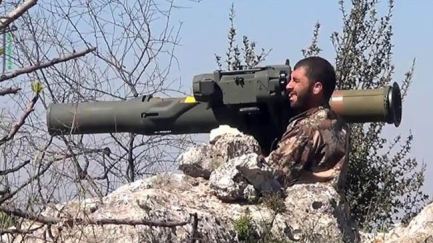
File photo shows a foreign-backed militant preparing to launch a US-made TOW anti-tank missile in Idlib countryside in northwestern Syria.
Press TV – December 30, 2014
The ISIL Takfiri group has released a photo showing one of its members preparing to launch a US-made TOW anti-tank missile against rival terrorists in Syria’s strategic and mountainous Qalamoun region along the border with Lebanon.
The ISIL militant is shown aiming at the positions of the Jaysh al-Islam militant group on the outskirts of al-Qaryatayn, located approximately 120 kilometers (74 miles) northeast of the capital, Damascus.
Political analysts say the photo shows the scale of threats the ISIL militants pose to the Qalamoun region against fighters of the Lebanese Hezbollah resistance movement.
On October 5, Hezbollah fighters killed scores of Takfiri militants after the gunmen crossed from crisis-hit Syria into eastern Lebanon and attacked the Lebanese resistance movement’s posts.
Most of the militants killed during the clashes were from the al-Qaeda-linked al-Nusra Front. Two Hezbollah fighters were also killed in the shootout.
Meanwhile, Ghuraba al-Sham Battlion and Lions of Shahba Battalion, both allied to the so-called Free Syrian Army, are reportedly training their members in a camp set up in Qalamoun.
Over the past months, Lebanon has been grappling with terrorist attacks by al-Qaeda-linked militants and rocket attacks, in what is said to be a spillover of the conflict in Syria.
The Takfiri ISIL terrorists currently control parts of Syria mostly in the east and north. They have also seized large swathes of land in neighboring Iraq.
More than 1.1 million Syrian refugees are currently taking shelter in Lebanon. The influx of Syrian refugees is exerting huge pressure on Lebanon’s poor infrastructure, education and health systems.
Syria has been grappling with a deadly crisis since March 2011. Western powers and their regional allies – especially Qatar, Saudi Arabia, and Turkey – are the main supporters of the militants operating inside Syria.
More than 200,000 people have died so far in the conflict in Syria, according to UN High Commissioner for Human Rights Zeid Ra’ad Zeid al-Hussein.
Selling ‘Peace Groups’ on US-Led Wars
By Margaret Sarfehjooy and Coleen Rowley | Consortium News | December 25, 2014
“War is peace” double-speak has become commonplace these days. And, the more astute foreign policy journalists and commentators are beginning to realize the extent of how “liberal interventionists” work in sync with neocon warhawks to produce and sustain a perpetual state of U.S. war.
More and more “peace and social justice” groups are even being twisted into “democracy promotion,” U.S. militarism style. But rarely do we get a window to see as clearly into how this Orwellian transformation occurs as with the “Committee in Solidarity with the People of Syria” (CISPOS) based in Minnesota’s Twin Cities, a spin-off of “Friends for a Nonviolent World” (FNVW), steering its Quaker-inspired founding in nonviolence to promote speakers and essayists with strong ties to the violent uprising to topple the Syrian government of President Bashar al-Assad, resulting in a war that has already taken some 200,000 lives.
Do the real pacifist members approve? Or even know?
Middle Eastern expats who support U.S. intervention in their countries are especially effective in promoting their message to Western audiences because they provide “proof” of the demonization of governments that the U.S. plans to invade and dominate, and often peace groups include these expats in presentations believing them to be representatives of an entire country.
In Minneapolis, FNVW and its spin-off CISPOS hosted several events with Syrian expats who were on record as supporting the U.S. bombing of their country. (This isn’t only happening in the U.S. In April 2011, a Vancouver peace group documented its objection to the fact that other Canadian “peace” groups were sponsoring speakers who justified and advocated “in favour of the NATO bombing of Libya.”)
Often Syrian “experts” speaking to peace groups, such as FNVW/CISPOS’s upcoming speaker, Mohja Kahf, have ties to the early destabilization of Syria. This American Prospect article documents how Najib Ghadbian, Kahf’s husband of over 20 years (apparently up to last year when they divorced) was one of the Syrian dissidents who attended the early 2006 meeting with Liz Cheney (then-Vice President Dick Cheney’s daughter), along with other Syrian dissidents to plan how to destabilize Syria and topple its government. Like some Syrian version of Ahmed Chalabi, the neocons’ choice to run post-invasion Iraq, Kahf’s husband apparently got himself invited to Liz Cheney’s “Iran-Syria Operations Group” by having signed the “Damascus Declaration” in 2005, the year before.
When Najib and Mohja sat down for a long 2011 interview with The Arkansas Traveler, they discussed their involvement with the Syrian Revolution, even joking about Ghadbian becoming the next Prime Minister. Kahf and Ghadbian reportedly divorced in 2013 but when CISPOS-FNVW first published her long essays, they were still appearing together at Syrian revolutionary meetings and speaking forums. Additionally, CISPOS’s latest handout (December 2014) lists Ghadbian’s organization, www.etilaf.us (The National Coalition of Syrian Revolutionary Forces) as a resource “For More Information on Syria and How to Help.”
Resources for information on Syria often come from “citizen journalists” with deep ties to neocons and U.S. government sources. From the State Department’s website , the $330 million in support for the Syrian opposition includes training for networks of citizen journalists, bloggers and cyber-activists to support their documentation and dissemination of information on developments in Syria.
Syrian dissidents received funding from the Los Angeles-based Democracy Council, which ran a Syria-related program called the “Civil Society Strengthening Initiative” funded with $6.3 million from the State Department. The program is described as “a discrete collaborative effort between the Democracy Council and local partners” to produce, among other things, “various broadcast concepts.”
James Prince, the founder and President of the Democracy Council, is also an adviser to CyberDissidents.org , a project created in 2008 by the Jerusalem-based Adelson Institute for Strategic Studies, founded and funded by Sheldon Adelson, a patron and confidant of Benjamin Netanyahu.
Other resources include postings on social media and alternative websites with sensational stories such as the anti-Assad activist “Gay Girl in Damascus” who turned out to be a middle-aged American man in Scotland or Syrian Danny Abdul Dayem, who was frequently interviewed using fake gun fire and flames in his interviews.
With all of the information about Syria, what are we to believe as true? We know the facts about recent U.S. interventions in Middle Eastern countries. Why would Syria be any different?
Afghanistan is still in shambles with the majority of the people living in extreme poverty; Libya, which had the highest GDP per capita and life expectancy on the continent, is now a failed state; Western intervention transformed Iraq from an emerging country with moderate prosperity into an impoverished country with a starving population. In the lead-up to each intervention, “experts” emerged to explain that while anti-imperialism is good in general and in past scenarios, this time is different. Is it?
Isn’t it time for war-weary Americans to wise up and stop falling for these pretexts of bringing democracy and human rights to foreign countries through training and funding of “color (and umbrella) revolutions,” inciting of coups and regime changes and eventually, through U.S.-NATO military might?
Liberal interventionists clearly assist neocon warhawks towards their mutual goal of “full spectrum dominance” under the euphemistic guise of Pax Americana. Only the “Pax” always turns out to be endless war and occupation.
Margaret Sarfehjooy is an anti-war activist and registered nurse in Minnesota. Coleen Rowley is a retired FBI agent and former Minneapolis Division legal counsel.
The EU shifting its strategy on Syria, Iraq and fighting ISIS
By Sami Kleib | Al-Akhbar | December 27, 2014
After the United States abandoned the idea of Syrian President Bashar al-Assad stepping down and enhanced security coordination with the Syrian army against the Islamic State in Iraq and Syria (ISIS), it appears the Europeans began some time ago a series of meetings to change their policy on Syria. According to information obtained by Al-Akhbar, some senior European officials did not hesitate to say at the last Council of European Union Foreign Ministers meeting that “this policy was wrong.” It is necessary, therefore, to change it and let the United Nations envoy Staffan de Mistura’s initiative lead the way. Does that mean we will soon see favorable signs towards the Syrian regime and further disregard for the external opposition?
Geneva – A European official told Al-Akhbar about the proceedings of an important meeting between United Nations (UN) envoy Staffan de Mistura and European Union (EU) foreign affairs ministers on December 11, confirming that there is a change in the European position towards Syria. He said the meeting was closed like all meetings during which Europeans discuss sensitive matters. De Mistura began to explain the situation in Syria and the regional and international framework surrounding his plan that is supposed to be implemented in three months “otherwise it loses its ability to be implemented.”
This, in short, is what de Mistura said and the Europeans’ position towards it.
- The plan to freeze the fighting in Aleppo is the only one currently available. There is no hope for another plan. Therefore, the EU should support it practically and not just verbally. It is the only plan capable of freezing the fighting, securing people’s needs and returning the displaced people who are burdening neighboring areas and states. It will also allow for the eventual process of reconstruction.
- Syrian President Bashar al-Assad, who showed readiness to ensure the success of the international plan in Aleppo, convinced Russian President Vladimir Putin of the plan and played a major role in convincing his Iranian allies as well. This was necessary because Moscow was reluctant, thinking that no US-Atlantic effort can be trusted and the plan might lead to dire consequences for Russia and its allies.
- Although the Americans expressed reservations and doubt about the plan at the beginning, they have become more flexible, tying their approval with that of some of their regional allies, meaning of course Saudi Arabia primarily. In any case, I am going to Riyadh to convince Saudi officials of the plan’s feasibility. If we obtain preliminary approval from them, I will subsequently continue my efforts in Damascus so we can start as soon as possible because time is running out.
Here, we should remember that Brahimi had told the Europeans once what he said on more than one occasion and in more than one place, namely, that his resignation will “relieve two people, Assad and Saudi Foreign Affairs Minister Saud al-Faisal” because his personal relationship with both men was quite bad. He was probably speaking about “Saud al-Faisal’s personal hatred towards Assad being a hindrance to finding a solution.” It is also known that the Syrian president, from his very first meeting with Brahimi, questioned his intentions especially when the Algerian UN envoy suggested that Assad should step down and intended to meet Syrian Vice President Farouk al-Sharaa before Assad prevented him from doing so, arguing that this is improper on an official visit. Brahimi at the time had to make do with a phone call. After a while, Sharaa was removed from power.
- Turkey remains a real problem for the Europeans. Some officials say it is impossible to predict what Ankara could do next. Others believe that Turkey is pretty much the only country still facilitating the passage of foreign fighters to Syria, it has not made up its mind about fighting the Islamic State in Iraq and Syria (ISIS) and is trying to blackmail the international community with its position. Here, the Europeans make two suggestions. Either put pressure on Turkey, including perhaps issuing a warning – which some believe is pointless because it might make the Turkish president Recep Tayyip Erdogan’s position more intransigent and push him further into Russia and Iran’s arms – or try to cajole and get closer to Turkey, prompting it to commit to the international decision to fight ISIS and stop the flow of foreign fighters. Either way, the Turkish position remains worrisome for Europe.
- Iran has become a central player in both the Syrian and Iraqi crises. It is necessary to deal with this reality regardless of the reservations that some might have. There is nothing to prevent engaging with Iran in a serious dialogue about Syria, even before signing a nuclear agreement. This is useful because it could lead to political concessions from the Syrian regime and it could strengthen the presence of European companies in Iran. Perhaps this has become a European need despite French reservations, which are understandable, given French-Saudi relations and France’s concern not to upset Israel.
- It is impossible to think of serious solution or temporary solutions in Syria without Saudi Arabia, which has extensive relations with a number of Anti-Assad parties. It is important to reassure Riyadh that the European efforts do not intend to buoy up the regime. De Mistura said that Saudi Arabia implicitly welcomes his initiative. The Spanish foreign affairs minister was clearer, saying that Riyadh accepts the plan and it is in France’s interest to tone down its critique otherwise it will appear more extremist than Saudi Arabia, which is not an understandable position. The Spanish minister went as far as suggesting that an international conference for Syria be held in his country given that the idea might be accepted by everybody.
- Russia remains the main obstacle to any solution that does not satisfy the Kremlin and the Syrian regime. Since its relationship with the US and Europe is currently strained because of Ukraine, it is necessary to look for ways to separate any discussion with Russia about Syria from the position regarding Ukraine. Some European officials intend to strengthen the dialogue with Moscow because “it is unacceptable to return to the logic of the cold war.” Perhaps the High Representative of the EU for Foreign Affairs and Security Policy Federica Mogherini will visit Moscow soon. Besides, Russia is active and serious about finding a political solution. The Europeans keeping their distance from Moscow might mean distancing the US and Russia.
The Europeans with and against Assad
First, everyone agrees to de Mistura’s plan, but they want to support it because it is the only plan currently available while awaiting the results of Russian efforts to bring the opposition and the Syrian regime delegation together in Russia. However, France, which currently enjoys strong trade relations with Saudi Arabia and Britain, is ahead of other Europeans in its contacts with Iran and insists that the plan should not support the Syrian army against the moderate opposition in Aleppo. In other words, the issue should not be portrayed as standing with the army against ISIS because in Aleppo and its surroundings there are fighters affiliated with the moderate opposition and they should be taken into consideration and supported “so we won’t appear as though we are drawing a parallel between the regime and the opposition and that we view both sides equally.”
The French foreign affairs minister was the most intransigent even though some within the current French administration point out the need to take a new position towards Syria, especially after the terrorist attacks that took place on French soil. Laurent Fabius said, “We don’t want what happened to Homs to happen in Aleppo,” where suspending the fighting benefited the regime only and was not balanced. The fighters left after they turned in their weapons to the state and were transported in government buses to the areas they come from.
A European official with ties to the Syrian opposition said “the departure of the fighters then was a farce for them. Imagine that the Grand Mufti, Ahmad Badreddin Hassoun, who is a regime loyalist showed up in the buses transporting the fighters joking with them and asking them isn’t it better to marry while they are young instead of getting killed on battlefronts? They were given cell phones to talk with their families and undermine their morale. In the end, the media image and the reality on the ground were in the interest of the regime.”
The French minister was insistent that “the regime should not benefit from this plan in terms of relieving it at the Aleppo front so it can focus on other fronts in other areas.” That is what Fabius was saying when the EU received information about the possibility of the Syrian and Iraqi armies engaging in a wide joint military operation in Deir Ezzor.
Second, the European relationship with Assad is possible, but it becomes evident during the discussions of the foreign affairs ministers and commissioners of the EU that they are at a loss on how to deal with Syria. For example, a European official in Geneva says that a number of his European colleagues have begun to talk about the failure of the policy adopted so far and about the “uncalculated mistake” of suggesting early on that Assad step down.
Some Europeans argue that their assessment of the situation was erroneous while others believe that trusting the US from the beginning was a mistake because Washington, as usual, places its interests ahead of all its alliances, often putting the Europeans in an awkward position. Still others argue that underestimating the capabilities of the Syrian army and its allies was their biggest mistake.
As such, EU officials are currently discussing how to “modify” the political position that has been adopted for more than three years in Syria. One sign of this change is abandoning the mantra of “Assad stepping down” and finding more realistic statements that have been repeated now and then, such as “Assad is not a final solution to the crisis” or “Assad will not stay at the end of the political solution” or “it is only natural that a political solution will eventually lead to transferring powers from the presidency and not all powers” according to Geneva I. Another sign of a change in position is abandoning the phrase “proceeding with a transitional process now” and replacing it with one accepted by all, namely, “calling for the start of a transitional process.”
It appears that Mogherini succeeded, to some extent, in promoting the point of view that “we agree on the end result but political realism and the developments of the situation require us to adjust our course and use new phrases.” In other words, even if everyone in Europe wanted Assad to step down, political realism suggests that this is not possible at this point and encouraging a political solution might eventually lead to this end, meaning this is no longer a European priority.
The security council in Aleppo?
In light of these discussions about modifying the European position towards the Syrian regime, the most important question in the EU is how to ensure the success of the Aleppo plan and how to implement it without portraying Assad as the winner, especially given that the Syrian army advanced in a noticeable way in Aleppo recently?
The dominant trend is to find a monitoring mechanism by the UN Security Council. However, the Europeans realize that this is impossible due to the dual Sino-Russian veto that is always ready to protect Syria. Therefore, unlike the French and British positions which insist on an international force from the UNSC, the EU is more inclined towards finding a diplomatic formula that talks about “a monitoring mechanism linked to the UNSC.”
All of this will be released soon in what is now called “the EU strategy on Syria, Iraq and fighting ISIS.”
Despair with the Syrian opposition, particularly, the National Coalition for Syrian Revolution and Opposition Forces, which for a long time monopolized, with international support, the representation of the opposition has infiltrated EU states after the US. The Europeans too are now more inclined towards expanding the scope of the opposition to include forces that were previously not accepted and undermine the Muslim Brotherhood.
It is remarkable for instance that when the head of the Coalition, Hadi al-Bahra, visited the EU in Brussels few days ago, representatives from the Coalition were calling the Europeans to say that Bahra no longer represents them. A European official says jokingly: “Everytime we begin to talk with an official from the Coalition, we discover that this Coalition held new elections and changed the official. So we start all over again. And every time we meet with a Coalition official, he repeats the same question, how are you going to prevent the regime from benefiting from the plan you are proposing? But we have noticed for some time now that some parties within the Coalition have come to accept the idea of negotiating with the regime and reaching a political agreement with it even if their ultimate goal is for Assad to step down. This is the case with Moaz al-Khatib and his team for instance. The problem of the Coalition is that it does not know the meaning of political realism and continues in its fragmentation as it is tossed around by conflicting foreign alliances.”
In light of all the above, is the EU starting to change its position towards Assad? Perhaps all its members still support the departure of the Syrian president. But political realism requires a change in behavior and approach and not insisting on Assad’s departure as a priority. This will become more evident in the future as terrorist attacks inside Europe have increased. The only solution left is to cooperate with Syrian security forces, the Syrian army and Iran in the context of fighting terrorism.
As for de Mistur’as plan in Aleppo, it is currently in a feverish race between a military solution and security arrangements that cannot be undertaken without the regime’s approval and that might be to its advantage.
Once again, history repeats the same old maxim, “international interests are more important than principles and people’s tragedies.”
Featured Video

The Truth About the Trump Shootings with Ken Silva
or go to
Aletho News Archives – Video-Images
From the Archives
Trans ‘milk’ as good as the real thing – NHS
RT | February 18, 2024
The drug-induced nipple secretions of trans women are as good as mothers’ breast milk for babies, the University of Sussex Hospitals NHS Trust claimed in a letter to campaigners made public in a report by British think tank the Policy Exchange on Sunday.
The healthcare trust’s medical director, Rachel James, argued that the off-label prescription drug cocktail men transitioning to female take in order to produce milk was “similar to the natural hormones which encourage lactation to develop when the baby is newly born.”
“The evidence which is available demonstrates that the milk is comparable to that produced following the birth of a baby,” James wrote in the letter, sent to Children of Transitioners last August.
Biological men who wish to lactate must first take hormones to grow milk glands and then take high doses of either domperidone or metoclopramide to stimulate milk production. Neither drug is approved for this use, though they are occasionally prescribed off-label to biological women who have trouble lactating.
However, domperidone’s own manufacturer, Janssen, warns patients the drug “may cause unwanted side effects affecting the heart in a breastfed baby” and “should be used during breastfeeding only if your physician considers this clearly necessary.” … continue
Blog Roll
 Aletho News
- How Real Is the Impact of Western Sanctions on Israel?
- France, You Are Guilty: How Paris Turned Western Sahara into the Maghreb’s Powder Keg
- 2025 Nature Paper Claiming Worsening Global Drought Gets RETRACTED …Heavily Flawed
- Your Milk Is Not the Problem
- The Truth About the Trump Shootings with Ken Silva
- ARE PATIENTS BEING PROPERLY INFORMED ABOUT OZEMPIC?
- US lawmaker blocks $2.8 billion weapons sale to Israel: Report
- Yemeni army claims responsibility for strikes on sensitive sites in Saudi capital, Aramco facilities in Yanbu
- Iran Judiciary issues indictments against 159 US, Israeli officials for assassination of Leader, commanders
- Turkiye revokes Iranian bank license under US sanctions campaign
- If Americans Knew
- Salah Sarsour’s Legal Team Says DHS Has Not Met Its Burden to Prove He Is Deportable
- An analysis of tax forms by The Intercept show Kraft’s charity and LLC have donated to Friends of the IDF and AIPAC’s super PAC.
- Israeli attacks kill four Palestinians in Gaza – Daily Update
- Inside Gaza’s death trap of collapsing, bombed-out buildings
- The everyday items Israel bans from Gaza every day
- Inside the siege, the ruined buildings of Gaza – Daily Update
- Debunking The Claim That Macklemore Has A “History Of Antisemitism”
- CPJ demands release of arrested Palestinian-US journalist near Bethlehem
- Robert Kraft: The Billionaire Friend of Netanyahu Pulling The Strings Behind the Macklemore/Ed Sheeran Blow Up
- Columbia Administered Fund Gives Big Money to Pro-Israel Groups
- No Tricks Zone
- 2025 Nature Paper Claiming Worsening Global Drought Gets RETRACTED …Heavily Flawed
- New Study: ‘Global Drought Shows No Detectable Recent Acceleration Under Climate Warming’
- Economic Masterminds: German Socialists Suggest Taxing Productivity Gains Stemming From Using AI
- The South China Sea Has Not Been Cooperating With The Climate Change Narrative
- Energy Crisis: Germany Enters Heating Season With Historically Low Gas Reserve Fill Levels
- New Study: The Antarctic Ice Sheet Gained Mass From 2020-2024 Due To Staggering Snow And Ice Accumulation
- Study: Ocean Heating Rates From Thousands Of Years Ago ‘Dwarf’ Modern Ocean Heating Rates
- Climate Extremists Target, Attack Large-Scale Power Grid Infrastructure In Germany!
- New Study: Antarctic Ice Melt Has Contributed Less Than 1 Centimeter To Sea Level Rise In The Last 30 Years
- Fear Of Debate: Alarmist German Climate Scientist Calls On Mainstream Media To Discredit Skeptic Voices
 Aletho News