The US charge against Syria is being driven by Damascus’ alleged use of chemical weapons against civilians. While Washington is quick to intervene on moral grounds, its own checkered past regarding WMDs may put the world’s policeman under the spotlight.
“Nobody disputes – or hardly anybody disputes – that chemical weapons were used on a large scale in Syria against civilian populations,” US President Barack Obama told a briefing Wednesday. “We have looked at all the evidence, and we do not believe the opposition possessed … chemical weapons of that sort.”
It is this charge, so far unsubstantiated by UN inspectors, that underpins Western attempts to intervene militarily in Syria.
“If we are saying in a clear and decisive but very limited way, we send a shot across the bow saying, ‘Stop doing this,’ this can have a positive impact on our national security over the long term,” Obama said.
On Monday, US Secretary of State John Kerry was more emphatic in stressing the ethical basis for intervention.
“Let me be clear: The indiscriminate slaughter of civilians, the killing of women and children and innocent bystanders, by chemical weapons is a moral obscenity.”
The obscenity of such attacks is a reality Kerry is all too familiar with, as the decorated war veteran served at a time when the US was engaged in a decade of chemical warfare in Vietnam.
From 1962 to 1971, the US military sprayed an estimated 20 million gallons of defoliants and herbicides over Vietnam, Laos and Cambodia in a bid to deprive the Vietcong of food and cover.
The Vietnamese government estimates that 400,000 people were killed or maimed and 500,000 children born with birth defects as a result of the so-called ‘rainbow herbicides.’
Christopher Busby, an expert on the health effects of ionizing radiation and Scientific Secretary of the European Committee on Radiation Risk, said it was important to make the distinction that defoliants such as Agent Orange are not anti-personnel weapons designed to kill or deform people, and are thus “not quite the same as using a nerve gas or something that is intended against personnel.”
“But nevertheless, it had a very serious effect, and they shouldn’t have used it because they must have known that it would have these side-effects,” Busby said. “At least, when they were using it they must have learned that there would be these side-effects, and they should have stopped using them at this or that point. But they didn’t.”
A similar legacy was left by the deployment of white phosphorous and depleted uranium following the US-led 2003 invasion of Iraq.
Busby said that while the genotoxic effects of white phosphorous were debatable, the deadliness of depleted uranium was beyond question.
“All of the genetic damage effects that we see in Iraq, in my opinion, were caused by… depleted uranium weapons. And also [non]-depleted uranium weapons of a new type. And these are really terrible weapons. These are weapons whic have absolutely destroyed the genetic integrity of the population of Iraq,” he said.
The people of Fallujah, where some of the most intense fighting during the Iraq war took place, have since suffered a veritable health crisis.
Four studies on the health crisis in the city were published in 2012. Busby, an author and co-author of two of them, described Fallujah as having “the highest rate of genetic damage in any population ever studied.”
There is a case to be made that in terms of Agent Orange, White Phosphorous and depleted uranium, the often deadly consequences have been a side-effect rather than the goal of their deployment.
While Washington currently argues that the use of chemical weapons is a “red line” that requires a swift and immediate military response to deter future crimes against humanity, the US has a checkered record on the issue, said former CIA analyst Ray McGovern, citing the time when then-US ally Saddam Hussein deployed chemical weapons against Iran during the Iran-Iraq War – with US knowledge.
“We had the famous picture of Donald Rumsfeld shaking hands with Saddam Hussein,” McGovern told RT. “That happened the day after the first public announcement that the Iraqis had used mustard gas against the Iranians. So [turning a] blind eye, yeah, in spades.”
“The problem is that we knew what was going on, and there is a Geneva Convention against the use of chemical warfare. Our top leaders knew it,” McGovern continued. “The question is: had they no conscience, had they no shame?”
The United States Department of Justice has requested that former President George W. Bush and the highest figures in his administration receive full exemption from being tried for the Iraq War, which the DoJ says was in line with international law.
Apart from Bush, the names listed in the paper the DoJ filed on Tuesday are former Vice President Richard Cheney, former Secretary of Defense Donald Rumsfeld, retired four-star General Colin Powell, former Secretary of State, Condoleezza Rice and former Deputy Secretary of Defense and President of the World Bank, Paul Wolfowitz.
Sundus Saleh, an Iraqi single mother of three who became a refugee, filed a complaint in March in the San Francisco federal court, claiming that the war in her country can be judged as a ‘crime of aggression’, according to the same legal standards that the Nuremberg Tribunal used for convicting Nazi war criminals of World War II.
Saleh is the lead plaintiff in this class action lawsuit.
The reason for the decision is connected with the ‘Westfall Act’ certification. The 1988 law gives the Attorney General the power to personally decide whether the United States is actually a defendant in the case. This in turn allows the granting of absolute immunity to politicians for actions carried out while in the government’s employ.
Inder Comar of Comar Law has agreed to take the case. The San-Francisco-based firm normally specializes in support to private companies, particularly those in the tech industry. Comar met with Saleh at her home in Jordan to discuss the case.
Chief counsel Comar wrote on the War Is a Crime website explaining that, “The DoJ claims that in planning and waging the Iraq War, ex-President Bush and key members of his Administration were acting within the legitimate scope of their employment and are thus immune from suit.”
The lawsuit filed by Saleh says that Cheney, Rumsfeld and Wolfowitz orchestrated the Iraq War in 1998 as part of their involvement with the ‘Project for the New American Century’, a Washington DC-based non-profit organization that pushed for the overthrow of Iraq’s former leader, Saddam Hussein.
Salleh then alleges that the tragedy of September 11, 2001, was pitched to other members of the Bush cabinet as the perfect excuse to scare the American public into supporting the war in Iraq. The lawsuit also claims that the United States failed to obtain United Nations approval for the invasion, making it an illegal and aggressive act of war.
According to Corey Hill, who is a member and outreach coordinator for Global Exchange, an international human rights organization, Comar Law is invoking something called the Alien Tort Statute, which is a 1789 law that permits a foreign national to sue the US federal court for injuries “committed in violation of the law of nations or a treaty of the United States.” Hill explained this in his article for YES! Magazine, for which he also writes.
All the defendants in the case have been summoned to appear in accordance with the usual legal proceedings. The trial is expected to start in early 2014.
There are, however, several problems that could arise with the allegations. As Paul Stephen, who teaches law at the University of Virginia and is former international law consultant for the Department of State told YES! Magazine, that it would be difficult to sue a government employee for acting “under the scope of employment” in this case, because of the modified nature of the Westfall Act, giving officials more scope for action.
The second problem may arise from the fact that their actions did not take place on US soil, making it difficult to validate the accusation.
And lastly, “courts aren’t open to ruling on matters of a political nature”, Hill said in reference to a doctrine in US Constitutional Law that separates clear-cut court cases with those better left to the legislative and executive branches of the government. This doctrine then means that the invasion of Iraq is a political case – not a legal one.
“If the expectation is that a federal court will declare that the invasion, although duly authorized by Congress, violated international law and thus violates U.S. law, I would respond that we walked up and down that hill with respect to Vietnam… No federal court ever has recognized such a claim,” Hill explained.
But Comar is optimistic in so far that in order for the Westfall Act to work in this case, the US government would have to prove that the act of preparing the invasion through a non-profit organization took place within office. But since that was not the case, the law cannot be invoked here. He further explained to Hill that separating a political matter from a purely legal one will also not be easy for the US government, as it may often be a very blurry line. Comar expanded on this position to the ‘War Is a Crime’ website.
“The good news is that while we were disappointed with the certification, we were prepared for it,” he said. “We do not see how a Westfall Act certification is appropriate given that Ms. Saleh alleges that the conduct at issue began prior to these defendants even entering into office. I think the Nuremberg prosecutors, particularly American Chief Prosecutor Robert Jackson, would be surprised to learn that planning a war of aggression at a private non-profit, misleading a fearful public, and foregoing proper legal authorization somehow constitute lawful employment duties for the American president and his or her cabinet.”
There is no way to say this truth nicely: Politicians lie. That includes Japanese, American, Egyptian, Israeli, and Palestinian politicians! Is there something more common sense than that? Yet, so many citizens around the world believe their own politicians or wistfully acknowledge lies but think it is part of the job needed to run things. They believe even when politicians contradict themselves blatantly. This phenomenon is rather remarkable. It is a dissonance and disconnect from reality that many seem oblivious to. It is very dangerous because it can lead to accepting rationales for going to war. These can be deadly wars that lead to millions of lives lost as happened in what was called World War 1 and WW2. Even when incredible and declassified evidence abound, politicians continue to lie and old mythologies refuse to die. Here are just a few of the countless lies told to us over the past few decades:
-Lies about the need to drop the bombs on Hiroshima and Nagazaki (not to end WWII but to start WWIII or the cold war)
-Lies about why Britain issued the Balfour declaration and France the Jules Cambon declaration in support of Zionism
-Lies about why Israel was created in Palestine
-Lies about why Henry Wallace was replaced by Harry Truman as a vice president in the Democratic convention
-Lies about why Truman supported the creation of Israel on top of Palestine
-Lies about the ethnic cleansing of 530 Palestinian villages and towns
-Lies about September 11, 2001
-Lies about the reasons for the war on Iraq
-Lies about safety of nuclear power plants
-Lies about violations of US citizen rights by their own government
-Lies about why US/Israel want to subdue Iran now
-Lies about the US role in propping-up dictatorships
-Lies about western governments and human rights
-Lies about Vietnam, Cambodia, and much more
With a little effort, any person could easily find 1,001 lies and the sometimes painful truth about them. With very minor effort, I compiled 65 lies/myths told to us about Zionism http://www.qumsiyeh.org/liesandtruths/ There are many more.
But even when they have nothing to do with going to war, lies can be very dangerous. I am not talking about naiveté or stupidity because that is not what the politicians have. Take for example the Palestinian authority “leadership” represented by Mr. Mahmoud Abbas. Is it naiveté that would make him go into fruitless negotiations for 20 years with Israeli politicians then suspend negotiations telling his people that we will not go back to negotiations until Israel stops colonial settlement building and then tell his people that he went back to negotiations anyway while Israel is building. This flip-flop is the typical politician: no principles and no honesty. Yet, again many continue to clap for him. I do not say vote for him since his term is expired a long time ago and no elections are going to happen.
Even when confronted with paper evidence of political lies, many people ignore the mounting evidence. In our case, there were the lies about support for right of return told to our people while Abu Mazen tells Israeli TV that 1948 areas are Israel and he has no right to go back there (maybe should be able to go “visit”). There were the lies about being good negotiators with Israel. Saeb Erekat even wrote two books about negotiations full of such lies. Those lies were clearly debunked by the leaking of the Palestine papers which show that even a middle school student could do a better job at these negotiations than this groveling charade that these Palestinian negotiators are going through. The fate of 12 million Palestinians and the legacy of 80,000 martyrs are left to lying politicians: Israeli, Palestinian and American.
But we cannot blame politicians for our ill societies. It is us the people who let them do what they do by not challenging them.
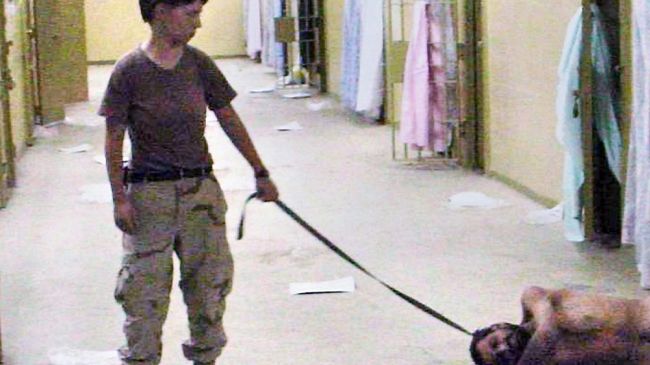
American defense contractor CACI International has sued four former detainees in Abu Ghraib prison to compensate the legal expenses it paid over their dismissed lawsuit regarding the company’s role in torturing the plaintiffs in the notorious jail in Iraq.
The four Iraqi nationals had earlier filed a lawsuit in a District Court in Alexandria against the company accusing it of torturing, humiliating and dehumanizing them when they served time in the prison.
But in July, the judge dismissed the case, saying the court did not have jurisdiction to hear the lawsuit because the incidents happened overseas.
The Arlington-based company has now demanded the plaintiffs pay over $15,000 for travel allowances, deposition transcripts and witness fees, Common Dreams reported.
The lawyers for former Abu Ghraib prisoners in a federal court filing rejected the request.
Our clients “have very limited financial means, even by non-US standards, and dramatically so when compared to the corporate defendants in this case,” according to the filing.
“At the same time, plaintiffs’ serious claims of torture, cruel, inhuman and degrading treatment, and war crimes were dismissed on very close, difficult – and only recently arguable – grounds.”
“Given the wealth disparities between this multi-billion dollar entity and four torture victims, given what they went through, it’s surprising and appears to be an attempt to intimidate and punish these individuals for asserting their rights to sue in US courts,” said Baher Azny, legal director for the Center for Constitutional Rights and the attorney for the plaintiffs.
“Our case is based on reports and investigations by high-level US military investigators, recognizing CACI’s role in conspiracy to torture detainees,” Azny added
“Once we get past legal obstacles and present the case to a jury, we are hopeful justice will come to these Iraqi victims.”
The lawyers who are planning to appeal the case to the US Court of Appeals in fall argue that US law should apply to CACI International as it is an American-based company that operated in a US military prison.
To the World Health Organization (WHO) and the Iraqi Ministry of Health: (New signatures added)
The back-breaking burden of cancers and birth defects continues to weigh heavily on the Iraqi people.
The joint WHO and Iraqi Ministry of Health Report on cancers and birth defect in Iraq was originally due to be released in November 2012. It has been delayed repeatedly and now has no release date whatsoever.
By March 2013, staff from the Iraqi Ministry of Health announced that this report will show an increase in cancers and birth defects due to the explosions of war. This was broadcasted repeatedly on the BBC.
Therefore we are baffled and alarmed at the WHO’s inability to release any of its findings, despite our urgent request of May 2013, for the WHO to release its report.
The Iraqi birth defects epidemic, by itself, would outrage anyone with the simplest understanding of population health and disease. Who could justify blocking the release of information from a long-completed investigation of that epidemic?
Why have our inquiries failed to break the WHO’s apparent filibuster against releasing that data? WHO has a staff of thousands, including medical doctors, public health specialists, scientists, and sophisticated epidemiologists. They are certainly capable of presenting that data to the public by now.
The need for a timely response to public health emergencies (such as the one unfolding in Iraq) is at the heart of all epidemiological studies. Delivering adequate and timely population relief should be the focal point of this WHO report — but where is the report? Where is the data which was clearly summarized (without numbers) on the BBC in March 2013?
We are now told that some new decisions were taken during a June 25th 2013 meeting http://www.emro.who.int/irq/iraq-infocus/faq-congenital-birth-defect-study.html between WHO and high level authorities of the Iraqi Ministry. They decided that not even a few bits of that birth-defects report can be released before WHO jumps these new hurdles:
(1) “additional analyses not originally conceived”,
(2) “in addition to further analyses, it was determined the work should also undergo the scientific standard of peer review”.
(3) recruitment of a “team of independent scientists… to review the planned analyses”.
(4) “preparation for that meeting”,
(5) “a summary report of that meeting”
(6) “key findings from the analysis” to be released following steps 1-5 above.
To an untrained ear, these might sound like reasonable explanations. We are certainly not opposed to additional steps like analyses, peer review, etc.
Yet none of those steps should be interposed as excuses for further delay in releasing the data which is already known. If it was known in March 2013, when the BBC broadcasted the Iraqi Ministry’s comments on that data, then surely now that information can be released. Why is it still treated like a state secret?
However, large-scale epidemiological studies, such as the WHO report on Iraq birth defects, are expensive to fund. Hence, highly competitive proposals are elicited for such studies. It is a matter of routine practice to include a detailed study time-line in such proposals from the beginning — not at the end. The time-line routinely includes an estimation of time for data analysis and reanalysis, followed by publication of findings (i.e. peer-review). This normally means there is a clear and defined timeframe in which the data is expected to be published. The originally reported release date (November 2012) is now long gone. So yes, the continuing delay, augmented by fresh excuses for more delay, concerns us.
The past record of the WHO when dealing with related findings from the region are also a source of serious concern.
The British Medical Journal published an article entitled” WHO suppressed evidence on effects of depleted uranium, expert says” in November 2006. It suggested that earlier WHO reports were compromised by the omission of a full account of depleted uranium genotoxicity.
Additionally, recent revelations by Hans von Sponeck, the former Assistant Secretary General of the United Nations, suggest that WHO may be susceptible to pressure from its member states. Mr. von Sponeck has said that “The US government sought to prevent WHO from surveying areas in southern Iraq where depleted uranium had been used and caused serious health and environmental dangers.”
Given the urgent public health crisis in Iraq, we the undersigned encourage the WHO and the Iraqi Health Ministry to release all available data from their completed study on birth defects and cancers immediately.
The Iraqi people’s health will be further harmed if you continue to delay that release. Allowing the public to examine that data cannot possibly hamper the WHO’s own expanded analysis.
Affiliations are listed only for identification purposes, unless otherwise indicated.
1) Muhsin Al-Sabbak , Professor of Obstetrics & Gynecology, Al Basrah Maternity Hospital, Basrah, Iraq.
2) Susan Sadik Ali, Professor of Dentistry, Al Basrah Maternity Hospital, Basrah, Iraq.
4) Saeed Dastgiri, Professor of Epidemiology, Tabriz University of Medical Sciences, Tabriz, Iran.
5) Azadeh Shahshahani, National Lawyers Guild, Atlanta, Georgia U.S.A.
6) As`ad AbuKhalil, Professor, Dept. of Politics, California State University, Stanislaus; U.S.A.
7) Maged Agour MD, Consultant Psychiatrist, U.K.
8) A Haroon Akram-Lodhi, Chair of the Department of International Development Studies Trent University, Canada.
9) Izzeldin Abuelaish, Associate Professor of Global Health, University of Toronto, Canada.
10) Michael Albert, American activist, economist, speaker, and writer.
11) Riad Bacho, Associate Professor, Lebanese University, Beirut, Lebanon.
12) Haim Bresheeth, Professor of film studies, filmmaker, photographer, University of East London, U.K.
13) David O. Carpenter, M.D. Director, Institute for Health and the Environment, Professor, Environmental Health Sciences, School of Public Health, University at Albany, N.Y.
14) Noam Chomsky, Professor of linguistics, Massachusetts Institute of Technology, U.S.A.
15) Blaine Coleman, Human rights activist and attorney, U.S.A.
16) Michael Collins, Professor, UCLA School of Public Health, Department of Molecular Toxicology, Environmental Health Sciences, Los Angeles U.S.A.
17) David Cromwell Co-Editor, Media Lens, U.K.
18) Tom Davis, Chief Program Officer, Food for the Hungry, U.S.A.
19) Peter Eglin, Department of Sociology, Wilfrid Laurier University, Canada.
20) Christo El Morr, Assistant Professor of Health Informatics, York University, Canada.
21) Gavin Fridell, Canada Research Chair in International Development Studies, Saint Mary’s University, Canada.
22) Irene Gendzier, Professor, Dept of Political Science, Boston University, USA.
23) Jess Ghannam, Professor, Department of Psychiatry, and Global Health Sciences University of California, San Francisco, USA.
24) Prof. David Ingleby, Centre for Social Science and Global Health, University of Amsterdam, Netherlands.
25) Kazuko Ito, Secretary General, signing on behalf of Human Rights Now, Japan.
26) Ms. Nahoko Tahako, Human Rights Now, Japan.
27) Jon Jureidini Professor and Child Psychiatrist, Department of Psychological Medicine Women’s and Children’s Hospital, Adelaide, University of Adelaide and Senior Research Fellow Department of Philosophy, Flinders University, South Australia.
28) Ilan Kapoor, Professor, Faculty of Environmental Studies, York University, Toronto, Canada.
29) Leili Kashani, Human rights activist, Center for constitutional rights, U.S.A.
30) Michael Keefer, Professor emeritus School of English and Theatre Studies, University of Guelph, Guelph, Canada.
31) Imad Khadduri, Iraqi nuclear scientist. U.K.
32) David Klein, Professor of Mathematics, California State University, Northridge, U.S.A.
33) Mustafa Koc, Professor, Department of Sociology and Centre for Studies in Food Security, Ryerson University, Toronto, Canada.
34) Hans Koechler, Professor and Chair of Political Philosophy and Philosophical Anthropology University of Innsbruck, President of the International Progress Organization, Vienna, Austria.
35) Malcolm Levitt, School of Chemistry, University of Southampton, U.K.
36) Drake Logan Civilian-Soldier Alliance, Right to Heal Initiative Right to Heal/Operation Recovery Research Team New York, United States.
37) Rudy List, Professor Emeritus, Mathematics, University of Birmingham, U.K.
38) Ken Loach, television and film director. U.K.
39) Moshe Machover, Professor Emeritus of philosophy, King’s College, London, U.K.
40) Arthur MacEwan, Professor Emeritus of Economics, University of Massachusetts, Boston, U.S.A.
41) Mary Anne Mercer, DrPH, Senior Mother & Child Health Advisor, on behalf of Health Alliance InternationalSeattle, U.S.A.
42) David Nicholl, MD, Consultant Neurologist, Birmingham, U.K.
43) David Ozonoff, Professor of Environmental Health, Boston University, Boston, U.S.A.
44) David Peterson, Chicago-based writer and researcher. U.S.A.
45) Mr. John Pilger, journalist and film director. U.K.
46) Elaine Power, Associate Professor, School of Kinesiology and Health Studies, Queen’s University Kingston, Canada.
47) Hilary Rose, Professor of Social Policy, University of Bradford Emerita Professor of Genetics and Society, Gresham College, London, former consultant to the WHO Copenhagen, Denmark.
48) Steven Rose, Emeritus Professor of Biology (neuroscience) Department of Life Health and Chemical Sciences The Open University Milton Keynes, MK76AA Emeritus Professor of Physick (Genetics and Society) Gresham College London
49) Professor Jonathan Rosenhead, Department of Management, London School of Economics.
50) Pamela Spees, Senior Staff Attorney, on behalf of Center for Constitutional Rights, United States.
51) Ruqayya Sulaiman-Hill, Centre for Rural Health, University of Western Australia, Perth, Western Australia.
52) Susanne Soederberg, Professor of Global Development Studies, Queen’s University, Kingston, Ontario, Canada.
53) John Tirman, Executive Director and Principal Research Scientist, Center for International Studies, MIT, U.S.A.
54) Tahir Zaman, Center for Research on Migration and Belonging, University of East London, U.K.
The US military’s use of depleted uranium in Iraq has led to a sharp increase in Leukemia and birth defects in the city of Najaf – and panicked residents are fearing for their health. Cancer is now more common than the flu, a local doctor tells RT.
The city of Najaf saw one of the most severe military actions during the 2003 invasion. RT traveled to the area, quickly learning that every residential street in several neighborhoods has seen multiple cases of families whose children are ill, as well as families who have lost children, and families who have many relatives suffering from cancer.
Uranium is radioactive and a known carcinogen, but whether or not the amount present in the American ammunition used during the war is enough to cause the kind of disease present in Iraq today has yet to be proven conclusively. But if reports are correct, it would be quite a coincidence that the areas presenting the increases in birth defects and cancer are also the ones where heavy use of depleted uranium shells took place.
Dr. Sundus Nsaif says the city has seen a “dramatic rise” in cancer and birth defects since the 2003 US-led invasion of Iraq. Nsaif said the alternative location was chosen because there is an active push by the government not to talk about the issue, perhaps in an effort not to embarrass coalition forces… Depleted uranium weapons are known for the ability to penetrate through walls and tanks. One of its most dangerous “side effects” is that when the substance vaporizes, it generates dust inhaled by individuals.
The Pentagon and the UN estimate that US and British forces used 1,100 to 2,200 tons of armor-piercing shells made of depleted uranium during attacks in Iraq in March and April, far more than the [officially] estimated 375 tons used in the 1991 Gulf War, according to a report published in the Seattle Post-Intelligencer in 2003.
It would seem the Iraqi people are not quite finished suffering for America’s historic blunder. Those who survived America’s invasion and resulting sectarian war have lived long enough to get cancer or watch their newborn children be crippled from the weaponry used in the war.
The Iranian Oil Ministry says Tehran and Baghdad have agreed to explore and develop oil and gas fields lying along the common border between the neighboring OPEC members, Press TV reports.
The ministry added that the two sides have agreed to work together to settle territorial and ownership differences.
Under the agreement, the two countries will establish joint ventures to carry out the exploration and development of joint oil and gas fields.
The energy cooperation is also expected to minimize the impacts of interferences made by international oil giants in regional affairs.
The agreement came during Iranian President Mahmoud Ahmadinejad’s official visit to Iraq.
Ahmadinejad arrived in Iraq on Thursday at the head of a high-ranking delegation for an official two-day tour aimed at strengthening bilateral relations between the two neighboring countries.
The Iranian president held talks with Iraqi Prime Minister Nouri al-Maliki and Vice President Khudayr al-Khuzai and also met with Iraqi Parliament Speaker Osama al-Nujaifi and the country’s lawmakers on Thursday .
Ahmadinejad also paid a visit to the holy shrine cities of Karbala and Najaf.
The two-term Iranian president will leave office on August 3 to be succeeded by Hassan Rohani, who won an outright victory in the country’s presidential elections of July 14.
Iran Foreign Ministry Spokesman Abbas Araqchi has dismissed reports quoting Iraqi Foreign Minister Hoshyar Zebari as saying that Tehran may be sending weapons to Syria through Iraq’s airspace.
“So far, the Iraqi government has conducted intrusive inspections of some Iranian planes bound for Syria, and in all cases it was officially announced that these planes were not carrying military equipment, while in some cases they [Iraqi officials] said [the planes] were carrying food and medicine,” Araqchi said on Wednesday.
Araqchi said high-ranking Iraqi officials and the inspection team have repeatedly said the same thing about Iranian planes heading for Syria.
In an interview published by the London-based Asharq al-Awsat on June 13, the Iraqi minister said Baghdad started to inspect Iranian and Syrian planes at random last September, adding, “We have found non-lethal materials, like equipment, medicine and food.”
However, Zebari claimed, “Those planes might be carrying other stuff, but we have neither the deterrent means, nor the air defenses and fighter jets to prevent … arms shipments.”
Under pressure from the United States, Baghdad has searched several Syria-bound Iranian planes.
In April, Baghdad checked Iranian aircraft for three consecutive days. The searches, however, found nothing but humanitarian aid and commercial goods.
In October 2012, Iraq forced a Damascus-bound IranAir cargo plane from Tehran to land and searched it for weapons, but allowed it to continue as no prohibited items were found onboard.
The foreign-sponsored unrest in Syria has taken its toll on the lives of many people, including large numbers of Syrian soldiers and security personnel, since March 2011.
In American politics and media, anyone who questions the concept of “American Exceptionalism” is banished to the margins of society. But this self-aggrandizing notion has always contained a large measure of self-deception, ignoring the suffering inflicted on other peoples and on U.S. soldiers, as Gary G. Kohls notes.
On this Fourth of July, amidst the celebrations of our mythical “American Exceptionalism,” I submit the following moving testimony from Daniel Somers, a once-patriotic Operation Iraqi Freedom veteran who could no longer tolerate the physical and spiritual pain resulting from his visible and invisible wounds, his PTSD symptoms and his guilt for participating, albeit unwillingly, in U.S. military crimes against humanity and international war crimes that have been committed far more often than any of the major media have even hinted.
The 30-year-old Somers had been part of Task Force Lightning, an intelligence unit. In 2004-05, he was mainly assigned to a Tactical Human-Intelligence Team (THT) in Baghdad, Iraq, where he ran more than 400 combat missions as a machine gunner in the turret of a Humvee. He also interviewed Iraqis, both civilians and suspected insurgents. In 2006-07, Somers worked with Joint Special Operations Command (JSOC) in Mosul, Iraq.
From his military service, Somers suffered from PTSD and had been diagnosed with traumatic brain injury and several other war-related conditions.
Somers’s unbearably honest suicide note of June 10 should help clear up the feigned bafflement of his military command pooh-bahs, their fawning major media and the assorted politicians (who were duped into voting for the wars but have remained unrepentant for their errant behavior since then) as to why 22 American veterans are committing suicide daily and why there are more active-duty soldier suicides and suicide attempts than there are KIAs.
Perhaps a part of our nation’s response (if it was being honest to its veterans, its active duty military and their grieving and confused families) concerning the tragic deaths and maimings should be to finally admit that the current wars in Iraq and Afghanistan were based on lies fomented by the many hawkish politicians (most of whom are ChickenHawks) and duly reported on as truth by the corporate-controlled, uber-patriotic media and profitably and eagerly endorsed by uncounted profit-minded corporations and assorted secretive forces that benefit from war without any risk to themselves or their loved ones.
The next step in what could be a logical healing process would be to issue a sincere and repeated apology to the suicide survivors that their sons and daughters and loved ones fought unnecessarily and therefore may have died in vain – a cognitively difficult thing for most humans, especially politicians, to do, especially when there has been so much flag-waving, war-glorifying propaganda obscuring the fact that war is anything but glorious, especially for war-traumatized veterans like Somers.
For Frederick Douglas, the heroic ex-slave of the mid-1800s, the annual Fourth of July celebrations inspired him to write one of the most biting critiques of America ever written. Here is what Douglas said in a July 4, 1852, speech that raised irrefutable questions about the supposed freedoms of white Americans who were blind to the crimes against black humanity that they were tolerating right in their own backyards. He spoke for black slaves and all other victims of American imperialism when he said:
“Your celebration is a sham; your boasted liberty, an unholy license; your national greatness, swelling vanity; your sounds of rejoicing are empty and heartless; your denunciation of tyrants, brass fronted impudence; your shouts of liberty and equality, hollow mockery; your prayers and hymns, your sermons and thanksgivings, with all your religious parade and solemnity, are, to God, mere bombast, fraud, deception, impiety, and hypocrisy — a thin veil to cover up crimes which would disgrace a nation of savages. There is not a nation on the earth guilty of practices more shocking and bloody than are the people of the United States, at this very hour.”
Today, the celebration of “American Exceptionalism” must ignore the fact that the United States is far down the list of “civilized” nations (and sinking fast) in scores of categories. The main exception being its #1 status in military spending, war-making, combat-induced PTSD, and the manufacture, possession and sales of the most lethal collection of weapons of mass destruction in the history of the world.
Before his suicide on June 10, Daniel Somers addressed the following statement to his family. It was published online with their permission and encouragement. Somers wrote: “I am sorry that it has come to this.
“The fact is, for as long as I can remember my motivation for getting up every day has been so that you would not have to bury me. As things have continued to get worse, it has become clear that this alone is not a sufficient reason to carry on. The fact is, I am not getting better, I am not going to get better, and I will most certainly deteriorate further as time goes on. From a logical standpoint, it is better to simply end things quickly and let any repercussions from that play out in the short term than to drag things out into the long term.
“You will perhaps be sad for a time, but over time you will forget and begin to carry on. Far better that than to inflict my growing misery upon you for years and decades to come, dragging you down with me. It is because I love you that I cannot do this to you. You will come to see that it is a far better thing as one day after another passes during which you do not have to worry about me or even give me a second thought. You will find that your world is better without me in it.
“I really have been trying to hang on, for more than a decade now. Each day has been a testament to the extent to which I cared, suffering unspeakable horror as quietly as possible so that you could feel as though I was still here for you. In truth, I was nothing more than a prop, filling space so that my absence would not be noted. In truth, I have already been absent for a long, long time.
“My body has become nothing but a cage, a source of pain and constant problems. The illness I have has caused me pain that not even the strongest medicines could dull, and there is no cure. All day, every day a screaming agony in every nerve ending in my body. It is nothing short of torture. My mind is a wasteland, filled with visions of incredible horror, unceasing depression, and crippling anxiety, even with all of the medications the doctors dare give. Simple things that everyone else takes for granted are nearly impossible for me. I cannot laugh or cry. I can barely leave the house. I derive no pleasure from any activity. Everything simply comes down to passing time until I can sleep again. Now, to sleep forever seems to be the most merciful thing.
You must not blame yourself. The simple truth is this: During my first deployment, I was made to participate in things, the enormity of which is hard to describe. War crimes, crimes against humanity. Though I did not participate willingly, and made what I thought was my best effort to stop these events, there are some things that a person simply cannot come back from. I take some pride in that, actually, as to move on in life after being part of such a thing would be the mark of a sociopath in my mind. These things go far beyond what most are even aware of.
“Force me to do these things and then participate in the ensuing cover-up is more than any government has the right to demand. Then, the same government has turned around and abandoned me. They offer no help, and actively block the pursuit of gaining outside help via their corrupt agents at the DEA. Any blame rests with them.
“Beyond that, there are the host of physical illnesses that have struck me down again and again, for which they also offer no help. There might be some progress by now if they had not spent nearly twenty years denying the illness that I and so many others were exposed to. Further complicating matters is the repeated and severe brain injuries to which I was subjected, which they also seem to be expending no effort into understanding. What is known is that each of these should have been cause enough for immediate medical attention, which was not rendered.
“Lastly, the DEA enters the picture again as they have now managed to create such a culture of fear in the medical community that doctors are too scared to even take the necessary steps to control the symptoms. All under the guise of a completely manufactured “over-prescribing epidemic,” which stands in stark relief to all of the legitimate research, which shows the opposite to be true. Perhaps, with the right medication at the right doses, I could have bought a couple of decent years, but even that is too much to ask from a regime built upon the idea that suffering is noble and relief is just for the weak.
“However, when the challenges facing a person are already so great that all but the weakest would give up, these extra factors are enough to push a person over the edge.
“Is it any wonder then that the latest figures show 22 veterans killing themselves each day? That is more veterans than children killed at Sandy Hook, every single day. Where are the huge policy initiatives? Why isn’t the president standing with those families at the state of the union? Perhaps because we were not killed by a single lunatic, but rather by his own system of dehumanization, neglect, and indifference.
“It leaves us to where all we have to look forward to is constant pain, misery, poverty, and dishonor. I assure you that, when the numbers do finally drop, it will merely be because those who were pushed the farthest are all already dead.
“And for what? Bush’s religious lunacy? Cheney’s ever growing fortune and that of his corporate friends? Is this what we destroy lives for
“Since then, I have tried everything to fill the void. I tried to move into a position of greater power and influence to try and right some of the wrongs. I deployed again, where I put a huge emphasis on saving lives. The fact of the matter, though, is that any new lives saved do not replace those who were murdered. It is an exercise in futility.
“Then, I pursued replacing destruction with creation. For a time this provided a distraction, but it could not last. The fact is that any kind of ordinary life is an insult to those who died at my hand. How can I possibly go around like everyone else while the widows and orphans I created continue to struggle? If they could see me sitting here in suburbia, in my comfortable home working on some music project they would be outraged, and rightfully so.
“I thought perhaps I could make some headway with this film project, maybe even directly appealing to those I had wronged and exposing a greater truth, but that is also now being taken away from me. I fear that, just as with everything else that requires the involvement of people who cannot understand by virtue of never having been there, it is going to fall apart as careers get in the way.
“The last thought that has occurred to me is one of some kind of final mission. It is true that I have found that I am capable of finding some kind of reprieve by doing things that are worthwhile on the scale of life and death. While it a nice thought to consider doing some good with my skills, experience, and killer instinct, the truth is that it isn’t realistic. First, there are the logistics of financing and equipping my own operation; then there is the near certainty of a grisly death, international incidents, and being branded a terrorist in the media that would follow. What is really stopping me, though, is that I simply am too sick to be effective in the field anymore. That too has been taken from me.
“Thus, I am left with basically nothing. Too trapped in a war to be at peace; too damaged to be at war. Abandoned by those who would take the easy route and a liability to those who stick it out—and thus deserve better. So you see, not only am I better off dead, but the world is better off without me in it
“This is what brought me to my actual final mission. Not suicide, but a mercy killing. I know how to kill, and I know how to do it so that there is no pain whatsoever. It was quick, and I did not suffer. And above all, now I am free. I feel no more pain. I have no more nightmares or flashbacks or hallucinations. I am no longer constantly depressed or afraid or worried. I am free.
“I ask that you be happy for me for that. It is perhaps the best break I could have hoped for.
“Please accept this and be glad for me.”
Gary G. Kohls, MD, is a founding member of Every Church A Peace Church (www.ecapc.org) and is a member of a local non-denominational affiliate of ECAPC, the Community of the Third Way. [The National Suicide Prevention Lifeline is 1-800-273-8255.]
In some of Shakespeare’s plays there was ambivalence about spying on people, but in one instance there has been an obvious follow-on to modern times, when in Hamlet he has Polonius demand of his servant Reynaldo that he should act as a spy and
Inquire me first what Danes are in Paris;
And how, and who, what means, and where they keep
What company, at what expense.
Which was a bit like the Brits’ comically amateur efforts at spying on foreign missions before and during the G20 International Summit in London in 2009, after which the intercept spooks boasted in a bizarre Power Point Presentation about
What are our Recent Successes?
Blackberry at G20
Delivered messages to analysts at the G20 in near real-time
Provided timely information to UK ministers
Enabled discovery of 20 new e-mail selectors
Gee Golly Gosh. Oh what fun, you must have had, you pointy-headed tummy-rubbing finger-lickin’ techno-dweebs, listening to all the foreign delegates’ Blackberry transmissions, and, as your Power Point had it, “reading people’s email before/as they do.” What were your orders? No doubt something like
Inquire me first, what Foreigners are in London;
And how, and who, what means, and where they keep,
What company, at what expense.
The orders, barely believably, came from the British government, and it’s sad to realize that it ordered spying on its allies, because Turkey — a main target of British G20 spookery — is, after all, a longtime fellow member of Nato, the North Atlantic Treaty Organization. But that sort of association is meaningless when the Brits want, as the orders went : “to establish Turkey’s position on agreements from the April London summit” by spying on this faithful military partner which has a thousand troops in Afghanistan.
Britain, and all the other G20 members boast that their Group is “the premier forum for our international economic development that promotes open and constructive discussion between industrial and emerging-market countries on key issues related to global economic stability.” But how on earth can you have “open discussion” when you can’t trust the host country of the gathering? How could you be “constructive” with Britain when you know its spooks are bugging your BlackBerry? And what else are they finding out from your conversations that will be most useful to other spooks?
There is no loyalty and no allegiance among allies in the Brave New World of BlackBerry buggers. The old-fashioned ideas of having honorable union to join in defending freedom is ditched in the interests of knowing what an ally might think or plan — in order that these thoughts and plans can be destroyed by the friend who spies on an ally.
Britain and Turkey signed the Nato Treaty which says, with optimistic ingenuousness, that
The Parties to this Treaty reaffirm their faith in the purposes and principles of the Charter of the United Nations . . . They are determined to safeguard the freedom, common heritage and civilization of their peoples, founded on the principles of democracy, individual liberty and the rule of law.
But the principles of democracy, rule of law, and all that sort of starry-eyed stuff are thrown out of the window when it’s considered necessary by the Brits to find out what is being done by Turkey. And by who else, one wonders? If you can spy on one Nato ally, you are probably spying on others. Or all of them?
And you wonder about the people who do all this stuff. What can they be like, deep down, these operatives who have cast aside all moral scruples? What do they look like, these programmed robots who consider themselves above the laws of nations and immune to the ideals of humanity and decency? Do they ever think, as Shakespeare had Polonius say to his son, that
This above all: to thine own self be true,
And it must follow, as the night the day,
Thou canst not then be false to any man.
And speaking of being false, it seems to have been forgotten that a British Cabinet Minister stated on February 26, 2004, that her country was spying on the UN Secretary General. This barely believable admission of criminality was only a five-minute wonder, of course, but it’s no less serious for that. The Minister, Clare Short, was being questioned by a BBC interviewer about the squalid deception leading up to the war on Iraq by America and Britain. In the course of discussion she was asked if US and UK pressure was being brought to bear on nations and individuals to fall in with their war plans, and part of her reply was that “The UK in this time was also getting spies on Kofi Annan’s office and getting reports from him about what was going on . . . These things are done and in the case of Kofi’s office, it was being done for some time . . . Well, I know — I’ve seen transcripts of Kofi Annan’s conversations.”
Then she was asked “So in other words British spies — let’s be very clear about this in case I’m misunderstanding you — British spies have been instructed to carry out operations inside the United Nations on people like Kofi Annan?” She answered “Yes, absolutely.”
So Britain, which signed the United Nations Charter almost 70 years ago “to reaffirm faith in fundamental human rights, in the dignity and worth of the human person,” chose to show its concern for fundamental human rights by planting listening devices in the office of the UN Secretary General. And Washington was in all this, right up to its earphones.
The interview with Clare Short came after dismissal of a criminal charge against a British government employee who informed the public in 2003 that a US National Security Agency official had asked British Intelligence to tap the telephones of UN Security Council delegates during the lead-up to the war on Iraq.
The person whose conscience would not permit her to accept a national policy of criminality was Katherine Gun, and she was charged with disclosing information contrary to national security. To be sure, she wasn’t treated as brutally and despicably as the pitiable Bradley Manning, against whom the mighty United States has brought all its power to crush. She wasn’t menaced by gigantic intimidating prison guards, or kept in solitary confinement, or subjected to a regime of endless menace that would have excited the admiration of any Nazi interrogator seeking to destroy the mind and body of a Jew or a Gypsy. No : she couldn’t be thrown in jail while awaiting trial, because Britain still has some citizens, thank God, who have a robust sense of decency and fair play — as well as a few most energetic newspapers. The slavering hyenas who rip at the body and mind of the vulnerable and wretched Manning wouldn’t get away with such persecution in Britain — not yet, anyway.
So after many months of waiting, Katherine Gun was brought to trial — and the case against her was dropped and she walked free. The charges were not publicly heard, examined and judged upon, as they should be in a democracy. Of course not — because that would have drawn the government and its pathetic little techno-dupes from the murky shadows into the light of truth and decency and open justice. And the really funny thing — the only funny thing, in fact, about the whole farcical shambles — was the statement by the prosecution (in Britain called ‘The Crown’), about its reason for refusing to go any further. The little puppet prosecutor told the judge that “You will understand that consideration had been given to what is appropriate for the Crown to say. It is not appropriate to give further reasons. I am reluctant to go further than that unless the court requires I do.” And the judge caved in. The Regime of secrecy and deception had won yet again, and justice suffered another blow.
After Clare Short’s disclosure that Britain spies on the UN Secretary General the then prime minister of Britain, the devious liar Tony Blair, pronounced that “I really do regard what Clare Short has said this morning as totally irresponsible.” And he justified his stance by declaring “she must know, and I think everyone knows, you can’t have a situation where people start making allegations like this about our security services.”
His message was clear, and remains clear from the recent statements by James, the Happy Clapper, the director of US national intelligence who lied to the Senate about spying on American citizens and then told the world that he gave the “least untruthful” answer to Senate questions because, of course, the end justifies the means. He knows that the intelligence industry will never be held accountable for breaking the law and spying on allies and fellow citizens — because the intelligence industry gets its orders from government.
As an anti-Obama placard had it in Berlin the other day : “Democracy: Citizens watch government. Tyranny: Government watches citizens.” We now realize that tyranny is approaching, in Britain and America. So be afraid; Be very afraid — because many of the people in power in our very own democracries intend that their fellow citizens should believe, in the words of Orwell, that “War is Peace, Freedom is Slavery, Ignorance is Strength.” And they’re getting there.
Last week the Taliban opened an office in Doha, Qatar with the US government’s blessing. They raised the Taliban flag at the opening ceremony and referred to Afghanistan as the “Islamic Emirate of Afghanistan”—the name they used when they were in charge before the US attack in 2001.
The US had meant for the Taliban office in Doha to be only a venue for a new round of talks on an end to the war in Afghanistan. The Taliban opening looked very much like a government in exile. The Karzai government was annoyed that the US and the Taliban had scheduled talks without even notifying Kabul. Karzai’s government felt as irrelevant to negotiations on post-war Afghanistan as they soon will be on the ground. It seemed strangely like Paris in 1968, where the US met with North Vietnamese representatives to negotiate a way out of that war, which claimed nearly 60,000 Americans and many times that number of Vietnamese lives.
For years many of us had argued the need to get out of Afghanistan. To end the fighting, the dying, the destruction, the nation-building. To end the foolish fantasy that we were building a Western-style democracy there. We cannot leave, we were told for all those years. If we leave Afghanistan now, the Taliban will come back! Well guess what, after 12 years, trillions of dollars, more than 2,200 Americans killed, and perhaps more than 50,000 dead Afghan civilians and fighters, the Taliban is coming back anyway!
The long US war in Afghanistan never made any sense in the first place. The Taliban did not attack the US on 9/11. The Authorization for the use of force that we passed after the attacks of 9/11 said nothing about a decade-long occupation of Afghanistan. But unfortunately two US presidents have taken it to mean that they could make war anywhere at any time they please. Congress, as usual, did nothing to rein in the president, although several Members tried to repeal the authorization.
Afghanistan brought the Soviet Union to its knees. We learned nothing from it.
We left Iraq after a decade of fighting and the country is in far worse shape than when we attacked in 2003. After trillions of dollars wasted and tens of thousands of lives lost, Iraq is a devastated, desperate, and violent place with a presence of al Qaeda. No one in his right mind speaks of a US victory in Iraq these days. We learned nothing from it.
We are leaving Afghanistan after 12 years with nothing to show for it but trillions of dollars wasted and thousands of lives lost. Afghanistan is a devastated country with a weak, puppet government—and now we negotiate with those very people we fought for those 12 years, who are preparing to return to power! Still we learn nothing.
Instead of learning from these disasters brought about by the interventionists and their failed foreign policy, the president is now telling us that we have to go into Syria!
US Army Col. Harry Summers told a story about a meeting he had with a North Vietnamese colonel named Tu while he visiting Hanoi in 1975. At the meeting, Col. Summers told Tu, “You know, you never defeated us on the battlefield.” Tu paused for a moment, then replied, “That may be so. But it is also irrelevant.”
Sadly, that is the story of our foreign policy. We have attacked at least five countries since 9/11. We have launched drones against many more. We have deposed several dictators and destroyed several foreign armies. But, looking around at what has been achieved, it is clear: it is all irrelevant.
In early 2003, as the U.S. and British governments were seeking international acquiescence to their aggressive war on Iraq, an unexpected cog thrown into the propaganda machine was the disclosure that the National Security Agency was spying on UN Security Council members in search of blackmail material.
The revelation received little attention in the mainstream U.S. news media, which was almost fully on board the pro-war bandwagon, but the disclosure received wide international attention and stopped the blackmail scheme. U.S. President George W. Bush and British Prime Minister Tony Blair were forced to abandon a UN resolution and invade Iraq with a ragtag “coalition of the willing.”
Former British Prime Minister Tony Blair.
Several months later, the identity of the leaker was revealed, a young woman named Katharine Gun who worked as a linguist at the NSA’s UK counterpart, British Government Communications Headquarters. Gun lost her job and was charged under British secrecy laws, but the case was dropped because the court would have required the Blair government to disclose that it also had twisted the arms of legal advisers to extract an opinion endorsing the invasion.
Now, a decade later, Edward Snowden, a young American systems analyst working for the NSA, has leaked documents revealing a global surveillance network and prompted another international debate – about government spying vs. personal privacy. Katharine Gun joined Pacifica’s “Flashpoints” host Dennis J Bernstein to discuss both cases.
DB: What exactly was your position when you decided to leak a certain document?
KG: My title was linguist analyst. I was a Mandarin Chinese speaker. We translated interceptions and produced reports for the various customers of GCHQ, which are normally the Foreign Office or MI-5 and MI-6.
DB: Can you explain the document you released and the significance of the timing?
KG: It was released at the end of January 2003, just before the invasion of Iraq. I saw an email that had been sent from the NSA to GCHQ. It was a request for GCHQ to help the NSA intercept the communications of six nations that sat on the Security Council at that time. It was to intercept their domestic and office telecoms in order to obtain all the information we could about the delegates, which the U.S. could then use to achieve goals favorable to U.S. interests. They called for the whole gamut of information, which made me think they would potentially use the information to blackmail or bribe the U.N. delegates.
DB: This bugging took place at the United Nations?
KG: Presumably, yes. Or it could involve the United Nations headquarters or also their domestic residence.
DB: The idea was to get the necessary information one way or the other to influence the key members to support the U.S. quest for war in Iraq?
KG: Yes. At the time, if you were not working for the intelligence services or the foreign offices of the U.S. or U.K. you would probably assume that the goal of [President George W.] Bush and [Prime Minister Tony] Blair at that time was to work diplomatically to reach a solution. But we now know, after several leaks over the years about the run-up to the war in Iraq, that war was the agenda all along. When I saw the email it made me think, “This is evidence that war is the agenda.” That’s why I decided the public needed to know.
DB: GCHQ is the British Government Communications Headquarters, the equivalent to the NSA [National Security Agency]. You were working there in the lead-up to the Iraq War. Can you remind us what governments were bugged?
KG: Six nations, smallish countries: Angola, Cameroon, and Pakistan, I think. Mexico was mentioned, and possibly Chile as well. They were countries that are generally not known for their big powerful positions at the U.N.
DB: What went through your mind leading up to the decision to leak this information? This big decision changed history a bit. How did you make this courageous decision that also changed your own life?
KG: I was very concerned. I had informed myself about the realities of Iraq and the situation there because I grew up during the first Gulf War and the following years of sanctions. It was in the back of my mind that Iraq was a country that was virtually destroyed, and that the people were living in impoverished conditions. It made me think that another attack on them would not be fair and justified because there was nothing about Iraq that was a threat to either the U.S. or the U.K.
So when I saw the email and realized what was going on behind closed doors was an attempt to get the U.N. to authorize what would then have become a pre-emptive strike on a country, I thought the public should know about this because it angered me.
DB: What happened after you made this information available? What happened with your position? Were you intimidated, attacked?
KG: Initially I tried to remain anonymous, but when I realized the information revealed in the newspaper at the time was identifiable to GCHQ, I decided I didn’t want to lead a double life at GCHQ and pretend I had nothing to do with it. I confided to my line-manager and said it was my leak. Then I was arrested under suspicion of breaking the Official Secrets Act, questioned, and released on bail for eight months.
In November 2003, much to our surprise, they decided to charge me, despite having waited so long. After discussions with my legal team, which included Liberty, an organization very similar to the U.S. ACLU, we decided I would plead non-guilty, because I personally felt that although I did the act, I didn’t feel guilt, because I didn’t feel I had done anything wrong. Our defense would have been to establish the defense of necessity, which is not yet tested in a court of law. My legal team then asked for all the legal advice leading up the war, and at that point, the prosecution decided to drop all charges against me.
DB: What do you think made them decide to prosecute you, and what information made them drop the charges? Were they trying to backpedal? Were they trying to make sure no other folks in positions like you would do it again?
KG: It’s speculation on my part because obviously they haven’t disclosed. I suspect one of the reasons they charged me was to make an example of my actions to try to deter people from it. On the other hand, when they dropped the charges, I suspect there may have been a variety of reasons. When we asked for the legal advice from the then-Attorney General, at that time his legal advice had not been fully disclosed.
During the run-up to the war, Blair asked for legal advice, obviously. The first draft was about 13 pages long. The language was very cautious – it didn’t say there was a definite reason for war. There were many legal terms of caution, but at some point Blair was told the legal advice was not good enough. He needed a watertight case. The Attorney General then re-drafted his advice, and condensed it to a single page that was then issued to the House of Commons.
That is what persuaded all the MPs in the House of Commons to vote for Britain’s involvement in the war. Eventually information came out, not from myself, but from other means and it became apparent that the legal advice had not been at all watertight to start with.
DB: Daniel Ellsberg said your most important and courageous leak is the only one made in time to avert an imminent possible war. Was your desire to avert war?
KG: Yes, I was hoping the British ministers would see the truth and question the actions of Blair and the secret negotiations he was having with Bush at the time. I wanted more transparency on the issue. I wanted people to question what was going on and to generally challenge this bandwagon for a preemptive strike against a country that was already very impoverished and no threat to anybody whatsoever.
DB: Did you ever hear from folks who based on your revelations, learned they were bugged?
KG: No.
DB: So there were no thank yous coming across from that part of the world?
KG: No. At the time of the leak, my name didn’t come out. Eight months later my name was made public.
DB: Did it change your life?
KG: I lost my job. The secure, full-time, long-term employment was no longer possible. That has made an impact, primarily financially, on my life and my family’s life.
DB: We are now seeing extraordinary NSA leaks from Edward Snowden in the British Guardian. What are your thoughts on this?
KG: I think Snowden is probably is a lot more clued-up than I was at the time. My leak was a single issue. Snowden has had a long period of time working within the U.S. intelligence services. He’s obviously a very technically savvy professional. I admire him for taking this tremendous step, which he thought out very carefully and methodically. He has made some very good points. These kinds of issues should be in the public domain because it involves innocent members of the public. We, the public, should be able to have a measure of a say in these matters.
DB: We hear that people like you, who were leaking before the war, and Snowden now, are putting people’s lives in jeopardy, endangering the people. We hear that secrecy is necessary to prevent terrorist attacks, and that many have been prevented by this kind of secrecy, investigation, wiretapping and bugging that’s going on now.
KG: There is absolutely no evidence that my leaks in any way endangered anybody else.
DB: But you were accused of that.
KG: Yes, they love to throw accusations around, there’s no doubt about that. But in my case, the majority of views supported my actions. In Snowden’s case, people who have a fair and just understanding of the issues at-large are supportive of his actions, as they would be of Private Manning, who is currently on trial.
DB: Did you lose any friends or associates, over this?
KG: Ironically, not really. Many of my friends and colleagues from GCHQ have also left GCHQ, partly to progress in their professions. They didn’t see much chance for their linguistic skills progressing much further within GCHQ and I continue to be in touch with them.
DB: If you had it all to do over again, would you?
KG: That’s a difficult question. Now I’m married and have a child. I would hope that I would still do it, but perhaps I would be more savvy about how I did it. Snowden was very clued-up and seems to know exactly what he should be doing – how to stay safe and keep out of the way of being unjustly arrested and tried without due process of law.
DB: Your language skills. Are you using them now?
KG: Not now. I’m only fluent in Mandarin Chinese. I speak some Japanese and am now trying to learn Turkish.
DB: That may in handy in the next decade or so. Thank you for talking to us.
The drug-induced nipple secretions of trans women are as good as mothers’ breast milk for babies, the University of Sussex Hospitals NHS Trust claimed in a letter to campaigners made public in a report by British think tank the Policy Exchange on Sunday.
The healthcare trust’s medical director, Rachel James, argued that the off-label prescription drug cocktail men transitioning to female take in order to produce milk was “similar to the natural hormones which encourage lactation to develop when the baby is newly born.”
“The evidence which is available demonstrates that the milk is comparable to that produced following the birth of a baby,” James wrote in the letter, sent to Children of Transitioners last August.
Biological men who wish to lactate must first take hormones to grow milk glands and then take high doses of either domperidone or metoclopramide to stimulate milk production. Neither drug is approved for this use, though they are occasionally prescribed off-label to biological women who have trouble lactating.
However, domperidone’s own manufacturer, Janssen, warns patients the drug “may cause unwanted side effects affecting the heart in a breastfed baby” and “should be used during breastfeeding only if your physician considers this clearly necessary.” … continue
This site is provided as a research and reference tool. Although we make every reasonable effort to ensure that the information and data provided at this site are useful, accurate, and current, we cannot guarantee that the information and data provided here will be error-free. By using this site, you assume all responsibility for and risk arising from your use of and reliance upon the contents of this site.
This site and the information available through it do not, and are not intended to constitute legal advice. Should you require legal advice, you should consult your own attorney.
Nothing within this site or linked to by this site constitutes investment advice or medical advice.
Materials accessible from or added to this site by third parties, such as comments posted, are strictly the responsibility of the third party who added such materials or made them accessible and we neither endorse nor undertake to control, monitor, edit or assume responsibility for any such third-party material.
The posting of stories, commentaries, reports, documents and links (embedded or otherwise) on this site does not in any way, shape or form, implied or otherwise, necessarily express or suggest endorsement or support of any of such posted material or parts therein.
The word “alleged” is deemed to occur before the word “fraud.” Since the rule of law still applies. To peasants, at least.
Fair Use
This site contains copyrighted material the use of which has not always been specifically authorized by the copyright owner. We are making such material available in our efforts to advance understanding of environmental, political, human rights, economic, democracy, scientific, and social justice issues, etc. We believe this constitutes a ‘fair use’ of any such copyrighted material as provided for in section 107 of the US Copyright Law. In accordance with Title 17 U.S.C. Section 107, the material on this site is distributed without profit to those who have expressed a prior interest in receiving the included information for research and educational purposes. For more info go to: http://www.law.cornell.edu/uscode/17/107.shtml. If you wish to use copyrighted material from this site for purposes of your own that go beyond ‘fair use’, you must obtain permission from the copyright owner.
DMCA Contact
This is information for anyone that wishes to challenge our “fair use” of copyrighted material.
If you are a legal copyright holder or a designated agent for such and you believe that content residing on or accessible through our website infringes a copyright and falls outside the boundaries of “Fair Use”, please send a notice of infringement by contacting atheonews@gmail.com.
We will respond and take necessary action immediately.
If notice is given of an alleged copyright violation we will act expeditiously to remove or disable access to the material(s) in question.
All 3rd party material posted on this website is copyright the respective owners / authors. Aletho News makes no claim of copyright on such material.


 Aletho News
 Aletho News