We need to call out the hypocrisy of the humanitarian paradigm
By Ramona Wadi | MEMO | September 26, 2024
Israeli Prime Minister Benjamin Netanyahu’s address to the Lebanese people before bombing their country was eerily similar to the rhetoric usually associated with Gaza. Hezbollah, he told the Lebanese, are using them as human shields and hiding weapons in their homes; the latter was made to sound more familiar by mentioning specific family rooms: “Rockets in your living rooms and missiles in your garage.” To seal Israel’s impunity in Lebanon after telling the Lebanese population to flee from his army’s bombs, Netanyahu added, “Don’t let Hezbollah endanger your lives.” As Israel’s kill toll rises in Lebanon, almost 500,000 Lebanese have been forcibly displaced from their homes in a matter of two days. This can be added to the 1.9 million Palestinian civilians who have been forcibly displaced from their homes in Gaza by Israel.
Meanwhile, the US reached for its playbook on Gaza and endorsed Israel’s right to defend itself, this time allegedly from Hezbollah. “No nation should have to live with these threats right across their border, right next door,” said US White House National Security Spokesperson John Kirby.
How about people not having to live with Israel’s threats at their border or in their homes, Mr Kirby?
Israel has invaded Lebanon on at least five occasions since the late seventies, remember, not including numerous air strikes.
Now diplomats are revealing that the genocide in Gaza is only the beginning of the chaos in the Middle East and the humanitarian paradigm is the only way for them to feign political concern. So blatantly is the world supporting Israel’s actions, that it has come to the point where a failed humanitarian paradigm remains at the forefront of the international agenda, and the discrepancy is rarely called out.
The international community sustains this discrepancy between colonial violence, war, genocide and humanitarian aid. The former reigns supreme and yields profits. Humanitarian aid, on the other hand, works like a defunct charity to make sure that the displaced remain too busy trying to survive to do anything untoward against those responsible for their situation. They face a daily struggle to survive Israeli aggression, bombs and the international community’s collaboration allowing Israel to eliminate who it chooses for territorial gain. “Greater Israel” is the Zionist objective.
We now see that speaking out against breaches of international law is being criminalised, and being taught not to speak out is normalised; in turn, the normalisation of complicity in genocide and forced displacement completes the cycle. World leaders, we are told, must be allowed to talk and lead uninterrupted, and they will decide which nation is to be massacred, displaced, forced to live in temporary shelters while foraging for food, waiting for a temporary pause in the slaughter to receive polio vaccines and be killed later; letting Israel control the lives and deaths of civilians, and all because the international community offers humanitarian aid in return for silence. For the victims, the humanitarian paradigm is a failure on so many levels, a licence to silence criticism and an open invitation to perpetual displacement and premeditated murder.
What do we make out of humanitarian aid as a political paradigm? How is a bare minimum of shelter against biting cold an acceptable measure, when tents provide no shelter against bombs and bullets? Why is it acceptable that countries bolstering Israel’s genocide in Gaza and its war in Lebanon get to dictate who gets humanitarian aid, and when?
The Norwegian Refugee Council-led Shelter Cluster has estimated that it would take aid agencies more than two years to deliver 25,000 sealing kits to Gaza at the current rate of two truckloads per week. In the face of humanitarian aid being weaponised — US Secretary of State Antony Blinken misled Congress about Israel blocking aid to Gaza, for example — leading to the slow death of its intended recipients, why is the world keeping silent? We need to call out the hypocrisy of the humanitarian paradigm.
Hezbollah bombs Israeli arms factory, forces fighter jets to withdraw
Al Mayadeen | September 25, 2024
The Islamic Resistance in Lebanon – Hezbollah announced Wednesday that its fighters launched rockets targeting a bomb material factory in Zikhron, occupied southern Haifa, using a barrage of Fadi-3 rockets.
For the second time on Wednesday, Hezbollah struck the settlement of Kiryat Motzkin with volleys of Fadi-1 rockets. Concurrently, Hezbollah’s air defense units engaged two hostile fighter jets near the Lebanese towns of Houla and Mays al-Jabal to force them out of Lebanese airspace.
In its statements, Hezbollah emphasized that these operations were carried out in support of the Palestinian people in the Gaza Strip and their Resistance, while also defending Lebanon and its citizens.
The Lebanese Resistance has expanded its strikes toward Israeli occupation military bases in northern occupied Palestine, landing precise and direct hits despite an unprecedented Israeli assault on various regions in the Bekaa Valley and southern Lebanon.
Israeli media reported that air raid sirens sounded in the settlements of Gonen, Lahavot Habashan, and Kiryat Shmona in the Houla Valley.
‘No region in Israel outside combat zone’
Israeli settlers in areas stretching from Katzrin in the North to Rosh Pina, Safed, and Mount Meron were advised to stay near bomb shelters.
“There is no region in Israel that is outside the combat zone in the past 24 hours, from Mount Hermon to the Arava Valley,” a correspondent for the Israeli Army Radio said.
These operations add to previous attacks carried out earlier in the day, including Hezbollah’s targeting of the Mossad headquarters in the outskirts of Tel Aviv with a Qader-1 ballistic missile. This facility was responsible for orchestrating assassinations and detonating pagers and handheld radio receivers in Lebanon.
Hezbollah had inflicted significant losses on the Israeli occupation through the expansion of its operations, with Israeli media saying “Isreal” has lost an estimated $1.07 billion over the past two days alone.
The Israeli Broadcasting Corporation (KAN) reported that “Israel’s” strikes on Lebanon on Monday cost the entity some 650 million shekels ($173 million). Officials have underlined that if the airstrikes campaign on Lebanon protracts beyond 10 days, it would require the approval of an additional budget breach.
Israeli media quoted a former official from the Shin Bet security service as saying, “The capability of Hezbollah to launch rockets towards central Israel should not be underestimated.”
The former official added, “What [Hezbollah leader Sayyed Hassan] Nasrallah did today is just a small preview of what he has in store.”
In an interview with the Israeli Channel 12, retired Israeli brigadier general and former financial advisor to the military’s chief of staff, Reem Aminoach, said the escalating use of missile interceptors is a major factor contributing to the significant increase in daily operational costs.
USAID memo exposes Blinken’s involvement in starving Palestinians

Al Mayadeen | September 25, 2024
The United States Agency for International Development (USAID) and the State Department’s Bureau of Population, Refugees, and Migration have said that “Israel” is blocking humanitarian aid heading to the Gaza Strip.
In a 17-page memo sent to US Secretary of State Antony Blinken in April, USAID told top US diplomats that US law requires the administration to cut off weapons shipments to governments that prevent the delivery of US-backed humanitarian aid. The refugees bureau also delivered a similar evaluation.
If acted upon, the assessment would cause tremulous changes to the Israeli regime’s supply of weapons, as the US delivers the majority of weapons through which the regime carries out its aggression.
According to ProPublica, both Blinken and the administration of President Joe Biden refused to accept the conclusions reached by the two US agencies.
“We do not currently assess that the Israeli government is prohibiting or otherwise restricting the transport or delivery of US humanitarian assistance,” Blinken said on May 10 to Congress, after receiving the reports.
Crimes, recommendations ignored
USAID’s memo also highlighted a series of grave actions by the Israeli regime, including the killing of aid workers, the destruction of agricultural infrastructure, the bombing of ambulances and hospitals, the occupation of supply depots, and the frequent rejection of trucks carrying vital food and medical supplies.
Moreover, the head of the State Department’s refugees bureau determined that the Israeli regime was blocking humanitarian aid and that the Foreign Assistance Act should be triggered to stop nearly $830 million in taxpayer dollars allocated for military aid to the Israeli occupation, according to ProPublica, which cited emails it had obtained.
Stacy Gilbert, a former senior civil-military advisor in the Refugees Bureau, resigned in protest over the wording of Blinken’s report to Congress, which she had been helping to draft. In a statement released shortly after her departure, and reported by The Washington Post and other outlets, she wrote, “There is abundant evidence showing Israel is responsible for blocking aid. To deny this is absurd and shameful.”
Hamas: Blinken, Biden’s actions are shameful
Islamic Resistance Movement – Hamas released a statement, commenting on ProPublica‘s report on Wednesday.
Hamas condemned Bliken and Biden’s deliberate concealment of evidence of “Israel’s” non-compliance with US aid missions during his addresses to Congress.
The movement said that Blinken did so, in complicity with Biden, “Out of fear that it would impact weapons supplies to the occupation’s military.”
It said that the revelations serve as evidence of Washington’s involvement in the genocide of the Palestinian people.
“This criminal conduct by Blinken demands that honorable members of the US Congress and American judicial bodies investigate his actions, which have led to the deaths of thousands of our people,” Hamas underlined.
“We call on international judicial institutions, foremost among them the International Criminal Court, to take these reports seriously and take the necessary legal action against Blinken,” the movement urged.
Hamas stressed that Blinken had participated in the deliberate starvation and the genocide of the Palestinian people in the Gaza Strip through his actions.
Biden’s ‘Performative’ Lecture on Democracy at UN Belies True US Role in World
By John Miles – Sputnik – 25.09.2024
Biden has made his claimed struggle for democracy a primary argument for the Democratic Party’s campaign against former President Donald Trump, but a closer look reveals the malign role of the United States in preserving countries’ sovereignty and self-rule.
US President Joe Biden spoke before the United Nations General Assembly Tuesday, taking the opportunity to deliver what is likely one of the final major speeches of his political career.
The yearly gathering of world leaders and diplomats, which takes place each September in New York City, has served as the backdrop for several significant moments throughout its almost 80-year history. Cuban revolutionary Ché Guevara addressed the assembly in 1964, touting Havana’s literacy campaign and assailing US intervention in Latin America. Former Libyan leader Muammar Gaddafi delivered a highly memorable speech in 2009, as did ex-Venezuelan President Hugo Chávez, who blasted George Bush, neoliberalism, and the US War on Terror in a 2006 broadside.
The week-long event provides an important forum for developing nations, who are briefly granted equal footing with great world powers. But the General Assembly is often criticized as a “talk shop” by those who claim the recognition granted to countries is more symbolic than tangible. Author and analyst Caleb Maupin joined Sputnik’s The Final Countdown program Tuesday to discuss the 78th session of the annual event and break down Biden’s address before the international audience.
“He talked about democracy and how he’s committed to democracy,” said Maupin, noting that Biden touched on themes he has frequently spoken about during the 2024 presidential election season. “He talked against Russia. He talked against Venezuela. He talked against the Palestinians. He talked up support for Israel. Joe Biden made a series of remarks going over standard US foreign policy.”
“Joe Biden really likes to do these kinds of performative, ideological shows, and that’s what his summit for democracy that he bragged about in his UN speech was,” the analyst claimed. “He loves to do these little performances where he talks about how he’s sticking up for democracy and democratic ideals.”
Biden has made his claimed struggle for democracy a primary argument for the Democratic Party’s campaign against former President Donald Trump, but a closer look reveals the malign role of the United States in preserving countries’ sovereignty and self-rule. A 2015 study found the US provides military support to 73% of nations labeled “dictatorships,” with Saudi Arabia and Juan Orlando Hernández’s oppressive former regime in Honduras providing perhaps the most prominent examples.
Former US Secretary of State Henry Kissinger, still lauded as one of America’s most admired and consequential statesmen, made his contempt for democracy clear in 1970, when he vowed to intervene in Chile if the country elected an anti-imperialist leader. “I don’t see why we need to stand by and watch a country go communist due to the irresponsibility of its own people,” said the controversial figure, who spearheaded a campaign of social and economic subversion of the Latin American country after the election of Salvador Allende.
Three years later Chile’s democratically-elected president would be removed in a bloody US-backed military putsch, ushering in almost two decades of bloody dictatorship resulting in the death and torture of tens of thousands. The model was duplicated in Bolivia, Brazil, Peru, Uruguay, Paraguay, and Argentina in a campaign of state terror and repression known as Plan Cóndor.
The US has worked to support coups and subvert democracy in dozens of countries around the globe, but its role in Palestine has generated perhaps the most attention in recent years. The United States has frequently undermined the influence of the UN and the force of international law in the name of defending Israel from criticism, recently downplaying the importance of a vote by the UN Security Council that called on the country to end its campaign in Gaza. The US has also led a group of Western countries in defunding the UN Relief and Works Agency for Palestine Refugees in the Near East (UNRWA), a crucial lifeline for refugees facing hunger and displacement that Israel has long viewed as an impediment.
“There is a lot of criticism that can be leveled at the United Nations Relief and Works Agency,” noted Maupin. “[With] Israel though, in particular, there is a political issue there, which is the UN frequently criticizes Israel and calls out Israel for its treatment of the Palestinians.”
“Israel considers any connection with the legitimate elected government of Gaza, which is Hamas… support for terrorism,” he continued. “If the UN set up a health care clinic and an elected official who’s part of the government in Gaza – that would be a member of Hamas – showed up and got health care, that would be considered aid to terrorism.”
Former US Secretary of State Hillary Clinton revealed the country’s actual views on democracy in leaked audio of comments from 2006, in which she demonstrated that the United States’ support for democratic elections is highly contingent upon voters choosing candidates in line with views and policies supported by Washington.
“I do not think we should have pushed for an election in the Palestinian territories. I think that was a big mistake,” Clinton said of the ballot that brought Hamas’s armed resistance movement to power in Gaza.
“If we were going to push for an election then we should have made sure that we did something to determine who was going to win,” she claimed, appearing to suggest the United States should have intervened to rig the outcome.
Towards a Greater Middle Eastern War & Defeat in Ukraine
Colonel Douglas Macgregor, interviewed by Professor Glenn Diesen
Video at Odyssee
Glenn Diesen | September 24, 2024
I spoke with Colonel Douglas Macgregor about the deteriorating situation in the Middle East and Ukraine. Colonel Macgregor was a senior advisor to the Secretary of Defence under President Trump, he has written several books on military strategy, and is the CEO of Our Country Our Choice which seeks among other things to challenge the bipartisan support for the militarisation of US foreign policy
The war in Gaza has now spread into Lebanon and can seemingly no longer be contained, which threatens to pull in other actors in the region such as Iran. However, leaders in the region are already facing angry populations for failing to take a more hardline position against Israel and the US. Yemen is already striking ships passing through the Gulf of Aden and the Red Sea, while attacks have also increased on US occupation troops in Syria and Iraq. The US and Israel continue to play good cop / bad cop in which the US provides the weapons and intelligence for the onslaught, while simultaneously complaining they are not able to impose a ceasefire. Israel is in deep trouble as its military exhausts itself and there are no desirable paths to peace, which is why pulling the US into a wider war appears to be the sole solution.
In Ukraine, the situation is also deteriorating quickly as the army suffers from a shortage of manpower, armoured vehicles, ammunition, air defences, aircrafts, and a multitude of other areas. Furthermore, Ukraine’s electric grids are severely damaged, the economy falters, the public grows more unhappy with the aggressive “recruitment” of new soldiers, while political divisions are yet again emerging in Kiev. In the West, there are fewer and fewer weapons to be sent and the US is seemingly reluctant to become directly involved in deep strikes within Russian territory as it will trigger a NATO-Russia war with the possibility of a nuclear exchange. War fatigue is growing throughout the West, with the exception of the UK which remains gung-ho for more war. When the US sabotaged the Minsk agreement and the Istanbul peace agreement, the objective was to use Ukrainians as a proxy to bleed and exhaust Russia to knock it out from the ranks of great powers, and thereafter shift focus to breaking China and thus restoring US global primacy. Instead, we are seeing a Russian victory, a pending unmitigated disaster in the Middle East, while the global majority is constructing a post-American world with BRICS.
We have crossed the point of no return in terms of reaching a peace in Ukraine and the Middle East. The world is heading towards major wars – and the US is approaching this dangerous situation with empty slogans rather than a strategy.
US deploying more troops to West Asia amid Israeli escalation of violence
Press TV – September 23, 2024
The US Department of Defense has decided to deploy more boots to West Asia amid the Israeli escalation of war in the region.
Additional US troops will be deployed to the Middle East in response to a sharp spike in violence between Israel and Hezbollah forces in Lebanon that has raised the risk of a greater regional war, the Pentagon spokesperson said on Monday.
Gen. Pat Ryder announced the new deployment without providing details on how many additional forces would be needed or what they would be tasked to do.
“In light of increased tension in the Middle East and out of an abundance of caution, we are sending a small number of additional US military personnel forward to augment our forces that are already in the region. But for operational security reasons, I’m not going to comment on or provide specifics.”
The United Nations has sounded the alarm, warning that the escalating violence between the Israeli regime forces and the Hezbollah resistance movement in Lebanon was catapulting the Middle East conflict “to another level”.
Prior to the latest escalation of violence, the Pentagon had announced that the approximately 40,000 US troops deployed in the region were “enough to protect Israel.”
In addition to tens of thousands of troops in the Middle East region, the Pentagon has warships, fighter jets, and air defense systems deployed to protect both its forces and the Israeli regime.
Ryder warned of the potential for the Israel-Hezbollah violence to escalate, calling for a diplomatic solution.
“Clearly there is the potential for these tit-for-tat operations between Israel and Hezbollah to escalate and to potentially spiral out of control into a wider regional war, which is why it’s so important that we resolve… the situation through diplomacy,” Ryder said.
Middle East tensions rose sharply after the Israeli assassination of Hamas leader Ismail Haniyeh in Tehran and Hezbollah commander Fuad Shakr in Beirut at the end of July, prompting the Pentagon to begin sending additional US troops to the region. The US military claimed the additional American troops would not be engaged by the Israeli forces for “offensive” operations against Hezbollah.
Pentagon’s announcement comes as fears of a broader regional war grow, with Israel striking hundreds of targets in Lebanon following Israel’s communication devices terror attacks which targeted Hezbollah cadre and civilians with exploding pagers earlier this week. The attacks killed 37 Lebanese and injured thousands more.
World powers have called on the Israeli regime and Hezbollah to pull back from the brink of an all-out war, with the focus of violence shifting sharply in recent days from Israel’s southern front with Gaza to its northern border with Lebanon.
Hezbollah, a powerful political and military force in Lebanon, has exchanged near-daily fire with the Israeli regime forces in support of the defenseless Palestinians in the besieged Gaza Strip.
The Islamic Resistance in Iraq (IRI) and the Ansarallah-led government of Yemen stand alongside Hamas and Hezbollah, targeting US and Israeli positions in the region in an effort to oppose Israel’s genocide of Palestinians in Gaza.
The occupying zionist regime forces launched the genocidal war on helpless Palestinians trapped in Gaza almost a year ago in early October, which has claimed the lives of more than 41,400 people, most of them innocent women and children.
Will Israel “recklessly” seize the day? “Have the doors to a war without limits been opened?”
By Alastair Crooke | Strategic Culture Foundation | September 23, 2024
“After today [the day of the pager simultaneous explosions], there can be no talk about settlement and solutions”, writes Ibrahim Amine, Editor of Al-Akhbar, known for his close contacts with the Hizbullah leadership:
“In just one minute, the enemy succeeded in delivering its harshest blows to the body of the Islamic Resistance … [Furthermore] through yesterday’s operation, the enemy confirmed that it doesn’t want to abide by the rules of engagement. Have the doors to a war [then] been opened: a war without any limits, ceilings, or borders”?
“After today, it [i.e. the Israeli enemy] will make no distinction between a fighter operating on the front and an individual working in some distant office”, Amine noted.
For the last year, both Israel and Hizbullah have avoided major escalation by observing unwritten rules of engagement or ‘equations’ between the parties, such as not targeting civilians. That is now over.
In his first speech since the devices blew up on Tuesday and Wednesday, Sayed Nasrallah, the Hizbullah leader, conceded that his group had “endured a severe and cruel blow”. He accused Israel of breaking “all conventions and laws” and said that it would “face just retribution and a bitter reckoning”. But he did not describe how Hezbollah might retaliate; “nor did he discuss the time, nor manner, nor place” of it ocurring.
Nasrallah warned:
“The enemy declares as its official goal to return the settlers to the North. We accept the challenge: You will not be able to return to the North. In fact, we will displace more Israelis from their homes. We hope Israel enters Lebanon, we are waiting for their tanks day and night: We say, ‘welcome!’”.
There is some point to this remark. From the outset, Hizbullah was configured militarily more for all-out war with Israel, than the limited tit-for-tat, calibrated war – which never played best to Hizbullah’s strengths.
Clearly, a new phase of war has begun, and to underline this point, Israel began one of its heaviest strikes on Israel after Nasrallah’s speech on Thursday night. U.S. Secretary of Defence Lloyd Austin reportedly informed leaders of Congress that evening about his fear of an imminent Israeli offensive into Lebanon.
Nasrallah’s assessment of coming war is fully shared by at least some senior Israeli military commanders, albeit by no means all. Several profess the belief that war with Hizbullah could extend into a regional war – and lead to the collapse of Israel.
However … “You don’t do something like that, hit thousands of people, and think war is not coming”, said retired Brig. Gen. Amir Avivi, who leads the Israel Defence and Security Forum, a group of hawkish former military commanders. “Why didn’t we do it for 11 months? Because we were not willing to go to war yet. What’s happening now? Israel is ready for war”.
“There’s a lot of pressure from the society to go to war and win”, said Avivi, the retired general. “Unless Hezbollah tomorrow morning says, ‘OK, we got the message. We’re pulling out of south Lebanon’ – war is imminent”.
A poll in late August by the Israel Democracy Institute, a Jerusalem think tank, found that 67% of Jewish respondents thought Israel should intensify its response to Hizbullah. That includes 46% who believed that Israel should launch a deep offensive striking Lebanese infrastructure, and 21% who seek an intensified response that only strikes on Hezbollah’s infrastructure.
General Avivi’s remarks likely reflect an underlying reality that had become only too clear: Amos Hochstein, the U.S. Envoy, has failed to achieve any ‘diplomatic’ progress towards a Hizbullah withdrawal from the south of Lebanon. In parallel, U.S. officials, (according to the WSJ ) now concede that a Gaza ceasefire is ‘out of reach’ for Biden; and that, equally, Israel’s military attrition on southern Lebanon that had resulted in the displacement of 80% of its inhabitants had achieved nothing. Israel’s northern residents also remain displaced.
It seems, therefore, that Israel is set on a path to wider conflict. A taster has already been given: On 17 September, the Houthis fired a missile at a target close to Ben Gurion airport. The missile covered 1,300 miles in less than 12 min, which is to say, it flew at hypersonic speed, approaching Mach 9 – untouchable by air defences – and struck its target.
It is probable that we shall see more such hypersonic missiles flying – immune to air defences – should this war escalate, and Iran intervene.
What is paradoxical (as so often in conflict) is that the exploding pager operation seemingly was entirely fortuitous in terms of the timing. It was not planned specifically to move Israel to a new phase in the Lebanese conflict:
“High-level regional intelligence sources told Al-Monitor that the decision to carry out the operation was “forced” on Israel following an intelligence lapse … The Israeli military’s original plan was to explode the devices in the event of a full-blown war with Hezbollah in order to gain a strategic edge – but not to detonate them on Tuesday”, the sources added.
“However suspicions from at least two Hezbollah members caused the Israeli security establishment to agree to a premature execution of the plan. After a Hezbollah member in Lebanon suspected foul play with the pagers several days ago – that person was killed, the sources said … [and the plan was] ultimately executed. The subsequent decision to trigger the radios to explode was said to be driven by the expectation that after the pager detonations the radios would fall under suspicion”.
With the weather due to change within a few weeks, curtailing – or even halting – air operations, Israel was faced with having to choose between two alternative courses: Military action within weeks, or to wait until next Spring to exert more pressure on Hizbullah to shift its stance. The political future in Israel going into next year however, is extremely opaque. (Netayahu’s court appearances are due to resume in December).
The Hizbullah member’s unforeseen suspicions about the pagers ‘cast the die’ – taking us to a new level of war.
Unsurprisingly, the chatter in Israel is that the pager operation has resulted in a major blow to Hizbullah’s communication system that will cripple the movement’s military capability, offering Israel the ‘window’ to press home an invasion to establish a ‘buffer zone’ in southern Lebanon – one that might facilitate the return of Israeli residents to the north. Nasrallah promises the opposite: More Israelis will be displaced from their homes in northern Israel.
The notion that Hizbullah’s communications are crippled is wishful thinking that fails to distinguish between what may be called civil-society Hizbullah, and its military arm.
Hizbullah is a civil movement, as well as a military power. It is the Authority over a significant slice of Beirut and a country – a responsibility that requires the Movement to provide civil order and security. The pagers and radios were used primarily by its civil security forces (effectively a civil police managing security and order in Hizbullah-controlled parts of Lebanon), as well as used by its logistics and support branches. Since these personnel are not combat forces, they were not seen to require truly secure communications.
Even before the 2006 war, Hizbullah ended all cellphone and landline communications in favour of their own dedicated optic cable system and hand-courier messaging for the military cadres. In short, Hizbullah’s communications at the civil level took a major hit, but this will not unduly impact upon its military forces. For years, the Movement has operated on the basis that units could continue with combat, even in the event of a complete rupture of optic communications, or the loss of a HQ.
What comes next? Several scenarios are possible: The key is that Netanyahu is now back in “his comfort zone”. The talk about hostages has subsided, and the plans for the stealth, calibrated expulsion of the Palestinian population are unfolding under the supervision of ministers Ben Gvir, Smotrich and others on the Right. Defence Minister Gallant has even declared military ‘victory’ in Gaza.
And it seems that Gallant too, has bowed to the inevitable: Netanyahu, it would seem, has got his way – bypassing Gallant and senior IDF officers’ objections to escalation versus Hizbullah, without having to sack the popular Gallant as defence minister, and without having to take in the troublesome Gideon Saar into his government!
Defence Minister Gallant, IDF chief Halevi and other IDF officials all issued statements on Wednesday evening which appeared to suggest a full-on war with Hizbullah was brewing, hours after the wave of explosions of communications devices across Lebanon.
From Netanyahu’s perspective, the U.S. – however grudgingly – is committed to supporting Israel in this war, and in a wider war, should Iran enter the fray. The U.S. hints its support is not open-ended, but Netanyahu probably counts on its engagement inexorably ratchetting up as events unfold, pulling the U.S. further in. (The Israel-supporting power-structures would never countenance any abandonment of an Israel in danger, in any case).
Judging by the statements out of Israel, the consensus is that Hizbullah will retaliate, but in a way that is different from the way it has responded until now. Will it make do with a limited response? That is unclear. But anything it does do could lead to an exchange of blows that, in turn, will precipitate a large-scale war.
Senior officials in the IDF and in other parts of the security establishment warn openly against ‘reckless steps being planned by their government in the north’. On the one hand, these steps carry a very tangible danger of flaring up a general state of war, not only on the border with Lebanon, but in the entire region; and on the other hand, they do not promise a solution that will allow the residents of the north to return to their homes, or that the Gaza hostages will ever be released.
What does Putin have to do with Israel’s attacks on Lebanon?
By Tarik Cyril Amar | RT | September 23, 2024
On September 17, Israel launched one of the largest and cruelest terrorist attacks in modern history. For Lebanon and Syria, the victim countries, 9/17 will now have a meaning akin to that of 9/11 in the US. That date will be remembered for a very long time, and beyond those two states, as the start of two waves of explosions, mostly affecting pagers on the first day and walkie-talkies the following day. There have been reports of other everyday objects, such as laptops and tablets as well as solar energy systems blowing up as well.
While some details are still murky, we already know that the attacks were devastating: According to an Amnesty International summary from September 20, more than 2,931 victims were injured and at least 37 were killed. Amnesty International tends to be cautious and conservative with its figures, and it is still too early for a full assessment of casualties and damage. It is certain that the final count will be worse.
Events are moving fast. The onslaught seems to have served to either provoke or start a larger war; UN General Secretary António Guterres quickly – and plausibly – suspected that 9/17 was meant as a preventive strike and prelude to a larger escalation. It has been followed by more and increasingly brutal bombings and massacres, in the manner that we know so well from the rogue state Israel. For now, it is already clear that after a horrific scene of mass terror in shops, streets, and homes, many of the victims of 9/17 have been injured severely, often leaving them with “life-changing injuries.”
An ophthalmologist at Mount Lebanon University Hospital in Beirut told us 60 to 70 percent of his patients “had to have at least one eye removed. [For] some of the patients, we had to remove both eyes. It kills me. In my past 25 years of practice, I’ve never removed as many eyes.”
Israel, the perpetrator regime, has done what it always does, namely release a barrage of lies. The first step, as so often, has been to boast of its crime without, however, officially admitting it. Israeli Defense Minister Yoav Gallant, a chief genocidaire in the Gaza slaughter, has spoken of a “new era” of war with Lebanon and extolled the “excellent achievements” of the Israeli intelligence services. Nudge, nudge, wink, wink. Get it, get it? By the way, that is a technique that Western propagandists just love to ascribe to Russia. Yet it’s as Israeli as (stolen) shakshuka and (authentically Zionist) ethnic cleansing. But that’s okay in the West. Because – Israel.
Israeli politicians, propagandists, and many cut-outs and useful idiots in the West claim that this was a legitimate intelligence operation to strike at Hezbollah, the resistance organization and political party based in Lebanon with which Israel is, in effect, at war. In reality, things are as clear as can be: Using civilian devices in this manner is a war crime.
Legally, two points are decisive as well as incontrovertible: First, Hezbollah is both a military and a civilian organization. Under International Humanitarian Law (IHL), which applies here without a doubt, only those Hezbollah members serving in a military capacity are combatants. All others are and remain civilians, who have and retain a right to protection – obviously also during armed conflict because (duh…) armed conflict is what IHL is all about. Amnesty International has found evidence that the exploding devices of 9/17 had indeed been distributed to members of Hezbollah’s civilian offices, too, as was perfectly expectable for the Israeli perpetrators.
Second, 9/17 was, in any case, fundamentally criminal because, as Amnesty International has explained, it was “indiscriminate […] according to” IHL as “those who planned and carried out these attacks could not verify who would be harmed when the devices exploded, or even if only fighters had been given them.” Indeed, booby-traps spread throughout a civilian population – yes, even while perhaps in immediate possession of a Hezbollah member – are “inherently indiscriminate,” as one expert has put it. That is also why booby-trapping things that are generally associated with civilian use – such as pagers, which are not, obviously, tanks or trenches – is explicitly forbidden by the 1996 Protocol on Prohibitions or Restrictions on the Use of Mines, Booby-Traps, and Other Devices, a United Nations treaty.
Against this background, Western Israel apologists have bent over backwards to spin 9/17. Indeed, this time they are doing overtime, not only downplaying and justifying brazen Israeli criminality as usual but also celebrating it as exemplary and clever (Ironically, dwelling on the stereotypical “cleverness” of Jews is a classic anti-Semitic prejudice, but let’s not dwell on that.) The Wall Street Journal editorial board has framed 9/17 as an example of Israel’s “remarkable” abilities. As if being bankrolled and protected by the US is a skill set. For the reliably warmongering British outlet The Telegraph, the attack was “audacious.” Interesting: how? Did the perpetrators show their face for an open fight? The Bild, a powerful, ultra-Zionist German yellow press outlet from the right-wing Springer group, admired the “almost movie-like spy thriller” behind the operation, that is, the criminal infiltration of civilian supply chains to plant explosives.
If you think that such comments are ever appropriate for a terror attack, try using them for the 9/11 assault on the US in 2001 instead of the 9/17 one on Lebanon and Syria now. See? Not funny, right?
Then there’s the more sophisticated and yet still completely misguided take. Writing for the Daily Mail, Mark Almond, not a stupid man, also felt he had to acknowledge how “spectacular” the “operation was on its own merits” and dwell on Israel’s “excelling” at this kind of “warfare.” That kind of “warfare” is criminal, and if Hezbollah had used it against Israel, Mark Almond would have found the correct word for it: terrorism. It is a principally wrong step to avoid facing or naming the true legal and ethical nature of an act of violence by focusing on how well it was executed, or, in Almond’s words, its “brutal ingeniousness.”
It’s also, frankly, immature. It’s what young bro’ish boys do, when they admire a war criminal such as Nazi Otto Skorzeny because his glider landing on Gran Sasso mountain to snatch washed-out Mussolini must have looked just so damn commando cool. But a world of Israeli genocide and mass murder forbids such infantilism. In a sadly fitting manner, and quite perversely, Almond has not one word for civilians, except Israeli ones.
Almond, however, does see a real downside to Israel’s “sophisticated” attack nevertheless: He fears that its perpetrators may have miscalculated this time and, in essence, bitten off more than they can chew, inviting a backlash he compares with what happened to Japan after its – by the way, non-terrorist – attack on Pearl Harbor. Again, not a thought about Israel’s victims.
What’s the worst that could happen, according to Almond’s unfortunately typical Western mind? That the Israeli terrorists get some pain in return for the suffering of their victims which he has painstakingly made sure not to even mention. Not a word, either, about Lebanon’s or Syria’s right not to be attacked by a terrorist rogue regime next door. Not a word about their sovereignty or their governments’ right and duty to protect their citizens. If this isn’t a racist bias, I don’t know what is.
And then, finally, it’s time for – you must see this coming by now – RUSSIA! Yes, Russia. Not that Almond has any factual reason to bring it up in this context. None at all. Strictly zero. But you see, when we talk about a horrific crime committed by, actually, Israel, but we can’t actually say that, then we talk about Russia. To be on the safe side, let’s add China, too. “How long before Vladimir Putin or Xi Jinping,” Almond dramatically asks, “works out how to make millions of iPhones around the world burst into flames in the pockets of their foes?”
Holy Sigmund Freud! Displacement is a powerful force indeed. Yet here’s the thing: If Moscow or Beijing wanted to do the same horrible things Israel routinely does, they easily could. There’s no issue of “working out” here. What Almond can’t face is that they simply are not like that. Israel is like that, criminal to the core, completely spoiled by decades of US-sponsored impunity, and addicted to underhanded violence and lying. It’s Israel that he supports with the absurd propaganda trick of talking about Russia and China instead of the state that has actually committed the crime and set the precedent he wants to warn about. The West is delusional. Clinically speaking.
Tarik Cyril Amar is a historian from Germany working at Koç University, Istanbul, on Russia, Ukraine, and Eastern Europe, the history of World War II, the cultural Cold War, and the politics of memory.
At least 182 killed, 727 wounded in Israeli air raids across Lebanon
Press TV – September 23, 2024
The Israeli regime’s warplanes have conducted extensive airstrikes against towns and villages across Lebanon, killing at least 182 people.
The country’s health ministry announced the death toll on Monday, saying at least 727 others had also been wounded in the attacks that targeted the areas earlier in the day.
The casualties included “children, women, and emergency workers,” it added, noting that the numbers were provisional.
The country’s media outlets said the aircraft had bombed all the towns and villages lying on the southern border as well as their surroundings.
Israeli warplanes also reportedly targeted eastern Lebanese areas, including the Bekaa Valley.
Lebanese sources said the airstrikes had targeted a total of more than 40 areas in Lebanon during the attacks.
Israeli media outlets, meanwhile, alleged that the attacks had hit locations lying as far as 125 kilometers (77 miles) inside the Lebanese territory.
Israeli military spokesman Danieh Hagari said the the regime “will engage in [more] extensive and precise strikes” against Lebanon, adding that the attacks would “go on for the near future.”
The regime has markedly intensified its attacks against the country since October 7, when it launched a genocidal war on the Gaza Strip.
Lebanon’s Hezbollah resistance movement has responded with numerous strikes against the occupied Palestinian territories as means of both retaliating against the regime and displaying support for the war-hit Gazans.
On Sunday, the group staged its farthest-reaching strikes against the territories since October, firing scores of rockets against the Ramat David Airbase, 20 kilometers (12 miles) southeast of the city of Haifa, and the Rafael weapons manufacturing facility in the Zevulun area north of city.
It described the strike against the facility as its “initial response” to the regime’s detonation of thousands of booby-trapped pagers and walkie-talkie radios that killed at least 39 people and wounded 3,000 others across Lebanon over Tuesday and Wednesday.
Also on Sunday, Hezbollah’s Deputy Secretary General Sheikh Naim Qassem said the movement was in a “new phase” in its battle against the regime.
“Threats will not stop us… We are ready to face all military possibilities,” he noted.
Qassem made the remarks while attending the funeral of Ibrahim Aqil, one of the group’s senior commanders.
Aqil had been martyred alongside 37 others, including three children and seven women, during an Israeli attack on a residential building in a southern suburb of Lebanon’s capital Beirut on Friday.
US Media Cover Up Their Own People Setting Themselves on Fire to Stop the Gaza Genocide
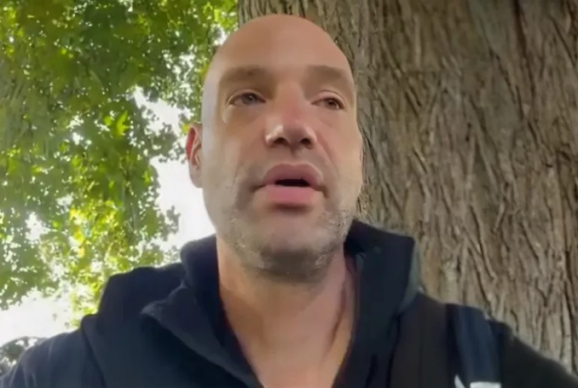
US citizen Matt Nelson set himself ablaze in solidarity protest of his country’s support of the genocide in Gaza. (Photo: video grab)
By Robert Inlakesh | The Palestine Chronicle | September 22, 2024
So far, three US citizens have self-immolated in protest of their government’s support for Israel’s ongoing genocide against the people of Gaza.
However, in two of the cases, American media actively worked to cover up that it even happened, and the most prominent example they deflected, trying to hint at mental illness being the reason.
On September 11, a man named Matt Nelson set himself ablaze across the street from the Israeli consulate in Boston.
“My name is Matt Nelson and I’m about to engage in an extreme act of protest,” echoing the speech delivered by Aaron Bushnell who also self-immolated on February 24.
Matt Nelson went on to say that “we are slaves to capitalism and the military-industrial complex. Most of us are too apathetic to care,” adding that “we are all culpable in the ongoing genocide in Gaza.”
He then stated:
“The protest I’m about to engage in is a call to our government to stop supplying Israel with the money and weapons it uses to imprison and murder innocent Palestinians, to pressure Israel to end the genocide in Gaza, and to support the (International Criminal Court) indictment of (Israeli Prime Minister) Benjamin Netanyahu and other members of the Israeli government.”
There can be no mistaking the intentions of Matt Nelson’s actions and even without the video, the fact that he was positioned right across from the road from the Israeli consulate when he self-immolated is enough of an indicator that this was a political act. However, not for the likes of NBC Boston who ran the headline “Man sets himself on fire outside Four Seasons hotel in Boston, witnesses say”.
Even Israeli media outlets like The Jerusalem Post and The Times of Israel covered the story with correct headlines, but not Western corporate media. In the US media, they either ignored it altogether or decided to twist it to make it seem like a random act of suicide.
On December 1, a similar instance occurred when a woman – whose name still has not been released to the public – self-immolated in front of the Israeli consulate in Atlanta, Georgia.
While the Atlanta Police Department publicly stated that what happened was an “act of extreme political protest”, the story was completely ignored in Western Corporate media.
The only exception to the story was the self-immolation of 25-year-old Aaron Bushnell, who was an active-duty airman, who self-immolated in front of the Israeli embassy in Washington this February.
While the coverage began with a similarly biased slant, where his act was depicted as a man lighting himself on fire, without any reason being presented, the truth could not be ignored in the end after it went viral on social media.
Aaron Bushnell had live-streamed the whole event, giving his very clearly stated reason for his actions that day and providing the world with a video of him burning alive while screaming “free Palestine” literally until his dying breath. Everyone who watched the video, either with blur over his body as he burned, or without it, was similarly in shock.
The fact that a young American man would put on his military uniform, cover himself with flammable liquid and scream the words “free Palestine” until he literally couldn’t speak anymore, should have been enough to shock the world. However, the corporate media decided to try and paint him as being mentally ill, later burying the story.
Instead of being praised as heroes who sacrificed themselves in order to try and prevent a genocide from continuing, the US media has put the interests of Israel ahead of its own people, hiding the truth, and actively participating in blocking their voices from being heard. Luckily, however, in the era of social media, their words still remain free for those who seek to hear them.
– Robert Inlakesh is a journalist, writer, and documentary filmmaker. He focuses on the Middle East, specializing in Palestine.
The more definitive the proof of Israeli atrocities, the less they get reported
By Jonathan Cook | September 20, 2024
The coverage of Israeli soldiers pushing three Palestinians off a roof in the West Bank town of Qabatiya – it’s unclear whether the men are dead or near-dead – is being barely reported by the western media, even though it was videoed from at least three different angles and a reporter from the main US news agency Associated Press witnessed it.
AP reported on this incident some nine hours ago. Its news feed is accessed by all western establishment media, so they all know.
Yet again, the media has chosen to ignore Israeli war crimes, even when there is definitive proof that they occurred. (Or perhaps more accurately: even more so when there is definitive proof they occurred.)
Remember, that same media never fails to highlight – or simply makes up – any crime Palestinians are accused of, such as those non-existent “beheaded babies”.
AP itself treats this latest atrocity in the West Bank as no big deal. It reports simply that it may be part of a “pattern of excessive force” by Israeli soldiers towards Palestinians.
That comment, without quote marks and ascribed to a human rights group, is almost certainly AP’s preferred characterisation of the group’s reference to a pattern not of “excessive force” but of war crimes, crimes against humanity and genocide.
AP makes sure to give Israel’s pretext for why it is committing war crimes: “Israel says the raids are necessary to stamp out militancy.”
But it forgets yet again to mention why that “militancy” exists: because Israel has been violently enforcing an illegal military occupation of the Palestinian territories for many decades, in which it – once again illegally – has drafted in an army of settler militias to drive out the native Palestinian population.
AP also forgets to mention that, under international law, the Palestinians have every right to resist Israel’s occupying soldiers, including “militantly”.
Western governments might characterise Palestinians shooting at Israeli soldiers as “terrorism”, but that’s not how it is seen in the international law codes that western states drafted decades ago and that they claim to uphold.
It’s also worth noting that the local Palestinian reporter who witnessed this crime had his report rewritten by “Julia Frankel, an Associated Press reporter in Jerusalem”.
As is true with many other western outlets, AP copy is editorially overseen from Jerusalem, where its office is staffed mostly with Israeli Jews.
Western news outlets doubtless privately rationalise this to themselves as a wise precaution, making sure copy is “sensitive” to Israel’s perspective and less likely to incur the wrath of the Israeli government and Israel lobby.
Which is precisely the problem. The bias in western reporting is baked in. It is designed not to upset Israel – in the midst of a “plausible genocide”, according to the World Court – which means it’s entirely skewed and completely untrustworthy.
It makes our media utterly complicit in Israel’s war crimes, including when Israeli soldiers throw Palestinians off a roof.
UPDATE:
Very belatedly, the BBC has reported this on one of its news channels. Note, it adds an entirely unnecessary disclaimer that the footage hasn’t been “independently verified” – whatever that means. There are now at least three separate videos, all taken from different angles, showing the same war crime. Even the Israeli military has confirmed the incident happened.
The BBC also assumes the three Palestinians are dead. There is absolutely no reason to make that assumption: it violates the most basic rules of reporting.
And the anchor, clearly nervous about how she should refer to the men being pushed off a roof, ends by observing that the footage is “another example of the tensions and the many fronts on which we see Israel fighting”. No, it’s another example of Israeli soldiers committing war crimes, and the media trying to deflect attention from that fact.
Featured Video

Dan Dicks with James Corbett on Solutions Watch
or go to
Aletho News Archives – Video-Images
From the Archives
$1.5bn up in smoke: US THAAD missile stockpile dries up defending Israel against Iran
By Ivan Kesic | Press TV | July 2, 2025
According to American media, defense news outlets, and independent analysts, the 12-day Israeli military aggression against Iran significantly depleted the US stockpile of THAAD (Terminal High Altitude Area Defense) interceptor missiles.
Citing official sources, American magazine Newsweek reported on Friday that the US transferred a substantial portion of its advanced missile defense capabilities to support the Israeli regime, an effort with questionable results and a critical impact on US strategic reserves.
THAAD, developed by Lockheed Martin arms manufacturing company, is a key component of Israel’s multi-layered air defense architecture. It is designed to intercept medium-range ballistic missiles, including those launched from Iran and Yemen.
The US-made system is capable of targeting short-, medium-, and intermediate-range ballistic missiles during their terminal phase, whether inside or outside Earth’s atmosphere.
THAAD uses a “hit-to-kill” method, relying on kinetic energy rather than explosive warheads to destroy incoming threats, intercepting at altitudes of up to 150 km and ranges between 150-200 km.
Operated exclusively by American personnel, the US military maintains eight THAAD batteries with an estimated 350–400 interceptors in total. The eighth battery was activated during the June 20 Israeli aggression against Iran and is capable of intercepting hypersonic missiles. … continue
Blog Roll
 Aletho News
- ‘THAAD Delusion’: Iran war exposes US missile shield limits – The Atlantic
- Moscow issues warning to NATO over Russian exclave
- Yes, the Iran war has destroyed Trump’s presidency
- The fallacy of US delusions about Iran’s economic collapse
- Hezbollah denies Syria cell link, warns of Israeli plan to sow discord
- The legacy of US sanctions, war, and occupation in Iraq
- Iraqi resistance group rejects disarmament, vows to maintain support for Lebanon
- Sheikh al-Asadi warns of Iraqi government compliance with US demands
- How to MAKE THE CONSPIRATORS PAY for their crimes! Dan Dicks with James Corbett on Solutions Watch
- There’s a drought in academia: A drought in honest research on the subject of drought and other weather extremes
- If Americans Knew
- Iran’s Revolutionary Guards Publish Letter to the American People
- DMFI launches $1 million ad campaign supporting Virginia’s Elaine Luria
- US Senate blocks resolution seeking report on Americans killed by Israel
- Israeli Attacks Kill Ten Palestinians in Gaza
- Massacre at Minab: The School That Became a Grave
- Israeli media: The IDF Shows It Doesn’t Turn a Blind Eye; It Actively Emboldens Settler Havoc
- As settlers ravage West Bank, Israeli forces kill 10 in Gaza – Daily Update
- New Report: “Scholasticide and Genocide in Gaza: Assessment, Testimonies and Legal Analysis”
- Ex-Biden officials are desperate for a Gaza scapegoat
- Israeli “settlers” Invade Al-Aqsa; Pour Boiling Water on 75-Year-Old
- No Tricks Zone
- Green Energy Debacle: German Expert Professor Fritz Vahrenholt Warns Of Severe Economic And Social Consequences
- Two More Paleo Reconstructions Affirm Meters-Higher Sea Levels Across Ireland, Brazil 7000-6000 Years Ago
- New Study: Earth And Venus Surface Warmth Largely Explained By Convection And Lapse Rate, Not CO2 Or Radiation
- 2025 Nature Paper Claiming Worsening Global Drought Gets RETRACTED …Heavily Flawed
- New Study: ‘Global Drought Shows No Detectable Recent Acceleration Under Climate Warming’
- Economic Masterminds: German Socialists Suggest Taxing Productivity Gains Stemming From Using AI
- The South China Sea Has Not Been Cooperating With The Climate Change Narrative
- Energy Crisis: Germany Enters Heating Season With Historically Low Gas Reserve Fill Levels
- New Study: The Antarctic Ice Sheet Gained Mass From 2020-2024 Due To Staggering Snow And Ice Accumulation
- Study: Ocean Heating Rates From Thousands Of Years Ago ‘Dwarf’ Modern Ocean Heating Rates

