Britain implicated in murder of Gaza doctor sponsored by its Foreign Office
BY KIT KLARENBERG · THE GRAYZONE · NOVEMBER 14, 2023
The UK government refused to condemn Israel’s targeted murder of Dr. Maisara Alrayyes, a Palestinian alumnus of the British Foreign Office’s prestigious Chevening scholarship. Meanwhile, London has instructed media outlets to keep silent about its direct involvement in the Gaza slaughter.
Since the beginning of Israel’s military assault on the besieged Gaza Strip, the British government has remained unflappably silent on the carnage inflicted on Palestinian civilians with one notable exception.
On November 8th, the Foreign Office announced the death of Dr. Maisara Alrayyes, a Palestinian alumnus of its prestigious Chevening scholarship scheme, under which “outstanding emerging leaders from all over the world” can pursue all-expenses-paid master’s degrees at prestigious British universities.
The Foreign Office refused to state the cause of Alrayyes’ death, provoking a wave of condemnation.
Meanwhile, King’s College, where in 2019 Alrayyes studied Women and Children’s Health, issued a brief statement stating he and his family were “killed,” though it refused to name the perpetrator. The college noted that his work had been published “in a number of high-profile journals… and he was well respected and known among his colleagues for his dedication to improving healthcare for women and children in low-income and war-affected regions.”
Colleagues of Alrayyes subsequently revealed that he and his family had been murdered as a result of Israeli airstrikes after spending 30 hours trapped under rubble.
In the days leading up to their deaths, the physician texted his former classmates at King’s College, telling them:
“In the last few days, I’m starting to feel more terrified than ever. I imagine myself underneath the rubble, and I have a great fear of staying alive under the rubble.”
His worst nightmares were realized thanks in no small part to the British government sponsors of his Chevening Scholarship.
Britain’s Cleverly meets Alrayyes, signs off on Israel’s killing spree
The Chevening Scholarship is considered something of a crown jewel in Britain’s soft power arsenal, and a vital mechanism for promoting her interests abroad. Over 15 Chevening graduates have gone on to become heads of state, and London is keen to promote the success of alumni the world over. A leaked Foreign Office report on improving public perceptions of Britain in the former Yugoslavia found London was “favourably associated with education (universities, schools, the Chevening scholarship programme).”
A Chevening Journalism Scholarship was therefore made available in every country in the region, to “improve the perception of the UK with participants, who are influencers in the Western Balkans.”
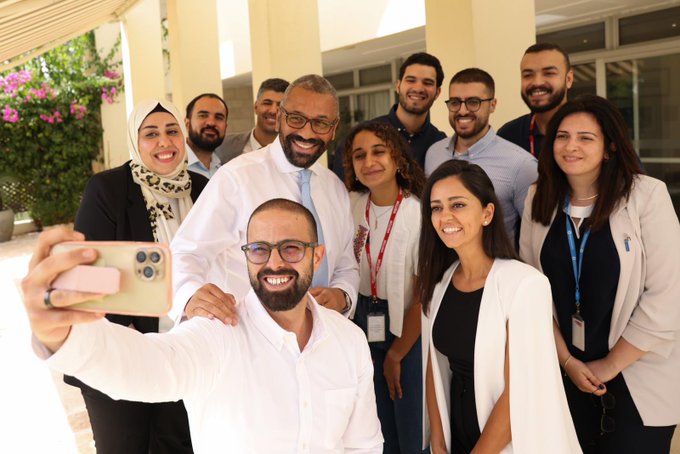
As Alrayyes met his fiancee, also a Chevening scholar, while studying in Britain, London was particularly enamored with his example. In September, he was among a select group of graduates granted a meeting with Foreign Secretary James Cleverly in Jerusalem.
These British leaders failed to provide Alrayyes with even the slightest measure of protection when the brutal bombardment of Gaza began this October. While sleeping in his home with his family, he became a target of the Israeli military. In death, he has become a public relations problem for the British Foreign Office that once sponsored him.
Cleverly has repeatedly dismissed calls for a ceasefire in Gaza while insisting Britain fervently supports Israel’s right to “defend” itself – a euphemism for backing Israel’s crushing assault. When grilled about Alrayyes’ murder by ITV, the Foreign Secretary half-heartedly mumbled:
“Every loss of life is heart-breaking. And there are people both Palestinian and Israeli who have lost their lives. That is why we are so focused on getting humanitarian aid into Gaza.”
Britain implicated directly in the Gaza slaughter
In every way, Alrayyes’ horrific death is a nightmare for London, not least because the British government itself may be somehow implicated. Analysis by Declassified UK indicates that since October 7, 33 military transport flights have traveled to Tel Aviv from Britain’s vast airbase in Cyprus. The outlet could not find records of similar journeys before the attack on Gaza began. A Ministry of Defence spokesperson denied the planes were ferrying “lethal aid”, but supported “diplomatic engagement.”
This explanation is rendered all the more dubious given that in late October, the Defence and Security Media Advisory (DSMA) Committee wrote to the editors of major British news outlets to demand they not report on British special forces “deployed to sensitive areas of the Middle East.”
DSMA is a Ministry of Defence body that imposes a very British form of censorship on the press. It brings together representatives of the intelligence and security services, military veterans, high ranking government officials, press association chiefs, senior editors, and journalists. Together, they decide what issues related to national security can be reported on, and how. It creates a situation in which the overwhelming majority of British national security journalism is directly influenced by the state.
The Committee’s recent intervention was spurred by media reports of the SAS being stationed in Cyprus to assist with hostage rescue operations. This was almost certainly designed to explain the presence of British special forces in the region while concealing their involvement in the assault on Gaza, where Alrayyes was murdered.
‘Israel controls the Foreign Office’
The Foreign Office’s handling of Alrayyes’ death reportedly sparked outrage even among its own staff, who were already outraged at Whitehall’s refusal to acknowledge, let alone condemn, the spiraling civilian death toll in Gaza. Historically, the department was pro-Arab. Its conversion to the cause of Zionism is a relatively recent development, although sympathy for the Palestinians endures in certain quarters.
This is somewhat remarkable, given British politicians who dare speak up for the Palestinians are routinely targeted for reputational destruction by the Israel lobby. Both Labour and the Conservatives have highly influential “Friends of Israel” clusters within parliament, which operate in close, clandestine concert with Tel Aviv’s embassy in London.
In 2017, undercover Al Jazeera journalists caught Israeli embassy representative Shai Masot on tape in meetings with Conservative Friends of Israel (CFI), discussing a “hit list” of parliamentarians to “take down” due to their support for Palestine. This included MP Crispin Blunt, a longtime critic of Israel, and Foreign Office minister Alan Duncan. Masot expressed a desire to “destroy” Duncan, to ensure he wouldn’t receive a top post within the department.
In response, Duncan telephoned Mark Regev, then-Israeli ambassador to Britain, who alleged Masot was a junior “local hire” with no formal diplomatic status. In reality, Masot was an Israeli Defense Forces veteran who had served as the embassy’s senior political officer since November 2014, acting as chief point of contact between the Israeli embassy and the Foreign Office.
Israel returns to kill Alrayyes’ family
On November 8, friends of Maisara Alrayyes learned that his two brothers were also murdered by the Israeli military as they dug through the rubble of his home to extract his dead body. They had survived the attack on their home two days prior, but became targets when they returned in an attempt to give their brother a proper burial.
Having whitewashed the murder of Alrayyes, the British Foreign Office has been silent about Israel’s targeted killing of Alrayyes’ family. Meanwhile, UK Rishi Sunak continues to reject calls for a ceasefire between Israel and Palestinian factions in Gaza.
Euro-Med: Israel used over 1,000 white phosphorous bombs in Gaza
Palestine Information Center – November 16, 2023
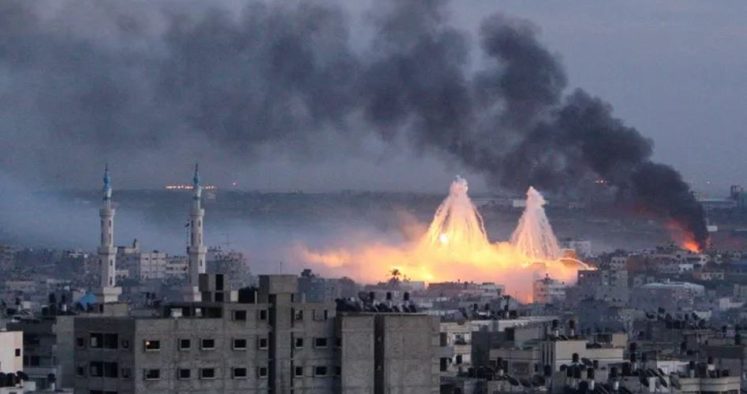
GAZA – The Euro-Med Human Rights Monitor has said that the Israeli army has launched more than 1,000 strikes, utilizing internationally prohibited white phosphorus, on populated areas since it started its genocidal war on the Gaza Strip on October 7.
In a statement on Thursday, the Euro-Med Monitor said it had documented the Israeli army’s indiscriminate use of white phosphorus against civilians, describing it as an “incendiary substance that burns human flesh and causes lifelong suffering.”
Euro-Med said that its team received testimonies affirming that the Israeli army carried out 300 strikes with white phosphorus bombs and projectiles within a period of about 40 minutes on Wednesday evening, November 15, on a residential block in Beit Lahia town, north of Gaza.
“The night before, a large number of white phosphorus shells were reportedly seen falling on a crowded populated area in Sheikh Radwan neighborhood, north of Gaza City. Similar attacks also occurred on several occasions in al-Shati refugee camp in western Gaza and the town and camp of Jabalia, north of the Strip,” Euro-Med elaborated.
“Palestinian residents said they suffered from severe shortness of breath and coughing as a result of inhaling white phosphorus in the midst of extremely unpleasant odors spreading in the air and severe blurred vision due to the thick white smoke,” Euro-Med cited.
According to Euro-Med, people exposed to white phosphorus can suffer from respiratory damage, organ failure, and other serious and life-altering injuries, including burns that are extremely difficult to treat and cannot be relieved with water.
“The escalating use of white phosphorus and smoke bombs against densely populated areas comes within the framework of forced displacement and ethnic cleansing that are being practiced by the Israeli army in order to force half of the Gaza’s population to leave their homes, shelters and hospitals and move to areas in the south of the Gaza Valley.”
Euro-Med accused Israel of persisting in violating the principles of proportionality and precaution by launching random attacks on the Gaza Strip and directly targeting the lives and health of civilians, and using internationally prohibited weapons in flagrant violation of the international humanitarian law and the rules of war.
“In addition to that, Israel uses bombs with huge destructive power against populated areas, and such bombs pose the single greatest threat to civilians in modern armed conflicts. This explains the severity of the massive destruction that turns entire residential neighborhoods into rubble and ruins in the Gaza Strip.”
Dozens killed in latest Israeli bombing of Gaza Mosque
The Cradle | November 16, 2023
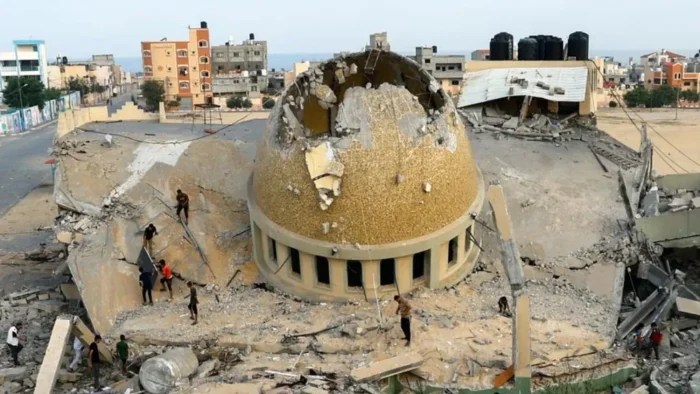
At least 50 Palestinians were killed and dozens of others injured on 15 November after the Israeli army targeted a mosque in the besieged Gaza Strip, WAFA news agency reports.
The attack on the Sabra neighborhood was conducted during a congressional prayer when the mosque was full of Palestinian worshippers.
Israel has conducted similar attacks on places of worship since its inception; in this war alone, multiple Mosques and churches have been leveled, including ones dating back centuries.
On 20 October, the Israeli army destroyed the Grand Al-Omari Mosque in Jabalia, dating back to the 7th century; it was one of the largest mosques in Palestine.
Hours before the Al-Omari bombing, the Israeli army targeted and destroyed the Church of Saint Porphyrios in Gaza, the third oldest church in the world.
“We condemn this unconscionable attack on a sacred compound and call upon the world community to enforce protections in Gaza for sanctuaries of refuge, including hospitals, schools, and houses of worship,” World Council of Churches (WCC) general secretary Rev. Jerry Pillay said in response to the bombing of the 1,400-year-old structure.
“Our prayers go out for healing to all those wounded, along with our condolences to Patriarch Theophilos II and all our Greek Orthodox brothers and sisters in Christ,” Pillay added.
Outside of Gaza, Israel launched an airstrike against the Al-Ansar mosque in Jenin refugee camp, West Bank, on 22 October.
An Israeli statement justifying the Al-Ansar Mosque attack said it was a“joint operation between the army and the Shin Bet” and that the strike targeted an “underground terrorist route.”
This has been a line used by Israel to justify their attacks on not only multiple places of worship but also civilian residences and hospitals.
As of 15 November, 11,470 Palestinians have been killed by Israeli airstrikes in Gaza, of whom are 4,707 children, 3,155 women, and 686 elderly.
Haniyeh family home in refugee camp bombed by Israel
MEMO | November 16, 2023
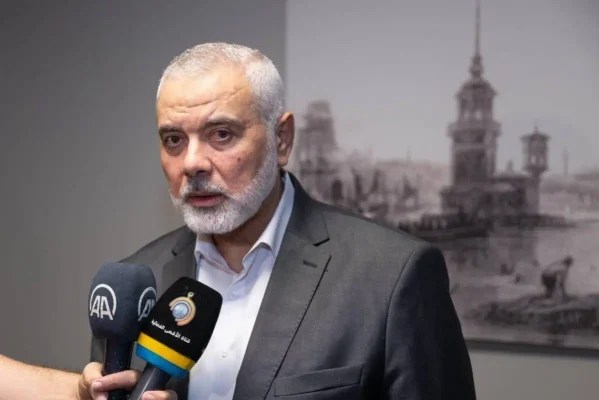
The family home of the head of the Hamas political bureau, Ismail Haniyeh, has been bombed by Israel, local media have reported. His home is in the overcrowded Al-Shati refugee camp, where he grew up.
Military sources claimed that the house was being used as infrastructure for Hamas, and a meeting place for the movement’s members and senior officials. Haniyeh has stayed outside the Gaza Strip since 2019, when the former Palestinian Authority prime minister was elected to head the political bureau. He is currently based in Qatar.
The Israeli occupation continues its ongoing aggression against the Gaza Strip for the 41st day, with the support of the US, as its aircraft bomb the vicinity of hospitals, residential buildings, tower blocks and the homes of Palestinian civilians, destroying them over the heads of their residents. It also continues to prevent the entry of water, food and fuel, all of which has led to the death toll rising to 11,500 martyrs, including more than 8,000 children and women, with 29,000 wounded.
Hamas rebuts Israeli claim about finding weapons at Al-Shifa Hospital
Palestine Information Center – November 16, 2023
GAZA – The Hamas Movement has belied the Israeli occupation army’s claim that it found weapons and military equipment in the Shifa Medical Complex, describing it as “part of its lies and cheap propaganda that aim to justify its crimes against the health sector in Gaza.”
“These claims are part of the silly propaganda that was spread by the occupation after it stormed the Rantisi Children’s Hospital. They put weapons in the place and then make up a weak story that no longer deceives anyone,” Hamas said in a statement on Wednesday.
“We have repeated more than once and for two weeks our call on the UN and international organizations to form an international committee to visit the hospitals and check on their conditions to expose the occupation’s lies and false claims because we are aware of the size of its fabrications and deception that aim to cover up its crimes against children, women and defenseless civilians,” the Movement added.
UN issues Gaza water warning
RT | November 15, 2023
At least 70% of Gaza will be without access to drinking water by the end of Wdnesday, the UN Relief and Works Agency (UNRWA) has warned. The agency blamed Israel’s fuel blockade for the crisis, which has resulted in the collapse of water infrastructure in the enclave.
The 23,000 liters of fuel Israel has allowed to the UNRWA on Wednesday can only be used “to transport the little aid coming via Egypt,” UNRWA Commissioner-General Philippe Lazzarini said in a statement. The agency needs around 160,000 liters a day for “basic humanitarian operations,” such as maintaining the water facilities, he added.
“Key services, including water desalination plants, sewage treatments, and hospitals have ceased to operate,” Lazzarini said. “It is appalling that fuel continues to be used as a weapon of war.”
Supplying just the trucks will lead to more loss of life, Lazzarini said, calling on Israel to “immediately authorize the delivery of the needed amount of fuel as is required under international humanitarian law.”
Israel imposed a total blockade on Gaza after the October 7 incursion by Hamas, which killed an estimated 1,200 people. Prime Minister Benjamin Netanyahu has vowed to destroy the Palestinian group, launching air and artillery strikes against the enclave and sending ground troops earlier this month.
Lazzarini has also appealed for a ceasefire, noting that over 60 UNRWA installations in the enclave have been hit – most of them in the south of Gaza, which Israel said would be “safe” for civilians.
The government in West Jerusalem has adamantly rejected any ceasefire, or fuel deliveries to Gaza. National Security Minister Itamar Ben-Gvir declared “Diesel = weapon” on Wednesday, while Transportation Minister Miri Regev wrote on X (formerly Twitter) that “fuel for UNRWA is fuel for Hamas.”
UNRWA was established in 1949 to provide humanitarian aid and protection to palestinian refugees “pending a just and lasting solution to their plight.” It operates in Gaza, the West Bank, Jordan, Lebanon, and Syria.
Belize severs diplomatic relations with Israel
MEMO | November 15, 2023
The Central American state of Belize announced the severing of its diplomatic relations with Israel due to Tel Aviv’s continued attacks on the Gaza Strip.
The Belize government said in a statement published on its website that the decision was taken because Israel did not accept calls for a ceasefire and prevented the entry of humanitarian aid into Gaza.
It added: “Despite our requests, Israel has not stopped its violations of international humanitarian law nor allowed relief workers to alleviate the suffering of millions of Gazans.”
As a result, it continued, the government is withdrawing the accreditation of Israel’s ambassador to Belize and withdrawing “its request for accreditation of Mr. Jonathan Enav as Belize’s Honorary Consul” to Israel.
“All activities conducted by the Israeli Honorary Consulate in Belize and the appointment of the Honorary Consul are suspended.”
It concluded that it “renews its call for an immediate ceasefire in Gaza, unimpeded access to humanitarian supplies into Gaza and the release of all hostages.”
This comes after South Africa, Bolivia, Chile, Colombia and Jordan recalled their ambassadors from the occupation state over its war crimes in Gaza.
US public support for Israel shrinks: Poll
The Cradle | November 15, 2023
Public support in the US for Israel’s ongoing war in the Gaza Strip has dwindled significantly, with only a third of US citizens saying Washington should continue to support Tel Aviv, according to a new poll carried out by Reuters.
“Most [US citizens] think Israel should call a ceasefire to a conflict that has ballooned into a humanitarian crisis,” the outlet writes.
According to the poll – which closed on 14 November – 32 percent of respondents said Washington should support Israel in the war with Gaza. This was a marked drop from 41 percent who said the US should support Israel in a Reuters poll conducted in mid-October.
The poll indicates that those who believe “the US should be a neutral mediator” rose to 39 percent from 27 percent last month.
“Four percent of respondents in the poll said the US should support Palestinians and 15 percent said the US shouldn’t be involved at all, both similar readings to a month ago.”
Western countries have witnessed a significant shift in public opinion recently, as evidenced by massive protests that have taken place across many cities.
In the US, tens of thousands have flocked to the streets of numerous cities, including Washington DC, New York, Los Angeles, Chicago, and many others. Those marching rejected Israel’s disproportionate response to the 7 October operation by the Gaza resistance and demanded an immediate ceasefire.
On 11 November, around 300,000 people marched through central London, demanding an immediate ceasefire in Gaza.
The brutality of Israel’s response to Operation Al-Aqsa Flood has shocked the world. The killing of over 11,300 – more than half of which are women and children – as well as open calls by Israel for ethnic cleansing and mass displacement, have been labeled a genocide by numerous international organizations and UN experts.
Condemnation of Israel’s actions is also growing within the US government.
An internal State Department dissent memo alleges that Israel is committing “war crimes” in Gaza and that President Biden is “spreading disinformation” and showing “disregard for Palestinian lives,” according to a copy of the memo obtained by Axios.
The five-page memo was transmitted to the State Department’s policy office on 3 November. It was signed by 100 State Department and USAID employees urging senior US officials to reassess their policy toward Israel and demand a ceasefire in Gaza.
Al-Shifa Hospital under Israeli control, turned into center for ‘detention and torture’
The Cradle | November 15, 2023
Gaza’s largest medical complex, Al-Shifa Hospital, fell under the control of the Israeli army on 15 November following an overnight raid that saw dozens of troops storm the hospital based on Israeli and US intelligence that alleged the complex houses a “Hamas command center.”
“Hamas and the Palestinian Islamic Jihad (PIJ) use some hospitals in the Gaza Strip, including Al-Shifa and tunnels underneath them, to conceal and to support their military operations and to hold hostages,” US National Security Council spokesman John Kirby said on Tuesday night, in comments that preceded the brutal raid on the besieged medical complex.
Deputy Pentagon Press Secretary Sabrina Singh made similar comments before the raid, claiming that Washington obtained “newly declassified intelligence” showing Gaza resistance factions use hospitals as a “way to conceal and support their military operations and hold hostages.”
Neither US official provided evidence to back their claims, citing simply a “variety” of intelligence sourcing to back up the assertion.
“Since last night, it’s been a nightmare that cannot be imagined […] Before storming the compound, they targeted all the floors, the generators, the communications unit, and now we can have no contact with the outside world,” Palestinian journalist Jihad Abu Shanab, who is inside the Al-Shifa compound, told Al-Jazeera on Wednesday morning.
“[The Israelis] have told everyone to go up a floor, then go to a lower floor for investigation, and then they are forced to be interrogated, and they have seen a lot of humiliation,” he added.
The Qatari news agency also cites sources saying “about 30 people [were] taken outside of the building, stripped of their clothes. They are in the courtyard of the hospital, blindfolded, surrounded by three tanks. There is one tank right at the front of the emergency department targeting any moving object inside these buildings.”
Sources add that the Israeli tanks surrounding the hospital “blew up a warehouse of medicines and medical devices.”
According to a statement by the Euro-Mediterranean Human Rights Monitor, Israel has turned Al-Shifa Hospital into a center for “detention and torture.” The monitor also expressed concerns that patients, medical staff, and refugees will be executed as sporadic gunfire continues inside the complex.
“Israeli allegations about the use of the Al-Shifa Medical Complex for military purposes do not need all these long hours of searching and raiding. Therefore, there are concerns that the army may be creating an artificial scene for a new play,” Rami Abdu, the Chairman of the Euro-Mediterranean Human Rights Monitor, said on Wednesday.
Staff inside the hospital report that the Israeli army has continued its attacks against the hospital, bombing several sections while live fire can be heard inside the complex.
“Israeli drones are shooting anything moving inside the hospital,” the head of the orthopedics department told Al-Alam Radio.
Videos shared online showed medical staff and volunteers transferring babies from one ward in Al-Shifa to another to protect them from the Israeli raid.
According to Israeli media, the invading troops discovered “weapons and Hamas assets” inside the hospital. Nonetheless, Tel Aviv claims there is “no indication” of Israeli captives held inside the complex, as they previously claimed.
“We hold the occupation [Israel] and President Biden wholly responsible for the assault on Al-Shifa medical complex,” Hamas said in a statement early on Wednesday.
“The adoption by the White House and the Pentagon of the occupation’s false claim that the resistance is using Al-Shifa medical complex for military ends has given the green light to the occupation to commit more massacres against civilians,” the statement added.
Israel kills elderly Palestinian after using him in propaganda about ‘safe corridor’
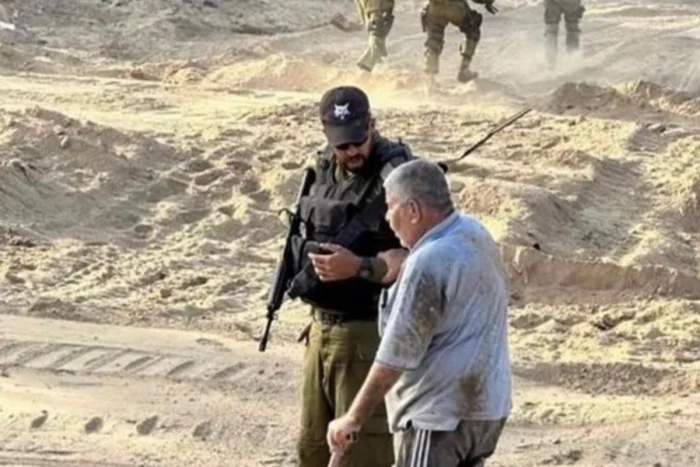
Israeli army soldier talking to Bashir Hajji, a 79-year-old resident of Gaza City [@MariamBarghouti/X]
MEMO | November 15, 2023
The Israeli army killed an elderly Palestinian after using him in a propaganda campaign promoting its “safe corridor” in Gaza, Euro-Med Human Rights Monitor has revealed. The organisation expressed its “outrage” on its website about Israel’s use of the man in an attempt to cover up its horrific crimes against displaced Palestinians fleeing Israeli violence in the northern Gaza Strip.
“The Israeli army released a photo of one of its soldiers talking to Bashir Hajji, a 79-year-old resident of Gaza City’s Zaytoun neighbourhood, as he travelled on Salah Al-Din Road, the main route to the southern Gaza Valley,” explained the organisation. “The soldier appears to be helping and protecting displaced Palestinian civilians.”
However, the elderly man’s granddaughter, Hala Hajji, told the Euro-Med Monitor team that her grandfather was “brutally executed while crossing the ‘safe corridor’ when members of the Israeli army deliberately shot him in the head and back.” She also confirmed that he is in the photo that was put out by Israel, “exposing the army’s dangerous practice of flagrantly fabricating stories.”
Euro-Med Monitor pointed out that it has documented dozens of cases of the Israeli army executing displaced Palestinians and, in some cases, bombing them. Those displaced were attempting to flee to the south of Wadi Gaza at the Israeli army’s request.
The organisation renewed its calls for the “UN and the International Criminal Court to open an urgent independent investigation into the crimes to which displaced Palestinians have been and are still being subjected to hold those who ordered such crimes accountable; and to achieve justice for the victims.”
Euro-Med Monitor is a non-profit human rights organisation. Seventy per cent of its staff and volunteers are victims of human rights violations. According to its website, it “advocates for the human rights of all persons across Europe and the MENA region, particularly those who live under occupation, in the throes of war or political unrest and/or have been displaced due to persecution or armed conflict.”
Tel Aviv Refuses Western Requests to Allow Aid Into Gaza Through Israel
By Kyle Anzalone | The Libertarian Institute | November 14, 2023
Officials in Tel Aviv have denied requests from some Western nations to bring aid into Gaza through an Israeli crossing. Israel has allowed a small amount of aid to enter Gaza via Egypt. The aid making it into the besieged enclave is only a tiny portion of what is required to prevent a humanitarian catastrophe.
Tel Aviv requires the trucks to pass inspection at the Israel-Egypt border before proceeding into Gaza through the Rafah crossing. In recent days, aid that flows into Gaza through Egypt has slowed because of a backup inside of Israel.
Western countries have asked Tel Aviv to allow aid to pass from Israel through the Kerem Shalom checkpoint. According to Haaretz, Tel Aviv has rejected the proposal because it does not want to take any responsibility for the Palestinians in Gaza who have been displaced by the Israeli military operations. “Israel opposes the idea,” the outlet reports. “Despite the pressure applied by the Western countries, Israeli sources say that Jerusalem objects because it wants to renounce any responsibility for civilian matters in the Gaza Strip.”
Haaretz explained that the Israeli refusal is creating some anger in Western countries. “If they’re going to check the goods at Kerem Shalom anyway, the most logical thing is to bring the goods in through there,” a Western diplomat told the Israeli outlet. “We understand Israel’s position, but there is an attempt to avert a humanitarian disaster in Gaza. If there are thousands more dead there, or heaven forbid an epidemic breaks out, the world will blame Israel. It’s in your interest to streamline the aid.”
After the Hamas attack in southern Israel on October 7, Israel imposed a complete siege of Gaza. The next day, Tel Aviv launched a massive military operation in Gaza that has decimated the small enclave’s infrastructure. A small number of aid trucks have entered Gaza, but aid groups have described the amount of aid as severely insufficient.
Since imposing the siege, Israel has not allowed any fuel into Gaza. On Tuesday, Axios reported speaking with Israeli and US officials who say some fuel will be allowed into the strip this week.
UNRWA Commissioner-General Philippe Lazzarini explained the situation inside Gaza was becoming increasingly desperate. “We have heavily rationed the use of fuel and accessed pre-existing, limited amounts stored in a depot inside the Gaza Strip through close coordination with Israeli Authorities. The depot is now empty,” he added. “It is unbelievable that humanitarian agencies have to beg for fuel and operate on life support. Since the beginning of the war, fuel has been used as a weapon of war, and this should stop immediately.”
The Biden administration has tried to focus on the aid it is providing to Palestinians amid a flurry of criticisms for supporting the Israeli military operation in Gaza that has killed at least 4,600 children in just five weeks.
Featured Video

or go to
Aletho News Archives – Video-Images
From the Archives
A Lesser “Grade” of Human
By Michael Hoffman | Revelation of the Method | January 3, 2024
Will the more than 100 Iranians killed by terrorist bombs today be mourned in the West as victims of terrorism? Certainly not. Allied doctrine has it that the killing of Israeli or American civilians is a crime of cosmic proportions, while shedding the blood of “enemy” women and children is perfectly acceptable; indeed commendable.
The West does not memorialize the hundreds of thousands of civilians bombed by the U.S. in Serbia, Iraq, Afghanistan and every major German city 1943-1945. America’s fire-bombing of the city of Tokyo by General Curtis LeMay in March 1945 was followed by Harry Truman’s atomic incineration of Hiroshima and Nagasaki in August of that year. Truman never had a moment of doubt or regret over the murder of more than a 100,000 Asian children, mothers and non-combatant boys and men. It was business as usual for the “noble” Allies during the “Good War.”
In the West human rights signifies passionate concern only for civilians designated as truly human: Israelis first, then Americans and British, followed by their satraps.
This inhumanity is the legacy of Talmudic ideology, beginning with tractate Sanhedrin 57a from 400 A.D., concerning liability for capital punishment: “If a Jew murders a gentile, he is exempt.”
This teaching of contempt was reiterated in the dogma of Chabad Lubavitch founder Rabbi Shneur Zalman in the 18th century. … continue
Blog Roll
 Aletho News
- The Makkah Pact Enters Into Force: The End of American Dominance or Its New Form?
- NATO’s top generals gather in Kiev
- EU’s continuing expansion – greater threat to Russia
- US Senator Murphy says Pentagon denied him entry to US base in Qatar
- Israel expands “incitement” charge to target Palestinian education and memory
- How Israel seeks to reshape Arab classrooms
- Paris bans pro-Palestinian demonstration planned for Oct. 7 over ‘risks of public disorder’
- In August Hanning Treason Case – All Signs Point To Tel Aviv.
- France cleared dozens of military sales to Israel between May and September: Report
- France projects nuclear power as Macron pushes arsenal expansion
- If Americans Knew
- Israel’s flailing chatbot army
- Five Palestinians Killed, Others Injured by Israeli Fire in Gaza
- Israel is rewriting the Palestinian curriculum in East Jerusalem to erase Palestinian identity
- Three years of genocide: Israel turned prisons into killing grounds and torture sites
- Three years of genocide. Words fail. Daily Update
- ‘I’d rather die than go back’: A Palestinian teen’s 10-month nightmare in Israeli jail
- How Jared Kushner’s firm’s investment in an Israeli company could be a major conflict of interest
- Soldier testimony sheds light on how Israel wages information war
- CIA Report Warns Israel Could Head Toward Civil War, Total Collapse
- Banker Who Exposed Howard Lutnick’s Ties to Epstein Warned of ‘Retaliation’ and ‘Personal Consequences’ in Last Post Before Suicide
- No Tricks Zone
- US September “Heat” Was No Record…Many Records Set Decades Ago
- Latest European Green Energy Debacle; Portugal’s Largest Flagship Solar Park Insolvent!
- Green Energy Debacle: German Expert Professor Fritz Vahrenholt Warns Of Severe Economic And Social Consequences
- Two More Paleo Reconstructions Affirm Meters-Higher Sea Levels Across Ireland, Brazil 7000-6000 Years Ago
- New Study: Earth And Venus Surface Warmth Largely Explained By Convection And Lapse Rate, Not CO2 Or Radiation
- 2025 Nature Paper Claiming Worsening Global Drought Gets RETRACTED …Heavily Flawed
- New Study: ‘Global Drought Shows No Detectable Recent Acceleration Under Climate Warming’
- Economic Masterminds: German Socialists Suggest Taxing Productivity Gains Stemming From Using AI
- The South China Sea Has Not Been Cooperating With The Climate Change Narrative
- Energy Crisis: Germany Enters Heating Season With Historically Low Gas Reserve Fill Levels

