Netanyahu: US should interfere more in the Middle East
MEMO | April 20, 2023
Israeli Prime Minister, Benjamin Netanyahu, said that Saudi Arabia could regret its rapprochement with Tehran as Iran is the reason for most of the problems in the Middle East, which he believes the US should be more involved in.
In statements made on Wednesday night to CNBC, Netanyahu said that 95 per cent of the Middle East’s problems emanate from Iran.
He added that the proof of the “misery” that Saudi Arabia may experience due to its rapprochement with Iran is evident in “Lebanon, Yemen, Syria, and Iraq”. He also explained that he views the Saudi-Iranian rapprochement, agreed on 10 March when Saudi Arabia and Iran announced the restoration of their diplomatic relations and reopening of embassies, as having more to do with the war in Yemen.
“I think that Saudi Arabia, the leadership there, has no illusions about who are their adversaries, and who are their friends,” he said.
“We’d like very much to have peace with Saudi Arabia. Because I think it would be another huge quantum leap for peace. In many ways it would end the Arab-Israeli conflict,” said Netanyahu, adding: “I think the sky’s the limit. And even the sky’s not the limit, because there are many opportunities in space as well.”
Asked about China’s manoeuvres in the Middle East, Netanyahu said that he had no knowledge of a Chinese proposal to resolve the Palestinian-Israeli conflict, but said: “We respect China, we deal with China a great deal. But we also know we have an indispensable alliance with our great friend the United States.”
He called for increased US involvement in the Middle East, and said: “I think that not only Israel but I think in many ways most of the … countries in the Middle East would welcome an American, not merely the American involvement in the Middle East which has been ongoing, but a greater engagement of America in the Middle East.”
“I think it’s very important for the United States to be very clear about its commitment and engagement in the Middle East.”
Chinese Foreign Minister Qin Gang told his Israeli and Palestinian counterparts that his country was ready to help facilitate peace talks between the two sides, the latest mediation effort in the region, in separate phone conversations on Monday.
Gang expressed China’s concern over the escalating tensions between the two sides and its support for the resumption of peace talks.
The restoration of diplomatic relations, which were severed between Tehran and Riyadh in 2016, was a major turning point for China’s diplomacy and acted as evidence of its ability to play a role in changing the Middle East.
Scotland’s new First Minister refuses to call Israel an apartheid state even though he has family in Gaza
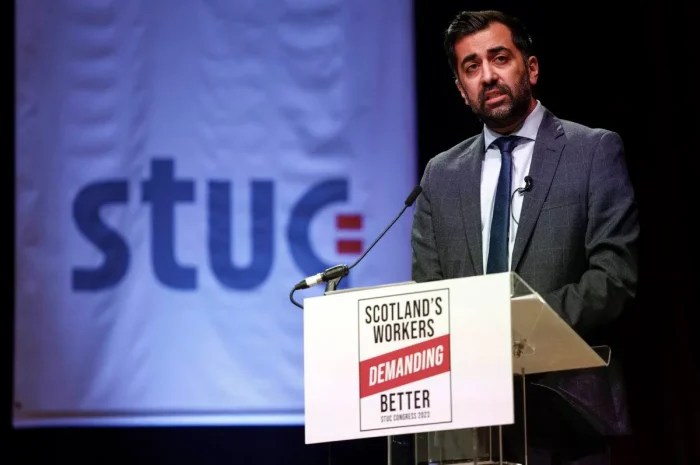
First Minister of Scotland Humza Yousaf on April 17, 2023 at Caird Hall in Dundee, Scotland [Jeff J Mitchell/Getty Images]
By Yvonne Ridley | MEMO | April 18, 2023
Scotland is one of the smallest countries in the world but you would have to be deaf, dumb and blind not to know that last month Humza Yousaf became the first Muslim to be elected as a leader in Western Europe.
You’d also have to live somewhere very remote to be unaware his political party, the Scottish National Party (SNP), was plunged into chaos within hours of his appointment as Police Scotland conducted a raid on the home of his predecessor, former First Minister Nicola Sturgeon, as well as the party’s headquarters in Edinburgh.
Her unexpected resignation as the leader of the Scottish Government was widely reported around the world but the speculation over her departure gave way to euphoria in large parts of Scotland’s vibrant Muslim community who support the country’s independence movement.
However, one of the most powerful Muslim political pressure groups in the UK reckons his appointment is not a cause for celebration. The Muslim Public Affairs Committee, MPACUK has accused Yousaf of wanting “to break Scotland away from England’s chains, yet denies the same right for Palestine”.
In a damning article on its website, MPACUK wrote: “As the new leader of the Scottish Nationalist Party, he is supposed to embody their mission objective, ‘a fair society where no-one is left behind’. But if Yousaf is not willing to call out an unjust society when he sees one, it calls into question either his integrity or his intelligence; whichever is found to be deficient, it spells poor leadership from the new First Minister.”
The unjust society referred to by the group is Israel which has also been called an “apartheid state” by US President Jimmy Carter as well as Amnesty International and Human Rights Watch, and Israeli-run B’Tselem .
Researchers in the group unearthed media claims going back to May 2014 in which Yousaf publicly stated “Israel is not an apartheid state.” Two months later Israel massacred over 2,100 Palestinians in one of its many wars in the Gaza Strip. Thanks to the silent complicity of politicians like Humza Yousaf the story barely made headlines in Western media.
I should declare an interest at this stage as I was a member of the SNP back then and shared platforms with Yousaf and Sturgeon to promote the case for independence. Back in 2021 I left, disillusioned, to join the ALBA Party formed by another former First Minister Alex Salmond whose Palestinian supporting credentials have been well documented by the Scottish Palestine Solidarity Campaign (SPSC).
And so, returning to Yousaf’s unseemly support for Israel, he is quoted as saying: “I can give you the Scottish Government’s vow that it is our policy not to boycott Israel…” and he went on to admit the SNP’s position on the Middle East “doesn’t vary much from the UK Government.”
I did write to him at the time and warned him that Palestinian supporters in the SPSC would never forgive or forget what they saw as a betrayal of the Palestinian people.
I do wonder if he has changed his position since then, and, if so, then he must tell us. The change could’ve been influenced by his second wife, Nadia El-Nakla, who is also an SNP politician and a local councillor, who just happens to be Palestinian. She is undoubtedly proud of her Palestinian roots and her family still resides in Gaza.
Humza certainly found his voice when the Zionist State launched a brutal bombardment on Palestinians in Ramadan of 2021. In newspaper articles he was critical of the violence which threatened the lives of his in-laws in Gaza and said he would “pray and hope they are alive in the morning” – that hope specifically being that “the international community intervenes and actually tackles the root of this conflict.”
This statement incurred the wrath of MPACUK which demanded: “Intervenes how, Yousaf? Tackle what root of the conflict? You have already indicated you will not hold Israel accountable. You refuse to stand for Palestine – can you really be trusted to stand for Scotland?”
Mick Napier, co-founder of SPSC, said: “As a first step, we urge the new First Minister to reaffirm the 2014 call from the Scottish Government, repeated in 2015, for an arms embargo on Israel.”
“He also needs to recognise that all major human rights groups have created a situation where sticking to his denial that Israel is an apartheid state will cut him off from progressive currents in Scotland. He will find that he can never placate the pro-Israel lobby except by praising Israeli crimes and condemning those who resist its barbarism against the Palestinian people. He can easily find out the depth of depravity of Israeli crimes but if he’s too busy he can just call his family in Gaza and get them to point their phones at the drones above, grey warships patrolling the shore, or the wall with robot machine guns keeping them under constant surveillance.”
Napier’s and MPACUK’s cutting observations will pile on more pressure on the under-fire First Minister who stands accused of supporting the oppressive state and, even worse, to the detriment of his own family. He won the leadership contest in a closely fought battle with female politicians Kate Forbes and Ash Regan under the ticket of being the “continuity candidate”.
But as critics have already pointed out, as long as Humza Yousaf is viewed as an ally to Israel, he cannot be a champion of independence.
Losing ‘Deterrence’: How Palestinian, Arab Resistance changed rules of war with Israel
By Ramzy Baroud | MEMO | April 17, 2023
When Israel launched a war against the Gaza Strip in August 2022, it declared that its target was the Islamic Jihad only. Indeed, neither Hamas nor the other Gaza-based groups engaged directly in the fighting. The war then raised more questions than answers.
Israel rarely distinguishes between one Palestinian group and another. For Tel Aviv, any kind of Palestinian Resistance is a form of terrorism or, at best, incitement. Targeting one group and excluding other supposedly ‘terrorist groups’ exposes a degree of Israeli fear in fighting all Palestinian factions in Gaza, all at once.
For Israel, wars in Gaza have proved progressively harder with time. For example, Israel’s so-called ‘Protective Edge’ in 2014 was very costly in terms of loss of lives among the invading troops. In May 2021, the so-called ‘Breaking Dawn’ was an even bigger flop. That war unified the Palestinians and served as a strategic blow to Israel, without considerably advancing Israeli military interests.
Though the Gaza groups provided the Islamic Jihad with logistical support in August 2022, they refrained from directly engaging in the fight. For some Palestinians, this was unexpected and was interpreted by some as indicative of weakness, disunity and even political opportunism.
Nearly a year later, another war loomed, following the release of harrowing footage of Israeli police senselessly beating up peaceful Palestinian worshipers at Al-Aqsa Mosque on the 14th day of the holy month of Ramadan. Like in May 2021, Palestinians rose in unison. This time, it was Resistance groups in Gaza and, eventually, Lebanon and Syria that fired rockets at Israel first.
Though Israel hit back at various targets, it was obvious that Tel Aviv was disinterested in a multi-front war with Palestinians, in order to avoid a repeat of the 2021 fiasco.
The violent and repeated Israeli military raids at Al Aqsa – and limited, though deadly attacks on Jenin, Nablus, and other parts of the West Bank – were meant to achieve political capital for the embattled government of Benjamin Netanyahu. But this strategy could only succeed if Israel manages to keep the violence confined to specific, isolated regions.
Large-scale and protracted military operations have proven useless for Israel in recent years. It has repeatedly failed in Gaza, as it did before in South Lebanon. The unavoidable change of strategy was also costly from the Israeli viewpoint, as it empowered the Palestinian Resistance, and denied Israel its so-called deterrence capabilities.
Indeed, the political discourse emanating from Israel recently is quite unprecedented. Following a security briefing with Netanyahu on 9 April, Israel’s opposition leader, Yair Lapid, left with ominous words. “I arrived at the briefing with Netanyahu worried, and I left even more worried.”
“What our enemies see in front of them, in all arenas, is an incompetent government … We’re losing our deterrence,” he added. The Times of Israel also quoted Lapid as saying that “Israel is losing the support of the United States and the international community.”
Though Israeli politics is inherently divisive, the country’s politicians have always managed to unify around the subject of ‘security’. During wars, Israelis often exhibited unity, and ideological divides seemed largely irrelevant. The fact that Lapid would publicly expose Israel’s weaknesses for political gains further highlights the deterioration of Tel Aviv’s political front.
But more dangerous for Israel is the loss of deterrence.
In an article published in the Jerusalem Post on 11 April, Yonah Jeremy Bob highlighted another truth: “Israel no longer decides when wars are fought.”
He writes: “One could have concluded this from the 2014 and May 2021 Gaza wars that Israel stumbled into, and which Hamas used to score various public relations points … but now Hamas learned in a more systematic way … how to instigate its own ring of fire around Jerusalem.”
The writer’s hyped language aside, he is not wrong. The battle between Israel and Palestinian Resistance groups has been largely centred around timing. Though Israel did not ‘stumble’ into a war between 2014 and 2021, it has not been able to control the duration and the political discourse around these wars. Though thousands of Palestinians were killed in what seemed like one-sided Israeli military campaigns, these conflicts almost always resulted in a public relations disaster for Tel Aviv abroad and further destabilised an already shaky home front.
This explains, at least in part, why Palestinians were keen not to expand the August 2022 war, which was also entirely initiated by Israel, while taking the initiative by firing rockets at Israel, starting on 5 April. The latest Palestinian action forced Israel to engage militarily on several fronts – Gaza, Lebanon, Syria and, arguably, the West Bank.
Throughout its 75 years of military conflict with Palestinians and Arabs, Israel’s success on the battlefield has been largely predicated on the unhindered military, logistical and financial support from its Western allies, and the disunity of its Arab enemies. This has allowed Israel to win wars on multiple fronts in the past, with the 1967 war serving as the main, and possibly, last example.
Since then, and especially following the considerable Arab resistance in the 1973 war, Israel shifted to different types of military conflicts: strengthening its occupation in the West Bank, Gaza and East Jerusalem, while launching massive wars at singular fronts – for example, Lebanon 1982.
The Israeli retreat from Lebanon in 2000, and the utter failure to re-invading parts of the country in 2006, brought Israel’s military ambitions in Lebanon to a complete halt.
Then, Israel turned to Gaza, launching one devastating war after the other, starting in 2008, only to discover that its military options in the besieged Strip are now as limited as that of Lebanon.
For Lapid, and other Israelis, the future of Israel’s ‘deterrence’ is now facing an unprecedented challenge. If the Israeli military is unable to operate at ease and at the time of its choosing, Tel Aviv would lose its ‘military edge’, a vulnerability that Israel has rarely faced before.
While Israeli politicians and military strategists are openly fighting over who has cost Israel its precious ‘deterrence,’ very few seem willing to consider that Israel’s best chance at survival is peacefully co-existing with Palestinians according to the international principles of justice and equality. This obvious fact continues to elude Israel after decades of a violent birth and troubled existence.
– Dr. Ramzy Baroud is a journalist, author and the Editor of The Palestine Chronicle. He is the author of six books. His latest book, co-edited with Ilan Pappé, is ‘Our Vision for Liberation: Engaged Palestinian Leaders and Intellectuals Speak Out’. His other books include ‘My Father was a Freedom Fighter’ and ‘The Last Earth’. Baroud is a Non-resident Senior Research Fellow at the Centre for Islam and Global Affairs (CIGA).
Sacred Christian site Emmaus destroyed by Israel

“The Road to Emmaus,” 1877 painting by Robert Zund. The Gospel of Luke account remains beloved reading and gives inspiration to spiritual retreats. United Methodist News Service.
By Alison Weir | Israel-Palestine News | April 15, 2023
Emmaus is a profoundly important place in Christianity. The Bible says that after Jesus’ death and resurrection, he appeared before two of his disciples while they were walking on the road to Emmaus, although at first they didn’t recognize him. When they arrived in Emmaus, Jesus took bread, blessed it, broke it in pieces, and gave it to them.
In 1967, after Israel launched its Six Day War, Israel expelled the inhabitants of Emmaus and obliterated almost all traces of the village, along with two other Palestinian villages nearby. This was part of the Israeli strategy, in the words of an Israeli historian, “to take over as much of Palestine as possible with as few Palestinians as possible” (a strategy initiated in the 1948 war to establish the modern state of Israel and then to erase the Palestinian presence).
Israeli journalist Amira Hass describes Emmaus before it was leveled: “Schools, mosques, an ancient church, olive presses, paths to fields and orchards, bubbling streams, mountain air, sabra bushes, carob and olive and deciduous trees, harvested fields, graves, water cisterns.”
Israel then “brought in the bulldozers and destroyed and detonated and trampled. Not for the first time, not for the last. And the owners of all that beauty – the elderly, the children, the infants – heard and watched the explosions from a kilometer or two away.”
The villages’ inhabitants then “trekked for days through the mountains to Ramallah, leaving their belongings behind. Four seniors and a one-year-old baby died along the way. The elderly and disabled residents who were unable to leave their homes had their houses demolished on top of them. Eighteen were killed, buried underneath the rubble.”
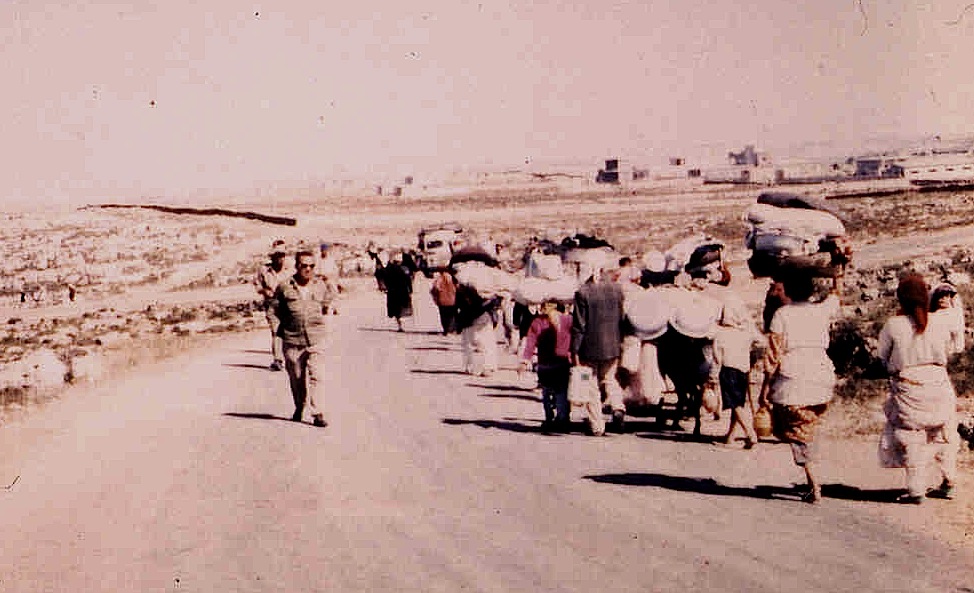
IDF soldiers expel the residents of Imwas (originally named Emmaus) from their village (source)
In 1972 Israel built its popular Canada Park on the location, named after Jewish Canadians who had been persuaded to donate for the venture. Hass writes that the park “was designed to conceal and bury” its war crime.
Christians often focus on the Biblical Emmaus story
Today, Christian pastors often retell the story of Jesus’ appearance to his disciples in Emmaus.
The numerous paintings of this sacred event are featured on Christian websites around the country. The story is often used as an inspirational message to Christians, for example, to become “more committed to serving others.” […]
Yet, almost none of the sites featuring the Biblical story of Emmaus seem aware of the modern story, and of the people made homeless and in need of help – perhaps because so few know these facts. As author Grace Halsell wrote in a powerful essay, most Christians are unaware of what they don’t know about Israel. “They were indoctrinated by U.S. supporters of Israel in their own country and when they traveled to the Land of Christ most did so under Israeli sponsorship.”
A moving film recounting the facts about Emmaus, “Ritorno a Emmaus” (Return to Emmaus), was broadcast on Swiss Italian Television on May 29, 1987 but was not shown in the U.S. This is the first time it’s available in English:
Israel drops case against soldiers who killed Palestinian doctor
MEMO | April 14, 2023
Israel’s State Prosecutor yesterday closed the case into two Israeli soldiers who shot dead a Palestinian man at one of the entrances to Al-Aqsa Mosque in the occupied city earlier this month.
According to Haaretz, the State Prosecutor, Amit Aisman, accepted the claims of the Israeli Justice Ministry’s police misconduct unit and the deputy state prosecutor for criminal affairs. Following “solid and clear evidence,” the State Prosecutor’s Office announced that the victim, Mohammad Al-Osaibi, shot two bullets while attempting to grab the weapon of one of the officers before he was shot dead and therefore, no offence was imposed by the Israeli forces.
Moreover, further investigation, according to Aisman, concluded that the area where the attack took place was not recorded by the cameras in the area and the Israeli officers failed to switch on their body cameras due to lack of time.
Rights groups have, however, questioned the lack of video footage of the event.
Al-Osaibi’s family deny the police’s version of events, saying the 26-year-old doctor from Houra, a Bedouin Arab village in southern Israel, was shot when he intervened to help a Palestinian girl.
His uncle, Ahmed Alasibi, told Haaretz : “From what we understand, he encountered the police who were harassing a young Palestinian woman, and apparently there was an argument. They shot him to death for no reason, the whole talk about an attack and taking their weapon is a lie.”
Tensions have been running high across the occupied West Bank, including East Jerusalem, in recent months amid repeated Israeli raids into Palestinian towns and Al-Aqsa Mosque.
Over 90 Palestinians have been killed by Israeli fire since the start of the year, according to Palestinian figures. Fourteen Israelis have also been killed over the same period.
It Was a Sad Friday in Jerusalem
By Steven Sahiounie | Strategic Culture Foundation | April 10, 2023
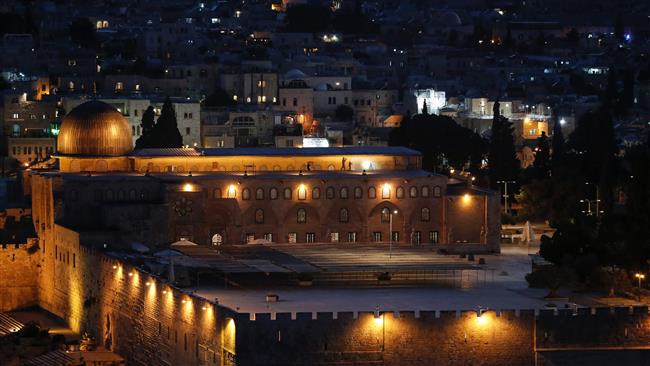
April 7 was “Good Friday” for Western Christians, the day when they believe Jesus was hung on a cross. But it was a “Sad Friday” in Jerusalem. To the Muslims of the world, this is the third Friday of Ramadan, and this morning worshippers attempting to pray at the Al-Aqsa Mosque in East Jerusalem were prevented entry to the area and severely beaten by Israeli Police batons. Street vendors and shopkeepers were also attacked by Israeli Police. It was indeed a sad Friday.
Who gave the order to attack the worshippers inside the Al Aqsa Mosque?
Kobi Shabtai is the Commissioner of the Israel Police. In 2021, he ordered the police to prevent access to the Damascus Gate in East Jerusalem in a similar escalation of tensions then.
National Security Minister Itamar Ben-Gvir leaked a recording of a conversation with Shabtai, in which he said, “There’s nothing we can do. They murder. It’s in their nature. That’s the mentality of the Arabs.” There were calls by Israeli Arab politicians for his dismissal because of his racist remarks.
Why did Israeli police storm Al-Aqsa Mosque?
On April 4, about 80,000 worshippers attended the evening prayers at the Al-Aqsa Mosque in East Jerusalem. Some of the Palestinians stayed overnight in the mosque to pray in a tradition observed during Ramadan. Some voiced concern to protect the third holiest site in Islam from extremist Jewish settlers who had threatened to come to the mosque to offer animal sacrifices in honor of Passover, which began on April 4.
The extremist Jewish settlers have a plan to destroy the Al-Aqsa Mosque and build a Jewish Temple on its site.
By the early hours of April 5, Palestinians had filled the streets near the mosque to pray the early morning prayer. The Israeli police were ordered to prevent Palestinians under the age of 40 to enter the area for prayers. By evening, the police entered the mosque by force and arrested dozens of worshippers after severely beating both men and women praying inside.
Palestinian Authority Prime Minister Mohammad Shtayyeh said in a statement “What happened in Jerusalem is a major crime against the worshipers. Prayer in Al-Aqsa Mosque is not with the permission of the [Israeli] occupation, but rather it is our right.”
Israeli air strikes on Gaza
In response to the attacks on Al Aqsa Mosque, several rockets were fired from Gaza into Israel. The Israeli air force then targeted multiple locations across Gaza causing damage to homes and the Al-Durrah Children’s Hospital in Gaza City. The Geneva Convention prohibits attacking civilian health facilities.
Israel has imposed a blockade upon Palestinians in the Gaza Strip since 2007, an illegal act of collective punishment. Israel’s repeated attacks upon the Gaza Strip have primarily impacted civilians, resulting in potential war crimes and crimes against humanity according to international investigations. Israel uses U.S. weapons to enforce its blockade and attack the Gaza Strip in violation of U.S. laws.
Lebanon rockets
A Palestinian resistance group in southern Lebanon launched rockets yesterday at Israel from Marjayoun in southern Lebanon in response to the Israeli attacks on the Al-Aqsa Mosque.
The Israeli forces then retaliated by striking southern Lebanon, but both sides have since stopped, and no casualties were reported. The flare-up came at a time when Hamas leader Ismail Haniyeh is in Lebanon on a private visit.
Previous attacks
The Arab League met in an emergency session after the Israeli police raid on the Al-Aqsa Mosque left at least 12 Palestinian injured, and 400 arrested on April 5, who remains in custody at Atarot police station in East Jerusalem.
The raids continued into the morning as Israeli police were videoed assaulting and pushing Palestinians out of the compound and preventing them from praying, while Israeli extremist settlers were allowed in under police protection. The police used stun grenades, tear gas, batons, and rifles to beat the worshippers. Some victims suffered respiratory injuries due to the gas which was thrown into the mosque after the police first broke the upper windows.
The Arab League Secretary-General Ahmed Aboul Gheit said, “The extremist approaches that control the policy of the Israeli government will lead to widespread confrontations with the Palestinians if they are not put to an end.”
The Palestinian Red Crescent reported that the Israeli police prevented them from reaching the mosque to attend to three injured victims who needed hospitalization.
Israeli police said in a statement that they were forced to enter the compound after “masked agitators” locked themselves inside the mosque with fireworks, sticks, and stones. No violence would have occurred if the police had remained outside. The police had never been threatened by people inside the mosque, and it was an unprovoked attack on people praying inside a closed building.
“Israel is committed to maintaining freedom of worship, freedom of access to all religions and the status quo and will not allow violent extremists to change that,” Israeli Prime Minister Netanyahu said.
Netanyahu is calling the victims inside the mosque ‘extremists’ when in fact it is his citizens, the extremist Jews who provoked the attack by insisting on going to the mosque during Passover. Netanyahu’s government is an alliance between his party and extremist Jewish parties who call for the deportation of all Palestinians, and refuse all calls for human rights for Palestinians. Netanyahu is bound to be beholden to those extremists, even though he has ridiculed them in the past. If he were to stand up to them now, the alliance would be broken, his government would fall, and he would go straight to jail. The only thing keeping him out of jail on multiple corruption charges is those extremists like Ithamar Ben-Gvir.
The U.S. reaction
The UN, Turkey, the U.S., Canada, and several other countries and bodies have expressed concern about Israeli forces storming the Al-Aqsa Mosque.
Washington said on Wednesday that it was “extremely concerned” about the violence.
“We urge all sides to avoid further escalation,” White House press secretary Karine Jean-Pierre told reporters. “It is imperative now more than ever that Israelis and Palestinians work together to de-escalate tensions and restore calm.”
“We remain extremely concerned by the continuing violence and we urge all sides to avoid further escalation,” White House National Security Council spokesman John Kirby said.
Since 1948, the U.S. has provided Israel with over $125 billion in military aid, which transformed the Israeli forces and police into one of the world’s top forces. Israel has been designated as a U.S. Major Non-NATO Ally, and yet the U.S. has never once held Israel accountable for war crimes, crimes against humanity, and the apartheid state in Israel.
With its silence, the U.S. stands complicit in the crimes against the Palestinian people who are deprived of every human right.
Turkey
Turkey’s President Recep Tayyip Erdogan condemned the Israeli police raid, calling such acts in the mosque compound a “red line” for Turkey.
“I condemn the vile acts against the first qibla of Muslims in the name of my country and people, and I call for the attacks to be halted as soon as possible,” Erdogan said. “The name of this is the politics of repression, the politics of blood, the politics of provocation. Turkey can never remain silent and unmoved in the face of these attacks.
Canada
Canadian Prime Minister Justin Trudeau said, “We need to see the Israeli government shifting in its approach, and Canada is saying that as a dear and close and steadfast friend to Israel, we are deeply concerned about the direction that the Israeli government has been taking.”
UAE
The UAE foreign ministry said in a statement, “The UAE called on Israeli authorities to halt escalation and avoid exacerbating tension and instability in the region.”
Saudi-Iran agreement
The recent restoration of full diplomatic relations between Iran and Saudi Arabia has changed the Middle East. Now, the two biggest powerhouses in the region have put differences aside and are willing to work together for peace and security. Neither nation has normalized a relationship with Israel, even though Netanyahu stated in December 2022 that getting a deal with Saudi Arabia was one of the two biggest goals of his new administration.
The U.S. has not offered any leadership for decades on an Israeli-Palestinian peace plan. In the meantime, the U.S. has slipped from global leadership, especially from the days of influence in the Middle East, since the area has turned independent of dictates from the Oval Office.
Archbishop Hanna demands freedom of access Jerusalem’s holy sites
MEMO | April 11, 2023
The head of the Greek Orthodox Church in Jerusalem, Archbishop Atallah Hanna, has demanded Palestinian Muslims and Christians be guaranteed freedom of access to their holy places in the occupied city of Jerusalem to practise their religious rituals in peace.
For years Israeli checkpoints have impeded the arrival of Christian worshippers to the Church of the Holy Sepulchre, he added, adding that Christian pilgrims visit Palestine to pray, worship and seek blessings from the holy places, and not to be stopped at the checkpoints and be abused.
Archbishop Hanna said freedom of worship and freedom of access to the holy places in Jerusalem are one of the most basic rights, and therefore it is not permissible to overlook these rights, or accept the fait accompli imposed by the Israeli occupation on Palestinians, where the city of Jerusalem becomes a military barracks with checkpoints in every corner.
“These days, Palestinian Christians are eager to visit the Church of the Holy Sepulcher and pray in it, but, unfortunately, there are unjust measures that prevent Palestinians from reaching Jerusalem, where military checkpoints and the Apartheid Wall surround the Holy City and prevent Palestinian Christians and Muslims, from reaching their holy places until after they obtain special permits that allow them to enter,” he explained.
“It is not permissible to hinder the arrival of Palestinian Christians and pilgrims coming from different parts of the world to the Church of the Holy Sepulchre, as well as our Muslim brothers who wish to reach Al-Aqsa Mosque,” he added.
“Open Jerusalem for its people so that they may reach it with complete freedom. Open Jerusalem to all its visitors and pilgrims who come to it from all parts of the world. Jerusalem is the city of our faith and the incubator of our most important sanctities. No believer should be prevented from reaching the holy places in this blessed part of the world,” he said.
‘Smile-kill-enjoy’: Motto of candidate to lead Israel’s National Guard
The former Unit 101 paratrooper commander, told his soldiers to enjoy killing Palestinians
The Cradle – April 10 2023
According to the Israeli newspaper Haaretz, one of the leading candidates to head Israel’s new National Guard is Avinoam Emunah, a retired colonel known for advocating violence against Palestinians.
Middle East Eye (MEE) noted that Emunah is the former commander of the infamous elite paratroopers Unit 101. Established in 1953, the unit was first led by former general and prime minister Ariel Sharon and was known for carrying out operations terrorizing Palestinian, Jordanian, and Egyptian civilians.
While a member of Unit 101, Emunah fought in campaigns during the Second Intifada, the invasion of Lebanon in 2006, and the war on Gaza in 2014.
Sources in the Israeli military report that Emunah punished his soldiers who did not use enough violence during fighting in the Gaza Strip in 2014.
In addition, a Video emerged of Emunah telling his soldiers, “Much of the time, you’ll be seeing them fleeing … Kill them as they flee” and “Smile, guys. You should enjoy it. Try to enjoy it.”
In a 2015 article published in an army magazine, he dubbed the “smile-kill-enjoy” motto as “words to spur on” the troops.
On 2 April, Israel’s government announced the establishment of the National Guard under the supervision of National Security Minister Itamar Ben Gvir, who is also known for his extreme anti-Palestinian views.
Haaretz reported as well that when asked who he would like to see enlist in the national guard, Ben-Gvir specifically mentioned La Familia, the racist hooligan fan club of the Beitar Jerusalem soccer team, and said that there are “officers and ethical people” among them.
The Israeli government approved a budget of around $278 million for the establishment of the armed branch while also increasing the salaries of over 3,000 police officers.
Ben Gvir said the establishment of the National Guard is “important news for Israeli residents and will improve personal security.”
However, the Association for Civil Rights in Israel called the proposed national guard “a private, armed militia that … will first and foremost act in mixed cities, first and foremost against the Arab population.”
Ben Gvir had previously called for establishing an Israeli National Guard to prepare the country for a new “imminent” war with Hamas.
The deal to establish the National Guard was reached with Gvir’s party, Otzma Yehudit, in exchange for not leaving the government over Prime Minister Benjamin Netanyahu’s intention to postpone the legislation of the controversial judicial reform bill.
Israel strikes Syria in response to rare missile attack
The Cradle | April 9, 2023
Israel launched several airstrikes against Syria during the early hours of 9 April, targeting Syrian military sites in the vicinity of the capital Damascus and other areas south of the country, state-media reported.
“At about 05:00 AM, the Israeli enemy launched an aerial aggression with a number of missiles from the direction of occupied Syrian Golan targeting some sites in the southern region,” a military source told state-news outlet SANA.
“Our air defenses intercepted the enemy’s missiles and downed some of them,” the Syrian source added.
The Israeli army claimed to have used airstrikes and artillery to target rocket-launchers and a Syrian military compound. So far, no casualties have been reported and only some material damages ensued.
The Israeli strikes came in response to the firing of several rockets from Syrian territory into the Israeli occupied Golan Heights the night before. Late on 8 April and after midnight on 9 April, a total of six rockets were fired from Syria towards the Golan Heights, three of which landed in Israeli controlled-territory. The missiles were launched in separate barrages.
Two others fell in an open space while the last was intercepted, the Israeli military claimed. Reports suggested that one of the missiles fell in Jordanian territory.
Israel “sees the State of Syria responsible for all activities occurring within its territory and will not allow any attempts to violate Israeli sovereignty,” the Israeli military said in a statement.
The Liwa al-Quds (Jerusalem Brigade) faction, a pro-Syrian government militant group formed in 2013 and made up predominantly of Palestinians, claimed responsibility for the rocket-attack into Israel. The group said that the attack was a response to Israel’s brutal assaults on worshipers in the Al-Aqsa Mosque over the past few days.
In older statements, the Liwa al-Quds group has pledged to “liberate Jerusalem and all of Palestine after purifying Syria from terrorism.”
The rocket-attack was a rare occurrence. The last time rockets were launched from Syria into Israel was in 2019.
This new attack came just two days after dozens of rockets were fired into northern Israel from Lebanese territory in response to Israel’s brutality in Al-Aqsa Mosque.
No group claimed responsibility for firing the rockets from Lebanon. However, Israeli media suggested that it was a coordinated attack carried out by the Palestinians in Lebanon and green-lighted by Hezbollah.
The Hebrew media claims represented the growing fear in Israel of increased coordination between Hezbollah, Iran, the Palestinians, and the axis of resistance in general – while also reinforcing the fear that several fronts are now open against Israel.
These recent rocket attacks against Israel have coincided with an unprecedented surge in Palestinian resistance operations against settlers and soldiers inside of Palestine.
US deploys guided-missile submarine to Middle East
Press TV – April 8, 2023
The United States says a nuclear-powered American guided-missile submarine is operating in the Middle East in support of the US Fifth Fleet, which is based in Bahrain.
The USS Florida entered the region on Thursday and began transiting the Suez Canal on Friday, Commander Timothy Hawkins said in a statement on Saturday, according to Reuters.
“It is capable of carrying up to 154 Tomahawk land-attack cruise missiles and is deployed to US 5th Fleet to help ensure regional maritime security and stability,” Hawkins added.
This came after the US Navy relocated a warship in the Mediterranean to the coast near Syria after tensions rose between Tehran and Washington over deadly attacks on Iranian military advisors in Syria.
Iran’s envoy to the UN Amir Saeid Iravani earlier on Monday warned that the Islamic Republic will take “decisive measures” to protect its forces and interests in Syria against any threats posed by the United States or others.
Last week, two Iranian military advisers stationed in Syria were killed in an Israeli airstrike near the country’s capital Damascus. Following the attack, the IRGC issued a stern warning to the Israeli regime on Sunday, vowing retaliation for the killing of its military advisers in Syria.
The relocation of the US warship came as US President Joe Biden claimed in March that the United States was not seeking a conflict with Iran.
Hamas: Ben Gvir’s militia plan reflects “ethnic cleansing mentality”
Palestine Information Center – April 3, 2023
GAZA – Hamas spokesman Hazem Qasem has described the Israeli government’s decision to form a terrorist militia under the name of “national guard” led by far-right security minister Itamar Ben Gvir as a “serious development confirming that this fascist government plans to escalate its aggression against the Palestinians in 1948 occupied Palestine.”
In press remarks on Sunday, spokesman Qasem said that such decision asserts that “the racist and fascist behavior is the main element that governs the Israeli government’s behavior and policies.”
The spokesman added that this decision also reflects that “the mentality of ethnic cleansing is still present in the Israeli practices against the Palestinians in 1948 occupied Palestine.”
The Israeli government approved on Sunday the establishment of a national guard supervised by the far-right security minister, Itamar Ben-Gvir, who said it would focus on suppressing Arab protests and unrest in Israel.
The exact powers of this national guard squad will be discussed by a committee comprising all the Israeli security agencies, which will submit recommendations within 90 days, Israeli premier Benjamin Netanyahu’s office claimed in a statement.
Ben Gvir, for his part, said that government funding would enable the initial intake of 1,850 persons for the new squad.
Bamford’s “Spyfail” exposes corruption at center of Netanyahu “judicial reform” crisis that is tearing Israel apart
By Grant F. Smith | IRmep | March 30, 2023
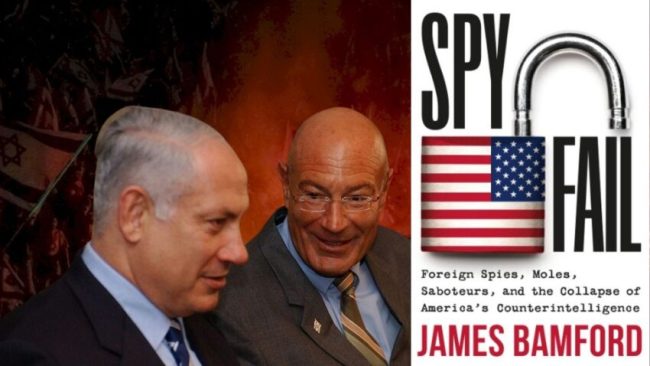
James Bamford’s new book Spyfail: Foreign Spies, Moles, Saboteurs, and the Collapse of America’s Counterintelligence devotes nine chapters to the impunity of Israel, its spies and U.S. lobby.
Bamford is best known as America’s premiere chronicler of the ultra-secretive National Security Agency in his books The Puzzle Palace and The Shadow Factory.
Unlike most authors published through mainstream publishing houses, Bamford has not held back on exposing extremely damaging and behind the scenes exploits of Israel and its lobby in this damning look at U.S. counterintelligence. That was a shock to the second most prominent reader reviewer on Amazon.com who claimed, “I did not expect a full-throated anti-Israel screed completely devoid of nuance or historical context.” Most other reviewers were much more appreciative of Bamford’s honest take.
Among the most scandalous episodes chronicled in Spy Fail are stunning new details about Hollywood movie producer Arnon Milchan’s espionage and weapons smuggling operations targeting the United States.
Bamford follows Milchan’s early efforts to prop up apartheid South Africa through well paid weapons dealing and propaganda, including the production of feel good theatrical works depicting exploited blacks as happy with their lot in South Africa. Milchan’s recruitment into Israel’s Bureau of Scientific Relations Lakam spy agency then leaves him scouring the U.S. for nuclear weapons related technology.
Since Israel had already stolen enough U.S. weapons grade uranium to build atomic bombs from NUMEC, Milchan was tasked to obtain high speed switches that could provide the precisely timed pulses to trigger a detonation. Milchan recruited the hapless Richard Kelly Smyth to set up the front company “Milco” in Huntington Beach California by bedazzling the failing businessman with stars and starlets at his Hollywood parties.
Smyth provided the triggers and many other export prohibited items, but always managed to give away what he was doing to vigilant federal government authorities. Smyth (but not Milchan) was eventually indicted and fled overseas. When he sought help, Milchan ghosted him while working to stay ahead of the law.
Milchan benefitted from mainstream press support to spread the word that the billionaire had no idea what was going on in his global network of companies. Perhaps the most valuable diversion was the New York Time’s Tom Friedman who quickly got wind of the Smyth indictment and promoted Milchan’s innocence. While Bamford mentions the Netanyahu-Milchan connection he does not delve into Smyth’s revelation that Israel’s current Prime Minister Benjamin Netanyahu worked inside the “Project Pinto” krytron smuggling network at the Israel based Heli Trading company. Heli executed the purchase orders from the Israeli Ministry of Defense for export controlled items Milco misclassified and exported.
The devolution of the Milchan Netanyahu relationship is perhaps the most important revelation of extreme current relevance in the book. Milchan pressed Netanyahu to pressure U.S. Secretary of State John Kerry for a 10-year visa after the agency—finally wise to Milchan’s espionage—refused to renew it. The feckless John Kerry eventually acquiesced to Netanyahu and issued the visa. To this day Milchan continues to produce blockbusters and allegedly dodge taxes in the U.S.
But just as Milchan burned Smyth, Netanyahu began pumping Milchan for endless boxes of expensive cigars—“leaves”—and cases of $400 per bottle champagne—“bubbles”—and other gifts for his wife in exchange for the visa favor. Bamford’s depiction of this shakedown is as detailed as it is relentless.
The resultant Israeli corruption cases against Netanyahu have recently led him to seek judicial reforms, which could give his coalition power to shut the cases down. Netanyahu’s initiative has torn Israel apart and put the country on the verge of civil war as protesters sought to stop the gutting of court oversight.
Americans who read and fully digest Spyfail will come away with new insights about how the politicization of American counterintelligence produces media frenzies and scapegoats—such as Maria Butina—while continually steering clear of Israel’s hugely damaging covert intelligence operations against the U.S. Bamford pins this impunity squarely on the Israel lobby and the oversize role it plays in financing the political careers of ever-compliant U.S. elected officials and their political appointees.
Grant F. Smith is director of IRmep and forced the declassification and release of many of the NUMEC and “Project Pinto” documents cited in this book through FOIA lawsuits.
Featured Video

Houthis Don’t Have to Conquer Saudi Arabia to Make It Pay
or go to
Aletho News Archives – Video-Images
From the Archives
Newly Released FBI Docs Shed Light on Apparent Mossad Foreknowledge of 9/11 Attacks
By Whitney Webb | MintPress News | May 17, 2019
NEW YORK — For nearly two decades, one of the most overlooked and little known arrests made in the aftermath of the September 11 attacks was that of the so-called “High Fivers,” or the “Dancing Israelis.” However, new information released by the FBI on May 7 has brought fresh scrutiny to the possibility that the “Dancing Israelis,” at least two of whom were known Mossad operatives, had prior knowledge of the attacks on the World Trade Center. … continue
Blog Roll
 Aletho News
- UK whines about losing billions to ‘Putin tax’
- Baghaei to Rubio: Distorted narratives cannot erase US record of broken commitments
- Houthis Don’t Have to Conquer Saudi Arabia to Make It Pay
- MOE: Nearly 22,000 Students and Education Workers Killed
- Guterres in Islamabad: Genocide, cowardice, and the cage of Imran Khan
- Johnson, Marandi say Yemen holds upper hand over Saudi Arabia
- False flags won’t save aggressors, Iran FM spokesman says
- The Makkah Pact Enters Into Force: The End of American Dominance or Its New Form?
- NATO’s top generals gather in Kiev
- EU’s continuing expansion – greater threat to Russia
- If Americans Knew
- Three years of death and devastation: Israel’s war on Gaza in pictures
- Why Hamas believed the status quo was more dangerous than its 7 October gamble
- Debunking Israel’s latest list of ‘terrorist’ journalists in Gaza
- In Gaza, focus is on survival, “every step is a struggle” – Daily Update
- Three Years of Genocide: How America’s Israel-First Media Filtered Out the Truth
- Israeli war chief briefs ministers on potential war against Palestinian Authority
- New Report: Israel Killed nearly 21,000 Palestinian Students and Education Workers in Past Three Years
- Israel’s flailing chatbot army
- Five Palestinians Killed, Others Injured by Israeli Fire in Gaza
- Israel is rewriting the Palestinian curriculum in East Jerusalem to erase Palestinian identity
- No Tricks Zone
- New Study: 50 Years Of The Most Aggressive ‘Net Zero’ Policies Can Only Affect The Global Climate By 0.03°C
- US September “Heat” Was No Record…Many Records Set Decades Ago
- Latest European Green Energy Debacle; Portugal’s Largest Flagship Solar Park Insolvent!
- Green Energy Debacle: German Expert Professor Fritz Vahrenholt Warns Of Severe Economic And Social Consequences
- Two More Paleo Reconstructions Affirm Meters-Higher Sea Levels Across Ireland, Brazil 7000-6000 Years Ago
- New Study: Earth And Venus Surface Warmth Largely Explained By Convection And Lapse Rate, Not CO2 Or Radiation
- 2025 Nature Paper Claiming Worsening Global Drought Gets RETRACTED …Heavily Flawed
- New Study: ‘Global Drought Shows No Detectable Recent Acceleration Under Climate Warming’
- Economic Masterminds: German Socialists Suggest Taxing Productivity Gains Stemming From Using AI
- The South China Sea Has Not Been Cooperating With The Climate Change Narrative

