Spiraling West Bank violence could spell political doom for both Israeli and Palestinian leadership
By Robert Inlakesh | RT | July 3, 2023
The latest upsurge in violence throughout the occupied West Bank signals the failure of US-led efforts to create calm. Both the Palestinian Authority (PA) and the Israeli government were faced with domestic pressure to take escalatory measures against the opposing side, resulting in an Israeli military operation against Palestinian armed groups in Jenin.
Beginning with an Israeli raid on the city of Jenin, a string of violent events again ignited tensions between Palestinians and Israelis inside the occupied West Bank. In mid-June, a number of Israeli armored vehicles stormed Jenin to arrest members of the armed group known as the Jenin Brigades, when they were ambushed by local Palestinian fighters. Seven Israeli soldiers were injured by improvised explosive devices that were detonated underneath their military vehicles. This led to the deployment of Apache helicopters and a large number of Israeli ground forces, who ended up killing seven Palestinians and injuring 91.
Just one day later, two Palestinian gunmen carried out an attack near the entrance to the West Bank settlement of Eli, killing four Israeli settlers and injuring four others. The two shooters were identified as having an affiliation with the armed wing of Hamas, the Qassam Brigades. Both were shot and killed by Israeli forces that same day.
The increase in violence followed the decision of the Israeli government to allow its far-right finance minister, Bezalel Smotrich, to assume special powers to develop settlement expansion plans, even without the approval of the Knesset. The move sparked only light condemnation from the US government, which said that it “opposes such unilateral actions that make a two-state solution more difficult to achieve and are an obstacle to peace.”
The following night, radical Israeli settlers decided to attack Palestinian villages, in what they called “revenge” for the shooting attack against settlers earlier that day. In the Palestinian village of Turmasaya alone, around 400 armed settlers torched 30 homes and 60 cars. The attack also resulted in over 100 injuries and 1 death. Israeli settler attacks like these target any Palestinian community that they are able to penetrate, almost always with the protection of the Israeli army. One such attack, earlier this year in the village of Huwara, was even described as a “pogrom” by Israeli general Yehuda Fuchs.
The Israeli government, headed by Prime Minister Benjamin Netanyahu, was put in an embarrassing position following the events in both Jenin and the settlement of Eli. Both these situations represented a clear development in the sophistication of the West Bank armed groups, proving them capable of inflicting casualties on both Israeli soldiers and settlers in just over a 24 hour window. Already there had been calls from Israeli settler communities, in the northern West Bank, to launch an all-out military operation in order to crush the armed groups, with the above mentioned incidents only leading to further pressure being placed on the government to act.
In an Israeli security session, held to assess the situation inside the West Bank following the Eli shooting attack, it was reported that both Netanyahu and his defense minister, Yoav Gallant, opposed the option of launching a military operation inside the occupied territory at the time. The expectation was raised on the government, at that point, to react disproportionately to such attacks, given that the Israeli coalition is held together by a number of hardliners who seek a complete annexation of the West Bank and currently live inside illegal settlements themselves.
Earlier this year, the Biden administration set up two security summits, aimed at improving cooperation between the Palestinian Authority (PA) and Israel. The conferences were held in Jordan’s Aqaba and the Egyptian city of Sharm El Sheikh. The goal was to have the PA’s security forces and the Israeli military work together in order to prevent further deterioration in the security situation. One of the components to creating a more stable environment was a plan to utilize a specially trained PA force that would directly confront the West Bank armed groups that have emerged over the past two years. The plan, drawn up by US security coordinator Michael Fenzel, represented political suicide for a PA that is already facing a massive backlash from Palestinians.
According to a recent poll conducted by the Palestinian Center for Policy and Survey Research, roughly 80% of Palestinians want the current PA President Mahmoud Abbas to resign. During the latest string of Israeli settler attacks against defenseless Palestinian villages, locals have also gone viral calling on the PA to deploy its roughly 70,000-strong security force to protect against settler attacks. The PA only has limited areas of jurisdiction inside the West Bank and uses its forces to handle domestic Palestinian crime, in addition to protecting Israeli security interests. Under the current circumstances, a direct confrontation between PA forces and Palestinian armed groups could lead to a revolt against its rule inside the territory.
Mahmoud Abbas is currently 87 years old and there is a fear that when he passes away, there will be a power vacuum, which could result in the PA’s collapse or even a revolutionary anti-Israeli group taking over. Although the PA is currently attempting to sit on the fence, knowing that no conflict resolution dialogue has even been entertained with the Israeli side since 2014. It attempts to pretend as if there aren’t thousands of armed Palestinian fighters who are currently operating outside of the administration’s control and that it cannot do anything about Israel’s actions either. This attitude is mostly born out of a desire to remain in the good graces of their top donors, the United States and European Union. While the PA does not want to assume the role of an active protector against Israeli military and settler attacks, which the Palestinian people call on it to be, neither does it want to commit to being a direct aggressor against the armed militant groups.
Unlike the PA, the Israeli government was in the position to launch a military operation against the West Bank armed groups, so it waited and decided to carry out its attack on Sunday night. In 2002, Israel launched Operation Defensive Shield, during which they killed around 500 Palestinians and effectively eliminated many of the strongholds for the armed groups that were operating at the time. Israel’s army would seek to replicate the 2002 model in any large-scale operation, however, it has instead chosen to isolate Jenin in order to set back the groups, instead of attempting all out elimination. If it is to launch an all encompassing campaign, it is also likely that it will lose many soldiers and that there will be attacks from other territories, such as Gaza, Syria and Lebanon. Therefore, there will be a political price to pay for launching such an operation, which is something that Netanyahu knows and is perhaps why he ordered a more limited attack.
Instead of declaring war inside the entire West Bank, it seems that the Israeli army has decided to increase the heat on the armed groups, using tactics like drone strikes to assassinate fighters, while this current escalation is an attempt to show strength and cut back the abilities of the groups. The day after the settlers’ “revenge” attack, Israeli forces announced that they had carried out a missile strike on a car, near a checkpoint that is located in Jenin, killing three Palestinian fighters. This airstrike was significant because it was the first assassination by missile strike in the West Bank since 2005. Now, the current invasion of Jenin is the largest since 2002.
If the Palestinian armed groups are allowed to grow stronger and their influence spreads to other cities, it may be politically impossible in the future for the Israeli government not to launch a large-scale military campaign, which is likely why it has opted for the current approach. However, one interesting element to the recent military operation in Jenin, is the lack of care from Palestinians in Ramallah and other cities, only Palestinians from the refugee camps came out in large demonstrations. This reflects a massive victory of Israeli policy over the Palestinians of the West Bank, they have successfully disconnected them from the suffering of their fellow people and it seems as if life can go on as normal for people living in cities like Ramallah.
Due to the US refusal to present any pathways forward, the West Bank is heading towards even greater violence. Its roadmap for the PA is not reasonable, given that it essentially asks the Palestinian Authority to commit suicide, but on the other hand, it won’t actually punish Israel for violating its own red-lines. Washington is frequently expressing its concern over the Israeli government’s constant approval of settlement expansion plans, yet it is unwilling to take a single step toward doing anything about it and supports Israel’s military solution to a problem that Washington failed to solve. The Biden administration has the power to pressure both the PA and Israel to sit down together today, yet it refuses, offering nothing more than platitudes about peace negotiations that have essentially been dead since the late 1990s. Without any viable options for a solution on the table, there will only be more violence, even if tensions calm temporarily.
Robert Inlakesh is a political analyst, journalist and documentary filmmaker currently based in London, UK. He has reported from and lived in the Palestinian territories and currently works with Quds News. Director of ‘Steal of the Century: Trump’s Palestine-Israel Catastrophe’.
Israel worried Hezbollah’s air defense systems will ‘limit freedom of action’ over Lebanon
The Cradle | July 1, 2023
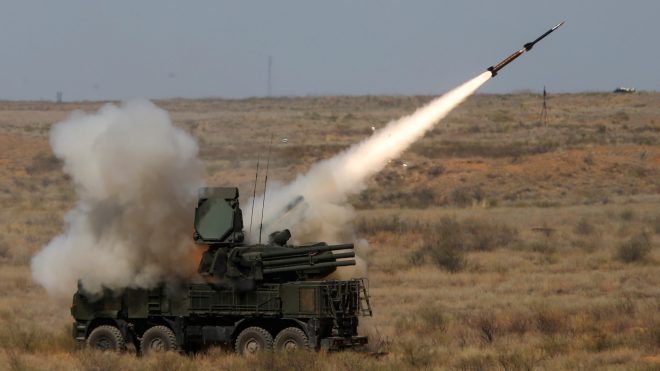
Israeli military planners are concerned about what they describe as “a significant change in the concept of air defense by Hezbollah in Lebanon” after the resistance group “doubled” the number of air defense systems in its possession, according to a report by Maariv newspaper published on 30 June.
The report cites unnamed military officials saying the resistance’s air defense systems will “restrict the freedom of action of the Israeli Air Force in Lebanon.”
“[Hezbollah] doubled the amount of air defense systems in its possession during the last five years … these defense systems are based mainly on modern Iranian systems,” the report adds.
Furthermore, Tel Aviv claims Hezbollah is in possession of the SA8 and SA22 Russian air defense systems, which have been previously deployed in Syria.
“The attack by an Israeli drone, in August 2019, on a facility in a building in the heart of the southern suburbs of Beirut … initiated the turning point in Hezbollah’s strategy, leading to the threat by [Secretary General Hassan Nasrallah] … to start shooting down Israeli drones,” the report highlights.
“Hezbollah implemented this threat two months later when it fired an SA8 missile at an Israeli Hermes 450 drone, which was on an intelligence-gathering mission, but the missile missed the target,” it adds.
In recent months, Israeli military planners have been on edge over Hezbollah’s vast military advancements coupled with the growing coordination among resistance factions in the region.
Earlier this week, Israeli media revealed that the US has stepped in to pressure Lebanon into having Hezbollah remove an outpost erected in the occupied Shebaa Farms.
Hezbollah has so far rejected these demands.
“You cannot threaten us with a large-scale war; it is us who are threatening you … Your follies, not ours, might blow up the entire region and lead to the Great War,” Nasrallah told Israeli leaders during a speech in May.
“The resistance is expanding by the day and has witnessed a great [positive] change in its financial and military capability,” he added.
Israel backs down on threats to bomb Iranian nuclear sites
The Cradle | July 1, 2023
Israel is not planning to attack Iran’s nuclear sites, Prime Minister Benjamin Netanyahu’s national security adviser said on 30 June, as indirect talks between Tehran and Washington regarding the nuclear issue have continued in recent weeks.
Asked whether an Israeli decision on a preemptive strike against Iran was any closer, Tzachi Hanegbi said:
“We are not getting closer because the Iranians have stopped, for a while now, they are not enriching uranium to the level that, in our view, is the red line.”
Hanegbi added: “But it can happen. So we are preparing for the moment.”
For several decades, Israel and the US have accused Iran of being “weeks away” from building a nuclear weapon. However, Iran says its nuclear industry is for peaceful purposes, including energy, and has stressed that Islam forbids pursuing weapons of mass destruction.
Hanegbi said it was still unclear what would come of the US-Iran talks. Still, he insisted that if an agreement is signed between Israel’s primary sponsor and main enemy during the indirect talks that began in Oman, this will not obligate Israel to abide by it.
Last week, Netanyahu said at a cabinet meeting that Israel opposes any interim agreement between the US and Iran regarding the latter’s nuclear program.
Israel opposed the 2015 Joint Comprehensive Plan of Action (JCPOA), and celebrated when Donald Trump withdrew from the deal in 2018.
The deal limited Iranian uranium enrichment to 3.67 percent. After the US withdrew from the agreement, Iran began enriching to 60 percent, which is still far from the 90 percent needed for use in a nuclear weapon.
“We also tell [the US] that even… ‘mini agreements,’ in our opinion, do not serve our goals, and we oppose those as well,” Netanyahu recently stated.
At the same time, US National Security Adviser Jake Sullivan reportedly accused Israeli officials of leaking information about the indirect US-Iran talks while complaining that the leaked information was inaccurate.
This included claims that the Biden administration seeks to reach an informal deal with Iran limiting its nuclear enrichment to bypass getting approval from Congress.
According to the New York Times, the US seeks an agreement that would include a pledge by Tehran not to enrich uranium beyond 60 percent purity, to better cooperate with UN nuclear inspectors, to stop attacks on US forces in Iraq and Syria, to avoid providing Russia with ballistic missiles, and to release three American-Iranians held in the Islamic Republic.
In exchange, the US would release billions in seized Iranian funds, commit not to impose additional sanctions, and not take action against Iran in international forums such as the UN and IAEA.
The Hate Crime Purging of “Antisemites” Is Underway!
Saying anything about Israel’s misbehavior can send you to jail
BY PHILIP GIRALDI • UNZ REVIEW • JUNE 20, 2023
There have recently been a number of incidents that would be of interest if one has concerns about the sorry state of free speech in Europe and the United States, the so-called “democracies” who tend to boast about their freedoms and the rights of their citizens. The chosen weapon in the US and elsewhere in the Anglo-sphere has been the designation “hate speech” which also covers “hate writing,” “possessing hate literature or films,” and even “hate thinking.” In Europe, where “hate speech” is often referred to using the English words, the expression is often preceded by the word “illegal” to make sure that the point about consequences is made and the potential penalty is clearly understood. Some Europeans have in fact been convicted and sent to prison when they have falsely believed they were exercising free speech.
Though the “hate” designation was originally coined to discourage racist language and other forms of expression it has increasingly been exploited by Israel and its associated Jewish support groups to criminalize any criticism of Israel or of Jewish group behavior. It has extended its reach by moving into subsets, notably “holocaust denial” and “antisemitism” which are also regarded ipso facto as hate crimes in a context in which Jews are always regarded as victims, never as perpetrators of violence.
Much of what is going on might be described in fairly simple terms: Israel’s treatment of the Palestinians and its unprovoked lethal attacks on its neighbors might reasonably be described as “deplorable” or even genocidal in the case of the Palestinians. Beyond that, Israel, which pretends to be a democracy, operates a system of control over the Christian and Muslim minority within its own borders and also in the area it illegally occupies that is describable as “apartheid,” where the minority is compelled to accept limited resources and consistently harsh treatment from the dominant Jewish population. More to the point, the extremist government coalition headed by Prime Minister Benjamin Netanyahu has made the situation even worse for those non-Jews that it controls, with talk of introducing mass expulsions and imprisonments. The death toll of Palestinians at the hands of the Israel Defense Forces has also been going up, with more than 150 Palestinians killed this year, including 26 children.
To be sure, Israel has become a home for Jews that can no longer tolerate anyone else. Some ministers in the new government are particularly vile in their views but it is to be assumed that Netanyahu and others in his administration are genuinely supportive of turning Israel into a truly and even exclusively Jewish state, which is in fact how it legally defines itself. The one minister most cited for his cruelty and racism is Itamar Ben-Gvir of the Jewish Power party. Ben-Gvir has been charged with crimes 50 times, and convicted on eight occasions, including once for support of a Jewish terrorist group. He is a former supporter of the now deceased right wing fanatic Meir Kahane, and, like Kahane, envisions an Israel that is as Palestinian free as possible and centered exclusively on Jewish interests. He has called for deporting Arabs who aren’t loyal to a Jewish Israel, annexing all of the West Bank and exercising full Israeli sovereignty over the Temple Mount, where the Muslim venerated Al-Aqsa mosque is located. He supports legislation defying international agreements to “divide” the Al-Aqsa site to permit regular Jewish worshippers and there have even been suggestions that the Israeli government will seek to rebuild the so-called Biblical Second Temple, destroyed in the First Century by the Romans, in that location.

MK Itamar Ben Gvir at a ceremony honoring late Jewish extremist leader Rabbi Meir Kahane in Jerusalem on November 10, 2022. Photo by Olivier Fitoussi/Flash90
Ben-Gvir is notorious for his provocations directed against Palestinian Muslims and Christians. He has led marches of armed settlers flaunting Israeli flags through Arab quarters of cities and towns and has even brought settlers and other extremists to the al-Aqsa mosque during Ramadan and to interrupt Friday prayers. To cap the irony, he has been since November 2022 the National Security Minister, which gives him authority over the police, to include the so-called Border Police as well as the police forces located on the illegally occupied West Bank. Indeed, as a practical matter, Ben-Gvir is seeking to have the Knesset pass legislation explicitly conferring legal immunity on all Israeli soldiers for any and all killings of Palestinians. He has also pressed the parliament to institute a formal, judicially administered death penalty for “terrorists”, which would mean any Palestinian who physically resists the Israeli occupation.
Another extremist who has obtained a major ministry in the Netanyahu government is Bezalel Yoel Smotrich who has served as the Minister of Finance since 2022. He has recently completed a controversial trip to the United States where he met with American Zionist leaders. Smotrich is the leader of the Religious Zionist Party, and lives in an illegal settlement in a house within the Israeli occupied West Bank that was also built doubly illegally outside the settlement proper. Smotrich supports expanding Israeli settlements in the West Bank, opposes any form of Palestinian statehood, and even denies the existence of the Palestinian people. He demands a state judiciary that relies only on Torah and Jewish traditional law. Accused of inciting hatred against Arab Israelis, he told Arab Israeli lawmakers in October 2021, that “it’s a mistake that David Ben-Gurion didn’t finish the job and didn’t throw all of you out in 1948.”
The increasing brutality of the Israeli government and its security forces have produced a reaction among many observers worldwide, so the supporters of Israel have engaged in their own first strike frequently using the “hate crime” weapon. They have basically turned the hate crime legislation to their advantage by convincing many nations to adopt the International Holocaust Remembrance Alliance (IHRA) definition of the “hate crime” antisemitism to automatically include criticism of Israel as being equivalent to hatred of Jews. When that doesn’t work the powerful Israel lobby can also resort to much more brutal threats. When Iceland sought to make illegal infant circumcision five years ago, regarding it as genital mutilation performed on an unconsenting child, the Anti-Defamation League (ADL) threatened to unleash Jewish power to destroy their economy and international reputation as punishment for making their country “inhospitable to Jews.”
Now that the “hate crime” genie together with the associated links to holocaust denial and antisemitism have been released from the bottle, they are being used regularly to silence anyone who even indirectly criticizes prominent Jews like George Soros. Conservatives including Tucker Carlson and Elon Musk have recently been on the receiving end of the antisemitism label after referring to Soros and his “Globalist” agenda. It is my belief that Tucker was fired at least in part due to Jewish pressure on FOX as he had been very critical of groups like the hysterical ADL and its hideous director Jonathan Greenblatt.
Roger Waters, the former lead singer of Pink Floyd, has emerged as a powerful critic of Israeli treatment of the Palestinians. As a consequence, he has been hounded by authorities in Europe, has had his concerts canceled, and has been threatened with legal action to make him shut up. The Biden Administration’s antisemitism Czar Deborah Lipstadt has also attacked him, saying “I wholeheartedly concur with [an online] condemnation of Roger Waters and his despicable Holocaust distortion.” She was referring to a tweet stating that “I am sick & disgusted by Roger Waters’ obsession to belittle and trivialize the Shoah & the sarcastic way in which he delights in trampling on the victims, systematically murdered by the Nazis. In Germany. Enough is enough. Holocaust trivialization is criminalized across the EU.” The State Department, speaking for the White House, then piled on adding that Waters has “a long track record of using antisemitic tropes” and a concert he gave late last month in Germany “contained imagery that is deeply offensive to Jewish people and minimized the Holocaust… The artist in question has a long track record of using antisemitic tropes to denigrate Jewish people.”
One might observe that the depiction of Waters is basically untrue – he is a critic of Israeli crimes against humanity but does not hate Jews. One might also add how the fact that the United States State Department actually has a Special Envoy to Combat Antisemitism speaks for itself and tells you exactly who is in charge in Washington. I wonder how much it costs to run Lipstadt’s mouth from a no doubt well-appointed office in Foggy Bottom each year? Maybe someone should do a cost/benefit analysis and give Debbie her walking papers.
Beyond that, several other recent stories show how it all often works in practice to confront and silence critics. Swedish pop star Zara Larsson is facing what is obviously a coordinated backlash on social media after criticizing Israel’s treatment of Palestinians. In an Instagram message to her 6.3 million followers, the 23-year-old declared the ongoing cross-border violence, which is killing mostly Arabs, was a “crime” against Palestinians. Her effort to be somewhat even handed was ignored, in the message, which she later deleted, where she wrote “We have to stand up for Jewish people all over the world facing anti-Semitic violence and threats, but we must also call out a state upholding apartheid and KILLING civilians, funded by American dollars.” She ended the message with the hashtag “#freepalestine.”
Larsson was hardly calling for targeting Jews or anything like that, but the reaction to her comment was symptomatic of the typical overkill response engaged in by Israel and its friends whenever anyone challenges the standard narrative of Israeli perpetual victimhood. Two other instances of comments about Israel leading to an overwhelming response to punish the perpetrators took place during the past month in the United States at college commencement ceremonies. The first was on May 12th, at a graduation ceremony for the law school of the City University of New York (CUNY), where Fatima Mousa Mohammed, a Queens native who was selected by the graduating 2023 class to speak during the May 12 ceremony, praised CUNY for supporting student activism, citing in particular the acceptance of student groups protesting against Israel’s brutality towards the Palestinians. She said “Israel continues to indiscriminately rain bullets and bombs on worshippers, murdering the old, the young and even attacking funerals and graveyards, as it encourages lynch mobs to target Palestinians homes and businesses. As it imprisons its children, as it continues its project of settler colonialism, expelling Palestinians from their homes. Silence is no longer acceptable.”
The response to Mohammed was immediate, including a scathing news report in the New York Post, a call by several Jewish groups to cut funding to CUNY and demands that the law school dean be fired. And the controversy again made news when a second student spoke out at a commencement at El Camino community college in Torrance California. Jana Abulaban, 18, strongly criticized Israeli government policies during her speech on June 9th.
Abulaban, who was born in Jordan in a family of Palestinian refugees, reportedly felt “inspired” by the speech of Fatima Mousa Mohammed and she told the audience “I gift my graduation to all Palestinians who have lost their life and those who continue to lose their lives every day due to the oppressive apartheid state of Israel killing and torturing Palestinians as we speak.’’
There was, of course an immediate reaction to the Abulaban speech coming from a variety of West Coast and New York pro-Israel sources. Brooke Goldstein, a claimed human-rights lawyer founder of The Lawfare Project, said, “This is yet one more example of the systemic Jew-hatred we’re seeing on our college campuses. When a student gives a commencement speech targeting Jews, trafficking in modern tropes of antisemitism, it’s clear that there has been a complete failure in that school to promote social justice for the Jewish people. If any other minority group were targeted like this, there would be consequences for the bigot. The Jewish community deserves no less.”
Of course, both women only spoke the truth about what is happening in the Middle East. Neither attacked the Jewish religion or Jews per se and only criticized Israel’s appalling behavior. When I last checked, Israel was a foreign country with both foreign and domestic policies that are considered very questionable by most of the world, so why should it be protected from being challenged in the United States? The two women were brave to speak up as they did, surely knowing that they would be targeted by the Jewish state’s many friends and supporters. Those of us who continue to speak out on Israel’s genocidal policies can likewise expect no less, particularly as both the federal as well as many state governments and also the media are now on a witch hunt directed against those who seek to speak the truth. But we must persevere. As Fatima Mousa Mohammed put it, “Silence is no longer acceptable.”
Philip M. Giraldi, Ph.D., is Executive Director of the Council for the National Interest, a 501(c)3 tax deductible educational foundation (Federal ID Number #52-1739023) that seeks a more interests-based U.S. foreign policy in the Middle East. Website is councilforthenationalinterest.org, address is P.O. Box 2157, Purcellville VA 20134 and its email is inform@cnionline.org.
Jordanians reject ties with Israel, welcome normalization with Iran, Syria: Poll
The Cradle | June 20, 2023
An overwhelming majority of Jordanians say they oppose “all sorts of cooperation” with Israel, including receiving humanitarian aid in the case of a natural disaster, according to a public opinion poll commissioned by the Washington Institute and conducted between March and April.
While 84 percent of respondents say they oppose “having business deals with Israeli companies,” 76 percent agreed with the following statement: “In case of an earthquake or other natural disaster … Arab countries should refuse any humanitarian aid from Israel.”
Furthermore, at least 60 percent of Jordanians have a favorable view of Palestinian resistance factions firing missiles at Israel. In comparison, only 12 percent expressed a positive opinion of the Abraham Accords.

While a sizable minority of Jordanians (42 percent) see Iran as an “enemy,” over half of the respondents (53 percent) positively welcomed the Iran-Saudi rapprochement, while 58 percent say Arab normalization with Syria is a positive development for the region.
Jordanians also vehemently oppose US or Israeli attacks against Iran, with 65 percent of respondents agreeing that such a move “would be too dangerous and a bad idea.”

In addition, only 13 percent believe Washington should do “more to help counter the threats we face from Iran,” while 59 percent oppose the idea of an Arab country developing a nuclear weapon “to counter Iran.”
While Jordan was among the first nations to normalize relations with neighboring Israel, a large majority of the country’s population has historically stood against the occupation of Palestine and in support of a free Palestinian state.
This is a reality widely shared across West Asia, as earlier this year the Arab Center for Research and Policy Studies (ACRPS) released the findings of the largest opinion survey conducted in the Arab world, showing that 84 percent of Arabs reject recognizing Israel for political and cultural reasons.
A similar poll conducted in September revealed that the Arab youth also prefer building ties with Russia and China over the US.
US analytics and advisory firm Gallup in April of this year released a poll that shows an overwhelming majority of citizens in 13 countries across West Asia and North Africa do not trust US claims about “encouraging the development of democracy” or about “improving the economic lot of people.”
Twisted narratives promote the targeted assassinations of Palestinians
By Ramona Wadi | MEMO | June 20, 2023
A recent poll by the Palestinian Centre for Policy and Survey Research detailed how Palestinians are largely in favour of armed resistance against Israel’s settler-colonialism. More importantly, Palestinians have again asserted that they no longer need to take their cues from the main Palestinian political factions, indicating a sharp detachment from the politics of the previous years that monopolised resistance depending on factions and geographical territory.
In the poll, 71 per cent of Palestinians favoured the forming of armed resistance groups such as the Lions’ Den and the Jenin Battalion. The Palestinian Authority continued to lose favour among the people of occupied Palestine, with 80 per cent of survey participants against the surrender of members from resistance groups to the PA. In relation to this, 86 per cent of Palestinian respondents declared themselves to be against the PA’s persecution of resistance group members.
Juxtaposed against these findings is the statement of Avigdor Lieberman, Israel’s former foreign minister and current head of the Yisrael Beiteinu party, who has called for a targeted assassination policy against Hamas leaders in Gaza. “We cannot accept the ‘rules of the game’ in which they can inflame Judea and Samaria while being immune in Gaza,” said Lieberman, referring to Palestinian resistance in the occupied West Bank. He also called for a large-scale military operation in the occupied Palestinian territory to quash the resistance.
The current Palestinian resistance — which is legitimate under international law — does not follow the politics of Palestinian factions, preferring instead to maintain a unified front encompassing all groups. Moreover, support for Hamas in the occupied West Bank is not a recent phenomenon, but the result of the Fatah-led PA’s corrupt existence.
Referring to the Israeli raid of the Jenin refugee camp in which five Palestinians were killed (a sixth has since died of his wounds), Hamas spokesman Hazem Qassem pointed out that, “The resistance fighters from all factions were united on the battlefield. It shows that the resistance still exists in the West Bank cities.”
Two narratives are at play here. One is the unified front which Palestinians are moving towards and embracing in their anti-colonial struggle. The other portrays Hamas as the epitome of Palestinian resistance and the reason why Palestinian resistance exists. Much of this is attributed to the discrepancy between Gaza and the occupied West Bank in terms of their portrayal, as well as the different reactions to their unique socio-economic and political realities. Now that the PA has lost much of its grip over the occupied West Bank, Hamas is looming as a bigger threat in the official narrative, despite Palestinians clearly veering towards a unified resistance that encompasses all factions and which remains independent.
Lieberman’s call for targeted assassinations exploits the image of Hamas as synonymous with Palestinian resistance. The movement is being used to promote Israel’s policy of targeted assassinations, a purportedly rational objective in the settler-colonial narrative. The impact, however, is not restricted to Gaza. A growing independent Palestinian resistance which is out of the PA’s control is an uncontained reality which Israel currently faces. Maintaining the narrative of Hamas as the exclusive source of resistance can ultimately be used as a facade for Israel and the PA to normalise extrajudicial killings of Palestinians in the occupied West Bank.
Read also: Israel forces assassinate Palestinian Authority officer in West Bank
Why the US sought secret talks with Iran
By Batoul Suleiman | The Cradle | June 20 2023
In an unforeseen development, the US initiated indirect talks with Iran in May, signaling Washington’s desire to de-escalate tensions between the two adversary states – even while publicly acting otherwise.
Hosted by the Sultanate of Oman, the indirect talks were attended by delegations of US and Iranian diplomats, but it is unclear whether any final agreement was reached, or, for that matter, what topic occupied the negotiations.
Despite countless rumors of nuclear negotiations being on the agenda in Muscat, Tehran has point-blank denied this. The Iranians have held firm that they will not entertain any temporary fixes to the 2015 nuclear agreement, which was unilaterally abandoned by the US in 2018.
While the secret negotiations may not directly pertain to Iran’s nuclear program, a potential formula for a deal has reportedly emerged, involving the mutual release of prisoners and the unfreezing of up to $10 billion held in South Korean banks and in Iraq, currently blocked by US sanctions.
But why would Washington offer up a slate of “rewards” to Iran for no obvious price? Especially given that the US has been the primary spoiler in prisoner exchange deals and the release of Iranian funds for years?
Washington’s two faces on Iran
On the surface, the US is assisting in the release of Iranian funds at the same time as the Pentagon escalates its threats against the Islamic Republic and stirs maritime tensions between their respective navies.
This kicked off in February, when Bloomberg published an unverified news report quoting two unnamed “senior diplomats” saying that Tehran had enriched uranium to 84 percent – “the highest level found by inspectors in the country to date, and a concentration just 6 percent below what’s needed for a weapon.” A nuclear bomb requires a 90-95 percent enrichment purity of 25 kilograms.
Iran immediately dismissed these reports, confirming through a senior official that Tehran had not carried out any uranium enrichment procedure to more than 60 percent.
In an unusual show of support for Tehran’s position, the International Atomic Energy Agency (IAEA) in late May shut down the “84 percent” rumors by declaring its investigation of those allegations to be closed.
But as likely intended, the anonymously-sourced Bloomberg story spawned months of “Iran is close to a nuclear bomb” narratives, which has conveniently provided an excuse for increased US and Israeli threats against the Islamic Republic to gain leverage at the negotiating table.
‘Two weeks away’
In March, US Army Chief of Staff Mark Milley testified before a Congressional committee that Iran could potentially produce sufficient material for a nuclear bomb within a span of two weeks, requiring only a few additional months to complete the construction of the weapon.
Milley’s statement, it appears, was the start of a leverage-building campaign against Iran on the ground.
First, the US Navy in the Arabian Sea seized Iranian oil aboard a tanker en route to China. In response to the move, Iran detained in the Gulf of Oman a tanker carrying American oil en route from Kuwait to the United States. Less than a week later, Iran also detained an oil tanker as it transited the Strait of Hormuz towards the port of Fujairah in the United Arab Emirates.
This comes after statements by White House Spokesman John Kirby in which he claimed that his country has detected repeated Iranian threats to commercial shipping in the Gulf, and that the US Department of Defense will begin to strengthen its defense position in the region.
That round was like a field test to increase pressure before returning to the negotiating table, but the Iranian response, according to political sources in Tehran, thwarted American pressure.
After this public escalation, Washington secretly requested – via Oman – to open communications with Iran. US sources familiar with the indirect talks told Axios that “the goal of the negotiation is to reach an understanding on ways to de-escalate Iran’s nuclear program, its behavior in the region, as well as its intervention in the conflict in Ukraine.”
But actual US aims are far less ambitious than what is stated for public consumption, Iranian analyst Amin Berto tells The Cradle:
“The only thing the US wants now is to stop the increase in uranium enrichment in Iran, without military conflict, because the US is involved in the crisis of Russia and Ukraine and tension with China.”
The US is reluctant to engage in further conflicts in West Asia, as it recognizes the potential consequences of an Israeli aggression against Iran, which could escalate into a larger war in the geostrategic Persian Gulf.
Additionally, the US is not interested in allowing Iran to become a “nuclear threshold” state, where it possesses the capability to produce a nuclear bomb at any given time without actually taking that final step.
Turning things up a notch
Presupposing Tehran reaches 90 percent enrichment, both Israel and the US would find themselves with limited options.
They would either have to resort to war or accept the new reality, wherein they could attempt to disrupt Iran’s nuclear program, impose stricter sanctions, or incite internal unrest within Iran. However, it is important to note that all of these options have been previously explored without causing a significant shift in Tehran’s “behavior.”
Confronted with this reality, Washington is compelled to engage in negotiations with Iran and strive to reach an agreement that curbs the enrichment rate. The objective is to avert a war that would detrimentally impact American and Israeli interests in the region.
Furthermore, it aims to prevent the emergence of a “nuclear threshold” state in Iran, which could have far-reaching regional deterrent effects. It is important to note that tightening sanctions could potentially push Iran towards strengthening its alliances with counterweights Russia and China.
Sources familiar with the ongoing negotiations in Muscat suggest that the current discussions revolve around a new, partial agreement rather than a comprehensive one similar to the 2015 deal.
The proposed understanding requires the US to take the initial step of releasing Iran’s funds held abroad, reportedly in exchange for Iran not enriching uranium past 60 percent purity. The process of releasing Iranian funds has already commenced, including the transfer of over $6 billion in Special Drawing Rights (SDRs) from the International Monetary Fund (IMF) and more than $3 billion in Iranian funds from Iraq.
While the coming days are expected to witness the mutual release of prisoners, the sources indicate that what hinders reaching a final solution is determining the maximum enrichment level to which Iran is willing to adhere. The negotiation revolves around whether it will be set at 60 percent or 20 percent, in exchange for freezing the sanctions imposed on Iran.
What does Iran want?
Iran has shown openness to reaching a new understanding that would lead to the lifting of sanctions, the release of seized funds, and enhanced economic opportunities. The understanding would serve as a placeholder for the defunct Joint Comprehensive Plan of Action (JCPOA) nuclear deal and not a replacement.
And Iran’s willingness to negotiate does not by any means imply acceptance of all US conditions. Tehran’s end goal will require the complete, verifiable lifting of US sanctions in exchange for establishing parameters on the country’s enrichment rate and nuclear activities.
This has been explained by recent statements of the Leader of Iran, Ali Khamenei, who said that “There is nothing wrong with the agreement (with the west), but the infrastructure of our nuclear industry should not be touched.”
The comments were made during a meeting with a group of Iranian nuclear experts on 11 June, during which Khamenei also explained that:
“We were dealt blows because of these misplaced trusts. It is very important that a nation and the officials of a country know and understand where they should trust and where not. We have understood it over the past twenty years. We understood who is trustworthy and who is not.”
Notably, Khamenei’s statements came shortly after the head of the Atomic Energy Organization of Iran, Mohammad Eslami, stated that Iran’s objective in enriching uranium is to lift US sanctions. Observing the historical context, it becomes apparent that Iran has increased its enrichment levels in response to persistent Israeli hostilities, often with US support, targeting its nuclear infrastructure. These escalations have also been prompted by incidents like the assassination of nuclear scientists, exemplified by the case of Mohsen Fakhrizadeh in 2020.
Where does this leave Israel?
Only Israel, who incidentally views a nuclear-armed Iran as an existential threat, maintains that a US-Iran backroom agreement is imminent.
While Tehran and Washington have denied making any significant progress in reviving the nuclear agreement, Israel expresses doubts over these claims. Israeli Prime Minister Benjamin Netanyahu stated during a phone call with US Secretary of State Antony Blinken, after his visit to Saudi Arabia, that Israel opposes any US agreement with Iran, and that “No deal with Iran will oblige Israel, which will do everything to defend itself.”
According to a report by the Jerusalem Center for Public Affairs, any new nuclear agreement between Washington and Tehran will reflect a danger to Israel through several factors, most notably that “Iran is likely to continue to develop nuclear weapons technology and ballistic missile programs”; and that the agreement will provide Iran with tens of billions of dollars, which will enable it to enhance its military capabilities and the capabilities of its allies in West Asia.
The Israeli think-tank also noted the great concern experienced by the entity’s officials in terms of their inability to influence the Biden administration and Congress:
“However, some senior officials in the Israeli security establishment believe that a new temporary nuclear agreement between Iran and the major powers might be the lesser of two evils compared to the current situation, where Iran continues to pursue its nuclear ambitions unchecked.”
The last point about Iran’s unchecked pursuit of nuclear ambitions is a key driver for Washington to seek an understanding with Tehran – mainly so that it can placate Tel Aviv and turn its geopolitical attentions to more pressing matters elsewhere.
Israeli raid in Jenin escalates into full-scale battle

One of the Israeli Apaches which launched airstrikes on Jenin, pictured firing flares over the West Bank city during a battle between the Israeli army and resistance fighters. 19 June, 2023. (Photo credit: AFP)
The Cradle | June 19, 2023
Israeli troops launched a massive raid into the occupied West Bank city of Jenin on the morning of 19 June, resulting in the death of five Palestinians and the injury of at least 66, Palestinian media outlets reported.
The four killed have been identified as 21-year-old Khaled Assasa, 21-year-old Qais Jabareen, Ahmad Daraghmeh, 19-year-old Qassam Sariya, and 15-year-old Ahmad Saqr.
The raid began as usual, with the Israeli army storming Jenin to make arrests and facing heavy gunfire from resistance fighters.
Confrontations escalated significantly after members of the Palestinian Islamic Jihad’s (PIJ) West Bank-based Jenin Brigade managed to ambush Israeli troops and detonate explosive devices targeting their military vehicles. Members of the Jenin Brigade opened fire at the vehicles following the explosions.
The Jenin Brigade named the operation “Fury of the Free.”
Israeli media outlets confirmed that seven Israeli soldiers were injured in one of the blasts, with unconfirmed reports suggesting deaths among the troops.
In a brief statement, the Jenin Brigade said: “We still have more surprises … we warn the occupation against continuing their aggression.”
As violence continued to escalate, Israeli helicopters launched airstrikes on Jenin, targeting the West Bank in an aerial attack for the first time in over 20 years.
The airstrikes were launched in order to secure the evacuation of the Israeli soldiers wounded in the resistance’s explosive attack, Israeli media said. Resistance fighters reportedly attempted to target Israeli helicopters with gunfire.
According to Palestinian media reports, the wounded Israeli soldiers remain trapped within one of the vehicles targeted in the blast.
In another brief statement, the Jenin Brigade claimed that the Israeli army was attempting to withdraw from Jenin, but the resistance was obstructing their escape from the area.
Israeli Finance Minister Bezalel Smotrich was quoted as saying, in response to the events in Jenin, that “the time has come” for Israel to launch a full-scale military operation against the resistance in the occupied West Bank, which has grown beyond unprecedented levels in the last two years.
“I will request an emergency meeting of the Security and Political Security Council,” Smotrich said.
For months, Smotrich and National Security Minister Itamar Ben Gvir have been calling for a wide-scale West Bank operation to root out ‘terrorism’ in the area.
However, the military establishment has been mulling over the idea and is conflicted, as some believe that a cost of such an operation would be too high.
Biden regime top aide in Saudi Arabia to further push for normalization with Israel after Blinken failure
Press TV – June 18, 2023
A top advisor to US President Joe Biden has reportedly traveled to Saudi Arabia as part of Washington’s relentless push to broker a normalization deal between Riyadh and Tel Aviv.
The US-based news website Axios reported on Saturday that Brett McGurk, Biden’s senior Middle East adviser, had arrived in Saudi Arabia to hold “talks with Saudi officials that will focus on the administration’s efforts to reach a normalization agreement between the Israel and the kingdom as well as other issues.”
According to the report, McGurk was also expected to meet with Saudi Crown Prince Muhammed bin Salman to discuss the kingdom’s normalization of relations with Israel.
McGurk’s visit is part of attempts by the White House to push for a Saudi-Israeli deal in the next six to seven months before Biden’s presidential election campaigns.
The top advisor’s trip to Saudi Arabia comes less than two weeks after US Secretary of State Tony Blinken visited the kingdom and met bin Salman, with Saudi officials having snubbed the US diplomat’s latest push for the normalization deal.
Saudi Foreign Minister Prince Faisal bin Farhan Al Saud said at a joint press conference with Blinken that “without finding a pathway to peace for the Palestinian people… any normalization will have limited benefits.”
Saudi Arabia cautiously welcomed the US-brokered normalization deals between the Israeli regime and the United Arab Emirates, Bahrain, Sudan and Morocco in 2020.
The oil-rich kingdom itself, however, has been expected to jump on the bandwagon since then, as the two sides have seen growing contacts and de-facto rapprochement in recent years, despite claims that it is committed to the 2002 so-called Arab Peace Initiative, which conditions normalizing ties with Israel on the establishment of an independent, sovereign Palestinian state within the 1967 borders.
The Riyadh regime in November 2020 granted permission for Israeli airlines to use its airspace, hours before the first Israeli flight to the UAE was set to take off.
Palestinian leaders, activists and ordinary people have repeatedly rejected Arab-Israeli normalization deals as “a stab in the back of the Palestinian cause and the Palestinian people.”
Featured Video

Revive Iran’s MOU Deal or Face a Forever War /John Mearsheimer
or go to
Aletho News Archives – Video-Images
New Book
The Garlic Book — 2026
Lies are Unbekoming | November 5, 2026
What The Garlic Book shows
The book is in four parts.
 Part One, The Record, treats the history of garlic as evidence. From the clay garlic bulb placed in an Egyptian grave nearly six thousand years ago, through the Ebers Papyrus, through Hippocrates, Dioscorides, Pliny and Galen, the Arab physicians under Avicenna, the medieval herbals, Culpeper, and the plague years, to the last era in which Western physicians prescribed garlic as a matter of course, which ran from 1850 to 1945. It closes with the living traditions that never stopped using it, and with the folklore of charms, vampires and the evil eye.
Part Two, The Chemistry and the Evidence, sets out what is known about why a clove has no smell until it is cut, and why the order of crush, rest and heat changes the medicine. It then reads the clinical evidence against the historical record — bacteria, blood and vessels, cancer epidemiology, metals and fatigue — and names the trials that went against garlic as directly as the trials that went for it, including the 2007 Stanford trial funded by the US National Institutes of Health which found that raw garlic, garlic powder and aged garlic extract moved LDL cholesterol no more than placebo did. It then turns to onion, garlic’s closest relative, and reads the newer evidence published since 2015, before closing with the whole of the record through the terrain lens.
Part Three, Why Medicine Set It Aside, asks the question directly. One chapter contrasts the pharmaceutical model of isolating a single active compound with the folk model of combining whole plants, and reports what the garlic evidence says about which model works better. One chapter examines the economics of research on a plant that cannot be patented. One chapter — Fire Cider — tells the story of a folk preparation whose name was taken into a United States trademark by a Massachusetts company in 2012, and won back by three herbalists in 2014 who documented forty years of prior use through Rosemary Gladstar and her students into the older tradition.
Part Four, Garlic in Practice, is the working manual — the kitchen pharmacy, traditional uses by body system, a full chapter on safety and interactions, and a complaint-by-complaint practical guide. The book closes with The Trial That Was Never Run — a one-chapter reading of the whole evidential architecture.
At the back: two appendices (a traditional list of uses, and a preparation quick-reference), a full bibliography, and a live index.
Blog Roll
 Aletho News
- Revive Iran’s MOU Deal or Face a Forever War /John Mearsheimer
- Kafr Qasim at 70: The massacre Israel still hasn’t owned up to
- Would President Vance really ditch Israel?
- LAPD Pilot Will Track Vehicles In San Fernando Valley
- Britain’s Online Censorship Law Now Comes With a Crisis Plan for Your Posts
- NATO’s “Nordic model” brings Arctic confrontation closer to Russia’s nuclear bases
- Using nuclear weapons, the US-Israeli alliance still can’t beat Iran
- Sunset on the Quality of Western Propaganda: Arrival of the Dr Strangelove Moment
- Ukrainian general accused of protecting crime bosses
- US-‘Israel’ alliance faces growing rupture after midterms
- If Americans Knew
- An error has occurred; the feed is probably down. Try again later.
- No Tricks Zone
- New Study: The Net Fossil Fuel Contribution To Rising Atmospheric CO2 Has Been Zero For 500 Years
- Germany’s Green Energy Transition Becoming Increasingly Expensive…Another 6 Trillion Euros!
- Sudden Stratospheric Warming, Powerful El Niño Combination May Lead To Extreme Europe Cold, Energy Crisis!
- Two New Studies Find Thwaites Glacier Melt Cannot Be Driven By Human Activity Or A Warming Ocean
- E-Cars Reduce CO2 Emissions By Only 41% Compared To Internal Combustion Engine Vehicles
- Predictions Made By Renowned Climate Professor Over Past Decades Have Been Proven To Be Poor
- New Study Suggests Large Regions Of The Pacific Ocean Have Been Cooling For The Last 80 Years
- Germany’s Green Energy Debacle: High Energy Costs Force Kahla Porzellan to Close After 182 Years!
- New Study: 50 Years Of The Most Aggressive ‘Net Zero’ Policies Can Only Affect The Global Climate By 0.03°C
- US September “Heat” Was No Record…Many Records Set Decades Ago

