Hamas warns against postponing Palestine elections
MEMO | April 23, 2021
Deputy head of Hamas’ political bureau, Khalil Al-Hayya yesterday warned against postponing the Palestinian legislative elections scheduled for 22 May, saying it would push the Palestinian people into the unknown.
Al-Hayya, who heads the movement’s list in the elections, said the postponement “will generate great frustration among the masses and youth”, warning that “the postponement will complicate the situation and perpetuate division”.
In January, Palestinian Authority President Mahmoud Abbas announced that the elections will be held in May followed by Presidential elections in July.
Earlier this week, the Jerusalem Media and Communication Centre published the results of a poll which showed that 79 per cent of Palestinians consider holding these elections important.
On Tuesday, Abbas’ senior adviser, Nabil Shaath, said the upcoming Palestinian national elections are “very likely” to be postponed if Israel does not allow voting in occupied East Jerusalem.
He told An-Nahar newspaper that if Israel continues to ignore the PA’s request to hold the elections in East Jerusalem, “the electoral process will be postponed.”
Israel has carried out an arrest campaign against those taking part in elections activities in occupied Jerusalem. Analysts believe occupation forces will not allow balloting to take place in the area as Israel claims all of Jerusalem as its capital and does not allow PA activities in the city.
However, many believe the PA is using this as an excuse because recent polls show that Hamas would, once again, win the election leaving President Abbas, who heads the Fatah movement, in a difficult predicament.
Abbas refused to step down following Palestine’s last election in 2006 when Hamas was elected to power. The move caused disunity among Palestinians and led to Fatah heading the government in the occupied West Bank and Hamas governing the besieged Gaza Strip.
Another case of “vast fraud” in Israel’s ever-shady binary options industry
By Kathryn Shihadah | Israel-Palestine News | April 21, 2021
The Times of Israel disclosed today that the US Securities and Exchange Commission (SEC) has filed charges against SpotOption, an Israel-based binary operations company, alleging that it used “deceptive and manipulative” tactics to commit global fraud.
According to the SEC, SpotOption (more recently known as Spot Tech House Ltd) has defrauded US investors alone out of more than $100 million – worldwide, the number runs into the billions – offering products and services to brokerage firms which then marketed binary options worldwide.
The brokerage firms themselves, and SpotOption, were (covertly) the counterparties for all trades. That is, whenever an investor lost money, brokers and SpotOption made money.
SpotOption amassed partners by boasting of huge potential profits, as “the average investor lost 80% of their investment within five months.”
According to the SEC’s complaint, SpotOption served as a one-stop shop for “white label partners” who wished to start a binary options website. These partners directly marketed binary options to investors around the world without telling them that they were the counter-parties on all investor trades. In other words, the websites, and SpotOption, made money when investors lost money.
Its two largest shareholders, Malhaz Pinhas Patarkazishvili (also known as Pini Peter) and Ran Amiran are also named in the complaint.
Subsidized by Israeli government
Even as Israeli Prime Minister Netanyahu urged a worldwide ban on binary options, and after the Israel Security Authority banned the practice in Israel, the Israeli government was giving taxpayer money to SpotOption to enable it to expand its operations to China.
Times of Israel adds:
The fraudulent binary options industry flourished for over a decade, from 2007, until it was outlawed by the Knesset in 2017…Many of the Israeli firms have since relocated overseas and continued the scam.
Israel has not prosecuted any of the thousands of employees of the binary options industry. The US Department of Justice has prosecuted several key individuals, notably including Lee Elbaz, the CEO of Yukom Communications Ltd. who was sentenced to 22 years in prison in 2019. Her bosses, Yossi Herzog and Kobi Cohen, have both been indicted, and are still at large.
Israel official calls for executing Palestinian protesters in Jerusalem
MEMO | April 21, 2021
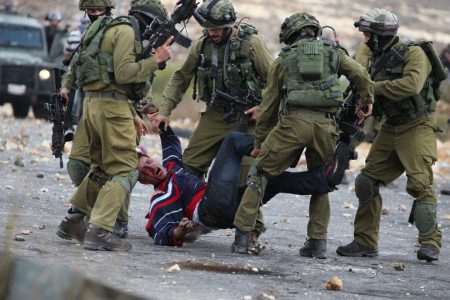
Deputy Mayor of Jerusalem, Aryeh King, yesterday called on Israeli police to execute Palestinian protesters who take to the streets of the holy city at night, Shehab news agency reported.
He proposed a change in police policy regarding dealing with protesters and stop using traditional means to disperse them.
According to the Israeli TV Channel 7, King said that shooting the protesters “is the only way which can end the night protests phenomenon.”
Police “do not save any efforts to prevent these demonstrations which were aggravated by the start of Ramadan,” he added.
King, Israeli newspaper Haaretz said, is best known for settling Jews in occupied East Jerusalem and evicting Palestinian families from the city’s Sheikh Jarrah neighbourhood.
Israel prevents non-vaccinated Palestinians from entering Al-Aqsa Mosque
![Israeli forces at the Qalandiya checkpoint from Ramallah into Jerusalem with worshippers who want to attend the first Friday prayer of Muslim holy month of Ramadan at the Al-Aqsa Mosque, on 16 April 2021 [Issam Rimawi/Anadolu Agency]](https://i0.wp.com/www.middleeastmonitor.com/wp-content/uploads/2021/04/Passing-through-Qalandiya-checkpoint-for-the-first-Friday-prayer-of-Ramadan_21.jpg?resize=1200%2C800&quality=85&strip=all&zoom=1&ssl=1)
Qalandiya checkpoint from Ramallah into Jerusalem, worshippers want to attend first Friday prayer of Muslim holy month of Ramadan, Al-Aqsa Mosque, 16 April 2021 [Issam Rimawi/Anadolu Agency]
MEMO | April 17, 2021
Israeli occupation authorities have prevented thousands of Palestinian worshippers from the occupied West Bank from entering Al-Aqsa Mosque on the first Friday of the Muslim holy month of Ramadan, Arab48 reported.
According to the news website, the Israeli authorities set a condition for the worshippers from the occupied territories to be vaccinated against COVID-19 in order to obtain access to the Muslim holy site.
Meanwhile, the occupied West Bank and Gaza Strip do not have sufficient quantities of vaccines, and therefore thousands were deprived of performing the first Friday prayer at Al-Aqsa Mosque.
Israeli military checkpoints between the West Bank and Israel have experienced severe congestion, Anadolu Agency reported, noting that disputes occurred between Palestinians and the Israeli occupation forces at Qalandia Checkpoint.
“We were prevented from entering Al-Aqsa Mosque under the pretext of not being vaccinated,” Samia Abdul-Aziz told Anadolu Agency. “However,” she argued, “they aim to reduce the number of Muslim worshippers inside the sanctity yards.”
Associated Press misreports news about Gaza rocket into Israel
By Alison Weir | Israel-Palestine News | April 16, 2021
A recent news report by the Associated Press (AP) published by thousands of newspapers around the U.S. contains inaccurate information.
The report, entitled “Israeli army: Rocket from Gaza hits south Israel,” states in its lead sentence that the rocket broke weeks of “cross border calm.”
In reality, Israeli forces have attacked Gaza numerous times in the past several weeks:
- Soldiers Fire Live Rounds Into Farmlands In Khan Younis (April 13)
- Army Carries Out A Limited Invasion Into Central Gaza (April 11)
- Israeli Army Attacks Palestinians Shepherds In Southern Gaza (April 7)
- Israeli Navy Attacks Fishing Boats In Gaza (April 5)
- Israeli Soldiers Invade Farmlands In Central Gaza (March 31)
- Israeli Army Invades Palestinian Lands In Central Gaza (March 29)
- Israeli Navy Attacks Palestinian Fishing Boats In Gaza (March 29)
- Israeli Warplanes Fire Missiles at the Besieged Gaza Strip (March 24)
Gazan rockets & Israeli airstrikes
Rockets from Gaza have killed 30 Israelis during the approximately 20 years they’ve been used, while Israeli air strikes have killed over 4,000 Gazans during the same time period.
Palestinian resistance groups began launching their mostly home made rockets in April 2001, after Israeli forces had invaded Gaza numerous times and killed over 570 Palestinians in the previous six months.
A detailed study by three American professors found that it was “overwhelmingly Israel, not Palestine,” that initiated violence after a period of calm.
Statistical studies of the Associated Press reporting conducted in 2006 and 2018 found that AP covered Israeli deaths at rates far greater than they covered Palestinian deaths.
The AP bureau is located in Israel and many of its editors are Israeli and/or married to Israelis.
The U.S. gives Israel over $10 million per day.
Alison Weir is executive director of If Americans Knew, president of the Council for the National Interest, and author of Against Our Better Judgment: The Hidden History of How the U.S. Was Used to Create Israel.
Bipartisan Murder
By Richard Medhurst | April 11, 2021
Syria is the key to the Middle East. Bordering Turkey, Iraq, Lebanon, Jordan and Palestine, and with access to the Mediterranean Sea, for millennia Syria has held unique geopolitical and strategic importance in the region. The war taking place there since 2011 has been sold by virtually every news outlet in the West as being strictly a civil war, part of the popular uprisings of the ‘Arab Spring’. The reality couldn’t be more different.
As General Wesley Clarke points out in 2007 there had been an agenda to take out “seven countries in five years” among them Syria, Iraq, Lebanon, Libya, Somalia, Sudan and Iran; to replace their governments with ones favorable to Washington DC.
Five years already before the “Arab Spring”, a 2006 cable from the United States embassy in Damascus published by WikiLeaks shows how the US was looking at various threats, both real and exaggerated, that it could exploit in order to destabilize the Syrian government.

The US and its allies Britain, Turkey, Saudi Arabia, Qatar began funding and arming various militias inside Syria, funneling weapons and supplies to them in order to overthrow the Syrian government. Efraim Halevy, former head of israel’s intelligence service the Mossad, even admitted in an interview that Israel had provided aid to Al Qaeda fighters just because it was advantageous for Israel to see the Syrian government fall.
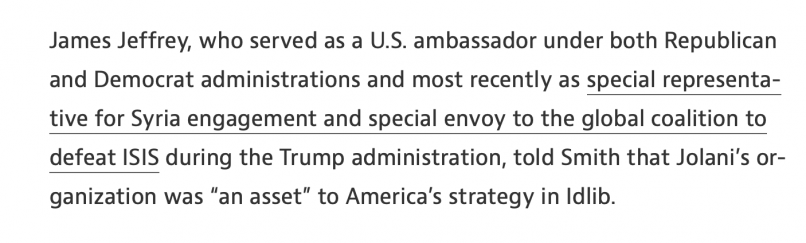
PBS recently did an interview with Abu Mohammad al Jolani, a terrorist leader in Syria’s north-western Idlib during which he expressed no intent to fight with the US, despite having a $10 million bounty on his head. The article goes on to mention how former Ambassador James Jeffrey, the US’ former Special Envoy to Syria, confirms that al Jolani’s organization Hayat Tahrir al-Sham (HTS), a rebrand of Al Qaeda, was a “an asset” to America’s strategy in Idlib.
To cover up the undeniable role played by foreign governments, to this day the mainstream media portrays the war on Syria as a grassroots uprising by “moderate rebels”— the overwhelming majority of whom just so happen to be rebrands or affiliated with Al Qaeda and other jihadist elements.
Despite the efforts of the entire Western propaganda machine and a dozen nations ganging up against Syria, their gamble for regime change has failed thus far: Syria has taken back most of its territory from ISIS and other foreign-backed terrorists, and now boasts even stronger ties with its allies than before. Take for example Russia’s naval port in Tartus, established in Syria in 1971 as part of an accord with the Syrian government, providing it access to the Mediterranean Sea. A decade ago, at the start of the war, the port was practically crumbling, Ten years later in 2021, it’s been completely renovated, upgraded and fitted with state of the art ships.
While some argue the main goal behind the war in Syria was to build the Qatar-Turkey pipeline which would deliver gas through Syria to Europe, undercutting Russia’s market share, I think the larger objective for the United States has mostly been regime change and to remove the “thorn” in israel’s side. Syria refuses to recognize israel and has no official ties with the Zionist occupation. The two have been at odds with each other for the last 73 years; not just since the start of the occupation of Palestine in 1948, but also the capture of the Syrian Golan Heights in 1967 and consequent illegal annexation. Syria is also allied with Russia, Iran and supports the various liberation movements of its neighbors including the Palestinian resistance, Hezbollah and the Popular Mobilization Forces in Iraq, collectively dubbed the “Axis of Resistance”– a twist on George Bush’s “Axis of Evil“.
Seeing how the regime change strategy through various terrorist and armed groups has failed in Syria, the United States is now occupying Syria’s vital breadbasket region, where most of its crops are grown, as well as the oil fields in Deir Ezzor and Hassakeh provinces in East and North-Eastern Syria.
After Trump openly admitted “we’re keeping the oil”, we also saw in August, 2020 then Secretary of State Pompeo admit to Senator Lindsay Graham during a Senate Foreign Relations Committee hearing that a US firm would be “modernizing Syria’s oil fields”, which is a nice way to say “plundering”.
Graham can be heard gloating about the brutal Caesar Act sanctions imposed by the Trump administration. Indeed, in addition to stealing Syria’s resources, the United States is also starving the Syrian population with siege warfare. These Caesar sanctions announced by Trump and kept by Biden serve no purpose other than to tighten the noose on the Syria’s population. Syria’s economy has collapsed, its currency in free-fall and nearly 60 percent of the population is now food insecure in a country which used to be self-sufficient and a net exporter of wheat. The US shamelessly states that its goal is to deprive the Syrian government, and by extension the Syrian people, of one of their most valuable resources (oil accounts for around 25% of government revenue) desperately needed to fund public infrastructure and social programs, with 90% of Syrians now living in poverty. They pretend that sanctions only affect the politicians but it’s the civilians who are suffering.
The West doesn’t care if Syrians die. This scorched-earth policy is advantageous to US and Western interests because it keeps Syria in a constant state of chaos and helps israel create a buffer beyond just the occupied Golan Heights, but also more generally as Syria is now unable to defend itself, defend its neighbors, and subject to regular airstrikes which the world lets israel carry out with impunity.
While Secretary of State Blinken uses his own kids in some deranged comparison to pretend he cares about Syrian children he and Biden are completely fine keeping Donald Trump’s “Maximum Pressure Campaign” of sanctions going. According to Syria’s oil minister around 90% of Syria’s crude is now under control of the US. Syrians wait in massive queues as they experience fuel shortages and are lining up for bread. Sanctions are a modern adaptation of siege warfare, just as ruthless and deadly.
Both Democrats and Republicans are on the same page when it comes to imperialism and their fealty to corporations. There is no difference among them in that regard except in decorum. After Trump bombed Syria in April 2018, over an alleged chemical gas attack in Douma later revealed to have been staged, then Senator Kamala Harris questioned the “legal rationale” behind the strikes. Some Democrats criticized Trump saying it was a breach of constitutional powers– but none of them fundamentally questioned whether these alleged chemical attacks had even taken place to begin with. The team of scientists sent by the Organization for the Prohibition for Chemical Weapons hadn’t even arrived in Syria yet to determine what had happened. Democrats only issued mild statements of rebuke while simultaneously cheering on Assad was being “punished”– which goes to show their objectives fundamentally remain the same, no matter who is in power.
Biden’s bombing of Syria
After Joe Biden became president his first military action was to bomb Syria. Naturally, bombings takes priority over campaign promises like the $15 minimum wage or $2,000 checks he lied about. Biden’s supposed “justification” for bombing Syria on February 25th, 2021 was that he was acting in self-defense to protect the United States. This is of course an absurdity; Syria is not a threat to the United States nor has it attacked the United States– if anything it’s the other way around. Nevertheless, it doesn’t matter that Biden blatantly lies in his letter to Congress, everyone knows this is merely a cover story in order to comply with the War Powers Resolution (notifying Congress of military action and citing defensive measures if no prior Authorization for Use of Military Force exists).
When Biden bombed Syria he claimed to have targeted “Iranian backed militias”- the same excuse that Israel gives when illegally bombing Syria almost on a weekly basis. When I spoke to Professor Max Abrahms on my television The Communiqué he said the bombing was likely more about sending a message to Israel rather than Iran; a show of support from Biden that the Zionist occupation could still count on the new administration’s support.
When corporate media and Western politicians say “Iranian backed militias” they’re referring to the Popular Mobilization Forces (PMF / PMU) or Hashed al Shaabi in Arabic. The PMU is made up mostly of various Iraqi brigades, consisting of different religious and ethnic groups, despite claims that they’re exclusively Shiah– although even then I struggle to understand how that would give the US or Israel the right to kill them. The popular forces are united under one banner to fight terrorism and occupation. Of course the United States can’t have you realizing they’re a resistance movement because then people would rightfully ask “resisting what?” and that’s of course the United States, illegally occupying Iraq since 2003. The PMU also celebrated major victories in defeated ISIS and Al Qaeda, taking back the major city of Mosul in 2016. Although the US and its illegal occupation like to take credit for that (so they can justify their presence) that victory is not theirs. As a matter of fact, the United States not only helped create Al Qaeda and ISIS but Trump’s assassination of General Soleimani and PMU commander Abu Mahdi was celebrated by the very terrorists who had come to fear them. While the US claims to fight terrorism it’s actively helping terrorists by killing their biggest enemies. And now of course Biden follows in Trump’s footsteps, proceeding to bomb the PMU. I wonder how many will break the situation down like that for you on the evening nows? Let’s be clear on something: I don’t care if the target was an empty barn in Syria – he has no right to bomb anything there nor in any other country.
Shortly after Biden’s bombing of Syria, Tim Kaine (D-VA) and Todd Young (R-IN) introduced legislation calling for the repeal of the 1991 and 2002 AUMFs. Note that the 2001 AUMF is missing – unsurprising as it’s the template Congress has used for two decades to invade, bomb and ransack the planet in the name of “the War on Terror”. Of course they wouldn’t repeal that AUMF. Biden is now on track to violate the Afghanistan peace deal signed under Trump, after drawing down the number of US troops in Afghanistan to 2,500, with a complete withdrawal set for a deadline of May 1st. Right on cue, the US claims that the Taliban aren’t holding up their end of the deal- hence why the US can’t leave just yet, continuing to impose conditions on their departure as if Afghanistan belongs to them. Naturally, the media provides cover for the longest war in US history, repeating without question or scrutiny Biden’s claims that a withdrawal “can’t be rushed” after occupying Afghanistan for almost 20 years. CNN also made the case that this is now about women’s rights– as if the United States cared about women when it displaced millions of them in Afghanistan, Libya, Iraq, Syria. We’re now made to believe that occupation is emancipation. The poor white man’s burden, freeing the world through bombs, sanctions and occupation.
Unsurprisingly, Democrats have largely chosen to side with him on the issue while others, including so called “progressives” like Alexandria-Ocasio Cortez have remained completely silent despite criticizing Trump for bombing Syria in 2018, calling him a ‘mad king’. This really shows you where their allegiances lie and how far their “progressivism” extends. The so called “left-wing” of the Democratic Party is about as “progressive” as you can get when you stay silent about Biden bombing Syria, ballooning the war machine to an outrageous $753 billion, and violating the Afghan peace deal in order to maintain a 20-year occupation. War pigs. All of them.
A template for war
The Authorization for Use of Military Force (AUMF) of 2001 and 2002 passed by Congress formed the legal basis with which Bush invaded Afghanistan and Iraq. Specifically, the AUMF of 2001 broadly authorizes force against those who “planned, authorized, committed, or aided the terrorist attacks that occurred on September 11, 2001, or harbored such organizations or persons.”. This ambiguous language essentially gives the president a blank check to conduct military strikes anywhere and has been distorted and manipulated by every president since in order to expand the “War on Terror” into 19 countries. Trump in his usual absurdity even cited the 2002 AUMF to try and justify his assassination of General Soleimani in January, 2020. Of course, Congress won’t ever go after him for that, despite all this talk of how Trump posed a unique danger to US democracy, let alone any other sitting or former president. Never forget, Nancy Pelosi refused to impeach George W. Bush and admits as late as 2019 that she knew George Bush had lied about weapons of mass destruction and still chose to ignore calls to impeach him over a war that displaced and killed millions of Iraqis.
The constitution clearly says that the president is the commander-in-chief of the United States’ Armed Forces, however, that the power to declare war resides with Congress. Although the president can respond to imminent threats, the War Powers Resolution of 1973 stipulates that the president must notify Congress in absence of a declaration of war or prior statutory authorization. Consultation and follow ups with the Legislative branch are a must and the entire point of the resolution is to limit the Executive’s reach in matters of war.
If Congress has already issued an Authorization for Use of Military Force (AUMF), presidents will operate within that framework and cite it to justify any action they take. What presidents have often done is to abuse this and distort its legal interpretation e.g. Bush’s crimes in Iraq, Obama’s drone strikes in Pakistan, Trump’s assassination of General Soleimani. On the other hand, if Congress hasn’t issued an AUMF, like in the case of Biden’s bombing of Syria, then the president will simply cite self-defense as the justification– which is exactly what Biden did– even if it isn’t true. In either case, whether an AUMF has been issued or not, it seems Congress allows presidents to proceed unchecked– because Congress agrees with their imperialist agenda.
One mustn’t forget that even in the case when Congress issues an AUMF and agrees with the president’s military action: US law does not supersede international law. For example, just because the US Congress voted to invade Iraq does not mean that this invasion was morally or legally justifiable.
While Biden cites Article 51 under the United Nations as the United States’ right to self-defense, one has to wonder how Article 51 would even begin to apply in this context. Syria has not attacked the United States, nor are the two nations (at least officially) at war. Moreover, if the targets were so called “Iranian-backed militias”, the same rationale still applies. These bombings also violate Article 2.4 of the United Nations Charter which asserts Syria’s sovereignty and prohibits use of force against other member states. Some legal scholars might go on to argue that self-defense under Article 51 only applies against other states, not “militias”. Some might also question how the United States can argue self-defense when its very presence in Iraq is illegal to begin with; the result of an illegal invasion in 2003? At best Biden’s pretext for bombing Syria is dubious, and at worst downright illegal and outrageous. I think most rational people can clearly see it’s the latter.
Indeed, no matter who is in charge, the warmongering remains the same. Obama, Trump, Biden have all maintained George Bush’s neoconservative wars, his creation and expansion of the electronic surveillance start, his Department of Homeland Security and the post-9/11 world crafted by the Bush-Cheney regime. You won’t see many Democrats or Republicans voicing support to repeal the AUMF anytime soon. War is a racket, and the United States excels at it. It’s no accident you have a revolving door between Washington D.C. and the private sector, and that the new Secretary of Defense Lloyd Austin is a former board member of the weapons manufacturer Raytheon. At least there’s diversity right? Now that the Treasury and Office of Foreign Assets Control, whose sanctions kill millions, is being run by Janet Yellen, its first woman ever, everything is fine. That’s what counts, right? Or that Alejandro Mayaorkas, the first Latino man to head the Department of Homeland Security, continuing to separate children, placing them in the same camps and appalling conditions as Trump and maintaining construction on Trump’s racist border wall (which all of a sudden Democrats have no issue with). What a diverse brand of imperialism: Uncle Joe’s Rainbow Coalition Death Cult®.
Spain allows Israeli agent to interrogate Palestinian journalist in Madrid
MEMO | April 15, 2021
The Spanish security services have allowed an Israeli agent from the Mossad spy agency to interrogate a Palestinian journalist seeking asylum, Wafa news agency has reported. The incident at the Civil Guard building in the capital has been condemned by the Palestinian Journalists’ Syndicate.
The syndicate called on the Spanish government to assume its responsibilities by ensuring the security of Muath Hamid and his family. It also called for the Spanish authorities to open an investigation into what happened during the interrogation.
Spain’s Civil Guard is the oldest law enforcement agency in the country and “military in nature”. The journalists’ union said that it is suspected of being “complicit” with Mossad in allowing the Israeli agent to interrogate Hamid in its building. “This was a gross violation of international law, a violation of Spanish sovereignty and a threat to the journalist’s security and safety,” the syndicate insisted.
It added that the case is being followed closely in conjunction with the Union of Spanish Journalists, the Palestinian Foreign Affairs and Expatriates Ministry, and the Spanish political and security authorities to ensure that Hamid is not subject to any harm or torture. The reporter for Al Araby TV and freelance contributor to Al-Araby Al-Jadeed is currently a refugee in Spain, where he lives with his wife and two children.
According to popular Spanish online newspaper Público last Friday, on 9 December Hamid received a telephone call from “Nicolás”, an officer on duty at the Civil Guard’s Spanish Information Services “Nicolás wanted to discuss Hamid’s work as a journalist, his past and his current life in Spain. This is a regular procedure for refugees and migrants.”
When the journalist went to meet “Nicolás” in Bilbao, he met another officer, Javier. “Hamid answered all the questions, explaining why he applied for asylum in Spain and describing his journey from Palestine to Europe through Turkey,” reported Público. “In early February, the young Palestinian journalist was summoned again by Nicolás… this time in the Spanish capital, Madrid.”
This time there was also another man in the room, allegedly named Omar, “who was introduced to him as a Palestinian. Hamid, however, immediately noticed his strong Israeli accent… and he decided to answer his questions in Hebrew.” Omar acknowledged that he was an Israeli, at which point Javier “left the room, leaving Muath in the hands of the supposed Mossad agent… who threatened the Palestinian journalist and his family, saying that they will never be allowed to go back to Palestine due to one of his journalistic investigations” related to the work of the Israeli spy agency.
Público sought comments and clarifications from the Israeli Embassy and the Civil Guard, as well as Spain’s Interior Ministry. It has received no replies.
Israeli Supreme Court green lights Israel’s ‘Cyber Unit’ that works with social media giants to censor user content
Adalah Press Release | April 12, 2021
Court authorizes Cyber Unit to continue operating in the shadows, conducting quasi-judicial censorship without allowing social media users to defend their rights or even to know that the state has been involved in removing their online content.
The Israeli Supreme Court on Monday, 12 April 2021, rejected a petition filed by Adalah – The Legal Center for Arab Minority Rights in Israel and the Association for Civil Rights in Israel (ACRI) giving a green light to the continued operations of the Israeli state attorney’s office Cyber Unit and its “alternative enforcement” model of censoring social media content.
Israel’s Cyber Unit uses an “alternative enforcement” mechanism to essentially censor social media platforms and muzzle users: it flags and submits social media posts – without legal proceedings and often without even the knowledge of the individual user – to social media giants and requests their removal.
This Israeli state practice is aimed at clamping down on social media dissent, and frequently even results in the suspension or removal of users. This censorship is conducted in collaboration and coordination with social media outlets, including U.S.-based giants Facebook and Twitter.
Similar units operating in countries around the world are known as Internet Referral Units (IRUs).
Adalah attorneys Fady Khoury and Rabea Eghbariah had filed the petition against the Cyber Unit to the Israeli Supreme Court on 26 November 2019. They stressed that the Cyber Unit’s “alternative enforcement” mechanism violates the constitutional rights of freedom of expression and due process, and that the unit is operating without any legal authority.
Israeli Supreme Court Justice Hanan Melcer announced the decision on Monday morning in Jerusalem, in his final ruling before retirement.
In its decision, the court granted unchecked and unauthorized power to the Israeli state, allowing it to govern online speech by using informal channels with social media corporations. The court essentially privatized the judicial process, allowing private corporations to decide upon censorship of social media content based on ostensibly unbinding requests from Israeli state authorities.
Adalah Attorney Rabea Eghbariah commented immediately following the Israeli Supreme Court ruling:
“The Israeli Supreme Court has just authorized the state to continue to use its Cyber Unit to conduct quasi-judicial censorship proceedings in cooperation with private corporations, without allowing social media users to defend their rights or even to know that the state has been involved in removing their online content. Israel’s Cyber Unit has operated in the shadows of the law to censor tens of thousands of social media posts every year. The Supreme Court has now, to our regret, given Israel a blank check to continue with this practice.”
The Magic of Israel
Now you see it, now you don’t
BY PHILIP GIRALDI • UNZ REVIEW • APRIL 13, 2021
The popular narrative of plucky little Israel prevailing over hordes of bloodthirsty Arabs has captured the Western imagination even though it is manifestly false in almost every detail. But Israel’s greatest accomplishment might well be something else, it’s ability to make things disappear. It plausibly all began in June 1967 when Israel attacked the USS Liberty, a lightly armed but well identified US naval vessel cruising in international waters under a large American flag. Fighter bombers and torpedo boats sought to sink the ship, destroying the lifeboats so no one would escape. In the engagement, 34 American military personnel were killed and a further 171 wounded, before a heroic defense by the crew managed to save the vessel. President Lyndon Johnson, who said he would rather see the ship sink than embarrass his friend Israel, started a cover-up which has lasted to this day. There has been no legitimate court of inquiry into the attack and when the ship’s captain received a Medal of Honor for his heroism, it was awarded secretly in the Washington Navy Yard rather than openly at the White House. Israel and its legion of apologists certainly know how to make potential embarrassments disappear.
Last week on this site I posted an article that I thought would prove to be extremely interesting to those who have been expressing concern about foreign interference in our government. It included a link to a series of computer screen texts provided by a credible independent source demonstrating that an employee of the Israeli Consulate General was deeply involved in what appears to be extorting millions of dollars from the father of a congressman based on assisting that congressman through some legal difficulties. The scheme being concocted also included discussion of arrangements for a commando raid on Iran to free a prisoner. The information conveyed in the screenshots that were provided of the texts has not been disputed by anyone involved in the venture, but as I thought the accompanying article was timid in its willingness to draw any conclusions, I wrote my piece attempting to connect the dots.
The Congressman involved was, of course, Matt Gaetz of Florida, who is now facing the House Ethics Committee, surely an oxymoron if there ever was one, concerning his primarily sexual exploits. To my surprise, however, there has been hardly a word in the mainstream media about looking deeper into the possible Israeli connection. One would have thought the copied texts would be newsworthy due to the extortion angle but even more due to the fact that an armed attack on a nation with which the US is not at war was being funded and planned by a foreign government’s diplomatic mission in New York.
To be sure my article did very well both on Unz and even Facebook, though I had to cut and paste it in the latter site due to its blocking of Unz. I did a bit more checking and noted something that has been occurring for some time: the piece, like others relating to Israel, was not coming up on search engines like Google, which means it was not getting the exposure that it merited. I search daily by my name assuming that my pieces if replayed elsewhere will be displayed. In the past I would sometimes get scores of hits on a popular article, but during the past year hardly anything has been appearing. I have to assume that deliberate and widespread censorship of articles critical of Israel is taking place, which was no surprise as friends of Israel are not exactly rare in the social media. Facebook’s censorship board, for example, includes a former Israeli government minister.
It all comes down to the power of the Israeli/Jewish lobby and its ability to make things that it does not like go away. And sometimes it can make things happen that are manifestly not in the interest of the United States. Jonathan Pollard, the most damaging spy ever in the history of the United States, was recently allowed to return to Israel. In an interview on March 26th he said that any American Jews working for US intelligence agencies must do their duty and spy for Israel because one’s real loyalty is to the Jewish state and one’s co-religionists.
Clearly Pollard is not alone and it was shocking to learn that outgoing president Donald Trump pardoned the Israeli agent who recruited and presumably helped “run” Pollard when he was stealing US secrets. Aviem Sella received a full pardon from Trump as part of hundreds of last minute pardons, many of which had been arranged through two Orthodox Jewish agencies favored by presidential son-in-law Jared Kushner.
Sella was a retired Israeli air force officer doing graduate studies and living in the US when he enlisted Pollard to spy for Israel. He fled the country after Pollard was arrested in 1985 and was charged in absentia on three espionage counts but Israel refused to extradite him to the US to stand trial. A White House statement noted that Sella’s request for clemency received support from Israeli Prime Minister Benjamin Netanyahu, the Israeli ambassador in Washington Ron Dermer, the American ambassador to Israel David Friedman, and Miriam Adelson, the widow of the Republican Party’s top donor and Trump supporter Sheldon Adelson. Would anyone expect otherwise?
The Sella pardon should be seen for what it is. It was a gift to the corrupt Netanyahu, who was at the time facing another national election. It served no US national interest at all and in fact sent the message to those who might be tempted a la Pollard that spying for Israel might be regarded as consequence free, in fact desirable and the right thing to do. Of course, the special “exemption” when dealing with Israel should also be regarded as a tribute to Jewish power in the United States, which relies on the corruption of those in leadership positions, using financial inducements or even blackmail backed up by smears of anti-Semitism and holocaust denial for those who cannot be bought.
And the power to corrupt governments and media is not limited to the United States. Nearly everyone in public office or who relies on the media for an income understands one does not cross the Israel Lobby. In Britain, former Foreign Office Minister Sir Alan Duncan has written a memoir that accuses pro-Israel lobbyists of “the most disgusting interference” in British politics while also distorting the country’s foreign policy in the Middle East to favor the Jewish state.
Duncan also claimed that Conservative Friends of Israel (CFI) went “ballistic” and blocked him from becoming the Middle East minister at the Foreign Office. Duncan has long been a major target for the Israel lobby. In 2017, an Al Jazeera documentary exposed the maneuvering of pro-Israel groups working together with the Israeli Embassy in London to “take down” Duncan and also Labour Party leader Jeremy Corbyn.
Per Duncan, Conservative Friends of Israel, which openly promotes the interests of a foreign country, had successfully promoted a “Netanyahu-type view of Israeli politics into our foreign policy.” In one chapter Duncan criticized Conservative MPs’ fawning over Benjamin Netanyahu during his visit to Britain, a performance apparently similar to the time when Bibi addressed the US Congress and received 27 standing ovations.
The Duncan book appeared when another story broke about how a group called “UK Lawyers for Israel” acting on behalf of the Israeli government has been altering the material included in secondary school text books. Per a statement issued by Pearson, the largest publisher of school books in the UK, the company has suspended publication of two textbooks responding to “an eight-page report, by Middle East specialists Professors John Chalcraft and James Dickins, which found hundreds of changes to the textbooks overwhelmingly favoring an Israeli narrative and removing or replacing passages that support Palestinian narratives.”
Censorship of course materials as well as textbooks by Jewish groups to depict Israel in a certain way has certainly been going on in the United States for many years. And the corruption of our institutions to favor Israel and protect it from criticism is incessant. It will be interesting to see if the Gaetz story in all its aspects will ever be allowed to surface or whether the congressman will be offered some inducement to allow him to quietly resign. Somehow, it reminds one of the still unresolved Jeffrey Epstein case in which Epstein and his accomplice Ghislaine Maxwell obtained blackmail material relating to world leaders and celebrities having sex with young girls, somewhat similar to the claims regarding Gaetz.
Many including myself believe that Epstein was part of an Israeli intelligence operation, similar in scale to what was being run on 9/11, which sought to “influence” key figures on issues regarded as important by the Jewish state. Clearly, the game goes on with no one in Washington caring much about the damage being done. Do corrupted and intimidated Congressmen over their morning coffee ponder whether certain activities are “Good for Israel” and therefore not subject to further scrutiny? Judging from Epstein and Gaetz, one would have to believe that to be the case.
Philip M. Giraldi, Ph.D., is Executive Director of the Council for the National Interest, a 501(c)3 tax deductible educational foundation (Federal ID Number #52-1739023) that seeks a more interests-based U.S. foreign policy in the Middle East. Website is councilforthenationalinterest.org, address is P.O. Box 2157, Purcellville VA 20134 and its email is inform@cnionline.org