The “Unvaccinated” Question

By CJ Hopkins | Consent Factory | March 29, 2021
So, the New Normals are discussing the Unvaccinated Question. What is to be done with us? No, not those who haven’t been “vaccinated” yet. Us. The “Covidiots.” The “Covid deniers.” The “science deniers.” The “reality deniers.” Those who refuse to get “vaccinated,” ever.
There is no place for us in New Normal society. The New Normals know this and so do we. To them, we are a suspicious, alien tribe of people. We do not share their ideological beliefs. We do not perform their loyalty rituals, or we do so only grudgingly, because they force us to do so. We traffic in arcane “conspiracy theories,” like “pre-March-2020 science,” “natural herd immunity,” “population-adjusted death rates,” “Sweden,” “Florida,” and other heresies.
They do not trust us. We are strangers among them. They suspect we feel superior to them. They believe we are conspiring against them, that we want to deceive them, confuse them, cheat them, pervert their culture, abuse their children, contaminate their precious bodily fluids, and perpetrate God knows what other horrors.
So they are discussing the need to segregate us, how to segregate us, when to segregate us, in order to protect society from us. In their eyes, we are no more than criminals, or, worse, a plague, an infestation. In the words of someone (I can’t quite recall who), “getting rid of the Unvaccinated is not a question of ideology. It is a question of cleanliness,” or something like that. (I’ll have to hunt down and fact-check that quote. I might have taken it out of context.)
In Israel, Estonia, Denmark, Germany, the USA, and other New Normal countries, they have already begun the segregation process. In the UK, it’s just a matter of time. The WEF, WHO, EU, and other transnational entities are helping to streamline the new segregation system, which, according to the WEF, “will need to be harmonized by a normative body, such as the WHO, to ensure that is ethical.”
Here in Germany, the government is considering banning us from working outside our homes. We are already banned from flying on commercial airlines. (We can still use the trains, if we dress up like New Normals.) In the village of Potsdam, just down the road from Wannsee (which name you might recall from your 20th-Century history lessons), we are banned from entering shops and restaurants. (I’m not sure whether we can still use the sidewalks, or whether we have to walk in the gutters.) In Saxony, we are forbidden from attending schools. At the Berliner Ensemble (the theater founded by Bertolt Brecht and Helene Weigel, lifelong opponents of totalitarianism and fascism), we are banned from attending New Normal performances.
In the USA, we are being banned by universities. Our children are being banned from public schools. In New York, the new “Excelsior Pass” will allow New Normals to attend cultural and sports events (and patronize bars and restaurants, eventually) secure in the knowledge that the Unvaccinated have been prevented from entering or segregated in an “Unvaccinated Only” section. The pass system, designed by IBM, which, if history is any guide, is pretty good at designing such systems (OK, technically, it was Deutsche Hollerith Maschinen Gesellschaft, IBM’s Nazi-Germany subsidiary), was launched this past weekend to considerable fanfare.
And this is only the very beginning.
Israel’s “Green Pass” is the model for the future, which makes sense, in a sick, fascistic kind of way. When you’re already an apartheid state, what’s a little more apartheid? Here’s a peek at what that looks like …

OK, I know what the New Normals are thinking. They’re thinking I’m “misleading” people again. That I’m exaggerating. That this isn’t really segregation, and certainly nothing like “medical apartheid.”
After all (as the New Normals will sternly remind me), no one is forcing us to get “vaccinated.” If we choose not to, or can’t for medical reasons, all we have to do is submit to a “test” — you know, the one where they ram that 9-inch swab up into your sinus cavities — within 24 hours before we want to go out to dinner, or attend the theater or a sports event, or visit a museum, or attend a university, or take our children to school or a playground, and our test results will serve as our “vaccine passports!” We just present them to the appropriate Covid Compliance Officer, and (assuming the results are negative, of course) we will be allowed to take part in New Normal society just as if we’d been “vaccinated.”
Either way, “vaccine” or “test,” the New Normal officials will be satisfied, because the tests and passes are really just stage props. The point is the display of mindless obedience. Even if you take the New Normals at their word, if you are under 65 and in relatively good health, getting “vaccinated” is more or less pointless, except as a public display of compliance and belief in the official Covid-19 narrative (the foundation stone of the New Normal ideology). Even the high priests of their “Science” confess that it doesn’t prevent you spreading the “plague.” And the PCR tests are virtually meaningless, as even the WHO finally admitted. (You can positive-PCR-test a pawpaw fruit … but you might want to be careful who you tell if you do that.)
In contrast to the “vaccine” and the “test” themselves, the forced choice between them is not at all meaningless. It is no accident that both alternatives involve the violation of our bodies, literally the penetration of our bodies. It doesn’t really matter what is in the “vaccines” or what “results” the “tests” produce. The ritual is a demonstration of power, the power of the New Normals (i.e., global capitalism’s new face) to control our bodies, to dominate them, to violate them, psychologically and physically.
Now, don’t get all excited, my “conspiracy theorist” friends. I haven’t gone full QAnon just yet. Bill Gates and Klaus Schwab are not sitting around together, sipping adrenochrome on George Soros’ yacht, dreaming up ways to rape people’s noses. This stuff is built into the structure of the system. It is a standard feature of totalitarian societies, cults, churches, self-help groups, and … well, human society, generally.
Being forced to repeat a physical action which only makes sense within a specific ideology reifies that ideology within us. There is nothing inherently diabolical about this. It is a basic socialization technology. It is how we socialize our children. It is why we conduct weddings, baptisms, and bar mitzvahs. It is how we turn young men and women into soldiers. It is how actors learn their blocking and their lines. It is why the Nazis held all those rallies. It is why our “democracies” hold elections. It is also basic ceremonial magic … but that’s a topic for a different column.
The issue, at the moment, is the Unvaccinated Question, and the public rituals that are being performed to make the New Normal ideology “reality,” and what to do about those of us who refuse to participate in those rituals, who refuse to forswear “old normal” reality and convert to New Normalism so that we can function in society without being segregated, criminalized, or “diagnosed” as “sociopathic” or otherwise psychiatrically disordered.
For us “conspiracy-theorizing reality deniers,” there is no getting around this dilemma. This isn’t Europe in the 1930s. There isn’t anywhere to emigrate to … OK, there is, temporarily, in some of the US states that have been staging rebellions, and other such “old normal” oases, but how long do you think that will last? They’re already rolling out the “mutant variants,” and God only knows what will happen when the long-term effects of the “vaccines” kick in.
No, for most of us denizens of the global capitalist empire, it looks like the New Normal is here to stay. So, unless we are prepared to become New Normals, we are going to have to stand and fight. It is going to get rather ugly, and personal, but there isn’t any way to avoid that. Given that many New Normals are our friends and colleagues, or even members of our families, it is tempting to believe that they will “come to their senses,” that “this is all just a hysterical overreaction,” and that “everything will go back to normal soon.”
This would be a monumental error on our parts … very possibly a fatal error.
Totalitarian movements, when they reach this stage, do not simply stop on their own. They continue to advance toward their full expressions, ultimately transforming entire societies into monstrous mirror-images of themselves, unless they are opposed by serious resistance. There is a window at the beginning when such resistance has a chance. That window is still open, but it is closing, fast. I can’t tell you how best to resist, but I can tell you it starts with seeing things clearly, and calling things, and people, exactly what they are.
Let’s not make the same mistake that other minorities have made throughout history when confronted with a new totalitarian ideology. See the New Normals for what they are, maybe not deep down in their hearts, but what they have collectively become a part of, because it is the movement that is in control now, not the rational individuals they used to be. Above all, recognize where this is headed, where totalitarian movements are always headed. (See. e.g., Milton Mayer’s They Thought They Were Free: The Germans 1933-45.)
No, the Unvaccinated are not the Jews and the New Normals are not flying big Swastika flags, but totalitarianism is totalitarianism, regardless of which Goebbelsian Big Lies, and ideology, and official enemies it is selling. The historical context and costumes change, but its ruthless trajectory remains the same.
Today, the New Normals are presenting us with a “choice,” (a) conform to their New Normal ideology or (b) social segregation. What do you imagine they have planned for us tomorrow?
#
Israel detains 3 prominent Hamas leaders in West Bank
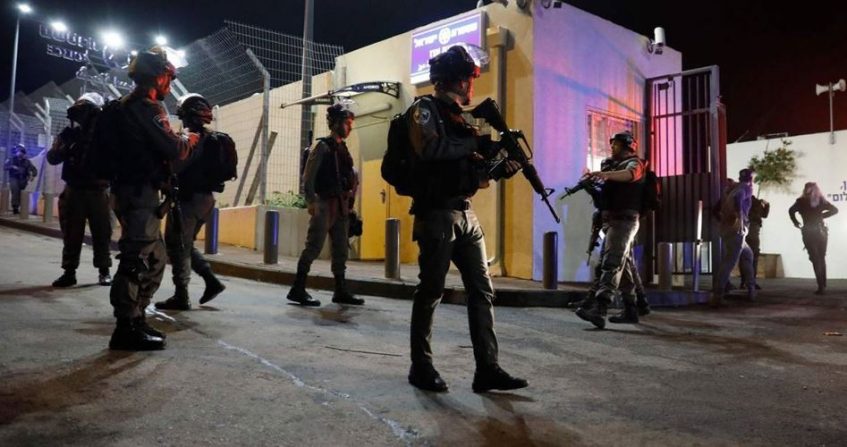
MEMO | March 26, 2021
The Israeli army detained three prominent Hamas leaders the occupied West Bank city of Hebron.
Eyewitnesses told Anadolu Agency that an Israeli soldier detained Hatem Qaffeisha, 58, a top Hamas leader in Hebron and a Palestinian lawmaker.
Former Local Governance Minister Isa Al-Jabari, 55, and top Hamas figure Mazen Al-Natsha, 49, were also detained.
The three figures have been jailed several times by the Israeli army.
Hamas has warned of Israeli plans to stage a mass arrest campaign against its members ahead of the Palestinian elections slated for May.
In February, key Hamas members were detained including Mustafa Al-Shannar, Adnan Asfour, Yaser Mansour, Khalid El-Haj, Abdel-Basit El-Haj, Omar Al-Hanbali and Faze’ Sawafteh.
Hamas says the Israeli authorities aim to disrupt the Palestinian elections and affect the results.
Hamas also accused the Israeli authorities of threatening its members with imprisonment if they run in the upcoming elections.
Palestinians are scheduled to vote in the legislative elections on 22 May, presidential polls are to be held on 31 July and the National Council elections on 31 August.
The last legislative elections were held in 2006, with Hamas coming out on top.
The Probe into the Israeli Vaccine Policy and its Outcome is beyond Damning
By Gilad Atzmon | March 23, 2021
In Israel yesterday, an independent legal body that calls itself the Civilian Probe (CP)* published its finding regarding the catastrophic impact of the Pfizer vaccine on the nation.
In their report, which they submitted to the Attorney General and the Health Minister, the committee listed a chain of critical legal and ethical failures that point at a possible attempt to mislead not just Israelis but also the entire world. Since the beginning of January I have been reporting on an undeniable correlation between vaccinations, cases and deaths (here , here, here and here ). The CP confirms my suspicions but their study also presents alarming medical findings regarding the scale of lethal side effects.
In the document the CP points at a government attempt to conceal its dealing with Pfizer. The document states that “the Pfizer-Israel agreement is suffocated with redacted segments, consequently, it is not possible to analyze it legally and/or fully grasp Its implications as far as public health is concerned… This concealment casts a heavy shadow over anyone who took part in the (Israeli/Pfizer) negotiations…”
The CP then continues arguing that “in order to generate demand (amongst the people) for the vaccine, the government and the Ministry of Health have launched an unprecedented aggressive campaign, aiming to make Israelis rush to ‘get vaccinated.’ During that campaign all the basic rules of medical caution and ethics were disregarded, and with them also key guidelines formed after WWII regarding participation in medical trials (the Nuremberg Code). Instead of transparent and clear explanations, the public was misled by repeated official statements that the (Pfizer vaccine) has been ‘approved by the FDA’ after passing ‘rigorous tests.’”
The CP is accusing the state of Israel of intentionally reckless conduct… “Monitoring systems that enable the detection of side effects are a basic and critical condition for granting a permission for mass use of any new medicine, certainly when a mass operation of treatment that is defined as experimental is given to millions, and especially when this treatment is given to an entire country…”.
But Israel failed to set such a monitoring system.
“On the one hand, the state did not inform the citizens that Pfizer’s vaccine is in experimental stages that have not yet been completed, and that at this stage they are actually taking part in the experiment. On the other hand, the state did not maintain transparent and open control and monitoring systems for the public. As a result, there is a serious concern that this critical and negligent omission stems from: (a) the fear that such disclosure could interfere with the fulfilment of the objectives that may be implied by the Israel-Pfizer agreement or (b) the fear of diminishing demand for the exceptional number of vaccines that were purchased by Israel in advance, and / or (c) the fear of revealing unflattering results of the ‘experiment’ being carried out in Israel.”
The CP is brave to admit that the lack of a monitoring system isn’t just a potential crime against the Israeli people, it may also be a crime against the rest of the world (i.e., humanity):
“In the absence of a transparent monitoring system that reports on side effects, not only have the Israeli government and the Ministry of Health failed citizens by providing them with misleading information, the Israeli government have failed both Pfizer and the rest of the world awaiting the results of the (so called) ‘real world experiment’ (that is taking place in Israel).”
To remove any doubt, the CP alerts the Israeli Attorney General to the possible criminal act implied by Israel’s vaccine policy.
“This is an alleged deception, suspiciously criminal, which should be thoroughly examined before the Attorney General allows the Israeli government to continue the alleged campaign of deception of Israel’s citizens and the (rest of the) world.”
The CP extended their study well beyond the legal realm, as it also attempts to fill the wide hole created by the State’s lack of a monitoring system.
“What do we learn from the facts on the ground?” the CP report asks. “An examination of mortality data published by the government shows that there is a correlation between number of vaccinations and the number of deaths. The excess mortality is noticeable among people up to 70 and also among adults over the age of 70, and remains even after offsetting the deaths attributed to Corona. In the population over the age of 70 – in January 2021 an excess mortality of 19.5% was observed compared to October 2020 – the month when the corona data were highest, and 22.4% compared to January 2020. In the younger population – an excess mortality of 7% was observed in January 2021 compared to the month October 2020 – the month in which the corona death numbers were the highest, and 7% compared to January 2020. It should be noted that this trend continues in the following month as well.”
As mentioned above I have been writing about the devastating correlation between vaccines and deaths since early January. In Britain and the USA, we detect identical correlation between mass vaccination and death. However, far more problematic is the realm of side effects, something which governments, the WHO, the corrupted pharmaceutical industry, and of course social media giants attempt to suppress in the most Orwellian manner. The Israeli CP seems to have produced the first robust report on Pfizer’s vaccine side effects. They published a table of their findings, which they summarize here:
“As one can detect looking at the table – there are close to 200 deaths, and this – only by examining about 800 reports of cases of serious side effects. As mentioned, the CP is still working on analyzing side effects and we have hundreds of additional reports that are subject to analysis. Our study so far indicates that about 25% of deaths are from people under the age of 60. About 15% of them are under 50 years old. 7 of the deceased are at young ages – below age 30. Also, the study identified 27 cases of heart problems in people under the age of 60, of which 24 cases are among young people aged 17-30. Regarding the issues to do with female medical complications (including labor-complication, delayed menstruation or irregular menstruation, etc.) – it should be noted that the committee has about 200 additional reports that have not yet been included in the final list of our findings.”
For many years, I doubted whether there was a force in the middle east that could face, let alone defeat, Israel. I am pretty convinced now that with Netanyahu at the helm and Pfizer taking care of the nation’s wellbeing, Israel doesn’t really need enemies. However, every world citizen who is concerned about the future of humanity should be alarmed by the CP’s findings and particularly by the desperate and relentless attempts to suppress free academic, scientific and ethical discussion about Covid, the so-called ‘vaccines’ or anything else.
*To read the CP report click here
The Nakba of Sheikh Jarrah: How Israel uses ‘the law’ to ethnically cleanse East Jerusalem

By Ramzy Baroud | MEMO | March 23, 2021
A Palestinian man, Atef Yousef Hanaysha, was killed by Israeli occupation forces on 19 March during a weekly protest against illegal Israeli settlement expansion in Beit Dajan, near Nablus, in the northern West Bank. Although tragic, this news reads like a routine item from occupied Palestine, where the shooting and killing of unarmed protesters is part of the daily reality. That reality, though, is part of a wider, more sinister development.
Since right-wing Israeli Prime Minister, Benjamin Netanyahu, announced in September 2019 his intention to formally and illegally annex nearly a third of the occupied Palestinian West Bank, tensions have remained high. The killing of Hanaysha is only the tip of the iceberg. In occupied East Jerusalem and the West Bank, a massive battle is already underway. On one side, Israeli soldiers, army bulldozers, and illegal armed Jewish settlers are carrying out daily missions to evict Palestinian families, displace farmers, burn orchards, demolish homes and confiscate land. On the other side, Palestinian civilians, often unorganised, unprotected and leaderless, are fighting back.
The territorial boundaries of this battle are largely located in occupied East Jerusalem and in so-called “Area C” of the West Bank — which covers nearly 60 per cent of the total area of the occupied territory — which is under complete and direct Israeli military control. No other place represents the perfect microcosm of this uneven war than the neighbourhood of Sheikh Jarrah in occupied East Jerusalem.
On 10 March, fourteen Palestinian and Arab organisations issued a “joint urgent appeal to the United Nations Special Procedures on forced evictions in East Jerusalem” to stop the Israeli evictions in the area. Successive decisions by Israeli courts have paved the way for the Israeli army and police to evict fifteen Palestinian families — 37 households of around 195 people — in the Karm Al-Ja’ouni area in Sheikh Jarrah as well as Batn Al-Hawa neighbourhood in the town of Silwan.
These imminent evictions are not the first, nor will they be the last. Israel occupied Palestinian East Jerusalem in June 1967 and formally, though illegally, annexed it in 1980. Since then, the Israeli government has vehemently rejected international criticism of the occupation, declaring instead that Jerusalem is the “eternal and undivided capital of Israel”.
To ensure that its annexation of the city is irreversible, the Israeli government approved the Master Plan 2000, a massive scheme that was undertaken to rearrange the boundaries of the city in such a way that it would ensure the permanent demographic majority of Israeli Jews at the expense of the city’s indigenous inhabitants. The Master Plan was no more than a blueprint for state-sponsored ethnic cleansing, which saw the destruction of thousands of Palestinian homes and the subsequent eviction of numerous families.
While news headlines occasionally present the habitual evictions of Palestinian families in Sheikh Jarrah, Silwan, and other parts of East Jerusalem as if it is simply a matter of counterclaims between Palestinian residents and Jewish settlers, the story is, in fact, a wider representation of Palestine’s modern history. Indeed, the innocent families which are now facing “the imminent risk of forced eviction” are re-living their ancestral nightmare of the Nakba, the very deliberate ethnic cleansing of historic Palestine in 1948.
Two years after the native inhabitants of historic Palestine were dispossessed of their homes and lands and ethnically cleansed, Israel enacted the so-called Absentees’ Property Law of 1950. The law, which has no legal or moral validity, simply granted to the State the properties of Palestinians who were driven out or fled from the war, to do with it as it pleases. Since those “absentee” Palestinians have never been allowed to exercise their legitimate right of return, as enshrined in international law, the Israeli law was state-sanctioned theft on a grand scale. It aimed ultimately to achieve two objectives: to ensure that Palestinian refugees do not return or attempt to claim their stolen properties in Palestine; and to give Israel a legal fig leaf for permanently confiscating Palestinian land and homes.
The Israeli military occupation of the remainder of historic Palestine in 1967 necessitated, from an Israeli colonial perspective, the creation of fresh laws that would allow the State and the illegal settlement enterprise to claim yet more Palestinian properties. This took place in 1970 in the form of the Legal and Administrative Matters Law. According to the new legal framework, only Israeli Jews were allowed to claim lost land and property in Palestinian areas.
Many of the evictions in East Jerusalem take place within the context of these three interconnected and strange legal arguments: the Absentees’ Property Law, the Legal and Administrative Matters Law, and the Master Plan 2000. Understood together, we can easily decipher the nature of the Israeli colonial scheme in East Jerusalem, where Israeli Jewish individuals, in coordination with settler organisations, work together to fulfil the vision of the State.
In their joint appeal, Palestinian human rights organisations describe how the flow of eviction orders issued by Israeli courts culminate in the construction of illegal Jewish settlements. Confiscated Palestinian properties are usually transferred to a branch within the Israeli Ministry of Justice called the Israeli Custodian General. The latter holds on to these properties until they are claimed by Israeli Jews, in accordance with the 1970 Legal and Administrative Matters Law. Once Israeli courts honour Jewish individuals’ legal claims to the confiscated Palestinian lands, these individuals often transfer their ownership rights or management to settler organisations. In no time, the latter utilise the newly-acquired property to expand existing settlements or to start new ones. All settlements are, of course, illegal under international law.
While the Israeli State claims to play an impartial role in this scheme, it is actually the facilitator of the entire process. The final outcome manifests in the ever-predictable scene, where an Israeli flag is triumphantly hoisted over a Palestinian home and a Palestinian family is assigned a tent from the UN and a few blankets.
While the above picture can thus be dismissed by some as another routine, common occurrence, the situation in the occupied West Bank and East Jerusalem has become extremely volatile. Palestinians feel that they have nothing more to lose and Netanyahu’s government is more emboldened than ever. The killing of Atef Hanaysha, and others like him, is only the beginning of an imminent and widespread confrontation.
Pro-Palestine activist stands trial after leading boycott against Israeli pharmaceutical company

Pro-Palestinian and anti-Israel Boycott, Divestment and Sanctions (BDS) movement march in Marseille, southern France. (Photo via Twitter)
Press TV – March 22, 2021
French activist Olivia Zemor has gone on trial in Lyon after making an online appeal in 2016 for a boycott of Israeli pharmaceutical giant Teva company.
She appeared in court on March 16 over publishing a call by Collectif Palestine 69 on EuroPalestine website, urging readers to boycott Teva, the largest Israeli pharmaceutical corporation by market value.
Zemor, an active advocate of the Boycott, Divestment, and Sanctions (BDS) movement against Israel, was sued for “defamation” by Teva after she accused the company of complicity in apartheid and occupation.
In comments to French newspaper Le Courrier de l’Atlas, she said, “Through its financial contribution to Israel, this pharmaceutical giant contributes to the financing of military operations in Gaza and to the development of colonization in the West Bank and East Jerusalem, in defiance of the rights of the Palestinian people and of international resolutions.”
Therefore, she added, it is necessary to call for the company’s boycott.
Pro-Palestine activist Olivia Zemor is going on trial in France after leading a boycott campaign against Israeli pharmaceutical giant Teva pic.twitter.com/ENtpjlLG2I
However, Frédéric Jeannin, lawyer for the pharmaceutical company, denied the accusation, claiming that “Teva is not involved in a geopolitical, ethnic or religious conflict, and these actions hamper its economic activity.”
On the day of Zemor’s trial, activists gathered outside the courtroom to condemn the French government’s attempts to silence criticism of Israel and those who speak out against the oppression of Palestinians.
They argue that the European Court of Human Rights last year affirmed the right to boycott Israel and that this ruling invalidates the French prosecution of Zemor, who is the president of the EuroPalestine solidarity group.
French Justice Minister Eric Dupond-Moretti is accused of “a blatant violation of the decision” by distributing a circular to prosecutors urging them to take action against activists supporting the BDS campaign.
Teva, one of the world’s largest manufacturers of generic drugs, provides millions of pounds in tax revenue to the Israeli regime and its military.
The company is accused of “joining hands with the French state to aggressively seek to shut down and silence international voices of conscience for exposing corporate complicity and profiteering from the Israeli occupation regime.”
People have been asked to show solidarity with Zemor by writing to French embassies and consulates and holding protests outside them.
Palestinians have for decades called on civil campaigns against Israel, organized under the BDS umbrella.
The BDS movement was initiated in 2005 by over 170 Palestinian civil society organizations, unions, as well as cultural and rights groups, including all major political parties, trade and academic unions that were pushing for “various forms of boycott against Israel until it meets its obligations under international law.”
Thousands of volunteers worldwide have since then joined the nonviolent campaign, which calls for people and groups across the world to cut economic, cultural and academic ties to Tel Aviv, to help promote the Palestinian cause.
Israel claims that the movement is a strategic threat and accuses it of anti-Semitism – a claim that activists firmly deny, calling it an attempt to discredit them.
The BDS, which adheres to peaceful resistance, intends to exert pressure on the Israeli regime to adhere to international law and human rights by lobbying various states, institutions and individuals to understand its oppression of Palestinians and take action as a result.
Israel seizes Palestinian foreign minister’s travel permit after visit to International Criminal Court over war crimes probe
RT | March 21, 2021
Palestinian Foreign Minister, Riyad al-Maliki, who was returning to the West Bank from a meeting at the International Criminal Court (ICC), was held up at a border crossing and got his VIP travel permit revoked by Israel.
Senior Palestinian official, Ahmed al-Deek, said that agents of Israel’s Shin Bet intelligence service have questioned al-Maliki for around 30 minutes at the Allenby crossing from Jordan into the West Bank on Sunday. Members of the FM’s entourage were questioned for around an hour, he added.
Al-Maliki’s special travel permit has been revoked and he left the border crossing without it. The VIP pass allows top Palestinian officials to move freely through the Israeli-operated checkpoints. It was unclear if the FM will be getting the papers back, al-Deek added.
An Israeli official has confirmed the development to the Times of Israel, but declined to name the reason for the cancellation of the minister’s pass. However, al-Deek insisted that the move by the Israeli authorities was retaliation for Maliki’s visit to the ICC in The Hague earlier this week.
“Israel is unable to solve cases through the law, but instead resorts to a policy of intimidation, sanctions and threats,” he told Palestinian WAFA news agency.
Al-Maliki, who was on European tour, met with ICC lead prosecutor, Fatou Bensouda, on Thursday. Earlier this month, Bensouda announced a probe into war crimes carried out in the Palestinian Territories since June 13, 2014.
According to al-Maliki’s office, he spoke to the prosecutor about “the importance of expediting investigations into the crimes committed in the territory of the State of Palestine, in a manner that ensures justice for the victims and their families among the Palestinian people.”
On Friday, Israeli and Palestinian administrations both received notifications from the ICC of the opening of a war crimes probe against them.
While welcomed by the Palestinians, the investigation has angered the Israeli authorities, with Prime Minister Benjamin Netanyahu labeling it “the epitome of anti-Semitism and hypocrisy.”
Rights group slams exclusion of Israel, Saudi-led coalition from UN’s children-in-conflict blacklist

Press TV – March 19, 2021
A group of child rights experts has strongly criticized the UN secretary-general for excluding eight parties, including the Israeli regime and the Saudi-led coalition, from a global blacklist of parties accountable for harming children during conflicts.
In a report, experts from Watchlist on Children, an international child rights group, said at least eight parties to conflicts were found responsible for killing and maiming more than 100 children in a single year but were excluded from the blacklist.
There were “numerous discrepancies and omissions in listing decisions, as well as unwarranted delisting decisions,” the report said, noting that the UN Security Council’s 2001 resolution establishing the list to protect children from the horrors of war “is being seriously undermined” and could result in “putting children at even greater risk.”
“The secretary-general’s 2015 annual report acknowledges that the number of children killed by Israel in 2014 was the third highest in the world and the number of schools damaged or destroyed was the highest anywhere in the world that year, and yet Israel has not been listed in the report’s annexes,” the report said.
It added that at the time the news media reported that Israel and the United States conducted intense lobbying to prevent the regime’s blacklisting.
The child rights experts also cited annual reports that have repeatedly found Israeli forces responsible for high levels of Palestinian child casualties, including over 1,525 killed and maimed in 2020 alone.
“Yet Israeli forces have yet to be included in the annexed list of violators,” they added.
According to the AP, co-author Yanghee Lee, former chair of the committee that monitors implementation of the UN Convention on the Rights of the Child, said: “We are calling on the secretary-general to urgently address these problems and commit to hold all countries and groups responsible for violations against children accountable without fear or favor.”
In response to the report, UN spokesman Stephane Dujarric said Secretary-General Antonio Guterres stands by the report’s conclusions, expressing willingness to engage with relevant partners in how to improve the system.
Benyam Dawit Mezmur, another co-author of the report urged the UN to ensure that the list of perpetrators it issues is “more credible, accurate, complete, and evidence-based, or risk pulling apart this unique tool for the protection of children caught in war.”
The report also said the Saudi-led war coalition against Yemen was delisted in 2020 for killing and maiming children in the Arab country, despite being responsible for a documented 222 child casualties during the reporting period.
“With this delisting, the Saudi-led coalition has been removed from the Secretary-General’s list altogether,” it noted.
Citing the Secretary-general’s reports that said the Saudi-led coalition was delisted due to a “sustained significant decrease” in the number of violations they committed, the rights experts said such argument runs counter to the established delisting criteria.
“This runs counter to the delisting criteria established in 2010 and the Security Council’s stated expectations that listing is based on whether or not grave violations against children took place in violation of international obligations,” they maintained.
According to the UN Office for the Coordination of Humanitarian Affairs (OCHA), the Saudi war on Yemen has killed a quarter of a million people, including women and children, since it was launched in March 2015 with the aim of restoring the Riyadh-friendly government of former President Abd Rabbuh Mansour Hadi.
As Israel plans to evict up to 550 Palestinians from East Jerusalem, Biden regime remains silent
By Robert Inlakesh | RT | March 18, 2021
Igniting tensions in East Jerusalem, Israeli settler organisations are seeking to uproot up to 550 Palestinians from the city, to the complete silence of a Biden administration that claims to seek a two-State solution.
In what could become one of the largest expulsions of Palestinians from East Jerusalem, Israeli settler organisations are working with the country’s legal system to evict 24 families from their homes.
During October, 2020, the Israeli magistrate court of Jerusalem ordered the expulsion of 12 families, out of the 24 living inside the East Jerusalem neighbourhood of Sheikh Jarrah. In addition to their expulsion from their homes, the Palestinian families were also ordered by the court to pay $20,000 in legal fees.
The expulsion order, which is likely to be completed with the destruction of Palestinian property, after it is seized to make way for illegal Israeli settlers, is set to be enforced as early as May. As it stands, four Palestinian households – comprising 27 people – will be forced out onto the street no later than May 2, while three other families are set to be forced out in August.
Israeli settler organisations based in the Karm al-Jaouni area are behind the expulsion orders, claiming that the land on which Palestinians live, in Sheikh Jarrah, was once owned by Jews prior to the 1948 Arab-Israeli war. Despite Palestinian attempts to present their legal case that the settler organisations are lying about this and have no proof, Israeli courts refuse to see the evidence. It is also important to note that, while the Israeli legal system will recognise the claims of Jewish Israelis to land allegedly owned previously by Jews, this right is not granted to Palestinians.
On the issue of the Sheikh Jarrah evictions, Fadi al-Hidmi, Palestinian Authority Minister of Jerusalem Affairs, stated that the international community is obligated to step in. “What is taking place is a systematic, programmed process of replacing the Palestinians expelled from their land and property with foreign settlers,” he said.
Last night, Palestinian Islamic Jihad (PIJ) movement also released a statement, vowing a response to the actions of Israel in Sheikh Jarrah. The PIJ proclaimed that Israel “will pay the price for this aggression.”
In the 1970s, following the June 1967 occupation of East Jerusalem, Israel began implementing a “demographic balance” policy. The aim for the Israeli authorities is to limit the percentage of Palestinians living in the city to 30% or less. While Israel claims that Jerusalem is its undivided capital, the Palestinian Authority only seeks to gain back East Jerusalem, which is considered under international law to be an illegally occupied territory.
Despite the Biden Administration having stated consistently that it seeks a two-State solution and that this is the only solution in the Palestine-Israel conflict, it continues to ignore the ongoing ethnic cleansing of East Jerusalem. Not only does Biden not confront Israel on the issue of its illegal settlements and home demolitions in Jerusalem, but it has worked to attack the International Criminal Court (ICC) which is poised to investigate the settlement issue.
Biden’s Secretary of State Antony Blinken, who is a supporter of the notion of a two-State solution weighed in on the announcement from the ICC that it would investigate alleged Israeli War Crimes, stating “The United States firmly opposes an @IntlCrimCourt investigation into the Palestinian Situation. We will continue to uphold our strong commitment to Israel and its security, including by opposing actions that seek to target Israel unfairly.”
If there is to be a two-State solution, the capital of the future Palestinian State will have to belong in currently occupied East Jerusalem. However, this is being made more and more impossible by the day, with the systematic expulsion of Palestinian residents from the city, along with the expansion of key settlements such as Atarot, Ramat Shlomo and Givat Hamatos, which divide the city from the West Bank.
Along with Sheikh Jarrah, Israeli Settler organisations are also heavily targeting the area of Silwan, from which at least 36 families have been expelled since the beginning of 2020, according to Israeli NGO Peace Now. In East Jerusalem as many as 200,000 Israeli settlers live, with about 2,500 hardline settlers residing in properties surrounding Palestinians in areas like Silwan.
Earlier this week, 11 Palestinians were injured in clashes with Israeli police forces, who reportedly raided the East Jerusalem neighbourhood of Kafr Aqab as a bulldozer made an opening in the wall surrounding the area. Local youths then acted to tear down the fences built around the construction site, for what has been described as a Judaization project in the area.
An Israeli NGO called Grassroots Jerusalem states that the presence of illegal Israeli settlers in East Jerusalem causes great agitation to Palestinian residents. The NGO claims that settlers have “been responsible for forced evictions and terrorism.”
Last year almost 1,000 Palestinians were made homeless due to Israeli house demolitions in the West Bank and East Jerusalem, with over 10,000 settler units having been approved.
If the Biden Administration continues to remain silent and shield Israel from prosecution for its violations of International Law in East Jerusalem, the two-State solution that the US claims to seek will only become more difficult to achieve. In order for there to be a Palestinian capital in East Jerusalem, Israel’s illegal settlements have to halt further construction, evacuate all settlers and the annexation of the territory – since 1980 – has to be reversed. None of the steps necessary to facilitate a two-State solution includes shielding war crimes, and what we are seeing is exactly that.
Robert Inlakesh is a political analyst, journalist, and documentary filmmaker currently based in London, UK. He has reported from and lived in the occupied Palestinian territories and currently works with Quds News and Press TV. Director of ‘Steal of the Century: Trump’s Palestine-Israel Catastrophe’.
Certain groups attempt to create civil war in Lebanon, Hezbollah chief warns
Press TV – March 18, 2021
The secretary-general of Lebanon’s Hezbollah resistance movement has warned against attempts by certain groups to foment a civil war in the cash-strapped country on economic, racial, and religious grounds, emphasizing that the movement will not allow anyone to realize such a fiendish plot.
Those, who become frustrated in the face of the country’s resistance, could resort to the option of trying to ignite such an internal conflict, Sayyed Hassan Nasrallah said in a televised speech broadcast from the Lebanese capital city of Beirut on Thursday evening.
“I have information that there are outside forces and some internal ones that are pushing towards civil war … They are looking for the fuel to add to the fire,” he said.
“The chaos in Lebanon is aimed at driving Lebanon into a civil war and this is a red line,” he, however, added.
Lebanon is experiencing its worst economic crisis in decades, compounded by the COVID-19 pandemic. Prices are skyrocketing and more than half of the population is now living below the poverty line.
Nasrallah’s remarks came as the country’s major cities are hosting fresh protests at the situation afflicting the economy that is falling apart at the seams. He, therefore, entitled the high point of his address to the domestic woes.
“Lebanon is at the heart of a true and great national economic, livelihood, financial, and also political crisis,” he said, noting, “It can also be described as a crisis of the establishment.”
Nasrallah categorically dismissed that his movement harbored any intention to exacerbate the already explosive situation.
“Some say that Hezbollah is the party, which has weapons [and may start a civil war]. This rhetoric is wrong since the civil war can be waged by light arms and such arms are found everywhere in Lebanon and are in the hands of many people,” the Hezbollah chief said.
Hezbollah has no intention to resort to its weapons in a bid to form a government or to deal with the economic and financial crisis.
Since the Lebanese government formally resigned after a massive explosion in Beirut port last August, domestic political divisions and pressure by some Western states have hindered the formation of a formal cabinet.
‘US pressure main factor behind crisis’
Nasrallah pointed to the pressure that the United States was applying to Lebanon as a main principle driving the country’s crisis.
The United States wants for Lebanon to “be placed in the US-Israel axis” in the same way that such regional countries as the United Arab Emirates and Bahrain did by normalizing their relations with the Israeli regime through Washington’s facilitation, he stated.
Nasrallah questions dependence on IMF
Without a formal cabinet, the country cannot resume negotiations with the International Monetary Fund (IMF) for potential bailout packages.
Even if the country was to be thrown such a lifeline, it would be required by the IMF and the West to enact certain “reforms” in its political structure. The reforms entail introduction of stringent austerity measures, the biggest part of whose burden falls on the people.
Lebanese Prime Minister-designate Saad al-Hariri alleged earlier that the only way to stop the country’s economy from total collapse was to re-engage with the IMF.
“The main priority of any government is to prevent the collapse that we are facing today… that we proceed to start halting the collapse with the IMF and regain the trust of the international community,” Hariri said at a press conference at the presidential palace in Baabda.
Nasrallah, however, asked whether the Lebanese nation could bear the burden of the IMF’s conditions, including subtraction of subsidies from staples.
He considered the country’s economic policies, including the policy of borrowing money from others, to be one of the reasons that Lebanon had ended up this way.
The American pressure, he added, was aimed at forcing Lebanon into “resorting to certain economic options.”
It was this very fear of Washington that was scaring some inside the country from strengthening its ties with China.
Hezbollah agrees to a technocratic-political government
The Hezbollah leader, meanwhile, signaled his movement’s approval of the formation of a government composed of technocrats and politically influential elements at the same time.
He said if Hariri and President Michel Aoun reached an agreement on formation of such a ruling structure, Hezbollah would agree to it too.
US apparatuses freeing Daesh ringleaders in Iraq
Nasrallah also said there is evidence pointing to US intelligence and security apparatuses establishing contact with the Takfiri terrorist group Daesh’s ringleaders in Iraq’s prisons before enabling their release.
“With every day that goes by, the truth that lies behind the armed Takfiri terrorist groups and the nature of their handler and supporter comes further to light,” he said.
Nasrallah, however, announced, “We stand up to the terrorist groups that are shaped, run, supported, and armed by the American intelligence apparatuses.”
Israel to displace 1,550 Palestinians to build park in Jerusalem
MEMO | March 18, 2021
More than 100 Palestinian homes face demolition and about 1,550 residents, including more than 800 children, will be made homeless at the hands of Israel’s Jerusalem Municipality, Arab48 reported yesterday.
This comes as the Israeli municipality cancelled all agreements with the Palestinian residents of the Silwan neighbourhood.
According to Arab48, the Israeli municipality rejected plans it had requested as an alternative to the demolition of the Palestinian homes, instead it is set to demolish the Palestinian homes and turn the area into The King’s Garden, claiming that it was a garden for Israeli kings thousands of years ago.
The municipality had agreed to provide Palestinians with land in other areas to build new homes, but it suddenly backtracked on this decision.
The legal battle has cost the Palestinian community more than $500,000.
Euro-Mediterranean Human Rights Monitor said in a statement that the “massive destruction and displacement operation against the population may amount to ethnic cleansing and a war crime.”
The Intellectually Superior Perpetual Victim Again on Display

By Philip Giraldi | Unz Review | March 16, 2021
Those who have followed developments in the Middle East would likely agree that Israel covers up its war crimes and other human rights violations by regularly invoking its own victimhood. Whether the subject is U.S. aid to the Jewish state or media coverage of the illegal expansion of Israel into the West Bank, one will always find references to the so-called holocaust or claims of anti-Semitism to discredit any criticism. And the results of this assiduous effort to assign guilt are clearly seen as the mainstream media in both the United States and Europe exhibits considerable reluctance to report honestly on what is being done to the Palestinians while politicians in the west sometimes appear to count themselves more as “friends of Israel” than as representatives advancing the interests of their own constituents.
As defenders of all things Israeli go, there is no one more assiduous than Bret Stephens of the New York Times. He is, of course, Jewish, and was the editor of the right-wing Jerusalem Post between 2002 and 2004. The Times employs him as one of its resident conservatives, though he would be better described as a neoconservative. Stephens’ recent piece entitled “California Ethnic Studies Follies” takes aim at California’s controversial diversity program that is being imposed on the state’s public school system.
Stephens’ article is sub-headed “A proposed curriculum magnifies differences, encourages tribal loyalties and advances ideological group think.” While it is clear that “Ethnic Studies,” a precursor to the current Critical Race Theory and similar to programs in a number of other states, does all that and more, Stephens inevitably turns the whole argument around to the alleged victimization of his own highly privileged caste, i.e. American Jews.
Stephens gets into it immediately, beginning his piece with:
“The first time California’s Department of Education published a draft of an ethnic studies ‘model curriculum’ for high school students, in 2019, it managed the neat trick of omitting anti-Semitism while committing it. More than a million Jews live in California. They are also among the state’s leading victims of hate crimes.
“Yet in a lengthy draft otherwise rich with references to various forms of bigotry, there was no mention of bigotry toward Jews. There was, however, an endorsement of the Boycott, Divest and Sanction [BDS] movement, which essentially calls for the elimination of the Jewish state. There was also an approving mention of a Palestinian singer rapping that Israelis ‘use the press so they can manufacture’ — the old refrain that lying Jews control the media.
“The draft outraged many Jews. And they were joined by Armenian, Assyrian, Hellenic, Hindu and Korean civic groups in a statement urging the California Department of Education to ‘completely redraft the curriculum.’ In its original form, they said, the document was ‘replete with mischaracterizations and omissions of major California ethnoreligious groups.’
“Last September, Gov. Gavin Newsom vetoed a bill that would mandate ethnic studies as a graduation requirement in California’s high schools, pending further review of the model curriculum. While some maintained that a critical ethnic studies curriculum was a mistake, and not just for Jews, others took the view that, when it came to those revisions, it was better to be at the table than on it. Progressive Jews helped redraft a curriculum that included two sample lessons on the Jewish-American experience, along with testimonials about Jewishness from the likes of Ruth Bader Ginsburg and Dianne Feinstein. A victory? One can still quarrel with the curriculum’s tendentiously racialized view of the American-Jewish experience. But at least the anti-Semitic and anti-Zionist dog whistles have been taken out and the history of anti-Semitism has been put in.”
To be sure, Stephens makes some good points about how the California program, which is again going to be voted on by the Board of Education later this month, is indoctrination and not education. But Stephens is also blind to the reality of what constitutes political power in the United States. He observes that the Irish, Poles and Italians apparently do not need to be supported by inclusion in an Ethnic Studies program while he simultaneously accepts that if there is such a thing Jews have to be carefully protected by it. And based on some of his other articles, his view of his own ethnicity seems to go well beyond that and is flattering to him and those who agree with his apparent view that that Ashkenazi Jews are intellectually and genetically superior to other groups.
One can only imagine what the reaction would have been if Stephens had written instead that whites are superior to blacks. And the points that Stephens raises in support of revising the California document to highlight both Jewish suffering and achievements are, of course, extremely self-serving. They are also deliberately deceptive. Yes, Jews have been “victims” of so-called “hate crimes” but the crimes themselves are very rarely violent. It has been demonstrated that many recent so-called anti-Semitic attacks on Jews involve easily recognizable Hasidic Jews and are actually based on community tensions as established neighborhoods are experiencing dramatic changes with the newcomers using pressure tactics to force out existing residents. And after the Hasidim take over a town or neighborhood, they defund local schools to support their own private academies and frequently engage in large scale welfare and other social services fraud to permit them to spend all their days studying the Talmud, which, inter alia teaches that gentiles are no better than beasts fit only to serve Jews.
Much more often “hate crimes” against Jews consist of graffiti or reaction to criticism of Israel for its brutal suppression of the Palestinians. Indeed, there are now organizations at universities like Canary Mission funded by Jewish oligarchs which encourage Jewish students to claim damages from critics while also “exposing them” on campus on behalf of Israel. A Jewish student walking on a college campus who passes by protesters objecting to Israel’s behavior can claim to feel threatened and the incident is recorded as anti-Semitism, for example, and slurs written on the sides of buildings or grave stones, not necessarily the work of Jew-haters, are similarly categorized. In one case in Israel in 2017, the two street swastika artists were Jews.
One is surprised that Stephens does not raise the issue of the “libel” of “Jews and money,” as if the Republicans actually loved a repulsive toad like Sheldon Adelson, who was dedicated to promoting Israeli interests, and bought the GOP foreign policy for $100 million. And Stephens is way over the top when it comes to characterizing BDS as a hate group that seeks to the “eliminate the Jewish state.” The group is explicitly non-violent and does in fact have significant liberal Jewish membership. It seeks to use economic pressure to compel Israel to behave better towards the Palestinians, similar to what produced change in apartheid South Africa.
But the most interesting aspect of the Stephens piece is the demand that Jews be universally recognized for their unique suffering. He considers it a libel when one maintains that Jews control the media… has he looked around the newsrooms at his own paper, the Washington Post, CNN, CBS and MSNBC lately? And as for bigotry and discrimination, how about consideration of the fact that Jews run Hollywood and the entertainment industry, are the wealthiest and best educated demographic in the country, are grossly disproportionate in high status and high pay jobs, and hold many of the top positions in the Biden Administration. Authorities like Professor Alan Dershowitz are quite outspoken in their praise of Jewish power in the United States. And Jewish organizations already receive more than 90% of the discretionary funding from the Department of Homeland Security to “protect themselves.” American Jews hardly seem to constitute a minority that needs more consideration and breaks because it is under siege, so when will Stephens stop whining?
And as for the claim of widespread anti-Semitism, one recalls the comment by former Israeli Education Minister Shulamit Aloni, speaking about calling critics anti-Semites. She said “Well, it’s a trick, we always use it. When from Europe somebody is criticizing Israel, then we bring up the Holocaust. When in this country people are criticizing Israel, then they are anti-Semitic. And the organization is strong, and has a lot of money, and the ties between Israel and the American Jewish establishment are very strong and they are strong in this country, as you know. And they have power, which is okay. They are talented people and they have power and money, and the media and other things, and their attitude is ‘Israel, my country right or wrong,’ identification. And they are not ready to hear criticism. And it’s very easy to blame people who criticize certain acts of the Israeli government as anti-Semitic, and to bring up the Holocaust, and the suffering of the Jewish people, and that is to justify everything we do to the Palestinians.”
Shulamit Aloni has described Bret Stephens and the political culture that he comes out of. Criticizing Israel or the sometimes predatory behavior of American Jews is one of the few remaining total taboos in America. One marvels at the recent account of a basketball player who apparently blurted out the word “kike” while engaged in a video game. Even though he apparently did not know that the word referred in derogatory fashion to Jews, he was suspended by his team and fined $50,000 by Adam Silver the NBA commissioner. Does anyone seriously believe that if he had said “Wop,” “Mick,” “Spick” or “Polack” he would have been punished at all? He was also required to publicly express contrition and forced to go through a counseling session with a representative from the Anti-Defamation League (ADL), which is, if I might be so bold as to suggest, the U.S. based enforcement arm of the powerful Israel Lobby.
Philip M. Giraldi, Ph.D., is Executive Director of the Council for the National Interest, a 501(c)3 tax deductible educational foundation (Federal ID Number #52-1739023) that seeks a more interests-based U.S. foreign policy in the Middle East. Website is https://councilforthenationalinterest.org address is P.O. Box 2157, Purcellville VA 20134 and its email is inform@cnionline.org
Featured Video

The Search for Truth: Charlie Kirk’s Assassination One Year Later
or go to
Aletho News Archives – Video-Images
From the Archives
US murdering 1 million Iraqis is democracy, Iran giving yogurt to Iraq is “domination”
By Ali Salaam | American Herald Tribune | July 31, 2017
The New York Times, owned by the Zionist Jewish supremacist Ochs-Sulzberger family, has no problem with Iraqi suffering as long as Iran is not the one behind it.
The Iraq War was a genocide of the Iraqi people by Zionist supremacists in the Bush administration. Over 1 million innocent people were killed based on a lie. American soldiers died in an Israeli war and now an average of 22 soldiers commit suicide every day because their consciences cannot cope with the fact they committed crimes in an illegal war that served no purpose other than to benefit Israel, not America.
Benjamin Netanyahu, Prime Minister of the Zionist regime, once said “We are benefiting from one thing, and that is the attack on the Twin Towers and Pentagon, and the American struggle in Iraq.”
Paul Wolfowitz had his sights on Iraq since his time in the first Bush administration. Former Israeli official and Bush administration official Richard Perle had his eyes on Iraq since at least his authorship of the Clean Break white paper. The Zionist regime had their eyes on Iraq since the 1980s when strategist Oded Yinon wrote his white paper in support of dividing the Arab-Muslim world along ethnic and sectarian lines. The global Zionist lobby has had their eyes on Iraq since Theodor Herzl stated that Eretz Israel’s true borders go from the Nile River in Egypt to the Euphrates River in Iraq. … continue
Blog Roll
 Aletho News
- The Search for Truth: Charlie Kirk’s Assassination One Year Later
- ‘Harsh reality’: Iran says France seeks monopoly on power and intimidation, not peace for all
- When Will This White House Madness End?
- Huckabee aide goes to ‘unusual lengths’ to portray ‘Israel’ positively
- Trump Announces Diesel Supply Deal With Putin Following Phone Call
- MEP blasts ‘Euro-Gestapo’ for lecturing Russia on democracy
- Syria May Send Troops to Saudi Arabia Amid War with Ansar Allah
- UK whines about losing billions to ‘Putin tax’
- Baghaei to Rubio: Distorted narratives cannot erase US record of broken commitments
- Houthis Don’t Have to Conquer Saudi Arabia to Make It Pay
- If Americans Knew
- Gaza ceasefire exists in name only, say more than 100 organizations
- Nearly 2 Million in Gaza Need Urgent Shelter Assistance as Winter Looms: IOM Chief Warns
- Suppressing Palestinian resistance: US charity under fire for AI monitoring of Gaza classrooms
- Thousands Are Held in Israeli Torture Camps. This Is What Happens Inside
- Israel puts Gaza’s sick, injured, newborn in peril – Daily Update
- Report claimed Mark Levin used by Israeli government to influence Trump
- Over 2,000 Gazans have died awaiting medical evacuation amid Israel’s continued siege
- How a U.S. Diplomat Suppressed and Altered Reports Critical of Israel
- 5 Palestinians Die from Israeli Strikes in Gaza as Relentless Attacks Continue
- Report: Ceasefire Slows Killing but Leaves Devastation Intact
- No Tricks Zone
- New Study: 50 Years Of The Most Aggressive ‘Net Zero’ Policies Can Only Affect The Global Climate By 0.03°C
- US September “Heat” Was No Record…Many Records Set Decades Ago
- Latest European Green Energy Debacle; Portugal’s Largest Flagship Solar Park Insolvent!
- Green Energy Debacle: German Expert Professor Fritz Vahrenholt Warns Of Severe Economic And Social Consequences
- Two More Paleo Reconstructions Affirm Meters-Higher Sea Levels Across Ireland, Brazil 7000-6000 Years Ago
- New Study: Earth And Venus Surface Warmth Largely Explained By Convection And Lapse Rate, Not CO2 Or Radiation
- 2025 Nature Paper Claiming Worsening Global Drought Gets RETRACTED …Heavily Flawed
- New Study: ‘Global Drought Shows No Detectable Recent Acceleration Under Climate Warming’
- Economic Masterminds: German Socialists Suggest Taxing Productivity Gains Stemming From Using AI
- The South China Sea Has Not Been Cooperating With The Climate Change Narrative

