Israel army chief censor in talks to join notorious spyware firm NSO
MEMO | January 6, 2020
The Israeli military chief censor is in talks to join notorious Israeli cyber surveillance company NSO Group, which has been embroiled in a number of scandals over the use of its software to target human rights activists and political dissidents.
According to Globes, Brigadier General Ariella Ben Avraham is “negotiating” to join NSO Group as soon as possible; currently scheduled to be discharged from the military in June, Ben Avraham has “asked to bring her release forward”. The role “will apparently focus on regulation and media.”
Founded in 2010, NSO “has developed a range of cyber intelligence products”, reported Globes, with the company’s lead product, Pegasus, “described as a surveillance tool, and the company says that it is devised to help governments and espionage organizations prevent terrorist acts”.
However, as Globes noted, NSO Group has been embroiled in a number of scandals where their “software has allegedly been used to spy on journalists and opponents of unsavoury regimes”.
Just last month, the Guardian revealed that the mobile phones of at least two dozen Pakistani government officials were allegedly targeted in 2019 with technology owned by NSO Group.
Last October, Facebook – as the owner of WhatsApp – filed a lawsuit against NGO, accusing the company of “unauthorised access and abuse” of its services.
The lawsuit claimed intended targets included “attorneys, journalists, human rights activists, political dissidents, diplomats, and other senior foreign government officials.”
Globes reported that a Tel Aviv court is currently “hearing a lawsuit against NSO seeking to find the company liable for spying on opponents of the regime in Saudi Arabia.”
“The court dismissed NSO’s petition to dismiss the claim,” the report added, and also dismissed NSO’s request “to bar publication of the legal proceedings against it.”
The court will thus hear “the question of the company’s responsibility for the use of its products.”
READ ALSO:
Israel tech ‘facilitating press freedom abuses around the world’
General Soleimani ‘martyr of Quds’: Hamas chief Haniyeh
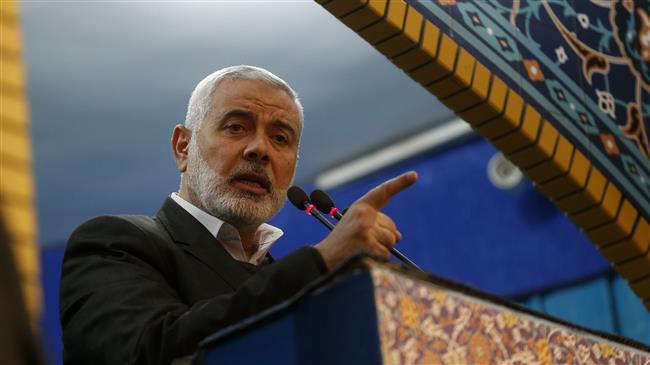
Hamas leader Ismail Haniyeh addresses a massive crowd of mourners during a funeral procession for General Qassem Soleimani in Tehran January 6, 2020. (Photo by Leader.ir)
Press TV – January 6, 2020
General Qassem Soleimani is a “martyr of Quds” for he devoted his life to supporting the Palestinian people’s struggle against Israel and his assassination by the United States is in many ways similar to crimes committed by the Israeli regime, says Hamas chief Ismail Haniyeh.
General Soleimani, commander of the Quds Force of Iran’s Islamic Revolution Guards Corps (IRGC), was assassinated in a US strike in Baghdad on Friday, alongside Abu Mahdi al-Muhandis, the deputy commander of Iraq’s pro-government Hashd al-Sha’abi forces.
A huge sea of mourners, streaming from all the adjoining streets, descended on the iconic Engelab Square in central Tehran early Monday morning and rallied to Azadi Tower in the capital’s west as they chanted “Death to America” and “Death to Israel.”
Leader of the Islamic Revolution Ayatollah Seyyed Ali Khamenei led the prayers over the general’s coffin and the remains of his companions at Tehran University, his voice cracking several times with emotion which caused the massive crowd to weep.
Speaking at the funeral procession in Tehran on Monday, Haniyeh condemned the US strike, which was personally authorized by President Donald Trump.
“We have come to Iran to condole with Leader of the Islamic Revolution Ayatollah Khamenei, the Iranian government and nation,” Haniyeh said.
“He [Gen. Soleimani] was the commander of the IRGC Quds Force and he is a martyr of Quds,” the Hamas official said.
Haniyeh also sent condolences to General Soleimani’s family and described him as one of the “flag-bearers of resistance against Zionist and American plots.”
Haniyeh said he was in Iran “to express our true and sincere feelings about a dear brother and a martyred commander – a commander who made many sacrifices for Palestine and the resistance until he achieved the position he has today.”
‘A crime similar to Zionist atrocities in Palestine’
Haniyeh said this “brutal crime” by the Americans is representative of the “criminal mentality” that is at work in the occupied Palestinian lands.
“The criminal mentality that led to Commander Soleimani’s assassination and martyrdom is the same mentality that drives the minds of the Zionist regime’s thugs, the same mentality and policy that assassinates and kills Palestinians every day,” he said.
He said Hamas owes its current prowess to General Soleimani’s wisdom. The Palestinian resistance, he said, won’t back away from combating Israel and the fight will continue “until we purge all enemies from the noble Quds.”
New Quds Force chief pledges vengeance
Brigadier General Esmail Qaani, who was named the new Quds commander by the Leader on Friday, said in a statement that Iran will no doubt avenge the assassination.
“Steps will be definitely taken” to avenge General Soleimani’s blood, which Qaani said has set in motion a series of steps that will lead to America’s expulsion from the region.
US ‘elimination’ from region only acceptable retribution
Brigadier General Amir Ali Hajizadeh, the commander of the IRGC’s Aerospace Division, echoed the remarks and said the only possible revenge for General Soleimani’s blood would be the total “elimination” of America from the region.
Launching a few missiles, destroying a base or even Trump’s death will not sufficiently avenge the blood of such a martyr, General Hajizadeh asserted, adding “the oppressed nations of the region will have to be rid of America’s evil.”
A Terrorist Attack Against Eurasian Integration
By Federico Pieraccini | Strategic Culture Foundation | January 6, 2020
The murder of Iranian general Qasem Soleimani in Baghdad, in the early hours of January 3 by US forces, only highlights the extent to which US strategy in the Middle East has failed. It is likely to provoke reactions that do not benefit US interests in the region.
To understand the significance of this event, it is necessary to quickly reconstruct the developments in Iraq. The US has occupied Iraq for 17 years, following its invasion of the country in 2003. During this time, Baghdad and Tehran have re-established ties by sustaining an important dialogue on post-war reconstruction as well as by acknowledging the importance of the Shia population in Iraq.
Within two decades, Iraq and Iran have gone from declaring war with each other to cooperating on the so-called Shia Crescent, favoring cooperation and the commercial and military development of the quartet composed of Iran, Iraq, Syria and Lebanon. Such ties, following recent victories over international terrorism, have been further consolidated, leading to current and planned overland connections between this quartet.
Local movements and organizations have been calling for US troops to leave Iraqi territory with increasing vigor and force in recent months. Washington has accused Tehran of inciting associated protests.
At the same time, groups of dubious origin, that have sought to equate the Iranian presence with the American one, have been calling for the withdrawal of the Popular Mobilization Units (PMUs) that are linked to Iran from Iraq. The protests from such groups appear to be sponsored and funded by Saudi Arabia.
With mutual accusations flying around, the US hit a pro-Iranian faction known as Kataib Hezbollah on December 29. This episode sparked a series of reactions in Iraq that ended up enveloping the US embassy in Baghdad, which was besieged for days by demonstrators angry about ongoing airstrikes by US forces.
The US secretary of state, Mike Pompeo, blamed this volatile situation on Iran, warning that Tehran would be held responsible for any escalation of the situation involving the embassy.
In the early hours of January 3, 2020, another tangle was added to the Gordian Knot that is the Middle East. Qasem Soleimani was assassinated when his convoy was attacked by a drone near Baghdad International Airport. The most effective opponents of ISIS and Wahabi jihadism in general was thus eliminated by the US in a terrorist act carried out in a foreign country in a civilian area (near Baghdad International Airport). The champagne would have no doubt been flowing immediately upon receiving this news in the US Congress, the Israeli Knesset, Riyadh royal palace and in Idlib among al Nusra and al Qaeda militants.
It remains to be seen what the reasons were behind Trump’s decision to okay the assassination of such an influential and important leader. Certainly the need to demonstrate to his base (and his Israeli and Saudi financiers) plays into his anti-Iranian crusade. But there are other reasons that better explain Trump’s actions that are more related to the influence of the US in the region; the geopolitical chess game in the Middle East transcends any single leader or any drone attack.
In Syria, for example, the situation is extremely favorable to the government in Damascus, with it only being a matter of time before the country is again under the control of the central government. General Soleimani and Iran have played a central role in ridding the country of the scourge of terrorism, a scourge directed and financed by the US and her regional allies.
In Iraq, the political situation is less favorable to the US now than it was back in 2006. Whatever progress in relations between Baghdad and Tehran has also been due to General Soleimani, who, together with the PMUs and the Iraqi army, freed the country from ISIS (which was created and nurtured by Western and Saudi intelligence, as revealed by Wikileaks).
It would seem that the US sanctions against Iran have not really had the intended effect, instead only serving to consolidate the country’s stance against imperialism. The US, as a result, is experiencing a crisis in the region, effectively being driven out of the Middle East, rather than leaving intentionally.
In this extraordinary and unprecedented situation, the Russians and Chinese are offering themselves variously as military, political and economic guarantors of the emerging Eurasian mega-project (the recent naval exercises between Beijing, Moscow and Tehran serving as a tangible example of this commitment). Naturally, it is in their interests to avoid any extended regional conflict that may only serve to throw a monkey wrench into their vast Eurasian mega-project.
Putin and Xi Jinping face tough days ahead, trying to council Iran in avoiding an excessive response that would give Washington the perfect excuse for a war against Iran.
The prospects of a region without terrorism, with a reinvigorated Shia Crescent, led by Iran at the regional level and accompanied by China and Russia at the economic (Belt and Road Initiative) and military level, offer little hope to Riyadh, Tel Aviv and Washington of being able to influence events in the region and this is likely going to be the top argument that Putin and Xi Jinping will use to try to deter any Iranian overt response.
Deciding to kill the leader of the Quds Force in Iraq proves only one thing: that the options available to Trump and his regional allies are rapidly shrinking, and that the regional trends over the next decade appear irreversible. Their only hope is for Tehran and her allies to lash out at the latest provocation, thereby justifying the regional war that would only serve to benefit Washington by slowing down regional unification under Iranian leadership.
We must remember that whenever the US finds itself in a situation where it cannot control a country or a region, its tendency is to create chaos and ultimately destroy it.
By killing General Soleimani, the US hopes to wreak havoc in the region so as to slow down or altogether scupper any prospect of integration. Fortunately, China, Russia and Iran are well aware that any conflict would not be in any of their own interests.
No drone-launched missiles will be enough to save the US from decades of foreign-policy errors and their associated horrors; nor will they be enough to extinguish the memory of a hero’s tireless struggle against imperialism and terrorism.
The Middle East Strategic “Balance” Shredded
By Alastair Crooke | Strategic Culture Foundation | January 6, 2020
President Trump was understood to not want a Mid-East war that might blight his rosy re-election prospects (so long as the US stock market stays inflated, and the economy doesn’t tank). Pat Buchanan, the three-times US Presidential candidate, warned Trump that if there is a potential landmine on Trump’s road to reelection, it may be found in the Middle and Near East: “Not infrequently, foreign policy has proven decisive in presidential years”. Plus Iran was not seeking any major confrontation; Hizbullah wasn’t; Iraq wasn’t; and the Israeli Security Establishment wasn’t.
In fact, the strategic balance – though sorely tested – had been hanging together. Just to be clear: Iran and Israel both had been keeping – just – within the parameters of unspoken ‘red lines’ – despite the inflated rhetoric. And both were practicing ‘strategic patience’. So the strategic balance seemed more or less sustainable: until its upending with the assassination of Qasem Soleimani and the head of the PMU, Al-Muhandis, ordered by Trump.
Israel has not – despite its lurid language – been landing strategic blows on Iran in Syria. It has not been killing Iranians there (apart from seven killed at T4 airport in eastern Syria last year). It did not target the head of the Iranian air force, some ten days ago, as some reports have suggested (he was not even in Iraq at the time). Most of the Israeli air attacks have been on depots in the early hours, when no personnel were present. It has been a campaign more of a regular, small slicing away at Iranian logistics. It was not strategic damage.
And Iran, after sending clear ‘messages’ to Gulf States of its willingness to inflict pain on parties to its economic siege, plainly had been calibrating this push-back carefully; Iran still had its eye to global diplomacy (to wit: the joint Iranian naval exercises with Russia and China in the Persian Gulf) – whilst countering politically, America’s ‘new’ tactic of inciting ‘colour’ protests across Lebanon and Iraq (and trying to bust Syria financially, by stealing its energy revenues).
Here is the point: The US was no longer content with mere sanctions on Iran. It has been covertly escalating across the board: orchestrating protests in Iraq, in Lebanon, and in Iran itself; mounting a major cyber offensive on Iran; and a ‘messaging’ operation aimed at turning genuine popular frustration with regional mis-governance and corruption, into a weapon aimed at weakening revolutionary Iran.
The US was having some success with turning protest messaging against Iran – until, that is – its killing and wounding of so many Iraqi security force members last week (Ketaib Hizbullah is a part of Iraq’s armed forces).
Escalation of maximum-pressure was one thing (Iran was confident of weathering that); but assassinating such a senior official on his state duties, was quite something else. We have not observed a state assassinating a most senior official of another state before.
And the manner of its doing, was unprecedented too. Soleimani was officially visiting Iraq. He arrived openly as a VIP guest from Syria, and was met on the tarmac by an equally senior Iraqi official, Al-Muhandis, who was assassinated also, (together with seven others). It was all open. General Soleimani regularly used his mobile phone as he argued that as a senior state official, if he were to be assassinated by another state, it would only be as an act of war.
This act, performed at the international airport of Baghdad, constitutes not just the sundering of red lines, but a humiliation inflicted on Iraq – its government and people. It will upend Iraq’s strategic positioning. The erstwhile Iraqi attempt at balancing between Washington and Iran will be swept away by Trump’s hubristic trampling on the country’s sovereignty. It may well mark the beginning of the end of the US presence in Iraq (and therefore Syria, too), and ultimately, of America’s footprint in the Middle East.
Trump may earn easy plaudits now for his “We’re America, Bitch!”, as one senior White House official defined the Trump foreign policy doctrine; but the doubts – and unforeseen consequences soon may come home to roost.
Why did he do it? If no one really wanted ‘war’, why did Trump escalate and smash up all the crockery? He has had an easy run (so far) towards re-election, so why play the always unpredictable ‘wild card’ of a yet another Mid-East conflict?
Was it that he wanted to show ‘no Benghazi’; no US embassy siege ‘on my watch’ – unlike Obama’s handling of that situation? Was he persuaded that these assassinations would play well to his constituency (Israeli and Evangelical)? Or was he offered this option baldly by the Netanyahu faction in Washington? Maybe.
Some in Israel are worried about a three or four front war reaching Israel. Senior Israeli officials recently have been speculating about the likelihood of regional conflict occurring within the coming months. Israel’s PM however, is fighting for his political life, and has requested immunity from prosecution on three indictments – pleading that this was his legal right, and that it was needed for him to “continue to lead Israel” for the sake of its future. Effectively, Netanyahu has nothing to lose from escalating tensions with Iran — but much to gain.
Opposition Israeli political and military leaders have warned that the PM needs ‘war’ with Iran — effectively to underscore the country’s ‘need’ for his continued leadership. And for technical reasons in the Israeli parliament, his plea is unlikely to be settled before the March general elections. Netanyahu thus may still have some time to wind up the case for his continued tenure of the premiership.
One prime factor in the Israeli caution towards Iran rests not so much on the waywardness of Netanyahu, but on the inconstancy of President Trump: Can it be guaranteed that the US will back Israel unreservedly — were it to again to become enmeshed in a Mid-East war? The Israeli and Gulf answer seemingly is ‘no’. The import of this assessment is significant. Trump now is seen by some in Israel – and by some insiders in Washington – as a threat to Israel’s future security vis à vis Iran. Was Trump aware of this? Was this act a gamble to guarantee no slippage in that vital constituency in the lead up to the US elections? We do not know.
So we arrive at three final questions: How far will Iran absorb this new escalation? Will Iran confine its retaliation to within Iraq? Or will the US cross another ‘red line’ by striking inside Iran itself, in any subsequent tit for tat?
Is it deliberate (or is it political autism) that makes Secretary Pompeo term all the Iraqi Hash’d a-Sha’abi forces – whether or not part of official Iraqi forces – as “Iran-led”? The term seems to be used as a laissez-passer to attack all the many Hash’d a-Sha’abi units on the grounds that, being “Iran-linked”, they therefore count as ‘terrorist forces’. This formulation gives rise to the false sequitur that all other Iraqis would somehow approve of the killings. This would be laughable, if it were not so serious. The Hash’d forces led the war against ISIS and are esteemed by the vast majority of Iraqis. And Soleimani was on the ground at the front line, with those Iraqi forces.
These forces are not Iranian ‘proxies’. They are Iraqi nationalists who share a common Shi’a identity with their co-religionists in Iran, and across the region. They share a common zeitgeist, they see politics similarly, but they are no puppets (we write from direct experience).
But what this formulation does do is to invite a widening conflict: Many Iraqis will be outraged by the US attacks on fellow Iraqis and will revenge them. Pompeo (falsely) will then blame Iran. Is that Pompeo’s purpose: casus belli?
But where is the off-ramp? Iran will respond… Is this affair simply set to escalate from limited military exchanges … and from thence, to escalate until what? We understand that this was not addressed in Washington before the President’s decision was made. There are no real US channels of communication (other than low level) with Iran; nor is there a plan for the next days. Nor an obvious exit. Is Trump relying on gut instinct again?
Soleimani was to deliver Tehran’s reply to Saudi de-escalation letter when killed: Iraqi PM
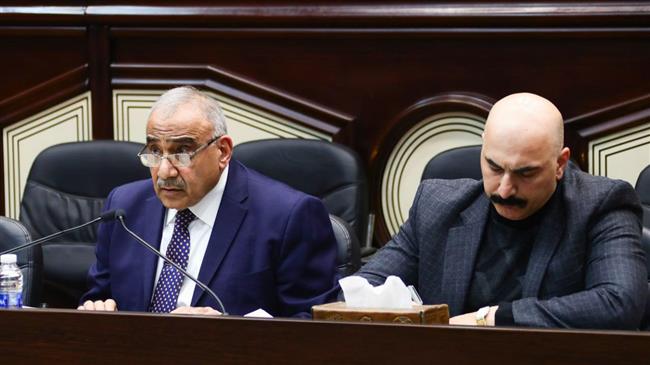
Picture released by Iraqi Prime Minister’s Media Office shows Iraq’s caretaker prime minister Adel Abdul Mahdi (L) attending a parliamentary session on January 5, 2020. (Photo via AFP)
Press TV – January 5, 2020
Iraq’s Caretaker Prime Minister Adel Abdul-Mahdi has said that Lieutenant General Qassem Soleimani was set to deliver Tehran’s reply to an earlier Saudi message regarding de-escalation talks mediated by Baghdad when he was assassinated.
Abdul-Mahdi made the remarks during an extraordinary parliamentary session in the capital which led to the adoption of a law demanding the withdrawal of US forces from the country on Sunday, the National Iraqi News Agency reported.
The premier said that he was due to meet Soleimani at 8:30 am local time on Friday before the US assassinated the general a few hours earlier.
The revelations come as Baghdad has been mediating talks between Tehran and Riyadh following a recent uptick of tensions the region.
Sunday’s parliamentary vote was held in response to Washington’s Friday airstrikes targeting Soleimani and his comrades.
Abu Mahdi al-Muhandis, the second-in-command of Iraq’s Popular Mobilization Units (PMU) was also killed in the attack.
Iran’s judiciary has said that the attack took place despite Soleimani being a “formal” and “high profile” guest of the Iraqi government.
The Sunday vote comes as many Iraqi figures and parliamentary factions have been long demanding the withdrawal of US troops from the country, specifically following a series of unclaimed airstrikes on PMU forces.
Abdul-Mahdi also revealed in his Sunday remarks that Washington had confirmed to Baghdad that Tel Aviv was behind a number of the attacks.
“America informed us that Israel bombed the warehouses of the PMU last summer,” he said, calling on the parliament to take all measures to end the presence of foreign forces in Iraq.
Rockets rock Baghdad’s Green Zone
Also on Sunday, the Iraqi military reported that three Katyusha rockets fell in Baghdad, two of which landed inside the capital’s heavily fortified Green Zone housing government buildings and foreign missions.
Witnesses told AFP that the rockets had landed close to the US embassy without further elaborating on probable casualties.
No group has yet claimed responsibility for the attack.
Israeli Forces Committed 255 Violations against Journalists in 2019
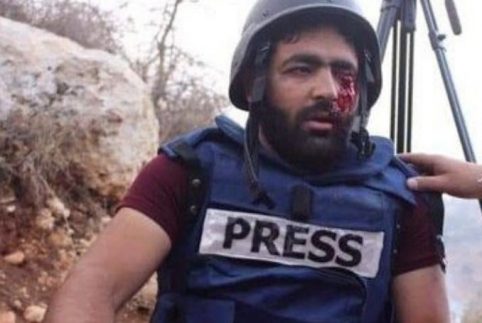
Moath Amarneh lost his eye by a rubber bullet while covering a peaceful protest in Hebron (Al-Khalil). (Photo: via Social Media)
Palestine Chronicle – January 5, 2020
In 2019, Israeli forces committed 255 violations against journalists and media institutions working in the occupied Palestinian territories, according to The Palestine News and Information Agency (WAFA).
The agency released its annual report on Israeli violations against journalists on Sunday.
Israeli violations included the use of live fire, rubber-coated bullets and teargas canisters against journalists, in addition to physical beating and arrest.
The report added that 145 journalists were injured by live fire or rubber-coated rounds, suffocated by teargas or beaten by Israeli forces during the year, while 145 journalists were either arrested or targeted by Israeli gunfire but were not injured. A total of 27 assaults by Israeli forces on media institutions were also documented.
“These daily crimes and violations against journalists,” the report said, “require an urgent and immediate intervention to pressure the Israeli government to stop its systematic and deliberate targeting of photographers and field journalists”.
170 Iraqi lawmakers sign draft bill to expel US military forces from country
Press TV – January 5, 2020
A total of 170 Iraqi lawmakers have signed a draft bill, demanding the withdrawal of US military forces from the country following the assassination of Iran’s top military commander, Lt. Gen. Qassem Soleimani, and the second-in-command of Iraq’s Popular Mobilization Units (PMU), Abu Mahdi al-Muhandis.
On Sunday, the legislators used an extraordinary parliamentary session to push for a vote on a resolution requiring the government to press Washington to withdraw US troops from Iraq.
The lawmakers, citing Articles 59 and 109 of the Constitution and in line with their national and regulatory responsibilities as representatives to safeguard the security and sovereignty of Iraq, singed a four-point draft bill as follows:
Firstly, the central government in Baghdad is obliged to cancel its request to the US-led military coalition, which was purportedly fighting the Daesh Takfiri terrorist on the grounds, now that military operations have ended in the country, and victory over Daesh has been achieved. The Iraqi government should therefore put an end to the presence of any foreign troops and prevent the use of the Iraqi airspace.
Secondly, the government and the commander-in-chief of the armed forces must announce the number of foreign trainers they need, along with their locations, responsibilities, and duration of their contracts.
Thirdly, the Iraqi foreign minister, on behalf of the government, must turn to the United Nations and the Security Council to file a complaint against the United States for violations of the Iraqi sovereignty and security.
Finally, the plan comes into force once it obtains the parliamentary approval.
On Saturday, the leader of a powerful political coalition in Iraq’s parliament said US forces will be driven out of the Iraqi territory following the vicious, cowardly US operation.
“We offer our condolences to the adherents of Hashd al-Sha’abi and all Iraqis over the martyrdom of Abu Mahdi al-Muhandis, General Soleimani and a number of young valiant men. This is the path of martyrdom, and we hereby declare that we will continue to tread it. We have no reservations whatsoever in this regard,” Hadi al-Ameri, who is the head of the Fatah (Conquest) Alliance, told reporters as he participated in the funeral ceremony for the fallen heroes in the Iraqi capital, Baghdad, on Saturday.
“We will defeat Americans and drive them out, as we did earlier in the face of Daesh. We will expel Americans right before Iraqis’ eyes as they will be frustrated and humiliated.”
“We will press ahead with this struggle. We don’t have any option but to fully restore Iraq’s sovereignty,” added Ameri, who is also the secretary general of the Badr Organization.
Back on August 27 last year, the Fatah Alliance called for the withdrawal of US troops from Iraq, following a series of airstrikes targeting Hashd al-Sha’abi forces in the country that have been blamed on Israel.
The parliamentary bloc said it held the United States fully responsible for the Israeli act of aggression, “which we consider to be a declaration of war on Iraq and its people.”
The US, backed by the United Kingdom, invaded Iraq in 2003 claiming that the former regime of Saddam Hussein possessed weapons of mass destruction.
No such weapons, however, were ever found.
The invaders withdrew from Iraq, after nearly nine years of a military campaign that cost tens of thousands of Iraqi lives.
Leading a new coalition of its allies, the United States returned to Iraq in 2014, when Daesh unleashed a campaign of destruction in the Arab country. Widespread reports, however, said the Washington-led operations largely spared the terrorists and led, instead, to civilian deaths and inflicted damage on the Iraqi infrastructure.
Iraq’s army troops, backed by volunteer Hashd al-Sha’abi forces, managed to liberate all Daesh-held areas thanks to military advisory assistance from neighboring Iran.
Baghdad declared the end of the anti-Daesh campaign in late 2017.
Israel forces confiscate five tractors in West Bank
![Palestinian farmers separate wheat and straw bundles as they work on a farm land in Gaza City, Gaza on 16 May 2018 [Abed Rahim Khatib/Anadolu Agency]](https://i0.wp.com/www.middleeastmonitor.com/wp-content/uploads/2018/05/2018_5-18-IWheat-harvest-in-Gaza20180517_2_30419109_33819412.jpg?resize=1200%2C800&quality=85&strip=all&ssl=1)
Palestinian farmers as they work on farm land in Gaza City, Gaza on 16 May 2018 [Abed Rahim Khatib/Anadolu Agency]
MEMO | January 4, 2020
Israeli occupation forces raided the Palestinian village of Al-Malih in the occupied West Bank on Friday and confiscated five tractors, Safa News Agency reported.
Head of the Village Council of Al-Malih, Ahmad Daraghmeh, revealed that the Israeli occupation forced confiscated the tractors and claimed the tractors were working in a “closed military zone”.
The head of the Village Council stressed that the area is owned by the Palestinian farmers, noting that the Israeli occupation had recently confiscated tens of tractors from their owners while they were working in their farms in the same area.
He condemned the weak support for the farmers in the village, adding that these farmers are considered a shield protecting the Palestinian lands from being expropriated by the Israeli occupation.
“We hear remarks and receive statements of support, but we see nothing on the ground. The farmers are in the field alone,” he concluded.
Why a Shadowy Tech Firm With Ties to Israeli Intelligence Is Running Doomsday Election Simulations
Graphic by Claudio Cabrera for MintPress News
By Whitney Webb | MintPress News | January 4, 2020
Election Day 2020: 32 Americans dead, over 200 injured, martial law declared and the election itself is canceled. While this horrific scenario seems more like the plot of a Hollywood film, such was the end result of a recent simulation examining the preparedness of U.S. officials from the Federal Bureau of Investigation (FBI), the Department of Homeland Security (DHS) and the U.S. Secret Service against “bad actors” seeking to undermine the upcoming presidential election.
Yet, this simulation was not a government-organized exercise but was instead orchestrated by a private company with deep ties to foreign and domestic intelligence services, a company that is also funded by investors with clear connections to individuals who would stand to benefit if such a catastrophic election outcome were to become reality.
Much of the rhetoric since the last presidential election in 2016 has focused on the issue of foreign meddling by U.S. rival states like Russia, while China has emerged as the new “meddler” of choice in American corporate media as the 2020 election approaches. Though time has revealed that many of the post-2016 election meddling claims were not as significant as initially claimed, the constant media discussion of foreign threats to U.S. democracy and electoral processes – whether real or imagined – has undeniably created a climate of fear.
Those fears have since been preyed upon by neoconservative groups and the U.S. military-industrial complex, both of which are hardly known for their love of democratic processes, to offer a series of ready-made solutions to these threats that actually undermine key pillars of American democracy, including independent reporting and voting machine software.
However, many of the very same media outlets and groups that frequently fretted about Russia, China or another rival state meddling in U.S. democracy have largely ignored the role of other nation states, such as Israel, in efforts to sway the last U.S. election in 2016 and meddle in numerous elections in Africa, Latin America and Asia in the years since.
As a consequence of this climate of fear, it should be hardly surprising that the corporate media lauded the recent 2020 election simulation that ended in an abysmal failure for U.S. officials, the cancellation of the U.S. election and the imposition of martial law. Yet, none of those reports on the exercise noted that the company that hosted the simulation, called Cybereason, is led by ex-members of Israel’s military intelligence unit 8200, advised by former top and current officials in both Israeli military intelligence and the CIA. In addition, it is funded by and partnered with top U.S. weapons manufacturer and government contractor Lockheed Martin and financial institutions with clear and direct ties to Saudi Crown Prince Mohammed bin Salman and White House adviser and the president’s son-in-law Jared Kushner. Also left unmentioned in media reports on Cybereason’s election simulations is the fact that Cybereason’s CEO, Lior Div, has openly admitted that he views his work at Cybereason as a “continuation” of his service to Israel’s intelligence apparatus.
With Cybereason planning to host more simulations in cooperation with federal agencies as the U.S. election inches closer, a deeper exploration of this company, its ties to intelligence and military contractors in the U.S. and Israel and its financial ties to key Trump allies both domestically and abroad warrants further investigation.
In this two part series, MintPress will not only explore these aspects but also how many of the technologies wielded by the “bad actors” in the Cybereason election simulation have been pioneered and perfected, not by U.S. rival states, but by Israeli companies and start-ups with clear ties to that country’s intelligence apparatus.
Also notable is the fact that Cybereason itself has covertly become a major software provider to the U.S. government and military through its direct partnership with Lockheed Martin, which followed the defense company’s decision to open an office at the Israeli military’s new cyber operations hub in the Negev desert. In examining all of these interlocking pieces, a picture emerges of a potentially sinister motive for Cybereason’s simulations aimed at gauging how U.S. federal officials respond to crisis situations on Election Day.
Understanding “Operation Blackout”
In early November, a team of “hackers” working for the private U.S.-based, Israeli-founded company Cybereason conducted a 2020 election simulation with members of various U.S. agencies, namely the DHS, FBI and the U.S. Secret Service. The simulation was organized by Cybereason and the law firm Venable and the U.S. agencies in attendance were invited and appear to not have been charged to participate.
The simulation, titled “Operation Blackout,” was set in a fictional swing state called “Adversaria” and pitted “ethical hackers” from Cybereason against a team of federal and local law enforcement officials. The opposing teams were supervised by a “white team” composed of members of Cybereason’s staff and Ari Schwartz — a former member of the White House’s National Security Council and the National Institute of Standards and Technology (NIST) — who set the rules of the simulation and would ultimately decide its outcome. Schwartz also used to work for the Center for Democracy and Technology (CDT), a major backer of Microsoft’s ElectionGuard software.
Operation Blackout did not involve hackers targeting election software or voting machines, instead, it focused on civilian infrastructure and psychological operations against the American citizens in the fictitious “Adversaria” on election day. The hacker team was led by Cybereason co-founder Yonathan Striem-Amit, a former contractor for Israeli government agencies and a former operative for the elite Israeli military intelligence Unit 8200, best known for its cyber offensives against other governments.
“In a country as fragmented as the US, the number of people needed to influence an election is surprisingly small,” Striem-Amit told Quartz of the exercise. “We attempted to create havoc and show law enforcement that protecting the electoral process is much more than the machine.”
Streim-Amit’s team completely devastated the U.S. law enforcement team in Operation Blackout by not only causing chaos but murdering numerous civilians. Hackers took control of city buses, ramming them into civilians waiting in line at polling stations, killing 32 and injuring over 200. They also took control of city traffic lights in order to cause traffic accidents, used so-called “deepfakes” to conduct psychological operations on the populace and created fake bomb threats posing as the terror group ISIS, which incidentally has its own ties to Israeli intelligence. Telecom networks and news outlets within the fictitious states were also hacked and flooded with deepfakes aimed at spreading disinformation and panic among U.S. citizens.

A map of targets in Adverseria is shown during Operation Blackout in Boston’s John Hancock Tower. Mark Albert | Twitter
The supervising team, composed of Cybereason employees and former NSC member Ari Schwartz, decided that the outcome of the face-off between the hacker and law enforcement teams was the outright cancellation of the 2020 election, the declaration of martial law by authorities, the growth of public fear regarding terrorism and allegations of U.S. government collusion with a foreign actor. Cybereason has stated that they will soon conduct another 2020 election simulation with federal authorities as the election draws closer.
Given how the simulation played out, it is quite clear that it is a far cry from the actual scope of alleged foreign meddling during the 2016 election, meddling which was allegedly the motivation behind Operation Blackout. Indeed, the extent of Russian interference in the 2016 election amounted to $100,000 worth of Facebook ads over three years, 25 percent of which were never seen by the public, and claims that Russian state actors were responsible for leaking emails from the then-Democratic presidential nominee Hillary Clinton and the Democratic National Committee (DNC). In contrast, Operation Blackout went well beyond any observed or even imagined “foreign meddling” related to the 2016 election and appears more like a terror attack targeting elections than a covert means of manipulating their outcomes.
Several mainstream publications have covered Operation Blackout but have failed to note that the company behind them has deep ties to foreign intelligence outfits and governments with a documented history of manipulating elections around the world, including the 2016 U.S. election.
Quartz framed the exercise as important for “preparing for any and all possibilities in 2020,” which “has become an urgent task for US regulators and law enforcement.” Similarly, CyberScoop treated the simulation as a “sophisticated exercise to help secure the vote.” Other articles took the same stance.
A series of simulations
In the weeks after the Washington area election simulation, Cybereason repeated the same exercise in London, this time with members of the U.K. Intelligence agency GCHQ, the U.K. Foreign Office and the Metropolitan Police. The law enforcement team in the exercise, which included the U.K. officials, was headed by a Cybereason employee — Alessandro Telami, who formerly worked for the NATO Communications and Information Agency (NCI). Like the prior simulation conducted in the U.S., Cybereason did not appear to charge U.K. government agencies for their participation in the exercise.
Cybereason has — with little fanfare — been promoting extreme election day scenarios since before the 2016 election. Cybereason’s first mention of these tactics appears in a September 2016 blog post written by the company’s CEO and former Israeli government contractor Lior Div — a former leader of offensive cyberattacks for the IDF’s elite Unit 8200 and a former development group leader at the controversial Israeli-American corporation Amdocs.
Div wrote that hackers may target U.S. elections by “breaking into the computers that operate traffic lighting systems and interfering with the ones around polling stations to create massive traffic jams, “hacking polling companies,” and “targeting live election coverage on cable or network television stations.” A follow-up post by Div from October 2016 added further meddling tactics such as “cut power to polling stations” and “mess with a voter’s mind.”
Two years later, Cybereason held its first election meddling simulation, touting many of these same tactics, in Boston. The simulation focused on local and state responses to such attacks and saw Boston-based Cybereason invite Massachusetts state and local officials as well as Boston police officers and a former police commissioner to participate. “Twitter accounts spreading fake news,” “turning off a city’s closed-circuit cameras,” “hacking self-driving cars and navigation apps,” and “targeting a city’s 911 call center with a DDoS attack” were all used in the simulation, which saw Cybereason’s “ethical hackers” attempt to disrupt election day. Media coverage of the simulation at the time framed it as a necessary preparation for countering “Russian” threats to U.S. democracy. Like the more recent simulations, the mock election was canceled and voter confidence in the electoral process was devastated.
This past July, Cybereason conducted a similar simulation with officials from the FBI, DHS and the Secret Service for the first time. That simulation, which also took place in Boston, was remarkably similar to that which occurred in November. One intelligence officer from DHS who participated in the July exercise called the simulation “very realistic.” Another claimed that the simulation was a way of applying “lessons learned from 9/11” by preventing the government’s “failure of imagination” that officials have long alleged was the reason for the government’s inability to thwart the September 11 attacks. Notably, The U.S. military simulated a scenario in which terrorists flew airplanes into the Pentagon less than a year before the September 11 attacks.
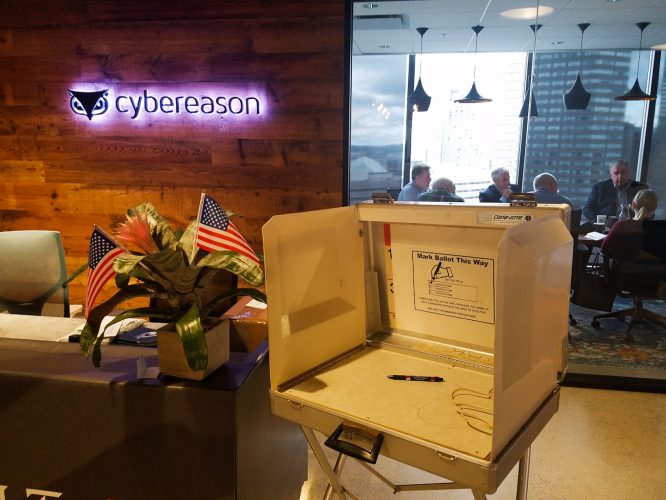
In this undated photo from Cybereason’s website, a faux ballot box is shown in the company’s Boston office.
Participating government officials, Cybereason staff and the media have consistently touted the importance of these simulations in securing elections against extreme threats, threats which — to date — have never materialized due to the efforts of foreign or domestic actors on election day. After all, these exercises are only simulations of possibilities and, even if those possibilities seem implausible or unlikely, it is important to be prepared for any eventuality.
But what if the very figures behind these simulations and the investors that fund them had a history of election meddling themselves? Cybereason’s deep ties to Israeli intelligence, which has a documented history of aggressive espionage and election meddling in the United States and in several nations worldwide, warrant a deeper look into the firms’ possible motives and the myriad conflicts of interest that arise in giving it such unprecedented access to the heart of America’s democracy.
What Does Cybereason Do?
Cybereason’s interest in terror events during elections seems out of place given that the company itself is focused on selling technological cybersecurity solutions like antivirus and ransomware protection software, software products that would be minimally effective against the type of threat encountered in the company’s election day simulations.
Cybereason is often described as offering a comprehensive technological defense platform to companies and governments that combines a next-generation antivirus with endpoint detection and response (EDR), which enables the company to respond to typical viruses and malware as well as sophisticated, complex attacks. The platform makes heavy use of artificial intelligence (AI) and cloud computing and specifically uses Amazon Web Services (AWS), which is used by a litany of private companies as well as U.S. intelligence agencies.
While many cybersecurity platforms combine antivirus and antimalware with EDR and AI, Cybereason claims that their military background is what sets them apart. They have marketed themselves as offering “a combination of military-acquired skills and cloud-powered machine learning to endpoint detection and response” and actively cite the fact that most of their employees are former members of Unit 8200 as proof that they are “applying the military’s perspective on cybersecurity to enterprise security.”
In 2018, Cybereason’s former senior director for intelligence, Ross Rustici, described the platform to CBR as follows:
Our founders are ex-Israeli intelligence who worked on the offensive side. They basically wanted to build a tool that would catch themselves. We follow the kill chain model started by Lockheed Martin [now a major investor in Cybereason] and try to interrupt every stage once an intruder’s inside a target network.”
Lior Div, Cybereason’s CEO described the difference between his company’s platform and that of past market leaders in this way to Forbes :
The old guard of antivirus companies like Symantec and McAfee would install something to block endpoints and you needed to do a lot [of monitoring] to make sure you weren’t under attack. We came with a different approach to see the whole enterprise and leverage AI to be able to fully autonomously identify where attackers are and what they’re doing.”
Thus, in looking at Cybereason’s product and its marketing objectively, it seems that the only innovative component of the company’s system is the large number of ex-military intelligence officers it employs and its tweaking of a previously developed and automated model for threat engagement, elimination and prevention.
Instead, Cybereason’s success seems to owe to its prominent connections to the private and public sectors, especially in Israel, and its investors who have funneled millions into the company’s operations, allowing them to expand rapidly and quickly claim a dominant position in emerging technology markets, such as the Internet of Things (IoT) and advanced healthcare systems.

A screenshot from a live stream of a 2019 Cybereason cyber-attack simulation
Their considerable funding from the likes of Lockheed Martin and Softbank, among others, has also helped them to expand their international presence from the U.S., Europe and Israel into Asia and Latin America, among other places. Notably, while Cybereason is open about their investors and how much funding they receive from each, they are extremely secretive about their financial performance as a company and decline to disclose their annual revenue, among other indicators. The significance of Cybereason’s main investors in the context of the company’s election simulations and its ties to Israeli and U.S. intelligence (the focus of this article) will be discussed in Part 2.
Cybereason also includes a security research arm called Nocturnus, currently headed by a former Unit 8200 officer. Nocturnus will be explored further in Part 2 of this series, as it essentially functions as a private intelligence company in the tech sector and has been behind several recent claims that have attributed alleged hacks to state actors, namely China and North Korea. For now, it is important to keep in mind that Nocturnus utilizes Cybereason’s “global network of millions of endpoints” for its intelligence gathering and research, meaning the endpoints of every device to which Cybereason’s software has access.
Given what Cybereason provides as a company, their interest in offering election simulations to government officials free of charge seems odd. Indeed, in the simulations hosted by Cybereason for U.S. officials, there is little opportunity for the company to market their software products given that the simulation did not involve electronic voting infrastructure at all and, instead, the malevolent actors used deep fakes, disinformation and terror attacks to accomplish their goals. Why then would this company be so interested in gauging the response of U.S. law enforcement to such crises on election day if there is no sales pitch to be made? While some may argue that these simulations are an altruistic effort by the company, an investigation into the company’s founders and the company’s ties to intelligence agencies suggests that this is unlikely to be the case.
The People Behind Cybereason
Cybereason was created in 2012 by three Israelis, all of whom served together as officers in the Israel Defense Force’s elite technological and signals intelligence unit, which is most often referred to as Unit 8200. Unit 8200 has been the subject of several MintPress investigative reports over the past year focusing on its ties to the tech industry.
Unit 8200 is an elite unit of the Israeli Intelligence corps that is part of the IDF’s Directorate of Military Intelligence and is involved mainly in signal intelligence, surveillance, cyberwarfare and code decryption. It is also well-known for its surveillance of Palestinian civilians and for using intercepted communications as blackmail in order to procure informants among Palestinians living under occupation in the West Bank.
The unit is frequently described as the Israeli equivalent of the NSA and Peter Roberts, a senior research fellow at Britain’s Royal United Services Institute, characterized the unit in an interview with the Financial Times as “probably the foremost technical intelligence agency in the world and stand[ing] on a par with the NSA in everything except scale.” Notably, the NSA and Unit 8200 have collaborated on numerous projects, most infamously on the Stuxnet virus as well as the Duqu malware.
Given the secrecy of the work conducted by Unit 8200, it is hard to know exactly what Cybereason’s co-founders did while serving in the controversial unit, however, a brief biography of the company’s current CEO and co-founder Lior Div states that “Div served as a commander [in Unit 8200] and carried out some of the world’s largest cyber offensive campaigns against nations and cybercrime groups. For his achievements, he received the Medal of Honor, the highest honor bestowed upon Unit 8200 members (emphasis added).”

Lior Div speaks during the Cyber Week conference in Tel Aviv, Israel, June 25, 2019. Corinna Kern | Reuters
After having served in leadership positions within Unit 8200, all three Cybereason co-founders went on to work for private Israel-based tech or telecom companies with a history of aggressive espionage against the U.S. government.
Cybereason co-founders Yonathan Striem Amit (Cybereason’s Chief Technology Officer) and Yossi Naar (Cybereason Chief Visionary Officer) both worked for Gita Technologies shortly before founding Cybereason with fellow Unit 8200 alumnus Lior Div. Gita, according to public records, is a subsidiary of Verint Systems, formerly known as Comverse Infosys.
Verint/Comverse was initially funded by the Israeli government and was founded by Jacob “Kobi” Alexander, a former Israeli intelligence officer who was wanted by the FBI on nearly three dozen charges of fraud, theft, lying, bribery, money laundering and other crimes for over a decade until he was finally extradited to the United States and pled guilty to some of those charges in 2016.
Despite its history of corruption and foreign intelligence connections, Verint/Comverse was hired by the National Security Agency (NSA) to create backdoors into all the major U.S. telecommunications systems and major tech companies, including Facebook, Microsoft and Google. An article on Verint’s access to U.S. tech infrastructure in Wired noted the following about Verint:
In a rare and candid admission to Forbes, Retired Brig. Gen. Hanan Gefen, a former commander of the highly secret Unit 8200, Israel’s NSA, noted his former organization’s influence on Comverse, which owns Verint, as well as other Israeli companies that dominate the U.S. eavesdropping and surveillance market. ‘Take NICE, Comverse and Check Point for example, three of the largest high-tech companies, which were all directly influenced by 8200 technology,’ said Gefen.”
Federal agents have reported systemic breaches at the Department of Justice, FBI, DEA, the State Department, and the White House going all the way back to the 1990s, breaches they claimed could all be traced back to two companies: Comverse/Verint and Amdocs. Cybereason’s other co-founder and current CEO, Lior Div, used to work for Amdocs as the company’s development group leader.
After leaving Amdocs, Div founded a company called Alfatech. Alfatech publicly claims to specialize in “professional Head Hunting and Quality Recruiting services,” yet it has no functional website. Despite its publicly stated mission statement, Israeli media reports that mention Alfatech describe it as “a cybersecurity services company for Israeli government agencies.” No reason for the obvious disconnect between the company’s own claims and those made by the media has been given.
Div left Alfatech in 2012 to found Cybereason alongside Striem-Amit and Naar. According to an interview that Div gave to TechCrunch earlier this year, he stated that his work at Cybereason is “the continuation of the six years of training and service he spent working with the Israeli army’s 8200 Unit (emphasis added).” Div was a high-level commander in Unit 8200 and “carried out some of the world’s largest cyber offensive campaigns against nations and cybercrime groups” during his time there. TechCrunch noted that “After his time in the military, Div worked for the Israeli government as a private contractor reverse-engineering hacking operations,” an apparent reference to his work at Alfatech.
Even deeper ties to intelligence
Not only do Cybereason’s own co-founders have considerable links to the Israeli government, Israeli intelligence and intelligence-connected private companies, but it also appears that the work of Cybereason itself is directly involved with Israeli intelligence.
The company periodically publishes reports by a secretive faction of the company called the Cybereason Intelligence Group or CIG. The only description of CIG’s composition available on Cybereason’s website is as follows:
The Cybereason Intelligence Group was formed with the unique mission of providing context to the most sophisticated threat actors. The group’s members include experts in cyber security and international security from various government agencies, including the Israel Defense Forces’ Unit 8200, which is dedicated to conducting offensive cyber operations. Their primary purpose is to examine and explain the Who and the Why behind cyber attacks, so that companies and individuals can better protect themselves (emphasis added).”
It is unclear how many members comprise CIG and if its members are employees of only Israeli government agencies, or if it includes officials from the U.S. government/Intelligence or other governments. However, what is clear is that it is composed entirely of government officials, which include active members of Unit 8200, and that the purpose of the group is to issue reports that place blame for cyberattacks on state and non-state actors. Perhaps unsurprisingly, the vast majority of CIG’s reports published by Cybereason focus exclusively on Russia and China. When discussing nation-state cyber threats in general, Cybereason’s website only mentions China, North Korea, Iran and Russia by name, all of which are incidentally rival states of the U.S. government. Notably, Israel’s government — listed as a “leading espionage threat” to U.S. financial institutions and federal agencies by the U.S.’ NSA — is absent from Cybereason’s discussions of state actors.
In addition to CIG, Cybereason’s cybersecurity research arm, Nocturnus, includes several Unit 8200 alumni and former Israeli military intelligence and government contractors and has assigned blame to state actors for several recent hacks. It also has claimed to have discovered more such hacks but has declined to publicly disclose them due to the “sensitive” nature of the hacks and companies affected.
Other hints at Cybereason’s connections to state intelligence can be seen in its advisory board. Robert Bigman, the former Chief Information Security Officer (CISO) for the Central Intelligence Agency (CIA) who oversaw the spy agency’s “commercial partner engagement” program (i.e. alliances with the private tech sector), is a key figure on the company’s advisory board. According to his biography, Bigman “ contributed to almost every Intelligence Community information security policy/technical standard and has provided numerous briefings to the National Security Council, Congress and presidential commissions. In recognition of his expertise and contributions, Bigman has received numerous CIA and Director of National Intelligence Awards.”
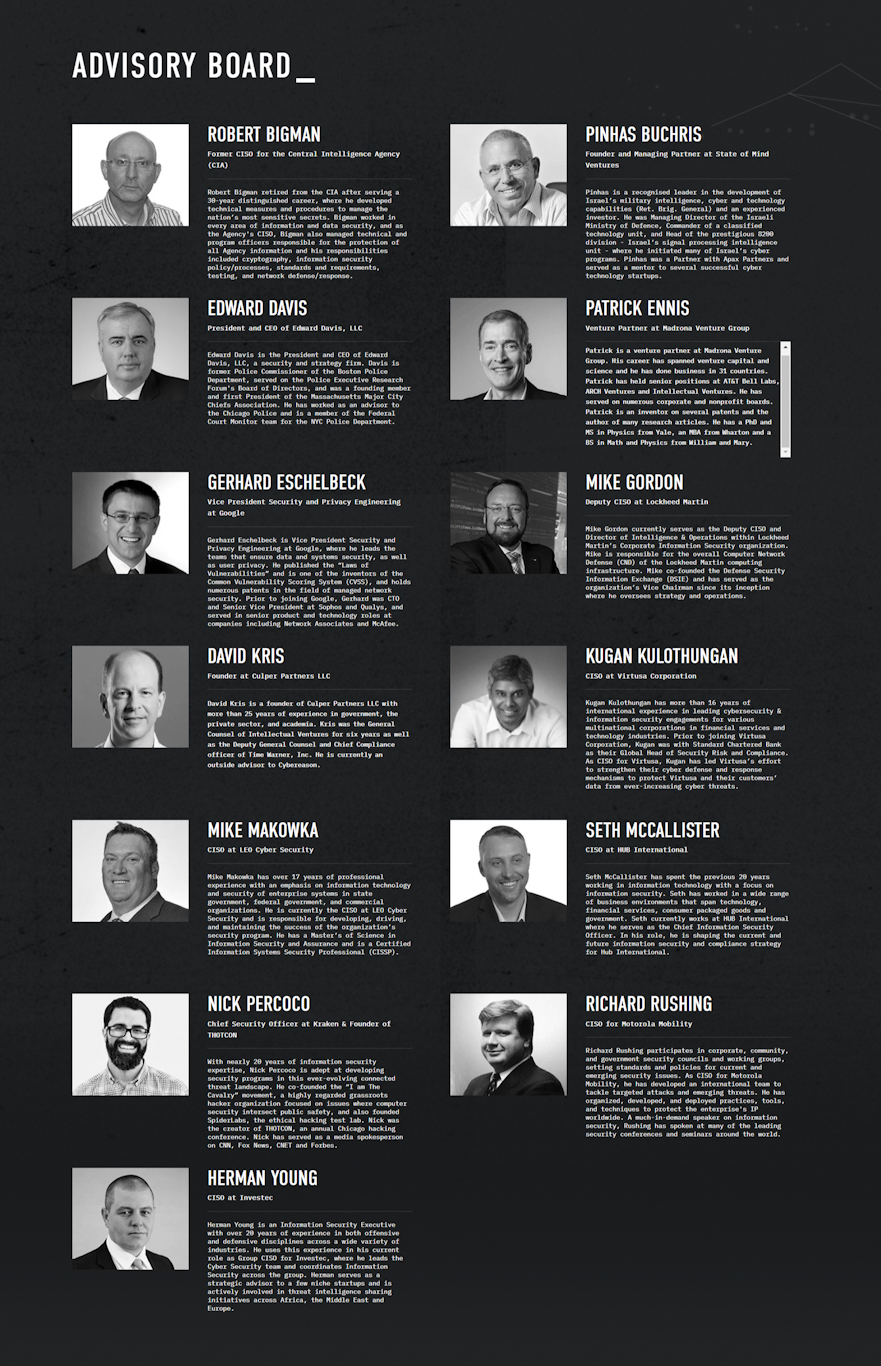
Cybereason’s leadership team features a who’s who of Israeli and US intel officials
Unmentioned in his biography published on his own website, or on Cybereason’s website, is that Bigman is also an advisor to another Israeli tech company, Sepio Systems. The chairman of Sepio, Tamir Pardo, is a self-described “leader” in the cybersecurity industry and former director of Israel’s Mossad. Sepio is funded by a venture capital firm founded by the creators of the controversial Israeli spy tech company NSO Group, which has received a slew of negative press coverage after its software was sold to several governments who used it to spy on dissidents and human rights activists.
In addition to Bigman, Cybereason’s advisory board includes Pinchas Buchris, the former head of Unit 8200 and former managing director of the IDF. Not unlike Bigman, Buchris’ bio fails to mention that he sits on the board of directors of Carbyne911, alongside former Israeli Prime Minister Ehud Barak and Nicole Junkerman, both well-known associates of intelligence-linked sex trafficker Jeffery Epstein. Epstein himself poured at least $1 million into Carbyne, an Israeli company that seeks to run all 911 call centers in the U.S. at the national level and has close ties to the Trump administration. More information on Carbyne and its ties to Israeli and U.S. intelligence as well as its connection to coming pre-crime policies to be enacted in 2020 by the U.S. Department of Justice can be found in this MintPress report from earlier this year. Given that Cybereason’s election day simulations involve the simulated collapse of 911 call center functionality, Buchris’ ties to both Cybereason and Carbyne911 are notable.
Another notable Cybereason advisor is the former commissioner of the Boston Police Department, Edward Davis. Davis heavily promoted Cybereason’s disturbing election day simulations and even participated directly in one of them. He was also police commissioner of the Boston PD at the time of the Boston Marathon bombing and oversaw the near-martial law conditions imposed on the city during the manhunt for the alleged perpetrators of that bombing (who themselves had a rather odd relationship with the FBI). This is notable given that Cybereason’s election day simulations ended with martial law being imposed on the fictional city used in the exercise
Cybereason also has several advisors who hold top positions at powerful U.S. companies that are also — incidentally — U.S. government contractors. These include the Vice President Security and Privacy Engineering at Google, Deputy Chief Information Security Officer (CISO) of Lockheed Martin and CISO at Motorola. Both Motorola and Lockheed Martin use Cybereason’s software and the latter is also a major investor in the company. Furthermore, as will be explained in Part 2 of this article, Lockheed Martin has used its privileged position as the top private contractor to the U.S. government to promote the widespread use of Cybereason’s software among U.S. government agencies, including the Pentagon.
Much more than a cybersecurity company
Given Cybereason’s deep and enduring ties to Israeli intelligence and its growing connections to the U.S. military and U.S. intelligence through its hiring of top CIA officials and partnership with Lockheed Martin, it’s worth asking if these disturbing election simulations could serve an ulterior purpose and, if so, who would benefit. While some aspects regarding clear conflicts of interest in relation to the 2020 election and Cybereason will be discussed in Part 2, this article will conclude by examining the possibility that Cybereason is acting as a front company for Israeli intelligence based on that country’s history of targeting the U.S. through private tech companies and on Cybereason’s own questionable characteristics.
First, Cybereason as a company presents several oddities. Its co-founder and CEO openly states that he views Cybereason’s work as a continuation of his service for Israeli military intelligence. In addition, he and the company’s other founders — after they left Unit 8200 — went to work for Israeli tech companies that have been known to spy on U.S. federal agencies for the Israeli government.
In addition, as previously mentioned, Cybereason has sought out former intelligence officers from the CIA and Unit 8200 for its management team and board of advisors. The company itself also functions as a private intelligence firm through CIG and Nocturnus, both of which employ former and current intelligence officials, and have made significant claims regarding the attribution of specific cybercrimes to state actors. It appears highly likely that these claims are influenced by those same intelligence agencies that boast close ties to Cybereason. Furthermore, Nocturnus’ access to Cybereason’s “global” network of endpoints makes it a private intelligence gathering company as it gathers and analyzes data from all devices that run Cybereason’s software.
Yet, even more telling is the fact that Israel’s government has an open policy of outsourcing intelligence-related activity to the private sector, specifically the country’s tech sector. As MintPress previously reported, this trend was first publicly acknowledged by Israel in 2012, the same year that Cybereason was founded by former Israeli military intelligence officers then-working for private contractors for Israel’s government (Alfatech) or private companies known to have ties to Israeli intelligence, including Verint/Comverse.
As noted in an article on the phenomenon from the Israeli media outlet The Calcalist:
Israel is siphoning cyber-related activities from its national defense apparatus to privately held companies. Since 2012, cyber-related and intelligence projects that were previously carried out in-house in the Israeli military and Israel’s main intelligence arms are transferred to companies that in some cases were built for this exact purpose.”
Mention of Israel’s policy of blurring the lines between the public and private sector when it comes to cybersecurity and intelligence gathering has even garnered the occasional mention in mainstream media, such as in a 2018 Foreign Policy article:
Israel, for one, has chosen to combat the problem on a statewide level by linking the public and private spheres, sometimes literally. The country’s cyberhub in the southern city of Beersheba is home not just to the Israeli military’s new technology campus but also to a high-tech corporate park, Ben-Gurion University of the Negev’s cyber-research center, and the Israel National Cyber Directorate, which reports directly to the prime minister’s office. “There’s a bridge between them—physically,” [Gabriel] Avner, the security consultant, said by way of emphasis.”
Notably, a year before Lockheed Martin invested in and partnered with Cybereason, the U.S.-based weapons company opened an office at the IDF’s public-private cyber hub in Beersheba. At the inauguration ceremony for Lockheed’s Beersheba office, company CEO Marilyn Hewson stated:
The consolidation of IDF Technical Units to new bases in the Negev Desert region is an important transformation of Israel’s information technology capability… By locating our new office in the capital of the Negev we are well positioned to work closely with our Israeli partners and stand ready to: accelerate project execution, reduce program risk and share our technical expertise by training and developing in-country talent.”

Lockheed Martin CEO Marillyn Hewson, inaugurates the Lockheed Martin Israel Demonstration Center in Tel Aviv.
Further evidence of this public-private merger can be seen in how two of Israel’s intelligence agencies, Shin Bet and Mossad, have both recently launched a private start-up accelerator and a hi-tech venture capital fund, respectively. The Shin Bet’s accelerator, called Xcelerator, usually makes its investments in private companies public, while Mossad’s Libertad Ventures refuses to disclose the tech companies and start-ups in which it invests. Former directors of both Mossad and Shin Bet have described these intelligence agencies themselves of being like start-ups, clearly showing how much the line between intelligence apparatus and private company has been blurred within the context of Israel’s tech industry and specifically its cybersecurity industry.
The advantages of outsourcing cyber intelligence operations to private companies have been noted by several analysts, including Sasha Romanosky, a former Cyber Policy Advisor at the Department of Defense and current analyst at RAND Corporation. Romanosky noted in 2017 that private intelligence and cybersecurity firms “do not necessarily face the same constraints or potential repercussions” as their public counterparts when it comes to designating blame for a cyberattack, for example. In addition, outsourcing intelligence objectives or missions to private companies provides a government with plausible deniability if that private company’s espionage-related activities or ties are made public.
Furthermore, Israeli intelligence has a long history of using private tech companies for the purposes of espionage, including against the United States. While Amdocs and Verint/Comverse were already mentioned as having been used by the state of Israel in this way, other private companies have also been used to market software backdoored by Israeli intelligence to countries around the world, both within the U.S. and elsewhere. The most well-known example of this is arguably the mass sale and distribution of the bugged PROMIS software, which was discussed at length in several recent MintPress News reports.
Given Cybereason’s ties to intelligence and Israeli intelligence’s history of placing backdoors in its software, it is worth pointing out that Cybereason’s main product, its antivirus and network defense platform, offers a major espionage opportunity. Blake Darché, a former N.S.A. operator, told the New York Times in 2017 that antivirus programs, which Cybereason’s defense platform includes, is “the ultimate backdoor,” adding that it “provides consistent, reliable and remote access that can be used for any purpose, from launching a destructive attack to conducting espionage on thousands or even millions of users.” Whether a company like Cybereason would use its software for such ends is unknown, though the company does acknowledge that its cybersecurity arm does gather intelligence from all systems that use the company’s software and currently employs and works with active duty Unit 8200 officials through CIG. This is notable because Unit 8200’s main task for Israeli military intelligence is signals intelligence, i.e. surveillance.
More of a mystery, however, is why a company like Cybereason is so interested in U.S. election security, particularly when Israeli intelligence and Israeli intelligence-connected private companies have been caught in recent years meddling in elections around the world, including the United States.
Whitney Webb is a MintPress News journalist based in Chile. She has contributed to several independent media outlets including Global Research, EcoWatch, the Ron Paul Institute and 21st Century Wire, among others. She has made several radio and television appearances and is the 2019 winner of the Serena Shim Award for Uncompromised Integrity in Journalism.
Lies, the Bethlehem Doctrine, and the Illegal Murder of Soleimani
By Craig Murray | January 4, 2020
In one of the series of blatant lies the USA has told to justify the assassination of Soleimani, Mike Pompeo said that Soleimani was killed because he was planning “Imminent attacks” on US citizens. It is a careful choice of word. Pompeo is specifically referring to the Bethlehem Doctrine of Pre-Emptive Self Defence.
Developed by Daniel Bethlehem when Legal Adviser to first Netanyahu’s government and then Blair’s, the Bethlehem Doctrine is that states have a right of “pre-emptive self-defence” against “imminent” attack. That is something most people, and most international law experts and judges, would accept. Including me.
What very few people, and almost no international lawyers, accept is the key to the Bethlehem Doctrine – that here “Imminent” – the word used so carefully by Pompeo – does not need to have its normal meanings of either “soon” or “about to happen”. An attack may be deemed “imminent”, according to the Bethlehem Doctrine, even if you know no details of it or when it might occur. So you may be assassinated by a drone or bomb strike – and the doctrine was specifically developed to justify such strikes – because of “intelligence” you are engaged in a plot, when that intelligence neither says what the plot is nor when it might occur. Or even more tenuous, because there is intelligence you have engaged in a plot before, so it is reasonable to kill you in case you do so again.
I am not inventing the Bethlehem Doctrine. It has been the formal legal justification for drone strikes and targeted assassinations by the Israeli, US and UK governments for a decade. Here it is in academic paper form, published by Bethlehem after he left government service (the form in which it is adopted by the US, UK and Israeli Governments is classified information).
So when Pompeo says attacks by Soleimani were “imminent” he is not using the word in the normal sense in the English language. It is no use asking him what, where or when these “imminent” attacks were planned to be. He is referencing the Bethlehem Doctrine under which you can kill people on the basis of a feeling that they may have been about to do something.
The idea that killing an individual who you have received information is going to attack you, but you do not know when, where or how, can be justified as self-defence, has not gained widespread acceptance – or indeed virtually any acceptance – in legal circles outside the ranks of the most extreme devoted neo-conservatives and zionists. Daniel Bethlehem became the FCO’s Chief Legal Adviser, brought in by Jack Straw, precisely because every single one of the FCO’s existing Legal Advisers believed the Iraq War to be illegal. In 2004, when the House of Commons was considering the legality of the war on Iraq, Bethlehem produced a remarkable paper for consideration which said that it was legal because the courts and existing law were wrong, a defence which has seldom succeeded in court.
(b)
following this line, I am also of the view that the wider principles of the law on self-defence also require closer scrutiny. I am not persuaded that the approach of doctrinal purity reflected in the Judgments of the International Court of Justice in this area provide a helpful edifice on which a coherent legal regime, able to address the exigencies of contemporary international life and discourage resort to unilateral action, is easily crafted;
In the absence of a respectable international lawyer willing to argue this kind of tosh, Blair brought in Bethlehem as Chief Legal Adviser, the man who advised Netanyahu on Israel’s security wall and who was willing to say that attacking Iraq was legal on the basis of Saddam’s “imminent threat” to the UK, which proved to be non-existent. It says everything about Bethlehem’s eagerness for killing that the formulation of the Bethlehem Doctrine on extrajudicial execution by drone came after the Iraq War, and he still gave not one second’s thought to the fact that the intelligence on the “imminent threat” can be wrong. Assassinating people on the basis of faulty intelligence is not addressed by Bethlehem in setting out his doctrine. The bloodlust is strong in this one.
There are literally scores of academic articles, in every respected journal of international law, taking down the Bethlehem Doctrine for its obvious absurdities and revolting special pleading. My favourite is this one by Bethlehem’s predecessor as the FCO Chief Legal Adviser, Sir Michael Wood and his ex-Deputy Elizabeth Wilmshurst.
I addressed the Bethlehem Doctrine as part of my contribution to a book reflecting on Chomsky‘s essay “On the Responsibility of Intellectuals”
In the UK recently, the Attorney
General gave a speech in defence of the UK’s drone policy, the assassination
of people – including British nationals – abroad. This execution
without a hearing is based on several criteria, he reassured us. His
speech was repeated slavishly in the British media. In fact, the Guardian
newspaper simply republished the government press release absolutely
verbatim, and stuck a reporter’s byline at the top.
The media have no interest in a critical appraisal of the process
by which the British government regularly executes without trial. Yet
in fact it is extremely interesting. The genesis of the policy lay in the
appointment of Daniel Bethlehem as the Foreign and Commonwealth
Office’s Chief Legal Adviser. Jack Straw made the appointment, and for
the first time ever it was external, and not from the Foreign Office’s own
large team of world-renowned international lawyers. The reason for that
is not in dispute. Every single one of the FCO’s legal advisers had advised
that the invasion of Iraq was illegal, and Straw wished to find a new head
of the department more in tune with the neo-conservative world view.
Straw went to extremes. He appointed Daniel Bethlehem, the legal
‘expert’ who provided the legal advice to Benjamin Netanyahu on the
‘legality’ of building the great wall hemming in the Palestinians away
from their land and water resources. Bethlehem was an enthusiastic
proponent of the invasion of Iraq. He was also the most enthusiastic
proponent in the world of drone strikes.
Bethlehem provided an opinion on the legality of drone strikes
which is, to say the least, controversial. To give one example, Bethlehem
accepts that established principles of international law dictate that
lethal force may be used only to prevent an attack which is ‘imminent’.
Bethlehem argues that for an attack to be ‘imminent’ does not require it
to be ‘soon’. Indeed you can kill to avert an ‘imminent attack’ even if you
have no information on when and where it will be. You can instead rely
on your target’s ‘pattern of behaviour’; that is, if he has attacked before,
it is reasonable to assume he will attack again and that such an attack is
‘imminent’.
There is a much deeper problem: that the evidence against the
target is often extremely dubious. Yet even allowing the evidence to
be perfect, it is beyond me that the state can kill in such circumstances
without it being considered a death penalty imposed without trial for
past crimes, rather than to frustrate another ‘imminent’ one.
You would think that background would make an interesting
story. Yet the entire ‘serious’ British media published the government
line, without a single journalist, not one, writing about the fact that
Bethlehem’s proposed definition of ‘imminent’ has been widely rejected
by the international law community. The public knows none of this. They
just ‘know’ that drone strikes are keeping us safe from deadly attack by
terrorists, because the government says so, and nobody has attempted to
give them other information
So that is lie one. When Pompeo says Soleimani was planning “imminent” attacks, he is using the Bethlehem definition under which “imminent” means neither “soon” nor “definitely going to happen”. To twist a word that far from its normal English usage is to lie. To do so to justify killing people is obscene. That is why, if I finish up in the bottom-most pit of hell, the worst thing about the experience will be the company of Daniel Bethlehem.
Let us now move on to the next lie, which is being widely repeated, this time originated by Donald Trump, that Soleimani was responsible for the “deaths of hundreds, if not thousands, of Americans”. This lie has been parroted by everybody, Republicans and Democrats alike.
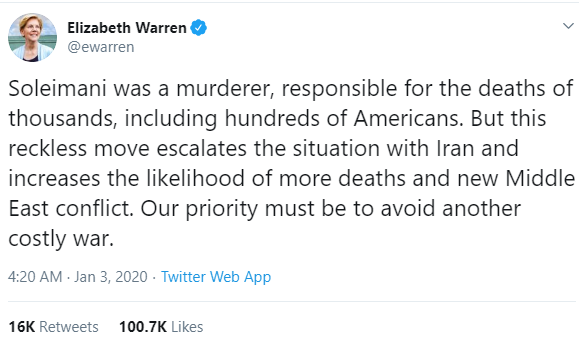
Really? Who were they? When and where? While the Bethlehem Doctrine allows you to kill somebody because they might be going to attack someone, sometime, but you don’t know who or when, there is a reasonable expectation that if you are claiming people have already been killed you should be able to say who and when.
The truth of the matter is that if you take every American killed including and since 9/11, in the resultant Middle East related wars, conflicts and terrorist acts, well over 90% of them have been killed by Sunni Muslims financed and supported out of Saudi Arabia and its gulf satellites, and less than 10% of those Americans have been killed by Shia Muslims tied to Iran.
This is a horribly inconvenient fact for US administrations which, regardless of party, are beholden to Saudi Arabia and its money. It is, the USA affirms, the Sunnis who are the allies and the Shias who are the enemy. Yet every journalist or aid worker hostage who has been horribly beheaded or otherwise executed has been murdered by a Sunni, every jihadist terrorist attack in the USA itself, including 9/11 [sic], has been exclusively Sunni, the Benghazi attack was by Sunnis, ISIL are Sunni, Al Nusra are Sunni, the Taliban are Sunni and the vast majority of US troops killed in the region are killed by Sunnis.
Precisely which are these hundreds of deaths for which Soleimani was responsible? Is there a list? It is of course a simple lie. Its tenuous connection with truth relates to the Pentagon’s estimate – suspiciously upped repeatedly since Iran became the designated enemy – that back during the invasion of Iraq itself, 83% of US troop deaths were at the hands of Sunni resistance and 17% of of US troop deaths were at the hands of Shia resistance, that is 603 troops. All the latter are now lain at the door of Soleimani, remarkably.
Those were US troops killed in combat during an invasion. The Iraqi Shia militias – whether Iran backed or not – had every legal right to fight the US invasion. The idea that the killing of invading American troops was somehow illegal or illegitimate is risible. Plainly the US propaganda that Soleimani was “responsible for hundreds of American deaths” is intended, as part of the justification for his murder, to give the impression he was involved in terrorism, not legitimate combat against invading forces. The idea that the US has the right to execute those who fight it when it invades is an absolutely stinking abnegation of the laws of war.
As I understand it, there is very little evidence that Soleimani had active operational command of Shia militias during the invasion, and in any case to credit him personally with every American soldier killed is plainly a nonsense. But even if Soleimani had personally supervised every combat success, these were legitimate acts of war. You cannot simply assassinate opposing generals who fought you, years after you invade.
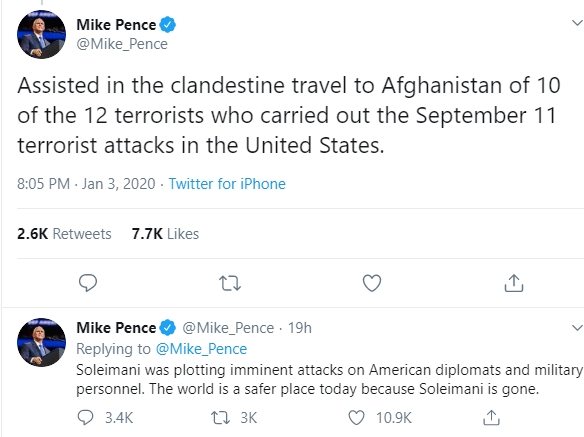
The final, and perhaps silliest lie, is Vice President Mike Pence’s attempt to link Soleimani to 9/11. There is absolutely no link between Soleimani and 9/11, and the most strenuous efforts by the Bush regime to find evidence that would link either Iran or Iraq to 9/11 (and thus take the heat off their pals the al-Saud who were actually responsible) failed. Yes, it is true that some of the hijackers at one point transited Iran to Afghanistan. But there is zero evidence, as the 9/11 report specifically stated, that the Iranians knew what they were planning, or that Soleimani personally was involved. This is total bullshit. 9/11 was Sunni and Saudi led, nothing to do with Iran.
Soleimani actually was involved in intelligence and logistical cooperation with the United States in Afghanistan post 9/11 (the Taliban were his enemies too, the shia Tajiks being a key part of the US aligned Northern Alliance). He was in Iraq to fight ISIL.
The final aggravating factor in the Soleimani murder is that he was an accredited combatant general of a foreign state which the world – including the USA – recognises. The Bethlehem Doctrine specifically applies to “non-state actors”. Unlike all of the foregoing, this next is speculation, but I suspect that the legal argument in the Pentagon ran that Soleimani is a non-state actor when in Iraq, where the Shia militias have a semi-official status.
But that does not wash. Soleimani is a high official in Iran who was present in Iraq as a guest of the Iraqi government, to which the US government is allied. This greatly exacerbates the illegality of his assassination still further.
The political world in the UK is so cowed by the power of the neo-conservative Establishment and media, that the assassination of Soleimani is not being called out for the act of blatant illegality that it is. It was an act of state terrorism by the USA, pure and simple.
Featured Video
Seyed M. Marandi: US-Iran War Inevitable: Kuwait and Bahrain May Fall
or go to
Aletho News Archives – Video-Images
From the Archives
Oil and the Israel Lobby
Reknowned economist M. Shahid Alam offers this excellent critique of Noam Chomsky’s defective analysis of the relative influence of Oil versus the Israel lobby over US foreign policy: … continue
Blog Roll
 Aletho News
- ICC ignored ‘very well-documented’ NATO crimes – ex-Libyan minister
- SNSC secretary dismisses US response to Iran’s conditions as ‘inadequate’
- Sanaa says Taiz roads open, secure for residents, warns Saudi forces
- Iraqi resistance group urges Saudi leadership to admit defeat, lift Yemen siege
- Trump’s Retreat: How Al-Aqsa Flood Took Down the US Empire
- Israel’s Military Actions in Lebanon Grossly Violate International Law — Lavrov
- Seyed M. Marandi: US-Iran War Inevitable: Kuwait and Bahrain May Fall
- Leaders Condemn Ansarallah Attack on Saudi Arabia While Ignoring Illegal War Against Yemen
- Leaked: Britain’s Covert Iraqi Psyops Network
- Yemeni Armed Forces Warn Airlines Against Using Saudi Airports, Exempt Mecca and Medina
- If Americans Knew
- How Israel Conquered the Latin American Right
- Agents search Rep. Omar’s Washington home in criminal probe as she vows she won’t ‘be silenced’
- “The Rule Was: ‘Shoot Everyone You See'”
- Israel goes ballistic over Nobel Laureate Navi Pillay
- U.S. May Join Yet Another Middle Eastern War — TCN
- Yellow Line moves again as Israel closes in on trapped Gazans – Daily Update
- Israeli Attacks Kill Seven Palestinians in Gaza Including Six-year-old Girl
- Gaza: Ceasefire Anniversary Marks Year of Failed Promises
- The American Conservative: Mike Huckabee Should Resign
- A C-Section in Shackles: A Palestinian Woman’s Harrowing Birth in Israeli Detention
- No Tricks Zone
- Germany’s Green Energy Debacle: High Energy Costs Force Kahla Porzellan to Close After 182 Years!
- New Study: 50 Years Of The Most Aggressive ‘Net Zero’ Policies Can Only Affect The Global Climate By 0.03°C
- US September “Heat” Was No Record…Many Records Set Decades Ago
- Latest European Green Energy Debacle; Portugal’s Largest Flagship Solar Park Insolvent!
- Green Energy Debacle: German Expert Professor Fritz Vahrenholt Warns Of Severe Economic And Social Consequences
- Two More Paleo Reconstructions Affirm Meters-Higher Sea Levels Across Ireland, Brazil 7000-6000 Years Ago
- New Study: Earth And Venus Surface Warmth Largely Explained By Convection And Lapse Rate, Not CO2 Or Radiation
- 2025 Nature Paper Claiming Worsening Global Drought Gets RETRACTED …Heavily Flawed
- New Study: ‘Global Drought Shows No Detectable Recent Acceleration Under Climate Warming’
- Economic Masterminds: German Socialists Suggest Taxing Productivity Gains Stemming From Using AI

