Iran’s FM Javad Zarif Claims Israel Tested Nuke-Missile ‘Aimed at Iran’
Sputnik – December 6, 2019
The Defence Ministry of Israel announced in the early hours of Friday morning that it had tested a new rocket propulsion system at a an airbase in the central part of the country, as part of a missile defence modernization plan.
Minister of Foreign Affairs of Iran, Mohammad Javad Zarif, commented on Friday on the recent test by the Israeli defense establishment of what has been described as a rocket propulsion system.
Zarif noted that the United States, along with the three European members of the Iran nuclear deal – officially known as the Joint Comprehensive Plan of Action (JCPOA), have never complained of the Israeli nuclear arsenal, the only nuclear arsenal in the region, although Tel Aviv has missiles that are “DESIGNED to be capable of carrying nukes”.
Earlier on Friday, Israel’s Ministry of Defence tweeted that its defence establishment had carried out a test of a rocket propulsion system from the Palmochim military base, located south of the nation’s capital city of Tel Aviv.
The tested missile propulsion system is reportedly capable of launching defence or attack payloads with a range of up to 2,000 kilometers. It is also said to be capable of carrying nuclear warheads, according to Tel Aviv’s news channel i24 News.
After the US unilaterally left the JCPOA in May 2018, Washington has since been waging a “maximum pressure” campaign against Tehran, claiming that the Islamic republic’s rocket program, alongside Iran’s alleged nuclear ambitions, represent a “threat” to the region. Under this pretext, the Trump administration has introduced multiple sanctions against the government in Tehran and against several senior officials, including Zarif.
Iran has repeatedly denied accusations regarding its intentions to obtain nuclear weapons, continuing to abide by the nuclear deal and urging European signatories to ensure its interests amid reimposed US sanctions, particularly through a partial withdrawal from some of the original commitments under the JCPOA.
‘Shameless Racism’: 13 Countries Change Long-Standing Position on Palestine at UN
Palestine Chronicle – December 5, 2019
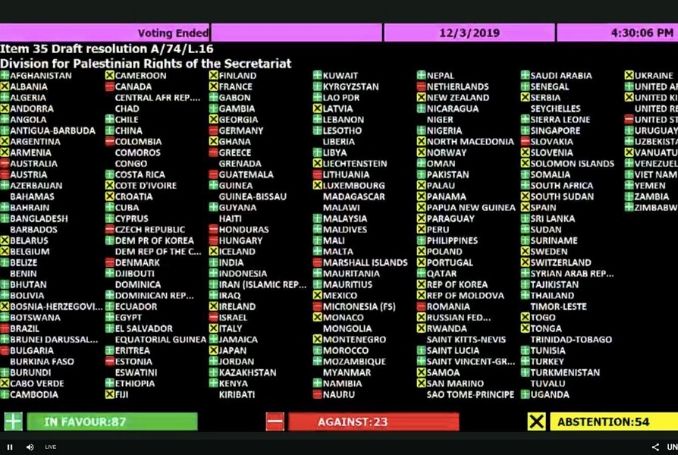
For the first time, 13 countries changed their longstanding positions and voted against a pro-Palestine measure at the United Nations on Tuesday.
Germany, the Czech Republic, Austria, Bulgaria, Denmark, Estonia, Greece, Lithuania, Netherlands, Romania, Slovakia, Brazil, and Colombia voted against the annual resolution regarding the “Division for Palestinian Rights of the Secretariat”, according to the Times of Israel.
They had previously abstained on the vote.
The resolution, which includes a call to halt to illegal Israeli settlements being constructed in the occupied West Bank, still passed with a large majority voting in favor.
The Palestinian representative told the council: “If you protect Israel, it will destroy you all.” He also said Israel’s character as a Jewish state is “shameless racism”.
The New York-based Division for Palestinian Rights oversees the Committee on the Exercise of the Inalienable Rights of the Palestinian People.
The resolution was co-sponsored by Comoros, Cuba, Indonesia, Jordan, Kuwait, Lao People’s Democratic Republic, Qatar, Saudi Arabia, Senegal, the United Arab Emirates, and Yemen.
The UK, France, and Spain abstained, as they do every year, allowing the resolution to pass with a vote of 87-54, with 21 other abstentions.
The General Assembly adopted five resolutions on the question of Palestine and the Middle East, including one calling on the Member States not to recognize any changes to the pre-1967 borders, including with regards to Jerusalem, other than those agreed by the parties through negotiations.
When holidays bring hate: Sarah’s Day in Occupied Hebron

Extremist and racist propaganda placed around Hebron (H2) ahead of Sarah’s Day, a major Jewish holiday.
International Solidarity Movement | November 28, 2019
Hebron, occupied Palestine – The Jewish holiday of Shabbat Chayei Sarah (Sarah’s day’) took place in Al Khalil (also known as Hebron) over the weekend of 22-23 November. Over the two days around 50,000 Israeli settlers flocked to the city, to celebrate the festival in the place that Zionists believe is their religious right (despite the fact that it is historically Palestinian and is clearly within the demarcation of Palestinian Territories).
For weeks the area was being adapted and prepared to accommodate the thousands of visitors. Israeli settlers from nearby illegal settlement Kiryat Arba were to be joined by other observant Jews from across Israel, as well as from countries abroad such as France, the UK, and the USA. The mood was set by blatant Zionist propaganda adorning the streets, such as a banner proclaiming “Palestine never existed – and never will”. Whole areas of the old city and surrounding areas were taken over by gazebos, tents and caravans for the weekend. Exclusive and expensive VIP tickets to celebrate ‘Sarah’s day’ were available for hundreds of US dollars, enabling attendees to meet and dine with religious leaders, alongside Knesset members, and IDF commanders.
By Friday afternoon, thousands of celebrants had arrived in the city and the already extensive Israeli Occupation Force (IOF) presence (normally 4000 IOF soldiers guard the 400 Israeli settlers) was even greater than usual. Enhanced security measures were in place and major roads were blocked off, obstructing Palestinian movement around the city, and forcing Arab shops to close for business in an already suffocated economic environment (due to businesses and areas being closed by military order, and commerce/tourism heavily suppressed by restrictions on movement through checkpoints).
Many of the visiting settlers were visibly armed, with handguns or automated weapons, in stark contrast to Palestinians for whom it is illegal to carry a weapon, tightly enforced at all of the numerous checkpoints.
Each day International Solidarity Movement (ISM) received reports of serious, violent attacks on Palestinians living in or passing through vulnerable areas where settlers filled the streets.
On Friday evening, on the ‘Prayer Road’, leading up to the large settlement of Kiryat Arba, a group of 8 Palestinians were attacked in a barber shop. ISM spoke to one of the victims, Fayed, who reported a large group of settlers forcing entry to his father’s shop. Despite attempts to persuade the settlers to leave, more arrived to join the attack. Up to 100 settlers sprayed pepper spray, threw stones, chairs and pieces of wood, damaging property and injuring Fayed, his brother, his uncle and father. Fayed’s 21 year old cousin suffered a broken hand, whilst he and his uncle and father sustained injuries to the head and arms, resulting in hospitalization. The police eventually moved the settlers on however no arrests were made. Only basic details of the attack were taken down and there has been no further investigation of the crime.
Later that night there were further reports of violent attacks by groups of settlers in the same area, including an assault on a young old child, who was kicked and sprayed with pepper spray, requiring him to be taken to hospital. A Palestinian bride was also harassed and attacked by settlers as she celebrated her wedding day.
Despite the heaviness of occupation pressing down on them, the brutal and unprovoked attacks from the settlers, and frustration at the lack of protection from the authorities, Fayed and his family are quietly resistant. “Our life here is hard, but we have to resist. We try to be nice to everyone… to treat them nice, we don’t want any violence. Violence is not the solution…. the settlers carry M16 guns. It’s normal for us and our situation here – to be attacked, arrested, killed. We grew up like this. What can we do? We don’t have a lot of power or support. We can’t fight with guns or knives, this is not the solution. How many Palestinians have been killed? Guns and knives are not free, they do not make Palestine free. We are not against Jews, we are against Zionists and settlers, and those that occupy our houses. ”
The following day, the entire old city plus large swathes of the normally unrestricted area (known as ‘H1’) was locked down, making way for thousands of settlers to be given religious tours of the city. Many were intoxicated, chanting provocative anti-Palestinian songs, shouting abuse, and urinating on Palestinian property. As the day progressed, their behavior became increasingly violent, with numerous incidents of settlers throwing rocks, bottles and other items at Palestinian people and homes, as well as unlawfully entering or climbing on Palestinian property. IOF remained passive, merely supervising the passage of the crowds through Palestinian areas.
In one shocking incident, a group of settlers attacked the home of a known Palestinian activist, Imad, who has been frequently targeted since speaking out against the murder of a Palestinian by the IOF several years ago.
Imad and his family are some of the few Palestinians brave enough to continue living in Tel Rumeida, part of an area in the heart of the old city which has been designated a restricted military zone (known as ‘H2’). Since 1968 Al Khalil has been subject to the establishment of illegal Jewish settlements, and over the last 20 years, the area has seen a huge influx of hardcore settlers who believe for religious reasons they have a right to occupy the land. These are some of the most extreme settlers in Israel, who routinely perpetrate abuse and violence against Palestinian residents, including children going to school. Many Palestinians have been forced out of their homes and for those who remain, living in this area is extremely dangerous for Palestinians. There is a daily threat to life and limb.
On Saturday, as the streets of Tel Rumeida were inundated with thousands more armed settlers, the violence and intimidation escalated. There were multiple reports of attacks on Palestinian people and property. Footage was recorded of large groups of drunk settlers climbing on the roofs of Palestinian homes, and abusing and intimidating residents.
On Saturday Imad remained confined at home with his grandchildren, due to the large numbers of settlers who had been marching and congregating in the streets outside, making it unsafe for Palestinians to leave the house. Imad heard settlers climbing on his roof, and trying to enter his home through the entrance way. He called friends to come and help. and unsuccessfully tried to convince the settlers to leave. The large group were shouting abuse, spitting and throwing stones at bottles. Moments later Imad heard crying from where his 18 month old grandson was sleeping. As he ran into the room he discovered that a settler had thrown a stone through the open window, striking the child on the head and wounding him.
Due to the closed and restricted nature of this part of the city, an ambulance was unable to reach the house to attend to the child. The child had to be carried through the streets, protected by a circle of local people from the settlers who continued to try to attack the group as they tried to reach the ambulance.
Imad explains that the IOF soldiers arrived at the house during the attack, however they only stood watching, and failed to intervene to stop the violence. When local Palestinian’s arrived to provide support, the soldiers pushed and held them back, threatening to arrest them. The IOF also failed to provide any first aid or show concern for the injured child.
Despite the heavy IOF and Israeli police presence throughout the city during this weekend, it was abundantly clear that they were there to protect the settlers, and not the Palestinian residents. There was a complete failure to protect the Palestinians under attack. Police also failed to undertake any investigation into the various incidents, or attempt to bring to justice those settlers engaging in violence against Palestinians.
This raises concerns that the IOF are turning a blind eye to the violence, sanctioning and enabling it to occur, or alternatively that they simply have no power or authority to control the settlers’ violence. The risk for Palestinians trying to resist the occupation and violence, such as Imad, is to be punished, singly or collectively, for their defiance in the face of the creeping genocide of the Palestinian land and people.
Whilst trying to document and observe violence and abuse, ISM experienced hostility and aggression from both settlers and the IOF, including physical and verbal threats, restriction of movement as well as having our passports photographed by police and threatened arrest, in a clear attempt to deter us from our work. Pro-Palestinian activists in Israel risk deportation, including a 10 year ban from the country, serving to silence and prevent the documenting of human rights violations in Palestine.
Is Criticism of Israel Already an Official Hate Crime in America?
By Philip Giraldi – American Free Press – December 2, 2019
One subject that congressmen and the mainstream media tend to avoid is the erosion of fundamental liberties in the United States as a consequence of the war on terror and American involvement in the Middle East. Some of America’s legislators apparently do not even understand that freedom of speech actually means that one can say things that others might find distasteful. The assault on freedom of speech has been accelerated through the invention of so-called “hate speech,” which has in turn morphed into “hate crimes” where punishments are increased if there is any suggestion that hatred of groups or individuals is involved. Some have rightly questioned the whole concept, pointing out that if you murder someone the result is the same whether you hate your victim or not.
Freedom of speech is particularly threatened in any situations having to do with Israel, a reflection of the power of that country’s lobby in the United States. At a recent town hall gathering, Rep. Dan Crenshaw (R-Texas) demonstrated how he and his colleagues run and hide whenever the issue of Israel is raised when he would not respond directly to a question over whether any criticism of Israel should or should not be protected under the First Amendment. Crenshaw is a Republican and generally reliably conservative, though he recently spoke out against the “For the People Act of 2019,” which he claimed “would limit free speech dramatically.”
A constituent specifically asked Crenshaw’s opinion about federal laws that require citizens in some states to sign a pledge that they will not boycott Israel if they wish to get government contracts or obtain a government job. The audience member also mentioned a law passed in Florida that bans anti-Semitism in public schools and universities, defining “anti-Semitism” as criticism of Israel. The constituent observed, “These laws are obviously flagrant and troubling violations of the First Amendment to free speech.”
“Will you honor your oath and denounce these laws here, now and forever?” Crenshaw was then asked. Crenshaw quickly fired back that the critic was “cloaking yourself in the First Amendment” to enable engaging in “vehement anti-Semitism.” Crenshaw then asserted that the questioner was “advocating the BDS movement,” a recent target of much of the legislation that the critic was addressing.
BDS refers to the Boycott, Divestment, and Sanctions movement, which calls on people to protest Israel by pulling investments from and boycotting the country.
Israel is engaged in what might be described as a war with the objective of driving any and all criticism of the Jewish state out of polite discourse, making it illegal wherever and whenever possible. The Knesset has passed legislation criminalizing anyone who supports BDS and has set up a semi-clandestine group called Kella Shlomo to counteract its message. The country’s education minister has called BDS supporters “enemy soldiers” and has compared them to Nazis. Netanyahu has also backed up the new law with a restriction on foreigners who support the BDS movement entering the country, including American Jewish dissidents, several of whom have been turned around at the airport and sent home.
Israel has been particularly successful at promoting its own preferred narrative, together with sanctions for those who do not concur, in the English language speaking world and also in France, which has the largest Jewish population in Europe. The U.S. government under Donald Trump is completely under the thumb of the Israeli prime minister’s office, with Secretary of State Mike Pompeo recently saying “our major focus is stamping out anti-Semitism.”
Sanctions already in place in Europe consist of fines and even jail time. The legal penalties come into play for those criticizing Israel or questioning the accuracy of the accepted holocaust narrative, i.e., disputing that “6 million died.” Even attacking specific Israeli government policies, like its slaughter of Palestinians in Gaza every Friday, can be found guilty of anti-Semitism, which is now considered a hate crime in Britain, France, Germany, and, most recently, the Czech Republic. In Britain, where the Jewish lobby is extremely strong, a law passed in December 2016 made the UK one of the first countries to use the definition of anti-Semitism agreed upon earlier in the year at a conference of the Berlin-based International Holocaust Remembrance Alliance (IHRA).
A statement from the British prime minister’s office at that time explained that the intention of the new definition was to “ensure that culprits will not be able to get away with being anti-Semitic because the term is ill-defined, or because different organizations or bodies have different interpretations of it.”
The British government’s own definition relies on guidance provided by the IHRA, which asserts that it is considered anti-Semitic to accuse Jews of being “more loyal to Israel or their religion than to their own nations, or to say the existence of Israel is intrinsically racist.” In other words, even if many Jews are more loyal to Israel than to the countries they live in and even though Israel is in fact intrinsically racist, it is now illegal to say so in Great Britain.
One should not be surprised, as the British government’s subservience to Jewish and Israeli interests is nearly as enthusiastic as is government in the United States, though it is driven by the same sorts of things—Jewish money and Jewish power, particularly in the media. A majority of Conservative Party members of parliament have joined Conservative Friends of Israel, and the Labour counterpart is also a major force to be reckoned with on the political left.
Here in the United States, the friends of Israel appear to believe that anyone who is unwilling to do business with Israel or even with the territories that it has illegally occupied should not be allowed to obtain any benefit from federal, state or even local governments. Constitutional guarantees of freedom of speech and association for every American are apparently not valid if one particular highly favored foreign country is involved, as the discussion with Crenshaw reveals.
Twenty-seven states now have laws sanctioning those who criticize or boycott Israel. And one particular pending piece of federal legislation that is regularly re-introduced into the Senate would far exceed what is happening at the state level and would set a new standard for deference to Israeli interests on the part of the national government. It would criminalize any U.S. citizen “engaged in interstate or foreign commerce” who supports a boycott of Israel or who even goes about “requesting the furnishing of information” regarding it, with penalties enforced through amendments of two existing laws, the Export Administration Act of 1979 and the Export-Import Act of 1945, that include potential fines of between $250,000 and $1 million and up to 20 years in prison.
Israel, and its friends like Crenshaw, are particularly fearful of the BDS movement because its non-violence is attractive to college students, including many young Jews, who would not otherwise get involved on the issue. The Israeli government clearly understands, correctly, that BDS can do more damage than any number of terrorist attacks, as it represents a serious critique of the behavior of the Jewish state while also challenging the actual legitimacy of the Israeli government and its colonizing activity in Palestine. Much of the current hate crime legislation in places like Germany and the Czech Republic directly targets BDS, stating specifically that it is “inherently” anti-Semitic. In late July, the House of Representatives overwhelmingly passed its own resolution condemning BDS explicitly in a 398-to-17 vote.
Going hand-in-hand with the condemnation of BDS is a drive to maintain the exclusivity of Jewish suffering. In June, when Rep. Alexandria Ocasio- Cortez (D-N.Y.) called border detention centers holding asylum seekers “concentration camps,” she was inundated with protests from Jewish groups that claimed she was denigrating the holocaust and “insulting victims of genocide.” The United States Holocaust Memorial Museum even published a statement objecting to comparisons between “the holocaust and other events.”
It is important for Americans to realize that Israel not only spies on the U.S., digs its paws deep into our Treasury, and perverts Washington’s Middle East policy, it is also attempting to dictate what we the people can and cannot say. And Congress and much of the media are fully on board, which is the real tragedy.
French MPs pass pro-Zionism resolution, defy warnings by advocates of Palestine rights
Press TV – December 4, 2019
The lower house of France’s Parliament has passed a nonbinding resolution equating criticism of the Zionists occupying Palestinian territories with anti-Semitism, defying warnings that such a move could serve to stifle the advocates of Palestinian rights.
The National Assembly passed the resolution on Tuesday, with 154 votes for and 72 against, various media outlets reported.
The resolution states, “Criticizing the very existence of Israel as a collective composed of Jewish citizens is tantamount to hatred towards the Jewish community as a whole.”
“Such abuses increasingly make anti-Zionism ‘one of the contemporary forms of anti-Semitism’ in the words of the President of the Republic,” it adds, citing French President Emanuel Macron.
The Zionist entity proclaimed existence in 1948 after occupying huge swathes of regional countries during a Western-backed war.
Right before the war, it had already gone on a campaign of ethnic cleansing that lasted until 1949, leading to the expulsion of between 750,000 and 850,000 Palestinians from their homeland while the Israeli regime was replacing them with a similar number of Jewish migrants.
Still using far-and-wide Western backing, the regime staged another wholesale war in 1967 that saw it seizing more chunks of land, including the West Bank, East Jerusalem al-Quds, the Gaza Strip and parts of Syria’s Golan Heights.
Many Jews worldwide are opposed to the occupation of Palestinian land and reject the Zionist concept of Israel being a legitimate Jewish state, arguing that the Zionist entity has hijacked their religious identity so it could push ahead with its land theft agenda.
Israeli Minister of Strategic Affairs Gilad Erdan applauded the French lawmakers’ approval of the resolution, urging Paris to take “practical steps” against the international pro-Palestine Boycott, Divestment, and Sanctions (BDS) movement.
Inspired by the South African anti-apartheid movement, the BDS was initiated in 2005 by over 170 Palestinian organizations and later turned international. It is meant to initiate “various forms of boycott against Israel until it meets its obligations under international law” and end its occupation of Palestinian lands.
The French MPs’ move came despite earlier warnings by activists and rights organizations that such a resolution could work to block any criticism of the occupying entity.
In a letter to National Assembly President Richard Ferrand in October, 39 organizations said the resolution would compromise “defense of freedom of expression and assembly for groups and activists that must be allowed to defend the rights of Palestinians and criticize Israel’s policy without being falsely accused of anti-Semitism.”
The resolution would also “weaken the universalist approach” to combating all forms of racism,” the letter added.
As the French legislators were about to adopt the measure, a group of 129 Jewish and Israeli scholars signed a petition calling on the parliament to vote against the resolution.
The signatories said, “It is cynical and insensitive to stigmatize them (Palestinians) as anti-Semites for opposing Zionism… They oppose Zionism not because they hate Jews, but because they experience Zionism as an oppressive political movement.”
Speaking to France 24, James Cohen, a professor at the Université Sorbonne Nouvelle Paris 3 and one of the signatories, said that “by equating anti-Zionism with anti-Semitism, you’re broadening the definition of anti-Semitism too much […] you’re going very far afield.”
Only 19.7% of Americans agree with US State Dept on Israeli settlements
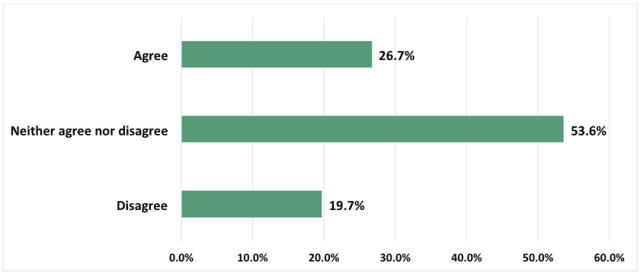
IRmep Poll: “International law SHOULD APPLY to Israel’s military occupation & colonization of the West Bank, Golan Heights, E. Jerusalem and displacement of their indigenous populations. Do you Disagree or Agree?”
More than 80 percent of Americans seem unwilling to let Israel reinterpret international law to suit its colonialist agenda.
By Grant F. Smith | IRmep Polls
IRmep representative public opinion poll of 2,034 American adults through Google Surveys on November 20-22. Answer order randomly reversed.
Most American adults of voting age don’t appear willing to reject the applicability of international law to Israel’s ongoing colonization of occupied territories in East Jerusalem, the West Bank and Golan Heights.
On Monday, November 18, U.S. Secretary of State Mike Pompeo reversed a 1978 State Department legal opinion stating that Israeli settlements were “inconsistent with international law.” Citing President Ronald Reagan’s 1981 assessment that the settlements were not “inherently illegal,” Pompeo stated that, “After carefully studying all sides of the legal debate… the establishment of Israeli civilian settlements in the West Bank is not, per se, inconsistent with international law.”
The Trump administration relocated the U.S. Embassy from Tel Aviv to Jerusalem in 2018 and recognized the city as the capital of Israel. This most recent announcement is yet another blow to rule of law and international consensus. However, when polled, 53.6 percent of Americans don’t yet appear ready to register any concrete view on the matter. This may be due to the longstanding absence of serious U.S. mass media coverage of historical and legal issues. In other countries, informed and ongoing international legal analysis is the norm. Given that reality, it is surprising that 26.7 percent of Americans believe international law still applies, while only 19.7 percent believe it does not.
In a Nov. 21 letter sent to Pompeo, 107 House Democrats condemned the State Department’s recent decision on settlements.
Grant F. Smith is the director of the Institute for Research: Middle Eastern Policy in Washington, DC. For more IRmep polls, visit https://IRmep.org/Polls.
Israeli Minister of Defense to Impose Sanctions on Palestinian ‘Militants’ Abroad

IMEMC & Agencies – December 3, 2019
Israeli Minister of Defense, Naftali Bennett, on Tuesday, issued a written order imposing international economic sanctions on Palestinian militants abroad, The Palestinian News and Info Agency reported.
Hebrew media outlets broadcast Bennett’s decision, pointing out that this move has never been attempted before.
Bennett issued his first order against Jamil Hersh, a member of the Arab Society for Human Rights in London, members of Lebanon’s Hezbollah party will also be sanctioned.
French vote one step closer to anti-Zionism ban
By Ramin Mazaheri – Press TV – December 3, 2019
Paris – France’s media has remained nearly silent ahead of a vote on a resolution which is one step away from criminalizing opposition to Zionism.
If the motion passes, in a vote on December 3rd, it will throw open the door to false accusations of anti-Semitism for anyone openly criticising Israeli crimes, war atrocities and its Apartheid policies.
The resolution purposely tries to confuse “Zionism”, which refers to the imperialist and segregationist political project upon which Israel is based, with “anti-Semitism” which is a bigotry against Jews and Judaism that has nothing to do with Israeli massacres and crimes against Palestinians and non-Jews.
The hypocritical irony is that the law arrives just as France is in the midst of its latest wave of Islamophobia. Last month many top, alleged leftist politicians refused to denounce Islamophobia because they said that doing so could mean they are not allowed to publicly criticise the tenets of Islam. Protesters in Paris asked: where are France’s many self-proclaimed defenders of free speech?
The resolution states that, “Criticizing the existence of a Jewish state is a way to express hate towards the entire Jewish community.” Not only is this logically false, but inaccurate: studies show the majority of Jews in Europe are also anti-Zionist. Such a view also unjustly and dangerously tries to hold all Jews responsible for the crimes committed by Israel.
Many believe that nowhere in the world is right and wrong clearer than in Palestine, and the inability to discuss the imperialist, segregationist and constantly murderous project of Zionism will surely lead to more funerals for innocent Palestinians.
The International Zionist Conspiracy
It poisons everything it touches

By Philip Giraldi • Unz Review • December 3, 2019
A recent article by Philip Weiss on the Mondoweiss website lays out an argument that most liberal Jews, like Weiss, are hesitant to support, namely that Jewish power, and more to the point its money, as exercised through the so-called Israel Lobby in the United States and elsewhere, has been the principal enabling force behind the international pariah that the state of Israel has become.
Weiss notes how “most observers accept the antisemitism redlines echoed lately by Bernie Sanders: you are not to speak of an outsize Jewish role in politics. So few write about the Israel lobby, though they know it to be a significant force…” In other words, Sanders, liberal to the core and ostensibly supportive of Palestinian rights, draws a line that forbids any real discussion of Jewish power in the United States even though everyone who has not been asleep is more than aware of just how powerful American Jews, and by extension Israel, are.
Weiss details how the vast sums of money raised by both Democratic and Republican Jews has distorted American politics since the time of President Harry S. Truman. He describes how president after president has backed down versus Israel when confronted by Jewish power and observes that “This is not just a domestic political question, it’s a foreign policy problem. The Israel lobby is the root cause of the Israel Palestine conflict. Consider the two… main causes of the conflict. 1, Israeli settlement/colonialism (or in Zionist terms, the effort to liberate European Jewry from persecution by establishing a Jewish homeland in historical Palestine). 2, Palestinian resistance to 1. Neither of these historical forces would still be a source of serious conflict 71 years after Israel’s establishment were it not for the lobby. Without the blind support of the United States, Israel would have made a deal a long time ago. The country would have followed through on the historic Palestinian concession of 1988 followed by the Arab Peace Initiative of 2001, and accepted partition of the land on highly favorable terms (Israel gets 78 percent). Without U.S. support, Israel would have been internationally isolated and would have grabbed the deal. The Israelis have been able to continue to devour the land only because the United States supports the occupation in international fora, and gives Israeli a diplomatic umbrella against any storm, due to blind bipartisan political backing here.”
Jewish power in America and elsewhere must never be discussed unless it is a discussion involving only Jews, who openly recognize and appreciate the phenomenon. Weiss notes how “Israel lobbyists themselves extol Jewish political power in the U.S. as Israel’s lifeline for money and arms and diplomatic protection” and quotes Michael Koplow of the Israel Policy Forum, who boasts how “I have no qualms about pointing out that the American Jewish community is almost certainly the most influential minority community in the history of the U.S., and possibly in the history of the world. American Jews have worked hard to make it so, and have built a network of outward-facing institutions that protect this privileged position.”
Beyond Weiss’s observations, one might note how Zionist Jews are essentially able to shut down any discussion of Palestine or of Palestinian rights. Given the extreme over-representation of Jews in both the news generation process and in various choke points in the political process, an honest discussion of Israel-Palestine and the actual U.S. interests in the region is extremely difficult to find anywhere in the mainstream media.
In both the 2012 and 2016 Democratic Party conventions, for example, there was considerable pressure from the members of the party base to include language reflective of the need to recognize Palestinian suffering and condemn the Israeli “occupation.” Long-time liberal activist James Zogby pushed for an amendment to the party platform in 2016 calling for “an end to occupation and illegal settlements” in Israel-Palestine. In both conventions, Hillary Clinton interests pushed back and rejected any changes, arguing that they would constitute “terrible mistake[s],” too “one-sided” toward the Palestinians. In both instances there was loud and sustained booing from the floor when the reflexively pro-Israel platform was announced, but the speaker rejected calls for any floor vote.
To cite another example, two weeks ago, California’s Democratic party concluded its fall convention by finalizing what would be included in the state party platform. An amendment promoted by Palestinian supporters was defeated in a floor vote. It was offered by delegate David Mandel, himself a Jew, and called on the party to support “a solution of the Israeli-Palestinian conflict negotiated by the parties that guarantees equality, security and democracy for all, no matter what the final settlement regarding states and borders” and called on party members to “oppose any unilateral annexation of territory, and support the right of all those who were forced from their homes to return to their homelands and receive compensation for their losses.” Mandel’s proposal attracted the ire of Zionist apologists including State Senator Scott Wiener and Assemblywoman Laura Friedman, who asserted that “This amendment cuts to the core of Israel’s ability to be its own state.”
One might observe that the Mandel amendment was pretty mild stuff relatively speaking, even excluding the word “occupation,” and that the Wiener-Friedman riposte is nonsense, but the result was more of the same. Reliably liberal California Democrats delivered the usual pander to Israeli-Jewish interests. They surrendered to the persistent Jews-in-politics demand never to give even one inch when it comes to permitting Israel absolute license to behave badly while at the same time extracting from the United States billions of dollars in subsidies every year.
And the Israel conspiracy might well be regarded as international. In France, which has the largest diaspora Jewish population after the United States, hate legislation which de facto protects only Jews has been employed to shut down any and all criticism. It has become common all across Europe to regard any criticism of Israel as anti-Semitism and therefore as a hate crime, with criminal penalties attached. French comedian Dieudonné, who admittedly is rather pointed in his satire, has been convicted eight times.
And then there is the sad case of Jeremy Corbyn, British Labour Party leader who will be contesting a national election on December 12th. Corbyn has been accused of being an anti-Semite based on his fairly mild defense of Palestinians, which one might have thought to be a good, sound socialist human rights position. And so it would be if Israel were not involved. With the election looming, British Jews have increased pressure on Corbyn and by default are endorsing his conservative opponent Boris Johnson, who has spoken repeatedly about his love of Israel. Britain’s Chief Rabbi Ephraim Mirvis recently produced an article for the influential Times of London declaring Corbyn “unfit for office” because “the way in which the [Labour] leadership has dealt with anti-Jewish racism is incompatible with the British values of which we are so proud — of dignity and respect for all people.”
The good rabbi is not, of course including Palestinians as worthy of “dignity and respect.” He is really only concerned about his own tribe and the “racism” he refers to is largely concentrated among those Britons who are opposed to Israeli government policies. Britain is already in some senses Zionist controlled territory, even more so than the United States. Jews are prominent at many choke points in the media and entertainment industries while 80% of Conservative Party politicians are members of “Conservative Friends of Israel.” The Labour Party is also active engaged with their own version of the same, Labour Friends of Israel, which includes 80 out of the party’s 262 members of parliament.
Finally, International Zionism is very well represented in recent announcements coming from the world of professional sports, where billionaire Jewish team owners take their orders from Israel to combat critics and the scourge of anti-Semitism.
In January 2019 New England Patriots owner Robert Kraft received the Genesis prize, a million-dollar award given annually to Jews “who have attained excellence and international renown in their chosen professional fields.” Kraft’s friend Israeli Prime Minister Benjamin Netanyahu personally presented the plaque and Kraft told the audience that he would use the money to combat anti-Semitism and the BDS (the Boycott, Divestment and Sanctions) movement. He also pledged to add $20 million of his own money to set up a foundation to do more of the same. Kraft enthused “Israel is so special to me and my family… I have sponsored dozens of missions and countless other trips for people to experience Israel for the first time. Spiritually, there is no place like it on earth.”
Perhaps Kraft should move to Israel so he won’t be troubled by allegations of dual loyalty made by people like me. He has now been joined by Britain’s Chelsea football club owner Roman Abramovich, a billionaire investor who has pledged £3.9m ($5 billion) of his own money to support the foundation “to tackle anti-Semitism.” Abramovich was born in the Soviet Union but is an Israeli citizen and lives most of the year in that country. He has been linked to a number of financial scandals.
Kraft, of course, has his own baggage. On February 22nd, 2019, he was charged in Jupiter Florida for “soliciting another to commit prostitution.” Kraft was reportedly video recorded by a hidden camera while engaged in sexual activity within the confines of a seedy enterprise called the Orchids of Asia Day Spa that sold the services of Asian sex trafficked women. The case is still being resolved but Kraft denies the charges and he has plenty of high- priced lawyers to make sure that he walks.
Beyond all that, if one doubts the power of the Jewish/Israel lobby internationally, note one of the first actions undertaken by the new coup government in Bolivia. It has moved to reestablish diplomatic relations with Israel as a top priority. Brazil also sought a closer relationship with Israel after conservative Jair Bolsonaro was elected president and pledged to visit the Jewish state, a promise which he carried out in March. Everyone in the world understands that the way to gain favor with Washington is to go through Israel.
Philip M. Giraldi, Ph.D., is Executive Director of the Council for the National Interest, a 501(c)3 tax deductible educational foundation (Federal ID Number #52-1739023) that seeks a more interests-based U.S. foreign policy in the Middle East. Website is councilforthenationalinterest.org, address is P.O. Box 2157, Purcellville VA 20134 and its email is inform@cnionline.org.
UN: Israeli occupation costs Palestinians $48 billion

MEMO | December 2, 2019
A UN report found that the fiscal cost of Israeli occupation for the Palestinian people in 2000-2017 period is estimated at $47.7 billion, or three times the size of the Palestinian economy in 2017, reports Anadolu Agency.
Mutasim Elagraa, an economist with the UN Conference on Trade and Development (UNCTAD), discussed the report Monday at a news conference in Geneva.
“In the last decade, several UNCTAD studies and reports have addressed the Palestinian fiscal leakage to Israel,” said Elagraa.
The report – entitled Economic cost of the Israeli occupation for the Palestinian people: Fiscal aspects – will be presented to the UN General Assembly on Tuesday.
“This fiscal leakage prompted other international organizations to bring this issue into question, which helped in retroactively retrieving part of the fiscal resources of the Palestinian National Authority (PNA) from Israel,” he said.
The economist said the estimate comprises lost public revenues and interest payments.
According to the report, it includes $28.2 billion in estimated accrued interest and $6.6 billion of leaked Palestinian fiscal revenues to Israel, and the amount continues to rise.
“This estimated cumulative fiscal cost of occupation by Israel would not only have eliminated the Palestinian budget deficit estimated at 17.7 billion US dollars during the same period. It would have also generated a surplus nearly twice the size of the deficit,” Elagraa said.
Alternatively, it would have increased more than tenfold the Palestinian government’s development spending, pegged at $4.5 billion during the period under review, according to the report.
Michael Bloomberg’s Israel connection runs deep
The Democratic Party’s Michael Bloomberg, has strong ties to Israel and apparently no time for justice for Palestinians; his media empire has also pushed a pro-Israel agenda.
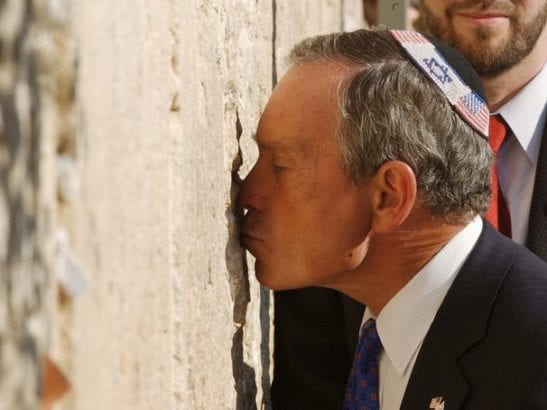
Then-Mayor Bloomberg kissing the Western Wall in Jerusalem on a visit to Israel in 2003 (GETTY IMAGES)
By Kathryn Shihadah – If Americans Knew – November 29, 2019
The pool of democratic candidates for president just expanded again with the addition of billionaire and three-term mayor of New York City, Michael Bloomberg. If Americans Knew has published multiple reports on the candidates’ positions regarding Israel/Palestine (including an in-depth analysis of Joe Biden and a comparison of Elizabeth Warren and Bernie Sanders); it’s only fair to have a look at Bloomberg as well.
The newest candidate has close ties to the Jewish state and asserts a commitment to what he calls “Jewish values.” The New York Times quoted Bloomberg:
The values I learned from my parents are probably the same values that, I hope, Christians and Muslims and Hindus and Buddhists learned from their parents. They’re all centered around God put us on Earth and said we should take care of each other. We have an obligation not to just talk about it but to actually do it. [Those values are] freedom, justice, service, ambition, innovation.
Michael Bloomberg’s record indicates that, when it comes to Palestinians, his close affiliation with Israel has hampered his ability to act on his values of freedom and justice.
Israel ties
Bloomberg has made many trips to Israel and donated millions to charitable causes in Jerusalem, including in 2003 a Mother and Child Center at the Hadassah University Medical Center dedicated to his mother, and in 2007 a blood bank and massive ambulance station named after his father.
During his time as NYC mayor, Bloomberg initiated a $2 billion high-tech research campus in Manhattan, a joint venture between Cornell University and the Technion-Israel Institute of Technology (Haifa, Israel). He personally donated $100 million to the effort.
In 2014, he talked about his closeness to the Jewish state:
My parents saw in our lives just why Israel had to exist, and why it must always exist, and those lessons were passed on to us. We are as one with this city [Jerusalem], and this country and this people as you can be.
[Jewish history] gives us a special obligation to build a brighter future for everyone, and to always believe that tomorrow can be better than today. For them and for so many Jews who witnessed the horrors of World War II, the creation of Israel embodied that obligation and validated that belief. It was a dream fulfilled.After all, if the dream of Israel can be realized, what dream can’t be?
Bloomberg’s words betray a total disregard for the Palestinian experience: the birth of the state of Israel came at the cost of the indigenous Palestinians’ loss of a homeland. 750,000 became refugees, thousands were massacred, and hundreds of villages were bulldozed – so that Jewish immigrants (and a small number of indigenous Jews) could have a nearly Arab-free state.
Michael Bloomberg was the inaugural recipient of the Genesis Prize, which was created to “inspire Jewish pride” and “strengthen the bond between Israel and the Diaspora.” He turned the $1 million prize into a global competition for ten $100,000 prizes – to be awarded to young entrepreneurs who demonstrated “Jewish values” and innovative ideas.
One of those prizes was awarded to Building with Israelis & Palestinians (BIP), which according to its website, “gives an opportunity for people around the world to partner with; and support Israelis & Palestinians willing to build together.” In 2016, BIP worked in the Palestinian town of Al-Auja to provide a solar facility that would enable farmers to pump more water less expensively.
What is not publicized about this project is the fact that in 1967, after Israel’s occupation of the West Bank, about 30% of Al-Auja’s land was confiscated from its Palestinian owners, some of which became four illegal Israeli settlements. More land was then confiscated in order to build a military base to protect the residents of the settlements. Most of the remaining village land is under total Israeli control.
Israeli skies
In 2009, when Israel was embroiled in an invasion of Gaza and the Federal Aviation Administration (FAA) downgraded Ben Gurion Airport’s security rating, then-mayor Bloomberg took his private jet to Israel as a show of solidarity. He visited Sderot, an Israeli city close to Gaza and within range of its rockets (rockets that had, as of that time, caused the deaths of 18 Israelis in 8 years).
Significantly, Sderot was built on the site of the demolished Palestinian village of Najd – a village whose history went back at least four centuries.
Bloomberg did not address the reason for the rockets – Israel’s then-two year long illegal siege of Gaza (a siege that still continues, and is designed to keep the Strip on the verge of collapse and its residents on the edge of starvation). Instead, he Bloomberg accused Gaza’s leaders of “trying to destroy [Israel].”
It would appear that the opposite is true: the Israeli invasion killed over 1,400 Gazans (over 900 of them civilians) and 13 Israelis (3 of them civilians).
In July 2014, during another Israeli onslaught, when Ben Gurion Airport was within reach of Gazan rockets, the FAA announced the suspension of all US flights to Israel; in defiance of this decision and solidarity with Israel, Bloomberg again flew to Israel.
Ignoring the facts of the ongoing blockade of Gaza and the humanitarian crisis that it had created, he wrote in an op-ed:
Every country has a right to defend its borders from enemies, and Israel was entirely justified in crossing into Gaza to destroy the tunnels and rockets that threaten its sovereignty. I know what I would want my government to do if the U.S. was attacked by a rocket from above or via a tunnel from below; I think most Americans do, too. Israel has no stronger ally than the U.S.
Michael Brown noted in the Electronic Intifada that Bloomberg’s op-ed failed to contextualize Israel’s onslaught: no reference was made to the occupation of Palestine or the siege of Gaza, and “[h]e says not a word about Palestinian freedom, but speaks only in general terms about ‘bringing peace to the region.’”
In a CBS interview a short time later, Bloomberg declared that Israel was not under obligation to limit itself to “proportional” response to Gaza’s rockets, and “nobody’s attacking schools or hospitals, we’re attacking Hamas.”
And indeed, Israel was unrestrained. Its 2014 assault killed 2,250 Gazans (about 1,600 civilians) and 73 Israelis (6 of whom were civilians).
Israel’s failure to act with proportionality – and Michael Bloomberg’s endorsement of this failure – clashes with international law, which prohibits attacks that would cause “excessive” civilian damage or loss of life in relation to the anticipated military advantage of the attack.
Israel’s military objective in both 2008-9 and 2014 was to end Gaza’s practice of shooting rockets – rockets that were rarely lethal – but Israel’s attacks caused heavy civilian casualties and immense destruction in a region that was already suffering the effects of an illegal blockade. Because of the disproportionate nature of the attacks and other factors, the United Nations determined that Israel committed war crimes and crimes against humanity in both the 2008-9 invasion (read more about it here) and that of 2014 (read more here). The Hamas leadership in Gaza also faced accusations of war crimes.
Through pro-Israel eyes
Other “small” incidents can be added to the above large, conspicuous examples of Michael Bloomberg’s affinity for all things Israeli.
For example, in 2014, he referred to the nonviolent movement known as Boycott, Divest, and Sanction (BDS) – modeled after the movement that brought the downfall of apartheid in South Africa – as “an outrage” that is “totally misplaced.” The ACLU has argued in favor of BDS as free speech, but Israel partisans routinely label it anti-Semitic.
As early as 2002, Bloomberg’s mainstream media empire, Bloomberg News, was demanding that its writers sanitize news reporting about Israel/Palestine. Mondoweiss quotes leaked memos:
Avoid referring to Palestine, as in “Israel’s incursion into Palestine,” because there is no such country. Instead, describe the occupied areas by their names, as in the West Bank or Gaza Strip. Palestinian people or Palestine Authority is OK.
A 2010 memo gave a selective history lesson:
Palestine signifies different territory in different contexts. The land historically belonged to the kingdoms of Israel and Judah. Palestine represented the area west of the Jordan River that was a British mandate from the 1920s until the creation of modern Israel in 1948.
Significantly, Bloomberg News, usually a stickler for objectivity in reporting, relaxes its standards when it comes to Israel. The above memo – and others circulated in the organization – were understood by Scott Roth, “dissenting Jew” and publisher of Mondoweiss as “an attempt to avoid using the term Palestine in any way that would signify that it ought to be or can be a country on its own.” He also noted that Bloomberg’s directives look:
like something out of an AIPAC primer. The land historically belonged to ancient Israel and Judah? It also belonged to a lot of other people. Plus no reference to partition, ’48, ’67 occupation or millions of human beings living under Israel’s boot that have no vote.
No surprise
The question is whether Michael Bloomberg would be very good for the United States.
The ballad of India’s Kashmir and Israel’s Palestine

Palestinian children play outside their dwelling in al-Eizariya town in the Israeli-occupied West Bank with the Jewish settlement of Maale Adumim in the background.
By M. K. BHADRAKUMAR | Indian Punchline | November 29, 2019
“I believe the security situation will improve (in J&K), it will allow the refugees to go back, and in your lifetime, you will be able to go back … and you will be able to find security, because we already have a model in the world.”
“I don’t know why we don’t follow it. It has happened in the Middle East. If the Israeli people can do it, we can also do it.”
The above reported remarks by India’s consul-general in New York Sandeep Chakravorty while addressing an audience of Kashmiri Pandits raised some dust in the Indian media. But his job or career is no mortal danger.
For, Chakravorty must be an intelligent man and probably estimated that he was only articulating from a Track 1.5 platform the Modi government’s surreptitious policy in J&K — following the Israeli footfalls of forcible occupation and colonisation of lands inhabited by alienated people.
Whether the policy is doable or not is for time to tell. To my mind, the final word is not yet available whether even the brutal Israeli policy will work or not. Besides, circumstances are vastly different, and Kashmir is not an analogous situation.
The main difference is that although the Indian state resorted to the use of force, much like Israel had done in Palestinian lands, the security situation has only deteriorated over the years, over decades. There are no two opinions that even half a million troops could not achieve anything by way of enduring results in the Kashmir valley.
The ground realities in the valley militate against repression and state terrorism as viable policy option for a country such as India. The stark evidence of it lies in the government’s decision in August to change the status of J&K, which is an admission of failure rather than a mark of triumphant glory.
Consul-general Chakravorty seems unaware how Israel went about systematically to prepare an external environment first by subduing the Arab countries that surrounded it and harboured sympathy, and were willing to support the Palestinian cause. Arguably, India too should begin with defeating and subduing Pakistan first? But, honestly, such an option is not available for India in our thermonuclear era, now or ever, the bravado of our ruling elite and their acolytes notwithstanding.
Then, there is the western support for Israel, which helps it to get away with murder. The underlying factors here are complex and deep rooted in history. At its core, the western countries are constantly forced into an attitude of atonement for their anti-semitism that has a long and loathsome history dating back centuries. Remember the notorious Dreyfus affair in France — leave alone the slaughter of Jews in the Holocaust, which makes Angela Merkel wobbly in the legs even today when she mentions Israel.
Israel plays the “anti-semitic card’ very effectively. In actual practice, any criticism of Israeli state violations against Palestinians is instantly discredited as being “antisemitic”. Today, US Congresswomen Ilhan Omar and Rashida Tlaib and British Labour Party leader Jeremy Corbyn are in the crosshairs of the Israeli lobby for this reason. Corbyn’s sin is that he has pledged to cut military trade with Israel and move to officially recognise a Palestinian state, if elected to power.
The well-known commentator Finian Cunningham recently wrote, “This conflation of valid criticism of the Israeli state with being “anti-Jew” is a cynical distortion which is wielded to give Israel impunity from international law. It plays on moral blackmail of critics by equating the historical persecution of Jews and in particular the Nazi holocaust with the sanctity of the modern Israeli state.”
Unfortunately, there is a notion even amongst educated Indians (including bureaucrats in the Indian Foreign Service) that linking up with the Jewish organisations would enable India to piggy ride on the Israeli lobby in the US. The false notion largely stems from sinister claims about the influence of “Jewish money” — and, it is not of recent origin. Didn’t Brajesh Mishra, the NSA under Atal Bihari Vajpayee, envisage a US-Israel-India condominium?
The heart of the matter is that India is not Israel. Unlike Judaism, Hinduism is not an Abrahamic religion and it is not joined at the hips with the Christian world. This is one thing. Second, while large sections of Hindus too have suffered cruel persecution through centuries, it happened to be at the hands of their co-religionists. Clearly, there is no reason for atonement on the part of the West.
Third, while Indian-Americans are a prosperous community relatively, their clout in the Wall Street is minimal. Unlike the “Jewish lobby”. Simply put, following the Israeli footfall on the occupation and colonisation of the Palestinian homeland or the territories illegally annexed during wars will not take India very far in regard of the J&K situation.
The bottom line is that the western opinion on Kashmir is supportive of neither India nor Pakistan. It always rooted for the “Third Option” — an independent and sovereign state of Kashmir. The official US position, in particular, always made it a point to stress that any solution should take into account the “wishes of the Kashmiri people.”
In the prevailing geopolitical situation in Asia, an independent Kashmir state will be a strategic asset for Washington. Surely, any colonisation of Kashmir Valley by non-Kashmiris grates against the US interests. Israel, on the contrary, is itself a western creation on the map of the Middle East and the US condones Israel’s war crimes and aggressive state policies as a matter of regional strategy.
One would imagine that an Indian diplomat of the rank of ambassador would know that discretion is the better part of valour. Yet, he voiced maverick opinions like a run-of-the mill rabble-rouser on the Hindutva platform, which, he should be intelligent enough to grasp, would only serve to confirm Pakistani allegations regarding the Modi government’s intentions behind the change of status of J&K. The politicisation of the Foreign Service, which such sordid episodes highlight, won’t serve any good.
Featured Video

Seyed M. Marandi: US-Iran War Inevitable: Kuwait and Bahrain May Fall
or go to
Aletho News Archives – Video-Images
From the Archives
Oil and the Israel Lobby
Reknowned economist M. Shahid Alam offers this excellent critique of Noam Chomsky’s defective analysis of the relative influence of Oil versus the Israel lobby over US foreign policy: … continue
Blog Roll
 Aletho News
- ICC ignored ‘very well-documented’ NATO crimes – ex-Libyan minister
- SNSC secretary dismisses US response to Iran’s conditions as ‘inadequate’
- Sanaa says Taiz roads open, secure for residents, warns Saudi forces
- Iraqi resistance group urges Saudi leadership to admit defeat, lift Yemen siege
- Trump’s Retreat: How Al-Aqsa Flood Took Down the US Empire
- Israel’s Military Actions in Lebanon Grossly Violate International Law — Lavrov
- Seyed M. Marandi: US-Iran War Inevitable: Kuwait and Bahrain May Fall
- Leaders Condemn Ansarallah Attack on Saudi Arabia While Ignoring Illegal War Against Yemen
- Leaked: Britain’s Covert Iraqi Psyops Network
- Yemeni Armed Forces Warn Airlines Against Using Saudi Airports, Exempt Mecca and Medina
- If Americans Knew
- How Israel Conquered the Latin American Right
- Agents search Rep. Omar’s Washington home in criminal probe as she vows she won’t ‘be silenced’
- “The Rule Was: ‘Shoot Everyone You See'”
- Israel goes ballistic over Nobel Laureate Navi Pillay
- U.S. May Join Yet Another Middle Eastern War — TCN
- Yellow Line moves again as Israel closes in on trapped Gazans – Daily Update
- Israeli Attacks Kill Seven Palestinians in Gaza Including Six-year-old Girl
- Gaza: Ceasefire Anniversary Marks Year of Failed Promises
- The American Conservative: Mike Huckabee Should Resign
- A C-Section in Shackles: A Palestinian Woman’s Harrowing Birth in Israeli Detention
- No Tricks Zone
- Germany’s Green Energy Debacle: High Energy Costs Force Kahla Porzellan to Close After 182 Years!
- New Study: 50 Years Of The Most Aggressive ‘Net Zero’ Policies Can Only Affect The Global Climate By 0.03°C
- US September “Heat” Was No Record…Many Records Set Decades Ago
- Latest European Green Energy Debacle; Portugal’s Largest Flagship Solar Park Insolvent!
- Green Energy Debacle: German Expert Professor Fritz Vahrenholt Warns Of Severe Economic And Social Consequences
- Two More Paleo Reconstructions Affirm Meters-Higher Sea Levels Across Ireland, Brazil 7000-6000 Years Ago
- New Study: Earth And Venus Surface Warmth Largely Explained By Convection And Lapse Rate, Not CO2 Or Radiation
- 2025 Nature Paper Claiming Worsening Global Drought Gets RETRACTED …Heavily Flawed
- New Study: ‘Global Drought Shows No Detectable Recent Acceleration Under Climate Warming’
- Economic Masterminds: German Socialists Suggest Taxing Productivity Gains Stemming From Using AI

