Boris Johnson’s New Government Will Pass Anti-BDS Law as Matter of Urgency
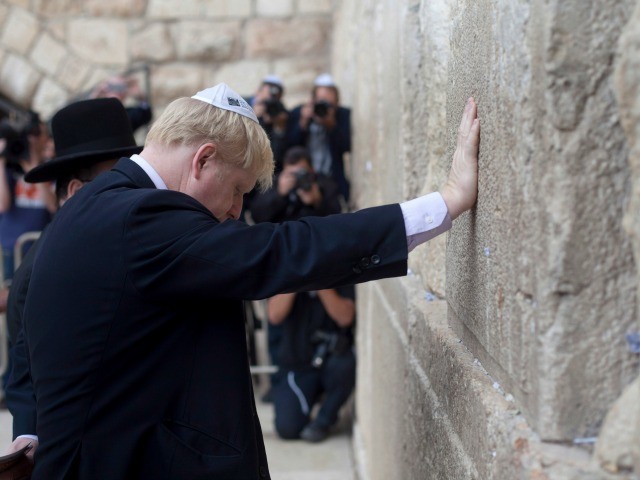
Eric Pickles, UK Special Envoy for post-Holocaust issues, has indicated Boris Johnson’s government will pass a law making it illegal for public bodies to engage with the Boycott Divestment and Sanctions (BDS) movement.
Speaking at the International Institute for Strategic Dialogue’s conference in Jerusalem on 15 December, Pickles said BDS was “anti-Semitic” and “should be treated as such”.
The law will not allow public bodies to work with individuals or groups advocating boycott, divestment or sanctions in respect of Israel in any way.
The pledge was alluded to in the Conservative party’s manifesto, with a commitment to “ban public bodies from imposing their own direct or indirect boycotts, disinvestment or sanctions campaigns against foreign countries” as they “undermine community cohesion”.
The anti-BDS law will form part of the Queen’s speech, which outlines the government’s agenda for the next year, and will be read at the opening of parliament on 19 December.
The move will mean local councils controlled by Labour are precluded from using taxpayer funds to boycott foreign countries, including Israel.
Pickles, who’s also chair of the Conservative Friends of Israel group, said Labour’s historic defeat in the 12th December general election UK showed the British people had overwhelmingly rejected anti-Semitism.
“Anti-Semitism is an attack on the British way of life and identity. Without our Jewish citizens we’d be a lesser nation,” he added.
While an increasingly popular global movement, adherent of which claim is targeted as Israeli government policies, not Israelis, renowned Holocaust historian Deborah Lipstadt has alleged BDS is “at its heart…intent on the destruction of the State of Israel”.
“If you look at the founding documents of the groups that first proposed BDS, they called for a full right of return…the ultimate objective of BDS is not BDS itself. If that were the case, we would all have to give up our iPhones, because so much of that technology is created in Israel. I think the objective of BDS, and especially the people who are the main organisers and supporters, is to make anything that comes out of Israel toxic, and I think they have had some success…I do not think any kid who supports BDS is ipso facto an anti-Semite. I think that’s wrong. It’s a mistake. And it’s not helpful,” she said.
Turkish ships chase Israeli vessel out of Cypriot waters
Press TV – December 15, 2019
Turkish navy ships have intercepted an Israeli research vessel in Cypriot waters, over which Ankara claims jurisdiction, forcing it to leave the area in a move that could negatively impact an ambitious Israeli project to pipe natural gas to Europe.
Quoting unnamed senior Israeli officials, Israel’s channel 13 news reported Saturday that the rare incident occurred two weeks ago when Turkish vessels approached Bat Galim.
Turkish navy officers radioed the Israeli ship and demanded to know its business in the area, and then ordered it to leave. The Israeli vessel had no choice but to comply and depart, said the report.
According to the report, the Israeli ship was conducting research in coordination with Cypriot officials and the Cypriot government.
Over the past year, Turkey has sent military ships as well as drilling ships to search for crude oil in the waters.
Recently, tensions have risen between Turkey, Greece, and Cyprus regarding gas fields discovered in the eastern Mediterranean.
In an interview with Reuters in September, Turkish President Tayyip Erdogan accused Greek Cypriots of trying to deprive Northern Cyprus of its rights.
EU member Cyprus and Turkey have argued for years regarding the ownership of fossil fuels in the eastern Mediterranean, where Ankara says Turkish Cypriots are entitled to a share of the resources.
Tensions rose again last month when Turkey signed agreements with Libya on maritime boundaries and military cooperation in the Mediterranean.
Erdogan said the maritime deal with Libya — which maps out a boundary between the two countries in the energy-rich eastern Mediterranean close to the Greek island of Crete — was in line with international law.
Israel’s Channel 13 said tensions could negatively affect an Israeli project to pipe natural gas to Europe. The pipeline is set to pass through Cyprus and Greece’s territorial waters.
According to the report, an Israeli embassy official in Ankara was summoned last week to be warned that the pipeline would require Turkey’s approval since it has to pass through Turkey’s economic waters.
“The Turks are trying to establish themselves as the ones running the show, and that is very worrying,” an Israeli official told Channel 13.
The media in Tel Aviv have reported that the UAE has invested as much as $100 million in an ambitious Israeli project to pipe natural gas to Europe.
Turkey, which does not have diplomatic ties with the Greek Cyprus, has vowed to prevent what it sees as a unilateral move by Greek Cypriots to claim offshore resources. It says some areas of Cyprus’s offshore maritime zone fall under what Ankara calls the territory of the Turkish Cyprus.
The island has been divided into Turkish Cypriot-controlled northern and Greek Cypriot-controlled southern territories since a brief war in 1974, which saw Turkey intervene militarily in response to a Greek-backed military coup on the island to annex Cyprus to Greece.
Greek Cypriots run the island’s government in the south, while Turkish Cypriots have a breakaway state in the north and say offshore resources belong to them, too.
Israel has signed a multilateral deal for the Eastern Mediterranean Pipeline Project with Greece, Italy and Cyprus. The European Union also supports the project.
Israel is already locked in a bitter dispute with Lebanon over tapping Mediterranean energy resources.
Last February, Israel described as “very provocative” a Lebanese tender for projects in two of the Arab country’s 10 offshore blocks in the Mediterranean Sea.
Israel itself has long been developing a number of disputed offshore gas deposits in the Mediterranean Sea, with the Tamar gas field with proven reserves of 200 billion cubic meters already producing gas, while the larger Leviathan field is expected to go online in the coming months.
UN Renews Agency Helping Palestinian Refugees in Defiance of US
teleSUR | December 13, 2019
With 169 votes in favor, nine abstentions, and two votes against, the United Nations General Assembly (UNGA) Friday extended the mandate for the United Nations Relief and Works Agency for Palestine Refugees in the Near East (UNRWA) until June 30, 2023.
“The General Assembly… expresses special commendation to the Agency for the essential role that it has played for almost seven decades since its establishment in providing vital services for the well-being, human development and protection of the Palestine refugees and the amelioration of their plight and for the stability of the region,” the UN resolution states.
Favorable reactions to the UNGA decision were immediate, especially among those who know from their own experience the consequences of the Israeli military occupation.
“We welcome the decision to renew the international mandate to UNRWA and we see it as another failure to hostile U.S. policies to the Palestinian rights,” the Hamas spokesperson Sami Abu Zuhri said.
Established in 1949, the UN humanitarian agency provides housing, education, health, relief services, and microfinance assistance to more than 5 million Palestinian refugees who are currently living in Jordan, Lebanon, Syria, the Gaza Strip, and East Jerusalem.
Palestine Liberation Organization (PLO) spokeswoman Hanan Ashrawi also praised the vote and said it was the UN’s responsibility to combat the U.S. and Israeli attacks on Palestinian refugees.
“All attempts at trying to limit the mandate of the UNRWA, defund it or attack it have failed, and we hope that the international community will continue to come to the rescue,” she said.
The U.S. and Israel, which have been leading a smear campaign accusing UNRWA of mismanagement and anti-Israeli incitement, voted against the resolution entitled “Assistance to Palestine Refugees.”
The nine abstentions came from Cameroon, Canada, Guatemala, Kiribati, Marshall Islands, Federated States of Micronesia, Nauru, Palau, and Vanuatu.
Former Spy Details Israel’s Main Motive Behind Epstein’s Sexual Blackmail Operation
MintPress speaks with Ari Ben-Menashe, a former Israeli spy who worked closely with Robert Maxwell, Ghislaine Maxwell’s father, as part of their work with Israeli military intelligence and had frequent encounters with Jeffrey Epstein.

A graphic shows Ari Ben-Menashe, left, and Jeffery Epstein, right. Credit | Claudio Cabrera
By Whitney Webb | MintPress News | December 13, 2019
MONTREAL — In recent weeks, renewed attention has been brought to the allegations that Jeffrey Epstein and Ghislaine Maxwell’s sex trafficking and sexual blackmail operation was run on behalf of Israeli military intelligence. Those claims revolve around statements made by a former Israeli military intelligence official turned public relations consultant Ari Ben-Menashe, whose allegations regarding the Epstein scandal were reported by MintPress this past October.
Ben-Menashe’s claims related to Epstein first surfaced in an interview between Ben-Menashe and Zev Shalev of the independent news outlet, Narativ. As detailed in a MintPress summary and commentary of that interview, Ben-Menashe claimed to have seen Jeffrey Epstein in the office of Robert Maxwell, Ghislaine Maxwell’s father, several times in the 1980s.
At the time, Ben-Menashe was in close contact with Robert Maxwell regarding their work mutual work with Israeli military intelligence. Maxwell, in addition to heading a media empire and being a one-time member of U.K. parliament, was a longtime operative for Israeli intelligence, so much so that his 1991 funeral was attended by no less than six serving and former heads of Israeli intelligence as well as several high-ranking Israeli politicians and prime ministers.
Maxwell is alleged to have recruited Jeffrey Epstein for Israeli intelligence and later introduced Epstein to Ben-Menashe and another operative, Nicholas Davies. Epstein was introduced to Ben-Menashe as having been pre-approved by leading figures in Israel’s military intelligence directorate, known as Aman.
MintPress recently conducted its own interview with Mr. Ben-Menashe as part of an ongoing investigation on the life and connections of the now-infamous Jeffrey Epstein.
Part of that interview is provided below with relevant commentary, particularly regarding claims related to the relationship between Epstein and former Israeli Prime Minister Ehud Barak, Epstein’s trip to Tel Aviv immediately prior to his first arrest, and the reasons for Israeli military intelligence’s interest in orchestrating and financing a major sexual blackmail operation targeting top U.S. politicians.
“Israel Requested that Epstein Target Clinton”
MintPress News first asked Ben-Menashe about Robert Maxwell, a known asset and operative for Israeli intelligence, having recruited Jeffrey Epstein. Ben-Menashe confirmed this to MintPress and also noted that, after their initial meeting, Epstein was frequently present in Maxwell’s office in London.
During the 1980s, as MintPress previously reported, Epstein claimed to have been an intelligence operative and so-called “bounty hunter” in the world of shadow finance. During this time, he was known to have developed close relationships with several British arms dealers, particularly Sir Douglas Leese. Thus, Epstein appeared to frequently be traveling between the Middle East and London, which is also supported by Epstein’s now-infamous Austrian passport which he was believed to have carried during this period of time.
Ben-Menashe told MintPress that he had not only met Epstein after Epstein had been recently recruited by Israeli military intelligence, but had seen him on several occasions thereafter as Epstein “used to be in [Robert Maxwell’s] office [in London] quite often” and would arrive there between trips to and from Israel.
In addition, Ben-Menashe revealed his understanding of why Epstein was eventually shepherded into acting as a professional sexual blackmailer on behalf of Israeli military intelligence. Per Ben-Menashe, there were concerns among Israeli intelligence figures that, following the Reagan Era, a new president would push for Israel to make peace with the Palestinians, something those officials sought to avoid by any means necessary.
ABM – Here’s the thing… Mr. Carter… as in President Carter… the Israelis feared that Mr. Clinton, when he was campaigning for President, will be a repeat of Mr. Carter. He wanted to press them for peace with the Palestinians and all that stuff. They feared… Clinton wasn’t that… but they feared he was that… And I think Mr. Epstein was sent early on to catch up with President Clinton.
MintPress News (MPN) – Well, that’s interesting because the first year Clinton was in office, Epstein was already attending donor dinners at the White House and making White House visits as well.
ABM – Yeah, that’s right. That’s right. I believe his biggest client was Mr. Clinton catch, or catch, or whatever, and he had a few other congressmen and what not but Clinton was, was his biggest catch.
Thus, Ben-Menashe argues, when Bill Clinton’s candidacy in the 1992 U.S. Presidential election became clear, efforts were made to target him via sexual blackmail and Jeffrey Epstein was chosen for that purpose. Bill Clinton was eventually blackmailed by the state of Israel and his administration was also targeted by Israeli espionage as part of the “Mega” spy scandal. Epstein’s involvement in the Clinton administration and his visits to the White House date back to Clinton’s first year in office. More information on the Epstein-Clinton relationship can be found in this MintPress report.
In addition, MintPress also asked Ben-Menashe if he was aware of Ghislaine Maxwell being directly involved with her father’s intelligence-related activities prior to his death in 1991. Ben-Menashe noted that Ghislaine accompanied her father so frequently, including on a now-infamous 1989 party on Maxwell’s yacht where Donald Trump and several key figures in the PROMIS software scandal were in attendance, that she was involved in his intelligence-related activities to some extent. However, he stopped short of saying how involved she was or what she has specifically been involved in prior to her father’s death.
When did Epstein really meet Ehud Barak?
One of the more controversial ties between Epstein and powerful politicians is that between Epstein and former Israeli Prime Minister Ehud Barak. Barak has claimed to have only met Epstein in 2002 and, from that point on, their relationship was very public, with Barak frequently visiting and even spending the night at residences owned by Epstein, including apartments where he housed the underage girls that he exploited. Barak also visited Epstein’s now-infamous island and recruited him to help fund the Israeli intelligence-connected company, Carbyne911.
However, there appear to be indications that Epstein and Barak may have met much earlier than Barak has since claimed. Given that Ben-Menashe claimed to have learned of Epstein’s recruitment by Israeli military intelligence in the 1980s, MintPress asked if one of the people involved in his recruitment was Ehud Barak. Barak served as head of Israel’s military intelligence directorate, Aman, from April 1983 to January 1986.
Ben-Menashe could not recall the exact year when he first became aware of Epstein’s recruitment by Israeli military intelligence but stated that it was “most likely” during Ehud Barak’s tenure as the head of Aman. Yet, even if Epstein’s recruitment did not take place while Barak headed Aman, it is highly likely — per Ben-Menashe — that Epstein had met Barak during this time because “Robert Maxwell became buddies with Ehud Barak… and he [Robert Maxwell] probably introduced them, the young man [Epstein] to Mr. Barak” if the two were not already acquainted.
Since the Epstein scandal broke, Ehud Barak has insisted that he did not meet Epstein until the year 2002 and claimed that the two had been introduced by former Israeli Prime Minister Shimon Peres. Ben-Menashe dismissed the possibility that this claim was true, emphatically stating that he was “sure they had met before” and that he did not believe that their first meeting was in 2002.
Epstein’s 2008 Trip to Tel Aviv
Just a few months before he was sentenced to prison for the first time in June 2008, Jeffrey Epstein had made a sudden visit to the Israeli capital of Tel Aviv. In April of that year, the Palm Beach Daily News reported that Epstein was staying at the Tel Aviv Hilton and quoted an Epstein spokesman as saying that he was “spending Passover, meeting with Israeli research scientists, and taking a tour of military bases.”
Sometime prior to Epstein’s sentencing on June 30 of that year, Alexander Acosta –then-U.S. Attorney for the Southern District of Florida– signed off on a lenient sentence for Epstein who was charged with soliciting sex from a minor. That legal arrangement has since been nicknamed the “sweetheart deal.” Acosta later told Trump transition officials prior to his nomination for Secretary of Labor that his decision to approve the “sweetheart deal” came after he had been told to back off in the Epstein case because Epstein “belonged to intelligence.”
Though Acosta did not specify from whom he had received this information, former CIA agent Phil Giraldi has made a convincing case that they originated from Epstein’s then-lawyer Alan Dershowitz, a close associate of Epstein with ties to high-ranking Israeli politicians, and Barry Krischer, then-Florida State Attorney for Palm Beach who recently received an award from the Anti-Defamation League (ADL) for his “outstanding contribution to the legal profession and to the community at large.”
As detailed in a previous MintPress report on Epstein’s ties to Israel published this past August, the ADL’s long-time top funders have close ties to Epstein and his sexual blackmail network, particularly the Bronfman family of Seagrams fame.
Ben-Menashe told MintPress that Epstein’s 2008 Tel Aviv visit was likely “blowing smoke” and involved Epstein “trying to make himself important maybe not to get arrested” and “hoping that the Israelis would help him.” He then added that “At the time they probably did” help Epstein, but added that “the second time around [i.e. 2019], well… it would be a harder sell.”
Whitney Webb is a MintPress News journalist based in Chile. She has contributed to several independent media outlets including Global Research, EcoWatch, the Ron Paul Institute and 21st Century Wire, among others. She has made several radio and television appearances and is the 2019 winner of the Serena Shim Award for Uncompromised Integrity in Journalism.
European taxpayers’ money going to Israeli entities accused of international law violations
MEMO | December 11, 2019
The European Union (EU) is channelling European taxpayers’ money to Israeli entities accused of international law violations, according to a new briefing by human rights campaigners.
The research, carried out by the Brussels-based group European Coordination of Committees and Associations for Palestine (ECCP), was published Tuesday.
“EU research funds have been a very important source of funding for Israeli academics, corporations and state institutions, among them a number of military companies and those involved in illegal Israeli settlements”, stated ECCP in a press release launching ‘EU and Israel: The Case of Complicity’.
“For many years European and Palestinian civil society and human rights organisations have been raising concerns over European taxpayers’ money being channelled to Israeli companies and institutions accused of war crimes and involved in violations of international law and human rights”.
According to ECCP, even at the same time as the EU has been criticising Israeli actions over the years in the occupied Palestinian territory, the body has also been “funding the very companies that sustain these unlawful activities”.
Thus, the human rights campaigners add, “when it comes to Israel the EU continues to violate its own directives and commitments to international law by funding Israeli complicit entities at the expense of Palestinians”.
In one example cited in the research, as part of the last funding cycle known as ‘Horizon 2020’, two of Israel’s largest military companies – Elbit Systems and Israeli Aerospace Industry – received almost 10 million Euros of European taxpayers’ money.
Although Israel is not an EU country, Israeli applicants have been able to access EU research funds on the same basis as member states since 1995 through the EU-Israel Association Agreement.
“While Israel, as the Occupying Power, bears the main responsibility to ensure respect for international law and human rights of the occupied Palestinian population”, ECCP states, “third states which are not party to the conflict, such as the EU and its member states, also have an obligation to not aid, assist or recognise bodies that violate international law”.
Report: 557 Israeli violations against Palestinian media
MEMO | December 11, 2019
The Israeli occupation has committed 557 violations against Palestinian mass media during 2019 alone, the Government Media Office (GMO) revealed in a report issued on Tuesday.
Commenting on the report, GMO director, Salama Marouf, announced that Palestinian journalists are facing the “worst violations” by the Israeli occupation, noting that a number of them were killed, with some losing body parts or suffering from serious injuries.
The most recent Israeli violation, according to Marouf, was the Israeli shooting of the Palestinian photojournalist from the West Bank, Muath Amarneh, causing serious injuries to his eye leading to its removal.
Marouf also cited the Israeli closure of Palestine TV’s office in Jerusalem, after raiding it and confiscating its contents.
Marouf stressed that the Israeli occupation forces use “direct excessive force” to crackdown on Palestinian journalists and mass media, in order to undermine their coverage of the Israeli violations against the Palestinians.
Recounting only some of the Israeli violations against journalists, Marouf cited “the Israeli occupation forces beat them, insult them, hinder their work, arrest them, raid their homes, confiscate their equipment and impose travel bans on them.”
Marouf also described the Israeli pressure and cooperation with the owners of the different social media platforms, including Facebook and Twitter, which closed and disabled hundreds of Palestinian pages and accounts, as part of the violations against Palestinian media.
He called for bringing the Israeli occupation to court over its crimes against Palestinian journalists and mass media, and called for the implementation of the UN Security Council Resolution 2222, which guarantees the protection of journalists.
Hebron Plan is Israel’s Reminder to Palestinians that Settler Power knows no Limits
Proposed destruction of Hebron’s market to make way for a new settlement is Israeli government’s route to refashion its apartheid system as the rule of law

By Jonathon Cook | The National | December 10, 2019
US President Donald Trump told thousands of Israel’s supporters at a rally in Florida at the weekend that some American Jews “don’t love Israel enough”. It is certainly troubling that a US president insists a section of his country’s citizens – the Jewish population – be required to love a foreign state. But then Trump went further, muddying the waters about what constitutes “Israel”.
Echoing remarks made last month by Mike Pompeo, his secretary of state, he described the Jewish settlements in the West Bank as legal – thereby subverting a long-established principle of international law.
US Jews – and the rest of us, it seems – are expected not only to love Israel inside its internationally recognised borders but also to love the Jewish settlements that international law designates as a war crime. Those are the same settlements eating up ever more of the territory supposed to form the basis of a Palestinian state.
When Trump, like his predecessors, told his weekend audience that the US shared an “unbreakable” bond with Israel, what exactly was the “Israel” he referred to? Both the US and Israel have implied in recent declarations and actions that a central plank of the long-delayed Trump peace plan will be Israel’s annexation of the settlements – and with them most of the West Bank.
“Loving Israel” now is meant to include abandoning any hope of Palestinian statehood and accepting that Palestinians will live permanently under an Israeli version of apartheid, with inferior rights to Jews.
The Trump administration seems keen to press ahead with the peace plan – and annexation – but is being hampered by political chaos in Israel.
Mired in corruption scandals and having staged two inconclusive elections this year, Benjamin Netanyahu, the caretaker prime minister, is unable to cobble together a coalition to keep himself in power. The impasse is not over the occupation or the settlements but about who gets to dominate the next government: far-right religious settlers led by Netanyahu or right-wing, secular former army generals?
Nonetheless, Netanyahu is behaving as if Washington has given its blessing to annexation – even without a US peace plan.
That was what Pompeo’s statement last month backing the settlements amounted to. He offered one paltry safeguard, investing responsibility for monitoring and limiting settlement expansion in Israel’s supreme court. But this is the same court that has consistently failed to block settlement growth over five decades. It now includes two judges who actually live in settlements, as well as others who sympathise politically with the settlement project.
Meanwhile, in preparation for a likely third election campaign, the interim Netanyahu government has announced a splurge of new settlement building and boosted settler budgets.
In another fillip for the settlers last month, Netanyahu appointed one of their leaders, Naftali Bennett, to the sensitive role of defence minister. Bennett lost no time in unveiling his latest settlement plan last week, selecting an incendiary spot greatly prized by the settlers: the middle of Hebron, the West Bank’s largest Palestinian city.
For decades, life for Hebron’s 230,000 Palestinians has been forced to a virtual standstill by a few hundred Jewish religious extremists who have taken over the city centre, backed by more than 1,000 Israeli soldiers. Their ultimate goal is to wrestle away the city’s Ibrahimi mosque, the reputed burial site of Abraham, father of the world’s three main monotheistic religions.
After Baruch Goldstein, a settler, shot dead and wounded some 150 Muslim worshippers in 1994, Israel rewarded the settlers twice over.
First, it segregated the mosque site, splitting it into two. Half is now the Jewish Tomb of the Patriarchs. But in practice the Israeli army enjoys absolute control over who can pray there.
And next, Israel declared the surrounding area, including Hebron’s main commercial market, a closed military zone, thereby forcing the Palestinian merchants out. It has been a ghost town ever since, serving as a passageway between the settlement enclaves and the mosque.
For years, the closed market has stood as a potent, silent symbol of the way Israel has been tearing the city apart.
In February, Netanyahu gave the settlers another boost. He shuttered the international observer mission in Hebron, there to witness and record the abuse of Palestinians, especially at the checkpoints that litter the city centre. But still the settlers were not satisfied. They have long wanted to take over the Hebron market for themselves, to expand their enclaves.
So last week, Bennett granted their wish. He announced plans to destroy the market to make way for a settlement serving effectively as a bridge between the existing enclaves and the mosque site. The plan will double the number of settlers in Hebron and complete a wall of Jewish settlement dividing the city in two. This week Palestinian leaders called a citywide strike in protest.
As ever, the Israeli government has tried to put a surreal legal gloss on its criminality, apparently to spare the blushes of its US and European allies. Bennett’s advisers have insisted that Israel has legal title to the air above the roofs of the empty shops. This is where the settlers will supposedly be housed, after the shops have been demolished and rebuilt to support the new apartment blocks.
It emerged this week that Bennett had threatened Hebron’s municipality, warning it would lose property rights to the shops area too if it did not consent to the settler homes above.
Israel is reminding Palestinians that there are now no limits – military, legal, moral or diplomatic – to the settlers’ power. Israel will annex land where it chooses and deceptively refashion the resulting apartheid system as the rule of law.
The material losses to the Palestinians from Israel’s ever-growing settlement enterprise are devastating enough. This month, the United Nations Conference on Trade and Development issued a report estimating conservatively that the past 17 years of occupation alone had cost the Palestinians a whopping $48 billion – three times the current size of its economy.
That income would have generated two million job opportunities, freeing Palestinians from a miserable choice between life without work and, if they are issued a permit by Israel, precarious, exploitative casual labour in Israel or the settlements.
Equally significantly, the ever-expanding settlements have stripped Palestinians of their most basic freedoms, such as movement, and undermined their security and right to be treated with dignity.
And no one ought to love that.
Netanyahu-Pompeo Meeting Solidifies War Plan on Iran
By Finian Cunningham | Strategic Culture Foundation | December 10, 2019
Ratcheting economic sanctions, military force encirclement, inciting seditious violence and relentless war rhetoric. This all by the US and its allies over the past year towards Iran, yet it is Iran which is portrayed as posing “potential threats” to American interests.
The hastily arranged meeting last week between Israeli leader Benjamin Netanyahu and US Secretary of State Mike Pompeo had the hallmarks of a war-plan summit amid a peak in renewed media provocation against Iran.
In the last weeks there has been a flurry of US media reports claiming that Iran is secretly moving ballistic missiles into Iraq and elsewhere across the region. As usual the media credulously cite anonymous intelligence and Pentagon officials on those claims.
Here’s CNN quoting one administration official: “There has been consistent intelligence in the last several weeks,” the official said, referring to “a potential Iranian threat against US forces and interests in the Middle East.”
Last month, the head of US CentCom made a similar dire forecast of Iranian intentions. General Kenneth McKenzie said: “I would expect that if we look at the past three or four months, it’s possible they [Iran] will do something that is irresponsible.”
Notice how General McKenzie tacitly acknowledges the background of the Trump administration’s “maximum pressure” campaign of economic sanctions and US military force buildup against Iran as if that is somehow normal international conduct. Then he turns all that US aggression on its head by accusing Iran of possibly doing “something that is irresponsible”.
There are worrying signs that the US and Israel are redoubling the pressure of war against Iran. This pressure has to be seen in the context of a formidable deployment of US military forces – troops, warplanes and warships in the region since May this year. The earlier buildup was announced on the basis of unfounded claims that Iran was preparing to launch offensive operations against American interests. Then came a series of mysterious attacks on oil tankers in the Persian Gulf over the summer which Washington blamed on Iran without evidence.
Street protests in Iran since mid-November over fuel-price increases appear to be hijacked by subversive elements. President Trump and other US officials have openly called for the protests to destabilize the Iranian government.
Fresh claims that Iran is sending ballistic missiles to neighboring countries appear to be setting the stage for justifying a pre-emptive US attack on Iran.
No doubt the Iranian government is under severe pressure from the economic hardship that the US has re-imposed unlawfully since Trump dumped the international nuclear accord in May 2018. No doubt too Iran is apprehensive about the relentless military threats against it from Washington and its Israeli ally. Almost certainly, Iran will have mobilized forces in the reasonable calculation that it may come under attack at any moment.
But, perversely, US intelligence and military officials are interpreting Iranian defensive moves as “indications of a potential threat” to American “interests”.
The meeting last week between Israeli Prime Minister Benjamin Netanyahu and US Secretary of State Mike Pompeo signals a foreboding development. Recall that this is in the context of US media reports of Iranian ballistic missiles being deployed and of reports that the Trump administration is considering a doubling of troop levels in the Middle East to 28,000, as well as sending more missiles and warplanes.
Netanyahu met Pompeo in Lisbon, Portugal, on Wednesday, December 04. The meeting was called urgently and was unscheduled. Netanyahu – who is fighting for his political survival over corruption charges – tried to arrange discussions with Pompeo on the sidelines of the NATO summit near London, but according to Israeli media reports there was not enough time for security logistics to be put in place by the British. That indicates the Israeli leader was trying to meet Pompeo in a hurry.
When Netanyahu met with Pompeo in Lisbon, he said at the start of their discussions: “The first subject that I will raise is Iran. The second subject is Iran, and so is the third. And many more.
The Israeli premier added: “We have been fortunate as President Trump has led a consistent policy of exerting pressure on Iran. Iran is increasing its aggression in the region as we speak, even today, in the region. They are trying to have staging grounds against us and the region from Iran itself, Iraq, Syria, Lebanon, Gaza and Yemen and we are actively engaged in countering that aggression.”
Netanyahu also gloated that the “Iranian empire [sic] is tottering… let’s make it totter even more.”
For several months Iran has steadfastly refused to take the bait of war laid down by the Trump administration. But with pressures mounting both within the country and externally, it would be imperative for the Iranian authorities to marshall their defenses.
US intelligence and military officials are using contorted logic to accuse Iran of posing a threat, and the American corporate media are ably assisting in the propagation of this oxymoron.
Netanyahu’s hasty meeting with Pompeo last week suggests that the US and Israel are putting the final touches to their malignant masterpiece for provoking a war with Iran.
Israeli FM threatens to target Tehran with ‘hundreds of Tomahawk missiles’
Press TV – December 8, 2019
Hawkish Israeli foreign minister Israel Katz has threatened a military operation against Iran with the help of the United States, Saudi Arabia and the United Arab Emirates.
Katz said Israeli bombing in Iran was “an option,” making the most brazen threat in years in an interview with the Italian newspaper Corriere della Sera Saturday on the sidelines of the Mediterranean Dialogues (MED) conference in Rome.
“If Iran crosses the ‘red line’, it will discover a uniform front between Saudi Arabia, UAE and the United States, which will launch hundreds of Tomahawk missiles at Tehran,” he said.
By the red line, Katz meant, “We will not allow Iran to acquire or stockpile nuclear weapons. If that is the last option – we will act militarily.”
Iran has repeatedly enunciated its nuclear program as exclusively civilian, subject to the most intensive UN supervision ever.
Unlike Israel, Iran is a signatory to the Treaty of the Non-Proliferation of Nuclear Weapons (NPT), whose aim is to prevent the spread of nuclear arms and weapons technology.
Israel is the only possessor of nuclear weapons in the Middle East, but maintains a policy of ambiguity, neither confirming nor denying its atomic bombs.
Nevertheless, Tel Aviv is estimated to have between 200 and 400 atomic warheads in its arsenal.
Tehran signed the Joint Comprehensive Plan of Action (JCPOA) in 2015 to forge closer cooperation with the International Atomic Energy Agency (IAEA) which has always confirmed the country to be in full compliance.
President Donald Trump pulled the US out of the international accord last year and announced sanctions on Iran in an attempt to wreck the agreement.
Katz criticized European countries for not supporting the hard line Washington has adopted against Tehran.
“As long as the Iranians delude themselves into thinking they have Europe’s backing, it will be more difficult for them to back down,” he said.
In his Friday address to the MED 2019, the top Israeli diplomat claimed that it was “high time” for Western and Arab countries to “create a coalition that would threaten Iran and tell it to stop its nuclear program.”
Belgian Trade Delegation to Israel Cancelled
IMEMC & Agencies – December 7, 2019
The trade mission would have taken place from the 8th to the 11th of December, will not go forward, due to criticism from the political opposition and several activist organizations, leading to its discontinuation, the Palestine News Network (PNN) reported.
The delegation would have consisted of representatives from the Walloon and Brussels governments, which are separate political entities in Belgium, and numerous companies from the respective regions.
The Walloon government had already withdrawn from the delegation at an earlier stage, but now the Brussels government has done the same, effectively leaving the rest of the mission without political representation.
In the last couple of weeks, the general criticism towards the trade mission has grown. Specifically Israel’s disregard for international agreements concerning the blockade of the Gaza Strip, sparked the opposition’s distaste for the mission.
“We’re talking about participating in the Israeli colonization policy,”
said Stéphanie Koplowicz, member of the Flemish left-wing PVDA-party.
“The UN Human Rights Comittee has complained that over 200 companies do business in these illegal settlements. Does the government want to encourage Brussels’ companies to participate in this?”
Featured Video

Seyed M. Marandi: US-Iran War Inevitable: Kuwait and Bahrain May Fall
or go to
Aletho News Archives – Video-Images
From the Archives
Oil and the Israel Lobby
Reknowned economist M. Shahid Alam offers this excellent critique of Noam Chomsky’s defective analysis of the relative influence of Oil versus the Israel lobby over US foreign policy: … continue
Blog Roll
 Aletho News
- ICC ignored ‘very well-documented’ NATO crimes – ex-Libyan minister
- SNSC secretary dismisses US response to Iran’s conditions as ‘inadequate’
- Sanaa says Taiz roads open, secure for residents, warns Saudi forces
- Iraqi resistance group urges Saudi leadership to admit defeat, lift Yemen siege
- Trump’s Retreat: How Al-Aqsa Flood Took Down the US Empire
- Israel’s Military Actions in Lebanon Grossly Violate International Law — Lavrov
- Seyed M. Marandi: US-Iran War Inevitable: Kuwait and Bahrain May Fall
- Leaders Condemn Ansarallah Attack on Saudi Arabia While Ignoring Illegal War Against Yemen
- Leaked: Britain’s Covert Iraqi Psyops Network
- Yemeni Armed Forces Warn Airlines Against Using Saudi Airports, Exempt Mecca and Medina
- If Americans Knew
- How Israel Conquered the Latin American Right
- Agents search Rep. Omar’s Washington home in criminal probe as she vows she won’t ‘be silenced’
- “The Rule Was: ‘Shoot Everyone You See'”
- Israel goes ballistic over Nobel Laureate Navi Pillay
- U.S. May Join Yet Another Middle Eastern War — TCN
- Yellow Line moves again as Israel closes in on trapped Gazans – Daily Update
- Israeli Attacks Kill Seven Palestinians in Gaza Including Six-year-old Girl
- Gaza: Ceasefire Anniversary Marks Year of Failed Promises
- The American Conservative: Mike Huckabee Should Resign
- A C-Section in Shackles: A Palestinian Woman’s Harrowing Birth in Israeli Detention
- No Tricks Zone
- Germany’s Green Energy Debacle: High Energy Costs Force Kahla Porzellan to Close After 182 Years!
- New Study: 50 Years Of The Most Aggressive ‘Net Zero’ Policies Can Only Affect The Global Climate By 0.03°C
- US September “Heat” Was No Record…Many Records Set Decades Ago
- Latest European Green Energy Debacle; Portugal’s Largest Flagship Solar Park Insolvent!
- Green Energy Debacle: German Expert Professor Fritz Vahrenholt Warns Of Severe Economic And Social Consequences
- Two More Paleo Reconstructions Affirm Meters-Higher Sea Levels Across Ireland, Brazil 7000-6000 Years Ago
- New Study: Earth And Venus Surface Warmth Largely Explained By Convection And Lapse Rate, Not CO2 Or Radiation
- 2025 Nature Paper Claiming Worsening Global Drought Gets RETRACTED …Heavily Flawed
- New Study: ‘Global Drought Shows No Detectable Recent Acceleration Under Climate Warming’
- Economic Masterminds: German Socialists Suggest Taxing Productivity Gains Stemming From Using AI

