Father and son activists in Dheisheh camp, seized by occupation forces

Samidoun Palestinian Prisoner Solidarity Network – November 1, 2018
Nidal Abu Aker, a longtime community leader and a journalist in Dheisheh refugee camp, and his son Mohammed Abu Aker, a university student, were seized by Israeli occupation forces who invaded the camp in the early morning hours of Thursday, 1 November. Both are prominent advocates for Palestinian rights and former prisoners who have been repeatedly jailed for their commitment to Palestinian liberation.
Israeli occupation forces invaded the home, pushing, shoving and hitting Abu Aker as he resisted the armed soldiers forcing their way inside the family’s house.
They manhandled Mohammed as they pulled him and his father from their home, raising their weapons in a threat to the Palestinian refugees in nearby apartments.
The Abu Aker family are refugees from Ras Abu Ammar in Palestine ’48; their family has lived in Dheisheh refugee camp since the Nakba. Nidal, 50, is married to Manal Shaheen and the father of three children, Mohammed, Dalia and Karmel. A prominent leader of the Popular Front for the Liberation of Palestine, he is also the host of a program about Palestinian prisoners called “In their cells” on Sawt al-Wihda radio station and a co-founder of the Families of Prisoners Association in the camp.
He has spent 17 years in Israeli prisons, through multiple arrests and under 11 years of administrative detention without charge or trial. In 2015, he engaged in a 40-day hunger strike with five more administrative detainees to demand an end to imprisonment without charge or trial. He was arrested for the first time in 1984, and his mother says that he has spent nearly half of his life in Israeli prisons. He was released from his latest stint in administrative detention without charge or trial in July 2018, after two years of imprisonment.
Mohammed, 25, was released in late 2017 after spending two years and two months in Israeli prison on an array of political charges, including support for and membership in a prohibited organization. All major Palestinian political parties are labeled illegal by the Israeli occupation, and people often face this charge for participating in student, labor or youth organizing, as did Mohammed. A student at Bethlehem University, he is known for his role in organizing the Palestinian student movement on campus.
Dheisheh refugee camp has been a site of intense repression and frequent violent raids by Israeli occupation forces. Youth in the camp have been threatened by Israeli military commanders with phone calls and text messages. Raed al-Salhi, an unarmed Palestinian youth was shot dead by occupation forces in an “arrest raid,” shortly after one occupation soldier had threatened to “shoot [Raed] in front of your mother.”
US sanctions on Hezbollah aim to punish Lebanon: Observers
Press TV – October 28, 2018
The US has imposed new sanctions on Hezbollah, but observers say Lebanon as a whole will be affected by the punitive measures.
Earlier this week, the administration of US President Donald Trump imposed a new round of sanctions on Hezbollah targeting individuals and international organizations that do business with the resistance group.
Economist Louis Hobeika said he thought “it is difficult to punish Hezbollah without punishing all of Lebanon.”
“No area fully belongs to Hezbollah. The southern suburb of Beirut is not confined to Hezbollah, so how will the sanctions apply here?” Hobeika told Arab News in remarks published Saturday.
Political activist Ali Al-Amin, the director of Janoubia news website, said the outcome of the US decision could be “disastrous” for Lebanon.
“Is the purpose of the sanctions to embarrass the Lebanese government and state?” he wondered.
In the May parliamentary elections, Hezbollah and its political allies won more than half of the seats at the legislature in a major victory for the party.
Former Lebanese lawmaker Fares Souaid told Arab News that the new sanctions are part of a series of US bans meant to “turn the party (Hezbollah) into a burden on the Lebanese after Hezbollah has come forward as a security guarantee for Lebanon.”
The US has its Arab allies in the Persian Gulf on board in cranking up pressure on the Lebanese leaders over their association with Hezbollah, and they all take their cue from Israel.
Israeli leaders have threatened that they would view the Lebanese state as part of Hezbollah in a future war with the resistance movement.
In May, the US Treasury Department imposed sanctions on the Hezbollah leadership jointly with members of the so-called Terrorist Financing and Targeting Center (TFTC), which includes Saudi Arabia, Bahrain, Kuwait, Oman, Qatar and the UAE.
Hezbollah was formed following the Israeli regime’s invasion of Lebanon and the ensuing occupation of its southern parts in 1980s, and currently constitutes Lebanon’s de facto military power.
Since then, the movement has helped the national army retake the occupied regions from Tel Aviv and thwart two Israeli acts of aggression in 2000 and 2006.
The movement has also been playing a significant role in the Syrian army’s fight against Takfiri terror groups, including Daesh and Nusra Front, thus preventing the spillover of the war into Lebanon.
Thoughts on One Democratic State

By Nahida Exiled Palestinian | Poetry for Palestine | May 18, 2018
Some activists are worried that my passion for justice and my advocacy for full restoration of Palestinians’ inalienable rights might “alienate” some Jewish supporters. They claim Palestinians desperately need Jewish support.
To them I have this to say:
Palestine has now been under the heel of violent foreign rulers since a full Century. Palestinians have always been eager to get international support, including from Jews. Since a full century, the naturally trustful Palestinians were grateful and delighted to give a platform to whomever showed the slightest interest in their cause. Tragically, this resulted in our authentic Palestinian narrative being gradually silenced. Genocidal atrocities since a century are ongoing. Our will to self-determination is untamed. Our Right to be sovereign inside our own land, is intact. Our historic, cultural and national identity, is as strong as ever. Yet all is more or less silenced.
Today we have the terribly dangerous situation where the authentic Palestinian narrative is so absent, that it has never been truly heard or appreciated in the West.
Every time an uncompromising authentic Palestinian voice steps up assertive and strong, it is quickly muffled and tucked away, as to not offend Jewish supporters or to not scratch their sensitivities.
Unconditionally and almost religiously pro-Palestinian organizations have sought Jewish approval in every event, every talk, ever letter, every petition, every motion and every campaign. This went on for decades. I know it from first hand experience, and also from the many Palestinians who echo this same disturbing experience almost globally.
Whenever an authentic Palestinian voice steps out of the narrow confinement of such censored discourse, they are immediately reprimanded and told in no uncertain terms that they have crossed the lines defined by Jewish “supporters”. When a Palestinian refuses to be terrorized by such Thought Police, he or she faces defamation, blacklisting, ostracism, and even threats.
On the day of signing of Oslo agreement, I remember sitting on the staircase in shock, sobbing for the rest of the day, for I knew what is to come. Yet the pro Palestinian camp with all its Jewish “supporters” in control, embraced the move. Palestinians were deceived into believing that a Palestinian state will come into being within five years. They were led to believe the Palestinian problem is on the verge of being resolved once and for all, and closure was eminent, nothing could have been further from truth. And the genocidal slaughter continued, worse then ever. And it continues today.
For the twenty five years that followed, “israel” used the “peace process” to proceed with it’s undeclared aims of total colonisation of West Bank and Gaza. The number of settlers sky rocketed and settlements have multiplied many folds over, making it impossible for any Palestinian state to exist on a land infested with and totally disconnected by Jewish only settlements and Jewish only roads.
In the present, “israel” has managed to totally conquer Palestine by war and terror. It has created a new reality on the ground, by annexing most of the land of historic Palestine, reducing Palestinian areas into fragmented open prisons where Jewish “israelis” can kill-at-will. “israel” together with its international Jewish support network has reduced and degraded the Palestinian population from a formerly radiant, self-sufficient, productive, cohesive, cooperative affluent society into an aid-dependent, traumatized, unproductive, poverty stricken population. The degradation is even practiced by distributing free narcotics to the Palestinian youth!
Despite having achieved their Jewish Zionist goals of total dominance over land and population, the geo-political circumstances are rapidly changing.
Increasingly, the strategists and think tanks of the Jewish state realise that they have passed the highest moment of success, and that the world community in spite of some coerced puppet governments, is very rapidly turning against the Jewish state. They began to feel the heat, of growing isolation, of world disdain. In this context, the next logical step from the perspective of their think tanks and strategists, is to seek the total finalization of their Zionist project, by seeking legitimacy from the rightful natives, through legalization, and through mass campaigns to gain “the hearts and minds” from world community by any artifice necessary.
Such step would guarantee their permanent presence in Palestine while securing themselves with “peace treaties’. And while the And while the Arab Muslims remain majority in greater region, the Jewish-“isrseli” total hegemony and dominance; financial, economical, militaristic, technological, administrative, educational, would be guaranteed.
Their next strategic move would be to offer a luring “solution” which would lure Palestinian support by nominally less oppression, by feigning “equality” while knowing that in reality their hegemony will remain de-facto, due to the huge economical, technological, industrial, and of course military gap between the two groups. Nothing, absolutely nothing in the Jewish state exhibits a willingness to relinquish any part of their control over all apparatus of power in the region. And it is an irrefutable fact, demonstrated by a century of nefarious “facts on the ground” that the Jewish Zionists who invaded Palestine and their aggravated offspring, will never voluntarily relinquish their weaponry, military, and aggressive violence.
Add to this unsettling scenario the most horrific component of ideological supremacy which would no doubt manifest in an explosion of settler violence against Palestinians who are seen as mere slaves created only to serve Jews.
That horrific deception is a strategic move already has a name. “One Democratic State”, “with Equal Rights to All its Citizens”. Very easy to be deceived by such a lofty romantic title, except that it is a cruel misnomer, a sirens’ song to fool and victimise, one last lethal time.
“It is easier to fool people than to convince them that they have been fooled” as goes the adage sometimes attributed to Mark Twain
Leading Palestinians by the nose, dangling the carrot of “One Democratic State” and promising them of a “bright” joined future with their persecutors, while knowing fair well that the promised crumbs will never come to fruition, exactly as the crumbs of Oslo, due to the fact-on-the-ground dominance coupled with lethal ideological supremacy.
“ODS-Equal Rights”, is not only an act of egregious deception, it is designed to perpetuate wars and genocide, by rewarding sadistic terrorists, thus it is an act of betrayal to humanity.
Israel Culture Minister arrives in UAE
MEMO | October 26, 2018
In first, Israel’s Culture and Sports Minister Miri Regev today arrived in the United Arab Emirates (UAE) to attend the Abu Dhabi Grand Slam Judo tournament.
Regev was invited to attend the event earlier this month to accompany Israel’s national judo team as they compete in the Emirati capital. President of the International Judo Federation (IJF), Marius Vizer, wrote to Regev on 2 October to invite her to the tournament and promised to “make all the necessary arrangements for [her] visit”.
The invitation came after the IJF demanded that the UAE allow the Israeli team to play its national anthem and fly its flag during the tournament. The event had previously been threatened with cancellation after the IJF stripped the UAE of the right to host the tournament due to its failure to guarantee “equal treatment” for Israeli athletes. In September, the UAE accepted the IJF’s conditions and allowed the Israeli judoists to sport their national insignia.
Regev’s attendance at the event – which is taking place from 25-27 October – will be seen as controversial in light of the lack of official relations between Israel and the UAE. In addition, Israeli passports are not valid for travel to the UAE.
However, the UAE has recently been pursuing a policy of normalisation with Israel. In September, it hosted secret backchannel talks between Israel and Turkey in an attempt to mend strained Israeli-Turkish relations. Envoys from the two countries flew into Abu Dhabi via Amman, Jordan, though neither government would confirm the purpose of the talks.
In August, an Israeli journalist claimed that an Emirati pilot participated in the bombing of Palestinian targets in the Gaza Strip during his training on Israeli Air Force F-35 fighters. Cohen, the journalist who made the claims, also accused Dubai’s Deputy Chairman of Police and Public Security, General Dhahi Khalfan, of being complicit in assassinating Hamas leader Mahmoud Mabhouh in Dubai in 2010.
In June, an exposé by the New Yorker revealed that Israel and the UAE have been engaged in secret normalisation talks since the 1990s. The report disclosed that “the secret relationship between Israel and the UAE can be traced back to a series of meetings in a nondescript office in Washington D.C. after the signing of the Oslo Accords”. These meetings discussed the possibility of the UAE purchasing F-16 fighter jets from the US which are known to be comprised of Israeli technology. The Crown Prince of Abu Dhabi, Mohammed Bin Zayed, also gave his blessing for delegations of influential American Jews to be brought to Abu Dhabi to meet with Emirati officials and establish an intelligence-sharing relationship.
Pro-Israel superstar may have worked as a secret agent on college campuses

By 2014 Mazzig had already spoken to over 40,000 students from high school through college, and helped defeat a boycott resolution at the University of Washington.
By Alison Weir | If Americans Knew | October 25, 2018
The Jewish Forward reports that a hugely popular pro-Israel speaker and writer, Hen Mazzig, has been secretly working directly for the Israeli government. It appears that his actions may have violated U.S. espionage laws.
A pro-Israel organization lists Mazzig among “The Top 100 People Positively Influencing Jewish Life, 2018.”
According to the Forward, Mazzig’s op-eds “have been published in nearly every Israeli and American Jewish publication (including the Forward ), and his speeches to students across North America and Europe, have garnered him legions of fans, including more than 18,000 Twitter followers.”
The publication reports:
“A Forward investigation has revealed that he also worked directly for the Israeli government. He doesn’t seem to have told anyone that, however — neither the sponsors of his speeches, nor the students who listened to them. Because he kept quiet, and because those payments are related to his political work in the United States, he might have violated an American anti-espionage law, according to experts consulted by the Forward.
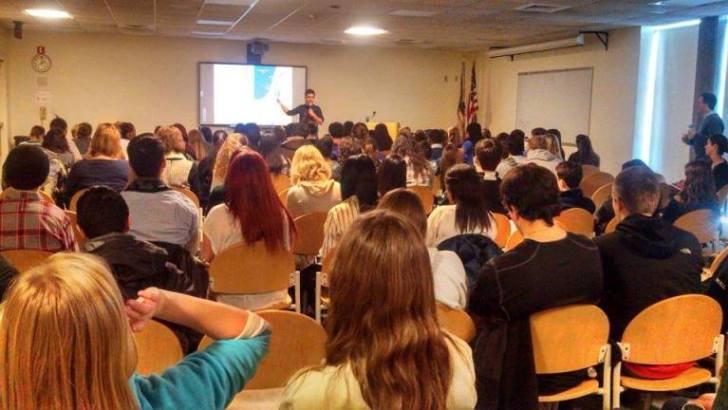
Hen Mazzig speaking to American students during a 2013 five month speaking tour.
Experts cited by the Forward say that Mazzig seems to have violated the Foreign Agent Registration Act (FARA), an American anti-espionage law. This law requires individuals and groups working on behalf of a foreign government to divulge that fact.
Attorneys say Mazzig should have registered as a foreign agent. Mazzig admitted to the Forward that he was a paid contractor for the government of Israel, and said that Israel’s official government advertising agency hired him to inform them about issues on American campuses.
FARA has recently been invoked against a Russian graduate student in the U.S., who has been imprisoned for three months, mostly in solitary confinement, despite the fact that she appears to be innocent of the charges.
It is unknown whether U.S. authorities will charge Mazzig with violating the FARA requirement.
An attorney who specializes in FARA cases told the Forward : “The policy behind FARA is, yes, lobbying will happen. The key is for the American people to know when it comes to foreign influences, who’s pulling the strings.”
The Forward reports that The Lawfare Project, a pro-Israel organization that often uses lawsuits to chill pro-Palestinian activism, demanded that the Forward delay publishing the article until lawyers could speak on Mazzig’s behalf. The Forward accordingly held the story for three and a half days, but did not hear further from Mazzig’s lawyers.
The publications and organizations such as campus Hillel groups that have been featuring Mazzig say they didn’t know he was employed by the Israeli government. According to the Forward, student organizers “say they don’t remember Mazzig disclosing his contracting work, either beforehand or during his speeches.”
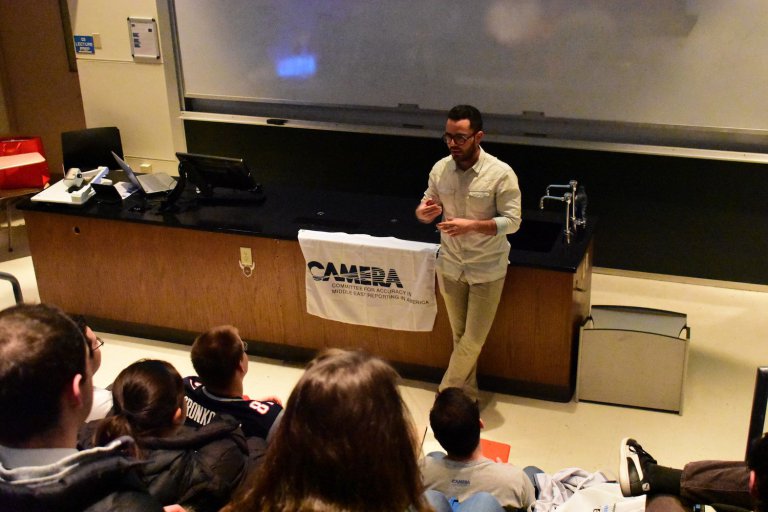
3/22/17 Hen Mazzig lecture/ Oriented showing by Kevin Musco
Hen Mazzig speaks at the University of Connecticut, March 3, 2017. Students were not informed that he was a paid agent of the Israeli government.
The Forward points out: “Over the last decade, and particularly in the last few years, the amount of money spent by outside groups to influence the Israeli-Palestinian debate on campus has risen sharply.
“In addition to American Jewish donors heavily increasing their funding for pro-Israel campus advocacy groups, foreign governments and other unaccountable entities are also inserting themselves into the collegiate fray.”
A paper trail provided by the Forward indicates that Mazzig may have been working under Israel’s notorious Ministry of Strategic Affairs, which sponsors diverse secretive operations.
Kela Shlomo – Solomon’s Sling
An Israeli organization named Seventh Eye reported last month that the Ministry of Strategic Affairs has been working with pro-Israel American nonprofits on a project called “Kela Shlomo” (translated as “Solomon’s Sling”). The Forward describes this as an effort “to fund anti-BDS activities outside of Israel that won’t be attributable to the government itself.”
Seventh Eye reports: “‘Kela Shlomo’ is an [Israeli] organization with a special corporate structure. Its legal envelope is civil: its founders have established it as a public benefit company, and its shareholders are former senior civil servants.”
The article points out that “the entire purpose of the organization is to implement government policy through a budget that combines the government budget and income from private donors.”
Ha’aretz has also reported on the initiative: “The Ministry of Strategic Affairs and Public Affairs established an external body – a private company for the benefit of the public called ‘Shlomo Kela’ – to which the government decided to transfer NIS 128 million two weeks ago, in addition to 128 million from private donors from around the world. This is according to the ministry, among other things, in order to carry out ‘mass awareness activities’ within the framework of “the struggle against Israel’s delegitimization campaign” around the world.
Among the project’s members is Sagi Balasha, a former CEO of Sheldon Adelson’s Israeli-American Council.
Central Fund of Israel
Seventh Eye reports that two American organizations have donated millions of shekels to Kela Shlomo. “The central body of the two is the Central Fund of Israel, which is managed by the American Marcus family, one of whose sons was recently interviewed by Israel’s Channel 11.”
The Central Fund of Israel is an American tax-exempt organization (#13-2992985) founded in 1979. Its IRS 990 form gives it mission as “promoting charitable activities in Israel.”

Its principal officers are listed on its 2016 990 tax form as Arthur Marcus, president (now deceased); Jay Marcus (his son), vice president; and Jeff Most, treasurer. Dr. Linda Kalish Marcus, Mitchell Elkin and Michael Fischberger are board members.
While Its address is listed as 980 Avenue of the Americas, Third floor, New York, NY (a Marcus textile company) and its phone number is given as 506-148-2718, it appears that the Marcus family lives much of he time in Efrat in the West Bank, a right wing Jewish-only colony built on land confiscated from three nearby Palestinian villages.
According to an Israeli eulogy for Arthur Marcus, the organization transferred $20 million of tax-deductible U.S. money to Israel.
One Israel Fund
The other American organization donating to Kelo Shlomo /Solomon’s Sling, according to the Forward, is the One Israel Fund.
The tagline for the organization says: One Israel Fund – Building and Securing the Heartland Of Our Nation.” While the organization refers to “our nation” as Israel, it is a registered nonprofit in the U.S. It lists an American address (445 Central Ave, Cedarhurst, New York) and raises money from American taxpayers. This money, sent to Israel, is deducted from the taxes individuals pay to the U.S.

One Israel Fund 2017 fundraising gala
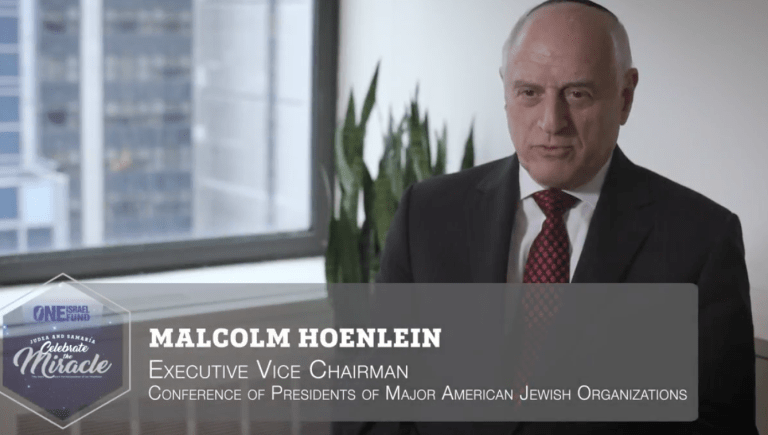
Head of Conference of Presidents of Major American Jewish Organizations (which includes 53 organizations) speaks at One Israel Fund event
Kelo Shlomo (also spelled Kello Shlomi) is expected to provide a speedy, coordinated response “to efforts to stain Israel’s image around the world, for example, in the event of a military operation, terror attacks [sic] or UN votes against government policies.”
“This would be done by launching online campaigns, lobbying, engaging organizations abroad and bringing delegations to Israel.”
Israel outsources work to agents abroad
Seventh Eye reports: “Much of the activity is outsourced, as a result of a declared strategy that in order to succeed in the mission, the government’s involvement in the ‘mass awareness activities’ it initiates should be disguised. This outsourcing is carried out by agents in Israel and abroad who make up… the ‘pro-Israel network.’”
CAMERA

One of Hen Mazzig’s U.S. sponsors has been the Committee for Accuracy in Middle East Reporting (CAMERA).” It’s unknown whether any CAMERA officials were aware of Mazzig’s paid employment by the Israeli government. Nor is it known to what degree CAMERA itself may work with the Israeli government.
CAMERA’S website states that the organization was founded in 1982. Among its earliest members were prominent Washington-area residents Saul Stern and Bernard White. Its Advisory Board included U.S. Senators Rudy Boschwitz and Charles Grassley, Congressman Tom Lantos, journalist M. Stanton Evans, Ambassador Charles Lichenstein, Pastor Roy Stewart, and Rabbi David Yellin.
CAMERA created chapters in major cities, including New York, Chicago, Fort Lauderdale, Los Angeles, Miami, San Francisco, Philadelphia, and in1988 a Boston chapter and office, founded and led by Andrea Levin, who has served as associate editor of the Journal of Policy Analysis and Management at Harvard’s Kennedy School of Government.
The Executive Board has included some top Boston business leaders, including the co-founders of Timberland and Staples.
CAMERA’s current head is Levin, named in 2002 as “America’s fifth most influential Jewish citizen.” Its membership now numbers over 65,000.
In addition to the Boston headquarters the organization also has offices in Washington, DC, New York, Chicago, Los Angeles, and Israel. Among CAMERA’s authors was columnist Charles Krauthammer. It now has assets of close to $8 million, and Levin receives an annual salary of over $260,000.
The organization, which operates both in the U.S. and abroad, is a member of the New England Israel Campus Roundtable, which includes 19 pro-Israel organizations.
New projects initiated by CAMERA:
-
The CAMERA Fellows Program recruits student leaders across the US as well as from Spain, South Africa and Latin America who present educational programs on their campuses to inform fellow students about Middle East realities. The Fellows monitor their student newspapers, write Op-Eds and help counter distorted characterizations of Israel in the campus arena.
-
Launched in early 2011 the CAMERA Campus Activist Project (CCAP) promotes creation of pro-Israel groups on campuses where there is little or no such activity.
-
Revista de Medio Oriente, CAMERA’s Spanish language counter part, challenges misinformation in the Spanish language world, whether in Spain’s media or in Latin American coverage.
-
The British Project addresses major media in Britain, such as the Guardian, the Independent, and the BBC, which have global reach and all too often have problematic Middle East coverage.
-
The Christian Project focuses on distorted Middle East coverage in Christian publications and sponsors programs in the Christian community.
So far it is unknown whether the U.S. justice department will investigate Hen Mazzig and his network of American enablers following the Forward’s revelations. Past history suggests that this will not occur – unless enough American demand it.
So far, no U.S. media seem to have reported the Forward’s findings.
Alison Weir is executive director of If Americans Knew, president of the Council for the National Interest, and author of Against Our Better Judgment: The Hidden History of How the U.S. Was Used to Create Israel.
Israeli forces assault priests, detain one in Jerusalem
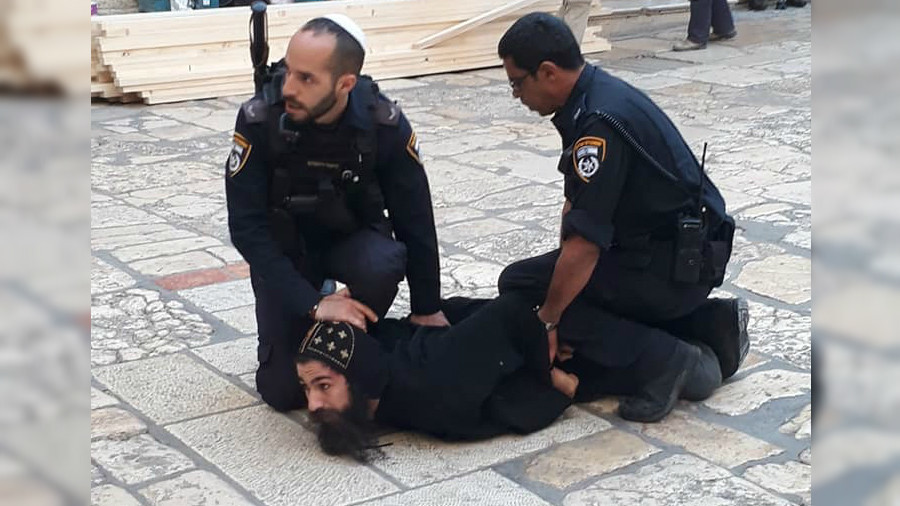
The arrest of Monk Macarius Orshalemy. © Coptic Orthodox Patriarchate Jerusalem
Ma’an – October 24, 2018
JERUSALEM – Israeli forces and police assaulted several Coptic Orthodox priests in front of the Church of the Holy Sepulchre, in the Old City of occupied East Jerusalem, and forcefully detained one of them on Wednesday morning.
Prior to the assault, the Coptic Orthodox Church organized a peaceful protest near Deir al-Sultan Monastery, located on the roof of the Church of the Holy Sepulchre, against an Israeli decision denying the church the right to conduct the needed renovation work inside the holy site.
It is noteworthy that the Israeli municipality of Jerusalem continues to conduct unauthorized renovation work for the Ethiopian Coptic Church section without the approval of the Coptic Orthodox Church.
Eyewitnesses said that Israeli soldiers and police officers surrounded the priests who were protesting, before assaulting and pushing them with excessive use of force, causing them several injuries.
Witnesses added that the Israeli police forcibly removed the priests and detained one of them, before allowing the Israeli municipality workers into the holy site.
The Islamic Christian Committee to Defend Jerusalem and Holy Sites condemned the assault on the Coptic Orthodox priests and denounced the intervention of Israeli authorities in the renovation works of the holy site.
The committee pointed out that it is not within its jurisdiction to intervene in issues of occupied East Jerusalem, considering the area is subjected to the rules of international humanitarian law (IHL).
The committee called upon the Egyptian government and the Christian world to immediately intervene to stop Israeli authorities from these attacks and not to enter the holy site under the pretext of restoration, since the Coptic Orthodox Church is the only authorized body to do so.
The committee also called on the world to stand by the Palestinian right to sovereignty over its land in the holy city and the rest of its other occupied territories, and to stop the measures carried out by the Israeli occupation in violation of the resolutions of international law and international humanitarian law.
Revealed: Israel tax funded group gives loans to build illegal settlements
MEMO | October 23, 2018
The World Zionist Organisation (WZO) gave dozens of loans to aid the establishment of illegal Israeli settlements in the occupied West Bank, a new investigation has revealed.
The investigation, conducted by Israeli newspaper Haaretz, uncovered documents which “show a pattern in which settlers have established farms and unauthorised outposts over the past 20 years with loans from the [World Zionist Organisation’s] Settlement Division — financed entirely through taxpayers’ money and frequently secured by liens on agricultural equipment or livestock”.
Haaretz obtained “dozens of documents relating to mortgages pertaining to 26 outposts across the West Bank” including Amona, which Israel evacuated in 2017 after deeming it had been established illegally on Palestinian land. The illegal settlers were then relocated to Amichai, the first brand new settlement to be built since the Oslo Accords. Although Israel differentiates between settlements and outposts – which do not have official government recognition – both are deemed illegal under the Fourth Geneva Convention which prohibits the transferring of civilian populations into occupied territory.
The investigation then cross-referenced maps with the names of those who obtained mortgages, their place of residence and the year in which the loan was granted. In doing so, it found that the WZO “repeatedly gave loans to people who were establishing unauthorided outpost, and did so during the period when the outposts were being set up”.
The first of these loans dates back to the mid-1990s, one of which was given to extremist Avri Ran – the founder of the notorious “hilltop youth” movement – who established a number of illegal outposts at Gva’ot Olam, south east of Nablus in the occupied West Bank. This policy of providing financial assistance to illegal settlements has continued up to the present day, with the WZO granting a loan to the Yitzhar settlement in 2014, even though it was subject to three demolition orders.
Haaretz adds that “mortgage financing was also provided for illegal structures in [Israeli government] authorised settlements such as Yitzhar,” located south of Nablus. Finance was also provided for the “Havat Har Sinai, Einot Kedem and Shkedim farms,” also scattered across the West Bank.
Significantly, Haaretz explains that though the World Zionist Organisation operates without the Israeli government’s direct authority, “all of its funding comes from the Israeli taxpayer”. The WZO in fact pre-dates the state of Israel, having been founded by the ideological-father of Zionism, Theodor Herzl, in the 19th century as an organisation dedicated to the promotion of Jewish settlement in Palestine.
Since Israel occupied the West Bank in 1967, it has consistently pursued a policy of illegal settlement. Israeli human rights organisation B’Tselem states that, as of the end of 2015, there were 127 Israeli government-sanctioned settlements in the West Bank (not including occupied East Jerusalem and Hebron). This was in addition to 100 non-recognised outposts and 15 Israeli neighbourhoods inside the Jerusalem Municipality.
‘A cruel choice’: Why Israel targets Palestinian schools

By Ramzy Baroud | Ma’an | October 23, 2018
Several Palestinian students, along with teachers and officials, were wounded in the Israeli army attack on a school south of Nablus in the West Bank on October 15. The students of al-Sawiya al-Lubban Mixed School were challenging an Israeli military order to shut down their school based on the ever-versatile accusation of the school being a “site of popular terror and rioting.”
“Popular terror,” is an Israeli army code for protests. The students, of course, have every right to protest, not just the Israeli military Occupation but also the encroaching colonization of the settlements of Alie and Ma’ale Levona. These two illegal Jewish settlements have unlawfully confiscated thousands of dunums of land belonging to the villages of al-Sawiya and al-Lubban.
“The Israeli citizens,” that the Occupation army is set to protect by shutting down the school, are, in fact, the very armed Jewish settlers who have been terrorizing this West Bank region for years.
According to a 2016 study commissioned by the United Nations, at least 2,500 Palestinian students from 35 West Bank communities must cross through Israeli military checkpoints to reach their schools every day. About half of these students have reported army harassment and violence for merely attempting to get to their classes or back home.
However, this is only half of the story, as violent Jewish settlers are always on the lookout for Palestinian kids. These settlers, who “also set up their own checkpoints,” engage in regular violence as well, by “throwing stones” at children, or “physically pushing (Palestinian children) around.”
“UNICEF’s protective presence teams have reported that their volunteers have been subjected to physical attacks, harassment, arrest and detention and death threats,” according to the same UN report.
In other words, even the “protectors” themselves often fall victim to the army and Jewish settler terror tactics.
Add to this that Area C – a major part of the West Bank that is under full Israeli military control – represents the pinnacle of Palestinian suffering. An estimated 50,000 children face numerous hurdles, including the lack of facilities, access, violence, closure and unjustified demolition orders.
The school of al-Sawiya al-Lubban located in Area C is, therefore, under the total mercy of the Israeli military, which has no tolerance for any form of resistance, including non-violent popular protests by school children.
What is truly uplifting, however, is that, despite the Israeli military Occupation and ongoing restrictions on Palestinian freedom, the Palestinian population remains one of the most educated in the Middle East.
According to the United Nations Development Program (UNDP), the literacy rate in Palestine (estimated at 96.3%) is one of the highest in the Middle East and the illiteracy rate (3.7% among individuals over the age of 15) is one of the lowest in the world.
If these statistics are not heartening enough, bearing in mind the ongoing Israeli war on Palestinian school and curricula, consider this: the besieged and war-stricken Gaza Strip has an even higher literacy rate than the West Bank, as they both stand at 96.6% and 96% respectively.
In truth, this should not come as a total surprise. The first wave of Palestinian refugees that were ethnically-cleansed from historic Palestine were so keen on ensuring their children strive to continue their education, they established school tents, operated by volunteer teachers as early as 1948.
Palestinians understand well that education is their greatest weapon to obtain their long-denied freedom. Israel, too, is aware of this dichotomy, knowing that an empowered Palestinian population is far more capable of challenging Israeli dominance than a subdued one, thus the relentless and systematic targeting of the Palestinian educational system.
Israel’s strategy in destroying the infrastructure of Palestinian schooling system is centered on the allegation of “terror”: that is, Palestinians teach “terror” in their schools; Palestinian school books celebrate “terrorists”; schools are sites for “popular terror” and various other accusations that, per Israeli logic, compels the army to seal off schools, demolish facilities, arrest and shoot students.
Take for example, the recent comments made by the Israeli mayor of Jerusalem, Nir Barkat, who is now leading a government campaign aimed at shutting down operations by the UN organization that caters for Palestinian refugees, UNRWA.
“It is time to remove UNRWA from Jerusalem,” Barkat announced early October.
Without any evidence whatsoever, Barkat claimed that “UNRWA is strengthening terror,” and that “the children of Jerusalem are taught under their auspices, terror, and this must be stopped.”
Of course, Barkat is being dishonest. The jibe at UNRWA in Jerusalem is part of a larger Israeli-US campaign aimed at shutting down an organization that proved central to the status and welfare of Palestinian refugees.
According to this skewed thinking, without UNRWA, Palestinian refugees would have no legal platform, thus closing down UNRWA is closing down the chapter of Palestinian refugees and their Right of Return altogether.
The link between the shutting down of al-Sawiya al-Lubban, the targeting of UNRWA by Israel and the US, the numerous checkpoints separating students from their schools in the West Bank and more, have more in common than Israel’s false allegation of “terror.”
Israeli writer, Orly Noy, summed up the Israeli logic in one sentence. “By destroying schools in Palestinian villages in Area C and elsewhere, Israel is forcing Palestinians to make a cruel choice — between their land and their children’s futures,” she wrote earlier this year.
It is this brutal logic that has guided the Israeli government strategy regarding Palestinian education for 70 years. It is a war that cannot be discussed or understood outside the larger war on Palestinian identity, freedom, and, in fact, the very existence of the Palestinian people.
The students’ fight for their right to education in al-Sawiya al-Lubban Mixed School is by no means an isolated skirmish involving Palestinian school kids and trigger-happy Israeli soldiers. Rather, it is at the heart of the Palestinian people’s fight for their freedom.
Minister: Jordan ending land lease ‘provocation’ to Israel
MEMO | October 23, 2018
The Israeli Agriculture Minister, Uri Ariel, of the right-wing Jewish Home party has described the decision of King Abdullah of Jordan to end a lease of two areas of land to Israel that was agreed in annexes to the 1994 peace treaty between the two countries as “provocative”.
“I call on Prime Minister, Netanyahu to explain to the king that Jordan needs Tel Aviv more than Israel needs Jordan,” Ariel is reported to have said. “Israel provides Jordan with large quantities of water. If it were not for this water, the people of Amman would have water only two days a week instead of four,” the Israeli minister was quoted as saying said.
Ariel also called on King Abdullah to “extend the land lease agreement to benefit Israeli farmers” in the region.
There was no official comment from Jordan in response to Ariel’s remarks.
Jordan said on Sunday it would not extend the 25-year deal that allows Israel to use two tracts of territory along its border just as Israel said it was still planning to negotiate an extension.
“These are Jordanian lands and they will remain..” the monarch said. In an “era of regional turmoil” his kingdom -sandwiched between Syria to the north, Iraq to the east and Israel to its west – Jordan wanted to protect its “national interests,” Abdullah said.
Israel revokes work permits for family of killed Palestinian mother
Ma’an – October 22, 2018
BETHLEHEM – The Israel Security Service, the Shin Bet, cancelled Israeli work permits for the husband and brothers of a Palestinian mother who was killed after Israeli settlers hurled rocks at her vehicle, on Monday.
Aisha Muhammad Talal al-Rabi, 47, a mother of eight children, from the Bidya village near Salfit in the northern West Bank, was killed on October 12th after Israeli settlers hurled rocks at her vehicle as she was passing by near the Zaatara checkpoint in southern Nablus.
Hebrew-language news sites reported that al-Rabi’s husband and brothers were surprised to find out that they were the ones who were punished by having their work permits revoked, instead of holding the Israeli settlers responsible for the attack.
Sources added that the Shin Bet claimed the ban was temporary.
The Shin Bet also mentioned that no one has been detained as the investigation continues.
The Palestinian Authority (PA) condemned the killing of al-Rabi and called for international protection for the Palestinian people under Israeli occupation.
Additionally, the United Nations Special Coordinator for the Middle East Peace Process, Nikolay Mladenov, condemned the attack and called on the Israeli authorities “to ensure that those responsible are swiftly brought to justice.”
Lieberman: ‘We exhausted all options with Hamas’
Palestine Information Center – October 22, 2018
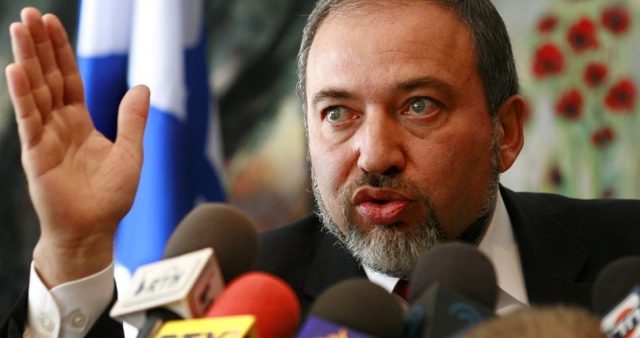
OCCUPIED JERUSALEM – Israel’s war Minister Avigdor Lieberman (Yisrael Beytenu) threatened to wage a bloody war against Gaza at the start of a meeting of the Knesset Foreign Affairs and Defense Committee.
“Wars are only conducted when there is no choice, and now there is no choice,” the minister claimed on Monday. “Anything less than the toughest response won’t help anymore. We have exhausted the other options.”
Lieberman alleged that Hamas was behind recent violence from the blockaded Gaza Strip and pays large sums to protesters.
“There is no popular uprising,” Lieberman said. “There is violence organized by Hamas. Fifteen thousand people don’t come by foot to the border at their own will. They come by bus and are paid.”
“I don’t believe in reaching an arrangement with Hamas,” he said. “It hasn’t worked, doesn’t work and won’t work in the future.”
Knesset Foreign Affairs and Defense Committee chairman Avi Dichter (Likud) also accused Palestinian Authority chairman Mahmoud Abbas of inflaming tensions in the Gaza Strip by preventing supplies and funding from reaching the people there.
“It is intolerable, unacceptable and unreasonable that Abbas closes the faucet for Gaza and Israel has to pay the price,” Dichter said.
Featured Video
Saudi Led Destruction of Yemen’s heritage
or go to
Aletho News Archives – Video-Images
From the Archives
Israel: Strategic Ally or Liability?
By Stephen Sniegoski | My Catbird Seat | June 12, 2010
The claim that Israel serves as a valuable ally for the United States is made by both pro-Zionists and much of the anti-war and anti-Zionist Left that is influenced by Noam Chomsky. As a result of the Gaza flotilla massacre, which has caused a world-wide uproar against Israel, the value of Israel to the United States is being publicly questioned in more mainstream foreign policy forums. … continue
Blog Roll
 Aletho News
- Declassified UK exposes British man who fought for ‘Israel’ in Gaza
- West’s death cult in a theater near you
- How the Yandex ‘Russian bots’ lie fell apart
- Burnham’s ‘Russia did Brexit’ ruse crumbles
- Estonia making movies and games to encourage war against Russia
- Four in five new UK jobs taken by foreigners – report
- Here’s what Trump’s latest U-turn really means for Russia and Ukraine
- The Houthis Are Not an Iranian Proxy
- Europe’s Energy Hypocrisy, Russian LNG Profits and US Dependence
- ICC ignored ‘very well-documented’ NATO crimes – ex-Libyan minister
- If Americans Knew
- Activists Abused By Israel Return to New Freedom Flotilla Mission
- 60 Minutes won’t tell the full truth about Israeli settler violence
- Nearly 50,000 women, girls killed or severely injured in Gaza since October 2023: UN Women
- ADL is working with AI companies to suppress alleged ‘antisemitism’
- Israeli occupation forces using social media surveillance unit to target hundreds of Palestinians in the West Bank
- Israel’s New – and Terrifying – Security Doctrine
- Israeli Attacks Kill Five in Gaza, Including a four-year-old and a woman
- Air Force Major Who Called for Trump’s Impeachment Held in Solitary Confinement
- It’s a Genocide, I’m Into It’: Seinfeld Mocks Protest over Palestinian Children Killed
- Universities fire dozens amid pressure from Zionist billionaires
- No Tricks Zone
- New Study Suggests Large Regions Of The Pacific Ocean Have Been Cooling For The Last 80 Years
- Germany’s Green Energy Debacle: High Energy Costs Force Kahla Porzellan to Close After 182 Years!
- New Study: 50 Years Of The Most Aggressive ‘Net Zero’ Policies Can Only Affect The Global Climate By 0.03°C
- US September “Heat” Was No Record…Many Records Set Decades Ago
- Latest European Green Energy Debacle; Portugal’s Largest Flagship Solar Park Insolvent!
- Green Energy Debacle: German Expert Professor Fritz Vahrenholt Warns Of Severe Economic And Social Consequences
- Two More Paleo Reconstructions Affirm Meters-Higher Sea Levels Across Ireland, Brazil 7000-6000 Years Ago
- New Study: Earth And Venus Surface Warmth Largely Explained By Convection And Lapse Rate, Not CO2 Or Radiation
- 2025 Nature Paper Claiming Worsening Global Drought Gets RETRACTED …Heavily Flawed
- New Study: ‘Global Drought Shows No Detectable Recent Acceleration Under Climate Warming’

