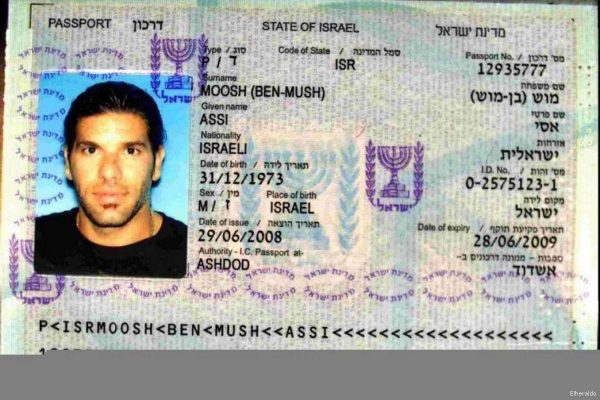
A former Israeli soldier was deported from Colombia for alleged links to a criminal network suspected of drug trafficking, child prostitution and tax offenses that spanned across several countries in Latin America.
Forty-three-year-old Assi Moosh was expelled by Colombia and returned to Tel Aviv under escort by immigration officers last weekend. In a statement confirming the deportation, security officials said: “Police in Santa Marta, capital of the Magdalena department, hereby announce the removal of an Israeli citizen who owns a spa hotel frequented by many foreign tourists. Deportation procedures have been commenced as per law and will be carried out due to the Israeli’s conduct, which has harmed Colombia’s national security.”
Colombian news agencies reporting on the deportation revealed details surrounding the expulsion of Moosh who was exposed as being part of a group of ex-Israeli soldiers that had turned a small fishing village in Taganga into a “sex and drug den” from their base in a luxury resort that was known to locals as “little Israel”.
El Heraldo, a regional newspaper, revealed Moosh as the head of an “international network of human trafficking, micro-trafficking and sex tourism”. The Israeli gained a reputation locally for organising private parties in a room within his hotel. From their base in “little Israel” Moosh is reported to have run similar clubs exploiting drugs and children in Cartagena, Bogotá, Medellín, Ecuador, Mexico and Brazil.
Local sources reported that Moosh was arrested when he arrived in the immigration office in Santa Marta accompanied by a group of armed men. It’s believed that he had been trying to obtain Colombian citizenship.
According to the national police, Moosh had raised suspicion after it was discovered that his permits for tourism and hotel operation were obtained through a third party, enabling him to carry out criminal activities undetected for a decade.
Locals are said to be “relived” by the arrest. Residents told journalists that Moosh “had been one of those who destabilised the social order of the people.” Many felt he should have been arrested long ago.
The mystery for many locals, according to El Heraldo, was the Benjamin hotel. Residents of Taganga described the resort as a “bunker” run by Moosh “exclusively for Jews”. While it’s unlikely that many of the locals would have actually seen the inside of the luxury resort, the feeling that it was an unwelcome place for non-Israelis has even been reported by visitors on TripAdvisor. “Not Israeli? Forget about it” wrote one visitor who had given the hotel two stars in the review. “First off this is a good hotel/hostel but if you are not from Israel I wouldn’t go there, my wife and I were made to feel very uncomfortable even had people come up to us and say ‘are you from Israel?’ I said ‘no’ to their reply ‘then why would you come here’.”
Reports of how “ex-soldiers turned a Colombia fishing town into a sex and drug den” had been on the media’s radar for a while. In February Colombia Reports uncovered the tension within the popular tourist region caused by the Benjamin hotel. The report found that “Benjamin [hotel] employs and accommodates almost exclusively Israeli citizens, and was officially opened by 20 rabbis brought over especially from Israel”.
Security in the hotel is reportedly coordinated by a Willington Vasquez, who, according to the report is also known as “Manuel, a former member of a paramilitary death squad”. Locals from Taganga complained that the Israeli “tourism entrepreneurs” were running a drug trafficking network and prostitution business.
The friction between locals in Taganga and the Israelis was also reported in 2012. “Four Israeli ex-soldiers are the new ‘masters’ of Taganga” was the headline in the El Tiempo. The paper alleged that the Israeli “businessmen” were selling cocaine and sexually exploiting young girls.
A journalist from El Tiempo investigating the allegations spoke with local officials, residents and the Israeli businessmen who pleaded innocence saying that “the community is wrong, everything is false”.
But the report proved otherwise. The authorities said that they were clear “several Israeli ex-soldiers who arrived in that village” were “leaders of criminal gangs”. The authorities complained that the Israelis took over social premises, violated rules on tax payments and permits and were involved in selling drugs and sexually exploiting children.
The ex-Israeli soldiers became known as “the untouchables”. El Tiempo journalists travelled to the area and established that some of them were living in a concrete mass, guarded by eight security cameras. Others carry arms and move in 4×4 trucks with the Israeli flag.
Testimonies from villagers and local authorities, who, El Tiempo said requested anonymity for fear of reprisals, exposed the drug and prostitution industry that had blighted the small fishing village.
Their standoff with the ex-Israeli soldiers led locals to create a committee and to request help from the Santa Marta administration.
Mayor of Santa Marta at the time, Carlos Caicedo, told El Tiempo that the situation in Taganga is serious and that he will ask the Israeli embassy and the Ministry of Foreign Affairs to review the legal status of the ex-military personnel settled in the Benjamin hotel.
Residents of Taganga appealed to their government to end the criminal activity in their village and a request was also made to the Israeli embassy, according to El Tiempo, to sanction the criminal behaviour of its nationals.
As for Moosh, it’s reported that Colombian authorities have imposed sanctions on him which prevent him from returning to country for at last ten years.
Read also: Israel killed 14 Palestinian children in 2017
November 29, 2017
Posted by aletho |
Corruption | Colombia, Israel, Latin America |
Leave a comment
By Yassir Al Zaatara | The New Khalij | November 27, 2017
Leaked information about Donald Trump’s “deal of the century” varies in some details, but the one thing that is consistent is that there will be no more on offer than autonomy for parts of the West Bank, without Jerusalem. There will be no Palestinian sovereignty and no return of the refugees, not even compensation for them, although there will be talk about linking autonomous areas with Jordan in a federal arrangement. In the meantime, relations between Israel and Arab states will be formalised.
What will be discussed when marketing the “deal”, of course, is that this solution is not the end product, and that the so-called “final status” issues, especially Jerusalem, will be left for another time after the neighbours are more reassured about each other’s intentions. Meanwhile, everyone knows that the plan is based on making the status quo permanent in due course, because no one in Israel wants to give up Jerusalem, nor allow the return of any Palestinian refugees.
This reminds me of the paradox of former minister Tzipi Livni’s response to Saeb Erekat mentioned in the well-known negotiation leaks, when the Palestinian official told Livni that the then Israeli Prime Minister Ehud Olmert had agreed to the return of 10,000 refugees in what were called, rather euphemistically, “reunions”. She insisted that this was Olmert’s personal opinion and that the number of people who will return to Israel is nil.
The details of the deal are of no concern, but what is, is that those involved in marketing and supporting such a proposal — and pressing for its acceptance by Palestinians and Arabs — are in more need of advice than the others for two reasons. The first is that such an agreement will be practically impossible to pass, even though it might seem possible to get through some of its early stages; and second, their position will be harmful to them.
In the first context, keep in mind what Netanyahu said a few days ago about it being the Arab people who reject normalisation of relations with Israel, not the regimes; this is true to a large extent. The people generally do not approve of Israel’s existence in principle, even if they accept the Arab Initiative, which proposed giving the Israelis 78 per cent of historic Palestine. Things will get more difficult when discussing a much worse proposal which involves the effective abandonment of Jerusalem and Al-Aqsa Mosque.
The people’s position on normalisation means that the new game will not pass. The stance of the Egyptian people after nearly four decades of the Camp David Treaty is the best evidence of this; there is also the position of the Jordanians 25 years after signing the Wadi Araba peace deal with Israel.
That is not all. The Palestinian people will not be silent about eradicating their cause in such a miserable way, and they will rise again, and the Jordanians will not accept the federalism being spoken of. It all, in any case, assumes that the Palestinian resistance forces will agree to the new proposal, which they won’t, or at least the majority of them won’t. Those in the Arab world who try to market the Trump deal will clash with their people if they go ahead and back a proposal to wipe out the Palestinian cause.
As a backdrop to all of this, it is clear that America and Israel will continue to be keen on keeping the regional conflicts going so that only Israel will remain as a strong and cohesive state, which everyone then seeks to befriend. Will those involved in supporting the Trump plan reconsider their positions? I hope so.
Translation by MEMO
November 29, 2017
Posted by aletho |
Ethnic Cleansing, Racism, Zionism, Illegal Occupation, Timeless or most popular, War Crimes | Egypt, Human rights, Israel, Middle East, Palestine, United States, Zionism |
Leave a comment
By Ahmed Jamil Azam | Arabi21 | November 28, 2017
The events currently occurring in the Palestinian arena, specifically the American vision for the Palestinian issue, are similar to a huge marketing campaign, as well as the sanctions that will be imposed on anyone who refuses the marketed product. This is despite the important fact that the product being marketed is not even ready yet.
The Israelis want to market a new idea, or rather, a new old idea. This idea suggests that there are various forms of sovereignty and that this could be proposed to the Palestinians. This is reminiscent of the Israelis’ past proposal of what they called functional sovereignty.
The American team responsible for the peace process is composed of a group of Zionists supporting settlements in the occupied West Bank. Therefore, it is not surprising that since the formation of the American administration we have been witnessing efforts to empty the settlement process of any content that includes any Israeli withdrawal or settlement dismantlement. Hence, this team is doing three things: buying time for the Israeli occupation and its settlement expansion, marketing ideas requiring the Palestinians to back down from the idea of an independent state, and thirdly, marketing the division of peace in the Middle East into two tracks: Arab-Israel peace and Palestinian-Israeli peace.
According to Al-Monitor, which operates mainly from Lebanon and publishes material in Arabic, Hebrew and English, the American Ambassador (a Jewish Zionist) to Tel Aviv, David Friedman, the American consulate in Jerusalem, in cooperation with the US Special Representative for International Negotiations, Jason Greenblatt, are making great efforts to propose a vision that has a regional context. What Benjamin Netanyahu is doing is trying to achieve normalised relations, as well as economic, political and military relations with Arab countries allowing him to establish Israeli influence in the region in the future. Of course, there is no reference or hints of this goal, but any amateur researcher in international relations who reads the Israeli theories, especially those of the Likud Party, and is familiar with the basics of international relations, especially the realism theory, would realise these are their goals.
Instead of announcing these goals, they announce the importance of an Arab-Israeli alliance against terrorism and Iran. According to Al-Monitor, which quoted Israeli diplomats, Netanyahu is currently looking into how he can pay the lowest price to market the idea of Arab-Israeli normalisation, along with other basic ideas, such as not withdrawing from the West Bank and maintaining full security control over it. Therefore, he proposed the idea of autonomy, but called it a different name, considering it another kind of sovereignty.
If the American initiative is ever announced, it will basically say: The Palestinians must accept the status quo in return for some facilitations in their living conditions and formal changes. The Palestinians declare their state on paper, and they can declare similar things, but will not have Israeli recognition, nothing will change on the ground, and it must be within restrictions that do not include requesting international recognition or prosecuting the Israelis in the International Criminal Court.
The Israelis raised the idea of ”functional sovereignty” in Jerusalem, during the Camp David and Taba negotiations of 2000 and 2001. It can basically be called “extensive administrative powers”, and nothing more. Nowadays, similar ideas are being marketed, but only in the West Bank.
We are not certain the Americans will reach the stage of declaring an initiative. If they do announce an initiative, it will be recognition of the Likud and Israeli initiatives for autonomy, as proposed in ideas raised in the 1970s during the Egyptian-Israeli negotiations.
Even if, for the sake of argument, we assume there are some Arab states that would accept these new ideas of an entity less than a Palestinian state and the return of the refugees, which is not yet certain, it will be the Palestinians who make the decision, specifically Palestinian President Mahmoud Abbas. Based on all past experiences, the Palestinians will not agree to any solution that does not include a Palestinian state, and Abbas will reject such a proposal.
There is much room for speculation about future scenarios, including holding the Palestinians responsible for the failure, reaching a temporary agreement (Oslo 2) that involves the beginning of Arab-Israeli normalisation and making minor changes to the status of the Palestinians, or new negotiations (which the Palestinians have rejected with[out] freezing settlement expansion). However, despite this, we are certain that the majority of the world superpowers are dealing with the possibility of reaching a final agreement as something far-fetched.
The Palestinians, more than anyone else, need a strategy that includes a hint to their alternative plan if a solution is not reached.
Translation from Arabic by MEMO.
November 29, 2017
Posted by aletho |
Ethnic Cleansing, Racism, Zionism, Illegal Occupation, War Crimes | Israel, Palestine, United States, Zionism |
Leave a comment
Egyptian authorities have criticised the Israeli Minister of Social Equality Gila Gamliel over her recent statements, in which she called for an alternative Palestinian state to be established in the Sinai Peninsula.
Egypt’s foreign minister, Sameh Shoukry, denounced today Gamliel’s statements stressing that Egypt firmly rejects any kind of “talk or thoughts” that undermine Egypt’s territorial sovereignty.
“The Egyptian domestic affairs should not be included in any statements by foreign parties most importantly when these statements touch Egyptian sovereignty,” Shoukry said in a press conference.
Shoukry noted that the Egyptian authorities have conveyed Cairo’s rejection on Gamliel’s statements to the Israeli ambassador in Cairo, adding that her comments “were made a long time ago.” He also denied summoning the Israeli ambassador.
“The Egyptian land in Sinai, which was watered with the blood of our sons and martyrs, is not something that can be given away or allowed to be attacked,” the Egyptian minister added.
An official source at the Egyptian foreign ministry told Quds Press that officials believe that the recent mosque attack is an Israeli attempt to empty Sinai from its original residents to build a Palestinian state in as an alternative for the two-state solution in the West Bank.
The Egyptian official noted that the Egyptian Embassy in Tel Aviv has asked Israel for clarifications on Gamliel’s comments, noting that the Israeli government had stressed that the statements “were personal comments and did not represent government policy.”
On his part, the Egyptian MP, Mostafa Bakry, told Quds Press that the Israeli statements were linked to the recent terrorist attack in Sinai.
Last week, Gamliel said during her visit to Cairo that “it is impossible to create a Palestinian state except in Sinai.”
Rejecting a Palestinian state in the West Bank, she noted that “a Palestinian State is a dangerous idea for the State of Israel,” she explained, stressing: “Between the River Jordan and the [Mediterranean] sea there cannot, and must not, arise a Palestinian state.”
“This call could be unacceptable to the international community and the Arab countries, which are neighbours to Israel, but it is based on our primary and historic right to the land of Israel,” the Israeli minister reiterated.
November 28, 2017
Posted by aletho |
Ethnic Cleansing, Racism, Zionism, War Crimes | Egypt, Israel, Palestine, Zionism |
Leave a comment
While accusations of student anti-Semitism at McGill draw international headlines, the university administration’s open association with the Jewish National Fund has been ignored.
In the latest iteration of a multi-year smear campaign against Palestine solidarity activists at the university, Canadian Jewish Political Affairs Committee activist Noah Lew cried “anti-Semitism” after he wasn’t voted on to the Board of Directors of the Students’ Society of McGill University (SSMU). At a General Assembly last month Democratize SSMU sought to impeach the student union’s president Muna Tojiboeva. The ad-hoc student group was angry over her role in suspending an SSMU vice president and adopting a Judicial Board decision that declared a Boycott, Divestment and Sanctions resolution unconstitutional.
(After two close votes, in February 2016 a motion mandating the student union support some BDS demands passed the union’s largest ever General Assembly, but failed an online confirmation vote after the university administration, Montreal’s English media and pro-Israel Jewish groups blitzed students. The resolution’s constitutionality was subsequently challenged.)
At the recent General Assembly Democratize SSMU’s effort to impeach the president failed. While they couldn’t muster the two thirds of votes required to oust the non-Jewish president of the student union, Democratize SSMU succeeded in blocking the re-election of two Board of Directors candidates who supported the effort to outlaw BDS resolutions.
After failing to be re-elected to the Board of Directors Noah Lew claimed he was “blocked from participating in student government because of my Jewish identity and my affiliations with Jewish organizations.” His claim was reported on by the National Post, Montreal Gazette, Global Television, as well as Israeli and Jewish press outlets. McGill Principal Suzanne Fortier sent out two emails to all students and faculty concerning the matter while the SSMU Board of Directors established a committee to investigate anti-Semitism. The affair was even mentioned in the House of Commons.
While a great deal has been written about alleged student anti-Jewish attitudes, the McGill administration’s open association with an explicitly Jewish supremacist organization passes with nary a comment. On November 28 McGill’s Associate Vice-Principal Innovation Angelique Mannella is scheduled to participate in a Jewish National Fund networking event called Tech Shuk, which connects Jewish capitalists with Montreal start-ups in a “Dragon’s Den” style competition. But, the JNF is a racist organization. Owner of 13 per cent of Israel’s land, it systematically discriminates against Palestinian citizens of Israel, who make up a fifth of the population. According to a UN report, Jewish National Fund lands are “chartered to benefit Jews exclusively,” which has led to an “institutionalized form of discrimination.” The JNF oversees discriminatory land use policies in Israel outlawed in this country 60 years ago.
In 2004 long-time McGill Principal Bernard Shapiro was the honoured guest at JNF Montréal’s annual fundraising dinner (two years later the then former University Principal was master of ceremonies at the event). The current president of JNF Montréal, Michael Goodman, was a member of the advisory board of McGill ASD (Autism spectrum disorder). In 2014 McGill gave an honorary degree to Marvin Corber. The University’s press releaseannouncing its two honorary degree recipients cited an award Corber received from the JNF. Corber has been a JNF Montréal campaign advisor and chair of its annual fundraising dinner.
While the university administration’s ties to the JNF are a stark example of its racial bias, McGill is also entangled in other more subtle forms of anti-Palestinianism. The Montréal university has a memorandum of understanding with Tel Aviv University, which claims to be on “the front line of the critical work to maintain Israel’s military and technological edge.” McGill also has a partnership with Technion, which conducts “research and development into military technology that Israel relies on to sustain its occupation of Palestinian land.”
In 2012 the estate of Simon and Ethel Flegg contributed $1 million to McGill’s Jewish Studies department partly for an “education initiative in conjunction with McGill Hillel.” But, the cultural organization turned Israel lobby group refuses to associate with Jews (or others) who “delegitimize, demonize, or apply a double standard to Israel; support boycott of, divestment from, or sanctions against the state of Israel.”
Imagine the outcry if a McGill department accepted a large donation to work with an organization that openly excluded Jews and others who “delegitimize, demonize, or apply a double standard to Palestine and fail to recognize Palestinians’ UN enshrined rights.”
It’s time to discuss the McGill administration’s support for Jewish supremacy in the Middle East.
November 28, 2017
Posted by aletho |
Ethnic Cleansing, Racism, Zionism, Solidarity and Activism | Canada, Israel, McGill University, Palestine, Zionism |
Leave a comment
How the United States military has become Zionized
There has been a report that Special Counsel Robert Mueller is looking into foreign lobbying in Washington while another story relates how his team is investigating the alleged contact of a Donald Trump associate with a Hungarian. Both are part of the ongoing investigation into Russiagate. Unless I am wrong, which happens occasionally, Hungary is a member of the European Union and also of the North Atlantic Treaty Organization (NATO). It has relatively free elections and its government changes as a result.
No one but the Mueller commission has considered contact with a Hungarian citizen to be a potential threat to American democracy. But then again, no one has really made the case in any kind of credible fashion that meeting with a Russian is either ipso facto criminal or treasonous, or that Moscow’s media does anything beyond what other state-owned broadcasters tend to do, but you wouldn’t know that from reading the mainstream press or from watching MSNBC and CNN.
An independent observer might well note that there is more than a whiff of hypocrisy in all of this. Case in point, the latest globalist-interventionist-neocon think tank the Alliance to Secure Democracy is currently being funded by a bundle of foreign governments, presumably doing so without any interference from Mueller or from those who run the Foreign Agents Registration desk at the Department of the Treasury.
And one other thing you can bet on is that Mueller will not be looking at the country that actually does interfere in American politics most, which is our best friend in the whole world and greatest ally Israel, the beneficiary of roughly one billion dollars-worth of lobbying carried out by hundreds of full time staff on its behalf.
Punish Israel for corrupting our politicians and media? On the contrary, now that we are officially into the holiday season, a whole bunch of goodies designed to make Benjamin Netanyahu’s eyes sparkle are pending. The highest priority item is the Trump Administration’s cooperation with the Israeli government in a frantic effort to bury a United Nations report that includes a database of all the companies that operate in Israel’s illegal settlements. Also regarding the U.N., Congress is considering a bill that would block U.S. aid to any country that opposes “the position of the United States.” Lest there be any confusion, Ambassador Nikki Haley has made it clear the American “position” would pretty much consist of never criticizing or voting against Israel.
Congress is meanwhile also making a list and checking it twice, looking into the vexing issue of how to make any and all criticism of Israel equate to anti-Semitism as a step forward to turning such activity into a hate crime with actual criminal penalties. The House Judiciary Committee has been holding meetings to try to decide how exactly one might do that without completely jettisoning the First Amendment, which once upon a time was intended to guarantee free speech. On November 8th, nine experts, seven of whom were Jewish, were summoned to address the issue of “codify[ing] a definition of anti-Semitism that incorporates a controversial component addressing attacks on Israel… [as] a necessary means of stemming anti-Semitism on campuses.”
The proposed amendment to the Civil Rights Act would use language being considered for the still pending Anti-Semitism Awareness Act to considerably expand the currently accepted government acceptance of anti-Semitism as “demonization” of Israel and/or its policies. A broader definition would have real world consequences as it would potentially block federal funding for colleges and universities where students are allowed to organize events critical of Israel. Fortunately, the hearing did not produce the result desired by Israel. To their credit, four of the witnesses, all Jewish, opposed expanding the definition of anti-Semitism and even some congressmen uncharacteristically indicated that to do so might be a bridge to far.
Indeed, one might argue that there is a tendency in Washington to see the world and even domestic policies through Israel’s eyes. One might even suggest that the United States government is being progressively Zionized because of the free hand that Israel and its supporters have, which gives them the ability to seek benefits for Israel that they would be unlikely to pursue for the United States. To cite only one example, an Israel Victory Caucus was launched in the House of Representatives in April advocating Israeli defeat of all its neighbors. The keynote speaker at the event, noted Islamophobe Daniel Pipes, explained “Victory means imposing your will on your enemy so he no longer wants to continue to fight,” before demanding “What I want the U.S. government to do is say, ‘Israel, do what you need to do to win your war.’”
Israel has been uniquely successful at imposing its will over Congress and the White House. Every freshman class in Congress, plus spouses, is automatically whisked off for a deluxe all expenses paid propaganda trip to Israel, which is funded by an affiliate of the American Israel Political Action Committee (AIPAC). That is supplemented frequently throughout the year through taxpayer funded CODELS by established politicians to find out the “facts” on what is going on in the Middle East. During congressional recesses Congressmen are sometimes more likely to be found visiting Israel than dealing with problems in their own districts and they routinely return spouting whatever line is being promoted by the Israeli government.
There is also the training of American police in “Israeli methods,” which is funded both by government and foundations set up for that purpose. Less well known is the inroads Israel has made with the American military establishment. Shoshana Bryen, former executive director of the Jewish Institute for National Security Affairs (JINSA) and currently affiliated with the Jewish Policy Center, who has been involved in hosting the indoctrination of U.S. national security personnel, recently described it this way: “I have taken more than 400 American security professionals – primarily retired American Admirals and Generals – to Israel in more than 30 trips. And at the other end of their careers, I have sent more than 500 cadets and midshipmen of our service academies to Israel before they received their commissions. And I can say that they all understood the fundamental and profound principles that guide both the United States and Israel. They don’t always agree with Israel’s politics – or Israel’s defense choices – or any other single aspect of Israeli political, military and social life, but I never found one that didn’t believe in the relationship between Jews and the land of Israel. The United States military, then, is a Zionist institution.”
Last Monday, Colonel Pat Lang, former special ops officer and head of the Defense Humint Service, considered Bryen’s assertion, writing “It’s an open question but I think the answer is probably yes. The U.S. military now seems to be totally focused on Israeli policy goals in Iran, Syria and Iraq… Israel wants Iran neutered and eliminated as a power rival in the Middle East. The putative Iranian nuclear weapons program is just one target of Israeli policy toward Iran. To reach the goal of Morgenthau-style comfort with regard to Iran, Israel wants to destroy Syria and Hizbullah as allies of Iran… The process of conditioning American officers to make them Zionists has been ongoing for a long time. when I came in the Army in 1962, there was little interest in Israel in the officer corps… [The] 1967 war was a watershed. Israel’s total victory had been unexpected by most. Americans are mentally driven by aggressive sports analogies and Israel was a winner. That made a big difference in spite of the repeated day long attacks by the Israeli air force and navy against U.S.S. Liberty, an American SIGINT collector positioned off the Egyptian coast. LBJ suppressed an armed reaction by a U.S. carrier battle group in the area and a subsequent naval investigation. His policy then became one of relatively complete support of Israel. The indoctrination and conditioning program described by Shoshana Bryen began in earnest after that and has carried through to the present under the umbrella of AIPAC and its galaxy of linked organizations especially JINSA. This program has been wildly, incredibly successful. As a result, there is an unthinking willingness among senior, and not so senior American officers to support Israeli policy in Iran, Syria, Lebanon, Palestine and now Saudi Arabia. The handful of M[iddle] E[ast] trained and educated U.S. officers are ignored, treated as technical experts or shoved out the door when they speak up.”
How deeply Israelophilia has been drilled into the American corporate psyche is best illustrated by a recent article that appeared on the National Interest website. The article was written by retired Israeli Colonel Shimon Arad, who apparently has contributed to the site previously, and its thrust is that the United States should only sell military hardware to the Middle East when Israel is satisfied that the sales will not undercut its self-defined military edge. In other words, U.S. defense industries and national security arrangements should be subordinated to Israeli interests and even subject to veto by the Netanyahu government.
Arad’s condescending piece, sub-titled “Israel’s Greatest Fear: An Arms Race Sparked by the F-35,” should be read fully to demonstrate just how arrogant the Israelis have become in dealing with their American puppet. Arad argues that no advanced fighters comparable to what Israel receives for free from the U.S. taxpayer should be sold to any Arab country, no matter how friendly or strategically valuable. Previous pledges that the new F-35 would not be sold to Arabs “played a significant role in [Israel]’s acquiescence to the sale of… advanced… fighters to the Gulf states…” “Acquiescence” is the key word, implying that Israel should by rights have the option to stop such sales by putting pressure on Congress. Arad then goes on to describe how sales to the United Arab Emirates would be a “dangerous precedent,” but he is clearly talking only about Israeli interests as the United States is in no way threatened by such a move. He concludes that “Israel must express its strenuous objection to the release of the F-35 to any and all Gulf and Arab countries.”
In an earlier article, Arad complained about Arab states being sold sophisticated air defenses, presumably because that would make it more difficult for Israel to bomb them. Why an American publication should provide a pulpit to an Israeli who is promoting a narrowly construed Israeli interest that differs significantly from the actual interests of the United States is not completely clear. The site’s readers apparently agreed with that observation in that most of the comments were highly critical both of Arad and of Israel. Someone should remind the colonel that America’s three major military concentrations in the Middle East – five bases in Kuwait, Al-Udeid Airbase in Qatar, and the Fifth-Fleet home base and Naval Central Command in Bahrain – are all in Arab countries that have accommodated Washington in ways that Israel never has. To place them on a list of countries that are somehow always suspect just because Israel perceives nearly all Muslims as enemies, is not in America’s own interest, but this has been the unfortunate pattern in the lopsided relationship prevailing between Washington and Tel Aviv.
The infiltration by little Israel of key sectors of the bureaucracy of a seemingly oblivious giant United States is extraordinary by any measure, but it has been brought about by a highly focused and well-funded powerful domestic lobby that has remarkable access both to the political class and to the media. As Admiral Thomas Moorer, former chairman of the Joint Chiefs of Staff once put it, “No American president can stand up to Israel.” He should have added Congress and even the Pentagon to his indictment but what he said is, unfortunately, truer now than it was when he made the comment back in 1997.
November 28, 2017
Posted by aletho |
Corruption, Ethnic Cleansing, Racism, Zionism, Russophobia, Timeless or most popular, Wars for Israel | Israel, JINSA, Robert Mueller, United States, Zionism |
Leave a comment
For the 330,000 dead souls of Syria it may be small comfort that the bloody conflict in their homeland is drawing to a close, finally, but it is brilliant news nonetheless.
Although there has been a struggle against terrorism on Syrian soil, the struggle was quintessentially geopolitical. The decades-long US agenda – at least, dating back to the invasion of Iraq in 2003 – was at the core of it. That agenda, which sucked in regional and extra-regional powers, has conclusively failed. Therefore, it is the regional settlement that becomes crucial at this stage.
Peacemaking makes strange bedfellows because protagonists are jockeying for position to secure their interests. The trilateral summit in Sochi between Russia, Iran and Turkey on Wednesday can be regarded as a celebratory event insofar as Russia and Iran have not only ‘won’ the Syrian war but also cemented the ‘defection’ of Turkey to their side. The locus of Middle East politics itself has shifted. This is one thing.
Equally, Russian diplomacy has effectively ‘neutralized’ Saudi Arabia and encouraged that country to ‘sanitize’ the Syrian opposition groups who are under its influence and nudge them toward swallowing the bitter pill and drop their persistent pre-condition that President Bashar al-Assad cannot be part of any solution to the Syrian problem.
With Qatar and Jordan having already moved to a ‘neutral position’ on their own accord in the recent months – each for its own reasons of self-interest – and with Egypt all along being fully behind the Russian leadership, there is no regional state that is any longer in the business of prolonging the fratricidal war by putting up proxy groups.
Except, of course, Israel. But then, Israel is a small country and non-Muslim and lacks the clout to influence the prevailing winds or to create new facts on the ground in Syria. The Russian President Vladimir Putin who spoke to all key regional leaders and (US President Donald Trump) on Tuesday night in a flurry of ‘telephone diplomacy’ pointedly ignored Israeli PM Benjamin Netanyahu who then had to initiate a request to the Kremlin to solicit a briefing by Putin. (Putin graciously obliged.) But it was a signal of displeasure to ‘Bibi’ from the Kremlin as well as a warning to behave responsibly in the period ahead.
Added to the Saudi back-tracking in Lebanon, Israel has been virtually put out of business. Besides, the fact of the matter is that ISIS has been defeated and the Syrian army controls over 98 percent of territory (according to Russian estimates.) There is already talk of a winding down of the Russian military presence in Syria before the end of the year.
So, how will the post-conflict scenario look in Syria? The Sochi summit provided some signposts. There are five main ‘takeaways’.
- Turkey has a deal with Russia and Iran to accept Assad’s continuance as leader through the transition – and even beyond (more of that below) – and in return, President Erdogan scored a major victory in keeping the Kurds from inclusion in the settlement.
- The troika – Russia, Iran and Turkey – will be in the driving seat to shepherd the Syrian parties to the negotiating table in Geneva where the UN will notionally preside over the talks. The three countries will decide the participants for the upcoming Syrian Dialogue to be held in Sochi in early December to discuss a constitution and deliberate on the broad contours of a settlement.
- The troika will also continue to be the ‘guarantor powers’ ensuring the ceasefire and will coordinate the maintenance of security within Syria through the uncertain period ahead. But the so-called ‘de-escalation zones’ as such will be an interim measure, which will be disbanded once the transition is complete. That means, there is no scope for external powers to carve out ‘spheres of influence’ on Syrian territory.
- A US withdrawal from Syria becomes inevitable, no matter what Defence Secretary James Mattis might say or not. In fact, an open-ended US military presence (such as in Afghanistan) will be possible only through the establishment of a puppet government in Syria, which is inconceivable.
- Russia has emerged as the Master of Ceremonies. This is not at all surprising since Russia is the only power on earth which has networking with all protagonists within Syria, in the region and internationally. The Russians displayed a masterly performance in optimally conducting ‘coercive diplomacy’. It is an incredible feat that they entered the Syrian conflict only in September 2015 but turned the tide of the war within a short period of time, went on to crush the ISIS, and consolidated Assad’s position as the unassailable future leader – all within a matter of two years flat – and are now putting together the nuts and bolts of a settlement almost suo moto, while also carrying along the ‘losers’ in the war and altogether eschewing triumphalism.
Trump himself appears to be on board Putin’s settlement formula, which is of a unitary Syrian state and a democratically government that comes out of UN-supervised elections in which all Syrians (including Assad) can contest. (To jog memory, the Trump-Putin statement on Syria after their meeting in Da Nang even made a reference to Assad.)
Indeed, there are grey areas still. The most important one involves the continued presence of the Islamic Revolutionary Guards, the militia supported by Iran and Hezbollah who have been the real source of strength on the ground for the Syrian government. But it is unrealistic to expect the Syrian army to handle the security all by itself through the delicate period of transition. There are terrorist groups present on Syrian soil, as the massive attack in Damascus today shows.
The bottom line is that the above becomes a non-issue if Assad remains in power because as the democratically elected leader of a sovereign country, it will be his prerogative to seek help from any quarter to strengthen national security. And the plain truth is that there is no credible opposition figure who can rival Assad in a free and fair election in Syria. If anything, the 7-year bloody civil war strengthens Assad’s appeal to the Syrian people cutting across religion or sects as the only bulwark against instability and chaos. To my mind, all that Assad needs is a level playing field in the nature of an inclusive democratic process.
Russia and Iran insisted throughout that it is for the Syrian people to elect or reject candidates in a democratic election. Turkey has now virtually identified with that principled stance. In a very significant remark, Turkish President Recep Erdogan said after the Sochi summit that he does not rule out resuming contacts with Assad in the coming period. The principle that it is simply not for outsiders to prescribe the political future of Syria is only going to get wider regional and international acceptance. In fact, one can visualize even European countries re-establishing ties with Damascus in a near future.
November 27, 2017
Posted by aletho |
Timeless or most popular | Iran, ISIS, Israel, Kurds, Middle East, Russia, Saudi Arabia, Syria, Turkiye |
Leave a comment
Measures aim to annex settlements to city and turn Palestinian areas into no-man’s land, warn rights groups
Israel is putting in place the final pieces of a Greater Jewish Jerusalem that will require “ethnically cleansing” tens of thousands of Palestinians from a city their families have lived and worked in for generations, human rights groups have warned.
The pace of physical and demographic changes in the city has accelerated dramatically since Israel began building a steel and concrete barrier through the city’s Palestinian neighbourhoods more than decade ago, according to the rights groups and Palestinian researchers.
Israel is preparing to cement these changes in law, they note. Two parliamentary bills with widespread backing among government ministers indicate the contours of Jerusalem’s future.
One bill intends to annex to Jerusalem some 150,000 Jews in illegal West Bank settlements surrounding the city. As well as bolstering the city’s Jewish population, the move will give these additional settlers a vote in Jerusalem’s municipal elections, pushing it politically even further to the right.
Another bill will deny more than 100,000 Palestinians on the “wrong” side of the barrier rights in the city. They will be assigned to a separate local council for Palestinians only, in what observers fear will be a prelude to stripping them of residency and barring them from Jerusalem.
Meanwhile, a web of harsh Israeli policies, including late-night arrests, land shortages, home demolitions and a denial of basic services, are intensifying the pressure on Palestinian inside the wall to move out.
These measures are designed to pre-empt any future peace efforts, and effectively nullify Palestinian ambitions for a state with East Jerusalem as its capital, said Aviv Tartasky, a field researcher with Ir Amim, an Israeli group advocating fair treatment for Palestinians in Jerusalem.
“What is going on is ethnic cleansing, without guns,” Tartasky told Middle East Eye. “Israel hopes to get rid of a third of Jerusalem’s Palestinian population through legislative moves alone.”
Demographic fears
Israel’s demographic concerns in Jerusalem date back to 1967, when it occupied and annexed East Jerusalem, combining the large Palestinian population there with West Jerusalem’s Jewish population. It also expanded the city’s municipal borders as a way to covertly annex West Bank land.
Israel initially set an upper limit of 30 per cent Palestinians to 70 per cent Jews in what it called its new “united, eternal capital”, but has been losing the battle to maintain that ratio ever since. Higher Palestinian birth rates mean that today there are more than 315,000 Palestinians in East Jerusalem, comprising nearly 40 per cent of the city’s total population. Projections suggest Palestinians could be a majority within a decade.

Although few Palestinians in Jerusalem have taken or been allowed Israeli citizenship, and almost none vote in municipal elections, Israel fears their growing numerical weight will increasingly make its rule in the city untenable.
“What we have in Jerusalem is an apartheid system in the making,” Mahdi Abd al-Hadi, a Palestinian academic in Jerusalem, told MEE.
“Israeli policies are dictated by demographic considerations and that has created a huge gulf between the two societies. Palestinians are being choked.”
‘Save Jewish Jerusalem’
Fear of the demographic loss of Jerusalem provoked the launch of a high-profile campaign by political and security leaders last year: “Save Jewish Jerusalem”. Fearful that Palestinians will soon be a majority and might start voting in municipal elections, the campaign warned Jewish residents they would “wake up to a Palestinian mayor in Jerusalem”.
Over the past year government ministers, including education minister Naftali Bennett, have aggressively pushed for the annexation of Maale Adumim, a large settlement outside Jerusalem, in the West Bank. Gradually, they appear to be winning the argument.
Late last month a ministerial committee was set to approve a Greater Jerusalem Bill, legislation intended to expand Jerusalem’s municipal borders to include Maale Adumim and several other large settlements in the West Bank. It won Netanyahu’s backing.
The settlements would have been annexed in all but name, and their 150,000 residents become eligible to vote in municipal elections.
De facto annexation
Yisrael Katz, the minister of transport and intelligence who helped introduce the bill, has said its purpose is to “safeguard a Jewish majority” in the city. A recent poll showed 58 per cent of Israeli Jews support the plan.
Under pressure from the administration of US President Donald Trump, Netanyahu has temporarily put the bill on the back burner. Washington is reportedly worried that the legislation will stymie a peace initiative it is reportedly about to unveil.
Ir Amim fears the legislation is likely to be revived when pressure dissipates. A position paper it published last week warned that the legislation was the “first practical move since the annexation of East Jerusalem in 1967 to implement the de facto annexation of areas in the West Bank to Israel”.
After decades of implanting Jewish settlers in the midst of Palestinian areas to prevent their development and growth, Israel is beginning the difficult process of disentangling the two populations, said Tartasky.
Eviction notices
The effects are being felt keenly on the ground.
Last Friday, Israeli forces stormed the Bedouin village of Jabal al-Baba and issued “eviction” notices to its 300 residents. In August the Israeli army demolished the village’s kindergarten school.
Jabal al-Baba stands between East Jerusalem and Maale Adumim.
“These Palestinian communities outside Jerusalem are like a bone in the throat for Israel,” said Tartasky. “Israel is trying to make their life as hard as possible to force them to leave, and so create a territorial continuity between Jerusalem and the settlements.”
The latest raid on Jabal al-Baba came immediately after Israel notified the hundreds of residents of Walaja that a military checkpoint would be relocated close to the entrance to their village. That will cut them off from ancient agricultural terraces on Jerusalem’s uplands their families have farmed for generations.
Although many of Walaja’s residents have Jerusalem identity papers issued by Israel, the new move will effectively seal them off from the city, as well as their lands. The terraces and a nearby spring, where the villagers water livestock, will become “attractions” in an expanded Jerusalem metropolitan park.
Chokehold tightening
Meanwhile, Israel is tightening its chokehold on Palestinians in East Jerusalem’s built-up areas.
Those on the far side of the concrete wall have been effectively abandoned by the Jerusalem municipality, and are finding it ever harder to access the rest of the city, said Daoud Alg’ol, a Palestinian researcher on Jerusalem.
A bill by Zeev Elkin, the Jerusalem affairs minister, is designed to disconnect from the Jerusalem municipality Palestinian neighbourhoods such as Walaja, Kafr Aqab, Shuafat refugee camp and Anata, which lie beyond the separation wall.
They would be hived off into a separate local council for Palestinians, instantly reducing the city’s Palestinian population by a third.
“Once Palestinians are in a separate local council, Israel will say the centre of their life is no longer in Jerusalem and their Jerusalem residency papers will be revoked,” said Alg’ol. “This already happens, but now it will be on a much larger scale.”
Since 1967, Israel has revoked the residency permits of more than 14,000 Palestinians, forcing them to leave Jerusalem.
Twilight zones of neglect
Even though their residents pay taxes to the Jerusalem municipality, Palestinian areas outside the barrier are already “twilight zones” of neglect and lawlessness.
In Kafr Aqab, for example, which is sealed off from the rest of East Jerusalem behind the wall and a military checkpoint, residents receive few services. Israel, however, has also denied the Palestinian Authority access.
“They are living in a no-man’s land,” said Alg’ol.
These areas have become a destination both for criminals and for Palestinian families caught out by Israel’s intricate web of strict residency regulations. Palestinians in the West Bank are denied access inside Jerusalem’s wall, while Palestinians in Jerusalem risk being stripped of their residency papers if they move out of the city.
Couples who have married across that residency divide have found a refuge in Kfar Aqab as Israel slowly disconnects the neighbourhood off from East Jerusalem. Residents say the population there has rocketed from a few thousand to tens of thousands in the past few years.
As a result, a building boom has taken place beyond the wall as Palestinians take advantage of a lack of enforcement by Israel of its building regulations. That has offered demographic gains for Israel too, said Alg’ol.
Housing crisis
“Planning restrictions and land shortages inside the wall have created a housing crisis for Palestinians, making it too expensive for them to live there,” he said. “They have been forced to move to areas outside the wall to find more affordable housing. Economic pressure is creating a silent transfer.”
Palestinians in neighbourhoods inside the wall are being driven out in other ways, noted Tartasky.
Traditionally, Israel has used a range of policies to strip Palestinians of land and prevent development in Jerusalem and justify house demolitions.
Those have included declaring Palestinian areas “national parks”, thereby criminalising the homes in them; confiscating the last green areas to build Jewish settlements; and allowing settlers to take over Palestinian properties in the Old City and surrounding neighbourhoods as israel seek to strengthen its hold over the city’s holy sites, especially al-Aqsa mosque.
There are now some 200,000 Jewish settlers living in East Jerusalem.
“Palestinians are never part of the planning in Jerusalem, and their interests are never taken into account – they are always an obstacle to be removed,” Alg’ol told MEE. “Israel wants the land but not the Palestinians on it.”
Late-night raids
Pressure has mounted on Palestinians in Jerusalem, noted Tartasky, as their communities have been denied schools and basic municipal services. More than 80 per cent of Palestinian children live below the poverty line.
The Jerusalem municipality and police have also begun stepping up “law enforcement” operations against Palestinians – or what residents term “collective punishment”. Under claims of “restoring order”, there has been a wave of recent late-night raids in areas like A-Tur and Issawiya. Large numbers of Palestinians have been arrested, demolition orders issued and businesses closed.
“Israel is using the same militarised methods as in the West Bank,” said Tartasky. “The assumption is these pressures will encourage them to move to areas outside the barrier, where sooner or later they will lose their residency rights.
“Israel has realised that is an opportunity it can exploit.”
The office of Jerusalem’s mayor, Nir Barkat, issued a statement to MEE denying that the situation of Palestinians in East Jerusalem was deteriorating. It said that there had been dramatic improvements in Palestinian areas in the provision of schools, community centres, sports fields, new roads, postal services and welfare.
It added that Barkat had “developed a plan unprecedented in scope and budget allocation to reduce gaps in East Jerusalem in order to address the 50 years of neglect he inherited from his municipal predecessors and successive Israeli governments.”
Alg’ol said the municipal claims were a denial of reality. “Israel wants to create a make-believe city free of Palestinians,” he said. “Where it can, it is ethnically cleansing them from the city. And where it can’t, it simply hides them from view.”
November 26, 2017
Posted by aletho |
Ethnic Cleansing, Racism, Zionism, Timeless or most popular | Human rights, Israel, Israeli settlement, Jerusalem, Palestine, Zionism |
Leave a comment

Israeli occupation forces seized Palestinian student leader Osama Mafarjeh, in addition to six more Palestinians taken by occupation forces from their homes in pre-dawn raids. Mafarjeh, 24, is the president of the Islamic Bloc at Bir Zeit University and has been imprisoned before by the Israeli occupation as well as Palestinian Authority security forces.
He was taken away by occupation forces after his vehicle was stopped by an occupation military checkpoint imposed at Beit Ur al-Fuqua southwest of Ramallah.
Palestinian students are frequently subject to arrest and imprisonment on the basis of their student activities; most student blocs are labeled as prohibited organizations by the occupation due to their political affiliations. Over 60 Bir Zeit University students are imprisoned in Israeli jails; just last week a number of students at an-Najah University in Nablus were seized by occupation forces. The Islamic Bloc, which Mafarjeh represents, won the largest share of seats on Bir Zeit’s student council during the annual spring elections.
November 26, 2017
Posted by aletho |
Ethnic Cleansing, Racism, Zionism, Full Spectrum Dominance, Subjugation - Torture | Human rights, Israel, Palestine, Zionism |
Leave a comment
Undoubtedly the media’s account of Saad Hariri’s ‘forced’ resignation is not the whole story, but how true or untrue is it? As Hariri is a Saudi-US asset, the ‘forced’ resignation seems more like the sacking of a company executive who has not lived up to expectations. Told to step out of office Hariri did what he was told, following through by issuing a Saudi-scripted statement accusing Hezbollah and Iran of sowing discord across the region, and talking of a plot to assassinate him.
In fact, it was Saudi Arabia sowing discord, by blaming Hezbollah and Iran for Hariri’s resignation, with the apparent aim of throwing Lebanon into chaos. Predictably, Netanyahu jumped in immediately, saying the resignation was a call to the ‘international community’ to take action against Iranian aggression but no-one else bought it, not even Lebanon’s Sunni Muslims. Hezbollah reacted calmly and if anyone came out of it badly it was Saudi Arabia. In the Iranian view the removal of Hariri was a plot cooked up by Trump and Crown Prince Muhammad bin Salman.
Hariri himself did not return to Lebanon where he could have defied the Saudis and resumed his position but moved on to France, where he was welcomed by President Macron at the Elysee Palace. Soon after talking to Hariri, Macron was on the phone to Trump, discussing the Iranian ‘threat’ and how to deal with it. According to Lebanon’s President Michel Aoun, Hariri told him he would return to Beirut by Independence Day, November 22, marking the end of the French mandate. The Lebanese parties, including Hezbollah, still regard Hariri as the country’s Prime Minister so how all of this plays after Hariri’s return will be interesting to see.
What lies behind all this? What is the connection between Hariri’s resignation (forced or otherwise) and the other events running concurrently in Saudi Arabia, namely the arrest of some of the most powerful figures in the kingdom and the confiscation of their assets, estimated at about $800 billion? One has to assume there is a connection. It seems far too much of a coincidence for there not to be one.
The claim that the purge of the princes was part of an anti-corruption drive is bunk, seeing that corruption is intrinsic to how the Saudi government operates, domestically and in its foreign policy. If corruption is a cover story, why were these princes removed? Could it be their opposition to Saudi Arabia’s policy failures, in Syria and Yemen, and their opposition to what is now clearly being moved from the drawing board to implementation, a war on Iran, involving the US, Israel and Saudi Arabia? They would hardly be alone in seeing Crown Prince Muhamad bin Salman as reckless, foolhardy and lethally dangerous to the stability of the Saudi kingdom: his accession to the throne they would regard, literally, as a crowning act of folly.
That another war is on the horizon is clear from all the signals coming out of Israel in the past six months. That not just the US but Saudi Arabia will be part of it is obvious. Intermittently, Israel and Saudi Arabia have been pushing for war on Iran for a decade. With the US refusing to bite, to the extent of launching an open military attack, Syria was chosen as the next best target: if the government in Damascus could be destroyed, the strategic alliance between Iran, Syria and Hezbollah would collapse at its central arch. This plan B was partly foiled by the refusal of the UN Security Council, thanks to the vetoes of Russia and China, to sanction an aerial war on Syria along the lines of the assault on Libya. Plan C had to come into effect, reliance on a war of attrition fought by takfiri proxies organised, financed and armed mainly by the US, Saudi Arabia, Qatar, Israel, Britain and France, and coordinated with the assistance of governments ranging from the Balkans to Central Asia. Seven years later Plan C has now ground to a halt. The ‘axis of reaction’ (the US, Israel and Saudi Arabia) has suffered a crushing defeat at the hands of the ‘axis of resistance’ (Iran, Syria and Hezbollah). Russian intervention has been critical, so the victory is Russia’s as well, and a particular humiliation for the US.
This does not end the list of defeats suffered by the ‘axis of reaction.’ Another severe blow has been suffered through the collapse of the Kurdish drive for independence in northern Iraq. Both the US and Israel have assiduously cultivated the Kurds for decades, seeing northern Iraq as a new strategic centre for military and intelligence operations across the Middle East. The US and British ‘no fly’ zone and ‘safe haven’ initiatives of 1990/91 were the first steps in the planned breakup of an Iraq that no longer suited imperial purposes. The invasion of 2003 and the imposition of a constitution dictated by the US, weakening the authority of the central government, led to Kurdish autonomy which, in time, would have been expected to end in independence and a new base for US/Israeli operations across the Middle East.
Even the US was against the referendum called by Masoud Barzani: seeing that it was already getting what it wanted, the referendum would be premature and cause more trouble than it was worth.
This proved to be the case. Turkey and Iran reacted viscerally, ending flights and closing border crossings: the Iraqi army retook Kirkuk and all the territory conquered by the Peshmerga in 2014. Barzani stepped down as president of the KRG: Jalal Talabani, the head of the Patriotic Union of Kurdistan (PUK), had died only recently, leaving the Kurds leaderless and at each other’s throats over who was responsible for this debacle. Iraq is now being reconstituted as a unitary state. The largely Shia Popular Mobilization Forces (PMF) has developed into a powerful annex to the regular army. Moreover, the government in Baghdad has a close working relationship with the government of the Islamic Republic in Tehran.
The paradox of these defeats is that they increase to a critical level the danger of a new attack by the ‘axis of reaction’ on the ‘axis of resistance.’ Russia, Iran, Syria and Hezbollah cannot be allowed to get away with these victories. The Israeli chief of staff, Gabi Eisenkot, hardly needed to say, as he did recently, that there is ‘complete agreement between us and the Kingdom of Saudi Arabia’ on the question of Iran’s spreading influence across the Middle East, or ‘control’ of the region as he put it. Unable to impose its will on one of the poorest countries in the world, Yemen, Saudi Arabia would be of little help on the front line in a war against dangerous targets such as Hezbollah and Iran. But it has money and according to Hasan Nasrallah, has offered to pay Israel billions of dollars for a new war on Hezbollah.
As Israel always has the next war on the drawing board, the central question is ‘when’ rather than ‘if’ it will be launched. In recent months it has held some of the largest-scale land and air exercises in its recent history in preparation for a new war on Hezbollah, including training for fighting in tunnels. It has warned repeatedly over the years that the next time around the ‘Dahiyeh strategy’ will be applied across Lebanon and is busy selling the propaganda package that there really is no Lebanon any more but only a Hezbollah enclave controlled by Iran.
Dahiyeh, of course, is the largely Shia Beirut suburb and urban HQ of Hezbollah that was pulverised from the air in 2006. Given the huge civilian casualties Israel is willing to inflict in the next war, Iran and Syria would be hard pressed to stay out but the moment they intervene, Israel, the US and Saudi Arabia will have their three primal enemies directly in their line of fire. The refusal of the US to withdraw its forces and dismantle its air bases in Syria now that the Islamic State has been ‘defeated’ (if still being used as an American tool) is probably connected with preparation for the coming conflict.
Israel’s existential struggle in the Middle East since 1948 has now reached the point of crisis. Israel may think it has all the time it needs to completely engorge the West Bank but it does not have such a luxury on the regional front. If Iran is stronger now than before the wars on Iraq and Syria, it will be even stronger in two or three years’ time. It has a large standing army, fought an extremely destructive war against Iraq (1980-89), has been deeply involved at the planning and combat level in the defence of Syria and has built up a large arsenal of locally developed short and long-range missiles.
By comparison, Israel has not even fought a regular army since 1973: in 2000 it was driven out of Lebanon by a guerrilla force and when it attempted to retrieve lost ground by launching a new war in 2006 its ground troops proved incapable of taking villages even a few kilometres from the armistice line. Its attacks on Gaza have been onslaughts on a largely defenceless civilian population.
Given that since 1948 its security/insecurity situation has ultimately been based not on diplomacy but on full spectrum military domination from the possession of nuclear weapons down to conventional warfare, Israel cannot allow the current situation of strengthening enemies to continue. Hostile to any kind of diplomatic settlement that would generate a real peace, Israel must go to war. It says it is much stronger and better prepared than in 2006 but so are Hezbollah and Iran. Hezbollah alone has a large stockpile of missiles able to reach any corner of occupied Palestine: Israel’s Iron Dome anti-missile system will stop some of them but not all.
If it does go to war Israel is certainly going to suffer civilian casualties unprecedented in its history but the politicians and generals around Netanyahu will argue that its existential situation will demand these sacrifices. The US would come in behind Israel, but Russia could not be expected to sit by while its diplomatic alliances and strategic assets in the Middle East are destroyed. The commentator Abd al Bari Atwan has warned that such a war would be the most destructive in the region’s history, developing into a global conflict, and has raised the question of whether Israel, having started it, could survive it. This is a truly apocalyptic scenario.
As usual the Palestinians find themselves caught in the middle. Mahmud Abbas is being told to go along with the Trump-Kushner-Israel ‘peace initiative’ or else, even by Saudi Arabia. This would involve Abbas publicly sharing the anti-Iranian, anti-Hezbollah and anti-Shia views of the Saudis at a time he is engaged in a reconciliation process with Hamas, which has refused to take a stand against Hezbollah. Furthermore, several of its senior leaders have recently been in Tehran. For the moment all eyes are on Hariri as he returns to Beirut: how will he explain himself, will he resume his position as Prime Minister and on what terms?
November 26, 2017
Posted by aletho |
Ethnic Cleansing, Racism, Zionism, Timeless or most popular, Wars for Israel | France, Hamas, Hezbollah, Iran, Israel, Lebanon, Middle East, Palestine, Saudi Arabia, Syria, United States, Zionism |
Leave a comment
Investigative journalist Gareth Porter has published two exclusives whose import is far greater than may be immediately apparent. They concern Israel’s bombing in 2007 of a supposed nuclear plant secretly built, according to a self-serving US and Israeli narrative, by Syrian leader Bashar Assad.
Although the attack on the “nuclear reactor” occurred a decade ago, there are pressing lessons to be learnt for those analysing current events in Syria.
Porter’s research indicates very strongly that the building that was bombed could not have been a nuclear reactor – and that was clear to experts at the International Atomic Energy Agency (IAEA) even as the story was being promoted uncritically across the western media.
But – and this is the critical information Porter conveys – the IAEA failed to disclose the fact that it was certain the building was not a nuclear plant, allowing the fabricated narrative to be spread unchallenged. It abandoned science to bow instead to political expediency.
The promotion of the bogus story of a nuclear reactor by Israel and key figures in the Bush administration was designed to provide the pretext for an attack on Assad. That, it was hoped, would bring an end to his presidency and drag into the fray the main target – Iran. The Syrian “nuclear reactor” was supposed to be a re-run of the WMD deception, used in 2003 to oust another enemy of the US and Israel’s – Saddam Hussein of Iraq.
It is noteworthy that the fabricated evidence for a nuclear reactor occurred in 2007, a year after Israel’s failure to defeat Hizbullah in Lebanon. The 2006 Lebanon war was itself intended to spread to Syria and lead to Assad’s overthrow, as I explained in my book Israel and the Clash of Civilisations.
It is important to remember that this Israeli-neocon plot against Syria long predated – in fact, in many ways prefigured – the civil war in 2011 that quickly morphed into a proxy war in which the US became a key, if mostly covert, actor.
The left’s Witchfinder General
The relevance of the nuclear reactor deception can be understood in relation to the latest efforts by Guardian columnist George Monbiot (and many others) to discredit prominent figures on the left, including Noam Chomsky and John Pilger, for their caution in making assessments of much more recent events in Syria. Monbiot has attacked them for not joining him in simply assuming that Assad was responsible for a sarin gas attack last April on Khan Sheikhoun, an al-Qaeda stronghold in Idlib province.
Understandably, many on the left have been instinctively wary of rushing to judgment about individual incidents in the Syrian war, and the narratives presented in the western media. The claim that Assad’s government used chemical weapons in Khan Sheikhoun, and earlier in Ghouta, was an obvious boon to those who have spent more than a decade trying to achieve regime change in Syria.
In what has become an ugly habit with Monbiot, and one I have noted before, he has enthusiastically adopted the role of Witchfinder General. Any questioning of evidence, scepticism or simply signs of open-mindedness are enough apparently to justify accusations that one is an Assadist or conspiracy theorist. Giving house room to the doubts of a ballistics expert like Ted Postol of MIT, or an experienced international arms expert like Scott Ritter, or a famous investigative journalist like Seymour Hersh, or a former CIA analyst like Ray McGovern, is apparently proof that one is an atrocity denier or worse.
Inconvenient facts buried
Monbiot’s latest attack was launched at a moment when he obviously felt he was on solid ground. A UN agency, the Organisation for the Prohibition of Chemical Weapons (OPCW), issued a report last month concluding that the 100 people killed and 200 injured in Khan Sheikhoun last April were exposed to sarin. Monbiot argues that the proof is now incontrovertible that Assad was responsible – a position that he, of course, adopted at the outset – and that all other theories have now been decisively discounted by the OPCW.
There are reasons to think that Monbiot is seriously misrepresenting the strength of the OPCW’s findings, as several commentators have observed. Most notably, Robert Parry, another leading investigative journalist, points out that evidence in the report’s annex – the place where inconvenient facts are often buried – appears to blow a large hole in the official story.
Parry notes that the time recorded by the UN of the photo of the chemical weapons attack is more than half an hour *after* some 100 victims had already been admitted to five different hospitals, some of them lengthy drives from the alleged impact site.
But potentially more significant than such troubling inconsistencies are the conclusions of Gareth Porter’s separate investigation into Israel’s bombing of the non-existent Syrian nuclear reactor. That gets to the heart of where Monbiot and many others have gone badly wrong in their certainty about events in Syria.
Extreme naivety
Monbiot has been only too willing to promote as indisputable fact claims made both by highly compromised and unreliable western sources and by supposedly reputable and independent organisations, such as international human rights groups and UN agencies. He, like many others, assumes that the latter can always be relied upon to stand apart from western interests and can therefore be implicitly trusted.
That indicates an extreme naivety or possibly the lack of any experience covering on the ground highly charged conflicts in which western interests are paramount.
I have been based in Israel for nearly two decades and have on several occasions taken to task Human Rights Watch (HRW), one of the world’s most esteemed human rights organisations. I have shown that assessments it has made were patently not rooted in evidence or even credible interpretations of international law but in geopolitical considerations. That was especially true in the case of the month-long fighting between Israel and Hizbullah in 2006. (See here and here.) My concerns about HRW’s work, I later learnt from insiders, were shared in its New York head office, but were silenced by the organisation’s most senior staff.
Nuclear plant deception
But Porter helps shine a light on how even the most reputable international agencies can end up similarly following a script written in Washington and one that rides roughshod over evidence, especially when the interests of the world’s only superpower are at stake. In this case, the deceptions were perpetuated by one of the world’s leading scientific organisations: the International Atomic Energy Agency, which monitors states’ nuclear activities.
Porter reveals that Yousry Abushady, the IAEA’s foremost expert on North Korean nuclear reactors, was able immediately to discount the aerial photographic evidence that the building Israel bombed in 2007 was a nuclear reactor. (Most likely it was a disused missile storage depot.)
The Syrian “nuclear plant”, he noted, could not have been built using North Korean know-how, as was claimed by the US. It lacked all the main features of a North Korean gas-cooled reactor. The photos produced by the Israelis showed a building that, among other things, covered too small an area and was not anywhere near high enough, it had none of the necessary supporting structures, and there was no cooling tower.
Abushady’s assessment was buried by the IAEA, which preferred to let the CIA and the Israelis promote their narrative unchallenged.
Atomic agency’s silence
This was not a one-off failure. In summer 2008, the IAEA visited the area to collect samples. Had the site been a nuclear plant, they could have expected to find nuclear-grade graphite particles everywhere. They found none.
Nonetheless, the IAEA again perpetrated a deception to try to prop up the fictitious US-Israeli narrative.
As was routine, they sent the samples to a variety of laboratories for analysis. None found evidence of any nuclear contamination – apart from one. It identified particles of man-made uranium. The IAEA issued a report giving prominence to this anomalous sample, even though in doing so it violated its own protocols, reports Parry. It could draw such a conclusion only if the results of all the samples matched.
In fact, as one of the three IAEA inspectors who had been present at the site later reported, the sample of uranium did not come from the plant itself, which was clean, but from a changing room nearby. A former IAEA senior inspector, Robert Kelley, told Parry that a “very likely explanation” was that the uranium particles derived from “cross contamination” from clothing worn by the inspectors. This is a problem that had been previously noted by the IAEA in other contexts.
Meanwhile, the IAEA remained silent about its failure to find nuclear-grade graphite in a further nine reports over two years. It referred to this critical issue for the first time in 2011.
Chance for war with Iran
In other words, the IAEA knowingly conspired in a fictitious, entirely non-scientific assessment of the Syrian “nuclear reactor” story, one that neatly served US-Israeli geopolitical interests.
Porter notes that vice-president Dick Cheney “hoped to use the alleged reactor to get President George W Bush to initiate US airstrikes in Syria in the hope of shaking the Syrian-Iranian alliance”.
In fact, Cheney wanted far more sites in Syria hit than the bogus nuclear plant. In his memoirs, the then-secretary of defence, Robert Gates, observed that Cheney was “looking for an opportunity to provoke a war with Iran”.
The Bush administration wanted to find a way to unseat Assad, crush Hizbullah in Lebanon, and isolate and weaken Iran as a way to destroy the so-called “Shia crescent”.
That goal is being actively pursued again by the US today, with Israel and Saudi Arabia leading the way. A former US ambassador to Israel, Dan Shapiro, recently warned that, after their failure to bring down Assad, the Saudis have been trying to switch battlefields to Lebanon, hoping to foment a confrontation between Israel and Hizbullah that would drag in Iran.
Abandoning science
Back in 2007, the IAEA, an agency of scientists, did its bit to assist – or at least not obstruct – US efforts to foster a political case, an entirely unjustified one, for military action against Syria and, very possibly by extension, Iran.
If the IAEA could so abandon its remit and the cause of science to help play politics on behalf of the US, what leads Monbiot to assume that the OPCW, an even more politicised body, is doing any better today?
That is not to say Assad, or at least sections of the Syrian government, could not have carried out the attack on Khan Sheikhoun. But it is to argue that in a matter like this one, where so much is at stake, the evidence must be subjected to rigorous scrutiny, and that critics, especially experts who offer counter-evidence, must be given a fair hearing by the left. It is to argue that, when the case against Assad fits so neatly a long-standing and self-serving western narrative, a default position of scepticism is fully justified. It is to argue that facts, strong as they may seem, can be manipulated even by expert bodies, and therefore due weight needs also to be given to context – including an assessment of motives.
This is not “denialism”, as Monbiot claims. It is a rational strategy adopted by those who object to being railroaded once again – as they were in Iraq and Libya – into catastrophic regime change operations.
Meanwhile, the decision by Monbiot and others to bury their heads in the sands of an official narrative, all the while denouncing anyone who seeks to lift theirs out for a better view, should be understood for what it is: an abnegation of intellectual and moral responsibility for those around the globe who continue to be the victims of western military supremacism.
November 21, 2017
Posted by aletho |
Fake News, Mainstream Media, Warmongering, Timeless or most popular, Wars for Israel | George Monbiot, Hezbollah, HRW, Israel, Middle East, Syria, The Guardian, United States, Zionism |
Leave a comment
The long wait appears to be coming to an end on Donald Trump’s “ultimate deal”, one supposedly capable of unlocking the impasse between Israel and the Palestinians.
The United States peace initiative may be unveiled as soon as January, marking the first anniversary of Mr Trump’s arrival in office. Other reports suggest it may be delayed until March. But all seem sure it will be upon us soon.
Neither Israeli prime minister Benjamin Netanyahu nor Mahmoud Abbas, the Palestinian president, appear keen to enter another round of fruitless dialogue.
But for good reason, Mr Abbas is far more reticent.
This month, in statements presumably directed at Washington, he insisted he would not agree to a Palestinian state without Gaza, or one restricted to Gaza. He also warned again that, in the absence of a two-state solution, Israel would face demands from Palestinians for equal rights in one state.
That was presumably the context for Mr Abbas being called to Riyadh earlier this month, doubtless after the White House urged Saudi Arabia use its leverage with the Palestinian leader to bring him onside. According to Palestinian sources cited by Israeli reporter Ben Caspit, Mr Abbas was told in no uncertain terms that he had to respond positively to the coming peace initiative.
Strong-arming Mr Abbas was doubtless also the motive behind US threats at the weekend to shut down what is effectively the Palestinians’ embassy in Washington – unless the Palestinian leader agrees to peace talks.
Outrage from Palestinian officials, who referred to the White House move as “extortion”, was an indication of their mounting exasperation.
Given that Mr Abbas is invested exclusively in diplomacy, his resistance to this round of US-led peacemaking should serve as warning enough of how bad a Trump peace is likely to prove.
At the weekend Israeli media offered the first substantive clues of what might be on offer.
The headline news is not entirely bad – so long as one ignores the small print. Most significantly, if reports are accurate – and Washington and Israel claim they are not – the US is said to be ready to recognise a Palestinian state.
It is a move characterised by the kind of bullishness that is Mr Trump’s trademark and has left Mr Netanyahu anxious. But everything else should reassure him.
The US will apparently agree that no one will be forcibly moved from their home. That may prove the answer to Israel’s prayers. It will finally have US blessing for all its illegal settlements, which have eaten into the bulk of the West Bank, turning it into a patchwork of Palestinian enclaves.
After five decades of Israel clearing most of the Palestinian population from the same area, penning them up in cities, the reported Trump deal will offer no restitution.
The most intractable issue, Jerusalem, will supposedly be kept off the table for now. But reports say Israel will be allowed to continue its military chokehold on the large agricultural spine of the West Bank, the Jordan Valley.
Everything else will be up for grabs – or as a US official noted, its role would be “not to impose anything” on the two parties. In practice, that means the strongest side, Israel, can impose its will by force.
All of this indicates that the “state” the US recognises will be a demilitarised archipelago of mini-Palestines. This Trumpian version of statehood could be the weirdest one ever conceived.
That should not surprise us. At a meeting in London this month to mark 100 years since the signing of the Balfour Declaration, Mr Netanyahu suggested that the Palestinians were an example of a people unsuited to “sovereignty”.
It is striking how little the prospect of a Trump peace process has ruffled the feathers of Israel’s far-right government.
That is in part because they have put in place measures to tie Mr Netanyahu’s hand. He is precluded from negotiating with a Palestinian unity government that includes Hamas, and he would have to refer any peace proposal to a referendum. And if he tests his colleagues’ loyalty too far, they can always bring down the coalition.
But their best hope is that the Trump deal will be so outrageously divorced from reality that Mr Abbas could never sign up to it, even if Washington secures Arab money to pay for its implementation.
The biggest danger may turn out to be the US president himself. Previous efforts at peacemaking, however skewed to Israeli interests, were at least premised on reaching a consensual agreement.
It is in Mr Trump’s nature to bargain ruthlessly and then cut a quick deal. In this environment, something has to give.
In one scenario, that could be the US president’s interest in solving the Israel-Palestine issue. But it could also be Mr Abbas and his increasingly authoritarian Palestinian Authority.
Forced into the corner by a bull-headed Trump administration, Mr Abbas may be faced with a hard choice: either he agrees to a series of non-viable statelets under Israel’s thumb, or he steps down and dismantles the Palestinians’ government-in-waiting.
In these circumstances, bringing down the house of cards that is the Palestinian Authority may be the best option, even if it delights many in Mr Netanyahu’s cabinet. It will leave a void, and one to be filled by a new generation of Palestinians no longer distracted by empty promises of statehood.
November 21, 2017
Posted by aletho |
Ethnic Cleansing, Racism, Zionism, Timeless or most popular | Israel, Palestine, United States, Zionism |
Leave a comment

 Aletho News
